EP0226078A1 - Vollaromatische mesomorphe Polyester, deren Herstellung sowie Verwendung - Google Patents
Vollaromatische mesomorphe Polyester, deren Herstellung sowie Verwendung Download PDFInfo
- Publication number
- EP0226078A1 EP0226078A1 EP86116264A EP86116264A EP0226078A1 EP 0226078 A1 EP0226078 A1 EP 0226078A1 EP 86116264 A EP86116264 A EP 86116264A EP 86116264 A EP86116264 A EP 86116264A EP 0226078 A1 EP0226078 A1 EP 0226078A1
- Authority
- EP
- European Patent Office
- Prior art keywords
- mol
- units
- formula
- fully aromatic
- polyesters
- Prior art date
- Legal status (The legal status is an assumption and is not a legal conclusion. Google has not performed a legal analysis and makes no representation as to the accuracy of the status listed.)
- Granted
Links
- FUBKKGPRCQOKJV-UHFFFAOYSA-N C[NH+](C(CC1)C=CC1[NH+](C)[O-])[O-] Chemical compound C[NH+](C(CC1)C=CC1[NH+](C)[O-])[O-] FUBKKGPRCQOKJV-UHFFFAOYSA-N 0.000 description 1
Classifications
-
- C—CHEMISTRY; METALLURGY
- C09—DYES; PAINTS; POLISHES; NATURAL RESINS; ADHESIVES; COMPOSITIONS NOT OTHERWISE PROVIDED FOR; APPLICATIONS OF MATERIALS NOT OTHERWISE PROVIDED FOR
- C09K—MATERIALS FOR MISCELLANEOUS APPLICATIONS, NOT PROVIDED FOR ELSEWHERE
- C09K19/00—Liquid crystal materials
- C09K19/04—Liquid crystal materials characterised by the chemical structure of the liquid crystal components, e.g. by a specific unit
- C09K19/38—Polymers
- C09K19/3804—Polymers with mesogenic groups in the main chain
- C09K19/3809—Polyesters; Polyester derivatives, e.g. polyamides
-
- C—CHEMISTRY; METALLURGY
- C08—ORGANIC MACROMOLECULAR COMPOUNDS; THEIR PREPARATION OR CHEMICAL WORKING-UP; COMPOSITIONS BASED THEREON
- C08G—MACROMOLECULAR COMPOUNDS OBTAINED OTHERWISE THAN BY REACTIONS ONLY INVOLVING UNSATURATED CARBON-TO-CARBON BONDS
- C08G63/00—Macromolecular compounds obtained by reactions forming a carboxylic ester link in the main chain of the macromolecule
- C08G63/02—Polyesters derived from hydroxycarboxylic acids or from polycarboxylic acids and polyhydroxy compounds
- C08G63/60—Polyesters derived from hydroxycarboxylic acids or from polycarboxylic acids and polyhydroxy compounds derived from the reaction of a mixture of hydroxy carboxylic acids, polycarboxylic acids and polyhydroxy compounds
- C08G63/605—Polyesters derived from hydroxycarboxylic acids or from polycarboxylic acids and polyhydroxy compounds derived from the reaction of a mixture of hydroxy carboxylic acids, polycarboxylic acids and polyhydroxy compounds the hydroxy and carboxylic groups being bound to aromatic rings
Definitions
- liquid-crystalline polyesters which are derived from units derived from 2,6-dihydroxyanthraquinone, 3-hydroxybenzoic acid, terephthalic acid and / or isophthalic acid.
- the polyesters described there have relatively high melting temperatures and can only be processed at temperatures above 300 ° C. In addition, they have glass transition temperatures Tg of ⁇ 130 ° C, which affects the heat resistance.
- liquid-crystalline polyesters which are composed of units which are derived from 4-hydroxybenzoic acid, 2,6-hydroxynaphthalene carboxylic acid, hydroquinone and terephthalic acid.
- such polyesters do not have sufficient heat resistance.
- the liquid-crystalline polyesters known from DE-OS 3 325 705 which are composed of units which are derived from 4-hydroxybenzoic acid, terephthalic acid and / or isophthalic acid and 2,7-dihydroxynaphthalene and optionally hydroquinone.
- EP 72540 also discloses aromatic polyesters based on terephthalic acid, p-hydroxybenzoic acid and hydroquinones, which have tertiary alkyl radicals with at least 5 carbon atoms as substituents. However, such polyesters can only be processed at temperatures above 300 ° C. No statements are made about their heat resistance.
- the new fully aromatic liquid-crystalline polyesters have the advantage that they do not require high processing temperatures and moreover have good long-term use properties even at elevated temperatures. Furthermore, the new fully aromatic polyesters are characterized by high rigidity and toughness and have a smooth surface as well as a low intrinsic color and good chemical resistance.
- the liquid-crystalline state of the polyesters can be detected with the polarizing microscope using a method described in DE-AS 2 520 819. Between crossed polarizers, the polyesters melt, which are applied in a layer thickness of 10 ⁇ m between glass plates, have textures that can be assigned to a mesomorphic (nematic) phase.
- the units e), f) and / or g) are advantageously present in an amount of 5 to 15 mol%. It has also proven to be advantageous if the molar proportion of units a) is 15 to 25 mol%. In particularly advantageous polyesters, the molar fraction of the sum of a) and one or more units e), f) and g) is 25 to 35 mol%.
- Preferred fully aromatic liquid-crystalline polyesters have a glass transition temperature of ⁇ 160 ° C.
- the glass temperature should be measured using the DSC method as described by K.H. Illers and others in Macromolecular Chemistry 127 (1969), page 1 ff.
- the fully aromatic liquid-crystalline polyesters according to the invention form at ⁇ 300 ° C. in particular ⁇ 280 ° C a liquid-crystalline thread-forming melt.
- liquid-crystalline polyesters which have a partial crystallinity at a temperature> 220 and ⁇ 280 ° C.
- copolyesters of the invention can be obtained by a number of techniques, such as those mentioned in U.S. Patents 4,375,530 and 4,118,372.
- the polyesters according to the invention are particularly advantageously obtained by reacting the aforementioned starting materials in non-derivatized form using anhydrides of lower fatty acids, in particular vinegar acid anhydride and optionally with the use of catalysts at elevated temperature.
- the dry starting compounds together with excess fatty acid anhydride are advantageously heated to an at least 5% molar excess, based on the hydroxyl groups present, in an inert gas atmosphere to the reflux temperature.
- the reaction mixture is kept, for example, up to a maximum of 5 hours, preferably up to 2 hours, at a temperature of 150 to 200 ° C., then the temperature is raised to 300 to 350 ° C., for example, within 2 to 2 1/2 hours.
- Acetic anhydride and acetic acid are distilled off.
- the fully aromatic liquid-crystalline polyesters thus obtained can be in the solid state e.g. condensed at temperatures of 150 to 250 ° C until the desired viscosity. This post-condensation in the solid phase can take place both before and after thermoplastic processing.
- the fully aromatic liquid-crystalline polyesters according to the invention are suitable for the production of threads, foils, foams and technical moldings by injection molding or extrusion.
- 0.2 mol of terephthalic acid, 0.26 mol of 4-hydroxybenzoic acid, 0.16 ml of t-butylhydroquinone, 0.04 ml of 4,4'-dihydroxybiphenyl and 0.86 mol of acetic anhydride are weighed into a flask with a stirrer, nitrogen inlet and a distillation attachment and heated to 100 ° C in a metal bath under an N2 atmosphere. The temperature is then increased in 30 'to 150 ° C, in another 100' to 200 ° C and then in 120 'to the final temperature of 325 ° C.
- 0.2 mol of terephthalic acid, 0.26 mol of 4-hydroxybenzoic acid, 0.04 mol of 4,4'-dihydroxybiphenyl, 0.16 mol of methyl hydroquinone and 0.86 mol of acetic anhydride are condensed as described in Example 1.
- the final temperature is 315 ° C, the final vacuum is 20 mbar.
- the DSC measurements show a glass transition temperature of 93 ° C and a melting point of> 300 ° C.
- the product is brittle, non-thread-forming and shows clear decomposition processes during processing.
- Example 2 0.2 mol of terephthalic acid, 0.26 mol of 4-hydroxybenzoic acid, 0.09 mol of t-butylhydroquinone, 0.07 mol of hydroquinone, 0.04 mol of 4,4'-dihydroxybiphenyl and 0.86 mol of acetic anhydride are described as in Example 1 , condensed.
- the final temperature is 325 ° C.
- the final vacuum is 30 mbar.
- the polymer obtained is highly viscous and thread-forming.
- the DSC diagrams show a glass transition temperature of 160 ° C and an endothermic melting point at 260 ° C.
- the inherent viscosity is 1.1 dl / g.
- the polymer can be processed from the melt at a temperature of 290 ° C.
- Example 2 0.2 mol of terephthalic acid, 0.26 mol of 4-hydroxybenzoic acid, 0.16 mol of t-butylhydroquinone, 0.02 mol of 4,4'-dihydroxybiphenyl, 0.02 mol of 2,6-dihydroxyanthraquinone, and 0.86 mol of acetic anhydride as in Example 1 described, condensed.
- the final temperature is 330 ° C.
- the polymer obtained is highly viscous and thread-forming. A glass transition temperature of 160 ° C results from DSC measurements. The inherent viscosity is 1.5 dl / g.
- the polymer can be processed from the melt at a temperature of 260 ° C.
Landscapes
- Chemical & Material Sciences (AREA)
- Organic Chemistry (AREA)
- Crystallography & Structural Chemistry (AREA)
- Engineering & Computer Science (AREA)
- Materials Engineering (AREA)
- Health & Medical Sciences (AREA)
- Chemical Kinetics & Catalysis (AREA)
- Medicinal Chemistry (AREA)
- Polymers & Plastics (AREA)
- Polyesters Or Polycarbonates (AREA)
Abstract
Description
- Es wurden schon eine Reihe von vollaromatischen flüssig-kristallinen Polyestern beschrieben. Aus der US-PS 4 224 433 sind flüssig-kristalline Polyester bekannt, die aus Einheiten, die sich von 2,6-Dihydroxyanthrachinon, 3-Hydroxybenzoesäure, Terephthalsäure und/oder Isophthalsäure ableiten, bekannt. Die dort beschriebenen Polyester haben relativ hohe Schmelztemperaturen und sind nur bei Temperaturen über 300°C verarbeitbar. Darüber hinaus weisen sie Glasübergangstemperaturen Tg von < 130°C auf, wodurch die Wärmeformbeständigkeit beeinträchtigt wird.
- In der US-PS 4 219 461 werden flüssig-kristalline Polyester beschrieben, aufgebaut aus Einheiten, die sich von 4-Hydroxybenzoesäure, 2,6-Hydroxynaphthalincarbonsäure, Hydrochinon und Terephthalsäure ableiten. Solche Polyester haben jedoch keine ausreichende Wärmeformbeständigkeit. Das gleiche gilt für die aus der DE-OS 3 325 705 bekannten flüssig-kristallinen Polyester, die aus Einheiten aufgebaut sind, die sich von 4-Hydroxybenzoesäure, Terephthalsäure und/oder Isophthalsäure sowie 2,7-Dihydroxynaphthalin und gegebenenfalls Hydrochinon ableiten.
- Aus der EP-Anmeldung 72540 sind auch aromatische Polyester auf Basis Terephthalsäure, p-Hydroxybenzoesäure und Hydrochinonen, die tertiäre Alkylreste mit mindestens 5 Kohlenstoffatome als Substituenten haben, bekannt. Solche Polyester sind jedoch erst bei Temperaturen oberhalb 300°C verarbeitbar. Über ihre Wärmeformbeständigkeit werden keine Aussagen gemacht.
- Es war deshalb die technische Aufgabe gestellt, vollaromatische flüssig-kristalline Polyester zu entwickeln, die niedrige Verarbeitungstemperaturen erlauben, jedoch gute Dauergebrauchseigenschaften bei erhöhter Temperatur haben und sich zudem durch eine geringe Eigenfarbe, glatte Oberfläche und gute Chemikalienbeständigkeit auszeichnen.
- Diese Aufgabe wird gelöst durch vollaromatische Polyester, die unterhalb 300°C eine flüssig-kristalline fadenbildende Schmelze bilden, aufgebaut aus
- a) 5 bis 35 Mol.% wiederkehrenden Einheiten der Formel I

- b) 3 bis 15 Mol.% wiederkehrenden Einheiten der Formel II

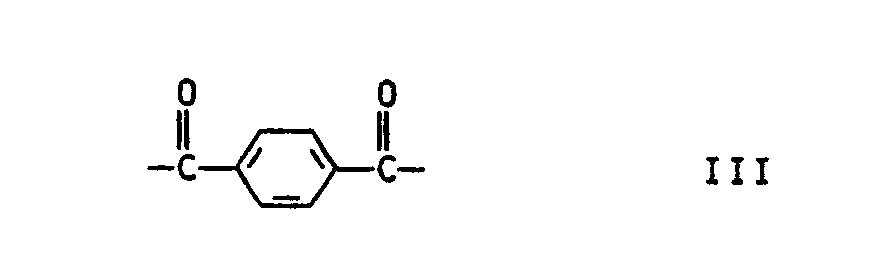
- c) einer Summe aus a) und b) entsprechenden molaren Menge an wiederkehrenden Einheiten der Formel III

- d) mindestens 10 Mol.% wiederkehrenden Einheiten der Formel IV

- Die neuen vollaromatisch flüssig-kristallinen Polyester haben den Vorteil, daß sie keiner hohen Verarbeitungstemperaturen bedürfen und darüber hinaus auch bei erhöhter Temperatur gute Dauergebrauchseigenschaften aufweisen. Ferner zeichnen sich die neuen vollaromatischen Polyester durch hohe Steifigkeit sowie Zähigkeit aus und haben eine glatte Oberfläche sowie eine geringe Eigenfarbe und gute Chemikalienbeständigkeit.
- Der flüssig-kristalline Zustand der Polyester kann mit dem Polarisationsmikroskop nach einer in der DE-AS 2 520 819 beschriebenen Methode nachgewiesen werden. Zwischen gekreuzten Polarisatoren weisen die Polyester schmelzen, die in einer Schichtdicke von 10 µm zwischen Glasplatten aufgetragen sind, Texturen auf, die einer mesomorphen (nematischen) Phase zugeordnet werden können.
- Die erfindungsgemäßen Polyester sind aufgebaut aus
- a) 5 bis 35 Mol.% wiederkehrenden Einheiten der Formel I

- b) 3 bis 15 Mol.% wiederkehrenden Einheiten der Formel II

- c) einer Summe aus a) und b) entsprechenden molaren Menge an wiederkehrenden Einheiten der Formel III

- d) 10 bis 70 Mol.% wiederkehrenden Einheiten der Formel IV

- In bevorzugten erfindungsgemäßen vollaromatischen Polyestern ist ein Teil der Einheiten b) ersetzt durch
- e) wiederkehrenden Einheiten der Formel V

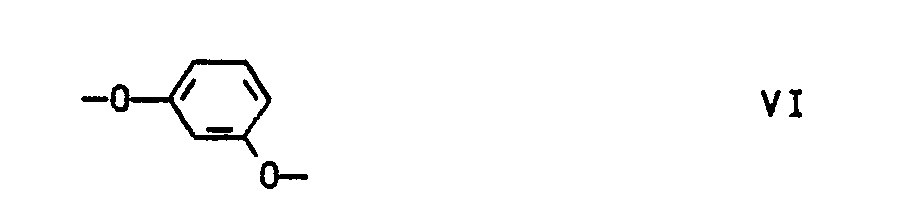
- f) wiederkehrenden Einheiten der Formel VI
- g) wiederkehrenden Einheiten der Formel VII

- h) wiederkehrenden Einheiten der Formel VIII

- In den bevorzugten Polyestern sind die Einheiten e), f) und/oder g) vorteilhaft in einer Menge von 5 bis 15 Mol.% enthalten. Ferner hat es sich als vorteilhaft erwiesen, wenn der molare Anteil an Einheiten a) 15 bis 25 Mol.% beträgt. In besonders vorteilhaften Polyestern beträgt der molare Anteil der Summe von a) sowie eine oder mehrere Einheiten e), f) und g) 25 bis 35 Mol.%.
- Es versteht sich, daß auf die Summe der Hydroxyverbindungen jeweils die äquivalente Menge Terephthalsäure und/oder Isophthalsäure verwendet wird.
- Bevorzugte vollaromatische flüssig-kristalline Polyester haben eine Glastemperatur von ≧ 160°C. Die Glastemperatur soll dabei gemessen werden mit der DSC-Methode, wie sie beschrieben ist von K.H. Illers und anderen in Makromolekulare Chemie 127 (1969), Seite 1 ff. Die vollaromatischen flüssig-kristallinen Polyester nach der Erfindung bilden bei < 300°C. insbesondere < 280°C eine flüssig-kristalline fadenbildende Schmelze. Bevorzugt sind auch flüssig-kristalline Polyester, die bei einer Temperatur > 220 und < 280°C eine Teilkristallinität aufweisen.
- Die erfindungsgemäßen Copolyester lassen sich erhalten durch eine Reihe von Techniken, wie sie beispielsweise in den US-PSen 4 375 530 und 4 118 372 erwähnt sind.
- Besonders vorteilhaft erhält man die erfindungsgemäßen Polyester durch Umsetzen der vorgenannten Ausgangsstoffe in nicht derivatisierter Form unter Verwendung von Anhydriden niederer Fettsäuren, insbesondere Essig säureanhydrid und gegebenenfalls unter Mitverwendung von Katalysatoren bei erhöhter Temperatur. Hierbei werden die trockenen Ausgangsverbindungen zusammen mit überschüssigem Fettsäureanhydrid vorteilhaft einem mindestens 5 %igen molaren Überschuß, bezogen auf die vorhandenen Hydroxygruppen, in einer Inertgasatmosphäre auf Rückflußtemperatur erhitzt. Das Reaktionsgemisch wird dabei z.B. bis zu höchstens 5 Stunden, vorzugsweise bis zu 2 Stunden auf eine Temperatur von 150 bis 200°C gehalten, anschließend wird die Temperatur z.B. innerhalb von 2 bis 2 1/2 Stunden auf 300 bis 350°C gesteigert. Essigsäureanhydrid und Essigsäure werden abdestilliert. Zur Vervollständigung der Reaktion ist es zweckmäßig, gegen Ende der Kondensation vermindertem Druck z.B. bis 5 bis 20 mbar anzuwenden.
- Bemerkenswert und nicht vorherzusehen bei der Anwendung von einer einzigen Reaktionsstufe ist zunächst die problemlose und vollständige Reaktion auch ohne Katalysatorzusatz zu den gewünschten Polymeren in einer relativ kurzen Zeit. Dies ist umso bemerkenswerter als durch die Vielzahl chemisch unterschiedlicher Hydroxygruppen eine Abstufung der Reaktivitäten und damit ein mangelhafter polymerer Aufbau zu erwarten wäre.
- Die so erhaltenen vollaromatischen flüssig-kristallinen Polyester können in festem Zustand z.B. bei Temperaturen von 150 bis 250°C weiter kondensiert werden bis zur gewünschten Viskosität. Diese Nachkondensation in fester Phase kann sowohl vor als auch nach einer thermoplastischen Verarbeitung erfolgen.
- Die erfindungsgemäßen vollaromatischen flüssig-kristallinen Polyester eignen sich zur Herstellung von Fäden, Folien, Schäumen und technischen Formteilen durch Spritzguß oder Extrusion.
- Die Erfindung sei an folgenden Beispielen veranschaulicht.
- 0,2 mol Terephthalsäure, 0,26 mol 4-Hydroxybenzoeäure, 0,16 ml t-Butylhydrochinon, 0,04 ml 4,4′-Dihydroxybiphenyl sowie 0,86 mol Essigsäureanhydrid werden in einem Kolben mit Rührer, Stickstoffeinleitung und einem Destillationsaufsatz eingewogen und unter N₂-Atmosphäre in einem Metallbad auf 100°C erhitzt. Die Temperatur wird dann in 30′ auf 150°C, in weiteren 100′ auf 200°C und anschließend in 120′ auf die Endtemperatur von 325°C erhöht.
- Anschließend wird der Druck auf 560 mbar und dann alle 10′ auf die Hälfte verringert. Das Endvakuum beträgt .. mbar. Man erhält so eine hochvis kose, fadenbildende Schmelze. Polymerschmelze und erstarrtes Polymere zeigen einen perlmuttartigen Glanz. Aus DSC-Messungen ergibt sich eine Glastemperatur von 164°C. Die inhärente Viskosität beträgt 1,6 dl/g, gemessen in 0,1 gew.%iger Lösung in Pentafluorphenol bei 60°C. Das Polymerisat bildet bei 280°C eine fadenbildende flüssig-kristalline Schmelze.
- 0,2 mol Terephthalsäure, 0,26 mol 4-Hydroxybenzoesäure, 0,04 mol 4,4′-Dihydroxybiphenyl, 0,16 mol Methylhydrochinon sowie 0,86 mol Essigsäureanhydrid werden wie in Beispiel 1 beschrieben kondensiert. Die Endtemperatur beträgt 315°C, das Endvakuum beträgt 20 mbar.
- Die DSC-Messungen ergeben eine Glastemperatur von 93°C und einen Schmelzpunkt von > 300°C. Das Produkt ist spröde, nicht-fadenbildend und zeigt bei der Verarbeitung eindeutige Zersetzungsprozesse.
- 0,18 mol Terephthalsäure, 0,02 mol Isophthalsäure, 0,26 mol p-4-Hydroxybenzoesäure, 0,16 mol t-Butylhydrochinon, 0,04 mol 4,4′-Dihydroxybiphenyl, sowie 0,86 mol Essigsäureanhydrid werden, wie in Beispiel 1 beschrieben, kondensiert. Die Endtemperatur beträgt 315°C. Das erhalten Polymere ist hochviskos und fadenbildend. Aus DSC-Messungen ergibt sich eine Glastemperatur von 165°C. Die inhärente Viskosität beträgt 0,9 dl/g. Das Polymere bildet bei 290°C eine flüssig-kristalline fadenbildende Schmelze.
- 0,2 mol Terephthalsäure, 0,26 mol 4-Hydroxybenzoesäure, 0,09 mol t-Butylhydrochinon, 0,07 mol Hydrochinon, 0,04 mol 4,4′-Dihydroxybiphenyl sowie 0,86 mol Essigsäureanhydrid werden wie in Beispiel 1 beschrieben, kondensiert. Die Endtemperatur beträgt 325°C. Das Endvakuum beträgt 30 mbar. Das erhaltene Polymere ist hochviskos und fadenbildend. Die DSC-Diagramme zeigen eine Glastemperatur von 160°C sowie einen endothermen Schmelzpunkt bei 260°C. Die inhärente Viskosität beträgt 1,1 dl/g. Das Polymere läßt sich bei einer Temperatur von 290°C aus der SChmelze verarbeiten.
- 0,2 mol Terephthalsäure, 0,26 mol 4-Hydroxybenzoesäure, 0,16 mol t-Butylhydrochinon, 0,02 mol 4,4′-Dihydroxybiphenyl, 0,02 mol 2,6-Dihydroxyanthrachinon, sowie 0,86 mol Essigsäureanhydrid werden, wie in Beispiel 1 beschrieben, kondensiert. Die Endtemperatur beträgt 330°C. Das erhaltene Polymere ist hochviskos und fadenbildend. Aus DSC-Messungen ergibt sich eine Glastemperatur von 160°C. Die inhärente Viskosität beträgt 1,5 dl/g. Das Polymere läßt sich bei einer Temperatur von 260°C aus der Schmelze verarbeiten.
Claims (9)




Applications Claiming Priority (2)
| Application Number | Priority Date | Filing Date | Title |
|---|---|---|---|
| DE3542814 | 1985-12-04 | ||
| DE3542814A DE3542814A1 (de) | 1985-12-04 | 1985-12-04 | Vollaromatische mesomorphe polyester, deren herstellung sowie verwendung |
Publications (2)
| Publication Number | Publication Date |
|---|---|
| EP0226078A1 true EP0226078A1 (de) | 1987-06-24 |
| EP0226078B1 EP0226078B1 (de) | 1989-06-28 |
Family
ID=6287561
Family Applications (1)
| Application Number | Title | Priority Date | Filing Date |
|---|---|---|---|
| EP86116264A Expired EP0226078B1 (de) | 1985-12-04 | 1986-11-24 | Vollaromatische mesomorphe Polyester, deren Herstellung sowie Verwendung |
Country Status (5)
| Country | Link |
|---|---|
| US (1) | US4778927A (de) |
| EP (1) | EP0226078B1 (de) |
| JP (1) | JPS62132920A (de) |
| CA (1) | CA1268590A (de) |
| DE (2) | DE3542814A1 (de) |
Cited By (2)
| Publication number | Priority date | Publication date | Assignee | Title |
|---|---|---|---|---|
| EP0242959A3 (en) * | 1986-04-23 | 1988-07-20 | E.I. Du Pont De Nemours And Company | Optically anisotropic melt forming aromatic copolyesters based on t-butylhydroquinone |
| EP0285554A1 (de) * | 1987-03-19 | 1988-10-05 | Maged A. Dr. Osman | Lineare stäbchenförmige Polyester |
Families Citing this family (17)
| Publication number | Priority date | Publication date | Assignee | Title |
|---|---|---|---|---|
| JPH07696B2 (ja) * | 1986-04-30 | 1995-01-11 | 三井石油化学工業株式会社 | 芳香族ポリエステル |
| US5278278A (en) * | 1986-07-28 | 1994-01-11 | Toray Industries, Inc. | Aromatic polyesters having good heat resistance |
| JP2638805B2 (ja) * | 1987-05-14 | 1997-08-06 | 東レ株式会社 | 流動性および耐熱性の優れた芳香族ポリエステル |
| CA2263603A1 (en) | 1996-09-11 | 1998-03-19 | Kenneth Earl Stevens | Polymeric multilayer heat exchangers containing a barrier layer |
| JP3373528B2 (ja) | 1996-09-11 | 2003-02-04 | デュポン カナダ インコーポレイテッド | 液晶ポリマー層を含有する熱交換器 |
| US6379795B1 (en) | 1999-01-19 | 2002-04-30 | E. I. Du Pont De Nemours And Company | Injection moldable conductive aromatic thermoplastic liquid crystalline polymeric compositions |
| US6364008B1 (en) | 1999-01-22 | 2002-04-02 | E. I. Du Pont De Nemours And Company | Heat exchanger with tube plates |
| EP1474838A1 (de) * | 2002-02-13 | 2004-11-10 | Dupont Canada Inc. | Verfahren zur herstellung von separatorplatten für brennstoffzellen unter geringer scherung |
| US20040113129A1 (en) * | 2002-07-25 | 2004-06-17 | Waggoner Marion G. | Static dissipative thermoplastic polymer composition |
| US20050082720A1 (en) * | 2003-01-23 | 2005-04-21 | Bloom Joy S. | Moldings of liquid crystalline polymer powders |
| CA2538761A1 (en) * | 2005-03-08 | 2006-09-08 | Anthony Joseph Cesaroni | Method for sealing heat exchanger tubes |
| US7547849B2 (en) | 2005-06-15 | 2009-06-16 | E.I. Du Pont De Nemours And Company | Compositions useful in electronic circuitry type applications, patternable using amplified light, and methods and compositions relating thereto |
| WO2009009070A1 (en) | 2007-07-09 | 2009-01-15 | E. I. Du Pont De Nemours And Company | Compositions and methods for creating electronic circuitry |
| US20090017309A1 (en) * | 2007-07-09 | 2009-01-15 | E. I. Du Pont De Nemours And Company | Compositions and methods for creating electronic circuitry |
| US8475924B2 (en) * | 2007-07-09 | 2013-07-02 | E.I. Du Pont De Nemours And Company | Compositions and methods for creating electronic circuitry |
| JP5017060B2 (ja) * | 2007-10-30 | 2012-09-05 | 上野製薬株式会社 | 全芳香族液晶ポリエステル |
| US20100193950A1 (en) * | 2009-01-30 | 2010-08-05 | E.I.Du Pont De Nemours And Company | Wafer level, chip scale semiconductor device packaging compositions, and methods relating thereto |
Citations (2)
| Publication number | Priority date | Publication date | Assignee | Title |
|---|---|---|---|---|
| US4118372A (en) * | 1974-05-10 | 1978-10-03 | E. I. Du Pont De Nemours And Company | Aromatic copolyester capable of forming an optically anisotropic melt |
| EP0139303A2 (de) * | 1983-10-26 | 1985-05-02 | BASF Aktiengesellschaft | Vollaromatische Polyester und deren Herstellung |
Family Cites Families (10)
| Publication number | Priority date | Publication date | Assignee | Title |
|---|---|---|---|---|
| SE416814B (sv) * | 1974-05-10 | 1981-02-09 | Du Pont | Nya syntetiska polyestrar och sett for deras framstellning |
| US4224433A (en) * | 1979-03-16 | 1980-09-23 | Celanese Corporation | Thermotropic polyesters of 2,6-dihydroxyanthraquinone |
| US4219461A (en) * | 1979-04-23 | 1980-08-26 | Celanese Corporation | Polyester of 6-hydroxy-2-naphthoic acid, para-hydroxy benzoic acid, aromatic diol, and aromatic diacid capable of readily undergoing melt processing |
| US4436894A (en) * | 1980-07-31 | 1984-03-13 | Teijin Limited | Novel wholly aromatic copolyester, process for production thereof, and film melt-shaped therefrom |
| DE3270761D1 (en) * | 1981-08-18 | 1986-05-28 | Teijin Ltd | Melt-anisotropic wholly aromatic polyester, process for production thereof, and fibers or films thereof |
| US4375530A (en) * | 1982-07-06 | 1983-03-01 | Celanese Corporation | Polyester of 2,6-naphthalene dicarboxylic acid, 2,6-dihydroxy naphthalene, terephthalic acid, and hydroquinone capable of forming an anisotropic melt |
| DE3325705A1 (de) * | 1983-07-16 | 1985-01-24 | Bayer Ag, 5090 Leverkusen | Mesomorphe aromatische polyester mit hoher zaehigkeitund verbesserter schmelzviskositaet, verfahren zu ihrer herstellung und ihre verwendung zur herstellung von formkoerpern, filamenten, fasern und folien |
| DE3325787A1 (de) * | 1983-07-16 | 1985-01-24 | Bayer Ag, 5090 Leverkusen | Mesomorphe aromatische polyester mit hoher steifigkeit und zaehigkeit, verfahren zu ihrer herstellung und ihre verwendung zur herstellung von formkoerpern, filamenten, fasern und folien |
| DE3415530A1 (de) * | 1984-04-26 | 1985-10-31 | Bayer Ag, 5090 Leverkusen | Thermotrope aromatische polyester hoher steifigkeit und zaehigkeit, verfahren zu ihrer herstellung und ihre verwendung zur herstellung von formkoerpern, filamenten, fasern und folien |
| US4664972A (en) * | 1986-04-23 | 1987-05-12 | E. I. Du Pont De Nemours And Company | Optically anisotropic melt forming aromatic copolyesters based on t-butylhydroquinone |
-
1985
- 1985-12-04 DE DE3542814A patent/DE3542814A1/de not_active Withdrawn
-
1986
- 1986-11-17 JP JP61272058A patent/JPS62132920A/ja active Pending
- 1986-11-24 DE DE8686116264T patent/DE3664137D1/de not_active Expired
- 1986-11-24 EP EP86116264A patent/EP0226078B1/de not_active Expired
- 1986-12-03 CA CA000524448A patent/CA1268590A/en not_active Expired - Lifetime
- 1986-12-04 US US06/938,064 patent/US4778927A/en not_active Expired - Fee Related
Patent Citations (2)
| Publication number | Priority date | Publication date | Assignee | Title |
|---|---|---|---|---|
| US4118372A (en) * | 1974-05-10 | 1978-10-03 | E. I. Du Pont De Nemours And Company | Aromatic copolyester capable of forming an optically anisotropic melt |
| EP0139303A2 (de) * | 1983-10-26 | 1985-05-02 | BASF Aktiengesellschaft | Vollaromatische Polyester und deren Herstellung |
Cited By (2)
| Publication number | Priority date | Publication date | Assignee | Title |
|---|---|---|---|---|
| EP0242959A3 (en) * | 1986-04-23 | 1988-07-20 | E.I. Du Pont De Nemours And Company | Optically anisotropic melt forming aromatic copolyesters based on t-butylhydroquinone |
| EP0285554A1 (de) * | 1987-03-19 | 1988-10-05 | Maged A. Dr. Osman | Lineare stäbchenförmige Polyester |
Also Published As
| Publication number | Publication date |
|---|---|
| EP0226078B1 (de) | 1989-06-28 |
| CA1268590A (en) | 1990-05-01 |
| DE3542814A1 (de) | 1987-06-11 |
| DE3664137D1 (en) | 1989-08-03 |
| JPS62132920A (ja) | 1987-06-16 |
| US4778927A (en) | 1988-10-18 |
Similar Documents
| Publication | Publication Date | Title |
|---|---|---|
| EP0226078B1 (de) | Vollaromatische mesomorphe Polyester, deren Herstellung sowie Verwendung | |
| EP0139303B1 (de) | Vollaromatische Polyester und deren Herstellung | |
| EP0230545B1 (de) | Vollaromatische Polyesteramide, deren Herstellung und Verwendung. | |
| EP0251113B1 (de) | Vollaromatische mesomorphe Polyester, deren Herstellung sowie Verwendung | |
| EP0225537B1 (de) | Vollaromatische mesomorphe Polyesterimide, deren Herstellung sowie Verwendung | |
| EP0226847B1 (de) | Vollaromatische mesmorphe Polyetherester, deren Herstellung und Verwendung | |
| EP0230551B1 (de) | Vollaromatische Polyestercarbamide, deren Herstellung und Verwendung | |
| DE3629211A1 (de) | Vollaromatische thermotrope polyester | |
| EP0226839B1 (de) | Vollaromatische Polyester, deren Herstellung und Verwendung | |
| DE3542855A1 (de) | Vollaromatische mesomorphe polyesteramide, deren herstellung und verwendung | |
| DE3629210A1 (de) | Vollaromatische thermotrope polyester | |
| DE68914271T2 (de) | Flüssigkristallines, thermoplastisches, vollaromatiches Polyesterimid und Verfahren zur Herstellung. | |
| EP0226080A2 (de) | Vollaromatische mesomorphe Polyesteramide, deren Herstellung und Verwendung | |
| DE60214734T2 (de) | Amorphe copolyester | |
| EP0374657A2 (de) | Neue thermotrope Polyester, Verfahren zu ihrer Herstellung sowie ihre Verwendung zur Herstellung von Formkörpern, Filamenten, Fasern und Folien | |
| EP0225539B1 (de) | Vollaromatische Polyetherester, deren Herstellung und Verwendung | |
| EP0064971B1 (de) | Hochmolekularer aromatischer Polyester, Verfahren zur Herstellung von Folien aus diesen Polyestern und Folie aus diesen Polyestern, ein elektrischer Leiter mit einer Isolierung aus diesen Polyestern und Verfahren zur Herstellung solcher Isolierungen | |
| EP0231462B1 (de) | Vollaromatische mesomorphe Polyetheresterimide, deren Herstellung und Verwendung | |
| EP0230550B1 (de) | Vollaromatische flüssigkristalline Polykondensate, deren Herstellung und Verwendung | |
| DE3622137A1 (de) | Vollaromatische mesomorphe polyester, deren herstellung sowie verwendung | |
| EP0231468B1 (de) | Flüssig-kristalline Carbamidgruppen enthaltende Polykondensate, deren Herstellung und Verwendung | |
| EP0284726B1 (de) | Aromatische Polyester auf Basis von Phenoxyterephthalsäure, Verfahren zu ihrer Herstellung und ihre Verwendung | |
| DE69023043T2 (de) | Vollaromatischer Copolyester. | |
| DE1595043B2 (de) | Verfahren zur herstellung von polyaetherestern und ihre verwendung |
Legal Events
| Date | Code | Title | Description |
|---|---|---|---|
| PUAI | Public reference made under article 153(3) epc to a published international application that has entered the european phase |
Free format text: ORIGINAL CODE: 0009012 |
|
| AK | Designated contracting states |
Kind code of ref document: A1 Designated state(s): BE CH DE FR GB IT LI LU NL SE |
|
| 17P | Request for examination filed |
Effective date: 19870519 |
|
| 17Q | First examination report despatched |
Effective date: 19880914 |
|
| GRAA | (expected) grant |
Free format text: ORIGINAL CODE: 0009210 |
|
| AK | Designated contracting states |
Kind code of ref document: B1 Designated state(s): BE CH DE FR GB IT LI LU NL SE |
|
| ITF | It: translation for a ep patent filed | ||
| GBT | Gb: translation of ep patent filed (gb section 77(6)(a)/1977) | ||
| REF | Corresponds to: |
Ref document number: 3664137 Country of ref document: DE Date of ref document: 19890803 |
|
| ET | Fr: translation filed | ||
| PLBE | No opposition filed within time limit |
Free format text: ORIGINAL CODE: 0009261 |
|
| STAA | Information on the status of an ep patent application or granted ep patent |
Free format text: STATUS: NO OPPOSITION FILED WITHIN TIME LIMIT |
|
| 26N | No opposition filed | ||
| ITTA | It: last paid annual fee | ||
| EPTA | Lu: last paid annual fee | ||
| EAL | Se: european patent in force in sweden |
Ref document number: 86116264.2 |
|
| PGFP | Annual fee paid to national office [announced via postgrant information from national office to epo] |
Ref country code: FR Payment date: 19961025 Year of fee payment: 11 |
|
| PGFP | Annual fee paid to national office [announced via postgrant information from national office to epo] |
Ref country code: SE Payment date: 19961028 Year of fee payment: 11 |
|
| PGFP | Annual fee paid to national office [announced via postgrant information from national office to epo] |
Ref country code: NL Payment date: 19961031 Year of fee payment: 11 |
|
| PGFP | Annual fee paid to national office [announced via postgrant information from national office to epo] |
Ref country code: LU Payment date: 19961101 Year of fee payment: 11 |
|
| PGFP | Annual fee paid to national office [announced via postgrant information from national office to epo] |
Ref country code: CH Payment date: 19961105 Year of fee payment: 11 |
|
| PGFP | Annual fee paid to national office [announced via postgrant information from national office to epo] |
Ref country code: BE Payment date: 19961114 Year of fee payment: 11 |
|
| PGFP | Annual fee paid to national office [announced via postgrant information from national office to epo] |
Ref country code: GB Payment date: 19961118 Year of fee payment: 11 |
|
| PGFP | Annual fee paid to national office [announced via postgrant information from national office to epo] |
Ref country code: DE Payment date: 19961126 Year of fee payment: 11 |
|
| PG25 | Lapsed in a contracting state [announced via postgrant information from national office to epo] |
Ref country code: LU Free format text: LAPSE BECAUSE OF NON-PAYMENT OF DUE FEES Effective date: 19971124 Ref country code: GB Free format text: LAPSE BECAUSE OF NON-PAYMENT OF DUE FEES Effective date: 19971124 |
|
| PG25 | Lapsed in a contracting state [announced via postgrant information from national office to epo] |
Ref country code: SE Free format text: LAPSE BECAUSE OF NON-PAYMENT OF DUE FEES Effective date: 19971125 |
|
| PG25 | Lapsed in a contracting state [announced via postgrant information from national office to epo] |
Ref country code: LI Free format text: LAPSE BECAUSE OF NON-PAYMENT OF DUE FEES Effective date: 19971130 Ref country code: FR Free format text: THE PATENT HAS BEEN ANNULLED BY A DECISION OF A NATIONAL AUTHORITY Effective date: 19971130 Ref country code: CH Free format text: LAPSE BECAUSE OF NON-PAYMENT OF DUE FEES Effective date: 19971130 Ref country code: BE Free format text: LAPSE BECAUSE OF NON-PAYMENT OF DUE FEES Effective date: 19971130 |
|
| PG25 | Lapsed in a contracting state [announced via postgrant information from national office to epo] |
Ref country code: DE Effective date: 19971201 |
|
| BERE | Be: lapsed |
Owner name: BASF A.G. Effective date: 19971130 |
|
| PG25 | Lapsed in a contracting state [announced via postgrant information from national office to epo] |
Ref country code: NL Free format text: LAPSE BECAUSE OF NON-PAYMENT OF DUE FEES Effective date: 19980601 |
|
| GBPC | Gb: european patent ceased through non-payment of renewal fee |
Effective date: 19971124 |
|
| REG | Reference to a national code |
Ref country code: CH Ref legal event code: PL |
|
| EUG | Se: european patent has lapsed |
Ref document number: 86116264.2 |
|
| NLV4 | Nl: lapsed or anulled due to non-payment of the annual fee |
Effective date: 19980601 |
|
| REG | Reference to a national code |
Ref country code: FR Ref legal event code: ST |
|
| PG25 | Lapsed in a contracting state [announced via postgrant information from national office to epo] |
Ref country code: IT Free format text: LAPSE BECAUSE OF NON-PAYMENT OF DUE FEES;WARNING: LAPSES OF ITALIAN PATENTS WITH EFFECTIVE DATE BEFORE 2007 MAY HAVE OCCURRED AT ANY TIME BEFORE 2007. THE CORRECT EFFECTIVE DATE MAY BE DIFFERENT FROM THE ONE RECORDED. Effective date: 20051124 |