EP0226196B1 - Dérivés tricycliques de la pyridone - Google Patents
Dérivés tricycliques de la pyridone Download PDFInfo
- Publication number
- EP0226196B1 EP0226196B1 EP86117347A EP86117347A EP0226196B1 EP 0226196 B1 EP0226196 B1 EP 0226196B1 EP 86117347 A EP86117347 A EP 86117347A EP 86117347 A EP86117347 A EP 86117347A EP 0226196 B1 EP0226196 B1 EP 0226196B1
- Authority
- EP
- European Patent Office
- Prior art keywords
- signifies
- group
- formula
- compound
- phenyl
- Prior art date
- Legal status (The legal status is an assumption and is not a legal conclusion. Google has not performed a legal analysis and makes no representation as to the accuracy of the status listed.)
- Expired - Lifetime
Links
- 0 C**(C)*=[N+][O-] Chemical compound C**(C)*=[N+][O-] 0.000 description 15
- GDOPTJXRTPNYNR-UHFFFAOYSA-N CC1CCCC1 Chemical compound CC1CCCC1 GDOPTJXRTPNYNR-UHFFFAOYSA-N 0.000 description 3
- CCZDNNSAFZENED-UHFFFAOYSA-N CC(N(C)N=C)=O Chemical compound CC(N(C)N=C)=O CCZDNNSAFZENED-UHFFFAOYSA-N 0.000 description 1
- HXNLHCBHBOSJQZ-UHFFFAOYSA-N CC1=C(CCC2)C2CC1 Chemical compound CC1=C(CCC2)C2CC1 HXNLHCBHBOSJQZ-UHFFFAOYSA-N 0.000 description 1
- BNEJJOCWZDKOKJ-UHFFFAOYSA-N CN(CSC)N=C Chemical compound CN(CSC)N=C BNEJJOCWZDKOKJ-UHFFFAOYSA-N 0.000 description 1
Classifications
-
- C—CHEMISTRY; METALLURGY
- C07—ORGANIC CHEMISTRY
- C07D—HETEROCYCLIC COMPOUNDS
- C07D471/00—Heterocyclic compounds containing nitrogen atoms as the only ring hetero atoms in the condensed system, at least one ring being a six-membered ring with one nitrogen atom, not provided for by groups C07D451/00 - C07D463/00
- C07D471/02—Heterocyclic compounds containing nitrogen atoms as the only ring hetero atoms in the condensed system, at least one ring being a six-membered ring with one nitrogen atom, not provided for by groups C07D451/00 - C07D463/00 in which the condensed system contains two hetero rings
- C07D471/04—Ortho-condensed systems
-
- A—HUMAN NECESSITIES
- A61—MEDICAL OR VETERINARY SCIENCE; HYGIENE
- A61P—SPECIFIC THERAPEUTIC ACTIVITY OF CHEMICAL COMPOUNDS OR MEDICINAL PREPARATIONS
- A61P21/00—Drugs for disorders of the muscular or neuromuscular system
- A61P21/02—Muscle relaxants, e.g. for tetanus or cramps
-
- A—HUMAN NECESSITIES
- A61—MEDICAL OR VETERINARY SCIENCE; HYGIENE
- A61P—SPECIFIC THERAPEUTIC ACTIVITY OF CHEMICAL COMPOUNDS OR MEDICINAL PREPARATIONS
- A61P25/00—Drugs for disorders of the nervous system
- A61P25/08—Antiepileptics; Anticonvulsants
-
- A—HUMAN NECESSITIES
- A61—MEDICAL OR VETERINARY SCIENCE; HYGIENE
- A61P—SPECIFIC THERAPEUTIC ACTIVITY OF CHEMICAL COMPOUNDS OR MEDICINAL PREPARATIONS
- A61P25/00—Drugs for disorders of the nervous system
- A61P25/20—Hypnotics; Sedatives
-
- C—CHEMISTRY; METALLURGY
- C07—ORGANIC CHEMISTRY
- C07D—HETEROCYCLIC COMPOUNDS
- C07D495/00—Heterocyclic compounds containing in the condensed system at least one hetero ring having sulfur atoms as the only ring hetero atoms
- C07D495/12—Heterocyclic compounds containing in the condensed system at least one hetero ring having sulfur atoms as the only ring hetero atoms in which the condensed system contains three hetero rings
- C07D495/14—Ortho-condensed systems
-
- C—CHEMISTRY; METALLURGY
- C07—ORGANIC CHEMISTRY
- C07D—HETEROCYCLIC COMPOUNDS
- C07D513/00—Heterocyclic compounds containing in the condensed system at least one hetero ring having nitrogen and sulfur atoms as the only ring hetero atoms, not provided for in groups C07D463/00, C07D477/00 or C07D499/00 - C07D507/00
- C07D513/02—Heterocyclic compounds containing in the condensed system at least one hetero ring having nitrogen and sulfur atoms as the only ring hetero atoms, not provided for in groups C07D463/00, C07D477/00 or C07D499/00 - C07D507/00 in which the condensed system contains two hetero rings
- C07D513/04—Ortho-condensed systems
-
- C—CHEMISTRY; METALLURGY
- C07—ORGANIC CHEMISTRY
- C07D—HETEROCYCLIC COMPOUNDS
- C07D513/00—Heterocyclic compounds containing in the condensed system at least one hetero ring having nitrogen and sulfur atoms as the only ring hetero atoms, not provided for in groups C07D463/00, C07D477/00 or C07D499/00 - C07D507/00
- C07D513/12—Heterocyclic compounds containing in the condensed system at least one hetero ring having nitrogen and sulfur atoms as the only ring hetero atoms, not provided for in groups C07D463/00, C07D477/00 or C07D499/00 - C07D507/00 in which the condensed system contains three hetero rings
- C07D513/14—Ortho-condensed systems
Definitions
- tricyclic pyridone derivatives have valuable pharmacological properties and can be used to control or prevent diseases. They are particularly muscle-relaxing, sedative-hypnotic, anxiolytic and / or anticonvulsant and can therefore be used to combat or prevent muscle tension, tension, insomnia, anxiety and / or convulsions.
- EP-A-183 994 describes compounds which have the same properties and which correspond to the formula I, but which have a methine group instead of the nitrogen atom in the pyridazine ring.
- the present invention relates to: The above compounds of formula I and the salts thereof as such; a process and intermediates for their manufacture; the use of the intermediates for the production of therapeutic agents; the above compounds of formula 1 and the salts thereof for use as therapeutic agents; Medicines based on these new active ingredients and their manufacture; the use of these active ingredients for the production of muscle relaxants, sedative-hypnotic, anxiolytic and / or anticonvulsant agents.
- alkanoyl taken alone or in combinations, such as alkanoyl, alkanoyloxy and alkoxyalkyl, denotes straight-chain or branched, saturated hydrocarbon radicals, such as methyl, ethyl, propyl, isopropyl and t-butyl.
- cycloalkyl denotes cyclic, saturated hydrocarbon radicals, such as cyclohexyl.
- alkoxy denotes alkyl groups such as methoxy and ethoxy bonded via an oxygen atom.
- hydroxyalkyl refers to alkyl groups substituted by hydroxy, such as 2-hydroxyethyl.
- alkanoyl and “alkanoyloxy” refer to fatty acid residues such as acetyl and acetoxy.
- alkylene denotes straight-chain or branched, saturated hydrocarbon radicals with two free valences, such as methylene, 1,2-ethylene and 1,3-propylene.
- halogen denotes the four forms fluorine, chlorine, bromine and iodine.
- aryl preferably denotes phenyl groups which are optionally substituted by halogen, trifluoromethyl, lower alkyl, lower alkoxy, nitro, amino or mono- or di (lower alkyl) amino.
- the 5-membered, saturated, partially unsaturated or aromatic heterocycles bonded via a carbon atom preferably contain, as hetero ring members, an oxygen or sulfur atom or an imino or lower alkylimino group and optionally one or two nitrogen atoms, the carbon atom via which the heterocycle is bonded , is preferably located next to or between two heteroatoms.
- heterocycles which can also be substituted as mentioned, are: 2-oxazolin-2-yl, 3-methyl-1,2,4-oxadiazol-5-yl, 3-cyclopropyl-1,2,4-oxadiazol- 5-yl, 2-thiazolin-2-yl, 2-tetrahydrofuryl and 2-thiazolyl.
- heterocycles which can also be substituted as mentioned, are: 2- (lower alkoxyalkyl) -1-azetidinyl, 3- (lower alkoxy) -1-azetidinyl, 3-hydroxy-1-azetidinyl, 2- (lower hydroxyalkyl) -1-azetidinyl, 2- (lower alkanoyloxyalkyl) -1-pyrrolidinyl, 3-oxo-1-pyrrolidinyl, 2- (lower alkoxycarbonyl) -1-pyrrolidinyl, 3- (lower alkoxy) -1-pyrrolidinyl, 3-hydroxy- 1-pyrrolidinyl, 2- (lower alkoxyalkyl) -1-pyrrolidinyl, 2- (lower hydroxyalkyl) -1-pyrrolidinyl, 2- (lower hydroxyalkyl) -4-hydroxy-1-pyrrolidinyl, 2- (lower alkoxyalkyl)
- Ra preferably denotes a phenyl group optionally substituted by m-halogen or m-trifluoromethyl, phenyl being particularly preferred.
- compounds of the formula I can be prepared in which Rd is hydrogen, cyano, nitro or the group of the formula ⁇ CO ⁇ (Q 1 A 2 ) q ⁇ R 1 and q, A 2 , Q 1 and R 1 above To have meaning.
- the reaction is conveniently carried out in an inert solvent which boils at elevated temperature, preferably above 80 ° C.
- Suitable solvents are, for example, aromatic hydrocarbons, such as benzene, toluene and xylene, the reaction preferably being carried out at the reflux temperature of the solvent.
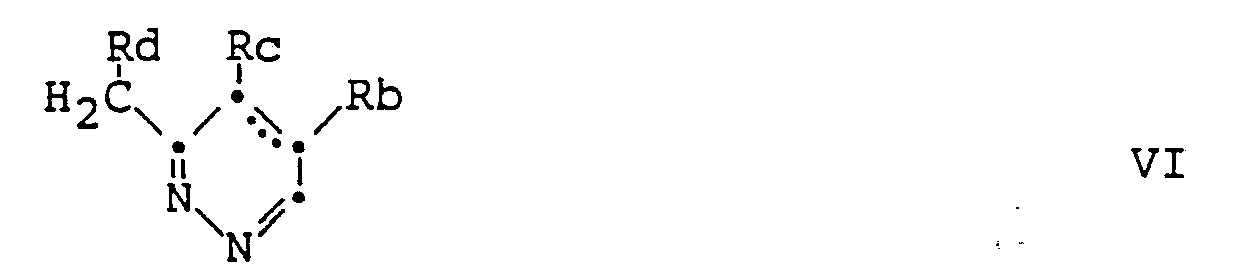
- reaction of a compound of formula V, wherein R 'is lower alkoxy in the presence of a strong base, such as sodium hydride, and in an inert solvent, preferably in an ether, such as tetrahydrofuran, with a compound of formula VI according to process variant b) the corresponding compound of formula I.
- the reaction temperature is in a range from room temperature to the boiling temperature of the reaction mixture.
- the hydrolysis can be carried out according to methods known per se.
- the hydrolysis is preferably carried out with an alkali metal hydroxide, such as sodium hydroxide and potassium hydroxide, in a lower alcohol, such as methanol and ethanol, or in a mixture of a lower alcohol and water.
- the reaction temperature is expediently in a range from room temperature to the boiling point of the reaction mixture, preferably at the boiling point of the reaction mixture.
- Esterification of a carboxylic acid of the formula Ia with an alcohol of the formula VII in accordance with process variant d) allows compounds of the formula I to be prepared in which Rd is the group of the formula - (A1) m-CO-O-N1_R1 and A 1 , A 21 , R 1 and m have the above meaning.
- the esterification can be carried out, for example, in the presence of an esterification reagent in an inert organic solvent.
- Suitable reagents are, for example, N-methyl-2-chloropyridinium iodide and the like, organic sulfonic acid halides such as methylsulfonyl chloride, p-toluenesulfonyl chloride and mesitylenesulfonic acid chloride, and the like.
- Suitable solvents are, for example, halogenated hydrocarbons, such as methylene chloride, chloroform and the like.
- Suitable bases are, for example, tertiary amines such as triethylamine, tri-n-butylamine and the like. The reaction is preferably carried out in a temperature range from room temperature to the reflux temperature of the solvent.
- the desired esterification can also be accomplished by first converting the carboxylic acid of the formula Ia into a reactive derivative and then reacting it with an alcohol of the formula VII in the presence of a base.
- the corresponding carboxylic acid chlorides are preferably used as reactive derivatives.
- Suitable bases are, for example, the tertiary amines already mentioned.
- the reaction is preferably carried out in a temperature range from about room temperature to the reflux temperature of the reaction mixture, the procedure advantageously being carried out at room temperature.
- the esterification with an alcohol of formula VII, in which A 21 is lower alkylene and R 1 is hydrogen, ie with a lower alcohol, can also be carried out by reacting the carboxylic acid with a di- (lower alkyl) acetal of N, N-dimethylformamide.
- the reaction with a di- (lower alkyl) acetal of N, N-dimethylformamide is preferably carried out in an inert solvent, for example in an aromatic hydrocarbon such as benzene, at the reflux temperature of the reaction mixture.
- R 1 is a group of the formula -NR 3 R 4 and R 3 and R 4 together with the nitrogen atom represent a 3 to 7-membered, saturated N-heterocycle, optionally substituted by one or two lower alkyl groups and by a carbamoyl or mono- or di (lower alkyl) carbamoyl group, which as Ring member can also contain an oxygen or sulfur atom or the group> NR 5 , and R 5 has the above meaning.
- the amidation reaction is preferably carried out in the presence of a condensing agent, such as N-methyl-2-chloropyridinium iodide, in an inert organic solvent and in the presence of a base.
- a condensing agent such as N-methyl-2-chloropyridinium iodide
- Suitable solvents are, for example, aromatic hydrocarbons such as benzene, toluene and xylene.
- Suitable bases are, for example, the tertiary amines mentioned above.
- Preferred reactive carboxylic acid derivatives which can be reacted directly with the corresponding amine in the presence of a base are the corresponding carboxylic acid chlorides.
- Suitable bases are in turn the aforementioned tertiary amines.
- Suitable solvents are, for example, aromatic hydrocarbons, such as benzene, toluene and xylene, and ethers, such as dioxane.
- the reaction is preferably carried out in a range from room temperature to the reflux temperature of the reaction mixture.
- compounds of the formula 1 can be prepared, in which Rd is a group of the formula - (A 1 ) m 0-A 21 -R 1 , and A 1 , A 21 , R 1 and m are as defined above, and on the other hand, compounds of the formula I which have a hydroxy group etherified in the form of a lower alkyl ether.
- reaction of a compound of the formula Ib 'with a compound of the formula XI or the reaction of a compound of the formula I which has a free hydroxyl group with a compound of the formula XII is advantageously carried out in an inert organic solvent, such as N, N-dimethylformamide or the like, carried out, with the base being expediently a strong base, for example an alkali metal hydride or hydroxide such as sodium hydride, potassium hydroxide and sodium hydroxide is used. It is convenient to work in a range from 0 ° C to room temperature.
- the leaving group denoted by X is preferably a halogen atom, in particular a chlorine, bromine or iodine atom, or an alkyl or arylsulfonyloxy group, for example a methanesulfonyloxy or p-toluenesulfonyloxy group.
- X can also mean a lower alkoxysulfonyloxy group, i.e. that the alkylating agent in this case is a di (lower alkyl) sulfate such as dimethyl sulfate.
- compounds of the formula I can be prepared in which Rd is a group of the formula - (A 1 ) m -O 1 -CO-R 1 , and A 1 , Q 1 , R 1 and m are as defined above.
- the reaction of a compound of formula Ib with a reactive derivative of a carboxylic acid of formula XIII, for example a carboxylic acid chloride is advantageously carried out in an inert organic solvent in the presence of an acid-binding agent, for example a tertiary amine.
- an acid-binding agent for example a tertiary amine.
- suitable solvents are aromatic hydrocarbons, such as benzene, toluene and xylene, and halogenated hydrocarbons, such as methylene chloride.
- R 1 is lower alkyl, corresponding carboxylic anhydrides can also be used, in which case pyridine is expediently used as solvent and as acid-binding agent.
- the reaction is preferably carried out in a temperature range from about 0 ° C. to the boiling point of the solvent.
- compounds of the formula I can be prepared in which Rd is a group of the formula - (A 1 ) m -CH 2 -NR 2 A 21 -R 1 or- (A 1 ) m -CH 2 -NR 3 R 4 means and A 1 , R 21 , R 1 , R 2 , R 3 , R 4 and m have the above meaning.
- the reaction is preferably carried out in a lower alcohol as the solvent and with sodium cyanoborohydride as the reducing agent, the procedure advantageously being carried out at room temperature and the amine used in the form of its hydrochloride.
- compounds of the formula I can be prepared in which Rd is a group of the formula - (A 1 ) m R 12 and R 12 are amino, aminomethyl, hydroxymethyl or methyl and A 1 and m are as defined above.
- the choice of the suitable reducing agent is based on the one hand depending on the starting material used and on the other hand according to the desired product.
- a compound of formula Id, wherein R "is cyano, can be reduced to the corresponding aminomethyl compound with, for example, diborane in tetrahydrofuran.
- a compound of formula Id, in which R" is nitro can be, for example, with sodium sulfide in a lower alcohol, such as methanol, to the corresponding amino compound be reduced.
- a compound of the formula Id in which R 11 is lower alkoxycarbonyl can be reduced with lithium borohydride, and the acid chloride of a compound of the formula Ia with sodium borohydride in tetrahydrofuran and / or dimethylformamide to the corresponding hydroxymethyl compound.
- a carboxylic acid of the formula Ia can be reduced to the corresponding methyl compound, for example using borane / tetrahydrofuran complex or borane / methyl sulfide complex in tetrahydrofuran.
- Rd is a group of the formula - (A 1 ) m -CHO or - (A 1 ) m - (CO) n - (Q 1 A 2 ) q -NR 34
- R 44 and R 34 and R 44 together represent a 3- to 7-membered, optionally substituted by one or two lower alkyl groups and an oxo group, saturated N-heterocycle, which as a ring member also contains an oxygen or sulfur atom or the group> NR 5 may contain, and A 1 , A 2 , Q 1 , R 5 , m, n and q have the above meaning.
- the oxidation of alcohols of the formulas Ib 'and le can be carried out according to methods known per se and familiar to any person skilled in the art.
- the desired oxidation can be accomplished, for example, with manganese dioxide in a halogenated hydrocarbon, such as methylene chloride, at room temperature.
- the desired oxidation can also be accomplished with pyridinium chlorochromate in a halogenated hydrocarbon, such as methylene chloride, at room temperature, or with dimethyl sulfoxide / trifluoroacetic anhydride in a halogenated hydrocarbon, such as methylene chloride, at temperatures of about -70 ° C.
- Rd is a group of Formula - (A 1 ) m -NHCO-R 13 , - (A 1 ) m -NHCO-NR 3 R 4 or - (A 1 ) m -Q 1 -CO-NH-R 33 and R13 mean lower alkoxy, and A 1 , Q 1 , R 3 , R 33 , R 4 and m have the above meaning.
- This reaction is conveniently carried out in an inert solvent, for example in an aromatic hydrocarbon, such as benzene, toluene or xylene, in a halogenated hydrocarbon, such as methylene chloride, or in an ether, such as dioxane.
- the reaction is preferably carried out in a temperature range from about room temperature to the boiling temperature of the reaction mixture. If an isocyanate of the formula XIV in which R 33 is hydrogen is used as the starting material, this is expediently used in a protected form.
- a particularly suitable protective group is the trichloroacetyl group, which can be removed by hydrolysis after the reaction, for example with potassium carbonate in water.
- compounds of the formula I can be prepared in which Rd is a group of the formula - (A 1 ) m -CO-R 14 and R 14 is lower alkyl, and A 1 and m are as defined above.
- the solvent used is preferably ether, such as tetrahydrofuran.
- the reaction is preferably carried out in a temperature range from -78 ° C to room temperature.
- Elemental halogen for example elemental bromine, is preferably used as the halogenating agent.
- Suitable solvents are, for example, halogenated hydrocarbons, such as chloroform. It is convenient to work in a temperature range from 0 ° C to about room temperature.
- compounds of the formula I can be prepared in which Rd is a group of the formula - (A 1 ) m -R 15 and R 15 a 5-membered bonded via a carbon atom, optionally substituted by one or two lower alkyl groups mean unsaturated or aromatic heterocycle, and A 'and m have the above meaning.
- reaction of a compound of the formula VIII with a compound of the formula XVI, XVII or XVIII is conveniently carried out in an inert solvent, for example in a halogenated hydrocarbon, such as methylene chloride, or in an aromatic hydrocarbon, such as benzene, toluene or xylene, and in a temperature range from about 0 ° C to the reflux temperature of the reaction mixture.
- a halogenated hydrocarbon such as methylene chloride
- aromatic hydrocarbon such as benzene, toluene or xylene
- Suitable bases are, for example, the tertiary amines mentioned earlier.
- the cyclization of the product thus obtained can be carried out according to methods known per se and familiar to any person skilled in the art.
- the cyclization can be accomplished, for example, in the presence of catalytic amounts of a strong acid such as p-toluenesulfonic acid, with removal of the water of reaction formed by means of a tug such as toluene.
- a strong acid such as p-toluenesulfonic acid
- the cyclization can also be accomplished by means of diethyl azodicarboxylate / triphenylphosphine in an ether, such as tetrahydrofuran.
- compounds of the formula I can be prepared in which Rd is a group of the formula - (A 1 ) m -CH 2 -R 16 , A 'C 1-6 alkylene and R 16 is lower alkoxycarbonyl, and m has the above meaning owns.
- the reaction of a diazoketone of the formula VIII with a lower alcohol is preferably carried out in the presence of a silver catalyst, such as silver oxide, where as Solvent preferably uses the lower alcohol.
- the reaction is carried out at elevated temperature, preferably at the boiling point of the reaction mixture.
- compounds of the formula I can be prepared in which Rd is hydrogen.
- the decarboxylation of a carboxylic acid of the formula Ia is preferably accomplished by dry heating, in particular by dry heating in vacuo to temperatures of about 200 ° to about 300 ° C.
- compounds of the formula I can be prepared in which Rd is halogen.
- Halogenating agents suitable for the present halogenation are N-haloimides and amides such as N-chlorosuccinimide, N-bromosuccinimide, N-chloroacetamide and the like.
- a halogenated hydrocarbon such as methylene chloride, chloroform, carbon tetrachloride and the like is preferably used as the solvent.
- the reaction can be carried out in a temperature range from about 0 ° C. to the boiling temperature of the reaction mixture. It is preferable to work at room temperature.
- compounds of the formula 1 can be prepared in which Rd denotes the group -CHO.
- the cleavage is preferably accomplished by transacetalization in the presence of an acid such as p-toluenesulfonic acid and a ketone such as cyclohexanone, acetone and the like.
- the reaction can be carried out in a temperature range from room temperature to the boiling temperature of the reaction mixture.
- compounds of the formula I can be prepared in which R 1 is a group of the formula - (A 1 ) m -OCO-NR 3 R 4 .
- Solvents suitable for the present purpose are, for example, ethers such as tetrahydrofuran, dioxane and diethyl ether, N, N-dimethylformamide and dimethyl sulfoxide. The reaction is conveniently carried out at room temperature.
- acids of the formula I which have one or more basic substituents can be converted into pharmaceutically acceptable acid addition salts.
- acid addition salts can be prepared by methods known per se and familiar to any person skilled in the art. Both salts with inorganic and salts with organic acids can be considered, for example hydrochlorides, hydrobromides, sulfates, nitrates, citrates, acetates, maleates, succinates, methanesulfonates, p-toluenesulfonates and the like.
- the carboxylic acids of the formula VIIIa can be prepared by hydrolysis of the corresponding lower alkyl esters of the formula 1. This hydrolysis can be carried out by methods known per se, for example in analogy to process variant c).
- the isocyanates of the formula VIIIb can be prepared by treating a compound of the formula b in which Q 1 is the group of the formula -NH- with phosgene in an inert solvent.
- suitable solvents are, for example, halogenated hydrocarbons, such as chloroform and 1,2-dichloroethane.
- the isocyanates of the formula VIIIlb can also be prepared by reacting a carboxylic acid halide of the formula VIIIlc in an inert organic solvent with an azide such as Sodium azide or trimethylsilyl azide, converted into the corresponding carboxylic acid azide and rearranged by heating to the corresponding isocyanate.
- Suitable solvents are, for example, ethers such as dioxane, ethylene glycol dimethyl ether, diethylene glycol dimethyl ether and the like, ketones such as ethyl methyl ketone and the like. The rearrangement is accomplished at temperatures of 80 ° C and above.
- the carboxylic acid halides of the formula VIIIc can be prepared by treating a carboxylic acid of the formula Ia with a halogenating agent.
- Suitable halogenating agents are, for example, thionyl chloride, oxalyl chloride, phosphorus pentachloride and the like. In a preferred embodiment, excess thionyl chloride is used and the process is carried out at room temperature without additional solvent.
- the diazoketones of the formula VIII can be prepared by reacting a carboxylic acid halide of the formula VIII in an inert organic solvent with diazomethane.
- Suitable solvents are, for example, ethers, such as tetrahydrofuran, dioxane and diethyl ether. The reaction is preferably carried out in a temperature range from about 0 ° to about 10 ° C.
- the compounds of the formula VIII can be prepared by reacting a compound of the formula Ib 'in an inert solvent, for example in an ether such as dioxane, and in the presence of a base, for example a basic amine such as pyridine, with phenyl chloroformate.
- an inert solvent for example in an ether such as dioxane
- a base for example a basic amine such as pyridine
- the other compounds used as starting materials belong to known classes of substances.
- the compounds of the formula I have valuable pharmacological properties. In particular, they develop pronounced muscle-relaxing, sedative-hypnotic, anticonvulsive and / or anxiolytic properties and have only low toxicity. These properties can be demonstrated, for example, in the antipentetrazole test described below and generally recognized for the detection of such properties.
- the compound to be tested is administered orally to mice and 30 minutes later 120 mg / kg of pentetrazole intraperitoneally, the emprosthotonus and tonic extensions of the front and / or rear gums of the front and / or rear limbs in unprotected test animals 1-4 minutes after the injection causes. 10 test animals are used per dose of test substance. After counting the protected test animals, the ED 50 is determined using the probit method. The ED 50 is the dose that protects 50% of the experimental animals from the seizures caused by pentetrazole.
- the following table summarizes the results which were obtained with representative representatives of the class of compounds defined by the general formula I in the experiment described above. The table also contains information on the acute toxicity (DL 50 ) of some of these compounds in mg / kg with a single oral administration to mice.
- the compounds of formula I and the pharmaceutically acceptable acid addition salts of compounds of formula I with a basic substituent can be used as medicaments, e.g. in the form of pharmaceutical preparations.
- the pharmaceutical preparations can be administered orally, e.g. in the form of tablets, coated tablets, coated tablets, hard and soft gelatin capsules, solutions, emulsions or suspensions.
- administration can also be rectal, e.g. in the form of suppositories, or parenterally, e.g. in the form of injection solutions.
- the products according to the invention can be processed with pharmaceutically inert, inorganic or organic carriers.
- Such carriers can be used for tablets, coated tablets, dragées and hard gelatin capsules, for example lactose, corn starch or derivatives thereof, talc, stearic acid or its salts and the like.
- Suitable carriers for soft gelatin capsules are, for example, vegetable oils, waxes, fats, semi-solid and liquid polyols and the like. Depending on the nature of the active ingredient, no carriers are required at all in the case of soft gelatin capsules.
- Suitable carriers for the preparation of solutions and syrups are, for example, water, polyols, sucrose, invert sugar, glucose and the like.
- Suitable carriers for injection solutions are, for example, water, alcohols, polyols, glycerin, vegetable oils and the like.
- Suitable carriers for suppositories are, for example, natural or hardened oils, waxes, fats, semi-liquid or liquid polyols and the like.
- the pharmaceutical preparations can also contain preservatives, solubilizers, stabilizers, wetting agents, emulsifiers, sweeteners, colorants, flavoring agents, salts for changing the osmotic pressure, buffers, coating agents or antioxidants. They can also contain other therapeutically valuable substances.
- Medicaments containing a product according to the invention and a therapeutically inert carrier, and a process for their preparation, which is characterized in that a product according to the invention and optionally one or more other therapeutically valuable substances are brought into a pharmaceutical dosage form, are also the subject of the present invention.
- the products according to the invention can be used in the control or prevention of diseases, in particular in the control of convulsions and anxiety states, and for the production of medicaments with muscle relaxant, sedative-hypnotic, anticonvulsive and / or anxiolytic properties.
- the dosage can vary within wide limits and must of course be adapted to the individual circumstances in each individual case.
- the daily dose ranges from about 1 mg to about 100 mg.
- the pure carboxylic acid chloride thus obtained is taken up in 90 ml of dioxane, whereupon 6.52 ml of triethylamine and 1.4 g of 3-hydroxyazetidine hydrochloride are added in succession. The mixture is stirred at room temperature until the reaction has ended. After the solvent has been removed in vacuo, a mixture of 200 ml of water and 100 ml of saturated aqueous sodium chloride solution is added to the residue, and the mixture is then cooled to about 2 ° and stirred for 30 minutes. The crystals are filtered off and washed twice with 15 ml of water. The crystals thus obtained are dried in vacuo at 70 °.
- the acid chloride prepared from 2.58 g of 7-oxo-8-phenyl-7H-pyrido [1,2-b] thieno [2,3-d] pyridazine-10-carboxylic acid according to Example 3a) is mixed with 0.8 g of cyclopropanecarboxamide oxime heated in reflux in 50 ml of acetic acid until conversion is complete. The solvent is removed in vacuo and the residue is chromatographed on silica gel.
Landscapes
- Chemical & Material Sciences (AREA)
- Organic Chemistry (AREA)
- Health & Medical Sciences (AREA)
- Life Sciences & Earth Sciences (AREA)
- General Health & Medical Sciences (AREA)
- Bioinformatics & Cheminformatics (AREA)
- Veterinary Medicine (AREA)
- Neurology (AREA)
- Public Health (AREA)
- Chemical Kinetics & Catalysis (AREA)
- General Chemical & Material Sciences (AREA)
- Medicinal Chemistry (AREA)
- Nuclear Medicine, Radiotherapy & Molecular Imaging (AREA)
- Pharmacology & Pharmacy (AREA)
- Engineering & Computer Science (AREA)
- Animal Behavior & Ethology (AREA)
- Neurosurgery (AREA)
- Biomedical Technology (AREA)
- Pain & Pain Management (AREA)
- Anesthesiology (AREA)
- Orthopedic Medicine & Surgery (AREA)
- Physical Education & Sports Medicine (AREA)
- Nitrogen Condensed Heterocyclic Rings (AREA)
- Pharmaceuticals Containing Other Organic And Inorganic Compounds (AREA)
- Nitrogen And Oxygen Or Sulfur-Condensed Heterocyclic Ring Systems (AREA)
- Heterocyclic Carbon Compounds Containing A Hetero Ring Having Oxygen Or Sulfur (AREA)
- Plural Heterocyclic Compounds (AREA)
- Pyridine Compounds (AREA)
Claims (24)







Applications Claiming Priority (4)
| Application Number | Priority Date | Filing Date | Title |
|---|---|---|---|
| CH532485 | 1985-12-13 | ||
| CH5324/85 | 1985-12-13 | ||
| CH392286 | 1986-10-01 | ||
| CH3922/86 | 1986-10-01 |
Publications (3)
| Publication Number | Publication Date |
|---|---|
| EP0226196A2 EP0226196A2 (fr) | 1987-06-24 |
| EP0226196A3 EP0226196A3 (en) | 1988-10-05 |
| EP0226196B1 true EP0226196B1 (fr) | 1990-08-22 |
Family
ID=25694178
Family Applications (1)
| Application Number | Title | Priority Date | Filing Date |
|---|---|---|---|
| EP86117347A Expired - Lifetime EP0226196B1 (fr) | 1985-12-13 | 1986-12-12 | Dérivés tricycliques de la pyridone |
Country Status (25)
| Country | Link |
|---|---|
| US (2) | US4855297A (fr) |
| EP (1) | EP0226196B1 (fr) |
| JP (1) | JPH066587B2 (fr) |
| CN (1) | CN1016692B (fr) |
| AT (1) | ATE55771T1 (fr) |
| AU (1) | AU597016B2 (fr) |
| CA (1) | CA1317945C (fr) |
| CS (1) | CS272769B2 (fr) |
| DE (1) | DE3673619D1 (fr) |
| DK (1) | DK599686A (fr) |
| DO (1) | DOP1986004499A (fr) |
| ES (1) | ES2031816T3 (fr) |
| FI (1) | FI83320C (fr) |
| GR (1) | GR3001073T3 (fr) |
| HU (1) | HU198945B (fr) |
| IE (1) | IE59440B1 (fr) |
| IL (1) | IL80908A (fr) |
| IS (1) | IS1514B (fr) |
| MC (1) | MC1784A1 (fr) |
| NO (1) | NO164027C (fr) |
| NZ (1) | NZ218521A (fr) |
| PH (1) | PH23845A (fr) |
| PT (1) | PT83924B (fr) |
| TN (1) | TNSN86158A1 (fr) |
| ZW (1) | ZW23586A1 (fr) |
Families Citing this family (5)
| Publication number | Priority date | Publication date | Assignee | Title |
|---|---|---|---|---|
| EP0294599A3 (fr) * | 1987-06-12 | 1990-05-09 | F. Hoffmann-La Roche Ag | Dérivés tricycliques de la pyridone |
| GB8728314D0 (en) * | 1987-12-03 | 1988-01-06 | May & Baker Ltd | New compositions of matter |
| CA2048003A1 (fr) * | 1990-08-21 | 1992-02-22 | Serge Burner | Derives tricycliques de pyridone |
| US5719147A (en) * | 1992-06-29 | 1998-02-17 | Merck & Co., Inc. | Morpholine and thiomorpholine tachykinin receptor antagonists |
| GB9708945D0 (en) * | 1997-05-01 | 1997-06-25 | Merck Sharp & Dohme | Therapeutic agents |
Family Cites Families (4)
| Publication number | Priority date | Publication date | Assignee | Title |
|---|---|---|---|---|
| NZ191763A (en) * | 1978-10-13 | 1984-05-31 | Hoffmann La Roche | 7-beta-phenyl-quinolidines, intermediates and pharmaceutical compositions |
| US4650804A (en) * | 1984-03-30 | 1987-03-17 | Fujisawa Pharmaceutical Co., Ltd. | Quinolizinone compounds and pharmaceutical composition comprising the same, useful as anti-ulcerative and anti-allergic agents |
| ZW17385A1 (en) * | 1984-11-06 | 1986-02-19 | Hoffmann La Roche | Tricyclic pyridine derivatives |
| EP0294599A3 (fr) * | 1987-06-12 | 1990-05-09 | F. Hoffmann-La Roche Ag | Dérivés tricycliques de la pyridone |
-
1986
- 1986-11-21 CA CA000523535A patent/CA1317945C/fr not_active Expired - Fee Related
- 1986-11-26 ZW ZW235/86A patent/ZW23586A1/xx unknown
- 1986-12-03 CS CS888386A patent/CS272769B2/cs unknown
- 1986-12-03 FI FI864941A patent/FI83320C/fi not_active IP Right Cessation
- 1986-12-04 US US06/937,934 patent/US4855297A/en not_active Expired - Fee Related
- 1986-12-05 NZ NZ218521A patent/NZ218521A/xx unknown
- 1986-12-08 IL IL80908A patent/IL80908A/xx not_active IP Right Cessation
- 1986-12-09 AU AU66326/86A patent/AU597016B2/en not_active Ceased
- 1986-12-10 HU HU865135A patent/HU198945B/hu unknown
- 1986-12-11 DO DO1986004499A patent/DOP1986004499A/es unknown
- 1986-12-11 MC MC861862A patent/MC1784A1/fr unknown
- 1986-12-12 IS IS3176A patent/IS1514B/is unknown
- 1986-12-12 TN TNTNSN86158A patent/TNSN86158A1/fr unknown
- 1986-12-12 JP JP61295055A patent/JPH066587B2/ja not_active Expired - Lifetime
- 1986-12-12 EP EP86117347A patent/EP0226196B1/fr not_active Expired - Lifetime
- 1986-12-12 PT PT83924A patent/PT83924B/pt not_active IP Right Cessation
- 1986-12-12 AT AT86117347T patent/ATE55771T1/de not_active IP Right Cessation
- 1986-12-12 NO NO865027A patent/NO164027C/no unknown
- 1986-12-12 PH PH34582A patent/PH23845A/en unknown
- 1986-12-12 IE IE325686A patent/IE59440B1/en not_active IP Right Cessation
- 1986-12-12 DE DE8686117347T patent/DE3673619D1/de not_active Expired - Lifetime
- 1986-12-12 ES ES86117347T patent/ES2031816T3/es not_active Expired - Lifetime
- 1986-12-12 DK DK599686A patent/DK599686A/da not_active Application Discontinuation
- 1986-12-12 CN CN86108467A patent/CN1016692B/zh not_active Expired
-
1989
- 1989-06-01 US US07/359,616 patent/US5114934A/en not_active Expired - Fee Related
-
1990
- 1990-11-14 GR GR90400916T patent/GR3001073T3/el unknown
Also Published As
Similar Documents
| Publication | Publication Date | Title |
|---|---|---|
| DE69011628T2 (de) | 1,2-Benzisoxazolderivate, Verfahren zu deren Herstellung, und sie enthaltende pharmazeutische Zusammensetzungen. | |
| EP0934311A2 (fr) | Nouveaux derives de pyrazol heterocyclylmethyle-substitues | |
| EP0183994B1 (fr) | Dérivés tricycliques de la pyridone | |
| US3966746A (en) | Amino derivatives of pyrazolopyridine carboxamides | |
| EP0294599A2 (fr) | Dérivés tricycliques de la pyridone | |
| EP0305322B1 (fr) | Dérivés d'isoxazole-bêta-carboline | |
| EP0220573B1 (fr) | Composés hétérocycliques | |
| DE69007900T2 (de) | 4,4-Disubstituierte Piperidinderivate, Verfahren zu ihrer Herstellung und diese enthaltende pharmazeutische Zubereitungen. | |
| EP0226196A2 (fr) | Dérivés tricycliques de la pyridone | |
| EP0472166A1 (fr) | Dérivés tricycliques de pyridone | |
| DE3752373T2 (de) | Pyridin-derivate | |
| EP0232675B1 (fr) | Dérivés d'aminoalkyl-5 bêta-carboline, leur préparation et leur application comme médicaments | |
| EP0037990B1 (fr) | Phénylquinolizidines, compositions pharmaceutiques correspondantes, préparation d'ingrédients actifs et produits de départ correspondants | |
| EP0084155B1 (fr) | 1,4-Benzodiazépines (1,2) anellés ainsi qu'un procédé pour leur préparation et médicaments contenant ces composés | |
| DE19901306A1 (de) | Neue Oxazolidinone | |
| HU188071B (en) | Process for producing pyrrolo-benzodiazepine derivatives | |
| KR930005448B1 (ko) | 트리사이클릭 피리딘 유도체의 제조방법 | |
| KR950007178B1 (ko) | 트리사이클릭 피리다조피리돈 유도체 및 그의 제조방법 | |
| DE3730667A1 (de) | Neue ss-carboline | |
| DE3624779A1 (de) | Verfahren zur herstellung von thieno-triazolo-1,4-diazepino-2- carbonsaeureamiden | |
| DE3701737A1 (de) | 1h-pyrido-(2,3-b)(1,4)-thiazine zur therapeutischen behandlung | |
| CH559746A5 (en) | Triheteocyclic derivs with psychotropic and - neurotropic activity | |
| WO1996032392A1 (fr) | β-CARBOLINES ANNELEES | |
| DE19501366A1 (de) | N-substituierte Piperidine |
Legal Events
| Date | Code | Title | Description |
|---|---|---|---|
| PUAI | Public reference made under article 153(3) epc to a published international application that has entered the european phase |
Free format text: ORIGINAL CODE: 0009012 |
|
| 17P | Request for examination filed |
Effective date: 19861212 |
|
| AK | Designated contracting states |
Kind code of ref document: A2 Designated state(s): AT BE CH DE ES FR GB GR IT LI LU NL SE |
|
| PUAL | Search report despatched |
Free format text: ORIGINAL CODE: 0009013 |
|
| AK | Designated contracting states |
Kind code of ref document: A3 Designated state(s): AT BE CH DE ES FR GB GR IT LI LU NL SE |
|
| 17Q | First examination report despatched |
Effective date: 19890511 |
|
| RAP1 | Party data changed (applicant data changed or rights of an application transferred) |
Owner name: F. HOFFMANN-LA ROCHE AG |
|
| GRAA | (expected) grant |
Free format text: ORIGINAL CODE: 0009210 |
|
| AK | Designated contracting states |
Kind code of ref document: B1 Designated state(s): AT BE CH DE ES FR GB GR IT LI LU NL SE |
|
| REF | Corresponds to: |
Ref document number: 55771 Country of ref document: AT Date of ref document: 19900915 Kind code of ref document: T |
|
| REF | Corresponds to: |
Ref document number: 3673619 Country of ref document: DE Date of ref document: 19900927 |
|
| ITF | It: translation for a ep patent filed | ||
| GBT | Gb: translation of ep patent filed (gb section 77(6)(a)/1977) | ||
| ET | Fr: translation filed | ||
| REG | Reference to a national code |
Ref country code: GR Ref legal event code: FG4A Free format text: 3001073 |
|
| PLBE | No opposition filed within time limit |
Free format text: ORIGINAL CODE: 0009261 |
|
| STAA | Information on the status of an ep patent application or granted ep patent |
Free format text: STATUS: NO OPPOSITION FILED WITHIN TIME LIMIT |
|
| 26N | No opposition filed | ||
| ITTA | It: last paid annual fee | ||
| REG | Reference to a national code |
Ref country code: ES Ref legal event code: FG2A Ref document number: 2031816 Country of ref document: ES Kind code of ref document: T3 |
|
| EPTA | Lu: last paid annual fee | ||
| PGFP | Annual fee paid to national office [announced via postgrant information from national office to epo] |
Ref country code: SE Payment date: 19941116 Year of fee payment: 9 |
|
| PGFP | Annual fee paid to national office [announced via postgrant information from national office to epo] |
Ref country code: GB Payment date: 19941117 Year of fee payment: 9 |
|
| PGFP | Annual fee paid to national office [announced via postgrant information from national office to epo] |
Ref country code: BE Payment date: 19941118 Year of fee payment: 9 |
|
| PGFP | Annual fee paid to national office [announced via postgrant information from national office to epo] |
Ref country code: LU Payment date: 19941201 Year of fee payment: 9 |
|
| PGFP | Annual fee paid to national office [announced via postgrant information from national office to epo] |
Ref country code: FR Payment date: 19941209 Year of fee payment: 9 |
|
| PGFP | Annual fee paid to national office [announced via postgrant information from national office to epo] |
Ref country code: ES Payment date: 19941214 Year of fee payment: 9 Ref country code: CH Payment date: 19941214 Year of fee payment: 9 |
|
| PGFP | Annual fee paid to national office [announced via postgrant information from national office to epo] |
Ref country code: DE Payment date: 19941216 Year of fee payment: 9 |
|
| PGFP | Annual fee paid to national office [announced via postgrant information from national office to epo] |
Ref country code: GR Payment date: 19941220 Year of fee payment: 9 |
|
| PGFP | Annual fee paid to national office [announced via postgrant information from national office to epo] |
Ref country code: AT Payment date: 19941230 Year of fee payment: 9 |
|
| PGFP | Annual fee paid to national office [announced via postgrant information from national office to epo] |
Ref country code: NL Payment date: 19941231 Year of fee payment: 9 |
|
| EAL | Se: european patent in force in sweden |
Ref document number: 86117347.4 |
|
| PG25 | Lapsed in a contracting state [announced via postgrant information from national office to epo] |
Ref country code: LU Free format text: LAPSE BECAUSE OF NON-PAYMENT OF DUE FEES Effective date: 19951212 Ref country code: GB Effective date: 19951212 Ref country code: AT Effective date: 19951212 |
|
| PG25 | Lapsed in a contracting state [announced via postgrant information from national office to epo] |
Ref country code: SE Effective date: 19951213 Ref country code: ES Free format text: LAPSE BECAUSE OF THE APPLICANT RENOUNCES Effective date: 19951213 |
|
| PG25 | Lapsed in a contracting state [announced via postgrant information from national office to epo] |
Ref country code: LI Effective date: 19951231 Ref country code: CH Effective date: 19951231 Ref country code: BE Effective date: 19951231 |
|
| BERE | Be: lapsed |
Owner name: F. HOFFMANN-LA ROCHE A.G. Effective date: 19951231 |
|
| PG25 | Lapsed in a contracting state [announced via postgrant information from national office to epo] |
Ref country code: GR Free format text: THE PATENT HAS BEEN ANNULLED BY A DECISION OF A NATIONAL AUTHORITY Effective date: 19960630 |
|
| PG25 | Lapsed in a contracting state [announced via postgrant information from national office to epo] |
Ref country code: NL Effective date: 19960701 |
|
| GBPC | Gb: european patent ceased through non-payment of renewal fee |
Effective date: 19951212 |
|
| REG | Reference to a national code |
Ref country code: CH Ref legal event code: PL |
|
| PG25 | Lapsed in a contracting state [announced via postgrant information from national office to epo] |
Ref country code: FR Effective date: 19960830 |
|
| REG | Reference to a national code |
Ref country code: GR Ref legal event code: MM2A Free format text: 3001073 |
|
| NLV4 | Nl: lapsed or anulled due to non-payment of the annual fee |
Effective date: 19960701 |
|
| PG25 | Lapsed in a contracting state [announced via postgrant information from national office to epo] |
Ref country code: DE Effective date: 19960903 |
|
| REG | Reference to a national code |
Ref country code: FR Ref legal event code: ST |
|
| REG | Reference to a national code |
Ref country code: ES Ref legal event code: FD2A Effective date: 20001009 |
|
| PG25 | Lapsed in a contracting state [announced via postgrant information from national office to epo] |
Ref country code: IT Free format text: LAPSE BECAUSE OF NON-PAYMENT OF DUE FEES;WARNING: LAPSES OF ITALIAN PATENTS WITH EFFECTIVE DATE BEFORE 2007 MAY HAVE OCCURRED AT ANY TIME BEFORE 2007. THE CORRECT EFFECTIVE DATE MAY BE DIFFERENT FROM THE ONE RECORDED. Effective date: 20051212 |