EP0226492A1 - Procédé de synthèse du chloropentafluoroéthane à partir de dichlorotétrafluoroéthane et d'acide fluorhydrique - Google Patents
Procédé de synthèse du chloropentafluoroéthane à partir de dichlorotétrafluoroéthane et d'acide fluorhydrique Download PDFInfo
- Publication number
- EP0226492A1 EP0226492A1 EP86402484A EP86402484A EP0226492A1 EP 0226492 A1 EP0226492 A1 EP 0226492A1 EP 86402484 A EP86402484 A EP 86402484A EP 86402484 A EP86402484 A EP 86402484A EP 0226492 A1 EP0226492 A1 EP 0226492A1
- Authority
- EP
- European Patent Office
- Prior art keywords
- alumina
- catalyst
- hydrofluoric acid
- dichlorotetrafluoroethane
- mixture
- Prior art date
- Legal status (The legal status is an assumption and is not a legal conclusion. Google has not performed a legal analysis and makes no representation as to the accuracy of the status listed.)
- Granted
Links
Classifications
-
- B—PERFORMING OPERATIONS; TRANSPORTING
- B01—PHYSICAL OR CHEMICAL PROCESSES OR APPARATUS IN GENERAL
- B01J—CHEMICAL OR PHYSICAL PROCESSES, e.g. CATALYSIS OR COLLOID CHEMISTRY; THEIR RELEVANT APPARATUS
- B01J27/00—Catalysts comprising the elements or compounds of halogens, sulfur, selenium, tellurium, phosphorus or nitrogen; Catalysts comprising carbon compounds
- B01J27/06—Halogens; Compounds thereof
- B01J27/125—Halogens; Compounds thereof with scandium, yttrium, aluminium, gallium, indium or thallium
-
- C—CHEMISTRY; METALLURGY
- C07—ORGANIC CHEMISTRY
- C07C—ACYCLIC OR CARBOCYCLIC COMPOUNDS
- C07C17/00—Preparation of halogenated hydrocarbons
- C07C17/093—Preparation of halogenated hydrocarbons by replacement by halogens
- C07C17/20—Preparation of halogenated hydrocarbons by replacement by halogens of halogen atoms by other halogen atoms
- C07C17/202—Preparation of halogenated hydrocarbons by replacement by halogens of halogen atoms by other halogen atoms two or more compounds being involved in the reaction
- C07C17/206—Preparation of halogenated hydrocarbons by replacement by halogens of halogen atoms by other halogen atoms two or more compounds being involved in the reaction the other compound being HX
Definitions
- the present invention relates to the manufacture of chloropentafluoroethane C 2 F S Cl by catalytic reaction in the gas phase of dichlorotetrafluoroethane C 2 F 4 C1 2 with hydrofluoric acid HF.
- the chloropentafluoroethane which is used as solvent, propellant or refrigerant is prepared by known methods for example from perchlorethylene, chlorine and hydrofluoric acid (East German patent No. 117,580) or by reaction of trichlorotrifluoroethane C 2 F 3 Cl 3 in the gas phase with hydrofluoric acid in the presence of aluminum trifluoride (Japanese publication 48-26729 / 73).
- US Patent 3087974 describes the disproportionation in the vapor phase of chlorofluorinated compounds on a catalyst without addition of hydrofluoric acid.
- the disproportionation of dichlorotetrafluoroethane is done according to the reaction:
- This catalyst is large surface activated alumina which is treated with a fluorocarbon compound before being used for the disproportionation reaction.
- the conversion of CF 2 ClCF 2 Cl to C 2 ClF 5 does not exceed 34 mol% and the production of the by-product C 2 Cl 3 F 3 is significant.
- the patent US 3258500 describes a catalytic fluorination in vapor phase by hydrofluoric acid.
- Dichlorotetrafluoroethane CF 2 Cl-CF 2 Cl and hydrofluoric acid HF in a molar ratio between 4 and 5 react at 400 ° C on the catalyst made of chromium oxide.
- the ratio of hexafluoroethane C 2 F 6 formed on C 2 F 5 Cl is 0.19 in moles.
- the present invention overcomes all these drawbacks by proposing a simple, flexible and economical process for producing C 2 F 5 Cl.
- the process according to the invention consists in subjecting the dichlorotetrafluoroethane C 2 C1 2 F 4 to the action of hydrofluoric acid HF in the gas phase in the presence of a catalyst prepared by reacting in the gas phase an activated alumina the content of which is sodium oxide is less than 300 ppm and whose pore volume with a radius of 40 Angstroms and more is greater than 0.7 cm 3 / g with hydrofluoric acid or with a mixture of hydrofluoric acid and air, nitrogen or a fluorinated compound.
- a high conversion of the raw materials greater than 80% is obtained and a high yield of C 2 F 5 Cl.
- Another advantage of the process is the lifetime of the catalyst.
- Activated aluminas are obtained by controlled heating of hydrated aluminas so as to eliminate most of the water of constitution (KIRK - OTHMER, Encyclopedia of chemical technology, 3rd edition, vol 2 page 225).
- the alumina used to prepare the catalyst is a commercially available alumina. It suffices to choose an activated alumina 0 whose pore volume of 40 A and more is greater than 0.7 cm 3 / g and preferably between 0.75 and 1 cm 3 / g. It is advantageous for the alumina to be in the form of grains, beads or extrusions of size smaller than a sphere of 20mm in diameter and preferably of a few millimeters to allow convenient handling during loading or emptying of the reactor.
- the content of sodium oxide Na 2 O must be less than 300 ppm and is preferably as low as possible. It is also advantageous to choose an alumina containing by weight not more than 0.5% of silica and not more than 0.2 X of iron oxide Fe 2 0 3 . This alumina is transformed into a mixture of aluminum trifluoride AlF 3 and of alumina by reaction with HF alone or as a mixture with air, nitrogen or a fluorinated compound.
- a mixture of dichlorotetrafluoroethane C 2 Cl 2 F 4 and hydrofluoric acid which is passed over this alumina at a temperature sufficient to initiate a reaction for the transformation of alumina into aluminum trifluoride. It is advantageous to operate between 150 and 500 ° C. It is preferably operated under atmospheric pressure with contact times between 5 and 15 seconds.
- a person skilled in the art can easily conduct the reaction and adjust the proportions of C 2 F 4 Cl 2 and HF, the temperature, the pressure and the contact time to prevent the alumina from being damaged by a high temperature due to the exothermicity of the reaction.
- the catalyst by subjecting the alumina in a fluidized bed to the action of a current of air or hot nitrogen containing hydrofluoric acid. It is advantageous to operate between 150 and 500 ° C.
- a mixture between 0.1 and 30 mol% of HF in air or nitrogen is used and preferably between 1.5 and 3%.
- the flow rate is advantageously between 200 and 250 moles / hour per liter of catalyst.
- the operation is carried out at atmospheric pressure at 350 ° C. or more. It is convenient to vary the concentration of air or nitrogen in HF to control the exothermicity of the reaction. When no more HF is consumed, the reaction is stopped and the catalyst is considered to be ready for the fluorination of C 2 F 4 Cl 2 .
- the reaction between dichlorotetrafluoroethane C 2 F 4 C1 2 and anhydrous HF hydrofluoric acid is made in the gas phase on the catalyst which can be prepared according to one of the two previous routes.
- the temperature is advantageously between 350 and 550 ° C and preferably between 380 and 500 ° C.
- the HF / C 2 Cl 2 F 4 molar ratio is advantageously between 0.5 and 1.5 and preferably between 0.9 and 1.1.
- the C 2 F 4 Cl 2 used contains 92.7 of a symmetrical isomer.
- the reactor temperature is then brought to 450 ° C., the C 2 Cl 2 F 4 being of the same quality as before.
- the results are reported in Table I below, where the molar flow rates are expressed for 0.1 liter of catalyst, the reactor pressure being 1 bar absolute, and the temperature maintained at 450 ° C.
- the operating time of the catalyst which is indicated includes the previous step of converting alumina to catalyst.
- the untransformed dichlorotetrafluoroethane (approximately 15 mol% of the compound C 2 Cl 2 F 4 used ) contains 20 to 25% of the symmetrical isomer CF 2 Cl-CF 2 Cl.
- the catalyst After 550 hours of operation under the operating conditions described above and regeneration at 450 ° C with clean air, the catalyst provides results absolutely identical to the previous ones.
- Example 2 The same activated alumina as in Example 1 is taken in the same physical form, 0.8 mm extrudates, and it is transformed into a catalyst by a fluidized bed technique. 0.125 liter of KAISER 4192 alumina is taken, i.e. 51.3 g, it is heated to 350 ° C. in a stream of nitrogen and then the gas mixture is introduced for 24 hours. next (air .... 27.2 moles / h (HF Vietnamese 0.77 moles / h
- the catalyst contains 62 X of fluorine, that is to say 91.4 X of aluminum fluoride and 8.6 X of untransformed alumina. Its weight reaches 77.9 grams.
- the operating time of the catalyst which is indicated in this table corresponds to the time since the loading of the reactor into a fixed bed and does not include the transformation of alumina into catalyst.
- Example 2 The procedure is as in Example 2 from the same activated alumina except that after the transformation of the alumina into a catalyst and loading of the reactor into a fixed fluorination bed of C 2 F 4 C1 2 , the reaction is started with a HF / C 2 C1 2 F 4 molar ratio close to 1 instead of 0.4 in example 2.
- the start-up mode does not modify the activity or the selectivity of the catalyst.
- the operating time which is indicated is the time since the loading of the reactor into a fixed bed and does not include the transformation of alumina into catalyst.
- Example 2 The procedure is as in Example 2 but using an activated alumina whose pore volume is different from the activated alumina used in the process according to the invention, use is made of SCM 250 alumina having the following characteristics:
- a catalyst is obtained, the AlF 3 content of which is 87.7% by weight, the remainder being unprocessed alumina.
- the results are reported in Table IV, 1 the operating times are measured as in Example 2.
- the same SCM 250 alumina is used in spheres of 2 to 4 mm and it is transformed into a catalyst as before, but after the transformation it is mechanically reduced into small pieces less than 1 mm to approximate the dimensions of the KAISER alumina of the examples 1,2 and 3. This catalyst is then used as above.
- the operating times shown in the table do not include the time to convert the alumina to the catalyst.
- the catalyst is prepared as in Example 2, the AlF 3 concentration of the catalyst is 92%, with 8% of untransformed alumina.
- the indicated operating times do not include the transformation of the alumina into a catalyst.
- Example 2 The procedure is as in Example 2, on the same type of alumina (KAISER 4192), but one works with a shorter contact time.
Landscapes
- Chemical & Material Sciences (AREA)
- Organic Chemistry (AREA)
- Chemical Kinetics & Catalysis (AREA)
- Engineering & Computer Science (AREA)
- Materials Engineering (AREA)
- Organic Low-Molecular-Weight Compounds And Preparation Thereof (AREA)
- Low-Molecular Organic Synthesis Reactions Using Catalysts (AREA)
- Catalysts (AREA)
Abstract
Description
- La présente invention concerne la fabrication du chloropentafluoroéthane C2FSCl par réaction catalytique en phase gazeuse du dichlorotétrafluoroéthane C2F4C12 avec l'acide fluorhydrique HF.
- Le chloropentafluoroéthane qui est utilisé comme solvant, agent propulseur ou fluide frigorigène est préparé par des procédés connus par exemple à partir de perchloréthylène, de chlore et d'acide fluorhydrique (brevet de l'Allemagne de l'Est n° 117 580) ou par réaction du trichlorotrifluoroéthane C2F3Cl3 en phase gazeuse avec l'acide fluorhydrique en présence de trifluorure d'aluminium (publication Japonaise 48-26729/73).
- Le brevet US 3087974 décrit la dismutation en phase vapeur de composés chlorofluorés sur un catalyseur sans addition d'acide fluorhydrique. La dismutation du dichlorotétrafluoroéthane se fait selon la réaction :
-

- Ce catalyseur est de l'alumine activée de grande surface qui est traitée par un composé fluorocarboné avant d'être utilisée pour la réaction de dismutation. La conversion du CF2ClCF2Cl en C2ClF5 ne dépasse pas 34 % molaire et la production du sous-produit C2Cl3F3 est importante.
- Le brevet US 3258500 décrit une fluoration catalytique en phase vapeur par l'acide fluorhydrique. Le dichlorotétrafluoroéthane CF2Cl-CF2Cl et l'acide fluorhydrique HF dans un rapport molaire

- Un article de L. MARANGONI et al "Preparation of chloropenta- fluoroethane from dichlorotetrafluoroethane" (Journal of fluorine Chemistry 19,1981/82 pages 21 à 34) décrit aussi un catalyseur base d'oxyde de chrome pour la fabrication en phase gazeuse de C2F5Cl à partir de C2F4Cl2 et HF. La conversion de C2Cl2F4 est comprise entre 72 et 75 X, le rendement en C2F5Cl est compris entre 89 et 92 % mais la production d'hexafluoroéthane est encore 8 % en moles de la production de C2F5Cl.
- Un article de M. VECCHIO et al "Studies on a vapor-phase process for the manufacture of chlorofluoroethanes" (Journal of Fluorine Chemistry, 4, 1974 pages 111 à 139) décrit la même réaction que dans l'article précédent mais sur un catalyseur à base de fluorure d'aluminium dopé par des halogénures de nickel, fer et chrome. Le taux de conversion de C2F4Cl2 ne dépasse pas 41 % et le pourcentage molaire de C2F5Cl en sortie de réacteur est 38 %.
- Les catalyseurs de l'art antérieur sont difficiles à préparer, les rendements et les sélectivités en C2F5Cl sont médiocres.
- La présente invention surmonte tous ces inconvénients en proposant un procédé simple, souple et économique pour produire le C2F5Cl.
- Le procédé selon l'invention consiste à soumettre le dichlorotétrafluoroéthane C2C12F4 à l'action de l'acide fluorhydrique HF en phase gazeuse en présence d'un catalyseur préparé en faisant réagir en phase gazeuse une alumine activée dont la teneur en oxyde de sodium est inférieure à 300 ppm et dont le volume des pores de rayon de 40 Angstrôms et plus est supérieur à 0,7 cm3/g avec de l'acide fluorhydrique ou avec un mélange d'acide fluorhydrique et d'air, d'azote ou d'un composé fluoré.
- On obtient une conversion élevée des matières premières supérieure à 80 % et un rendement élevé en C2F5Cl. Un autre avantage du procédé est la durée de vie du catalyseur.
- Les alumines activées sont obtenues par chauffage contrôlé d'alumines hydratées de manière à éliminer la plupart de l'eau de constitution (KIRK - OTHMER, Encyclopedia of chemical technology, 3è édition, vol 2 page 225).
- L'alumine utilisée pour préparer le catalyseur est une alumine disponible dans le commerce. Il suffit de choisir une alumine 0 activée dont le volume des pores de 40 A et plus est supérieur à 0,7 cm3/g et de préférence compris entre 0,75 et 1 cm3/g. Il est avantageux que l'alumine se présente sous la forme de grains, billes ou extrudés de taille inférieure à une sphère de 20mm de diamètre et de préférence de quelques millimètres pour permettre une manipulation commode durant le chargement ou la vidange du réacteur.
- Comme indiqué précédemment, la teneur en oxyde de sodium Na2O doit être inférieure à 300 ppm et est, de préférence, la plus faible possible. Il est aussi avantageux de choisir une alumine ne contenant en poids pas plus de 0,5 % de silice et pas plus de 0,2 X d'oxyde de fer Fe203. Cette alumine est transformée en mélange de trifluorure d'aluminium AlF3 et d'alumine par réaction avec HF seul ou en mélange avec de l'air, de l'azote ou un composé fluoré.
- Par exemple, on peut utiliser un mélange de dichlorotétrafluoroéthane C2Cl2F4 et d'acide fluorhydrique qu'on fait passer sur cette alumine à une température suffisante pour initier une réaction de transformation de l'alumine en trifluorure d'aluminium. Il est avantageux d'opérer entre 150 et 500° C. On opére de préférence sous la pression atmosphérique avec des temps de contact compris entre 5 et 15 secondes. L'homme de métier peut facilement conduire la réaction et ajuster les proportions de C2F4Cl2 et HF, la température, la pression et le temps de contact pour éviter que l'alumine ne soit endommagée par une haute température due à l'éxothermicité de la réaction.
- Quand il n'y a plus d'évolution de la composition des gaz après passage sur cette alumine, c'est que l'alumine a été transformée en catalyseur. On peut l'utiliser, éventuellement après un lavage à l'eau, pour faire la fluoration du C2F4Cl2 en C2F5Cl selon l'invention.
- On peut aussi selon un mode de réalisation préféré de l'invention préparer le catalyseur en soumettant l'alumine en lit fluidisé à l'action d'un courant d'air ou d'azote chaud contenant de l'acide fluorhydrique. Il est avantageux d'opérer entre 150 et 500° C. Avantageusement, on utilise un mélange entre 0,1 et 30 % molaire d'HF dans l'air ou l'azote et de préférence compris entre 1,5 et 3 %. Le débit est avantageusement compris entre 200 et 250 moles/heure par litre de catalyseur. De préférence on opére à la pression atmosphérique à 350° C ou plus. Il est commode de faire varier la concentration de l'air ou de l'azote en HF pour contrôler l'exother- micité de la réaction. Quand on ne consomme plus d'HF on arrête la réaction et on considère que le catalyseur est prêt pour la fluoration du C2F4Cl2.
- La réaction entre le dichlorotétrafluoroéthane C2F4C12 et l'acide fluorhydrique HF anhydre est faite en phase gazeuse sur le catalyseur qui peut être préparé selon l'une des deux voies précédentes. La température est avantageusement comprise entre 350 et 550° C et de préférence entre 380 et 500° C. Le rapport molaire HF/C2Cl2F4 est avantageusement compris entre 0,5 et 1,5 et de préférence entre 0,9 et 1,1. Bien qu'on puisse opérer à toute pression, pourvu qu'on reste en phase gazeuse, il est cependant beaucoup plus simple d'opérer entre 0,5 et 4 bar absolus et de préférence à la pression atmosphérique ou a une pression voisine, et avec un temps de contact compris entre 5 et 15 secondes et de préférence compris entre 6 et 13 secondes.
- Les exemples suivants illustrent l'invention sans la limiter.
- Dans tous ces exemples le C2F4Cl2 utilisé contient 92,7 d'isomère symétrique.
- On utilise une alumine pure activée fournie par la Société KAISER (réf Al 4192) sous forme d'extrudés de 0.8 mm (1/32") dont les caractéristiques sont les suivantes :

- On charge 0,12 litre de cette alumine en lit fixe dans un réacteur tubulaire de diamètre intérieur 28 mm puis on la transforme en catalyseur en opérant comme dans le tableau ci-dessous.

- A l'issue de ce traitement, après lavage des hydracides à l'eau et à l'aide d'une solution aqueuse de soude, le taux de C2CIF5 dans l'effluent gazeux du réacteur atteint 23,6 %, alors qu'il n'était que de 0,7 % à 350° C.
- La température du réacteur est alors portée à 450° C, le C2Cl2F4 étant de même qualité que précédemment. Les résultats sont reportés dans le tableau I suivant, où les débits molaires sont exprimés pour 0,1 litre de catalyseur, la pression du réacteur étant 1 bar absolu, et la température maintenue à 450° C. La durée de fonctionnement du catalyseur qui est indiquée comprend l'étape précédente de transformation de l'alumine en catalyseur.
- Dans tous les essais précédemment décrits le dichlorotétrafluoroéthane non transformé (environ 15 % en moles du composé C2Cl2F4 engagé) contient 20 à 25 % d'isomère symétrique CF2Cl-CF2Cl.
- Après 550 heures de fonctionnement dans les conditions opératoires décrites plus haut et une régénération à 450° C avec de l'air pur, le catalyseur fournit des résultats absolument identiques aux précédents.
- On prend la même alumine activée que dans l'exemple 1 sous la même forme physique, des extrudés de 0,8 mm, et on la transforme en catalvseur par une technique en lit fluidisé. On prend 0,125 litre d'alumine KAISER 4192, soit 51,3g, on la chauffe à 350°C dans un courant d'azote puis on introduit pendant 24 h le mélange gazeux suivant ( air.... 27,2 moles/h ( HF..... 0,77 moles/h
- Au bout de 24 heures de ce traitement, le catalyseur contient 62 X de fluor, c'est-à-dire 91,4 X de fluorure d'aluminium et 8,6 X d'alumine non transformée. Son poids atteint 77,9 grammes.
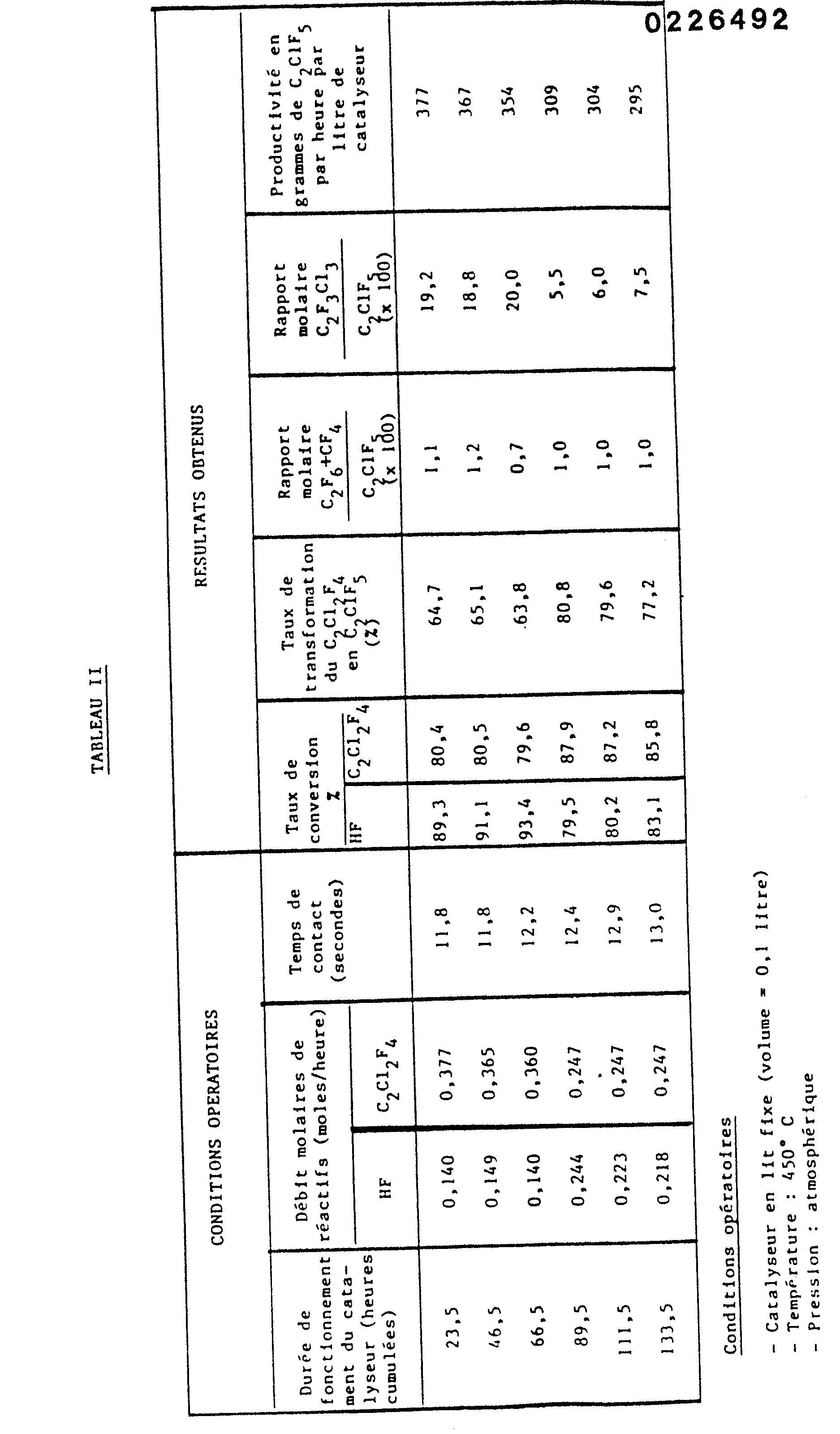
- On prélève 68,1 grammes de ce catalyseur (0,1 litre) pour le tester dans le même réacteur tubulaire de 28 mm de diamètre que dans l'exemple 1, et on opère comme dans l'exemple 1. Les résultats sont reportés dans le tableau II ci-après.
- La durée de fonctionnement du catalyseur qui est indiquée dans ce tableau correspond à la durée depuis le chargement du réacteur en lit fixe et ne comprend pas la transformation de l'alumine en catalyseur.
- On opére comme dans l'exemple 2 à partir de la même alumine activée sauf qu'après la transformation de l'alumine en catalyseur et chargement du réacteur en lit fixe de fluoration de C2F4C12, on démarre la réaction avec un rapport molaire HF/C2C12F4 voisin de 1 au lieu de 0,4 dans l'exemple 2.
- Les résultats sont reportés sur le tableau III.
- Le mode de démarrage ne modifie pas l'activité ni la sélectivité du catalyseur.
- La durée de fonctionnement qui est indiquée est la durée depuis le chargement du réacteur en lit fixe et ne comprend pas la transformation de l'alumine en catalyseur.
- On opère comme dans l'exemple 2 mais en utilisant une alumine activée dont le volume poreux est différent de l'alumine activée utilisée dans le procédé selon l'invention, on utilise l'alumine SCM 250 ayant les caractéristiques suivantes :
-

- - Forme : billes de 2 à 4 mm de diamètre
- - Surface spécifique (BET) - 270 m2/g
- - Volume total des pores de rayon supérieur ou égal à 40 A - 0,63 cm3/g •
- - Diamètre moyen de pores 90 A
- - Densité en vrac = 0,66 g/ml
- On obtient un catalyseur dont la teneur en AlF3 est 87,7 % en poids, le reste étant de l'alumine non transformée. Les résultats sont reportés dans le tableau IV,1 les durées de fonctionnement sont mesurées comme dans l'exemple 2.
- On utilise la même alumine SCM 250 en sphères de 2 à 4 mm et on la transforme en catalyseur comme précédemment, mais après la transformation on la réduit mécaniquement en petits morceaux inférieurs à 1 mm pour se rapprocher des dimensions de l'alumine KAISER des exemples 1,2 et 3. On utilise alors ce catalyseur comme précédemment.
- Les résultats sont reportés dans le tableau IV,2.
- Les durées de fonctionnement figurant dans le tableau ne comprennent pas le temps de transformation de l'alumine en catalyseur.
- On utilise l'alumine CS 331-1 vendue par la Société CATALYSTS AND CHEMICALS EUROPE (CCE) dont les principales caractéristiques sont les suivantes :
- - forme : extrudés de 1/16" (≃ 1,6 mm) de diamètre.
- - surface active (BET) : 255 m 2/g 0
- - rayon moyen des pores : 90 A
- 0 - volume des pores de rayon supérieur ou égal à 40 A : 0,76 cm3/g
- - densité en vrac : 0,60 g/ml
- - teneur en Na20 : 0,02 %
- - teneur en Fe203 : 0,08%
- - teneur en SiO2: 0,03 %
- Le catalyseur est préparé comme dans l'exemple 2, la concentration en AlF3 du catalyseur est 92 %, avec 8 % d'alumine non tranfor- mée.
- Les résultats des essais correspondants figurent dans le tableau n° V ci-après ; on constate que les résultats obtenus sont nettement supérieurs à ceux obtenus dans l'exemple comparatif n° 4 (Alumine SCM 250).
- Les durées de fonctionnement indiquées ne comprennent pas la transformation de l'alumine en catalyseur.
- Fluoration de C2F4Cl2 par HF selon un procédé non conforme à l'invention.
- Au lieu de prendre une alumine et de la tranformer en catalyseur comme précédemment, on utilise du trifluorure d'aluminium commercial en poudre contenant environ 8 % d'alumine.
- Ses principales caractéristiques physico-chimiques sont les suivantes :
- - granulométrie moyenne de la poudre : 50 à 80 microns
- - aire spécifique totale (BET) = 1,6 m2/g 0
- - volume des pores de rayon supérieur ou égal à 40 A:0,25 cm3/g Puis on fait comme dans les exemples précédents la fluoration du C2F4Cl2 par HF mais en lit fluide au lieu d'un lit fixe.
- Le tableau VI rassemble les résultats.
- On opère comme dans l'exemple 2, sur le même type d'alumine (KAISER 4192), mais on travaille avec un temps de contact plus faible.
- Les résultats sont reportés dans le tableau VII où les durées de fonctionnement ne comprennent pas le temps de transformation de l'alumine en catalyseur.
- On constate que la productivité en C2ClF5 peut être augmentée de manière importante sans nuire au rendement.
- Le tableau VIII qui rassemble des résultats obtenus dans des conditions opératoires analogues, montre l'influence de la teneur en



Claims (12)
Priority Applications (1)
| Application Number | Priority Date | Filing Date | Title |
|---|---|---|---|
| AT86402484T ATE41650T1 (de) | 1985-11-15 | 1986-11-06 | Verfahren zur synthese von chlorpentafluorethan aus dichlortetrafluorethan und fluorwasserstoff. |
Applications Claiming Priority (3)
| Application Number | Priority Date | Filing Date | Title |
|---|---|---|---|
| FR8516951 | 1985-11-15 | ||
| FR8516951A FR2590251B1 (fr) | 1985-11-15 | 1985-11-15 | Procede de synthese du chloropentafluoroethane a partir de dichlorotetrafluoroethane et d'acide fluorhydrique |
| BR8700509A BR8700509A (pt) | 1985-11-15 | 1987-02-05 | Processo de fabricacao em fase gasosa do cloropentafluretano |
Publications (2)
| Publication Number | Publication Date |
|---|---|
| EP0226492A1 true EP0226492A1 (fr) | 1987-06-24 |
| EP0226492B1 EP0226492B1 (fr) | 1989-03-22 |
Family
ID=25664168
Family Applications (1)
| Application Number | Title | Priority Date | Filing Date |
|---|---|---|---|
| EP86402484A Expired EP0226492B1 (fr) | 1985-11-15 | 1986-11-06 | Procédé de synthèse du chloropentafluoroéthane à partir de dichlorotétrafluoroéthane et d'acide fluorhydrique |
Country Status (7)
| Country | Link |
|---|---|
| US (1) | US4745236A (fr) |
| EP (1) | EP0226492B1 (fr) |
| JP (1) | JPS62174034A (fr) |
| AU (1) | AU603069B2 (fr) |
| BR (1) | BR8700509A (fr) |
| CA (1) | CA1265163A (fr) |
| FR (1) | FR2590251B1 (fr) |
Cited By (3)
| Publication number | Priority date | Publication date | Assignee | Title |
|---|---|---|---|---|
| FR2631959A1 (fr) * | 1988-05-30 | 1989-12-01 | Central Glass Co Ltd | Procede de preparation de 1,1,1,2-tetrafluoroethane a partir de 1,1-dichloro-1,2,2,2-tetrafluoroethane |
| EP0439338A1 (fr) * | 1990-01-25 | 1991-07-31 | Imperial Chemical Industries Plc | Catalyseur pour l'échange d'halogène des hydrocarbures halogénés et pour les réactions acide-base |
| US6242659B1 (en) | 1995-06-29 | 2001-06-05 | Elf Atochem, S.A. | Process for the manufacture of difluoromethane |
Families Citing this family (3)
| Publication number | Priority date | Publication date | Assignee | Title |
|---|---|---|---|---|
| JPH0631932Y2 (ja) * | 1986-02-17 | 1994-08-24 | 吉田工業株式会社 | スライドフアスナ−用停止装置付きスライダ− |
| US6077819A (en) * | 1993-11-01 | 2000-06-20 | E. I. Du Pont De Nemours And Company | Azeotropes of chlorofluoroethanes of the formula CF3 CC12+x ub. F.s1-x with HF and manufacturing processes therewith |
| IT1291758B1 (it) * | 1997-05-22 | 1999-01-21 | Ausimont Spa | Processo per la preparazione di fluoruro di alluminio |
Citations (3)
| Publication number | Priority date | Publication date | Assignee | Title |
|---|---|---|---|---|
| US2946828A (en) * | 1957-12-02 | 1960-07-26 | Hoechst Ag | Process for preparing aliphatic fluorine compounds |
| US3087974A (en) * | 1960-03-30 | 1963-04-30 | Pennsalt Chemicals Corp | Process for making halogenated organic compounds |
| DE1443184A1 (de) * | 1960-02-09 | 1968-10-17 | Union Carbide Corp | Verfahren zur Herstellung von Chlorpentafluoraethan |
Family Cites Families (7)
| Publication number | Priority date | Publication date | Assignee | Title |
|---|---|---|---|---|
| CA832501A (en) * | 1970-01-20 | W. Clark Jared | Preparation of chloropentafluoroethane | |
| US3258500A (en) * | 1959-08-17 | 1966-06-28 | Du Pont | Process for fluorinating halohydro-carbons |
| SE374675B (fr) * | 1970-06-10 | 1975-03-17 | Montedison Spa | |
| JPS4826729A (fr) * | 1971-08-05 | 1973-04-09 | ||
| DD117580A3 (fr) * | 1972-11-09 | 1976-01-20 | ||
| US3961036A (en) * | 1974-01-04 | 1976-06-01 | Exxon Research And Engineering Company | Alumina synthesis |
| FR2498591A1 (fr) * | 1980-12-31 | 1982-07-30 | Ugine Kuhlmann | Procede continu de preparation en phase gazeuse du trichlorotrifluorethane, du dichlorotetrafluorethane et du monochloropentafluorethane en proportions controlees |
-
1985
- 1985-11-15 FR FR8516951A patent/FR2590251B1/fr not_active Expired
-
1986
- 1986-11-06 EP EP86402484A patent/EP0226492B1/fr not_active Expired
- 1986-11-14 US US06/931,365 patent/US4745236A/en not_active Expired - Fee Related
- 1986-11-14 CA CA000522971A patent/CA1265163A/fr not_active Expired - Lifetime
- 1986-11-14 AU AU65186/86A patent/AU603069B2/en not_active Ceased
- 1986-11-15 JP JP61272749A patent/JPS62174034A/ja active Granted
-
1987
- 1987-02-05 BR BR8700509A patent/BR8700509A/pt unknown
Patent Citations (3)
| Publication number | Priority date | Publication date | Assignee | Title |
|---|---|---|---|---|
| US2946828A (en) * | 1957-12-02 | 1960-07-26 | Hoechst Ag | Process for preparing aliphatic fluorine compounds |
| DE1443184A1 (de) * | 1960-02-09 | 1968-10-17 | Union Carbide Corp | Verfahren zur Herstellung von Chlorpentafluoraethan |
| US3087974A (en) * | 1960-03-30 | 1963-04-30 | Pennsalt Chemicals Corp | Process for making halogenated organic compounds |
Cited By (5)
| Publication number | Priority date | Publication date | Assignee | Title |
|---|---|---|---|---|
| FR2631959A1 (fr) * | 1988-05-30 | 1989-12-01 | Central Glass Co Ltd | Procede de preparation de 1,1,1,2-tetrafluoroethane a partir de 1,1-dichloro-1,2,2,2-tetrafluoroethane |
| DE3917573A1 (de) * | 1988-05-30 | 1989-12-14 | Central Glass Co Ltd | Verfahren zur herstellung von 1,1,1,2-tetrafluorethan aus 1,1-dichlor-1,2,2,2-tetrafluorethan |
| EP0439338A1 (fr) * | 1990-01-25 | 1991-07-31 | Imperial Chemical Industries Plc | Catalyseur pour l'échange d'halogène des hydrocarbures halogénés et pour les réactions acide-base |
| US6242659B1 (en) | 1995-06-29 | 2001-06-05 | Elf Atochem, S.A. | Process for the manufacture of difluoromethane |
| US6639115B2 (en) | 1995-06-29 | 2003-10-28 | Atofina | Process for the manufacture of difluoromethane |
Also Published As
| Publication number | Publication date |
|---|---|
| FR2590251B1 (fr) | 1988-10-14 |
| CA1265163A (fr) | 1990-01-30 |
| US4745236A (en) | 1988-05-17 |
| JPH0251532B2 (fr) | 1990-11-07 |
| FR2590251A1 (fr) | 1987-05-22 |
| BR8700509A (pt) | 1988-08-16 |
| JPS62174034A (ja) | 1987-07-30 |
| AU6518686A (en) | 1987-05-21 |
| EP0226492B1 (fr) | 1989-03-22 |
| AU603069B2 (en) | 1990-11-08 |
Similar Documents
| Publication | Publication Date | Title |
|---|---|---|
| EP0657408B1 (fr) | Fluoration en phase gazeuse au moyen de catalyseurs cristallisés | |
| CA2113510C (fr) | Procede de fluoration du perchlorethylene ou du pentachlorethane | |
| EP0486333A1 (fr) | Procédé de fabrication du tétrafluoro-1,1,1,2-éthane | |
| CA2039646C (fr) | Procede de fabrication du 1,1,1,2-tetrafluoro-chloroethane et du pentafluoroethane | |
| FR2701943A1 (fr) | Purification du pentafluoroéthane. | |
| EP0226492B1 (fr) | Procédé de synthèse du chloropentafluoroéthane à partir de dichlorotétrafluoroéthane et d'acide fluorhydrique | |
| EP0751108B1 (fr) | Procédé de fabrication du difluorométhane | |
| JP2002069014A (ja) | オクタフルオロプロパンの製造方法及びその用途 | |
| CN112723983B (zh) | Z-1-卤-3,3,3-三氟丙烯的制备方法 | |
| CA2019913A1 (fr) | Production de fluorure de vinylidene a partir de 1,1-difluoroethane | |
| FR2729136A1 (fr) | Procede de deshydrofluoration de fluoroalcanes en fluoroalcenes. | |
| KR100854982B1 (ko) | 1,1,1,2-테트라플루오로에탄 및/또는 펜타플루오로에탄의제조방법 및 그 용도 | |
| CA2117981C (fr) | Procede de purification du 1,1,1,2-tetrafluoroethane | |
| KR100643674B1 (ko) | 하이드로플루오로카본의 제조방법, 그 제품 및 그 용도 | |
| CA2176189C (fr) | Purification du pentafluoroethane | |
| FR2713634A1 (fr) | Fluoration catalytique d'hydrocarbures halogènes en phase gazeuse. | |
| CH498792A (fr) | Procédé d'oxychloruration de l'éthylène | |
| JP2543671B2 (ja) | 1,1,1,2−テトラフルオロエタンの精製方法 | |
| JP4738035B2 (ja) | 1,1,1,2−テトラフルオロエタンおよび/またはペンタフルオロエタンの製造方法およびその用途 | |
| KR890002822B1 (ko) | 디클로로테트라플루오로에탄 및 플루오르화 수소산으로부터 클로로펜타플루오로에탄을 합성하는 방법 | |
| EP0115887B1 (fr) | Procédé pour l'obtention du 2,2,2-trifluoroéthanol | |
| FR2894250A1 (fr) | Procede de fabrication du pentafluoroethane | |
| CS53291A2 (en) | Method of fluorination by halogen exchange | |
| FR2736049A1 (fr) | Synthese du difluoromethane a partir de chlorofluoromethane | |
| FR2690686A1 (fr) | Procédé de production de fluorure de vinylidène. |
Legal Events
| Date | Code | Title | Description |
|---|---|---|---|
| PUAI | Public reference made under article 153(3) epc to a published international application that has entered the european phase |
Free format text: ORIGINAL CODE: 0009012 |
|
| 17P | Request for examination filed |
Effective date: 19861114 |
|
| AK | Designated contracting states |
Kind code of ref document: A1 Designated state(s): AT BE CH DE ES FR GB GR IT LI LU NL SE |
|
| 17Q | First examination report despatched |
Effective date: 19880707 |
|
| GRAA | (expected) grant |
Free format text: ORIGINAL CODE: 0009210 |
|
| AK | Designated contracting states |
Kind code of ref document: B1 Designated state(s): AT BE CH DE ES FR GB GR IT LI LU NL SE |
|
| REF | Corresponds to: |
Ref document number: 41650 Country of ref document: AT Date of ref document: 19890415 Kind code of ref document: T |
|
| ITF | It: translation for a ep patent filed | ||
| REF | Corresponds to: |
Ref document number: 3662518 Country of ref document: DE Date of ref document: 19890427 |
|
| GBT | Gb: translation of ep patent filed (gb section 77(6)(a)/1977) | ||
| PLBE | No opposition filed within time limit |
Free format text: ORIGINAL CODE: 0009261 |
|
| STAA | Information on the status of an ep patent application or granted ep patent |
Free format text: STATUS: NO OPPOSITION FILED WITHIN TIME LIMIT |
|
| 26N | No opposition filed | ||
| REG | Reference to a national code |
Ref country code: GR Ref legal event code: FG4A Free format text: 3000043 |
|
| ITTA | It: last paid annual fee | ||
| PGFP | Annual fee paid to national office [announced via postgrant information from national office to epo] |
Ref country code: AT Payment date: 19921019 Year of fee payment: 7 |
|
| PGFP | Annual fee paid to national office [announced via postgrant information from national office to epo] |
Ref country code: GB Payment date: 19921026 Year of fee payment: 7 |
|
| PGFP | Annual fee paid to national office [announced via postgrant information from national office to epo] |
Ref country code: ES Payment date: 19921102 Year of fee payment: 7 |
|
| PGFP | Annual fee paid to national office [announced via postgrant information from national office to epo] |
Ref country code: FR Payment date: 19921109 Year of fee payment: 7 |
|
| PGFP | Annual fee paid to national office [announced via postgrant information from national office to epo] |
Ref country code: CH Payment date: 19921113 Year of fee payment: 7 |
|
| PGFP | Annual fee paid to national office [announced via postgrant information from national office to epo] |
Ref country code: SE Payment date: 19921116 Year of fee payment: 7 |
|
| PGFP | Annual fee paid to national office [announced via postgrant information from national office to epo] |
Ref country code: DE Payment date: 19921123 Year of fee payment: 7 |
|
| PGFP | Annual fee paid to national office [announced via postgrant information from national office to epo] |
Ref country code: NL Payment date: 19921130 Year of fee payment: 7 |
|
| PGFP | Annual fee paid to national office [announced via postgrant information from national office to epo] |
Ref country code: LU Payment date: 19921210 Year of fee payment: 7 |
|
| PGFP | Annual fee paid to national office [announced via postgrant information from national office to epo] |
Ref country code: BE Payment date: 19921211 Year of fee payment: 7 |
|
| EPTA | Lu: last paid annual fee | ||
| PG25 | Lapsed in a contracting state [announced via postgrant information from national office to epo] |
Ref country code: LU Free format text: LAPSE BECAUSE OF NON-PAYMENT OF DUE FEES Effective date: 19931106 Ref country code: GB Effective date: 19931106 Ref country code: AT Effective date: 19931106 |
|
| PG25 | Lapsed in a contracting state [announced via postgrant information from national office to epo] |
Ref country code: SE Effective date: 19931107 |
|
| PG25 | Lapsed in a contracting state [announced via postgrant information from national office to epo] |
Ref country code: ES Free format text: LAPSE BECAUSE OF EXPIRATION OF PROTECTION Effective date: 19931108 |
|
| PG25 | Lapsed in a contracting state [announced via postgrant information from national office to epo] |
Ref country code: LI Effective date: 19931130 Ref country code: CH Effective date: 19931130 Ref country code: BE Effective date: 19931130 |
|
| PGFP | Annual fee paid to national office [announced via postgrant information from national office to epo] |
Ref country code: GR Payment date: 19931130 Year of fee payment: 8 |
|
| BERE | Be: lapsed |
Owner name: ATOCHEM Effective date: 19931130 |
|
| PG25 | Lapsed in a contracting state [announced via postgrant information from national office to epo] |
Ref country code: NL Effective date: 19940601 |
|
| GBPC | Gb: european patent ceased through non-payment of renewal fee |
Effective date: 19931106 |
|
| NLV4 | Nl: lapsed or anulled due to non-payment of the annual fee | ||
| PG25 | Lapsed in a contracting state [announced via postgrant information from national office to epo] |
Ref country code: FR Effective date: 19940729 |
|
| REG | Reference to a national code |
Ref country code: CH Ref legal event code: PL |
|
| PG25 | Lapsed in a contracting state [announced via postgrant information from national office to epo] |
Ref country code: DE Effective date: 19940802 |
|
| REG | Reference to a national code |
Ref country code: FR Ref legal event code: ST |
|
| EUG | Se: european patent has lapsed |
Ref document number: 86402484.9 Effective date: 19940610 |
|
| PG25 | Lapsed in a contracting state [announced via postgrant information from national office to epo] |
Ref country code: GR Free format text: THE PATENT HAS BEEN ANNULLED BY A DECISION OF A NATIONAL AUTHORITY Effective date: 19950531 |
|
| REG | Reference to a national code |
Ref country code: GR Ref legal event code: MM2A Free format text: 3000043 |
|
| REG | Reference to a national code |
Ref country code: ES Ref legal event code: FD2A Effective date: 20010301 |
|
| PG25 | Lapsed in a contracting state [announced via postgrant information from national office to epo] |
Ref country code: IT Free format text: LAPSE BECAUSE OF NON-PAYMENT OF DUE FEES Effective date: 20051106 |