EP0227076B1 - Procédé pour la fabrication d'une couche mince monocristalline - Google Patents
Procédé pour la fabrication d'une couche mince monocristalline Download PDFInfo
- Publication number
- EP0227076B1 EP0227076B1 EP86117799A EP86117799A EP0227076B1 EP 0227076 B1 EP0227076 B1 EP 0227076B1 EP 86117799 A EP86117799 A EP 86117799A EP 86117799 A EP86117799 A EP 86117799A EP 0227076 B1 EP0227076 B1 EP 0227076B1
- Authority
- EP
- European Patent Office
- Prior art keywords
- film
- thin
- monocrystal
- silicon
- plate
- Prior art date
- Legal status (The legal status is an assumption and is not a legal conclusion. Google has not performed a legal analysis and makes no representation as to the accuracy of the status listed.)
- Expired - Lifetime
Links
Images



Classifications
-
- H—ELECTRICITY
- H10—SEMICONDUCTOR DEVICES; ELECTRIC SOLID-STATE DEVICES NOT OTHERWISE PROVIDED FOR
- H10P—GENERIC PROCESSES OR APPARATUS FOR THE MANUFACTURE OR TREATMENT OF DEVICES COVERED BY CLASS H10
- H10P14/00—Formation of materials, e.g. in the shape of layers or pillars
- H10P14/20—Formation of materials, e.g. in the shape of layers or pillars of semiconductor materials
- H10P14/38—Formation of materials, e.g. in the shape of layers or pillars of semiconductor materials characterised by treatments done after the formation of the materials
- H10P14/3802—Crystallisation or recrystallisation of non-monocrystalline semiconductor materials, e.g. regrowth
-
- H—ELECTRICITY
- H10—SEMICONDUCTOR DEVICES; ELECTRIC SOLID-STATE DEVICES NOT OTHERWISE PROVIDED FOR
- H10P—GENERIC PROCESSES OR APPARATUS FOR THE MANUFACTURE OR TREATMENT OF DEVICES COVERED BY CLASS H10
- H10P14/00—Formation of materials, e.g. in the shape of layers or pillars
- H10P14/20—Formation of materials, e.g. in the shape of layers or pillars of semiconductor materials
- H10P14/32—Formation of materials, e.g. in the shape of layers or pillars of semiconductor materials characterised by intermediate layers between substrates and deposited layers
- H10P14/3202—Materials thereof
- H10P14/3238—Materials thereof being insulating materials
-
- H—ELECTRICITY
- H10—SEMICONDUCTOR DEVICES; ELECTRIC SOLID-STATE DEVICES NOT OTHERWISE PROVIDED FOR
- H10P—GENERIC PROCESSES OR APPARATUS FOR THE MANUFACTURE OR TREATMENT OF DEVICES COVERED BY CLASS H10
- H10P14/00—Formation of materials, e.g. in the shape of layers or pillars
- H10P14/20—Formation of materials, e.g. in the shape of layers or pillars of semiconductor materials
- H10P14/32—Formation of materials, e.g. in the shape of layers or pillars of semiconductor materials characterised by intermediate layers between substrates and deposited layers
- H10P14/3242—Structure
-
- H—ELECTRICITY
- H10—SEMICONDUCTOR DEVICES; ELECTRIC SOLID-STATE DEVICES NOT OTHERWISE PROVIDED FOR
- H10P—GENERIC PROCESSES OR APPARATUS FOR THE MANUFACTURE OR TREATMENT OF DEVICES COVERED BY CLASS H10
- H10P14/00—Formation of materials, e.g. in the shape of layers or pillars
- H10P14/20—Formation of materials, e.g. in the shape of layers or pillars of semiconductor materials
- H10P14/34—Deposited materials, e.g. layers
- H10P14/3402—Deposited materials, e.g. layers characterised by the chemical composition
- H10P14/3404—Deposited materials, e.g. layers characterised by the chemical composition being Group IVA materials
- H10P14/3411—Silicon, silicon germanium or germanium
-
- H—ELECTRICITY
- H10—SEMICONDUCTOR DEVICES; ELECTRIC SOLID-STATE DEVICES NOT OTHERWISE PROVIDED FOR
- H10P—GENERIC PROCESSES OR APPARATUS FOR THE MANUFACTURE OR TREATMENT OF DEVICES COVERED BY CLASS H10
- H10P14/00—Formation of materials, e.g. in the shape of layers or pillars
- H10P14/20—Formation of materials, e.g. in the shape of layers or pillars of semiconductor materials
- H10P14/34—Deposited materials, e.g. layers
- H10P14/3451—Structure
- H10P14/3452—Microstructure
- H10P14/3458—Monocrystalline
-
- H—ELECTRICITY
- H10—SEMICONDUCTOR DEVICES; ELECTRIC SOLID-STATE DEVICES NOT OTHERWISE PROVIDED FOR
- H10P—GENERIC PROCESSES OR APPARATUS FOR THE MANUFACTURE OR TREATMENT OF DEVICES COVERED BY CLASS H10
- H10P14/00—Formation of materials, e.g. in the shape of layers or pillars
- H10P14/20—Formation of materials, e.g. in the shape of layers or pillars of semiconductor materials
- H10P14/38—Formation of materials, e.g. in the shape of layers or pillars of semiconductor materials characterised by treatments done after the formation of the materials
- H10P14/3802—Crystallisation or recrystallisation of non-monocrystalline semiconductor materials, e.g. regrowth
- H10P14/3808—Crystallisation or recrystallisation of non-monocrystalline semiconductor materials, e.g. regrowth using laser beams
-
- H—ELECTRICITY
- H10—SEMICONDUCTOR DEVICES; ELECTRIC SOLID-STATE DEVICES NOT OTHERWISE PROVIDED FOR
- H10P—GENERIC PROCESSES OR APPARATUS FOR THE MANUFACTURE OR TREATMENT OF DEVICES COVERED BY CLASS H10
- H10P14/00—Formation of materials, e.g. in the shape of layers or pillars
- H10P14/20—Formation of materials, e.g. in the shape of layers or pillars of semiconductor materials
- H10P14/38—Formation of materials, e.g. in the shape of layers or pillars of semiconductor materials characterised by treatments done after the formation of the materials
- H10P14/3802—Crystallisation or recrystallisation of non-monocrystalline semiconductor materials, e.g. regrowth
- H10P14/382—Scanning of a beam
-
- Y—GENERAL TAGGING OF NEW TECHNOLOGICAL DEVELOPMENTS; GENERAL TAGGING OF CROSS-SECTIONAL TECHNOLOGIES SPANNING OVER SEVERAL SECTIONS OF THE IPC; TECHNICAL SUBJECTS COVERED BY FORMER USPC CROSS-REFERENCE ART COLLECTIONS [XRACs] AND DIGESTS
- Y10—TECHNICAL SUBJECTS COVERED BY FORMER USPC
- Y10S—TECHNICAL SUBJECTS COVERED BY FORMER USPC CROSS-REFERENCE ART COLLECTIONS [XRACs] AND DIGESTS
- Y10S117/00—Single-crystal, oriented-crystal, and epitaxy growth processes; non-coating apparatus therefor
- Y10S117/901—Levitation, reduced gravity, microgravity, space
- Y10S117/902—Specified orientation, shape, crystallography, or size of seed or substrate
-
- Y—GENERAL TAGGING OF NEW TECHNOLOGICAL DEVELOPMENTS; GENERAL TAGGING OF CROSS-SECTIONAL TECHNOLOGIES SPANNING OVER SEVERAL SECTIONS OF THE IPC; TECHNICAL SUBJECTS COVERED BY FORMER USPC CROSS-REFERENCE ART COLLECTIONS [XRACs] AND DIGESTS
- Y10—TECHNICAL SUBJECTS COVERED BY FORMER USPC
- Y10S—TECHNICAL SUBJECTS COVERED BY FORMER USPC CROSS-REFERENCE ART COLLECTIONS [XRACs] AND DIGESTS
- Y10S117/00—Single-crystal, oriented-crystal, and epitaxy growth processes; non-coating apparatus therefor
- Y10S117/903—Dendrite or web or cage technique
- Y10S117/904—Laser beam
Definitions
- the present invention relates to a method of manufacturing a monocrystal thin-film to be used in a field where a semiconductor device is manufactured, and more particularly, to improvements in a method of performing the monocrystallizing operation, i.e., single crystallizing operation through the application of energy beams upon the non-monocrystal thin-film of non-crystalloid, i.e., amorphous or ., polycrystals formed on the non-crystalloid insulation film.
- a method of manufacturing a monocrystal thin film with monocrystal silicon base plate coinciding in the crystal direction therewith is proposed through forming a non-crystalloid or multicrystal thin film on an insulating film formed on the monocrystal silicon base-plate, i.e., substrate, and through performing molten-recrystallizing operation by the application of energy beams on the thin film.
- the monocrystalloid or multicrystal thin film near the insulating film flows into the insulating film when it is melted through the application of the energy beams to make the non-crystalloid or multicrystal thin-film thinner near the insulating film.
- the crystal growth is not continuously caused from the non-crystalloid or multi-crystal thin film in the region which is in contact against the monocrystal silicon base-plate into the non-crystalloid or multicrystal thin film on the insulating film.
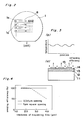
- Fig. 6 shows a case where the form of the monocrystal silicon base-plate is stripe-shaped or dot-shaped in a known manner. It is found out that the superior molten condition is not provided in the case of the stripe-shape.
- an object of the present invention is to provide a method of manufacturing a monocrystal thin film of silicon, which forms the monocrystal thin film controlled in crystal direction, superior in quality through the application of the energy beams.
- the method of manufacturing a monocrystal thin-film of the present invention comprised the successive steps of claim 1. Further embodiments can be found in the dependent claims 2 to 4.
- the size of the insulating film opening-portion is 4 ⁇ m square (or 4 ⁇ m in diameter) or less and the insulating film opening-portion should be filled in advance with the same material as the material to be mono-crystallized.
- the temperature is likely to rise in the non-crystalloid or multicrystal thin-film on the insulating film if the thermal conductivity of the film is smaller than the thermal conductivity of the non-crystalloid or multicrystal thin film in the monocrystal silicon base-plate exposed portion.
- the exposed portion of the monocrystal silicon base-plate is stripe-shaped or becomes more than 4 ⁇ m square, the amount of the heat that escapes to the base plate through the non-crystalloid or multicrystal thin-film within the insulating-film opening portion therein becomes large so that the non-crystalloid or multicrystal thin-film on the opening portion becomes hard to melt.
- the power density of the energy beams is raised till the non-crystalloid or multicrystal thin film within the opening portion is melted, scattering is caused in the non-crystalloid or multicrystal thin-film on the insulating film.
- the configuration of the insulating-film opening portion is made square or almost circular in dot shape and the size thereof is made 4 ⁇ m or lower, so that the amount of heat escaping into the base plate through the opening portion becomes smaller, the difference between the temperature of the non-crystalloid or multicrystal thin-film on the opening portion and the temperature of the non-crystalloid or multicrystal thin-film on the insulating film becomes smaller through the thermal conduction from the periphery to simultaneously melt both portions of the above non-crystalloids or multicrystal thin-films without scattering.
- the insulating-film opening portion is filled in advance with a piece of the non-crystalloid or multicrystal thin film.
- the molten thin-film flows into the insulating film opening portion from the periphery of the opening portion during the application of the energy beams to prevent the non-crystalloid or multicrystal thin-film from becoming thinner so that the crystal growth of the monocrystal thin-film is caused continuously onto the insulating film from on the insulating film opening portion.
- the monocrystals may grow from the monocrystal silicon base-plate exposed portion stably if the insulating film increases in thickness through the above-described operation.
- an insulating film 2 of non-crystal is formed on a top plane of a (100) monocrystal silicon base-plate 1 being partially exposed to provide an exposed portion 1a, as shown in Fig. 1(b), of the monocrystal silicon base-plate 1, as shown in Fig. 1(a).
- the size of the monocrystal silicon base-plate exposed portion is assumed to be 3 ⁇ m square.
- the SiO2 film of 2 ⁇ m in thickness is formed on the monocrystal silicon base-plate 1 by means of, for example, a known thermal oxidation method.
- the monocrystal silicon base-plate 1 of the SiO2 film is selectively by a known photoeching method only in the portion to be exposed to form a plurality of opening portions 1a, 1a, 1a, ... of dot shapes, each being 3 ⁇ m square with an interval of 15 ⁇ m, as shown in Fig. 2.
- the non-crystalloid silicon thin-film or multicrystal silicon thin-film is formed by a known LPCVD method on the whole surface of the insulating film 2 including the opening portion 1a therein.
- organic application film material is applied evenly on the whole surface of the non-crystalloid or multicrystal silicon thin-film, which is formed unevenly on the surface corresponding to the opening portion 1a of the monocrystal silicon base-plate 1 and the surface of the insulating film 2, to form an organic application film.
- equal-speed etching is performed from the surface of the organic application film surface to transfer the even surface of the initial organic application film, and the etching operation is stopped in a time point when the insulating film 2 has been exposed filling the non-crystalloid or multicrystal silicon thin-film 3 into the opening portion 1a of the insulating film 2, as shown in Fig. 1(c).
- the step difference in surface between the non-crystalloid or multicrystal silicon thin film 3 filled in at this time, and the insulating film 2 is assumed to be 1 ⁇ m or less.
- a non-crystalloid or multicrystal silicon thin film 4 which becomes an active layer of 0.6 ⁇ m in thickness is formed by the LPCVD method on both regions by the upper portion of the thin film 3 filled in and of the upper portion of the insulating film 2, as shown in Fig. 1(d).
- an SiO2 film which serves as a surface protective film, i.e., anti-reflective film 5 for the silicon thin film 4 is formed by the APCVD method 850 ⁇ in thickness on the whole surface of the silicon thin film 4, as shown in Fig. 1(e).
- a bundle of laser beams 6 of 60 ⁇ m in molten width and 10W in power is applied upon the region including the monocrystal silicon base-plate exposed portion 1a, as shown in Fig. 1(f), and the mono-crystalloid or multicrystal thin-film 4 on the monocrystal silicon base-plate exposed portion 1a is caused to mono-crystallize with the monocrystal silicon base-plate exposed portion 1a which is adapted as a seed for mono-crystal, so that the monocrystal thin-film 7 is obtained in the crystal direction in coincidence with that of the monocrystal silicon base-plate 1.
- the non-crystalloid or multicrystal silicon thin film 8 is formed 0.6 ⁇ m in thickness by the LPCVD method on the surface protective film 5, and is made stripe-shaped through the selective etching operation by a known photo-etching method.
- each stripe of the non-crystalloid or multicrystal silicon thin film 8 is formed to cover the monocrystal silicon base-plate exposed portion 1a with the width of stripe being 10 ⁇ m, the internal between the stripes being 5 ⁇ m.
- the scanning operation of the laser beam 9 of 60 ⁇ m in molten width and 12 W in power is effected from the monocrystal silicon base-plate exposed portion 1a with the scanning speed of 100 mm per second in the longitudinal direction of the stripe-shaped non-crystalloid or multicrystal silicon thin-film 8, as shown in Fig. 1(i), to provide a monocrystal silicon thin film 10 in which the non-crystalloid or multicrystal silicon thin-film 4 is mono-crystallized with the filled silicon 7 coincided with the monocrystal silicon base-plate 1 in the crystal direction being provided as the seed.
- the monocrystal silicon (100) thin-film 10 coincided (100) with the monocrystal silicon (100) base-plate 1 in the crystal direction is finally obtained on the surface of the insulating film 2.
- the reason why the stripe-shaped non-crystalloid or multicrystal silicon thin-film 8 is formed is that the reflection factor, i.e., reflectivity of the laser beam 9 in the place where the stripe-shaped silicon is located is enlarged compared to that where the stripe-shaped silicon does not exist, as shown in Fig. 3(a), the solidification for monocrystallization starts from right under the stripe-shaped silicon central portion with such temperature distribution being provided, as shown in Fig. 3(b), and the monocrystal growth of the silicon thin film 10 is caused with the monocrystal silicon base-plate exposed portion 1a as the seed.
- the seeding factor of the seed is changed by the insulating film 2 thickness when the size of the insulating film opening portion 1a is changed is examined for comparison, with a result as shown in Fig. 4.
- the opening of the opening portion 1a is as large as 5 ⁇ m square
- the seeding factor is lowered if the insulating film 2 becomes as thick as 4 ⁇ m.
- the seeding factor is not seen if the thickness of the insulating 2 film is made 4 ⁇ m.
- the opening portion 1a will do well if it is made 4 ⁇ m square or less in size, because the thickness between the respective active layers is about 4 ⁇ m even at the largest.
- the reason why the crystal face of the (100) is used as the monocrystal silicon base-plate 1, and the laser scanning direction is made along the ⁇ 010 ⁇ is that the crystal defect is hardest to have in the combination of (100) and (010), and the monocrystal region may be smoothly enlarged from the seed portion.
- the length for which the monocrystal region extends from the seed portion when the laser scanning direction is varied between (010) and (011) by the use of the (100) monocrystal silicon base plate 1 is used as shown in Fig. 5. It is the most desirable from Fig. 5 that the laser scanning in the ⁇ 010 ⁇ direction is best.
- the superior monocrystal silicon thin-film 10 coincided with the monocrystal silicon base plate in the crystal direction is formed on the insulating film 2 even if the insulating film as thick as 4 ⁇ m is sufficiently covered between the active layers of the three-dimensional circuit element on the monocrystal silicon base plate 1.
Landscapes
- Recrystallisation Techniques (AREA)
Claims (4)
- Procédé de fabrication d'un film mince de silicium, monocristal, comprenant les étapes successives consistant à :- former un film isolant, non-cristallin, sur une plaque de base de silicium, monocristal ;- pratiquer une ouverture en forme de point dans le film isolant, de telle sorte que la partie correspondante de la plaque de base de silicium, monocristal, soit exposée ;- remplir l'ouverture en forme de point du film isolant par un film mince de silicium, non-monocristallin ;- former un film mince de silicium, non-monocristallin, sur ledit film isolant non-cristallin ;- former un film antiréflexion sur ledit film mince non-monocristal ;- appliquer des faisceaux énergétiques sur la région comprenant l'ouverture en forme de point remplie par ledit film mince de silicium, non-monocristallin, pour le transformer en un film mince monocristal coïncidant avec la plaque de base de silicium, monocristal, dans la direction du cristal, avec la partie exposée de ladite plaque de base de silicium, monocristal, ménagée en tant que germe cristallin ;- former un film de silicium, augmentant la réflexion, en forme de bande, sur ledit film antiréflexion, de telle sorte que ladite région rendue monocristalline soit incluse ; et- appliquer des faisceaux énergétiques dans la direction de la bande pour rendre monocristallin ledit film mince de silicium, non-monocristallin, formé sur le film isolant, avec le film rendu monocristallin dans l'ouverture en forme de point, ménagé en tant que germe cristallin.
- Procédé selon la revendication 1, dans lequel la dimension de l'ouverture en forme de point est de 4 µm ou d'une valeur inférieure.
- Procédé selon la revendication 2, dans lequel la partie exposée de la plaque de base de silicium, monocristal, qui devient la partie formant germe, est formée de façon multiple, et plusieurs films revêtus de silicium en forme de bandes, sont formés en conformité avec les différentes parties formant germe précitées.
- Procédé selon l'une des revendications 1 à 3, dans lequel l'orientation de la plaque de base de silicium, monocristal, est {100}, et la direction du film revêtu de silicium en forme de bande, est <100>.
Applications Claiming Priority (6)
| Application Number | Priority Date | Filing Date | Title |
|---|---|---|---|
| JP285438/85 | 1985-12-20 | ||
| JP28543885A JPS62145721A (ja) | 1985-12-20 | 1985-12-20 | 単結晶薄膜の製造方法 |
| JP68554/86 | 1986-03-28 | ||
| JP6855486A JPS62226621A (ja) | 1986-03-28 | 1986-03-28 | 単結晶シリコン薄膜形成方法 |
| JP225900/86 | 1986-09-26 | ||
| JP22590086A JPS6381807A (ja) | 1986-09-26 | 1986-09-26 | 単結晶シリコン薄膜の製造方法 |
Publications (3)
| Publication Number | Publication Date |
|---|---|
| EP0227076A2 EP0227076A2 (fr) | 1987-07-01 |
| EP0227076A3 EP0227076A3 (en) | 1989-05-24 |
| EP0227076B1 true EP0227076B1 (fr) | 1992-06-17 |
Family
ID=27299781
Family Applications (1)
| Application Number | Title | Priority Date | Filing Date |
|---|---|---|---|
| EP86117799A Expired - Lifetime EP0227076B1 (fr) | 1985-12-20 | 1986-12-19 | Procédé pour la fabrication d'une couche mince monocristalline |
Country Status (3)
| Country | Link |
|---|---|
| US (1) | US4801351A (fr) |
| EP (1) | EP0227076B1 (fr) |
| DE (1) | DE3685732T2 (fr) |
Families Citing this family (5)
| Publication number | Priority date | Publication date | Assignee | Title |
|---|---|---|---|---|
| JPS62206816A (ja) * | 1986-03-07 | 1987-09-11 | Agency Of Ind Science & Technol | 半導体結晶層の製造方法 |
| EP0235819B1 (fr) * | 1986-03-07 | 1992-06-10 | Iizuka, Kozo | Procédé pour fabriquer une couche semi-conductrice monocristalline |
| US4931323A (en) * | 1987-12-10 | 1990-06-05 | Texas Instruments Incorporated | Thick film copper conductor patterning by laser |
| FR2640428B1 (fr) * | 1988-12-09 | 1992-10-30 | Thomson Csf | Procede de durcissement vis-a-vis des rayonnements ionisants de composants electroniques actifs, et composants durcis de grandes dimensions |
| TW264575B (fr) * | 1993-10-29 | 1995-12-01 | Handotai Energy Kenkyusho Kk |
Family Cites Families (10)
| Publication number | Priority date | Publication date | Assignee | Title |
|---|---|---|---|---|
| JPS5734331A (en) * | 1980-08-11 | 1982-02-24 | Toshiba Corp | Manufacture of semiconductor device |
| US4487639A (en) * | 1980-09-26 | 1984-12-11 | Texas Instruments Incorporated | Localized epitaxy for VLSI devices |
| US4448632A (en) * | 1981-05-25 | 1984-05-15 | Mitsubishi Denki Kabushiki Kaisha | Method of fabricating semiconductor devices |
| US4565599A (en) * | 1981-12-21 | 1986-01-21 | Massachusetts Institute Of Technology | Graphoepitaxy by encapsulation |
| JPS58130517A (ja) * | 1982-01-29 | 1983-08-04 | Hitachi Ltd | 単結晶薄膜の製造方法 |
| JPS59108313A (ja) * | 1982-12-13 | 1984-06-22 | Mitsubishi Electric Corp | 半導体単結晶層の製造方法 |
| CA1197628A (fr) * | 1984-01-05 | 1985-12-03 | Thomas W. Macelwee | Fabrication de dispositifs mos empiles |
| US4555300A (en) * | 1984-02-21 | 1985-11-26 | North American Philips Corporation | Method for producing single crystal layers on insulators |
| FR2580672B1 (fr) * | 1985-04-19 | 1987-05-15 | France Etat | Procede de fabrication sur un support isolant d'un film de silicium monocristallin oriente et a defauts localises |
| US4651407A (en) * | 1985-05-08 | 1987-03-24 | Gte Laboratories Incorporated | Method of fabricating a junction field effect transistor utilizing epitaxial overgrowth and vertical junction formation |
-
1986
- 1986-12-19 EP EP86117799A patent/EP0227076B1/fr not_active Expired - Lifetime
- 1986-12-19 US US06/943,428 patent/US4801351A/en not_active Expired - Lifetime
- 1986-12-19 DE DE8686117799T patent/DE3685732T2/de not_active Expired - Fee Related
Also Published As
| Publication number | Publication date |
|---|---|
| DE3685732T2 (de) | 1993-01-21 |
| US4801351A (en) | 1989-01-31 |
| DE3685732D1 (de) | 1992-07-23 |
| EP0227076A2 (fr) | 1987-07-01 |
| EP0227076A3 (en) | 1989-05-24 |
Similar Documents
| Publication | Publication Date | Title |
|---|---|---|
| EP0235819B1 (fr) | Procédé pour fabriquer une couche semi-conductrice monocristalline | |
| US4670088A (en) | Lateral epitaxial growth by seeded solidification | |
| US4596604A (en) | Method of manufacturing a multilayer semiconductor device | |
| US4576851A (en) | Semiconductor substrate | |
| US4523962A (en) | Method for fabricating monocrystalline semiconductor layer on insulating layer by laser crystallization using a grid of anti-reflection coating disposed on poly/amorphous semiconductor | |
| EP0093981B1 (fr) | Méthode de fabrication d'un film de silicium monocristallin | |
| EP0070878B1 (fr) | Croissance de structures a base de materiaux semi-conducteurs du groupe iv | |
| EP0227076B1 (fr) | Procédé pour la fabrication d'une couche mince monocristalline | |
| EP0236953B1 (fr) | Procédé pour la fabrication d'une couche semi-conductrice cristalline | |
| US5214001A (en) | Method of manufacturing semiconductor device having planar single crystal semiconductor surface | |
| KR20000021215A (ko) | 실리콘 박막을 결정화하는 방법과 이를 이용한 박막트랜지스터및 그 제조방법 | |
| JPH027415A (ja) | Soi薄膜形成方法 | |
| US5094714A (en) | Wafer structure for forming a semiconductor single crystal film | |
| US5431126A (en) | Method of forming semiconductor crystal and semiconductor device | |
| JPH0442358B2 (fr) | ||
| JPS627116A (ja) | Soi単結晶作製法 | |
| JPS62145721A (ja) | 単結晶薄膜の製造方法 | |
| JPS58180019A (ja) | 半導体基体およびその製造方法 | |
| JPH024559B2 (fr) | ||
| JPH04214615A (ja) | 半導体デバイスの製造方法 | |
| JPH03286520A (ja) | 結晶性半導体薄膜の製造方法 | |
| JPH0652711B2 (ja) | 半導体装置 | |
| JPS6083322A (ja) | 半導体薄膜の結晶化方法 | |
| JPS61240676A (ja) | 半導体薄膜結晶の製造方法 | |
| JPS61212012A (ja) | Soi構造形成方法 |
Legal Events
| Date | Code | Title | Description |
|---|---|---|---|
| PUAI | Public reference made under article 153(3) epc to a published international application that has entered the european phase |
Free format text: ORIGINAL CODE: 0009012 |
|
| 17P | Request for examination filed |
Effective date: 19861219 |
|
| AK | Designated contracting states |
Kind code of ref document: A2 Designated state(s): DE FR GB |
|
| PUAL | Search report despatched |
Free format text: ORIGINAL CODE: 0009013 |
|
| AK | Designated contracting states |
Kind code of ref document: A3 Designated state(s): DE FR GB |
|
| RHK1 | Main classification (correction) |
Ipc: H01L 21/268 |
|
| 17Q | First examination report despatched |
Effective date: 19910131 |
|
| GRAA | (expected) grant |
Free format text: ORIGINAL CODE: 0009210 |
|
| AK | Designated contracting states |
Kind code of ref document: B1 Designated state(s): DE FR GB |
|
| REF | Corresponds to: |
Ref document number: 3685732 Country of ref document: DE Date of ref document: 19920723 |
|
| ET | Fr: translation filed | ||
| PLBE | No opposition filed within time limit |
Free format text: ORIGINAL CODE: 0009261 |
|
| STAA | Information on the status of an ep patent application or granted ep patent |
Free format text: STATUS: NO OPPOSITION FILED WITHIN TIME LIMIT |
|
| 26N | No opposition filed | ||
| PGFP | Annual fee paid to national office [announced via postgrant information from national office to epo] |
Ref country code: GB Payment date: 19961210 Year of fee payment: 11 |
|
| PGFP | Annual fee paid to national office [announced via postgrant information from national office to epo] |
Ref country code: FR Payment date: 19961227 Year of fee payment: 11 Ref country code: DE Payment date: 19961227 Year of fee payment: 11 |
|
| PG25 | Lapsed in a contracting state [announced via postgrant information from national office to epo] |
Ref country code: GB Free format text: LAPSE BECAUSE OF NON-PAYMENT OF DUE FEES Effective date: 19971219 |
|
| PG25 | Lapsed in a contracting state [announced via postgrant information from national office to epo] |
Ref country code: FR Free format text: THE PATENT HAS BEEN ANNULLED BY A DECISION OF A NATIONAL AUTHORITY Effective date: 19971231 |
|
| GBPC | Gb: european patent ceased through non-payment of renewal fee |
Effective date: 19971219 |
|
| PG25 | Lapsed in a contracting state [announced via postgrant information from national office to epo] |
Ref country code: DE Free format text: LAPSE BECAUSE OF NON-PAYMENT OF DUE FEES Effective date: 19980901 |
|
| REG | Reference to a national code |
Ref country code: FR Ref legal event code: ST |