EP0227433A2 - Elektrolytische Lösung eines quaternären Ammoniumsalzes für elektrolytische Kondensatoren - Google Patents
Elektrolytische Lösung eines quaternären Ammoniumsalzes für elektrolytische Kondensatoren Download PDFInfo
- Publication number
- EP0227433A2 EP0227433A2 EP86309882A EP86309882A EP0227433A2 EP 0227433 A2 EP0227433 A2 EP 0227433A2 EP 86309882 A EP86309882 A EP 86309882A EP 86309882 A EP86309882 A EP 86309882A EP 0227433 A2 EP0227433 A2 EP 0227433A2
- Authority
- EP
- European Patent Office
- Prior art keywords
- acid
- electrolyte solution
- quaternary ammonium
- solute
- ammonium salt
- Prior art date
- Legal status (The legal status is an assumption and is not a legal conclusion. Google has not performed a legal analysis and makes no representation as to the accuracy of the status listed.)
- Granted
Links
Images
Classifications
-
- H—ELECTRICITY
- H01—ELECTRIC ELEMENTS
- H01G—CAPACITORS; CAPACITORS, RECTIFIERS, DETECTORS, SWITCHING DEVICES, LIGHT-SENSITIVE OR TEMPERATURE-SENSITIVE DEVICES OF THE ELECTROLYTIC TYPE
- H01G9/00—Electrolytic capacitors, rectifiers, detectors, switching devices, light-sensitive or temperature-sensitive devices; Processes of their manufacture
- H01G9/004—Details
- H01G9/022—Electrolytes; Absorbents
Definitions
- the present invention relates to an electrolyte solution for an electrolytic capacitor, and more particularly to an electrolyte solution which has high electrical conductivity.
- the chemical or electrical properties of an electrolyte solution such as electrical conductivity and sparking voltage are the main factors which determine the properties of the electrolytic capacitors.
- a solution of an amine salt of maleic acid or phthalic acid in an aprotic organic polar solvent such as N,N-dimethylformamide or gamma-butyrolactone is used for low voltage electrolytic capacitors which have good low temperature characteristics.
- a solution of boric acid or ammonium borate in an ethylene glycol solvent has been used as an electrolyte solution for medium to high voltages because it has a high sparking voltage.
- this electrolyte solution contains large amounts of water formed during esterification of ethylene glycol and boric acid, and large amounts of water vapor formed at temperature exceeding 100°C causes distortion in the appearance of the armoring case and reduces the electrical properties of the electrolytic capacitors. For this reason, it is impossible to use this electrolyte solution at a temperature over 100°C.
- an aprotic solvent such as N,N-dimethylformamide or gamma-butyrolactone having a broader freezing point-boiling point range than ethylene glycol together with the aforesaid ammonium salt of a branched-chain aliphatic dicarboxylic acid in order to improve the low temperature characteristics, but very little of these ammonium salts solve into such solvents.
- Japanese Laid-Open Patent Application No. 78522/84 (corresponding to U.S. Patent 4,473,864) discloses an electrolyte solution having high electric conductivity composed of a solution of a quaternary ammonium salt of a dibasic carboxylic acid HOOC CH2) COOH (4 ⁇ n ⁇ 8) in amide solvents with 2 to 10% by weight of water.
- This electrolyte solution is not fully satisfactory in electrical conductivity sparking voltage, and temperature range.
- the present inventors have made extensive investigations in order to find out a novel electrolyte solution having a higher electric conductivity, and have consequently found that quaternary ammonium salts of maleic acid and/or citraconic acid having an unsaturated double bond and high acidity show at least twice as high electrical conductivity as the quaternary ammonium salts of adipic acid, etc.; that quaternary ammonium salts of aromatic carboxylic acids also show higher electrical conductivity than the quaternary ammonium salt of adipic acid; and that for use in a medium to high voltage electrolyte solution, quaternary ammonium salts of branched-chain aliphatic dicarboxylic acids having 11 to 30 carbon atoms in total show high solubility in aprotic solvents and show relatively high electrical conductivity.
- an electrolyte solution for use in an electrolytic capacitor comprising as a solute at least one quaternary ammonium salt of a carboxylic acid selected from the group consisting of:
- the quaternary ammonium salts of maleic acid, and/or citraconic acid, aromatic carboxylic acids, and branched-chain aliphatic dicarboxylic acids having 11 to 30 carbon atoms in total used as solutes in this invention show good solubility in solvent and high electric conductivity, and when used together with solvents having a broad freezing point-boiling point range, constitute excellent electrolyte solutions for use in an electrolytic capacitor having a wide range of service temperatures.
- Examples of the quaternary ammonium salts of maleic acid and/or citraconic acid, aromatic acids, and branched-chain aliphatic dicarboxylic acids having 11 to 30 carbon atoms in total used in this invention include aliphatic quaternary ammonium salts such as tetraethylammonium, tetrapropylammonium, tetrabutylammonium, methyltriethylammonium, methyltripropylammonium, methyltributylammonium, dimethyldiethylammonium, dimethyldipropylammonium, dimethyldibutylammonium, ethyltripropylammonium, ethyltributylammonium, diethyldipropylammonium, diethyldibutylammonium, triethylpropylammonium, triethylbutylammonium; ali
- aromatic carboxylic acids in the quaternary ammonium salts of aromatic carboxylic acids used in this invention are compounds represented by the following formula (I): wherein X, Y and Z are identical or different and each represents a hydrogen atom or an alkyl, hydroxyl, alkoxy, amino, monoalkylamino, dialkylamino, nitro or carboxyl group.
- the aromatic carboxylic acids have 7 to 30 carbon atoms, preferably 7 to 12 carbon atoms, in total.
- aromatic monocarboxylic acids such as benzoic acid, toluic acid, ethylbenzoic acid, propylbenzoic acid, isopropylbenzoic acid, butylbenzoic acid, isobutylbenzoic acid, sec-butylbenzoic acid, tert-butylbenzoic acid, hydroxybenzoic acid, anisic acid, ethoxybenzoic acid, propoxybenzoic acid, isopropoxybenzoic acid, butoxybenzoic acid, isobutoxybenzoic acid, secbutoxybenzoic acid, tert-butoxybenzoic acid, aminobenzoic acid, N-methylaminobenzoic acid, N-ethylaminobenzoic acid, N-propylaminobenzoic acid, N-isopropylaminobenzoic acid, N-butylaminobenzoic acid
- branched-chain aliphatic dicarboxylic acids having 11 to 30 carbon atoms in total used in this invention
- specific examples of the branched-chain aliphatic dicarboxylic acids include 1,5-octanedicarboxylic acid, 1,6-decanedicarboxylic acid, 5,6-decanedicarboxylic acid, 1,7-decanedicarboxylic acid, 4,6-dimethyl-4-nonene-1,2-dicarboxylic acid, 4,6-dimethyl-1,2-nonanedicarboxylic acid, 1,7-dodecane-dicarboxylic acid, 5-ethyl-1,10-decanedicarboxylic acid, 6-methyl-6-dodecene-1,12-dicarboxylic acid, 6-methyl-1,12-dodecanedicarboxylic acid, 6-ethylene-1,12-dodecane-dicarboxy
- Solvents which are used to dissolve the quaternary ammonium salts of maleic acid and/or citraconic acid, the quaternary ammonium salts of the aromatic carboxylic acids and the quaternary ammonium salts of branched-chain aliphatic dicarboxylic acids having 11 to 30 carbon atoms in total include amides such as N-methylformamide, N-ethylformamide, N,N-dimethylformamide, N,N-diethylformamide, N-methylacetamide, N-ethylacetamide, N,N-dimethylacetamide, N,N-diethylacetamide and N-methylpyrrolidinone, lactones such as beta-butyrolactone, gamma-butyrolactone, gamma-valerolactone and delta-valerolactone, carbonates such as ethylene carbonate, propylene carbonate and butylene carbonate, alcohols such as ethylene glycol, g
- solvents composed mainly of aprotic solvents such as amides and lactones are prefer strictlyred, and particularly solvents composed mainly of gamma-butyrolactone and preferred by the following reasons.
- Gamma-butyrolactone has a broad freezing point-boiling point range and is less toxic.
- Gamma-butyrolactone also does not attack the sealing gaskets compared with amide solvents, and electrolytic capacitor using this solvent is hardly suffered serious damage from halogen ion generated from the washing agent for solder flux which will be transmitted through a closure.
- the amount of the quaternary ammonium salt dissolved in the solvent is below the saturation concentration, preferably 5 to 40% by weight based on the total weight of the electrolyte solution when the quaternary ammonium salt is the quaternary ammonium salt of maleic acid, and/or citraconic acid or the aromatic carboxylic acid.
- the quaternary ammonium salt of a branched-chain aliphatic carboxylic acid having 11 to 30 carbon atoms in total its concentration in the solvent is 1 to 40% by weight based on the total weight of the electrolyte solution, and the sparking voltage of the resulting solution can be made higher as the concentration is lower.
- the equivalent ratio of the acid to the base in the salt dissolved in the electrolyte solution is usually from 1/1 to 4/1.
- the mole ratio of the acid to the base is from 1/1 to 4/1 for monocarboxylic acids, from 0.5/1 to 2/1 for dicarboxylic acids, from 0.33/1 to 1.33/1 for tricarboxylic acids, and from 0.25/1 to 1/1 for tetracarboxylic acids.
- the quaternary ammonium salt of maleic acid or phthalic acid requires 0.5 to 2 moles of the acid per mole of quaternary ammonium, but the most preferred electric conductivity can be obtained when 1 mole of the acid is used for 1 mole of quaternary ammonium.
- the quaternary ammonium salt of benzoic acid requires 1 to 4 moles of the acid per mole of quaternary ammonium, but the most preferred electric conductivity is obtained when 1 mole of the acid is used for 1 mole of quaternary ammonium.
- the quaternary ammonium salt of a carboxylic acid used in this invention can be obtained, for example, by neutralizing the carboxylic acid with an aqueous solution of a quaternary ammonium hydroxide, evaporating water under reduced pressure, recrystallizing the resulting product from methanol or acetone, and drying the product in vacuum.
- the electrolyte solution of this invention can also be prepared by adding the carboxylic acid and an aqueous solution of quaternary ammonium hydroxide to the solvent, and dehydrating the resulting solution.
- the electrolyte solution comprises at least one of quaternary ammonium salts of maleic acid and/or citraconic acid, quaternary ammonium salts of aromatic carboxylic acid and quaternary ammonium salts of branched-chain aliphatic carboxylic acids having 11 to 30 carbon atoms in total and the solvent.
- various auxiliary solutes such as phosphoric acid derivatives and nitrobenzene derivatives may be added.
- boric acid derivatives for example, may be added to increase sparking voltage of medium to high voltage electrolyte solutions.
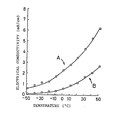
- curve A represents the changes of the electric conductivity of the electrolyte solution in Example 28 with temperature
- B shows the changes of the electric conductivity of the electrolyte solution obtained in Comparative Example 10 with temperature.
- GBL Gamma-butyrolactone
- DMF N,N-Dimethylformamide
- MPN 3-Methoxypropionitrile
- TMP Trimethyl phosphate
- PC Propylene carbonate
- EG Ethylene glycol
- Monotetraethylammonium maleate was dissolved in a concentration of 20% by weight in gamma-butyrolactone as a solvent to form an electrolyte solution.
- the electrolyte solution had an electric conductivity of 13.7 mS/cm at 25°C which was more than twice that of the electrolyte solution containing an amine salt (obtained in Comparative Example 1) or the electrolyte solution containing an adipic acid salt (obtained in Comparative Example 4).
- a constant current of 2 mA/cm2 was applied to one set of plus and minus smooth aluminum foils in the electrolyte solution, the voltage at which spark was generated was 83 V.
- Example 1 was repeated except that N,N-dimethylformamide (Example 2), propylene carbonate (Example 3), a mixture of gamma-butyrolactone and ethylene glycol (80:20 by weight percent) (Example 4), 3-methoxypropionitrile (Example 5), or trimethyl phosphate (Example 6) was used respectively instead of the gamma-butyrolactone.
- the electric conductivity and sparking voltage of the electrolyte solution were measured, and the results are shown in Table 1.
- Example 1 was repeated except that monotetrapropylammonium maleate (Example 7), monotetrabutylammonium maleate (Example 8), mono-N-methyl-N-ethylpyrrolidinium maleate (Example 9), or ditetraethylammonium maleate (Example 10) was used instead of mono tetraethylammonium maleate.
- the electric conductivity and sparking voltage of the electrolyte solution were measured, and the results are shown in Table 1.
- Example 1 was repeated except that monotetraethylammonium citraconate was used instead of monotetraethylammonium maleate.
- the resulting electrolyte solution had an electric conductivity of 11.8 mS/cm, and a sparking voltage of 86 V.
- Monotriethylammonium maleate was dissolved in a concentration of 20% by weight in gamma-butyrolactone (Comparative Example 1), N,N-dimethylformamide (Comparative Example 2) or propylene carbonate (Comparative Example 3) as a solvent to form an electrolyte solution.
- the electric conductivity of the electrolyte solution was measured, and the results are shown in Table 2.
- Tetraethylammonium benzoate was dissolved in a concentration of 20% by weight in gamma-butyrolactone as a solvent to form an electrolyte solution.
- the electrolyte solution had an electric conductivity of 8.4 mS/cm at 25°C, and a sparking voltage of 133 V when a constant current of 2 mA/cm was applied to one set of plus and minus smooth aluminum foils in the electrolyte solution.
- Example 12 was repeated except that monotetraethylammonium phthalate (Example 13), monotetraethylammonium trimellitate (Example 14), or ditetraethylammonium pyromellitate (Example 15) was used instead of the tetraethylammonium benzoate.
- the electric conductivity and the sparking voltage of the electrolyte solution were measured, and the results are shown in Table 3.
- Example 12 was repeated except that N,N-dimethylformamide (Example 16), 3-methoxypropionitrile (Example 17) or trimethyl phosphate (Example 18) was used instead of gamma-butyrolactone.
- the electric conductivity of the electrolyte solution was measured, and the results are shown in Table 3.
- Example 1 was repeated except that monotetraethylammonium adipate was used instead of the monotetraethylammonium maleate.
- the electric conductivity and sparking voltage of the electrolyte solution were measured, and the results are shown in Table 4.
- Monotetraethylammonium adipate was dissolved in a concentration of 20% by weight in N,N-dimethylformamide (Comparative Example 5), 3-methoxypropionitrile (Comparative Example 6), trimethyl phosphate (Comparative Example 7) or propylene carbonate (Comparative Example 8) as a solvent.
- the electric conductivity and sparking voltage of the electrolyte solution were measured, and the results are shown in Table 4.
- Example 12 was repeated except that triethylammonium benzoate was used instead of the tetraethylammonium benzoate.
- the resulting electrolyte solution had a poor electric conductivity of 0.8 mS/cm.
- Example 12 was repeated except that tetraethylammonium salicylate (Example 19), tetraethylammonium p-nitrobenzoate (Example 20), tetraethylammonium o-nitrobenzoate (Example 21), tetraethylammonium o-toluate (Example 22), tetraethylammonium o-anisate (Example 23) or tetraethylammonium gamma-resorcylate (Example 24) was used instead of the tetraethylammonium benzoate.
- the electric conductivity of the resulting electrolyte solution was measured, and the results are shown in Table 5.
- Monotetraethylammonium 6-ethyl-1,16-hexadecanedicarboxylate was dissolved in a concentration of 5% by weight in gamma-butyrolactone as a solvent to form an electrolyte solution.
- This electrolyte solution had an electric conductivity at 25°C of 2.0 mS/cm and a sparking voltage of 355 V when a constant current of 4 mA/cm2 was applied to one set of plus and minus smooth aluminum foils in the electrolyte solution.
- Example 25 was repeated except that the concentration of the solute was changed to 2%(Example 26), 10% (Example 27), 20%(Example 28), 30%(Example 29) or 40% (Example 30) by weight.
- the electric conductivity and sparking voltage of the electrolyte solution were measured, and the results are shown in Table 6.
- Example 25 was repeated except that N,N-dimethylformamide was used instead of gamma-butyrolactone.
- the electric conductivity and the sparking voltage of the resulting electrolyte solution are shown in Table 6.
- Monotetraethylammonium 3-hexyl-1,2-decanedicarboxylate was dissolved in a concentration of 20% by weight in gamma-butyrolactone as a solvent to form an electrolyte solution. Its electric conductivity and sparking voltage are shown in Table 6.
- Example 32 was repeated except that monotetraethylammonium 7,12-dimethyl-7,11-octadecadiene-1,18-dicarboxylate (Example 33) or monotetraethylammonium 6,8-diphenyl-1,14-tetradecanedicarboxylate (Example 34) was used instead of the monotetraethylammonium 3-hexyl-1,2-decanedicarboxylate.
- the electric conductivity and sparking voltage of the electrolyte solution are shown in Table 6.
- Ammonium 6-ethyl-1,16-hexadecanedicarboxylate was dissolved in a concentration of 20% by weight in ethylene glycol as a solvent to form an electrolyte solution.
- the electric conductivity of the electrolyte solution is shown in Table 6.
- Ammonium 6-ethyl-1,16-hexadecanedicarboxylate (5% by weight) was added to gamma-butyrolactone as a solvent, and the mixture was heated. The compound partly did not dissolve, and the resulting product was unsuitable for use as an electrolyte solution.
- Example 28 Changes in the electric conductivities of the electrolyte solutions obtained in Example 28 and Comparative Example 10 with temperature were measured, and are shown in the Drawing.
- the electrolyte solution of this invention (Example 28) had much higher electric conductivity than the electrolyte solution of Comparative Example 10, and did not freeze even at -50°C.
Landscapes
- Engineering & Computer Science (AREA)
- Power Engineering (AREA)
- Chemical & Material Sciences (AREA)
- Chemical Kinetics & Catalysis (AREA)
- Electrochemistry (AREA)
- Microelectronics & Electronic Packaging (AREA)
- Electric Double-Layer Capacitors Or The Like (AREA)
- Organic Low-Molecular-Weight Compounds And Preparation Thereof (AREA)
Applications Claiming Priority (6)
| Application Number | Priority Date | Filing Date | Title |
|---|---|---|---|
| JP286982/85 | 1985-12-20 | ||
| JP60286980A JPS62145713A (ja) | 1985-12-20 | 1985-12-20 | 電解コンデンサ用電解液 |
| JP28698285A JPS62145715A (ja) | 1985-12-20 | 1985-12-20 | 電解コンデンサ用電解液 |
| JP286980/85 | 1985-12-20 | ||
| JP61098673A JPH0797541B2 (ja) | 1986-04-28 | 1986-04-28 | 電解コンデンサ用電解液 |
| JP98673/86 | 1986-04-28 |
Publications (3)
| Publication Number | Publication Date |
|---|---|
| EP0227433A2 true EP0227433A2 (de) | 1987-07-01 |
| EP0227433A3 EP0227433A3 (en) | 1987-09-02 |
| EP0227433B1 EP0227433B1 (de) | 1992-01-15 |
Family
ID=27308734
Family Applications (1)
| Application Number | Title | Priority Date | Filing Date |
|---|---|---|---|
| EP86309882A Expired EP0227433B1 (de) | 1985-12-20 | 1986-12-17 | Elektrolytische Lösung eines quaternären Ammoniumsalzes für elektrolytische Kondensatoren |
Country Status (3)
| Country | Link |
|---|---|
| US (1) | US4715976A (de) |
| EP (1) | EP0227433B1 (de) |
| DE (1) | DE3683473D1 (de) |
Cited By (5)
| Publication number | Priority date | Publication date | Assignee | Title |
|---|---|---|---|---|
| EP0263182A4 (de) * | 1986-02-21 | 1988-12-15 | Sanyo Chemical Ind Ltd | Elektrolytlösung für elektrolytkondensator, sowie mit dieser lösung hergestellter elektrolytkondensator. |
| EP0299496A1 (de) * | 1987-07-17 | 1989-01-18 | Asahi Glass Company Ltd. | Elektrolytkondensator |
| US5055975A (en) * | 1989-06-29 | 1991-10-08 | Siemens Aktiengesellschaft | Electrolyte capacitor |
| EP0543311A3 (en) * | 1991-11-19 | 1993-09-15 | Nippon Chemi-Con Corporation | Electrolytic solution for electrolytic capacitor |
| GB2521022A (en) * | 2013-07-26 | 2015-06-10 | Innospec Ltd | Compositions and methods |
Families Citing this family (26)
| Publication number | Priority date | Publication date | Assignee | Title |
|---|---|---|---|---|
| US5202042A (en) * | 1987-03-09 | 1993-04-13 | Nippon Chemi-Con Corporation | Heterocyclic electrolyte salts for electrolytic capacitors |
| JPS63226912A (ja) * | 1987-03-16 | 1988-09-21 | 日本ケミコン株式会社 | 電解コンデンサ用電解液 |
| US4835660A (en) * | 1988-08-15 | 1989-05-30 | North American Philips Corporation | Use of choline as the cation in capacitor for electrolytes |
| US4860169A (en) * | 1988-12-14 | 1989-08-22 | North American Philips Corporation | Long chain carboxylic acids for very high voltage aluminum electrolytic capacitors |
| EP0591810B1 (de) * | 1992-09-29 | 1997-12-29 | Matsushita Electric Industrial Co., Ltd. | Elektrolyt zur Verwendung in Elektrolytkondensatoren und Elektrolytkondensator |
| US5870275A (en) * | 1993-12-03 | 1999-02-09 | Sanyo Chemical Industries, Ltd. | Electrolyte and electronic component using same |
| JPH08203781A (ja) * | 1995-01-31 | 1996-08-09 | Matsushita Electric Ind Co Ltd | チップ形アルミ電解コンデンサ |
| US6017367A (en) * | 1995-08-15 | 2000-01-25 | Matsushita Electric Industrial Co., Ltd. | Chip type aluminum electrolytic capacitor |
| US6166899A (en) | 1997-12-18 | 2000-12-26 | Nippon Chemi-Con Corporation | Electrolyte for electrolytic capacitor and electrolytic capacitor having the same |
| JPH11283874A (ja) | 1998-01-28 | 1999-10-15 | Matsushita Electric Ind Co Ltd | 電解コンデンサ |
| US6149793A (en) * | 1998-06-04 | 2000-11-21 | Kemet Electronics Corporation | Method and electrolyte for anodizing valve metals |
| ATE350757T1 (de) * | 1998-08-28 | 2007-01-15 | Greatbatch W Ltd | Elektrolyt für einen kondensator |
| CN100440397C (zh) * | 2001-01-15 | 2008-12-03 | 宇部兴产株式会社 | 电解电容器用电解液 |
| DE10104714C1 (de) * | 2001-02-02 | 2002-07-25 | Epcos Ag | Betriebselektrolyt für einen Aluminium-Elektrolyt-Kondensator, Kondensator mit dem Betriebselektrolyt und Verwendung des Kondensators |
| US7807300B2 (en) * | 2006-01-31 | 2010-10-05 | Medtronic, Inc. | Resistance-stabilizing additives for electrolyte |
| KR100922706B1 (ko) * | 2001-12-11 | 2009-10-22 | 오카무라 세이유 가부시키가이샤 | 전해액용 조성물 및 이의 제조방법 |
| US20040161671A1 (en) * | 2003-02-13 | 2004-08-19 | Medtronic, Inc. | Liquid electrolyte for an electrochemical cell |
| EP2698802B1 (de) * | 2004-09-07 | 2018-05-16 | Panasonic Intellectual Property Management Co., Ltd. | Elektrolytkondensator |
| US20070077488A1 (en) * | 2005-10-04 | 2007-04-05 | Kaimin Chen | Power capability of a cathode |
| JP2007110033A (ja) * | 2005-10-17 | 2007-04-26 | Sanyo Chem Ind Ltd | 電解液およびそれを用いた電解コンデンサ |
| JP2007158203A (ja) * | 2005-12-08 | 2007-06-21 | Nichicon Corp | 電解コンデンサ |
| US20070176151A1 (en) * | 2006-01-31 | 2007-08-02 | Kaimin Chen | Electrolyte additive for performance stability of batteries |
| JPWO2008029821A1 (ja) * | 2006-09-07 | 2010-01-21 | パナソニック株式会社 | 電解液とそれを用いた電解コンデンサ |
| US9105401B2 (en) | 2011-12-02 | 2015-08-11 | Avx Corporation | Wet electrolytic capacitor containing a gelled working electrolyte |
| RU2716491C1 (ru) * | 2019-07-29 | 2020-03-12 | Открытое акционерное общество "Элеконд" | Рабочий электролит для конденсатора, способ его приготовления и алюминиевый электролитический конденсатор с таким электролитом |
| US12512274B2 (en) | 2022-08-26 | 2025-12-30 | KYOCERA AVX Components Corporation | Wet electrolytic capacitor containing a gelled working electrolyte |
Family Cites Families (15)
| Publication number | Priority date | Publication date | Assignee | Title |
|---|---|---|---|---|
| US3118939A (en) * | 1960-06-29 | 1964-01-21 | Sprague Electric Co | Quaternary ammonium hexaborates |
| US3223639A (en) * | 1962-07-10 | 1965-12-14 | Union Carbide Corp | Solion electrolyte |
| US3403304A (en) * | 1966-02-07 | 1968-09-24 | Sprague Electric Co | Electrolytic capacitor with an electrolyte of an ammonium organoboron compound |
| US3300693A (en) * | 1966-06-28 | 1967-01-24 | Sprague Electric Co | Capacitor with low resistivity electrolyte and high voltage range |
| GB1147058A (en) * | 1966-10-17 | 1969-04-02 | Tavkozlesi Ki | A method for preparing electrolytic capacitors |
| US3567518A (en) * | 1968-10-07 | 1971-03-02 | Sprague Electric Co | Solid-state battery cell with complex organic electrolyte material |
| DE1805383C3 (de) * | 1968-10-26 | 1981-09-03 | Les Condensateurs Sic-Safco, Colombes, Hauts-de-Seine | Elektrolyt für Elektrolytkondensatoren mit Aluminiumanoden |
| DE2209095C3 (de) * | 1971-02-25 | 1978-03-09 | Sanyo Electric Co., Ltd., Moriguchi, Osaka (Japan) | Elektrolyt für Elektrolytkondensatoren |
| US4101458A (en) * | 1973-11-16 | 1978-07-18 | Sanyo Electric Co., Ltd. | Electrolyte for electrolytic capacitors |
| GB2051393A (en) * | 1979-05-23 | 1981-01-14 | Ibm | Electrochromic electrolyte |
| US4408258A (en) * | 1980-09-24 | 1983-10-04 | North American Philips Corporation | Aluminum electrode capacitor and glycol fill electrolyte therefor |
| US4377692A (en) * | 1981-07-24 | 1983-03-22 | Sprague Electric Company | Anomalous salts of dibasic acids |
| US4399489A (en) * | 1982-03-25 | 1983-08-16 | Sprague Electric Company | High temperature electrolytic capacitor |
| NL8203708A (nl) * | 1982-09-24 | 1984-04-16 | Philips Nv | Elektrolytische kondensator. |
| US4469610A (en) * | 1983-07-18 | 1984-09-04 | Nippon Chemi-Con Corporation | Electrolyte for an electrolytic capacitor |
-
1986
- 1986-12-17 EP EP86309882A patent/EP0227433B1/de not_active Expired
- 1986-12-17 DE DE8686309882T patent/DE3683473D1/de not_active Expired - Lifetime
- 1986-12-19 US US06/943,728 patent/US4715976A/en not_active Expired - Lifetime
Cited By (13)
| Publication number | Priority date | Publication date | Assignee | Title |
|---|---|---|---|---|
| EP0263182A4 (de) * | 1986-02-21 | 1988-12-15 | Sanyo Chemical Ind Ltd | Elektrolytlösung für elektrolytkondensator, sowie mit dieser lösung hergestellter elektrolytkondensator. |
| EP0299496A1 (de) * | 1987-07-17 | 1989-01-18 | Asahi Glass Company Ltd. | Elektrolytkondensator |
| US4831499A (en) * | 1987-07-17 | 1989-05-16 | Asahi Glass Company Ltd. | Electrolytic capacitor |
| US5055975A (en) * | 1989-06-29 | 1991-10-08 | Siemens Aktiengesellschaft | Electrolyte capacitor |
| EP0543311A3 (en) * | 1991-11-19 | 1993-09-15 | Nippon Chemi-Con Corporation | Electrolytic solution for electrolytic capacitor |
| US5338472A (en) * | 1991-11-19 | 1994-08-16 | Nippon Chemi-Con Corporation | Electrolytic solution for electrolytic capacitor |
| CN1035906C (zh) * | 1991-11-19 | 1997-09-17 | 日本凯米空株式会社 | 用于电解电容器的电解溶液 |
| GB2521022A (en) * | 2013-07-26 | 2015-06-10 | Innospec Ltd | Compositions and methods |
| GB2527241A (en) * | 2013-07-26 | 2015-12-16 | Innospec Ltd | Compositions and methods |
| GB2533892A (en) * | 2013-07-26 | 2016-07-06 | Innospec Ltd | Compositions and methods |
| GB2533892B (en) * | 2013-07-26 | 2018-04-11 | Innospec Ltd | Compositions and methods |
| GB2521022B (en) * | 2013-07-26 | 2018-04-11 | Innospec Ltd | Compositions and methods |
| GB2527241B (en) * | 2013-07-26 | 2018-04-11 | Innospec Ltd | Compositions and methods |
Also Published As
| Publication number | Publication date |
|---|---|
| DE3683473D1 (de) | 1992-02-27 |
| EP0227433A3 (en) | 1987-09-02 |
| EP0227433B1 (de) | 1992-01-15 |
| US4715976A (en) | 1987-12-29 |
Similar Documents
| Publication | Publication Date | Title |
|---|---|---|
| US4715976A (en) | Electrolyte solution for electrolytic capacitor | |
| KR910003216B1 (ko) | 전해콘덴서구동용 전해액 및 그것을 사용한 전해콘덴서 | |
| US4740869A (en) | Electrolytic capacitor | |
| JPH036646B2 (de) | ||
| JPS62145715A (ja) | 電解コンデンサ用電解液 | |
| JP2611301B2 (ja) | 電解コンデンサ用電解液 | |
| KR940010192B1 (ko) | 전해콘덴서용 전해액 | |
| US5202042A (en) | Heterocyclic electrolyte salts for electrolytic capacitors | |
| JPS62145714A (ja) | 電解コンデンサ用電解液 | |
| JP2701874B2 (ja) | 電解コンデンサ用電解液 | |
| JP2774524B2 (ja) | 電解コンデンサ用電解液 | |
| JPH0797541B2 (ja) | 電解コンデンサ用電解液 | |
| JP2732406B2 (ja) | 電解コンデンサ用電解液 | |
| JP2672125B2 (ja) | 電解コンデンサ用電解液 | |
| JPS62145716A (ja) | 電解コンデンサ用電解液 | |
| JP2774525B2 (ja) | 電解コンデンサ用電解液 | |
| JPH0351285B2 (de) | ||
| JPH0376007B2 (de) | ||
| JPH01196114A (ja) | 電解コンデンサ用電解液 | |
| JPH0269918A (ja) | 電解コンデンサ用電解液 | |
| JP2672128B2 (ja) | 電解コンデンサ用電解液 | |
| JPS6345711A (ja) | 電解コンデンサ | |
| JPH0269913A (ja) | 電解コンデンサ用電解液 | |
| JPS63248113A (ja) | 電解コンデンサ | |
| JPH0254919A (ja) | 電解コンデンサ用電解液 |
Legal Events
| Date | Code | Title | Description |
|---|---|---|---|
| PUAI | Public reference made under article 153(3) epc to a published international application that has entered the european phase |
Free format text: ORIGINAL CODE: 0009012 |
|
| AK | Designated contracting states |
Kind code of ref document: A2 Designated state(s): DE FR GB NL |
|
| PUAL | Search report despatched |
Free format text: ORIGINAL CODE: 0009013 |
|
| AK | Designated contracting states |
Kind code of ref document: A3 Designated state(s): DE FR GB NL |
|
| 17P | Request for examination filed |
Effective date: 19880212 |
|
| 17Q | First examination report despatched |
Effective date: 19900828 |
|
| GRAA | (expected) grant |
Free format text: ORIGINAL CODE: 0009210 |
|
| AK | Designated contracting states |
Kind code of ref document: B1 Designated state(s): DE FR GB NL |
|
| REF | Corresponds to: |
Ref document number: 3683473 Country of ref document: DE Date of ref document: 19920227 |
|
| ET | Fr: translation filed | ||
| PLBE | No opposition filed within time limit |
Free format text: ORIGINAL CODE: 0009261 |
|
| STAA | Information on the status of an ep patent application or granted ep patent |
Free format text: STATUS: NO OPPOSITION FILED WITHIN TIME LIMIT |
|
| 26N | No opposition filed | ||
| REG | Reference to a national code |
Ref country code: GB Ref legal event code: IF02 |
|
| PGFP | Annual fee paid to national office [announced via postgrant information from national office to epo] |
Ref country code: FR Payment date: 20051208 Year of fee payment: 20 |
|
| PGFP | Annual fee paid to national office [announced via postgrant information from national office to epo] |
Ref country code: GB Payment date: 20051214 Year of fee payment: 20 |
|
| PGFP | Annual fee paid to national office [announced via postgrant information from national office to epo] |
Ref country code: NL Payment date: 20051215 Year of fee payment: 20 Ref country code: DE Payment date: 20051215 Year of fee payment: 20 |
|
| PG25 | Lapsed in a contracting state [announced via postgrant information from national office to epo] |
Ref country code: GB Free format text: LAPSE BECAUSE OF EXPIRATION OF PROTECTION Effective date: 20061216 |
|
| PG25 | Lapsed in a contracting state [announced via postgrant information from national office to epo] |
Ref country code: NL Free format text: LAPSE BECAUSE OF EXPIRATION OF PROTECTION Effective date: 20061217 |
|
| REG | Reference to a national code |
Ref country code: GB Ref legal event code: PE20 |
|
| NLV7 | Nl: ceased due to reaching the maximum lifetime of a patent |
Effective date: 20061217 |