EP0227839B1 - Procede de formage d'un film mince - Google Patents
Procede de formage d'un film mince Download PDFInfo
- Publication number
- EP0227839B1 EP0227839B1 EP86904352A EP86904352A EP0227839B1 EP 0227839 B1 EP0227839 B1 EP 0227839B1 EP 86904352 A EP86904352 A EP 86904352A EP 86904352 A EP86904352 A EP 86904352A EP 0227839 B1 EP0227839 B1 EP 0227839B1
- Authority
- EP
- European Patent Office
- Prior art keywords
- reaction chamber
- thin film
- cleaning
- film
- substrate
- Prior art date
- Legal status (The legal status is an assumption and is not a legal conclusion. Google has not performed a legal analysis and makes no representation as to the accuracy of the status listed.)
- Expired - Lifetime
Links
Images



Classifications
-
- H—ELECTRICITY
- H10—SEMICONDUCTOR DEVICES; ELECTRIC SOLID-STATE DEVICES NOT OTHERWISE PROVIDED FOR
- H10P—GENERIC PROCESSES OR APPARATUS FOR THE MANUFACTURE OR TREATMENT OF DEVICES COVERED BY CLASS H10
- H10P14/00—Formation of materials, e.g. in the shape of layers or pillars
- H10P14/60—Formation of materials, e.g. in the shape of layers or pillars of insulating materials
- H10P14/65—Formation of materials, e.g. in the shape of layers or pillars of insulating materials characterised by treatments performed before or after the formation of the materials
- H10P14/6502—Formation of materials, e.g. in the shape of layers or pillars of insulating materials characterised by treatments performed before or after the formation of the materials of treatments performed before formation of the materials
- H10P14/6504—In-situ cleaning
-
- G—PHYSICS
- G03—PHOTOGRAPHY; CINEMATOGRAPHY; ANALOGOUS TECHNIQUES USING WAVES OTHER THAN OPTICAL WAVES; ELECTROGRAPHY; HOLOGRAPHY
- G03F—PHOTOMECHANICAL PRODUCTION OF TEXTURED OR PATTERNED SURFACES, e.g. FOR PRINTING, FOR PROCESSING OF SEMICONDUCTOR DEVICES; MATERIALS THEREFOR; ORIGINALS THEREFOR; APPARATUS SPECIALLY ADAPTED THEREFOR
- G03F7/00—Photomechanical, e.g. photolithographic, production of textured or patterned surfaces, e.g. printing surfaces; Materials therefor, e.g. comprising photoresists; Apparatus specially adapted therefor
- G03F7/70—Microphotolithographic exposure; Apparatus therefor
- G03F7/708—Construction of apparatus, e.g. environment aspects, hygiene aspects or materials
- G03F7/70908—Hygiene, e.g. preventing apparatus pollution, mitigating effect of pollution or removing pollutants from apparatus
- G03F7/70925—Cleaning, i.e. actively freeing apparatus from pollutants, e.g. using plasma cleaning
-
- H—ELECTRICITY
- H10—SEMICONDUCTOR DEVICES; ELECTRIC SOLID-STATE DEVICES NOT OTHERWISE PROVIDED FOR
- H10P—GENERIC PROCESSES OR APPARATUS FOR THE MANUFACTURE OR TREATMENT OF DEVICES COVERED BY CLASS H10
- H10P14/00—Formation of materials, e.g. in the shape of layers or pillars
- H10P14/60—Formation of materials, e.g. in the shape of layers or pillars of insulating materials
- H10P14/63—Formation of materials, e.g. in the shape of layers or pillars of insulating materials characterised by the formation processes
- H10P14/6326—Deposition processes
- H10P14/6328—Deposition from the gas or vapour phase
- H10P14/6334—Deposition from the gas or vapour phase using decomposition or reaction of gaseous or vapour phase compounds, i.e. chemical vapour deposition
-
- H—ELECTRICITY
- H10—SEMICONDUCTOR DEVICES; ELECTRIC SOLID-STATE DEVICES NOT OTHERWISE PROVIDED FOR
- H10P—GENERIC PROCESSES OR APPARATUS FOR THE MANUFACTURE OR TREATMENT OF DEVICES COVERED BY CLASS H10
- H10P14/00—Formation of materials, e.g. in the shape of layers or pillars
- H10P14/60—Formation of materials, e.g. in the shape of layers or pillars of insulating materials
- H10P14/65—Formation of materials, e.g. in the shape of layers or pillars of insulating materials characterised by treatments performed before or after the formation of the materials
- H10P14/6502—Formation of materials, e.g. in the shape of layers or pillars of insulating materials characterised by treatments performed before or after the formation of the materials of treatments performed before formation of the materials
- H10P14/6512—Formation of materials, e.g. in the shape of layers or pillars of insulating materials characterised by treatments performed before or after the formation of the materials of treatments performed before formation of the materials by exposure to a gas or vapour
-
- H—ELECTRICITY
- H10—SEMICONDUCTOR DEVICES; ELECTRIC SOLID-STATE DEVICES NOT OTHERWISE PROVIDED FOR
- H10P—GENERIC PROCESSES OR APPARATUS FOR THE MANUFACTURE OR TREATMENT OF DEVICES COVERED BY CLASS H10
- H10P14/00—Formation of materials, e.g. in the shape of layers or pillars
- H10P14/60—Formation of materials, e.g. in the shape of layers or pillars of insulating materials
- H10P14/69—Inorganic materials
- H10P14/694—Inorganic materials composed of nitrides
- H10P14/6943—Inorganic materials composed of nitrides containing silicon
- H10P14/69433—Inorganic materials composed of nitrides containing silicon the material being a silicon nitride not containing oxygen, e.g. SixNy or SixByNz
-
- H—ELECTRICITY
- H10—SEMICONDUCTOR DEVICES; ELECTRIC SOLID-STATE DEVICES NOT OTHERWISE PROVIDED FOR
- H10P—GENERIC PROCESSES OR APPARATUS FOR THE MANUFACTURE OR TREATMENT OF DEVICES COVERED BY CLASS H10
- H10P70/00—Cleaning of wafers, substrates or parts of devices
- H10P70/10—Cleaning before device manufacture, i.e. Begin-Of-Line process
- H10P70/12—Cleaning before device manufacture, i.e. Begin-Of-Line process by dry cleaning only
Definitions
- the present invention relates to a method of forming thin films such as gate insulating films, passivation films and reflection checking films on the surfaces of III-V group compound semiconductors by chemical vapour deposition (CVD).
- CVD chemical vapour deposition
- EP-A-0104658 As a thin film formation method there is known from EP-A-0104658 for example a photo CVD method which activates the reactive gases by optical energy.
- This method has the advantage that it enables film formation at low temperatures and does not damage the formed surface of the semiconductor substrate.
- the photo CVD method of thin film deposition makes use of a substrate (1) held within a reaction chamber (2), heating means (3) for heating the substrate, and a low pressure mercury lamp (9) for irradiating the substrate, as shown by the example illustrated in Fig. 1 of the accompanying drawings.
- a doping system (7) is equipped with a mercury bubbler (13) for exciting the reactive gas, and an exhaust system (8) is equipped with a rotary pump (19).
- amorphous silicon for example, on the substrate (which is at a temperature of 250°C) as a reaction product, through introduction of a reaction gas, for instance disilane, from the doping system to the reaction chamber (2), there is also formed at the same time a thick silicon film on the mercury lamp covering plate (10) which is typically a quartz window for transmission of ultraviolet rays.
- a reaction gas for instance disilane
- an oil for example a fluorine-based oil
- the oil prevents the formation of a silicon film on the window (10), it causes oil components to become mixed in the film as impurities. Further, the tendency of the oil to be mixed in the film increases as the distance between the window and the surface of the formed film is reduced so that this distance cannot be made less than 4 cm (generally, it can be reduced only to 5 cm). On the other hand, however, a reduction of this distance is effective for increasing the irradiation by the ultraviolet rays from the mercury lamp of the semiconductor surface where the film is being formed.
- the object of the present invention is thus to provide a solution to the abovementioned problems.
- a method of manufacturing a semiconductor device which includes the CVD formation of at least one thin film onto the surface of a III-V group compound semiconductor substrate characterized in that prior to the deposition of the thin film the semiconductor substrate surface is subjected to a cleaning step within the CVD apparatus for removal of surface contaminants, such cleaning step being effected by exposure of the substrate for a predetermined time period to active hydrogen and/or to an active halogen generated within the CVD apparatus by photodecomposition of a non-oxide hydride and/or halide introduced into the CVD apparatus.
- the invention provides for the generation of active hydrogens by photo-activating nonoxide hydrides such as ammonia or hydrazine (which are hydrogen nitrides) or methane, ethane, propane, or ethylene (which are hydrogen carbides).
- nonoxide hydrides such as ammonia or hydrazine (which are hydrogen nitrides) or methane, ethane, propane, or ethylene (which are hydrogen carbides).
- the reduced Ga and As can recombine with each other. Similarly, oxides on the surface of other III-V group compound semiconductor substrates can be removed.
- nitride film for example, silicon nitride or aluminum nitride, can be formed on the surface to a thickness of 1 to 5 nm (10 to 50 ⁇ ) by a vapor phase (active nitrogen, NH, NH2, and others)-solid phase (GaAs, GaAlAs, and others) reaction.
- the nitride film Since such a film possesses the capability of masking (blocking action) As which is easy to evaporate, dispersion of As into the outside can be obstructed. Further, the nitride film has sufficient blocking action against water, sodium, and others so that it has an advantage that it can prevent the formation of unstable compounds on the substrate surface.
- the present invention has an advantage that during the formation of a film by the photo CVD method, there does not occur a drawback of generating changes in the crystal structure of the substrate itself.
- the invention provides for cleaning of the surface of a III-V group compound semiconductor by the generation of active fluorine or active chlorine by photo-activation of nonoxide halides such as NF3 and N2F4 that are nitrogen fluorides, NCl3 and N2Cl4 that are nitrogen chlorides, and CF3Br, H2CF2, HCCl3, and H2CCl2 that are carbide halides for example.
- active fluorine and hydrogen acts as explained hereinbefore to remove surface contaminants and has the same advantages as are mentioned hereinbefore.
- the photo-cleaning process utilizing active halides there can be formed by the photo CVD method a film that contains fluorine or chlorine, continuously using the identical reaction furnace without returning it to atmospheric pressure. Moreover, in case the thickness of the film formed by the photo CVD method was insufficient, a second film could be formed on top of it by the plasma CVD method in the same reaction furnace.
- the distance between the window covering the ultraviolet source and the surface of the semiconductor substrate upon which the thin film was required to be formed was set to be 3 cm or less, and preferably 0.5 to 2 cm.
- the covering plate according to another feature of the present invention was advantageously constructed, instead of being a single quartz plate, as a louvre window consisting of a plurality of strips fixed to permit ventilation of the CVD reaction chamber.
- a louvre window is effective for admitting to the reaction chamber nonproduct gases (namely, gases which do not form solids by reaction or decomposition, such as He, Ar, H2, N2 NH3, N2O, O2, and mixtures thereof) from the light source chamber through the openings between the louvres.
- the present invention provides a partial pressure reduction means which reduces the partial pressure of the reactive gases or active reaction products in the region of the transparent window so that the deposition of the reaction products on the transparent window is prevented or is made more difficult so as not to shut off the ultraviolet rays.
- This enables the distance between the surface of the semiconductor substrate and the transparent window to be reduced to less than 3 cm, preferably 0.5 to 2.0 cm.
- the substrate with high intensity ultraviolet rays of short wavelength of 185 nm, even without providing a coating of oil or the like on the window, so that the limiting thickness of the film that can be formed can be improved to 60 to 120 nm (600 to 1,200 ⁇ ).
- the necessary thickness for gate insulating films and passivation films becomes obtainable by means of the photo CVD method of the invention.
- the method of the present invention advantageously employs an oil-free system that does not use oil or the like on the window so that the background vacuum can be made below 133.3 ⁇ 10 _ 7 N/m2 (10 _ 7 Torr).
- semiconductor films of silicon or the like, and conductor films of silicon oxide, silicon nitride, aluminum nitride and metals such as titanium and tungsten or their nitrides, can be formed by means of the photo CVD method.
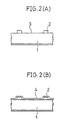
- Fig. 2 is shown a GaAs single crystal semiconductor (1).
- the surface of the semiconductor substrate (1) was cleaned for removal of contaminants (3) by the photo-cleaning and photo CVD apparatus shown in Fig. 3, and a nitride film (4) was formed on its top surface.
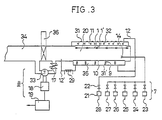
- the substrate (1) is held by a holder (1′) and is placed close to a halogen lamp heater (32) having its upper surface cooled with water (31) in a reaction chamber (20).
- the reaction chamber (20), a light source chamber (35) in which is provided an ultraviolet light source, and a heating chamber (11) in which is provided the heater (32) are arranged to hold their respective pressures that have approximately equal values of less than 1.3 KPa (10 torr).
- a gas nitrogen, argon, or hydrogen
- the light source (35) and the reaction chamber (20) were partitioned by a synthetic quartz window (10). On the upper side of the window (10) there was provided a nozzle (14), and a mixed gas of ammonia (NH3), nitrogen fluoride (NF3), silane (Si n H 2n+2 , n ⁇ 2), and methyl aluminum (Al(CH3)3) was supplied to the reaction chamber.
- NH3 ammonia
- NF3 nitrogen fluoride
- Al(CH3)3 methyl aluminum
- a doping system consists of a valve (22) and a flow meter (21), and reaction gases that will form solid products and gaseous products after reaction are supplied to the reaction chamber (20) from (23) and (24) and from (25) and (26), respectively.
- ammonia or hydrazine was introduced from (25) and (26).
- Si n H 2n+2 (n ⁇ 2) was supplied in addition to the above materials.
- gas was exhausted by means of a turbo molecular pump (PG 550 made by Osaka Vacuum Co.,) (18) and a rotary pump (19) via a control valve (17).
- PG 550 made by Osaka Vacuum Co.,
- a tap (33) of he exhaust system (8) was opened on the preparation chamber side and closed on the reaction chamber side.
- the reaction chamber side was opened and the preparation chamber side was closed.
- the substrate was mounted in the reaction chamber as show.
- the vacuum of the reaction chamber was set to be below 133.3 ⁇ 10 _ 7 N/m2 (10 _ 7 Torr). After that, nitrogen was introduced from (28), and film formation was carried out by introducing reactive gases into the reaction chamber through (7).
- the ultraviolet light source consisted of 16 low pressure mercury lamps made of synthetic quartz, each lamp having an illumination length of 40 cm and being able to radiate light of wavelengths 185 nm and 254 nm with a radiation intensity of 20 mw/cm2 and lamp power of 40 W.
- the ultraviolet light irradiated the formed surface of the substrate (1) in the reaction chamber (20) via quartz window (10).
- a "deposition up” system was adopted with the heater (32) provided on the top side of the reaction chamber and the UV source (35) irradiating the lower surface of the substrate (1), to avoid the possibility of pin holes being caused due to flakes falling from the heater (32) on to the surface of the substrate which is to be coated with a film.
- the ultraviolet light source is housed within a stainless steel light source chamber coupled to the reaction chamber.
- the effective surface area over which thin films could be formed in the illustrated case was 30 cm ⁇ 30 cm, and a configuration was employed to permit the arrangement of four substrates (1) each with a diameter of 12.7cm (5 inches).
- the substrates could be heated to a predetermined temperature ranging from room temperature to 250°C.
- Example 1 Example for forming silicon nitride film on GaAs film.
- N+PP+-type GaAs single crystal semiconductor was used as the substrate (1).
- a P-type semiconductor was grown epitaxially to the thickness of about 5 microns on a P+-type GaAs substrate. Further, an N+ layer was grown epitaxially on top of it to a thickness of 100 to 200 nm (1000 to 2000 ⁇ ). Such a substrate is effective as a photoelectric converter.
- a gold film was formed on top of it by vacuum deposition to a thickness of 300 nm (3000 ⁇ ) to be used as an electrode (2), then, on the surface of the substrate there exist contaminants (3) such as oxides in the region outside of the electrode.
- the substrate were sealed in the reaction chamber, heated to 150°C, and ammonia was introduced from (25) at the flow rate of 300 cc/min. (pressure of 400 N/m2 (3 Torr)).
- the ammonia releases active hydrogen (H) when it is decomposed by ultraviolet rays of 185 nm.
- oxides on the surface of GaAs were cleaned and removed for about 30 minutes.
- the surface can also be nitrified to some extent to a thickness of 0.5 to 5 nm (5 to 50 ⁇ ) with the active nitrides (NH and NH2) that are generated simultaneously.
- Example 2 Example of forming aluminum nitride film.
- the energy band of aluminum nitride (AlN) has a width of 6eV so that even if a film was formed on the window ((10) in Fig.3), it will not block ultraviolet rays and it was possible to form a film with the thickness that is necessary for a reflection checking film by the photo CVD method alone.
- the conversion efficiency was 18.1% (AM 100 mW/cm2) (open-circuit voltage of 0.91 V, release current of 23.0 mA/cm2, and fill factor of 0.78), and characteristics nearly the same as those of silicon nitride were obtained.
- ammonia as the nonoxide hydride.
- it may be substituted by hydrazine (N2H4), or mixed gas of NH3 or N2H4 with hydrogen, helium, nitrogen, or argon.
- these nitrides may be replaced by hydrocarbons C2H6, C2H4, and others.
- gases of fluorides such as NF3 and N2F4 or chlorides such as NCl3 as the material for photo-cleaning is effective.
- AlN obtained from Al(CH3)3 and Si3N4 obtained from Si2H6 and NH3 were shown as nonoxide films.
- similarly nonoxides such as GaN from Ga(CH3)3 and NH3, GaP from Ga(CH3)3 and PH3, and AlP from Al(CH3)3 and PH3.
- Example 3 Example of forming silicon nitride film on GaAs substrate.
- N+PP+-type GaAs single crystal semiconductor described in the foregoing was used as substrate (1).
- a P-type semiconductor was grown epitaxially on a P+-type GaAs substrate to a thickness of about 5 microns.
- an N+ layer was further grown epitaxially to a thickness of 100 to 200 nm (1000 to 2000 ⁇ ).
- This substrate is effective as a photoelectrical converter.
- gold was formed on top of it to the thickness of 300 nm (3000 ⁇ ) by vacuum evaporation method to use it as the electrode (2). Then, there exists contaminants (3) such as oxides in the region of the semiconductor other than that of the electrode.
- the substrate was sealed in the reaction chamber, heated to 150°C, and nitrogen fluoride was introduced from (25) at 30 cc/min (pressure of 400 N/m2 (3 Torr)). In addition, ammonia was introduced from (26) at 30 cc/min. Then, nitrogen fluoride and ammonia release active fluorine (F) and active hydrogen (H) that are decomposed by ultraviolet rays of 185 nm. Oxides on the surface of GaAs were cleaned by (F) and (H) for about 30 minutes to be removed. The active nitrides (NF, NH2, NH, and NH2) that are generated at the same time can nitrify the surface to some extent to a thickness of 0.5 to 5 nm (5 to 50 ⁇ ).
- nitrogen fluoride was introduced from (25) at 30 cc/min (pressure of 400 N/m2 (3 Torr)).
- ammonia was introduced from (26) at 30 cc/min.
- nitrogen fluoride and ammonia release active fluorine (
- nitrogen fluoride was introduced from (25) at 30 cc/min, ammonia from (26) at 30 cc/min, disilane from (23) at 8 cc/min, and nitrogen from (24) at 30 cc/min as reactive gases into the same reaction region, and the substrate temperature was raised to 100°C.
- the number of substrates placed in the reaction chamber was five wafers of diameter of 5 cm (2 inches).
- the pressure within the reaction chamber (20) was set to 400 N/m2 (3.0 Torr).
- the speed of film formation was 1.6 nm/min (16 ⁇ /min).
- the properties of the film obtained were as follows.
- the conversion efficiency obtained can be only about 8%. This value is far smaller than 13% of the conversion efficiency for the case of not forming at all a reflection checking film. Therefore, the usefulness of forming a silicon nitride film on the surface of the GaAs compound semiconductor by the photo CVD method became clear. Further, in the so-called photo CVD alone, without applying the photo-cleaning, the efficiency of 15.2% was obtained. Therefore, it was found by this that the generation of the recombination centers on the surface can be prevented by the photo-cleaning.
- Example 4 Example of forming silicon oxide film.
- H2CF2 was introduced to the reaction chamber at the flow rate of 30 cc/min, and photo-cleaning was carried out at 300°C for 30 minutes by further introducing hydrogen (30 cc/min) as carrier gas, to remove oxides on the surface of the semiconductor.
- N2O and SiH4 were supplied from (23) and (24), respectively, and nitrogen as carrier gas was introduced from (27), to this reaction system.
- H2SiCl2 is used as a reaction gas
- chlorine can be contained in the film at the same time. Namely, atoms of halogens can be mixed simultaneously in the film, sodium ions in the film can be neutralized, and form clean oxides at low temperatures below 350°C.
- the energy band of silicon oxide (SiO2) has a width of 8ev. Therefore, even if a film is formed on the window ((10) in Fig. 3), it will not block ultraviolet rays so that it is possible to form a film which has a necessary thickness as a reflection checking film can be formed by the photo CVD method alone.
- films of SiO2 obtained from SiH4 and N2O and Si3N4 obtained from Si2H6 and NH3 were shown.
- nitride or oxides to which are added halogens also by the photo CVD method such as AlN from Al(CH3)3 and NH3, GaN from Ga(CH3)3 and NH3, GaP from Ga(CH3)3 and PH3, AlP from Al(CH3)3 and PH3, Si3N4 from Si2F6 and NH3, Si3N4 from SiH4 and NH3, SiO2 from SiF4 and O2, SiO2 from Si2F6 and O2, SiO2 from SiH4 and NO or NO2, those compounds that are mixed with phosphorous and bromine.
- the present invention makes it possible to accomplish the formation of films of arbitrary thickness on a substrate of large area using the same reaction chamber, without damaging the formed surface.
- reproducibility from one batch to the next can be improved by the photo-cleaning of the surface of semiconductor elements.
- photo-cleaning removal of oxides and dirt may be done not only by use of active hydrogen or by active fluorine or chlorine but also by mixing active hydrogen and fluorine or chlorine at the same time.
- the present invention there can be formed semiconductor devices such as photoelectric converter, MES FET (field effect semiconductor devices), SL elements (super-lattice elements), and HEMT elements.
- the present invention is also effective for semiconductor lasers, or optical integrated circuits (using III-V group compounds such as GaAs).
- III-V group compounds such as GaAs.
- the light source use may be made of excimer laser (wavelength from 100 to 400 nm), argon laser, nitrogen laser, and the like, instead of or simultaneously with a low voltage mercury lamp.
- the present invention is similarly effective for semiconductors of III-V compounds such as GaAlAs, InP, and GaN not only for GaAs.
- a substrate (1) that has a formed surface held by a holder (1′) is placed close to a halogen heater (3) (its upper surface being water cooled (32)) above a reaction chamber (2).
- the reaction chamber (2), a light source chamber (5) provided with a source of ultraviolet rays (9), and a heating chamber (3′) provided with the heater (3) are maintained at an approximately equal vacuum of a pressure less than 133.3 ⁇ 10 _ 5 N/m2 (100 Torr).
- nonproduct gases nitrogen, hydrogen, helium, or argon
- the reaction are supplied to the light source chamber (5) and a heating chamber (3′) through (27) via a flow meter (21) and a valve (22).
- product gases gases that form solids after reaction
- oxide gases O2, N2O, NO, and NO2
- nitride gases NH3, N2H4, NF3, and N2F4
- silane Si n H 2n+2 n ⁇ 1
- silicon fluorides SiF2, SiF4, Si2F6, and H2SiF2
- carrier gases of nonproduct gases use was made of hydrogen, nitrogen, argon, or helium which was supplied from (24).
- nitrides silicon nitrides, aluminum nitride, gallium nitride, indium nitride, and antimony nitride
- Si2H6, Al(H3)3, Ga(CH3)3, In(CH3)3, Sn(CH3)4, and Sb(CH3)3 which were supplied from (23).
- nonproduct gases use was made of ammonia or hydrazine which was suppled from (26). Further, nonproduct gas (hydrogen or helium) that does not particiate in the reaction was supplied from (24) and (28) as a carrier gas.
- oxides (silicion oxide, phosphorus glass, boron glass, aluminum oxide, indium oxide, tin oxide, antimony oxide, or mixture of these) as the reaction product.
- oxides N2O, O2, NO, or NO2
- the pressure control of the reaction chamber was accomplished by exhausting from a turbo molecular pump (18) (used PG550 made by Osaka Vacuum Co.) and a rotary pump through a control valve (17) and a cock (20).
- a turbo molecular pump (18) used PG550 made by Osaka Vacuum Co.
- a rotary pump through a control valve (17) and a cock (20).
- the exhaust system (8) opened a preparation chamber (4) and closed the reaction chamber (2) side by means of the cock (20), for vacuum pumping the preparation chamber (4).
- the reaction chamber side was opened and the preparation chamber side was closed.
- the formation process of films employed the load and lock system so as not to create pressure difference in moving the substrate from the preparation chamber to the reaction chamber.
- substrate (1) and holder (1′) were inserted and arranged in the preparation chamber.
- a gate valve (6) between the reaction chamber which was vacuum pumped in advance to 133.3 ⁇ 10 _ 7 N/m2 (10 _ 7 Torr) or below, was opened to move the substrates (1) and the holder (1′) to the reaction chamber (2), and the gate valve (6) was closed to partition the reaction chamber (2) and the preparation chamber (4).
- nonproduct gases were introduced first to the light source chamber and the heating chamber at the flow rate of 100 to 1,500 cc/min, and at the same time a nonproduct gas, for example, NH3, was supplied to the reaction chamber in a similar manner. It was left standing in this state for about 30 minutes, and photo-cleaning of the formed surface of the substrate was carried out by generating active hydrogen and fluorine by the photo-decomposition of the gases. Later, the product gases among the reactive gases were supplied through a nozzle (30).
- a nonproduct gas for example, NH3
- the light source for reaction use was made of a low voltage mercury lamp (9) made of synthetic quartz tube with water cooling (32).
- the source of the ultraviolet rays consisted of 16 low voltage mercury lamps (with illumination length of 40 cm, irradiation intensity of 20 mw/cm2, and lamp power of 45 W that can radiate light with 185 nm and 254 nm) made of synthetic quartz.
- the ultraviolet rays irradiate, through transparent covering plate (10) made of synthetic quartz, reactive gases (31) and the formed surface of the substrates (1) in the reaction space of the reaction chamber (2).
- transparent covering plate (10) made of synthetic quartz
- reactive gases (31) reactive gases
- the substrates (1) were heated from the rear side by a halogen lamp heater to a predetermined temperature (between the room temperature and 700°C).
- the reaction chamber was made of stainless steel, and the source of the ultraviolet rays was placed in the light source chamber which was kept under vacuum.
- the light source chamber and the reaction chamber were held under pressure-reduced atmosphere enclosed in a stainless steel container. Because of this, it was possible to form a film on a substrate with size of 30 cm ⁇ 30 cm, not a small film formation area of 5 cm ⁇ 5 cm, without any particular engineering problems.
- Example 5 Example of forming silicon nitride film.
- Fig. 4 ammonia was supplied from (25) as a reactive gas at 50 cc/min and disilane was supplied from (23) at 20 cc/min as a reactive gas, and the substrate temperature was set to 300°C (33), 200°C (34), and 100°C (35) see, Fig. (5).
- the substrate had four wafers of diameter 12.7 cm (5 inches).
- the pressure within the reaction chamber (2) was set at 400 N/m2 (3.0 Torr).
- Nitrogen as a nonproduct gas that does not participate in the reaction was introduced from (26) at 200 cc/min and ammonia as a nonproduct gas that could participate in the reaction was introduced from (27) at 200 cc/min.
- Fig. 5 The dependence of the thickness of silicon nitride in the range of 20 to 110 nm (200 to 1,100 ⁇ ) formed by the reaction for 50 minutes, on the distance, given as abscissa, between the covering plate and the substrate with a film surface, is shown in Fig.5. It will be seen from Fig. 5 that the maximum film thickness of 100 nm (1,000 ⁇ ) was obtained for the distance of 1 cm. Also, it became clear that it is extremely important that the distance has to be less than 3 cm in order to obtain a film thickness greater than 50 nm (500 ⁇ ).
- the film thickness does not depend too much on the temperature. On the contrary, however, it depends strongly on the intensity of light. Based on this, it is conjectured that the film thickness will become large correspondingly when the light intensity becomes greater than 20 mW/cm2.
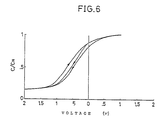
- Fig. 6 is shown the C-V characteristic of silicon nitride film formed on silicon semiconductor, for the case of the distance of 2 cm and the substrate temperature of 300°C.
- the graph corresponds to the case of frequency of 1 MHz, temperature of 300°C, silicon nitride film thickness of 35.2 nm (352 ⁇ ), CN of 3786 pF, and impurity concentration of 4 ⁇ 1015 cm _ 3 .
- a flat band voltage of _0.39 V and a surface level density Qss/q of 8.6 ⁇ 1010 cm _ 2 It is extremely worthwhile to note that a surface level density of less than 1 ⁇ 1011 cm _ 2 was obtained by CVD method.
- the fifth embodiment it was possible, in forming a film on a substrate of large area, to obtain, in addition to the effects of the previous embodiments, a maximum film thickness by setting the distance between the transparent covering plate and the formed surface to be 3 cm or less, preferably 0.5 to 2.0 cm.
- a maximum film thickness by setting the distance between the transparent covering plate and the formed surface to be 3 cm or less, preferably 0.5 to 2.0 cm.
- a louvre window comprising a plurality of window elements instead of a simple synthetic quartz window, may be used, and in addition, it is possible also to provide a partial pressure reduction means on the reaction chamber side. In that case, it is necessary to keep the smallest separation between the upper end portion of the partial pressure reduction means and the formed surface to be 3 cm or less.
- the film growth speed may be improved by letting gases pass through a mercury bubbler.
- the light source was arranged in the lower part and the reaction space was provided in the upper part. However, if it is possible to prevent the generation of flakes by arranging the reaction space in the lower part, contrary to the above, a corresponding arrangement of the substrate is possible and also easy. Moreover, the light source may be arranged sideways.
Landscapes
- Physics & Mathematics (AREA)
- Engineering & Computer Science (AREA)
- Health & Medical Sciences (AREA)
- Epidemiology (AREA)
- Public Health (AREA)
- Plasma & Fusion (AREA)
- Life Sciences & Earth Sciences (AREA)
- Atmospheric Sciences (AREA)
- Environmental & Geological Engineering (AREA)
- General Physics & Mathematics (AREA)
- Drying Of Semiconductors (AREA)
- Cleaning Or Drying Semiconductors (AREA)
Abstract
Claims (10)
Applications Claiming Priority (6)
| Application Number | Priority Date | Filing Date | Title |
|---|---|---|---|
| JP14489785A JPS625633A (ja) | 1985-07-02 | 1985-07-02 | 薄膜形成方法 |
| JP144900/85 | 1985-07-02 | ||
| JP60144900A JP2593642B2 (ja) | 1985-07-02 | 1985-07-02 | 半導体装置およびその作製方法 |
| JP144896/85 | 1985-07-02 | ||
| JP144897/85 | 1985-07-02 | ||
| JP14489685A JPH0622228B2 (ja) | 1985-07-02 | 1985-07-02 | 薄膜形成方法 |
Publications (3)
| Publication Number | Publication Date |
|---|---|
| EP0227839A1 EP0227839A1 (fr) | 1987-07-08 |
| EP0227839A4 EP0227839A4 (fr) | 1988-06-13 |
| EP0227839B1 true EP0227839B1 (fr) | 1991-05-15 |
Family
ID=27318898
Family Applications (1)
| Application Number | Title | Priority Date | Filing Date |
|---|---|---|---|
| EP86904352A Expired - Lifetime EP0227839B1 (fr) | 1985-07-02 | 1986-06-27 | Procede de formage d'un film mince |
Country Status (2)
| Country | Link |
|---|---|
| EP (1) | EP0227839B1 (fr) |
| WO (1) | WO1987000346A1 (fr) |
Cited By (6)
| Publication number | Priority date | Publication date | Assignee | Title |
|---|---|---|---|---|
| EP0316835A1 (fr) * | 1987-11-19 | 1989-05-24 | Oki Electric Industry Company, Limited | Méthode et dispositif pour nettoyer des substrats |
| EP0331555A1 (fr) * | 1988-02-26 | 1989-09-06 | Fujitsu Limited | Procédé de traitement gettering |
| US5225355A (en) * | 1988-02-26 | 1993-07-06 | Fujitsu Limited | Gettering treatment process |
| US6451713B1 (en) | 2000-04-17 | 2002-09-17 | Mattson Technology, Inc. | UV pretreatment process for ultra-thin oxynitride formation |
| US6673262B1 (en) | 1997-12-18 | 2004-01-06 | Central Glass Company, Limited | Gas for removing deposit and removal method using same |
| US6706643B2 (en) | 2002-01-08 | 2004-03-16 | Mattson Technology, Inc. | UV-enhanced oxy-nitridation of semiconductor substrates |
Families Citing this family (3)
| Publication number | Priority date | Publication date | Assignee | Title |
|---|---|---|---|---|
| JPH0228322A (ja) * | 1988-04-28 | 1990-01-30 | Mitsubishi Electric Corp | 半導体基板の前処理方法 |
| EP1403715A3 (fr) * | 2002-09-30 | 2006-01-18 | ASML Netherlands B.V. | Appareil lithographique et méthode pour la fabrication d'un dispositif |
| US8317929B2 (en) | 2005-09-16 | 2012-11-27 | Asml Netherlands B.V. | Lithographic apparatus comprising an electrical discharge generator and method for cleaning an element of a lithographic apparatus |
Family Cites Families (3)
| Publication number | Priority date | Publication date | Assignee | Title |
|---|---|---|---|---|
| JPS57199225A (en) * | 1981-06-02 | 1982-12-07 | Seiko Epson Corp | Manufacture of semiconductor device |
| JPS5958819A (ja) * | 1982-09-29 | 1984-04-04 | Hitachi Ltd | 薄膜形成方法 |
| JPS59124124A (ja) * | 1982-12-29 | 1984-07-18 | Fujitsu Ltd | 半導体装置の製造方法 |
-
1986
- 1986-06-27 EP EP86904352A patent/EP0227839B1/fr not_active Expired - Lifetime
- 1986-06-27 WO PCT/JP1986/000328 patent/WO1987000346A1/fr not_active Ceased
Cited By (7)
| Publication number | Priority date | Publication date | Assignee | Title |
|---|---|---|---|---|
| EP0316835A1 (fr) * | 1987-11-19 | 1989-05-24 | Oki Electric Industry Company, Limited | Méthode et dispositif pour nettoyer des substrats |
| US4871416A (en) * | 1987-11-19 | 1989-10-03 | Oki Electric Industry Co., Ltd. | Method and device for cleaning substrates |
| EP0331555A1 (fr) * | 1988-02-26 | 1989-09-06 | Fujitsu Limited | Procédé de traitement gettering |
| US5225355A (en) * | 1988-02-26 | 1993-07-06 | Fujitsu Limited | Gettering treatment process |
| US6673262B1 (en) | 1997-12-18 | 2004-01-06 | Central Glass Company, Limited | Gas for removing deposit and removal method using same |
| US6451713B1 (en) | 2000-04-17 | 2002-09-17 | Mattson Technology, Inc. | UV pretreatment process for ultra-thin oxynitride formation |
| US6706643B2 (en) | 2002-01-08 | 2004-03-16 | Mattson Technology, Inc. | UV-enhanced oxy-nitridation of semiconductor substrates |
Also Published As
| Publication number | Publication date |
|---|---|
| EP0227839A1 (fr) | 1987-07-08 |
| WO1987000346A1 (fr) | 1987-01-15 |
| EP0227839A4 (fr) | 1988-06-13 |
Similar Documents
| Publication | Publication Date | Title |
|---|---|---|
| US4987008A (en) | Thin film formation method | |
| US5512102A (en) | Microwave enhanced CVD system under magnetic field | |
| US6230650B1 (en) | Microwave enhanced CVD system under magnetic field | |
| JPH0752718B2 (ja) | 薄膜形成方法 | |
| US4588610A (en) | Photo-chemical vapor deposition of silicon nitride film | |
| US4910436A (en) | Wide area VUV lamp with grids and purging jets | |
| EP0227839B1 (fr) | Procede de formage d'un film mince | |
| JPH04151822A (ja) | 化合物半導体の有機金属気相成長法 | |
| US6673722B1 (en) | Microwave enhanced CVD system under magnetic field | |
| US4910044A (en) | Ultraviolet light emitting device and application thereof | |
| EP0466320B1 (fr) | Procédé de préparation d'un dispositif semi-conducteur comprenant le dépôt sélectif de métal | |
| KR920000591B1 (ko) | 마이크로파 강화 cvd시스템 | |
| Li et al. | Low temperature heteroepitaxial growth of Si1− xGexon-Si by photo-enhanced ultra high vacuum chemical vapor deposition using Si2H6 and Ge2H6 | |
| US4719122A (en) | CVD method and apparatus for forming a film | |
| JP2616759B2 (ja) | 薄膜形成方法 | |
| JP2593642B2 (ja) | 半導体装置およびその作製方法 | |
| JPS625640A (ja) | 薄膜形成方法 | |
| JPS6380525A (ja) | 被膜形成方法 | |
| JP3232754B2 (ja) | Ii−vi族化合物半導体の成長方法 | |
| JPH0474430B2 (fr) | ||
| JPS62118521A (ja) | 半導体被膜作製方法 | |
| Osgood Jr | An Overview of Laser Chemical Processing | |
| JPH0669028B2 (ja) | 光cvd薄膜形成装置 | |
| Chan et al. | Selective epitaxial growth of GaInP by low‐pressure metal‐organic chemical‐vapor deposition using ethyldimethylindium as In source | |
| JPS61255014A (ja) | 薄膜成長方法 |
Legal Events
| Date | Code | Title | Description |
|---|---|---|---|
| PUAI | Public reference made under article 153(3) epc to a published international application that has entered the european phase |
Free format text: ORIGINAL CODE: 0009012 |
|
| 17P | Request for examination filed |
Effective date: 19870302 |
|
| AK | Designated contracting states |
Kind code of ref document: A1 Designated state(s): DE FR GB |
|
| A4 | Supplementary search report drawn up and despatched |
Effective date: 19880613 |
|
| RAP1 | Party data changed (applicant data changed or rights of an application transferred) |
Owner name: SEMICONDUCTOR ENERGY LABORATORY CO., LTD. |
|
| 17Q | First examination report despatched |
Effective date: 19890613 |
|
| GRAA | (expected) grant |
Free format text: ORIGINAL CODE: 0009210 |
|
| AK | Designated contracting states |
Kind code of ref document: B1 Designated state(s): DE FR GB |
|
| REF | Corresponds to: |
Ref document number: 3679299 Country of ref document: DE Date of ref document: 19910620 |
|
| ET | Fr: translation filed | ||
| PLBE | No opposition filed within time limit |
Free format text: ORIGINAL CODE: 0009261 |
|
| STAA | Information on the status of an ep patent application or granted ep patent |
Free format text: STATUS: NO OPPOSITION FILED WITHIN TIME LIMIT |
|
| 26N | No opposition filed | ||
| REG | Reference to a national code |
Ref country code: GB Ref legal event code: IF02 |
|
| PGFP | Annual fee paid to national office [announced via postgrant information from national office to epo] |
Ref country code: FR Payment date: 20030610 Year of fee payment: 18 |
|
| PGFP | Annual fee paid to national office [announced via postgrant information from national office to epo] |
Ref country code: GB Payment date: 20030625 Year of fee payment: 18 |
|
| PGFP | Annual fee paid to national office [announced via postgrant information from national office to epo] |
Ref country code: DE Payment date: 20030710 Year of fee payment: 18 |
|
| PG25 | Lapsed in a contracting state [announced via postgrant information from national office to epo] |
Ref country code: GB Free format text: LAPSE BECAUSE OF NON-PAYMENT OF DUE FEES Effective date: 20040627 |
|
| PG25 | Lapsed in a contracting state [announced via postgrant information from national office to epo] |
Ref country code: DE Free format text: LAPSE BECAUSE OF NON-PAYMENT OF DUE FEES Effective date: 20050101 |
|
| GBPC | Gb: european patent ceased through non-payment of renewal fee |
Effective date: 20040627 |
|
| PG25 | Lapsed in a contracting state [announced via postgrant information from national office to epo] |
Ref country code: FR Free format text: LAPSE BECAUSE OF NON-PAYMENT OF DUE FEES Effective date: 20050228 |
|
| REG | Reference to a national code |
Ref country code: FR Ref legal event code: ST |