EP0227947A2 - Vollaromatische mesomorphe Polyesterimide, deren Herstellung und Verwendung - Google Patents
Vollaromatische mesomorphe Polyesterimide, deren Herstellung und Verwendung Download PDFInfo
- Publication number
- EP0227947A2 EP0227947A2 EP86116268A EP86116268A EP0227947A2 EP 0227947 A2 EP0227947 A2 EP 0227947A2 EP 86116268 A EP86116268 A EP 86116268A EP 86116268 A EP86116268 A EP 86116268A EP 0227947 A2 EP0227947 A2 EP 0227947A2
- Authority
- EP
- European Patent Office
- Prior art keywords
- mol
- repeating units
- formulas
- und
- formula
- Prior art date
- Legal status (The legal status is an assumption and is not a legal conclusion. Google has not performed a legal analysis and makes no representation as to the accuracy of the status listed.)
- Withdrawn
Links
- 0 CC1=CCC(C(*)(*)N(C)*)C=C1 Chemical compound CC1=CCC(C(*)(*)N(C)*)C=C1 0.000 description 2
- CINZNKWMEQRLRW-UHFFFAOYSA-N CC(CC1)C=CC1C(C)=O Chemical compound CC(CC1)C=CC1C(C)=O CINZNKWMEQRLRW-UHFFFAOYSA-N 0.000 description 1
- SOORFFQWTKCPDH-UHFFFAOYSA-N CC(CCC1C)CC1C(C)=O Chemical compound CC(CCC1C)CC1C(C)=O SOORFFQWTKCPDH-UHFFFAOYSA-N 0.000 description 1
- RDDBZCWGTIXAOG-UHFFFAOYSA-N CC(c1cc(C)c(C=O)cc1C)=C Chemical compound CC(c1cc(C)c(C=O)cc1C)=C RDDBZCWGTIXAOG-UHFFFAOYSA-N 0.000 description 1
- KWIOILGCKUTQQF-UHFFFAOYSA-N CCC1(C)C2=CCC(C)C=C2C1C Chemical compound CCC1(C)C2=CCC(C)C=C2C1C KWIOILGCKUTQQF-UHFFFAOYSA-N 0.000 description 1
- VPZPLSUFTYHQKY-UHFFFAOYSA-N COC(C=CC1C=C2)=CC1C=C2OC Chemical compound COC(C=CC1C=C2)=CC1C=C2OC VPZPLSUFTYHQKY-UHFFFAOYSA-N 0.000 description 1
- YYZNONMEYBVCCR-UHFFFAOYSA-N COC1C=CC(OC)=CC1 Chemical compound COC1C=CC(OC)=CC1 YYZNONMEYBVCCR-UHFFFAOYSA-N 0.000 description 1
- DPZNOMCNRMUKPS-UHFFFAOYSA-N COc1cc(OC)ccc1 Chemical compound COc1cc(OC)ccc1 DPZNOMCNRMUKPS-UHFFFAOYSA-N 0.000 description 1
- AZIHFYUYWBVPTC-UHFFFAOYSA-N COc1cccc([C-]=O)c1 Chemical compound COc1cccc([C-]=O)c1 AZIHFYUYWBVPTC-UHFFFAOYSA-N 0.000 description 1
- QCIFLGSATTWUQJ-UHFFFAOYSA-O Cc(cc1)ccc1[NH2+]C Chemical compound Cc(cc1)ccc1[NH2+]C QCIFLGSATTWUQJ-UHFFFAOYSA-O 0.000 description 1
Classifications
-
- C—CHEMISTRY; METALLURGY
- C08—ORGANIC MACROMOLECULAR COMPOUNDS; THEIR PREPARATION OR CHEMICAL WORKING-UP; COMPOSITIONS BASED THEREON
- C08G—MACROMOLECULAR COMPOUNDS OBTAINED OTHERWISE THAN BY REACTIONS ONLY INVOLVING UNSATURATED CARBON-TO-CARBON BONDS
- C08G73/00—Macromolecular compounds obtained by reactions forming a linkage containing nitrogen with or without oxygen or carbon in the main chain of the macromolecule, not provided for in groups C08G12/00 - C08G71/00
- C08G73/06—Polycondensates having nitrogen-containing heterocyclic rings in the main chain of the macromolecule
- C08G73/10—Polyimides; Polyester-imides; Polyamide-imides; Polyamide acids or similar polyimide precursors
- C08G73/16—Polyester-imides
Definitions
- the invention relates to fully aromatic mesomorphic polyester imides which form a liquid-crystalline thread-forming melt below 32 ° C.
- polyesterimides A number of liquid-crystalline polyesterimides are already known. However, such polymers are in need of improvement with regard to their heat resistance, their processability and in particular their low abrasion resistance. From EP application 81 9OO polyester amides are known which consist of at least 40% of coaxial units such as aromatic dicarboxylic acids, hydroxyaromatic carboxylic acids, diphenols and aminophenols and contain a sufficient amount of non-linear residues which differ from aromatic amino compounds or dinuclear aromatic sulfones deduce. However, there is no indication of what composition is required to achieve the required combination of properties. US Pat. No.
- polyesterimides which are composed of naphthalenedicarboxylic acid, substituted hydroquinones and 4- (4'-carboxy-phthalimido) benzoic acid.
- such polymers require temperatures of 33 ° C. and more for their processing from the melt.
- polyesterimides known from US Pat. No. 4,383,105 which are composed of hydroxynaphthalene carboxylic acid, terephthalic acid, p-hydroxibenzoic acid and 4- (4'-hydroxyphthalimido) phenol.
- the new fully aromatic polyester imides have the advantage of combining high heat resistance with a smooth, abrasion-resistant surface. Furthermore, the new polyester imides are characterized by high rigidity, strength and toughness. In addition, the new polyester imides are largely chemical-resistant and flame-retardant. Finally, the new polyester imides have the advantage that they can be processed from the melt below 32 ° C.
- the liquid-crystalline state of the polyesterimides can be detected with a polarizing microscope using a method described in DE-AS 2 52O 819. Between crossed polarizers, the polymer melts, which are applied in a layer thickness of 10 ⁇ m between glass plates, have textures that can be assigned to a mesomorphic phase.
- Preferred polyesterimides contain as component c 10 to 31 mol% of repeating units of the formula V and / or 5 to 25 mol% of repeating units VI, VII or VIII. Particularly preferred as component c are repeating units of the formulas V, VI and / or VII and mixtures thereof.
- Preferred fully aromatic polyester imides have a glass transition temperature Tg of ⁇ 140 ° C., in particular ⁇ 150 ° C.
- the glass temperature should be measured using the DSC method as described by K.H. Illers and others in Macromolecular Chemistry, Volume 127 (1969), pages 1 ff.
- the fully aromatic liquid-crystalline polyester imides form a liquid-crystalline thread-forming melt at a temperature of ⁇ 32 ° C.
- liquid crystalline aromatic polyester imides which have partial crystallinity at a temperature of> 2OO ° C and ⁇ 3OO ° C.
- liquid-crystalline polyesterimides according to the invention can be obtained analogously to the procedures described, for example, in US Pat. Nos. 4,375,533 and 4,118,372.
- the polyesterimides according to the invention are obtained in a one-step process in which the non-deriva reacted starting materials using anhydrides of lower fatty acids, for example fatty acids with 2 to 4 carbon atoms, in particular acetic anhydride.
- catalysts as described, for example, in EP-A 131 846, p. 9 can also be used in amounts of 0.020 to 1% by weight, based on the starting materials.
- the starting materials are heated together with fatty acid anhydride, advantageously in an at least 5% molar excess, based on the hydroxyl groups present, under an inert gas atmosphere and with stirring to a temperature at which reflux can be observed.
- the temperature is advantageously increased in stages, for example not more than 5 hours, preferably up to 2 hours, to 130 ° to 200 ° C., and then the temperature is raised to 250 ° to 350 ° C. in the course of 2 to 2.5 hours, for example. Excess fatty acid anhydrides and fatty acids are distilled off. In order to complete the reaction, it has proven to be advantageous to use reduced pressure, for example 200 to 0.1 mbar, towards the end.
- the fully aromatic liquid crystalline polyesterimides thus obtained can be in the solid state after the condensation in the melt, e.g. at temperatures of 15O to 25O ° C to the desired viscosity.
- This post-condensation in the solid phase can take place both before and after thermoplastic processing.
- the solid phase condensation is advantageously carried out with the use of inert gases such as nitrogen.
- polyesterimides according to the invention contain conventional additives in effective amounts.
- Suitable additives are stabilizers and antioxidants, agents against heat decomposition and decomposition by ultraviolet light, lubricants and mold release agents, colorants such as dyes and pigments, fibrous or powdery fillers and reinforcing agents, nucleating agents or plasticizers.
- the stabilizers can be added to the polymers at any stage of manufacture or to the finished polymers.
- the stabilizers are preferably added at an early stage to prevent decomposition from beginning before the polymers can be protected.
- Suitable oxidation retarders and heat stabilizers are, for example, halides of metals of group I of the periodic table, e.g. Sodium, potassium or lithium halides with copper I halides, e.g. Chlorides, bromides or iodides; sterically hindered phenols, hydroquinones, various substituted representatives of these groups and combinations thereof.
- oxidation retarders and heat stabilizers are added in amounts of up to 1% by weight to the weight of the polymer.
- Suitable UV stabilizers are, for example, various substituted resorcinols, salicylates, benzotriazoles, benzophenones. Such UV stabilizers are generally used in amounts of up to 2% by weight, based on the polymer.
- Organic dyes such as nigrosine and pigments e.g. Titanium dioxide, cadmium sulfide, cadmium sulfide selenide, phthalocyanines, ultramarine blue or carbon black, e.g. in amounts up to about 5% by weight.
- nigrosine and pigments e.g. Titanium dioxide, cadmium sulfide, cadmium sulfide selenide, phthalocyanines, ultramarine blue or carbon black, e.g. in amounts up to about 5% by weight.
- Suitable pulverulent and fibrous fillers and reinforcing agents are, for example, carbon fibers, glass fibers, amorphous silica, asbestos, calcium silicate, aluminum silicate, magnesium carbonate, kaolin, chalk, powdered quartz, mica or feldspar. Reinforcing agents and fillers are generally used in amounts of up to 70% by weight, based on the polymer.
- Suitable nucleating agents are, for example, talc, calcium fluoride, sodium phenylphosphinate, aluminum oxide or finely divided tetrafluoroethylene.
- Plasticizers which are used in amounts of up to 20% by weight, based on the polymer, are, for example, dioctyl phthalate, dibenzyl phthalate, butyl benzyl phthalate, hydrocarbon oils, N-n-butylbenzenesulfonamide, o- and p-toluenesulfonamide.
- the fully aromatic liquid-crystalline polyesterimides according to the invention are suitable for the production of threads, foils, foams and technical moldings by injection molding, pressing or extrusion.
- the molded parts produced from the polyesterimides according to the invention are notable for excellent mechanical properties, such as rigidity, strength and toughness. They are extremely chemical resistant and flame retardant. They also have high heat resistance and a smooth, abrasion-resistant surface.
- the fiction Suitable polyester imides are therefore ideal for the manufacture of articles for electrical engineering, data technology, vehicle construction and other technical areas. However, they can also be dispersed as coating and coating compositions (powder) or used as a film.
- 0.1 mol of terephthalic acid, 0.26 mol of 4-hydroxybenzoic acid, 0.07 mol of hydroquinone, 0.24 mol of dihydroxibiphenyl, 0.09 mol of 2,7-dihydroxy naphthalene and 0.1 mol of the compound and 120 ml of acetic anhydride are heated under nitrogen atmosphere and stirring from 150 ° C. to 300 ° C. within 2 hours 50 minutes. Excess acetic anhydride and acetic acid are distilled off. The pressure is then reduced to 95 mbar within 65 minutes. A viscous, bright, thread-forming melt is obtained. The polymer melt and the cooled polymer show a pearlescent sheen.
- the polymer has a smooth, hard and abrasion-resistant surface.
- a glass transition temperature of 153 ° C results from DSC measurements.
- the inherent viscosity is 0.86 dl / g, measured in 0.1% (w / v) solution in pentafluorophenol at 60 ° C.
- 0.1 mol of isophthalic acid, 0.26 mol of 4-hydroxybenzoic acid, 0.07 mol of hydroquinone, 0.24 mol of dihydroxybiphenyl, 0.29 mol of 2,7-dihydroxy naphthalene and 0.1 mol of the compound and 134 ml of acetic anhydride are heated from 150 ° C. to 300 ° C. under a nitrogen atmosphere and stirring within 2 hours 50 minutes. Excess acetic anhydride and acetic acid are distilled off. The pressure is then reduced to 150 mbar within 18 minutes. A viscous thread-forming melt is obtained. The polymer melt and the cooled poly mer show a pearlescent sheen. The polymer has a smooth, hard and abrasion-resistant surface. A glass transition temperature of 159 ° C results from DSC measurements. The inherent viscosity is 0.92 dl / g, measured in 0.1% (w / v) solution in pentafluorophenol at 60 ° C.
- O, O85 mol terephthalic acid, O, 221 mol 4-hydroxybenzoic acid, O, O85 mol hydroquinone, O, O85 mol dihydroxibiphenyl, O, O85 mol of the compound and 140 ml of acetic anhydride are heated under nitrogen atmosphere and stirring from 150 ° C. to 300 ° C. within 2 hours 50 minutes. Excess acetic anhydride and acetic acid are distilled off. The pressure is then reduced to 85 mbar within 40 minutes. A viscous thread-forming melt is obtained. The polymer melt and the cooled polymer show a pearlescent sheen. The polymer has a smooth, hard and abrasion-resistant surface. A glass transition temperature of 184 ° C and a melting temperature of 29O ° C result from DSC measurements.
- O, O8 mol terephthalic acid, O, 2O8 mol 4-hydroxybenzoic acid, O, O56 mol hydroquinone, O, O32 mol dihydroxibiphenyl, O, O72 mol 2,7-dihydroxy naphthalene and O, O8 mol compound and 91 ml of acetic anhydride are heated from 150 ° C. to 300 ° C. under a nitrogen atmosphere and stirring within 2 hours 50 minutes. Excess acetic anhydride and acetic acid are distilled off. The pressure is then reduced to 30 mbar within 30 minutes. A viscous thread-forming melt is obtained. The polymer melt and the cooled polymer show a pearlescent sheen.
- the polymer has a smooth, hard and abrasion-resistant surface.
- a glass transition temperature of 158 ° C results from DSC measurements.
- the inherent viscosity is 59.5 dl / g, measured in 0.5% (w / v) solution in 4-chlorophenol at 60 ° C.
Landscapes
- Chemical & Material Sciences (AREA)
- Health & Medical Sciences (AREA)
- Chemical Kinetics & Catalysis (AREA)
- Medicinal Chemistry (AREA)
- Polymers & Plastics (AREA)
- Organic Chemistry (AREA)
- Polyesters Or Polycarbonates (AREA)
- Macromolecular Compounds Obtained By Forming Nitrogen-Containing Linkages In General (AREA)
- Compositions Of Macromolecular Compounds (AREA)
- Transition And Organic Metals Composition Catalysts For Addition Polymerization (AREA)
- Indole Compounds (AREA)
- Polymers With Sulfur, Phosphorus Or Metals In The Main Chain (AREA)
Abstract
- a) 5 bis 35 Mol-% wiederkehrenden Einheiten der Formeln I und/oder II

- b) O bis 3O Mol-% wiederkehrenden Einheiten der Formeln III und/oder IV
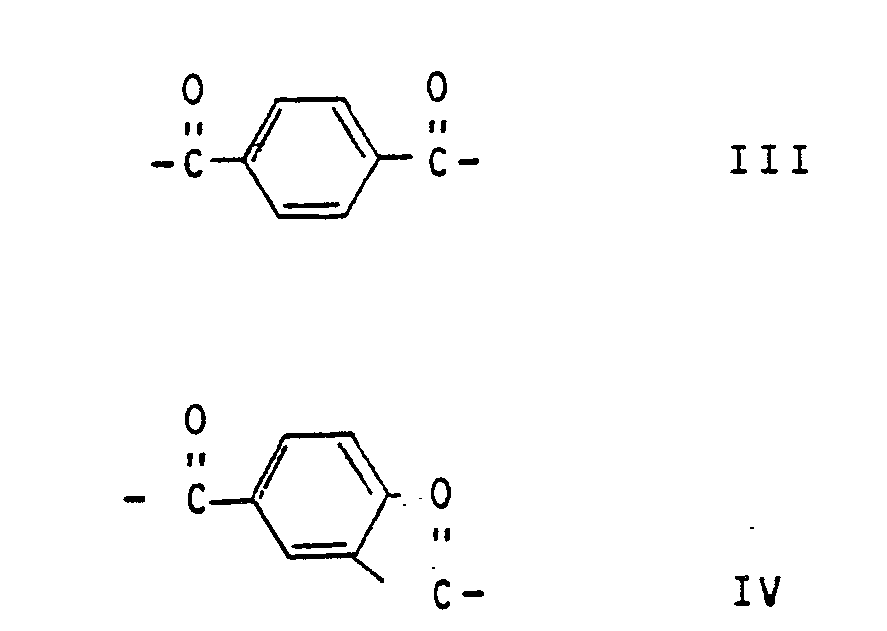
- c) einer Summe der Komponenten a und b entsprechenden molaren Menge mindestens einer der wiederkehrenden Einheiten der Formeln V, VI, VII oder VIII

- d) mindestens 1O Mol-% wiederkehrenden Einheiten der Formel IX

- e) gegebenenfalls 5 bis 25 Mol-% wiederkehrenden Einheiten der Formel X
Description
- Gegenstand der Erfindung sind vollaromatische mesomorphe Polyesterimide die unterhalb 32O°C eine flüssigkristalline fadenbildende Schmelze bilden.
- Es sind schon eine Reihe von flüssigkristallinen Polyesterimiden bekannt. Solche Polymere sind jedoch hinsichtlich ihrer Wärmeformbeständigkeit, ihrer Verarbeitbarkeit und insbesondere ihre geringen Abriebfestigkeit verbesserungsbedürfig. Aus der EP-Anmeldung 81 9OO sind Polyesteramide bekannt, die zumindestens zu 4O % aus koaxialen Einheiten wie aromatischen Dicarbonsäuren, hydroxyaromatischen Carbonsäuren, Diphenolen und Aminophenolen bestehen und eine ausreichende Menge an nicht-linearen Resten enthalten, die sich von aromatischen Aminoverbindungen oder zweikernigen aromatischen Sulfonen ableiten. Es wird jedoch kein Hinweis gegeben, welche Zusammensetzung erforderlich ist, um die geforderte Eigenschaftskombination zu erzielen. In der US-PS 4 176 223 werden Polyesterimide beschrieben, die aus Naphthalindicarbonsäure, substituierten Hydrochinonen sowie 4-(4′-Carboxy-phthalimido)benzoesäure aufgebaut sind. Solche Polymere erfordern jedoch für ihre Verarbeitung aus der Schmelze Temperaturen von 33O°C und mehr. Das gleiche gilt für die aus der US-PS 4 383 1O5 bekannten Polyesterimide, die aus Hydroxynaphthalincarbonsäure, Terephthalsäure, p-Hydroxibenzoesäure sowie 4-(4′-Hydroxyphthalimido)-Phenol aufgebaut sind.
- Es war deshalb die technische Aufgabe gestellt, vollaromatische mesomorphe Polyesterimide zur Verfügung zu stellen, die unterhalb 32O°C eine flüssigkristalline fadenbildende Schmelze bilden und sich somit leicht verarbeiten lassen und darüber hinaus eine hohe Wärmeformbeständigkeit, eine gute Abriebfestigkeit sowie eine gute Zähigkeit aufweisen.
- Diese Aufgabe wird gelöst durch vollaromatische mesomorphe Polyesterimide, die unterhalb 32O°C eine flüssigkristalline fadenbildende Schmelze bilden aufgebaut aus
- a) 5 bis 35 Mol-% wiederkehrenden Einheiten der Formeln I und/oder II

- b) O bis 3O Mol-% wiederkehrenden Einheiten der Formeln III und/oder IV

- c) einer Summe aus a) und b) entsprechenden molaren Menge mindestens einer der wiederkehrenden Einheiten der Formeln V, VI, VII oder VIII.

- d) mindestens 1O Mol-% wiederkehrenden Einheiten der Formel IX.

- e) gegebenenfalls 5 bis 25 Mol.% wiederkehrenden Einheiten der Formel X,

- Die neuen vollaromatischen Polyesterimide haben den Vorteil, eine hohe Wärmeformbeständigkeit mit einer glatten abriebfesten Oberfläche zu verbinden. Weiterhin zeichnen sich die neuen Polyesterimide durch hohe Steifigkeit, Festigkeit und Zähigkeit aus. Zudem sind die neuen Polyesterimide weitgehend chemikalienbeständig und schwer brennbar. Schließlich haben die neuen Polyesterimide den Vorteil, daß sie unterhalb 32O°C aus der Schmelze verarbeitbar sind.
- Der flüssigkristalline Zustand der Polyesterimide kann mit dem Polarisationsmikroskop nach einer in der DE-AS 2 52O 819 beschriebenen Methode nachgewiesen werden. Zwischen gekreuzten Polarisatoren weisen die Polymerschmelzen, die in einer Schichtdicke von 1O µm zwischen Glasplatten aufgetragen sind, Texturen auf, die einer mesomorphen Phase zugeordnet werden können.
- Die erfindungsgemäßen Polyesterimide sind aufgebaut aus
- a) 5 bis 35 Mol.% insbesondere 7 bis 31 Mol.% wiederkehrenden Einheiten der Formeln I und/oder II.

4,4′-Bis-[(4-carboxy)-N-phthalimido]diphenyhlether,
4,4′-Bis-[(4-carboxy)-N-phthalimido]diphenylmethan,
4,4′-Bis-[(4-carboxy)-N-phthalimido]diphenylsulfon.
4,4′-Bis-[(4-carboxy)-N-phthalimido]diphenylsulfid
4,4′-Bis-[(4-carboxy)-N-phthalimido]diphenylketon
3,4′-Bis-[(4-carboxy)-N-phthalimido]diphenylether
4,4′-Bis-[(4-carboxy)-N-phthalimido]diphenylsulfid
3,4′-Bis-[(4-carboxy)-N-phthalimido]diphenylsulfon
3,4′-Bis-[(4-carboxy)-N-phthalimido]diphenylketon
3,4′-Bis-[(4-carboxy)-N-phthalimido]diphenylmethan - b) O bis 3O Mol-% insbesondere O bis 2O mol.% wiederkehrenden Einheiten der Formeln III und/oder IV.

- c) Einer Summe aus den Komponenten a) und b) entsprechenden molaren Menge mindestens einer der wiederkehrenden Einheiten der Formeln V, VI, VII, oder VIII.

- d) mindestens 1O Mol-% insbesondere mindestens 2O mol.% wiederkehrenden Einheiten der Formel IX

- e) Gegebenenfalls 5 bis 25 insbesondere 1O bis 2O Mol-% wiederkehrenden Einheiten der Formel X

- Bevorzugte Polyesterimide enthalten als Komponente c 1O bis 31 Mol-% wiederkehrende Einheiten der Formel V und/oder 5 bis 25 Mol.% wiederkehrende Einheiten VI, VII oder VIII. Besonders bevorzugt als Komponente c sind wiederkehrende Einheiten der Formeln V, VI und/oder VII sowie Mischungen derselben.
- Bevorzugte vollaromatische Polyesterimide haben eine Glasübergangstemperatur Tg von ≧ 14O°C, insbesondere ≧ 15O°C. Die Glastemperatur soll dabei gemessen werden mit der DSC-Methode, wie sie beschrieben ist von K.H. Illers und anderen in Makromolekulare Chemie, Band 127 (1969), Seiten 1 ff. Die vollaromatischen flüssigkristallinen Polyesterimide bilden bei einer Temperatur < 32O°C, eine flüssigkristalline fadenbildende Schmelze. Bevorzugt sind auch flüssigkristalline aromatische Polyesterimide, die bei einer Temperatur > 2OO°C und < 3OO°C Teilkristallinität aufweisen.
- Die erfindungsgemäßen flüssigkristallinen Polyesterimide lassen sich erhalten analog den Arbeitsweisen wie sie beispielsweise in den US-PSen 4 375 53O und 4 118 372 beschrieben werden.
- Nach einer vorteilhaften Arbeitsweise erhält man die erfindungsgemäßen Polyesterimide in einem Einstufenverfahren bei dem man die nicht deriva tisierten Ausgangsstoffe unter Verwendung von Anhydriden niederer Fettsäuren zum Beispiel Fettsäuren mit 2 bis 4 Kohlenstoffatomen, insbesondere Essigsäureanhydrid umsetzt. Gegebenenfalls können Katalysatoren wie sie beispielsweise in der EP-A 131 846, S. 9 beschrieben sind in Mengen von O,OO1 bis 1 Gew.%, bezogen auf die Ausgangsstoffe, mitverwendet werden. Die Ausgangsstoffe werden zusammen mit Fettsäureanhydrid, vorteilhaft in einen mindestens 5 %igen molaren Überschuß, bezogen auf die vorhandenen Hydroxygruppen, unter Inertgasatmosphäre und Rühren auf eine Temperatur erhitzt, bei der Rückfluß zu beobachten ist. Vorteilhaft wird die Temperatur stufenweise gesteigert, z.B. höchstens 5 Stunden, vorzugsweise bis zu 2 Stunden auf 13O bis 2OO°C, anschließend wird die Temperatur z.B. innerhalb von 2 bis 2,5 Stunden auf 25O bis 35O°C gesteigert. Hierbei werden überschüssige Fettsäureanhydride und Fettsäuren abdestilliert. Um die Reaktion zu vervollständigen, hat es sich als vorteilhaft erwiesen gegen Ende verminderten Druck, z.B. 2OO bis O,1 mbar anzuwenden.
- Bemerkenswert und nicht vorherzusehen bei der Anwendung dieses Einstufenverfahrens ist zunächst die problemlose und vollständige Reaktion ohne Katalysatorzusatz zu den gewünschten Polymeren in einer relativ kurzen Zeit. Dies ist umso bemerkenswerter als durch die Vielzahl chemisch unterschiedlicher Hydroxygruppen eine Abstufung der Reaktivitäten und damit ein mangelhafter polymerer Aufbau zu erwarten wäre.
- Die so erhaltenen vollaromatischen flüssigkristallinen Polyesterimide können nach der Kondensation in der Schmelze in festem Zustand, z.B. bei Temperaturen von 15O bis 25O°C bis zur gewünschten Viskosität weiter kondensiert werden. Diese Nachkondensation in fester Phase kann sowohl vor als auch nach einer thermoplastischen Verarbeitung erfolgen. Vorteilhaft wird die Festphasenkondensation unter Mitverwendung von Inertgasen wie Stickstoff durchgeführt.
- Die Polyesterimide gemäß der Erfindung übliche Zusatzstoffe in wirksamen Mengen enthalten. Geeignete Zusatzstoffe sind Stabilisatoren und Oxidationsverzögerer, Mittel gegen Wärmezersetzung und Zersetzung durch ultraviolettes Licht, Gleit- und Entformungsmittel, Färbemittel wie Farbstoffe und Pigmente, faser- oder pulverförmige Füll- und Verstärkungsmittel, Keimbildungsmittel oder Weichmacher.
- Die Stabilisatoren können den Polymeren in jedem Stadium der Herstellung oder den fertigen Polymeren zugesetzt werden. Vorzugsweise werden die Stabilisatoren zu einem frühen Zeitpunkt zugesetzt um zu verhindern, daß die Zersetzung bereits beginnt, bevor die Polymeren geschützt werden können.
- Geeignete Oxidationsverzögerer und Wärmestabilisatoren sind beispielsweise Halogenide von Metallen der Gruppe I des Periodischen Systems z.B. Natrium-, Kalium- oder Lithiumhalogenide mit Kupfer-I-halogeniden, z.B. Chloriden, Bromiden oder Jodiden; ferner sterisch gehinderte Phenole , Hydrochinone, verschiedene substituierte Vertreter dieser Gruppen und Kombinationen derselben. In der Regel setzt man solche Oxidationsverzögerer und Wärmestabilisatoren in Mengen bis zu 1 Gew.% auf das Gewicht des Polymeren zu.
- Geeignete UV-Stabilisatoren sind beispielsweise verschiedene substituierte Resorcine, Salicylate, Benzotriazole, Benzophenone. Solche UV-Stabilisatoren werden im allgemeinen in Mengen bis zu 2 Gew.% bezogen auf das Polymere angewandt.
- Ferner können zugesetzt werden organische Farbstoffe wie Nigrosin sowie Pigmente z.B. Titandioxid, Cadmiumsulfid, Cadmiumsulfid-selenid, Phthalocyanine, Ultramarinblau oder Ruß, z.B. in Mengen bis etwa 5 Gew.%.
- Als geeignete pulver- und faserförmige Füllstoffe und Verstärkungsmittel seien beispielsweise genannt, Kohlenstoffasern, Glasfasern, amorphe Kieselsäure, Asbest, Calciumsilicat, Aluminiumsilicat, Magnesiumcarbonat, Kaolin, Kreide, gepulverter Quarz, Glimmer oder Feldspat. Verstärkungs-und Füllmittel werden im allgemeinen in Mengen bis zu 7O Gew.% bezogen auf das Polymere angewandt.
- Geeignete Keimbildungsmittel sind beispielsweise Talkum, Calciumfluorid, Natriumphenylphosphinat, Aluminiumoxid oder feinverteiltes Tetrafluorethylen.
- Weichmacher, die in Mengen bis zu 2O Gew.%, bezogen auf das Polymere angewandt werden, sind beispielsweise Phthalsäuredioctylester, Phthalsäuredibenzylester, Phthalsäurebutylbenzylester, Kohlenwasserstofföle, N-n-Butylbenzolsulfonamid, o- und p-Toluolethylsulfonamid.
- Die erfindungsgemäßen vollaromatischen flüssigkristallinen Polyesterimide eignen sich zur Herstellung von Fäden, Folien, Schäumen und technischen Formteilen durch Spritzguß, Pressen oder Extrusion.
- Die aus den erfindungsgemäßen Polyesterimiden hergestellten Formteile zeichnen sich durch hervorragende mechanische Eigenschaften wie Steifigkeit, Festigkeit und Zähigkeit aus. Sie sind außerordentlich chemikalienresistent und flammwidrig. Zudem besitzen sie eine hohe Wärmeformbeständigkeit und eine glatte, abriebfeste Oberfläche. Die erfindungs gemäßen Polyesterimide eignen sich daher hervorragend zur Herstellung von Artikeln für die Elektro- und Datentechnik, den Fahrzeugbau und andere technische Bereiche. Sie können aber auch als Überzugs- und Beschichtungsmassen (pulverförmig) dispergiert oder als Film angewandt werden.
- Die Erfindung sei an folgenden Beispielen veranschaulicht.
- O,1 mol Terephthalsäure, O.26 mol 4-Hydroxibenzoesäure, O,O7 mol Hydrochinon, O,O4 mol Dihydroxibiphenyl, O,O9 mol 2,7-Dihydroxinaphthalin und O,1 mol der Verbindung

- O,182 mol 4-Hydroxibenzoesäure, O,O77 mol Hydrochinon, O,O63 mol 4,4′-Dihydroxybiphenyl und O,14 mol der Verbindung

- O,182 mol 4-Hydroxybenzoesäure, O,14 mol Hydrochinon, O,14 mol der Verbindung

- O,1 mol Isophthalsäure, O,26 mol 4-Hydroxibenzoesäure, O,O7 mol Hydrochinon, O,O4 mol Dihydroxibiphenyl, O,O9 mol 2,7-Dihydroxinaphthalin und O,1 mol der Verbindung

- O,O85 mol Terephthalsäure, O,221 mol 4-Hydroxybenzoesäure, O,O85 mol Hydrochinon, O,O85 mol Dihydroxibiphenyl, O,O85 mol der Verbindung

- O,O8 mol Terephthalsäure, O,2O8 mol 4-Hydroxibenzoesäure, O,O56 mol Hydrochinon, O,O32 mol Dihydroxibiphenyl, O,O72 mol 2,7-Dihydroxinaphthalin und O,O8 mol der Verbindung

Claims (9)


Applications Claiming Priority (2)
| Application Number | Priority Date | Filing Date | Title |
|---|---|---|---|
| DE3542857A DE3542857A1 (de) | 1985-12-04 | 1985-12-04 | Vollaromatische mesomorphe polyesterimide |
| DE3542857 | 1985-12-04 |
Publications (2)
| Publication Number | Publication Date |
|---|---|
| EP0227947A2 true EP0227947A2 (de) | 1987-07-08 |
| EP0227947A3 EP0227947A3 (de) | 1989-04-26 |
Family
ID=6287603
Family Applications (1)
| Application Number | Title | Priority Date | Filing Date |
|---|---|---|---|
| EP86116268A Withdrawn EP0227947A3 (de) | 1985-12-04 | 1986-11-24 | Vollaromatische mesomorphe Polyesterimide, deren Herstellung und Verwendung |
Country Status (5)
| Country | Link |
|---|---|
| US (1) | US4728713A (de) |
| EP (1) | EP0227947A3 (de) |
| JP (1) | JPS62132934A (de) |
| CA (1) | CA1268586A (de) |
| DE (1) | DE3542857A1 (de) |
Cited By (1)
| Publication number | Priority date | Publication date | Assignee | Title |
|---|---|---|---|---|
| EP0603725A1 (de) * | 1992-12-16 | 1994-06-29 | Kanegafuchi Kagaku Kogyo Kabushiki Kaisha | Thermoplastisches Polymid, Polyamidsäure, und thermoschmelzbarer Verbundfilm zum Verkleiden von leitenden Drähten |
Families Citing this family (10)
| Publication number | Priority date | Publication date | Assignee | Title |
|---|---|---|---|---|
| DE3542831A1 (de) * | 1985-12-04 | 1987-06-11 | Basf Ag | Fluessig-kristalline carbamidgruppen enthaltende polykondensate, deren herstellung und verwendung |
| DE3802511A1 (de) * | 1988-01-28 | 1989-08-10 | Huels Chemische Werke Ag | Formmassen bestehend aus einem thermoplastisch verarbeitbaren, aromatischen polyesterimid |
| US5409979A (en) * | 1989-02-08 | 1995-04-25 | Polyplastics Co., Ltd. | Liquid-crystal polyester resin composition containing specified mold release agents |
| JPH0333125A (ja) * | 1989-06-29 | 1991-02-13 | Toray Ind Inc | 光学異方性ポリエステル |
| US4988821A (en) * | 1989-08-23 | 1991-01-29 | General Electric Company | Liquid crystalline polyesteretherimides and intermediates therefor |
| US5097010A (en) * | 1990-02-05 | 1992-03-17 | Battelle Memorial Institute | Thermally-reversible isocyanate polymers |
| US5239039A (en) * | 1990-02-05 | 1993-08-24 | Battelle Memorial Institute | Polyarylimidazolidines with phenolic hydroxyl end groups |
| US5470945A (en) * | 1990-02-05 | 1995-11-28 | Battelle Memorial Institute | Thermally reversible isocyanate-based polymers |
| IT1258302B (it) * | 1992-04-10 | 1996-02-22 | Eniricerche Spa | Poliestereimmide trmotropica, procedimento per la sua preparazione e suo impiego |
| FI94054C (fi) * | 1992-09-18 | 1995-07-10 | Neste Oy | Sulatyöstettävä polyesteri-imidilohkokopolymeeri ja menetelmä sen valmistamiseksi |
Family Cites Families (14)
| Publication number | Priority date | Publication date | Assignee | Title |
|---|---|---|---|---|
| US4146703A (en) * | 1966-12-16 | 1979-03-27 | Firma Dr. Beck & Co. Ag | Unsaturated homopolymerizable and/or copolymerizable polyester resins |
| JPS5250386B2 (de) * | 1972-12-29 | 1977-12-23 | ||
| PH15509A (en) * | 1974-05-10 | 1983-02-03 | Du Pont | Improvements in an relating to synthetic polyesters |
| US4176223A (en) * | 1978-12-18 | 1979-11-27 | E. I. Du Pont De Nemours And Company | Polyimide-esters and filaments prepared from 4-(4'-carboxyphthalimido)benzoic acid or 4-(4'-hydroxyphthalimido)phenol |
| ATE39263T1 (de) * | 1980-11-07 | 1988-12-15 | Ici Plc | Fumarsaeure oder substituierte fumarsaeure enthaltende polymere, die eine anisotrope schmelze bilden koennen. |
| EP0055527A1 (de) * | 1980-12-22 | 1982-07-07 | Imperial Chemical Industries Plc | Thermotrope Polyesteranhydrid-Polymere |
| US4362861A (en) * | 1980-12-23 | 1982-12-07 | Schenectady Chemicals, Inc. | Polyesterimide |
| US4351918A (en) * | 1981-04-06 | 1982-09-28 | Celanese Corporation | Poly(ester-amide) capable of forming an anisotropic melt phase derived from 6-hydroxy-2-naphthoic acid, other aromatic hydroxyacid, carbocyclic dicarboxylic acid, and aromatic monomer capable of forming an amide linkage |
| EP0081900B1 (de) * | 1981-11-16 | 1987-05-13 | Imperial Chemical Industries Plc | Anisotrope Polymere, die bei erhöhten Temperaturen ein verbessertes Beibehalten der physikalischen Eigenschaften besitzen, und Verfahren zu ihrer Herstellung |
| US4383105A (en) * | 1981-12-28 | 1983-05-10 | E. I. Du Pont De Nemours And Company | Polyimide-esters and filaments |
| US4375530A (en) * | 1982-07-06 | 1983-03-01 | Celanese Corporation | Polyester of 2,6-naphthalene dicarboxylic acid, 2,6-dihydroxy naphthalene, terephthalic acid, and hydroquinone capable of forming an anisotropic melt |
| DE3325705A1 (de) * | 1983-07-16 | 1985-01-24 | Bayer Ag, 5090 Leverkusen | Mesomorphe aromatische polyester mit hoher zaehigkeitund verbesserter schmelzviskositaet, verfahren zu ihrer herstellung und ihre verwendung zur herstellung von formkoerpern, filamenten, fasern und folien |
| US4632798A (en) * | 1983-07-27 | 1986-12-30 | Celanese Corporation | Encapsulation of electronic components with anisotropic thermoplastic polymers |
| US4623732A (en) * | 1983-11-18 | 1986-11-18 | General Electric Company | Process for the preparation of N-alkylphthalimide and copolymer derived therefrom |
-
1985
- 1985-12-04 DE DE3542857A patent/DE3542857A1/de not_active Withdrawn
-
1986
- 1986-11-14 JP JP61270011A patent/JPS62132934A/ja active Pending
- 1986-11-24 EP EP86116268A patent/EP0227947A3/de not_active Withdrawn
- 1986-12-03 CA CA000524453A patent/CA1268586A/en not_active Expired
- 1986-12-04 US US06/937,718 patent/US4728713A/en not_active Expired - Fee Related
Cited By (1)
| Publication number | Priority date | Publication date | Assignee | Title |
|---|---|---|---|---|
| EP0603725A1 (de) * | 1992-12-16 | 1994-06-29 | Kanegafuchi Kagaku Kogyo Kabushiki Kaisha | Thermoplastisches Polymid, Polyamidsäure, und thermoschmelzbarer Verbundfilm zum Verkleiden von leitenden Drähten |
Also Published As
| Publication number | Publication date |
|---|---|
| DE3542857A1 (de) | 1987-06-11 |
| US4728713A (en) | 1988-03-01 |
| CA1268586A (en) | 1990-05-01 |
| EP0227947A3 (de) | 1989-04-26 |
| JPS62132934A (ja) | 1987-06-16 |
Similar Documents
| Publication | Publication Date | Title |
|---|---|---|
| EP0225537B1 (de) | Vollaromatische mesomorphe Polyesterimide, deren Herstellung sowie Verwendung | |
| EP0230545B1 (de) | Vollaromatische Polyesteramide, deren Herstellung und Verwendung. | |
| EP0230546B1 (de) | Vollaromatische mesomorphe Polyesteramide, deren Herstellung und Verwendung | |
| EP0225529A2 (de) | Vollaromatische mesomorphe Polyesteramidimide, deren Herstellung und Verwendung | |
| EP0226847B1 (de) | Vollaromatische mesmorphe Polyetherester, deren Herstellung und Verwendung | |
| EP0251113B1 (de) | Vollaromatische mesomorphe Polyester, deren Herstellung sowie Verwendung | |
| EP0226080B1 (de) | Vollaromatische mesomorphe Polyesteramide, deren Herstellung und Verwendung | |
| EP0257558B1 (de) | Vollaromatische thermotrope Polyester | |
| EP0259670B1 (de) | Vollaromatische thermotrope Polyester und Polyesteramide | |
| EP0227947A2 (de) | Vollaromatische mesomorphe Polyesterimide, deren Herstellung und Verwendung | |
| EP0230551B1 (de) | Vollaromatische Polyestercarbamide, deren Herstellung und Verwendung | |
| EP0258767B1 (de) | Vollaromatische thermotrope Polyester | |
| EP0226078A1 (de) | Vollaromatische mesomorphe Polyester, deren Herstellung sowie Verwendung | |
| EP0230547A2 (de) | Vollaromatische mesomorphe Polyesteramidimide, deren Herstellung und Verwendung | |
| EP0257598B1 (de) | Vollaromatische thermotrope Polyester und Polyesteramide | |
| EP0231462B1 (de) | Vollaromatische mesomorphe Polyetheresterimide, deren Herstellung und Verwendung | |
| EP0226839A1 (de) | Vollaromatische Polyester, deren Herstellung und Verwendung | |
| EP0231468B1 (de) | Flüssig-kristalline Carbamidgruppen enthaltende Polykondensate, deren Herstellung und Verwendung | |
| EP0230550B1 (de) | Vollaromatische flüssigkristalline Polykondensate, deren Herstellung und Verwendung | |
| DE3700821A1 (de) | Vollaromatische thermotrope polyester |
Legal Events
| Date | Code | Title | Description |
|---|---|---|---|
| PUAI | Public reference made under article 153(3) epc to a published international application that has entered the european phase |
Free format text: ORIGINAL CODE: 0009012 |
|
| AK | Designated contracting states |
Kind code of ref document: A2 Designated state(s): AT BE CH DE FR GB IT LI LU NL SE |
|
| PUAL | Search report despatched |
Free format text: ORIGINAL CODE: 0009013 |
|
| AK | Designated contracting states |
Kind code of ref document: A3 Designated state(s): AT BE CH DE FR GB IT LI LU NL SE |
|
| 17P | Request for examination filed |
Effective date: 19890322 |
|
| 17Q | First examination report despatched |
Effective date: 19900122 |
|
| STAA | Information on the status of an ep patent application or granted ep patent |
Free format text: STATUS: THE APPLICATION HAS BEEN WITHDRAWN |
|
| 18W | Application withdrawn |
Withdrawal date: 19900522 |
|
| R18W | Application withdrawn (corrected) |
Effective date: 19900522 |
|
| RIN1 | Information on inventor provided before grant (corrected) |
Inventor name: REITER, UDO, DR. Inventor name: HISGEN, BERND, DR. Inventor name: PORTUGALL, MICHAEL, DR. |