EP0228039A2 - Procédé et appareil pour la transmission de chaleur à une masse de métal fondu - Google Patents
Procédé et appareil pour la transmission de chaleur à une masse de métal fondu Download PDFInfo
- Publication number
- EP0228039A2 EP0228039A2 EP86117667A EP86117667A EP0228039A2 EP 0228039 A2 EP0228039 A2 EP 0228039A2 EP 86117667 A EP86117667 A EP 86117667A EP 86117667 A EP86117667 A EP 86117667A EP 0228039 A2 EP0228039 A2 EP 0228039A2
- Authority
- EP
- European Patent Office
- Prior art keywords
- vessel
- molten metal
- oxygen gas
- blowing
- combustion
- Prior art date
- Legal status (The legal status is an assumption and is not a legal conclusion. Google has not performed a legal analysis and makes no representation as to the accuracy of the status listed.)
- Granted
Links
Images


Classifications
-
- C—CHEMISTRY; METALLURGY
- C21—METALLURGY OF IRON
- C21C—PROCESSING OF PIG-IRON, e.g. REFINING, MANUFACTURE OF WROUGHT-IRON OR STEEL; TREATMENT IN MOLTEN STATE OF FERROUS ALLOYS
- C21C5/00—Manufacture of carbon-steel, e.g. plain mild steel, medium carbon steel or cast steel or stainless steel
- C21C5/28—Manufacture of steel in the converter
- C21C5/38—Removal of waste gases or dust
- C21C5/40—Offtakes or separating apparatus for converter waste gases or dust
-
- C—CHEMISTRY; METALLURGY
- C21—METALLURGY OF IRON
- C21C—PROCESSING OF PIG-IRON, e.g. REFINING, MANUFACTURE OF WROUGHT-IRON OR STEEL; TREATMENT IN MOLTEN STATE OF FERROUS ALLOYS
- C21C5/00—Manufacture of carbon-steel, e.g. plain mild steel, medium carbon steel or cast steel or stainless steel
- C21C5/28—Manufacture of steel in the converter
- C21C5/30—Regulating or controlling the blowing
- C21C5/32—Blowing from above
-
- C—CHEMISTRY; METALLURGY
- C21—METALLURGY OF IRON
- C21C—PROCESSING OF PIG-IRON, e.g. REFINING, MANUFACTURE OF WROUGHT-IRON OR STEEL; TREATMENT IN MOLTEN STATE OF FERROUS ALLOYS
- C21C5/00—Manufacture of carbon-steel, e.g. plain mild steel, medium carbon steel or cast steel or stainless steel
- C21C5/28—Manufacture of steel in the converter
- C21C5/30—Regulating or controlling the blowing
- C21C5/35—Blowing from above and through the bath
-
- C—CHEMISTRY; METALLURGY
- C21—METALLURGY OF IRON
- C21C—PROCESSING OF PIG-IRON, e.g. REFINING, MANUFACTURE OF WROUGHT-IRON OR STEEL; TREATMENT IN MOLTEN STATE OF FERROUS ALLOYS
- C21C7/00—Treating molten ferrous alloys, e.g. steel, not covered by groups C21C1/00 - C21C5/00
- C21C7/0081—Treating and handling under pressure
-
- Y—GENERAL TAGGING OF NEW TECHNOLOGICAL DEVELOPMENTS; GENERAL TAGGING OF CROSS-SECTIONAL TECHNOLOGIES SPANNING OVER SEVERAL SECTIONS OF THE IPC; TECHNICAL SUBJECTS COVERED BY FORMER USPC CROSS-REFERENCE ART COLLECTIONS [XRACs] AND DIGESTS
- Y02—TECHNOLOGIES OR APPLICATIONS FOR MITIGATION OR ADAPTATION AGAINST CLIMATE CHANGE
- Y02P—CLIMATE CHANGE MITIGATION TECHNOLOGIES IN THE PRODUCTION OR PROCESSING OF GOODS
- Y02P10/00—Technologies related to metal processing
- Y02P10/25—Process efficiency
Definitions
- the present invention relates to a method for transferring heat to molten metal contained in a reaction vessel, and also to an apparatus which has a reaction vessel and in which heat can be transferred to molten metal contained in the reaction vessel. More particularly, the invention relates to a method and an apparatus wherein heat can be transferred to molten metal contained in a reaction vessel in which CO gas is generated and can be combusted.
- Some converters are equipped with a lance, for post-combustion, having nozzle holes in the lower end thereof, through which oxygen gas is blown out. CO gas generated from molten metal is post-combusted by oxygen gas blown out through the nozzle holes, and the heat produced thereby, as heat value necessary for the operation, is transferred through a layer of molten slag floating on top of the molten metal.
- Japanese Patent Application Laid Open No. 74390/82 describes a method wherein:
- An object of the present invention is to provide a method for combusting optimizingly gas generated within a reaction vessel, and for transferring the heat produced thereby to molten metal contained in the vessel.
- a further object of the present invention is to provide an apparatus which has a reaction vessel and in which gas generated within the vessel can be optimizingly combusted, and the heat produced thereby can be effectively transferred to molten metal contained in the vessel.
- Another object of the present invention is to provide a method for decreasing the consumption of carbonaceous material used as the reducing agent.
- a method for transferring heat to molten metal contained in a reaction vessel which comprises the steps of:
- an apparatus for transferring heat to molten metal which comprises:
- FIG. 1 showing schematically an apparatus having a smelting reduction furnace, wherein an embodiment of a method according to the present invention.is carried out, reference numerals indicate as follows:
- Iron ore and coal are charged through material feed hopper 22, onto molten metal 12 within a vessel.
- Oxygen gas is blown in through top blow lance 18.
- a portion of the charged coal is combusted with the oxygen gas blown in, and CO gas is produced.
- Another portion dissolves into the molten metal 12, and the balance remains in molten slag layer 14.
- the iron ore is reduced by carbon contained in molten metal 12 and molten slag layer 14.
- the CO gas produced by the combustion process ascends through the molten slag layer, and is further combusted with oxygen gas blown out through nozzle holes 21 set in the lower end of top blow lance 18, and heat is produced.
- the combustion of the CO gas with the blown out oxygen gas is, throughout the description and the claims contained herein, denoted by the term post-combustion. Amount of oxygen gas for reduction and that of oxygen gas for post-combustion are separately controlled.
- CO-C0 2 gaseous atmosphere 16 is kept at higher than atmospheric pressure, by means of pressure regulator 26 connected to outlet 24 which opens to the gaseous atmosphere. Since keeping the pressure higher than atmospheric pressure is maintained, the slower the post-combusted gas ascends, the longer the post-combusted gas stays in molten slag layer 14. In addition, there is a greater chance that the CO gas ascending through the molten slag layer will mix with oxygen gas provided for the post-combustion, and will be combusted therewith.
- the embodiment according to the present invention is applied to a smelting reduction process for iron ore.
- the application thereof is not limited to the smelting reduction process and can be applied to steel making for decarburization and dephosphorization.
- the pressure of gaseous atmosphere 16 is kept at approximately 2 to 5 kg/cm 2 .
- This range reduces the speed at which the post-combusted gas ascends, to a half to a fifth of the conventional rate and also lowers the rate of ascend of the CO gas generated in the molten metal 12.
- This pressure range does not affect the speed of the reaction represented by the following formula:
- the pressure is less than 2 kg/cm 2 , it may be impossible to reduce the rate of ascend of the post-combusted C0 2 gas and the generated CO gas.
- a pressure of more than 5 kg/cm 2 may undesirably reduce the speed of the reaction, which is given by the above-mentioned formula.
- the pressure of CO-C0 2 gaseous atmosphere 16 is controlled by pressure regulator 26, more precisely by controlling the opening of the valve of regulator 26 in accordance with the pressure measured.
- oxygen gas for post-combustion is blown in through nozzle holes 21 set in the lower end of lance 18.
- the oxygen gas can be blown into in other ways.
- Fig. 2 schematically illustrates an example of another apparatus according to the invention having a reaction vessel provided with a plurality of side-blow tuyeres 20 set in wall 10. Through tuyeres 20, oxygen gas for post-combustion can be blown into the molten metal layer. These tuyeres 20 are sloping downward and open to the layer of slag contained in the vessel. The quantity of charging material and the quantity of tapping molten metal are controlled so as to keep the level of layer 14 constant. Material is charged through feeding hopper 22. A tapping hole for the molten metal (not shown) can be cut in the furnace wall in the publicly known manner.
- the oxygen gas for post-combustion is blown into the vessel through tuyeres 20 sloping downward and opening to layer 14 of molten slag.
- the molten slag first moves downward, then hits against the top of the molten metal, and finally moves upward, thus circulating within the vessel.
- the oxygen gas reacts with CO gas ascending through layer 14 of molten slag. The reaction heat is transferred to the molten slag, and is further to molten metal 12, since the molten slag is circulating.
- Tuyeres 20 are sloping downwards in the apparatus shown in Fig. 2. They can be inclined upward, in which case the molten slag can circulate in the same manner. However, it is preferable that tuyeres 20 be sloping downwards, since more oxygen gas can be blown into the molten slag, and the molten slag can circulate more vigorously.
- top-blow lance 18 shown in Fig. 2 for blowing in oxygen gas for reduction, bottom-blow tuyeres 19 shown in Fig. 3 can be employed.
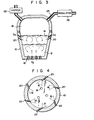
- Figs. 4 and 5 show still another apparatus having a reaction vessel.
- a plurality of bottom-blow tuyeres 19 are set in the bottom of the vessel, and a plurality of side-blow tuyeres 20 are provided in furnace wall 10 of the vessel.
- Side-blow tuyeres 20 are inclined, in a horizontal plane, at angle ⁇ to the radius of the vessel, as is shown in Fig. 4.
- Some of tuyeres 20 are sloping downwards, and the others are sloping upwards, as is illustrated in Fig. 5.
- Angle e can be given as follows:
- Angle 8 can be changed within the ranges represented by the foregoing formulas. If angle e falls outside the ranges, the molten slag cannot circulate sufficiently.
- tuyeres 20 are sloping downwards, and the others are sloping upwards. More specifically, they can be sloping alternately downwards and upwards, or, for instance, any two adjacent tuyeres 20 can be sloping down while the next two are sloping up.
- Side-blow tuyeres 20 are set in furnace wall 10 such that they open to layer 14 of molten slag.
- Molten metal 12 is kept moving by the stream of oxygen gas provided for the reduction thereof, or by the blow of powders and gas blown thereon during the smelting reduction process, but the surface level of the molten metal and the thickness of the molten-slag layer are constantly controlled. Accordingly, the side-blow tuyeres can be positioned to open to the molten-slag layer.
- Oxygen gas for reduction is blown in through outer pipe 25 of bottom-blow tuyeres 19, and fine iron ore and powdered coal are blown in through inner pipe 23 of tuyeres 19.
- Oxygen gas for post-combustion is blown in through side-blow tuyeres 20.
- Layer 14 of molten slag highly heated by post-combustion is circulated within the vessel, in both a horizontal plane and a vertical plane, and transfers the heat to molten metal 12 since it contacts the molten metal 12.
- Iron ore and coal were fed through feeding hopper 22.
- Oxygen gas for reduction was blown in through lance 18, and oxygen gas for post-combustion was blown in through nozzle holes 21 set in the lower end of the lance.
- the oxygen gas for post-combustion was introduced into molten slag layer 14 in an amount of 50% of oxygen flow-rate for post-combustion which is given as follows:
- Rate of molten metal production was 32 tons/hour.
- Controller 1 wherein gaseous atmosphere 16 was set to atmospheric pressure, was carried out, thereby producing molten metal at the rate of 32 tons/hour.
- the results are shown in Table 1, along with the results of
- heat efficiency is given: where A represents heat given to molten metal, and B represents heat produced when all oxygen gas for post-combustion is consumed.
- Example 1 As is clearly understood from Table 1, the consumption of coal and that of oxygen gas were reduced, compared with Controller 1, since the heat efficiency of Example 1 was higher than that of Controller 1.
- FIG. 1 Another example of smelting reduction of iron ore was carried out, using the apparatus shown in Fig. 1.
- the smelting operation was performed with gaseous atmosphere 16 being set at a pressure of 3 kg/cm 2 , and oxygen gas for post-combustion was introduced in oxygen flow-rate for post-combustion of 0 to 100%.
- Controller 2 wherein gaseous atmosphere 16 was set to atmospheric pressure, and oxygen gas was introduced in the same oxygen flow-rate for post-combustion was performed.
- Fig. 6 shows graphically the results of Example 2 and Controller 2.
- the results of Example 2 and Controller 2 are illustrated respectively by a solid and a broken line. As these lines show, the heat efficiency of Example 2 is 15%, on average, higher than that of Controller 2. Therefore, the transfer of heat to the molten metal can be achieved efficiently by controlling, appropriately, the pressure of gaseous atmosphere 16, by means of pressure regulator 26 in compliance with the amount of CO gas generated and with the state of foaming molten slag layer 14.
- Oxygen gas for reduction, and oxygen gas for post-combustion, were respectively blown in straight downwards through lance 18 and at a downward-sloping angle through six side-blow tuyeres 20.
- FIG. 4 and 5 An apparatus as is shown in Figs. 4 and 5 was employed.
- Six side-blow tuyeres 20 were set in furnace wall 10atan angle 6 of 30°.
- Three bottom-blow tuyeres 19 were each composed of an inner pipe 23 and an outer pipe 25 embracing inner pipe 23.
- Oxygen gas for reduction was introduced through outer pipe 25 of each tuyere 19, and a mixture of fine iron ore and powdered coal, was introduced through inner pipe 23.
- Oxygen gas for post-combustion was blown in through side-blow tuyeres 20, so as to circulate the molten slag in both a horizontal plane and a vertical plane.
- Examples 3A and 3B proved an improvement in the heat efficiency, and a reduction in the consumption of coal and oxygen needed for reduction, in comparison with Example 1.
Landscapes
- Chemical & Material Sciences (AREA)
- Engineering & Computer Science (AREA)
- Materials Engineering (AREA)
- Metallurgy (AREA)
- Organic Chemistry (AREA)
- Manufacturing & Machinery (AREA)
- Environmental & Geological Engineering (AREA)
- Manufacture Of Iron (AREA)
- Carbon Steel Or Casting Steel Manufacturing (AREA)
- Furnace Details (AREA)
- Manufacture And Refinement Of Metals (AREA)
- Treatment Of Steel In Its Molten State (AREA)
Applications Claiming Priority (2)
| Application Number | Priority Date | Filing Date | Title |
|---|---|---|---|
| JP282952/85 | 1985-12-18 | ||
| JP60282952A JPS62142712A (ja) | 1985-12-18 | 1985-12-18 | 転炉又は溶融還元炉における製鋼・製鉄方法 |
Publications (3)
| Publication Number | Publication Date |
|---|---|
| EP0228039A2 true EP0228039A2 (fr) | 1987-07-08 |
| EP0228039A3 EP0228039A3 (en) | 1988-03-23 |
| EP0228039B1 EP0228039B1 (fr) | 1995-05-24 |
Family
ID=17659246
Family Applications (1)
| Application Number | Title | Priority Date | Filing Date |
|---|---|---|---|
| EP86117667A Expired - Lifetime EP0228039B1 (fr) | 1985-12-18 | 1986-12-18 | Procédé et appareil pour la transmission de chaleur à une masse de métal fondu |
Country Status (6)
| Country | Link |
|---|---|
| US (1) | US4740242A (fr) |
| EP (1) | EP0228039B1 (fr) |
| JP (1) | JPS62142712A (fr) |
| AT (1) | ATE123073T1 (fr) |
| CA (1) | CA1318134C (fr) |
| DE (1) | DE3650328T2 (fr) |
Families Citing this family (7)
| Publication number | Priority date | Publication date | Assignee | Title |
|---|---|---|---|---|
| SE466118B (sv) * | 1989-05-02 | 1991-12-16 | Aga Ab | Saett vid behandling av en metallsmaelta i en skaenk och anordning vid en saadan skaenk |
| US4931090A (en) * | 1989-08-23 | 1990-06-05 | Zia Technology, Inc. | Pneumatic steelmaking vessel and method of producing steel |
| JP2602573B2 (ja) * | 1990-06-29 | 1997-04-23 | 川崎重工業株式会社 | 金属精錬法 |
| US5700308A (en) * | 1995-01-20 | 1997-12-23 | Massachusetts Institute Of Technology | Method for enhancing reaction rates in metals refining extraction, and recycling operations involving melts containing ionic species such as slags, mattes, fluxes |
| US5681526A (en) * | 1996-04-23 | 1997-10-28 | Usx Corporation | Method and apparatus for post-combustion of gases during the refining of molten metal |
| US5943360A (en) * | 1998-04-17 | 1999-08-24 | Fuchs Systems, Inc. | Electric arc furnace that uses post combustion |
| JP5517537B2 (ja) | 2009-09-25 | 2014-06-11 | 株式会社リンレイ | 可剥離性床用被覆組成物 |
Family Cites Families (6)
| Publication number | Priority date | Publication date | Assignee | Title |
|---|---|---|---|---|
| US3418109A (en) * | 1964-01-30 | 1968-12-24 | Kaiser Ind Corp | Method for producing steel by an oxygen lance |
| BE755456A (fr) * | 1969-08-29 | 1971-03-01 | Allegheny Ludlum Ind Inc | Decarburation de l'acier fondu |
| US3999977A (en) * | 1973-04-25 | 1976-12-28 | United States Steel Corporation | Method for controlling the injection of flux into a steelmaking vessel as a function of pressure differential |
| DE2750725A1 (de) * | 1977-11-12 | 1979-05-17 | Kloeckner Humboldt Deutz Ag | Verfahren und vorrichtung zur herstellung eines im wesentlichen co und h tief 2 enthaltenden gases |
| DE3031680A1 (de) * | 1980-08-22 | 1982-03-11 | Klöckner-Werke AG, 4100 Duisburg | Verfahren zur gaserzeugung |
| US4551174A (en) * | 1984-09-03 | 1985-11-05 | Nippon Kokan Kabushiki Kaisha | Method of refining molten steel by arc process |
-
1985
- 1985-12-18 JP JP60282952A patent/JPS62142712A/ja active Granted
-
1986
- 1986-12-11 US US06/940,579 patent/US4740242A/en not_active Expired - Lifetime
- 1986-12-17 CA CA000525656A patent/CA1318134C/fr not_active Expired - Fee Related
- 1986-12-18 AT AT86117667T patent/ATE123073T1/de not_active IP Right Cessation
- 1986-12-18 EP EP86117667A patent/EP0228039B1/fr not_active Expired - Lifetime
- 1986-12-18 DE DE3650328T patent/DE3650328T2/de not_active Expired - Fee Related
Also Published As
| Publication number | Publication date |
|---|---|
| EP0228039A3 (en) | 1988-03-23 |
| DE3650328T2 (de) | 1996-01-11 |
| EP0228039B1 (fr) | 1995-05-24 |
| JPH0424407B2 (fr) | 1992-04-27 |
| ATE123073T1 (de) | 1995-06-15 |
| US4740242A (en) | 1988-04-26 |
| JPS62142712A (ja) | 1987-06-26 |
| CA1318134C (fr) | 1993-05-25 |
| DE3650328D1 (de) | 1995-06-29 |
Similar Documents
| Publication | Publication Date | Title |
|---|---|---|
| EP0318896B1 (fr) | Procédé et dispositif pour la réduction en bain de fusion de minerais de fer | |
| US4657586A (en) | Submerged combustion in molten materials | |
| US4195985A (en) | Method of improvement of the heat-balance in the refining of steel | |
| EP0592830A1 (fr) | Procédé pour intensifier les réactions dans les récipients de réactions métallurgiques | |
| CA1336542C (fr) | Methode de fusion et de reduction de minerais de fer, et appareillage utilise | |
| MXPA00006739A (es) | Procedimiento de puesta a punto para proceso de fundicion directa. | |
| EP1320633B1 (fr) | Dispositif et procede de fusion directe | |
| EP0320999B1 (fr) | Procédé et appareil pour la réduction de minerais de fer par fusion | |
| KR100806266B1 (ko) | 직접제련 방법 및 장치 | |
| RU2226219C2 (ru) | Способ прямой плавки | |
| US4740242A (en) | Method for transferring heat to molten metal, and apparatus therefor | |
| EP0382900B1 (fr) | Procédé de production de fonte liquide | |
| JP3286114B2 (ja) | 屑鉄から高炭素溶融鉄を製造する方法 | |
| JP3239691B2 (ja) | アーク炉溶解法 | |
| JPH09143522A (ja) | 鉄スクラップの高速溶解法 | |
| JPH0641606B2 (ja) | 鉄系合金溶湯のスラグ浴式溶融還元製造装置および方法 | |
| AU2001272223A1 (en) | A direct smelting process and apparatus | |
| JPH0533027A (ja) | 溶融還元製鉄法 | |
| MXPA00012893A (en) | A direct smelting process | |
| JPS61253313A (ja) | 転炉出鋼時の炉壁溶損防止方法 | |
| JPS6338508A (ja) | 溶融金属又はスラグ浴中への粉体吹込み用羽口 |
Legal Events
| Date | Code | Title | Description |
|---|---|---|---|
| PUAI | Public reference made under article 153(3) epc to a published international application that has entered the european phase |
Free format text: ORIGINAL CODE: 0009012 |
|
| AK | Designated contracting states |
Kind code of ref document: A2 Designated state(s): AT DE FR GB |
|
| PUAL | Search report despatched |
Free format text: ORIGINAL CODE: 0009013 |
|
| AK | Designated contracting states |
Kind code of ref document: A3 Designated state(s): AT DE FR GB |
|
| 17P | Request for examination filed |
Effective date: 19880803 |
|
| 17Q | First examination report despatched |
Effective date: 19900424 |
|
| GRAA | (expected) grant |
Free format text: ORIGINAL CODE: 0009210 |
|
| AK | Designated contracting states |
Kind code of ref document: B1 Designated state(s): AT DE FR GB |
|
| REF | Corresponds to: |
Ref document number: 123073 Country of ref document: AT Date of ref document: 19950615 Kind code of ref document: T |
|
| ET | Fr: translation filed | ||
| REF | Corresponds to: |
Ref document number: 3650328 Country of ref document: DE Date of ref document: 19950629 |
|
| PLBE | No opposition filed within time limit |
Free format text: ORIGINAL CODE: 0009261 |
|
| STAA | Information on the status of an ep patent application or granted ep patent |
Free format text: STATUS: NO OPPOSITION FILED WITHIN TIME LIMIT |
|
| 26N | No opposition filed | ||
| PGFP | Annual fee paid to national office [announced via postgrant information from national office to epo] |
Ref country code: FR Payment date: 19981124 Year of fee payment: 13 |
|
| PG25 | Lapsed in a contracting state [announced via postgrant information from national office to epo] |
Ref country code: FR Free format text: LAPSE BECAUSE OF NON-PAYMENT OF DUE FEES Effective date: 20000831 |
|
| REG | Reference to a national code |
Ref country code: FR Ref legal event code: ST |
|
| REG | Reference to a national code |
Ref country code: GB Ref legal event code: IF02 |
|
| PGFP | Annual fee paid to national office [announced via postgrant information from national office to epo] |
Ref country code: AT Payment date: 20021211 Year of fee payment: 17 |
|
| PGFP | Annual fee paid to national office [announced via postgrant information from national office to epo] |
Ref country code: GB Payment date: 20021218 Year of fee payment: 17 |
|
| PGFP | Annual fee paid to national office [announced via postgrant information from national office to epo] |
Ref country code: DE Payment date: 20021219 Year of fee payment: 17 |
|
| PG25 | Lapsed in a contracting state [announced via postgrant information from national office to epo] |
Ref country code: GB Free format text: LAPSE BECAUSE OF NON-PAYMENT OF DUE FEES Effective date: 20031218 Ref country code: AT Free format text: LAPSE BECAUSE OF NON-PAYMENT OF DUE FEES Effective date: 20031218 |
|
| PG25 | Lapsed in a contracting state [announced via postgrant information from national office to epo] |
Ref country code: DE Free format text: LAPSE BECAUSE OF NON-PAYMENT OF DUE FEES Effective date: 20040701 |
|
| GBPC | Gb: european patent ceased through non-payment of renewal fee |
Effective date: 20031218 |