EP0230210A2 - Reaktivfarbstoffe, deren Herstellung und Verwendung - Google Patents
Reaktivfarbstoffe, deren Herstellung und Verwendung Download PDFInfo
- Publication number
- EP0230210A2 EP0230210A2 EP86810599A EP86810599A EP0230210A2 EP 0230210 A2 EP0230210 A2 EP 0230210A2 EP 86810599 A EP86810599 A EP 86810599A EP 86810599 A EP86810599 A EP 86810599A EP 0230210 A2 EP0230210 A2 EP 0230210A2
- Authority
- EP
- European Patent Office
- Prior art keywords
- formula
- parts
- reactive dyes
- reactive
- amino
- Prior art date
- Legal status (The legal status is an assumption and is not a legal conclusion. Google has not performed a legal analysis and makes no representation as to the accuracy of the status listed.)
- Granted
Links
Classifications
-
- C—CHEMISTRY; METALLURGY
- C09—DYES; PAINTS; POLISHES; NATURAL RESINS; ADHESIVES; COMPOSITIONS NOT OTHERWISE PROVIDED FOR; APPLICATIONS OF MATERIALS NOT OTHERWISE PROVIDED FOR
- C09B—ORGANIC DYES OR CLOSELY-RELATED COMPOUNDS FOR PRODUCING DYES, e.g. PIGMENTS; MORDANTS; LAKES
- C09B62/00—Reactive dyes, i.e. dyes which form covalent bonds with the substrates or which polymerise with themselves
- C09B62/02—Reactive dyes, i.e. dyes which form covalent bonds with the substrates or which polymerise with themselves with the reactive group directly attached to a heterocyclic ring
- C09B62/04—Reactive dyes, i.e. dyes which form covalent bonds with the substrates or which polymerise with themselves with the reactive group directly attached to a heterocyclic ring to a triazine ring
- C09B62/08—Azo dyes
- C09B62/085—Monoazo dyes
Definitions
- Reactive dyes are widely used for dyeing and printing textile fiber materials. Although a large number of usable reactive dyes with different properties and for different areas of application are available today, the technical status achieved can often not be fully satisfactory in view of the high requirements with regard to suitability for certain dyeing processes and the authenticity level of the dyeings.
- the object of the present invention was to find new reactive dyes which are particularly suitable for the printing process.
- the dyes should have a high degree of fixation and, at the same time, good washability of the non-fixed portions, furthermore generally good fastness properties and in particular shades in the range from yellow to reddish yellow. It has been shown that the new dyes defined below largely fulfill the task.
- the invention relates to reactive dyes of the formula wherein R for 1 to 3 substituents from the group hydrogen, halogen, nitro, cyano, trifluoromethyl, sulfamoyl, carbamoyl, C 1-4 alkyl, C 1-4 alkoxy, amino, acetylamino, ureido, hydroxy, carboxy, sulfomethyl and Sulfo is independently; and Z is morpholino, piperidino or piperazino.
- R come into consideration as halogen: fluorine, chlorine and bromine; as C 1-4 alkyl: methyl, ethyl, propyl, isopropyl, butyl, isobutyl, sec-butyl and tert-butyl; and as C 1-4 alkoxy: methoxy, ethoxy, propyloxy, isopropyloxy, butyloxy, isobutyloxy, sec-butyloxy and tert-butyloxy.
- the reactive dye of the formula is particularly preferred
- the dyes of the formulas (1), (2) and (3) are fiber-reactive since they contain a releasable chlorine atom in the s-triazine radical.
- Fiber-reactive compounds are to be understood as those which are able to react with the hydroxyl groups of cellulose, the amino, carboxy, hydroxyl and thiol groups in wool and silk, or with the amino and possibly carboxy groups of synthetic polyamides to form covalent chemical bonds .
- the process for the preparation of the reactive dyes of the formula (1) is characterized in that a diazotized diazo component of the formula is used in any order to a coupling component of the formula couples and the aminomonoazo compound thus obtained and an amine of the formula H - Z (6) condensed with 2,4,6-trichloro-s-triazine.
- the preferred method of preparing the reactive dye of the formula (3) is characterized in that after 1 a monoazo compound of the formula produces, these condensed with 2,4,6-trichloro-s-triazine, and the dichlorotriazine azo compound of the formula obtained condensed with morpholine.
- the diazotization of the diazo components is generally carried out by the action of nitrous acid in aqueous mineral acid solution at low temperature, the coupling to the coupling components at weakly acidic, neutral to weakly alkaline pH values.
- the condensations of 2,4,6-trichloro-s-triazine with the aminomonoazo compounds and the amino compounds of the formula (6) are preferably carried out in aqueous solution or suspension, at low temperature and at a weakly acidic, neutral to weakly alkaline pH, see above that in the finished reactive dye of the formula (1) at least one chlorine atom remains as a removable residue.
- the hydrogen chloride liberated in the condensation is advantageously continuously neutralized by adding aqueous alkali metal hydroxides, carbonates or bicarbonates. Isolation of the dichlorotriazine azo compound is generally dispensed with.
- the reactive dyes of the formula (1) can be isolated and processed into useful, dry dye preparation data.
- the isolation is preferably carried out at the lowest possible temperatures by salting out and filtering.
- the filtered dyes can, if appropriate, after adding couping agents and / or buffering agents, for example after adding a Mixtures of equal parts of mono- and disodium phosphate are dried; drying is preferably carried out at temperatures which are not too high and under reduced pressure.
- the dry preparations according to the invention can be produced directly, ie without intermediate insulation of the dyes, by spray drying the entire production mixture.
- the reactive dyes of formula (1) are new. They are characterized by high reactivity and they give dyeings with good wet and light fastness. It is particularly noteworthy that the dyes have good solubility and high dye fixation, that they diffuse well in the cellulose fiber and that the non-fixed portions can be easily removed.
- the reactive dyes of the formula (1) are suitable for dyeing and printing a wide variety of materials, such as silk, leather, wool, polyamide fibers and polyurethanes, but in particular cellulosic materials with a fibrous structure, such as linen, cellulose, regenerated cellulose and especially cotton. They are suitable both for the exhaust process and for dyeing according to the Fouolard dyeing process, according to which the goods are impregnated with aqueous and optionally also salt-containing dye solutions, and the dyes are fixed after an alkali treatment or in the presence of an alkali, if appropriate with the action of heat.
- They are particularly suitable for printing, especially on cotton, but also for printing nitrogen-containing fibers, e.g. of blended fabrics containing wool, silk or wool.
- the dyes according to the invention are advantageously used as liquid dyeing or printing preparations.
- the parts mean parts by weight.
- Example 1 The same dye, which is obtained in Example 1, can be isolated from the resulting dye solution by adding 500 parts of sodium chloride.
- Example 1 or 2 If the procedure of Example 1 or 2 is followed, but instead of the aminoazo dye used there, there are equivalent amounts of the aminoazo dyes listed in the following table, and the amines given in the last column are used for the exchange of the second chlorine atom on the triazine ring, the same is obtained valuable dyes that dye cotton in yellow to reddish yellow tones.
- Example 2 2 parts of the dye obtained in Example 1 are dissolved in 2000 parts of water with the addition of 120 parts of table salt or calcined Glauber's salt at 75 ° C.
- This dye bath is mixed with 100 parts of a cotton fabric and the temperature is kept constant for 30 to 60 minutes.
- 10 parts of soda ash and 4 ml of sodium hydroxide solution (36 ° Bé) are added.
- the temperature is held at 75 to 80 ° C for a further 45 to 60 minutes, then soaped in a 0.1% boiling solution of an ion-free detergent for 15 minutes, rinsed and dried.
- Example 2 parts of the dye obtained in Example 1 are dissolved in 100 parts of water with the addition of 0.5 part of sodium m-nitrobenzenesulfonate.
- a cotton fabric is impregnated with the solution obtained so that it increases by 75% of its weight, and then dried. Then the fabric is impregnated with a 20 ° C solution containing 5 g of sodium hydroxide and 300 g of sodium chloride per liter, squeezed to 75% weight gain, the dye is dampened for 30 seconds at 100 to 101 ° C, rinsed, soaped for one Quarter of an hour in a 0.3% boiling solution of an ion-free detergent, rinse and dry.
- Example 2 parts of the dye obtained in Example 1 are dissolved in 100 parts of water.
- the solution is added to 1900 parts of cold water, 60 parts of sodium chloride are added and 100 parts of a cotton fabric are added to this dye bath.
- the temperature is raised to 60 ° C., 40 parts of calcined soda and another 60 parts of sodium chloride being added after 30 minutes.
- the temperature is kept at 60 ° C. for 30 minutes, rinsed and the soap is then soaped for 15 minutes in a 0.3% boiling solution of an ion-free detergent, rinsed and dried.
Landscapes
- Chemical & Material Sciences (AREA)
- Organic Chemistry (AREA)
- Coloring (AREA)
Abstract

Description
- Reaktivfarbstoffe werden in grossem Umfange für das Färben und Bedrucken von textilen Fasermaterialien eingesetzt. Obwohl heute eine grosse Anzahl von brauchbaren Reaktivfarbstoffen mit unterschiedlichen Eigenschaften und für verschiedene Anwendungsbereiche zur Verfügung steht, kann der erreichte technische Stand, angesichts der hohen Anforderungen in Bezug auf Eignung für bestimmte Färbeverfahren und Echtheitsniveau der Färbungen vielfach nicht voll befriedigen.
- Das gilt auch für Reaktivfarbstoffe im Druck. Das vorhandene Angebot an qualitativ hochwertigen Druckfarbstoffen ist, besonders unter Berücksichtigung der Nuance, allgemein noch lückenhaft. Die Bereitstellung weiterer verbesserter Reaktivfarbstoffe ist daher drigend erwünscht.
- Der vorliegenden Erfindung lag die Aufgabe zugrunde, neue Reaktivfarbstoffe zu finden, die besonders für das Druckverfahren geeignet sind. Die Farbstoffe sollten einen hohen Fixiergrad und zugleich eine gute Auswaschbarkeit der nichtfixierten Anteile haben, ferner allgemein gute Echtheiten und insbesondere Nuancen im Bereich gelb bis rotstichig gelb besitzen. Es hat sich gezeigt, dass die weiter unten definierten neuen Farbstoffe die gestellte Aufgabe weitgehend erfüllen.
- Gegenstand der Erfindung sind Reaktivfarbstoffe der Formel

- Für R kommen in Betracht, als Halogen: Fluor, Chlor und Brom; als C1-4-Alkyl: Methyl, Aethyl, Propyl, Isopropyl, Butyl, Isobutyl, sek.-Butyl und tert.-Butyl; und als C1-4-Alkoxy: Methoxy, Aethoxy, Propyloxy, Isopropyloxy, Butyloxy, Isobutyloxy, sek.-Butyloxy und tert.-Butyloxy.
- Bevorzugt sind:
- a) Reaktivfarbstoffe der Formel (1), worin der Naphthalinrest ein Dioder Trisulfonaphthyl-(2)-rest ist;
- b) Reaktivfarbstoffe der Formel

- c) Reaktivfarbstoffe gemäss b), worin R Wasserstoff, Halogen, C1-4-Alkyl oder C1-4-Alkoxy ist;
- d) Reaktivfarbstoffe gemäss c), worin R Wasserstoff ist, so dass der Benzolrest ausser der Ureidogruppe keine weiteren Substituenten enthält;
- e) Reaktivfarbstoffe gemäss d), worin der Rest Z ein Morpholinorest ist.
- Bevorzugt ist insbesondere der Reaktivfarbstoff der Formel

- Die Farbstoffe der Formeln (1), (2) und (3) sind faserreaktiv, da sie im s-Triazinrest ein abspaltbares Chloratom enthalten. Unter faserreaktiven Verbindungen sind solche zu verstehen, die mit den Hydroxygruppen der Cellulose, den Amino-, Carboxy-, Hydroxy- und Thiolgruppen bei Wolle und Seide, oder mit den Amino- und eventuell Carboxygruppen von synthetischen Polyamiden unter Bildung kovalenter chemischer Bindungen zu reagieren vermögen.
- Das Verfahren zur Herstellung der Reaktivfarbstoffe der Formel (1) ist dadurch gekennzeichnet, dass man in beliebiger Folge eine diazotierte Diazokomponente der Formel


H - Z (6)
mit 2,4,6-Trichlor-s-triazin kondensiert. - Da die Kondensationen in unterschiedlicher Reihenfolge ausgeführt werden können, sind zwei Verfahrensvarianten möglich.
- Die beiden Verfahrensvarianten sind dadurch gekennzeichnet, dass man
- 1. eine diazotierte Diazokomponente der Formel (4) mit einer Kupplungskomponente der Formel (5) kuppelt, die erhaltene AminomonoazoVerbindung mit 2,4,6-Trichlor-s-triazin kondensiert und das primäre Kondensationsprodukt mit einem Amin der Formel (6) kondensiert.
- 2. 2,4,6-Trichlor-s-triazin zuerst mit einem Amin der Formel (6) kondensiert und das erhaltene primäre Kondensationsprodukt mit der wie in 1. hergestellten Aminomonoazo-Verbindung kondensiert.
- Die bevorzugte Herstellungsweise des Reaktivfarbstoffes der Formel (3) ist dadurch gekennzeichnet, dass man nach 1. eine Monoazoverbindung der Formel


- Als Ausgangsverbindungen zur Herstellung der Reaktivfarbstoffe der Formel (1) können beispielsweise die folgenden genannt werden:
- (a) Diazokomponenten der Formel (4):
1-Naphthylamin-2-, -3-, -4-, -5-, -6-, -7- und -8-sulfonsäure, 2-Naphthylamin-1-, -3-, -4-, -5-, -6-, -7- und -8-sulfonsäure, 1-Naphthylamin-2,4-, -2,5-, -2,7-, -2,8-, -3,5-, -3,6-, -3,7-, -3,8-, -4,6-, -4,7-, -4,8- und -5,8-disulfonsäure, 2-Naphthylamin-1,5-, -1,6-, -1,7-, -3,6-, -3,7-, -4,7-, -4,8-, -5,7- und -6,8-disulfonsäure, 1-Naphthylamin-2,4,6-, -2,4,7-, -2,5,7-, -3,5,7-, -3,6,8- und -4,6,8-trisulfonsäure, 2-Naphthylamin-1,3,7-, -1,5,7-, -3,5,7-, -3,6,7-, -3,6,8- und -4,6,8-trisulfonsäure. - (b) Kupplungskomponenten der Formel (5):
3-Aminophenylharnstoff, 1-Amino-3-ureido-6-methylbenzol, 1-Amino-3-ureido-6-methoxybenzol, 1-Amino-3-ureido-6-äthoxybenzol, 1-Amino-3-ureido-6-äthylbenzol, 1-Amino-3-ureido-6-chlorbenzol, 1-Amino-3-ureido-6-trifluormethylbenzol und 1-Amino-3-ureido-6-sulfobenzol. - (c) 2,4,6-Trichlor-s-triazin (Cyanurchlorid).
- (d) Amin der Formel (6):
Morpholin, Piperidin und Piperazin. - Die Diazotierung der Diazokomponenten erfolgt in der Regel durch Einwirkung salpetriger Säure in wässrig-mineralsaurer Lösung bei tiefer Temperatur, die Kupplung auf die Kupplungskomponenten bei schwach sauren, neutralen bis schwach alkalischen pH-Werten.
- Die Kondensationen des 2,4,6-Trichlor-s-triazins mit den Aminomonoazoverbindungen und den Aminoverbindungen der Formel (6) erfolgen vorzugsweise in wässriger Lösung oder Suspension, bei niedriger Temperatur und bei schwach saurem, neutralem bis schwach alkalischem pH-Wert, so dass im fertigen Reaktivfarbstoff der Formel (1) noch mindestens ein Chloratom als abspaltbarer Rest übrig bleibt. Vorteilhaft wird der bei der Kondensation freiwerdende Chlorwasserstoff laufend durch Zugabe wässriger Alkalihydroxide, -carbonate oder -bicarbonate neutralisiert. Auf eine Isolierung der Dichlortriazin-Azoverbindung wird im allgemeinen verzichtet.
- Die Reaktivfarbstoffe der Formel (1) können isoliert und zu brauchbaren, trockenen Färbepräpdaraten verarbeitet werden. Die Isolierung erfolgt vorzugsweise bei möglichst niedrigen Temperaturen durch Aussalzen und Filtrieren. Die filtrierten Farbstoffe können gegebenenfalls nach Zugabe von Coupagemitteln und/oder Puffermitteln, z.B. nach Zugabe eines Gemisches gleicher Teile Mono- und Dinatriumphosphat, getrocknet werden; vorzugsweise wird die Trocknung bei nicht zu hohen Temperaturen und unter vermindertem Druck vorgenommen. Durch Zerstäubungstrocknung des ganzen Herstellungsgemisches kann man in gewissen Fällen die erfindungsgemässen trockenen Präparate direkt, d.h. ohne Zwischenisolierung der Farbstoffe herstellen.
- Die Reaktivfarbstoffe der Formel (1) sind neu. Sie zeichnen sich durch hohe Reaktivität aus, und sie ergeben Färbungen mit guten Nass- und Lichtechtheiten. Besonders hervorzuheben ist es, dass die Farbstoffe eine gute Löslichkeit und hohe Farbstoff-Fixierung aufweisen, dass sie gut in der Cellulosefaser diffundieren, und dass sich die nichtfixierten Anteile leicht entfernen lassen.
- Die Reaktivfarbstoffe der Formel (1) eignen sich zum Färben und Bedrucken der verschiedensten Materialien, wie Seide, Leder, Wolle, Polyamidfasern und Polyurethanen, insbesondere aber cellulosehaltiger Materialien faseriger Struktur, wie Leinen, Zellstoff, regenerierte Cellulose und vor allem Baumwolle. Sie eignen sich sowohl für das Ausziehverfahren als auch zum Färben nach dem Fouolardfärbeverfahren, wonach die Ware mit wässrigen und gegebenenfalls auch salzhaltigen Farbstofflösungen imprägniert wird, und die Farbstoffe nach einer Alkalibehandlung oder in Gegenwart won Alkali, gegebenenfalls unter Wärmeeinwirkung fixiert werden.
- Sie eignen sich vor allem zum Druck, insbesondere auf Baumwolle, ebenso aber auch zum Bedrucken von stickstoffhaltigen Fasern, z.B. von Wolle, Seide oder Wolle enthaltenden Mischgeweben.
- Es empfiehlt sich, die Färbungen und Drucke einem gründlichen Spülen mit kaltem und heissem Wasser, gegebenenfalls unter Zusatz eines dispergierend wirkenden und die Diffusion der nichtfixierten Anteile fördernden Mittel zu unterwerfen.
- Bei der Anwendung in der Praxis werden die erfindungsgemässen Farbstoffe vorteilhaft als flüssige Färbe- oder Druckpräparate eingesetzt.
- Die Herstellung der Monoazozwischenverbindungen ist in den nachfolgenden Ausführungsbeispielen nicht in allen Fällen beschrieben, sie ergibt sich jedoch ohne weiteres aus dem oben Gesagten.
- In den nachfolgenden Beispielen bedeuten die Teile Gewichtsteile.
- 585 Teile 7-[4-(4,6-Dichlor-1,3,5-triazin-2-yl-amino)-2-ureidophenyl-azo]-1,3,6-naphthalin-trisulfosäure, hergestellt nach bekanntem Verfahren, werden in 5000 Teilen Wasser bei 8°C und pH 4,5 durch Zugabe von Natriumhydroxidlösung gelöst. Eine Mischung von 114 Teilen Morpholin mit 70 Teilen Wasser wird so zugetropft, dass der pH nicht über 7,5 steigt. Die Temperatur steigt dabei auf etwa 20°C. Danach wird für 2 Stunden auf etwa 40°C erwärmt, wobei der pH durch Zugabe von 195 Teilen Natriumhydroxidlösung à 5n konstant gehalten wird. Der gelöste Farbstoff der Formel

- Man erhält - nach üblichem Verfahren auf Baumwolle appliziert - sehr echte goldgelbe Drucke oder Färbungen.
- Zu einer Suspension von 184 Teilen Cyanurchlorid in 1000 Volumteilen Wasser werden bei 0 bis 5°C 96 Teile Morpholin so zugetropft, dass der pH-Wert bei 5,0 gehalten wird. Danach wird der pH-Wert weiter durch Zugabe von 100 Volumteilen 10n-Natronlauge auf 5,0 bis 5,5 gehalten. Inzwischen werden 546 Teile 7-(4-Amino-2-ureidophenyl-azo)-naphthalin-1,3,6-trisulfonsäure, hergestellt nach bekanntem Verfahren, in 4000 Volumteilen Wasser neutral gelöst. Diese Lösung wird zu der Lösung des oben hergestellten Kondensationsproduktes zulaufen gelassen. Die Reaktionsmischung wird nun für 2 bis 3 Stunden auf 40 bis 45°C erwärmt, und gleichzeitig wird der pH-Wert durch Zutropfen von 110 Volumteilen 10n-Natronlauge auf 7,5 gehalten. Aus der so entstandenen Farbstofflösung lässt sich durch Zugabe von 500 Teilen Natriumchlorid der gleiche Farbstoff isolieren, der in Beispiel 1 erhalten wird.
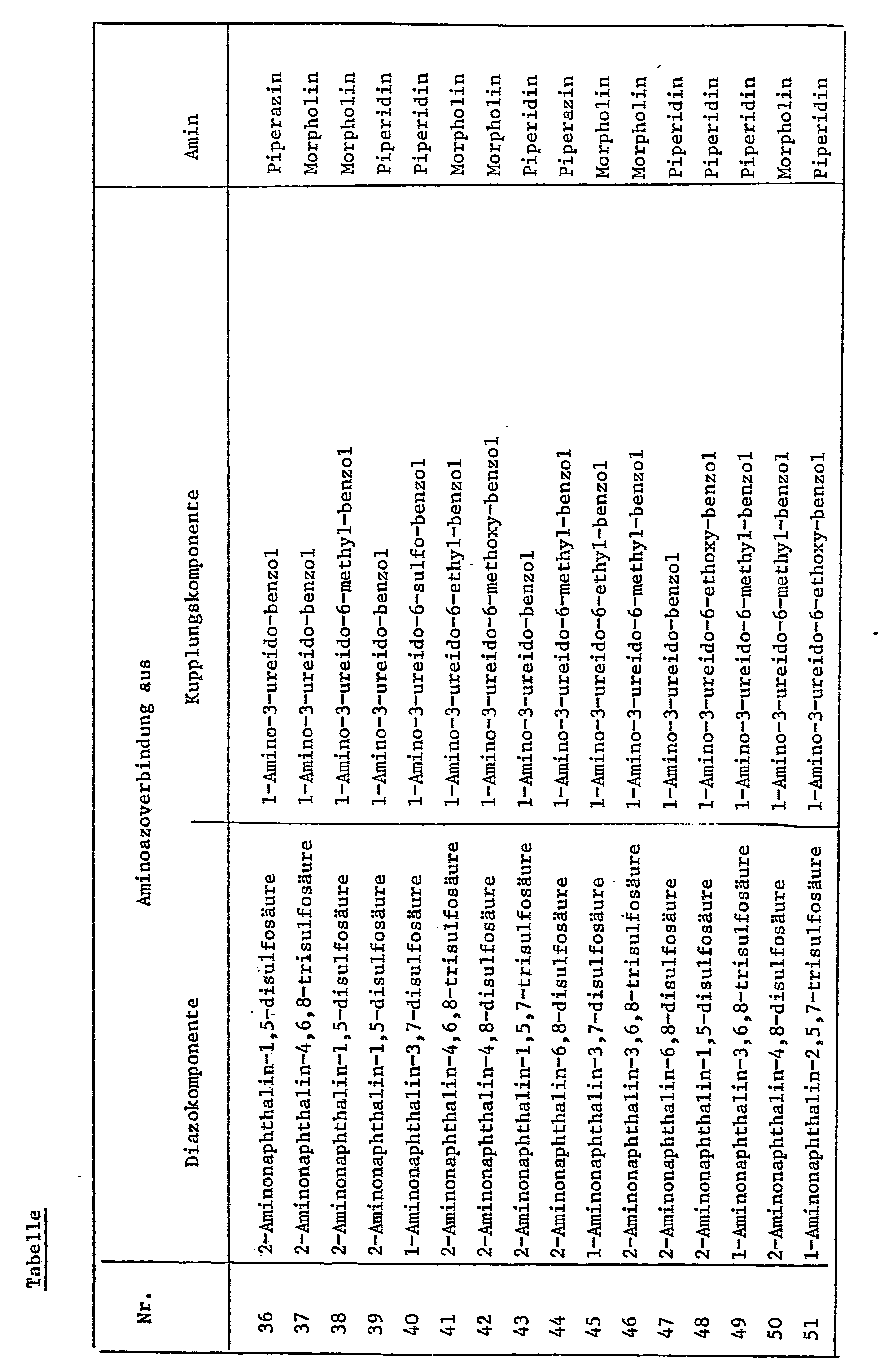
- Wenn man nach den Angaben von Beispiel 1 oder 2 verfährt, jedoch anstelle des dort verwendeten Aminoazofarbstoffs äquivalente Mengen der in der folgenden Tabelle aufgeführten Aminoazofarbstoffe, und für den Austausch des zweiten Chloratoms am Triazinring die in der letzten Spalte angegebenen Amine verwendet, so erhält man gleichfalls wertvolle Farbstoffe, die Baumwolle in gelben bis rotstichig gelben Tönen färben.




- 2 Teile des gemäss Beispiel 1 erhaltenen Farbstoffes werden unter Zusatz von 5 bis 20 Teilen Harnstoff und 2 Teilen kalzinierter Soda in 100 Teilen Wasser bei 20 bis 50°C gelöst. Mit der erhaltenen Lösung wird ein Baumwollgewebe imprägniert, so dass es um 60 bis 80% seines Gewichtes zunimmt, und dann getrocknet. Danach wird während 1 1/2 bis 5 Minuten bei 140 bis 210°C thermofixiert, dann während einer Viertelstunde in einer 0,1%igen kochenden Lösung eines ionenfreien Waschmittels geseift, gespült und getrocknet.
- 2 Teile des gemäss Beispiel 1 erhaltenen Farbstoffes werden in 2000 Teilen Wasser unter Zusatz von 120 Teilen Kochsalz oder kalziniertem Glaubersalz bei 75°C gelöst. Man geht mit 100 Teilen eines Baumwollgewebes in dieses Färbebad ein und hält die Temperatur während 30 bis 60 Minuten konstant. Danach werden 10 Teile kalzinierter Soda und 4 ml Natronlauge (36°Bé) zugegen. Die Temperatur wird weitere 45 bis 60 Minuten bei 75 bis 80°C gehalten, dann wird während 15 Minuten in einer 0,1%igen kochenden Lösung eines ionenfreien Waschmittels geseift, gespült und getrocknet.
- 2 Teile des gemäss Beispiel 1 erhaltenen Farbstoffes werden unter Zusatz von 0,5 Teilen m-nitrobenzolsulfonsaurem Natrium in 100 Teile Wasser gelöst. Mit der erhaltenen Lösung wird ein Baumwollgewebe imprägniert, so dass es um 75% seines Gewichtes zunimmt, und dann getrocknet. Danach imprägniert man das Gewebe mit einer 20°C warmen Lösung, die pro Liter 5 g Natriumhydroxid und 300 g Natriumchlorid enthält, quetscht auf 75% Gewichtszunahme ab, dämpft die Färbung während 30 Sekunden bei 100 bis 101°C, spült, seift während einer Viertelstunde in einer 0,3%igen kochenden Lösung eines ionenfreien Waschmittels, spült und trocknet.
- 2 Teile des gemäss Beispiel 1 erhaltenen Farbstoffes werden in 100 Teilen Wasser gelöst. Die Lösung gibt man zu 1900 Teilen kaltem Wasser, fügt 60 Teile Natriumchlorid zu und geht mit 100 Teilen eines Baumwollgewebes in dieses Färbebad ein. Man steigert die Temperatur auf 60°C, wobei nach 30 Minuten 40 Teile kalzinierte Soda und nochmals 60 Teile Natriumchlorid zugegeben werden. Man hält die Temperatur 30 Minuten auf 60°C, spült und seift dann die Färbung während 15 Minuten in einer 0,3%igen kochenden Lösung eines ionenfreien Waschmittels, spült und trocknet.
- 2 Teile des gemäss Beispiel 1 hergestellten Farbstoffes werden unter schnellem Rühren in 100 Teile einer Stammverdickung, enthaltend 45 Teile 5%ige Natriumalginatverdickung, 32 Teile Wasser, 20 Teile Harnstoff, 1 Teil m-nitrobenzolsulfonsaures Natrium sowie 2 Teile Natriumcarbonat, eingestreut. Mit der so erhaltenen Druckpaste bedruckt man ein Baumwollgewebe auf einer Rouleauxdruckmaschine und dämpft den erhaltenen bedruckten Stoff 4 bis 8 Minuten bei 100°C in gesättigtem Dampf. Das bedruckte Gewebe wird dann in kaltem und heissem Wasser gründlich gespült, wobei sich die nicht chemisch fixierten Anteile sehr leicht von der Faser entfernen lassen, und anschliessend getrocknet.
Claims (10)


H - Z (6)
mit 2,4,6-Trichlor-s-triazin kondensiert.
Applications Claiming Priority (2)
| Application Number | Priority Date | Filing Date | Title |
|---|---|---|---|
| CH551585 | 1985-12-23 | ||
| CH5515/85 | 1985-12-23 |
Publications (3)
| Publication Number | Publication Date |
|---|---|
| EP0230210A2 true EP0230210A2 (de) | 1987-07-29 |
| EP0230210A3 EP0230210A3 (en) | 1987-10-28 |
| EP0230210B1 EP0230210B1 (de) | 1989-12-13 |
Family
ID=4294914
Family Applications (1)
| Application Number | Title | Priority Date | Filing Date |
|---|---|---|---|
| EP86810599A Expired EP0230210B1 (de) | 1985-12-23 | 1986-12-17 | Reaktivfarbstoffe, deren Herstellung und Verwendung |
Country Status (9)
| Country | Link |
|---|---|
| EP (1) | EP0230210B1 (de) |
| JP (1) | JPS62158761A (de) |
| KR (1) | KR920002641B1 (de) |
| BR (1) | BR8606383A (de) |
| DE (1) | DE3667479D1 (de) |
| ES (1) | ES2011776B3 (de) |
| FI (1) | FI865240A7 (de) |
| OA (1) | OA08452A (de) |
| TR (1) | TR22964A (de) |
Cited By (1)
| Publication number | Priority date | Publication date | Assignee | Title |
|---|---|---|---|---|
| EP0431411A1 (de) * | 1989-12-06 | 1991-06-12 | Bayer Ag | Azoreaktivfarbstoffe |
Families Citing this family (1)
| Publication number | Priority date | Publication date | Assignee | Title |
|---|---|---|---|---|
| CN102433021A (zh) * | 2011-08-23 | 2012-05-02 | 湖北华丽染料工业有限公司 | 一种橙色活性染料及其制备方法及其用途 |
Family Cites Families (1)
| Publication number | Priority date | Publication date | Assignee | Title |
|---|---|---|---|---|
| GB2031932B (en) * | 1978-09-16 | 1982-11-10 | Bayer Ag | Fibre-reactive azo dyestuffs |
-
1986
- 1986-12-17 ES ES86810599T patent/ES2011776B3/es not_active Expired - Lifetime
- 1986-12-17 EP EP86810599A patent/EP0230210B1/de not_active Expired
- 1986-12-17 DE DE8686810599T patent/DE3667479D1/de not_active Expired - Lifetime
- 1986-12-19 OA OA59024A patent/OA08452A/xx unknown
- 1986-12-19 FI FI865240A patent/FI865240A7/fi not_active Application Discontinuation
- 1986-12-19 TR TR10/87A patent/TR22964A/xx unknown
- 1986-12-22 KR KR1019860011043A patent/KR920002641B1/ko not_active Expired
- 1986-12-22 BR BR8606383A patent/BR8606383A/pt unknown
- 1986-12-23 JP JP61305590A patent/JPS62158761A/ja active Pending
Cited By (2)
| Publication number | Priority date | Publication date | Assignee | Title |
|---|---|---|---|---|
| EP0431411A1 (de) * | 1989-12-06 | 1991-06-12 | Bayer Ag | Azoreaktivfarbstoffe |
| US5132410A (en) * | 1989-12-06 | 1992-07-21 | Bayer Aktiengesellschaft | Azo reactive dyestuffs containing a fluorotriazinyl group |
Also Published As
| Publication number | Publication date |
|---|---|
| ES2011776B3 (es) | 1990-02-16 |
| OA08452A (fr) | 1988-06-30 |
| DE3667479D1 (de) | 1990-01-18 |
| JPS62158761A (ja) | 1987-07-14 |
| FI865240L (fi) | 1987-06-24 |
| EP0230210B1 (de) | 1989-12-13 |
| FI865240A0 (fi) | 1986-12-19 |
| TR22964A (tr) | 1988-12-13 |
| EP0230210A3 (en) | 1987-10-28 |
| KR920002641B1 (ko) | 1992-03-31 |
| FI865240A7 (fi) | 1987-06-24 |
| BR8606383A (pt) | 1987-10-13 |
| KR870006146A (ko) | 1987-07-09 |
Similar Documents
| Publication | Publication Date | Title |
|---|---|---|
| EP0070808B1 (de) | Reaktivfarbstoffe, deren Herstellung und Verwendung | |
| EP0074928A2 (de) | Reaktivfarbstoffe, deren Herstellung und Verwendung | |
| CH628671A5 (de) | Verfahren zur herstellung von reaktivfarbstoffen. | |
| EP0179019B1 (de) | Reaktivfarbstoffe, deren Herstellung und Verwendung | |
| DE2657341C2 (de) | Faserreaktive Azofarbstoffe, deren Herstellung und Verwendung | |
| EP0073178B1 (de) | Reaktivfarbstoffe, deren Herstellung und Verwendung | |
| EP0132223B1 (de) | Reaktivfarbstoffe, deren Herstellung und Verwendung | |
| EP0428482B1 (de) | Reaktivfarbstoffe, Verfahren zu deren Herstellung und deren Verwendung | |
| EP0120807B1 (de) | Reaktivfarbstoffe, deren Herstellung und Verwendung | |
| EP0499588A1 (de) | Reaktivefarbstoffe, Verfahren zu deren Herstellung und deren Verwendung | |
| EP0096659B1 (de) | Verfahren zum Färben oder Bedrucken von textilen Fasermaterialien mit Reaktivfarbstoffen | |
| EP0230210B1 (de) | Reaktivfarbstoffe, deren Herstellung und Verwendung | |
| EP0170612B1 (de) | Reaktivfarbstoffe, deren Herstellung und Verwendung | |
| EP0097119A2 (de) | Reaktivfarbstoffe, deren Herstellung und Verwendung | |
| DE3046452A1 (de) | "chlor-triazinyl verbindungen" | |
| EP0333656B1 (de) | Reaktivfarbstoffe, Verfahren zu deren Herstellung und deren Verwendung | |
| EP0426616B1 (de) | Reaktivfarbstoffe, deren Herstellung und Verwendung | |
| EP0105027B1 (de) | Reaktivfarbstoffe, deren Herstellung und Verwendung | |
| EP0708151B1 (de) | Faserreaktive Anthrachinonfarbstoffe, Verfahren zu deren Herstellung und deren Verwendung | |
| CH628919A5 (de) | Verfahren zur herstellung von azofarbstoffen. | |
| DE1419794B2 (de) | Verfahren zur Herstellung von Disazoreaktivfarbstoffen und deren Verwendung | |
| DE1298220B (de) | Verfahren zur Herstellung faserreaktiver Monoazofarbstoffe | |
| DE1544447C3 (de) | Stilbenazoreaktivfarbstoffe und Verfahren zur Herstellung dieser Farbstoffe | |
| DE1419795C3 (de) | Verfahren zur Herstellung von Disazoreaktivfarbstoffen | |
| EP0134192B1 (de) | Reaktivfarbstoffe, deren Herstellung und Verwendung |
Legal Events
| Date | Code | Title | Description |
|---|---|---|---|
| PUAI | Public reference made under article 153(3) epc to a published international application that has entered the european phase |
Free format text: ORIGINAL CODE: 0009012 |
|
| 17P | Request for examination filed |
Effective date: 19861217 |
|
| AK | Designated contracting states |
Kind code of ref document: A2 Designated state(s): BE CH DE ES FR GB IT LI NL SE |
|
| PUAL | Search report despatched |
Free format text: ORIGINAL CODE: 0009013 |
|
| AK | Designated contracting states |
Kind code of ref document: A3 Designated state(s): BE CH DE ES FR GB IT LI NL SE |
|
| 17Q | First examination report despatched |
Effective date: 19880919 |
|
| GRAA | (expected) grant |
Free format text: ORIGINAL CODE: 0009210 |
|
| AK | Designated contracting states |
Kind code of ref document: B1 Designated state(s): BE CH DE ES FR GB IT LI NL SE |
|
| ET | Fr: translation filed | ||
| REF | Corresponds to: |
Ref document number: 3667479 Country of ref document: DE Date of ref document: 19900118 |
|
| ITF | It: translation for a ep patent filed | ||
| GBT | Gb: translation of ep patent filed (gb section 77(6)(a)/1977) | ||
| PLBE | No opposition filed within time limit |
Free format text: ORIGINAL CODE: 0009261 |
|
| STAA | Information on the status of an ep patent application or granted ep patent |
Free format text: STATUS: NO OPPOSITION FILED WITHIN TIME LIMIT |
|
| 26N | No opposition filed | ||
| PGFP | Annual fee paid to national office [announced via postgrant information from national office to epo] |
Ref country code: FR Payment date: 19911014 Year of fee payment: 6 |
|
| PGFP | Annual fee paid to national office [announced via postgrant information from national office to epo] |
Ref country code: DE Payment date: 19911024 Year of fee payment: 6 |
|
| PGFP | Annual fee paid to national office [announced via postgrant information from national office to epo] |
Ref country code: GB Payment date: 19911104 Year of fee payment: 6 |
|
| PGFP | Annual fee paid to national office [announced via postgrant information from national office to epo] |
Ref country code: CH Payment date: 19911122 Year of fee payment: 6 |
|
| PGFP | Annual fee paid to national office [announced via postgrant information from national office to epo] |
Ref country code: ES Payment date: 19911210 Year of fee payment: 6 |
|
| PGFP | Annual fee paid to national office [announced via postgrant information from national office to epo] |
Ref country code: SE Payment date: 19911219 Year of fee payment: 6 |
|
| PGFP | Annual fee paid to national office [announced via postgrant information from national office to epo] |
Ref country code: BE Payment date: 19911227 Year of fee payment: 6 |
|
| ITTA | It: last paid annual fee | ||
| PGFP | Annual fee paid to national office [announced via postgrant information from national office to epo] |
Ref country code: NL Payment date: 19911231 Year of fee payment: 6 |
|
| PG25 | Lapsed in a contracting state [announced via postgrant information from national office to epo] |
Ref country code: GB Effective date: 19921217 |
|
| PG25 | Lapsed in a contracting state [announced via postgrant information from national office to epo] |
Ref country code: SE Effective date: 19921218 |
|
| PG25 | Lapsed in a contracting state [announced via postgrant information from national office to epo] |
Ref country code: LI Effective date: 19921231 Ref country code: CH Effective date: 19921231 Ref country code: BE Effective date: 19921231 |
|
| BERE | Be: lapsed |
Owner name: CIBA-GEIGY A.G. Effective date: 19921231 |
|
| PG25 | Lapsed in a contracting state [announced via postgrant information from national office to epo] |
Ref country code: NL Effective date: 19930701 |
|
| GBPC | Gb: european patent ceased through non-payment of renewal fee |
Effective date: 19921217 |
|
| NLV4 | Nl: lapsed or anulled due to non-payment of the annual fee | ||
| PG25 | Lapsed in a contracting state [announced via postgrant information from national office to epo] |
Ref country code: FR Effective date: 19930831 |
|
| REG | Reference to a national code |
Ref country code: CH Ref legal event code: PL |
|
| PG25 | Lapsed in a contracting state [announced via postgrant information from national office to epo] |
Ref country code: DE Effective date: 19930901 |
|
| REG | Reference to a national code |
Ref country code: FR Ref legal event code: ST |
|
| PG25 | Lapsed in a contracting state [announced via postgrant information from national office to epo] |
Ref country code: ES Free format text: LAPSE BECAUSE OF NON-PAYMENT OF DUE FEES Effective date: 19931218 |
|
| EUG | Se: european patent has lapsed |
Ref document number: 86810599.0 Effective date: 19930709 |
|
| REG | Reference to a national code |
Ref country code: ES Ref legal event code: FD2A Effective date: 19940113 |
|
| PG25 | Lapsed in a contracting state [announced via postgrant information from national office to epo] |
Ref country code: IT Free format text: LAPSE BECAUSE OF NON-PAYMENT OF DUE FEES;WARNING: LAPSES OF ITALIAN PATENTS WITH EFFECTIVE DATE BEFORE 2007 MAY HAVE OCCURRED AT ANY TIME BEFORE 2007. THE CORRECT EFFECTIVE DATE MAY BE DIFFERENT FROM THE ONE RECORDED. Effective date: 20051217 |