EP0230230A2 - Verfahren zur Herstellung von Hydroxybenzaldoxim-O-ethern - Google Patents
Verfahren zur Herstellung von Hydroxybenzaldoxim-O-ethern Download PDFInfo
- Publication number
- EP0230230A2 EP0230230A2 EP87100170A EP87100170A EP0230230A2 EP 0230230 A2 EP0230230 A2 EP 0230230A2 EP 87100170 A EP87100170 A EP 87100170A EP 87100170 A EP87100170 A EP 87100170A EP 0230230 A2 EP0230230 A2 EP 0230230A2
- Authority
- EP
- European Patent Office
- Prior art keywords
- formula
- hydroxybenzaldoxime
- mol
- iii
- alkyl
- Prior art date
- Legal status (The legal status is an assumption and is not a legal conclusion. Google has not performed a legal analysis and makes no representation as to the accuracy of the status listed.)
- Ceased
Links
- ORIHZIZPTZTNCU-UHFFFAOYSA-N 2-(hydroxyiminomethyl)phenol Chemical compound ON=CC1=CC=CC=C1O ORIHZIZPTZTNCU-UHFFFAOYSA-N 0.000 title claims abstract description 20
- 238000000034 method Methods 0.000 title claims description 29
- 238000002360 preparation method Methods 0.000 title claims description 4
- 150000001350 alkyl halides Chemical class 0.000 claims abstract description 11
- 125000000217 alkyl group Chemical group 0.000 claims abstract description 8
- 239000003085 diluting agent Substances 0.000 claims abstract description 7
- 229910052736 halogen Inorganic materials 0.000 claims abstract description 3
- HEMHJVSKTPXQMS-UHFFFAOYSA-M Sodium hydroxide Chemical compound [OH-].[Na+] HEMHJVSKTPXQMS-UHFFFAOYSA-M 0.000 claims description 18
- XLYOFNOQVPJJNP-UHFFFAOYSA-N water Substances O XLYOFNOQVPJJNP-UHFFFAOYSA-N 0.000 claims description 11
- 150000008050 dialkyl sulfates Chemical class 0.000 claims description 10
- 239000007858 starting material Substances 0.000 claims description 8
- KWYUFKZDYYNOTN-UHFFFAOYSA-M Potassium hydroxide Chemical compound [OH-].[K+] KWYUFKZDYYNOTN-UHFFFAOYSA-M 0.000 claims description 6
- 125000004432 carbon atom Chemical group C* 0.000 claims description 6
- 239000000203 mixture Substances 0.000 claims description 6
- WKBOTKDWSSQWDR-UHFFFAOYSA-N Bromine atom Chemical group [Br] WKBOTKDWSSQWDR-UHFFFAOYSA-N 0.000 claims description 4
- GDTBXPJZTBHREO-UHFFFAOYSA-N bromine Chemical group BrBr GDTBXPJZTBHREO-UHFFFAOYSA-N 0.000 claims description 4
- 229910052794 bromium Inorganic materials 0.000 claims description 4
- LJEARAFLOCEYHX-VMPITWQZSA-N chembl202611 Chemical compound O\N=C\C1=CC=C(O)C=C1 LJEARAFLOCEYHX-VMPITWQZSA-N 0.000 claims description 3
- ZCYVEMRRCGMTRW-UHFFFAOYSA-N 7553-56-2 Chemical group [I] ZCYVEMRRCGMTRW-UHFFFAOYSA-N 0.000 claims description 2
- 150000001298 alcohols Chemical class 0.000 claims description 2
- 229910052801 chlorine Inorganic materials 0.000 claims description 2
- 239000000460 chlorine Substances 0.000 claims description 2
- 150000002367 halogens Chemical group 0.000 claims description 2
- 229910052740 iodine Chemical group 0.000 claims description 2
- 239000011630 iodine Chemical group 0.000 claims description 2
- 125000001309 chloro group Chemical group Cl* 0.000 claims 1
- 125000001495 ethyl group Chemical group [H]C([H])([H])C([H])([H])* 0.000 claims 1
- 125000002496 methyl group Chemical group [H]C([H])([H])* 0.000 claims 1
- 125000005843 halogen group Chemical group 0.000 abstract 1
- 150000003467 sulfuric acid derivatives Chemical class 0.000 abstract 1
- YMWUJEATGCHHMB-UHFFFAOYSA-N Dichloromethane Chemical compound ClCCl YMWUJEATGCHHMB-UHFFFAOYSA-N 0.000 description 9
- 239000002585 base Substances 0.000 description 7
- 238000006243 chemical reaction Methods 0.000 description 7
- WEVYAHXRMPXWCK-UHFFFAOYSA-N Acetonitrile Chemical compound CC#N WEVYAHXRMPXWCK-UHFFFAOYSA-N 0.000 description 6
- 150000001875 compounds Chemical class 0.000 description 6
- RTZKZFJDLAIYFH-UHFFFAOYSA-N Diethyl ether Chemical compound CCOCC RTZKZFJDLAIYFH-UHFFFAOYSA-N 0.000 description 5
- -1 phenol anion Chemical class 0.000 description 5
- 239000011541 reaction mixture Substances 0.000 description 5
- QAOWNCQODCNURD-UHFFFAOYSA-N Sulfuric acid Chemical compound OS(O)(=O)=O QAOWNCQODCNURD-UHFFFAOYSA-N 0.000 description 4
- 239000002168 alkylating agent Substances 0.000 description 4
- 229940100198 alkylating agent Drugs 0.000 description 4
- 230000015572 biosynthetic process Effects 0.000 description 4
- NEHMKBQYUWJMIP-UHFFFAOYSA-N chloromethane Chemical compound ClC NEHMKBQYUWJMIP-UHFFFAOYSA-N 0.000 description 4
- 238000003786 synthesis reaction Methods 0.000 description 4
- QFICVZPLAHMLSB-UHFFFAOYSA-N 4-(hydroxyiminomethyl)phenol hydrate Chemical compound O.ON=Cc1ccc(O)cc1 QFICVZPLAHMLSB-UHFFFAOYSA-N 0.000 description 3
- UDQKPOSZVPAOEO-UHFFFAOYSA-N 4-methoxyimino-2-methylcyclohexa-1,5-dien-1-ol Chemical compound CON=C1CC(=C(C=C1)O)C UDQKPOSZVPAOEO-UHFFFAOYSA-N 0.000 description 3
- LFQSCWFLJHTTHZ-UHFFFAOYSA-N Ethanol Chemical compound CCO LFQSCWFLJHTTHZ-UHFFFAOYSA-N 0.000 description 3
- OKKJLVBELUTLKV-UHFFFAOYSA-N Methanol Chemical compound OC OKKJLVBELUTLKV-UHFFFAOYSA-N 0.000 description 3
- YXFVVABEGXRONW-UHFFFAOYSA-N Toluene Chemical compound CC1=CC=CC=C1 YXFVVABEGXRONW-UHFFFAOYSA-N 0.000 description 3
- 230000000843 anti-fungal effect Effects 0.000 description 3
- 239000012043 crude product Substances 0.000 description 3
- 230000000855 fungicidal effect Effects 0.000 description 3
- ONWAMSCBMMZGPI-UHFFFAOYSA-N 1-(4-methoxyimino-2-methylcyclohexa-1,5-dien-1-yl)oxy-3,3-dimethyl-1-(1,2,4-triazol-1-yl)butan-2-one Chemical compound CC(C(C(N1N=CN=C1)OC1=C(CC(C=C1)=NOC)C)=O)(C)C ONWAMSCBMMZGPI-UHFFFAOYSA-N 0.000 description 2
- KIVDZERHEZTUGL-UHFFFAOYSA-N 1-bromo-3,3-dimethyl-1-(1,2,4-triazol-1-yl)butan-2-one Chemical compound CC(C)(C)C(=O)C(Br)N1C=NC=N1 KIVDZERHEZTUGL-UHFFFAOYSA-N 0.000 description 2
- FMWWRALTYIWZEB-UHFFFAOYSA-N 3,3-dimethyl-1-(1,2,4-triazol-1-yl)butan-2-one Chemical compound CC(C)(C)C(=O)CN1C=NC=N1 FMWWRALTYIWZEB-UHFFFAOYSA-N 0.000 description 2
- QTBSBXVTEAMEQO-UHFFFAOYSA-N Acetic acid Chemical compound CC(O)=O QTBSBXVTEAMEQO-UHFFFAOYSA-N 0.000 description 2
- 238000009835 boiling Methods 0.000 description 2
- 238000004508 fractional distillation Methods 0.000 description 2
- 150000002443 hydroxylamines Chemical class 0.000 description 2
- 230000000749 insecticidal effect Effects 0.000 description 2
- 238000004519 manufacturing process Methods 0.000 description 2
- 229940050176 methyl chloride Drugs 0.000 description 2
- 239000012074 organic phase Substances 0.000 description 2
- BWHMMNNQKKPAPP-UHFFFAOYSA-L potassium carbonate Chemical compound [K+].[K+].[O-]C([O-])=O BWHMMNNQKKPAPP-UHFFFAOYSA-L 0.000 description 2
- 239000000047 product Substances 0.000 description 2
- 230000000630 rising effect Effects 0.000 description 2
- SMQUZDBALVYZAC-UHFFFAOYSA-N salicylaldehyde Chemical class OC1=CC=CC=C1C=O SMQUZDBALVYZAC-UHFFFAOYSA-N 0.000 description 2
- 238000003756 stirring Methods 0.000 description 2
- 239000000126 substance Substances 0.000 description 2
- DAJIRPMNQQGGJN-UHFFFAOYSA-N 4-(methoxyiminomethyl)phenol Chemical compound CON=CC1=CC=C(O)C=C1 DAJIRPMNQQGGJN-UHFFFAOYSA-N 0.000 description 1
- ZNBNBTIDJSKEAM-UHFFFAOYSA-N 4-[7-hydroxy-2-[5-[5-[6-hydroxy-6-(hydroxymethyl)-3,5-dimethyloxan-2-yl]-3-methyloxolan-2-yl]-5-methyloxolan-2-yl]-2,8-dimethyl-1,10-dioxaspiro[4.5]decan-9-yl]-2-methyl-3-propanoyloxypentanoic acid Chemical compound C1C(O)C(C)C(C(C)C(OC(=O)CC)C(C)C(O)=O)OC11OC(C)(C2OC(C)(CC2)C2C(CC(O2)C2C(CC(C)C(O)(CO)O2)C)C)CC1 ZNBNBTIDJSKEAM-UHFFFAOYSA-N 0.000 description 1
- BVKZGUZCCUSVTD-UHFFFAOYSA-M Bicarbonate Chemical compound OC([O-])=O BVKZGUZCCUSVTD-UHFFFAOYSA-M 0.000 description 1
- ZAMOUSCENKQFHK-UHFFFAOYSA-N Chlorine atom Chemical compound [Cl] ZAMOUSCENKQFHK-UHFFFAOYSA-N 0.000 description 1
- KFZMGEQAYNKOFK-UHFFFAOYSA-N Isopropanol Chemical compound CC(C)O KFZMGEQAYNKOFK-UHFFFAOYSA-N 0.000 description 1
- LRHPLDYGYMQRHN-UHFFFAOYSA-N N-Butanol Chemical compound CCCCO LRHPLDYGYMQRHN-UHFFFAOYSA-N 0.000 description 1
- PMZURENOXWZQFD-UHFFFAOYSA-L Sodium Sulfate Chemical compound [Na+].[Na+].[O-]S([O-])(=O)=O PMZURENOXWZQFD-UHFFFAOYSA-L 0.000 description 1
- VMHLLURERBWHNL-UHFFFAOYSA-M Sodium acetate Chemical compound [Na+].CC([O-])=O VMHLLURERBWHNL-UHFFFAOYSA-M 0.000 description 1
- 229960000583 acetic acid Drugs 0.000 description 1
- 150000008044 alkali metal hydroxides Chemical class 0.000 description 1
- 239000004927 clay Substances 0.000 description 1
- 238000001816 cooling Methods 0.000 description 1
- DENRZWYUOJLTMF-UHFFFAOYSA-N diethyl sulfate Chemical compound CCOS(=O)(=O)OCC DENRZWYUOJLTMF-UHFFFAOYSA-N 0.000 description 1
- 229940008406 diethyl sulfate Drugs 0.000 description 1
- VAYGXNSJCAHWJZ-UHFFFAOYSA-N dimethyl sulfate Chemical compound COS(=O)(=O)OC VAYGXNSJCAHWJZ-UHFFFAOYSA-N 0.000 description 1
- 239000000706 filtrate Substances 0.000 description 1
- 238000004817 gas chromatography Methods 0.000 description 1
- 239000012362 glacial acetic acid Substances 0.000 description 1
- 125000002887 hydroxy group Chemical group [H]O* 0.000 description 1
- 229910000378 hydroxylammonium sulfate Inorganic materials 0.000 description 1
- 239000000543 intermediate Substances 0.000 description 1
- ZXEKIIBDNHEJCQ-UHFFFAOYSA-N isobutanol Chemical compound CC(C)CO ZXEKIIBDNHEJCQ-UHFFFAOYSA-N 0.000 description 1
- 238000002955 isolation Methods 0.000 description 1
- 238000002844 melting Methods 0.000 description 1
- 230000008018 melting Effects 0.000 description 1
- 230000000269 nucleophilic effect Effects 0.000 description 1
- 150000004045 organic chlorine compounds Chemical class 0.000 description 1
- 239000003960 organic solvent Substances 0.000 description 1
- 150000002923 oximes Chemical class 0.000 description 1
- ISWSIDIOOBJBQZ-UHFFFAOYSA-N phenol group Chemical group C1(=CC=CC=C1)O ISWSIDIOOBJBQZ-UHFFFAOYSA-N 0.000 description 1
- 125000001997 phenyl group Chemical group [H]C1=C([H])C([H])=C(*)C([H])=C1[H] 0.000 description 1
- 229910000027 potassium carbonate Inorganic materials 0.000 description 1
- BDERNNFJNOPAEC-UHFFFAOYSA-N propan-1-ol Chemical compound CCCO BDERNNFJNOPAEC-UHFFFAOYSA-N 0.000 description 1
- 239000003586 protic polar solvent Substances 0.000 description 1
- 230000035484 reaction time Effects 0.000 description 1
- 239000002002 slurry Substances 0.000 description 1
- 239000001632 sodium acetate Substances 0.000 description 1
- 235000017281 sodium acetate Nutrition 0.000 description 1
- 229910052938 sodium sulfate Inorganic materials 0.000 description 1
- 235000011152 sodium sulphate Nutrition 0.000 description 1
- 125000001424 substituent group Chemical group 0.000 description 1
Classifications
-
- C—CHEMISTRY; METALLURGY
- C07—ORGANIC CHEMISTRY
- C07C—ACYCLIC OR CARBOCYCLIC COMPOUNDS
- C07C249/00—Preparation of compounds containing nitrogen atoms doubly-bound to a carbon skeleton
- C07C249/04—Preparation of compounds containing nitrogen atoms doubly-bound to a carbon skeleton of oximes
- C07C249/12—Preparation of compounds containing nitrogen atoms doubly-bound to a carbon skeleton of oximes by reactions not involving the formation of oxyimino groups
-
- C—CHEMISTRY; METALLURGY
- C07—ORGANIC CHEMISTRY
- C07C—ACYCLIC OR CARBOCYCLIC COMPOUNDS
- C07C251/00—Compounds containing nitrogen atoms doubly-bound to a carbon skeleton
- C07C251/32—Oximes
- C07C251/34—Oximes with oxygen atoms of oxyimino groups bound to hydrogen atoms or to carbon atoms of unsubstituted hydrocarbon radicals
- C07C251/48—Oximes with oxygen atoms of oxyimino groups bound to hydrogen atoms or to carbon atoms of unsubstituted hydrocarbon radicals with the carbon atom of at least one of the oxyimino groups bound to a carbon atom of a six-membered aromatic ring
Definitions
- the invention relates to a new process for the preparation of known hydroxybenzaldoxime O-ethers which can be used as intermediates for the synthesis of compounds having fungicidal, insecticidal and antifungal activity.
- O-substituted aldoximes can be obtained in a technical process if oximes are reacted with an organochloride and an alkali metal hydroxide in a low molecular weight alcohol (cf. EP-OS 0 121 701).
- EP-OS 0 121 701 a low molecular weight alcohol
- only those radicals which are inert under the reaction conditions are suitable as substituents in the phenyl part. The reaction of hydroxybenzaldoximes is therefore not possible under these conditions.
- the method according to the invention is characterized by a number of advantages. It enables the production of hydroxybenzaldoxime O-ethers of the formula (I) in high yields, with readily accessible compounds being used as starting products. Furthermore, the reaction can be carried out easily and the isolation of the hydroxybenzaldoxime O-ethers of the formula (I) presents no difficulties. The process according to the invention is therefore particularly suitable for producing hydroxybenzaldoxime O ether also on an industrial scale.
- Formula (II) provides a general definition of the hydroxybenzaldoximes to be used as starting materials in the process according to the invention. 4-Hydroxybenzaldoxime or its hydrate is particularly preferred.
- the hydroxybenzaldoximes of the formula (II) are generally known compounds of organic chemistry (cf. e.g. EP-OS 0 012 158, CA 96: 68526p or CA 85: 21226y). They can be obtained in a particularly advantageous manner by reacting hydroxybenzaldehydes with hydroxylamine sulfate solution.
- Formula (III) provides a general definition of the dialkyl sulfates to be used as starting materials for the process according to the invention.
- R 1 preferably represents straight-chain or branched alkyl having 1 to 10 carbon atoms.
- Particularly preferred starting materials are those dialkyl sulfates of the formula (III) in which R 1 represents straight-chain or branched alkyl having 1 to 4 carbon atoms.
- Formula (IV) provides a general definition of the alkyl halides to be used as starting materials in the process according to the invention.
- R 1 preferably represents straight-chain or branched alkyl having 1 to 10 carbon atoms, in particular having 1 to 4 carbon atoms.
- X preferably represents chlorine, bromine or iodine.
- dialkyl sulfates of the formula (III) and the alkyl halides of the formula (IV) are generally known compounds of organic chemistry.
- the process according to the invention is carried out in the presence of a diluent.
- Polar, protic solvents such as alcohols, e.g. Methanol, ethanol, n- and i-propanol and n- and i-butanol; also water and mixtures of water with the organic solvents mentioned.
- Sodium hydroxide and potassium hydroxide are preferably suitable as strong bases for the process according to the invention.
- temperatures can be varied within a substantial range when carrying out the process according to the invention. In general, temperatures between 0 ° C and 60 ° C, preferably between 10 ° C and 50 ° C.
- gaseous alkyl halides of the formula (IV) are used as the alkylating agent, the process is carried out in pressure vessels under a pressure between 1 and 15 bar.
- hydroxybenzaldoxime of the formula (II) When carrying out the process according to the invention, 1 to 2 mol, preferably 1 to 1.5 mol of dialkyl sulfate of the formula (III) and 1 to 4 mol, preferably 1.5 to 3 mol, of base are employed per mol of hydroxybenzaldoxime of the formula (II) .
- the reaction time is generally 5 to 15 hours, preferably 5 to 10 hours.
- the hydroxybenzaldoxime O-ethers of the formula (I) are isolated in the customary manner, for example by fractional distillation.
- the hydroxybenzaldoxime O-ethers of the formula (I) which can be prepared by the process according to the invention are generally known starting materials for the synthesis of biologically active compounds, such as e.g. for the synthesis of oxime ethers which have good insecticidal properties (cf. EP-OS 0 115 828); Azolyl-phenoxy derivatives which have excellent fungicidal properties (cf. EP-OS 0 076 370); 1-hydroxyethyl-triazolyl derivatives which have good fungicidal and antifungal properties (cf. EP-OS 0 110 048 and DE-OS 3 314 548); and of hydroxyalkyl azole derivatives which have good antifungal activity (cf. DE-OS 3 427 844).
- biologically active compounds such as e.g. for the synthesis of oxime ethers which have good insecticidal properties (cf. EP-OS 0 115 828); Azolyl-phenoxy derivatives which have excellent
- the 3,3-dimethyl-1- (4-methoximinomethyl-phenoxy) -1- (1,2,4-triazol-1-yl) butan-2-one of the formula by making 3,3-dimethyl-1- (1,2,4-triazol-1-yl) -butan-2-one with bromine to give 1-bromo- (1,2,4-triazol-1- yl) -3,3-dimethyl-butan-2-one is reacted and this is then reacted with 4-hydroxybenzaldehyde-O-methyl-oxime ether in the presence of a base.
- This synthesis can be illustrated as follows:
Landscapes
- Chemical & Material Sciences (AREA)
- Organic Chemistry (AREA)
- Chemical Kinetics & Catalysis (AREA)
- Organic Low-Molecular-Weight Compounds And Preparation Thereof (AREA)
- Nitrogen And Oxygen Or Sulfur-Condensed Heterocyclic Ring Systems (AREA)
- Saccharide Compounds (AREA)
Abstract
Description
- Die Erfindung betrifft ein neues Verfahren zu Herstellung von bekannten Hydroxybenzaldoxim-O-ethern, die als Zwischenprodukte zur Synthese von Verbindungen mit fungizider, insektizider und antimykotischer Wirksamkeit verwendet werden können.
- Es ist bereits bekannt geworden, daß man bestimmte Hydroxybenzaldoxim-O-ether herstellen kann, indem man Hydroxybenzaldehyde mit den entsprechenden Hydroxylamin-Derivaten umsetzt (vgl. EP-OS 0 076 370 und EP-OS 0 115 828). Die betreffende Umsetzung läßt sich durch das folgende Reaktionsschema veranschaulichen:

- Nachteilig an diesem Verfahren sind jedoch der hohe Preis und die schlechte Verfügbarkeit der als Reaktionskomponenten benötigten substituierten Hydroxylamine. Der Einsatz dieser Stoffe für eine Herstellung von Hydroxybenzaldoxim-O-ethern in technischem Maßstab ist daher problematisch.
- Weiterhin ist bekannt, daß O-substituierte Aldoxime in einem technischen Prozeß erhalten werden können, wenn man Oxime mit einem Organochlorid und einem Alkalimetall-Hydroxid in einem niedermolekularen Alkohol umsetzt (vgl. EP-OS 0 121 701). Als Substituenten im Phenylteil kommen hierbei jedoch nur solche Reste in Frage, die sich unter den Reaktionsbedingungen inert verhalten. Die Umsetzung von Hydroxybenzaldoximen ist daher unter diesen Bedingungen nicht möglich.
- Es wurde nun gefunden, daß man bekannte Hydroxybenzaldoxim-O-ether der Formel

R¹ für Alkyl steht,
erhält, wenn man Hydroxybenzaldoxime der Formel
R¹ - O - SO₂ - O - R¹ (III)
in welcher
R¹ die oben angegebene Bedeutung hat,
oder mit Alkylhalogeniden der Formel
R¹X (IV)
in welcher
R¹ die oben angegebene Bedeutung hat und
X für Halogen steht,
in Gegenwart einer starken Base und in Gegenwart eines Verdünnungsmittels bei Temperaturen zwischen 0° C und 60° C umsetzt. - Es ist als äußerst überraschend zu bezeichnen, daß die erfindungsgemäße Umsetzung unter den angegebenen Verfahrensbedingungen glatt und in guter Ausbeute abläuft. Es war nämlich zu erwarten, daß das Alkylierungsmittel in sehr starkem Maß an der phenolischen OH-Gruppe angreift, da diese in Gegenwart einer starken Base als nukleophiles Phenol-Anion vorliegt.
- Das erfindungsgemäße Verfahren zeichnet sich durch eine Reihe von Vorteilen aus. So ermöglicht es die Herstellung von Hydroxybenzaldoxim-O-ethern der Formel (I) in hohen Ausbeuten, wobei gut zugängliche Verbindungen als Ausgangsprodukte eingesetzt werden. Ferner ist die Umsetzung einfach durchführbar, und die Isolierung der Hydroxybenzaldoxim-O-ether der Formel (I) bereitet keinerlei Schwierigkeiten. Das erfindungsgemäße Verfahren ist somit besonders geeignet, um Hydroxybenzaldoxim-O-ether auch in technischem Maßstab herzustellen.
- Verwendet man beispielsweise 4-Hydroxybenzaldoxim als Ausgangsstoff, Diethylsulfat als Alkylierungsmittel, Natriumhydroxid als starke Base und Wasser als Verdünnungsmittel, so kann der Verlauf des erfindungsgemäßen Verfahrens durch das folgende Formelschema veranschaulicht werden:

- Verwendet man 4-Hydroxybenzaldoxim-hydrat als Ausgangsmaterial, Methylchlorid als Alkylierungsmittel, Natriumhydroxid als starke Base und Wasser als Verdünnungsmittel, so kann der Verlauf des erfindungsgemäßen Verfahrens durch das folgende Formelschema veranschaulicht werden:

- Die bei dem erfindungsgemäßen Verfahren als Ausgangsstoffe zu verwendenden Hydroxybenzaldoxime sich durch die Formel (II) allgemein definiert. Besonders bevorzugt ist das 4-Hydroxybenzaldoxim bzw. dessen Hydrat.
- Die Hydroxybenzaldoxime der Formel (II) sind allgemein bekannte Verbindungen der organischen Chemie (vgl. z.B. EP-OS 0 012 158, CA 96:68526p oder CA 85:21226y). Sie können in besonders vorteilhafter Weise durch Umsetzung von Hydroxybenzaldehyden mit Hydroxylaminsulfat-Lösung erhalten werden .
- Die für das erfindungsgemäße Verfahren außerdem als Ausgangsstoffe zu verwendenden Dialkylsulfate sind durch die Formel (III) allgemein definiert. In dieser Formel steht R¹ vorzugsweise für geradkettiges oder verzweigtes Alkyl mit 1 bis 10 Kohlenstoffatomen.
- Besonders bevorzugte Ausgangsstoffe sind diejenigen Dialkylsulfate der Formel (III), in denen R¹ für geradkettiges oder verzweigtes Alkyl mit 1 bis 4 Kohlenstoffatomen steht.
- Die bei dem erfindungsgemäßen Verfahren außerdem als Ausgangsstoffe zu verwendenden Alkylhalogenide sind durch die Formel (IV) allgemein definiert. Auch in dieser Formel steht R¹ vorzugsweise für geradkettiges oder verzweigtes Alkyl mit 1 bis 10 Kohlenstoffatomen, insbesondere mit 1 bis 4 Kohlenstoffatomen. X steht vorzugsweise für Chlor, Brom oder Iod.
- Die Dialkylsulfate der Formel (III) und die Alkylhalogenide der Formel (IV) sind allgemein bekannte Verbindungen der organischen Chemie.
- Das erfindungsgemäße Verfahren wird in Gegenwart eines Verdünnungsmittels durchgeführt. Hierfür kommen vorzugsweise polare, protische Lösungsmittel infrage, wie Alkohole, z.B. Methanol, Ethanol, n- und i-Propanol und n- und i-Butanol; ferner Wasser sowie Mischungen von Wasser mit den genannten organischen Lösungsmitteln.
- Als starke Basen Kommen für das erfindungsgemäße Verfahren vorzugsweise Natriumhydroxid und Kaliumhydroxid infrage.
- Die Temperaturen können bei der Durchführung des erfindungsgemäßen Verfahrens in einem größeren Bereich variiert werden. Im allgemeinen arbeitet man bei Temperaturen zwischen 0° C und 60° C, vorzugsweise zwischen 10° C und 50° C.
- Wenn als Alkylierungsmittel gasförmige Alkylhalogenide der Formel (IV) eingesetzt werden, so arbeitet man in Druckgefäßen unter einem Druck zwischen 1 und 15 bar.
- Bei der Durchführung des erfindungsgemäßen Verfahrens setzt man auf 1 Mol Hydroxybenzaldoxim der Formel (II) 1 bis 2 Mol, vorzugsweise 1 bis 1,5 Mol Dialkylsulfat der Formel (III) und 1 bis 4 Mol, vorzugsweise 1,5 bis 3 Mol Base ein.
Die Reaktionszeit beträgt im allgemeinen 5 bis 15 Stunden, vorzugsweise 5 bis 10 Stunden.
Die Isolierung der Hydroxybenzaldoxim-O-ether der Formel (I) erfolgt in üblicher Art und Weise, wie beispielsweise durch fraktionierte Destillation. - Die nach dem erfindungsgemäßen Verfahren herstellbaren Hydroxybenzaldoxim-O-ether der Formel (I) sind allgemein bekannte Ausgangsstoffe zur Synthese von biologisch aktiven Verbindungen, wie z.B. zur Synthese von Oximethern, welche gute insektizide Eigenschaften besitzen (vgl. EP-OS 0 115 828); von Azolyl-phenoxy-Derivaten, welche hervorragende fungizide Eigenschaften aufweisen (vgl. EP-OS 0 076 370); von 1-Hydroxyethyl-triazolyl-Derivaten, welche gute fungizide und antimykotische Eigenschaften aufweisen (vgl. EP-OS 0 110 048 und DE-OS 3 314 548); sowie von Hydroxyalkyl-azol-Derivaten, welche gute antimykotische Wirksamkeit besitzen (vgl. DE-OS 3 427 844).
- So läßt sich beispielsweise das 3,3-Dimethyl-1-(4-methoximinomethyl-phenoxy)-1-(1,2,4-triazol-1-yl)-butan-2-on der Formel

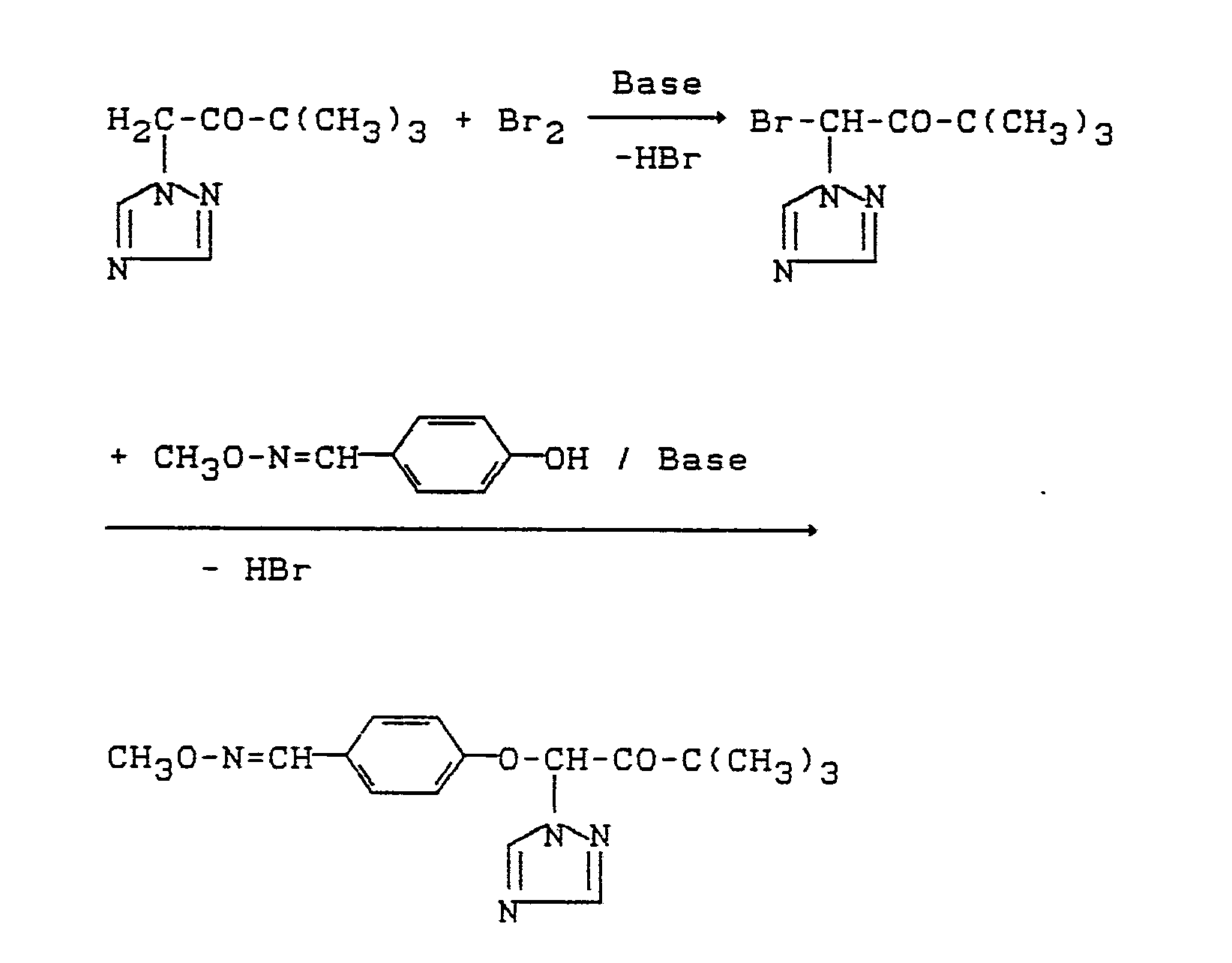
- Das erfindungsgemäße Verfahren wird durch die nachfolgenden Beispiele veranschaulicht.
-

- 318,4 g (1.889 Mol) 4-Hydroxybenzaldoxim-hydrat (92 %-ig) und 197,2 g (4.93 Mol) Natriumhydroxid werden in 2 l Wasser beim Raumtemperatur vorgelegt. Man läßt 15 Minuten nachrühren und versetzt anschließend mit 285,5 g (2;266 Mol) Dimethylsulfat. Nach erfolgter Zugabe läßt man 8 Stunden bei Raumtemperatur nachrühren. Das Reaktionsgemisch wird mit verdünnter wäßriger Schwefelsäure neutralisiert und mit Methylenchlorid extrahiert. Die organische Phase wird getrocknet und im Vakuum eingeengt.
Durch gaschromatographische Bestimmung wird ermittelt, daß das so anfallende Rohprodukt folgende Stoffe in den angegegebenen prozentualen Mengen enthält:
- Dieses Rohprodukt wird fraktioniert destilliert. Man erhält 179,4 g (62,9 % der Theorie) 4-Methoximinomethylphenol vom Siedepunkt 143 °C/0,13 mbar.
-

- Eine Lösung von 137 g (0,89 Mol) 4-Hydroxybenzaldoxim-Hydrat und 104 g (2,6 Mol) Natriumhydroxid in 715 ml Wasser wird bei Raumtemperatur in einem 1,3 l VA-Autoklaven gegeben. Man drückt 56 g (= 61,5 ml; 1,1 Mol) Methylchlorid auf und erhitzt auf 50° C, wobei sich ein Druck von 10 bar einstellt. Nach fünfstündigem Rühren bei 50° C ist der Druck auf 5 bar gefallen. Man entspannt auf Normaldruck und stellt den pH-Wert des Reaktionsgemisches durch Zugabe von verdünnter, wäßriger Schwefelsäure auf 6 ein. Anschließend filtriert man das Reaktionsgemisch, extrahiert das Filtrat mit Methylenchlorid, trocknet die vereinigten organischen Phasen und engt unter vermindertem Druck ein. Es verbleiben 103,7 g eines Rohproduktes, das einer fraktionierten Destillation unterworfen wird. Man erhält auf diese Weise 84,7 g eines Produktes, das zu 93 % aus 4-Methoximinomethyl-phenol besteht. Die Ausbeute errechnet sich danach zu 58,6 % der Theorie. Siedepunkt: 124 bis 128° C/0,07 mbar.
-

- In eine Lösung von 217 g (1,3 Mol) 3,3-Dimethyl-1-(1,2,4-triazol-1-yl)-2-butanon in 700 ml Eisessig trägt man 110 g (1,34 Mol) Natriumacetat ein, wobei die Temperatur auf ca. 28° C ansteigt. Man läßt 30 Minuten nachrühren und versetzt tropfenweise unter leichter Kühlung bei 30 bis 33° C mit 208 g (1,3 Mol) Brom. Das Reaktionsgemisch wird 2,5 Stunden bei Raumtemperatur nachgerührt und in 1200 ml Wasser gegeben. Man extrahiert mit Methylenchlorid, wäscht mit Wasser und wäßriger Bicarbonatlösung, trocknet über Natriumsulfat und engt ein.
- Das so erhaltene rohe 1-Brom-3,3-Dimethyl-1-(1,2,4-triazol-1-yl)-2-butanon wird in 100 ml Acetonitril gelöst und zu einer Aufschlämmung von 151 g (1 Mol) 4-Methoximinomethylphenol und 150 g (1,09 Mol) Kaliumcarbonat in 800 ml Acetonitril gegeben, wobei die Temperatur auf etwa 40° C ansteigt. Man läßt das Reaktionsgemisch 3 Stunden bei 60 bis 65° C nachrühren, kühlt anschließend ab und gibt auf Wasser. Man extrahiert mit Toluol, wäscht mit Wasser, trocknet und engt ein. Der Rückstand wird in Ligroin verrieben und auf Ton getrocknet. Man erhält 241 g (76 % der Theorie) 3,3-Dimethyl-1-(4-methoximinomethyl-phenoxy)-1-(1,2,4-triazol-1-yl)-butan-2-on vom Schmelpunkt 83-87° C.
Claims (10)

R¹ für Alkyl steht,
dadurch gekennzeichnet, daß man Hydroxybenzaldoxime der Formel

R¹ - O - SO₂ - O - R¹ (III)
in welcher
R¹ die oben angegebene Bedeutung hat,
oder mit Alkylhalogeniden der Formel
R¹X (IV)
in welcher
R¹ die oben angegebene Bedeutung hat und
X für Halogen steht,
in Gegenwart einer starken Base und in Gegenwart eines Verdünnungsmittels bei Temperaturen zwischen 0° C und 60° C umsetzt.
Applications Claiming Priority (2)
| Application Number | Priority Date | Filing Date | Title |
|---|---|---|---|
| DE3601564 | 1986-01-21 | ||
| DE19863601564 DE3601564A1 (de) | 1986-01-21 | 1986-01-21 | Verfahren zur herstellung von hydroxybenzaldoxim-o-ethern |
Publications (2)
| Publication Number | Publication Date |
|---|---|
| EP0230230A2 true EP0230230A2 (de) | 1987-07-29 |
| EP0230230A3 EP0230230A3 (de) | 1988-06-15 |
Family
ID=6292234
Family Applications (1)
| Application Number | Title | Priority Date | Filing Date |
|---|---|---|---|
| EP87100170A Ceased EP0230230A3 (de) | 1986-01-21 | 1987-01-09 | Verfahren zur Herstellung von Hydroxybenzaldoxim-O-ethern |
Country Status (3)
| Country | Link |
|---|---|
| EP (1) | EP0230230A3 (de) |
| JP (1) | JPS62169760A (de) |
| DE (1) | DE3601564A1 (de) |
-
1986
- 1986-01-21 DE DE19863601564 patent/DE3601564A1/de not_active Withdrawn
-
1987
- 1987-01-09 EP EP87100170A patent/EP0230230A3/de not_active Ceased
- 1987-01-21 JP JP1011287A patent/JPS62169760A/ja active Pending
Non-Patent Citations (2)
| Title |
|---|
| HOUBEN-WEYL: "Methoden der organischen Chemie", Band X/4, Stickstoffverbindungen I, Teil 4, 1968, Seiten 220-223, GEORG THIEME VERLAG, Stuttgart, DE * |
| THE JOURNAL OF THE AMERICAN CHEMICAL SOCIETY, Band LXXI, September-Dezember 1949, Seiten 3021-3023, Mack Printing Co., Easton, Pa.; A.H. BLATT et al.: "The chemical effects accompanying hydrogen bonding. II. Alkylation of the oximes of 2-hydroxy-5-methylbenzophenone" * |
Also Published As
| Publication number | Publication date |
|---|---|
| DE3601564A1 (de) | 1987-07-23 |
| JPS62169760A (ja) | 1987-07-25 |
| EP0230230A3 (de) | 1988-06-15 |
Similar Documents
| Publication | Publication Date | Title |
|---|---|---|
| EP0124009B1 (de) | Verfahren zur Herstellung von Oxiranen | |
| EP0124013B1 (de) | Verfahren zur Herstellung von Oxiranen | |
| EP0048373B1 (de) | Verfahren zur Herstellung von Pyrazol | |
| EP0218123B1 (de) | Verfahren zur Herstellung von Hydroxy-benzaldoxim-O-ethern | |
| DD239591A5 (de) | Verfahren zur herstellung von 2,4-dichlor-5-fluor-benzoesaeure | |
| DE2726393C2 (de) | Verfahren zur Herstellung von 5-(quartär-Alkyl)resorcinen | |
| EP0230230A2 (de) | Verfahren zur Herstellung von Hydroxybenzaldoxim-O-ethern | |
| EP0250897B1 (de) | Verfahren zur Herstellung von Hydroxybenzaldoxim-O-ethern | |
| EP0089485B1 (de) | Verfahren zur Herstellung von 5-Chlor-1H-tetrazol-1-carbonsäureestern sowie Verfahren zur Herstellung der erforderlichen Dichlorisonitril-carbonsäureester | |
| EP1309538A2 (de) | Verfahren zur herstellung von trifluorethoxysubstituierten benzoesäuren | |
| EP0229641B1 (de) | Verfahren zur Herstellung von Hydroxybenzaldoxim-O-ethern | |
| EP0087596B1 (de) | Verfahren zur Herstellung von 5-substituierten 1-Chlor-3,3-dimethylpentan-2-onen | |
| EP0248253B1 (de) | Verfahren zur Herstellung eines Azol-Derivates | |
| EP0012108B1 (de) | Verfahren zur Herstellung von 4,5-Dichlor-2-(4-chlorphenoxy)-phenol und 4,5-Dichlor-2-(4-chlorphenoxy)-anisol | |
| DE2601782C3 (de) | Verfahren zur Herstellung von o-Dialkylaminomethylphenolen | |
| EP0081675B1 (de) | Alkylcycloalkyl-triazolylmethyl-ketone und Verfahren zu ihrer Herstellung | |
| EP0047941B1 (de) | Verfahren zur Herstellung und Reinigung von Phenoxy-azolyl-butanon-Derivaten | |
| EP0277554B1 (de) | Verfahren zur Herstellung von Hydroxybenzaldoxim-O-ethern | |
| DE19832146B4 (de) | Verfahren zur Herstellung von 3-Methylpyrazol bzw. dessen Salze | |
| DE3101143A1 (de) | Verfahren zur herstellung von l-aryloxy-methylketonen | |
| WO2006097510A1 (de) | Verfahren zur herstellung von 5-halo-2,4,6-trifluorisophthalsäure | |
| EP0101901A1 (de) | Verfahren zur Herstellung von 1-Azolyl-3,3-dimethyl-1-phenoxy-butan-2-olen | |
| EP0101996A1 (de) | Verfahren zur Herstellung von E-Isomeren von 1-Cyclohexyl-2-(1,2,4-triazol-1-yl)-1-penten-3-on-Derivaten | |
| EP0081128A1 (de) | Verfahren zur Herstellung von alpha-(5-(4-Trifluormethyl-phenoxy)-2-nitro-phenoxy)-propionsäure-(alkoxy-carbonyl-methyl)-estern | |
| CH626602A5 (de) |
Legal Events
| Date | Code | Title | Description |
|---|---|---|---|
| PUAI | Public reference made under article 153(3) epc to a published international application that has entered the european phase |
Free format text: ORIGINAL CODE: 0009012 |
|
| 17P | Request for examination filed |
Effective date: 19870109 |
|
| AK | Designated contracting states |
Kind code of ref document: A2 Designated state(s): BE CH DE FR GB IT LI NL |
|
| PUAL | Search report despatched |
Free format text: ORIGINAL CODE: 0009013 |
|
| AK | Designated contracting states |
Kind code of ref document: A3 Designated state(s): BE CH DE FR GB IT LI NL |
|
| 17Q | First examination report despatched |
Effective date: 19890711 |
|
| STAA | Information on the status of an ep patent application or granted ep patent |
Free format text: STATUS: THE APPLICATION HAS BEEN REFUSED |
|
| 18R | Application refused |
Effective date: 19910331 |
|
| RIN1 | Information on inventor provided before grant (corrected) |
Inventor name: ELBE, HANS-LUDWIG, DR. Inventor name: LANTZSCH, REINHARD, DR. |