EP0230356A1 - Production d'une réserve de mélange pour essence à indice d'octane élevé - Google Patents
Production d'une réserve de mélange pour essence à indice d'octane élevé Download PDFInfo
- Publication number
- EP0230356A1 EP0230356A1 EP87300146A EP87300146A EP0230356A1 EP 0230356 A1 EP0230356 A1 EP 0230356A1 EP 87300146 A EP87300146 A EP 87300146A EP 87300146 A EP87300146 A EP 87300146A EP 0230356 A1 EP0230356 A1 EP 0230356A1
- Authority
- EP
- European Patent Office
- Prior art keywords
- aluminogallosilicate
- metal
- process according
- crystalline
- weight
- Prior art date
- Legal status (The legal status is an assumption and is not a legal conclusion. Google has not performed a legal analysis and makes no representation as to the accuracy of the status listed.)
- Granted
Links
Images



Classifications
-
- C—CHEMISTRY; METALLURGY
- C10—PETROLEUM, GAS OR COKE INDUSTRIES; TECHNICAL GASES CONTAINING CARBON MONOXIDE; FUELS; LUBRICANTS; PEAT
- C10G—CRACKING HYDROCARBON OILS; PRODUCTION OF LIQUID HYDROCARBON MIXTURES, e.g. BY DESTRUCTIVE HYDROGENATION, OLIGOMERISATION, POLYMERISATION; RECOVERY OF HYDROCARBON OILS FROM OIL-SHALE, OIL-SAND, OR GASES; REFINING MIXTURES MAINLY CONSISTING OF HYDROCARBONS; REFORMING OF NAPHTHA; MINERAL WAXES
- C10G35/00—Reforming naphtha
- C10G35/04—Catalytic reforming
- C10G35/06—Catalytic reforming characterised by the catalyst used
- C10G35/065—Catalytic reforming characterised by the catalyst used containing crystalline zeolitic molecular sieves, other than aluminosilicates
Definitions
- the present invention relates to a novel crystalline aluminogallosilicate and to a process for the preparation of a high-octane gasoline blending stock containing an aromatic hydrocarbon as a major constituent, which uses the crystalline aluminogallosilicate as a catalyst.
- Naphtha to be used as a raw material is usually from fractions having boiling points in the range from 70'C to 180t, when . intended to be used for the preparation of gasoline for use with automobiles and from fractions having boiling points in the range from 60t to 150t, when intended to be used for the preparation of BTX.
- a process for the preparation of a high-octane gasoline which comprises contacting a light hydrocarbon containing one or more paraffins and/or olefins, each having 2 to 7 carbon atoms with a crystalline silicate catalyst characterized in that said catalyst comprises an aluminogallosilicate with its skeleton comprised of SiO 4 , AlO 4 and GaO 4 tetrahedra, and in that said contacting is performed at a temperature of 350-650 °C under a hydrogen partial pressure of not higher than 5 kg/cm 2 .
- the present invention provides a crystalline aluminogallosilicate having the skeleton comprised of Si0 4 , A10 4 and Ga0 4 tetrahedra and having the following formula:
- Fig. 1 is a graph showing the relationships of SiO z/ T 2 0 3 (T: Al or Ga) vs. conversion and aromatics yield of an aluminosilicate and a gallosilicate for comparison uses;
- Fig. 2 is a graph showing the relationships of Si0 2/ Ga 2 0 3 vs. conversion and aromatics yield of the aluminogallosilicate of the present invention and the comparing gallosilicate;
- Fig. 3 is a graph showing the relationship of SiO 2 /Al 2 O 3 vs. aromatics yield of the comparing aluminosilicate
- Fig. 4 is a graph showing the relationships of the gallium concentrations and aromatics yields of the H-form aluminogallosilicate according to the present invention with those of the comparing H-form aluminosilicate carried with gallium;
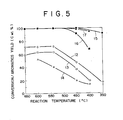
- Fig. 5 is a graph showing the relationships of reaction temperatures vs. conversion and aromatics yields of the aluminogallosilicate according to the present invention and the comparing aluminosilicate and gallosilicate;
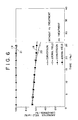
- Fig. 6 is a graph showing the relationships of times vs. conversion and aromatics yields of the H 2 -treated and untreated aluminogallosilcates according to the present invention.
- Fig. 7 is a graph showing the relationships of regeneration cycles vs. conversion, aromatics yields and hydrogen yields of the aluminogallosilicate according to the present invention during the repetition of the reaction and regeneration cycles.
- high-octane gasoline blending stock and related ones referred to in the present specification mean hydrocarbons having the octane number of 95 or higher, when determined by the research method, and containing a large quantity of aromatic hydrocarbons with carbon atoms in the range from 6 to 10.
- the high-octane gasoline may be used as automobile fuel and for the preparation of aromatic hydrocarbons.
- the term "light hydrocarbons” referred to herein as raw materials for the preparation of high-octane gasoline means hydrocarbons containing a paraffin and/or an olefin with carbon atoms ranging from 2 to 7 as a major constituent.
- Representative of light hydrocarbons are light fractions having boiling points of 100t or lower obtainable from naphtha fractions containing a paraffin of of carbon atoms ranging from 5 to 7 as a major constituent.
- the crystalline aluminogallosilicate according to the present invention may be produced by the gel crystallization method using the hydrothermal synthesis or by the method of inserting gallium into the lattice skeleton of an aluminosilicate or a zeolite crystal.
- the gel crystallization method is a simplified one because an objective quantity of aluminium and gallium can be contained at the same time in the preparation of a crystalline aluminogallosilicate.
- the crystalline aluminogallosilicate obtainable by the gel crystallization method may be produced by causing an aqueous mixture containing an alumina source and a gallia source as an essential constituent, in addition to a constituent necessary for the silicate synthesis, to be retained under conditions for the hydrothermal synthesis.
- sources of silica may be used, for example, a silicate such as sodium silicate, potassium silicate or the like, colloidal silica, silica powder, dissolved silica, soluble glass and so on.
- sources of alumina for example, an aluminium salt such as aluminium sulfate, aluminium nitrate or the like, an aluminate such as sodium aluminate, alumina gel and so on.
- sources of gallia are used, for example, a gallium salt such as gallium nitrate, gallium chloride or the like, gallium oxide and so on.
- a source of alumina or gallia there may be used a solution or a hydroxide containing aluminium or gallium obtainable during the extraction or purification step of a deposit such as a bauxite deposit, zinc deposit or the like.
- An organic additive may also be used in order to accelerate the growth of a desired crystalline aluminogallosilicate and improve the purity thereof, thus yielding products of better quality.
- the organic additive to be used here may include, for example, a quaternary ammonium salt such as a tetrapropylammonium salt, a tetrabutylammonium salt, a tripropylmethylammonium salt or the like, an amine such as propylamine, butylamine, aniline, dipropylamine, dibutylamine, morpholine or the like, an aminoalcohol such as ethanolamine, diglycolamine, diethanolamine or the like, an alcohol such as ethanol, propylalcohol, ethylene glycol, pinacol or the like, an organic acid, an ether, a ketone, an amino acid, an ester, a thioalcohol and a thioether.
- a compound that may produce the above-described organic additive under the hydrothermal synthesis conditions may also be employed.
- an alkali metal or an alkaline earth metal there may be used a hydroxide, a halide, a sulfate, a nitrate, a carbonate or the like of an alkali metal such as sodium, potassium or the like or an alkaline earth metal such as magnesium, calcium or the like.
- Raw materials may contain a mineral acid such as sulfuric acid, nitric acid or the like as a pH adjusting agent in addition to the above-described compounds.
- An aqueous mixture containing one or more of the above-described compounds to be used as a raw material may be subjected to crystallization at temperatures of from 50°C to 300'C, preferably from 100°C to 250°C under autogenous pressures for a retention period of from about 1 hour to 7 days, preferably from 1 t o 5 days.
- the product obtained by the above-mentioned process may be subjected further to the modification treatment as needed.
- the crystalline aluminogallosilicate referred to herein may also include a variety of modified products obtainable by the modification treatment in addition to those producible by the hydrothermal synthesis.
- the MASNMR (Magic Angle Spinning Nuclear Magnetic Resonance) analysis may give useful information on the elements present in the crystal structure of the crystalline aluminogallosilicate and on the composition thereof.
- the 27 A1-NMR analysis of an aluminosilicate gives information on the tetrahedral configuration in the anionic skeletal structure.
- the 27 A1-NMR and 71 Ga-NMR analyses show that the Al and Ga elements of the tetrahedral configuration are present in the skeletal structure. From information provided by the 29 Si-NMR analysis, the mole ratio of Si0 2 to (Al 2 O 3 + Ga 2 O 3 ) in the crystal structure is computed.
- One of the chemical characteristics of the crystalline aluminogallosilicate is its acid property.
- a degree of acidity may be determined by means of the temperature programmed desorption or the measurement for heat of adsorption using a basic substance such as ammonia, pyridine or the like.
- a basic substance such as ammonia, pyridine or the like.
- the crystalline aluminogallosilicate according to the present invention is characterized in that aluminium is present in the amount ranging the amount ranging from 0.1% to 5.0% by weight and gallium in the amount ranging from 0.1X to 10. 0% by weight in the skeletal structure, and the mole ratio of Si0 2 to (A1 2 0 3 + Ga 2 0 3 ) is in the range from 15 to 300, the mole ratio of Si0 2 to Al 2 O 3 being in the range from 16 to 870, more preferably from 16 to 400, and the mole ratio of Si0 2 to Ga 2 0 3 being in the range from 18 to 2, 000, more preferably from 18 to 500.
- the composition is represented in terms of mole ratios of the oxides calcined at 500 °C or higher as follows:
- n means a valence of the alkali metal or the alkaline earth metal
- a - d, inclusive each represent a positive number of the following value:
- MFI type and MEL type silicates belong to the structural type of the known zeolites of the kind published in "The Structure Commission of the International Zeolite Association” (Atlas Of Zeolite Structure Types; W. M. Meiyer and D. H. Olson (1978), Distributed by Polycrystal Book Service, Pittsburgh, PA, USA).
- the aluminogallosilicates obtainable by the hydrothermal synthesis as described above contain usually an alkali metal such as sodium, potassium or the like and/or an alkaline earth metal such as magnesium, calcium or the like, and they may be subjected to various conventional modification treatment as desired. For example, they may be converted to the ammonium form by the ion exchange in an aqueous solution containing an ammonium salt such as ammonium chloride, ammonium nitrate or the like and then subjected to ion exchange in an aqueous solution containing ions of a metal other than the alkali metal and the alkaline earth metal, thus introducing thereinto a desired metal other than the alkali metal and the alkaline earth metal.
- an alkali metal such as sodium, potassium or the like and/or an alkaline earth metal such as magnesium, calcium or the like
- they may be converted to the ammonium form by the ion exchange in an aqueous solution containing an ammonium salt such as am
- the aluminogallosilicate in the ammonium form may be converted to the hydrogen form 'by calcination at temperatures ranging from 350C to 650C.
- Treatment of the aluminogallosilicate with hydrogen and/or steam is also effective in maintenance of the aromatization activity thereof.
- the modification treatment referred to herein may include a treatment that removes at least a portion of an alkali metal and/or an alkaline earth metal contained in the synthesized aluminogallosilicate, and such modification treatments are well known to the skilled in the art because they are conventional with respect to conventional crystalline zeolites.
- the crystalline aluminogallosilicates according to the present invention may be utilized in various forms, and they may be formulated in the forms of powder and a molded product such as a granule, a sheet, a pellet or the like by means of the extrusion molding, spray drying, and tableting press molding after an addition of a binder such as alumina, silica or the like.
- a binder such as alumina, silica or the like.
- the above-described modification treatments may also be applied to such molded products as well as to powdery products.
- a desired metal may be introduced into the molded products using the ion exchange method and the impregnation method.
- Metals capable of being introduced may include, for example, magnesium, calcium, strontium, barium, manganese, rhenium, iron, ruthenium, cobalt, rhodium, iridium, nickel, palladium, platinum, copper, silver, zinc, aluminium, indium, germanium, tin, lead, phosphorus, antimony, bismuth, selenium or the like.
- the crystalline aluminogallosilicates according to the present invention exhibit extremely superior catalytic activities as catalysts for the preparation of high-octane gasoline using light hydrocarbons as raw materials, and their catalytic activities are higher than those of conventional aluminosilicates and gallosilicates.
- aluminogallosilicates in accordance with the present invention, light hydrocarbons are catalyzed with the crystalline aluminogallosilicate according to the present invention at temperatures ranging from 350°C to 650'C under hydrogen partial pressures of 5 kg/cm 2 or lower.
- the use of the crystalline aluminogallosilicates in the hydrogen form is preferred, and the aluminogallosilicates in the hydrogen form may be preferably carried with a metal constituent as an accessory constituent.
- Such a carrier metal as being capable of improving the catalytic activities may include, for example, magnesium, calcium, strontium, barium, lanthanum, cerium, titanium, vanadium, chromium, molybdenum, tungsten, manganese, rhenium, iron, ruthenium, cobalt, rhodium, iridium, nickel, palladium, platinum, copper, silver, zinc, aluminium, indium, germanium, tin, lead, phosphorus, antimony, bismuth, selenium or the like. These metals may be used singly or in combination with two or more, and the carrier quantity may be in the range from 0.1 to 10% by weight when reduced to a metal basis.
- aluminogallosilicates to be used as catalysts in accordance with the present invention may also be carried with one or more metals selected from magnesium, calcium, lanthanum, cerium, ruthenium and iridium in order to prevent coke from being accumulated.
- the carrier amount may be in the range from 0.01% to 5X by weight when reduced on a metal basis.
- Reaction temperatures to be applied to the conversion reaction of the light hydrocarbons according to the present invention may be determined depending upon the compositions of the light hydrocarbons serving as a reactant, yields of the high-octane gasoline and so on, and they may range preferably from 350r to 650°C. If the reaction temperatures become lower, the production of byproducts such as light gases, e.g., methane, ethane or the like, can be prevented, but the yields of the high-octane gasoline are decreased. If the reaction temperatures become higher, the yields of the high-octane gasoline can be increased while the catalytic deactivation may be accelerated by means of coke or the like, thereby reducing the life of the catalyst.
- the reaction temperatures may range more preferably from 450°C to 650°C for the light hydrocarbons containing a n-paraffin as a major constituent, from 400t to 600°C for the light hydrocarbons containing an isoparaffin as a major constituent, and from 350°C to 550°C for the light hydrocarbons containing an olefin as a major constituent.
- An intentional addition of hydrogen may have the advantages that the coke accumulation can be prevented and the catalyst life can be prolonged, but it is not necessarily advantageous because an increase of the hydrogen partial pressure may radically decrease the yields of the high-octane gasoline. It is accordingly preferred to restrict the hydrogen partial pressures to 5 kg/cm 2 or lower.
- the modes of the reactions to be carried out for the conversion processes of the light hydrocarbons may be any mode of the fixed bed, moving bed and fluidized bed.
- the quantity of the reactants to be used for the fixed bed may range from 100 to 10,000 hr- 1 , preferably from 100 to 2,000 hr- 1 as a gas space velocity. If the reaction mode other than the fixed bed is used, the catalytic period may be determined so as to become virtually the same as with the fixed bed.
- the crystalline aluminogallosilicates according to the present invention are superior in catalytic activities with respect to the conversion reaction of the light hydrocarbons to the high-octane gasoline to conventional aluminosilicates and gallosilicates. Furthermore, the crystalline aluminogallosilicates according to the present invention are advantageous, in terms of manufacturing costs because of a low content of gallia as compared to conventional gallosilicates. Moreover, they have properties as a solid acid superior to aluminosilicates and gallosilicates.
- the crystalline aluminogallosilicates according to the present invention can be utilized as catalysts for the conversion reaction for the above-described light hydrocarbons.
- the cracking reaction forms methane, and a higher rate of the cracking reaction does not lead to an efficient utilization of carbon to aromatic compounds.
- the catalytic cracking proceeds on the Br;nsted acid sites, and the BrOnsted acid sites in turn are activation sites necessary for the consecutive reactions, such as oligomerization, of olefins in the aromatization step of the olefins.
- the crystalline aluminogallosilicates according to the present invention can be said to be highly superior in terms of the dehydrogenation function of paraffins and the cyclization and dehydrogenation functions of the olefins as the catalyst design has intended to perform the functions.
- the crystalline aluminogallosilicates according to the present invention can be employed as catalysts for the isomerization, alkylation and disproportionation of hydrocarbons, the aromatization of methanol and so on by utilizing their properties as solid acids. They also may be used as adsorbents, like conventional aluminosilicates, by utilizing their physical adsorptive characteristics.
- a total number of 17 crystalline aluminogallosilicates were prepared in accordance with the following procedures.
- a solution (I) was prepared from sodium silicate (J Sodium silicate #3: 28-30% by weight of SiO 2 ; 9-10% by weight of Na 2 0; balance, water; Product of Nippon Kagaku Kogyo K.K. ) in the amount shown under the column q-1 in Table 3 below and water in the amount shown under the column q-2 therein.
- Another solution (II) was prepared from Al 2 (SO 4 ) 3 .14 ⁇ 18H 2 O in the amount shown under the column q-3 in Table 3 below, Ga(NO 3 ) 3 -9H 2 O in the amount shown under the column q-4 therein, tetrapropylammonium bromide in the amount shown under the column q-5 therein, H 2 S0 4 (97% by weight) in the amount shown under the column q-6 therein, NaCl in the amount shown under the column q-7 therein and water in the amount shown under the column q-8 therein.
- the solution (II) was gradually poured into the solution (I) with stirring at room temperature, and the mixture was stirred with a'mixer for 5 minutes. After the stirring, the mixture was placed in a stainless steel autoclave and subjected to crystallization at 180 C under autogenous pressure.
- the resultant gel was then charged to the autoclave that in turn was sealed and heated to 180 C.
- the gel was held for 5 days therein, and the crystalline product was separated from its mother liquor by filtration, washed five times with a 1-liter portion of water and then dried at 120°C for 3 hours.
- the dried product was then calcined at 550 °C for 3 hours in air. After the calcined product was taken, it was filtered by suction and then washed five times with a 1-liter portion of water.
- the filtered solid material was dried at 120 °C for 3 hours and then calcined at 55 °C for 3 hours under air streams to produce each of the 17 aluminogallosilicates.
- Table 3 indicates the components of aqueous mixtures that are raw materials for aluminogallosilicates Al/Ga-1 to Al/Ga-17, respectively.
- the mole ratios of the aluminogallosilicate may be represented by the following formula:
- compositions of the aluminogallosilicate are shown in Table 4 below.
- Each of the aluminogallosilicates Al/Ga-1 to Al/Ga-17 obtained in Example 1 was blended with alumina powder (Cataloid AP; Catalyst & Chemicals Ind. Co. , Ltd. ) and additional water.
- the mixture was blended in proportions to give about 73X aluminogallosilicate and about 27% Al 2 O 4 in the final product.
- the blended mixture was then extruded through about 1/32" opening die plate.
- the extrudate was dried at 120 °C for 3 hours in air and then calcined at 550 °C or 3 hours under air streams.
- the extrudate was ion-exchanged four times at 100 C, each for two hours with a 2.2N ammonium nitrate aqueous solution at the rate of 5 ml per 100 grams of the calcined extrudate.
- the resultant NH 4 +- form extrudate was washed, dried at about 120°C for 3 hours in air and then calcined at about 550 °C in air to give the H-form aluminogallosilicate catalyst No. I to XVII in the H-form as shown in Table 4 above.
- the resultant products were analyzed by a gas chromatograph connected to the reactor.
- Tables 7 and 9 show compiled reaction data with respect to the aluminogallosilicates.
- Tables 8 and 9 show compiled reaction data with respect to the aluminosilicates and the gallosilicates used for comparative purposes.
- Fig. 1 shows the reaction data of Comparative Examples 1 to 16 in Table 8 below.
- the curved lines 1 and 2 indicate aromatics yields of the aluminosilicates and the gallosilicates on the C-standard basis, respectively. It is to be noted from the data that the gallosilicates are high in the aromatics yield than the aluminosilicates.
- Fig. 2 show the aromatics yields and the conversion for the aluminogallosilicates according to the present invention (curved lines 5 and 7, respectively) and those for the gallosilicates (curved lines 6 and 8, respectively) for comparative purposes. This figure demonstrates that the aluminogallosilicates are remarkably superior catalysts.
- Fig. 3 demonstrates a variation in aromatics yields vs. SiO 2 /Al 2 O 3 for the aluminogallosilicate catalyst containing in its skeleton gallium in the amount virtually equivalent to the H-form gallosilicate catalyst H- [Ga-7] used for comparative purposes.
- aluminogallosilicate according to the present invention is different from a physical mixture of the aluminosilicate with the gallosilicate.
- Example 4 Using the H-form aluminogallosilicate No. X prepared in Example 2, as shown in Table 4, the reaction was carried out using light naphtha having the composition as shown in Table 6 below, under the reaction conditions: temperature, 538 °C; pressure, 3 kg/cm 2 G; hydrogen partial pressure, 1 kg/cm 2 or lower; LHSV, 1 hr- 1 ; gas present, N 2 (flow rate: 10N liter/hour); catalyst amount, 20 cc.
- a catalyst for comparison was prepared by drying and calcinating as in Example 2 to carry a NH 4 -form aluminosilicate, NH 4 - [Al-4], with Ga.
- Fig. 4 shows the results of the conversion reaction obtained by the aluminogallosilicate catalyst (curved line 10) in comparison with those obtained by the aluminosilicate Al-4 (curved line 11) with the aluminium in the skeleton in the amount virtually equivalent to that of the latter.
- the aluminogallosilicate according to the present invention has a higher aromatization activity than the aluminosilicate carried with gallium.
- a solution (I) was prepared from 464.5 g of sodium silicate (J Sodium silicate #3; SO 2 : 28-30% by weight; Na 2 0: 9-10% by weight; balance, water; Nippon Kagaku Kogyo K.K.) and 520 g of water.
- a solution (II) was prepared from 17.0 g of Al 2 (SO 4 ) 3 ⁇ 14-18H 2 O, 8.7 g of Ga(N0 3 ) 3 -9H 2 0, 143.4 g of tetrabutylammonium bromide, 43.3 g of H 2 S0 4 (97% by weight) and 550 g of water.
- the solution (II) was poured gradually into the solution (I) at room temperature, and the mixture was allowed to stand overnight in a sealed container and then stirred for 5 minutes with a mixer.
- the product was identified to be of the MEL structure type by X-ray diffraction. And the mole ratios of the aluminogallosilicate were as follows:
- aluminogallosilicate was then blended with alumina powder (Cataloid AP: Catalyst & Chemicals Ind. Co., Ltd.) and additional water.
- the aluminogallosilicate and the A1 2 0 3 were then blended in proportions to give ca. 73X aluminogallosilicate and ca. 27% A1 2 0 3 in the final product.
- the mixture was then extruded through an about 1/32" opening die plate.
- the extrudate was dried at about 120 °C for 3 hours in air and then calcined at about 550 °C for 3 hours in air.
- the extrudate was subjected to ion exchange four times, each for 2 hours with 5 ml of a 2.2N ammonium nitrate solution at 100 °C per gram of the calcined extrudate.
- the resultant NH 4 -form extrudate was then washed, dried at about 120 °C in air and again calcined at about 550 °C for 3 hours in air to give a H-form aluminogallosilicate.
- Example 22 Using the H-form aluminogallosilicate obtained in Example 22 as a catalyst, the conversion reaction of n-hexane was carried out in the same manner as in Example 3.
- the reaction results were 100% for a conversion rate and 71.5 C% by weight for an aromatics yield.
- the aluminogallosilicate Al/Ga-9 as shown in Table 4 was blended with silica sol (Cataloid SI-350: Si0 2 , 30% by weight; Catalyst & Chemicals Ind. Co., Ltd.) and additional water.
- the aluminogallosilicate and the Si0 2 were blended in proportions to give ca. 73% aluminogallosilicate and ca. 27% Si0 2 in the final product.
- the mixture was then dried and calcined as previously described.
- the calcined product was broken and sieved to pass 16 to 24 mesh.
- the H-form aluminogallosilicate catalyst was prepared as described in Example 2.
- Fig. 5 shows the relationships of the aromatics yields (curved line 12) and the conversion rates of n-hexane (curved line 15) vs. reaction temperature for the aluminogallosilicate catalyst IX as shown in Table 4 with the aromatics yields (curved lines 13 and 14, respectively) and the conversion rates (curved lines 16 and 17, respectively) for the aluminosilicate catalyst H-[Al-4] as shown in Table 5 and the gallosilicate catalyst H-[Ga-3] as shown in Table 5.
- aluminogallosilicate was higher in an aromatization activity than the gallosilicate that in turn was higher than the aluminosilicate in the whole temperature areas tested and consequently that the aluminogallosilicate catalyst according to the present invention was superior to the others.
- the aluminogallosilicate was subjected to pre-treatment with hydrogen under conditions: temperature, 600 t; pressure, 1 atm. ; treatment time, 2 hours; and hydrogen flow rate, 100 cc/minute.
- the conversion reaction of n-hexane was carried using the aluminogallosilicate IX as shown in Table 4 under the following conditions: temperature, 538 t; pressure, 1 atm. ; LHSV, 2 hr- 1 ; and reaction time, 25 hours.
- the experiment was carried out using a reactor filled with the catalyst. After the treatment under the above conditions, the specimens were subjected to X-ray fluorescence analysis to measure degrees of the desorption of the aluminium and gallium. Table 13 below shows the test As will be shown in the table, it was confirmed that no desorption of the aluminium and gallium in the crystal skeleton of the aluminogallosilicate was recognized.
- Fig. 7 shows the compiled test results. It was found that the aromatization activity was maintained to virtually constant levels as the conversion rates were almost 100% as shown by the curved line 22, the aromatics yields were about 64 C% by weight as shown by the curved line 23, and the hydrogen yields were about 4.5% by weight as shown by the curved line 24.
- the conversion of ethane, propane and butane was carried out using the aluminogallosilicates IV, VIII and IX as shown in Table 4 in a flow reactor under the following reaction conditions: temperature, 538 °C (propane and butane) and 625 °C (ethane); pressure, 1 atm. ; GHSV, 170 hr -1 (ethane), 700 hr -1 (propane and -isobutane), 530 hr -1 (butane); and catalyst amount, 3 ml (sieved to pass 16 to 24 mesh).
- the products were analyzed by a gas chromatograph connected to the reactor.
- the ion exchange treatment was conducted using ammonium nitrate, thereby replacing a majority of the alkali metals contained in the samples.
- the samples were then dried and calcined at 550°C.
- each of the calcined samples was measured for heat of adsorption that generated when ammonia was added at the rate as small as 0.163 ⁇ 0.027 cc per gram of the sample at 25°C in the standard state at many times for adsorption.
- the measured results are shown in Table 17 below.
- the aluminogallosilicate according to the present invention is large with respect to the quantity of adsorption that generates the heat of adsorption equal to those of the aluminosilicate and the gallosilicate.
- the degree of acidity balancing the aluminum and gallium used for the synthesis was found in the crystalline aluminogallosilicates according to the present invention, it is implied that the aluminium and gallium are present in the crystal structure.
- the 29 Si-MASNMR measurement was carried out using Model JNM-GX270 FTNMR (manufactured by Nippon Denshi K. K. ) equipped with a solid CP/MAS unit (NM-GSH27HU). The measurement was conducted using the gated decoupling method under the following conditions: observed frequency, 53. 67 MHz; data point, 8192; observed spectral width, 20, 000 Hz; number of integration, 3,000 - 4,000; angle of pulse, 45' (5.3 ⁇ s) ; pulse repetition time, 5 seconds; and exterior standard substance, tetramethylsilane. Each of the measured 29 Si-MASNMR spectra was subjected to waveform dissociation treatment and divided into Gauss type components.
- the extrudate (10 grams) of the NH 4 -form aluminogallosilicate IX as shown in Table 4 was treated by getting it into contact with an aqueous solution of a metal salt in a manner as will be described below.
- the extrudate was dired at 120 'C for 3 hours in air and then calcined at 550 °C for 3 hours under air streams, thereby leading to the production of a final catalyst composition carried with the metal in the amount (as an elemental metal) as will be described below.
- the extrudate was immersed in a solution of 0.05 g of sodium nitrate in 11.6 ml of deionized water for one day at room temperature, filtered and washed with water. The amount of the metal carried was 0.12% by weight.
- Mg The same procedures as above were followed except that the immersion was conducted in a solution of 0.81 g of Mg(NO 3 ) 2 ⁇ 6H 2 O in 10 ml of deionized water. The metal amount was 0.30% by weight.
- La The same procedures as above were followed except that the extrudate was immersed in a solution of 0.91 g of La(NO 3 ) 3 ⁇ 6H 2 O in 10 ml of deionized water. The metal amount was 1.20% by weight.
- the extrudate was immersed in a solution of 4 g of Cr(NO 3 ) 3 ⁇ 9H 2 O in 50 ml of deionized water at room temperature for 7 days, filtered and washed with water.
- the metal amount was 0.45% by weight.
- Mn The same procedures as with Na were followed except for the immersion in a solution of 0.18 g of Mn(NO 3 ) 2 ⁇ 6H 2 O in 6.58 ml of deionized water. The metal amount was 0.36% by weight.
- Ir The same procedures as with Na were followed except for the immersion in a solution of 0.21 g of IrCl 3 ⁇ 1.5H 2 O in 15 ml of deionized water for 2 days.
- the metal amount was 0.53X by weight.
- Ni The same procedures as with Na were followed except for the immersion in a solution of 7.27 g of Ni(NO 3 ) 2 ⁇ 6H 2 O in 50 ml of deionized water at 100 °C for 4 hours. The metal amount was 0.28% by weight.
- Zn The same procedures as with Na were followed except for the immersion in a solution of 0.74 g of Zn(N0 3 ) 2 in 50 ml of deionized water for 4 hours. The metal amount was 0.35% by weight.
Landscapes
- Chemical & Material Sciences (AREA)
- Oil, Petroleum & Natural Gas (AREA)
- Crystallography & Structural Chemistry (AREA)
- Engineering & Computer Science (AREA)
- Chemical Kinetics & Catalysis (AREA)
- General Chemical & Material Sciences (AREA)
- Organic Chemistry (AREA)
- Catalysts (AREA)
- Production Of Liquid Hydrocarbon Mixture For Refining Petroleum (AREA)
- Low-Molecular Organic Synthesis Reactions Using Catalysts (AREA)
- Organic Low-Molecular-Weight Compounds And Preparation Thereof (AREA)
- Silicates, Zeolites, And Molecular Sieves (AREA)
Applications Claiming Priority (2)
| Application Number | Priority Date | Filing Date | Title |
|---|---|---|---|
| JP2658/86 | 1986-01-09 | ||
| JP265886 | 1986-01-09 |
Publications (2)
| Publication Number | Publication Date |
|---|---|
| EP0230356A1 true EP0230356A1 (fr) | 1987-07-29 |
| EP0230356B1 EP0230356B1 (fr) | 1991-06-12 |
Family
ID=11535441
Family Applications (1)
| Application Number | Title | Priority Date | Filing Date |
|---|---|---|---|
| EP87300146A Expired EP0230356B1 (fr) | 1986-01-09 | 1987-01-08 | Production d'une réserve de mélange pour essence à indice d'octane élevé |
Country Status (4)
| Country | Link |
|---|---|
| US (1) | US4861934A (fr) |
| EP (1) | EP0230356B1 (fr) |
| JP (1) | JPH0816228B2 (fr) |
| DE (1) | DE3770647D1 (fr) |
Cited By (4)
| Publication number | Priority date | Publication date | Assignee | Title |
|---|---|---|---|---|
| EP0299392A1 (fr) * | 1987-07-15 | 1989-01-18 | Research Association For Utilization Of Light Oil | Procédé pour préparer un silicate gallo-alumineux cristallin et procédé pour préparer des hydrocarbures aromatiques |
| WO1989010190A1 (fr) * | 1988-04-28 | 1989-11-02 | Duncan Seddon | Catalyseur de transformation d'olefines et de paraffines |
| EP0400987A1 (fr) * | 1989-05-31 | 1990-12-05 | Chiyoda Corporation | Procédé de fabrication de stock de coupage d'essence à indice d'octane élevé |
| US5202513A (en) * | 1987-07-15 | 1993-04-13 | Research Association For Utilization Of Light Oil | Process for producing aromatic hydrocarbons |
Families Citing this family (36)
| Publication number | Priority date | Publication date | Assignee | Title |
|---|---|---|---|---|
| FR2666249B1 (fr) * | 1990-09-03 | 1994-07-22 | Inst Francais Du Petrole | Catalyseur et procede d'aromatisation des hydrocarbures contenant 2 a 4 atomes de carbone par molecule. |
| US5268522A (en) * | 1990-09-03 | 1993-12-07 | Institut Francais De Petrole | Process for the aromatization of hydrocarbons containing 5 to 9 carbon atoms per molecule in the presence of a particular catalyst |
| FR2674769B1 (fr) * | 1991-04-04 | 1994-04-29 | Inst Francais Du Petrole | Catalyseur du type galloaluminosilicate contenant du gallium, un metal noble de la famille du platine et au moins un metal additionnel, et son utilisation en aromatisation des hydrocarbures. |
| US5336393A (en) * | 1991-06-12 | 1994-08-09 | Idemitsu Kosan Co., Ltd. | Process for catalytically converting organic compounds |
| US5276232A (en) * | 1991-08-20 | 1994-01-04 | Research Association For Utilization Of Light Oil | Process for preparing high-octane gasoline blending stock |
| RU2141993C1 (ru) * | 1998-06-29 | 1999-11-27 | Каратун Ольга Николаевна | Способ получения высокооктановых бензинов и ароматических углеводородов |
| RU2186089C1 (ru) * | 2001-02-12 | 2002-07-27 | Научно-инженерный центр "Цеосит" Объединенного института катализа СО РАН | Способ получения высокооктановых бензиновых фракций и ароматических углеводородов |
| RU2208624C2 (ru) * | 2001-09-03 | 2003-07-20 | Научно-инженерный центр "Цеосит" Объединенного института катализа СО РАН | Способ получения высокооктановых бензиновых фракций и ароматических углеводородов (варианты) |
| EP1721953A4 (fr) * | 2004-03-02 | 2009-10-28 | Nippon Oil Corp | Procédé de fabrication d'une essence de base à indice d'octane élevé |
| EP2050731B1 (fr) | 2006-08-07 | 2017-07-05 | Nippon Oil Corporation | Procédé de production d'hydrocarbures aromatiques |
| JP5222602B2 (ja) * | 2008-03-27 | 2013-06-26 | Jx日鉱日石エネルギー株式会社 | 触媒組成物及び芳香族炭化水素の製造方法 |
| US8748681B2 (en) * | 2009-03-31 | 2014-06-10 | Uop Llc | Process for oligomerizing dilute ethylene |
| US8575410B2 (en) * | 2009-03-31 | 2013-11-05 | Uop Llc | Process for oligomerizing dilute ethylene |
| US8021620B2 (en) * | 2009-03-31 | 2011-09-20 | Uop Llc | Apparatus for oligomerizing dilute ethylene |
| CA2860773C (fr) | 2012-01-13 | 2020-11-03 | Siluria Technologies, Inc. | Procede de separation de composes hydrocarbones |
| US9969660B2 (en) | 2012-07-09 | 2018-05-15 | Siluria Technologies, Inc. | Natural gas processing and systems |
| AU2013355038B2 (en) | 2012-12-07 | 2017-11-02 | Lummus Technology Llc | Integrated processes and systems for conversion of methane to multiple higher hydrocarbon products |
| WO2015081122A2 (fr) | 2013-11-27 | 2015-06-04 | Siluria Technologies, Inc. | Réacteurs et systèmes destinés au couplage oxydatif du méthane |
| KR101579654B1 (ko) * | 2013-11-29 | 2015-12-22 | 지에스칼텍스 주식회사 | 항공 가솔린 조성물 |
| CA2935937A1 (fr) | 2014-01-08 | 2015-07-16 | Siluria Technologies, Inc. | Systemes et procedes de conversion d'ethylene en liquides |
| US10377682B2 (en) | 2014-01-09 | 2019-08-13 | Siluria Technologies, Inc. | Reactors and systems for oxidative coupling of methane |
| CA2935946C (fr) | 2014-01-09 | 2022-05-03 | Siluria Technologies, Inc. | Couplage oxydatif d'implementations methaniques pour la production d'olefines |
| US10793490B2 (en) | 2015-03-17 | 2020-10-06 | Lummus Technology Llc | Oxidative coupling of methane methods and systems |
| US9334204B1 (en) | 2015-03-17 | 2016-05-10 | Siluria Technologies, Inc. | Efficient oxidative coupling of methane processes and systems |
| US20160289143A1 (en) | 2015-04-01 | 2016-10-06 | Siluria Technologies, Inc. | Advanced oxidative coupling of methane |
| US9328297B1 (en) | 2015-06-16 | 2016-05-03 | Siluria Technologies, Inc. | Ethylene-to-liquids systems and methods |
| EP3786138A1 (fr) | 2015-10-16 | 2021-03-03 | Lummus Technology LLC | Couplage oxidatif de méthane |
| EP3442934A4 (fr) | 2016-04-13 | 2019-12-11 | Siluria Technologies, Inc. | Couplage oxydant de méthane pour la production d'oléfines |
| EP3554672A4 (fr) | 2016-12-19 | 2020-08-12 | Siluria Technologies, Inc. | Procédés et systèmes pour effectuer des séparations chimiques |
| KR20200034961A (ko) | 2017-05-23 | 2020-04-01 | 루머스 테크놀로지 엘엘씨 | 메탄의 산화적 커플링 공정의 통합 |
| AU2018298234B2 (en) | 2017-07-07 | 2022-11-17 | Lummus Technology Llc | Systems and methods for the oxidative coupling of methane |
| US11465950B2 (en) | 2020-09-03 | 2022-10-11 | Saudi Arabian Oil Company | Aromatization of light hydrocarbons using metal-doped zeolite catalysts with enhanced mesoporosity |
| US11673845B2 (en) | 2020-09-03 | 2023-06-13 | Saudi Arabian Oil Company | Aromatization of light hydrocarbons using metal-modified zeolite catalysts |
| CA3138540A1 (fr) | 2020-11-13 | 2022-05-13 | Lummus Technology Llc | Methodes et systemes pour convertir des oxydes de carbone en olefines |
| CN118302400A (zh) | 2021-08-31 | 2024-07-05 | 鲁玛斯科技有限责任公司 | 用于进行甲烷氧化偶联的方法和系统 |
| US11548842B1 (en) | 2022-06-01 | 2023-01-10 | Saudi Arabian Oil Company | Conversion of light naphtha to enhanced value aromatics in an integrated reactor process |
Citations (2)
| Publication number | Priority date | Publication date | Assignee | Title |
|---|---|---|---|---|
| EP0107875A2 (fr) * | 1982-10-28 | 1984-05-09 | Shell Internationale Researchmaatschappij B.V. | Procédé de préparation d'un mélange d'hydrocarbures aromatiques |
| EP0124271A1 (fr) * | 1983-03-29 | 1984-11-07 | The British Petroleum Company p.l.c. | Galloaluminosilicates cristallins, galloaluminosilicates cristallins modifiés à la vapeur, leur préparation et leur utilisation comme catalyseurs et supports de catalyseurs |
Family Cites Families (3)
| Publication number | Priority date | Publication date | Assignee | Title |
|---|---|---|---|---|
| DE3136686A1 (de) * | 1981-09-16 | 1983-04-21 | Hoechst Ag, 6230 Frankfurt | "gallium- und/oder indiumhaltige zeolithe und verfahren zu deren herstellung sowie ihre verwendung" |
| DE3381352D1 (de) * | 1982-10-28 | 1990-04-26 | Shell Int Research | Verfahren zur herstellung eines aromatischen kohlenwasserstoffgemisches. |
| US4605805A (en) * | 1983-02-14 | 1986-08-12 | Mobil Oil Corporation | Acid-catalyzed organic compound conversion |
-
1987
- 1987-01-08 DE DE8787300146T patent/DE3770647D1/de not_active Expired - Lifetime
- 1987-01-08 EP EP87300146A patent/EP0230356B1/fr not_active Expired
- 1987-01-09 JP JP62002752A patent/JPH0816228B2/ja not_active Expired - Lifetime
-
1988
- 1988-02-25 US US07/163,188 patent/US4861934A/en not_active Expired - Lifetime
Patent Citations (2)
| Publication number | Priority date | Publication date | Assignee | Title |
|---|---|---|---|---|
| EP0107875A2 (fr) * | 1982-10-28 | 1984-05-09 | Shell Internationale Researchmaatschappij B.V. | Procédé de préparation d'un mélange d'hydrocarbures aromatiques |
| EP0124271A1 (fr) * | 1983-03-29 | 1984-11-07 | The British Petroleum Company p.l.c. | Galloaluminosilicates cristallins, galloaluminosilicates cristallins modifiés à la vapeur, leur préparation et leur utilisation comme catalyseurs et supports de catalyseurs |
Cited By (6)
| Publication number | Priority date | Publication date | Assignee | Title |
|---|---|---|---|---|
| EP0299392A1 (fr) * | 1987-07-15 | 1989-01-18 | Research Association For Utilization Of Light Oil | Procédé pour préparer un silicate gallo-alumineux cristallin et procédé pour préparer des hydrocarbures aromatiques |
| US5202513A (en) * | 1987-07-15 | 1993-04-13 | Research Association For Utilization Of Light Oil | Process for producing aromatic hydrocarbons |
| US5321179A (en) * | 1987-07-15 | 1994-06-14 | Research Association For Utilization Of Light Oil | Process for preparing of aromatic hydrocarbons |
| WO1989010190A1 (fr) * | 1988-04-28 | 1989-11-02 | Duncan Seddon | Catalyseur de transformation d'olefines et de paraffines |
| EP0400987A1 (fr) * | 1989-05-31 | 1990-12-05 | Chiyoda Corporation | Procédé de fabrication de stock de coupage d'essence à indice d'octane élevé |
| US5073673A (en) * | 1989-05-31 | 1991-12-17 | Research Association For The Utilization Of Light Oil | Process for the production of high-octane gasoline blending stock |
Also Published As
| Publication number | Publication date |
|---|---|
| JPS62254847A (ja) | 1987-11-06 |
| DE3770647D1 (de) | 1991-07-18 |
| JPH0816228B2 (ja) | 1996-02-21 |
| EP0230356B1 (fr) | 1991-06-12 |
| US4861934A (en) | 1989-08-29 |
Similar Documents
| Publication | Publication Date | Title |
|---|---|---|
| US4861934A (en) | Production of high-octane gas blending stock | |
| AU628031B2 (en) | A dehydrogenation and dehydrocyclization catalyst, its synthesis and use | |
| KR100702191B1 (ko) | 제올라이트 에스에스제트-53 | |
| US4585799A (en) | Catalyst composition, method for its production and its use in the production of hydrocarbons from synthesis gas | |
| EP0400987B1 (fr) | Procédé de fabrication de stock de coupage d'essence à indice d'octane élevé | |
| US4724275A (en) | Crystalline aluminosilicates and their use in the conversion of methanol to low molecular weight hydrocarbons | |
| US20050197515A1 (en) | Catalyst for aromatization of alkanes, process of making and process of using thereof | |
| WO2008127538A1 (fr) | Aromatisation d'alcanes à l'aide d'un catalyseur de germanium-zéolite | |
| WO2005065393A2 (fr) | Procede d'aromatisation d'alcanes au moyen d'un catalyseur platine-zeolithe | |
| JPH10101327A (ja) | ゼオライトnu−88、その調製方法およびその触媒としての使用 | |
| AU647871B2 (en) | Process for dehydrogenation of paraffins to yield alkenes | |
| JPH05506044A (ja) | 耐硫黄性のゼオライト触媒を用いる脱水素環化または接触改質 | |
| US4994254A (en) | Aluminogallosilicates of the mfi type | |
| EP0032414A1 (fr) | Amélioration de réformats | |
| US4910357A (en) | Alkylate upgrading | |
| CA1262713A (fr) | Compositions cristallines d'aluminosilicate, leur preparation et leur emploi pour la conversion du gaz de synthese en hydrocarbures de faible masse moleculaire | |
| CA2562702C (fr) | Catalyseur pour l'ouverture selective de paraffines cycliques et procede d'utilisation du catalyseur | |
| AU650358B2 (en) | Zeolite-type material | |
| RU2235590C1 (ru) | Катализатор для превращения алифатических углеводородов c2-c12, способ его получения и способ превращения алифатических углеводородов c2-c12 в высокооктановый бензин и/или ароматические углеводороды | |
| US7407907B2 (en) | Dual functional catalyst for selective opening of cyclic paraffins and process for using the catalyst | |
| US5124497A (en) | Production of mono-substituted alkylaromatics from C8 +N-paraffins | |
| US5208201A (en) | Chemical process and catalyst | |
| JP3068347B2 (ja) | 高オクタン価ガソリン基材の製造方法 | |
| JPS6257571B2 (fr) | ||
| JPH0261518B2 (fr) |
Legal Events
| Date | Code | Title | Description |
|---|---|---|---|
| PUAI | Public reference made under article 153(3) epc to a published international application that has entered the european phase |
Free format text: ORIGINAL CODE: 0009012 |
|
| AK | Designated contracting states |
Kind code of ref document: A1 Designated state(s): DE FR GB NL |
|
| 17P | Request for examination filed |
Effective date: 19880112 |
|
| 17Q | First examination report despatched |
Effective date: 19890406 |
|
| GRAA | (expected) grant |
Free format text: ORIGINAL CODE: 0009210 |
|
| AK | Designated contracting states |
Kind code of ref document: B1 Designated state(s): DE FR GB NL |
|
| ET | Fr: translation filed | ||
| REF | Corresponds to: |
Ref document number: 3770647 Country of ref document: DE Date of ref document: 19910718 |
|
| PLBE | No opposition filed within time limit |
Free format text: ORIGINAL CODE: 0009261 |
|
| STAA | Information on the status of an ep patent application or granted ep patent |
Free format text: STATUS: NO OPPOSITION FILED WITHIN TIME LIMIT |
|
| 26N | No opposition filed | ||
| REG | Reference to a national code |
Ref country code: GB Ref legal event code: 732E |
|
| NLS | Nl: assignments of ep-patents |
Owner name: MITSUBISHI OIL CO.,LTD.;CHIYODA CORPORATION |
|
| REG | Reference to a national code |
Ref country code: FR Ref legal event code: TP |
|
| REG | Reference to a national code |
Ref country code: FR Ref legal event code: TP |
|
| REG | Reference to a national code |
Ref country code: GB Ref legal event code: 732E |
|
| REG | Reference to a national code |
Ref country code: GB Ref legal event code: IF02 |
|
| PGFP | Annual fee paid to national office [announced via postgrant information from national office to epo] |
Ref country code: GB Payment date: 20060104 Year of fee payment: 20 |
|
| PGFP | Annual fee paid to national office [announced via postgrant information from national office to epo] |
Ref country code: DE Payment date: 20060105 Year of fee payment: 20 |
|
| PGFP | Annual fee paid to national office [announced via postgrant information from national office to epo] |
Ref country code: FR Payment date: 20060110 Year of fee payment: 20 |
|
| PGFP | Annual fee paid to national office [announced via postgrant information from national office to epo] |
Ref country code: NL Payment date: 20060115 Year of fee payment: 20 |
|
| PG25 | Lapsed in a contracting state [announced via postgrant information from national office to epo] |
Ref country code: GB Free format text: LAPSE BECAUSE OF EXPIRATION OF PROTECTION Effective date: 20070107 |
|
| PG25 | Lapsed in a contracting state [announced via postgrant information from national office to epo] |
Ref country code: NL Free format text: LAPSE BECAUSE OF EXPIRATION OF PROTECTION Effective date: 20070108 |
|
| REG | Reference to a national code |
Ref country code: GB Ref legal event code: PE20 |
|
| NLV7 | Nl: ceased due to reaching the maximum lifetime of a patent |
Effective date: 20070108 |