EP0230448B1 - Compositions conductrices et poudres conductrices destinees a etre utilisees dans lesdites compositions - Google Patents
Compositions conductrices et poudres conductrices destinees a etre utilisees dans lesdites compositions Download PDFInfo
- Publication number
- EP0230448B1 EP0230448B1 EP86904571A EP86904571A EP0230448B1 EP 0230448 B1 EP0230448 B1 EP 0230448B1 EP 86904571 A EP86904571 A EP 86904571A EP 86904571 A EP86904571 A EP 86904571A EP 0230448 B1 EP0230448 B1 EP 0230448B1
- Authority
- EP
- European Patent Office
- Prior art keywords
- silver
- process according
- powder
- hours
- inch
- Prior art date
- Legal status (The legal status is an assumption and is not a legal conclusion. Google has not performed a legal analysis and makes no representation as to the accuracy of the status listed.)
- Expired - Lifetime
Links
Images


Classifications
-
- H—ELECTRICITY
- H01—ELECTRIC ELEMENTS
- H01B—CABLES; CONDUCTORS; INSULATORS; SELECTION OF MATERIALS FOR THEIR CONDUCTIVE, INSULATING OR DIELECTRIC PROPERTIES
- H01B1/00—Conductors or conductive bodies characterised by the conductive materials; Selection of materials as conductors
- H01B1/02—Conductors or conductive bodies characterised by the conductive materials; Selection of materials as conductors mainly consisting of metals or alloys
- H01B1/026—Alloys based on copper
-
- B—PERFORMING OPERATIONS; TRANSPORTING
- B22—CASTING; POWDER METALLURGY
- B22F—WORKING METALLIC POWDER; MANUFACTURE OF ARTICLES FROM METALLIC POWDER; MAKING METALLIC POWDER; APPARATUS OR DEVICES SPECIALLY ADAPTED FOR METALLIC POWDER
- B22F1/00—Metallic powder; Treatment of metallic powder, e.g. to facilitate working or to improve properties
- B22F1/17—Metallic particles coated with metal
-
- C—CHEMISTRY; METALLURGY
- C22—METALLURGY; FERROUS OR NON-FERROUS ALLOYS; TREATMENT OF ALLOYS OR NON-FERROUS METALS
- C22C—ALLOYS
- C22C5/00—Alloys based on noble metals
- C22C5/06—Alloys based on silver
-
- H—ELECTRICITY
- H01—ELECTRIC ELEMENTS
- H01B—CABLES; CONDUCTORS; INSULATORS; SELECTION OF MATERIALS FOR THEIR CONDUCTIVE, INSULATING OR DIELECTRIC PROPERTIES
- H01B1/00—Conductors or conductive bodies characterised by the conductive materials; Selection of materials as conductors
- H01B1/20—Conductive material dispersed in non-conductive organic material
- H01B1/22—Conductive material dispersed in non-conductive organic material the conductive material comprising metals or alloys
-
- Y—GENERAL TAGGING OF NEW TECHNOLOGICAL DEVELOPMENTS; GENERAL TAGGING OF CROSS-SECTIONAL TECHNOLOGIES SPANNING OVER SEVERAL SECTIONS OF THE IPC; TECHNICAL SUBJECTS COVERED BY FORMER USPC CROSS-REFERENCE ART COLLECTIONS [XRACs] AND DIGESTS
- Y10—TECHNICAL SUBJECTS COVERED BY FORMER USPC
- Y10T—TECHNICAL SUBJECTS COVERED BY FORMER US CLASSIFICATION
- Y10T428/00—Stock material or miscellaneous articles
- Y10T428/29—Coated or structually defined flake, particle, cell, strand, strand portion, rod, filament, macroscopic fiber or mass thereof
- Y10T428/2982—Particulate matter [e.g., sphere, flake, etc.]
- Y10T428/2991—Coated
Definitions
- This invention relates to an improved method of making conductive polymer compositions containing silver-surfaced copper particles dispensed in a matrix of a polymer such as plastics, rubbers, or resins, which compositions can be used for example in electro-magnetic interference and radio-frequency shielding applications, microwave gaskets, conductive adhesives and other such applications.
- Silver-surfaced powder has long been used as a conductive filler in "conductive plastic" formulations.
- Ehrreich et al disclose in U.S. Patent 3,202,488 a procedure for plating silver onto copper to provide such powders. It has also been known to coat aluminum with silver to form conductive particles.
- a process for making a heat-stable conductive polymer wherein a silver-coated copper powder having an average particle size of not more than 0.025 in (0.635 mm) is incorporated into an organic polymer, characterised in that prior to incorporation into the polymer the powder is heat treated at a temperature of 130 to 220°C for a period which is more than 24 hours for a treatment temperature of 200°C, which period is increased to at least 70 hours if the treatment temperature is 150°C, the minimum treatment time bearing an inverse relationship to the treatment temperature.
- a process for making a heat-stable conductive polymer wherein a silver-coated copper powder having an average particle size not more than 0.025 in (0.635 mm) is incorporated into an organic polymer, characterised in that prior to silver coating the copper powder is cleaned in a metal-complexing cleaning bath and prior to incorporation into the polymer the silver-coated powder is heat treated at a temperature of 130 to 220°C for a period which is at least 15 hours for a treatment temperature of 195°C, which period is increased to at least 70 hours if the heat treatment temperature is 150°C, the minimum treatment time bearing an inverse relationship to the treatment temperature
- the invention is particularly applicable to electroconductive compositions of the type wherein the metal powder is not locked in a rigid composition but is held in a resilient or soft composition.
- the silver-coated, copper powders exhibit much improved electroconductive stability when utilized as fillers in resin-based compositions.
- the process of the invention can be used to provide superior electromagnetic-energy-shielding sealing compositions, particularly in the form of gaskets and the like, wherein said compositions exhibit superior electroconductive stability and excellent physical properties.
- a silver-coated copper powder wherein the copper powder substrate has been pre-treated for several minutes in a bath of a silver-complexing, or silver-chelating agent, such as a sodium-cyanide or potassium cyanide bath.
- the powder is so pretreated then can be plated immediately without the need of any conventional acid-washing and rinsing steps.
- Excellent results appear to be achieved with a cyanide-based electroplating bath, e.g. a bath containing dissolved potassium or sodium cyanide.
- a cyanide-based electroplating bath e.g. a bath containing dissolved potassium or sodium cyanide.
- other silver-complexing agents capable of a controlled, surface-enhancing removal of oxide and surface contamination are also useful.
- the major advance disclosed herein appears to be associated with the very long-term heat-treatment of the silver-coated base-metal powder before it is incorporated into the resinous matrix.
- the heat treatment may be suitably carried out in an oven with a circulating air environment.
- the preferable treatment time, at 200°C is a period of from 24 hours to several hundred hours.
- Lower temperatures may be utilized, e.g. temperatures of about 150°C have been found effective when used for times in excess of about 70 hours. Excellent results are obtained at 150°C for 1500 hours.
- temperatures much above 200°C, say 220°C tend to cause undesirable degradation of the metal.
- Plating with silver may suitably be carried out by replacement plating, i.e. deposition of silver from solution by the copper, which is of higher electrode potential.
- the copper particles to be treated may conveniently have a maximum average particulate dimension of 25 mils (0.635mm).
- the amount of silver deposited on the copper is preferably in the range 0.2 to 8 troy ounces of silver per pound of the powder (13.7-548.6 g/kg).
- the powder is typically in the range of about 0.5 mils to 10 mils (12.7-25.4 ⁇ m) in average diameter and carries, typically about 0.5 to 4 troy ounces of silver per pound of copper (34.3-274.3 g/kg).
- the particles described herein are the actual discrete particles which, in form, may be agglomerates formed during the manufacturing process from more elemental particles which are much smaller in size.
- the electrically conductive plastic compositions formed with the silver powder are characterized by much-improved conductivity (often magnitudes higher) than that of a control composition prepared according to the prior art.
- the advantage of the invention is greatest when the silver coating is relatively thin. With enough silver on the copper powder, the invention will lose any pertinence; but, of course, any such increased silver content will reduce, very markedly, any commercial advantage otherwise achievable by the replacement of a pure silver powder with one having a copper core. Copper is a non-noble metal of particular interest because of its low relative price, its high conductivity, and the fact that it has the ability to more readily diffuse into or through imperfections in a thin silver coating than would most substrate metals.
- the resistivity will be less than 2 ohm-cm after 500 hours at 195°C.
- the materials are best prepared by a combination of a pretreatment believed to provide effective removal of oxide and other surface contamination and extensive heat treatment which follows addition of the silver to the base metal substrate.
- the still-highly advantageous materials can be prepared by intensive heat treatments and the other embodiments by less severe heat treatment.
- compositions and articles which are made using the powders of the invention are electromagnetic-energy-shielding gaskets formed from all of the resilient, e.g. silicone-based formulations described herein having definitive form-stable shape, e.g. of the type used to fit a closure to be sealed.
- gaskets are usually flexible and resilient with durometer of less than 95 Shore A.
- Articles may be formed by injection, transfer, compression molding depending on the shape and matrix material selected. They may be processed by calendering or extrusion. Elastomeric matrix materials are particularly useful. Sometimes it is convenient to make the composition of invention in paste form that can be extruded as a caulking compound.
- particle-to-particle contact it is not essential that particle-to-particle contact be maintained in said liquid; however such contact must occur on subsequent solidification, e.g. as the composition decreases in volume on curing or drying as the case may be. Pressure during curing much improves the conductivity of the material.
- Such articles may be formed with additional structural means, e.g. web or wire reinforcement and the like.
- the crease-resistant silicone binder system comprises as a first silicone component a vinyl gum type of silicone resin system.
- the system may be one of the type usually cured with a peroxide-type curing agent. However, in the illustrated binder system, it will be cured with the curing agent conventionally utilized with the second silicone component, described below, of the homogeneous binder system.
- the second type of silicone resin which is advantageously used to provide a mixture with improved crease resistance is a liquid silicone resin, such as those sold under the trademark, Silastic E, Silastic J and Silastic L by Dow Corning Company and General Electric Company's material sold under the tradename RTV-615. These systems are sold as two-part systems along with the curing agent therefor.
- the crease resistance of the silicone formulations survive long curing cycles, e.g. the crease resistance remains intact after about 20 hours at 200°C and, indeed, after even more severe thermal testing.
- the crease test by which such compositions are tested is merely one in which electrically-conductive sheets, formed of the two-part silicone binder and a quantity of metal particles sufficient to achieve good particle-to-particle contact, can be folded over at 180-degree angle and held in place with the fingers (a "pinch fold") without cracking. Sheets of about 70 mils (1.78 mm) are suitably used in the test.
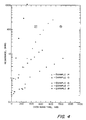
- Figures 1, 2, 3 and 4 all show aging data of different silver-coated copper powders based on the change in electroconductivity of a standard powder-filled silicone resin sample with time.
- the temperature reported for the following examples are those measured in a circulating air oven. Quantities of metal being heated were sufficiently small so thermal inertia in heating could be ignored.
- a copper powder (SCM Metal Products' Grade 943 untreated irregular copper particles produced by an atomization-reduction process and having a particle size distribution of 5 percent maximum retained on 150 mesh and 10 percent maximum minus through 325 mesh) was silver replacement plated by a process similar to that described in Example I of U.S. Patent 3,202,488 using initial sodium cyanide concentrations of 18 oz./gal (135 g/l) and plating 2 troy ounces of silver per pound of (137.2 g/kg) of copper powder by the addition of the silver cyanide solution to the acetic-acid precleaned copper powder while mixing, followed by five water rinses and drying of the plated powder.
- a conductive silicone sheet was prepared by the following process: A silicone mix was formed of 18 parts by weight of silicone (500 parts Dow Corning Silastic E and 100 parts GE SE-33 gum) and 2 parts of Silastic E curing agent. Sixty parts of the silver coated copper powder from Example 1 were mixed with the 20 parts of the silicone mix to give a heavy dough-like mix.
- the powdered metal/silicone composition was placed as an oblong ball shape in the center of a 12 inch by 12 inch by 0.005 inch (30.48 cm x 30.48 cm x 0.127 mm) EL Mylar sheet with a 32 mil (0.8 mm)-thick aluminum chase (1 inch (2.54 cm) wide with 8 inch by 10 inch (20.3 x 25.4 cm) opening) and a 12 inch by 12 inch by 0.060-inch (304.8 x 304.8 x 1.5 mm) aluminum back-up plate.
- EL Mylar is a designation used by DuPont for its electronic grade biaxially-oriented polyester polymer film).
- a 1 ⁇ 2-inch by 4-inch (1.27 x 10.16 cm) piece of the sheet was cut out, and the resistance was measured by placing volt-ohm meter probes on the surface across the 1 ⁇ 2 inch (1.27 mm) width and with 3 inches (7.62 cm) between probes.
- the resistance of this strip was 0.3 ohms. (This is estimated to be about 0.004 ohm-cm in terms of volume resistivity; other such volume-resistivity estimates are set out below in parenthesis following the surface resistivity measurement).
- the above conductive strip was then aged at 195°C and tested periodically by cooling to room temperature and measuring its resistance. (Figure 1). After 15 hours at 195°C, the resistance was 800 ohms (about 11.9 ohm-cm); after a total of 39 hours, the resistance of the strip was greater than 50,000 ohms.
- the above silicone formulation and sheet preparation procedure is called, herein, The Standard Test. While the conductive powder (both amount and technique of preparation) may be varied.
- the initial volume resistivity of the Standard Test formulation will be such that the volume resistivity will be 0.1 ohm-cm or less, and the conductive silicone sheet will have the capability of being pinch folded upon itself (at a 1/16-inch (1.6 mm) thick sheet).
- a conductive silicone sheet was prepared with the processing conditions and materials described in Example 2 excepting that the silver coated copper powder was heat pretreated at 195°C for 15 hours before being added to the silicone mix and, thereafter, making up the conductive silicone sheet.
- a 1 ⁇ 2-inch by 4-inch (1.27 x 10.16 cm) strip was cut out of the resulting 0.032 inch (0.8 mm) thick, conductive, silicone sheet.
- the resistance of the strip measured as before with probes 3 inches (7.62 cm) apart and on opposite sides of the 1 ⁇ 2-inch (1.27 cm) width, was 0.6 ohms (about 0.009 ohm-cm).
- This conductive silicone strip was aged at 195°C and tested periodically for resistance at room temperature (Figure 1). After 15 hours at 195°C the resistance was 11.3 ohms (about 0.17 ohm-cm). And after a total of 39 hours the resistance was 135 ohms (about 2.0 ohm-cm).
- Another conductive silicone sheet was prepared by processing conditions and materials as described in Example 2, excepting that the silver-coated copper powder was heat pretreated at 195°C for 252 hours before it was used to make up the conductive silicone sheet.
- a 1 ⁇ 2-inch by 4 inch (1.27 x 10.16 cm) strip was cut out of a resulting 0.035 inch (0.89 mm) thick conductive silicone sheet.
- the resistance of the strip with probes 3 inches (7.62 cm) apart was 4.5 ohms (about 0.067 ohm-cm).
- the above conductive silicone strip was aged at 195°C and tested periodically for resistance at room temperature (Figure 1). After 65 hours at 195°C the resistance was 4.6 ohms (about 0.068 ohm-cm). This thermal pretreatment of the silver coated copper powder produced a conductive silicone strip that withstood 1000 hours at 195°C before its resistance was measured at 135 ohms (about 2 ohm-cm).
- a similar copper powder as that described in Example 2 was silver replacement plated by a process similar to that described in Example I of U.S. Patent 3,202,488 except that the acetic acid precleaning of the copper powder was eliminated. Instead, the powder was subjected to a pretreatment in a sodium cyanide solution (23 oz./gal.(172.3 g/l)) for 11 minutes with mixing. This step was followed, immediately and, without rinsing by the 2 min. addition of the silver cyanide-sodium cyanide solution and plating of 2 troy ounces of silver per pound (137.2 g/kg) of copper powder onto the pretreated copper. Subsequently, the plated powder was washed five times with water (so that the powder is free of cyanide contamination) and is dried in air at 150°F.
- a conductive silicone sheet was prepared according to Example 2, except that 60 parts by weight of Example 5 silver coated copper powder was used. This powder was treated for 15 hours at 195°C before its use as the conductive filler.
- a 1 ⁇ 2-inch by 4-inch (1.27 x 10.16 cm) strip was cut out of a 0.035 inch (0.89 mm) thick conductive silicone sheet.
- the 3-inch (7.62 cm) spaced resistance measurement of this strip was 0.1 ohms (about 0.0015 ohm-cm).
- the resistance after aging ( Figure 2) of this strip at 195°C for 113 hours was 0.6 ohms (about 0.0089 ohm-cm).
- the resistance of this strip was not measured to be as high as 135 ohms (about 2 ohm-cm) until 1325 hours of aging at 195°C.
- a conductive silicone sheet was prepared by similar processing conditions and materials as those described in Example 6 with except that the silver coated powder from Example 5 was pretreated at 195°C for 135 hours before it is used to make up the conductive silicone sheet.
- a 1 ⁇ 2 inch by 4 inch (1.27 x 10.16 cm) strip was cut out of the 0.034 inch (0.86 mm) thick conductive silicone sheet.
- the 3-inch (7.62 cm) spaced resistance measurement of the strip was 0.18 ohms (about 0.0027 ohm-cm).
- Another conductive silicone sheet was prepared by similar processing conditions and materials as those described in Example 6 with the difference it is that the silver coated copper powder from Example 5 was heat pretreated at 195°C for 310 hours before being used to make up the conductive silicone sheet.
- a 1 ⁇ 2-inch by 4-inch (1.27 x 10.16 cm) strip was cut out of the resulting 0.034 inch (0.86 mm) thick conductive silicone sheet.
- the 3-inch (7.62 cm) spaced resistance of this strip was 0.4 ohms (about 0.0059 ohm-cm).
- Silver-coated copper powder was prepared by using similar plating conditions as those described in Example 5 with the difference being that 3 troy ounces of silver were replacement plated per each pound (205.89 g/kg) of copper powder instead of 2 troy ounces (137.2 g/kg).
- Example 9 silver coated copper powder which had been pre-heat treated for 15 hours at 195°C was used as the conductive filler.
- a 1 ⁇ 2-inch by 4-inch (1.27 x 10.16 cm) strip was cut out of the 0.034 inch (0.86 mm) thick conductive silicone sheet.
- the 3-inch (7.62 cm) spaced resistance measurement of this strip was 0.1 ohms (about 0.0015 ohm-cm).
- Another conductive silicone sheet was prepared using similar processing conditions and materials as those described in Example 10 with the difference being that the silver coated copper powder from Example 9 was heat pretreated at 195°C for 263 hours before it is used to make up the conductive silicone sheet.
- a 1 ⁇ 2-inch by 4-inch (1.27 x 10.16 cm) strip was cut out of the 0.035 inch (0.89 mm) thick conductive silicone sheet.
- the 3-inch (7.62 cm) spaced resistance measurement of this strip was 0.15 ohms (about 0.0022 ohm-cm).
- the copper powder was silver plated under similar conditions to those in Example 5 with differences being that the sodium cyanide concentration was 16 ozs. per gallon (119.8 g/l) and, after the copper powder was pretreated with a sodium cyanide solution for 11 minutes, the copper powder was rinsed with water and than dispersed in fresh sodium cyanide solution before the silver cyanide-sodium cyanide solution was added. Two troy ounces of silver were replacement plated per pound of copper powder (137.2 g/kg)
- Example 12 The same material and procedure as described in Example 2 was used to prepare a conductive silicone sheet except 60 parts by weight of Example 12 silver coated copper powder were used as the conductive filler.
- a 1 ⁇ 2-inch by 4-inch (1.27 x 10.16 cm) strip was cut out of the 0.034 inch (0.86 mm) thick conductive silicone sheet.
- the 3-inch (7.62 cm) space resistance of this strip was 0.2 ohms (about 0.003 ohm-cm).
- a conductive silicone sheet was prepared by using similar processing conditions and materials as those in Example 13 with the difference being that the silver coated copper powder from Example 12 was heat pretreated at 195°C for 110 hours before it was used to make up the conductive silicone sheet.
- a 1 ⁇ 2-inch by 4-inch (1.27 x 10.16 cm) strip was cut out of the 0.033 inch (0.84 mm) thick conductive silicone sheet.
- the resistance of the strip with probes 3 inches (7.62 cm) apart was 0.8 ohms (about 0.012 ohm-cm).
- the above conductive silicone strip was aged (Fig. 4) at 195°C for 87 hours and again tested with its resistance being 0.9 ohms (about 0.013 ohm-cm). After 500 hours at 195°C the resistance was 32 ohms (about 0.47 ohm-cm).
- Another conductive silicone sheet was prepared by using similar processing conditions and materials as those described in Example 13 with the difference being that the silver coated powder from Example 12 was heat pretreated at 152°C for 120 hours before it was used to make up the conductive silicone sheet.
- a 1 ⁇ 2-inch by 4-inch (1.27 x 10.16 cm) strip was cut out of the 0.034 inch (0.86 mm) thick conductive silicone sheet.
- the 3-inch (7.62 cm) space resistance of the strip was 0.18 ohms (0.0027 ohm-cm).
- Example 13 Similar processing conditions and materials were used as those described in Example 13 with the exception being that the silver coated copper powder from Example 12 was heat pretreated at 152°C for 288 hours before being used to make up the conductive silicone sheet.
- a 1 ⁇ 2-inch by 4-inch (1.27 x 10.16 cm) strip was cut out of the 0.034 inch (0.86 mm) thick conductive silicone sheet.
- the 3-inch (7.62 cm) space resistance of the strip was 0.2 ohms (about 0.003 ohm-cm).
- Example 13 was repeated except that the silver-coated copper powder of Example 12 was heat pre-treated 152°C, 640 hours before it was used to make up the conductive silicone sheet.
- the 3 inch spaced resistance was 0.2 ohms (0.003 ohm-centimeter).
- the 3-inch (7.62 cm) spaced resistance was 0.26 ohms (about 0.004 ohm-cm).
- the 3-inch spaced resistivity was 1.9 ohm (0.028 ohm-cm).
- Example 13 was repeated except that the silver-coated copper powder of Example 12 was heat pre-treated at 152°C for 1552 hours it was being used to make up the silicone sheet.
- a strip was tested as in Ex 17.
- the initial 3-inch (7.62 cm) spaced resistance was 0.25 ohms (about 0.0038 ohm-cm).
- the 3-inch spaced resistance was 0.28 ohms (0.004 ohm-cm); after 231 hours at 195°C, the resistance was 0.35 ohm (0.005 ohm-cms).
- This powder was heat-pretreated for 135 hours at 195°C.
- a conductive epoxy resin was obtained by mixing 4 parts of an epoxy (45 parts EPON 828, Shell Chemical; and 5 parts diluent, 37-058 Reichold Chemical) with 14.64 parts of the heat-treated metal powder and 0.88 parts of menthane diamine (Rohm & Haas). The resulting thick paste was then used as an adhesive to bond, (by curing 17 hours at 98°C) a copper jumper to two separate, clean aluminum surfaces resulting in an initial resistance of less than 0.10 ohm between the two surfaces. After aging for 1000 hours at 195°C, the resistance between the two aluminum surfaces was still less than 0.1 ohm.
- Example 19 The same powder used in Example 19 is used to fill a series of organic polymer systems including the vinyl polymers, such as polyvinylidene-chloride copolymer and poly-vinyl chloride, plastisol prepolymerized polyurethanes of both the polyester and polyether types.
- Metal filling is typically carried out in the range of 70-80 weight percent of total solids.
Landscapes
- Chemical & Material Sciences (AREA)
- Physics & Mathematics (AREA)
- Dispersion Chemistry (AREA)
- Spectroscopy & Molecular Physics (AREA)
- Engineering & Computer Science (AREA)
- Materials Engineering (AREA)
- Mechanical Engineering (AREA)
- Metallurgy (AREA)
- Organic Chemistry (AREA)
- Conductive Materials (AREA)
- Compositions Of Macromolecular Compounds (AREA)
- Pigments, Carbon Blacks, Or Wood Stains (AREA)
Abstract
Claims (19)
- Procédé pour fabriquer un polymère conducteur stable à la chaleur dans lequel une poudre de cuivre revêtue d'argent présentant une dimension moyenne de particule de pas plus de 0,025 pouces (0,635 mm) est incorporé dans un polymère organique, caractérisé en ce qu'avant l'incorporation dans le polymère, la poudre est traitée à chaud à une température de 130 à 220°C pendant une période qui est supérieure à 24 heures pour une température de traitement de 200°C, laquelle période est augmentée d'au moins 70 heures si la température du traitement est de 150°C, le temps de traitement minimal étant en relation inverse à la température de traitement.
- Procédé pour fabriquer un polymère conducteur stable à la chaleur dans lequel une poudre de cuivre revêtue d'argent présentant une dimension moyenne de particule de pas plus de 0,025 pouces (0,635 mm) est incorporé dans un polymère organique, caractérisé en ce qu'avant le revêtement avec l'argent, la poudre de cuivre est lavée dans un bain de lavage de complexes métallifères et avant incorporation dans le polymère, la poudre revêtue d'argent est traitée à chaud à une température de 130 à 220°C pendant une période qui est au moins de 15 heures pour une température de traitement de 195°C, laquelle période est augmentée d'au moins 70 heures si la température du traitement à chaud est de 150°C, le temps de traitement minimal étant en relation inverse à la température du traitement.
- Procédé selon la revendication 2, dans lequel les particules de cuivre sont plaquées à l'argent dans une solution de revêtement, tout en maintenant l'agitation en continu de la solution de revêtement, et ultérieurement rincées et séchées avant le traitement à chaud.
- Procédé selon la revendication 2 ou la revendication 3, dans lequel le processus de revêtement comprend le revêtement de remplacement.
- Procédé selon l'une quelconque des revendications 2 à 4, dans lequel le revêtement d'argent est obtenu à partir d'ions d'argent, de nitrate d'argent ou de cyanure d'argent.
- Procédé selon l'une quelconque des revendications 2 à 5, dans lequel suivant l'étape de lavage, la poudre est immédiatement soumise, sans rinçage à l'étape de revêtement.
- Procédé selon l'une quelconque des revendications 2 à 6, dans lequel l'agent complexe comprend des ions de cyanure.
- Procédé selon la revendication 7, dans lequel les ions de cyanure sont obtenus à partir du cyanure de sodium ou du cyanure de potassium.
- Procédé selon l'une quelconque des revendications précédentes, dans lequel la poudre de cuivre est du cuivze pratiquement pur.
- Procédé selon l'une quelconque des revendications précédentes, dans lequel la poudre de cuivre a une dimension de particule inférieure à 0,010 pouces (0,254
- Procédé selon l'une quelconque des revendications précédentes, dans lequel la poudre de cuivre revêtue d'argent contient 0,5 à 4 oz. dans le système troy d'argent par livre de cuivre (34,3 à 274 g Ag/Kg Cu).
- Procédé selon l'une quelconque des revendications précédentes, dans lequel la température du traitement à chaud est d'au moins 150°C
- Procédé selon la revendication 12, dans lequel la température du traitement à chaud est d'au moins 195°C.
- Procédé selon l'une quelconque des revendications précédentes dans lequel la poudre revêtue préparée est constituée d'une pâte de résine polymère organique, la poudre étant ajoutée en une quantité suffisante pour communiquer l'électro-conductivité à la composition lorsque la composition est dans, ou convertie en, un état monolithique solide si bien que ladite poudre est en contact électro-conducteur particule à particule à l'intérieur d'une pâte formée de ladite résine organique.
- Procédé selon l'une quelconque des revendications précédentes, dans lequel ledit polymère organique est une résine silicone.
- Procédé selon l'une quelconque des revendications 1 à 14, dans lequel ladite résine de polymère organique est une résine époxy.
- Procédé selon l'une quelconque des revendications 1 à 14, dans lequel ladite résine de polymère organique comprend un polymère vinylique.
- Procédé selon l'une quelconque des revendications 1 à 14, dans lequel ladite résine de polymère organique comprend un polyuréthanne pré-polymérisé.
- Garniture de protection contre l'énergie électromagnétique formé par un procédé selon la revendication 15, présentant une forme stable définitive et une valeur de dureté de moins de 95 (Shore A).
Applications Claiming Priority (2)
| Application Number | Priority Date | Filing Date | Title |
|---|---|---|---|
| US757061 | 1985-07-19 | ||
| US06/757,061 US4716081A (en) | 1985-07-19 | 1985-07-19 | Conductive compositions and conductive powders for use therein |
Publications (3)
| Publication Number | Publication Date |
|---|---|
| EP0230448A1 EP0230448A1 (fr) | 1987-08-05 |
| EP0230448A4 EP0230448A4 (fr) | 1987-12-09 |
| EP0230448B1 true EP0230448B1 (fr) | 1992-04-01 |
Family
ID=25046203
Family Applications (1)
| Application Number | Title | Priority Date | Filing Date |
|---|---|---|---|
| EP86904571A Expired - Lifetime EP0230448B1 (fr) | 1985-07-19 | 1986-06-23 | Compositions conductrices et poudres conductrices destinees a etre utilisees dans lesdites compositions |
Country Status (6)
| Country | Link |
|---|---|
| US (2) | US4716081A (fr) |
| EP (1) | EP0230448B1 (fr) |
| JP (1) | JPS63500624A (fr) |
| CA (1) | CA1259504A (fr) |
| DE (1) | DE3684691D1 (fr) |
| WO (1) | WO1987000676A1 (fr) |
Families Citing this family (45)
| Publication number | Priority date | Publication date | Assignee | Title |
|---|---|---|---|---|
| JPS6167702A (ja) * | 1984-09-07 | 1986-04-07 | Mitsui Mining & Smelting Co Ltd | 導電性粉末及びこれを用いた導電性組成物 |
| US4716081A (en) * | 1985-07-19 | 1987-12-29 | Ercon, Inc. | Conductive compositions and conductive powders for use therein |
| US4861643A (en) * | 1987-03-13 | 1989-08-29 | The Boeing Company | Aerospace structure having a cast-in-place noncompressible void filler |
| US4980005A (en) * | 1987-03-13 | 1990-12-25 | The Boeing Company | Method for producing an aerospace structure having a cast-in-place noncompressible void filler |
| JPH0759660B2 (ja) * | 1987-09-25 | 1995-06-28 | アルプス電気株式会社 | 導電性組成物 |
| US4883774A (en) * | 1988-03-21 | 1989-11-28 | Motorola, Inc. | Silver flashing process on semiconductor leadframes |
| US4857233A (en) * | 1988-05-26 | 1989-08-15 | Potters Industries, Inc. | Nickel particle plating system |
| US5091114A (en) * | 1988-08-23 | 1992-02-25 | Asahi Kasei Kogyo Kabushiki Kaisha | Conductive metal powders, process for preparation thereof and use thereof |
| KR900702541A (ko) * | 1988-08-29 | 1990-12-07 | 마리안 제이 오스톨스키 | 귀금속 도금된 금속입자 및 이러한 입자로 얻은 전도성 재료의 제조방법 |
| US5141770A (en) * | 1988-11-10 | 1992-08-25 | Vanguard Products Corporation | Method of making dual elastomer gasket shield for electromagnetic shielding |
| US5068493A (en) * | 1988-11-10 | 1991-11-26 | Vanguard Products Corporation | Dual elastomer gasket shield for electronic equipment |
| US5180523A (en) * | 1989-11-14 | 1993-01-19 | Poly-Flex Circuits, Inc. | Electrically conductive cement containing agglomerate, flake and powder metal fillers |
| US5376403A (en) * | 1990-02-09 | 1994-12-27 | Capote; Miguel A. | Electrically conductive compositions and methods for the preparation and use thereof |
| US5853622A (en) * | 1990-02-09 | 1998-12-29 | Ormet Corporation | Transient liquid phase sintering conductive adhesives |
| US5262737A (en) * | 1992-07-30 | 1993-11-16 | International Business Machines Corporation | Data processing system and housing having reduced electromagnetic emissions |
| US5674606A (en) * | 1995-04-06 | 1997-10-07 | Parker-Hannifin Corporation | Electrically conductive flame retardant materials and methods of manufacture |
| US5696196A (en) * | 1995-09-15 | 1997-12-09 | Egyptian Lacquer Mfg. Co. | EMI/RFI-shielding coating |
| US5968600A (en) * | 1995-09-15 | 1999-10-19 | Egyptian Lacquer Mfg. Co. | EMI/RFI-shielding coating |
| US5611884A (en) * | 1995-12-11 | 1997-03-18 | Dow Corning Corporation | Flip chip silicone pressure sensitive conductive adhesive |
| US6010646A (en) * | 1997-04-11 | 2000-01-04 | Potters Industries, Inc. | Electroconductive composition and methods for producing such composition |
| KR100247463B1 (ko) * | 1998-01-08 | 2000-03-15 | 윤종용 | 탄성중합체를 포함하는 반도체 집적회로 소자의 제조 방법 |
| US6106303A (en) * | 1998-05-27 | 2000-08-22 | Lear Automotive Dearborn, Inc. | Trim panel having grooves with integrally formed electrical circuits |
| US6533963B1 (en) | 1999-02-12 | 2003-03-18 | Robert A. Schleifstein | Electrically conductive flexible compositions, and materials and methods for making same |
| JP3603945B2 (ja) | 1999-10-06 | 2004-12-22 | 信越化学工業株式会社 | 導電性シリコーンゴム組成物 |
| US6433057B1 (en) * | 2000-03-28 | 2002-08-13 | Dow Corning Corporation | Silicone composition and electrically conductive silicone adhesive formed therefrom |
| ITMI20010807A1 (it) * | 2000-04-14 | 2002-10-13 | Saint Gobain | Procedimento per la fabbricazione di piste elettroconduttorici sunun substrato trasparente e substrato ottenuto |
| WO2005031760A1 (fr) * | 2003-09-26 | 2005-04-07 | Hitachi Chemical Co., Ltd. | Poudre conductrice melangee et son utilisation |
| KR100739061B1 (ko) * | 2005-07-29 | 2007-07-12 | 삼성에스디아이 주식회사 | 전극 형성용 감광성 조성물, 전사필름, 전극 및 이를포함하는 플라즈마 디스플레이 패널 |
| EP3473681B1 (fr) | 2005-08-12 | 2020-10-07 | Cambrios Film Solutions Corporation | Conducteurs transparents basés sur des nanofils |
| WO2007115964A1 (fr) * | 2006-04-12 | 2007-10-18 | Ciba Holding Inc. | Procede de traitement de particules enduites de metal |
| WO2009035453A1 (fr) * | 2007-09-13 | 2009-03-19 | Henkel Ag & Co. Kgaa | Composition électriquement conductrice |
| US8231808B2 (en) * | 2008-05-27 | 2012-07-31 | Hong Kong University Of Science And Technology | Percolation efficiency of the conductivity of electrically conductive adhesives |
| US8299159B2 (en) | 2009-08-17 | 2012-10-30 | Laird Technologies, Inc. | Highly thermally-conductive moldable thermoplastic composites and compositions |
| US8173523B2 (en) * | 2009-10-09 | 2012-05-08 | Sumco Corporation | Method of removing heavy metal in semiconductor substrate |
| DE102010060904A1 (de) | 2010-11-30 | 2012-05-31 | Benecke-Kaliko Ag | Polymermischung |
| CN102220012B (zh) * | 2011-06-08 | 2012-10-31 | 北京工业大学 | 电磁屏蔽用单组分挤出成型导电橡胶及其制备方法 |
| KR102250406B1 (ko) * | 2013-03-14 | 2021-05-12 | 다우 실리콘즈 코포레이션 | 경화성 실리콘 조성물, 전기 전도성 실리콘 접착제, 이의 제조 및 사용 방법, 및 이를 포함하는 전기 디바이스 |
| US9428680B2 (en) * | 2013-03-14 | 2016-08-30 | Dow Corning Corporation | Conductive silicone materials and uses |
| JP6679312B2 (ja) * | 2015-01-13 | 2020-04-15 | Dowaエレクトロニクス株式会社 | 銀被覆銅粉およびその製造方法 |
| DE102015207814A1 (de) | 2015-04-28 | 2016-11-03 | Benecke-Kaliko Ag | Elektrisch leitfähige Materialzusammensetzung |
| CN105196647A (zh) * | 2015-10-14 | 2015-12-30 | 文雪烽 | 一种消除表面静电的界面材料 |
| CN105921737B (zh) * | 2016-04-28 | 2018-01-19 | 中南大学 | 一种铜银复合粉的制备方法和导电胶 |
| CN109881191B (zh) * | 2019-03-29 | 2020-05-22 | 上海交通大学 | 一种用于电接触材料银铜扩散涂层的制备方法 |
| WO2023080027A1 (fr) * | 2021-11-02 | 2023-05-11 | 昭栄化学工業株式会社 | Composition de résine conductrice thermodurcissable et procédé de production de composant électronique |
| WO2023080028A1 (fr) * | 2021-11-02 | 2023-05-11 | 昭栄化学工業株式会社 | Composition de résine électroconductrice thermodurcissable, et procédé de production d'un composant électronique |
Family Cites Families (11)
| Publication number | Priority date | Publication date | Assignee | Title |
|---|---|---|---|---|
| US3003975A (en) * | 1958-11-26 | 1961-10-10 | Myron A Coler | Conductive plastic composition and method of making the same |
| US3194860A (en) * | 1962-10-02 | 1965-07-13 | John E Ehrreich | Manufacture of reinforced conductive plastic gaskets |
| US3202488A (en) * | 1964-03-04 | 1965-08-24 | Chomerics Inc | Silver-plated copper powder |
| US3583930A (en) * | 1968-04-16 | 1971-06-08 | Chomerics Inc | Plastics made conductive with coarse metal fillers |
| US4092459A (en) * | 1975-01-13 | 1978-05-30 | Graham Magnetics Incorporated | Powder products |
| US4011077A (en) * | 1975-06-06 | 1977-03-08 | Ford Motor Company | Copper coated, iron-carbon eutectic alloy powders |
| US4171393A (en) * | 1977-06-20 | 1979-10-16 | Eastman Kodak Company | Electroless plating method requiring no reducing agent in the plating bath |
| JPS5553017A (en) * | 1978-10-16 | 1980-04-18 | Nippon Mining Co | Method of manufacturing multiple coating composite powder |
| JPS5554561A (en) * | 1978-10-18 | 1980-04-21 | Nippon Mining Co Ltd | Metal plating method for powdered body by substitution method |
| US4594181A (en) * | 1984-09-17 | 1986-06-10 | E. I. Du Pont De Nemours And Company | Metal oxide-coated copper powder |
| US4716081A (en) * | 1985-07-19 | 1987-12-29 | Ercon, Inc. | Conductive compositions and conductive powders for use therein |
-
1985
- 1985-07-19 US US06/757,061 patent/US4716081A/en not_active Expired - Lifetime
-
1986
- 1986-06-23 WO PCT/US1986/001357 patent/WO1987000676A1/fr not_active Ceased
- 1986-06-23 JP JP61503757A patent/JPS63500624A/ja active Pending
- 1986-06-23 EP EP86904571A patent/EP0230448B1/fr not_active Expired - Lifetime
- 1986-06-23 DE DE8686904571T patent/DE3684691D1/de not_active Expired - Fee Related
- 1986-06-26 CA CA000512490A patent/CA1259504A/fr not_active Expired
-
1987
- 1987-11-03 US US07/116,025 patent/US4836955A/en not_active Expired - Lifetime
Also Published As
| Publication number | Publication date |
|---|---|
| US4836955A (en) | 1989-06-06 |
| JPS63500624A (ja) | 1988-03-03 |
| EP0230448A4 (fr) | 1987-12-09 |
| US4716081A (en) | 1987-12-29 |
| WO1987000676A1 (fr) | 1987-01-29 |
| EP0230448A1 (fr) | 1987-08-05 |
| DE3684691D1 (de) | 1992-05-07 |
| CA1259504A (fr) | 1989-09-19 |
Similar Documents
| Publication | Publication Date | Title |
|---|---|---|
| US4836955A (en) | Conductive compositions | |
| US3202488A (en) | Silver-plated copper powder | |
| US4434541A (en) | Electromagnetic shielding | |
| US4447492A (en) | Articles having an electrically conductive surface | |
| CA2548835C (fr) | Charge conductrice a rendement ameliore et polymeres conducteurs fabriques a partir de cette charge | |
| US4624865A (en) | Electrically conductive microballoons and compositions incorporating same | |
| US3359145A (en) | Electrically conducting adhesive | |
| US4507359A (en) | Electromagnetic shielding | |
| US4590115A (en) | Metallizing of plastic substrata | |
| US3476530A (en) | Iron based conductive filler for plastics | |
| US4695404A (en) | Hyperconductive filled polymers | |
| US20030113531A1 (en) | Conductive fillers and conductive polymers made therefrom | |
| US4769280A (en) | Electromagnetic shielding | |
| JPS6320270B2 (fr) | ||
| US5049332A (en) | Method of making conductive metal-filled substrates without developing agents | |
| US4765929A (en) | Silk-screenable circuit paste | |
| WO2002067274A2 (fr) | Charges conductrices de ni/c revetues de metal precieux et polymeres conducteurs realises a partir de telles charges | |
| JPH0694593B2 (ja) | 陽極酸化アルミニウム上への無電解ニッケル鍍金 | |
| EP0038679A1 (fr) | Compositions de matière plastique conduisant l'électricité | |
| JPS6119318A (ja) | プリント回路用基板の製造方法、該方法に用いられる組成物およびそれより製せられる基板 | |
| JPS6235501A (ja) | 高分子正温度特性抵抗体の製造法 | |
| JPS5749632A (en) | Electrically conductive filler | |
| JPH01247501A (ja) | 導電性粒子 | |
| HK1098246B (en) | Conductive filler and use thereof | |
| Hideo et al. | Surface treatment of copper inner-layer with electroless copper plating using hypophosphite as reducing agent |
Legal Events
| Date | Code | Title | Description |
|---|---|---|---|
| PUAI | Public reference made under article 153(3) epc to a published international application that has entered the european phase |
Free format text: ORIGINAL CODE: 0009012 |
|
| AK | Designated contracting states |
Kind code of ref document: A1 Designated state(s): BE CH DE FR GB IT LI SE |
|
| 17P | Request for examination filed |
Effective date: 19870722 |
|
| A4 | Supplementary search report drawn up and despatched |
Effective date: 19871209 |
|
| 17Q | First examination report despatched |
Effective date: 19890428 |
|
| GRAA | (expected) grant |
Free format text: ORIGINAL CODE: 0009210 |
|
| AK | Designated contracting states |
Kind code of ref document: B1 Designated state(s): BE CH DE FR GB IT LI SE |
|
| PG25 | Lapsed in a contracting state [announced via postgrant information from national office to epo] |
Ref country code: LI Effective date: 19920401 Ref country code: IT Free format text: LAPSE BECAUSE OF FAILURE TO SUBMIT A TRANSLATION OF THE DESCRIPTION OR TO PAY THE FEE WITHIN THE PRE;WARNING: LAPSES OF ITALIAN PATENTS WITH EFFECTIVE DATE BEFORE 2007 MAY HAVE OCCURRED AT ANY TIME BEFORE 2007. THE CORRECT EFFECTIVE DATE MAY BE DIFFERENT FROM THE ONE RECORDED.SCRIBED TIME-LIMIT Effective date: 19920401 Ref country code: BE Effective date: 19920401 Ref country code: FR Effective date: 19920401 Ref country code: CH Effective date: 19920401 Ref country code: SE Effective date: 19920401 |
|
| REF | Corresponds to: |
Ref document number: 3684691 Country of ref document: DE Date of ref document: 19920507 |
|
| REG | Reference to a national code |
Ref country code: CH Ref legal event code: PL |
|
| EN | Fr: translation not filed | ||
| PLBE | No opposition filed within time limit |
Free format text: ORIGINAL CODE: 0009261 |
|
| STAA | Information on the status of an ep patent application or granted ep patent |
Free format text: STATUS: NO OPPOSITION FILED WITHIN TIME LIMIT |
|
| 26N | No opposition filed | ||
| PGFP | Annual fee paid to national office [announced via postgrant information from national office to epo] |
Ref country code: GB Payment date: 20010531 Year of fee payment: 16 |
|
| PGFP | Annual fee paid to national office [announced via postgrant information from national office to epo] |
Ref country code: DE Payment date: 20010626 Year of fee payment: 16 |
|
| REG | Reference to a national code |
Ref country code: GB Ref legal event code: IF02 |
|
| PG25 | Lapsed in a contracting state [announced via postgrant information from national office to epo] |
Ref country code: GB Free format text: LAPSE BECAUSE OF NON-PAYMENT OF DUE FEES Effective date: 20020623 |
|
| PG25 | Lapsed in a contracting state [announced via postgrant information from national office to epo] |
Ref country code: DE Free format text: LAPSE BECAUSE OF NON-PAYMENT OF DUE FEES Effective date: 20030101 |
|
| GBPC | Gb: european patent ceased through non-payment of renewal fee |
Effective date: 20020623 |