EP0236704A2 - Procédé et appareil pour la récupération de la perte de chaleur - Google Patents
Procédé et appareil pour la récupération de la perte de chaleur Download PDFInfo
- Publication number
- EP0236704A2 EP0236704A2 EP87100898A EP87100898A EP0236704A2 EP 0236704 A2 EP0236704 A2 EP 0236704A2 EP 87100898 A EP87100898 A EP 87100898A EP 87100898 A EP87100898 A EP 87100898A EP 0236704 A2 EP0236704 A2 EP 0236704A2
- Authority
- EP
- European Patent Office
- Prior art keywords
- building
- cavity
- heat
- air
- ambient air
- Prior art date
- Legal status (The legal status is an assumption and is not a legal conclusion. Google has not performed a legal analysis and makes no representation as to the accuracy of the status listed.)
- Granted
Links
Images



Classifications
-
- F—MECHANICAL ENGINEERING; LIGHTING; HEATING; WEAPONS; BLASTING
- F24—HEATING; RANGES; VENTILATING
- F24D—DOMESTIC- OR SPACE-HEATING SYSTEMS, e.g. CENTRAL HEATING SYSTEMS; DOMESTIC HOT-WATER SUPPLY SYSTEMS; ELEMENTS OR COMPONENTS THEREFOR
- F24D3/00—Hot-water central heating systems
- F24D3/18—Hot-water central heating systems using heat pumps
-
- F—MECHANICAL ENGINEERING; LIGHTING; HEATING; WEAPONS; BLASTING
- F24—HEATING; RANGES; VENTILATING
- F24F—AIR-CONDITIONING; AIR-HUMIDIFICATION; VENTILATION; USE OF AIR CURRENTS FOR SCREENING
- F24F12/00—Use of energy recovery systems in air conditioning, ventilation or screening
-
- Y—GENERAL TAGGING OF NEW TECHNOLOGICAL DEVELOPMENTS; GENERAL TAGGING OF CROSS-SECTIONAL TECHNOLOGIES SPANNING OVER SEVERAL SECTIONS OF THE IPC; TECHNICAL SUBJECTS COVERED BY FORMER USPC CROSS-REFERENCE ART COLLECTIONS [XRACs] AND DIGESTS
- Y02—TECHNOLOGIES OR APPLICATIONS FOR MITIGATION OR ADAPTATION AGAINST CLIMATE CHANGE
- Y02B—CLIMATE CHANGE MITIGATION TECHNOLOGIES RELATED TO BUILDINGS, e.g. HOUSING, HOUSE APPLIANCES OR RELATED END-USER APPLICATIONS
- Y02B30/00—Energy efficient heating, ventilation or air conditioning [HVAC]
- Y02B30/12—Hot water central heating systems using heat pumps
Definitions
- the invention relates to a method for recovering transmission heat that flows between a body having at least one internal cavity, preferably a building, and the ambient air, and a building for carrying out the method.
- the process of the type mentioned at the outset has no model in technology. It should preferably serve to air-condition the interior of buildings and at the same time minimize the energy required for this.
- Suitable methods and correspondingly designed buildings are already known, for example, from European publication No. 0115014 in the area of minimizing the energy requirement. Such methods and the corresponding building design have already proven to be extremely effective in practice. However, it has been shown that a not inconsiderable heat loss must nevertheless be accepted. It is essentially transmission heat that is radiated from the outer skin of the building and warms the ambient air, in which case this heated ambient air is distributed in the immediate vicinity of the building by the outside air circulation in the outside air. The greater the temperature difference between the outside air temperature and the inside temperature of the building, the greater this loss. Exactly considered, only the temperature difference between the temperature of the air flowing around the building in the air duct and the outside air is decisive, but from ver For various reasons, the air circulating in the air ducts cannot be lowered accordingly with a sensible result at low outside temperatures.
- the invention is therefore based on the object of proposing a method of the type described in the introduction with which it is possible to recover at least the essential part of the transmission heat which is still lost according to methods of the prior art.
- the body at least in its predominant surface area from the ambient air through at least one first cavity and this at least predominantly at least in the area in which the body projects into the ambient air , is separated from at least one second cavity which is separated from the first cavity and is located further away, the outer surface of which in turn forms an interface with the ambient air, the outer, second cavity being connected or connectable to the ambient air at the highest possible locations and via
- Defined leaks are connected or connectable to the first cavity, wherein at least the first cavity is kept at a negative pressure with respect to the ambient air by means of a suction device and the air extracted in this way is heated and the heat obtained is at least partially returned to the area which released it is fed.
- the outer cavity which is delimited from the surrounding atmosphere by an outer boundary layer, is to have openings which are as high as possible and which allow the outside atmosphere to penetrate into this outer cavity.
- this outside atmosphere is cooler than the area inside the building, so that the outside atmosphere sinks into this outer cavity through the high-lying openings as a denser and therefore heavier medium.
- the outside air now in the outer cavity already has a higher pressure due to its higher density. The pressure difference is increased by the suction through the heat recovery device and there is therefore no flow around the building envelope, but rather a radial movement of the outside air from outside to inside, so to speak.
- the temperature difference between the outside air and the outer cavity almost zero. But this means that heat of transmission cannot be lost here.
- the flow temperature of such a heater can be in the range of the desired room temperature.
- the temperature gradient between room temperature and heating surface temperature can be kept extremely low. This can, for. B. with a floor heating even at very low outside temperatures, a floor temperature near the desired room temperature can be maintained.
- the heat pump of a heat recovery device can also be designed to be small and, moreover, with more economical performance number to operate. All in all, a balance is achieved inside the building, so to speak, by recapturing and returning whatever heat is lost to the outside.
- the loss of heat from the building not only can the loss of heat from the building be prevented without any problems, but also the loss of heat from the ambient air to the building can be prevented, for example.
- B. is important if, such as. B. In summer, the outside temperature of the ambient air is significantly higher than the temperature desired for the interior of the building. In such a case, the ambient air loses transmission heat to the interior of the building. Since this heat has to flow into the interior of the building via the cavities, but these cavities are extracted in the manner described, the warm air extracted in this way can be heated and the heat obtained in this way cannot be released into the interior of the building but into the outside air.
- the heated air can be used directly or indirectly via heat exchangers to cool the interior of the building.
- the internal temperature of the building can also be reduced in this way if desired.
- This can be the case, for example, when the inside temperature of the building and the outside temperature are initially the same and, for example, there are many people in the building who give off heat and thus increase the inside temperature of the building.
- the cooling capacity can be increased by the fact that the warm air is extracted from the rooms, heated and replaced by fresh air.
- the heat gained here can be in unheated building masses of the building, for example in the Cellar floors are stirred and heated. If necessary, this heat can then be recovered and used for heating purposes or for heating domestic water. It is also possible to equip the surrounding soil of the building with corresponding channels, and to store excess heat by heating this soil and to remove it again if necessary.
- At least the heat obtained by the heat dissipation is at least partially returned to the body in at least one area to be heated. This creates a closed cycle of heat. If the supply is only partial, this circuit is opened for temperature regulation.
- the air located in the first cavity is guided through the building structure of unheated rooms and / or the adjacent soil.
- these can be used as heat stores. Depending on the temperature, you can then either give off heat again or serve as a heat buffer.
- the extracted air is heated to approximately the temperature of the outside air. If the temperature of the air released into the outside air were higher than this, heat would be lost to the outside air; but if it were lower, the necessary heat pump would have to be in a less favorable area work.
- the heat obtained during the cooling is supplied to the environment, while de-heated fluid is guided through the building structure to at least be cooled rooms. In this way, a desired temperature level can be reached and maintained.
- the temperature gradient of the fluid with the heat recovered is influenced by changes in throughput. This is a particularly simple and effective way of influencing the temperature or regulating the temperature.
- the internal energy of the fluid in the heat distribution of the internal energy of the fluid which is to be influenced in terms of its temperature, for. B. air is adjusted.
- the mass of the fluid used for energy distribution e.g. the water of the heating circuit
- its heat content is of the same order of magnitude as the heat content e.g. B. the air of the associated building.
- a device for carrying out the method according to the invention is based on a building with at least one inner cavity, the building having at least one inner collecting shaft which is connected on the one hand to the intake side of a heat recovery system and on the other hand to the cavities of the building to be influenced and the building is surrounded in at least the major part of its outer area by a first cavity with an outer boundary surface, which is also connected to the collecting shaft, and wherein the building Has heat exchangers which are connected to the heat exchanger of the heat recovery system.
- Such a structure can be found, for example, in European publication No. 0 115 014.
- the outer boundary surface is at least predominantly surrounded by a second cavity, at least predominantly in the area in which the body projects into the outside air, which in turn forms a building body via an outer boundary surface to the outside air is delimited from the outside air, the second cavity being connected or connectable to the first cavity via defined leaks, and the first cavity and the inner cavity being connected or connectable via the collecting shaft to the suction device of the heat recovery system, in order to generate a constant negative pressure the external ambient air, which can penetrate into the second cavity via openings as high as possible.
- the building Due to the construction described, the building is surrounded in its essential areas in two layers by cavities, the air masses of which are not pumped around but are sucked off by a suitable suction device of a heat recovery system.
- the construction of such a building is very simple and there are special requirements for the Cavities or the cavity shape is not placed, since the flow velocities of the extracted air are very low.
- copper pipes in gypsum or gypsum-like substance are laid in the building as the heat exchanger of the building which is connected to the heat exchanger of the heat recovery system. This is very easy to manufacture and there is easy heat transfer. Because of the very small temperature difference between the surface of such a heat exchanger in the building (e.g. the surface of an underfloor heating system), the cross-sectional dimensions of the copper pipes can be kept very small and can, for. B. with a clear diameter of 6 to 8 mm. Pipes of such a small diameter also allow particularly simple and small-sized distribution devices for the various heating or cooling circuits, so that the entire structure for carrying out the method according to the invention is simplified in terms of construction costs compared to the known structures of the prior art and is therefore cheaper.
- the heat recovery system contains at least one heat pump.
- a heat pump can be kept small in relation to the content of the associated building, measured by the design of the heat pumps in buildings of the prior art.
- the heat recovery system several Contains heat pumps that are connected in series on the air side and their performance is graded according to this circuit. This makes it possible to use relatively small and therefore economically working heat pumps even in larger buildings and, depending on the operating conditions, to switch the heat pumps in operation on or off in an optimal performance range by switching heat pumps of different outputs on or off.
- the structures forming the outer boundary of the structure, at least in the area in which the structure is surrounded by outside air, are structured at least in the essential areas so that they have an inner first and an outer second , contain the structure at least in the above-mentioned areas. This enables the necessary cavities to be integrated directly into the building structure.
- the first and second cavities at least partially as a plurality of hollow channels is trained. This simplifies the construction effort and improves the stability of an outer skin constructed in this way.
- the structures containing the cavities are designed as assemblable components and form an external heat insulation shell in a composite form. This makes it possible to prefabricate such structures and keep them ready as prefabricated elements. At the same time, the construction of such an outer insulating layer is facilitated.
- At least one collecting shaft is formed by the corridors provided in the building and the stairwells connected therewith. In this way, it is largely possible to avoid special structural measures for the production of a collecting shaft.
- Existing fireplaces can also be used to draw in and preheat outside air.
- controllable openings for the regulated outside air inlet into the inner cavity of the building as well as control devices with the associated actuators are provided with which the outside air inlet on the one hand and the amount of air extracted via the heat recovery system on the other hand are regulated.
- a change in the temperature level of the interior of the building can be reliably effected, and it is additionally possible to achieve such a change in the temperature level individually for each room or for groups of rooms inside the building.
- air collectors are provided which are connected or connectable to the cavity.
- the air collectors can be used to influence the temperature and negative pressure of the air in the cavity 1 in a simple manner.
- the solar energy gained can also be used to heat swimming pools.
- Another embodiment of the invention provides that a heat exchanger is provided in the heating flow for supplying the process water or the water of a swimming pool with heat.
- a heat exchanger is provided in the heating flow for supplying the process water or the water of a swimming pool with heat.
- an economically favorable continuous operation of a heat pump with a relatively low output and a favorable coefficient of performance is achieved and a possible excess of heat is expediently dissipated via the heat exchanger, so that the room temperature can be maintained at the desired level despite the excess of heat.
- the outflowing process water can also be heated again in a manner known per se, so that heat is not lost even through outflowing process water.
- Another embodiment of the invention provides that at least one actuator is provided to regulate the air quantities from the cavities.
- the quantity and vacuum can be influenced within certain limits via these actuators, which means that the heat pump's coefficient of performance and performance can also be influenced.
- an actuator is provided to influence the temperature of the heated air.
- the mass flow rate of the heat pump is regulated or controlled with this actuator.
- At least one circulation pump for the fluid in the copper pipes is connected to a room thermostat for regulating the pump throughput. This makes it possible to change the temperature gradient of the fluid in the copper pipes via the throughput of the circulation pump, which is controlled by the room thermostats.
- the intake air of the heat pumps can be influenced in terms of temperature, humidity and quantity via actuators, heating devices and humidification devices, which are provided in the building.
- the tubes of the heat distribution have the largest possible surface to volume ratio.
- the invention enables the use of very thin pipes for the heat distribution lines. Very small clear widths of the pipes are preferred, which makes the pipes cheaper and their laying becomes easier. However, this also makes the mass of the medium transported through the tubes less, which means that it reacts more quickly to the supply or dissipation of heat, a further significant advantage.
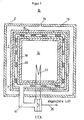
- a body 13 to be influenced with regard to its temperature level (eg container, pipeline, building) is shown schematically in cross section.
- An area 16 to be kept at its temperature is surrounded by an insulation layer 38.
- These Insulation layer 38 is surrounded by the first cavity 1, which is again surrounded by an insulation layer 3.
- the insulation layers 3 and 38 are constructed from components 28 which have defined leaks and, by means of these leaks, connect a second cavity which surrounds the first cavity 1 and the insulation layer 3 to the first cavity 1.
- the second cavity 2 is delimited from the outside air 10 via an outer interface 3 ⁇ , which can be formed, for example, by a casing.
- the interface 3 ⁇ has an opening at a high point 14 for connecting the outside air 10 to the second cavity 2.
- the second cavity 2 is connected via the aforementioned leaks 15 to the first cavity 1, which in turn is connected to a heat recovery device 7 via the channel 41 , 7 ⁇ , 8 is connected.
- the heat recovery device is able to discharge heated or warmed air to the ambient air 10 via the exhaust air line 35.
- the heat recovery device has a heat exchanger 22 located in area 16 in order to supply or remove heat from area 16.
- the building 13 in FIG. 2 is covered in the usual way by a roof (not specified in any more detail), which rests in a known manner on outer walls, which in turn are supported in the usual way on basement walls which are connected to a foundation. This essentially forms the foundation of a building structure 17, which includes unheated rooms. This structure is surrounded by soil 19.
- the building also has a collecting shaft 21 designed as a central shaft, as well as internal cavities 20 which can form, for example, the living area of the building.
- a heating device 45 Arranged in the collecting shaft 21 is a heating device 45, the energy lines 46 of which are connected to an energy source, not shown.
- the heating device can be of any design. The operation of the heating device can be controlled via a control device, not shown. With the heating device, heat can be supplied to the intake air of the heat pump as required.
- Both the first cavity 1 and the inner cavities 20 are connected to the collecting shaft 21, but the first cavity 1 is connected to the collecting shaft 21 in the region of the foundation.
- An actuator 31b arranged in the collecting shaft 21 effects a pressure and throughput distribution between the medium sucked out of the interior 20, or the interior 16 ⁇ to be heated, and the first cavity 1.
- This medium is sucked off by a fan 8 of a heat pump 7 'with a heat exchanger 7.
- a connecting line 49 can also be provided, which is connected to an air humidification device 47 and, if necessary, to humidify the sucked-in air to the desired extent. This measure also allows heat to be supplied to the desired extent.
- the humidification device is connected to a water supply line 48.
- the operation of the humidification device can also can be controlled via a control device, not shown.
- Said device can be accommodated in a basement room, that is to say a room 18 that is not heated.
- the device 7, 7 ⁇ , 8 is connected to the outside air 10 via the exhaust air line 35.
- the heat recovery system consisting essentially of two heat exchangers 7, the compressor 7 ⁇ , the expansion valve and the fan 8 is duplicated in the exemplary embodiment.
- the two devices are connected in series on the air side and have different, complementary services.
- the heat obtained via the system is fed via line 36 and via pump 34 to a further heat exchanger 33 which, if necessary, heat for heating domestic water or, for. B. for heating a swimming pool.
- the fluid conveyed by the pump 34 for example water, is passed through the copper pipes 23 to a floor and ceiling heater and from there via the line 37 to the heat recovery system 7, 7 ⁇ , 8 again.
- the copper pipes of the floor and ceiling heating are above and below an insulation layer in a gypsum-like substance 24, such as. B. Floor screed. Since only very small amounts of heat have to be transported in order to maintain a desired temperature in the inner cavities 20 or 16 ⁇ and only an extremely small temperature difference between room temperature and the temperature of the fluid flowing through the copper tubes 23 is required, these copper tubes 23 can be kept extremely small in their cross-sectional dimensions . For example, an inner diameter of the pipes of 6 to 8 mm is sufficient. This will of course be the laying of the pipes and the design of the pipe manifold as a side effect very simplified.
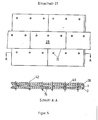
- the first cavity 1 (FIG. 4) has an interface 3, which is located further out and is designed as an intermediate wall and is followed by a second cavity 2 which is located further out. Substantial parts of the building substance of the building according to FIG. 1, projecting beyond the soil 19, are encompassed by this second cavity 2, which can also be designed in the form of a plurality of channels. Such hollow channels 27 (see FIG. 5) can be constructed from components 28 which are connected to the first cavity 1 via defined leaks 15.
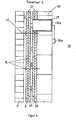
- FIG. 4 shows an enlargement of a detail of the building body 4. There, seen from the outside inward, the masonry forming the outer boundary surface 3 ⁇ is shown, which delimits the second cavity 2 to the outside from the outside air 10.
- the second cavity 2 is followed inwardly by the boundary surface 3, which is designed as a double-layer insulation layer and separates the first cavity 1 from the second cavity 2. Further inward, the first cavity 1 is followed by a second double-layer insulation layer 38, which is applied together with the insulation layer 3 to the masonry 39 of the building. Spacers 40 determine the size of the first cavity 1 and ensure the corresponding stability of the hollow insulation, which is composed of tongue and groove type from normal hard foam panels in one device, the staggered rigid foam panels being held together with barbs and adhesives.
- An adjustable opening 29 (FIG. 4) is provided in the masonry 39 and continuously through the insulation layer 38, in which an actuator 31a is arranged, which is actuated by a control device 30.
- the first cavity 1 can be connected to an inner cavity 20 via this controllable opening 29.
- the mass flow resulting from the respective negative pressure difference can be influenced by the actuator 31a actuated by the control device 30a.
- Said control device ensures in operation that a desired or necessary negative pressure is generated in the first cavity 1 and, if necessary, in the interior 16 ⁇ or 20 by controlling the mass flow rate.
- the second, outer cavity 2 can include the first cavity 1, if necessary also over the roof surface, as indicated in the exemplary embodiment according to FIG. 1. It is necessary that the second, outer cavity 2 has a connection to the outside air 10 at points 14 as high as possible. At these points, the outside air 10 can penetrate into this second cavity 2. Because on the one hand the first cavity 1 is under vacuum and on the other hand is connected to the second cavity 2 via the defined leaks 15, the outside air which has penetrated into the second cavity 2 via the high points 14 migrates through the defined leaks 15 into the first cavity 1 and is extracted from there into the heat recovery system. Transmission heat, which has thus passed from the interior spaces 16 / and / or 20 into the first cavity 1, is therefore first recovered by the heat recovery system via the extraction of this first cavity 1.
- the temperature there can be greater than the temperature of the outside air which is in the second cavity 2 is located can also transfer heat there due to the existing temperature gradient.
- the transmission heat that passes through here is already significantly lower - due to the lower temperature gradient - than with conventional construction with the corresponding higher temperature gradient.
- the heat of transmission that still reaches the second cavity 2 is, at least predominantly, recovered by the fact that only the air layer near the boundary at the interface 3 in the second cavity 2 is heated by the heat of transmission, but by the defined leaks 15 in the first Cavity 1 is sucked back. According to conventional technology, this heated layer of air near the border would be blown away by the outside atmosphere and the heat would be lost. This is no longer possible according to the invention.
- Trans mission heat which has come from the interior 16 ⁇ or 20 to the outside into the cavities 1 and 2, is recovered.
- the recovered heat is then returned to rooms 16 ⁇ or 20, if this is necessary. If there is no need there, the recovered heat can also be used to heat process water or, for example, to heat the water in a swimming pool.
- the heated air goes back into the outside air 10 as exhaust air 12 via the exhaust air line 35, for example.
- the performance of the heat recovery device can be kept unusually low. Since the heat exchanger 22 of the building or the corresponding floor and ceiling heating system only has to transport small amounts of heat, the pipelines there can be kept very small. Because of the low heat transfer, this device can also work with a very low temperature gradient to the desired room temperature, because only small amounts of heat have to be transported. This low temperature of the floor and ceiling heating allows a correspondingly small design of the necessary heat pump and at the same time allows it to be operated with a favorable coefficient of performance.
- FIG. 6 finally shows a block diagram of the method according to the invention. The energy flow is shown again schematically there.
Landscapes
- Engineering & Computer Science (AREA)
- General Engineering & Computer Science (AREA)
- Chemical & Material Sciences (AREA)
- Combustion & Propulsion (AREA)
- Mechanical Engineering (AREA)
- Thermal Sciences (AREA)
- Physics & Mathematics (AREA)
- Building Environments (AREA)
- Heat Treatments In General, Especially Conveying And Cooling (AREA)
- Heating, Cooling, Or Curing Plastics Or The Like In General (AREA)
- Processing And Handling Of Plastics And Other Materials For Molding In General (AREA)
- Transforming Light Signals Into Electric Signals (AREA)
- Devices For Conveying Motion By Means Of Endless Flexible Members (AREA)
Priority Applications (1)
| Application Number | Priority Date | Filing Date | Title |
|---|---|---|---|
| AT87100898T ATE65314T1 (de) | 1986-03-08 | 1987-01-23 | Verfahren und einrichtung zur rueckgewinnung von transmissionswaerme. |
Applications Claiming Priority (2)
| Application Number | Priority Date | Filing Date | Title |
|---|---|---|---|
| DE19863607719 DE3607719A1 (de) | 1986-03-08 | 1986-03-08 | Verfahren und einrichtung zur rueckgewinnung von transmissionswaerme |
| DE3607719 | 1986-03-08 |
Publications (3)
| Publication Number | Publication Date |
|---|---|
| EP0236704A2 true EP0236704A2 (fr) | 1987-09-16 |
| EP0236704A3 EP0236704A3 (en) | 1989-02-01 |
| EP0236704B1 EP0236704B1 (fr) | 1991-07-17 |
Family
ID=6295864
Family Applications (1)
| Application Number | Title | Priority Date | Filing Date |
|---|---|---|---|
| EP87100898A Expired - Lifetime EP0236704B1 (fr) | 1986-03-08 | 1987-01-23 | Procédé et appareil pour la récupération de la perte de chaleur |
Country Status (7)
| Country | Link |
|---|---|
| US (1) | US4741391A (fr) |
| EP (1) | EP0236704B1 (fr) |
| JP (1) | JPS62266334A (fr) |
| AT (1) | ATE65314T1 (fr) |
| DE (2) | DE3607719A1 (fr) |
| ES (1) | ES2022818B3 (fr) |
| GR (1) | GR3002897T3 (fr) |
Cited By (5)
| Publication number | Priority date | Publication date | Assignee | Title |
|---|---|---|---|---|
| EP0811809A2 (fr) | 1996-06-05 | 1997-12-10 | Johannes Dr.-Ing. Schmitz | Procédé d'opération d'une pompe à chaleur |
| EP1243863A2 (fr) | 2001-03-21 | 2002-09-25 | Johannes Dr.-Ing. Schmitz | Méthode pour diriger de l'air frais dans un mur rideau et dans un bâtiment et méthode pour conditionner un bâtiment |
| US6843718B2 (en) | 2001-03-26 | 2005-01-18 | Johannes Schmitz | Method of guiding external air in a building shell and a building; and a method of temperature control of a building |
| ES2308942A1 (es) * | 2008-04-04 | 2008-12-01 | Edificios Sostenibles Getech,S.L | Nuevo modelo de edificio sostenible. |
| CN114370052A (zh) * | 2021-12-29 | 2022-04-19 | 厦门中宸集团有限公司 | 一种高效控制大体积混凝土裂缝的系统及其控制方法 |
Families Citing this family (11)
| Publication number | Priority date | Publication date | Assignee | Title |
|---|---|---|---|---|
| ATE130426T1 (de) * | 1992-01-17 | 1995-12-15 | Goetz Metall Anlagen | Klimatisierungsanlage für ein gebäude. |
| DE4326229A1 (de) * | 1993-08-05 | 1995-02-09 | Schmitz Johannes | Verfahren zur Temperaturregelung von Räumen in Gebäuden und Einrichtung zur Durchführung des Verfahrens |
| US5620368A (en) * | 1995-01-19 | 1997-04-15 | R.T.R. Credit, Inc. | Forced climate ventilator |
| JP3585826B2 (ja) * | 2000-11-24 | 2004-11-04 | 株式会社直方建材 | 省エネルギー住宅及びそれにおける床暖房装置の形成方法 |
| US20090001185A1 (en) * | 2007-06-28 | 2009-01-01 | Corvid Homes | Structural wall panels and methods and systems for controlling interior climates |
| US20100198414A1 (en) * | 2007-06-28 | 2010-08-05 | Kroll Steven C | Systems and methods for controlling interior climates |
| US20110061832A1 (en) * | 2009-09-17 | 2011-03-17 | Albertson Luther D | Ground-to-air heat pump system |
| US8152608B1 (en) * | 2010-10-27 | 2012-04-10 | Aubrey Eugene Hamby | Solar energy intercept and waste heat recovery system |
| US11035586B2 (en) | 2012-02-02 | 2021-06-15 | Carrier Corporation | Energy recovery ventilator |
| US9605863B2 (en) * | 2013-11-12 | 2017-03-28 | David W. Schonhorst | System for the regulation of the internal temperature of a structure |
| WO2019212528A1 (fr) * | 2018-05-01 | 2019-11-07 | Volpe Miles | Évent télescopique |
Family Cites Families (7)
| Publication number | Priority date | Publication date | Assignee | Title |
|---|---|---|---|---|
| US3929186A (en) * | 1970-05-13 | 1975-12-30 | Otto Alfred Becker | Thermally insulating wall units |
| DE2602479B2 (de) * | 1976-01-23 | 1978-03-02 | Erich 5885 Schalksmuehle Klawitter | Wärmerückgewinnungsanlage für mittels einer Wärmepumpe beheizte Gebäude |
| DE2929070C2 (de) * | 1979-07-18 | 1985-11-07 | Bauer, Heinrich, Ing.(grad.), 6750 Kaiserslautern | Anordnung zur Verringerung der Transmissionswärmeverluste bzw. -gewinne eines Gebäudes |
| DE3001023A1 (de) * | 1980-01-12 | 1981-07-16 | Hermann 3201 Söhlde Burgdorf | Anlage zur nutzung der sonnenenergie |
| US4411255A (en) * | 1981-01-06 | 1983-10-25 | Lee Kenneth S | Passive thermal storage wall structures for heating and cooling buildings |
| EP0115014B1 (fr) * | 1982-12-30 | 1988-04-20 | Johannes Dr.-Ing. Schmitz | Procédé pour l'économie d'énergie à commande de température d'air dans des bâtiments et bâtiment permettant la mise en oeuvre du procédé |
| DE3441597A1 (de) * | 1984-11-14 | 1986-04-10 | Stute, Carola, 5963 Wenden | Bio-klima-therm-wandflaechenheizungs- und lueftungselement |
-
1986
- 1986-03-08 DE DE19863607719 patent/DE3607719A1/de not_active Withdrawn
-
1987
- 1987-01-23 DE DE8787100898T patent/DE3771352D1/de not_active Expired - Lifetime
- 1987-01-23 ES ES87100898T patent/ES2022818B3/es not_active Expired - Lifetime
- 1987-01-23 EP EP87100898A patent/EP0236704B1/fr not_active Expired - Lifetime
- 1987-01-23 AT AT87100898T patent/ATE65314T1/de not_active IP Right Cessation
- 1987-03-03 JP JP62046925A patent/JPS62266334A/ja active Granted
- 1987-03-06 US US07/022,401 patent/US4741391A/en not_active Expired - Fee Related
-
1991
- 1991-10-15 GR GR91401542T patent/GR3002897T3/el unknown
Cited By (12)
| Publication number | Priority date | Publication date | Assignee | Title |
|---|---|---|---|---|
| EP0811809A2 (fr) | 1996-06-05 | 1997-12-10 | Johannes Dr.-Ing. Schmitz | Procédé d'opération d'une pompe à chaleur |
| EP0811809A3 (fr) * | 1996-06-05 | 1998-08-12 | Johannes Dr.-Ing. Schmitz | Procédé d'opération d'une pompe à chaleur |
| EP1243863A2 (fr) | 2001-03-21 | 2002-09-25 | Johannes Dr.-Ing. Schmitz | Méthode pour diriger de l'air frais dans un mur rideau et dans un bâtiment et méthode pour conditionner un bâtiment |
| EP1243863A3 (fr) * | 2001-03-21 | 2003-12-17 | Johannes Dr.-Ing. Schmitz | Méthode pour diriger de l'air frais dans un mur rideau et dans un bâtiment et méthode pour conditionner un bâtiment |
| US6843718B2 (en) | 2001-03-26 | 2005-01-18 | Johannes Schmitz | Method of guiding external air in a building shell and a building; and a method of temperature control of a building |
| ES2308942A1 (es) * | 2008-04-04 | 2008-12-01 | Edificios Sostenibles Getech,S.L | Nuevo modelo de edificio sostenible. |
| ES2308942B1 (es) * | 2008-04-04 | 2009-09-22 | Edificios Sostenibles Getech,S.L | Nuevo modelo de edificio sostenible. |
| WO2009121990A1 (fr) * | 2008-04-04 | 2009-10-08 | Edificios Sostenibles Getch, S.L. | Nouveau modèle d'édifice durable |
| US8291659B2 (en) | 2008-04-04 | 2012-10-23 | Edificios Sostenibles Getech, S.L. | Sustainable building model |
| RU2493503C2 (ru) * | 2008-04-04 | 2013-09-20 | Эдифисиос Состениблес Хетеч, С.Л. | Новаторская экологичная строительная модель |
| CN114370052A (zh) * | 2021-12-29 | 2022-04-19 | 厦门中宸集团有限公司 | 一种高效控制大体积混凝土裂缝的系统及其控制方法 |
| CN114370052B (zh) * | 2021-12-29 | 2023-07-21 | 厦门中宸集团有限公司 | 一种高效控制大体积混凝土裂缝的系统及其控制方法 |
Also Published As
| Publication number | Publication date |
|---|---|
| DE3607719A1 (de) | 1987-09-24 |
| EP0236704A3 (en) | 1989-02-01 |
| JPH037853B2 (fr) | 1991-02-04 |
| US4741391A (en) | 1988-05-03 |
| ES2022818B3 (es) | 1991-12-16 |
| JPS62266334A (ja) | 1987-11-19 |
| ATE65314T1 (de) | 1991-08-15 |
| DE3771352D1 (de) | 1991-08-22 |
| EP0236704B1 (fr) | 1991-07-17 |
| GR3002897T3 (en) | 1993-01-25 |
Similar Documents
| Publication | Publication Date | Title |
|---|---|---|
| EP0236704B1 (fr) | Procédé et appareil pour la récupération de la perte de chaleur | |
| EP1062463B1 (fr) | Methode de climatisation de batiments et batiments climatises | |
| EP0016337A1 (fr) | Dispositif et procédé de climatisation d'un bâtiment | |
| DE2929004A1 (de) | Verfahren und anlage zur rueckgewinnung von waerme | |
| DE19809974A1 (de) | Klimatisierung von Gebäuden | |
| EP0115014B1 (fr) | Procédé pour l'économie d'énergie à commande de température d'air dans des bâtiments et bâtiment permettant la mise en oeuvre du procédé | |
| DE4408096A1 (de) | Lüftungs-Heizungseinheit | |
| DE2953055A1 (en) | Radiant heating system using partitioned lighting plenums | |
| DE19849127A1 (de) | Dynamisches Wärmeverbundsystem | |
| DE3802731C2 (fr) | ||
| DE3843067A1 (de) | Waermerueckgewinnung bei einem bausystem in skelettbauweise fuer den wohnungsbau | |
| DE3877280T2 (de) | Temperatursteuerung vom gebaeuden. | |
| EP3220068B1 (fr) | Système de ventilation destiné à produire un flux d'air dans un bâtiment | |
| DE3008630C2 (de) | Wärmerückgewinnungsanlage für Gebäude | |
| DE2848573A1 (de) | Anlage zur heizung und/oder klimatisierung von umbauten raeumen | |
| EP4269889B1 (fr) | Système de ventilation pour un bâtiment | |
| DE3238757C2 (de) | Warmluft-Heizungsanlage | |
| EP4269890B1 (fr) | Méthode et système de régulation thermique d'un bâtiment | |
| DE3045091A1 (de) | "verfahren zur waermerueckgewinnung bei einem gebaeude zum betrieb eines niedertemperaturheiz- und/oder kuehlsystems und anordnung zur durchfuehrung des verfahrens" | |
| DE1279916B (de) | Verfahren und Vorrichtung zur Beheizung, Kuehlung, Be- und Entlueftung von Innenraeumen mit Zuluft | |
| DE2161119A1 (de) | In einem fussboden, einer wand oder einer decke zu verlegender rohrstrang | |
| DE2922441A1 (de) | Hochdruckklimageraet fuer energiesparbetrieb | |
| DE29804095U1 (de) | Niedrigenergiehaus | |
| DE2915793A1 (de) | Flaechenheizung mit gasfoermigen waermetraeger | |
| DE3022408C2 (de) | Gebäude |
Legal Events
| Date | Code | Title | Description |
|---|---|---|---|
| PUAI | Public reference made under article 153(3) epc to a published international application that has entered the european phase |
Free format text: ORIGINAL CODE: 0009012 |
|
| AK | Designated contracting states |
Kind code of ref document: A2 Designated state(s): AT BE CH DE ES FR GB GR IT LI LU NL SE |
|
| PUAL | Search report despatched |
Free format text: ORIGINAL CODE: 0009013 |
|
| AK | Designated contracting states |
Kind code of ref document: A3 Designated state(s): AT BE CH DE ES FR GB GR IT LI LU NL SE |
|
| RHK1 | Main classification (correction) |
Ipc: F24D 3/00 |
|
| 17P | Request for examination filed |
Effective date: 19890616 |
|
| 17Q | First examination report despatched |
Effective date: 19900418 |
|
| GRAA | (expected) grant |
Free format text: ORIGINAL CODE: 0009210 |
|
| AK | Designated contracting states |
Kind code of ref document: B1 Designated state(s): AT BE CH DE ES FR GB GR IT LI LU NL SE |
|
| REF | Corresponds to: |
Ref document number: 65314 Country of ref document: AT Date of ref document: 19910815 Kind code of ref document: T |
|
| ITF | It: translation for a ep patent filed | ||
| REF | Corresponds to: |
Ref document number: 3771352 Country of ref document: DE Date of ref document: 19910822 |
|
| ET | Fr: translation filed | ||
| GBT | Gb: translation of ep patent filed (gb section 77(6)(a)/1977) | ||
| PLBE | No opposition filed within time limit |
Free format text: ORIGINAL CODE: 0009261 |
|
| STAA | Information on the status of an ep patent application or granted ep patent |
Free format text: STATUS: NO OPPOSITION FILED WITHIN TIME LIMIT |
|
| 26N | No opposition filed | ||
| REG | Reference to a national code |
Ref country code: GR Ref legal event code: FG4A Free format text: 3002897 |
|
| PGFP | Annual fee paid to national office [announced via postgrant information from national office to epo] |
Ref country code: LU Payment date: 19931216 Year of fee payment: 8 |
|
| PGFP | Annual fee paid to national office [announced via postgrant information from national office to epo] |
Ref country code: CH Payment date: 19931220 Year of fee payment: 8 |
|
| PGFP | Annual fee paid to national office [announced via postgrant information from national office to epo] |
Ref country code: GR Payment date: 19931228 Year of fee payment: 8 |
|
| PGFP | Annual fee paid to national office [announced via postgrant information from national office to epo] |
Ref country code: AT Payment date: 19931230 Year of fee payment: 8 |
|
| PGFP | Annual fee paid to national office [announced via postgrant information from national office to epo] |
Ref country code: GB Payment date: 19940113 Year of fee payment: 8 |
|
| PGFP | Annual fee paid to national office [announced via postgrant information from national office to epo] |
Ref country code: ES Payment date: 19940114 Year of fee payment: 8 |
|
| EPTA | Lu: last paid annual fee | ||
| PGFP | Annual fee paid to national office [announced via postgrant information from national office to epo] |
Ref country code: FR Payment date: 19940124 Year of fee payment: 8 |
|
| PGFP | Annual fee paid to national office [announced via postgrant information from national office to epo] |
Ref country code: SE Payment date: 19940126 Year of fee payment: 8 |
|
| PGFP | Annual fee paid to national office [announced via postgrant information from national office to epo] |
Ref country code: NL Payment date: 19940131 Year of fee payment: 8 |
|
| PGFP | Annual fee paid to national office [announced via postgrant information from national office to epo] |
Ref country code: BE Payment date: 19940211 Year of fee payment: 8 |
|
| PG25 | Lapsed in a contracting state [announced via postgrant information from national office to epo] |
Ref country code: LU Free format text: LAPSE BECAUSE OF NON-PAYMENT OF DUE FEES Effective date: 19950123 Ref country code: GB Effective date: 19950123 Ref country code: AT Effective date: 19950123 |
|
| PG25 | Lapsed in a contracting state [announced via postgrant information from national office to epo] |
Ref country code: SE Effective date: 19950124 Ref country code: ES Free format text: LAPSE BECAUSE OF NON-PAYMENT OF DUE FEES Effective date: 19950124 |
|
| EAL | Se: european patent in force in sweden |
Ref document number: 87100898.3 |
|
| PG25 | Lapsed in a contracting state [announced via postgrant information from national office to epo] |
Ref country code: LI Effective date: 19950131 Ref country code: CH Effective date: 19950131 Ref country code: BE Effective date: 19950131 |
|
| PGFP | Annual fee paid to national office [announced via postgrant information from national office to epo] |
Ref country code: DE Payment date: 19950228 Year of fee payment: 9 |
|
| BERE | Be: lapsed |
Owner name: SCHMITZ JOHANNES Effective date: 19950131 |
|
| PG25 | Lapsed in a contracting state [announced via postgrant information from national office to epo] |
Ref country code: GR Free format text: THE PATENT HAS BEEN ANNULLED BY A DECISION OF A NATIONAL AUTHORITY Effective date: 19950731 |
|
| PG25 | Lapsed in a contracting state [announced via postgrant information from national office to epo] |
Ref country code: NL Effective date: 19950801 |
|
| GBPC | Gb: european patent ceased through non-payment of renewal fee |
Effective date: 19950123 |
|
| PG25 | Lapsed in a contracting state [announced via postgrant information from national office to epo] |
Ref country code: FR Effective date: 19950929 |
|
| REG | Reference to a national code |
Ref country code: CH Ref legal event code: PL |
|
| REG | Reference to a national code |
Ref country code: GR Ref legal event code: MM2A Free format text: 3002897 |
|
| NLV4 | Nl: lapsed or anulled due to non-payment of the annual fee |
Effective date: 19950801 |
|
| EUG | Se: european patent has lapsed |
Ref document number: 87100898.3 |
|
| REG | Reference to a national code |
Ref country code: FR Ref legal event code: ST |
|
| PG25 | Lapsed in a contracting state [announced via postgrant information from national office to epo] |
Ref country code: DE Effective date: 19961001 |
|
| REG | Reference to a national code |
Ref country code: ES Ref legal event code: FD2A Effective date: 19990201 |
|
| PG25 | Lapsed in a contracting state [announced via postgrant information from national office to epo] |
Ref country code: IT Free format text: LAPSE BECAUSE OF NON-PAYMENT OF DUE FEES;WARNING: LAPSES OF ITALIAN PATENTS WITH EFFECTIVE DATE BEFORE 2007 MAY HAVE OCCURRED AT ANY TIME BEFORE 2007. THE CORRECT EFFECTIVE DATE MAY BE DIFFERENT FROM THE ONE RECORDED. Effective date: 20050123 |