EP0236827A2 - Zahnpasta - Google Patents
Zahnpasta Download PDFInfo
- Publication number
- EP0236827A2 EP0236827A2 EP87102496A EP87102496A EP0236827A2 EP 0236827 A2 EP0236827 A2 EP 0236827A2 EP 87102496 A EP87102496 A EP 87102496A EP 87102496 A EP87102496 A EP 87102496A EP 0236827 A2 EP0236827 A2 EP 0236827A2
- Authority
- EP
- European Patent Office
- Prior art keywords
- salts
- water
- toothpaste
- alkylenediaminotetra
- tartar
- Prior art date
- Legal status (The legal status is an assumption and is not a legal conclusion. Google has not performed a legal analysis and makes no representation as to the accuracy of the status listed.)
- Granted
Links
Classifications
-
- A—HUMAN NECESSITIES
- A61—MEDICAL OR VETERINARY SCIENCE; HYGIENE
- A61Q—SPECIFIC USE OF COSMETICS OR SIMILAR TOILETRY PREPARATIONS
- A61Q11/00—Preparations for care of the teeth, of the oral cavity or of dentures; Dentifrices, e.g. toothpastes; Mouth rinses
-
- A—HUMAN NECESSITIES
- A61—MEDICAL OR VETERINARY SCIENCE; HYGIENE
- A61K—PREPARATIONS FOR MEDICAL, DENTAL OR TOILETRY PURPOSES
- A61K8/00—Cosmetics or similar toiletry preparations
- A61K8/18—Cosmetics or similar toiletry preparations characterised by the composition
- A61K8/19—Cosmetics or similar toiletry preparations characterised by the composition containing inorganic ingredients
- A61K8/24—Phosphorous; Compounds thereof
-
- A—HUMAN NECESSITIES
- A61—MEDICAL OR VETERINARY SCIENCE; HYGIENE
- A61K—PREPARATIONS FOR MEDICAL, DENTAL OR TOILETRY PURPOSES
- A61K8/00—Cosmetics or similar toiletry preparations
- A61K8/18—Cosmetics or similar toiletry preparations characterised by the composition
- A61K8/30—Cosmetics or similar toiletry preparations characterised by the composition containing organic compounds
- A61K8/55—Phosphorus compounds
Definitions
- the present invention relates to a toothpaste. which has a tartar-reducing effect.
- EHDP ethane-1-hydroxy-1,1-diphosphonic acid
- the tartar reduction that can be achieved with such toothpaste is less than 30%.
- Preferred cleaning agents in compositions containing such complexing agents are the various silicon dioxides or silica gels, as is also proposed, for example, in DE-A 2 310 771.
- tetraalkali pyrophosphates in particular tetrasodium and tetrapotassium pyrophosphate, cf. W.W. Briner, M.D. Francis, Calc. Tiss. Res. 11 (1973), 10 to 22.
- EP-A 97 476 also makes use of the knowledge of this scientific publication, which relates to dentifrices and oral care products which, on a per se conventional basis (of course in the absence of compounds which release calcium ions), contain dialkali or tetraalkali pyrophosphates.
- the proportion of ethane-1-hydroxy-1,1-diphosphonic acid in the toothpaste according to the invention is preferably about 0.2 to 2.0% by weight of the total composition, in particular between about 0.5 and 1.0% by weight. %.
- the calculation relates to the proportion of free acid.
- Preferred salts are the tetrasodium salts.
- ethylene and hexamethylene alkylenediaminotetra (methylenephosphonic acids) and their salts are particularly suitable.
- Suitable alkali pyrophosphates are in particular disodium and dipotassium as well as tetrasodium and tetrapotassium pyrophosphate.
- the proportion of these compounds in the mixture according to the invention is between about 1 and about 5% by weight, preferably between 2 and 4, in particular about 2.5 to 3.5% by weight, based on the total composition of the toothpaste, calculated in each case on the pyrophosphate ion.
- the toothbrushes according to the invention "should not contain any polishing agents which are capable of releasing calcium ions to a significant extent.
- Suitable polishing agents are therefore in particular various silica modifications such as precipitated silica gels, silica xerogels and hydrogels, alkali aluminum silicates, for example those of the zeolite type such as synthetic sodium aluminum silicate of the empirical formula Na 12 (AlO 2 ) 12 (SiO 2 ) 12 .H 2 O, Aluminum oxide and aluminum oxide trihydrate, insoluble metaphosphate, powdered plastics as well as heat-treated calcium pyrophosphate.
- silica modifications such as precipitated silica gels, silica xerogels and hydrogels, alkali aluminum silicates, for example those of the zeolite type such as synthetic sodium aluminum silicate of the empirical formula Na 12 (AlO 2 ) 12 (SiO 2 ) 12 .H 2 O, Aluminum oxide and aluminum oxide trihydrate, insoluble metaphosphate, powdered plastics as well as heat-treated calcium pyrophosphate.
- polishing agents from the substances mentioned, for example a mixture of a-atomic oxide trihydrate and / or insoluble alkali metal metaphosphate and synthetic zeolite A in a ratio of about 1: 1.
- the proportion of polishing agent in the toothpastes according to the invention is preferably between about 20 and 60% by weight of the total composition.
- Such synthetic surface-active substances are, for example, alkyl sulfates, alkyl ether sulfates, olefin sulfonates, sodium lauroyl sarcosinate or ampholytic, nonionic or cationic compounds or soaps such as, for example, those of lauric acid, myristic acid, palmitic acid, stearic acid or mixtures thereof, for example coconut oil fatty acids or tallow fatty acids.
- humectants typically used in toothpastes in amounts of between about 10 and about 35% by weight, such as glycerol, diols such as 1,4-butanediol or 1 ) 2-propanediol or sugar alcohols such as sorbitol, mannitol or xylitol and polyglycols with low molecular weights, also for thickeners, the amount of which in toothpastes is between about 0.25 and about 2.5% by weight of the total composition.
- Preferred thickeners are carboxymethyl cellulose and their alkali metal salts, in particular sodium carboxymethyl cellulose, hydroxyalkyl celluloses such as hydroxymethyl cellulose and hydroxyethyl cellulose, methyl cellulose, plant gums such as tragacanth, gum arabic, caraya gum, guar gum, xanthan gum and Irish moss, synthetic polyelectrolytes such as the amine and alkali acid salts and inorganic salts of the amine and alkali metal salts , for example colloidal magnesium aluminum silicate or disperse silicon oxide.
- hydroxyalkyl celluloses such as hydroxymethyl cellulose and hydroxyethyl cellulose, methyl cellulose
- plant gums such as tragacanth, gum arabic, caraya gum, guar gum, xanthan gum and Irish moss
- synthetic polyelectrolytes such as the amine and alkali acid salts and inorganic salts of the amine and alkali metal salts
- active ingredients can of course also be used in the toothpastes according to the invention.
- active ingredients can of course also be used in the toothpastes according to the invention.
- Such are in particular the known caries-prophylactic fluorides, preferably in an amount such that the concentration of pure fluorine is on average about 0.05 to about 1% by weight, preferably 0.1 to 0.5% by weight of the agent.
- Suitable fluorine compounds are in particular the various salts of monofluorophosphoric acid, such as sodium, potassium, lithium, calcium and aluminum mono- and difluorophosphate, as well as various fluorides contained in fluorine in ionically bound form, in particular alkali metal fluorides, such as sodium, lithium, potassium and ammonium fluoride , Tin fluoride, manganese fluoride, copper fluoride, zirconium fluoride and aluminum fluoride as well as mixtures or addition products of these fluorides with one another and with other fluorine compounds, for example alkali manganese fluorides.
- monofluorophosphoric acid such as sodium, potassium, lithium, calcium and aluminum mono- and difluorophosphate
- fluorides contained in fluorine in ionically bound form in particular alkali metal fluorides, such as sodium, lithium, potassium and ammonium fluoride , Tin fluoride, manganese fluoride, copper fluoride, zirconium fluoride and aluminum fluor
- agents for preventing plaque formation such as chlorhexidine salts, zinc and copper compounds, urea, hexetidine, hesperidin, allantoin, azulene, etc.
- the pH of the toothpaste according to the invention is between about 4 and about 10, preferably 5.5 and 9.5.
- compositions that can be used in toothpastes, as well as any other substances commonly used in the manufacture of dentifrices and the manufacturing processes used, can be found in the M.S. Balsam and E. Sagarin, "Cosmetics - Science and Technology", 2nd Ed., Vol. 1, pp. 423 to 533 (1972), to which express reference is made here.
Landscapes
- Health & Medical Sciences (AREA)
- Life Sciences & Earth Sciences (AREA)
- Animal Behavior & Ethology (AREA)
- General Health & Medical Sciences (AREA)
- Public Health (AREA)
- Veterinary Medicine (AREA)
- Birds (AREA)
- Epidemiology (AREA)
- Chemical & Material Sciences (AREA)
- Inorganic Chemistry (AREA)
- Oral & Maxillofacial Surgery (AREA)
- Cosmetics (AREA)
Abstract
Description
- Die vorliegende Erfindung betrifft eine Zahnpasta. die eine die Zahnsteinbildung reduzierende Wirkung aufweist.
- Es sind bereits zahlreiche Wirkstoffe zum Einsatz in Zahn- und Mundpflegemitteln vorgeschlagen worden, die eine die Bildung von Zahnstein verringernde Wirksamkeit aufweisen sollen.
- Eine in diesem Zusammenhang bereits umfangreich untersuchte Substanz ist die Ethan-1-hydroxy-1,1-diphosphonsäure (EHDP), deren Verwendung als zahnsteinhemmendes Mittel erstmals in der FR-A 1 514 194 vorgeschlagen wurde.
- Von diesem Vorschlag wird zwischenzeitlich auch kommerziell Gebrauch gemacht, da eine diesen Wirkstoff enthaltende Zahnpasta seit längerem auf dem Markt angeboten wird.
- Die mit einer solchen Zahnpasta erzielbare Zahnsteinreduktion liegt jedoch unter 30%.
- Unter den zahlreichen weiteren für diesen Zweck vorgeschlagenen Komplexbildnern ist noch auf die Alkylendiaminotetra(methylen- phosponsäuren) und deren Salze hinzuweisen, deren Verwendung als zahnsteinhemmende Mittel Gegenstand der DE-A 2 255 177 ist.
- Es ist bekannt, daß solche die Zahnsteinbildung verringernde Wirkstoffe in Zahnpasten nur in Kombination mit keine Calciumionen abgebenden Poliermitteln zum Einsatz gelangen sollen, wie bereits aus der obengenannten FR-A 1 514 194 hervorgeht.
- Bevorzugte Putzkörper in solchen Komplexbildner enthaltenden Zusammensetzungen sind die verschiedenen Siliciumdioxide bzw. Silikagele, wie es beispielsweise auch in der DE-A 2 310 771 vorgeschlagen wird.
- Eine weitere Gruppe von Substanzen, die sowohl in vitro als auch in vivo eine die Zahnsteinbildung vermindernde Wirkung aufweisen, sind Tetraalkalipyrophosphate, insbesondere Tetranatrium- und Tetrakaliumpyrophosphat, vgl. W.W. Briner, M.D. Francis, Calc. Tiss. Res. 11 (1973), 10 bis 22.
- Von der Erkenntnis dieser wissenschaftlichen Veröffentlichung macht auch die EP-A 97 476 Gebrauch, die Zahn- und Mundpflegemittel zum Gegenstand hat, die, in an sich üblicher Grundlage (selbstverständlich in Abwesenheit von Calciumionen abspaltenden Verbindungen), Dialkali- bzw. Tetraalkalipyrophosphate enthalten.
- Derartige Zahnpasten haben in klinischen Untersuchungen eine durchschnittliche Reduktion der Zahnsteinbildung zwischen etwa 26 und etwa 35% erzielt (vgl. J. Amer. Dental Assoc. 110 (1985), 737 bis 738 und J. Dental Res. 64 (1985) 1159 bis 1162).
- Die durch die bekannten, oben beschriebenen Zahnpasten erzielbare Reduktion der Zahnsteinbildung erscheint somit nicht ausreichend.
- Es wurde nun gefunden, daß sich eine wesentlich höhere Reduktion der Zahnsteinbildung erzielen läßt, wenn man als zahnsteinverhinderndes Mittel in einer Zahnpasta ein Gemisch aus mindestens einem Dialkali- oder Tetraalkalipyrophosphat und mindestens einer Substanz der Gruppe Ethan-1-hydroxy-1,1-diphosphonsäure bzw. deren Salzenund/oder Alkylendiaminotetra(methylenphosphonsäuren) bzw. deren Salzen einsetzt.
- Es war überraschend und nicht vorhersehbar, daß sich durch die Kombination dieser Wirkstoffe eine Wirkungssteigerung erzielen läßt, da einerseits bekannt ist, daß eine Konzentrationserhöhung der einzelnen Wirkstoffe zu keiner proportionalen Aktivitätserhöhung führt und darüber hinaus auch für den Zahnschmelz schädlich sein kann, da sie möglicherweise zu einer Behinderung der Remineralisation führen kann, andererseits jedoch bisher auch durch die Verwendung anderer Kombinationen aus bekannten Komplexbildenden Wirkstoffen eine erwünschte Aktivitätserhöhung nicht beobachtet werden konnte.
- Es bedurfte daher einer echten erfinderischen Auswahl, unter den zahlreichen zur Verfügung stehenden Möglichkeiten gerade die eng, begrenzten Substanzgruppen auszuwählen, durch deren gemeinsame Anwendung eine überraschende synergistische Wirkungssteigerung auftritt.
- Diese Wirkung wurde im Rattenexperiment überzeugend bestätigt. Der Anteil an Ethan-1-hydroxy-1,1-diphosphonsäure in der erfindungsgemäßen Zahnpasta liegt dabei vorzugsweise bei etwa 0,2 bis 2,0 Gew.-% der Gesamtzusammensetzung, insbesondere zwischen etwa 0,5 und 1,0 Gew.-%.
- Falls die Salze, beispielsweise das Di- und Trinatriumsalz von EHDP eingesetzt werden, bezieht sich die Berechnung auf den Anteil an freier Säure.
- Falls Alkylendiaminotetra(methylenphosphonsäuren) oder deren Salze, vorzugsweise C2-C8-Alkylendiaminotetra(methylenphosphon- säuren), zum Einsatz gelangen, liegt deren Anteil zwischen etwa 0,5 und 5,0, vorzugsweise zwischen 1 und 3, insbesondere bei etwa 1,5 Gew.%, jeweils berechnet auf die Säure.
- Bevorzugte Salze sind auch hier die Tetranatriumsalze.
- Besonders geeignet sind die Ethylen- und Hexamethylenalkylendi- aminotetra(methylenphosphonsäuren) und deren Salze.
- Geeignete Alkalipyrophosphate sind insbesondere Dinatrium- und Dikalium- sowie Tetranatrium- und Tetrakaliumpyrophosphat. Der Anteil dieser Verbindungen in dem erfindungsgemäßen Gemisch liegt zwischen etwa 1 und etwa 5 Gew.-%, vorzugsweise zwischen 2 und 4, insbesondere bei etwa 2,5 bis 3,5 Gew.-%, bezogen auf die Gesamtzusammensetzung der Zahnpasta, jeweils berechnet auf das Pyrophosphation.
- Wie bereits ausgeführt, sollen die erfinduagsgemäßen Zahnpssten" keine Poliermittel enthalten, die in der Lage sind, Calciumionen in nennenswertem Umfang abzugeben.
- Geeignete Poliermittel sind deshalb insbesondere verschiedene Siliciumdioxid-Modifikationen wie gefällte Silikagele, Siliciumdioxid-Xerogele und -Hydrogele, Alkalialuminiumsilikate, beispielsweise solche vom Zeolith Typ wie synthetisches Natriumaluminiumsilikat der empirischen Formel Na12(AlO2)12 (SiO2)12.H2O, Aluminiumoxid und Aluminiumoxidtrihydrat, unlösliches Metaphosphat, pulverförmige Kunststoffe sowie auch hitzebehandeltes Calciumpyrophosphat.
- Es können selbstverständlich auch Poliermittelgemische aus den genannten Substanzen eingesetzt werden, beispielsweise ein Gemisch aus a-Atumimumoxidtrihydrat und/oder unlöslichem Alkalimetaphosphat und synthetischem Zeolith A im Verhältnis von etwa 1:1.
- Der Poliermittelanteil in den erfindungsgemäßen Zahnpasten liegt vorzugsweise zwischen etwa 20 und 60 Gew.-% der Gesamtzusammensetzung.
- Es ist selbstverständlich möglich, die üblichen in Zahnpasten eingesetzten oberflächenaktiven Verbindungen in Mengen bis zu etwa 2,5 Gew.-% der Gesamtzusammensetzung zu verwenden.
- Solche synthetischen oberflächenaktiven Stoffe sind beispielsweise Alkylsulfate, Alkylethersulfate, Olefinsulfonate, Natriumlauroylsarcosinat oder ampholytische, nichtionische oder kationaktive Verbindungen oder auch Seifen wie beispielsweise solche von Laurinsäure, Myristinsäure, Palmitinsäure, Stearinsäure oder Gemischen derselben, beispielsweise Cocosölfettsäuren oder Talgfettsäuren.
- Gleiches gilt hinsichtlich der in Zahnpasten üblicherweise in Mengen zwischen etwa 10 und etwa 35 Gew.-% zum Einsatz gelangenden Feuchthaltemittel, wie Glycerin, Diolen wie 1,4-Butandiol oder 1)2-Propandiol oder Zuckeralkoholen wie Sorbit, Mannit oder Xylit und Polyglykolen mit niederen Molekulargewichten, ebenso für Verdickungsmittel, deren Mengenanteil in Zahnpasten zwischen etwa 0,25 und etwa 2,5 Gew.-% der Gesamtzusammensetzung liegt.
- Bevorzugte Verdickungsmittel sind Carboxymethylcellulose und deren-Alkalisalze, insbesondere Natriumcarboxymethylcellulose, Hydroxyalkylcellulosen wie Hydroxymethylcellulose und Hydroxyethylcellulose, Methylcellulose, Pflanzengummen wie Tragant, Gummi arabicum, Carayagummi, Guargummi, Xanthangummi und Irish Moos, synthetische Polyelektrolyte wie die Amin- und Alkalisalze der - Polyacrylsäure sowie anorganische Verdickungsmittel, beispielsweise kolloidales Magnesiumaluminiumsilikat oder disperses Siliciumoxid.
- In den erfindungsgemäßen Zahnpasten können selbstverständlich auch weitere Wirkstoffe Verwendung finden. Solche sind insbesondere die bekannten kariesprophylaktischen Fluoride, vorzugsweise in einer solchen Menge, daß die Konzentration an reinem Fluor im Mittel etwa 0,05 bis etwa 1 Gew.-%, vorzugsweise 0,1 bis 0,5 Gew.-% des Mittels beträgt.
- Geeignete Fluorverbindungen sind insbesondere die verschiederen Salze der Monofluorphosphorsäure wie Natrium-, Kalium-, Lithium-, Calcium- und Aluminiummono- und difluorphosphat sowie verschiedene, Fluor in ionisch gebundener Form enthaltene Fluoride, insbesondere Alkalifluoride wie Natrium-, Lithium-, Kalium- und Ammoniumfluorid, Zinnfluorid, Manganfluorid, Kupferfluorid, Zirkoniumfluorid und Aluminiumfluorid sowie Gemische oder Anlagerungsprodukte dieser Fluoride untereinander und mit anderen Fluorverbindungen, beispielsweise Alkalimanganfluoride.
- Weitere, in den erfindungsgemäßen Zahnpasten einsetzbare Stoffe sind Mittel zur Verhinderung von Zahnbelagsbildung wie Chlorhexidinsalze, Zink- und Kupferverbindungen, Harnstoff, Hexetidin, Hesperidin, Allantoin, Azulen, etc..
- Der pH-Wert der erfindungsgemäßen Zahnpasta liegt zwischen etwa 4 und etwa 10, vorzugsweise 5,5 und 9,5.
- Eine Übersicht über in Zahnpasten einsetzbare Zusammensetzungen findet sich, wie überhaupt über sonstige zur Herstellung von Zahnpflegemitteln üblicherweise zum Einsatz gelangende Stoffe und die dabei angewandten Herstellungsverfahren, in dem Handbuch von M.S. Balsam und E. Sagarin, "Cosmetics - Science and Technology", 2nd Ed., Vol. 1, S. 423 bis 533 (1972), auf das hier ausdrücklich Bezug genommen wird.
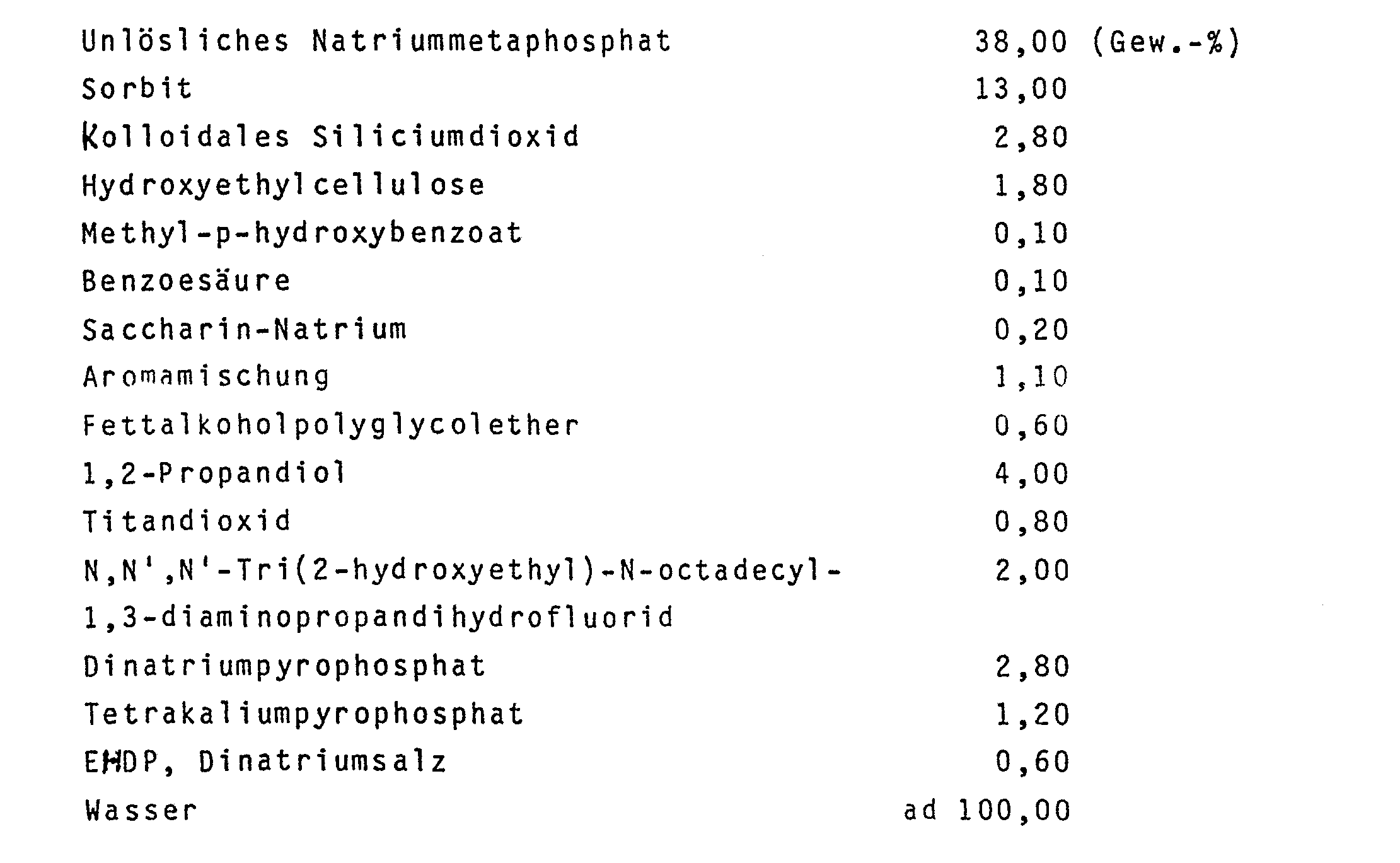
- Im folgenden werden einige Beispiele gegeben, die das Wesen der vorliegenden Erfindung charakterisieren:
-

-

-
-

-

-

Claims (4)
Priority Applications (1)
| Application Number | Priority Date | Filing Date | Title |
|---|---|---|---|
| AT87102496T ATE52910T1 (de) | 1986-03-07 | 1987-02-21 | Zahnpasta. |
Applications Claiming Priority (2)
| Application Number | Priority Date | Filing Date | Title |
|---|---|---|---|
| DE19863607480 DE3607480A1 (de) | 1986-03-07 | 1986-03-07 | Zahnpasta |
| DE3607480 | 1986-03-07 |
Publications (3)
| Publication Number | Publication Date |
|---|---|
| EP0236827A2 true EP0236827A2 (de) | 1987-09-16 |
| EP0236827A3 EP0236827A3 (en) | 1988-04-06 |
| EP0236827B1 EP0236827B1 (de) | 1990-05-23 |
Family
ID=6295724
Family Applications (1)
| Application Number | Title | Priority Date | Filing Date |
|---|---|---|---|
| EP87102496A Expired - Lifetime EP0236827B1 (de) | 1986-03-07 | 1987-02-21 | Zahnpasta |
Country Status (7)
| Country | Link |
|---|---|
| EP (1) | EP0236827B1 (de) |
| JP (1) | JPS62212314A (de) |
| AT (1) | ATE52910T1 (de) |
| CA (1) | CA1333885C (de) |
| DE (2) | DE3607480A1 (de) |
| ES (1) | ES2015546B3 (de) |
| GR (1) | GR3000731T3 (de) |
Cited By (13)
| Publication number | Priority date | Publication date | Assignee | Title |
|---|---|---|---|---|
| GB2235133A (en) * | 1989-08-25 | 1991-02-27 | Colgate Palmolive Co | Antibacterial antiplaque, anticalculus oral composition |
| US5000940A (en) * | 1989-05-30 | 1991-03-19 | Nabisco Brands, Inc. | Devices, compositions and the like having or containing an inorganic pyrophosphate |
| US5000943A (en) * | 1989-05-30 | 1991-03-19 | Nabisco Brands, Inc. | Canine biscuits containing an inorganic pyrophosphate |
| US5000973A (en) * | 1989-05-30 | 1991-03-19 | Nabisco Brands, Inc. | Nutritionally-balanced canine biscuits containing an inorganic pyrophosphate |
| US5011679A (en) * | 1989-05-30 | 1991-04-30 | Nabisco Brands, Inc. | Raw hide having a coating containing an inorganic pyrophosphate |
| US5015485A (en) * | 1989-05-30 | 1991-05-14 | Nabisco Brands, Inc. | Dog biscuits having a coating containing an inorganic pyrophosphate |
| GB2200551B (en) * | 1987-01-30 | 1991-06-05 | Colgate Palmolive Co | Antibacterial antiplaque, anticalculus oral composition |
| US5047231A (en) * | 1989-05-30 | 1991-09-10 | Nabisco Brands, Inc. | Raw hide containing an inorganic pyrophosphate |
| US5094870A (en) * | 1989-05-30 | 1992-03-10 | Nabisco Brands, Inc. | Canine biscuits containing an inorganic pyrophosphate |
| US5114704A (en) * | 1989-05-30 | 1992-05-19 | Nabisco Brands, Inc. | Raw hide having a coating containing an inorganic pyrophosphate |
| WO1994000102A1 (en) * | 1992-06-26 | 1994-01-06 | The Procter & Gamble Company | Anticalculus compositions |
| WO1994000103A1 (en) * | 1992-06-26 | 1994-01-06 | The Procter & Gamble Company | Anticalculus compositions |
| WO2006100073A1 (en) * | 2005-03-21 | 2006-09-28 | Glaxo Group Limited | Dentifrice compositions comprising as a soluble calcium sequestring agent a derivative comprising a phosphonate group |
Families Citing this family (1)
| Publication number | Priority date | Publication date | Assignee | Title |
|---|---|---|---|---|
| JP6288840B2 (ja) * | 2013-04-30 | 2018-03-07 | ライオン株式会社 | 衣類用洗浄剤 |
Family Cites Families (4)
| Publication number | Priority date | Publication date | Assignee | Title |
|---|---|---|---|---|
| NL149701C (nl) * | 1965-12-08 | 1981-05-15 | Procter & Gamble | Werkwijze voor het bereiden van een tegen tandsteen werkzaam tandverzorgingsmiddel, dat als werkzaam bestanddeel een fosfonzuurderivaat bevat, alsmede gevormd tandverzorgingsmiddel. |
| US3766349A (en) * | 1971-11-12 | 1973-10-16 | G Codrino | Pushbutton switch, provided with a lighted ideogram |
| US4323551A (en) * | 1981-02-19 | 1982-04-06 | The Procter & Gamble Company | Mouthwash compositions |
| PH22221A (en) * | 1982-06-22 | 1988-06-28 | Procter & Gamble | Oral compositions |
-
1986
- 1986-03-07 DE DE19863607480 patent/DE3607480A1/de active Granted
-
1987
- 1987-02-11 CA CA000529477A patent/CA1333885C/en not_active Expired - Fee Related
- 1987-02-21 EP EP87102496A patent/EP0236827B1/de not_active Expired - Lifetime
- 1987-02-21 ES ES87102496T patent/ES2015546B3/es not_active Expired - Lifetime
- 1987-02-21 DE DE8787102496T patent/DE3762799D1/de not_active Expired - Fee Related
- 1987-02-21 AT AT87102496T patent/ATE52910T1/de not_active IP Right Cessation
- 1987-03-06 JP JP62050459A patent/JPS62212314A/ja active Pending
-
1990
- 1990-08-23 GR GR90400584T patent/GR3000731T3/el unknown
Cited By (15)
| Publication number | Priority date | Publication date | Assignee | Title |
|---|---|---|---|---|
| GB2200551B (en) * | 1987-01-30 | 1991-06-05 | Colgate Palmolive Co | Antibacterial antiplaque, anticalculus oral composition |
| GB2230189B (en) * | 1987-01-30 | 1991-07-10 | Colgate Palmolive Co | Antibacterial,antiplaque,anticalculus oral composition |
| US5000973A (en) * | 1989-05-30 | 1991-03-19 | Nabisco Brands, Inc. | Nutritionally-balanced canine biscuits containing an inorganic pyrophosphate |
| US5011679A (en) * | 1989-05-30 | 1991-04-30 | Nabisco Brands, Inc. | Raw hide having a coating containing an inorganic pyrophosphate |
| US5015485A (en) * | 1989-05-30 | 1991-05-14 | Nabisco Brands, Inc. | Dog biscuits having a coating containing an inorganic pyrophosphate |
| US5000943A (en) * | 1989-05-30 | 1991-03-19 | Nabisco Brands, Inc. | Canine biscuits containing an inorganic pyrophosphate |
| US5000940A (en) * | 1989-05-30 | 1991-03-19 | Nabisco Brands, Inc. | Devices, compositions and the like having or containing an inorganic pyrophosphate |
| US5047231A (en) * | 1989-05-30 | 1991-09-10 | Nabisco Brands, Inc. | Raw hide containing an inorganic pyrophosphate |
| US5094870A (en) * | 1989-05-30 | 1992-03-10 | Nabisco Brands, Inc. | Canine biscuits containing an inorganic pyrophosphate |
| US5114704A (en) * | 1989-05-30 | 1992-05-19 | Nabisco Brands, Inc. | Raw hide having a coating containing an inorganic pyrophosphate |
| GB2235133A (en) * | 1989-08-25 | 1991-02-27 | Colgate Palmolive Co | Antibacterial antiplaque, anticalculus oral composition |
| GB2235133B (en) * | 1989-08-25 | 1994-01-26 | Colgate Palmolive Co | Antibacterial, antiplaque, anticalculus oral compositions comprising polyphosphate salt as anticalculus agent |
| WO1994000102A1 (en) * | 1992-06-26 | 1994-01-06 | The Procter & Gamble Company | Anticalculus compositions |
| WO1994000103A1 (en) * | 1992-06-26 | 1994-01-06 | The Procter & Gamble Company | Anticalculus compositions |
| WO2006100073A1 (en) * | 2005-03-21 | 2006-09-28 | Glaxo Group Limited | Dentifrice compositions comprising as a soluble calcium sequestring agent a derivative comprising a phosphonate group |
Also Published As
| Publication number | Publication date |
|---|---|
| CA1333885C (en) | 1995-01-10 |
| ES2015546B3 (es) | 1990-09-01 |
| DE3607480C2 (de) | 1988-02-04 |
| EP0236827A3 (en) | 1988-04-06 |
| JPS62212314A (ja) | 1987-09-18 |
| DE3607480A1 (de) | 1987-09-10 |
| EP0236827B1 (de) | 1990-05-23 |
| GR3000731T3 (en) | 1991-10-10 |
| ATE52910T1 (de) | 1990-06-15 |
| DE3762799D1 (de) | 1990-06-28 |
Similar Documents
| Publication | Publication Date | Title |
|---|---|---|
| DE3532860C1 (de) | Mittel zur oralen Hygiene | |
| EP0123296B1 (de) | Verwendung von Hesperidin | |
| EP0229375B1 (de) | Mittel zur oralen Hygiene | |
| EP0038867B1 (de) | Zahnpasta | |
| DE60022180T2 (de) | Dentales produkt gegen zahnstein und betreffende methode | |
| WO1988008697A1 (fr) | Pate dentifrice | |
| EP0108318B1 (de) | Zahn- und Mundpflegemittel | |
| EP0152836B1 (de) | Mittel zur oralen Hygiene | |
| EP0236827B1 (de) | Zahnpasta | |
| CH649706A5 (de) | Mund- und zahnpflegemittel. | |
| DE3878089T3 (de) | Zahnpasten. | |
| DE3044448A1 (de) | Zahncreme | |
| EP0179396A2 (de) | Mund- und Zahnpflegemittel | |
| AT390368B (de) | Stabiles zahnpflegemittel zur verhinderung von zahnbelag | |
| DE2221023B2 (de) | Zusammensetzungen fuer die mundhygiene mit einem gehalt an monofluorphosphat | |
| EP0002690A1 (de) | Zahnpasta und Verwendung eines synthetischen Alkalialuminiumsilikats als antikorrosiver Zusatz darin | |
| DE3504178C2 (de) | ||
| DE1492027B2 (de) | Natriummonofluorphosphat enthaltende zahnpaste | |
| DE2255177C3 (de) | Mittel zur Verhinderung von Zahnstein | |
| DE1106926B (de) | Zahnpflegemittel | |
| DE3402805A1 (de) | Gegen karies und zahnstein wirkendes mundpflegemittel | |
| DE3406005C1 (de) | Mittel zur oralen Hygiene | |
| DE2153821B2 (de) | Zahnpflegemittel | |
| DE3432571C1 (de) | Mittel zur oralen Hygiene | |
| DE69100273T2 (de) | Orale Präparate. |
Legal Events
| Date | Code | Title | Description |
|---|---|---|---|
| PUAI | Public reference made under article 153(3) epc to a published international application that has entered the european phase |
Free format text: ORIGINAL CODE: 0009012 |
|
| AK | Designated contracting states |
Kind code of ref document: A2 Designated state(s): AT BE CH DE ES FR GB GR IT LI LU NL SE |
|
| PUAL | Search report despatched |
Free format text: ORIGINAL CODE: 0009013 |
|
| AK | Designated contracting states |
Kind code of ref document: A3 Designated state(s): AT BE CH DE ES FR GB GR IT LI LU NL SE |
|
| 17P | Request for examination filed |
Effective date: 19880226 |
|
| RAP1 | Party data changed (applicant data changed or rights of an application transferred) |
Owner name: BLENDAX GMBH |
|
| 17Q | First examination report despatched |
Effective date: 19891010 |
|
| GRAA | (expected) grant |
Free format text: ORIGINAL CODE: 0009210 |
|
| AK | Designated contracting states |
Kind code of ref document: B1 Designated state(s): AT BE CH DE ES FR GB GR IT LI LU NL SE |
|
| REF | Corresponds to: |
Ref document number: 52910 Country of ref document: AT Date of ref document: 19900615 Kind code of ref document: T |
|
| REF | Corresponds to: |
Ref document number: 3762799 Country of ref document: DE Date of ref document: 19900628 |
|
| ITF | It: translation for a ep patent filed | ||
| ET | Fr: translation filed | ||
| GBT | Gb: translation of ep patent filed (gb section 77(6)(a)/1977) | ||
| REG | Reference to a national code |
Ref country code: GR Ref legal event code: FG4A Free format text: 3000731 |
|
| ITTA | It: last paid annual fee | ||
| PLBE | No opposition filed within time limit |
Free format text: ORIGINAL CODE: 0009261 |
|
| STAA | Information on the status of an ep patent application or granted ep patent |
Free format text: STATUS: NO OPPOSITION FILED WITHIN TIME LIMIT |
|
| 26N | No opposition filed | ||
| EPTA | Lu: last paid annual fee | ||
| EAL | Se: european patent in force in sweden |
Ref document number: 87102496.4 |
|
| PGFP | Annual fee paid to national office [announced via postgrant information from national office to epo] |
Ref country code: NL Payment date: 20001222 Year of fee payment: 15 |
|
| PGFP | Annual fee paid to national office [announced via postgrant information from national office to epo] |
Ref country code: GB Payment date: 20010104 Year of fee payment: 15 |
|
| PGFP | Annual fee paid to national office [announced via postgrant information from national office to epo] |
Ref country code: AT Payment date: 20010105 Year of fee payment: 15 |
|
| PGFP | Annual fee paid to national office [announced via postgrant information from national office to epo] |
Ref country code: LU Payment date: 20010124 Year of fee payment: 15 |
|
| PGFP | Annual fee paid to national office [announced via postgrant information from national office to epo] |
Ref country code: GR Payment date: 20010129 Year of fee payment: 15 |
|
| PGFP | Annual fee paid to national office [announced via postgrant information from national office to epo] |
Ref country code: SE Payment date: 20010201 Year of fee payment: 15 Ref country code: FR Payment date: 20010201 Year of fee payment: 15 |
|
| PGFP | Annual fee paid to national office [announced via postgrant information from national office to epo] |
Ref country code: ES Payment date: 20010216 Year of fee payment: 15 |
|
| PGFP | Annual fee paid to national office [announced via postgrant information from national office to epo] |
Ref country code: DE Payment date: 20010228 Year of fee payment: 15 |
|
| PGFP | Annual fee paid to national office [announced via postgrant information from national office to epo] |
Ref country code: BE Payment date: 20010313 Year of fee payment: 15 |
|
| PGFP | Annual fee paid to national office [announced via postgrant information from national office to epo] |
Ref country code: CH Payment date: 20010327 Year of fee payment: 15 |
|
| REG | Reference to a national code |
Ref country code: GB Ref legal event code: IF02 |
|
| PG25 | Lapsed in a contracting state [announced via postgrant information from national office to epo] |
Ref country code: LU Free format text: LAPSE BECAUSE OF NON-PAYMENT OF DUE FEES Effective date: 20020221 Ref country code: GB Free format text: LAPSE BECAUSE OF NON-PAYMENT OF DUE FEES Effective date: 20020221 Ref country code: AT Free format text: LAPSE BECAUSE OF NON-PAYMENT OF DUE FEES Effective date: 20020221 |
|
| PG25 | Lapsed in a contracting state [announced via postgrant information from national office to epo] |
Ref country code: SE Free format text: LAPSE BECAUSE OF NON-PAYMENT OF DUE FEES Effective date: 20020222 Ref country code: ES Free format text: LAPSE BECAUSE OF NON-PAYMENT OF DUE FEES Effective date: 20020222 |
|
| PG25 | Lapsed in a contracting state [announced via postgrant information from national office to epo] |
Ref country code: LI Free format text: LAPSE BECAUSE OF NON-PAYMENT OF DUE FEES Effective date: 20020228 Ref country code: CH Free format text: LAPSE BECAUSE OF NON-PAYMENT OF DUE FEES Effective date: 20020228 Ref country code: BE Free format text: LAPSE BECAUSE OF NON-PAYMENT OF DUE FEES Effective date: 20020228 |
|
| BERE | Be: lapsed |
Owner name: BLENDAX G.M.B.H. Effective date: 20020228 |
|
| PG25 | Lapsed in a contracting state [announced via postgrant information from national office to epo] |
Ref country code: NL Free format text: LAPSE BECAUSE OF NON-PAYMENT OF DUE FEES Effective date: 20020901 |
|
| PG25 | Lapsed in a contracting state [announced via postgrant information from national office to epo] |
Ref country code: DE Free format text: LAPSE BECAUSE OF NON-PAYMENT OF DUE FEES Effective date: 20020903 |
|
| PG25 | Lapsed in a contracting state [announced via postgrant information from national office to epo] |
Ref country code: GR Free format text: LAPSE BECAUSE OF NON-PAYMENT OF DUE FEES Effective date: 20020909 |
|
| EUG | Se: european patent has lapsed |
Ref document number: 87102496.4 |
|
| GBPC | Gb: european patent ceased through non-payment of renewal fee |
Effective date: 20020221 |
|
| REG | Reference to a national code |
Ref country code: CH Ref legal event code: PL |
|
| PG25 | Lapsed in a contracting state [announced via postgrant information from national office to epo] |
Ref country code: FR Free format text: LAPSE BECAUSE OF NON-PAYMENT OF DUE FEES Effective date: 20021031 |
|
| NLV4 | Nl: lapsed or anulled due to non-payment of the annual fee |
Effective date: 20020901 |
|
| REG | Reference to a national code |
Ref country code: FR Ref legal event code: ST |
|
| REG | Reference to a national code |
Ref country code: ES Ref legal event code: FD2A Effective date: 20030922 |
|
| PG25 | Lapsed in a contracting state [announced via postgrant information from national office to epo] |
Ref country code: IT Free format text: LAPSE BECAUSE OF NON-PAYMENT OF DUE FEES;WARNING: LAPSES OF ITALIAN PATENTS WITH EFFECTIVE DATE BEFORE 2007 MAY HAVE OCCURRED AT ANY TIME BEFORE 2007. THE CORRECT EFFECTIVE DATE MAY BE DIFFERENT FROM THE ONE RECORDED. Effective date: 20050221 |