EP0240392A1 - Composés du type cyclophosphazène, procédé de préparation et composition pharmaceutique les contenant - Google Patents
Composés du type cyclophosphazène, procédé de préparation et composition pharmaceutique les contenant Download PDFInfo
- Publication number
- EP0240392A1 EP0240392A1 EP87400490A EP87400490A EP0240392A1 EP 0240392 A1 EP0240392 A1 EP 0240392A1 EP 87400490 A EP87400490 A EP 87400490A EP 87400490 A EP87400490 A EP 87400490A EP 0240392 A1 EP0240392 A1 EP 0240392A1
- Authority
- EP
- European Patent Office
- Prior art keywords
- substituted
- formula
- unsubstituted
- compound
- radical
- Prior art date
- Legal status (The legal status is an assumption and is not a legal conclusion. Google has not performed a legal analysis and makes no representation as to the accuracy of the status listed.)
- Granted
Links
- 150000001875 compounds Chemical class 0.000 title claims abstract description 50
- 238000000034 method Methods 0.000 title claims description 22
- 230000008569 process Effects 0.000 title claims description 8
- 238000002360 preparation method Methods 0.000 title claims description 7
- 239000000825 pharmaceutical preparation Substances 0.000 title 1
- -1 1-aziridinyl radical Chemical class 0.000 claims abstract description 29
- 150000003254 radicals Chemical class 0.000 claims abstract description 12
- 150000005840 aryl radicals Chemical class 0.000 claims abstract description 6
- 125000004435 hydrogen atom Chemical group [H]* 0.000 claims abstract description 5
- 125000002947 alkylene group Chemical group 0.000 claims abstract description 4
- 125000004450 alkenylene group Chemical group 0.000 claims abstract description 3
- 125000004419 alkynylene group Chemical group 0.000 claims abstract description 3
- 238000006243 chemical reaction Methods 0.000 claims description 13
- YMWUJEATGCHHMB-UHFFFAOYSA-N Dichloromethane Chemical compound ClCCl YMWUJEATGCHHMB-UHFFFAOYSA-N 0.000 claims description 11
- 229920000768 polyamine Polymers 0.000 claims description 11
- 239000000203 mixture Substances 0.000 claims description 10
- 239000002904 solvent Substances 0.000 claims description 9
- RTZKZFJDLAIYFH-UHFFFAOYSA-N Diethyl ether Chemical compound CCOCC RTZKZFJDLAIYFH-UHFFFAOYSA-N 0.000 claims description 8
- PFNFFQXMRSDOHW-UHFFFAOYSA-N spermine Chemical compound NCCCNCCCCNCCCN PFNFFQXMRSDOHW-UHFFFAOYSA-N 0.000 claims description 6
- 239000003795 chemical substances by application Substances 0.000 claims description 5
- 239000008194 pharmaceutical composition Substances 0.000 claims description 5
- 230000009471 action Effects 0.000 claims description 4
- 125000005843 halogen group Chemical group 0.000 claims description 4
- 239000007972 injectable composition Substances 0.000 claims description 4
- 229940063675 spermine Drugs 0.000 claims description 3
- 150000001412 amines Chemical group 0.000 claims description 2
- 239000012298 atmosphere Substances 0.000 claims description 2
- 150000001541 aziridines Chemical class 0.000 claims description 2
- 239000003153 chemical reaction reagent Substances 0.000 claims description 2
- 229910052736 halogen Inorganic materials 0.000 claims description 2
- 239000003208 petroleum Substances 0.000 claims description 2
- 125000005270 trialkylamine group Chemical group 0.000 claims description 2
- 125000003545 alkoxy group Chemical group 0.000 claims 1
- 125000003118 aryl group Chemical group 0.000 claims 1
- 125000004069 aziridinyl group Chemical group 0.000 claims 1
- 239000003814 drug Substances 0.000 description 10
- 230000000694 effects Effects 0.000 description 10
- 229940079593 drug Drugs 0.000 description 8
- 239000007924 injection Substances 0.000 description 8
- 238000002347 injection Methods 0.000 description 8
- 230000000259 anti-tumor effect Effects 0.000 description 7
- VEXZGXHMUGYJMC-UHFFFAOYSA-N Hydrochloric acid Chemical compound Cl VEXZGXHMUGYJMC-UHFFFAOYSA-N 0.000 description 6
- NOWKCMXCCJGMRR-UHFFFAOYSA-N Aziridine Chemical compound C1CN1 NOWKCMXCCJGMRR-UHFFFAOYSA-N 0.000 description 5
- 206010028980 Neoplasm Diseases 0.000 description 5
- 241000699670 Mus sp. Species 0.000 description 4
- WYURNTSHIVDZCO-UHFFFAOYSA-N Tetrahydrofuran Chemical compound C1CCOC1 WYURNTSHIVDZCO-UHFFFAOYSA-N 0.000 description 4
- 238000000338 in vitro Methods 0.000 description 4
- 239000002243 precursor Substances 0.000 description 4
- 239000000243 solution Substances 0.000 description 4
- 125000004432 carbon atom Chemical group C* 0.000 description 3
- 239000012634 fragment Substances 0.000 description 3
- 238000001727 in vivo Methods 0.000 description 3
- 238000007912 intraperitoneal administration Methods 0.000 description 3
- 208000032839 leukemia Diseases 0.000 description 3
- XLYOFNOQVPJJNP-UHFFFAOYSA-N water Substances O XLYOFNOQVPJJNP-UHFFFAOYSA-N 0.000 description 3
- IQMLWPPOVFMTOU-UHFFFAOYSA-N 1,3,3,5,5-pentakis(aziridin-1-yl)-1$l^{6}-thia-2,4,6-triaza-3$l^{5},5$l^{5}-diphosphacyclohexa-1,3,5-triene 1-oxide Chemical compound N=1S(=O)(N2CC2)=NP(N2CC2)(N2CC2)=NP=1(N1CC1)N1CC1 IQMLWPPOVFMTOU-UHFFFAOYSA-N 0.000 description 2
- XKRFYHLGVUSROY-UHFFFAOYSA-N Argon Chemical compound [Ar] XKRFYHLGVUSROY-UHFFFAOYSA-N 0.000 description 2
- 208000031637 Erythroblastic Acute Leukemia Diseases 0.000 description 2
- 208000036566 Erythroleukaemia Diseases 0.000 description 2
- 208000006552 Lewis Lung Carcinoma Diseases 0.000 description 2
- 108091093105 Nuclear DNA Proteins 0.000 description 2
- 239000002202 Polyethylene glycol Substances 0.000 description 2
- FAPWRFPIFSIZLT-UHFFFAOYSA-M Sodium chloride Chemical compound [Na+].[Cl-] FAPWRFPIFSIZLT-UHFFFAOYSA-M 0.000 description 2
- 241000193998 Streptococcus pneumoniae Species 0.000 description 2
- 208000021841 acute erythroid leukemia Diseases 0.000 description 2
- 125000000217 alkyl group Chemical group 0.000 description 2
- 239000003125 aqueous solvent Substances 0.000 description 2
- VHRGRCVQAFMJIZ-UHFFFAOYSA-N cadaverine Chemical compound NCCCCCN VHRGRCVQAFMJIZ-UHFFFAOYSA-N 0.000 description 2
- 239000002775 capsule Substances 0.000 description 2
- 210000004027 cell Anatomy 0.000 description 2
- 230000001684 chronic effect Effects 0.000 description 2
- YMWUJEATGCHHMB-DICFDUPASA-N dichloromethane-d2 Chemical compound [2H]C([2H])(Cl)Cl YMWUJEATGCHHMB-DICFDUPASA-N 0.000 description 2
- 239000003995 emulsifying agent Substances 0.000 description 2
- 238000013467 fragmentation Methods 0.000 description 2
- 238000006062 fragmentation reaction Methods 0.000 description 2
- 230000002519 immonomodulatory effect Effects 0.000 description 2
- 238000001990 intravenous administration Methods 0.000 description 2
- 231100000225 lethality Toxicity 0.000 description 2
- 230000003211 malignant effect Effects 0.000 description 2
- 238000004519 manufacturing process Methods 0.000 description 2
- 238000001819 mass spectrum Methods 0.000 description 2
- 239000012528 membrane Substances 0.000 description 2
- 231100001160 nonlethal Toxicity 0.000 description 2
- 230000000144 pharmacologic effect Effects 0.000 description 2
- 229920001223 polyethylene glycol Polymers 0.000 description 2
- 230000002265 prevention Effects 0.000 description 2
- 239000000047 product Substances 0.000 description 2
- KIDHWZJUCRJVML-UHFFFAOYSA-N putrescine Chemical compound NCCCCN KIDHWZJUCRJVML-UHFFFAOYSA-N 0.000 description 2
- 239000007787 solid Substances 0.000 description 2
- 238000001228 spectrum Methods 0.000 description 2
- ATHGHQPFGPMSJY-UHFFFAOYSA-N spermidine Chemical compound NCCCCNCCCN ATHGHQPFGPMSJY-UHFFFAOYSA-N 0.000 description 2
- 229940031000 streptococcus pneumoniae Drugs 0.000 description 2
- 239000000829 suppository Substances 0.000 description 2
- YLQBMQCUIZJEEH-UHFFFAOYSA-N tetrahydrofuran Natural products C=1C=COC=1 YLQBMQCUIZJEEH-UHFFFAOYSA-N 0.000 description 2
- 230000001225 therapeutic effect Effects 0.000 description 2
- 231100001274 therapeutic index Toxicity 0.000 description 2
- 231100000419 toxicity Toxicity 0.000 description 2
- 230000001988 toxicity Effects 0.000 description 2
- XFNJVJPLKCPIBV-UHFFFAOYSA-N trimethylenediamine Chemical compound NCCCN XFNJVJPLKCPIBV-UHFFFAOYSA-N 0.000 description 2
- 239000003981 vehicle Substances 0.000 description 2
- QYPPJABKJHAVHS-UHFFFAOYSA-N Agmatine Natural products NCCCCNC(N)=N QYPPJABKJHAVHS-UHFFFAOYSA-N 0.000 description 1
- 208000023275 Autoimmune disease Diseases 0.000 description 1
- 229920002134 Carboxymethyl cellulose Polymers 0.000 description 1
- FKLJPTJMIBLJAV-UHFFFAOYSA-N Compound IV Chemical compound O1N=C(C)C=C1CCCCCCCOC1=CC=C(C=2OCCN=2)C=C1 FKLJPTJMIBLJAV-UHFFFAOYSA-N 0.000 description 1
- 208000001382 Experimental Melanoma Diseases 0.000 description 1
- 108010010803 Gelatin Proteins 0.000 description 1
- 206010018364 Glomerulonephritis Diseases 0.000 description 1
- 229920000084 Gum arabic Polymers 0.000 description 1
- 229920002153 Hydroxypropyl cellulose Polymers 0.000 description 1
- GUBGYTABKSRVRQ-QKKXKWKRSA-N Lactose Natural products OC[C@H]1O[C@@H](O[C@H]2[C@H](O)[C@@H](O)C(O)O[C@@H]2CO)[C@H](O)[C@@H](O)[C@H]1O GUBGYTABKSRVRQ-QKKXKWKRSA-N 0.000 description 1
- 239000004166 Lanolin Substances 0.000 description 1
- 208000008342 Leukemia P388 Diseases 0.000 description 1
- OKKJLVBELUTLKV-UHFFFAOYSA-N Methanol Chemical compound OC OKKJLVBELUTLKV-UHFFFAOYSA-N 0.000 description 1
- 241000699729 Muridae Species 0.000 description 1
- NBIIXXVUZAFLBC-UHFFFAOYSA-N Phosphoric acid Chemical compound OP(O)(O)=O NBIIXXVUZAFLBC-UHFFFAOYSA-N 0.000 description 1
- 239000005700 Putrescine Substances 0.000 description 1
- 241000978776 Senegalia senegal Species 0.000 description 1
- 206010040070 Septic Shock Diseases 0.000 description 1
- 229920002472 Starch Polymers 0.000 description 1
- 241001080024 Telles Species 0.000 description 1
- CIUQDSCDWFSTQR-UHFFFAOYSA-N [C]1=CC=CC=C1 Chemical compound [C]1=CC=CC=C1 CIUQDSCDWFSTQR-UHFFFAOYSA-N 0.000 description 1
- 239000000205 acacia gum Substances 0.000 description 1
- 235000010489 acacia gum Nutrition 0.000 description 1
- 239000002671 adjuvant Substances 0.000 description 1
- QYPPJABKJHAVHS-UHFFFAOYSA-P agmatinium(2+) Chemical compound NC(=[NH2+])NCCCC[NH3+] QYPPJABKJHAVHS-UHFFFAOYSA-P 0.000 description 1
- 150000001298 alcohols Chemical class 0.000 description 1
- 125000003342 alkenyl group Chemical group 0.000 description 1
- 238000004458 analytical method Methods 0.000 description 1
- PXZAWHSJYIECNQ-UHFFFAOYSA-N apholate Chemical compound C1CN1P1(N2CC2)=NP(N2CC2)(N2CC2)=NP(N2CC2)(N2CC2)=N1 PXZAWHSJYIECNQ-UHFFFAOYSA-N 0.000 description 1
- 229910052786 argon Inorganic materials 0.000 description 1
- 239000012300 argon atmosphere Substances 0.000 description 1
- JXHSZQZCKLNUGB-UHFFFAOYSA-N aziridine;hydrochloride Chemical compound Cl.C1CN1 JXHSZQZCKLNUGB-UHFFFAOYSA-N 0.000 description 1
- 210000003719 b-lymphocyte Anatomy 0.000 description 1
- 230000000035 biogenic effect Effects 0.000 description 1
- 239000000872 buffer Substances 0.000 description 1
- 229910052799 carbon Inorganic materials 0.000 description 1
- 239000001768 carboxy methyl cellulose Substances 0.000 description 1
- 235000010948 carboxy methyl cellulose Nutrition 0.000 description 1
- 239000008112 carboxymethyl-cellulose Substances 0.000 description 1
- 210000000170 cell membrane Anatomy 0.000 description 1
- 239000007795 chemical reaction product Substances 0.000 description 1
- 239000003086 colorant Substances 0.000 description 1
- 230000008878 coupling Effects 0.000 description 1
- 238000010168 coupling process Methods 0.000 description 1
- 238000005859 coupling reaction Methods 0.000 description 1
- 238000002425 crystallisation Methods 0.000 description 1
- 230000008025 crystallization Effects 0.000 description 1
- 230000007547 defect Effects 0.000 description 1
- 201000010099 disease Diseases 0.000 description 1
- 208000037265 diseases, disorders, signs and symptoms Diseases 0.000 description 1
- 238000009826 distribution Methods 0.000 description 1
- 231100000673 dose–response relationship Toxicity 0.000 description 1
- 239000003937 drug carrier Substances 0.000 description 1
- 239000003480 eluent Substances 0.000 description 1
- 210000003743 erythrocyte Anatomy 0.000 description 1
- 150000002148 esters Chemical class 0.000 description 1
- 238000001704 evaporation Methods 0.000 description 1
- 230000008020 evaporation Effects 0.000 description 1
- 238000001914 filtration Methods 0.000 description 1
- 239000000499 gel Substances 0.000 description 1
- 239000008273 gelatin Substances 0.000 description 1
- 229920000159 gelatin Polymers 0.000 description 1
- 235000019322 gelatine Nutrition 0.000 description 1
- 235000011852 gelatine desserts Nutrition 0.000 description 1
- 239000008187 granular material Substances 0.000 description 1
- 125000000623 heterocyclic group Chemical group 0.000 description 1
- UBIJTWDKTYCPMQ-UHFFFAOYSA-N hexachlorophosphazene Chemical compound ClP1(Cl)=NP(Cl)(Cl)=NP(Cl)(Cl)=N1 UBIJTWDKTYCPMQ-UHFFFAOYSA-N 0.000 description 1
- 238000004128 high performance liquid chromatography Methods 0.000 description 1
- 239000001257 hydrogen Substances 0.000 description 1
- 229910052739 hydrogen Inorganic materials 0.000 description 1
- 235000010977 hydroxypropyl cellulose Nutrition 0.000 description 1
- 239000005457 ice water Substances 0.000 description 1
- 230000006872 improvement Effects 0.000 description 1
- 150000002500 ions Chemical class 0.000 description 1
- 230000000155 isotopic effect Effects 0.000 description 1
- 239000008101 lactose Substances 0.000 description 1
- 229940039717 lanolin Drugs 0.000 description 1
- 235000019388 lanolin Nutrition 0.000 description 1
- 230000003902 lesion Effects 0.000 description 1
- 239000007788 liquid Substances 0.000 description 1
- 238000003760 magnetic stirring Methods 0.000 description 1
- 201000006512 mast cell neoplasm Diseases 0.000 description 1
- 208000006971 mastocytoma Diseases 0.000 description 1
- VNWKTOKETHGBQD-UHFFFAOYSA-N methane Natural products C VNWKTOKETHGBQD-UHFFFAOYSA-N 0.000 description 1
- 239000010413 mother solution Substances 0.000 description 1
- 239000002547 new drug Substances 0.000 description 1
- 210000003924 normoblast Anatomy 0.000 description 1
- 239000003921 oil Substances 0.000 description 1
- 239000002674 ointment Substances 0.000 description 1
- 230000035515 penetration Effects 0.000 description 1
- 235000019271 petrolatum Nutrition 0.000 description 1
- 239000000546 pharmaceutical excipient Substances 0.000 description 1
- 150000003904 phospholipids Chemical class 0.000 description 1
- 235000011007 phosphoric acid Nutrition 0.000 description 1
- 125000004437 phosphorous atom Chemical group 0.000 description 1
- 239000002504 physiological saline solution Substances 0.000 description 1
- 229920001515 polyalkylene glycol Polymers 0.000 description 1
- 229920005862 polyol Polymers 0.000 description 1
- 150000003077 polyols Chemical class 0.000 description 1
- 239000000843 powder Substances 0.000 description 1
- 239000003755 preservative agent Substances 0.000 description 1
- 238000011160 research Methods 0.000 description 1
- 238000012216 screening Methods 0.000 description 1
- 239000011780 sodium chloride Substances 0.000 description 1
- 238000000638 solvent extraction Methods 0.000 description 1
- 229940063673 spermidine Drugs 0.000 description 1
- 239000003381 stabilizer Substances 0.000 description 1
- 239000008107 starch Substances 0.000 description 1
- 235000019698 starch Nutrition 0.000 description 1
- 239000007858 starting material Substances 0.000 description 1
- 230000000638 stimulation Effects 0.000 description 1
- 238000005728 strengthening Methods 0.000 description 1
- 239000000126 substance Substances 0.000 description 1
- 239000000725 suspension Substances 0.000 description 1
- 201000000596 systemic lupus erythematosus Diseases 0.000 description 1
- 239000003826 tablet Substances 0.000 description 1
- 238000012360 testing method Methods 0.000 description 1
- 238000004809 thin layer chromatography Methods 0.000 description 1
- 206010043554 thrombocytopenia Diseases 0.000 description 1
- 231100000816 toxic dose Toxicity 0.000 description 1
- 239000013598 vector Substances 0.000 description 1
- 239000000080 wetting agent Substances 0.000 description 1
Classifications
-
- C—CHEMISTRY; METALLURGY
- C07—ORGANIC CHEMISTRY
- C07F—ACYCLIC, CARBOCYCLIC OR HETEROCYCLIC COMPOUNDS CONTAINING ELEMENTS OTHER THAN CARBON, HYDROGEN, HALOGEN, OXYGEN, NITROGEN, SULFUR, SELENIUM OR TELLURIUM
- C07F9/00—Compounds containing elements of Groups 5 or 15 of the Periodic Table
- C07F9/02—Phosphorus compounds
- C07F9/547—Heterocyclic compounds, e.g. containing phosphorus as a ring hetero atom
-
- C—CHEMISTRY; METALLURGY
- C07—ORGANIC CHEMISTRY
- C07F—ACYCLIC, CARBOCYCLIC OR HETEROCYCLIC COMPOUNDS CONTAINING ELEMENTS OTHER THAN CARBON, HYDROGEN, HALOGEN, OXYGEN, NITROGEN, SULFUR, SELENIUM OR TELLURIUM
- C07F9/00—Compounds containing elements of Groups 5 or 15 of the Periodic Table
- C07F9/02—Phosphorus compounds
- C07F9/547—Heterocyclic compounds, e.g. containing phosphorus as a ring hetero atom
- C07F9/6564—Heterocyclic compounds, e.g. containing phosphorus as a ring hetero atom having phosphorus atoms, with or without nitrogen, oxygen, sulfur, selenium or tellurium atoms, as ring hetero atoms
- C07F9/6581—Heterocyclic compounds, e.g. containing phosphorus as a ring hetero atom having phosphorus atoms, with or without nitrogen, oxygen, sulfur, selenium or tellurium atoms, as ring hetero atoms having phosphorus and nitrogen atoms with or without oxygen or sulfur atoms, as ring hetero atoms
- C07F9/65812—Cyclic phosphazenes [P=N-]n, n>=3
- C07F9/65815—Cyclic phosphazenes [P=N-]n, n>=3 n = 3
-
- A—HUMAN NECESSITIES
- A61—MEDICAL OR VETERINARY SCIENCE; HYGIENE
- A61P—SPECIFIC THERAPEUTIC ACTIVITY OF CHEMICAL COMPOUNDS OR MEDICINAL PREPARATIONS
- A61P35/00—Antineoplastic agents
-
- A—HUMAN NECESSITIES
- A61—MEDICAL OR VETERINARY SCIENCE; HYGIENE
- A61P—SPECIFIC THERAPEUTIC ACTIVITY OF CHEMICAL COMPOUNDS OR MEDICINAL PREPARATIONS
- A61P37/00—Drugs for immunological or allergic disorders
Definitions
- the present invention relates to novel chemical compounds, methods for their preparation and the application of these compounds as medicaments.
- the compounds according to the present invention are related to non-carbonated heterocyclic derivatives of the cyclophosphazenes type, a number of which have already been described in the literature.
- the first generation inorganic anti-tumor cycles (cyclophosphazenes of the MYKO 63 type) and second generation (cyclodiphosphathiazenes of the SoAz type) are generally characterized by too low specificity for malignant cells, the therapeutic effects being obtained only with doses close to the maximum non-lethal dose (DLo), hence the appearance of significant side effects (mainly thrombocytopenia) since dose-dependent.
- DLo non-lethal dose
- Such vectorization leads to a decrease by a factor of 3 to 5 in the toxicity (DLo) of the drug and above all a considerable increase in the therapeutic index (IT) (defined as the ratio of DLo to the minimum active dose in mono-injection) which goes from the value 4 for the "naked" drug to 10-15 for the vectorized drug.
- DLo toxicity
- IT therapeutic index
- the present invention relates more particularly to super-systems in which a polyamine molecule carries with it two drug molecules.
- A, B and C can represent, independently of one another, an alkylene, alkenylene or alkynylene chain, straight or branched, substituted or not, which can be interrupted by one or more divalent radicals -NR3-, -S- or -O-, .
- R1, R2 and R3 may represent, independently of one another: a hydrogen atom, a substituted or unsubstituted alkyl radical, a substituted or unsubstituted alkenyl radical, a substituted or unsubstituted alkynyl radical and a substituted or unsubstituted aryl radical .
- the 1-aziridinyl radical can be substituted by 1 to 4 C1 to C3 alkyl or alkoxy radicals.
- the radical Az is preferably an unsubstituted 1-aziridinyl radical.
- the chains A, B and C are preferably alkylene chains having 1 to 6 carbon atoms. They can be interrupted, preferably by 1 to 4 radicals of the type -NR3-.
- radicals R1, R2 and R3 are preferably a hydrogen atom or an alkyl radical, substituted or unsubstituted. These radicals R1, R2 and R3 can, in addition, be substituted, like the chains A, B and C, by one or more halogen atoms, imino, amino, aryl radicals unsubstituted or substituted by one or more atoms halogen or C1 to C3 alkyl radicals.
- alkyl, alkenyl or alkynyl radicals is meant more particularly the lower radicals, straight or branched, preferably having from 1 to 7 carbon atoms, in particular from 1 to 3 carbon atoms.
- aryl radical is meant essentially monocyclic radicals, substituted or not, such as the phenyl radical.
- the present invention relates, in particular, to the compounds of formula I ⁇ : r, s and t each representing, independently of one another, an integer between 1 and 6.
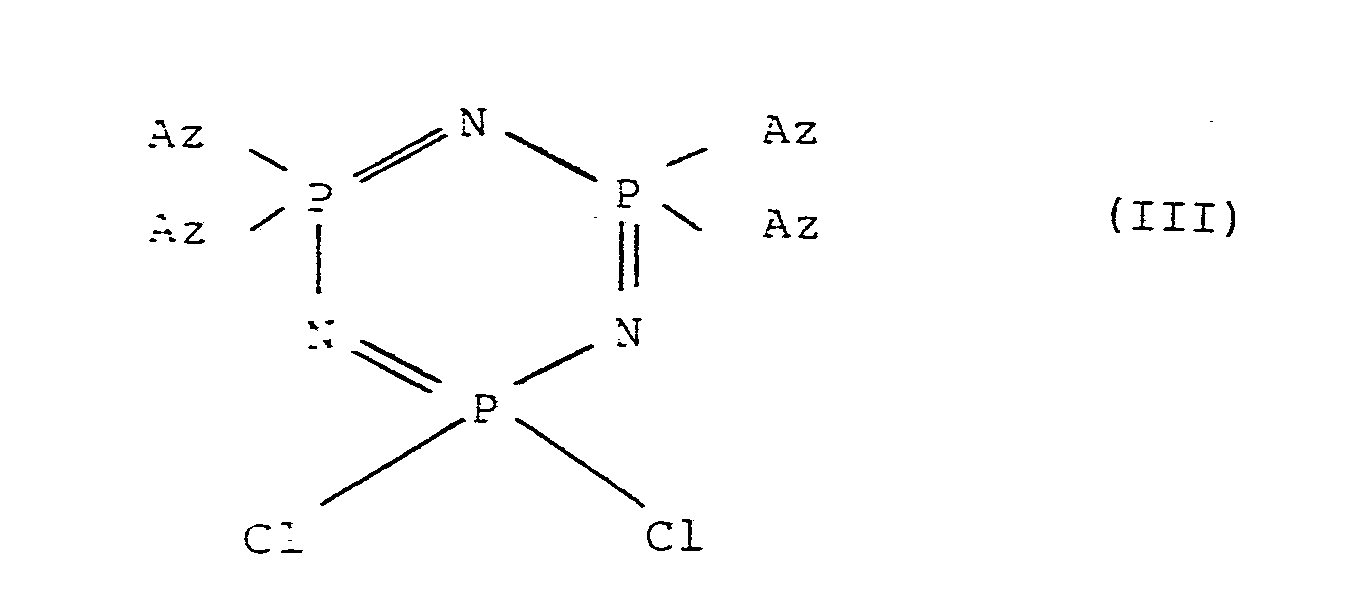
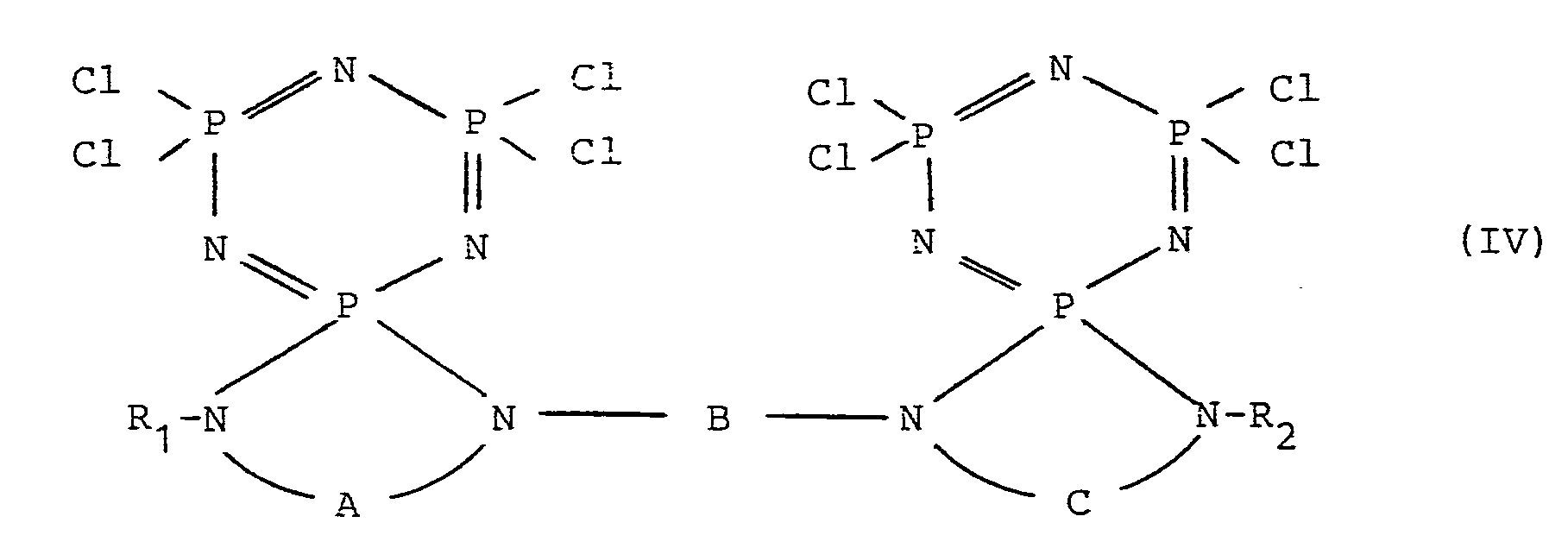
- the compounds of formula III and IV can be prepared from the hexachlorocyclotriphosphazene N3P3Cl6 of formula V: . either by reacting the aziridine, substituted or not, to prepare the compound of formula III, . either by reacting the polyamine, substituted or not, of formula II, to obtain the compound of formula IV.
- HCl sensing agent which is preferably an amine which does not react on the base nucleus, such as a trialkylamine for example.
- This ratio of 2: 1 can be increased to 4: 1 or more, in the case where the reaction is carried out without using an HCl sensing agent.
- reaction are preferably carried out in a solvent such as an ether or a halogenated solvent, or a mixture of such solvents, for example a mixture of petroleum ether 60-80 ° and dichloromethane in the ratio 4: 1 .
- a solvent such as an ether or a halogenated solvent, or a mixture of such solvents, for example a mixture of petroleum ether 60-80 ° and dichloromethane in the ratio 4: 1 .
- Tetrahydrofuran can also be used.
- the reactions take place preferably at a temperature between -20 ° C and + 20 ° C, for example at a temperature close to 0 ° C, and in an inert atmosphere (N2 or carefully dried argon).
- spermine substituted or unsubstituted, of formula: H2N- (CH2) 3-NH- (CH2) 4-NH- (CH2) 3-NH2.
- reaction product of formula I can be purified by known methods such as solvent extraction, crystallization, high performance liquid chromatography for example.
- the various starting materials useful in the implementation of the methods according to the present invention can be prepared, in particular, by the methods described in: -Y. KOBAYASHI, LA CHASIN and LB CLAPP, Inorg. Chem., 2 , 212 (1963), - R. RATZ, E. KOBER, C. GRUNDMANN and G. OTTMANN, Inorg. Chem., 3, 757 (1964) and US Patent No. 3,197,464, July 27, 1965, -G. GUERCH, JF. LABARRE, F. SOURNIES, M. MANFAIT, F. SPREAFICO and S. FILIPPESCHI, Inorg. Chim.
- the present invention relates, as a new medicament, to certain compounds as described above as well as pharmaceutical compositions comprising as active principle at least one of these compounds and, in particular, pharmaceutical compositions which can be administered parenterally. .
- compositions which can be administered parenterally mention should be made of injectable compositions, in particular by intraperitoneal and intravenous route.
- an aqueous solvent for example a physiological solution of sodium chloride
- a physiological solution of sodium chloride will preferably be used as the pharmaceutical carrier.
- buffers fixing the pH or optionally non-aqueous solvents such as esters, alcohols, polyols or various oils in combination with emulsifying agents; suspensions, in particular hydroxypropylcelluloses, can also be used.
- compositions according to the present invention are preferably injectable compositions
- these compositions possibly being in solid form, tablets, capsules, granules, capsules, suppositories for example, or in liquid form, drops and ampoules.
- compositions which can be administered orally they are formulated with known solid supports such as gelatin, gum arabic, lactose, starch, polyalkylene glycol, carboxymethylcellulose for example.
- polyethylene glycol, lanolin can be used as a vehicle.
- compositions according to the present invention can also be applicable topically, in particular in the form of an ointment or gel applicable to the skin with an inert vehicle such as petroleum jelly, polyethylene glycol or other fatty excipients; it is also possible to provide an agent facilitating the skin penetration of the active principle.
- an inert vehicle such as petroleum jelly, polyethylene glycol or other fatty excipients
- compositions according to the present invention can contain various adjuvants such as preservatives, stabilizers, wetting agents, emulsifiers, texture, disintegration, flavoring, coloring agents.
- adjuvants such as preservatives, stabilizers, wetting agents, emulsifiers, texture, disintegration, flavoring, coloring agents.
- the compounds according to the present invention have been found to be particularly active in the treatment of certain tumors. In particular, they have been shown to be very active in standard tumors such as P388 leukemia, human K562 erythroleukemia, L1210 leukemia, Lewis lung carcinoma, B16 melanoma and mastocytoma 5076.
- These compounds also exhibit remarkable immunomodulatory properties, in particular in terms of immunomodulation of polyclonal stimulation of B lymphocytes, prevention of lesions of glomerulonephritis with immune complexes and prevention of endotoxin shock. These substances can therefore be considered for the treatment of certain affections with immune complexes such as autoimmune diseases and in particular systemic lupus erythematosus.
- These compounds can be used essentially by injection, in particular by the intraperitoneal route or by the intravenous route. These compounds being very soluble in water, the production of injectable compositions presents no problem.
- the doses applied are, of course, a function, in each case, of the type of tumor to be treated as well as of the general condition of the patient, and can vary to a very large extent, in particular between 1 mg / kg / day and 400 mg / kg / day, in one or more injections, the frequency of which may be variable.
- a solution of 581.4 mmol of aziridine in 100 ml of anhydrous tetrahydrofuran is added dropwise over 2 hours to a solution of 19.95 mmol of the chlorinated precursor in 350 ml of the same solvent.
- the magnetic stirring is maintained for 48 hours under an argon atmosphere and on an ice bath. It is considered that the reaction is terminated when the frequencies of IR extension (518 and 570 cm ⁇ 1) of the P-Cl bonds of the precursor have disappeared.
- the aziridine hydrochloride formed is removed by filtration and the solvent of the mother solution is evaporated in vacuo at 30 ° C. The residue thus obtained still contains a small amount of hydrochloride.
- the milecular ion M+ is observed as expected at m / z 804 with 2 satellites at m / z 805 and 806 due to the isotopic distribution 14N / 15N.
- the main fragmentation mode of M+ gives simultaneously the fragments N3P3Az4 [HN- (CH2) 3-N] (CH2) 4 (M1, m / z 430) and N3P3Az4 [HN- (CH2) 3-N] (M2, m / z 374).
- M2 The successive loss by M2 first of its SPIRO loop and then of 1 to 4 Az radicals (associated here again with hydrogen transfers) gives the peaks at m / z 360, 345, 332, 317, 304, 261, 220, 179 and 135.
- a mode of fragmentation of less importance also exists by M2 which first passes through the loss of 1 to 4 radicals Az to give the peaks at m / z 332, 292, 248 and 207.
- the fragment m / z 207 then loses its SPIRO loop step by step to give the peaks at m / z 194, 179, 165, 151 and 135.
- the 31P spectrum of SPM, recorded on a Bruker WH90 (36.43 MHz) is an AX2 spectrum comprising a doublet at 38.48 and 37.59 ppm (entity PAz2) and a triplet at 22.58, 21.69 and 20 , 88 ppm (P atoms carrying the SPIRO loops).
- the coupling constant 2J PP is equal to 32.36 Hz.
- the compound SPM was tested in terms of its pharmacological activity, in particular as regards its anti-tumor properties in vivo.
- solubility in water and in physiological saline is greater than 20 g / l, which is therefore largely sufficient for the production of injectable forms.
- the toxicity of PMS was determined on male Swiss or CD2F1 mice. Lethality, when it exists, systematically appears on days 5 and 6 after i.p. Recording this lethality as a function of the dose injected makes it possible to deduce the DLo which is the maximum non-lethal dose. The same DLo value was obtained in Swiss and CD2F1: it was found to be 1500 mg / kg. This is a remarkable result.
- the anti-tumor activity tests were conducted within the Screening and Pharmacology Group of the E.O.R.T.C., located at the Mario Negri Institute in Milan.
- the antitumor activity is measured by the T / C% ratio, T (in days) being the average lifespan of the treated mice, C (in days) being the average lifespan of the control mice.
- the therapeutic effect is considered significant when T / C% is greater than or equal to 125.
- the SPM compound constitutes, from the antitumor point of view, a non-negligible improvement compared to MYCLAz, although its overall therapeutic index is objectively lower than one might have hoped.
Landscapes
- Chemical & Material Sciences (AREA)
- Health & Medical Sciences (AREA)
- Organic Chemistry (AREA)
- General Health & Medical Sciences (AREA)
- Life Sciences & Earth Sciences (AREA)
- Nuclear Medicine, Radiotherapy & Molecular Imaging (AREA)
- Veterinary Medicine (AREA)
- Pharmacology & Pharmacy (AREA)
- General Chemical & Material Sciences (AREA)
- Animal Behavior & Ethology (AREA)
- Chemical Kinetics & Catalysis (AREA)
- Public Health (AREA)
- Medicinal Chemistry (AREA)
- Molecular Biology (AREA)
- Biochemistry (AREA)
- Immunology (AREA)
- Bioinformatics & Cheminformatics (AREA)
- Engineering & Computer Science (AREA)
- Pharmaceuticals Containing Other Organic And Inorganic Compounds (AREA)
- Lubricants (AREA)
- Polymers With Sulfur, Phosphorus Or Metals In The Main Chain (AREA)
Abstract
Description
- La présente invention concerne des composés chimiques nouveaux, des procédés pour leur préparation et l'application de ces composés à titre de médicaments.
- Les composés selon la présente invention sont apparentés aux dérivés hétérocycliques non carbonés de type cyclophosphazènes dont un certain nombre ont déjà été décrits dans la littérature.
- Les cycles inorganiques antitumoraux de première génération (cyclophosphazènes du type MYKO 63) et de deuxième génération (cyclodiphosphathiazènes du type SoAz) se caractérisent d'une manière générale par une spécificité trop faible pour les cellules malignes, les effets thérapeutiques n'étant obtenus qu'avec des doses proches de la dose maximale non léthale (DLo), d'où apparition d'effets secondaires (essentiellement de thrombocytopénies) importants puisque dose-dépendants.
- C'est pour remédier à ce défaut qu'il a été entrepris depuis 1981 d'augmenter la spécificité de ces drogues de première et de deuxième génération en les accrochant de manière covalente à des vecteurs présentant une affinité pour les tumeurs que constituent les polyamines biogènes, c'est-à-dire le 1,3-diaminopropane, la putrescine, la cadavérine, la spermidine, l'agmatine et la spermine.
- Les bénéfices tirés d'une telle vectorisation par les polyamines accrochées à la drogue en configuration SPIRO ont été clairement démontrés et sont décrits dans le brevet français no 82 19768 déposé le 25 novembre 1982 au nom du Centre National de la Recherche Scientifique (CNRS).
- Une telle vectorisation conduit à une diminution par un facteur de 3 à 5 de la toxicité (DLo) de la drogue et surtout une augmentation considérable de l'index thérapeutique (IT) (défini comme le rapport de la DLo à la dose minimale active en mono-injection) qui passe de la valeur 4 pour la drogue "nue" à 10-15 pour la drogue vectorisée.
- La présente invention a plus particulièrement pour objet des super-systèmes dans lesquels une molécule de polyamine entraîne avec elle deux molécules de drogue.
- Il s'agit de composés de formule I :

. Az est un radical 1-aziridinyle substitué ou non,
. A, B et C peuvent représenter,indépendamment l'un de l'autre, une chaîne alcoylène, alcénylène ou alcynylène, droite ou ramifiée, substituée ou non, qui peut être interrompue par un ou plusieurs radicaux divalents -NR₃-, -S- ou -O-,
. R₁, R₂ et R₃ peuvent représenter, indépendamment l'un de l'autre : un atome d'hydrogène, un radical alkyle substitué ou non, un radical alcényle substitué ou non, un radical alcynyle substitué ou non et un radical aryle substitué ou non. - Le radical 1-aziridinyle peut être substitué par 1 à 4 radicaux alkyles ou alcoxy en C₁ à C₃. Cependant, dans les composés de formule I, le radical Az est de préférence un radical 1-aziridinyle non substitué.
- Les chaînes A, B et C sont, de préférence, des chaînes alcoylènes ayant 1 à 6 atomes de carbone. Elles peuvent être interrompues, de préférence par 1 à 4 radicaux du type -NR₃-.
- Les radicaux R₁, R₂ et R₃ sont, de préférence, un atome d'hydrogène ou un radical alkyle, substitué ou non. Ces radicaux R₁, R₂ et R₃ peuvent, en outre, être substitués, comme les chaînes A, B et C, par un ou plusieurs atomes d'halogène, radicaux imino, amino, aryle non substitué ou substitué par un ou plusieurs atomes d'halogène ou radicaux alkyles en C₁ à C₃.
- Par "radicaux alkyles, alcényles ou alcynyles", il faut entendre plus particulièrement les radicaux inférieurs, droits ou ramifiés, ayant de préférence de 1 à 7 atomes de carbone, notamment de 1 à 3 atomes de carbone.
- Par "radical aryle", il faut entendre essentiellement des radicaux monocycliques, substitués ou non, tels que le radical phényle.
- La présente invention concerne, en particulier, les composés de formule Iʹ :
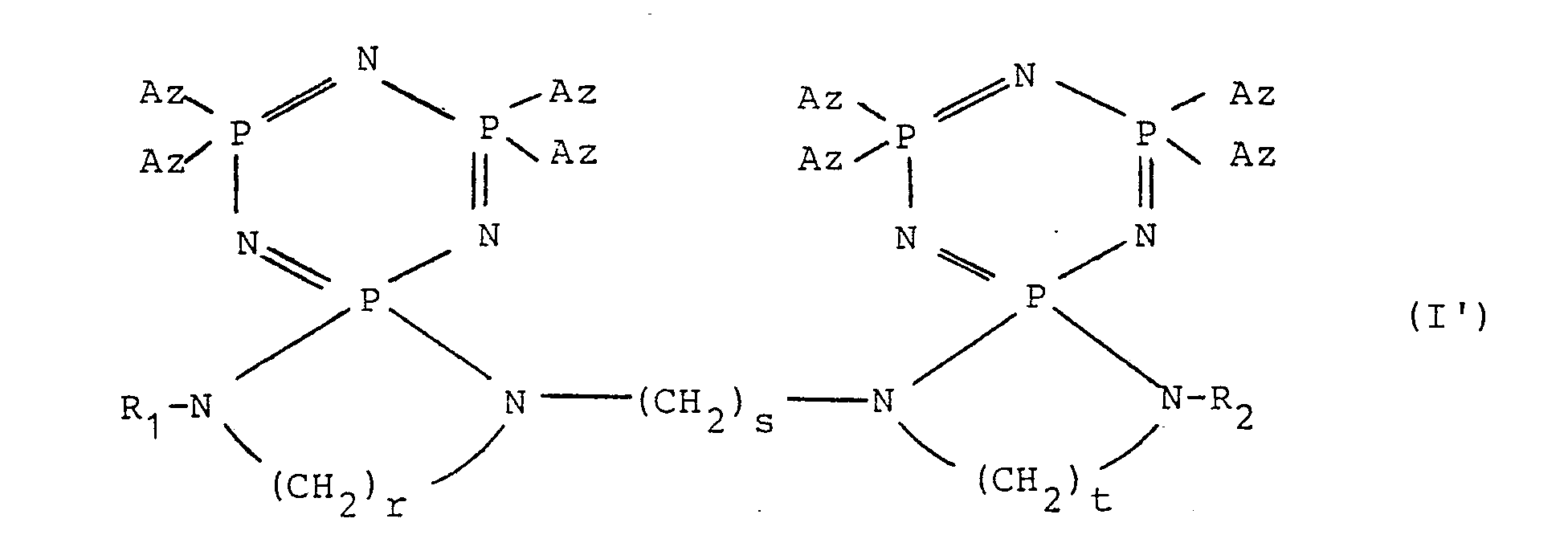
- Parmi les composés de l'invention, il faut citer le composé dénommé SPM dans lequel Az = 1-aziridinyle, R₁ = R₂ = H, r = t = 3 et s = 4.
- La présente invention concern également des procédés de préparation des composés de formule I dans lesquels :
- a) on fait réagir la polyamine substituée ou non de formule II :
H(R₁N)-A-NH-B-NH-C-(NR₂)H (II)
sur le composé gem dichloré de formule III en excès :
- b) on fait réagir l'aziridine substituée ou non en excès sur le composé de formule IV :
- Les composés de formule III et IV peuvent être préparés à partir de l'hexachlorocyclotriphosphazène N₃P₃Cl₆ de formule V :

. soit en faisant réagir la polyamine, substitueé ou non, de formule II, pour obtenir le composé de formule IV. - Ces différentes réactions sont effectuées, de préférence, en présence d'un agent capteur de HCl qui est, de préférence, une amine ne réagissant pas sur le noyau de base,telle qu'une trialcoylamine par exemple.
- Ces différentes réactions peuvent être aussi effectuées sans agent capteur de HCl, mais en présence d'un large excès stoechiométrique du réactif utilisé en excès, à savoir le composé de formule III dans la variante a) des procédés, ou l'aziridine dans la variante b) des procédés.
- Ainsi, selon la variante a) des procédés de préparation des composés de formule I, on peut, en présence d'un agent capteur de HCl, effectuer la réaction en utilisant la proportion de 2 molécules du composé gem dichloré de formule III pour 1 molécule de la polyamine de formule II.
- Ce rapport de 2:1 peut passer à 4:1 ou plus, dans le cas où l'on effectue la réaction sans utiliser d'agent capteur de HCl.
- De même, selon la variante b) des procédés de préparation des composés de formule I, on peut, en présence d'un agent capteur de HCl, faire réagir 8 molécules d'aziridine avec 1 molécule du composé de formule IV ; par contre, en l'absence d'agent capteur de HCl, ce rapport de 8:1 peut être augmenté jusqu'à 16:1 ou plus.
- Ces réactions sont conduites, de préférence, dans un solvant tel qu'un éther ou un solvant halogéné, ou un mélange de tels solvants, par exemple un mélange d'éther de pétrole 60-80° et de dichlorométhane dans le rapport 4:1. Le tétrahydrofuranne peut être également utilisé. Les réactions se déroulent, de préférence, à une température comprise entre -20°C et +20°C, par exemple à une température voisine de 0°C, et en atmosphère inerte (N₂ ou argon soigneusement desséché).
- Parmi les polyamines utilisables selon la présente invention, il faut citer la spermine, substituée ou non, de formule : H₂N-(CH₂)₃-NH-(CH₂)₄-NH-(CH₂)₃-NH₂.
- Enfin, le produit de la réaction de formule I peut être purifié par des procédés connus tels que l'extraction par solvant, la cristallisation, la chromatographie en phase liquide à haute performance par exemple.
- Les différents produits de départ utiles dans la mise en oeuvre des procédés selon la présente invention peuvent être préparés, notamment, par les méthodes décrites dans :
-Y. KOBAYASHI, L.A. CHASIN et L.B. CLAPP, Inorg. Chem., 2, 212 (1963),
- R. RATZ, E. KOBER, C. GRUNDMANN et G. OTTMANN, Inorg. Chem., 3, 757 (1964) et brevet des E.U.A. no 3 197 464, 27 juillet 1965,
-G. GUERCH, J-F. LABARRE, F. SOURNIES, M. MANFAIT, F. SPREAFICO et S. FILIPPESCHI, Inorg. Chim. Acta, 66, 175-183 (1982),
pour le MYCLAz,
et
- G. GUERCH, Thèse de Doctorat d'Etat no 1118, Université Paul Sabatier, Toulouse, France 2 décembre 1983,
- J-F. LABARRE, G. GUERCH, F. SOURNIES, R. LAHANA, R. ENJALBERT et J. GALY, J. Mol. Struct., 116, 75 (1984),
- J-F. LABARRE, Topics in Current Chemistry, 129, 173 (1985), pour le composé IV. - Enfin, la présente invention concern, à titre de médicament nouveau, certains composés tels que décrits précédemment ainsi que des compositions pharmaceutiques comprenant à titre de principe actif au moins l'un de ces composés et, en particulier, des compositions pharmaceutiques administrables par voie parentérale.
- Parmi les compositions administrables par voie parentérale, il faut citer les compositions injectables, en particulier par voie intra-péritonéale et intra-veineuse.
- Les produits en cause étant, en général, assez solubles dans l'eau, on utilisera de préférence comme support pharmaceutique un solvant aqueux, par exemple une solution physiologique de chlorure de sodium. Bien entendu, dans le cas de produits difficiles à solubiliser, on peut utiliser des tampons fixant le pH ou éventuellement des solvants non aqueux tels que des esters, des alcools, des polyols ou diverses huiles en combinaison avec des agents émulsifiants ; on peut également utiliser des suspensions, en particulier des hydroxypropylcelluloses.
- Bien que les compositions pharmaceutiques selon la présente invention soient, de préférence, des compositions injectables, on peut également utiliser des compositions administrables par voie sublinguale, orale ou rectale, ces compositions pouvant se présenter sous forme solide, comprimés, capsules, granulés, gélules, suppositoires par exemple, ou sous forme liquide, gouttes et ampoules.
- Dans le cas des compositions administrables par voie orale, celles-ci sont formulées avec des supports connus solides tels que gélatine, gomme arabique, lactose, amidon, polyalkylène glycol , carboxyméthylcellulose par exemple.
- Dans le cas de suppositoires, on peut utiliser des polyéthylène glycol, de la lanoline à titre de véhicule.
- Les compositions selon la présente invention peuvent également être applicables par voie topique, en particulier sous forme de pommade ou de gel applicables sur la peau avec un véhicule inerte tel que la vaseline, les polyéthylène glycol ou d'autres excipients gras ; il est possible également de prévoir un agent facilitant la pénétration cutanée du principe actif.
- De façon générale, les compositions selon la présente invention peuvent contenir des adjuvants variés tels que conservateurs, stabilisants, mouillants, émulsifiants, agents de texture, de délitement, aromatisation, colorants.
- Les composés selon la présente invention se sont révélés particulièrement actifs dans le traitement de certaines tumeurs. Ils se sont, en particulier, révélés très actifs sur les tumeurs standards que sont la leucémie P388, l'érythroleucémie humaine K562, la leucémie L1210, le carcinome du poumon de Lewis, le mélanome B16 et le mastocytome 5076.
- Ces composés manifestent également des propirétés immuno-modulatrices remarquables, au niveau notamment de l'immuno-modulation de la stimulation polyclonale des lymphocytes B, de la prévention des lésions de glomérulonéphrites à complexes immuns et de la prévention du choc endotoxinique. Ces substances peuvent donc être envisagées pour le traitement de certaines affections à complexes immuns telles que les maladies auto-immunes et notamment le lupus érythémateux disséminé.
- Ces composés sont utilisables essentiellement par injection, en particulier par voie intra-péritonéale ou par voie intra-veineuse. Ces composés étant très solubles dans l'eau, la réalisation de compositions injectables ne présente aucun problème. Les doses appliquées sont, bien entendu, fonction, dans chacun des cas, du type de tumeur à traiter ainsi que de l'état général du malade, et peuvent varier dans une très large mesure, en particulier entre 1 mg/kg/jour et 400 mg/kg/jour, en une ou plusieurs injections dont la fréquence peut être variable.
- Les exemples et figure suivants sont destinés à illustrer la préparation et les activités de certains des composés selon la présente invention sans pour autant la limiter.
- Une solution de 581,4 mmoles d'aziridine dans 100 ml de tétrahydrofuranne anhydre est ajoutée goutte à goutte en 2 heures à une solution de 19,95 mmoles du précurseur chloré dans 350 ml du même solvant. L'agitation magnétique est maintenue durant 48 heures sous atmosphère d'argon et sur bain de glace. On considère que la réaction est terminée quand les fréquences d'élongation IR (518 et 570 cm⁻¹) des liaison P-Cl du précurseur ont disparu. Le chlorhydrate d'aziridine formé est éliminé par filtration et le solvant de la solution mère est évaporé sous vide à 30°C. Le résidu ainsi obtenu contient encore une petite quantité de chlorhydrate. Il est donc lavé avec 20 ml d'eau glacée et extrait à trois reprises avec chaque fois 250 ml de dichlorométhane. On obtient ainsi, après évaporation sous vide de CH₂Cl₂, 11,2 g (70 %) d'une poudre blanche dont le Rf en chromatographie sur couche mince est égal à 0,46 avec CH₃OH comme éluant. L'analyse élémentaire de l'échantillon obtenu est tout à fait en accord avec la structure du composé SPM attendu.
- Le spectre de masse enregistré sur un spectromètre R1010 Ribermag en utilisant un système d'injection directe a permis de mettre en évidence les caractéristiques suivantes :
- L'ion miléculaire M⁺ est observé comme attendu à m/z 804 avec 2 satellites à m/z 805 et 806 dus à la distribution isotopique ¹⁴N/¹⁵N.
- Le mode de fragmentation principal de M⁺ donne simultanément les fragments N₃P₃Az₄[HN-(CH₂)₃-N](CH₂)₄ (M1, m/z 430) et N₃P₃Az₄[HN-(CH₂)₃-N] (M2, m/z 374).
- La perte successive par M1 de 1 à 4 CH₂ puis de la boucle SPIRO [HN-(CH₂)₃-N] pas à pas et enfin de 1 à 4 radicaux Az donne les pics d'intensité maximale à m/z 416, 402, 388, 374, 360, 345 (pic de base I = 100 %), 332, 317, 304, 261, 220, 179 et 135.
- La perte successive par M2 d'abord de sa boucle SPIRO et ensuite de 1 à 4 radicaux Az (associée ici encore avec des transferts d'hydrogène) donne les pics à m/z 360, 345, 332, 317, 304, 261, 220, 179 et 135. Un mode de fragmentation de moindre importance existe également par M2 qui passe d'abord par la perte de 1 à 4 radicaux Az pour donner les pics à m/z 332, 292, 248 et 207. Le fragment m/z 207 perd ensuite sa boucle SPIRO pas à pas pour donner les pics à m/z 194, 179, 165, 151 et 135.
- Il est intéressant de signaler que le pic de base (I = 100 %) pour SPM correspond au fragment N₃P₃Az₄ [HN-(CH₂)₂] alors qu'il correspond à l'entité N₃P₃Cl₄ [HN-(CH₂)₃-N] (CH₂)₄ pour son précurseur chloré.
- L'intensité des autres pics de la figure que ceux que nous avons assignés est inférieure à 0,5 %.
RMN³¹P en solution dans CD₂Cl₂ (par rapport à H₃PO₄, 85 %). - Le spectre ³¹P de SPM, enregistré sur un Bruker WH90 (36,43 MHz) est un spectre AX₂ comportant un doublet à 38,48 et 37,59 ppm (entité PAz₂) et un triplet à 22,58, 21,69 et 20,88 ppm (atomes P portant les boucles SPIRO). La constante de couplage ²JPP est égale à 32,36 Hz.
- Le composé SPM a été testé sur le plan de son activité pharmacologique, notamment quant à ses propriétés antitumorales in vivo.
- La solubilité dans l'eau et dans le sérum physiologique est supérieure à 20 g/l ce qui est donc largement suffisant pour la réalisation de formes injectables.
- La toxicité de SPM a été déterminée sur des souris mâles Swiss ou CD2F1. La léthalité, quand elle existe, apparaît systématiquement aux jours 5 et 6 après l'adminstration par voie i.p. L'enregistrement de cette léthalité en fonction de la dose injectée permet de déduire la DLo qui est la dose maximale non léthale. La même valeur de DLo a été obtenue chez les Swiss et les CD2F1 : elle a été trouvée égale à 1 500 mg/kg. C'est là un résultat remarquable.
- Les tests d'activité antitumorale ont été conduits au sein du Screening and Pharmacology Group de l'E.O.R.T.C., implanté à l'Institut Mario Negri de Milan.
- Ces essais ont été conduits soit en mono-injection à différentes doses au jour J+1 suivant la greffe de la tumeur, soit en poly-injections chroniques Q1D, soit en protocoles Q4D.
- Les résultats obtenus sont rassemblés dans les tableaux ci-après.
- L'activité antitumorale est mesurée par le rapport T/C %, T (en jours) étant le durée moyenne de vie des souris traitées, C (en jours) étant la durée moyenne de vie des souris témoins.
- L'effet thérapeutique est considéré comme significatif quant T/C % est supérieur ou égal à 125.
- Les tableaux appellent les remarques essentielles suivantes :
- 1°) Un effet remarquable est obtenu sur la leucémie P388 en mono-injection 400 mg/kg (T/C = 200 %), en protocole Q4D à 250 mg/kg/jour (T/C = 285 %) et en protocole chronique 9Q1D à 100 mg/kg/jour (T/C = 260 %) ;
on remarque surtout qu'un effet tout à fait significatif est obtenu en injectant en chronique sur 9 jours 25 mg/kg/jour (T/C = 166 %), c'est-à-dire le 1/60ème de la DLo. - 2°) SPM inhibe d'une manière très remarquable la croissance in vitro de l'érythroleucémie humaine K562 alors que le MYCLAz est sans effet, même à dose toxique, sur cette souche. L'effet de SPM est significatif pour des doses comprises entre 100 µg/ml et 0,01 µg/ml, soit sur une plage d'amplitude au moins égale à 10 000.
L'action de SPM sur la K562, maladie où les cellules malignes sont des érythroblastes (globules rouges) matures donc sans noyau, donc sans ADN nucléaire, semble prouver que la cible primaire de cette nouvelle drogue n'est pas l'ADN nucléaire. On retrouve là, sous une forme directe, ce qui a été observé pour la drogue nue SOAz (étude in vitro sur les monocouches phospholipidiques modèles et in vivo sur Streptococcus pneumoniae) à savoir que la cible primaire de la plupart des cyclophosphazènes biologiquement actifs serait la membrane cellulaire (M-C. TROMBE, C. BEAUBESTRE, A-M. SAUTEREAU, J-F. LABARRE, G. LANEELLE et J-F. TOCANNE, Biochem. Pharmacology, 33, 2749 (1984). - 3°) L'activité de SPM sur la leucémie L1210 est relativement faible, quel que soit le protocole utilisé. Ceci n'est pas étonnant car une telle faiblesse est commune à toutes les drogues cyclophosphazéniques décrites à ce jour.
- 4°) On note enfin une intéressante activité du SPM sur le carcinome du poumon de Lewis implanté chez des souris C57B1/6.
- En conclusion, le composé SPM constitue, du point de vue antitumoral, une amélioration non négligeable par rapport au MYCLAz, bien que son index thérapeutique global soit objectivement moins élevé que l'on eut pu l'espérer.
- On note, toutefois, une différence dans les bénéfices tirés ici de l'utilisation des composés selon la présente invention par rapport à ceux décrits dans le brevet français no 82 19768 : il semble, en effet, que l'utilisation des composés selon la présente invention se traduise par un renforcement de la spécificité du site membranaire pour l'activité antitumorale, comme en témoignent les remarquables effets obtenus sur le K562, effets jamais approchés à ce jour.


Claims (21)

. Az est un radical 1-aziridinyle substitué ou non,
. A, B et C peuvent représenter, indépendamment l'un de l'autre, une chaîne alcoylène, alcénylène ou alcynylène, droite ou ramifiée, substituée ou non, qui peut être interrompue par un ou plusieurs radicaux divalents -NR₃-, -S- ou -O-,
. R₁, R₂ et R₃ peuvent représenter, indépendamment l'un de l'autre, un atome d'hydrogène, un radical alkyle substitué ou non, un radical alcényle substitué ou non, un radical alcynyle substitué ou non, un radical aryle substitué ou non.

H(R₁N)-A-NH-B-NH-C-(NR₂)H (II)
sur le composé gem dichloré de formule III en excès :

H(R₁N)-A-NH-B-NH-C-(NR₂)H (II)
sur le composé de formule V :

Priority Applications (1)
| Application Number | Priority Date | Filing Date | Title |
|---|---|---|---|
| AT87400490T ATE52515T1 (de) | 1986-03-06 | 1987-03-05 | Verbindungen des cyclophosphazen-typs, verfahren zu ihrer herstellung und sie enthaltende pharmazeutische praeparate. |
Applications Claiming Priority (2)
| Application Number | Priority Date | Filing Date | Title |
|---|---|---|---|
| FR8603155 | 1986-03-06 | ||
| FR8603155A FR2595360B1 (fr) | 1986-03-06 | 1986-03-06 | Composes du type cyclophosphazene, procede de preparation et composition pharmaceutique les contenant |
Publications (2)
| Publication Number | Publication Date |
|---|---|
| EP0240392A1 true EP0240392A1 (fr) | 1987-10-07 |
| EP0240392B1 EP0240392B1 (fr) | 1990-05-09 |
Family
ID=9332823
Family Applications (1)
| Application Number | Title | Priority Date | Filing Date |
|---|---|---|---|
| EP87400490A Expired - Lifetime EP0240392B1 (fr) | 1986-03-06 | 1987-03-05 | Composés du type cyclophosphazène, procédé de préparation et composition pharmaceutique les contenant |
Country Status (10)
| Country | Link |
|---|---|
| EP (1) | EP0240392B1 (fr) |
| JP (1) | JPS62223186A (fr) |
| KR (1) | KR870008902A (fr) |
| AT (1) | ATE52515T1 (fr) |
| AU (1) | AU6968287A (fr) |
| DE (1) | DE3762622D1 (fr) |
| ES (1) | ES2015067B3 (fr) |
| FR (1) | FR2595360B1 (fr) |
| GR (1) | GR3000692T3 (fr) |
| HU (1) | HUT44571A (fr) |
Cited By (2)
| Publication number | Priority date | Publication date | Assignee | Title |
|---|---|---|---|---|
| FR2655046A1 (fr) * | 1989-11-24 | 1991-05-31 | Centre Nat Rech Scient | Composes oxodiaminodicyclophosphazenes de configuration mono-bino et di-bino, complexes derives de composes et applications desdits complexes et ces composes. |
| FR2706464A1 (fr) * | 1993-06-18 | 1994-12-23 | Pf Medicament | Nouveaux dérivés de spirodiaza ou spirooxaaza alkylcyclotriphosphazènes substitués par des méthyl ou diméthyl aziridines, leur préparation et leur utilisation en tant que médicament. |
Citations (1)
| Publication number | Priority date | Publication date | Assignee | Title |
|---|---|---|---|---|
| EP0112743A1 (fr) * | 1982-11-25 | 1984-07-04 | CNRS, Centre National de la Recherche Scientifique | Nouveaux dérivés de tricyclophosphazènes, procédé pour leur préparation et leur application en tant que médicament |
-
1986
- 1986-03-06 FR FR8603155A patent/FR2595360B1/fr not_active Expired
-
1987
- 1987-03-04 AU AU69682/87A patent/AU6968287A/en not_active Abandoned
- 1987-03-05 ES ES87400490T patent/ES2015067B3/es not_active Expired - Lifetime
- 1987-03-05 AT AT87400490T patent/ATE52515T1/de not_active IP Right Cessation
- 1987-03-05 EP EP87400490A patent/EP0240392B1/fr not_active Expired - Lifetime
- 1987-03-05 DE DE8787400490T patent/DE3762622D1/de not_active Expired - Lifetime
- 1987-03-06 HU HU87970A patent/HUT44571A/hu unknown
- 1987-03-06 KR KR870002015A patent/KR870008902A/ko not_active Withdrawn
- 1987-03-06 JP JP62051865A patent/JPS62223186A/ja active Pending
-
1990
- 1990-08-02 GR GR90400551T patent/GR3000692T3/el unknown
Patent Citations (1)
| Publication number | Priority date | Publication date | Assignee | Title |
|---|---|---|---|---|
| EP0112743A1 (fr) * | 1982-11-25 | 1984-07-04 | CNRS, Centre National de la Recherche Scientifique | Nouveaux dérivés de tricyclophosphazènes, procédé pour leur préparation et leur application en tant que médicament |
Non-Patent Citations (1)
| Title |
|---|
| INORGANICA CHIMICA ACTA, vol. 108, 1985, pages 23-27, Elsevier Sequoia; J.-L. SASSUS et al.: "Covalent binding of non-effective diaziridinocyclotriphosphazenes to natural polyamines as tumor finders makes potential anticancer agents" * |
Cited By (3)
| Publication number | Priority date | Publication date | Assignee | Title |
|---|---|---|---|---|
| FR2655046A1 (fr) * | 1989-11-24 | 1991-05-31 | Centre Nat Rech Scient | Composes oxodiaminodicyclophosphazenes de configuration mono-bino et di-bino, complexes derives de composes et applications desdits complexes et ces composes. |
| WO1991008212A1 (fr) * | 1989-11-24 | 1991-06-13 | Centre National De La Recherche Scientifique (Cnrs) | Derives oxodiaminodicyclophosphazenes de configuration mono-bino et di-bino |
| FR2706464A1 (fr) * | 1993-06-18 | 1994-12-23 | Pf Medicament | Nouveaux dérivés de spirodiaza ou spirooxaaza alkylcyclotriphosphazènes substitués par des méthyl ou diméthyl aziridines, leur préparation et leur utilisation en tant que médicament. |
Also Published As
| Publication number | Publication date |
|---|---|
| ATE52515T1 (de) | 1990-05-15 |
| FR2595360B1 (fr) | 1988-07-01 |
| GR3000692T3 (en) | 1991-09-27 |
| ES2015067B3 (es) | 1990-08-01 |
| AU6968287A (en) | 1987-09-10 |
| FR2595360A1 (fr) | 1987-09-11 |
| DE3762622D1 (de) | 1990-06-13 |
| HUT44571A (en) | 1988-03-28 |
| EP0240392B1 (fr) | 1990-05-09 |
| KR870008902A (ko) | 1987-10-22 |
| JPS62223186A (ja) | 1987-10-01 |
Similar Documents
| Publication | Publication Date | Title |
|---|---|---|
| CA1244455A (fr) | Derives de tricyclophosphazenes, procede pour leur preparation et leur application en tant que medicament | |
| EP0318392B1 (fr) | Nouveaux dérivés N-(vinblastinoyl-23) d'acide amino-1 méthylphosphonique, leurs procédés de préparation et les compositions pharmaceutiques qui les contiennent | |
| EP0240392B1 (fr) | Composés du type cyclophosphazène, procédé de préparation et composition pharmaceutique les contenant | |
| FR2580642A1 (fr) | 5-pyrimidinecarboxamides et traitement de la leucemie et des tumeurs en les utilisant | |
| LU86059A1 (fr) | Nouveaux analogues 6-substitues de la mitomycine | |
| WO1998031688A1 (fr) | Derives d'acides boroniques inhibiteurs d'angiogenese | |
| FR2499577A1 (fr) | Nouvelles 1-(2-chloroethyl)-1-nitrosourees-3-substituees par un reste de sucre, utiles notamment comme agents antitumoraux et leur procede de preparation | |
| EP0143675B1 (fr) | Nouveaux dérivés de nitrosourée, leur procédé de préparation et compositions pharmaceutiques les contenant | |
| FR2538385A1 (fr) | Composes enamides acyles, compositions pharmaceutiques les contenant, utilisation de ces composes et procede de preparation de ces composes | |
| EP0022407B1 (fr) | Cyclophosphathiazènes, procédé pour leur préparation et compositions les contenant | |
| EP1297835B1 (fr) | Dérivés de benzo[b]pyrano[3,2-h]acridin-7-one, leur procédé de préparation et les compositions pharmaceutiques qui les contiennent | |
| JPH11504041A (ja) | 多発性硬化症の治療に有用な生物学上活性なウレイド誘導体 | |
| EP0482993A1 (fr) | Dérivés N,O spirocycliques de cyclotriphosphazènes, leur préparation et leur application en thérapeutique | |
| CA1249818A (fr) | Derives de l'oxaazaphosphorine et leur procede de preparation | |
| LU87543A1 (fr) | Derives phosphoriques des mitomycines | |
| EP1674101B1 (fr) | Dérivés cinnamates de benzo [b]pyrano[3,2-h]acridin-7-one, leur procédé de préparation et les compositions pharmaceutiques qui les contiennent | |
| FR2516085A1 (fr) | Sels quaternaires de n,n3-di(b-bromopropionyl)-n1,n2-dispirotripiperazinium, procede de preparation desdits sels et medicament a action antitumorale a base d'un tel sel | |
| FR2485015A1 (fr) | Derives de l'olivacine et leur application therapeutique | |
| EP0179076A1 (fr) | Derives sulfures de l'hydantoine et compositions pharmaceutiques les contenant. | |
| FR2534259A1 (fr) | Diester d'acide aliphatique a chaine moyenne en positions 6, 6' d'a,a-trehalose et son application en therapeutique | |
| FR2614303A1 (fr) | Derives de nitrosourees, leur nouveau procede de preparation et leurs applications therapeutiques. | |
| EP0288395A2 (fr) | Dérivés de nitrosourées, leur nouveau procédé de préparation et leurs applications thérapeutique | |
| EP0457817A1 (fr) | Composes oxodiaminocyclotriphosphazenes, leur preparation et leurs applications | |
| IE912081A1 (en) | Enantiomers of 2-tetrahydrofuran derivatives, intermediates therefor and their preparation | |
| BE835759A (fr) | Nouveaux dibenzocycloheptenes a portion cycloprupyle condensee, leur preparation et compositions pharmaceutiques les contenant |
Legal Events
| Date | Code | Title | Description |
|---|---|---|---|
| PUAI | Public reference made under article 153(3) epc to a published international application that has entered the european phase |
Free format text: ORIGINAL CODE: 0009012 |
|
| AK | Designated contracting states |
Kind code of ref document: A1 Designated state(s): AT BE CH DE ES FR GB GR IT LI LU NL SE |
|
| 17P | Request for examination filed |
Effective date: 19880328 |
|
| 17Q | First examination report despatched |
Effective date: 19881125 |
|
| GRAA | (expected) grant |
Free format text: ORIGINAL CODE: 0009210 |
|
| AK | Designated contracting states |
Kind code of ref document: B1 Designated state(s): AT BE CH DE ES FR GB GR IT LI LU NL SE |
|
| REF | Corresponds to: |
Ref document number: 52515 Country of ref document: AT Date of ref document: 19900515 Kind code of ref document: T |
|
| ITF | It: translation for a ep patent filed | ||
| REF | Corresponds to: |
Ref document number: 3762622 Country of ref document: DE Date of ref document: 19900613 |
|
| GBT | Gb: translation of ep patent filed (gb section 77(6)(a)/1977) | ||
| REG | Reference to a national code |
Ref country code: GR Ref legal event code: FG4A Free format text: 3000692 |
|
| PGFP | Annual fee paid to national office [announced via postgrant information from national office to epo] |
Ref country code: SE Payment date: 19910220 Year of fee payment: 5 Ref country code: LU Payment date: 19910220 Year of fee payment: 5 |
|
| PGFP | Annual fee paid to national office [announced via postgrant information from national office to epo] |
Ref country code: GR Payment date: 19910226 Year of fee payment: 5 |
|
| PGFP | Annual fee paid to national office [announced via postgrant information from national office to epo] |
Ref country code: CH Payment date: 19910227 Year of fee payment: 5 |
|
| PGFP | Annual fee paid to national office [announced via postgrant information from national office to epo] |
Ref country code: GB Payment date: 19910304 Year of fee payment: 5 |
|
| PGFP | Annual fee paid to national office [announced via postgrant information from national office to epo] |
Ref country code: BE Payment date: 19910305 Year of fee payment: 5 |
|
| PGFP | Annual fee paid to national office [announced via postgrant information from national office to epo] |
Ref country code: ES Payment date: 19910307 Year of fee payment: 5 |
|
| PLBE | No opposition filed within time limit |
Free format text: ORIGINAL CODE: 0009261 |
|
| STAA | Information on the status of an ep patent application or granted ep patent |
Free format text: STATUS: NO OPPOSITION FILED WITHIN TIME LIMIT |
|
| PGFP | Annual fee paid to national office [announced via postgrant information from national office to epo] |
Ref country code: AT Payment date: 19910314 Year of fee payment: 5 |
|
| PGFP | Annual fee paid to national office [announced via postgrant information from national office to epo] |
Ref country code: FR Payment date: 19910327 Year of fee payment: 5 |
|
| ITTA | It: last paid annual fee | ||
| PGFP | Annual fee paid to national office [announced via postgrant information from national office to epo] |
Ref country code: NL Payment date: 19910331 Year of fee payment: 5 |
|
| 26N | No opposition filed | ||
| PGFP | Annual fee paid to national office [announced via postgrant information from national office to epo] |
Ref country code: DE Payment date: 19910511 Year of fee payment: 5 |
|
| EPTA | Lu: last paid annual fee | ||
| PG25 | Lapsed in a contracting state [announced via postgrant information from national office to epo] |
Ref country code: LU Free format text: LAPSE BECAUSE OF NON-PAYMENT OF DUE FEES Effective date: 19920305 Ref country code: GB Effective date: 19920305 Ref country code: AT Effective date: 19920305 |
|
| PG25 | Lapsed in a contracting state [announced via postgrant information from national office to epo] |
Ref country code: SE Effective date: 19920306 Ref country code: ES Free format text: LAPSE BECAUSE OF NON-PAYMENT OF DUE FEES Effective date: 19920306 |
|
| PG25 | Lapsed in a contracting state [announced via postgrant information from national office to epo] |
Ref country code: LI Effective date: 19920331 Ref country code: CH Effective date: 19920331 Ref country code: BE Effective date: 19920331 |
|
| BERE | Be: lapsed |
Owner name: CENTRE NATIONAL DE LA RECHERCHE SCIENTIFIQUE CNRS Effective date: 19920331 |
|
| PG25 | Lapsed in a contracting state [announced via postgrant information from national office to epo] |
Ref country code: GR Free format text: THE PATENT HAS BEEN ANNULLED BY A DECISION OF A NATIONAL AUTHORITY Effective date: 19920930 |
|
| PG25 | Lapsed in a contracting state [announced via postgrant information from national office to epo] |
Ref country code: NL Effective date: 19921001 |
|
| GBPC | Gb: european patent ceased through non-payment of renewal fee | ||
| NLV4 | Nl: lapsed or anulled due to non-payment of the annual fee | ||
| PG25 | Lapsed in a contracting state [announced via postgrant information from national office to epo] |
Ref country code: FR Effective date: 19921130 |
|
| REG | Reference to a national code |
Ref country code: CH Ref legal event code: PL |
|
| PG25 | Lapsed in a contracting state [announced via postgrant information from national office to epo] |
Ref country code: DE Effective date: 19921201 |
|
| REG | Reference to a national code |
Ref country code: FR Ref legal event code: ST |
|
| REG | Reference to a national code |
Ref country code: GR Ref legal event code: MM2A Free format text: 3000692 |
|
| EUG | Se: european patent has lapsed |
Ref document number: 87400490.6 Effective date: 19921005 |
|
| REG | Reference to a national code |
Ref country code: ES Ref legal event code: FD2A Effective date: 19990201 |
|
| PG25 | Lapsed in a contracting state [announced via postgrant information from national office to epo] |
Ref country code: IT Free format text: LAPSE BECAUSE OF NON-PAYMENT OF DUE FEES;WARNING: LAPSES OF ITALIAN PATENTS WITH EFFECTIVE DATE BEFORE 2007 MAY HAVE OCCURRED AT ANY TIME BEFORE 2007. THE CORRECT EFFECTIVE DATE MAY BE DIFFERENT FROM THE ONE RECORDED. Effective date: 20050305 |