EP0240732A2 - Welding element for butt-welding plastic pipes - Google Patents
Welding element for butt-welding plastic pipes Download PDFInfo
- Publication number
- EP0240732A2 EP0240732A2 EP87103165A EP87103165A EP0240732A2 EP 0240732 A2 EP0240732 A2 EP 0240732A2 EP 87103165 A EP87103165 A EP 87103165A EP 87103165 A EP87103165 A EP 87103165A EP 0240732 A2 EP0240732 A2 EP 0240732A2
- Authority
- EP
- European Patent Office
- Prior art keywords
- welding
- welding element
- saddle part
- annular disc
- element according
- Prior art date
- Legal status (The legal status is an assumption and is not a legal conclusion. Google has not performed a legal analysis and makes no representation as to the accuracy of the status listed.)
- Granted
Links
Images


Classifications
-
- B—PERFORMING OPERATIONS; TRANSPORTING
- B29—WORKING OF PLASTICS; WORKING OF SUBSTANCES IN A PLASTIC STATE IN GENERAL
- B29D—PRODUCING PARTICULAR ARTICLES FROM PLASTICS OR FROM SUBSTANCES IN A PLASTIC STATE
- B29D23/00—Producing tubular articles
- B29D23/001—Pipes; Pipe joints
- B29D23/003—Pipe joints, e.g. straight joints
- B29D23/005—Pipe joints, e.g. straight joints provided with electrical wiring
-
- B—PERFORMING OPERATIONS; TRANSPORTING
- B29—WORKING OF PLASTICS; WORKING OF SUBSTANCES IN A PLASTIC STATE IN GENERAL
- B29C—SHAPING OR JOINING OF PLASTICS; SHAPING OF MATERIAL IN A PLASTIC STATE, NOT OTHERWISE PROVIDED FOR; AFTER-TREATMENT OF THE SHAPED PRODUCTS, e.g. REPAIRING
- B29C65/00—Joining or sealing of preformed parts, e.g. welding of plastics materials; Apparatus therefor
- B29C65/02—Joining or sealing of preformed parts, e.g. welding of plastics materials; Apparatus therefor by heating, with or without pressure
- B29C65/34—Joining or sealing of preformed parts, e.g. welding of plastics materials; Apparatus therefor by heating, with or without pressure using heated elements which remain in the joint, e.g. "verlorenes Schweisselement"
- B29C65/3404—Joining or sealing of preformed parts, e.g. welding of plastics materials; Apparatus therefor by heating, with or without pressure using heated elements which remain in the joint, e.g. "verlorenes Schweisselement" characterised by the type of heated elements which remain in the joint
- B29C65/342—Joining or sealing of preformed parts, e.g. welding of plastics materials; Apparatus therefor by heating, with or without pressure using heated elements which remain in the joint, e.g. "verlorenes Schweisselement" characterised by the type of heated elements which remain in the joint comprising at least a single wire, e.g. in the form of a winding
-
- B—PERFORMING OPERATIONS; TRANSPORTING
- B29—WORKING OF PLASTICS; WORKING OF SUBSTANCES IN A PLASTIC STATE IN GENERAL
- B29C—SHAPING OR JOINING OF PLASTICS; SHAPING OF MATERIAL IN A PLASTIC STATE, NOT OTHERWISE PROVIDED FOR; AFTER-TREATMENT OF THE SHAPED PRODUCTS, e.g. REPAIRING
- B29C65/00—Joining or sealing of preformed parts, e.g. welding of plastics materials; Apparatus therefor
- B29C65/02—Joining or sealing of preformed parts, e.g. welding of plastics materials; Apparatus therefor by heating, with or without pressure
- B29C65/34—Joining or sealing of preformed parts, e.g. welding of plastics materials; Apparatus therefor by heating, with or without pressure using heated elements which remain in the joint, e.g. "verlorenes Schweisselement"
- B29C65/3468—Joining or sealing of preformed parts, e.g. welding of plastics materials; Apparatus therefor by heating, with or without pressure using heated elements which remain in the joint, e.g. "verlorenes Schweisselement" characterised by the means for supplying heat to said heated elements which remain in the join, e.g. special electrical connectors of windings
-
- B—PERFORMING OPERATIONS; TRANSPORTING
- B29—WORKING OF PLASTICS; WORKING OF SUBSTANCES IN A PLASTIC STATE IN GENERAL
- B29C—SHAPING OR JOINING OF PLASTICS; SHAPING OF MATERIAL IN A PLASTIC STATE, NOT OTHERWISE PROVIDED FOR; AFTER-TREATMENT OF THE SHAPED PRODUCTS, e.g. REPAIRING
- B29C65/00—Joining or sealing of preformed parts, e.g. welding of plastics materials; Apparatus therefor
- B29C65/02—Joining or sealing of preformed parts, e.g. welding of plastics materials; Apparatus therefor by heating, with or without pressure
- B29C65/34—Joining or sealing of preformed parts, e.g. welding of plastics materials; Apparatus therefor by heating, with or without pressure using heated elements which remain in the joint, e.g. "verlorenes Schweisselement"
- B29C65/3472—Joining or sealing of preformed parts, e.g. welding of plastics materials; Apparatus therefor by heating, with or without pressure using heated elements which remain in the joint, e.g. "verlorenes Schweisselement" characterised by the composition of the heated elements which remain in the joint
- B29C65/3476—Joining or sealing of preformed parts, e.g. welding of plastics materials; Apparatus therefor by heating, with or without pressure using heated elements which remain in the joint, e.g. "verlorenes Schweisselement" characterised by the composition of the heated elements which remain in the joint being metallic
-
- B—PERFORMING OPERATIONS; TRANSPORTING
- B29—WORKING OF PLASTICS; WORKING OF SUBSTANCES IN A PLASTIC STATE IN GENERAL
- B29C—SHAPING OR JOINING OF PLASTICS; SHAPING OF MATERIAL IN A PLASTIC STATE, NOT OTHERWISE PROVIDED FOR; AFTER-TREATMENT OF THE SHAPED PRODUCTS, e.g. REPAIRING
- B29C66/00—General aspects of processes or apparatus for joining preformed parts
- B29C66/01—General aspects dealing with the joint area or with the area to be joined
- B29C66/05—Particular design of joint configurations
- B29C66/10—Particular design of joint configurations particular design of the joint cross-sections
- B29C66/11—Joint cross-sections comprising a single joint-segment, i.e. one of the parts to be joined comprising a single joint-segment in the joint cross-section
- B29C66/112—Single lapped joints
-
- B—PERFORMING OPERATIONS; TRANSPORTING
- B29—WORKING OF PLASTICS; WORKING OF SUBSTANCES IN A PLASTIC STATE IN GENERAL
- B29C—SHAPING OR JOINING OF PLASTICS; SHAPING OF MATERIAL IN A PLASTIC STATE, NOT OTHERWISE PROVIDED FOR; AFTER-TREATMENT OF THE SHAPED PRODUCTS, e.g. REPAIRING
- B29C66/00—General aspects of processes or apparatus for joining preformed parts
- B29C66/01—General aspects dealing with the joint area or with the area to be joined
- B29C66/05—Particular design of joint configurations
- B29C66/10—Particular design of joint configurations particular design of the joint cross-sections
- B29C66/11—Joint cross-sections comprising a single joint-segment, i.e. one of the parts to be joined comprising a single joint-segment in the joint cross-section
- B29C66/114—Single butt joints
-
- B—PERFORMING OPERATIONS; TRANSPORTING
- B29—WORKING OF PLASTICS; WORKING OF SUBSTANCES IN A PLASTIC STATE IN GENERAL
- B29C—SHAPING OR JOINING OF PLASTICS; SHAPING OF MATERIAL IN A PLASTIC STATE, NOT OTHERWISE PROVIDED FOR; AFTER-TREATMENT OF THE SHAPED PRODUCTS, e.g. REPAIRING
- B29C66/00—General aspects of processes or apparatus for joining preformed parts
- B29C66/01—General aspects dealing with the joint area or with the area to be joined
- B29C66/05—Particular design of joint configurations
- B29C66/10—Particular design of joint configurations particular design of the joint cross-sections
- B29C66/11—Joint cross-sections comprising a single joint-segment, i.e. one of the parts to be joined comprising a single joint-segment in the joint cross-section
- B29C66/114—Single butt joints
- B29C66/1142—Single butt to butt joints
-
- B—PERFORMING OPERATIONS; TRANSPORTING
- B29—WORKING OF PLASTICS; WORKING OF SUBSTANCES IN A PLASTIC STATE IN GENERAL
- B29C—SHAPING OR JOINING OF PLASTICS; SHAPING OF MATERIAL IN A PLASTIC STATE, NOT OTHERWISE PROVIDED FOR; AFTER-TREATMENT OF THE SHAPED PRODUCTS, e.g. REPAIRING
- B29C66/00—General aspects of processes or apparatus for joining preformed parts
- B29C66/01—General aspects dealing with the joint area or with the area to be joined
- B29C66/05—Particular design of joint configurations
- B29C66/10—Particular design of joint configurations particular design of the joint cross-sections
- B29C66/12—Joint cross-sections combining only two joint-segments; Tongue and groove joints; Tenon and mortise joints; Stepped joint cross-sections
- B29C66/122—Joint cross-sections combining only two joint-segments, i.e. one of the parts to be joined comprising only two joint-segments in the joint cross-section
- B29C66/1222—Joint cross-sections combining only two joint-segments, i.e. one of the parts to be joined comprising only two joint-segments in the joint cross-section comprising at least a lapped joint-segment
-
- B—PERFORMING OPERATIONS; TRANSPORTING
- B29—WORKING OF PLASTICS; WORKING OF SUBSTANCES IN A PLASTIC STATE IN GENERAL
- B29C—SHAPING OR JOINING OF PLASTICS; SHAPING OF MATERIAL IN A PLASTIC STATE, NOT OTHERWISE PROVIDED FOR; AFTER-TREATMENT OF THE SHAPED PRODUCTS, e.g. REPAIRING
- B29C66/00—General aspects of processes or apparatus for joining preformed parts
- B29C66/01—General aspects dealing with the joint area or with the area to be joined
- B29C66/05—Particular design of joint configurations
- B29C66/10—Particular design of joint configurations particular design of the joint cross-sections
- B29C66/12—Joint cross-sections combining only two joint-segments; Tongue and groove joints; Tenon and mortise joints; Stepped joint cross-sections
- B29C66/122—Joint cross-sections combining only two joint-segments, i.e. one of the parts to be joined comprising only two joint-segments in the joint cross-section
- B29C66/1224—Joint cross-sections combining only two joint-segments, i.e. one of the parts to be joined comprising only two joint-segments in the joint cross-section comprising at least a butt joint-segment
-
- B—PERFORMING OPERATIONS; TRANSPORTING
- B29—WORKING OF PLASTICS; WORKING OF SUBSTANCES IN A PLASTIC STATE IN GENERAL
- B29C—SHAPING OR JOINING OF PLASTICS; SHAPING OF MATERIAL IN A PLASTIC STATE, NOT OTHERWISE PROVIDED FOR; AFTER-TREATMENT OF THE SHAPED PRODUCTS, e.g. REPAIRING
- B29C66/00—General aspects of processes or apparatus for joining preformed parts
- B29C66/50—General aspects of joining tubular articles; General aspects of joining long products, i.e. bars or profiled elements; General aspects of joining single elements to tubular articles, hollow articles or bars; General aspects of joining several hollow-preforms to form hollow or tubular articles
- B29C66/51—Joining tubular articles, profiled elements or bars; Joining single elements to tubular articles, hollow articles or bars; Joining several hollow-preforms to form hollow or tubular articles
- B29C66/52—Joining tubular articles, bars or profiled elements
- B29C66/522—Joining tubular articles
- B29C66/5221—Joining tubular articles for forming coaxial connections, i.e. the tubular articles to be joined forming a zero angle relative to each other
-
- B—PERFORMING OPERATIONS; TRANSPORTING
- B29—WORKING OF PLASTICS; WORKING OF SUBSTANCES IN A PLASTIC STATE IN GENERAL
- B29C—SHAPING OR JOINING OF PLASTICS; SHAPING OF MATERIAL IN A PLASTIC STATE, NOT OTHERWISE PROVIDED FOR; AFTER-TREATMENT OF THE SHAPED PRODUCTS, e.g. REPAIRING
- B29C66/00—General aspects of processes or apparatus for joining preformed parts
- B29C66/50—General aspects of joining tubular articles; General aspects of joining long products, i.e. bars or profiled elements; General aspects of joining single elements to tubular articles, hollow articles or bars; General aspects of joining several hollow-preforms to form hollow or tubular articles
- B29C66/51—Joining tubular articles, profiled elements or bars; Joining single elements to tubular articles, hollow articles or bars; Joining several hollow-preforms to form hollow or tubular articles
- B29C66/52—Joining tubular articles, bars or profiled elements
- B29C66/522—Joining tubular articles
- B29C66/5229—Joining tubular articles involving the use of a socket
- B29C66/52291—Joining tubular articles involving the use of a socket said socket comprising a stop
- B29C66/52292—Joining tubular articles involving the use of a socket said socket comprising a stop said stop being internal
-
- F—MECHANICAL ENGINEERING; LIGHTING; HEATING; WEAPONS; BLASTING
- F16—ENGINEERING ELEMENTS AND UNITS; GENERAL MEASURES FOR PRODUCING AND MAINTAINING EFFECTIVE FUNCTIONING OF MACHINES OR INSTALLATIONS; THERMAL INSULATION IN GENERAL
- F16L—PIPES; JOINTS OR FITTINGS FOR PIPES; SUPPORTS FOR PIPES, CABLES OR PROTECTIVE TUBING; MEANS FOR THERMAL INSULATION IN GENERAL
- F16L47/00—Connecting arrangements or other fittings specially adapted to be made of plastics or to be used with pipes made of plastics
- F16L47/02—Welded joints; Adhesive joints
-
- B—PERFORMING OPERATIONS; TRANSPORTING
- B29—WORKING OF PLASTICS; WORKING OF SUBSTANCES IN A PLASTIC STATE IN GENERAL
- B29C—SHAPING OR JOINING OF PLASTICS; SHAPING OF MATERIAL IN A PLASTIC STATE, NOT OTHERWISE PROVIDED FOR; AFTER-TREATMENT OF THE SHAPED PRODUCTS, e.g. REPAIRING
- B29C66/00—General aspects of processes or apparatus for joining preformed parts
- B29C66/70—General aspects of processes or apparatus for joining preformed parts characterised by the composition, physical properties or the structure of the material of the parts to be joined; Joining with non-plastics material
- B29C66/71—General aspects of processes or apparatus for joining preformed parts characterised by the composition, physical properties or the structure of the material of the parts to be joined; Joining with non-plastics material characterised by the composition of the plastics material of the parts to be joined
-
- B—PERFORMING OPERATIONS; TRANSPORTING
- B29—WORKING OF PLASTICS; WORKING OF SUBSTANCES IN A PLASTIC STATE IN GENERAL
- B29C—SHAPING OR JOINING OF PLASTICS; SHAPING OF MATERIAL IN A PLASTIC STATE, NOT OTHERWISE PROVIDED FOR; AFTER-TREATMENT OF THE SHAPED PRODUCTS, e.g. REPAIRING
- B29C66/00—General aspects of processes or apparatus for joining preformed parts
- B29C66/80—General aspects of machine operations or constructions and parts thereof
- B29C66/81—General aspects of the pressing elements, i.e. the elements applying pressure on the parts to be joined in the area to be joined, e.g. the welding jaws or clamps
- B29C66/816—General aspects of the pressing elements, i.e. the elements applying pressure on the parts to be joined in the area to be joined, e.g. the welding jaws or clamps characterised by the mounting of the pressing elements, e.g. of the welding jaws or clamps
- B29C66/8167—Quick change joining tools or surfaces
-
- Y—GENERAL TAGGING OF NEW TECHNOLOGICAL DEVELOPMENTS; GENERAL TAGGING OF CROSS-SECTIONAL TECHNOLOGIES SPANNING OVER SEVERAL SECTIONS OF THE IPC; TECHNICAL SUBJECTS COVERED BY FORMER USPC CROSS-REFERENCE ART COLLECTIONS [XRACs] AND DIGESTS
- Y10—TECHNICAL SUBJECTS COVERED BY FORMER USPC
- Y10T—TECHNICAL SUBJECTS COVERED BY FORMER US CLASSIFICATION
- Y10T403/00—Joints and connections
- Y10T403/47—Molded joint
- Y10T403/477—Fusion bond, e.g., weld, etc.
-
- Y—GENERAL TAGGING OF NEW TECHNOLOGICAL DEVELOPMENTS; GENERAL TAGGING OF CROSS-SECTIONAL TECHNOLOGIES SPANNING OVER SEVERAL SECTIONS OF THE IPC; TECHNICAL SUBJECTS COVERED BY FORMER USPC CROSS-REFERENCE ART COLLECTIONS [XRACs] AND DIGESTS
- Y10—TECHNICAL SUBJECTS COVERED BY FORMER USPC
- Y10T—TECHNICAL SUBJECTS COVERED BY FORMER US CLASSIFICATION
- Y10T428/00—Stock material or miscellaneous articles
- Y10T428/21—Circular sheet or circular blank
- Y10T428/218—Aperture containing
Definitions
- the invention relates to a method for welding butt-butted plastic pipes and a welding element for carrying out the method.
- the temperature required for perfect welding must be observed as precisely as possible. However, this is relatively difficult when butt welding using welding mirrors.
- the temperature of the welding mirror can be predetermined and maintained relatively accurately, but the temperature of the pipe ends cannot.
- the pipe ends heated by pressing on the welding mirror must therefore be aligned and pressed together as quickly as possible, since the plasticity of the heated pipe ends quickly decreases again due to cooling.
- the invention has for its object to improve the butt welding of plastic pipes to the effect that an optimal quality of the weld is guaranteed with simplified handling.
- This object has been achieved according to the invention in that a welding element with a wire winding for electrical resistance heating is placed between the abutting pipe ends, that the pipe ends are pressed together and the welding element is heated to the welding temperature at the same time, and that the pipe ends then remain together until the welded area is hardened by cooling.
- the use of a welding mirror can be dispensed with due to the welding element which can be placed between the tube ends to be butted against one another.
- the pipe ends can be aligned in a final position and are only pressed together, which can also be done manually if necessary.
- the Intermediate welding element consists of a material which, when heated to the welding temperature, connects the butt-jointed tube ends to one another.
- the welding element is made of the same material as the pipes.
- the abutting pipe ends together with the welding element become plastic at the welding temperature, and the connection is completed by pressing them together.
- the weld seams are homogeneous and durable. The welding is easier than with a welding mirror because the temperatures can be kept in the simplest way.
- a welding element created for carrying out the method, for which independent protection is also claimed, is characterized in that it is designed as an annular disc, the outside diameter of which is approximately equal to the outside diameter of the pipes and the inside diameter of which is approximately the same as the nominal pipe size.
- An annular disc can advantageously be placed between the pipe ends.
- the outer peripheral surface of the washer is flush with the surfaces of the pipe ends.
- the free cross-section of the pipes is only insignificantly reduced even after welding, since only a small bead forms on the weld joint when the pipe ends are pressed together.
- a heating wire winding is continuously placed around the geometric center of the ring disk on both ring side surfaces coming into contact with the pipe ends.
- This type of arrangement of the heating wire winding has the advantage that the Heating wire is heated evenly when the welding current is applied, and thus the surfaces of the ring disk that are in contact with the pipe ends to be welded are brought uniformly to the welding temperature and passed on to the adjacent pipe ends. Overheated areas do not appear.
- the winding is laid in such a way that, starting on one side of the ring disk, it runs spirally inwards, passes there to the other side of the ring disk and is then again guided in a spiral from the inside to the outside.
- the beginning and end of the wire placed spirally on the side of the ring protrude from the ring disk, so that they remain usable for connecting the welding current supply.
- the heating wire winding is held on the surfaces of the ring disk, the ring side surfaces, the ring side surfaces have molded-in holding members for the heating wire winding.
- holding members e.g. grooves defining the wire path can be provided, into which the wire can be inserted with clamping.
- the heating wire winding can be applied in a simple manner by rotating the ring disk, the wire being fed continuously to the rotating ring disk and being pressed into the groove of the ring disk to be loaded, which runs under a wire feed.
- the annular disc consists of a material that can be plasticized when heated, preferably of the same plastic from which the pipes to be welded are also made.
- the ring disk can be inserted with particular advantage into a saddle part having the shape of a sleeve section.
- the saddle part can be placed in the area of the pipe ends of two pipes that are aligned with one another, the annular disc inserted into the saddle part then being inserted into the joint between the pipe ends as soon as the saddle part rests on the pipes that are aligned with one another.
- the saddle piece fulfills this with the advantageous function of positioning the washer between the pipe ends to be welded together and holding it in this position until the pipe ends are pressed against one another and thus holding the washer clamped between them.
- the saddle part also fulfills the function of keeping the pipe ends to be connected in alignment, so that an undesired misalignment of the pipe ends cannot occur.
- the saddle part can accommodate contact elements with which the ends of the heating wire windings are connected on the ring disk.
- the connection to a welding unit that emits the welding current is therefore easy to use and reliable.
- the saddle part encloses the ring disk in a circumference greater than 180 °.
- the saddle part can thus act on the pipe ends to be connected to one another like a clamp, which holds the pipes properly positioned during the welding process. Additional holding devices for the pipes during the welding process are not necessary since the holding of the pipes is also taken over by the saddle part.
- the welding element is characterized in that the annular disk and the saddle part have connecting elements which can be brought into engagement with one another. This allows the ring disk to be manufactured separately from the saddle part, with the advantage that the winding of the ring disk with heating wire is easier. The completely wound ring disk can then be connected to the prepared saddle part to form a ready-to-use welding element.
- At least one projection radially projecting from the annular disk and at least one recess in the saddle part receiving the projection are provided as the connecting element. Recess and projection can be inserted into one another, so that the It is easy to assemble the ring washer and saddle part, there is no need to pay attention to special mutual alignment and positioning, because the parts only fit into one another if the projection and recess coincide.
- connection is preferably designed such that the projection protrudes through the recess and that edges of the projection protruding from the recess are connected to the saddle part.
- This connection can be made by gluing or welding. When welding, for example, a heated bar is pressed onto the protruding edge of the projection until it is plasticized, pressed wide and the connection between the projection and the saddle part is fully given after cooling.
- the saddle part Since the saddle part is intended to align and hold the pipe ends to be welded to one another without misalignment, its inner wall surfaces lie against the outer lateral surface of the pipe ends. Since the pipe ends are pressed against one another during welding, material that has become plastic emerges from the weld joint as a result of the heating and protrudes like a bead, as is usual in butt welding processes.
- the inner circumferential surface of the saddle part In order to enable the formation of a welding bead despite the close contact of the saddle part on the surfaces of the pipe ends, it is provided that the inner circumferential surface of the saddle part has a groove receiving the circumferential edge of the ring disk, the width of which is greater than the thickness of the ring disk. Plasticized material pressed out of the weld joint between the pipe ends can escape into this groove, so that a clean weld bead can form between the pipe ends.
- the material for the ring disk and the saddle part is preferably polyethylene, which material is common for pipes, in particular gas and water pipes.
- the washer and saddle can be injection molded in a simple manner processes can be produced in large numbers. Since the dimensions of pipes are standardized, corresponding ring disks with saddle parts can easily be produced with suitable dimensions.
- FIG. 1 shows a front view of a disk 1 made of plastic by injection molding, the outer circular ring region of which forms ring side surfaces 2 can be covered with a heating wire winding which runs spirally around the geometric center 3 of the disk. After the heating wire winding has been fitted, the hatched central region 4 of the disk is cut away, as a result of which an annular disk 5 with wound ring side surfaces 2 remains.
- an opening 6 is arranged, which makes it possible to guide the wire of the winding from the ring side surface 2 of the ring disk 5 visible here to the opposite ring side surface of the ring disk and then to continue the winding from the inside to the outside.
- the edge of the disc is provided with a projection 7 in the upper region.
- the projection is used to attach the washer to a saddle part, which will be explained in more detail below.
- 2 shows a section through the pane 1. The same components are identified by the same reference numbers. 2 shows the two ring side surfaces 2 and 2a of the ring disk 5 provided with heating wire windings.
- FIG. 3 shows that 5 grooves 8 are formed in the ring side surfaces 2 and 2a of the washer, which run spirally and correspond to the spiral laying of the heating wire winding.
- a heating wire 9 is inserted into the groove.
- the beginning of the wire 10 begins in the area of the outer circumference of the ring disk 5 and runs in a spiral in the plane of the ring side surface 2 until the opening 6 is reached.
- the opening is arranged so that it extends into the lowermost groove, so that the wire can be guided through the opening 6 to the opposite groove 8a and is returned to the outer circumference in a spiral following the grooves in the ring side surface 2a, until the wire end 11 is freely available.
- a disc 1 wound in this way is then formed by punching out the central region 4 to form the annular disc 5.
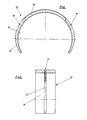
- the wound washer 5 is inserted into a saddle part, which is shown in Fig. 4 in a front view in section represents is.
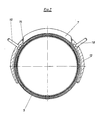
- the saddle part 12 encloses the annular disc, as shown here, to a extent that is greater than 180 °.
- the washer is inserted into a groove 13 on the inner surface 14 of the saddle part, the projection 7 of the washer extending through the recess 15 of the saddle part.
- the saddle part has bores 16 and 17 indicated here, which can accommodate the free wire ends 10 and 11 when the washer is held in the saddle part, so that they protrude outwards from the saddle part.
- the saddle part 12 is shown in a side view in section.
- the same components are labeled with the same reference numbers.
- Fig. 6 the wound washer 5 and the saddle part 12 is shown in an exploded view.
- the same components are identified by the same reference numbers.
- Fig. 6 shows that in the bores 16 and 17 of the saddle part contact pins 18 and 19 can be inserted, in which the free ends 10 and 11 of the wire winding can be inserted and fastened with solder drops 22 accordingly.
- Corresponding clamps of a welding unit can be connected to the contact pins.
- Fig. 7 shows a sectional view through a composite welding element, which consists of the washer 5 and the saddle part 12, wherein the projection 7 of the washer protrudes through the recess 15 in the saddle part.
- a heated welding bar can be pressed onto the edge of the projection 7 protruding from the recess 15, which plasticizes and broadly presses the edge, so that there is a firm connection between the washer and the saddle part.
- Fig. 7 also shows the arrangement of the contact pins 18 and 19, by means of which the connection of the heating wire winding on the washer 5 is ensured with a welding unit.
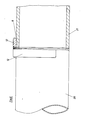
- the welding element designed in this way can, as shown in FIG. 8 is shown, are placed on two flush, butt-butted tubes 20 and 21.
- the washer 5 extends into the joint between the abutting pipe ends.
- the saddle part 12 fixes the pipe ends in the end position necessary for the welding.
- the welding element can remain on the pipe string after welding the pipe ends. However, measures can also be taken to release the connection between the saddle part and the ring disk melted by the welding process, so that the saddle part can be removed.
- the saddle part can also be made of other material, so that reuse is possible if necessary.
- the washer must in any case consist of weldable or heat-plastifiable material which can connect the pipe ends to be welded together.
Landscapes
- Engineering & Computer Science (AREA)
- Mechanical Engineering (AREA)
- General Engineering & Computer Science (AREA)
- Lining Or Joining Of Plastics Or The Like (AREA)
- Branch Pipes, Bends, And The Like (AREA)
Abstract
Zum Verschweißen stumpfgestoßener Rohre aus Kunststoff wird ein Schweißelement mit einer Drahtbewicklung zur elektrischen Widerstandsbeheizung zwischen die aneinanderstoßenden Rohrenden gelegt. Die Rohrenden werden aneinandergedrückt und das Schweißelement gleichzeitig auf Schweißtemperatur erhitzt. Die Rohrenden bleiben anschließend solange aneinandergehalten, bis der verschweißte Bereich durch Erkalten erhärtet ist. Das Schweißelement ist als Ringscheibe ausgebildet, dessen Außendurchmesser etwa gleich dem Außendurchmesser der Rohre ist und dessen Innendurchmesser etwa gleich der Rohrnennweite ist. Eine Heizdrahtwicklung ist spiralförmig um das geometrische Zentrum der Ringscheibe laufend, auf beide mit den Rohrenden zur Anlage kommende Ringseitenflächen gelegt. 
Description
Die Erfindung betrifft ein Verfahren zum Verschweißen stumpfgestoßener Rohre aus Kunststoff und ein Schweißelement zur Durchführung des Verfahrens.The invention relates to a method for welding butt-butted plastic pipes and a welding element for carrying out the method.
Es ist bekannt, Kunststoffrohre stumpf zu verschweißen, indem die aneinanderstoßenden Rohrenden kurzzeitig an einen auf vorbestimmte Temperatur erwärmten Schweißspiegel gepreßt werden. Dadurch werden die Rohrenden erwärmt, das Material der Rohre plastisch und durch Zusammenfügen der vom Schweißspiegel abgehobenen Rohrenden unter Beibehaltung eines vorbestimmten Anpreßdruckes erfolgt die Verbindung.It is known to butt weld plastic pipes by briefly pressing the abutting pipe ends against a welding mirror heated to a predetermined temperature. As a result, the pipe ends are heated, the material of the pipes is plastic and the connection is made by joining the pipe ends lifted off the welding mirror while maintaining a predetermined contact pressure.
Dabei ist die für einwandfreie Verschweißungen notwendige Temperatur möglichst genau einzuhalten. Dies ist jedoch beim Stumpfschweißen mittels Schweißspiegeln relativ schwierig. Die Temperatur des Schweißspiegels kann zwar verhältnismäßig genau vorbestimmt und eingehalten werden, die Temperatur der Rohrenden jedoch nicht. Die durch Anpressen an den Schweißspiegel erwärmten Rohrenden müssen deshalb möglichst schnell ausgerichtet und zusammengepreßt werden, da die Plastizität der erwärmten Rohrenden durch Abkühlung schnell wieder abnimmt.The temperature required for perfect welding must be observed as precisely as possible. However, this is relatively difficult when butt welding using welding mirrors. The temperature of the welding mirror can be predetermined and maintained relatively accurately, but the temperature of the pipe ends cannot. The pipe ends heated by pressing on the welding mirror must therefore be aligned and pressed together as quickly as possible, since the plasticity of the heated pipe ends quickly decreases again due to cooling.
Beim Herausziehen des Schweißspiegels aus der Fuge zwischen zwei Rohrenden kommt es auch oft zu einem Versatz der zu verschweißenden Rohre. Die Rohre müssen deshalb möglichst genau ausgerichtet und in dieser ausgerichteten Stellung auch während des Aneinanderdrückens nach Herausziehen des Schweißspiegels gehalten werden. In der Praxis wird die Ausrichtung dadurch gewährleistet, daß relativ aufwendige Vorrichtungen zum Halten und Aneinanderdrücken der zu verschweißenden Rohre verwendet werden. Wegen dieser Probleme wird das Stumpfschweißen von Kunststoffrohren immer mehr durch das zwar aufwendigere, aber leichter durchzuführende Muffenschweißen ersetzt. Dabei wird über die Nahtstelle zwischen zwei aneinanderstoßenden Rohren ein als elektrisch beheizbare Muffe ausgebildetes Schweißelement geschoben, das mit den Rohren einfach verschweißbar ist. Das Muffenschweißen erfordert zwar aufwendigere Vorbereitungsarbeiten, die beim Stumpfschweißen entfallen können, jedoch sind die Verschweißungen beim Muffenschweißen meistens von besserer Qualität, weil die eigentliche Schweißung hinsichtlich der Schweißtemperatur, der Anpreßdrücke, der Ausrichtung leichter zu beherrschen ist.When the welding mirror is pulled out of the joint between two pipe ends, the pipes to be welded are often offset. The pipes must therefore be aligned as precisely as possible and also in this aligned position pressed together after pulling out the welding mirror. In practice, alignment is ensured by using relatively complex devices for holding and pressing the pipes to be welded together. Because of these problems, butt welding of plastic pipes is increasingly being replaced by socket welding, which is more complex but easier to carry out. In this case, a welding element designed as an electrically heatable sleeve is pushed over the interface between two abutting tubes and can be easily welded to the tubes. Socket welding does require more complex preparatory work, which can be omitted in butt welding, but the welds in socket welding are usually of better quality because the actual welding is easier to master with regard to the welding temperature, the contact pressure and the alignment.
Der Erfindung liegt die Aufgabe zugrunde, das Stumpfschweißen von Kunststoffrohren dahingehend zu verbessern, daß bei vereinfachter Handhabung eine optimale Qualität der Verschweißung gewährleistet ist.The invention has for its object to improve the butt welding of plastic pipes to the effect that an optimal quality of the weld is guaranteed with simplified handling.
Diese Aufgabe ist erfindungsgemäß dadurch gelöst worden, daß ein Schweißelement mit einer Drahtbewicklung zur elektrischen Widerstandsbeheizung zwischen die aneinanderstoßenden Rohrenden gelegt wird, daß die Rohrenden aneinandergedrückt und das Schweißelement gleichzeitig auf Schweißtemperatur erhitzt wird und daß die Rohrenden anschließend solange aneinander gehalten bleiben, bis der verschweißte Bereich durch Erkalten erhärtet ist.This object has been achieved according to the invention in that a welding element with a wire winding for electrical resistance heating is placed between the abutting pipe ends, that the pipe ends are pressed together and the welding element is heated to the welding temperature at the same time, and that the pipe ends then remain together until the welded area is hardened by cooling.
Durch das zwischen die aneinanderzustoßenden Rohrenden setzbare Schweißelement kann auf den Einsatz eines Schweißspiegels verzichtet werden. Die Rohrenden können in eine endgültige Position ausgerichtet werden und werden lediglich aneinandergedrückt, was notfalls auch manuell ausgeführt werden kann. Das zwischengesetzte Schweißelement besteht aus einem Werkstoff, der bei Erwärmung auf Schweißtemperatur die stumpf aneinanderstoßenden Rohrenden miteinander verbindet.The use of a welding mirror can be dispensed with due to the welding element which can be placed between the tube ends to be butted against one another. The pipe ends can be aligned in a final position and are only pressed together, which can also be done manually if necessary. The Intermediate welding element consists of a material which, when heated to the welding temperature, connects the butt-jointed tube ends to one another.
Für eine optimale Verbindung besteht das Schweißelement aus dem gleichen Werkstoff wie die Rohre. Bei Beheizung des Schweißelements durch elektrischen Strom werden auch die aneinanderstoßenden Rohrenden zusammen mit dem Schweißelement bei Schweißtemperatur plastisch, und durch Aneinanderdrücken wird die Verbindung vollendet. Die Schweißnähte sind homogen und haltbar. Die Verschweißung ist einfacher als mit einem Schweißspiegel, da die Temperaturen auf einfachste Weise eingehalten werden können.For an optimal connection, the welding element is made of the same material as the pipes. When the welding element is heated by electrical current, the abutting pipe ends together with the welding element become plastic at the welding temperature, and the connection is completed by pressing them together. The weld seams are homogeneous and durable. The welding is easier than with a welding mirror because the temperatures can be kept in the simplest way.
Ein zur Durchführung des Verfahrens geschaffenes Schweißelement, für welches auch selbständiger Schutz beansprucht wird, zeichnet sich dadurch aus, daß es als Ringscheibe augebildet ist, dessen Außendurchmesser etwa gleich dem Außendurchmesser der Rohre ist und dessen Innendurchmesser etwa gleich der Rohrnennweite ist.A welding element created for carrying out the method, for which independent protection is also claimed, is characterized in that it is designed as an annular disc, the outside diameter of which is approximately equal to the outside diameter of the pipes and the inside diameter of which is approximately the same as the nominal pipe size.
Eine Ringscheibe läßt sich mit Vorteil passend zwischen die Rohrenden setzen. Die äußere Umfangsfläche der Ringscheibe schließt bündig mit den Flächen der Rohrenden ab. Der freie Querschnitt der Rohre ist auch nach dem Verschweißen nur unwesentlich verkleinert, da sich durch das Aneinanderdrücken der Rohrenden lediglich ein kleiner Wulst an der Schweißfuge bildet.An annular disc can advantageously be placed between the pipe ends. The outer peripheral surface of the washer is flush with the surfaces of the pipe ends. The free cross-section of the pipes is only insignificantly reduced even after welding, since only a small bead forms on the weld joint when the pipe ends are pressed together.
Damit die zwischen die Rohrenden gesetzte Ringscheibe und somit auch die an der Ringscheibe anliegenden Rohrenden auf Schweißtemperatur erwärmt werden können, ist vorgesehen, daß eine Heizdrahtwicklung spiralförmig um das geometrische Zentrum der Ringscheibe laufend auf beide mit den Rohrenden zur Anlage kommende Ringseitenflächen gelegt ist. Diese Art der Anordnung der Heizdrahtwicklung hat den Vorteil, daß sich der Heizdraht bei Anlegen des Schweißstroms gleichmäßig erwärmt und somit auch die mit den zu verschweißenden Rohrenden in Kontakt stehenden Oberflächen der Ringscheibe gleichmäßig auf Schweißtemperatur gebracht und an die anliegenden Rohrenden weitergeleitet wird. Überhitzte Bereiche treten nicht auf. Die Wicklung ist derartig gelegt, daß sie, auf einer Seite der Ringscheibe beginnend, spiralförmig nach innen verläuft, dort auf die andere Seite der Ringscheibe durchläuft und dann von innen nach außen wiederum spiralförmig geführt ist. Anfang und Ende des spiralförmig an die Ringseitenflächen gelegten Drahtes stehen von der Ringscheibe ab, so daß sie für den Anschluß der Schweißstromzuführung nutzbar bleiben.So that the ring disk placed between the pipe ends and thus also the pipe ends lying against the ring disk can be heated to welding temperature, it is provided that a heating wire winding is continuously placed around the geometric center of the ring disk on both ring side surfaces coming into contact with the pipe ends. This type of arrangement of the heating wire winding has the advantage that the Heating wire is heated evenly when the welding current is applied, and thus the surfaces of the ring disk that are in contact with the pipe ends to be welded are brought uniformly to the welding temperature and passed on to the adjacent pipe ends. Overheated areas do not appear. The winding is laid in such a way that, starting on one side of the ring disk, it runs spirally inwards, passes there to the other side of the ring disk and is then again guided in a spiral from the inside to the outside. The beginning and end of the wire placed spirally on the side of the ring protrude from the ring disk, so that they remain usable for connecting the welding current supply.
Damit die Heizdrahtwicklung an den Oberflächen der Ringscheibe, den Ringseitenflächen, festgehalten wird, weisen die Ringseitenflächen eingeformte Halteorgane für die Heizdrahtwicklung auf. Als Halteorgane können z.B. den Drahtverlauf vorgebende Rillen vorgesehen sein, in die der Draht unter Klemmung einlegbar ist. Die Heizdrahtwicklung kann dadurch einfach aufgebracht werden, indem die Ringscheibe gedreht wird, wobei der drehenden Ringscheibe der Draht fortlaufend zugeführt und in die jeweils zu beschickende, unter einer Drahtzuführung durchlaufende Rille der Ringscheibe eingedrückt wird.So that the heating wire winding is held on the surfaces of the ring disk, the ring side surfaces, the ring side surfaces have molded-in holding members for the heating wire winding. As holding members e.g. grooves defining the wire path can be provided, into which the wire can be inserted with clamping. The heating wire winding can be applied in a simple manner by rotating the ring disk, the wire being fed continuously to the rotating ring disk and being pressed into the groove of the ring disk to be loaded, which runs under a wire feed.
Selbstverständlich besteht die Ringscheibe aus einem bei Erwärmung plastifizierbaren Material, vorzugsweise aus dem gleichen Kunststoff, aus dem auch die zu verschweißenden Rohre gefertigt sind.Of course, the annular disc consists of a material that can be plasticized when heated, preferably of the same plastic from which the pipes to be welded are also made.
Mit besonderem Vorteil kann die Ringscheibe in ein die Form eines Hülsenabschnittes aufweisendes Sattelteil eingesetzt sein. Das Sattelteil kann im Bereich der Rohrenden zweier miteinander fluchtender Rohre angesetzt werden, wobei die in das Sattelteil eingesetzte Ringscheibe dann in die Fuge zwischen den Rohrenden eingelegt ist, sobald das Sattelteil auf den miteinander fluchtenden Rohren aufliegt. Das Sattelteil erfüllt so mit die vorteilhafte Funktion, die Ringscheibe zwischen den miteinander zu verschweißenden Rohrenden zu positionieren und in dieser Position zu halten, bis die Rohrenden aneinandergedrückt sind und somit die Ringscheibe zwischen sich klemmend halten. Gleichzeitig erfüllt das Sattelteil auch die Funktion, die miteinander zu verbindenden Rohrenden in einer Flucht zu halten, so daß ein nicht erwünschter Versatz der Rohrenden nicht auftreten kann.The ring disk can be inserted with particular advantage into a saddle part having the shape of a sleeve section. The saddle part can be placed in the area of the pipe ends of two pipes that are aligned with one another, the annular disc inserted into the saddle part then being inserted into the joint between the pipe ends as soon as the saddle part rests on the pipes that are aligned with one another. The saddle piece fulfills this with the advantageous function of positioning the washer between the pipe ends to be welded together and holding it in this position until the pipe ends are pressed against one another and thus holding the washer clamped between them. At the same time, the saddle part also fulfills the function of keeping the pipe ends to be connected in alignment, so that an undesired misalignment of the pipe ends cannot occur.
Weiterhin kann das Sattelteil Kontaktelemente aufnehmen, mit denen die Enden der Heizdrahtwicklungen auf der Ringscheibe verbunden sind. Der Anschluß an ein den Schweißstrom abgebendes Schweißaggregat ist dadurch einfach zu handhaben und betriebssicher.Furthermore, the saddle part can accommodate contact elements with which the ends of the heating wire windings are connected on the ring disk. The connection to a welding unit that emits the welding current is therefore easy to use and reliable.
Ein Vorteil ergibt sich daraus, daß das Sattelteil die Ringscheibe in einem Umfang größer als 180° umschließt. Das Sattelteil kann dadurch auf die miteinander zu verbindenden Rohrenden wie eine Klemme wirken, welche die Rohre während des Schweißvorganges einwandfrei positioniert hält. Zusätzliche Haltevorrichtungen für die Rohre während des Verschweißvorganges sind nicht notwendig, da das Halten der Rohre von dem Sattelteil mit übernommen wird.An advantage arises from the fact that the saddle part encloses the ring disk in a circumference greater than 180 °. The saddle part can thus act on the pipe ends to be connected to one another like a clamp, which holds the pipes properly positioned during the welding process. Additional holding devices for the pipes during the welding process are not necessary since the holding of the pipes is also taken over by the saddle part.
Weiterhin zeichnet sich das Verschweißelement dadurch aus, daß die Ringscheibe und das Sattelteil gegenseitig in Eingriff bringbare Verbindungselemente aufweisen. Dadurch läßt sich die Ringscheibe separat vom Sattelteil fertigen, mit dem Vorteil, daß sich die Bewicklung der Ringscheibe mit Heizdraht einfacher gestaltet. Die fertig gewickelte Ringscheibe kann dann mit dem vorbereiteten Sattelteil zu einem einsatzbereiten Schweißelement verbunden werden.Furthermore, the welding element is characterized in that the annular disk and the saddle part have connecting elements which can be brought into engagement with one another. This allows the ring disk to be manufactured separately from the saddle part, with the advantage that the winding of the ring disk with heating wire is easier. The completely wound ring disk can then be connected to the prepared saddle part to form a ready-to-use welding element.
Als Verbindungselement ist wenigstens ein von der Ringscheibe radial abstehender Vorsprung und wenigsten eine den Vorsprung aufnehmende Ausnehmung in dem Sattelteil vorgesehen. Ausnehmung und Vorsprung lassen sich ineinanderstecken, so daß der Zusammenbau von Ringscheibe und Sattelteil einfach ist, auf besondere gegenseitige Ausrichtung und Positionierung braucht dabei nicht geachtet zu werden, denn die Teile passen nur dann ineinander, wenn Vorsprung und Ausnehmung miteinander kongruieren.At least one projection radially projecting from the annular disk and at least one recess in the saddle part receiving the projection are provided as the connecting element. Recess and projection can be inserted into one another, so that the It is easy to assemble the ring washer and saddle part, there is no need to pay attention to special mutual alignment and positioning, because the parts only fit into one another if the projection and recess coincide.
Vorzugsweise ist die Verbindung so gestaltet, daß der Vorsprung durch die Ausnehmung ragt und daß aus der Ausnehmung vorstehende Ränder des Vorsprungs mit dem Sattelteil verbunden sind. Diese Verbindung kann durch Verkleben oder Verschweißen erfolgen. Beim Verschweißen wird beispielsweise ein erwärmter Balken auf den vorstehenden Rand des Vorsprungs gedrückt, bis dieser plastifiziert, breitgedrückt und die Verbindung zwischen Vorsprung und Sattelteil nach Erkalten voll gegeben ist.The connection is preferably designed such that the projection protrudes through the recess and that edges of the projection protruding from the recess are connected to the saddle part. This connection can be made by gluing or welding. When welding, for example, a heated bar is pressed onto the protruding edge of the projection until it is plasticized, pressed wide and the connection between the projection and the saddle part is fully given after cooling.
Da das Sattelteil die miteinander zu verschweißenden Rohrenden ohne Versatz ausrichten und halten soll, liegt es mit seinen Innenwandflächen an der äußeren Mantelfläche der Rohrenden an. Da während des Verschweißens die Rohrenden aneinandergedrückt werden, tritt durch die Erwärmung plastisch gewordenes Material aus der Schweißfuge aus und steht wulstartig vor, wie es bei Stumpfschweißverfahren üblich ist. Um trotz des engen Anliegens des Sattelteils an den Oberflächen der Rohrenden die Ausbildung eines Schweißwulstes zu ermöglichen, ist vorgesehen, daß die Innenmantelfläche des Sattelteils eine dem Umfangsrand der Ringscheibe aufnehmende Nut aufweist, deren Breite größer als die Dicke der Ringscheibe ist. In diese Nut kann plastifiziertes, aus der Schweißfuge zwischen den Rohrenden herausgedrücktes Material ausweichen, so daß sich ein sauberer Schweißwulst zwischen den Rohrenden ausbilden kann.Since the saddle part is intended to align and hold the pipe ends to be welded to one another without misalignment, its inner wall surfaces lie against the outer lateral surface of the pipe ends. Since the pipe ends are pressed against one another during welding, material that has become plastic emerges from the weld joint as a result of the heating and protrudes like a bead, as is usual in butt welding processes. In order to enable the formation of a welding bead despite the close contact of the saddle part on the surfaces of the pipe ends, it is provided that the inner circumferential surface of the saddle part has a groove receiving the circumferential edge of the ring disk, the width of which is greater than the thickness of the ring disk. Plasticized material pressed out of the weld joint between the pipe ends can escape into this groove, so that a clean weld bead can form between the pipe ends.
Vorzugsweise ist der Werkstoff für die Ringscheibe und das Sattelteil Polyethylen, welcher Werkstoff für Rohre, insbesondere Gas- und Wasserrohre üblich ist.The material for the ring disk and the saddle part is preferably polyethylene, which material is common for pipes, in particular gas and water pipes.
Ringscheibe und Sattelteil können in einem einfachen Spritzguß verfahren in großen Stückzahlen hergestellt werden. Da Abmessungen von Rohren genormt sind, können entsprechende Ringscheiben mit Sattelteilen ohne weiteres mit passenden Abmessungen hergestellt werden.The washer and saddle can be injection molded in a simple manner processes can be produced in large numbers. Since the dimensions of pipes are standardized, corresponding ring disks with saddle parts can easily be produced with suitable dimensions.
Ein Ausführungsbeispiel der Erfindung, aus dem sich weitere erfinderische Merkmale ergeben, ist in der Zeichnung dargestellt. Es zeigen:
- Fig. 1 eine Ansicht auf eine Scheibe im Stadium der Vorfertigung eines Schweißelements,
- Fig. 2 eine Schnittansicht der Scheibe gemäß Fig. 1,
- Fig. 3 die durch Einkreisung in Fig. 2 gekennzeichnete Einzelheit X in vergrößerndem Maßstab,
- Fig. 4 eine Vorderansicht eines vorgefertigten Sattelteils im Schnitt,
- Fig. 5 eine Seitenansicht des Sattelteils gemäß Fig. 4 im Schnitt
- Fig. 6 verdeutlicht den Zusammenbau einer fertigen Ringscheibe mit dem Sattelteil zu einem Schweißelement,
- Fig. 7 zeigt eine Ansicht eines zusammengebauten Schweißelements im Schnitt und
- Fig. 8 eine Seitenansicht zweier stumpfgestoßener, miteinander zu verschweißender Rohrenden im Halbschnitt, mit angesetztem Schweißelement.
- 1 is a view of a disc at the stage of prefabrication of a welding element,
- 2 is a sectional view of the disc of FIG. 1,
- 3 shows the detail X marked by encirclement in FIG. 2 on an enlarged scale,
- 4 is a front view of a prefabricated saddle part in section,
- Fig. 5 is a side view of the saddle part of FIG. 4 in section
- 6 illustrates the assembly of a finished annular disc with the saddle part to form a welding element,
- Fig. 7 shows a view of an assembled welding element in section and
- Fig. 8 is a side view of two butt-butted, to be welded pipe ends in half section, with attached welding element.
In Fig. 1 ist eine Vorderansicht einer im Spritzgußverfahren aus Kunststoff gefertigten Scheibe 1 dargestellt, deren äußerer Kreisringbereich, der Ringseitenflächen 2 bildet, mit einer um das geometrische Zentrum 3 der Scheibe spiralförmig verlaufenden Heizdrahtwicklung belegt werden kann. Nach Anbringen der Heizdrahtwicklung wird der schraffierte Zentralbereich 4 der Scheibe weggeschnitten, wodurch eine Ringscheibe 5 mit bewickelten Ringseitenflächen 2 verbleibt.1 shows a front view of a disk 1 made of plastic by injection molding, the outer circular ring region of which forms ring side surfaces 2 can be covered with a heating wire winding which runs spirally around the
Im Übergangsbereich zwischen wegzuschneidendem zentralen Schei benbereich 4 und der Ringseitenfläche 2 ist eine Durchbrechung 6 angeordnet, welche ermöglicht, den Draht der Wicklung von der hier sichbaren Ringseitenfläche 2 der Ringscheibe 5 auf die gegenüberliegende Ringseitenfläche der Rihgscheibe zu führen und dort die Bewicklung dann von innen nach außen fortzusetzen.In the transition area between the central disc to be cut away benbereich 4 and the
Im oberen Bereich ist der Rand der Scheibe mit einem Vorsprung 7 versehen. Der Vorsprung dient zur Befestigung der Ringscheibe an einem nachstehend noch näher erläuterten Sattelteil.The edge of the disc is provided with a
In Fig. 2 ist ein Schnitt durch die Scheibe 1 dargestellt. Gleiche Bauteile sind mit gleichen Bezugszahlen bezeichnet. Fig. 2 läßt die beiden mit Heizdrahtwicklungen versehenen Ringseitenflächen 2 und 2a der Ringscheibe 5 erkennen.2 shows a section through the pane 1. The same components are identified by the same reference numbers. 2 shows the two ring side surfaces 2 and 2a of the
In Fig. 3 ist die durch Einkreisung in Fig. 2 gekennzeichnete Einzelheit X in vergrößerndem Maßstab dargestellt. Gleiche Bauteile sind wieder mit gleichen Bezugszahlen bezeichnet. Fig. 3 läßt erkennen, daß in die Ringseitenflächen 2 und 2a der Ringscheibe 5 Rillen 8 eingeformt sind, die spiralförmig verlaufen und der spiralförmigen Verlegung der Heizdrahtwicklung entsprechen. In die Rille ist ein Heizdraht 9 eingelegt. Der Drahtanfang 10 beginnt im Bereich des Außenumfangs der Ringscheibe 5 und verläuft spiralförmig in der Ebene der Ringseitenfläche 2, bis der Durchbruch 6 erreicht ist. Der Durchbruch ist so angeordnet, daß er sich bis in die unterste Rille erstreckt, so daß der Draht durch den Durchbruch 6 zur gegenüberliegenden Rille 8a geführt werden kann und in einer den Rillen in der Ringseitenfläche 2a folgenden Spirale zum Außenumfang zurückgeführt wird, bis das Drahtende 11 frei zur Verfügung steht. Eine derart bewickelte Scheibe 1 wird anschließend durch Ausstanzen des Zentralbereichs 4 zur Ringscheibe 5 ausgebildet.In Fig. 3, the detail X marked by encirclement in Fig. 2 is shown on an enlarged scale. The same components are again identified by the same reference numbers. Fig. 3 shows that 5
Die bewickelte Ringscheibe 5 wird in ein Sattelteil eingesetzt, das in Fig. 4 in einer Vorderansicht im Schnitt darge stellt ist. Das Sattelteil 12 umschließt die Ringscheibe, wie es hier dargestellt ist, in einem Umfang, der größer ist als 180°. Die Ringscheibe wird in eine Nut 13 an der Innenfläche 14 des Sattelteils eingelegt, wobei sich der Vorsprung 7 der Ringscheibe durch die Ausnehmung 15 des Sattelteils erstreckt. Das Sattelteil weist hier angedeutete Bohrungen 16 und 17 auf, die bei im Sattelteil gehaltener Ringscheibe die freien Drahtenden 10 und 11 aufnehmen können, so daß diese nach außen aus dem Sattelteil vorstehen.The
In Fig. 5 ist das Sattelteil 12 in einer Seitenansicht im Schnitt dargestellt. Gleiche Bauteile sind mit gleichen Bezugszahlen bezeichnet.5, the
In Fig. 6 ist in einer Explosionsdarstellung noch einmal die bewickelte Ringscheibe 5 und das Sattelteil 12 dargestellt. Gleiche Bauteile sind mit gleichen Bezugszahlen bezeichnet. Fig. 6 läßt erkennen, daß in die Bohrungen 16 und 17 des Sattelteils Kontaktstifte 18 und 19 steckbar sind, in die die freien Enden 10 und 11 der Drahtbewicklung einsteckbar und mit Löttropfen 22 entsprechend befestigt werden können. An die Kontaktstifte sind entsprechende Klemmen eines Schweißaggregats anschließbar.In Fig. 6, the
Fig. 7 zeigt eine Schnittansicht durch ein zusammengesetztes Schweißelement, das aus Ringscheibe 5 und Sattelteil 12 besteht, wobei der Vorsprung 7 der Ringscheibe durch die Ausnehmung 15 im Sattelteil vorsteht. Auf den aus der Ausnehmung 15 vorragenden Rand des Vorsprungs 7 kann ein erhitzter Schweißbalken gedrückt werden, der den Rand plastifiziert und breitdrückt, so daß eine feste Verbindung zwischen Ringscheibe und Sattelteil gegeben ist. Fig. 7 läßt auch die Anordnung der Kontaktstifte 18 und 19 erkennen, mittels welcher die Verbindung der Heizdrahtwicklung auf der Ringscheibe 5 mit einem Schweißaggregat gewährleistet ist.Fig. 7 shows a sectional view through a composite welding element, which consists of the
Das derart ausgebildete Schweißelement kann, wie es in Fig. 8 dargestellt ist, auf zwei miteinander fluchtende, stumpfgestoßene Rohre 20 und 21 gesetzt werden. Die Ringscheibe 5 erstreckt sich dabei in die Fuge zwischen den aneinanderstoßenden Rohrenden. Das Sattelteil 12 fixiert die Rohrenden in der für die Verschweißung notwendigen Endstellung.The welding element designed in this way can, as shown in FIG. 8 is shown, are placed on two flush, butt-butted
Das Schweißelement kann nach dem Schweißen der Rohrenden an dem Rohrstrang verbleiben. Es können jedoch auch Maßnahmen getroffen werden, um die Verbindung zwischen Sattelteil und durch den Schweißvorgang zerschmolzener Ringscheibe zu lösen, so daß das Sattelteil abgenommen werden kann.The welding element can remain on the pipe string after welding the pipe ends. However, measures can also be taken to release the connection between the saddle part and the ring disk melted by the welding process, so that the saddle part can be removed.
Das Sattelteil kann auch aus anderem Werkstoff gefertigt werden, so daß gegebenenfalls eine Wiederverwendung möglich ist. Die Ringscheibe muß in jedem Fall aus verschweißbarem, bzw. durch Wärmeeinwirkung plastifizierbarem Material bestehen, welches die miteinander zu verschweißenden Rohrenden verbinden kann.The saddle part can also be made of other material, so that reuse is possible if necessary. The washer must in any case consist of weldable or heat-plastifiable material which can connect the pipe ends to be welded together.
Claims (13)
dadurch gekennzeichnet,
daß ein Schweißelement mit einer Drahtbewicklung zur elektrischen Widerstandsbeheizung zwischen die aneinanderstoßenden Rohrenden (20, 21) gelegt wird, daß die Rohrenden (20, 21) aneinandergedrückt und das Schweißelement gleichzeitig auf Schweißtemperatur erhitzt wird und daß die Rohrenden anschließend solange aneinandergehalten bleiben, bis der verschweißte Bereich durch Erkalten erhärtet ist.1. Process for welding butt-butted plastic pipes,
characterized,
that a welding element with a wire winding for electrical resistance heating is placed between the abutting tube ends (20, 21), that the tube ends (20, 21) are pressed against one another and the welding element is heated to the welding temperature at the same time, and that the tube ends then remain held together until the welded Area hardened by cooling.
Priority Applications (1)
| Application Number | Priority Date | Filing Date | Title |
|---|---|---|---|
| AT87103165T ATE95113T1 (en) | 1986-04-04 | 1987-03-05 | WELDING ELEMENT FOR WELDING BUT-CUT PLASTIC PIPES. |
Applications Claiming Priority (2)
| Application Number | Priority Date | Filing Date | Title |
|---|---|---|---|
| DE19863611192 DE3611192A1 (en) | 1986-04-04 | 1986-04-04 | METHOD FOR WELDING BLAST-PUSHED PIPES OF PLASTIC AND WELDING ELEMENT FOR CARRYING OUT THE METHOD |
| DE3611192 | 1986-04-04 |
Publications (3)
| Publication Number | Publication Date |
|---|---|
| EP0240732A2 true EP0240732A2 (en) | 1987-10-14 |
| EP0240732A3 EP0240732A3 (en) | 1990-01-31 |
| EP0240732B1 EP0240732B1 (en) | 1993-09-29 |
Family
ID=6297846
Family Applications (1)
| Application Number | Title | Priority Date | Filing Date |
|---|---|---|---|
| EP87103165A Expired - Lifetime EP0240732B1 (en) | 1986-04-04 | 1987-03-05 | Welding element for butt-welding plastic pipes |
Country Status (6)
| Country | Link |
|---|---|
| US (1) | US4851647A (en) |
| EP (1) | EP0240732B1 (en) |
| JP (1) | JPS631526A (en) |
| AT (1) | ATE95113T1 (en) |
| DE (2) | DE3611192A1 (en) |
| ES (1) | ES2047479T3 (en) |
Cited By (2)
| Publication number | Priority date | Publication date | Assignee | Title |
|---|---|---|---|---|
| EP0382971B1 (en) * | 1989-02-13 | 1993-09-15 | Uponor Bv | Adjustable pipe bend with electrofusion facility |
| FR2693145A1 (en) * | 1992-07-02 | 1994-01-07 | Fischer Georg Rohrleitung | A method of welding tubular shaped parts and welding element for the implementation of the method. |
Families Citing this family (13)
| Publication number | Priority date | Publication date | Assignee | Title |
|---|---|---|---|---|
| NL8403462A (en) * | 1984-11-13 | 1986-06-02 | Arie De Jong | METHOD FOR MANUFACTURING A CONNECTION FORM, IN PARTICULAR TAPER SEAT AND A CONNECTION FORMATION MADE ACCORDING TO THE METHOD |
| US5104468A (en) * | 1984-11-13 | 1992-04-14 | Riesselmann & Sohn | Method of producing a molded connection piece and method for joining tube with molded connection piece |
| US5407514A (en) * | 1988-02-03 | 1995-04-18 | E. O. Butts Consultants Ltd. | Method for welding thermoplastic materials |
| JPH01124475U (en) * | 1988-02-17 | 1989-08-24 | ||
| US5494318A (en) * | 1993-04-29 | 1996-02-27 | Butts; Nicholas E. | Secondary containment system |
| GB2284179A (en) * | 1993-11-30 | 1995-05-31 | Uponor Aldyl Ltd | Electrofusion coupling element |
| AU6370796A (en) * | 1995-06-28 | 1997-01-30 | Raymond Allan Goldsmid | Element for fusion welding plastics |
| GB2304073B (en) * | 1995-08-04 | 1999-06-16 | Uponor Ltd | Electrofusion element |
| US5736715A (en) * | 1996-03-19 | 1998-04-07 | Thermacor Process, Inc. | Method of forming pressure testable joint between insulated pipes using split sleeve arrangement |
| US6142483A (en) * | 1998-09-21 | 2000-11-07 | The United States Of America As Represented By The Administrator Of The National Aeronautics And Space Administration | Gasket assembly for sealing mating surfaces |
| WO2003036149A2 (en) * | 2001-10-22 | 2003-05-01 | Compagnie Plastic Omnium Corp. | Welded, plastic flange connection |
| DE102004023338A1 (en) * | 2004-05-12 | 2005-12-15 | Gwc Gas-Water-Valves-Components Gmbh | Heating apparatus for welding plastic objects such as pipes or fittings comprises plastic baseplate onto which heating wire is mechanically fastened |
| US8741091B2 (en) * | 2012-04-26 | 2014-06-03 | Richard Hardy | Method for thermoplastic welding and welded composite structures |
Family Cites Families (16)
| Publication number | Priority date | Publication date | Assignee | Title |
|---|---|---|---|---|
| DE7121715U (en) * | 1971-09-02 | Mannesmann Ag | Resistance heating element for welding objects made of thermoplastic plastic | |
| DD1161A (en) * | ||||
| US2744655A (en) * | 1953-09-22 | 1956-05-08 | Vnuk Josef | Lined container and closure therefor |
| DE1055305B (en) * | 1954-05-26 | 1959-04-16 | Ramsay Olaf St George | Connection part made of thermoplastic material in the form of a sleeve, a T-piece or L-piece |
| CH336980A (en) * | 1955-09-16 | 1959-03-15 | Fischer Ag Georg | Process for welding together pipe elements made of plastic |
| US3378672A (en) * | 1966-03-18 | 1968-04-16 | Susquehanna Corp | Insulated, electrical resistance wire and welding sleeve made therefrom |
| DE1629221B2 (en) * | 1966-06-10 | 1972-12-21 | Wegener, Willy, Dipl.-Ing., 5100 Aachen | Welding mirror for butt welding of pipes and containers made of thermoplastic material |
| CH507081A (en) * | 1969-04-09 | 1971-05-15 | Gebert & Cie | Connection sleeve for welding plastic pipes |
| JPS5150375A (en) * | 1974-10-30 | 1976-05-01 | Furukawa Electric Co Ltd | |
| FR2353381A1 (en) * | 1976-06-03 | 1977-12-30 | Pont A Mousson | ASSEMBLY PROCESS BY WELDING PLASTIC TUBES AND CONNECTING FOR SUCH ASSEMBLY |
| US4313053A (en) * | 1980-01-02 | 1982-01-26 | Von Roll A.G. | Welding sleeve of thermoplastic material |
| FR2519578A1 (en) * | 1981-07-01 | 1983-07-18 | Sam Innovation Tech | PLASTIC DEVICE FOR REALIZING PERFORATION IN A PLASTIC UNDERLYING ELEMENT, METHOD OF MANUFACTURING SUCH A DEVICE AND ITS IMPLEMENTATION FOR PERFORMING PIPELINE DERIVATIONS |
| MC1446A1 (en) * | 1981-07-01 | 1982-12-06 | Innovation Tech Innotec | ELECTROSOLDABLE BYPASS FOR THERMOPLASTIC MATERIAL PIPING |
| GB8410765D0 (en) * | 1984-04-27 | 1984-06-06 | Glynwed Tubes & Fittings | Fusion pad |
| ATE32132T1 (en) * | 1984-08-08 | 1988-02-15 | Fischer Ag Georg | DRILLING PIECE MADE OF WELDABLE PLASTIC. |
| US4689108A (en) * | 1985-11-04 | 1987-08-25 | Gte Government Systems Corporation | Apparatus for assembling electrochemical batteries and similar articles |
-
1986
- 1986-04-04 DE DE19863611192 patent/DE3611192A1/en not_active Ceased
-
1987
- 1987-03-05 ES ES87103165T patent/ES2047479T3/en not_active Expired - Lifetime
- 1987-03-05 DE DE87103165T patent/DE3787557D1/en not_active Expired - Fee Related
- 1987-03-05 AT AT87103165T patent/ATE95113T1/en not_active IP Right Cessation
- 1987-03-05 EP EP87103165A patent/EP0240732B1/en not_active Expired - Lifetime
- 1987-04-02 JP JP62079842A patent/JPS631526A/en active Pending
-
1988
- 1988-08-01 US US07/226,545 patent/US4851647A/en not_active Expired - Fee Related
Cited By (3)
| Publication number | Priority date | Publication date | Assignee | Title |
|---|---|---|---|---|
| EP0382971B1 (en) * | 1989-02-13 | 1993-09-15 | Uponor Bv | Adjustable pipe bend with electrofusion facility |
| FR2693145A1 (en) * | 1992-07-02 | 1994-01-07 | Fischer Georg Rohrleitung | A method of welding tubular shaped parts and welding element for the implementation of the method. |
| DE4224680A1 (en) * | 1992-07-02 | 1994-01-27 | Fischer Georg Rohrleitung | Method for welding tubular parts and a welding element for carrying out the method |
Also Published As
| Publication number | Publication date |
|---|---|
| JPS631526A (en) | 1988-01-06 |
| US4851647A (en) | 1989-07-25 |
| ES2047479T3 (en) | 1994-03-01 |
| EP0240732B1 (en) | 1993-09-29 |
| DE3611192A1 (en) | 1987-10-15 |
| DE3787557D1 (en) | 1993-11-04 |
| EP0240732A3 (en) | 1990-01-31 |
| ATE95113T1 (en) | 1993-10-15 |
Similar Documents
| Publication | Publication Date | Title |
|---|---|---|
| EP0240732A2 (en) | Welding element for butt-welding plastic pipes | |
| DE69021955T2 (en) | Method and device for interconnecting pipes. | |
| DE2724981C3 (en) | Welding ring for connecting plastic pipes | |
| DE69028097T2 (en) | MELT JOINING PIPE SYSTEMS AND THE METHOD THEREFOR | |
| EP0076460B1 (en) | Welding joint for plastics tubes | |
| EP0170845B1 (en) | Shaped piercing piece for joining a branch pipe | |
| DE2208862B2 (en) | Electrically weldable tapping saddle made of thermoplastic material | |
| EP0689931A2 (en) | Process for welding plastic tubes and socket for its realisation | |
| DE1908888A1 (en) | Pipe connection and process for their manufacture | |
| EP1756464B1 (en) | Connecting arrangement, particularly for the non-positive fastening of at least one fiber composite component to another component | |
| DE4441373C2 (en) | Pipe connection, in particular for pipes with at least one plastic layer | |
| DE68914996T3 (en) | METHOD AND DEVICE FOR CONNECTING TWO TUBULAR PLASTIC PRODUCTS. | |
| DE3615947C1 (en) | Welding and centring ring | |
| EP3271138B1 (en) | Induction connection sleeve | |
| DE4224680A1 (en) | Method for welding tubular parts and a welding element for carrying out the method | |
| EP1752699A2 (en) | Line-coupling between a fitting and a composite pipe as well as a method of production of a line-coupling | |
| EP3298316B1 (en) | Flange connection for components composed of plastic, in particular for tubular components composed of plastic | |
| DE9107311U1 (en) | Welding sleeve | |
| DE19612279C2 (en) | Housing, in particular socket housing for incandescent lamps with a screw base, and method for producing such a housing and devices for carrying out the method | |
| EP1506834A1 (en) | Method, welding device and welding filler for welding a seam between two workpieces, in particular for manufacturing a level measuring device | |
| DE3708705A1 (en) | METHOD AND DEVICE FOR WELDING TUBULAR PLASTIC PARTS | |
| DE19722275C2 (en) | Connection of plastic pipe parts | |
| DE4136349C2 (en) | Welding device for plastic pipes | |
| EP1927806A1 (en) | Device for connecting two pipes | |
| DE20218378U1 (en) | Weldable branch saddle for plastic pipes has heating coil with vertically standing windings fused onto underside of saddle surface, whereby depth of fusion corresponds approximately to wire thickness of coil |
Legal Events
| Date | Code | Title | Description |
|---|---|---|---|
| PUAI | Public reference made under article 153(3) epc to a published international application that has entered the european phase |
Free format text: ORIGINAL CODE: 0009012 |
|
| AK | Designated contracting states |
Kind code of ref document: A2 Designated state(s): AT BE CH DE ES FR GB GR IT LI LU NL SE |
|
| PUAL | Search report despatched |
Free format text: ORIGINAL CODE: 0009013 |
|
| AK | Designated contracting states |
Kind code of ref document: A3 Designated state(s): AT BE CH DE ES FR GB GR IT LI LU NL SE |
|
| 17P | Request for examination filed |
Effective date: 19900613 |
|
| 17Q | First examination report despatched |
Effective date: 19910610 |
|
| GRAA | (expected) grant |
Free format text: ORIGINAL CODE: 0009210 |
|
| AK | Designated contracting states |
Kind code of ref document: B1 Designated state(s): AT BE CH DE ES FR GB GR IT LI LU NL SE |
|
| REF | Corresponds to: |
Ref document number: 95113 Country of ref document: AT Date of ref document: 19931015 Kind code of ref document: T |
|
| REF | Corresponds to: |
Ref document number: 3787557 Country of ref document: DE Date of ref document: 19931104 |
|
| ITF | It: translation for a ep patent filed | ||
| ET | Fr: translation filed | ||
| GBT | Gb: translation of ep patent filed (gb section 77(6)(a)/1977) |
Effective date: 19940113 |
|
| REG | Reference to a national code |
Ref country code: GR Ref legal event code: FG4A Free format text: 3010319 |
|
| REG | Reference to a national code |
Ref country code: ES Ref legal event code: FG2A Ref document number: 2047479 Country of ref document: ES Kind code of ref document: T3 |
|
| PGFP | Annual fee paid to national office [announced via postgrant information from national office to epo] |
Ref country code: NL Payment date: 19940331 Year of fee payment: 8 Ref country code: LU Payment date: 19940331 Year of fee payment: 8 Ref country code: GB Payment date: 19940331 Year of fee payment: 8 Ref country code: FR Payment date: 19940331 Year of fee payment: 8 Ref country code: AT Payment date: 19940331 Year of fee payment: 8 |
|
| PGFP | Annual fee paid to national office [announced via postgrant information from national office to epo] |
Ref country code: BE Payment date: 19940401 Year of fee payment: 8 |
|
| PGFP | Annual fee paid to national office [announced via postgrant information from national office to epo] |
Ref country code: SE Payment date: 19940406 Year of fee payment: 8 |
|
| PGFP | Annual fee paid to national office [announced via postgrant information from national office to epo] |
Ref country code: DE Payment date: 19940412 Year of fee payment: 8 |
|
| PGFP | Annual fee paid to national office [announced via postgrant information from national office to epo] |
Ref country code: ES Payment date: 19940418 Year of fee payment: 8 |
|
| PGFP | Annual fee paid to national office [announced via postgrant information from national office to epo] |
Ref country code: GR Payment date: 19940427 Year of fee payment: 8 |
|
| PGFP | Annual fee paid to national office [announced via postgrant information from national office to epo] |
Ref country code: CH Payment date: 19940503 Year of fee payment: 8 |
|
| EPTA | Lu: last paid annual fee | ||
| PLBE | No opposition filed within time limit |
Free format text: ORIGINAL CODE: 0009261 |
|
| STAA | Information on the status of an ep patent application or granted ep patent |
Free format text: STATUS: NO OPPOSITION FILED WITHIN TIME LIMIT |
|
| 26N | No opposition filed | ||
| EAL | Se: european patent in force in sweden |
Ref document number: 87103165.4 |
|
| PG25 | Lapsed in a contracting state [announced via postgrant information from national office to epo] |
Ref country code: LU Free format text: LAPSE BECAUSE OF NON-PAYMENT OF DUE FEES Effective date: 19950305 Ref country code: GB Effective date: 19950305 Ref country code: AT Effective date: 19950305 |
|
| PG25 | Lapsed in a contracting state [announced via postgrant information from national office to epo] |
Ref country code: SE Effective date: 19950306 Ref country code: ES Free format text: LAPSE BECAUSE OF NON-PAYMENT OF DUE FEES Effective date: 19950306 |
|
| PG25 | Lapsed in a contracting state [announced via postgrant information from national office to epo] |
Ref country code: LI Effective date: 19950331 Ref country code: CH Effective date: 19950331 Ref country code: BE Effective date: 19950331 |
|
| BERE | Be: lapsed |
Owner name: RIESSELMANN & SOHN Effective date: 19950331 |
|
| PG25 | Lapsed in a contracting state [announced via postgrant information from national office to epo] |
Ref country code: GR Free format text: THE PATENT HAS BEEN ANNULLED BY A DECISION OF A NATIONAL AUTHORITY Effective date: 19950930 |
|
| PG25 | Lapsed in a contracting state [announced via postgrant information from national office to epo] |
Ref country code: NL Effective date: 19951001 |
|
| GBPC | Gb: european patent ceased through non-payment of renewal fee |
Effective date: 19950305 |
|
| PG25 | Lapsed in a contracting state [announced via postgrant information from national office to epo] |
Ref country code: FR Free format text: LAPSE BECAUSE OF NON-PAYMENT OF DUE FEES Effective date: 19951130 |
|
| REG | Reference to a national code |
Ref country code: CH Ref legal event code: PL Ref country code: GR Ref legal event code: MM2A Free format text: 3010319 |
|
| NLV4 | Nl: lapsed or anulled due to non-payment of the annual fee |
Effective date: 19951001 |
|
| PG25 | Lapsed in a contracting state [announced via postgrant information from national office to epo] |
Ref country code: DE Effective date: 19951201 |
|
| EUG | Se: european patent has lapsed |
Ref document number: 87103165.4 |
|
| REG | Reference to a national code |
Ref country code: FR Ref legal event code: ST |
|
| REG | Reference to a national code |
Ref country code: ES Ref legal event code: FD2A Effective date: 19990201 |
|
| PG25 | Lapsed in a contracting state [announced via postgrant information from national office to epo] |
Ref country code: IT Free format text: LAPSE BECAUSE OF NON-PAYMENT OF DUE FEES;WARNING: LAPSES OF ITALIAN PATENTS WITH EFFECTIVE DATE BEFORE 2007 MAY HAVE OCCURRED AT ANY TIME BEFORE 2007. THE CORRECT EFFECTIVE DATE MAY BE DIFFERENT FROM THE ONE RECORDED. Effective date: 20050305 |