EP0242512A2 - Verbundwerkstoffe, Verfahren zu ihrer Herstellung und Verwendung - Google Patents
Verbundwerkstoffe, Verfahren zu ihrer Herstellung und Verwendung Download PDFInfo
- Publication number
- EP0242512A2 EP0242512A2 EP87101493A EP87101493A EP0242512A2 EP 0242512 A2 EP0242512 A2 EP 0242512A2 EP 87101493 A EP87101493 A EP 87101493A EP 87101493 A EP87101493 A EP 87101493A EP 0242512 A2 EP0242512 A2 EP 0242512A2
- Authority
- EP
- European Patent Office
- Prior art keywords
- prepregs
- novolak
- composite materials
- resin
- epoxy resin
- Prior art date
- Legal status (The legal status is an assumption and is not a legal conclusion. Google has not performed a legal analysis and makes no representation as to the accuracy of the status listed.)
- Granted
Links
- 239000002131 composite material Substances 0.000 title claims abstract description 39
- 238000004519 manufacturing process Methods 0.000 title claims description 8
- 238000000034 method Methods 0.000 title claims description 6
- 239000003822 epoxy resin Substances 0.000 claims abstract description 24
- 229920000647 polyepoxide Polymers 0.000 claims abstract description 24
- 229920003986 novolac Polymers 0.000 claims abstract description 21
- 238000003825 pressing Methods 0.000 claims abstract description 10
- 229920005989 resin Polymers 0.000 claims description 25
- 239000011347 resin Substances 0.000 claims description 25
- WSFSSNUMVMOOMR-UHFFFAOYSA-N Formaldehyde Chemical compound O=C WSFSSNUMVMOOMR-UHFFFAOYSA-N 0.000 claims description 16
- VKYKSIONXSXAKP-UHFFFAOYSA-N hexamethylenetetramine Chemical compound C1N(C2)CN3CN1CN2C3 VKYKSIONXSXAKP-UHFFFAOYSA-N 0.000 claims description 14
- IJGRMHOSHXDMSA-UHFFFAOYSA-N Atomic nitrogen Chemical compound N#N IJGRMHOSHXDMSA-UHFFFAOYSA-N 0.000 claims description 8
- 239000004312 hexamethylene tetramine Substances 0.000 claims description 7
- 235000010299 hexamethylene tetramine Nutrition 0.000 claims description 7
- 239000012779 reinforcing material Substances 0.000 claims description 7
- 239000004593 Epoxy Substances 0.000 claims description 5
- 239000007795 chemical reaction product Substances 0.000 claims description 5
- 239000004848 polyfunctional curative Substances 0.000 claims description 5
- 229910052757 nitrogen Inorganic materials 0.000 claims description 4
- 229920001187 thermosetting polymer Polymers 0.000 claims description 3
- 239000003562 lightweight material Substances 0.000 claims description 2
- 229920001169 thermoplastic Polymers 0.000 claims description 2
- 229920001971 elastomer Polymers 0.000 claims 1
- 239000005060 rubber Substances 0.000 claims 1
- 239000004634 thermosetting polymer Substances 0.000 claims 1
- 239000000779 smoke Substances 0.000 abstract description 8
- 230000000704 physical effect Effects 0.000 abstract 1
- 229920001568 phenolic resin Polymers 0.000 description 15
- 239000005011 phenolic resin Substances 0.000 description 14
- KXGFMDJXCMQABM-UHFFFAOYSA-N 2-methoxy-6-methylphenol Chemical compound [CH]OC1=CC=CC([CH])=C1O KXGFMDJXCMQABM-UHFFFAOYSA-N 0.000 description 9
- ISWSIDIOOBJBQZ-UHFFFAOYSA-N phenol group Chemical group C1(=CC=CC=C1)O ISWSIDIOOBJBQZ-UHFFFAOYSA-N 0.000 description 9
- 239000004744 fabric Substances 0.000 description 8
- 239000000835 fiber Substances 0.000 description 6
- LNEPOXFFQSENCJ-UHFFFAOYSA-N haloperidol Chemical compound C1CC(O)(C=2C=CC(Cl)=CC=2)CCN1CCCC(=O)C1=CC=C(F)C=C1 LNEPOXFFQSENCJ-UHFFFAOYSA-N 0.000 description 6
- XLYOFNOQVPJJNP-UHFFFAOYSA-N water Chemical compound O XLYOFNOQVPJJNP-UHFFFAOYSA-N 0.000 description 6
- 241000264877 Hippospongia communis Species 0.000 description 5
- 235000019256 formaldehyde Nutrition 0.000 description 5
- 239000011159 matrix material Substances 0.000 description 5
- 238000010521 absorption reaction Methods 0.000 description 4
- 239000002585 base Substances 0.000 description 4
- 239000000203 mixture Substances 0.000 description 4
- MUBZPKHOEPUJKR-UHFFFAOYSA-N Oxalic acid Chemical compound OC(=O)C(O)=O MUBZPKHOEPUJKR-UHFFFAOYSA-N 0.000 description 3
- IISBACLAFKSPIT-UHFFFAOYSA-N bisphenol A Chemical compound C=1C=C(O)C=CC=1C(C)(C)C1=CC=C(O)C=C1 IISBACLAFKSPIT-UHFFFAOYSA-N 0.000 description 3
- 239000003795 chemical substances by application Substances 0.000 description 3
- 239000005007 epoxy-phenolic resin Substances 0.000 description 3
- 229920000642 polymer Polymers 0.000 description 3
- 239000007787 solid Substances 0.000 description 3
- PLIKAWJENQZMHA-UHFFFAOYSA-N 4-aminophenol Chemical compound NC1=CC=C(O)C=C1 PLIKAWJENQZMHA-UHFFFAOYSA-N 0.000 description 2
- 229920000049 Carbon (fiber) Polymers 0.000 description 2
- VZCYOOQTPOCHFL-OWOJBTEDSA-N Fumaric acid Chemical compound OC(=O)\C=C\C(O)=O VZCYOOQTPOCHFL-OWOJBTEDSA-N 0.000 description 2
- VEXZGXHMUGYJMC-UHFFFAOYSA-N Hydrochloric acid Chemical compound Cl VEXZGXHMUGYJMC-UHFFFAOYSA-N 0.000 description 2
- QIGBRXMKCJKVMJ-UHFFFAOYSA-N Hydroquinone Chemical compound OC1=CC=C(O)C=C1 QIGBRXMKCJKVMJ-UHFFFAOYSA-N 0.000 description 2
- NBIIXXVUZAFLBC-UHFFFAOYSA-N Phosphoric acid Chemical compound OP(O)(O)=O NBIIXXVUZAFLBC-UHFFFAOYSA-N 0.000 description 2
- QAOWNCQODCNURD-UHFFFAOYSA-N Sulfuric acid Chemical compound OS(O)(=O)=O QAOWNCQODCNURD-UHFFFAOYSA-N 0.000 description 2
- 230000032683 aging Effects 0.000 description 2
- XAGFODPZIPBFFR-UHFFFAOYSA-N aluminium Chemical compound [Al] XAGFODPZIPBFFR-UHFFFAOYSA-N 0.000 description 2
- 229910052782 aluminium Inorganic materials 0.000 description 2
- PXKLMJQFEQBVLD-UHFFFAOYSA-N bisphenol F Chemical compound C1=CC(O)=CC=C1CC1=CC=C(O)C=C1 PXKLMJQFEQBVLD-UHFFFAOYSA-N 0.000 description 2
- 239000004917 carbon fiber Substances 0.000 description 2
- 239000003054 catalyst Substances 0.000 description 2
- YCIMNLLNPGFGHC-UHFFFAOYSA-N catechol Chemical compound OC1=CC=CC=C1O YCIMNLLNPGFGHC-UHFFFAOYSA-N 0.000 description 2
- 238000006243 chemical reaction Methods 0.000 description 2
- 230000002860 competitive effect Effects 0.000 description 2
- 238000007906 compression Methods 0.000 description 2
- 230000006835 compression Effects 0.000 description 2
- 150000001896 cresols Chemical class 0.000 description 2
- QGBSISYHAICWAH-UHFFFAOYSA-N dicyandiamide Chemical compound NC(N)=NC#N QGBSISYHAICWAH-UHFFFAOYSA-N 0.000 description 2
- 238000009792 diffusion process Methods 0.000 description 2
- 239000011521 glass Substances 0.000 description 2
- VNWKTOKETHGBQD-UHFFFAOYSA-N methane Chemical compound C VNWKTOKETHGBQD-UHFFFAOYSA-N 0.000 description 2
- 229920000728 polyester Polymers 0.000 description 2
- 229920003987 resole Polymers 0.000 description 2
- GHMLBKRAJCXXBS-UHFFFAOYSA-N resorcinol Chemical compound OC1=CC=CC(O)=C1 GHMLBKRAJCXXBS-UHFFFAOYSA-N 0.000 description 2
- 239000002904 solvent Substances 0.000 description 2
- 238000003860 storage Methods 0.000 description 2
- 239000000126 substance Substances 0.000 description 2
- VZCYOOQTPOCHFL-UHFFFAOYSA-N trans-butenedioic acid Natural products OC(=O)C=CC(O)=O VZCYOOQTPOCHFL-UHFFFAOYSA-N 0.000 description 2
- 150000003739 xylenols Chemical class 0.000 description 2
- VASMRQAVWVVDPA-UHFFFAOYSA-N 1,3,5-triphenyl-1,3,5-triazinane Chemical compound C1N(C=2C=CC=CC=2)CN(C=2C=CC=CC=2)CN1C1=CC=CC=C1 VASMRQAVWVVDPA-UHFFFAOYSA-N 0.000 description 1
- WZCQRUWWHSTZEM-UHFFFAOYSA-N 1,3-phenylenediamine Chemical compound NC1=CC=CC(N)=C1 WZCQRUWWHSTZEM-UHFFFAOYSA-N 0.000 description 1
- RNFJDJUURJAICM-UHFFFAOYSA-N 2,2,4,4,6,6-hexaphenoxy-1,3,5-triaza-2$l^{5},4$l^{5},6$l^{5}-triphosphacyclohexa-1,3,5-triene Chemical compound N=1P(OC=2C=CC=CC=2)(OC=2C=CC=CC=2)=NP(OC=2C=CC=CC=2)(OC=2C=CC=CC=2)=NP=1(OC=1C=CC=CC=1)OC1=CC=CC=C1 RNFJDJUURJAICM-UHFFFAOYSA-N 0.000 description 1
- YPACMOORZSDQDQ-UHFFFAOYSA-N 3-(4-aminobenzoyl)oxypropyl 4-aminobenzoate Chemical compound C1=CC(N)=CC=C1C(=O)OCCCOC(=O)C1=CC=C(N)C=C1 YPACMOORZSDQDQ-UHFFFAOYSA-N 0.000 description 1
- QHPQWRBYOIRBIT-UHFFFAOYSA-N 4-tert-butylphenol Chemical compound CC(C)(C)C1=CC=C(O)C=C1 QHPQWRBYOIRBIT-UHFFFAOYSA-N 0.000 description 1
- ZOXJGFHDIHLPTG-UHFFFAOYSA-N Boron Chemical compound [B] ZOXJGFHDIHLPTG-UHFFFAOYSA-N 0.000 description 1
- OKTJSMMVPCPJKN-UHFFFAOYSA-N Carbon Chemical compound [C] OKTJSMMVPCPJKN-UHFFFAOYSA-N 0.000 description 1
- UGFAIRIUMAVXCW-UHFFFAOYSA-N Carbon monoxide Chemical compound [O+]#[C-] UGFAIRIUMAVXCW-UHFFFAOYSA-N 0.000 description 1
- MQJKPEGWNLWLTK-UHFFFAOYSA-N Dapsone Chemical compound C1=CC(N)=CC=C1S(=O)(=O)C1=CC=C(N)C=C1 MQJKPEGWNLWLTK-UHFFFAOYSA-N 0.000 description 1
- BRLQWZUYTZBJKN-UHFFFAOYSA-N Epichlorohydrin Chemical compound ClCC1CO1 BRLQWZUYTZBJKN-UHFFFAOYSA-N 0.000 description 1
- 239000004609 Impact Modifier Substances 0.000 description 1
- 229920000784 Nomex Polymers 0.000 description 1
- IGFHQQFPSIBGKE-UHFFFAOYSA-N Nonylphenol Natural products CCCCCCCCCC1=CC=C(O)C=C1 IGFHQQFPSIBGKE-UHFFFAOYSA-N 0.000 description 1
- 239000004952 Polyamide Substances 0.000 description 1
- OFOBLEOULBTSOW-UHFFFAOYSA-N Propanedioic acid Natural products OC(=O)CC(O)=O OFOBLEOULBTSOW-UHFFFAOYSA-N 0.000 description 1
- 239000002262 Schiff base Substances 0.000 description 1
- 150000004753 Schiff bases Chemical class 0.000 description 1
- 230000002378 acidificating effect Effects 0.000 description 1
- 239000000654 additive Substances 0.000 description 1
- 229910000147 aluminium phosphate Inorganic materials 0.000 description 1
- 239000004760 aramid Substances 0.000 description 1
- 229920003235 aromatic polyamide Polymers 0.000 description 1
- 239000004842 bisphenol F epoxy resin Substances 0.000 description 1
- 229910052796 boron Inorganic materials 0.000 description 1
- 229910052799 carbon Inorganic materials 0.000 description 1
- 239000000919 ceramic Substances 0.000 description 1
- 239000011248 coating agent Substances 0.000 description 1
- 238000000576 coating method Methods 0.000 description 1
- 150000001875 compounds Chemical class 0.000 description 1
- 239000007859 condensation product Substances 0.000 description 1
- XXBDWLFCJWSEKW-UHFFFAOYSA-N dimethylbenzylamine Chemical compound CN(C)CC1=CC=CC=C1 XXBDWLFCJWSEKW-UHFFFAOYSA-N 0.000 description 1
- ZZTCPWRAHWXWCH-UHFFFAOYSA-N diphenylmethanediamine Chemical compound C=1C=CC=CC=1C(N)(N)C1=CC=CC=C1 ZZTCPWRAHWXWCH-UHFFFAOYSA-N 0.000 description 1
- 230000000694 effects Effects 0.000 description 1
- 229920006332 epoxy adhesive Polymers 0.000 description 1
- 230000008020 evaporation Effects 0.000 description 1
- 238000001704 evaporation Methods 0.000 description 1
- 230000002349 favourable effect Effects 0.000 description 1
- 239000003063 flame retardant Substances 0.000 description 1
- 239000003546 flue gas Substances 0.000 description 1
- 238000009472 formulation Methods 0.000 description 1
- 239000001530 fumaric acid Substances 0.000 description 1
- 239000003365 glass fiber Substances 0.000 description 1
- 150000002357 guanidines Chemical class 0.000 description 1
- 238000010438 heat treatment Methods 0.000 description 1
- 150000002460 imidazoles Chemical class 0.000 description 1
- 238000005470 impregnation Methods 0.000 description 1
- 229940079865 intestinal antiinfectives imidazole derivative Drugs 0.000 description 1
- 239000007788 liquid Substances 0.000 description 1
- 231100000053 low toxicity Toxicity 0.000 description 1
- 229940018564 m-phenylenediamine Drugs 0.000 description 1
- VZCYOOQTPOCHFL-UPHRSURJSA-N maleic acid Chemical compound OC(=O)\C=C/C(O)=O VZCYOOQTPOCHFL-UPHRSURJSA-N 0.000 description 1
- 239000011976 maleic acid Substances 0.000 description 1
- 239000000463 material Substances 0.000 description 1
- 230000007246 mechanism Effects 0.000 description 1
- 230000005499 meniscus Effects 0.000 description 1
- 239000004763 nomex Substances 0.000 description 1
- 239000004745 nonwoven fabric Substances 0.000 description 1
- SNQQPOLDUKLAAF-UHFFFAOYSA-N nonylphenol Chemical compound CCCCCCCCCC1=CC=CC=C1O SNQQPOLDUKLAAF-UHFFFAOYSA-N 0.000 description 1
- 150000007524 organic acids Chemical class 0.000 description 1
- 235000005985 organic acids Nutrition 0.000 description 1
- 235000006408 oxalic acid Nutrition 0.000 description 1
- 229920001643 poly(ether ketone) Polymers 0.000 description 1
- 229920002492 poly(sulfone) Polymers 0.000 description 1
- 229920000058 polyacrylate Polymers 0.000 description 1
- 229920005559 polyacrylic rubber Polymers 0.000 description 1
- 229920002239 polyacrylonitrile Polymers 0.000 description 1
- 229920002647 polyamide Polymers 0.000 description 1
- 229920002857 polybutadiene Polymers 0.000 description 1
- 229920006393 polyether sulfone Polymers 0.000 description 1
- 229920001601 polyetherimide Polymers 0.000 description 1
- 239000002994 raw material Substances 0.000 description 1
- 230000002787 reinforcement Effects 0.000 description 1
- 229920003051 synthetic elastomer Polymers 0.000 description 1
- 239000005061 synthetic rubber Substances 0.000 description 1
- 239000004416 thermosoftening plastic Substances 0.000 description 1
- 231100000419 toxicity Toxicity 0.000 description 1
- 230000001988 toxicity Effects 0.000 description 1
Classifications
-
- B—PERFORMING OPERATIONS; TRANSPORTING
- B29—WORKING OF PLASTICS; WORKING OF SUBSTANCES IN A PLASTIC STATE IN GENERAL
- B29C—SHAPING OR JOINING OF PLASTICS; SHAPING OF MATERIAL IN A PLASTIC STATE, NOT OTHERWISE PROVIDED FOR; AFTER-TREATMENT OF THE SHAPED PRODUCTS, e.g. REPAIRING
- B29C70/00—Shaping composites, i.e. plastics material comprising reinforcements, fillers or preformed parts, e.g. inserts
- B29C70/04—Shaping composites, i.e. plastics material comprising reinforcements, fillers or preformed parts, e.g. inserts comprising reinforcements only, e.g. self-reinforcing plastics
- B29C70/06—Fibrous reinforcements only
- B29C70/08—Fibrous reinforcements only comprising combinations of different forms of fibrous reinforcements incorporated in matrix material, forming one or more layers, and with or without non-reinforced layers
-
- C—CHEMISTRY; METALLURGY
- C08—ORGANIC MACROMOLECULAR COMPOUNDS; THEIR PREPARATION OR CHEMICAL WORKING-UP; COMPOSITIONS BASED THEREON
- C08J—WORKING-UP; GENERAL PROCESSES OF COMPOUNDING; AFTER-TREATMENT NOT COVERED BY SUBCLASSES C08B, C08C, C08F, C08G or C08H
- C08J5/00—Manufacture of articles or shaped materials containing macromolecular substances
- C08J5/24—Impregnating materials with prepolymers which can be polymerised in situ, e.g. manufacture of prepregs
- C08J5/241—Impregnating materials with prepolymers which can be polymerised in situ, e.g. manufacture of prepregs using inorganic fibres
- C08J5/243—Impregnating materials with prepolymers which can be polymerised in situ, e.g. manufacture of prepregs using inorganic fibres using carbon fibres
-
- C—CHEMISTRY; METALLURGY
- C08—ORGANIC MACROMOLECULAR COMPOUNDS; THEIR PREPARATION OR CHEMICAL WORKING-UP; COMPOSITIONS BASED THEREON
- C08J—WORKING-UP; GENERAL PROCESSES OF COMPOUNDING; AFTER-TREATMENT NOT COVERED BY SUBCLASSES C08B, C08C, C08F, C08G or C08H
- C08J5/00—Manufacture of articles or shaped materials containing macromolecular substances
- C08J5/24—Impregnating materials with prepolymers which can be polymerised in situ, e.g. manufacture of prepregs
- C08J5/241—Impregnating materials with prepolymers which can be polymerised in situ, e.g. manufacture of prepregs using inorganic fibres
- C08J5/244—Impregnating materials with prepolymers which can be polymerised in situ, e.g. manufacture of prepregs using inorganic fibres using glass fibres
-
- C—CHEMISTRY; METALLURGY
- C08—ORGANIC MACROMOLECULAR COMPOUNDS; THEIR PREPARATION OR CHEMICAL WORKING-UP; COMPOSITIONS BASED THEREON
- C08J—WORKING-UP; GENERAL PROCESSES OF COMPOUNDING; AFTER-TREATMENT NOT COVERED BY SUBCLASSES C08B, C08C, C08F, C08G or C08H
- C08J5/00—Manufacture of articles or shaped materials containing macromolecular substances
- C08J5/24—Impregnating materials with prepolymers which can be polymerised in situ, e.g. manufacture of prepregs
- C08J5/249—Impregnating materials with prepolymers which can be polymerised in situ, e.g. manufacture of prepregs characterised by the additives used in the prepolymer mixture
-
- B—PERFORMING OPERATIONS; TRANSPORTING
- B29—WORKING OF PLASTICS; WORKING OF SUBSTANCES IN A PLASTIC STATE IN GENERAL
- B29K—INDEXING SCHEME ASSOCIATED WITH SUBCLASSES B29B, B29C OR B29D, RELATING TO MOULDING MATERIALS OR TO MATERIALS FOR MOULDS, REINFORCEMENTS, FILLERS OR PREFORMED PARTS, e.g. INSERTS
- B29K2061/00—Use of condensation polymers of aldehydes or ketones or derivatives thereof, as moulding material
- B29K2061/04—Phenoplasts
-
- B—PERFORMING OPERATIONS; TRANSPORTING
- B29—WORKING OF PLASTICS; WORKING OF SUBSTANCES IN A PLASTIC STATE IN GENERAL
- B29K—INDEXING SCHEME ASSOCIATED WITH SUBCLASSES B29B, B29C OR B29D, RELATING TO MOULDING MATERIALS OR TO MATERIALS FOR MOULDS, REINFORCEMENTS, FILLERS OR PREFORMED PARTS, e.g. INSERTS
- B29K2063/00—Use of EP, i.e. epoxy resins or derivatives thereof, as moulding material
-
- Y—GENERAL TAGGING OF NEW TECHNOLOGICAL DEVELOPMENTS; GENERAL TAGGING OF CROSS-SECTIONAL TECHNOLOGIES SPANNING OVER SEVERAL SECTIONS OF THE IPC; TECHNICAL SUBJECTS COVERED BY FORMER USPC CROSS-REFERENCE ART COLLECTIONS [XRACs] AND DIGESTS
- Y02—TECHNOLOGIES OR APPLICATIONS FOR MITIGATION OR ADAPTATION AGAINST CLIMATE CHANGE
- Y02T—CLIMATE CHANGE MITIGATION TECHNOLOGIES RELATED TO TRANSPORTATION
- Y02T50/00—Aeronautics or air transport
- Y02T50/40—Weight reduction
-
- Y—GENERAL TAGGING OF NEW TECHNOLOGICAL DEVELOPMENTS; GENERAL TAGGING OF CROSS-SECTIONAL TECHNOLOGIES SPANNING OVER SEVERAL SECTIONS OF THE IPC; TECHNICAL SUBJECTS COVERED BY FORMER USPC CROSS-REFERENCE ART COLLECTIONS [XRACs] AND DIGESTS
- Y10—TECHNICAL SUBJECTS COVERED BY FORMER USPC
- Y10T—TECHNICAL SUBJECTS COVERED BY FORMER US CLASSIFICATION
- Y10T428/00—Stock material or miscellaneous articles
- Y10T428/249921—Web or sheet containing structurally defined element or component
- Y10T428/249953—Composite having voids in a component [e.g., porous, cellular, etc.]
- Y10T428/249967—Inorganic matrix in void-containing component
- Y10T428/24997—Of metal-containing material
-
- Y—GENERAL TAGGING OF NEW TECHNOLOGICAL DEVELOPMENTS; GENERAL TAGGING OF CROSS-SECTIONAL TECHNOLOGIES SPANNING OVER SEVERAL SECTIONS OF THE IPC; TECHNICAL SUBJECTS COVERED BY FORMER USPC CROSS-REFERENCE ART COLLECTIONS [XRACs] AND DIGESTS
- Y10—TECHNICAL SUBJECTS COVERED BY FORMER USPC
- Y10T—TECHNICAL SUBJECTS COVERED BY FORMER US CLASSIFICATION
- Y10T428/00—Stock material or miscellaneous articles
- Y10T428/29—Coated or structually defined flake, particle, cell, strand, strand portion, rod, filament, macroscopic fiber or mass thereof
- Y10T428/2904—Staple length fiber
- Y10T428/2907—Staple length fiber with coating or impregnation
-
- Y—GENERAL TAGGING OF NEW TECHNOLOGICAL DEVELOPMENTS; GENERAL TAGGING OF CROSS-SECTIONAL TECHNOLOGIES SPANNING OVER SEVERAL SECTIONS OF THE IPC; TECHNICAL SUBJECTS COVERED BY FORMER USPC CROSS-REFERENCE ART COLLECTIONS [XRACs] AND DIGESTS
- Y10—TECHNICAL SUBJECTS COVERED BY FORMER USPC
- Y10T—TECHNICAL SUBJECTS COVERED BY FORMER US CLASSIFICATION
- Y10T428/00—Stock material or miscellaneous articles
- Y10T428/29—Coated or structually defined flake, particle, cell, strand, strand portion, rod, filament, macroscopic fiber or mass thereof
- Y10T428/2913—Rod, strand, filament or fiber
- Y10T428/2933—Coated or with bond, impregnation or core
-
- Y—GENERAL TAGGING OF NEW TECHNOLOGICAL DEVELOPMENTS; GENERAL TAGGING OF CROSS-SECTIONAL TECHNOLOGIES SPANNING OVER SEVERAL SECTIONS OF THE IPC; TECHNICAL SUBJECTS COVERED BY FORMER USPC CROSS-REFERENCE ART COLLECTIONS [XRACs] AND DIGESTS
- Y10—TECHNICAL SUBJECTS COVERED BY FORMER USPC
- Y10T—TECHNICAL SUBJECTS COVERED BY FORMER US CLASSIFICATION
- Y10T428/00—Stock material or miscellaneous articles
- Y10T428/29—Coated or structually defined flake, particle, cell, strand, strand portion, rod, filament, macroscopic fiber or mass thereof
- Y10T428/2913—Rod, strand, filament or fiber
- Y10T428/2933—Coated or with bond, impregnation or core
- Y10T428/2938—Coating on discrete and individual rods, strands or filaments
-
- Y—GENERAL TAGGING OF NEW TECHNOLOGICAL DEVELOPMENTS; GENERAL TAGGING OF CROSS-SECTIONAL TECHNOLOGIES SPANNING OVER SEVERAL SECTIONS OF THE IPC; TECHNICAL SUBJECTS COVERED BY FORMER USPC CROSS-REFERENCE ART COLLECTIONS [XRACs] AND DIGESTS
- Y10—TECHNICAL SUBJECTS COVERED BY FORMER USPC
- Y10T—TECHNICAL SUBJECTS COVERED BY FORMER US CLASSIFICATION
- Y10T428/00—Stock material or miscellaneous articles
- Y10T428/31504—Composite [nonstructural laminate]
- Y10T428/31511—Of epoxy ether
-
- Y—GENERAL TAGGING OF NEW TECHNOLOGICAL DEVELOPMENTS; GENERAL TAGGING OF CROSS-SECTIONAL TECHNOLOGIES SPANNING OVER SEVERAL SECTIONS OF THE IPC; TECHNICAL SUBJECTS COVERED BY FORMER USPC CROSS-REFERENCE ART COLLECTIONS [XRACs] AND DIGESTS
- Y10—TECHNICAL SUBJECTS COVERED BY FORMER USPC
- Y10T—TECHNICAL SUBJECTS COVERED BY FORMER US CLASSIFICATION
- Y10T428/00—Stock material or miscellaneous articles
- Y10T428/31504—Composite [nonstructural laminate]
- Y10T428/31942—Of aldehyde or ketone condensation product
-
- Y—GENERAL TAGGING OF NEW TECHNOLOGICAL DEVELOPMENTS; GENERAL TAGGING OF CROSS-SECTIONAL TECHNOLOGIES SPANNING OVER SEVERAL SECTIONS OF THE IPC; TECHNICAL SUBJECTS COVERED BY FORMER USPC CROSS-REFERENCE ART COLLECTIONS [XRACs] AND DIGESTS
- Y10—TECHNICAL SUBJECTS COVERED BY FORMER USPC
- Y10T—TECHNICAL SUBJECTS COVERED BY FORMER US CLASSIFICATION
- Y10T442/00—Fabric [woven, knitted, or nonwoven textile or cloth, etc.]
- Y10T442/60—Nonwoven fabric [i.e., nonwoven strand or fiber material]
- Y10T442/659—Including an additional nonwoven fabric
- Y10T442/67—Multiple nonwoven fabric layers composed of the same inorganic strand or fiber material
Definitions
- thermosetting composite materials with an improved property profile. They are of great importance in the production of weight-saving components, such as, for. B. in sandwich components u. a. used by the aerospace, automotive and transportation industry to save energy, improve mechanical properties and increase safety requirements for transportation.
- the composite materials consist of several layers of resin-impregnated reinforcing materials, the so-called prepregs, which are bonded together using press hardening processes.
- composite materials are subject to very high requirements in terms of properties such as strength, resistance to solvents, aging and weathering. In particular, good resistance to warm moisture, increased flame resistance and a low smoke density are required.
- High-quality composite materials have preferred thermosetting plastics as the matrix material Epoxy resins.
- Epoxy resins show excellent strength, good adhesion to all fibers or fabrics commonly used in high-quality composite materials and a low shrinkage in the curing process compared to polyesters or phenolic resins.
- Phenolic resins as matrix materials generally lead to low mechanical skills, but to lower moisture absorption and water vapor diffusion, especially in warm humidity, and above all show more favorable fire behavior and a lower smoke density with correspondingly low toxicity. Therefore, epoxy resins and phenolic resins have already been used in combination to obtain printed circuit boards with improved properties. These combinations were made either by impregnating the reinforcing materials with a mixture of epoxy resin and phenolic resin and optionally another polymer, such as e.g. B. from JP 60/18531 A2 (CA 103 : 7433 x) is known, or in that the reinforcing materials were impregnated first with a resin system and then with another resin system, such as. B. is disclosed in JP 60/189987 A2 (CA 104 : 51808 t).
- the pressing of fiber-reinforced epoxy resin prepregs with fiber-reinforced webs pre-impregnated with phenolic resoles does not lead to an intimate bond due to incompatibilities and competitive reactions during pressing, but to blister-containing bonds with low interlaminar shear strength and poor layer bonding.
- the epoxy resin prepreg and novolak prepreg composites obtain further improved properties if they are constructed such that the epoxy prepregs are located between novolak prepregs, so that the novolak prepregs are always the top and the bottom Form top layer.
- Composites of this type are flame-retardant, have a surprisingly low flue gas density and are also surprisingly excellent in resistance to warm moisture. Since they also have good weather, aging and chemical resistance, they show an overall property profile that meets the requirements mentioned at the beginning.
- Suitable epoxy resin systems to be used according to the invention are all epoxy resins based on reaction products of epichlorohydrin with bisphenol A, bisphenol F, higher-functional novolaks of phenol, cresols, xylenols and longer-chain alkylphenols, such as, for. B.
- p-tert-butylphenol or nonylphenol further with tris-1,3,3-hydroxyphenylpropane, Tetrakishydroxyphenylethane, resorcinol, hydroquinone, pyrocatechol, chloroglucin, pyrrogallol, tris-1,1,1- (hydroxyphenyl) methane and o-, m-, p-aminophenol in connection with the hardening agents commonly used in practice for prepreg production, e.g. B.
- dicyandiamide guanidines, guanamines, guanamides, diaminodiphenyl sulfone, diaminodiphenylmethane, m-phenylenediamine or 1,3-propylene-bis (4-aminobenzoate) and optionally accelerator z.
- Phenolic resin systems in the sense of the invention are phenolic novolak resins in combination with hexamethylenetetramine or other reaction products of formaldehyde with nitrogen bases as hardening agents.
- the preferred curing agent is hexamethylenetetramine.
- Suitable phenol novolak resins are all condensation products which are composed of phenol, cresols, xylenols and alkylphenols with formaldehyde in a molar ratio of 1: 0.25 to 1: 0.98 using acidic catalysts, for.
- the novolak resins used have average molecular weights of 200-2000, preferably 300-1000.
- Hexamethylenetetramine or other reaction products of formaldehyde and nitrogen bases, for example, are particularly suitable as hardeners and catalysts for the novolak resin curing and the chemical linkage with the epoxy prepreg systems.
- the addition of hexamethylenetetramine or the Schiff bases mentioned is preferably 2-18%.
- the mechanical property values of the fiber composite materials can be further improved, in particular with regard to the flexibility of the matrix, if the phenolic novolak resins or the epoxy resins in amounts of 2-20% by weight compatible synthetic rubbers, e.g. B.
- polyacrylonitrile butadiene rubbers polyacrylic elastomers, preferably with reactive end groups or thermoplastic impact modifier additives, for.
- polyesters polyacrylates, polyamides, polysulfones, polyether sulfones, polyetherimides or polyether ketones can be added.
- Reinforcement materials are loose fiber mixtures, fiber mats or nonwovens, as well as fabrics or rovings based on high-quality fiber raw materials such as. B. glass, ceramic, boron, carbon, aramid or phenolic resin fibers.
- the reinforcing materials are impregnated with the resin systems in a manner known per se, either by impregnation or coating with liquid resin systems or with solutions of solid resin systems and subsequent evaporation of the solvents.
- the phenolic resin prepregs according to the invention have good drapability at room temperature. They can be combined as flat blanks with corresponding prepregs of the same or different type of resin or of the same or different reinforcing material and pressed into high-quality composite materials at a higher temperature and at normal pressures in about 30 minutes.
- the temperature during the pressing is chosen so that it is above, preferably 10 to 20 ° C. above, the curing temperature of the resin system with the highest curing temperature. Depending on the resin system, this results in a compression temperature in the range of 80 to 250 ° C. Composites with excellent mechanical and interlaminar shear strengths as well as an unprecedented high ply bond and exceptionally good resistance to the effects of moisture and heat are obtained.
- the composite materials produced according to the invention by cover pressing epoxy resin and novolak resin prepregs can either be used directly as components for the aerospace, automotive and transport industry, but they can also be used in combination with lightweight materials, such as.
- As aluminum or Nomex honeycombs can be used for the production of composite components (sandwich components).
- core compounds e.g. B. when applied to honeycomb cores, the epoxy prepregs are placed towards the honeycomb in order to controlled meniscus training to ensure a good connection to the honeycomb rod. This is followed by one or more phenolic prepregs on both flat sides.
- Both the simple composite materials and core composites show a lower water absorption than composites based on epoxy resin prepregs alone and surprisingly also resistance to moist heat (hot-wet resistance) that was not previously achievable by epoxy resins and phenolic resins.
- Prepregs produced in this way are used together with commercially available epoxy resin prepregs (resin: modified bisphenol A / bisphenol F epoxy resin formulation with a viscosity at 25 ° C. of 650 mPa.s, a solids content of 74% and an epoxy equivalent (solids) of 315 g / equiv Resin is commercially available under the name Rütapox ® 0146 / LS 82, hardener: dicyandiamide) at 155 ° C. for 30 minutes, the epoxy resin prepreg fabric being covered with phenolic resin prepregs on the top and bottom.
- the heating time from RT to press temperature is more than 40 min.
- a composite material produced from 3 layers of the phenolic resin prepreg contained in Example 1, 2 layers of the above epoxy resin prepreg and again 3 layers of the phenolic resin prepreg, each on glass fabric with a basis weight of 286 g / m2, by pressing under a pressure of 0.1-0. 5 N / mm2 (1 - 5 bar) for 30 min at 155 ° C gives the following mechanical values depending on the temperature and storage in hot water:
- a 2 mm composite panel made from 2 layers of phenol resin prepreg, 3 layers of epoxy resin prepreg and again 2 layers of phenol resin prepreg, the respective resins corresponding to those of Example 1, each on carbon fiber fabric with a basis weight of 245 g / m2 by pressing under a pressure of 0.1 - 0.5 N / mm2 (1 - 5 bar) at 155 ° C for 30 min shows the following mechanical values depending on temperature and storage in hot water:
- Prepreg combinations according to Examples 1, 2 and 3 are applied to the production of sandwich components on aluminum honeycombs and pressed into low-smoke and water-resistant core composite components.
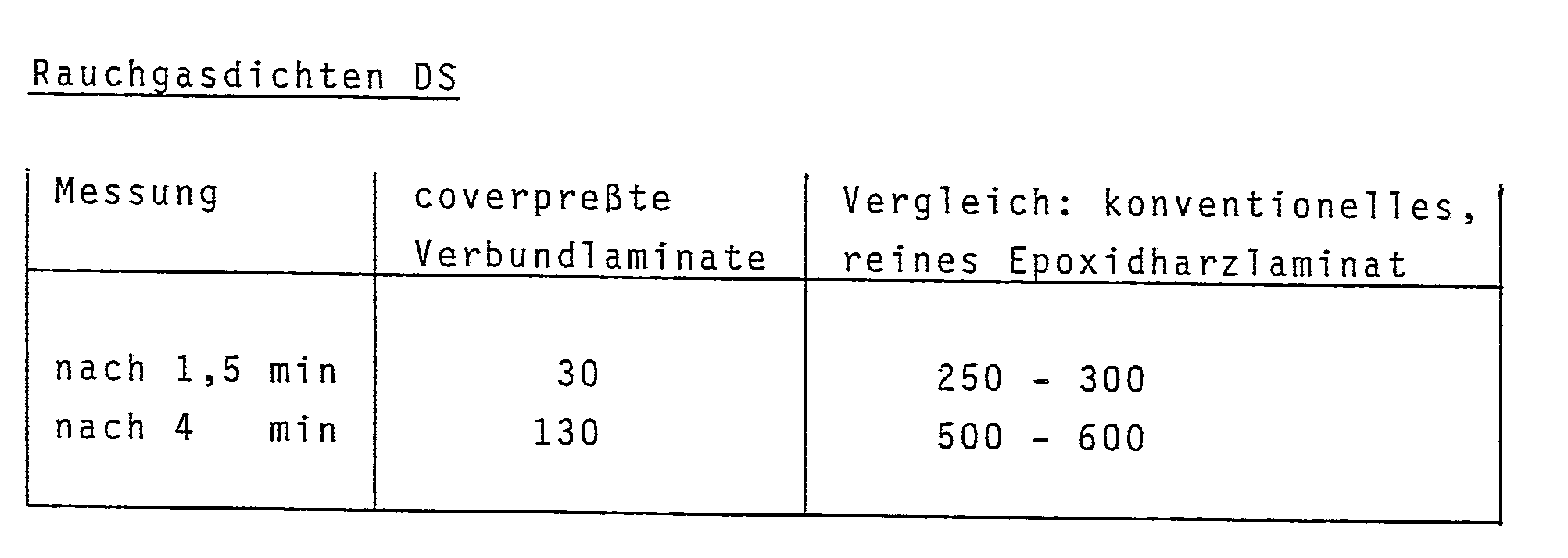
- the smoke density is measured according to ATS 1000.001 and gives the following values:
Landscapes
- Chemical & Material Sciences (AREA)
- Engineering & Computer Science (AREA)
- Materials Engineering (AREA)
- Medicinal Chemistry (AREA)
- Health & Medical Sciences (AREA)
- Chemical Kinetics & Catalysis (AREA)
- Manufacturing & Machinery (AREA)
- Polymers & Plastics (AREA)
- Organic Chemistry (AREA)
- Inorganic Chemistry (AREA)
- Composite Materials (AREA)
- Mechanical Engineering (AREA)
- Reinforced Plastic Materials (AREA)
- Laminated Bodies (AREA)
- Vehicle Interior And Exterior Ornaments, Soundproofing, And Insulation (AREA)
Abstract
Description
- Die Erfindung betrifft duroplastische Verbundwerkstoffe mit verbessertem Eigenschaftsprofil. Sie haben eine große Bedeutung bei der Herstellung von gewichtseinsparenden Bauteilen, wie sie z. B. in Sandwichbauteilen u. a. von der Luft- und Raumfahrt-, Automobil- und Transportmittelbau-Industrie zur Energieeinsparung, zur Verbesserung der mechanischen Eigenschaften sowie zur Erhöhung der sicherheitstechnischen Anforderungen für das Verkehrswesen verwendet werden.
- Die Verbundwerkstoffe bestehen aus mehreren Lagen harzgetränkter Verstärkungsmaterialien, den sogenannten Prepregs, die mittels Presshärtungsverfahren miteinander verbunden werden.
- An diese Verbundwerkstoffe werden sehr hohe Anforderungen gestellt hinsichtlich der Eigenschaften wie Festigkeit, Lösungsmittel-, Alterungs- und Witterungsbeständigkeit. Insbesondere wird eine gute Beständigkeit gegen warme Feuchtigkeit, eine erhöhte Flammwidrigkeit und eine geringe Rauchgasdichte gefordert.
- Durch Variation der in den Verbundwerkstoffen eingesetzten Verstärkungsmaterialien einerseits und durch Verwendung verschiedener Matrixmaterialien andererseits läßt sich eine Vielzahl verschiedener Verbundwerkstoffe herstellen, die jeweils gute Eigenschaften besitzen (Encyclopedia of Polymer Science and Engineering, Second Edition, Volume 3 (1985), 776 ff). Trotzdem ist kein Verbundwerkstoff bekannt, dessen Eigenschaftsprofil in seiner Gesamtheit den obengenannten Anforderungen entspricht.
- Es ist daher die Aufgabe der vorliegenden Erfindung, einen Verbundwerkstoff bereitzustellen, der dem obengenannten Eigenschaftsprofil entspricht. Die Lösung der Aufgabe erfolgt durch einen Verbundwerkstoff gemäß der Ansprüche 1 bis 5 und ein Verfahren gemäß der Ansprüche 6 und 7. Sie finden Verwendung als Bauteile oder für die Herstellung von Verbundbauteilen für die Luft- und Raumfahrt-, Automobil- und Transportmittelbau-Industrie gemäß der Verwendungsansprüche 8 und 9.
- Hochwertige Verbundwerkstoffe haben als Matrixmaterial vorwiegend duroplastische Kunststoffe, bevorzugt Epoxidharze. Epoxidharze zeigen hervorragende Festigkeiten, gute Haftfähigkeit auf allen üblicherweise in hochwertigen Verbundwerkstoffen verwendeten Fasern oder Geweben und eine im Vergleich zu Polyestern oder Phenolharzen geringe Schwindung beim Härtungsprozeß.
Nachteilig sind jedoch die nicht unbeträchtliche Feuchtigkeitsabsorption und Wasserdampfdiffusion sowie das Brandverhalten, insbesondere die Rauchgasdichte und die Toxizität der Rauchgase. - Phenolharze als Matrixmaterialien führen zwar im allgemeinen zu niedrigen mechanischen Fertigkeiten, aber zu geringerer Feuchtigkeitsabsorption und Wasserdampfdiffusion, insbesondere bei warmer Feuchte und zeigen vor allem ein günstigeres Brandverhalten und eine niedrigere Rauchgasdichte von entsprechend geringer Toxizität.
Man hat daher bereits Epoxidharze und Phenolharze miteinander kombiniert eingesetzt, um Leiterplatten für gedruckte Schaltungen mit verbesserten Eigenschaften zu erhalten.
Diese Kombinationen erfolgten entweder dadurch, daß die Verstärkungsmaterialien mit einem Gemisch aus Epoxidharz und Phenolharz und gegebenenfalls einem anderen Polymer imprägniert wurden, wie dies z. B. aus JP 60/18531 A2 (C.A. 103: 7433 x) bekannt ist, oder dadurch, daß die Verstärkungsmaterialien zuerst mit einem Harzsystem und danach mit einem anderen Harzsystem imprägniert wurden, wie dies z. B. in JP 60/189987 A2 (C.A. 104: 51808 t) offenbart ist. - Durch diese Art der Kombinationen von Epoxid- und Phenolharzen wird allerdings die Rauchgasdichte entsprechender Verbundwerkstoffe nicht erniedrigt. Ebenso betrifft die Verbesserung der Feuchtigkeitsaufnahme nur die kalte Feuchte. Das Problem der sogenannten Hot-Wet-Beständigkeit, der Beständigkeit gegen warme Feuchte, ist dadurch nicht gelöst.
- Es wurde gefunden, daß sich durch Härtungsverpressung von Prepregs mit Epoxidharzsystemen mit Prepregs mit speziellen Phenolharzsystemen Verbundwerkstoffe herstellen lassen, die einen absolut homogenen Verbund der Prepregs miteinander besitzen und die eine ausgezeichnete Festigkeit zeigen. Als spezielle Phenolharze eignen sich Novolakharze, die mit Hexamethylentetramin oder anderen Umsetzungsprodukten des Formaldehyds mit Stickstoffbasen ausgehärtet werden.
- Dies ist für den Fachmann überraschend, denn aufgrund der bekannten unterschiedlichen Schrumpfung der Matrixharze während der Härtung und der unterschiedlichen Härtungsmechanismen waren die Festigkeit vermindernde Störungen des Verbundes in den Grenzschichten der unterschiedlichen Prepregs zueinander zu erwarten.
Außerdem war zu erwarten, daß Mischungen von Epoxidharz-/Härter-/Beschleunigersystemen und Phenolharz-/Härter-/Beschleunigersystemen wegen bestimmter Konkurrenzreaktionen und einer ausgeprägten Polymerunverträglichkeit in der Grenzfläche der verschiedenen vorimprägnierten Gewebelagen nicht zu einem homogenen, hochmolekularen Netzwerk aushärten. So führt die Verpressung von faserverstärkten Epoxidharz-Prepregs mit faserverstärkten, mit Phenolresolen vorimprägnierten Bahnen wegen Unverträglichkeiten und Konkurrenzreaktionen bei der Verpressung nicht zu einem innigen Verbund, sondern zu blasenhaltigen Verbunden mit geringer interlaminarer Scherfestigkeit und schlechter Lagenbindung. - Ferner wurde gefunden, daß die Verbundwerkstoffe aus Epoxidharz-Prepregs und Novolak-Prepregs weitere verbesserte Eigenschaften erhalten, wenn sie so aufgebaut sind, daß die Epoxid-Prepregs sich zwischen Novolak-Prepregs befinden, so daß die Novolak-Prepregs immer die obere und die untere Deckschicht bilden. Derartige Verbundwerkstoffe sind schwer entflammbar, haben eine überraschend niedrige Rauchgasdichte und ebenso überraschend eine ausgezeichnete Beständigkeit gegen warme Feuchte. Da sie zudem eine gute Witterungs-, Alterungs- und Chemikalienbeständigkeit haben, zeigen sie ein Gesamteigenschaftsprofil, das den anfangs genannten Forderungen entspricht.
- Als erfindungsgemäß zu verwendende Epoxidharzsysteme eignen sich alle Epoxidharze auf Basis von Umsetzungsprodukten des Epichlorhydrins mit Bisphenol A, Bisphenol F, höherfunktionellen Novolaken von Phenol, Kresolen, Xylenolen und längerkettigen Alkylphenolen, wie z. B. p-tert.-Butylphenol oder Nonylphenol, ferner mit Tris-1,3,3-hydroxyphenylpropan, Tetrakishydroxyphenylethan, Resorcin, Hydrochinon, Brenzkatechin, Chloroglucin, Pyrrogallol, Tris-1,1,1-(hydroxyphenyl)methan und o-,m-,p-Aminophenol in Verbindung mit den in der Praxis zur Prepregherstellung allgemein verwendeten Härtungsmitteln, z. B. Dicyandiamid, Guanidine, Guanamine, Guanamide, Diaminodiphenylsulfon, Diaminodiphenylmethan, m-Phenylendiamin oder 1,3-Propylen-bis(4-aminobenzoat) sowie gegebenenfalls Beschleuniger z. B. Benzyldimethylamin oder Imidazolderivate.
- Phenolharzsysteme im Sinne der Erfindung sind Phenolnovolakharze in Verbindung mit Hexamethylentetramin bzw. anderen Umsetzungsprodukten von Formaldehyd mit Stickstoffbasen als Härtungsmittel. Bevorzugtes Härtungsmittel ist Hexamethylentetramin. Als Phenolnovolakharze eignen sich alle Kondensationsprodukte, die aus Phenol, Kresolen, Xylenolen und Alkylphenolen mit Formaldehyd im Molverhältnis von 1 : 0,25 bis 1 : 0,98 unter Verwendung von sauren Katalysatoren, z. B. Salzsäure, Schwefelsäure, Phosphorsäure oder auch organische Säuren, wie Oxalsäure, Maleinsäure und Fumarsäure, kondensiert wurden. Die verwendeten Novolakharze weisen mittlere Molekulargewichte von 200 - 2000, vorzugsweise 300 - 1000 auf. Als Härter und Katalysatoren für die Novolakharz-Härtung sowie die chemische Verknüpfung mit den Epoxid-Prepregsystemen eignen sich besonders Hexamethylentetramin bzw. andere Umsetzungsprodukte von Formaldehyd und Stickstoffbasen, z. B. Anhydroformaldehyd-Anilin oder ähnliche Schiff'sche Basen. Der Zusatz von Hexamethylentetramin bzw. der genannten Schiff'schen Basen liegt vorzugsweise bei 2 - 18 %. Die mechanischen Eigenschaftswerte der Faserverbundwerkstoffe können noch weiter verbessert werden, insbesondere in Bezug auf die Flexibilität der Matrix, wenn den Phenolnovolakharzen bzw. den Epoxidharzen in Mengen von 2 - 20 Gew.-% verträgliche Synthese-Kautschuke, z. B. Polyacrylnitril-butadien-Kautschuke, Polyacrylelastomere, vorzugsweise mit reaktiven Endgruppen oder thermoplastische Schlagzähemacher-Additive, z. B. Polyester, Polyacrylate, Polyamide, Polysulfone, Polyethersulfone, Polyetherimide oder Polyetherketone, zugesetzt werden.
- Verstärkungsmaterialien sind lose Fasermischungen, Fasermatten oder -vliese, sowie Gewebe oder Rovings auf der Basis hochwertiger Faserrohstoffe wie z. B. Glas-, Keramik-, Bor-, Kohlenstoff-, Aramid- oder Phenolharzfasern.
- Die Verstärkungsmaterialien werden in an sich bekannter Weise mit den Harzsystemen imprägniert, entweder durch Tränkung oder Beschichtung mit flüssigen Harzsystemen oder mit Lösungen fester Harzsysteme und darauffolgendem Abdunsten der Lösemittel.
- Während mit üblichen Phenolresolen beschichtete Gewebe eine hohe Sprödigkeit und Steifigkeit besitzen, sowie schmelzrheologische Eigenschaften, die eine Verarbeitung zusammen mit Epoxy-Klebeprepregs zu geformten Verbundbauteilen nicht zulassen, besitzen die erfindungsgemäßen Phenolharzprepregs eine gute Drapierbarkeit bei Raumtemperatur. Sie lassen sich als flächige Zuschnitte mit entsprechenden Prepregs des gleichen oder anderen Harztyps oder des gleichen oder anderen Verstärkungsmaterials zusammenlegen und bei höherer Temperatur und bei üblichen Drücken in etwa 30 min zu hochwertigen Verbundwerkstoffen verpressen.
- Die Temperatur bei der Verpressung wird so gewählt, daß sie oberhalb, bevorzugt 10 bis 20 °C oberhalb der Härtungstemperatur des Harzsystems mit der höchsten Härtungstemperatur liegt. Je nach Harzsystem ergibt sich dann eine Verpressungstemperatur im Bereich von 80 bis 250 °C. Erhalten werden Verbundwerkstoffe mit hervorragenden mechanischen und interlaminaren Scherfestigkeiten sowie einer bisher nicht erreichten hohen Lagenbindung und außergewöhnlich guter Beständigkeit gegenüber der Einwirkung von Feuchtigkeit und Wärme.
- Die erfindungsgemäß durch Coverpressung von Epoxidharz- und Novolakharzprepregs hergestellten Verbundwerkstoffe können entweder direkt als Bauteile für die Luft- und Raumfahrt-, Automobil- und Transportmittelbau-Industrie eingesetzt werden, sie können aber auch in Kombination mit Leichtbaustoffen, wie z. B. Aluminium- oder Nomex-Waben, zur Herstellung von Verbundbauteilen (Sandwichbauteilen) verwendet werden. Bei dieser Anwendung in Kernverbunden, z. B. bei der Applikation auf Wabenkerne, werden die Epoxidharzprepregs zur Wabe hin gelegt, um durch kontrollierte Meniskenausbildung eine gute Anbindung an die Wabenstange zu sichern. Darauf folgen auf beiden Flachseiten ein oder mehrere Phenolharzprepregs.
- Sowohl die einfachen Verbundwerkstoffe als auch Kernverbunde zeigen eine geringere Wasseraufnahme als Verbunde auf der Basis von Epoxidharzprepregs alleine und überraschend auch eine bisher von Epoxidharzen und Phenolharzen nicht erreichbare Resistenz gegen feuchte Wärme (Hot-Wet-Beständigkeit).
- 350 g einer 70%igen methanolischen Lösung eines Novolaks (Molverhältnis Phenol: CH₂O von 1 : 0,85) werden 33,4 g Hexamethylentetramin zugesetzt. Mit dieser Lösung wird ein Gewebe aus Glas- oder Kohlenstoffasern imprägniert. Dazu wird das Gewebe mit der Harzlösung getränkt und bei einer Temperatur von 105 - 115 °C im Luftstrom ca. 5 min getrocknet. Das Prepreg hat dann bei einem Harzgehalt von 45 - 50 % einen Fluß zwischen 25 - 35 % und einen Gehalt an flüchtigen Bestandteilen von 4 - 6 %. Die Messung der Fließeinheit der Prepregs erfolgte nach der deutschen Airbus-Norm DAN 406.
- So hergestellte Prepregs werden zusammen mit handelsüblichen Epoxidharzprepregs (Harz: modifizierte Bisphenol A/Bisphenol F-Epoxidharzformulierung mit einer Viskosität bei 25 °C von 650 mPa . s, einem Feststoffgehalt von 74 % und einem Epoxidäquivalent (Feststoff) von 315 g/äquiv. Entsprechendes Harz ist unter der Bezeichnung Rütapox ® 0146/LS 82 im Handel, Härter: Dicyandiamid) bei 155 °C 30 min lang verpreßt, wobei das Epoxidharz-Prepreg-Gelege auf der Ober- und Unterseite mit Phenolharzprepregs beplankt ist. Die Aufheizzeit von RT auf Preßtemperatur beträgt mehr als 40 min.
- Ein Verbundwerkstoff, hergestellt aus 3 Lagen des gemäß Beispiel 1 enthaltenen Phenolharzprepregs, 2 Lagen des obigen Epoxidharzprepregs und wiederum 3 Lagen des Phenolharzprepregs, jeweils auf Glasgewebe mit dem Flächengewicht von 286 g/m², durch Verpressen unter einem Druck von 0,1 - 0,5 N/mm² (1 - 5 bar) während 30 min bei 155 °C ergibt folgende mechanische Werte in Abhängigkeit von der Temperatur und Lagerung in heißem Wasser:

- Eine 2 mm Verbundwerkstoffplatte, hergestellt aus 2 Lagen Phenolharzprepreg, 3 Lagen Epoxidharzprepreg und wiederum 2 Lagen Phenolharzprepreg, wobei die jeweiligen Harze denen des Beispiels 1 entsprechen, jeweils auf Kohlenstoffasergewebe mit einem Flächengewicht von 245 g/m² durch Verpressen unter einem Druck von 0,1 - 0,5 N/mm² (1 - 5 bar) bei 155 °C während 30 min zeigt folgende mechanische Werte in Abhängigkeit von Temperatur und Lagerung in heißem Wasser:

- Prepregkombinationen gemäß der Beispiele 1, 2 und 3 werden zur Herstellung von Sandwichbauteilen auf Aluminiumwaben appliziert und zu rauchgasarmen und wasserbeständigen Kernverbundbauteilen verpreßt. Die Messung der Rauchgasdichte erfolgt nach ATS 1000.001 und ergibt folgende Werte:
Claims (9)
Applications Claiming Priority (2)
| Application Number | Priority Date | Filing Date | Title |
|---|---|---|---|
| DE19863613990 DE3613990A1 (de) | 1986-04-25 | 1986-04-25 | Verbundwerkstoffe, verfahren zu ihrer herstellung und verwendung |
| DE3613990 | 1986-04-25 |
Publications (3)
| Publication Number | Publication Date |
|---|---|
| EP0242512A2 true EP0242512A2 (de) | 1987-10-28 |
| EP0242512A3 EP0242512A3 (en) | 1989-11-29 |
| EP0242512B1 EP0242512B1 (de) | 1992-05-20 |
Family
ID=6299496
Family Applications (1)
| Application Number | Title | Priority Date | Filing Date |
|---|---|---|---|
| EP87101493A Expired - Lifetime EP0242512B1 (de) | 1986-04-25 | 1987-02-04 | Verbundwerkstoffe, Verfahren zu ihrer Herstellung und Verwendung |
Country Status (5)
| Country | Link |
|---|---|
| US (1) | US4839229A (de) |
| EP (1) | EP0242512B1 (de) |
| JP (1) | JPH0659729B2 (de) |
| DE (2) | DE3613990A1 (de) |
| ES (1) | ES2000160T3 (de) |
Cited By (3)
| Publication number | Priority date | Publication date | Assignee | Title |
|---|---|---|---|---|
| WO1990001412A3 (en) * | 1988-08-10 | 1990-09-07 | Battelle Memorial Institute | Ceramic fabric materials and methods for making |
| EP0445620A3 (en) * | 1990-03-08 | 1992-10-28 | Basf Aktiengesellschaft | Leaf springs from fibre/plastic composite |
| WO1998038031A3 (en) * | 1997-02-27 | 1998-12-17 | Advanced Composites Group Ltd | Improvements in or relating to moulding methods and moulded articles |
Families Citing this family (9)
| Publication number | Priority date | Publication date | Assignee | Title |
|---|---|---|---|---|
| DE3839335A1 (de) * | 1987-12-08 | 1989-06-29 | Yamaha Corp | Verfahren zur herstellung eines hoelzernen dekorativen gegenstandes |
| DE69026219T2 (de) * | 1989-12-19 | 1996-09-05 | Mitsubishi Chem Corp | Epoxyharz imprägnierte Glasmatte mit einer Kleberschicht |
| US5538789A (en) * | 1990-02-09 | 1996-07-23 | Toranaga Technologies, Inc. | Composite substrates for preparation of printed circuits |
| US5261984A (en) * | 1992-01-21 | 1993-11-16 | General Electric Company | Stamp press process for imprinting decorative textures in thermoplastic composites |
| US5954898A (en) * | 1994-05-13 | 1999-09-21 | Lockheed Fort Worth Company | Method and system for fabricating parts from composite materials |
| US6675543B2 (en) * | 2001-06-22 | 2004-01-13 | Lemert Steven G. | Glass block structure with phenolic resin framework |
| US7043885B2 (en) * | 2003-09-12 | 2006-05-16 | Lemert Steven G | Glass block panel system and fabrication method of same |
| DE102018132798A1 (de) | 2018-12-19 | 2020-06-25 | Deutsches Zentrum für Luft- und Raumfahrt e.V. | Verfahren zur Herstellung eines porösen Faserverbundmaterials, Faserverbundmaterial und Verwendung eines Faserverbundmaterials |
| CN112318979A (zh) * | 2020-11-03 | 2021-02-05 | 广东航科新材料有限公司 | 一种轻质防火复合材料的制备方法 |
Family Cites Families (13)
| Publication number | Priority date | Publication date | Assignee | Title |
|---|---|---|---|---|
| DE1077426B (de) * | 1957-09-17 | 1960-03-10 | Mendip Chemical Engineering Lt | Verfahren zur Herstellung von Schichtkoerpern mit lagenweisem Aufbau aus epoxy- und polyesterharzgebundenen Fasermateriallagen |
| GB1342898A (en) * | 1970-10-24 | 1974-01-03 | British Aircraft Corporaton Lt | Composite panels |
| US3906684A (en) * | 1971-05-20 | 1975-09-23 | Norton Co | Abrasive articles and their method of manufacture |
| US3895158A (en) * | 1973-08-15 | 1975-07-15 | Westinghouse Electric Corp | Composite glass cloth-cellulose fiber epoxy resin laminate |
| ATE8022T1 (de) * | 1980-08-23 | 1984-07-15 | Hoechst Aktiengesellschaft | Schwer entflammbare dekorative schichtstoffplatte. |
| AU537228B2 (en) * | 1981-03-03 | 1984-06-14 | Norsolor, Societe Anonyme | Layered reinforced plastic |
| JPS6055541A (ja) * | 1983-09-06 | 1985-03-30 | Sharp Corp | テ−プレコ−ダのヘッド位置制御機構 |
| US4543290A (en) * | 1984-01-26 | 1985-09-24 | Westinghouse Electric Corp. | Chemical resistant decorative laminates |
| JPS60192732A (ja) * | 1984-03-15 | 1985-10-01 | Shin Kobe Electric Mach Co Ltd | 積層板の製造法 |
| JPS60255831A (ja) * | 1984-06-01 | 1985-12-17 | Sumitomo Bakelite Co Ltd | エポキシ樹脂積層板の製造方法 |
| DE3423639A1 (de) * | 1984-06-27 | 1986-01-09 | Bayer Ag, 5090 Leverkusen | Phosphorsaeureester |
| JPS6119641A (ja) * | 1984-07-06 | 1986-01-28 | Sumitomo Chem Co Ltd | 耐熱積層板の製法 |
| JPS6178842A (ja) * | 1984-09-27 | 1986-04-22 | Mitsubishi Gas Chem Co Inc | エポキシ樹脂積層板の製法 |
-
1986
- 1986-04-25 DE DE19863613990 patent/DE3613990A1/de not_active Withdrawn
-
1987
- 1987-02-04 EP EP87101493A patent/EP0242512B1/de not_active Expired - Lifetime
- 1987-02-04 DE DE8787101493T patent/DE3779173D1/de not_active Expired - Lifetime
- 1987-02-04 ES ES198787101493T patent/ES2000160T3/es not_active Expired - Lifetime
- 1987-03-26 US US07/031,232 patent/US4839229A/en not_active Expired - Lifetime
- 1987-04-23 JP JP62098790A patent/JPH0659729B2/ja not_active Expired - Lifetime
Cited By (3)
| Publication number | Priority date | Publication date | Assignee | Title |
|---|---|---|---|---|
| WO1990001412A3 (en) * | 1988-08-10 | 1990-09-07 | Battelle Memorial Institute | Ceramic fabric materials and methods for making |
| EP0445620A3 (en) * | 1990-03-08 | 1992-10-28 | Basf Aktiengesellschaft | Leaf springs from fibre/plastic composite |
| WO1998038031A3 (en) * | 1997-02-27 | 1998-12-17 | Advanced Composites Group Ltd | Improvements in or relating to moulding methods and moulded articles |
Also Published As
| Publication number | Publication date |
|---|---|
| EP0242512A3 (en) | 1989-11-29 |
| DE3779173D1 (de) | 1992-06-25 |
| EP0242512B1 (de) | 1992-05-20 |
| ES2000160A4 (es) | 1987-12-16 |
| DE3613990A1 (de) | 1987-10-29 |
| JPH0659729B2 (ja) | 1994-08-10 |
| US4839229A (en) | 1989-06-13 |
| JPS62259847A (ja) | 1987-11-12 |
| ES2000160T3 (es) | 1993-03-01 |
Similar Documents
| Publication | Publication Date | Title |
|---|---|---|
| DE68925340T2 (de) | Zwischenschicht in geschichteten faserverstärkten plastischen Verbundwerkstoffen | |
| DE69610830T2 (de) | Wabenförmige Kernmaterialien mit partikelförmiger Verstärkung | |
| EP0798102B1 (de) | Sandwichstruktur mit einem selbstklebenden Prepreg | |
| DE69926527T3 (de) | Formmassen | |
| EP0242512B1 (de) | Verbundwerkstoffe, Verfahren zu ihrer Herstellung und Verwendung | |
| DE60223646T3 (de) | Epoxidharzzusammensetzung, verfahren zur herstellung von faserverstärkten verbundwerkstoffen und faserstärkte verbundwerkstoffe | |
| EP0492498B1 (de) | Ski enthaltend flächenförmige Platten oder Bänder aus einem faserverstärkten Werkstoff | |
| EP0142906A1 (de) | Zusammengestellte Materialien | |
| WO2010000781A1 (de) | Imprägnierung mit hybridharzen | |
| DE69322329T2 (de) | Faserverstärkte Verbundwerkstoffe | |
| JP2002363253A (ja) | エポキシ樹脂組成物、プリプレグおよび繊維強化複合材料 | |
| DE69924244T2 (de) | Reaktionsharzblattmaterialien | |
| DE3852687T2 (de) | Phenolmodifizierter Epoxydharzklebstoff. | |
| EP0356946A2 (de) | Epoxidharzmischungen für Faserverbundwerkstoffe | |
| DE69230252T2 (de) | Ballistische materialien | |
| DE69906539T2 (de) | Transfergiessen von harz | |
| EP0802937B1 (de) | Flexibilisierte phenolharze, verfahren zu ihrer herstellung und verwendung | |
| WO1991019755A1 (de) | Prepreg, verfahren zu dessen herstellung und dessen verwendung | |
| EP0097921B1 (de) | Verfahren zur Herstellung von Verbundmaterialien und diese Materialien | |
| DE4111638A1 (de) | Verfahren zur herstellung einer mehrschichtplatte | |
| EP0058872B1 (de) | Härtbares Phenolformaldehydharz mit verbesserten elastischen Eigenschaften nach der Aushärtung | |
| EP0540838B1 (de) | Bindemittelsysteme auf Basis von Epoxydharz-Phenolharz-Kombinationen | |
| EP0265604B1 (de) | Verfahren zur Herstellung modifizierte Phenolharze und ihre Verwendung | |
| CH637327A5 (en) | Process for producing composite materials | |
| DE2001946C (de) | Verfahren zur Herstellung eines verstärkten Verbundstoffes |
Legal Events
| Date | Code | Title | Description |
|---|---|---|---|
| PUAI | Public reference made under article 153(3) epc to a published international application that has entered the european phase |
Free format text: ORIGINAL CODE: 0009012 |
|
| AK | Designated contracting states |
Kind code of ref document: A2 Designated state(s): BE CH DE ES FR GB IT LI NL SE |
|
| ITCL | It: translation for ep claims filed |
Representative=s name: BARZANO' E ZANARDO ROMA S.P.A. |
|
| TCNL | Nl: translation of patent claims filed | ||
| GBC | Gb: translation of claims filed (gb section 78(7)/1977) | ||
| EL | Fr: translation of claims filed | ||
| PUAL | Search report despatched |
Free format text: ORIGINAL CODE: 0009013 |
|
| AK | Designated contracting states |
Kind code of ref document: A3 Designated state(s): BE CH DE ES FR GB IT LI NL SE |
|
| 17P | Request for examination filed |
Effective date: 19891027 |
|
| 17Q | First examination report despatched |
Effective date: 19901221 |
|
| ITF | It: translation for a ep patent filed | ||
| GRAA | (expected) grant |
Free format text: ORIGINAL CODE: 0009210 |
|
| AK | Designated contracting states |
Kind code of ref document: B1 Designated state(s): BE CH DE ES FR GB IT LI NL SE |
|
| REF | Corresponds to: |
Ref document number: 3779173 Country of ref document: DE Date of ref document: 19920625 |
|
| GBT | Gb: translation of ep patent filed (gb section 77(6)(a)/1977) | ||
| ET | Fr: translation filed | ||
| REG | Reference to a national code |
Ref country code: ES Ref legal event code: FG2A Ref document number: 2000160 Country of ref document: ES Kind code of ref document: T3 |
|
| PLBE | No opposition filed within time limit |
Free format text: ORIGINAL CODE: 0009261 |
|
| STAA | Information on the status of an ep patent application or granted ep patent |
Free format text: STATUS: NO OPPOSITION FILED WITHIN TIME LIMIT |
|
| 26N | No opposition filed | ||
| EAL | Se: european patent in force in sweden |
Ref document number: 87101493.2 |
|
| REG | Reference to a national code |
Ref country code: CH Ref legal event code: NV Representative=s name: E. BLUM & CO. PATENTANWAELTE |
|
| REG | Reference to a national code |
Ref country code: GB Ref legal event code: 732E |
|
| REG | Reference to a national code |
Ref country code: FR Ref legal event code: TP Ref country code: FR Ref legal event code: CD |
|
| REG | Reference to a national code |
Ref country code: CH Ref legal event code: PUE Owner name: RUETGERS AKTIENGESELLSCHAFT TRANSFER- BAKELITE AG Ref country code: CH Ref legal event code: PFA Free format text: RUETGERSWERKE AKTIENGESELLSCHAFT TRANSFER- RUETGERS AKTIENGESELLSCHAFT |
|
| NLS | Nl: assignments of ep-patents |
Owner name: BAKELITE AG |
|
| REG | Reference to a national code |
Ref country code: ES Ref legal event code: PC2A |
|
| PGFP | Annual fee paid to national office [announced via postgrant information from national office to epo] |
Ref country code: BE Payment date: 19970410 Year of fee payment: 11 |
|
| PGFP | Annual fee paid to national office [announced via postgrant information from national office to epo] |
Ref country code: SE Payment date: 19980218 Year of fee payment: 12 |
|
| PG25 | Lapsed in a contracting state [announced via postgrant information from national office to epo] |
Ref country code: BE Free format text: LAPSE BECAUSE OF NON-PAYMENT OF DUE FEES Effective date: 19980228 |
|
| BERE | Be: lapsed |
Owner name: RUTGERS A.G. Effective date: 19980228 |
|
| PG25 | Lapsed in a contracting state [announced via postgrant information from national office to epo] |
Ref country code: SE Free format text: LAPSE BECAUSE OF NON-PAYMENT OF DUE FEES Effective date: 19990205 |
|
| EUG | Se: european patent has lapsed |
Ref document number: 87101493.2 |
|
| REG | Reference to a national code |
Ref country code: GB Ref legal event code: IF02 |
|
| PGFP | Annual fee paid to national office [announced via postgrant information from national office to epo] |
Ref country code: NL Payment date: 20060116 Year of fee payment: 20 |
|
| PGFP | Annual fee paid to national office [announced via postgrant information from national office to epo] |
Ref country code: FR Payment date: 20060217 Year of fee payment: 20 |
|
| PGFP | Annual fee paid to national office [announced via postgrant information from national office to epo] |
Ref country code: GB Payment date: 20060223 Year of fee payment: 20 |
|
| PGFP | Annual fee paid to national office [announced via postgrant information from national office to epo] |
Ref country code: ES Payment date: 20060224 Year of fee payment: 20 |
|
| PGFP | Annual fee paid to national office [announced via postgrant information from national office to epo] |
Ref country code: CH Payment date: 20060227 Year of fee payment: 20 |
|
| PGFP | Annual fee paid to national office [announced via postgrant information from national office to epo] |
Ref country code: IT Payment date: 20060228 Year of fee payment: 20 |
|
| PGFP | Annual fee paid to national office [announced via postgrant information from national office to epo] |
Ref country code: DE Payment date: 20060331 Year of fee payment: 20 |
|
| REG | Reference to a national code |
Ref country code: FR Ref legal event code: CJ Ref country code: FR Ref legal event code: CD |
|
| PG25 | Lapsed in a contracting state [announced via postgrant information from national office to epo] |
Ref country code: GB Free format text: LAPSE BECAUSE OF EXPIRATION OF PROTECTION Effective date: 20070203 |
|
| PG25 | Lapsed in a contracting state [announced via postgrant information from national office to epo] |
Ref country code: NL Free format text: LAPSE BECAUSE OF EXPIRATION OF PROTECTION Effective date: 20070204 |
|
| PG25 | Lapsed in a contracting state [announced via postgrant information from national office to epo] |
Ref country code: ES Free format text: LAPSE BECAUSE OF EXPIRATION OF PROTECTION Effective date: 20070205 |
|
| REG | Reference to a national code |
Ref country code: CH Ref legal event code: PL Ref country code: GB Ref legal event code: PE20 |
|
| NLV7 | Nl: ceased due to reaching the maximum lifetime of a patent |
Effective date: 20070204 |
|
| REG | Reference to a national code |
Ref country code: ES Ref legal event code: FD2A Effective date: 20070205 |