EP0242881A2 - Finisseuse de revêtement en béton - Google Patents
Finisseuse de revêtement en béton Download PDFInfo
- Publication number
- EP0242881A2 EP0242881A2 EP87105959A EP87105959A EP0242881A2 EP 0242881 A2 EP0242881 A2 EP 0242881A2 EP 87105959 A EP87105959 A EP 87105959A EP 87105959 A EP87105959 A EP 87105959A EP 0242881 A2 EP0242881 A2 EP 0242881A2
- Authority
- EP
- European Patent Office
- Prior art keywords
- joint
- former
- concrete
- concrete floor
- paver
- Prior art date
- Legal status (The legal status is an assumption and is not a legal conclusion. Google has not performed a legal analysis and makes no representation as to the accuracy of the status listed.)
- Granted
Links
- 238000004519 manufacturing process Methods 0.000 claims abstract description 15
- 238000005056 compaction Methods 0.000 claims abstract 2
- 238000009499 grossing Methods 0.000 claims description 21
- 238000007789 sealing Methods 0.000 claims description 14
- 238000009736 wetting Methods 0.000 claims description 8
- 238000007654 immersion Methods 0.000 claims description 3
- 239000003292 glue Substances 0.000 claims description 2
- 239000000725 suspension Substances 0.000 claims description 2
- 239000000463 material Substances 0.000 description 17
- 239000003795 chemical substances by application Substances 0.000 description 7
- 238000010276 construction Methods 0.000 description 6
- 238000009415 formwork Methods 0.000 description 6
- 239000007788 liquid Substances 0.000 description 6
- 238000009434 installation Methods 0.000 description 5
- 244000007853 Sarothamnus scoparius Species 0.000 description 4
- 229910000831 Steel Inorganic materials 0.000 description 4
- 239000010959 steel Substances 0.000 description 4
- 238000005452 bending Methods 0.000 description 3
- 238000000034 method Methods 0.000 description 3
- 239000004033 plastic Substances 0.000 description 3
- 229910000278 bentonite Inorganic materials 0.000 description 2
- 239000000440 bentonite Substances 0.000 description 2
- SVPXDRXYRYOSEX-UHFFFAOYSA-N bentoquatam Chemical compound O.O=[Si]=O.O=[Al]O[Al]=O SVPXDRXYRYOSEX-UHFFFAOYSA-N 0.000 description 2
- 230000006835 compression Effects 0.000 description 2
- 238000007906 compression Methods 0.000 description 2
- 230000008878 coupling Effects 0.000 description 2
- 238000010168 coupling process Methods 0.000 description 2
- 238000005859 coupling reaction Methods 0.000 description 2
- 230000009969 flowable effect Effects 0.000 description 2
- 239000006260 foam Substances 0.000 description 2
- 238000004806 packaging method and process Methods 0.000 description 2
- 239000004576 sand Substances 0.000 description 2
- 230000001133 acceleration Effects 0.000 description 1
- 230000015572 biosynthetic process Effects 0.000 description 1
- 239000004566 building material Substances 0.000 description 1
- 230000006735 deficit Effects 0.000 description 1
- 238000010586 diagram Methods 0.000 description 1
- 238000006073 displacement reaction Methods 0.000 description 1
- 230000000694 effects Effects 0.000 description 1
- 230000008030 elimination Effects 0.000 description 1
- 238000003379 elimination reaction Methods 0.000 description 1
- 239000004744 fabric Substances 0.000 description 1
- 239000000835 fiber Substances 0.000 description 1
- 239000003365 glass fiber Substances 0.000 description 1
- 230000001771 impaired effect Effects 0.000 description 1
- 230000001788 irregular Effects 0.000 description 1
- 230000000149 penetrating effect Effects 0.000 description 1
- 235000019353 potassium silicate Nutrition 0.000 description 1
- 230000000717 retained effect Effects 0.000 description 1
- NTHWMYGWWRZVTN-UHFFFAOYSA-N sodium silicate Chemical compound [Na+].[Na+].[O-][Si]([O-])=O NTHWMYGWWRZVTN-UHFFFAOYSA-N 0.000 description 1
- 239000007779 soft material Substances 0.000 description 1
- 239000000080 wetting agent Substances 0.000 description 1
Images


Classifications
-
- E—FIXED CONSTRUCTIONS
- E01—CONSTRUCTION OF ROADS, RAILWAYS, OR BRIDGES
- E01C—CONSTRUCTION OF, OR SURFACES FOR, ROADS, SPORTS GROUNDS, OR THE LIKE; MACHINES OR AUXILIARY TOOLS FOR CONSTRUCTION OR REPAIR
- E01C23/00—Auxiliary devices or arrangements for constructing, repairing, reconditioning, or taking-up road or like surfaces
- E01C23/02—Devices for making, treating or filling grooves or like channels in not-yet-hardened paving, e.g. for joints or markings; Removable forms therefor; Devices for introducing inserts or removable insert-supports in not-yet-hardened paving
- E01C23/026—Introducing preformed inserts into or filling grooves or like channels in laid paving, with or without concurrent making or working of groove or channel, e.g. filling groove with semi-plastic material
-
- E—FIXED CONSTRUCTIONS
- E01—CONSTRUCTION OF ROADS, RAILWAYS, OR BRIDGES
- E01C—CONSTRUCTION OF, OR SURFACES FOR, ROADS, SPORTS GROUNDS, OR THE LIKE; MACHINES OR AUXILIARY TOOLS FOR CONSTRUCTION OR REPAIR
- E01C23/00—Auxiliary devices or arrangements for constructing, repairing, reconditioning, or taking-up road or like surfaces
- E01C23/02—Devices for making, treating or filling grooves or like channels in not-yet-hardened paving, e.g. for joints or markings; Removable forms therefor; Devices for introducing inserts or removable insert-supports in not-yet-hardened paving
- E01C23/025—Making or working grooves or like channels in laid paving, e.g. smoothing groove edges
Definitions
- the invention relates to a concrete paver with a device for producing a longitudinal glue joint running in the production direction by means of a jointing agent reaching into the area of compacting units, in particular in the form of immersion vibrators and a pressure plate connected downstream thereof, with a smoothing device and possibly with a jointing agent following device for wetting or filling the joint formed.
- concrete ceiling paver of the Fugensentner consists of a short erdichtungsaggregaten in front of the V-ended tubular portion of the concrete ceiling paver is continuously introduced an elastic joint sealing profile in the still plastic concrete by the in the course of the forward movement.
- the entry end of the pipe section is located on a vertical bulkhead of the paver, behind which the concrete supply is poured.
- the joint sealing profile can then be easily inserted into the pipe section from a coil arranged in front of this wall.
- This known arrangement is not suitable for concrete pavers without such bulkheads, which drive onto the paving material heaped up in front of them and distribute them automatically and process them to the concrete ceiling.
- Another disadvantage is that in the known concrete paver, the pressure plate and the smoothing devices follow the joint former, so that there is a risk that the smoothing movements (especially when using screed boards) will affect the course of the joint.
- a concrete paver which does not require a bulkhead and can therefore also process paving material that has been piled up in front of the paver.
- Attached to this paver is a profiled steel strip that forms the longitudinal joint, which extends beyond the rear end of the concrete paver to the area of the broom line.
- a longitudinal joint is obtained with a dimensionally stable cross section and good straightness;
- the operation of the concrete paver is made more difficult by this long section steel strip, especially at the start of production and at the end of production.
- the broom line must maintain a predetermined distance corresponding to the length of the section steel strip.
- the object of the invention is to provide a concrete ceiling finisher of the type mentioned, we l - cher with simple construction and easy handling longitudinal provides false joints of good dimensional accuracy and straightness and can process paving material in front of the paver.
- the joint former comprises a joint preformer in the area of the pressure plate and a joint main former separate from this in the area of the smoothing device, in particular the screed, of the concrete paver.
- the main joint former is located in the area of the smoothing device, that is to say in an area with already compacted and therefore less plastic concrete, which is then subjected to practically no vibrations, shaking movements or the like.
- the longitudinal joint created by the main joint former therefore has a high level of dimensional stability.
- the task of the joint preformer aligned with the main joint former is to clear stones or the like out of the way so that the main joint former can easily cut into the already more or less compacted concrete. Since the joint preformer is still in the area of the plastic concrete, it does not pose any difficulties for it to clear even larger stones.
- the joint preformer be arranged in the region of the front edge of the pressure plate.
- the F preferably approximately sword-shaped ugenvorformer is releasably attached to the pressure plate.
- the underside of the pressure plate is then continuously smooth on the joint preformer in the area of the front edge, so that the concrete is compacted extremely evenly. This is of great importance for the ceiling quality.
- the main joint former passes under the screed and is preferably coupled in height to it.
- the result is consequently a dimensionally stable joint formation in this at least above f l ambalich still moving situated concrete ceiling.
- the height coupling with the screed that determines the final ceiling level ensures that an exact joint depth is maintained.
- the F ugenmaschineformer reciprocate horizontally via a sliding or roller bearing on the supporting and reciprocable smoothing board.
- the preferably approximately sword-shaped main joint former is pivotally connected to a concrete paver frame around a vertical axis in the region of the front end of the main joint former. This ensures the correct orientation of the main joint former with a particularly simple construction, since it automatically adjusts itself in the manner of a rudder according to the direction of the concrete material flowing past.
- the Main joint former on one or the concrete paver frame is laterally displaceable.
- a swivel arm connecting the main joint former to the concrete paver frame is preferably used here.
- a joint preformer provided with a vibratory drive is provided in the region between the pressure plate and the joint main former.
- This preformer ensures a path free of aggregates for the subsequent main joint former under all operating conditions, especially if the main joint former immediately follows the joint preformer. All that is required is a small movement gap for the shaking movement of the joint preform.
- the joint preformer on the pressure plate leading edge can be in many cases are omitted, so that the changeover is easier when attaching an intermediate formwork.
- the joint preformer between the pressure plate and the main joint former can be easily removed by simply pulling it upwards. Lateral position adjustment of the joint preform is unnecessary if it is guided laterally in a fork that is fixed to the pressure plate or to the paver frame.
- the joint preformer is attached to a vertical support on which a vibratory drive, preferably an unbalance motor, is held.
- the vertical support can be mounted on a frame-fixed suspension fork via rubber elements, which makes it easier to remove the joint preform upwards.
- the joint preformer in the area of the fork can be connected to the pressure plate or to the concrete paver frame by means of a detachable elastic strap.
- Such tensile tapes can practically not be bent in the band plane.
- examples of such tapes are the fiber tapes which are customary for box or package packaging or for packaging pallet loads, in particular glass fiber tapes. These are extremely tear-resistant, weather-resistant and available at low cost.
- the tape would have to be bent in a first bending section around an axis parallel to the flat side of the tape from the vertical feed direction into the horizontal longitudinal direction of the groove and due to the tensile rigidity and then be twisted in a second bend section by 90 ° around its longitudinal axis so that it comes to rest in the vertical longitudinal plane of the groove.
- the first and second bend sections must be below the top of the concrete ceiling, with the result that the paving material on both sides of the joint is strongly churned.
- the broad side of the band is perpendicular to the vertical longitudinal plane of the groove.
- the main joint former is provided with a feed for at least two joint sealing tapes arranged one above the other in the joint.
- the at least two joint sealing strips arranged one above the other prevent the groove side walls from caking in a sufficiently large groove height range. Due to the division into several narrower bands corresponding to the dimension of the feeder is perpendicular to the vertical F ugenebene reduced accordingly. The installation material is only slightly disturbed by the feed. The subsequent screed ensures reliable Elimination of any impairments to the concrete structure.
- the feeder feed the tapes into the joint at a distance from one another.
- the distance can be up to 5 mm, for example, so that the effective height of the joint area secured by the strips is correspondingly increased. With the stated distance up to a maximum of about 5 mm, the desired opening of the dummy joint is nevertheless ensured.
- a simple construction and reliable function of the feed are ensured if a flat feed pipe adapted to the joint cross section is provided for each band, with a first bend section around an axis parallel to the flat side of the feed pipe and with a second bend section with twisting of the feed pipe around its longitudinal axis.
- a width of the main joint former which at most only slightly exceeds the joint width, while being inexpensive to manufacture and with high mechanical stability, is achieved by the main joint former being formed with the following parts which are rigidly connected, preferably worn, to one another, a plate-shaped lower part, a plate-shaped upper part and the guide tubes, which form one Fill in the L-shaped gap formed between the lower and upper part.
- the feed is therefore integrated with the main joint former.
- a feed for at least one joint sealing profile is provided on the main joint former, and a device for wetting the profile.
- the joint sealing profile pulls
- the wetting liquid wicking similar with in the groove, so that special constructional measures, such as D ruck apparatus for supplying the wetting agent is unnecessary.
- a filling funnel can be provided at the input end of a guide tube that receives the joint sealing profile and inserts it into the joint.
- the invention further relates to a method for producing a longitudinal joint with the help of a concrete paver, in particular with the features according to the invention mentioned above.
- the principal function of the Lssensscheinfuge is namely a predetermined breaking point already satisfied if the invention is wetted in accordance with the joint with a sticking together of the F ugenflow practitioner preventing release agent and / or setting accelerators.
- a joint sealing profile eg sealing tape
- a waxy release agent is preferred. It can be sprayed onto the joint walls, for example. The structural effort for this is advantageously low; relatively little release agent is required.
- the joint be filled with support material, preferably sand or bentonite. You can also foam out the joint.
- the invention also relates to a concrete paver with a device for producing a longitudinal apparent joint running in the production direction and for installing at least one joint tape, comprising one in the area between compacting units, in particular in the form of vibrators and a pressure plate arranged downstream of the latter. and a smoothing device, in particular smoothing screed, arranged joint former, which is provided with a feed for the at least one joint band.
- Such a concrete paver is known (DE-AS 15 34 258) and DE-OS 32 21 028).
- a single band is fed through the hollow joint former to the joint formed behind the joint former.
- the tape used must be elastic so that it can bend around a horizontal transverse axis lying in a vertical plane within the joint former ( Figures 2 and 3 of DE-AS 15 34 258).
- the joint former ends at a distance in front of the subsequent smoothing device (smoothing plate or smoothing board). The depth of the joint thus essentially corresponds to the width of the band, since a deeper joint in the area below the band would be pressed by the smoothing device.
- the band which is made of relatively soft material, must be inserted relatively deep into the joint, in order to avoid damage, for example, from a subsequent broom line device, with the risk that the dummy joint edge will become irregular.
- the joint former must be made relatively long, since a greater curvature of the band in a vertical plane containing the band side surface is difficult to achieve.
- a groove can be made with a depth that far exceeds the total width of the at least one joint strip.
- the at least one joint tape extends in the area of the surface of the concrete ceiling; the joint area below the at least one joint tape is essentially retained.
- the feeder bend the at least one tape about an axis parallel to the flat side of the tape and twist about the longitudinal direction of the tape.
- the tape can be taken from a tape supply, e.g. Roll, are guided into the joint former above the concrete ceiling and inserted into the joint lying in a vertical plane with a horizontal longitudinal direction.
- the bend is 90 °, for example, as is the twist.
- the length of the joint former (in the conveying direction) can be shortened compared to the known shape, since the radius of curvature of the band can be selected to be comparatively small when it is bent around an axis parallel to the flat side of the band.
- the mechanically stable band can be inserted into the groove at a reduced distance below the surface of the concrete ceiling, since the risk of damage from a subsequent broom line device is significantly reduced.
- the feeder introduces at least two belts one above the other into the joint.
- the concrete ceiling paver shown schematically in FIGS. 1 and 2 bears the reference number 10.
- the concrete ceiling paver is supported with drives of the usual type, in particular with lateral caterpillar tracks 12 indicated by dashed lines in FIG. 1, on the base 14 or on lateral ones (not shown) careers.
- the direction of manufacture is indicated by an arrow A in FIG. 1.
- the concrete paver 10 has distributor plates 16 which are connected to one another via a pipe 18.
- the tube 18 is mounted on a support 22 on a frame-fixed tube 21 transversely to the production direction A with the help of a movement drive, not shown, to and fro.
- the distributor plates 16 are followed by a metering slide 26 which is pivotably mounted about a horizontal transverse axis 28 fixed to the frame in order to be able to supply a subsequent pressure plate 30 with installation material 20 in a predeterminable amount, in particular layer thickness.
- the structure and the control of the metering slide 26 can correspond to DE-OS 32 32 020.
- Immersion vibrators 34 of conventional construction are arranged between the pressure plate 30 and the shield 32 of the metering slide 26. Together with the pressure plate 30, these form compression units for the installation material 20.
- an approximately sword-shaped joint preform 38 is detachably attached to the pressure plate in a manner not shown in detail. Since its vertical rear edge 40 is at a comparatively small distance from the front edge 36 in relation to the length a of the pressure plate underside 42, the underside 42 is practically free of elevation, so that a uniform compression of the installation material 20 by the pressure plate 30 is ensured.
- the joint preformer 38 has the function of coarser components of the one to clear building material 20, in particular stones, from the path of a subsequent joint main former 44 which is in alignment with the joint preformer 38. This is facilitated in that the joint preformer is still in effect b e-rich the pokers is 34, ie in a region in which the mounting material 20 is still readily flowable.
- the main joint former 44 passes under a following on the pressure plate 30 screed 46. Its forward end 48 is slightly pointed to granular structures of the paving material to be able to reject readily 20 behind the joint preformer 38 accordingly slightly into the path of the trailing F ugenhauptformers 44 have penetrated.
- the main joint former 44 is provided on a holding frame 50 which surrounds the screed 46 in a U-shape. About this holding frame, the joint main former 44 is supported on the screed 4. 6 This is indicated schematically by a roller 54 which is rotatably mounted on an upper longitudinal spar 52 of the holding frame 50 and has an axis of rotation parallel to the production direction A. The roller is supported on the top 56 of the screed 46.
- the roller 54 and a clear movement distance between the underside 58 of the screed and the upper longitudinal edge 60 of the main joint former 44 permit the usual back and forth movement of the screed (double arrow B in FIG. 2 transverse to direction A) without the main joint former 44 being carried along. Due to this height coupling of the main joint former 44 to the screed 46, a defined constant joint depth b is ensured since the screed 46 defines the concrete ceiling surface 62.
- the main joint former is connected to the concrete paver frame 24 via a swivel arm 64.
- One end of the latter is leaned against a vertically extending frame support 66 (vertical axis 68) and the other end is connected in an articulated manner to the holding frame 50 (vertical axis 70).
- the articulated connection between the arm 46 and the holding frame 50 permits a vertical displacement of the frame 50 relative to the arm 64, corresponding to the respective height setting of the screed 46. This is indicated in FIGS. 1 and 2 by the fact that a vertical frame leg 72 of the holding frame 50 is divided into two vertically hinged eyes 74 of the rectangular frame-like frame 64 are supported so as to be height-adjustable.
- the frame leg 72 is rigidly connected to the main joint former 44 in the region of the front end of the main joint former. In this way, the desired orientation of the main joint former results automatically in the manner of a dragged rudder parallel to the production direction A.
- the swivel arm G4 is held in the desired angular position by appropriate adjusting means (joint main former 44 in alignment with the joint preformer 38).
- the main joint former 44 can be pivoted laterally into a waiting position 78 indicated by the broken line in FIG. 2.
- This pivoting movement of the arm 64 can be brought about by hydraulic cylinders or the like.
- a particularly simple adjustment device is shown, which consists of a spindle 80 with a handwheel 82 which is mounted, for example, on a horizontal frame part 84 of the concrete paver frame 24 so as to be axially immovable but rotatable about its axis.
- the spindle 80 engages in a spindle nut 85 a, which is non-rotatably mounted on the arm 64 but pivotable slightly about a vertical axis 86. Accordingly, the spindle 80 can also be pivoted slightly on the frame part 84 via a corresponding intermediate sleeve, not shown, about a vertical axis 88, in order to allow the spindle 80 to also pivot when the arm 64 is pivoted.
- the main joint former 44 is followed by a joint filling device 90 indicated in FIGS. 1 and 2.
- This is rigidly connected to the concrete ceiling paver frame 24, for example via a frame part 92 which adjoins the horizontal frame part 84.
- the joint filling device 90 is connected via a feed hose 94 joint filling material is supplied from a storage container, not shown.
- This material is filled into the longitudinal joint 96 formed behind the main joint former 44 via nozzles of the joint filling device, which are not shown in detail.
- the joint filling material can be support material, preferably sand or bentonite. You can also foam out the joint.
- the joint 96 can also be wetted with a release agent which prevents the joint side walls from sticking together. A wax-like release agent can be used for this.
- the Fugen hypothalamic device may also be different from the schematic diagrams in Figs. 1 and 2, directly on the F ugenhauptformer 44 is fixed so that the jointing fo l l-device can be pivoted away together with the joint main former 44, if an intermediate formwork assembled t should be.
- a feed for joint sealing tapes corresponding to the joint filling device 90 is attached directly to the main joint former.
- the concrete paver is easy to use. If, in order to produce a B and V track, a lateral slip form is to be attached to the concrete paver instead of the previous longitudinal joint, it is sufficient if the joint main former 44 is pivoted away by pivoting the swivel arm 64 accordingly.
- the joint preform 38 can either also be dismantled or, under certain circumstances, can also remain in place, the sliding formwork then having a recess corresponding to the outline of the joint preform 38.
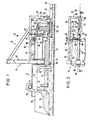
- FIGS. 3 to 5 Components of the concrete floor paver designated 110 which correspond to those in FIGS. 1 and 2 are provided with the same reference numbers, in each case increased by the number 100.
- the side view of FIG. 3 shows only the part of the paver 110 of interest in the area of the screed 146.
- the other components are to be supplemented accordingly in accordance with FIG. 1.
- FIGS. 3 and 4 show the pressure plate 130, the underside 142 of which defines the concrete ceiling surface 162.
- the pivot arm 164 is pivotally mounted about a front axis 168;
- the swivel arm 164 is held in the desired angular position by adjusting means, not shown.
- the main joint former 144 can be pivoted about an axis 170 that runs parallel to the axis 168 and is additionally height-adjustable.
- the joint main former 144 is held in its intended height immediately below the screed 146 by being supported on a roller 154 with an angle 153 fixed to the joint main former, the length of which corresponds at least to the stroke of the screed 146.
- the roller 164 is mounted on an arm 155 which is pivotably mounted on the screed 146 in a swivel joint 147. This arm 155 can be adjusted with respect to the screed 146 in the vertical plane by means of an adjusting bolt 157.
- the main joint former 144 consists of a plate-shaped lower part 202, two double-curved, flattened guide tubes 204 and 206 as well as a plate-shaped upper part 208.
- the guide tubes 204, 206 fill an essentially L-shaped gap 210 between the upper - And lower part 208 or 202.
- the parts mentioned are welded.
- the upper part 208 is rigidly connected to the vertical leg 172 forming the axis 170.
- the screed 146 is not encompassed by a rectangular frame of the main joint former.
- a tensile joint tape 212 is inserted into the longitudinal joint 19 6 .
- the joint tapes 212 are each supplied by a supply roll 214 above the main joint former 144 unwound.
- the axis of rotation 216 of the rollers runs in the transverse direction. Since the joint tapes 212 lie within the joint 196 with their width direction in a vertical plane and extend in the horizontal direction, the tensile tape must be bent in a first bending section 218 of the respective guide tube by 90 ° about an axis of curvature parallel to the axis 216 (along a cylindrical surface) and then be twisted in a second bend section 220 around its longitudinal direction by 90 °.
- the strips 212 are inserted into the joint 196 just below the road surface 162, with a clear distance of at most about 5 mm from one another.
- the width of the bands is preferably about 5 mm. In this way, an area of approximately 15 mm of the joint 196 immediately below the surface 162 is secured against caking by the joint tapes 212.
- the adjoining deeper area of the joints which are, for example, about 90 mm deep and about 4 mm wide, is less at risk.
- a dashed-dot line indicates a filling funnel 224 which surrounds the upper pipe ends 222 and for wetting the joint tapes 212 entering the ends 222 the liquid provides.
- a supply pipe 225 for the liquid above the funnel 224 is indicated by a dash-dot-dot line.
- a joint preformer 138 ' is provided between the pressure plate 130 and the joint main former 144. It in turn has a sword shape with a rounded leading edge 139. Apart from a slight movement gap 143 between the joint preformer 138 'and the main joint former 144, the horizontal lower edge 141 of the joint preformer 138' merges directly into the horizontal lower edge 145 of the joint main former 144.
- the joint preformer 138 ' is attached to a vertical support 230 which grips around the joint preformer 138' in a fork-like manner (fastening bolts 231).
- a horizontal guide fork 234 attached to the pressure plate 130 provides lateral guidance of the vertical support 230, which can be brought into vertical vibration (double arrow C in FIGS. 3 and 4) via an unbalance motor 232 mounted on its upper end.
- the vertical support 230 is detachably connected to the pressure plate 130 via a detachable elastic tab (rubberized fabric band) 238. It can be seen strength in F.
- the plate 238 transmits the thrust forces exerted by the installation material on the joint preformer 138 'to the pressure plate 130. In doing so, it leaves the vibration vibrations C of the vertical support 230 unrestricted to.
- the vertical support 230 is suspended in a bearing fork 246 on the frame part 184 with the interposition of rubber elements 248 and fixed by means of screws 250.
- a concrete ceiling paver 10 has a device for producing a longitudinal joint 96 extending in the production direction A with a preformer 38 in the area of compacting units 30, 34 and a separate joint main former 44 in the area of a screed 30. This enables dimensionally stable, linear longitudinal joint joints achieve easier handling of the concrete paver 10.
Landscapes
- Engineering & Computer Science (AREA)
- Architecture (AREA)
- Civil Engineering (AREA)
- Structural Engineering (AREA)
- Road Paving Machines (AREA)
- On-Site Construction Work That Accompanies The Preparation And Application Of Concrete (AREA)
- Vehicle Interior And Exterior Ornaments, Soundproofing, And Insulation (AREA)
- Road Paving Structures (AREA)
- Road Repair (AREA)
- Preparation Of Clay, And Manufacture Of Mixtures Containing Clay Or Cement (AREA)
Priority Applications (1)
| Application Number | Priority Date | Filing Date | Title |
|---|---|---|---|
| AT87105959T ATE61640T1 (de) | 1986-04-23 | 1987-04-23 | Betondecken-fertiger. |
Applications Claiming Priority (2)
| Application Number | Priority Date | Filing Date | Title |
|---|---|---|---|
| DE3613784 | 1986-04-23 | ||
| DE19863613784 DE3613784A1 (de) | 1986-04-23 | 1986-04-23 | Betondecken-fertiger |
Publications (3)
| Publication Number | Publication Date |
|---|---|
| EP0242881A2 true EP0242881A2 (fr) | 1987-10-28 |
| EP0242881A3 EP0242881A3 (en) | 1988-08-10 |
| EP0242881B1 EP0242881B1 (fr) | 1991-03-13 |
Family
ID=6299374
Family Applications (1)
| Application Number | Title | Priority Date | Filing Date |
|---|---|---|---|
| EP87105959A Expired - Lifetime EP0242881B1 (fr) | 1986-04-23 | 1987-04-23 | Finisseuse de revêtement en béton |
Country Status (3)
| Country | Link |
|---|---|
| EP (1) | EP0242881B1 (fr) |
| AT (1) | ATE61640T1 (fr) |
| DE (2) | DE3613784A1 (fr) |
Cited By (3)
| Publication number | Priority date | Publication date | Assignee | Title |
|---|---|---|---|---|
| FR2648492A1 (fr) * | 1989-06-16 | 1990-12-21 | Tech Special Securite | Procede de mise en place d'un joint en continu dans une chaussee, une dalle ou analogue en beton et dispositif pour sa mise en oeuvre |
| FR2669656A1 (fr) * | 1990-11-28 | 1992-05-29 | Viafrance Sa | Procede et dispositif pour la pose d'armatures de grande longueur dans des couches de materiau. |
| EP1921209A1 (fr) | 2006-11-09 | 2008-05-14 | Aggregate Industries UK limited | Véhicule à induction de fissures et procédé |
Families Citing this family (1)
| Publication number | Priority date | Publication date | Assignee | Title |
|---|---|---|---|---|
| DE3823917A1 (de) * | 1988-07-14 | 1990-01-18 | Berger Bau Gmbh | Fertiger fuer grosse arbeitsbreiten und hohe einbauleistungen fuer den asphalt- und betonstrassenbau |
Family Cites Families (8)
| Publication number | Priority date | Publication date | Assignee | Title |
|---|---|---|---|---|
| US1683292A (en) * | 1926-03-11 | 1928-09-04 | Heltzel Joseph William | Method of and means for grooving plastic material |
| FR1411538A (fr) * | 1964-10-15 | 1965-09-17 | Ts K Bureau Glavstroimekhaniza | Dispositif pour exécuter des joints dans un revêtement frais, par exemple en béton |
| DE1534258B1 (de) * | 1965-04-22 | 1970-01-29 | Guntert & Zimmerman Const Div | An einem Strassenfertiger angeordnete Vorrichtung zum Einbauen von Fugeneinlagen |
| DE1534243A1 (de) * | 1966-02-25 | 1969-06-26 | Edoco Technical Products | Verfahren und Vorrichtung zum Einbauen von Fugenbildungsmitteln in plastischen Beton |
| DE2415034A1 (de) * | 1973-03-27 | 1974-10-10 | Laing & Son Ltd John | Bruchausloesender koerper fuer fahrbahnen, strassenbelaege und dergl. aus beton |
| DD205941B1 (de) * | 1982-05-21 | 1987-01-28 | Kolbe | Vorrichtung zur herstellung von fugen |
| DE3221028C2 (de) * | 1982-06-04 | 1985-07-18 | Hochtief Ag Vorm. Gebr. Helfmann, 4300 Essen | Vorrichtung zum Herstellen einer Längsscheinfuge in einer Betondecke |
| DD232080A1 (de) * | 1984-12-21 | 1986-01-15 | Strassenwesen Entwurfs Ingbuer | Verfahren zur gezielten fugenherstellung in zementbeton |
-
1986
- 1986-04-23 DE DE19863613784 patent/DE3613784A1/de not_active Ceased
-
1987
- 1987-04-23 EP EP87105959A patent/EP0242881B1/fr not_active Expired - Lifetime
- 1987-04-23 AT AT87105959T patent/ATE61640T1/de not_active IP Right Cessation
- 1987-04-23 DE DE8787105959T patent/DE3768544D1/de not_active Expired - Lifetime
Cited By (4)
| Publication number | Priority date | Publication date | Assignee | Title |
|---|---|---|---|---|
| FR2648492A1 (fr) * | 1989-06-16 | 1990-12-21 | Tech Special Securite | Procede de mise en place d'un joint en continu dans une chaussee, une dalle ou analogue en beton et dispositif pour sa mise en oeuvre |
| FR2669656A1 (fr) * | 1990-11-28 | 1992-05-29 | Viafrance Sa | Procede et dispositif pour la pose d'armatures de grande longueur dans des couches de materiau. |
| EP0488855A1 (fr) * | 1990-11-28 | 1992-06-03 | Viafrance | Procédé et dispositif pour la pose d'armatures de grande longueur dans des couches de matériau |
| EP1921209A1 (fr) | 2006-11-09 | 2008-05-14 | Aggregate Industries UK limited | Véhicule à induction de fissures et procédé |
Also Published As
| Publication number | Publication date |
|---|---|
| DE3613784A1 (de) | 1987-11-05 |
| ATE61640T1 (de) | 1991-03-15 |
| EP0242881B1 (fr) | 1991-03-13 |
| EP0242881A3 (en) | 1988-08-10 |
| DE3768544D1 (de) | 1991-04-18 |
Similar Documents
| Publication | Publication Date | Title |
|---|---|---|
| DE102008046476B4 (de) | Verlegevorrichtung zum Verlegen von Bordsteinen | |
| DE68919206T2 (de) | Selbstfahrende vorrichtung zum betonieren von gräben. | |
| EP0241803B1 (fr) | Procédé et dispositif pour déposer du canevas pour armer les revêtements liés par du bitume des routes ou similaires | |
| DE2330548A1 (de) | Vorrichtung, die waehrend ihrer vorwaertsbewegung ein band aus einem formbaren plastischen gemisch legt | |
| DE2856635C2 (de) | Maschine zum Beschichten von abgefrästen oder abgeschälten Straßendecken | |
| DE3444690C2 (fr) | ||
| EP0242881B1 (fr) | Finisseuse de revêtement en béton | |
| AT403487B (de) | Verfahren und vorrichtung zur herstellung eines schotterlosen gleisoberbaus | |
| DE2505606A1 (de) | Maschine zum stranggiessen von spannbetonsaeulen | |
| DE2937205C2 (de) | Kanalbaulängsmaschine | |
| EP0397956B1 (fr) | Machine de bourrage, mobile de façon continue, comportant un dispositif de charrue | |
| DE19903638A1 (de) | Vorrichtung zum Glätten einer Betonbelagsoberfläche | |
| DE8817049U1 (de) | Vorrichtung zur Herstellung eines Gleisschotterplanums | |
| DE2739555A1 (de) | Vorrichtung zum extrudieren von betonteilen | |
| DE3202795C2 (de) | Vorgefertigter Baukörper, insbesondere Tunnelbaukörper, zum Durchpressen von Bodenschichten | |
| DE3129060A1 (de) | Verfahren und kanalbaulaengsmaschine zum einbauen von auskleidungen in wasserkanaelen, z.b. in bewaesserungskanaelen | |
| DE2739216C2 (de) | Vorrichtung zum Aufbringen von Abdichtungs- und Vergußmassen auf Sohlen oder Böschungen | |
| EP1882812B1 (fr) | Dispositif et procédé destinés à l'application d'une couche retirable sur des éléments de construction | |
| DE2633321A1 (de) | Stoffauflauf einer papiermaschine | |
| AT501384B1 (de) | Strassenbaumaschine | |
| DE1915101A1 (de) | Verfahren und Vorrichtung zum Abdecken von Fluss-,Kanalsohlen und Boeschungen | |
| DE3627872C2 (de) | Mischvorrichtung zum Einbringen einer Dichtwandmasse in einen Dichtwandschlitz | |
| EP0335339A1 (fr) | Finisseuse de couche de base | |
| EP0338242B1 (fr) | Dispositif pour la fabrication d'une couche de béton divisée en panneaux individuels | |
| DE3904117A1 (de) | Strassenbaumaschine zum erneuern des deckenbelages einer fahrbahn oder dgl. |
Legal Events
| Date | Code | Title | Description |
|---|---|---|---|
| PUAI | Public reference made under article 153(3) epc to a published international application that has entered the european phase |
Free format text: ORIGINAL CODE: 0009012 |
|
| 17P | Request for examination filed |
Effective date: 19870423 |
|
| AK | Designated contracting states |
Kind code of ref document: A2 Designated state(s): AT BE DE FR |
|
| PUAL | Search report despatched |
Free format text: ORIGINAL CODE: 0009013 |
|
| AK | Designated contracting states |
Kind code of ref document: A3 Designated state(s): AT BE DE FR |
|
| 17Q | First examination report despatched |
Effective date: 19891215 |
|
| GRAA | (expected) grant |
Free format text: ORIGINAL CODE: 0009210 |
|
| AK | Designated contracting states |
Kind code of ref document: B1 Designated state(s): AT BE DE FR |
|
| REF | Corresponds to: |
Ref document number: 61640 Country of ref document: AT Date of ref document: 19910315 Kind code of ref document: T |
|
| REF | Corresponds to: |
Ref document number: 3768544 Country of ref document: DE Date of ref document: 19910418 |
|
| PGFP | Annual fee paid to national office [announced via postgrant information from national office to epo] |
Ref country code: BE Payment date: 19910515 Year of fee payment: 5 |
|
| ET | Fr: translation filed | ||
| PLBE | No opposition filed within time limit |
Free format text: ORIGINAL CODE: 0009261 |
|
| STAA | Information on the status of an ep patent application or granted ep patent |
Free format text: STATUS: NO OPPOSITION FILED WITHIN TIME LIMIT |
|
| 26N | No opposition filed | ||
| PG25 | Lapsed in a contracting state [announced via postgrant information from national office to epo] |
Ref country code: BE Effective date: 19920430 |
|
| BERE | Be: lapsed |
Owner name: HEILIT & WOERNER BAU-A.G. Effective date: 19920430 |
|
| PGFP | Annual fee paid to national office [announced via postgrant information from national office to epo] |
Ref country code: FR Payment date: 19940328 Year of fee payment: 8 |
|
| PGFP | Annual fee paid to national office [announced via postgrant information from national office to epo] |
Ref country code: AT Payment date: 19940408 Year of fee payment: 8 |
|
| PGFP | Annual fee paid to national office [announced via postgrant information from national office to epo] |
Ref country code: DE Payment date: 19940418 Year of fee payment: 8 |
|
| PG25 | Lapsed in a contracting state [announced via postgrant information from national office to epo] |
Ref country code: AT Effective date: 19950423 |
|
| PG25 | Lapsed in a contracting state [announced via postgrant information from national office to epo] |
Ref country code: FR Effective date: 19951229 |
|
| PG25 | Lapsed in a contracting state [announced via postgrant information from national office to epo] |
Ref country code: DE Effective date: 19960103 |
|
| REG | Reference to a national code |
Ref country code: FR Ref legal event code: ST |