EP0243009A1 - Spracherkennungssystem unter Verwendung von Markov-Modellen - Google Patents
Spracherkennungssystem unter Verwendung von Markov-Modellen Download PDFInfo
- Publication number
- EP0243009A1 EP0243009A1 EP87302603A EP87302603A EP0243009A1 EP 0243009 A1 EP0243009 A1 EP 0243009A1 EP 87302603 A EP87302603 A EP 87302603A EP 87302603 A EP87302603 A EP 87302603A EP 0243009 A1 EP0243009 A1 EP 0243009A1
- Authority
- EP
- European Patent Office
- Prior art keywords
- models
- speech
- adaptation
- probability
- elements
- Prior art date
- Legal status (The legal status is an assumption and is not a legal conclusion. Google has not performed a legal analysis and makes no representation as to the accuracy of the status listed.)
- Granted
Links
- 230000006978 adaptation Effects 0.000 claims abstract description 40
- 230000007704 transition Effects 0.000 claims abstract description 34
- 238000000034 method Methods 0.000 claims description 25
- 238000004364 calculation method Methods 0.000 description 10
- 238000010586 diagram Methods 0.000 description 5
- 238000002372 labelling Methods 0.000 description 5
- 239000007787 solid Substances 0.000 description 4
- VIKNJXKGJWUCNN-XGXHKTLJSA-N norethisterone Chemical compound O=C1CC[C@@H]2[C@H]3CC[C@](C)([C@](CC4)(O)C#C)[C@@H]4[C@@H]3CCC2=C1 VIKNJXKGJWUCNN-XGXHKTLJSA-N 0.000 description 3
- 238000007476 Maximum Likelihood Methods 0.000 description 1
- 230000006870 function Effects 0.000 description 1
- 238000007619 statistical method Methods 0.000 description 1
Images




Classifications
-
- G—PHYSICS
- G10—MUSICAL INSTRUMENTS; ACOUSTICS
- G10L—SPEECH ANALYSIS TECHNIQUES OR SPEECH SYNTHESIS; SPEECH RECOGNITION; SPEECH OR VOICE PROCESSING TECHNIQUES; SPEECH OR AUDIO CODING OR DECODING
- G10L15/00—Speech recognition
- G10L15/06—Creation of reference templates; Training of speech recognition systems, e.g. adaptation to the characteristics of the speaker's voice
- G10L15/065—Adaptation
- G10L15/07—Adaptation to the speaker
-
- G—PHYSICS
- G10—MUSICAL INSTRUMENTS; ACOUSTICS
- G10L—SPEECH ANALYSIS TECHNIQUES OR SPEECH SYNTHESIS; SPEECH RECOGNITION; SPEECH OR VOICE PROCESSING TECHNIQUES; SPEECH OR AUDIO CODING OR DECODING
- G10L15/00—Speech recognition
- G10L15/08—Speech classification or search
- G10L15/14—Speech classification or search using statistical models, e.g. Hidden Markov Models [HMMs]
- G10L15/142—Hidden Markov Models [HMMs]
- G10L15/144—Training of HMMs
Definitions
- the present invention relates to a speech recognition system using Markov models.
- a speech recognition system using Markov models speech is recognised from a probabilistic view point.
- a Markov model is established for each word.
- a Markov model is a finite state device having a plurality of states and the ability to undergo transitions between the states. For each transition, the probability of occurrence is defined 'and each transition produces an output of a string of labels or symbols. Unknown speech to be recognised is converted into a label string, and thereafter the probability of each word Markov model producing the label string as an output is determined based on the transition occurrence probabilities and the label output produced, which are hereafter referred to as parameters, and then the word Markov model having the highest probability of producing the label string is determined.
- the speech recognition is performed according to this result.
- the parameters can be estimated statistically so that a recognition score is improved.
- a speech recognition system using Markov models needs a tremendous amount of speech data and the training thereof requires much time. Furthermore a speech recognition system trained to recognise the speech from a particular speaker often is not able to recognise satisfactorily the speech from other speakers. Even with the same speaker, when there is a long time between the training of the system and the use of the system or the recognition of speech from that speaker, only a poor standard of recognition can be achieved.
- the object of the present invention to provide an improved speech recognition system.
- the present invention relates to a speech recognition system of the type comprising a plurality of probabilistic finite state models each having a number of states and the ability of undergoing transitions from one state to another and producing a corresponding output representing a speech element, and means for defining for each model probability parameters each representing the probability that the model will undergo a transition from one predetermined state to another predetermined state and produce a corresponding output.
- Such a system can be used to recognise input speech data by initially dividing the input speech data into individual speech elements and then applying the input speech elements to the models, and utilising the probability parameters of the models to recognise the input speech elements.
- the speech recognition system is characterised in that it comprises training means for supplying training speech data to the models in order to train the models and to define initial values for the probability parameters for each of the models, and adaptation means for supplying adaptation speech data to the models in order to adapt the models and to define adapted values of the probability parameters for each of the models.
- the adapted values of the probability parameters are used to recognise the input speech elements.
- p(ij,k) is defined as the probability of undergoing a transition from state i to state j and producing an output k.
- the probability of the Markov model being in the state i, S * (i), as shown by the arc, is obtained by summing C(ij,k) for each j and each k. From the definition of the probabilities C*(i,j,k) and S*(i), new parameters P'(ij,k) can be obtained according to the following estimation equation.
- the probabilities of the occurrence of the transition from one state to another state and producing an output label are used as probabilistic parameters of Markov models, although transition occurrence probabilities and output label output probabilities may be defined separately and used as parameters.
- Fig.1 illustrates a s speech recognition system in accordance with the invention as a whole.
- Input speech data is supplied to an analog/digital (A/D) converter 3 through a microphone 1 and an amplifier 2 to be converted into digital data, which is then supplied to a feature extracting block 4.
- the feature extracting block 4 can be a array processor of the type sold by Floating Point Systems Inc.
- the digitised input speech data is initially Fourier transformed every ten milli seconds using a twenty milli second wide window.
- the speech data is then produced as a output in each channel of a 20 channel band pass filter and is subsequently provided to the next stage, labelling block 5.
- This block 5 performs a labelling operation by referring to a label prototype dictionary 6, whose prototypes have been produced by clustering. The number of them is 128.
- each input feature X is in turn compared with the feature of each prototype, and for each input feature the most similar prototype, that is, the prototype having the shortest distance (X,Y i ) is produced as an output label or label number P.
- the labelling block 5 produces an output label string with time period of ten milli seconds. between consecutive labels.
- the label string from the labelling block 5 is provided either to a training block 8, or to an adaptation block 9, or to a recognition block 10, through the operation of a switching block 7.
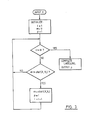
- the detailed description of the operation of the training block 8 and the adaptation block 9 will be given later referring to Fig.4 and the following Figures.
- the switching block 7 is switched to the training block 8 to supply the label string thereto.
- the training block 8 determines the parameter values of a parameter table 11 by training Markov models using the label string.
- the switching block 7 is switched to the adaptation block 9, which adapts the parameter values of the parameter table 11 based on the label string.
- the switching block 7 is switched to the recognition block 10, which recognises input speech data based on the label string and the parameter table 11.
- the recognition block 10 can be designed according to Forward calculation or Viterbi algorithms which are described in detail in the above- mentioned article (2).
- the output from the recognition block 10 is supplied to a workstation 12 and is, for example, displayed on its monitor screen.
- Fig.1 the blocks surrounded by the broken line can be implemented in software on a host computer.
- An IBM 3083 processor can be used as the host computer, and CMS and PV1 are used as an operation system and a programming language respectively.
- CMS and PV1 are used as an operation system and a programming language respectively.
- the above blocks can alternatively be implemented in hardware.
- each word Markov model is first defined, step 13.
- the number of words is 200.
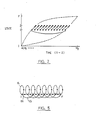
- a word Markov model is such as shown in Fig.5.
- small solid circles indicate states, and arrows show transitions.
- the number of probable states, including the initial state I and the final state F, is 8.
- There are three types of transition that is, transitions to the next state tN, transitions skipping one state tS, and transitions looping the same state tL.
- the number of the labels assigned to one word is about 40 to 50, and the label string of the word is matched from the initial state to the final state, looping sometimes and skipping sometimes.
- the Markov models means to establish the parameter table 11 of Fig. 1 tentatively.
- a table format as shown in Fig.6 is assigned and the parameters P(i,j,k) are initialised.
- the parameter P(i,j,k) means the probability that a transition from the state i to the state j occurs in a Markov model, outputting a label k.
- the parameters are set so that a transition to the next state, a looping transition and a skipping transition occur at probabilities of 0.9, 0.05 and 0.05 respectively, and so that on each transition all labels are produced at an equal probability, that is 1/128.
- step 14 (Fig. 4), which data has been obtained by speaking 200 words to be recognised five times each. Five utterances of a word have been put together and each utterance has been prepared to show which word it responds to, and in which order it was spoken.
- Forward calculation and Backward calculation are performed, step 15 (Fig. 4). Though the following procedure is performed for each word, for convenience of description, consideration is only given to a set of utterances of one word. In Forward calculation and Backward calculation the following forward value f(i,x,n) and backward value b(i,x,n) are calculated.
- f(i,x,n) the probability that the Markov model undergoes a transition forward to the state i at time x after starting from the initial state at time 0 for the label string u n .
- b(i,x,n) the probability that the Markov model undergoes a transition backwards to the state i at time x after starting from the final state at time In for the label string u n .
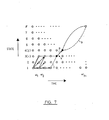
- count(ij,k,n) is then determined based on the forward value f(i,x,n) and the backward value b(i,k,n) for the label string u n , step 16.
- u n (w nx ) is also shown along the time axis.
- the w nx is circled.
- Count(i,j,k,n) is obtained by summing up the probabilities of the circled labels, which corresponds to the operation of ⁇ (w nx ,k). The can be expressed as follows:
- C t (i,j,k) The probability for the whole training speech data of the word to be recognised, is determined as follows.
- step 20 The above estimation process,or procedure of steps 14 through 19 is repeated a predetermined number of times, for example five times, step 20 to complete the training of the target words. In other words the same training operation is performed repeatedly.
- the final parameter Po(i,j,k) is determined on the parameter table, Fig.1, to be used for the speech recognition that is followed.
- the probability which has been used for the last round of the estimation, S o (i), is also stored. This probability S o (i) is to be used for the adaptation, which will be hereinafter described.
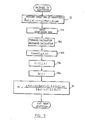
- Step 14A which data has been obtained by the speaker who is going to input his speech, uttering only once each word to be recognised.
- Step 15A through 18A the operations shown successively in the steps 15A through 18A are performed in the same way as in the case of the above mentioned training (Fig. 4).
- two probabilities which are to be used for estimation are obtained by interpolation.
- the speech recognition system being described can be adapted for different circumstances with small data and short training time.
- optimisation of the system can be achieved by adjusting the interior division ratio, ⁇ , according to the quality of the adaptation data such as reliability.
- the speech recognition system described also has an advantage that parts of software or hardware used can be used for both the adaptation process and the initial training process because these processes have many identical steps.
- the adaptation process can be performed again for example for the word wrongly recognised because the adaptation process can be performed for each word. Needless to say, an adaptation process for a word may not be performed until the word is wrongly recognised.
- FIG. 9. shows the adaptation process of this alternative form of the system.
- parts having counterparts in Fig. 8 are given the same reference numbers, and a detailed description thereof will not be given.
- the adaptation of the speech recognition system can be done with a small amount of speech data and in a short time.
- the required store capacity, the increase in the number of program steps and hardware components are respectively very small.
- optimisation of the system can be achieved by adjusting the interior division ratio according to the quality of the adaptation speech data.
Landscapes
- Engineering & Computer Science (AREA)
- Physics & Mathematics (AREA)
- Health & Medical Sciences (AREA)
- Computational Linguistics (AREA)
- Audiology, Speech & Language Pathology (AREA)
- Human Computer Interaction (AREA)
- Acoustics & Sound (AREA)
- Multimedia (AREA)
- Artificial Intelligence (AREA)
- Probability & Statistics with Applications (AREA)
- Measurement Of Mechanical Vibrations Or Ultrasonic Waves (AREA)
- Complex Calculations (AREA)
- Telephonic Communication Services (AREA)
- Machine Translation (AREA)
Applications Claiming Priority (2)
| Application Number | Priority Date | Filing Date | Title |
|---|---|---|---|
| JP65030/86 | 1986-03-25 | ||
| JP61065030A JPS62231993A (ja) | 1986-03-25 | 1986-03-25 | 音声認識方法 |
Publications (2)
| Publication Number | Publication Date |
|---|---|
| EP0243009A1 true EP0243009A1 (de) | 1987-10-28 |
| EP0243009B1 EP0243009B1 (de) | 1991-09-18 |
Family
ID=13275169
Family Applications (1)
| Application Number | Title | Priority Date | Filing Date |
|---|---|---|---|
| EP87302603A Expired EP0243009B1 (de) | 1986-03-25 | 1987-03-25 | Spracherkennungssystem unter Verwendung von Markov-Modellen |
Country Status (5)
| Country | Link |
|---|---|
| US (1) | US4829577A (de) |
| EP (1) | EP0243009B1 (de) |
| JP (1) | JPS62231993A (de) |
| CA (1) | CA1256562A (de) |
| DE (1) | DE3773039D1 (de) |
Cited By (6)
| Publication number | Priority date | Publication date | Assignee | Title |
|---|---|---|---|---|
| EP0314908A3 (en) * | 1987-10-30 | 1989-10-25 | International Business Machines Corporation | Automatic determination of labels and markov word models in a speech recognition system |
| US5072452A (en) * | 1987-10-30 | 1991-12-10 | International Business Machines Corporation | Automatic determination of labels and Markov word models in a speech recognition system |
| EP0720147A1 (de) * | 1994-12-30 | 1996-07-03 | AT&T Corp. | Einrichtungen, Verfahren und Gegenstände zum Ausführen hochauflösender mehrfacher Rechenhypothesen |
| GB2347253B (en) * | 1999-02-23 | 2001-03-07 | Motorola Inc | Method of selectively assigning a penalty to a probability associated with a voice recognition system |
| EP1286251A3 (de) * | 2001-08-17 | 2006-06-21 | AT&T Corp. | Multimodale Benutzerschnittstelle |
| US7257575B1 (en) | 2002-10-24 | 2007-08-14 | At&T Corp. | Systems and methods for generating markup-language based expressions from multi-modal and unimodal inputs |
Families Citing this family (57)
| Publication number | Priority date | Publication date | Assignee | Title |
|---|---|---|---|---|
| JPH01102599A (ja) * | 1987-10-12 | 1989-04-20 | Internatl Business Mach Corp <Ibm> | 音声認識方法 |
| JP2545914B2 (ja) * | 1988-02-09 | 1996-10-23 | 日本電気株式会社 | 音声認識方法 |
| JP2733955B2 (ja) * | 1988-05-18 | 1998-03-30 | 日本電気株式会社 | 適応型音声認識装置 |
| JPH0293597A (ja) * | 1988-09-30 | 1990-04-04 | Nippon I B M Kk | 音声認識装置 |
| US5027406A (en) * | 1988-12-06 | 1991-06-25 | Dragon Systems, Inc. | Method for interactive speech recognition and training |
| JPH067348B2 (ja) * | 1989-04-13 | 1994-01-26 | 株式会社東芝 | パタン認識装置 |
| CA2015410C (en) * | 1989-05-17 | 1996-04-02 | Chin H. Lee | Speech recognition employing key word modeling and non-key word modeling |
| US5509104A (en) * | 1989-05-17 | 1996-04-16 | At&T Corp. | Speech recognition employing key word modeling and non-key word modeling |
| US5220639A (en) * | 1989-12-01 | 1993-06-15 | National Science Council | Mandarin speech input method for Chinese computers and a mandarin speech recognition machine |
| US5129001A (en) * | 1990-04-25 | 1992-07-07 | International Business Machines Corporation | Method and apparatus for modeling words with multi-arc markov models |
| DE4024890A1 (de) * | 1990-08-06 | 1992-02-13 | Standard Elektrik Lorenz Ag | Anpassung von referenzsprachmustern an umgebungsbedingte aussprachevarianten |
| US5182773A (en) * | 1991-03-22 | 1993-01-26 | International Business Machines Corporation | Speaker-independent label coding apparatus |
| US5278942A (en) * | 1991-12-05 | 1994-01-11 | International Business Machines Corporation | Speech coding apparatus having speaker dependent prototypes generated from nonuser reference data |
| US5544257A (en) * | 1992-01-08 | 1996-08-06 | International Business Machines Corporation | Continuous parameter hidden Markov model approach to automatic handwriting recognition |
| JP2795058B2 (ja) * | 1992-06-03 | 1998-09-10 | 松下電器産業株式会社 | 時系列信号処理装置 |
| US5502774A (en) * | 1992-06-09 | 1996-03-26 | International Business Machines Corporation | Automatic recognition of a consistent message using multiple complimentary sources of information |
| WO1994015330A1 (en) * | 1992-12-18 | 1994-07-07 | Sri International | Method and apparatus for automatic evaluation of pronunciation |
| JPH0776880B2 (ja) * | 1993-01-13 | 1995-08-16 | 日本電気株式会社 | パターン認識方法および装置 |
| US5627939A (en) | 1993-09-03 | 1997-05-06 | Microsoft Corporation | Speech recognition system and method employing data compression |
| US5602963A (en) * | 1993-10-12 | 1997-02-11 | Voice Powered Technology International, Inc. | Voice activated personal organizer |
| US5794197A (en) * | 1994-01-21 | 1998-08-11 | Micrsoft Corporation | Senone tree representation and evaluation |
| WO1995034884A1 (en) * | 1994-06-13 | 1995-12-21 | Matsushita Electric Industrial Co., Ltd. | Signal analyzer |
| US5805771A (en) * | 1994-06-22 | 1998-09-08 | Texas Instruments Incorporated | Automatic language identification method and system |
| US5864810A (en) * | 1995-01-20 | 1999-01-26 | Sri International | Method and apparatus for speech recognition adapted to an individual speaker |
| US5710866A (en) * | 1995-05-26 | 1998-01-20 | Microsoft Corporation | System and method for speech recognition using dynamically adjusted confidence measure |
| US5913193A (en) * | 1996-04-30 | 1999-06-15 | Microsoft Corporation | Method and system of runtime acoustic unit selection for speech synthesis |
| US5937384A (en) * | 1996-05-01 | 1999-08-10 | Microsoft Corporation | Method and system for speech recognition using continuous density hidden Markov models |
| US5806030A (en) * | 1996-05-06 | 1998-09-08 | Matsushita Electric Industrial Co Ltd | Low complexity, high accuracy clustering method for speech recognizer |
| US5835890A (en) * | 1996-08-02 | 1998-11-10 | Nippon Telegraph And Telephone Corporation | Method for speaker adaptation of speech models recognition scheme using the method and recording medium having the speech recognition method recorded thereon |
| US6151575A (en) * | 1996-10-28 | 2000-11-21 | Dragon Systems, Inc. | Rapid adaptation of speech models |
| US6349281B1 (en) * | 1997-01-30 | 2002-02-19 | Seiko Epson Corporation | Voice model learning data creation method and its apparatus |
| US6212498B1 (en) | 1997-03-28 | 2001-04-03 | Dragon Systems, Inc. | Enrollment in speech recognition |
| US6223156B1 (en) * | 1998-04-07 | 2001-04-24 | At&T Corp. | Speech recognition of caller identifiers using location information |
| US6343267B1 (en) | 1998-04-30 | 2002-01-29 | Matsushita Electric Industrial Co., Ltd. | Dimensionality reduction for speaker normalization and speaker and environment adaptation using eigenvoice techniques |
| US6263309B1 (en) | 1998-04-30 | 2001-07-17 | Matsushita Electric Industrial Co., Ltd. | Maximum likelihood method for finding an adapted speaker model in eigenvoice space |
| US6163768A (en) * | 1998-06-15 | 2000-12-19 | Dragon Systems, Inc. | Non-interactive enrollment in speech recognition |
| US6463413B1 (en) * | 1999-04-20 | 2002-10-08 | Matsushita Electrical Industrial Co., Ltd. | Speech recognition training for small hardware devices |
| US6571208B1 (en) | 1999-11-29 | 2003-05-27 | Matsushita Electric Industrial Co., Ltd. | Context-dependent acoustic models for medium and large vocabulary speech recognition with eigenvoice training |
| US6526379B1 (en) | 1999-11-29 | 2003-02-25 | Matsushita Electric Industrial Co., Ltd. | Discriminative clustering methods for automatic speech recognition |
| US7216077B1 (en) * | 2000-09-26 | 2007-05-08 | International Business Machines Corporation | Lattice-based unsupervised maximum likelihood linear regression for speaker adaptation |
| US7362892B2 (en) * | 2003-07-02 | 2008-04-22 | Lockheed Martin Corporation | Self-optimizing classifier |
| JP4366652B2 (ja) * | 2004-04-23 | 2009-11-18 | 横河電機株式会社 | 伝送器及びその二重化方法 |
| JP5327054B2 (ja) * | 2007-12-18 | 2013-10-30 | 日本電気株式会社 | 発音変動規則抽出装置、発音変動規則抽出方法、および発音変動規則抽出用プログラム |
| WO2010019831A1 (en) * | 2008-08-14 | 2010-02-18 | 21Ct, Inc. | Hidden markov model for speech processing with training method |
| US8473293B1 (en) * | 2012-04-17 | 2013-06-25 | Google Inc. | Dictionary filtering using market data |
| EP2713367B1 (de) * | 2012-09-28 | 2016-11-09 | Agnitio, S.L. | Sprechererkennung |
| US10141009B2 (en) | 2016-06-28 | 2018-11-27 | Pindrop Security, Inc. | System and method for cluster-based audio event detection |
| US9824692B1 (en) | 2016-09-12 | 2017-11-21 | Pindrop Security, Inc. | End-to-end speaker recognition using deep neural network |
| AU2017327003B2 (en) | 2016-09-19 | 2019-05-23 | Pindrop Security, Inc. | Channel-compensated low-level features for speaker recognition |
| WO2018053531A1 (en) * | 2016-09-19 | 2018-03-22 | Pindrop Security, Inc. | Dimensionality reduction of baum-welch statistics for speaker recognition |
| US10325601B2 (en) | 2016-09-19 | 2019-06-18 | Pindrop Security, Inc. | Speaker recognition in the call center |
| US10397398B2 (en) | 2017-01-17 | 2019-08-27 | Pindrop Security, Inc. | Authentication using DTMF tones |
| US11710035B2 (en) * | 2018-09-28 | 2023-07-25 | Apple Inc. | Distributed labeling for supervised learning |
| WO2020159917A1 (en) | 2019-01-28 | 2020-08-06 | Pindrop Security, Inc. | Unsupervised keyword spotting and word discovery for fraud analytics |
| US11019201B2 (en) | 2019-02-06 | 2021-05-25 | Pindrop Security, Inc. | Systems and methods of gateway detection in a telephone network |
| WO2020198354A1 (en) | 2019-03-25 | 2020-10-01 | Pindrop Security, Inc. | Detection of calls from voice assistants |
| US12015637B2 (en) | 2019-04-08 | 2024-06-18 | Pindrop Security, Inc. | Systems and methods for end-to-end architectures for voice spoofing detection |
Family Cites Families (7)
| Publication number | Priority date | Publication date | Assignee | Title |
|---|---|---|---|---|
| US4587670A (en) * | 1982-10-15 | 1986-05-06 | At&T Bell Laboratories | Hidden Markov model speech recognition arrangement |
| US4593367A (en) * | 1984-01-16 | 1986-06-03 | Itt Corporation | Probabilistic learning element |
| US4718094A (en) * | 1984-11-19 | 1988-01-05 | International Business Machines Corp. | Speech recognition system |
| US4741036A (en) * | 1985-01-31 | 1988-04-26 | International Business Machines Corporation | Determination of phone weights for markov models in a speech recognition system |
| US4759068A (en) * | 1985-05-29 | 1988-07-19 | International Business Machines Corporation | Constructing Markov models of words from multiple utterances |
| US4748670A (en) * | 1985-05-29 | 1988-05-31 | International Business Machines Corporation | Apparatus and method for determining a likely word sequence from labels generated by an acoustic processor |
| US4783803A (en) * | 1985-11-12 | 1988-11-08 | Dragon Systems, Inc. | Speech recognition apparatus and method |
-
1986
- 1986-03-25 JP JP61065030A patent/JPS62231993A/ja active Granted
-
1987
- 1987-02-04 CA CA000528993A patent/CA1256562A/en not_active Expired
- 1987-03-12 US US07/025,257 patent/US4829577A/en not_active Expired - Fee Related
- 1987-03-25 EP EP87302603A patent/EP0243009B1/de not_active Expired
- 1987-03-25 DE DE8787302603T patent/DE3773039D1/de not_active Expired - Lifetime
Non-Patent Citations (2)
| Title |
|---|
| IBM TECHNICAL DISCLOSURE BULLETIN, vol. 24, no. 4, September 1981, pages 2042-2043, New York, US; L.R. BAHL et al.: "Automatic selection of speech prototypes" * |
| IEEE TRANSACTIONS ON INFORMATION THEORY, vol. IT-21, no. 3, May 1975, pages 250-256, New York, US; F. JELINEK et al.: "Design of a linguistic statistical decoder for the recognition of continuous speech" * |
Cited By (14)
| Publication number | Priority date | Publication date | Assignee | Title |
|---|---|---|---|---|
| EP0314908A3 (en) * | 1987-10-30 | 1989-10-25 | International Business Machines Corporation | Automatic determination of labels and markov word models in a speech recognition system |
| US5072452A (en) * | 1987-10-30 | 1991-12-10 | International Business Machines Corporation | Automatic determination of labels and Markov word models in a speech recognition system |
| EP0720147A1 (de) * | 1994-12-30 | 1996-07-03 | AT&T Corp. | Einrichtungen, Verfahren und Gegenstände zum Ausführen hochauflösender mehrfacher Rechenhypothesen |
| US5805772A (en) * | 1994-12-30 | 1998-09-08 | Lucent Technologies Inc. | Systems, methods and articles of manufacture for performing high resolution N-best string hypothesization |
| GB2347253B (en) * | 1999-02-23 | 2001-03-07 | Motorola Inc | Method of selectively assigning a penalty to a probability associated with a voice recognition system |
| US6233557B1 (en) | 1999-02-23 | 2001-05-15 | Motorola, Inc. | Method of selectively assigning a penalty to a probability associated with a voice recognition system |
| EP1286251A3 (de) * | 2001-08-17 | 2006-06-21 | AT&T Corp. | Multimodale Benutzerschnittstelle |
| US7505908B2 (en) | 2001-08-17 | 2009-03-17 | At&T Intellectual Property Ii, L.P. | Systems and methods for classifying and representing gestural inputs |
| US7783492B2 (en) | 2001-08-17 | 2010-08-24 | At&T Intellectual Property Ii, L.P. | Systems and methods for classifying and representing gestural inputs |
| US7257575B1 (en) | 2002-10-24 | 2007-08-14 | At&T Corp. | Systems and methods for generating markup-language based expressions from multi-modal and unimodal inputs |
| US7660828B2 (en) | 2002-10-24 | 2010-02-09 | At&T Intellectual Property Ii, Lp. | Systems and methods for generating markup-language based expressions from multi-modal and unimodal inputs |
| US8433731B2 (en) | 2002-10-24 | 2013-04-30 | At&T Intellectual Property Ii, L.P. | Systems and methods for generating markup-language based expressions from multi-modal and unimodal inputs |
| US8898202B2 (en) | 2002-10-24 | 2014-11-25 | At&T Intellectual Property Ii, L.P. | Systems and methods for generating markup-language based expressions from multi-modal and unimodal inputs |
| US9563395B2 (en) | 2002-10-24 | 2017-02-07 | At&T Intellectual Property Ii, L.P. | Systems and methods for generating markup-language based expressions from multi-modal and unimodal inputs |
Also Published As
| Publication number | Publication date |
|---|---|
| DE3773039D1 (de) | 1991-10-24 |
| US4829577A (en) | 1989-05-09 |
| EP0243009B1 (de) | 1991-09-18 |
| JPS62231993A (ja) | 1987-10-12 |
| CA1256562A (en) | 1989-06-27 |
| JPH0355837B2 (de) | 1991-08-26 |
Similar Documents
| Publication | Publication Date | Title |
|---|---|---|
| EP0243009B1 (de) | Spracherkennungssystem unter Verwendung von Markov-Modellen | |
| US5050215A (en) | Speech recognition method | |
| CA1336458C (en) | Voice recognition apparatus | |
| EP0303022B1 (de) | Schnelle Anpassung eines Spracherkenners an einen neuen Sprecher auf Grund der Daten eines Referenzsprechers | |
| US10008197B2 (en) | Keyword detector and keyword detection method | |
| EP0387602B1 (de) | Verfahren und Einrichtung zur automatischen Bestimmung von phonologischen Regeln für ein System zur Erkennung kontinuierlicher Sprache | |
| EP0240679B1 (de) | Ausbildung von in einem Spracherkennungssystem verwandten Markov-Modellen | |
| US6041299A (en) | Apparatus for calculating a posterior probability of phoneme symbol, and speech recognition apparatus | |
| US5268990A (en) | Method for recognizing speech using linguistically-motivated hidden Markov models | |
| US5794197A (en) | Senone tree representation and evaluation | |
| EP0706171A1 (de) | Einrichtung und Verfahren zur Spracherkennung | |
| EP0750293A2 (de) | Konstruktionsverfahren für ein Zustandsübertragungsmodell und Spracherkennungsverfahren und Gerät dafür | |
| EP0109190A1 (de) | Einsilbenerkennungseinrichtung | |
| EP0762383A2 (de) | Vorrichtung zur Musteranpassung für Sprach- oder Mustererkennung | |
| US4876720A (en) | Speech recognition system | |
| US5293451A (en) | Method and apparatus for generating models of spoken words based on a small number of utterances | |
| JP2982689B2 (ja) | 情報量基準を用いた標準パターン作成方式 | |
| JP2001188557A (ja) | 最大エントロピ音声モデルの生成方法 | |
| JP3873418B2 (ja) | 音声スポッティング装置 | |
| JPH01202798A (ja) | 音声認識方法 | |
| JP2005091504A (ja) | 音声認識装置 | |
| JP2738508B2 (ja) | 統計的言語モデル作成装置及び音声認識装置 | |
| EP0238689A1 (de) | Verfahren zum akustischen Vergleichen in einem Spracherkennungssystem | |
| Shahin | Using second-order hidden Markov model to improve speaker identification recognition performance under neutral condition | |
| JP2912513B2 (ja) | ヒドン・マルコフ・モデルの学習方法 |
Legal Events
| Date | Code | Title | Description |
|---|---|---|---|
| PUAI | Public reference made under article 153(3) epc to a published international application that has entered the european phase |
Free format text: ORIGINAL CODE: 0009012 |
|
| AK | Designated contracting states |
Kind code of ref document: A1 Designated state(s): DE FR GB IT |
|
| 17P | Request for examination filed |
Effective date: 19880126 |
|
| 17Q | First examination report despatched |
Effective date: 19900418 |
|
| GRAA | (expected) grant |
Free format text: ORIGINAL CODE: 0009210 |
|
| AK | Designated contracting states |
Kind code of ref document: B1 Designated state(s): DE FR GB IT |
|
| REF | Corresponds to: |
Ref document number: 3773039 Country of ref document: DE Date of ref document: 19911024 |
|
| ITF | It: translation for a ep patent filed | ||
| ET | Fr: translation filed | ||
| PLBE | No opposition filed within time limit |
Free format text: ORIGINAL CODE: 0009261 |
|
| STAA | Information on the status of an ep patent application or granted ep patent |
Free format text: STATUS: NO OPPOSITION FILED WITHIN TIME LIMIT |
|
| 26N | No opposition filed | ||
| PGFP | Annual fee paid to national office [announced via postgrant information from national office to epo] |
Ref country code: FR Payment date: 19950228 Year of fee payment: 9 |
|
| PGFP | Annual fee paid to national office [announced via postgrant information from national office to epo] |
Ref country code: GB Payment date: 19960208 Year of fee payment: 10 |
|
| PGFP | Annual fee paid to national office [announced via postgrant information from national office to epo] |
Ref country code: DE Payment date: 19960313 Year of fee payment: 10 |
|
| PG25 | Lapsed in a contracting state [announced via postgrant information from national office to epo] |
Ref country code: FR Effective date: 19961129 |
|
| REG | Reference to a national code |
Ref country code: FR Ref legal event code: ST |
|
| PG25 | Lapsed in a contracting state [announced via postgrant information from national office to epo] |
Ref country code: GB Effective date: 19970325 |
|
| GBPC | Gb: european patent ceased through non-payment of renewal fee |
Effective date: 19970325 |
|
| PG25 | Lapsed in a contracting state [announced via postgrant information from national office to epo] |
Ref country code: DE Effective date: 19971202 |
|
| PG25 | Lapsed in a contracting state [announced via postgrant information from national office to epo] |
Ref country code: IT Free format text: LAPSE BECAUSE OF NON-PAYMENT OF DUE FEES Effective date: 20050325 |