EP0706171A1 - Einrichtung und Verfahren zur Spracherkennung - Google Patents
Einrichtung und Verfahren zur Spracherkennung Download PDFInfo
- Publication number
- EP0706171A1 EP0706171A1 EP95306890A EP95306890A EP0706171A1 EP 0706171 A1 EP0706171 A1 EP 0706171A1 EP 95306890 A EP95306890 A EP 95306890A EP 95306890 A EP95306890 A EP 95306890A EP 0706171 A1 EP0706171 A1 EP 0706171A1
- Authority
- EP
- European Patent Office
- Prior art keywords
- hmm
- states
- speech
- speech recognition
- output
- Prior art date
- Legal status (The legal status is an assumption and is not a legal conclusion. Google has not performed a legal analysis and makes no representation as to the accuracy of the status listed.)
- Granted
Links
Images



Classifications
-
- G—PHYSICS
- G10—MUSICAL INSTRUMENTS; ACOUSTICS
- G10L—SPEECH ANALYSIS TECHNIQUES OR SPEECH SYNTHESIS; SPEECH RECOGNITION; SPEECH OR VOICE PROCESSING TECHNIQUES; SPEECH OR AUDIO CODING OR DECODING
- G10L15/00—Speech recognition
- G10L15/08—Speech classification or search
- G10L15/14—Speech classification or search using statistical models, e.g. Hidden Markov Models [HMMs]
- G10L15/142—Hidden Markov Models [HMMs]
- G10L15/144—Training of HMMs
-
- G—PHYSICS
- G10—MUSICAL INSTRUMENTS; ACOUSTICS
- G10L—SPEECH ANALYSIS TECHNIQUES OR SPEECH SYNTHESIS; SPEECH RECOGNITION; SPEECH OR VOICE PROCESSING TECHNIQUES; SPEECH OR AUDIO CODING OR DECODING
- G10L15/00—Speech recognition
- G10L15/08—Speech classification or search
- G10L15/18—Speech classification or search using natural language modelling
- G10L15/183—Speech classification or search using natural language modelling using context dependencies, e.g. language models
- G10L15/187—Phonemic context, e.g. pronunciation rules, phonotactical constraints or phoneme n-grams
Definitions
- the present invention relates to a speech recognition method and apparatus for recognizing unknown speech input.
- a high-speed speech recognition system can be constructed through use of software only.
- Most speech recognition systems which are targeted for recognizing unspecified speakers, large vocabularies and continuous speech, employ a HMM (Hidden Markov Model) which is considered to be the most effective statistical model at the moment.
- HMM Hidden Markov Model
- computers have become much faster, it is still not easy to construct a speech recognition system of the type which is adequate to process recognition of unspecified speakers in real time, large vocabularies and continuous speech with only software. It is thus still important to speed up the speech recognition processing.
- the continuous HMMs speech recognition systems using continuous mixture HMMs for output probability computation (hereinafter referred to as "the continuous HMMs), which are now being extensively studied, require much greater computation in comparison with speech recognition systems using discrete HMMs for output probability computation. Accordingly, for the practical use of a speech recognition system which is able to recognize unspecified speakers, large vocabularies and continuous speech in real time using the continuous HMMs, a reduction in the amount of the output probability computation is essential.
- the following is applied to speech recognition performed using the continuous HMMs if sufficient training data is given.
- a larger number of mixtures results in the better recognition accuracy but a larger amount of computation is required.
- a smaller number of mixtures requires less calculation, but results in lower recognition accuracy. Accordingly, it is necessary to reduce the total number of mixtures provided for calculation without deteriorating the recognition accuracy.
- the present invention provides the following speech recognition method. States of a HMM which are likely to contribute to the recognition results are first estimated by use of a HMM having a small number of mixtures which requires only a small amount of output probability computation. Then, only the output probabilities of the estimated states are re-calculated by use of the states of a HMM having a large number of mixtures, resulting in a high rate of recognition accuracy. According to this method, the total number of mixtures provided for actual computation can be reduced.
- At least two types of HMMs are employed for the HMMs in the same class.
- HMM One type of HMM is a rough HMM which requires only a small amount of computation and also results in a satisfactory rate of recognition accuracy (for example, a HMM having a small number of mixtures).
- the other type of HMM is a detailed HMM which requires a large amount of computation and obtains a high rate of recognition accuracy (for example, a HMM which has a large number of mixtures).
- the two types of HMMs are identical in structure (topology) so that the respective states of one type can correspond to the respective states of the other type.
- the output probabilities of the former states are thus related to those of the latter states in a certain fixed manner, and the output probabilities are exchangeable between the two types of HMMs.
- the output probabilities of classes and their states and mixtures which are likely to contribute to the recognition results are first determined by use of the rough HMM. As a result of the rough HMM processing, the top N classes and their states and mixtures exhibiting the highest output probabilities are determined, or alternatively, the classes and their states and mixtures having the output probabilities greater than the threshold that are likely to contribute to the recognition results are determined.
- the output probabilities of the top M classes and their states and mixtures are re-calculated by use of the detailed HMM. If required, further processing of the output probabilities is performed using a more detailed HMM of the top N classes or their states and mixtures having the highest probabilities obtained by the calculations by the detailed HMM (N ⁇ M). Accordingly, the more precise output probability can be obtained according to the aforementioned process in a plurality of stages.
- the precise output probability is determined by use of the two steps of detailed HMM.
- the output probabilities of the top range from N to M classes and their states and mixtures (N ⁇ M) are calculated by use of the comparatively-detailed HMM.
- the output probabilities of the top N classes or their states and mixtures exhibiting the highest output probabilities obtained by the rough HMM are similarly calculated by use of the more detailed HMM.
- the more precise output probability can be obtained according to the aforementioned process in two stages.
- two types of HMMs that is, a phonemic context-independent HMM and a phonemic context-dependent HMM in which a phoneme is dependent on a plurality of surrounding phonemes, are employed for the same phoneme of HMMs.
- the two types of HMMs are identical in structure (topology).
- the respective states of one type can correspond to the respective states of the other type.
- the output probabilities of the former states are thus related to those of the latter states in a certain fixed manner, and the output probabilities are exchangeable with each other between the two types of HMMs.
- the output probabilities of phonemes and their states and mixtures which are likely to contribute to the recognition results are first determined by use of the phonemic context-independent HMM. As a result, the top N phonemes and their states and mixtures exhibiting the highest output probabilities are determined. Alternatively, the phonemes and their states and mixtures having the output probabilities greater than a threshold that are likely to contribute to the recognition results are determined.
- the top N phonemes and their states and mixtures exhibiting the highest output probabilities, obtained by the previous calculations by use of the phonemic context-independent HMM that are likely to contribute to the speech recognition are determined.
- the output probabilities of the top N phonemes and their states and mixtures are re-calculated by use of the phonemic context-dependent HMM. Accordingly, the most precise output probability can be obtained according to the aforementioned process in a plurality of stages.
- Fig. 1 is a block diagram illustrating a speech recognition system according to a first embodiment of the present invention.
- the speech recognition system includes: a speech input unit 101 including an A/D converter and a microphone through which unknown speech is input; a sound processing section 102 for determining voice parameters from the voice which is input from the voice input unit 101; an output probability processing section 103 for determining the output probability by comparing the voice parameters obtained in the sound processing section 102 with HMMs which are used as dictionary data for speech recognition; an HMM storing section 104 used as a dictionary section for speech recognition in which the output probabilities are calculated; an HMM S storing portion 105 for storing rough HMMs, that is, HMM S s, used for estimating how much a phoneme will contribute to the recognition of the input voice; an HMM L storing portion 106 for storing detailed HMMs, that is, HMM L s, for calculating the precise output probability; a language search section 107 for executing language processing; a grammar and dictionary section 108 in which a grammar and a dictionary used for the language processing are stored; and a display section 109 for displaying the speech recognition results in
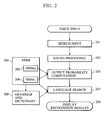
- the speech recognition system constructed as described above is operated according to the flow shown in Fig. 2.
- the speech supplied from the speech input section 101 (step 201) is analyzed and processed into speech parameters in the sound processing section 102 (step 202).
- the output probability is determined in the output probability computation section 103 (step 203) by use of a rough HMM S stored in the HMM S storing portion 105 (step 205) contained in a HMM stored in the HMM storing section 104 (step 204). Further, the states of the HMM of the phoneme which are likely to contribute to the recognition results are determined.
- the precise output probabilities are re-determined by use of a detailed HMM L stored in the HMM L storing portion 106 corresponding to the states of the phoneme which have been determined to contribute to the recognition results in step 205 (step 206).
- the language processing is performed in the language search section 107 (step 207) by use of the grammar and dictionary stored in the grammar and dictionary 108 section (step 208).
- the recognition results are output to the display section 109 (step 209).
- classes which are likely to contribute to the recognition results are first estimated by use of the HMM S s having the smaller number of mixtures (smaller number of mixture HMMs). Then, only the estimated classes are re-calculated by use of the HMM L s having the large number of mixtures (large number of mixture HMMs). As explained above, the large number of mixture HMMs are advantageous because they exhibit higher recognition accuracy, but are disadvantageous because they require a larger amount of computation. This method eliminates the necessity of calculating all the phonemes by use of the HMM L s, which reduces the total number of mixtures provided for the actual calculations, thereby achieving the faster speech recognition.
- HMM is formed of only a single state.
- an HMM formed of only one single state is not used very much because an HMM used for the speech recognition represents a change in the time sequence of the feature sequence in the model.
- high performance cannot be obtained from an HMM formed of only one single state.
- the suitable number of states in an HMM for obtaining high performance is generally a plurality of (e.g., three or four) states, and thus, HMMs each formed of three or four states are most widely used.
- the following problem is encountered with this type of HMM.
- the maximum likelihood estimator of the class of the HMM which is determined by the output probability of each state and the state transition probability between the states, disadvantageously varies depending on the duration of each state, and it is thus difficult to obtain the overall maximum likelihood estimator of the HMM. Accordingly, it is not easy to uniformly make a comparison for determining HMMs which are likely to contribute to the recognition results.
- This problem can be solved by carrying out the following assumption. Based on this assumption, the idea of an HMM state is introduced instead of the above-described classes, and the foregoing basic concept is still applicable to the HMM state.
- HMMs are trained in comparatively-short units, such as a phoneme. All the HMMs are formed of a simple left-to-right structure with several states, for example, three states. Under these conditions, even if the different HMMs having different numbers of mixtures are independently trained, the related states of the different HMMs become substantially equal and thus represent substantially similar features. As a consequence, the respective states of the different HMMs having different number of mixtures can be related to each other.
- the output probabilities are first determined using the small number of mixture HMMs. As a result, the states of the HMM which have the highest output probabilities and are thus likely to contribute to the recognition results are estimated. The output probabilities are re-determined by use of the states of the large number of mixture HMM corresponding to the states of the HMM estimated by the previous calculations. On the other hand, for the states which are not re-determined by use of the large number of mixture HMM, the estimated output probabilities obtained by use of the small number of mixture HMM can be copied as the output probabilities.
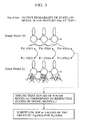
- FIG. 3 A specific process of the output probability determination is illustrated below.
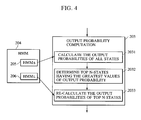
- the state diagram of the process is illustrated in Fig. 3, and the flow of the recognition process is illustrated in Fig. 4.
- Two types of HMMs having different number of mixtures are independently trained according to the well known EM-algorithm using the sound database (phonemic labels and feature parameters) .
- the mixture number of the small number of mixture HMM S is indicated by s
- the mixture number of the large number of mixture HMM L is represented by l (s ⁇ l).
- the output probabilities P Lj (O(t)) are calculated by use of only the states j of the large number of mixture HMM L corresponding to the states j determined by the previous calculations (step 2303).
- the N output probabilities P Lj (O(t)) obtained by the large number of mixture HMM L and the J-N output probabilities P Sj (O(t)) other than the N output probabilities P Lj (O(t)) obtained by the small number of mixture HMM S are employed as the final output probability P j (O(t)) of each state (j).
- recognition processing is executed.
- the conventional recognition method employed by only one type of HMM three states and two mixtures in each state (a total number of 900 mixtures) are used to achieve 79.0% of the top 1 sentence recognition accuracy, or three states and eighteen mixtures in each state (a total number of 1350 mixtures) are used to achieve 81.0% of the top 1 sentence recognition accuracy.
- three states and four mixtures are used for the first estimation, and then, the output probabilities of ten states are determined by use of three states and eighteen mixtures, the recognition accuracy substantially similar to those according to the conventional method can be obtained with a reduction of the total number of mixtures to 480.
- the recognition accuracy substantially similar to those according to the conventional method can be obtained with a reduction of the total number of mixtures to 690. Consequently, according to the method of the present invention, the amount of output probability processing can be reduced to nearly one half of the processing required for the conventional method, both methods exhibiting substantially similar rates of recognition accuracy.
- the present invention is not limited to three states in each HMM, and instead, the number of states may be around three or four as long as the resulting number of determinations is suitable and a reasonably good rate of recognition accuracy can be obtained.
- this embodiment employs only two types of HMMs, that is, a rough HMM having a smaller number of mixtures and a detailed HMM having a larger number of mixtures. However, a plurality of types of HMMs having different number of mixtures may be employed.
- the output probabilities are calculated in two stages since the two types of HMMs, the rough HMM and the detailed HMM are used.
- the output probabilities may be redetermined in a plurality of stages in accordance with the number of types of HMMs.
- the output probabilities of all the states may first be determined by use of the rough HMM. Then, the output probabilities of a range from the top A states to the top B states (A ⁇ B) (B-A+1) having the highest output probabilities obtained by the previous determinations may be redetermined by the comparatively-detailed HMM.
- the output probabilities of the top (A-1) states may be similarly re-determined by use of the more detailed HMM. According to this process in a plurality of stages, the most precise output probability can be achieved.
- the output probabilities of all the states may first be determined by use of the rough HMM. Then, the output probabilities of the top B states having the highest output probabilities obtained by the previous determinations may be redetermined by use of the comparatively-detailed HMM. Further, the output probabilities of the top A states (A ⁇ B) having the highest output probabilities obtained by the previous redeterminations may be once again determined by use of the more detailed HMM. Recognition processing may thus be executed according to the resulting output probabilities obtained by the respective types of HMMs.
- Fig. 5 is a schematic view illustrating a speech recognition system according to a second embodiment of the present invention.
- the same elements as described in the first embodiment are designated by like reference numerals, and an explanation thereof will thus be omitted.
- the speech recognition system of this embodiment differs from the system of the previous embodiment in the construction of the HMM storing section 104.
- the HMM storing section 104 of this embodiment includes a HMM I storing portion 2105 in which phonemic context-independent HMMs, that is, HMM I s are stored, for estimating now much a phoneme will contribute to the recognition of the input voice, and a HMM D storing portion 2106 in which phonemic context-dependent HMMs, that is, HMM D S, are stored for determining the precise output probabilities.
- the speech recognition system constructed as described above is operated according to the flow shown in Fig. 6.
- the same steps as those shown in Fig. 2 for executing a recognition process are also designated like reference numerals, and an explanation thereof will thus be omitted.
- the output probabilities are first determined in the output probability computation section 103 (step 203) by use of the phonemic context-independent HMM I stored in the HMM I storing portion 2105 of the HMM storing section 104 (step 2205 in 204). Further, the states of the HMMs which are likely to contribute to the recognition results are determined.
- the precise output probabilities are redetermined by use of a phonemic context-dependent HMM L stored in the HMM D storing portion 2106 corresponding to the states which have been determined to contribute to the recognition results in step 2205 (step 2206).
- the language processing is performed in the language search section 107 (step 207) by use of the grammar and the dictionary stored in the grammar and dictionary section 108 (step 208).
- the recognition results are output to the display section 109 (step 209).
- phonemes which are likely to contribute to the recognition results are estimated by use of the phonemic context-independent HMMs. Then, only the output probabilities of the estimated phonemes are redetermined by use of the phonemic context-dependent HMMs which achieve high recognition accuracy. As a consequence, the total number of mixtures provided for actual processing can be reduced, thereby achieving faster speech recognition processing.
- the HMMs each formed of three states are employed for the reason similar to that given for the first embodiment.
- phonemic context-independent HMM I s m models
- phonemic context-dependent HMM D M models
- the output probability P i (O(t)) of the state i can be determined by determining the output probability represented by P Ij (O(t)) using the state (i) of the phonemic context-independent HMM I .
- the top l states (l ⁇ 1) (l ⁇ j) having the highest output probabilities P Ij (O(t)) will contribute to the recognition results, and the states i corresponding to the highest l output probabilities are determined (step 2032).
- the states L p output probabilities, k ⁇ p ⁇ l of the phonemic context-dependent HMM D corresponding to the states i obtained by the previous determinations are determined (step 2035). For determining the states L, consideration is only given to the phonemic context-dependent HMM D which will be verified against the grammar and dictionary data for language search processing.
- the output probabilities P DL (O(t)) are determined by use of only the states L of the phonemic context-dependent HMM D (step 2036).
- the p output probabilities P DL (O(t)) obtained by the phonemic context-dependent HMM D and the k-p output probabilities other than the p output probabilities are employed as the final output probability P i (O(t)).
- recognition processing is executed.
- the present invention is not intended to be limited to the use of Hidden Markov Models.
- the present invention may be adapted for use with other types of models that are used as a means of representing training speech data.
Landscapes
- Engineering & Computer Science (AREA)
- Physics & Mathematics (AREA)
- Probability & Statistics with Applications (AREA)
- Computational Linguistics (AREA)
- Health & Medical Sciences (AREA)
- Audiology, Speech & Language Pathology (AREA)
- Human Computer Interaction (AREA)
- Acoustics & Sound (AREA)
- Multimedia (AREA)
- Machine Translation (AREA)
- Image Analysis (AREA)
Applications Claiming Priority (3)
| Application Number | Priority Date | Filing Date | Title |
|---|---|---|---|
| JP24400594A JP3581401B2 (ja) | 1994-10-07 | 1994-10-07 | 音声認識方法 |
| JP24400594 | 1994-10-07 | ||
| JP244005/94 | 1994-10-07 |
Publications (2)
| Publication Number | Publication Date |
|---|---|
| EP0706171A1 true EP0706171A1 (de) | 1996-04-10 |
| EP0706171B1 EP0706171B1 (de) | 2001-01-10 |
Family
ID=17112303
Family Applications (1)
| Application Number | Title | Priority Date | Filing Date |
|---|---|---|---|
| EP95306890A Expired - Lifetime EP0706171B1 (de) | 1994-10-07 | 1995-09-29 | Einrichtung und Verfahren zur Spracherkennung |
Country Status (4)
| Country | Link |
|---|---|
| US (1) | US5787396A (de) |
| EP (1) | EP0706171B1 (de) |
| JP (1) | JP3581401B2 (de) |
| DE (1) | DE69519840T2 (de) |
Cited By (4)
| Publication number | Priority date | Publication date | Assignee | Title |
|---|---|---|---|---|
| WO1998000834A1 (en) * | 1996-06-28 | 1998-01-08 | Microsoft Corporation | Method and system for dynamically adjusted training for speech recognition |
| EP0805434A3 (de) * | 1996-05-01 | 1998-08-26 | Microsoft Corporation | Verfahren und System zur Spracherkennung mittels verborgener Markoff-Modelle mit kontinuierlichen Ausgangswahrscheinlichkeiten |
| EP0953971A1 (de) * | 1998-05-01 | 1999-11-03 | Entropic Cambridge Research Laboratory Ltd. | System und Verfahren zur Spracherkennung |
| CN1099646C (zh) * | 1997-01-30 | 2003-01-22 | 摩托罗拉公司 | 发音测量装置和方法 |
Families Citing this family (37)
| Publication number | Priority date | Publication date | Assignee | Title |
|---|---|---|---|---|
| JPH10161692A (ja) * | 1996-12-03 | 1998-06-19 | Canon Inc | 音声認識装置及び音声認識方法 |
| JPH10187195A (ja) * | 1996-12-26 | 1998-07-14 | Canon Inc | 音声合成方法および装置 |
| JP3962445B2 (ja) | 1997-03-13 | 2007-08-22 | キヤノン株式会社 | 音声処理方法及び装置 |
| JPH10254486A (ja) | 1997-03-13 | 1998-09-25 | Canon Inc | 音声認識装置および方法 |
| US6073098A (en) * | 1997-11-21 | 2000-06-06 | At&T Corporation | Method and apparatus for generating deterministic approximate weighted finite-state automata |
| JP3884856B2 (ja) | 1998-03-09 | 2007-02-21 | キヤノン株式会社 | 音声合成用データ作成装置、音声合成装置及びそれらの方法、コンピュータ可読メモリ |
| JP3902860B2 (ja) | 1998-03-09 | 2007-04-11 | キヤノン株式会社 | 音声合成制御装置及びその制御方法、コンピュータ可読メモリ |
| US6061653A (en) * | 1998-07-14 | 2000-05-09 | Alcatel Usa Sourcing, L.P. | Speech recognition system using shared speech models for multiple recognition processes |
| JP2000047696A (ja) | 1998-07-29 | 2000-02-18 | Canon Inc | 情報処理方法及び装置、その記憶媒体 |
| US6725195B2 (en) * | 1998-08-25 | 2004-04-20 | Sri International | Method and apparatus for probabilistic recognition using small number of state clusters |
| US6246982B1 (en) * | 1999-01-26 | 2001-06-12 | International Business Machines Corporation | Method for measuring distance between collections of distributions |
| JP3969908B2 (ja) | 1999-09-14 | 2007-09-05 | キヤノン株式会社 | 音声入力端末器、音声認識装置、音声通信システム及び音声通信方法 |
| US7039588B2 (en) * | 2000-03-31 | 2006-05-02 | Canon Kabushiki Kaisha | Synthesis unit selection apparatus and method, and storage medium |
| JP3728172B2 (ja) | 2000-03-31 | 2005-12-21 | キヤノン株式会社 | 音声合成方法および装置 |
| JP3814459B2 (ja) * | 2000-03-31 | 2006-08-30 | キヤノン株式会社 | 音声認識方法及び装置と記憶媒体 |
| JP4632384B2 (ja) * | 2000-03-31 | 2011-02-16 | キヤノン株式会社 | 音声情報処理装置及びその方法と記憶媒体 |
| JP2001282278A (ja) * | 2000-03-31 | 2001-10-12 | Canon Inc | 音声情報処理装置及びその方法と記憶媒体 |
| US6662158B1 (en) | 2000-04-27 | 2003-12-09 | Microsoft Corporation | Temporal pattern recognition method and apparatus utilizing segment and frame-based models |
| US6629073B1 (en) * | 2000-04-27 | 2003-09-30 | Microsoft Corporation | Speech recognition method and apparatus utilizing multi-unit models |
| JP3728177B2 (ja) | 2000-05-24 | 2005-12-21 | キヤノン株式会社 | 音声処理システム、装置、方法及び記憶媒体 |
| KR100464428B1 (ko) * | 2002-08-12 | 2005-01-03 | 삼성전자주식회사 | 음성 인식 장치 |
| JP4280505B2 (ja) * | 2003-01-20 | 2009-06-17 | キヤノン株式会社 | 情報処理装置及び情報処理方法 |
| JP4587160B2 (ja) * | 2004-03-26 | 2010-11-24 | キヤノン株式会社 | 信号処理装置および方法 |
| ATE398324T1 (de) * | 2004-04-20 | 2008-07-15 | France Telecom | Spracherkennung durch kontextuelle modellierung der spracheinheiten |
| JP4541781B2 (ja) * | 2004-06-29 | 2010-09-08 | キヤノン株式会社 | 音声認識装置および方法 |
| JP4298672B2 (ja) * | 2005-04-11 | 2009-07-22 | キヤノン株式会社 | 混合分布hmmの状態の出力確率計算方法および装置 |
| US7970613B2 (en) | 2005-11-12 | 2011-06-28 | Sony Computer Entertainment Inc. | Method and system for Gaussian probability data bit reduction and computation |
| KR100943236B1 (ko) * | 2006-02-14 | 2010-02-18 | 에스케이에너지 주식회사 | 용융파단 특성이 우수한 폴리올레핀 미세다공막 및 그제조방법 |
| US7877256B2 (en) * | 2006-02-17 | 2011-01-25 | Microsoft Corporation | Time synchronous decoding for long-span hidden trajectory model |
| US7778831B2 (en) * | 2006-02-21 | 2010-08-17 | Sony Computer Entertainment Inc. | Voice recognition with dynamic filter bank adjustment based on speaker categorization determined from runtime pitch |
| US8010358B2 (en) * | 2006-02-21 | 2011-08-30 | Sony Computer Entertainment Inc. | Voice recognition with parallel gender and age normalization |
| JP4853298B2 (ja) * | 2007-01-17 | 2012-01-11 | 日本電気株式会社 | 信号処理装置、信号処理方法および信号処理プログラム |
| US8543393B2 (en) * | 2008-05-20 | 2013-09-24 | Calabrio, Inc. | Systems and methods of improving automated speech recognition accuracy using statistical analysis of search terms |
| US8442833B2 (en) * | 2009-02-17 | 2013-05-14 | Sony Computer Entertainment Inc. | Speech processing with source location estimation using signals from two or more microphones |
| US8788256B2 (en) * | 2009-02-17 | 2014-07-22 | Sony Computer Entertainment Inc. | Multiple language voice recognition |
| US8442829B2 (en) * | 2009-02-17 | 2013-05-14 | Sony Computer Entertainment Inc. | Automatic computation streaming partition for voice recognition on multiple processors with limited memory |
| US9153235B2 (en) | 2012-04-09 | 2015-10-06 | Sony Computer Entertainment Inc. | Text dependent speaker recognition with long-term feature based on functional data analysis |
Citations (3)
| Publication number | Priority date | Publication date | Assignee | Title |
|---|---|---|---|---|
| EP0533491A2 (de) * | 1991-09-19 | 1993-03-24 | Xerox Corporation | Schlüsselwörtererkennung in einem zusammenhängenden Text mittels zweier "Hidden Markov" Modelle |
| EP0560378A1 (de) * | 1992-03-13 | 1993-09-15 | Kabushiki Kaisha Toshiba | Erkennungssystem |
| US5289562A (en) * | 1990-09-13 | 1994-02-22 | Mitsubishi Denki Kabushiki Kaisha | Pattern representation model training apparatus |
-
1994
- 1994-10-07 JP JP24400594A patent/JP3581401B2/ja not_active Expired - Fee Related
-
1995
- 1995-09-18 US US08/529,436 patent/US5787396A/en not_active Expired - Lifetime
- 1995-09-29 EP EP95306890A patent/EP0706171B1/de not_active Expired - Lifetime
- 1995-09-29 DE DE69519840T patent/DE69519840T2/de not_active Expired - Lifetime
Patent Citations (3)
| Publication number | Priority date | Publication date | Assignee | Title |
|---|---|---|---|---|
| US5289562A (en) * | 1990-09-13 | 1994-02-22 | Mitsubishi Denki Kabushiki Kaisha | Pattern representation model training apparatus |
| EP0533491A2 (de) * | 1991-09-19 | 1993-03-24 | Xerox Corporation | Schlüsselwörtererkennung in einem zusammenhängenden Text mittels zweier "Hidden Markov" Modelle |
| EP0560378A1 (de) * | 1992-03-13 | 1993-09-15 | Kabushiki Kaisha Toshiba | Erkennungssystem |
Cited By (7)
| Publication number | Priority date | Publication date | Assignee | Title |
|---|---|---|---|---|
| EP0805434A3 (de) * | 1996-05-01 | 1998-08-26 | Microsoft Corporation | Verfahren und System zur Spracherkennung mittels verborgener Markoff-Modelle mit kontinuierlichen Ausgangswahrscheinlichkeiten |
| WO1998000834A1 (en) * | 1996-06-28 | 1998-01-08 | Microsoft Corporation | Method and system for dynamically adjusted training for speech recognition |
| US5963903A (en) * | 1996-06-28 | 1999-10-05 | Microsoft Corporation | Method and system for dynamically adjusted training for speech recognition |
| CN1099646C (zh) * | 1997-01-30 | 2003-01-22 | 摩托罗拉公司 | 发音测量装置和方法 |
| EP0953971A1 (de) * | 1998-05-01 | 1999-11-03 | Entropic Cambridge Research Laboratory Ltd. | System und Verfahren zur Spracherkennung |
| WO1999057716A1 (en) * | 1998-05-01 | 1999-11-11 | Entropic Limited | Speech recognition system and method |
| US6370505B1 (en) * | 1998-05-01 | 2002-04-09 | Julian Odell | Speech recognition system and method |
Also Published As
| Publication number | Publication date |
|---|---|
| US5787396A (en) | 1998-07-28 |
| DE69519840T2 (de) | 2001-06-28 |
| JP3581401B2 (ja) | 2004-10-27 |
| EP0706171B1 (de) | 2001-01-10 |
| JPH08110791A (ja) | 1996-04-30 |
| DE69519840D1 (de) | 2001-02-15 |
Similar Documents
| Publication | Publication Date | Title |
|---|---|---|
| US5787396A (en) | Speech recognition method | |
| Digalakis et al. | Genones: Generalized mixture tying in continuous hidden Markov model-based speech recognizers | |
| US5956679A (en) | Speech processing apparatus and method using a noise-adaptive PMC model | |
| EP0303022B1 (de) | Schnelle Anpassung eines Spracherkenners an einen neuen Sprecher auf Grund der Daten eines Referenzsprechers | |
| US5865626A (en) | Multi-dialect speech recognition method and apparatus | |
| US6041299A (en) | Apparatus for calculating a posterior probability of phoneme symbol, and speech recognition apparatus | |
| US5825978A (en) | Method and apparatus for speech recognition using optimized partial mixture tying of HMM state functions | |
| JP3049259B2 (ja) | 音声認識方法 | |
| US9058811B2 (en) | Speech synthesis with fuzzy heteronym prediction using decision trees | |
| JP2924555B2 (ja) | 音声認識の境界推定方法及び音声認識装置 | |
| US20110077943A1 (en) | System for generating language model, method of generating language model, and program for language model generation | |
| US6801892B2 (en) | Method and system for the reduction of processing time in a speech recognition system using the hidden markov model | |
| US20040039572A1 (en) | Pattern recognition | |
| US20010011218A1 (en) | A system and apparatus for recognizing speech | |
| JPS62231995A (ja) | 音声認識方法 | |
| KR20010078746A (ko) | 다층 네트워크를 이용한 신호 분류를 위한 방법 및 장치 | |
| EP0903730B1 (de) | Verfahren zur Suche und Neubewertung für ein Spracherkennungssystem | |
| US5956676A (en) | Pattern adapting apparatus using minimum description length criterion in pattern recognition processing and speech recognition system | |
| EP1576580B1 (de) | Verfahren zur optimierung der durchführung eines neuronalen netzwerkes in einem spracherkennungssystem durch bedingtes überspringen einer variablen anzahl von zeitfenstern | |
| KR20040068023A (ko) | 은닉 궤적 은닉 마르코프 모델을 이용한 음성 인식 방법 | |
| KR101120765B1 (ko) | 스위칭 상태 스페이스 모델과의 멀티모덜 변동 추정을이용한 스피치 인식 방법 | |
| Wolfertstetter et al. | Structured Markov models for speech recognition | |
| JP2982689B2 (ja) | 情報量基準を用いた標準パターン作成方式 | |
| EP1369847B1 (de) | Verfahren und Vorrichtung zur Spracherkennung | |
| Gopalakrishnan et al. | Fast match techniques |
Legal Events
| Date | Code | Title | Description |
|---|---|---|---|
| PUAI | Public reference made under article 153(3) epc to a published international application that has entered the european phase |
Free format text: ORIGINAL CODE: 0009012 |
|
| AK | Designated contracting states |
Kind code of ref document: A1 Designated state(s): DE FR GB IT NL |
|
| 17P | Request for examination filed |
Effective date: 19960829 |
|
| 17Q | First examination report despatched |
Effective date: 19981008 |
|
| GRAG | Despatch of communication of intention to grant |
Free format text: ORIGINAL CODE: EPIDOS AGRA |
|
| GRAG | Despatch of communication of intention to grant |
Free format text: ORIGINAL CODE: EPIDOS AGRA |
|
| GRAG | Despatch of communication of intention to grant |
Free format text: ORIGINAL CODE: EPIDOS AGRA |
|
| GRAH | Despatch of communication of intention to grant a patent |
Free format text: ORIGINAL CODE: EPIDOS IGRA |
|
| RIC1 | Information provided on ipc code assigned before grant |
Free format text: 7G 10L 15/02 A, 7G 10L 15/06 B, 7G 10L 15/14 B |
|
| GRAH | Despatch of communication of intention to grant a patent |
Free format text: ORIGINAL CODE: EPIDOS IGRA |
|
| GRAA | (expected) grant |
Free format text: ORIGINAL CODE: 0009210 |
|
| AK | Designated contracting states |
Kind code of ref document: B1 Designated state(s): DE FR GB IT NL |
|
| PG25 | Lapsed in a contracting state [announced via postgrant information from national office to epo] |
Ref country code: NL Free format text: LAPSE BECAUSE OF FAILURE TO SUBMIT A TRANSLATION OF THE DESCRIPTION OR TO PAY THE FEE WITHIN THE PRESCRIBED TIME-LIMIT Effective date: 20010110 Ref country code: IT Free format text: LAPSE BECAUSE OF FAILURE TO SUBMIT A TRANSLATION OF THE DESCRIPTION OR TO PAY THE FEE WITHIN THE PRE;WARNING: LAPSES OF ITALIAN PATENTS WITH EFFECTIVE DATE BEFORE 2007 MAY HAVE OCCURRED AT ANY TIME BEFORE 2007. THE CORRECT EFFECTIVE DATE MAY BE DIFFERENT FROM THE ONE RECORDED.SCRIBED TIME-LIMIT Effective date: 20010110 |
|
| REF | Corresponds to: |
Ref document number: 69519840 Country of ref document: DE Date of ref document: 20010215 |
|
| ET | Fr: translation filed | ||
| NLV1 | Nl: lapsed or annulled due to failure to fulfill the requirements of art. 29p and 29m of the patents act | ||
| PLBE | No opposition filed within time limit |
Free format text: ORIGINAL CODE: 0009261 |
|
| STAA | Information on the status of an ep patent application or granted ep patent |
Free format text: STATUS: NO OPPOSITION FILED WITHIN TIME LIMIT |
|
| REG | Reference to a national code |
Ref country code: GB Ref legal event code: IF02 |
|
| 26N | No opposition filed | ||
| PGFP | Annual fee paid to national office [announced via postgrant information from national office to epo] |
Ref country code: FR Payment date: 20101004 Year of fee payment: 16 |
|
| PGFP | Annual fee paid to national office [announced via postgrant information from national office to epo] |
Ref country code: GB Payment date: 20100928 Year of fee payment: 16 |
|
| PGFP | Annual fee paid to national office [announced via postgrant information from national office to epo] |
Ref country code: DE Payment date: 20100930 Year of fee payment: 16 |
|
| GBPC | Gb: european patent ceased through non-payment of renewal fee |
Effective date: 20110929 |
|
| REG | Reference to a national code |
Ref country code: FR Ref legal event code: ST Effective date: 20120531 |
|
| REG | Reference to a national code |
Ref country code: DE Ref legal event code: R119 Ref document number: 69519840 Country of ref document: DE Effective date: 20120403 |
|
| PG25 | Lapsed in a contracting state [announced via postgrant information from national office to epo] |
Ref country code: DE Free format text: LAPSE BECAUSE OF NON-PAYMENT OF DUE FEES Effective date: 20120403 |
|
| PG25 | Lapsed in a contracting state [announced via postgrant information from national office to epo] |
Ref country code: GB Free format text: LAPSE BECAUSE OF NON-PAYMENT OF DUE FEES Effective date: 20110929 Ref country code: FR Free format text: LAPSE BECAUSE OF NON-PAYMENT OF DUE FEES Effective date: 20110930 |