EP0243574A2 - Echangeur de chaleur et procédé de fabrication d'échangeurs de chaleur - Google Patents
Echangeur de chaleur et procédé de fabrication d'échangeurs de chaleur Download PDFInfo
- Publication number
- EP0243574A2 EP0243574A2 EP87100393A EP87100393A EP0243574A2 EP 0243574 A2 EP0243574 A2 EP 0243574A2 EP 87100393 A EP87100393 A EP 87100393A EP 87100393 A EP87100393 A EP 87100393A EP 0243574 A2 EP0243574 A2 EP 0243574A2
- Authority
- EP
- European Patent Office
- Prior art keywords
- sleeve
- tube
- heat exchanger
- tubes
- heat
- Prior art date
- Legal status (The legal status is an assumption and is not a legal conclusion. Google has not performed a legal analysis and makes no representation as to the accuracy of the status listed.)
- Granted
Links
Images

Classifications
-
- B—PERFORMING OPERATIONS; TRANSPORTING
- B29—WORKING OF PLASTICS; WORKING OF SUBSTANCES IN A PLASTIC STATE IN GENERAL
- B29C—SHAPING OR JOINING OF PLASTICS; SHAPING OF MATERIAL IN A PLASTIC STATE, NOT OTHERWISE PROVIDED FOR; AFTER-TREATMENT OF THE SHAPED PRODUCTS, e.g. REPAIRING
- B29C65/00—Joining or sealing of preformed parts, e.g. welding of plastics materials; Apparatus therefor
- B29C65/02—Joining or sealing of preformed parts, e.g. welding of plastics materials; Apparatus therefor by heating, with or without pressure
- B29C65/14—Joining or sealing of preformed parts, e.g. welding of plastics materials; Apparatus therefor by heating, with or without pressure using wave energy, i.e. electromagnetic radiation, or particle radiation
- B29C65/1429—Joining or sealing of preformed parts, e.g. welding of plastics materials; Apparatus therefor by heating, with or without pressure using wave energy, i.e. electromagnetic radiation, or particle radiation characterised by the way of heating the interface
- B29C65/1448—Joining or sealing of preformed parts, e.g. welding of plastics materials; Apparatus therefor by heating, with or without pressure using wave energy, i.e. electromagnetic radiation, or particle radiation characterised by the way of heating the interface radiating the edges of the parts to be joined, e.g. for curing a layer of adhesive placed between two flat parts to be joined, e.g. for making CDs or DVDs
-
- B—PERFORMING OPERATIONS; TRANSPORTING
- B29—WORKING OF PLASTICS; WORKING OF SUBSTANCES IN A PLASTIC STATE IN GENERAL
- B29C—SHAPING OR JOINING OF PLASTICS; SHAPING OF MATERIAL IN A PLASTIC STATE, NOT OTHERWISE PROVIDED FOR; AFTER-TREATMENT OF THE SHAPED PRODUCTS, e.g. REPAIRING
- B29C66/00—General aspects of processes or apparatus for joining preformed parts
- B29C66/01—General aspects dealing with the joint area or with the area to be joined
- B29C66/05—Particular design of joint configurations
- B29C66/10—Particular design of joint configurations particular design of the joint cross-sections
- B29C66/13—Single flanged joints; Fin-type joints; Single hem joints; Edge joints; Interpenetrating fingered joints; Other specific particular designs of joint cross-sections not provided for in groups B29C66/11 - B29C66/12
- B29C66/137—Beaded-edge joints or bead seals
-
- B—PERFORMING OPERATIONS; TRANSPORTING
- B29—WORKING OF PLASTICS; WORKING OF SUBSTANCES IN A PLASTIC STATE IN GENERAL
- B29C—SHAPING OR JOINING OF PLASTICS; SHAPING OF MATERIAL IN A PLASTIC STATE, NOT OTHERWISE PROVIDED FOR; AFTER-TREATMENT OF THE SHAPED PRODUCTS, e.g. REPAIRING
- B29C66/00—General aspects of processes or apparatus for joining preformed parts
- B29C66/50—General aspects of joining tubular articles; General aspects of joining long products, i.e. bars or profiled elements; General aspects of joining single elements to tubular articles, hollow articles or bars; General aspects of joining several hollow-preforms to form hollow or tubular articles
- B29C66/51—Joining tubular articles, profiled elements or bars; Joining single elements to tubular articles, hollow articles or bars; Joining several hollow-preforms to form hollow or tubular articles
- B29C66/52—Joining tubular articles, bars or profiled elements
- B29C66/522—Joining tubular articles
- B29C66/5227—Joining tubular articles for forming multi-tubular articles by longitudinally joining elementary tubular articles wall-to-wall (e.g. joining the wall of a first tubular article to the wall of a second tubular article) or for forming multilayer tubular articles
-
- B—PERFORMING OPERATIONS; TRANSPORTING
- B29—WORKING OF PLASTICS; WORKING OF SUBSTANCES IN A PLASTIC STATE IN GENERAL
- B29C—SHAPING OR JOINING OF PLASTICS; SHAPING OF MATERIAL IN A PLASTIC STATE, NOT OTHERWISE PROVIDED FOR; AFTER-TREATMENT OF THE SHAPED PRODUCTS, e.g. REPAIRING
- B29C66/00—General aspects of processes or apparatus for joining preformed parts
- B29C66/50—General aspects of joining tubular articles; General aspects of joining long products, i.e. bars or profiled elements; General aspects of joining single elements to tubular articles, hollow articles or bars; General aspects of joining several hollow-preforms to form hollow or tubular articles
- B29C66/51—Joining tubular articles, profiled elements or bars; Joining single elements to tubular articles, hollow articles or bars; Joining several hollow-preforms to form hollow or tubular articles
- B29C66/53—Joining single elements to tubular articles, hollow articles or bars
- B29C66/534—Joining single elements to open ends of tubular or hollow articles or to the ends of bars
- B29C66/5344—Joining single elements to open ends of tubular or hollow articles or to the ends of bars said single elements being substantially annular, i.e. of finite length, e.g. joining flanges to tube ends
-
- B—PERFORMING OPERATIONS; TRANSPORTING
- B29—WORKING OF PLASTICS; WORKING OF SUBSTANCES IN A PLASTIC STATE IN GENERAL
- B29C—SHAPING OR JOINING OF PLASTICS; SHAPING OF MATERIAL IN A PLASTIC STATE, NOT OTHERWISE PROVIDED FOR; AFTER-TREATMENT OF THE SHAPED PRODUCTS, e.g. REPAIRING
- B29C66/00—General aspects of processes or apparatus for joining preformed parts
- B29C66/50—General aspects of joining tubular articles; General aspects of joining long products, i.e. bars or profiled elements; General aspects of joining single elements to tubular articles, hollow articles or bars; General aspects of joining several hollow-preforms to form hollow or tubular articles
- B29C66/51—Joining tubular articles, profiled elements or bars; Joining single elements to tubular articles, hollow articles or bars; Joining several hollow-preforms to form hollow or tubular articles
- B29C66/53—Joining single elements to tubular articles, hollow articles or bars
- B29C66/534—Joining single elements to open ends of tubular or hollow articles or to the ends of bars
- B29C66/5346—Joining single elements to open ends of tubular or hollow articles or to the ends of bars said single elements being substantially flat
- B29C66/53465—Joining single elements to open ends of tubular or hollow articles or to the ends of bars said single elements being substantially flat said single flat elements being provided with holes facing the tube ends, e.g. for making heat-exchangers
-
- B—PERFORMING OPERATIONS; TRANSPORTING
- B29—WORKING OF PLASTICS; WORKING OF SUBSTANCES IN A PLASTIC STATE IN GENERAL
- B29C—SHAPING OR JOINING OF PLASTICS; SHAPING OF MATERIAL IN A PLASTIC STATE, NOT OTHERWISE PROVIDED FOR; AFTER-TREATMENT OF THE SHAPED PRODUCTS, e.g. REPAIRING
- B29C66/00—General aspects of processes or apparatus for joining preformed parts
- B29C66/70—General aspects of processes or apparatus for joining preformed parts characterised by the composition, physical properties or the structure of the material of the parts to be joined; Joining with non-plastics material
- B29C66/73—General aspects of processes or apparatus for joining preformed parts characterised by the composition, physical properties or the structure of the material of the parts to be joined; Joining with non-plastics material characterised by the intensive physical properties of the material of the parts to be joined, by the optical properties of the material of the parts to be joined, by the extensive physical properties of the parts to be joined, by the state of the material of the parts to be joined or by the material of the parts to be joined being a thermoplastic or a thermoset
- B29C66/739—General aspects of processes or apparatus for joining preformed parts characterised by the composition, physical properties or the structure of the material of the parts to be joined; Joining with non-plastics material characterised by the intensive physical properties of the material of the parts to be joined, by the optical properties of the material of the parts to be joined, by the extensive physical properties of the parts to be joined, by the state of the material of the parts to be joined or by the material of the parts to be joined being a thermoplastic or a thermoset characterised by the material of the parts to be joined being a thermoplastic or a thermoset
- B29C66/7392—General aspects of processes or apparatus for joining preformed parts characterised by the composition, physical properties or the structure of the material of the parts to be joined; Joining with non-plastics material characterised by the intensive physical properties of the material of the parts to be joined, by the optical properties of the material of the parts to be joined, by the extensive physical properties of the parts to be joined, by the state of the material of the parts to be joined or by the material of the parts to be joined being a thermoplastic or a thermoset characterised by the material of the parts to be joined being a thermoplastic or a thermoset characterised by the material of at least one of the parts being a thermoplastic
- B29C66/73921—General aspects of processes or apparatus for joining preformed parts characterised by the composition, physical properties or the structure of the material of the parts to be joined; Joining with non-plastics material characterised by the intensive physical properties of the material of the parts to be joined, by the optical properties of the material of the parts to be joined, by the extensive physical properties of the parts to be joined, by the state of the material of the parts to be joined or by the material of the parts to be joined being a thermoplastic or a thermoset characterised by the material of the parts to be joined being a thermoplastic or a thermoset characterised by the material of at least one of the parts being a thermoplastic characterised by the materials of both parts being thermoplastics
-
- F—MECHANICAL ENGINEERING; LIGHTING; HEATING; WEAPONS; BLASTING
- F28—HEAT EXCHANGE IN GENERAL
- F28F—DETAILS OF HEAT-EXCHANGE AND HEAT-TRANSFER APPARATUS, OF GENERAL APPLICATION
- F28F21/00—Constructions of heat-exchange apparatus characterised by the selection of particular materials
- F28F21/06—Constructions of heat-exchange apparatus characterised by the selection of particular materials of plastics material
- F28F21/062—Constructions of heat-exchange apparatus characterised by the selection of particular materials of plastics material the heat-exchange apparatus employing tubular conduits
-
- F—MECHANICAL ENGINEERING; LIGHTING; HEATING; WEAPONS; BLASTING
- F28—HEAT EXCHANGE IN GENERAL
- F28F—DETAILS OF HEAT-EXCHANGE AND HEAT-TRANSFER APPARATUS, OF GENERAL APPLICATION
- F28F21/00—Constructions of heat-exchange apparatus characterised by the selection of particular materials
- F28F21/06—Constructions of heat-exchange apparatus characterised by the selection of particular materials of plastics material
- F28F21/067—Details
-
- F—MECHANICAL ENGINEERING; LIGHTING; HEATING; WEAPONS; BLASTING
- F28—HEAT EXCHANGE IN GENERAL
- F28F—DETAILS OF HEAT-EXCHANGE AND HEAT-TRANSFER APPARATUS, OF GENERAL APPLICATION
- F28F9/00—Casings; Header boxes; Auxiliary supports for elements; Auxiliary members within casings
- F28F9/02—Header boxes; End plates
- F28F9/04—Arrangements for sealing elements into header boxes or end plates
- F28F9/16—Arrangements for sealing elements into header boxes or end plates by permanent joints, e.g. by rolling
- F28F9/18—Arrangements for sealing elements into header boxes or end plates by permanent joints, e.g. by rolling by welding
- F28F9/187—Arrangements for sealing elements into header boxes or end plates by permanent joints, e.g. by rolling by welding at least one of the parts being non-metallic, e.g. heat-sealing plastic elements
-
- B—PERFORMING OPERATIONS; TRANSPORTING
- B29—WORKING OF PLASTICS; WORKING OF SUBSTANCES IN A PLASTIC STATE IN GENERAL
- B29C—SHAPING OR JOINING OF PLASTICS; SHAPING OF MATERIAL IN A PLASTIC STATE, NOT OTHERWISE PROVIDED FOR; AFTER-TREATMENT OF THE SHAPED PRODUCTS, e.g. REPAIRING
- B29C66/00—General aspects of processes or apparatus for joining preformed parts
- B29C66/70—General aspects of processes or apparatus for joining preformed parts characterised by the composition, physical properties or the structure of the material of the parts to be joined; Joining with non-plastics material
- B29C66/71—General aspects of processes or apparatus for joining preformed parts characterised by the composition, physical properties or the structure of the material of the parts to be joined; Joining with non-plastics material characterised by the composition of the plastics material of the parts to be joined
-
- B—PERFORMING OPERATIONS; TRANSPORTING
- B29—WORKING OF PLASTICS; WORKING OF SUBSTANCES IN A PLASTIC STATE IN GENERAL
- B29C—SHAPING OR JOINING OF PLASTICS; SHAPING OF MATERIAL IN A PLASTIC STATE, NOT OTHERWISE PROVIDED FOR; AFTER-TREATMENT OF THE SHAPED PRODUCTS, e.g. REPAIRING
- B29C66/00—General aspects of processes or apparatus for joining preformed parts
- B29C66/70—General aspects of processes or apparatus for joining preformed parts characterised by the composition, physical properties or the structure of the material of the parts to be joined; Joining with non-plastics material
- B29C66/72—General aspects of processes or apparatus for joining preformed parts characterised by the composition, physical properties or the structure of the material of the parts to be joined; Joining with non-plastics material characterised by the structure of the material of the parts to be joined
- B29C66/725—General aspects of processes or apparatus for joining preformed parts characterised by the composition, physical properties or the structure of the material of the parts to be joined; Joining with non-plastics material characterised by the structure of the material of the parts to be joined being hollow-walled or honeycombs
- B29C66/7252—General aspects of processes or apparatus for joining preformed parts characterised by the composition, physical properties or the structure of the material of the parts to be joined; Joining with non-plastics material characterised by the structure of the material of the parts to be joined being hollow-walled or honeycombs hollow-walled
- B29C66/72523—General aspects of processes or apparatus for joining preformed parts characterised by the composition, physical properties or the structure of the material of the parts to be joined; Joining with non-plastics material characterised by the structure of the material of the parts to be joined being hollow-walled or honeycombs hollow-walled multi-channelled or multi-tubular
-
- B—PERFORMING OPERATIONS; TRANSPORTING
- B29—WORKING OF PLASTICS; WORKING OF SUBSTANCES IN A PLASTIC STATE IN GENERAL
- B29C—SHAPING OR JOINING OF PLASTICS; SHAPING OF MATERIAL IN A PLASTIC STATE, NOT OTHERWISE PROVIDED FOR; AFTER-TREATMENT OF THE SHAPED PRODUCTS, e.g. REPAIRING
- B29C66/00—General aspects of processes or apparatus for joining preformed parts
- B29C66/70—General aspects of processes or apparatus for joining preformed parts characterised by the composition, physical properties or the structure of the material of the parts to be joined; Joining with non-plastics material
- B29C66/72—General aspects of processes or apparatus for joining preformed parts characterised by the composition, physical properties or the structure of the material of the parts to be joined; Joining with non-plastics material characterised by the structure of the material of the parts to be joined
- B29C66/727—General aspects of processes or apparatus for joining preformed parts characterised by the composition, physical properties or the structure of the material of the parts to be joined; Joining with non-plastics material characterised by the structure of the material of the parts to be joined being porous, e.g. foam
-
- B—PERFORMING OPERATIONS; TRANSPORTING
- B29—WORKING OF PLASTICS; WORKING OF SUBSTANCES IN A PLASTIC STATE IN GENERAL
- B29L—INDEXING SCHEME ASSOCIATED WITH SUBCLASS B29C, RELATING TO PARTICULAR ARTICLES
- B29L2031/00—Other particular articles
- B29L2031/18—Heat-exchangers or parts thereof
-
- B—PERFORMING OPERATIONS; TRANSPORTING
- B29—WORKING OF PLASTICS; WORKING OF SUBSTANCES IN A PLASTIC STATE IN GENERAL
- B29L—INDEXING SCHEME ASSOCIATED WITH SUBCLASS B29C, RELATING TO PARTICULAR ARTICLES
- B29L2031/00—Other particular articles
- B29L2031/60—Multitubular or multicompartmented articles, e.g. honeycomb
- B29L2031/601—Multi-tubular articles, i.e. composed of a plurality of tubes
- B29L2031/602—Multi-tubular articles, i.e. composed of a plurality of tubes composed of several elementary tubular elements
-
- Y—GENERAL TAGGING OF NEW TECHNOLOGICAL DEVELOPMENTS; GENERAL TAGGING OF CROSS-SECTIONAL TECHNOLOGIES SPANNING OVER SEVERAL SECTIONS OF THE IPC; TECHNICAL SUBJECTS COVERED BY FORMER USPC CROSS-REFERENCE ART COLLECTIONS [XRACs] AND DIGESTS
- Y10—TECHNICAL SUBJECTS COVERED BY FORMER USPC
- Y10S—TECHNICAL SUBJECTS COVERED BY FORMER USPC CROSS-REFERENCE ART COLLECTIONS [XRACs] AND DIGESTS
- Y10S165/00—Heat exchange
- Y10S165/454—Heat exchange having side-by-side conduits structure or conduit section
- Y10S165/468—Core formed by stack tubular members with abutting edges
-
- Y—GENERAL TAGGING OF NEW TECHNOLOGICAL DEVELOPMENTS; GENERAL TAGGING OF CROSS-SECTIONAL TECHNOLOGIES SPANNING OVER SEVERAL SECTIONS OF THE IPC; TECHNICAL SUBJECTS COVERED BY FORMER USPC CROSS-REFERENCE ART COLLECTIONS [XRACs] AND DIGESTS
- Y10—TECHNICAL SUBJECTS COVERED BY FORMER USPC
- Y10S—TECHNICAL SUBJECTS COVERED BY FORMER USPC CROSS-REFERENCE ART COLLECTIONS [XRACs] AND DIGESTS
- Y10S165/00—Heat exchange
- Y10S165/905—Materials of manufacture
Definitions
- the invention relates to a heat exchanger consisting of at least one group of tubes made of thermoplastic material and a method for producing these heat exchangers.
- the heat exchangers known today consist of tubes or tube groups which are embedded in a tube sheet. This tube sheet is either manufactured separately, in which case the tube ends must be connected to the tube sheet, or the tube sheet is produced when the heat exchanger is produced by introducing a casting compound between the tube ends.
- the production of such heat exchangers is complex because either the pipes have to be threaded into the tube sheet and positioned before they are connected to the tube sheet, or the tube ends have to be kept at a distance using special devices to prevent the casting compound (self-curing material or plastic melt) between the pipes.
- the object of the present invention is to provide a heat exchanger which is particularly simple to manufacture.
- the heat exchanger according to the invention is designed to be very compact in the area of the otherwise conventional tube sheet. It is also an object of the present invention to provide a method for producing these heat exchangers that is particularly simple to carry out.
- the tube ends of a group are surrounded by a sleeve, which consists at least partially of thermoplastic material, and the tube ends of the tubes adjacent to the sleeve are welded to the sleeve on the end face.
- the combination of sleeves and pipe ends enables a compact arrangement of the pipe ends without losing the strength and tightness required at the entrance to a heat exchanger.
- the pipe ends are preferably made of a thermoplastic material which has an average linear expansion coefficient between 100 ⁇ 10 0 and 400 ⁇ 10 0 / K in the range between room temperature and melting temperature.
- the pipe ends are fused to one another or to the sleeve at least to a depth that corresponds to the thinnest wall thickness of the pipes.
- heat exchanger also includes substance exchangers for gases and mufflers for gas or liquid jets.
- tubes includes all tubular bodies, such as tubes, hoses or hollow fibers.
- the cross-sectional shape of the tubes is not limited to circular cross-sections; the tubes can also have an elliptical or polygonal, for example triangular, quadrangular, square, pentagonal, etc. cross section.
- the wall thickness of the pipes, which results from the outside and inside cross section of the pipes, can be the same or different over the circumference of the pipes.
- Outside and inside cross-section of the tubes can have the same or different cross-sectional shape.
- a tube may have a polygonal contour in the outer cross section and a circular or elliptical contour in the inner cross section.
- the inner cross section of the tubes can also have one or more continuous cavities.
- the tubes can also be put together in groups. For example, these tube groups can have the shape of a plate, e.g. when the pipes are parallel to each other and the axes are arranged on a straight line.
- a particularly compact shape results in the area of the sleeve of the heat exchanger according to the invention if the inner cross section of the sleeve and the outer cross section of all ends of the tube groups arranged in a sleeve have the shape of a hexagon. This is especially true when the outer cross section of each pipe or pipe group is circular or hexagonal.
- the hexagon is a guarantee for the circular outer cross section of the pipe ends densest packing of the pipe ends.
- Such a hexagon generally has sides of at least approximately the same length. Any cross-sectional shape of the sleeve is suitable, however, as far as the tube ends can be inserted into the sleeve in a compact arrangement.
- Each tube group can consist of 7 to ll4l tubes.
- thermoplastic polymer material from which the pipes and / or sleeve are made is preferably a polyethylene, polypropylene or belongs to the fluoropolymers.
- the tubes of the heat exchanger usually have no porosity or a maximum porosity of 20% of the wall volume.
- the object of the invention is also achieved by a method for producing a heat exchanger according to the invention, which is characterized in that the tube ends are combined at least one side of the tubes and positioned in a sleeve such that the tube ends are arranged almost vertically upwards, and the Pipe ends form an essentially flat surface with one another so that heat is supplied to the pipe ends from above so that the pipe ends at least partially soften and the outer walls of the pipe ends expand such that they abut the outer walls of adjacent pipe ends and fuse with these pipe ends .
- the heat is usually supplied by heat radiation.
- the supply of heat can be achieved in the simplest way by moving a heating plate from above onto the pipe ends and at a short distance, which is in the range from 0.5 to 30 mm, until the pipe ends are positioned with one another are fused.
- the thermal treatment can also be carried out under vacuum or under a protective gas atmosphere, in which case the distance between the heating plate can be in other areas.
- the heat can also be supplied by sound waves, light, electromagnetic waves, hot gases, hot liquids or the like. It is essential here that the pipe ends do not come into contact with the actual heat source.
- a sleeve made of a material is used to which the pipe ends hardly or not at all stick, the sleeve can be pulled off again after the pipe ends that have been fused together have cooled.
- the fused tube ends can then be embedded in another sleeve, for example in a tube sheet or in a heat exchanger using conventional methods.
- the surface of the tube ends welded to one another has excellent strength when a sleeve is used which is at least partially made of thermoplastic material and the tube ends are supplied with sufficient heat that the tubes adjacent to the sleeve abut and fuse with the sleeve .
- the thermal treatment should preferably be carried out under the following conditions: where Q is the amount of heat supplied, per surface (end face) and time in J / m2s, e is the linear expansion coefficient of the rod material in l / K, t the duration of the heat in seconds, ⁇ the density of the rod material in kg / m3, C p is the specific heat of the rod material in J / kg K, and ⁇ is the thermal conductivity of the rod material in J / msK
- the method according to the invention is particularly successful when tubes made of a thermoplastic material are used which has an average linear expansion coefficient between 100 ⁇ 10 0 and 400 ⁇ 10 0 1 / K in the range between room temperature and melting temperature.
- the tube ends are at least partially heated to a temperature which is above the melting temperature of the tube material.
- the heat exchangers produced by the process according to the invention have an end face, that is to say on the surface in which the tubes end, a surface which is flush with the sleeve if the tube ends are positioned in the opening of the sleeve before the thermal treatment in such a way that the tube ends protrude 0.5 to 3 mm above the sleeve.
- the method according to the invention can be carried out most favorably if the tube ends are combined into a compact packing - in the case of circular or hexagonal outer cross sections of the tube ends into a packing with a hexagonal outer contour - before heat is supplied to them.
- Tubes are preferably used in the process according to the invention, the hydraulic diameter of each cavity between 0.3 and 15 mm, preferably between 0.5 and 7.5 mm, and the wall thickness at the thinnest point between 5 and 25%, preferably between 7 and 5 and l7.5% of the hydraulic diameter.
- sleeve used here is not limited to tubular bodies. It can also have the form of a plate which has a through opening which correlates with the outer contour of the tube bundle. A plurality of openings for one tube bundle each can also be provided in a plate. The sleeve can also be part of the heat exchanger housing comprising the tube bundle.
- the tube ends are positioned in such a way that they form an essentially flat surface before the thermal treatment, then this condition should also include that this surface can also be convex or concave.
- the sides of the hexagonal opening are all l2 mm long, with all corner points of the hexagon lying on a circle.
- the opening of the plate has a bevel toward the outside (end face), opposite bevels enclosing an acute angle of 45 °, and the bevel extends from the surface to a depth of 1.5 mm.
- the tube ends are positioned in the opening of the sleeve so that they protrude 0.5 mm from the edge of the sleeve.
- a round heating plate with a diameter of 100 mm which has an emission coefficient of 0.9 and was heated to a temperature of 430 ° C., was held for 2 minutes at a distance of 10 mm over the essentially upward ends of the tubes , causing the pipe ends to widen. After the tube ends and the sleeve have cooled, it can be determined that the tube ends are welded to one another or to the sleeve over a depth of 1.25 mm or to the sleeve.
- a tube group produced in this way can either be used alone, or several groups can be inserted next to one another in a heat exchanger housing.
- the five tubes 1 shown are positioned in a sleeve 2 - here designed as a plate - in such a way that the tube ends form a flat surface and project beyond the sleeve 2 by the amount s.
- a heated plate P - here shown in broken lines - is held at a distance d from above onto the pipe ends. As a result, the pipe ends l expand and fuse together.
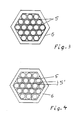
- the pipe ends of the pipes 1 are connected to one another or to the sleeve 2.
- the points at which the pipe end of a pipe 1 is fused to the sleeve 2 is denoted by 3, at which two pipe ends are fused together, is denoted by 4.
- FIG. 3 similar to FIG. 1, the arrangement of 19 tubes in a sleeve 6 with a hexagonal cross section before the thermal treatment is shown in a top view. This results in the densest packing for pipes with a circular cross-section.
Landscapes
- Engineering & Computer Science (AREA)
- Mechanical Engineering (AREA)
- Physics & Mathematics (AREA)
- Thermal Sciences (AREA)
- General Engineering & Computer Science (AREA)
- Health & Medical Sciences (AREA)
- Electromagnetism (AREA)
- Toxicology (AREA)
- Heat-Exchange Devices With Radiators And Conduit Assemblies (AREA)
- Details Of Heat-Exchange And Heat-Transfer (AREA)
- Lining Or Joining Of Plastics Or The Like (AREA)
Applications Claiming Priority (2)
| Application Number | Priority Date | Filing Date | Title |
|---|---|---|---|
| DE19863614339 DE3614339A1 (de) | 1986-04-28 | 1986-04-28 | Waermetauscher und verfahren zum herstellen von waermetauschern |
| DE3614339 | 1986-04-28 |
Publications (3)
| Publication Number | Publication Date |
|---|---|
| EP0243574A2 true EP0243574A2 (fr) | 1987-11-04 |
| EP0243574A3 EP0243574A3 (en) | 1988-10-19 |
| EP0243574B1 EP0243574B1 (fr) | 1990-06-06 |
Family
ID=6299700
Family Applications (1)
| Application Number | Title | Priority Date | Filing Date |
|---|---|---|---|
| EP87100393A Expired - Lifetime EP0243574B1 (fr) | 1986-04-28 | 1987-01-14 | Echangeur de chaleur et procédé de fabrication d'échangeurs de chaleur |
Country Status (5)
| Country | Link |
|---|---|
| US (1) | US4867233A (fr) |
| EP (1) | EP0243574B1 (fr) |
| JP (1) | JPS62266392A (fr) |
| DE (2) | DE3614339A1 (fr) |
| DK (1) | DK65787A (fr) |
Cited By (4)
| Publication number | Priority date | Publication date | Assignee | Title |
|---|---|---|---|---|
| EP0550078A1 (fr) * | 1992-01-03 | 1993-07-07 | 3P-Consulting Inc. | Procédé pour la fabrication d'un élément de construction et élément fabriqué par ce procédé |
| WO1993016346A1 (fr) * | 1992-02-06 | 1993-08-19 | Aalander Johan | Procede de fabrication d'echangeurs de chaleur |
| RU2157494C2 (ru) * | 1998-05-20 | 2000-10-10 | Петриков Сергей Анатольевич | Сотовый теплообменный аппарат |
| FR3006232A1 (fr) * | 2013-05-28 | 2014-12-05 | Bieder Alexandra Singer | Procede d'assemblage de tubes en plastique a partir d'une source de chaleur permettant par une soudure autogene, d'obtenir un materiau homogene aux qualites esthetiques, mecaniques et de lumieres |
Families Citing this family (15)
| Publication number | Priority date | Publication date | Assignee | Title |
|---|---|---|---|---|
| DE3806517A1 (de) * | 1988-03-01 | 1989-09-14 | Akzo Gmbh | Rohrboden fuer waerme- und/oder stoffaustauscher, dessen verwendung sowie verfahren zu dessen herstellung |
| ES2108980T3 (es) * | 1993-02-04 | 1998-01-01 | Baxter Int | Conjunto de elementos de plastico alargados y procedimiento y dispositivo para su realizacion. |
| US5840151A (en) * | 1993-02-04 | 1998-11-24 | Baxter International Inc. | Apparatus and dies for forming peelable tube assemblies |
| DE19529227C2 (de) * | 1995-08-09 | 1998-08-06 | Steag Ag | Speicherblock für Regenerativ-Wärmetauscher |
| JPH09253945A (ja) * | 1996-03-25 | 1997-09-30 | Ngk Insulators Ltd | フィン付きセラミック製シェルアンドチューブ型熱交換器及びその製造方法 |
| JP3059393B2 (ja) * | 1996-11-26 | 2000-07-04 | 日本ピラー工業株式会社 | 熱交換器 |
| WO2002029347A2 (fr) | 2000-10-06 | 2002-04-11 | E.I. Du Pont De Nemours And Company | Echangeur de chaleur avec fonction de refroidissement fait d'une tuyauterie cintrable en matiere plastique et procede correspondant |
| US20030079872A1 (en) * | 2000-10-06 | 2003-05-01 | Kevin Bergevin | Refrigerant-capable heat exchanger made from bendable plastic tubing and method |
| EP2275766A1 (fr) * | 2001-10-01 | 2011-01-19 | Entegris, Inc. | Echangeur de chaleur ou de meteriau a faisceau de tubes |
| WO2003055591A1 (fr) * | 2001-12-25 | 2003-07-10 | Wellness Co., Ltd. | Convertisseur de champ et dispositif de traitement de fluides utilisant ce convertisseur |
| US20070144716A1 (en) * | 2003-12-22 | 2007-06-28 | Doh Cha P | Potted exchange devices and methods of making |
| US20060005955A1 (en) * | 2004-07-12 | 2006-01-12 | Orr Troy J | Heat exchanger apparatus and methods for controlling the temperature of a high purity, re-circulating liquid |
| US7458222B2 (en) * | 2004-07-12 | 2008-12-02 | Purity Solutions Llc | Heat exchanger apparatus for a recirculation loop and related methods and systems |
| GB0620512D0 (en) * | 2006-10-16 | 2006-11-22 | Sustainable Engine Systems Ltd | Heat exchanger |
| TWI392580B (zh) * | 2010-07-09 | 2013-04-11 | Allied Supreme Corp | Fluorine resin pipe joint manufacturing method |
Family Cites Families (40)
| Publication number | Priority date | Publication date | Assignee | Title |
|---|---|---|---|---|
| US2433546A (en) * | 1943-12-11 | 1947-12-30 | Richard T Cornelius | Method and apparatus for forming plastic radiator cores |
| US2538808A (en) * | 1950-03-24 | 1951-01-23 | Westinghouse Electric Corp | Sealed heater element and the like |
| FR1135923A (fr) * | 1954-08-30 | 1957-05-06 | Standard Thomson Corp | Perfectionnements apportés aux noyaux d'échangeurs de chaleur et à leur procédéde fabrication |
| US2966373A (en) * | 1959-02-02 | 1960-12-27 | Ici Ltd | Tubular inserts |
| DE1209725B (de) * | 1960-03-11 | 1966-01-27 | Hans Joachim Dietzsch G M B H | Verfahren zur Oberflaechenbehandlung eines Koerpers aus gebuendelten Hohlfaeden |
| US3313740A (en) * | 1962-09-26 | 1967-04-11 | Gen Tire & Rubber Co | Expoxide polymerization catalysts, their preparation and their use |
| DE1238621B (de) * | 1963-04-13 | 1967-04-13 | Dom Techniczno Handlowy Przed | Vorrichtung zur Abkuehlung oder Erwaermung des Blutes bei chirurgischen Operationen |
| US3347728A (en) * | 1964-07-29 | 1967-10-17 | Gen Motors Corp | Method for forming joints in tubes |
| NL151792C (fr) * | 1965-01-14 | |||
| US3462362A (en) * | 1966-07-26 | 1969-08-19 | Paul Kollsman | Method of reverse osmosis |
| US3459622A (en) * | 1966-11-07 | 1969-08-05 | Du Pont | Apparatus for the manufacture of plastic tube heat exchanger units |
| US3419069A (en) * | 1967-04-28 | 1968-12-31 | Du Pont | Heat transfer apparatus having flexible plastic tubular elements arranged in a braided configuration |
| US3435893A (en) * | 1967-07-31 | 1969-04-01 | Du Pont | Heat exchanger component formed with flexible plastic tubes |
| US3438434A (en) * | 1967-10-19 | 1969-04-15 | Du Pont | Subdivided heat exchanger tube bundle assembly providing longitudinally distributed fluid bypass and distributing channels |
| US3616022A (en) * | 1968-08-06 | 1971-10-26 | Du Pont | Method of making heat exchange components |
| US3592261A (en) * | 1968-11-25 | 1971-07-13 | Lummus Co | Heat exchanger |
| US3529664A (en) * | 1969-04-23 | 1970-09-22 | Du Pont | End structure for thermoplastic tubing |
| BE755779A (fr) * | 1969-09-05 | 1971-02-15 | Westinghouse Electric Corp | Appareil pour l'osmose inverse et procede pour le fabriquer |
| FR2088805A5 (fr) * | 1970-04-24 | 1972-01-07 | Fabr Element Catalytiq | |
| US3708069A (en) * | 1970-08-13 | 1973-01-02 | Aqua Chem Inc | Reverse osmosis membrane module and apparatus using the same |
| US3718181A (en) * | 1970-08-17 | 1973-02-27 | Du Pont | Plastic heat exchange apparatus |
| GB1354502A (en) * | 1970-08-28 | 1974-06-05 | Ici Ltd | Heat exchangers |
| US3741849A (en) * | 1971-02-08 | 1973-06-26 | Angelica Corp | Method of joining tubes to manifold |
| DE2204167A1 (de) * | 1972-01-29 | 1973-08-09 | Krupp Gmbh | Waermetauscher und verfahren zu seiner herstellung |
| DE2221951C2 (de) * | 1972-04-27 | 1983-04-28 | The Dow Chemical Co., 48640 Midland, Mich. | Membraneinheit zum Reinigen eines Flüssigkeitsgemisches durch Anwendung der umgekehrten Osmose |
| US4098852A (en) * | 1972-07-04 | 1978-07-04 | Rhone-Poulenc, S.A. | Process for carring out a gas/liquid heat-exchange |
| FR2191091B1 (fr) * | 1972-07-04 | 1975-03-07 | Rhone Poulenc Ind | |
| GB1478015A (en) * | 1973-07-27 | 1977-06-29 | Delanair Ltd | Heat exchanger |
| FR2273222B1 (fr) * | 1974-05-30 | 1977-10-07 | Chausson Usines Sa | |
| DD121029A2 (fr) * | 1975-06-19 | 1976-07-12 | ||
| GB1497204A (en) * | 1976-01-20 | 1978-01-05 | Kato M | Method for bundling tubes |
| US4047563A (en) * | 1976-01-27 | 1977-09-13 | Japan Medical Supply Co., Ltd. | Heat exchanger for artificial heart and lung devices |
| DE2603615C3 (de) * | 1976-01-30 | 1979-06-13 | Masashi Daito Osaka Kato (Japan) | Vorrichtung zum Herstellen eines Rohrbfindels aus thermoplastischem Kunststoff |
| DE2612514B1 (de) * | 1976-03-24 | 1977-09-29 | Cenrus Ag | Rohrboden eines rohrbuendel-waermeaustauschers |
| DE2734958A1 (de) * | 1977-08-03 | 1979-02-15 | Froehlich Air Ag | Verfahren zur herstellung eines rohrwaermetauschers und nach diesem verfahren hergestellter rohrwaermetauscher |
| US4177816A (en) * | 1978-03-27 | 1979-12-11 | Sci-Med Life Systems, Inc. | Heat exchanger for blood |
| US4300971A (en) * | 1979-04-23 | 1981-11-17 | Mcalister Roy E | Method for manifolding multiple passage solar panel |
| US4481057A (en) * | 1980-10-28 | 1984-11-06 | Oximetrix, Inc. | Cutting device and method of manufacture |
| DE3240143A1 (de) * | 1982-10-29 | 1984-05-03 | Akzo Gmbh, 5600 Wuppertal | Verfahren zum einbetten von membranen in ein thermoplastisches material |
| DE3338157A1 (de) * | 1983-10-20 | 1985-05-02 | Akzo Gmbh, 5600 Wuppertal | Verfahren zum dichten verbinden von rohrenden in rohrboeden |
-
1986
- 1986-04-28 DE DE19863614339 patent/DE3614339A1/de not_active Withdrawn
-
1987
- 1987-01-14 EP EP87100393A patent/EP0243574B1/fr not_active Expired - Lifetime
- 1987-01-14 DE DE8787100393T patent/DE3763109D1/de not_active Expired - Lifetime
- 1987-02-10 DK DK065787A patent/DK65787A/da not_active Application Discontinuation
- 1987-03-10 US US07/024,090 patent/US4867233A/en not_active Expired - Fee Related
- 1987-04-27 JP JP62102155A patent/JPS62266392A/ja active Pending
Cited By (5)
| Publication number | Priority date | Publication date | Assignee | Title |
|---|---|---|---|---|
| EP0550078A1 (fr) * | 1992-01-03 | 1993-07-07 | 3P-Consulting Inc. | Procédé pour la fabrication d'un élément de construction et élément fabriqué par ce procédé |
| WO1993016346A1 (fr) * | 1992-02-06 | 1993-08-19 | Aalander Johan | Procede de fabrication d'echangeurs de chaleur |
| US5474639A (en) * | 1992-02-06 | 1995-12-12 | Alander; Johan | Method for manufacturing heat exchangers |
| RU2157494C2 (ru) * | 1998-05-20 | 2000-10-10 | Петриков Сергей Анатольевич | Сотовый теплообменный аппарат |
| FR3006232A1 (fr) * | 2013-05-28 | 2014-12-05 | Bieder Alexandra Singer | Procede d'assemblage de tubes en plastique a partir d'une source de chaleur permettant par une soudure autogene, d'obtenir un materiau homogene aux qualites esthetiques, mecaniques et de lumieres |
Also Published As
| Publication number | Publication date |
|---|---|
| DE3763109D1 (de) | 1990-07-12 |
| EP0243574A3 (en) | 1988-10-19 |
| DK65787A (da) | 1987-10-29 |
| US4867233A (en) | 1989-09-19 |
| JPS62266392A (ja) | 1987-11-19 |
| DE3614339A1 (de) | 1987-10-29 |
| DK65787D0 (da) | 1987-02-10 |
| EP0243574B1 (fr) | 1990-06-06 |
Similar Documents
| Publication | Publication Date | Title |
|---|---|---|
| EP0243574B1 (fr) | Echangeur de chaleur et procédé de fabrication d'échangeurs de chaleur | |
| EP0243575B1 (fr) | Echangeur de chaleur et/ou de matière et procédé de fabrication des échangeurs de chaleur et/ou de matière | |
| DE4039292C2 (fr) | ||
| EP0226825B1 (fr) | Liaison d'un profilé creux avec une plaque en matière plastique, en particulier pour la fabrication d'échangeurs de chaleur | |
| DE3104010A1 (de) | Waermetauscherrohr und waermetauscher mit sammelplatte und mechanischem zusammenbau mit dem waermetauscherrohr | |
| DE2814595C2 (de) | Verfahren zum Herstellen eines Rohres aus thermoplastischem Kunststoff | |
| EP1358855A1 (fr) | Procédé pour la production d'objets par formage de formes libres lors d'un procédé de frittage au laser | |
| DE4343825A1 (de) | Rohr-Bodenverbindung für einen Wärmetauscher | |
| CH648393A5 (de) | Elektro-schweissmuffe aus einem thermoplast zum verbinden von leitungselementen aus thermoplast. | |
| DE3518441C2 (de) | Verfahren zum Herstellen eines Verformlings für das Blasformen eines Hohlkörpers | |
| EP1980380A1 (fr) | Dispositif de chauffage ou de refroidissement, en particulier comme partie d'un moule destiné au traitement de matières plastiques, tel qu' un moule d'injection pour plastique. | |
| EP2307650B1 (fr) | Connecteur linéaire pour écarteur dans des vitres isolantes, procédé de fabrication associé et procédé de raccordement de deux extrémités d une barre de profilé creux pour un écarteur comprenant un tel connecteur linéaire | |
| EP2159366B1 (fr) | Procédé et dispositif de fabrication d'un cadre intercalaire carré pour vitres d'isolation | |
| EP0947659A2 (fr) | Cadre intercalaire en matière plastique renforcée par des fibres de verre pour vitrage isolant et méthode pour la production d'angles dans ledit cadre | |
| EP0299182B1 (fr) | Procédé pour souder des extrémités de tuyaux à un plateau à tubes | |
| DE2727666A1 (de) | Zellenkasten fuer akkumulatoren sowie verfahren zu seiner herstellung | |
| DE3117716A1 (de) | Solarkollektoren und ihre herstellung | |
| EP4214043A1 (fr) | Dispositif de régulation de la température d'un élément et son procédé de fabrication | |
| WO2007088072A1 (fr) | Liaison entre le cote frontal d'un tube en matiere synthetique et un corps en matiere synthetique | |
| DE4303396A1 (de) | Preßformen von perforierten Gegenständen | |
| CH663244A5 (de) | Abstandshalter zur verwendung bei wandbauelementen. | |
| DE8611642U1 (de) | Wärmetauscher | |
| DE2805545C3 (de) | Verfahren und Vorrichtung zum Druckverschweißen mindestens eines Rohres mit einer Platte | |
| DE3636177A1 (de) | Verfahren, insbesondere zum herstellen eines waermetauschers sowie waermetauscher | |
| DE3742416A1 (de) | Verfahren und vorrichtung zum herstellen eines profilstabes aus thermoplastischem kunststoff |
Legal Events
| Date | Code | Title | Description |
|---|---|---|---|
| PUAI | Public reference made under article 153(3) epc to a published international application that has entered the european phase |
Free format text: ORIGINAL CODE: 0009012 |
|
| AK | Designated contracting states |
Kind code of ref document: A2 Designated state(s): AT BE CH DE FR GB IT LI NL SE |
|
| PUAL | Search report despatched |
Free format text: ORIGINAL CODE: 0009013 |
|
| AK | Designated contracting states |
Kind code of ref document: A3 Designated state(s): AT BE CH DE FR GB IT LI NL SE |
|
| 17P | Request for examination filed |
Effective date: 19881102 |
|
| 17Q | First examination report despatched |
Effective date: 19890209 |
|
| GRAA | (expected) grant |
Free format text: ORIGINAL CODE: 0009210 |
|
| AK | Designated contracting states |
Kind code of ref document: B1 Designated state(s): BE CH DE FR GB LI NL |
|
| GBT | Gb: translation of ep patent filed (gb section 77(6)(a)/1977) | ||
| ET | Fr: translation filed | ||
| REF | Corresponds to: |
Ref document number: 3763109 Country of ref document: DE Date of ref document: 19900712 |
|
| PLBE | No opposition filed within time limit |
Free format text: ORIGINAL CODE: 0009261 |
|
| STAA | Information on the status of an ep patent application or granted ep patent |
Free format text: STATUS: NO OPPOSITION FILED WITHIN TIME LIMIT |
|
| 26N | No opposition filed | ||
| PGFP | Annual fee paid to national office [announced via postgrant information from national office to epo] |
Ref country code: FR Payment date: 19931125 Year of fee payment: 8 |
|
| PGFP | Annual fee paid to national office [announced via postgrant information from national office to epo] |
Ref country code: CH Payment date: 19931129 Year of fee payment: 8 |
|
| PGFP | Annual fee paid to national office [announced via postgrant information from national office to epo] |
Ref country code: GB Payment date: 19931216 Year of fee payment: 8 |
|
| PGFP | Annual fee paid to national office [announced via postgrant information from national office to epo] |
Ref country code: DE Payment date: 19931217 Year of fee payment: 8 |
|
| PGFP | Annual fee paid to national office [announced via postgrant information from national office to epo] |
Ref country code: NL Payment date: 19940131 Year of fee payment: 8 |
|
| PGFP | Annual fee paid to national office [announced via postgrant information from national office to epo] |
Ref country code: BE Payment date: 19940628 Year of fee payment: 8 |
|
| PG25 | Lapsed in a contracting state [announced via postgrant information from national office to epo] |
Ref country code: GB Effective date: 19950114 |
|
| PG25 | Lapsed in a contracting state [announced via postgrant information from national office to epo] |
Ref country code: LI Effective date: 19950131 Ref country code: CH Effective date: 19950131 Ref country code: BE Effective date: 19950131 |
|
| BERE | Be: lapsed |
Owner name: AKZO N.V. Effective date: 19950131 |
|
| PG25 | Lapsed in a contracting state [announced via postgrant information from national office to epo] |
Ref country code: NL Effective date: 19950801 |
|
| GBPC | Gb: european patent ceased through non-payment of renewal fee |
Effective date: 19950114 |
|
| PG25 | Lapsed in a contracting state [announced via postgrant information from national office to epo] |
Ref country code: FR Effective date: 19950929 |
|
| REG | Reference to a national code |
Ref country code: CH Ref legal event code: PL |
|
| NLV4 | Nl: lapsed or anulled due to non-payment of the annual fee |
Effective date: 19950801 |
|
| PG25 | Lapsed in a contracting state [announced via postgrant information from national office to epo] |
Ref country code: DE Effective date: 19951003 |
|
| REG | Reference to a national code |
Ref country code: FR Ref legal event code: ST |