EP0243832B1 - Verfahren zur Herstellung von elastischen, kompakten oder zelligen Polyurethan- oder Polyurethan-Polyharnstoff-Form-Körpern - Google Patents
Verfahren zur Herstellung von elastischen, kompakten oder zelligen Polyurethan- oder Polyurethan-Polyharnstoff-Form-Körpern Download PDFInfo
- Publication number
- EP0243832B1 EP0243832B1 EP87105759A EP87105759A EP0243832B1 EP 0243832 B1 EP0243832 B1 EP 0243832B1 EP 87105759 A EP87105759 A EP 87105759A EP 87105759 A EP87105759 A EP 87105759A EP 0243832 B1 EP0243832 B1 EP 0243832B1
- Authority
- EP
- European Patent Office
- Prior art keywords
- weight
- parts
- molecular weight
- prepared
- acid
- Prior art date
- Legal status (The legal status is an assumption and is not a legal conclusion. Google has not performed a legal analysis and makes no representation as to the accuracy of the status listed.)
- Expired - Lifetime
Links
- 238000000034 method Methods 0.000 title claims abstract description 32
- 239000004814 polyurethane Substances 0.000 title claims abstract description 18
- 230000001413 cellular effect Effects 0.000 title claims abstract description 11
- 229920002635 polyurethane Polymers 0.000 title claims abstract description 8
- 229920002396 Polyurea Polymers 0.000 title claims abstract description 6
- 238000002360 preparation method Methods 0.000 title abstract description 5
- -1 polyoxytetramethylene Polymers 0.000 claims abstract description 75
- LYCAIKOWRPUZTN-UHFFFAOYSA-N Ethylene glycol Chemical compound OCCO LYCAIKOWRPUZTN-UHFFFAOYSA-N 0.000 claims abstract description 68
- 239000000203 mixture Substances 0.000 claims abstract description 39
- 239000005056 polyisocyanate Substances 0.000 claims abstract description 33
- 229920001228 polyisocyanate Polymers 0.000 claims abstract description 33
- WGCNASOHLSPBMP-UHFFFAOYSA-N hydroxyacetaldehyde Natural products OCC=O WGCNASOHLSPBMP-UHFFFAOYSA-N 0.000 claims abstract description 22
- 150000002334 glycols Chemical class 0.000 claims abstract description 17
- 125000002887 hydroxy group Chemical group [H]O* 0.000 claims abstract description 12
- 239000003054 catalyst Substances 0.000 claims abstract description 11
- 150000001991 dicarboxylic acids Chemical class 0.000 claims abstract description 10
- 239000002253 acid Substances 0.000 claims abstract description 8
- 239000004604 Blowing Agent Substances 0.000 claims abstract description 7
- 239000000654 additive Substances 0.000 claims abstract description 6
- 150000002009 diols Chemical class 0.000 claims description 27
- WNLRTRBMVRJNCN-UHFFFAOYSA-N adipic acid Chemical compound OC(=O)CCCCC(O)=O WNLRTRBMVRJNCN-UHFFFAOYSA-N 0.000 claims description 22
- WERYXYBDKMZEQL-UHFFFAOYSA-N butane-1,4-diol Chemical compound OCCCCO WERYXYBDKMZEQL-UHFFFAOYSA-N 0.000 claims description 22
- 125000004432 carbon atom Chemical group C* 0.000 claims description 19
- 150000004984 aromatic diamines Chemical class 0.000 claims description 15
- 238000000465 moulding Methods 0.000 claims description 15
- 239000001361 adipic acid Substances 0.000 claims description 11
- 235000011037 adipic acid Nutrition 0.000 claims description 11
- 239000004970 Chain extender Substances 0.000 claims description 10
- 229920003171 Poly (ethylene oxide) Polymers 0.000 claims description 10
- 229920001451 polypropylene glycol Polymers 0.000 claims description 9
- UPMLOUAZCHDJJD-UHFFFAOYSA-N 4,4'-Diphenylmethane Diisocyanate Chemical compound C1=CC(N=C=O)=CC=C1CC1=CC=C(N=C=O)C=C1 UPMLOUAZCHDJJD-UHFFFAOYSA-N 0.000 claims description 8
- 238000004519 manufacturing process Methods 0.000 claims description 7
- OFOBLEOULBTSOW-UHFFFAOYSA-N Malonic acid Chemical compound OC(=O)CC(O)=O OFOBLEOULBTSOW-UHFFFAOYSA-N 0.000 claims description 6
- PUPZLCDOIYMWBV-UHFFFAOYSA-N (+/-)-1,3-Butanediol Chemical compound CC(O)CCO PUPZLCDOIYMWBV-UHFFFAOYSA-N 0.000 claims description 4
- 125000003277 amino group Chemical group 0.000 claims description 4
- 239000003431 cross linking reagent Substances 0.000 claims description 4
- KDYFGRWQOYBRFD-UHFFFAOYSA-N succinic acid Chemical compound OC(=O)CCC(O)=O KDYFGRWQOYBRFD-UHFFFAOYSA-N 0.000 claims description 4
- RTBFRGCFXZNCOE-UHFFFAOYSA-N 1-methylsulfonylpiperidin-4-one Chemical compound CS(=O)(=O)N1CCC(=O)CC1 RTBFRGCFXZNCOE-UHFFFAOYSA-N 0.000 claims description 3
- JFCQEDHGNNZCLN-UHFFFAOYSA-N anhydrous glutaric acid Natural products OC(=O)CCCC(O)=O JFCQEDHGNNZCLN-UHFFFAOYSA-N 0.000 claims description 3
- 239000001384 succinic acid Substances 0.000 claims 1
- 238000006068 polycondensation reaction Methods 0.000 abstract description 11
- 229920005906 polyester polyol Polymers 0.000 abstract description 9
- 238000006243 chemical reaction Methods 0.000 abstract description 6
- 239000003795 chemical substances by application Substances 0.000 abstract description 4
- 230000000996 additive effect Effects 0.000 abstract 1
- 239000012752 auxiliary agent Substances 0.000 abstract 1
- 229920000728 polyester Polymers 0.000 description 24
- XLYOFNOQVPJJNP-UHFFFAOYSA-N water Substances O XLYOFNOQVPJJNP-UHFFFAOYSA-N 0.000 description 12
- 229920005862 polyol Polymers 0.000 description 9
- 150000001875 compounds Chemical class 0.000 description 8
- 230000007062 hydrolysis Effects 0.000 description 8
- 238000006460 hydrolysis reaction Methods 0.000 description 8
- 239000007788 liquid Substances 0.000 description 7
- 150000003077 polyols Chemical class 0.000 description 7
- IMNIMPAHZVJRPE-UHFFFAOYSA-N triethylenediamine Chemical compound C1CN2CCN1CC2 IMNIMPAHZVJRPE-UHFFFAOYSA-N 0.000 description 7
- MTHSVFCYNBDYFN-UHFFFAOYSA-N diethylene glycol Chemical compound OCCOCCO MTHSVFCYNBDYFN-UHFFFAOYSA-N 0.000 description 6
- 125000001449 isopropyl group Chemical group [H]C([H])([H])C([H])(*)C([H])([H])[H] 0.000 description 6
- 239000000243 solution Substances 0.000 description 6
- 229910052783 alkali metal Inorganic materials 0.000 description 4
- 238000009835 boiling Methods 0.000 description 4
- 239000000945 filler Substances 0.000 description 4
- 239000011256 inorganic filler Substances 0.000 description 4
- 229910052757 nitrogen Inorganic materials 0.000 description 4
- 239000012766 organic filler Substances 0.000 description 4
- 238000012545 processing Methods 0.000 description 4
- 239000011541 reaction mixture Substances 0.000 description 4
- 150000003839 salts Chemical class 0.000 description 4
- BOSAWIQFTJIYIS-UHFFFAOYSA-N 1,1,1-trichloro-2,2,2-trifluoroethane Chemical compound FC(F)(F)C(Cl)(Cl)Cl BOSAWIQFTJIYIS-UHFFFAOYSA-N 0.000 description 3
- WFDIJRYMOXRFFG-UHFFFAOYSA-N Acetic anhydride Chemical compound CC(=O)OC(C)=O WFDIJRYMOXRFFG-UHFFFAOYSA-N 0.000 description 3
- UHOVQNZJYSORNB-UHFFFAOYSA-N Benzene Chemical compound C1=CC=CC=C1 UHOVQNZJYSORNB-UHFFFAOYSA-N 0.000 description 3
- YMWUJEATGCHHMB-UHFFFAOYSA-N Dichloromethane Chemical compound ClCCl YMWUJEATGCHHMB-UHFFFAOYSA-N 0.000 description 3
- PEDCQBHIVMGVHV-UHFFFAOYSA-N Glycerine Chemical compound OCC(O)CO PEDCQBHIVMGVHV-UHFFFAOYSA-N 0.000 description 3
- CJKRXEBLWJVYJD-UHFFFAOYSA-N N,N'-diethylethylenediamine Chemical compound CCNCCNCC CJKRXEBLWJVYJD-UHFFFAOYSA-N 0.000 description 3
- HEMHJVSKTPXQMS-UHFFFAOYSA-M Sodium hydroxide Chemical compound [OH-].[Na+] HEMHJVSKTPXQMS-UHFFFAOYSA-M 0.000 description 3
- YXFVVABEGXRONW-UHFFFAOYSA-N Toluene Chemical compound CC1=CC=CC=C1 YXFVVABEGXRONW-UHFFFAOYSA-N 0.000 description 3
- ZMANZCXQSJIPKH-UHFFFAOYSA-N Triethylamine Chemical compound CCN(CC)CC ZMANZCXQSJIPKH-UHFFFAOYSA-N 0.000 description 3
- 239000013543 active substance Substances 0.000 description 3
- 150000001298 alcohols Chemical class 0.000 description 3
- 125000001931 aliphatic group Chemical group 0.000 description 3
- 125000003118 aryl group Chemical group 0.000 description 3
- 230000000052 comparative effect Effects 0.000 description 3
- 150000004985 diamines Chemical class 0.000 description 3
- 239000006185 dispersion Substances 0.000 description 3
- 230000032050 esterification Effects 0.000 description 3
- 238000005886 esterification reaction Methods 0.000 description 3
- 125000001495 ethyl group Chemical group [H]C([H])([H])C([H])([H])* 0.000 description 3
- 239000003063 flame retardant Substances 0.000 description 3
- 239000006260 foam Substances 0.000 description 3
- XXMIOPMDWAUFGU-UHFFFAOYSA-N hexane-1,6-diol Chemical compound OCCCCCCO XXMIOPMDWAUFGU-UHFFFAOYSA-N 0.000 description 3
- 125000004435 hydrogen atom Chemical group [H]* 0.000 description 3
- 239000012948 isocyanate Substances 0.000 description 3
- NLYAJNPCOHFWQQ-UHFFFAOYSA-N kaolin Chemical compound O.O.O=[Al]O[Si](=O)O[Si](=O)O[Al]=O NLYAJNPCOHFWQQ-UHFFFAOYSA-N 0.000 description 3
- 125000002496 methyl group Chemical group [H]C([H])([H])* 0.000 description 3
- CXMXRPHRNRROMY-UHFFFAOYSA-N sebacic acid Chemical compound OC(=O)CCCCCCCCC(O)=O CXMXRPHRNRROMY-UHFFFAOYSA-N 0.000 description 3
- 229920002545 silicone oil Polymers 0.000 description 3
- 239000007858 starting material Substances 0.000 description 3
- 125000000999 tert-butyl group Chemical group [H]C([H])([H])C(*)(C([H])([H])[H])C([H])([H])[H] 0.000 description 3
- 238000012360 testing method Methods 0.000 description 3
- RUELTTOHQODFPA-UHFFFAOYSA-N toluene 2,6-diisocyanate Chemical compound CC1=C(N=C=O)C=CC=C1N=C=O RUELTTOHQODFPA-UHFFFAOYSA-N 0.000 description 3
- DNIAPMSPPWPWGF-VKHMYHEASA-N (+)-propylene glycol Chemical compound C[C@H](O)CO DNIAPMSPPWPWGF-VKHMYHEASA-N 0.000 description 2
- YPFDHNVEDLHUCE-UHFFFAOYSA-N 1,3-propanediol Substances OCCCO YPFDHNVEDLHUCE-UHFFFAOYSA-N 0.000 description 2
- LFSYUSUFCBOHGU-UHFFFAOYSA-N 1-isocyanato-2-[(4-isocyanatophenyl)methyl]benzene Chemical compound C1=CC(N=C=O)=CC=C1CC1=CC=CC=C1N=C=O LFSYUSUFCBOHGU-UHFFFAOYSA-N 0.000 description 2
- 239000005995 Aluminium silicate Substances 0.000 description 2
- CURLTUGMZLYLDI-UHFFFAOYSA-N Carbon dioxide Chemical compound O=C=O CURLTUGMZLYLDI-UHFFFAOYSA-N 0.000 description 2
- 239000004971 Cross linker Substances 0.000 description 2
- RTZKZFJDLAIYFH-UHFFFAOYSA-N Diethyl ether Chemical compound CCOCC RTZKZFJDLAIYFH-UHFFFAOYSA-N 0.000 description 2
- VZCYOOQTPOCHFL-OWOJBTEDSA-N Fumaric acid Chemical compound OC(=O)\C=C\C(O)=O VZCYOOQTPOCHFL-OWOJBTEDSA-N 0.000 description 2
- 229910019142 PO4 Inorganic materials 0.000 description 2
- ALQSHHUCVQOPAS-UHFFFAOYSA-N Pentane-1,5-diol Chemical compound OCCCCCO ALQSHHUCVQOPAS-UHFFFAOYSA-N 0.000 description 2
- GOOHAUXETOMSMM-UHFFFAOYSA-N Propylene oxide Chemical compound CC1CO1 GOOHAUXETOMSMM-UHFFFAOYSA-N 0.000 description 2
- WQDUMFSSJAZKTM-UHFFFAOYSA-N Sodium methoxide Chemical compound [Na+].[O-]C WQDUMFSSJAZKTM-UHFFFAOYSA-N 0.000 description 2
- WYURNTSHIVDZCO-UHFFFAOYSA-N Tetrahydrofuran Chemical compound C1CCOC1 WYURNTSHIVDZCO-UHFFFAOYSA-N 0.000 description 2
- 239000007983 Tris buffer Substances 0.000 description 2
- YKTSYUJCYHOUJP-UHFFFAOYSA-N [O--].[Al+3].[Al+3].[O-][Si]([O-])([O-])[O-] Chemical compound [O--].[Al+3].[Al+3].[O-][Si]([O-])([O-])[O-] YKTSYUJCYHOUJP-UHFFFAOYSA-N 0.000 description 2
- 235000012211 aluminium silicate Nutrition 0.000 description 2
- 150000001412 amines Chemical class 0.000 description 2
- ADCOVFLJGNWWNZ-UHFFFAOYSA-N antimony trioxide Chemical compound O=[Sb]O[Sb]=O ADCOVFLJGNWWNZ-UHFFFAOYSA-N 0.000 description 2
- 239000010425 asbestos Substances 0.000 description 2
- TZCXTZWJZNENPQ-UHFFFAOYSA-L barium sulfate Chemical compound [Ba+2].[O-]S([O-])(=O)=O TZCXTZWJZNENPQ-UHFFFAOYSA-L 0.000 description 2
- HIFVAOIJYDXIJG-UHFFFAOYSA-N benzylbenzene;isocyanic acid Chemical class N=C=O.N=C=O.C=1C=CC=CC=1CC1=CC=CC=C1 HIFVAOIJYDXIJG-UHFFFAOYSA-N 0.000 description 2
- 125000000484 butyl group Chemical group [H]C([*])([H])C([H])([H])C([H])([H])C([H])([H])[H] 0.000 description 2
- OSGAYBCDTDRGGQ-UHFFFAOYSA-L calcium sulfate Chemical compound [Ca+2].[O-]S([O-])(=O)=O OSGAYBCDTDRGGQ-UHFFFAOYSA-L 0.000 description 2
- VPKDCDLSJZCGKE-UHFFFAOYSA-N carbodiimide group Chemical group N=C=N VPKDCDLSJZCGKE-UHFFFAOYSA-N 0.000 description 2
- 150000001735 carboxylic acids Chemical class 0.000 description 2
- 239000004359 castor oil Substances 0.000 description 2
- 235000019438 castor oil Nutrition 0.000 description 2
- MVPPADPHJFYWMZ-UHFFFAOYSA-N chlorobenzene Chemical compound ClC1=CC=CC=C1 MVPPADPHJFYWMZ-UHFFFAOYSA-N 0.000 description 2
- 150000001990 dicarboxylic acid derivatives Chemical class 0.000 description 2
- 235000014113 dietary fatty acids Nutrition 0.000 description 2
- 125000005442 diisocyanate group Chemical group 0.000 description 2
- ZZTCPWRAHWXWCH-UHFFFAOYSA-N diphenylmethanediamine Chemical class C=1C=CC=CC=1C(N)(N)C1=CC=CC=C1 ZZTCPWRAHWXWCH-UHFFFAOYSA-N 0.000 description 2
- SZXQTJUDPRGNJN-UHFFFAOYSA-N dipropylene glycol Chemical compound OCCCOCCCO SZXQTJUDPRGNJN-UHFFFAOYSA-N 0.000 description 2
- 229920001971 elastomer Polymers 0.000 description 2
- 239000000806 elastomer Substances 0.000 description 2
- 150000002148 esters Chemical class 0.000 description 2
- 239000000194 fatty acid Substances 0.000 description 2
- 229930195729 fatty acid Natural products 0.000 description 2
- 150000004665 fatty acids Chemical class 0.000 description 2
- 150000002191 fatty alcohols Chemical class 0.000 description 2
- 239000004872 foam stabilizing agent Substances 0.000 description 2
- ZEMPKEQAKRGZGQ-XOQCFJPHSA-N glycerol triricinoleate Natural products CCCCCC[C@@H](O)CC=CCCCCCCCC(=O)OC[C@@H](COC(=O)CCCCCCCC=CC[C@@H](O)CCCCCC)OC(=O)CCCCCCCC=CC[C@H](O)CCCCCC ZEMPKEQAKRGZGQ-XOQCFJPHSA-N 0.000 description 2
- 238000011065 in-situ storage Methods 0.000 description 2
- 229910003475 inorganic filler Inorganic materials 0.000 description 2
- 150000002513 isocyanates Chemical class 0.000 description 2
- ZFSLODLOARCGLH-UHFFFAOYSA-N isocyanuric acid Chemical group OC1=NC(O)=NC(O)=N1 ZFSLODLOARCGLH-UHFFFAOYSA-N 0.000 description 2
- NIMLQBUJDJZYEJ-UHFFFAOYSA-N isophorone diisocyanate Chemical compound CC1(C)CC(N=C=O)CC(C)(CN=C=O)C1 NIMLQBUJDJZYEJ-UHFFFAOYSA-N 0.000 description 2
- 150000002736 metal compounds Chemical class 0.000 description 2
- 238000002156 mixing Methods 0.000 description 2
- 239000006082 mold release agent Substances 0.000 description 2
- BDJRBEYXGGNYIS-UHFFFAOYSA-N nonanedioic acid Chemical compound OC(=O)CCCCCCCC(O)=O BDJRBEYXGGNYIS-UHFFFAOYSA-N 0.000 description 2
- UTOPWMOLSKOLTQ-UHFFFAOYSA-N octacosanoic acid Chemical compound CCCCCCCCCCCCCCCCCCCCCCCCCCCC(O)=O UTOPWMOLSKOLTQ-UHFFFAOYSA-N 0.000 description 2
- 239000003921 oil Substances 0.000 description 2
- 235000021317 phosphate Nutrition 0.000 description 2
- 229920003023 plastic Polymers 0.000 description 2
- 239000004033 plastic Substances 0.000 description 2
- 229920000768 polyamine Polymers 0.000 description 2
- 229920000570 polyether Polymers 0.000 description 2
- 229920000642 polymer Polymers 0.000 description 2
- 229920006389 polyphenyl polymer Polymers 0.000 description 2
- 229920000166 polytrimethylene carbonate Polymers 0.000 description 2
- 229920003225 polyurethane elastomer Polymers 0.000 description 2
- SCUZVMOVTVSBLE-UHFFFAOYSA-N prop-2-enenitrile;styrene Chemical compound C=CC#N.C=CC1=CC=CC=C1 SCUZVMOVTVSBLE-UHFFFAOYSA-N 0.000 description 2
- 125000001436 propyl group Chemical group [H]C([*])([H])C([H])([H])C([H])([H])[H] 0.000 description 2
- 238000010107 reaction injection moulding Methods 0.000 description 2
- 229910052895 riebeckite Inorganic materials 0.000 description 2
- 125000002914 sec-butyl group Chemical group [H]C([H])([H])C([H])([H])C([H])(*)C([H])([H])[H] 0.000 description 2
- 229910052708 sodium Inorganic materials 0.000 description 2
- 239000011734 sodium Substances 0.000 description 2
- TYFQFVWCELRYAO-UHFFFAOYSA-N suberic acid Chemical compound OC(=O)CCCCCCC(O)=O TYFQFVWCELRYAO-UHFFFAOYSA-N 0.000 description 2
- 150000005846 sugar alcohols Polymers 0.000 description 2
- WGTYBPLFGIVFAS-UHFFFAOYSA-M tetramethylammonium hydroxide Chemical compound [OH-].C[N+](C)(C)C WGTYBPLFGIVFAS-UHFFFAOYSA-M 0.000 description 2
- 150000003606 tin compounds Chemical class 0.000 description 2
- IUTCEZPPWBHGIX-UHFFFAOYSA-N tin(2+) Chemical class [Sn+2] IUTCEZPPWBHGIX-UHFFFAOYSA-N 0.000 description 2
- VZCYOOQTPOCHFL-UHFFFAOYSA-N trans-butenedioic acid Natural products OC(=O)C=CC(O)=O VZCYOOQTPOCHFL-UHFFFAOYSA-N 0.000 description 2
- JOYRKODLDBILNP-UHFFFAOYSA-N urethane group Chemical group NC(=O)OCC JOYRKODLDBILNP-UHFFFAOYSA-N 0.000 description 2
- HFVMEOPYDLEHBR-UHFFFAOYSA-N (2-fluorophenyl)-phenylmethanol Chemical compound C=1C=CC=C(F)C=1C(O)C1=CC=CC=C1 HFVMEOPYDLEHBR-UHFFFAOYSA-N 0.000 description 1
- ZBBLRPRYYSJUCZ-GRHBHMESSA-L (z)-but-2-enedioate;dibutyltin(2+) Chemical compound [O-]C(=O)\C=C/C([O-])=O.CCCC[Sn+2]CCCC ZBBLRPRYYSJUCZ-GRHBHMESSA-L 0.000 description 1
- AJDIZQLSFPQPEY-UHFFFAOYSA-N 1,1,2-Trichlorotrifluoroethane Chemical compound FC(F)(Cl)C(F)(Cl)Cl AJDIZQLSFPQPEY-UHFFFAOYSA-N 0.000 description 1
- DDMOUSALMHHKOS-UHFFFAOYSA-N 1,2-dichloro-1,1,2,2-tetrafluoroethane Chemical compound FC(F)(Cl)C(F)(F)Cl DDMOUSALMHHKOS-UHFFFAOYSA-N 0.000 description 1
- ZFDWWDZLRKHULH-UHFFFAOYSA-N 1,2-dimethyl-5,6-dihydro-4h-pyrimidine Chemical compound CN1CCCN=C1C ZFDWWDZLRKHULH-UHFFFAOYSA-N 0.000 description 1
- GIWQSPITLQVMSG-UHFFFAOYSA-N 1,2-dimethylimidazole Chemical compound CC1=NC=CN1C GIWQSPITLQVMSG-UHFFFAOYSA-N 0.000 description 1
- PFUKECZPRROVOD-UHFFFAOYSA-N 1,3,5-triisocyanato-2-methylbenzene Chemical compound CC1=C(N=C=O)C=C(N=C=O)C=C1N=C=O PFUKECZPRROVOD-UHFFFAOYSA-N 0.000 description 1
- FCQPNTOQFPJCMF-UHFFFAOYSA-N 1,3-bis[3-(dimethylamino)propyl]urea Chemical compound CN(C)CCCNC(=O)NCCCN(C)C FCQPNTOQFPJCMF-UHFFFAOYSA-N 0.000 description 1
- WZCQRUWWHSTZEM-UHFFFAOYSA-N 1,3-phenylenediamine Chemical class NC1=CC=CC(N)=C1 WZCQRUWWHSTZEM-UHFFFAOYSA-N 0.000 description 1
- RXYPXQSKLGGKOL-UHFFFAOYSA-N 1,4-dimethylpiperazine Chemical compound CN1CCN(C)CC1 RXYPXQSKLGGKOL-UHFFFAOYSA-N 0.000 description 1
- SBJCUZQNHOLYMD-UHFFFAOYSA-N 1,5-Naphthalene diisocyanate Chemical compound C1=CC=C2C(N=C=O)=CC=CC2=C1N=C=O SBJCUZQNHOLYMD-UHFFFAOYSA-N 0.000 description 1
- 229940008841 1,6-hexamethylene diisocyanate Drugs 0.000 description 1
- ZMESHQOXZMOOQQ-UHFFFAOYSA-N 1-(naphthalen-1-ylmethyl)naphthalene Chemical class C1=CC=C2C(CC=3C4=CC=CC=C4C=CC=3)=CC=CC2=C1 ZMESHQOXZMOOQQ-UHFFFAOYSA-N 0.000 description 1
- CVFRFSNPBJUQMG-UHFFFAOYSA-N 2,3-bis(2-hydroxyethyl)benzene-1,4-diol Chemical compound OCCC1=C(O)C=CC(O)=C1CCO CVFRFSNPBJUQMG-UHFFFAOYSA-N 0.000 description 1
- RZEWIYUUNKCGKA-UHFFFAOYSA-N 2-(2-hydroxyethylamino)ethanol;octadecanoic acid Chemical compound OCCNCCO.CCCCCCCCCCCCCCCCCC(O)=O RZEWIYUUNKCGKA-UHFFFAOYSA-N 0.000 description 1
- LCZVSXRMYJUNFX-UHFFFAOYSA-N 2-[2-(2-hydroxypropoxy)propoxy]propan-1-ol Chemical compound CC(O)COC(C)COC(C)CO LCZVSXRMYJUNFX-UHFFFAOYSA-N 0.000 description 1
- IIVWHGMLFGNMOW-UHFFFAOYSA-N 2-methylpropane Chemical compound C[C](C)C IIVWHGMLFGNMOW-UHFFFAOYSA-N 0.000 description 1
- WUPHOULIZUERAE-UHFFFAOYSA-N 3-(oxolan-2-yl)propanoic acid Chemical compound OC(=O)CCC1CCCO1 WUPHOULIZUERAE-UHFFFAOYSA-N 0.000 description 1
- BRKHZWFIIVVNTA-UHFFFAOYSA-N 4-cyclohexylmorpholine Chemical compound C1CCCCC1N1CCOCC1 BRKHZWFIIVVNTA-UHFFFAOYSA-N 0.000 description 1
- MGYGFNQQGAQEON-UHFFFAOYSA-N 4-tolyl isocyanate Chemical compound CC1=CC=C(N=C=O)C=C1 MGYGFNQQGAQEON-UHFFFAOYSA-N 0.000 description 1
- RSWGJHLUYNHPMX-UHFFFAOYSA-N Abietic-Saeure Natural products C12CCC(C(C)C)=CC2=CCC2C1(C)CCCC2(C)C(O)=O RSWGJHLUYNHPMX-UHFFFAOYSA-N 0.000 description 1
- PNEYBMLMFCGWSK-UHFFFAOYSA-N Alumina Chemical class [O-2].[O-2].[O-2].[Al+3].[Al+3] PNEYBMLMFCGWSK-UHFFFAOYSA-N 0.000 description 1
- 239000004114 Ammonium polyphosphate Substances 0.000 description 1
- KZMGYPLQYOPHEL-UHFFFAOYSA-N Boron trifluoride etherate Chemical compound FB(F)F.CCOCC KZMGYPLQYOPHEL-UHFFFAOYSA-N 0.000 description 1
- 239000004338 Dichlorodifluoromethane Substances 0.000 description 1
- VGGSQFUCUMXWEO-UHFFFAOYSA-N Ethene Chemical compound C=C VGGSQFUCUMXWEO-UHFFFAOYSA-N 0.000 description 1
- 239000005977 Ethylene Substances 0.000 description 1
- IAYPIBMASNFSPL-UHFFFAOYSA-N Ethylene oxide Chemical compound C1CO1 IAYPIBMASNFSPL-UHFFFAOYSA-N 0.000 description 1
- 239000005058 Isophorone diisocyanate Substances 0.000 description 1
- 239000002841 Lewis acid Substances 0.000 description 1
- 229920000877 Melamine resin Polymers 0.000 description 1
- UEEJHVSXFDXPFK-UHFFFAOYSA-N N-dimethylaminoethanol Chemical compound CN(C)CCO UEEJHVSXFDXPFK-UHFFFAOYSA-N 0.000 description 1
- AKNUHUCEWALCOI-UHFFFAOYSA-N N-ethyldiethanolamine Chemical compound OCCN(CC)CCO AKNUHUCEWALCOI-UHFFFAOYSA-N 0.000 description 1
- CTQNGGLPUBDAKN-UHFFFAOYSA-N O-Xylene Chemical compound CC1=CC=CC=C1C CTQNGGLPUBDAKN-UHFFFAOYSA-N 0.000 description 1
- 239000004721 Polyphenylene oxide Substances 0.000 description 1
- 235000004443 Ricinus communis Nutrition 0.000 description 1
- KHPCPRHQVVSZAH-HUOMCSJISA-N Rosin Natural products O(C/C=C/c1ccccc1)[C@H]1[C@H](O)[C@@H](O)[C@@H](O)[C@@H](CO)O1 KHPCPRHQVVSZAH-HUOMCSJISA-N 0.000 description 1
- YSMRWXYRXBRSND-UHFFFAOYSA-N TOTP Chemical compound CC1=CC=CC=C1OP(=O)(OC=1C(=CC=CC=1)C)OC1=CC=CC=C1C YSMRWXYRXBRSND-UHFFFAOYSA-N 0.000 description 1
- UWHCKJMYHZGTIT-UHFFFAOYSA-N Tetraethylene glycol, Natural products OCCOCCOCCOCCO UWHCKJMYHZGTIT-UHFFFAOYSA-N 0.000 description 1
- RTAQQCXQSZGOHL-UHFFFAOYSA-N Titanium Chemical compound [Ti] RTAQQCXQSZGOHL-UHFFFAOYSA-N 0.000 description 1
- WOURXYYHORRGQO-UHFFFAOYSA-N Tri(3-chloropropyl) phosphate Chemical compound ClCCCOP(=O)(OCCCCl)OCCCCl WOURXYYHORRGQO-UHFFFAOYSA-N 0.000 description 1
- GSEJCLTVZPLZKY-UHFFFAOYSA-N Triethanolamine Chemical compound OCCN(CCO)CCO GSEJCLTVZPLZKY-UHFFFAOYSA-N 0.000 description 1
- SLINHMUFWFWBMU-UHFFFAOYSA-N Triisopropanolamine Chemical compound CC(O)CN(CC(C)O)CC(C)O SLINHMUFWFWBMU-UHFFFAOYSA-N 0.000 description 1
- ZJCCRDAZUWHFQH-UHFFFAOYSA-N Trimethylolpropane Chemical compound CCC(CO)(CO)CO ZJCCRDAZUWHFQH-UHFFFAOYSA-N 0.000 description 1
- 239000005083 Zinc sulfide Substances 0.000 description 1
- ISKQADXMHQSTHK-UHFFFAOYSA-N [4-(aminomethyl)phenyl]methanamine Chemical compound NCC1=CC=C(CN)C=C1 ISKQADXMHQSTHK-UHFFFAOYSA-N 0.000 description 1
- CQQXCSFSYHAZOO-UHFFFAOYSA-L [acetyloxy(dioctyl)stannyl] acetate Chemical compound CCCCCCCC[Sn](OC(C)=O)(OC(C)=O)CCCCCCCC CQQXCSFSYHAZOO-UHFFFAOYSA-L 0.000 description 1
- UKLDJPRMSDWDSL-UHFFFAOYSA-L [dibutyl(dodecanoyloxy)stannyl] dodecanoate Chemical compound CCCCCCCCCCCC(=O)O[Sn](CCCC)(CCCC)OC(=O)CCCCCCCCCCC UKLDJPRMSDWDSL-UHFFFAOYSA-L 0.000 description 1
- IKWTVSLWAPBBKU-UHFFFAOYSA-N a1010_sial Chemical compound O=[As]O[As]=O IKWTVSLWAPBBKU-UHFFFAOYSA-N 0.000 description 1
- 238000005299 abrasion Methods 0.000 description 1
- 229920001893 acrylonitrile styrene Polymers 0.000 description 1
- 150000007933 aliphatic carboxylic acids Chemical class 0.000 description 1
- 239000003513 alkali Substances 0.000 description 1
- 150000008044 alkali metal hydroxides Chemical class 0.000 description 1
- 150000001340 alkali metals Chemical class 0.000 description 1
- 150000001447 alkali salts Chemical class 0.000 description 1
- 125000000217 alkyl group Chemical group 0.000 description 1
- WYTGDNHDOZPMIW-RCBQFDQVSA-N alstonine Natural products C1=CC2=C3C=CC=CC3=NC2=C2N1C[C@H]1[C@H](C)OC=C(C(=O)OC)[C@H]1C2 WYTGDNHDOZPMIW-RCBQFDQVSA-N 0.000 description 1
- 229910052782 aluminium Inorganic materials 0.000 description 1
- XAGFODPZIPBFFR-UHFFFAOYSA-N aluminium Chemical compound [Al] XAGFODPZIPBFFR-UHFFFAOYSA-N 0.000 description 1
- 230000009435 amidation Effects 0.000 description 1
- 238000007112 amidation reaction Methods 0.000 description 1
- 150000001409 amidines Chemical class 0.000 description 1
- 235000019826 ammonium polyphosphate Nutrition 0.000 description 1
- 229920001276 ammonium polyphosphate Polymers 0.000 description 1
- 150000003863 ammonium salts Chemical class 0.000 description 1
- 229910052612 amphibole Inorganic materials 0.000 description 1
- 229910052898 antigorite Inorganic materials 0.000 description 1
- VMPVEPPRYRXYNP-UHFFFAOYSA-I antimony(5+);pentachloride Chemical compound Cl[Sb](Cl)(Cl)(Cl)Cl VMPVEPPRYRXYNP-UHFFFAOYSA-I 0.000 description 1
- 229910000413 arsenic oxide Inorganic materials 0.000 description 1
- 229960002594 arsenic trioxide Drugs 0.000 description 1
- 238000010533 azeotropic distillation Methods 0.000 description 1
- 239000000022 bacteriostatic agent Substances 0.000 description 1
- OHJMTUPIZMNBFR-UHFFFAOYSA-N biuret Chemical group NC(=O)NC(N)=O OHJMTUPIZMNBFR-UHFFFAOYSA-N 0.000 description 1
- 238000004061 bleaching Methods 0.000 description 1
- KDYFGRWQOYBRFD-NUQCWPJISA-N butanedioic acid Chemical compound O[14C](=O)CC[14C](O)=O KDYFGRWQOYBRFD-NUQCWPJISA-N 0.000 description 1
- 229910052980 cadmium sulfide Inorganic materials 0.000 description 1
- 229910052799 carbon Inorganic materials 0.000 description 1
- 239000001569 carbon dioxide Substances 0.000 description 1
- 229910002092 carbon dioxide Inorganic materials 0.000 description 1
- 150000003857 carboxamides Chemical class 0.000 description 1
- 150000001244 carboxylic acid anhydrides Chemical class 0.000 description 1
- 150000001733 carboxylic acid esters Chemical class 0.000 description 1
- 238000010538 cationic polymerization reaction Methods 0.000 description 1
- 239000003245 coal Substances 0.000 description 1
- 239000011248 coating agent Substances 0.000 description 1
- 238000005056 compaction Methods 0.000 description 1
- 239000002131 composite material Substances 0.000 description 1
- 238000009833 condensation Methods 0.000 description 1
- 230000005494 condensation Effects 0.000 description 1
- 238000007796 conventional method Methods 0.000 description 1
- 229920001577 copolymer Polymers 0.000 description 1
- 125000000058 cyclopentadienyl group Chemical group C1(=CC=CC1)* 0.000 description 1
- 229960002887 deanol Drugs 0.000 description 1
- FOTKYAAJKYLFFN-UHFFFAOYSA-N decane-1,10-diol Chemical compound OCCCCCCCCCCO FOTKYAAJKYLFFN-UHFFFAOYSA-N 0.000 description 1
- 125000002704 decyl group Chemical group [H]C([H])([H])C([H])([H])C([H])([H])C([H])([H])C([H])([H])C([H])([H])C([H])([H])C([H])([H])C([H])([H])C([H])([H])* 0.000 description 1
- JQZRVMZHTADUSY-UHFFFAOYSA-L di(octanoyloxy)tin Chemical compound [Sn+2].CCCCCCCC([O-])=O.CCCCCCCC([O-])=O JQZRVMZHTADUSY-UHFFFAOYSA-L 0.000 description 1
- PNOXNTGLSKTMQO-UHFFFAOYSA-L diacetyloxytin Chemical compound CC(=O)O[Sn]OC(C)=O PNOXNTGLSKTMQO-UHFFFAOYSA-L 0.000 description 1
- 125000004985 dialkyl amino alkyl group Chemical group 0.000 description 1
- WMWXXXSCZVGQAR-UHFFFAOYSA-N dialuminum;oxygen(2-);hydrate Chemical compound O.[O-2].[O-2].[O-2].[Al+3].[Al+3] WMWXXXSCZVGQAR-UHFFFAOYSA-N 0.000 description 1
- 239000012975 dibutyltin dilaurate Substances 0.000 description 1
- PXBRQCKWGAHEHS-UHFFFAOYSA-N dichlorodifluoromethane Chemical compound FC(F)(Cl)Cl PXBRQCKWGAHEHS-UHFFFAOYSA-N 0.000 description 1
- 235000019404 dichlorodifluoromethane Nutrition 0.000 description 1
- 229940087091 dichlorotetrafluoroethane Drugs 0.000 description 1
- 235000013870 dimethyl polysiloxane Nutrition 0.000 description 1
- XXBDWLFCJWSEKW-UHFFFAOYSA-N dimethylbenzylamine Chemical compound CN(C)CC1=CC=CC=C1 XXBDWLFCJWSEKW-UHFFFAOYSA-N 0.000 description 1
- 239000012972 dimethylethanolamine Substances 0.000 description 1
- 239000012971 dimethylpiperazine Substances 0.000 description 1
- PYBNTRWJKQJDRE-UHFFFAOYSA-L dodecanoate;tin(2+) Chemical compound [Sn+2].CCCCCCCCCCCC([O-])=O.CCCCCCCCCCCC([O-])=O PYBNTRWJKQJDRE-UHFFFAOYSA-L 0.000 description 1
- KWKXNDCHNDYVRT-UHFFFAOYSA-N dodecylbenzene Chemical class CCCCCCCCCCCCC1=CC=CC=C1 KWKXNDCHNDYVRT-UHFFFAOYSA-N 0.000 description 1
- 239000000975 dye Substances 0.000 description 1
- 239000003995 emulsifying agent Substances 0.000 description 1
- ZSWFCLXCOIISFI-UHFFFAOYSA-N endo-cyclopentadiene Natural products C1C=CC=C1 ZSWFCLXCOIISFI-UHFFFAOYSA-N 0.000 description 1
- 238000005516 engineering process Methods 0.000 description 1
- 125000004185 ester group Chemical group 0.000 description 1
- SHZIWNPUGXLXDT-UHFFFAOYSA-N ethyl hexanoate Chemical compound CCCCCC(=O)OCC SHZIWNPUGXLXDT-UHFFFAOYSA-N 0.000 description 1
- 235000013312 flour Nutrition 0.000 description 1
- 239000001530 fumaric acid Substances 0.000 description 1
- 230000001408 fungistatic effect Effects 0.000 description 1
- 239000011521 glass Substances 0.000 description 1
- 239000003365 glass fiber Substances 0.000 description 1
- 229920000578 graft copolymer Polymers 0.000 description 1
- 150000008282 halocarbons Chemical class 0.000 description 1
- RRAMGCGOFNQTLD-UHFFFAOYSA-N hexamethylene diisocyanate Chemical compound O=C=NCCCCCCN=C=O RRAMGCGOFNQTLD-UHFFFAOYSA-N 0.000 description 1
- 125000004051 hexyl group Chemical group [H]C([H])([H])C([H])([H])C([H])([H])C([H])([H])C([H])([H])C([H])([H])* 0.000 description 1
- 238000000265 homogenisation Methods 0.000 description 1
- 229910052892 hornblende Inorganic materials 0.000 description 1
- 229930195733 hydrocarbon Natural products 0.000 description 1
- 150000002430 hydrocarbons Chemical class 0.000 description 1
- 229910052739 hydrogen Inorganic materials 0.000 description 1
- 239000001257 hydrogen Substances 0.000 description 1
- 239000012796 inorganic flame retardant Substances 0.000 description 1
- 229910052500 inorganic mineral Inorganic materials 0.000 description 1
- 239000001023 inorganic pigment Substances 0.000 description 1
- UQSXHKLRYXJYBZ-UHFFFAOYSA-N iron oxide Inorganic materials [Fe]=O UQSXHKLRYXJYBZ-UHFFFAOYSA-N 0.000 description 1
- 235000013980 iron oxide Nutrition 0.000 description 1
- VBMVTYDPPZVILR-UHFFFAOYSA-N iron(2+);oxygen(2-) Chemical class [O-2].[Fe+2] VBMVTYDPPZVILR-UHFFFAOYSA-N 0.000 description 1
- IQPQWNKOIGAROB-UHFFFAOYSA-N isocyanate group Chemical group [N-]=C=O IQPQWNKOIGAROB-UHFFFAOYSA-N 0.000 description 1
- 239000010410 layer Substances 0.000 description 1
- 150000007517 lewis acids Chemical class 0.000 description 1
- 150000004668 long chain fatty acids Chemical class 0.000 description 1
- 229940018564 m-phenylenediamine Drugs 0.000 description 1
- 150000004988 m-phenylenediamines Chemical class 0.000 description 1
- VZCYOOQTPOCHFL-UPHRSURJSA-N maleic acid Chemical compound OC(=O)\C=C/C(O)=O VZCYOOQTPOCHFL-UPHRSURJSA-N 0.000 description 1
- 239000011976 maleic acid Substances 0.000 description 1
- JDSHMPZPIAZGSV-UHFFFAOYSA-N melamine Chemical compound NC1=NC(N)=NC(N)=N1 JDSHMPZPIAZGSV-UHFFFAOYSA-N 0.000 description 1
- 238000002844 melting Methods 0.000 description 1
- 230000008018 melting Effects 0.000 description 1
- 229910052751 metal Inorganic materials 0.000 description 1
- 239000002184 metal Substances 0.000 description 1
- 229910044991 metal oxide Inorganic materials 0.000 description 1
- 150000004706 metal oxides Chemical class 0.000 description 1
- CRVGTESFCCXCTH-UHFFFAOYSA-N methyl diethanolamine Chemical group OCCN(C)CCO CRVGTESFCCXCTH-UHFFFAOYSA-N 0.000 description 1
- 239000011707 mineral Substances 0.000 description 1
- 230000004048 modification Effects 0.000 description 1
- 238000012986 modification Methods 0.000 description 1
- HOKMYEORIPLLGI-KVVVOXFISA-N n-ethylethanamine;(z)-octadec-9-enoic acid Chemical compound CCNCC.CCCCCCCC\C=C/CCCCCCCC(O)=O HOKMYEORIPLLGI-KVVVOXFISA-N 0.000 description 1
- 125000002347 octyl group Chemical group [H]C([*])([H])C([H])([H])C([H])([H])C([H])([H])C([H])([H])C([H])([H])C([H])([H])C([H])([H])[H] 0.000 description 1
- 235000019198 oils Nutrition 0.000 description 1
- 150000002894 organic compounds Chemical class 0.000 description 1
- SOQBVABWOPYFQZ-UHFFFAOYSA-N oxygen(2-);titanium(4+) Chemical class [O-2].[O-2].[Ti+4] SOQBVABWOPYFQZ-UHFFFAOYSA-N 0.000 description 1
- 239000003973 paint Substances 0.000 description 1
- 239000012188 paraffin wax Substances 0.000 description 1
- 239000002245 particle Substances 0.000 description 1
- UKODFQOELJFMII-UHFFFAOYSA-N pentamethyldiethylenetriamine Chemical compound CN(C)CCN(C)CCN(C)C UKODFQOELJFMII-UHFFFAOYSA-N 0.000 description 1
- 239000010452 phosphate Substances 0.000 description 1
- 150000003013 phosphoric acid derivatives Chemical class 0.000 description 1
- 239000000049 pigment Substances 0.000 description 1
- 229920000435 poly(dimethylsiloxane) Polymers 0.000 description 1
- 229920006149 polyester-amide block copolymer Polymers 0.000 description 1
- 238000006116 polymerization reaction Methods 0.000 description 1
- 229920001296 polysiloxane Polymers 0.000 description 1
- 229910052700 potassium Inorganic materials 0.000 description 1
- 239000011591 potassium Substances 0.000 description 1
- 125000002924 primary amino group Chemical group [H]N([H])* 0.000 description 1
- 239000011814 protection agent Substances 0.000 description 1
- ADRDEXBBJTUCND-UHFFFAOYSA-N pyrrolizidine Chemical compound C1CCN2CCCC21 ADRDEXBBJTUCND-UHFFFAOYSA-N 0.000 description 1
- 150000003254 radicals Chemical class 0.000 description 1
- 230000001105 regulatory effect Effects 0.000 description 1
- 239000012744 reinforcing agent Substances 0.000 description 1
- 239000012763 reinforcing filler Substances 0.000 description 1
- 229920005989 resin Polymers 0.000 description 1
- 239000011347 resin Substances 0.000 description 1
- WBHHMMIMDMUBKC-XLNAKTSKSA-N ricinelaidic acid Chemical compound CCCCCC[C@@H](O)C\C=C\CCCCCCCC(O)=O WBHHMMIMDMUBKC-XLNAKTSKSA-N 0.000 description 1
- 229960003656 ricinoleic acid Drugs 0.000 description 1
- FEUQNCSVHBHROZ-UHFFFAOYSA-N ricinoleic acid Natural products CCCCCCC(O[Si](C)(C)C)CC=CCCCCCCCC(=O)OC FEUQNCSVHBHROZ-UHFFFAOYSA-N 0.000 description 1
- 238000007127 saponification reaction Methods 0.000 description 1
- 238000000926 separation method Methods 0.000 description 1
- 229910052604 silicate mineral Inorganic materials 0.000 description 1
- 150000004760 silicates Chemical class 0.000 description 1
- 159000000000 sodium salts Chemical class 0.000 description 1
- 239000007787 solid Substances 0.000 description 1
- 238000003756 stirring Methods 0.000 description 1
- 229920000638 styrene acrylonitrile Polymers 0.000 description 1
- 150000003460 sulfonic acids Chemical class 0.000 description 1
- 150000003467 sulfuric acid derivatives Chemical class 0.000 description 1
- 239000002344 surface layer Substances 0.000 description 1
- 239000000454 talc Substances 0.000 description 1
- 229910052623 talc Inorganic materials 0.000 description 1
- 150000003512 tertiary amines Chemical class 0.000 description 1
- 150000005622 tetraalkylammonium hydroxides Chemical class 0.000 description 1
- YLQBMQCUIZJEEH-UHFFFAOYSA-N tetrahydrofuran Natural products C=1C=COC=1 YLQBMQCUIZJEEH-UHFFFAOYSA-N 0.000 description 1
- 239000010936 titanium Substances 0.000 description 1
- 229910052719 titanium Inorganic materials 0.000 description 1
- OGIDPMRJRNCKJF-UHFFFAOYSA-N titanium oxide Inorganic materials [Ti]=O OGIDPMRJRNCKJF-UHFFFAOYSA-N 0.000 description 1
- KHPCPRHQVVSZAH-UHFFFAOYSA-N trans-cinnamyl beta-D-glucopyranoside Natural products OC1C(O)C(O)C(CO)OC1OCC=CC1=CC=CC=C1 KHPCPRHQVVSZAH-UHFFFAOYSA-N 0.000 description 1
- IMFACGCPASFAPR-UHFFFAOYSA-N tributylamine Chemical compound CCCCN(CCCC)CCCC IMFACGCPASFAPR-UHFFFAOYSA-N 0.000 description 1
- CYRMSUTZVYGINF-UHFFFAOYSA-N trichlorofluoromethane Chemical compound FC(Cl)(Cl)Cl CYRMSUTZVYGINF-UHFFFAOYSA-N 0.000 description 1
- 229940029284 trichlorofluoromethane Drugs 0.000 description 1
- ZIBGPFATKBEMQZ-UHFFFAOYSA-N triethylene glycol Chemical compound OCCOCCOCCO ZIBGPFATKBEMQZ-UHFFFAOYSA-N 0.000 description 1
- 150000004072 triols Chemical class 0.000 description 1
- XSQUKJJJFZCRTK-UHFFFAOYSA-N urea group Chemical group NC(=O)N XSQUKJJJFZCRTK-UHFFFAOYSA-N 0.000 description 1
- AVWRKZWQTYIKIY-UHFFFAOYSA-N urea-1-carboxylic acid Chemical group NC(=O)NC(O)=O AVWRKZWQTYIKIY-UHFFFAOYSA-N 0.000 description 1
- 239000010456 wollastonite Substances 0.000 description 1
- 229910052882 wollastonite Inorganic materials 0.000 description 1
- 239000008096 xylene Substances 0.000 description 1
- 229910052984 zinc sulfide Inorganic materials 0.000 description 1
- DRDVZXDWVBGGMH-UHFFFAOYSA-N zinc;sulfide Chemical compound [S-2].[Zn+2] DRDVZXDWVBGGMH-UHFFFAOYSA-N 0.000 description 1
Classifications
-
- C—CHEMISTRY; METALLURGY
- C08—ORGANIC MACROMOLECULAR COMPOUNDS; THEIR PREPARATION OR CHEMICAL WORKING-UP; COMPOSITIONS BASED THEREON
- C08G—MACROMOLECULAR COMPOUNDS OBTAINED OTHERWISE THAN BY REACTIONS ONLY INVOLVING UNSATURATED CARBON-TO-CARBON BONDS
- C08G18/00—Polymeric products of isocyanates or isothiocyanates
- C08G18/06—Polymeric products of isocyanates or isothiocyanates with compounds having active hydrogen
- C08G18/28—Polymeric products of isocyanates or isothiocyanates with compounds having active hydrogen characterised by the compounds used containing active hydrogen
- C08G18/40—High-molecular-weight compounds
- C08G18/42—Polycondensates having carboxylic or carbonic ester groups in the main chain
- C08G18/4244—Polycondensates having carboxylic or carbonic ester groups in the main chain containing oxygen in the form of ether groups
- C08G18/4247—Polycondensates having carboxylic or carbonic ester groups in the main chain containing oxygen in the form of ether groups derived from polyols containing at least one ether group and polycarboxylic acids
- C08G18/4252—Polycondensates having carboxylic or carbonic ester groups in the main chain containing oxygen in the form of ether groups derived from polyols containing at least one ether group and polycarboxylic acids derived from polyols containing polyether groups and polycarboxylic acids
-
- C—CHEMISTRY; METALLURGY
- C08—ORGANIC MACROMOLECULAR COMPOUNDS; THEIR PREPARATION OR CHEMICAL WORKING-UP; COMPOSITIONS BASED THEREON
- C08G—MACROMOLECULAR COMPOUNDS OBTAINED OTHERWISE THAN BY REACTIONS ONLY INVOLVING UNSATURATED CARBON-TO-CARBON BONDS
- C08G18/00—Polymeric products of isocyanates or isothiocyanates
- C08G18/06—Polymeric products of isocyanates or isothiocyanates with compounds having active hydrogen
- C08G18/28—Polymeric products of isocyanates or isothiocyanates with compounds having active hydrogen characterised by the compounds used containing active hydrogen
- C08G18/40—High-molecular-weight compounds
- C08G18/42—Polycondensates having carboxylic or carbonic ester groups in the main chain
- C08G18/4244—Polycondensates having carboxylic or carbonic ester groups in the main chain containing oxygen in the form of ether groups
- C08G18/4247—Polycondensates having carboxylic or carbonic ester groups in the main chain containing oxygen in the form of ether groups derived from polyols containing at least one ether group and polycarboxylic acids
- C08G18/425—Polycondensates having carboxylic or carbonic ester groups in the main chain containing oxygen in the form of ether groups derived from polyols containing at least one ether group and polycarboxylic acids the polyols containing one or two ether groups
-
- C—CHEMISTRY; METALLURGY
- C08—ORGANIC MACROMOLECULAR COMPOUNDS; THEIR PREPARATION OR CHEMICAL WORKING-UP; COMPOSITIONS BASED THEREON
- C08G—MACROMOLECULAR COMPOUNDS OBTAINED OTHERWISE THAN BY REACTIONS ONLY INVOLVING UNSATURATED CARBON-TO-CARBON BONDS
- C08G18/00—Polymeric products of isocyanates or isothiocyanates
- C08G18/06—Polymeric products of isocyanates or isothiocyanates with compounds having active hydrogen
- C08G18/28—Polymeric products of isocyanates or isothiocyanates with compounds having active hydrogen characterised by the compounds used containing active hydrogen
- C08G18/65—Low-molecular-weight compounds having active hydrogen with high-molecular-weight compounds having active hydrogen
- C08G18/66—Compounds of groups C08G18/42, C08G18/48, or C08G18/52
- C08G18/6633—Compounds of group C08G18/42
- C08G18/6637—Compounds of group C08G18/42 with compounds of group C08G18/32 or polyamines of C08G18/38
Definitions
- hydroxyl-containing compounds and polyisocyanates are foamed in the presence of blowing agents and catalysts.
- hydroxyl-containing polyesters, polyethers, polyether esters, polyester amides, etc. and organic polyisocyanates as well as through the additional use of chain extenders, e.g.
- glycols or diamines can be used to produce both elastic and rigid polyurethanes and all modifications in between.
- cell-containing polyurethane elastomers are obtained, for example, by the low pressure process according to EP-A-00 17 060 by reacting organic polyisocyanates, polyester polyols, obtained by polycondensation of organic dicarboxylic acids with a butanediol-1,4-pentanediol-1,5-hexanediol. 1.6 mixture and chain extender made.
- the object of the present invention was to produce liquid and low-viscosity polyester polyols at room temperature and to convert them to hydrolysis-resistant, compact or cellular PU or PU-PH moldings, in particular shoe soles, with improved mechanical properties by the low-pressure or high-pressure process.
- This task was surprisingly achieved by using polyoxytetramethylene glycol or their mixtures with a molecular weight or average molecular weight of 162 to 600 as build-up components for the polycondensation of polyester polyols and their processing to give shaped articles.
- hydrolysis-resistant, low-viscosity polyester diols are obtained which are readily miscible with the other structural components and become PU or PU even at room temperature -Have PH moldings processed with very good hydrolysis stability and good mechanical properties.
- Suitable organic polyisocyanates are aliphatic, cycloaliphatic, araliphatic and preferably aromatic isocyanates.
- alkylene diisocyanates with 4 to 12 carbon atoms in the alkylene radical such as 1,12-dodecane diisocyanate, 1,4-tetramethylene diisocyanate and preferably 1,6-hexamethylene diisocyanate
- cycloaliphatic diisocyanates such as cyclohexane-1,3- and -1,4-diisocyanate and any mixtures of these isomers, 1-isocyanato-3,3,5-trimethyl-5-isocyanatomethyl-cyclohexane (isophorone diisocyanate), 2,4- and 2,6-hexahydrotoluylene diisocyanate and the corresponding isomer mixtures, 4,4 ⁇ -, 2,2 ⁇ - and 2,4 ⁇ -dicyclohexylmethane diisocyanate and the corresponding isomer mixtures and preferably aromatic di- and polyisocyanates, such as 4,4 ⁇ -, 2, 4 ⁇ - and 2,2 ⁇
- modified polyvalent isocyanates ie products obtained by chemical reaction of the above di- and / or polyisocyanates
- modified organic di- and polyisocyanates are: polyisocyanates containing carbodiimide groups according to DE-PS 1 092 007, polyisocyanates containing allophanate groups, as described, for example, in British patent specification 994 890, the documents laid out in Belgian patent 761 626 and the NL-OS 71 02 524, polyisocyanates containing isocyanurate groups, as described, for example, in DE-PS 1 022 789, 1 222 067 and 1 027 394 and DE-OS 1 929 034 and 2 004 048, polyisocyanates containing urethane groups, as described For example, described in the documents laid out in Belgian patent 752 261 or US Pat.
- polyisocyanates containing acylated urea groups for example according to DE-PS 1 230 778, polyisocyanates containing biuret groups, for example according to DE-PS 1 101 394 and GB-PS 889 050;
- Polyisocyanates prepared by telomerization reactions for example in accordance with the documents laid out in Belgian patent 723,640, polyisocyanates containing ester groups, as mentioned, for example, in British Pat. Nos. 965,474 and 1,072,956, US Pat. No. 3,567,765 and German Pat. No. 1,231,688 will.
- polyisocyanates containing urethane groups for example with low molecular weight linear or branched alkane diols, dialkylene glycols or polyoxyalkylene glycols with molecular weights up to 3000 based on ethylene oxide, 1,2-propylene oxide or mixtures thereof, modified 4,4'- and / or 2,4 '-Diphenylmethane diisocyanate or 2,4- and / or 2,6-tolylene diisocyanate, carbodiimide groups and / or isocyanurate rings containing polyisocyanates, for example based on 4,4'-, 2,4'-diphenylmethane diisocyanate, 2,4- and / or 2,6-tolylene diisocyanate and in particular 4,4'-diphenylmethane diisocyanate, mixtures of 2,4 ' - and 4,4'-diphenylmethane diisocyanate, tolylene diiso
- Suitable organic polyisocyanates are in particular quasi-prepolymers with an NCO content of 15 to 30% by weight, preferably 18 to 23% by weight, based on the total weight, which are prepared by reacting 4,4'-diphenylmethane diisocyanate with at least one di- to trifunctional polyester polyol, preferably a polyester diol, with a hydroxyl number of 30 to 300, preferably 45 to 60 or a mixture of a polyester diol with a hydroxyl number of 30 to 300 and at least one alkane diol with 2 to 12 Carbon atoms in the alkylene radical.
- the polyester diols (b) which can be used according to the invention have hydroxyl numbers from 25 to 100, preferably 40 to 70 and acid numbers less than 2, preferably from 0.1 to 1.5 and are prepared by polycondensation of organic dicarboxylic acids having 2 to 15 carbon atoms, preferably aliphatic dicarboxylic acids with 2 to 12 and in particular 4 to 6 carbon atoms and at least one polyoxytetramethylene glycol with a molecular weight of 162 to 600, preferably from 200 to 300 and in particular from 240 to 280.
- the polyoxytetramethylene glycols can be used individually. However, polyoxytetramethylene glycol mixtures with average molecular weights are preferably used in the range mentioned.
- mixtures of at least one polyoxytetramethylene glycol and at least one aliphatic diol having 2 to 12, preferably 4 to 6 carbon atoms in the alkylene radical and / or polyoxyalkylene glycol from the group of the polyoxyethylene glycols, polyoxypropylene glycols and / or polyoxypropylene are also suitable as the diol component.
- suitable dicarboxylic acids are: succinic acid, glutaric acid, adipic acid, suberic acid, azelaic acid, sebacic acid, decanedicarboxylic acid, maleic acid and fumaric acid.
- the dicarboxylic acids can be used both individually and in a mixture with one another.
- dicarboxylic acid derivatives e.g. Dicarboxylic acid esters of alcohols with 1 to 4 carbon atoms or dicarboxylic acid anhydrides are used.
- Dicarboxylic acid mixtures of succinic, glutaric and adipic acid are preferably used in proportions of, for example, 20-35: 35-50: 20-32 parts by weight, and in particular adipic acid.
- the polyoxytetramethylene glycols can be prepared by conventional methods. However, products which are advantageously used by cationic polymerization of tetrahydrofuran in the presence of Lewis acids, e.g. Antimony pentachloride, boron fluoride etherate, etc.
- bleaching earth as catalysts and carboxylic acid anhydride, preferably acetic anhydride, and optionally alcohols having 1 to 4 carbon atoms and subsequent saponification of the intermediate polyoxytetramethylene glycol dicarboxylic acid esters.
- diols and polyoxyalkylene glycols with molecular weights from 106 to 1000 are ethanediol, 1,2- and 1,3-propanediol, 2,2-dimethylpropanediol-1,3, 1,4-butanediol, 1,5-pentanediol, 1 , 6-hexanediol, polyoxyethylene glycols, such as Diethylene glycol, triethylene glycol, tetraethylene glycol, polyoxypropylene glycols, e.g. Dipropylene glycol and tripropylene glycol and polyoxypropylene-polyoxyethylene glycols or mixtures thereof.
- diols and polyoxyalkylene glycols with molecular weights from 106 to 1000 are ethanediol, 1,2- and 1,3-propanediol, 2,2-dimethylpropanediol-1,3, 1,4-butanediol, 1,5-pentaned
- polyester diols which are produced by polycondensation of 10 to 70 parts by weight, preferably 20 to 50 parts by weight, of at least one organic, preferably aliphatic dicarboxylic acid and in particular adipic acid, 1 to 90 parts by weight, preferably 10 to 90 parts by weight of at least one polyoxytetramethylene glycol with a molecular weight of 162 to 600, preferably from 200 to 300 and 0 to 50 parts by weight, preferably 0 to 30 parts by weight, of at least one aliphatic diol having 2 to 12 carbon atoms.
- 1,4-butanediol and / or a polyoxyalkylene glycol from the group of polyoxyethylene, polyoxypropylene or polyoxypropylene polyoxyethylene glycols with a molecular weight of 106 to 1000 and polyester diols, produced by polycondensation of adipic acid and at least one polyoxytetramethylene glycol Molecular weights of 200 to 300 or a mixture of at least one polyoxytetramethylene glycol with a molecular weight of 200 to 300 and 1,4-butanediol.
- polyester diols which can be used according to the invention are prepared in a manner known per se by polycondensation of the starting materials at temperatures from 100 to 250 ° C., preferably from 150 to 220 ° C., polycondensation being expediently carried out in the final phase of the reaction under reduced pressure.
- the polycondensation can optionally be carried out in the presence of esterification catalysts, e.g. organic titanium or tin compounds, and / or water entraining agents, e.g. Benzene, toluene, xylene and chlorobenzene, for azeotropic distillation of the condensate.
- esterification catalysts e.g. organic titanium or tin compounds
- water entraining agents e.g. Benzene, toluene, xylene and chlorobenzene
- R1 is a hydrogen atom or a linear or branched alkyl radical having 1 to 12 carbon atoms, preferably 1 to 6 carbon atoms and R2 and R3 are identical or different, linear or branched alkyl radicals having 1 to 4 carbon atoms, such as, for example, a methyl, ethyl, Are propyl, isopropyl, butyl or sec-butyl.
- alkyl radicals R1 in which the branching point is located on the C1 carbon atom.
- alkyl radicals R 1 may be mentioned as examples: methyl, ethyl, n and isopropyl, butyl, hexyl, octyl, decyl, 1-methyl-octyl, 2-ethyl-octyl, 1-methyl-hexyl-, 1,1-dimethyl-pentyl-, 1,3,3-trimethyl-hexyl-, 1-ethyl-pentyl-, 2-ethyl-pentyl- and preferably cyclohexyl-, 1-methyl- n-propyl, tert-butyl, 1-ethyl-n-propyl, 1-methyl-n-butyl and 1,1-dimethyl-n-propyl.
- alkyl-substituted m-phenylenediamines are: 2,4-dimethyl, 2,4-diethyl, 2,4-diisopropyl, 2,4-diethyl-6-methyl, 2-methyl-4,6- diethyl-, 2,4,6-triethyl-, 2,4-dimethyl-6-cyclohexyl-, 2-cyclohexyl-4,6-diethyl-, 2-cyclohexyl-4,6-diisopropyl-, 2,4-dimethyl -6- (1-ethyl-n-propyl) -, 2,4-dimethyl-6- (1,1-dimethyl-n-propyl) - and 2- (1-methyl-n-butyl) -4.6 -dimethyl-phenylenediamine-1,3.
- Alkyl-substituted diamino-diphenylmethanes such as e.g. 3,3'-di- and 3,3 ', 5,5'-tetra-n-alkyl-substituted 4,4'-diaminodiphenylmethanes such as e.g. 3,3'-diethyl, 3,3 ', 5,5'-tetraethyl and 3,3', 5,5'-tetra-n-propyl-4,4'-diamino-diphenylmethane.
- Diamino-diphenylmethanes of the formula are advantageously used in which R4, R5, R6 and R7 are the same or different and represent a methyl, ethyl, propyl, isopropyl, sec-butyl and tert-butyl radical, but at least one of the radicals is an isopropyl or sec .-Butyl radical must be.
- the alkyl-substituted 4,4'-diaminodiphenylmethanes can also be mixed with isomers of the formulas are used, wherein R4, R5, R6 and R7 have the meaning given above.
- Examples include: 3,3 ⁇ , 5-trimethyl-5 ⁇ -isopropyl-, 3,3 ⁇ , 5-triethyl-5 ⁇ -isopropyl-, 3,3 ⁇ , 5-trimethyl-5 ⁇ -sec-butyl-, 3,3 ⁇ , 5-triethyl-5 ⁇ -sec-butyl-4,4 ⁇ -diamino-diphenylmethane, 3,3 ⁇ -dimethyl-5,5 ⁇ -diisopropyl-, 3,3 ⁇ -diethyl-5,5 ⁇ -diisopropyl-, 3,3 ⁇ -dimethyl -5,5 ⁇ -di-sec-butyl-, 3,3 ⁇ -diethyl-5,5 ⁇ -di-sec.-butyl-, 3,5-dimethyl-3 ⁇ , 5 ⁇ -diisopropyl-, 3,5-diethyl- 3 ⁇ , 5 ⁇ -diisopropyl-, 3,5-dimethyl-3 ⁇ , 5 ⁇ -di-sec.-butyl-, 3,5-diethyl
- the following primary aromatic diamines are preferably used: 2,4-diethyl-, 2,4-dimethyl-phenylenediamine-1,3, 2,4-diethyl-6-methyl-, 2-methyl-4,6-diethyl-phenylenediamine- 1,3, 2,4,6-triethyl-phenylenediamine-1,3, 2,4-dimethyl-6-tert-butyl-, 2,4-dimethyl-6-isooctyl- and 2,4-dimethyl-6 -cyclohexyl-phenylenediamine-1,3 and 3,5-dimethyl-3 ⁇ , 5 ⁇ -diisopropyl and 3,3 ⁇ , 5,5 ⁇ -tetraisopropyl-4,4 ⁇ -diamino-diphenylmethane.
- the primary aromatic diamines (ci) can be used individually or in the form of mixtures, for example of alkyl-substituted 1,3-phenylenediamines, 3,3 ⁇ -di- and / or 3,3 ⁇ , 5,5 ⁇ -tetraalkyl-substituted 4,4 ⁇ -diamino-diphenylmethanes will.
- secondary aromatic diamines (cii) are: N, N ⁇ -dialkyl-substituted aromatic diamines, which may optionally be substituted on the aromatic nucleus by alkyl radicals, having 1 to 20, preferably 1 to 4, carbon atoms in the N-alkyl radical, such as e.g.
- Suitable polyhydric alcohols and / or polyoxyalkylene polyols are: aliphatic and / or araliphatic diols having 2 to 14, preferably 2 to 6, carbon atoms, such as 1,3-propanediol, 1,10-decanediol, diethylene glycol, dipropylene glycol , Bis (2-hydroxyethyl) hydroquinone and preferably ethylene glycol, 1,4-butanediol and 1,6-hexanediol, triols such as glycerol and trimethylolpropane, and low molecular weight Polyoxyalkylene polyols based on ethylene and / or 1,2-propylene oxide and the aforementioned starter molecules.
- the chain extenders and / or crosslinking agents (c) can be added individually or in the form of mixtures and come in the process according to the invention for example in amounts of 5 to 50 parts by weight, preferably 10 to 40 parts by weight and in particular 15 to 30 parts by weight. Parts, based on 100 parts by weight of the polyester diols (b), for use. If mixtures of sterically hindered primary aromatic diamines (ci) and sec. aromatic diamines (cii) and / or polyhydric alcohols (ciii) are used, these advantageously contain 1 to 40, preferably 5 to 20 parts by weight of component (cii) and / or per 100 parts by weight of component (ci) (ciii). In particular, low molecular weight diols (ciii) and / or aromatic diamines (ci) which contain at least one alkyl radical bonded in the ortho position to the amino groups are used as chain extenders.
- Organic metal compounds preferably organic tin compounds, such as tin (II) salts of organic carboxylic acids, e.g. Tin (II) acetate, Tin (II) octoate, Tin (II) ethylhexoate and Tin (II) laurate and the dialkyltin (IV) salts of organic carboxylic acids, e.g.
- Dibutyltin diacetate, dibutyltin dilaurate, dibutyltin maleate and dioctyltin diacetate are used alone or preferably in combination with strongly basic amines.
- Examples include amidines such as 2,3-dimethyl-3,4,5,6-tetrahydropyrimidine, tertiary amines such as triethylamine, tributylamine, dimethylbenzylamine, N-methyl-, N-ethyl-, N-cyclohexylmorpholine, N, N, N ⁇ , N ⁇ -tetramethylethylenediamine, N, N, N ⁇ , N ⁇ -tetramethyl-butanediamine.
- Pentamethyl-diethylenetriamine tetramethyl-diaminoethyl ether, bis- (dimethylaminopropyl) urea, dimethylpiperazine, 1,2-dimethylimidazole, 1-aza-bicyclo- (3,3,0) -octane and preferably 1,4-diaza-bicyclo- ( 2,2,2) octane and alkanolamine compounds such as triethanolamine, triisopropanolamine, N-methyl- and N-ethyl-diethanolamine and dimethylethanolamine.
- catalysts are: tris (dialkylaminoalkyl) -s-hexahydrotriazines, in particular tris (N, N-dimethylaminopropyl) -s-hexahydrotriazine, tetraalkylammonium hydroxides, such as tetramethylammonium hydroxide, alkali metal hydroxides, such as sodium hydroxide and alkali metal alcoholates, and potassium alkali metal alcoholates, such as sodium alkali metal alcoholate, and sodium alkali metal alcoholate, such as sodium methylate of long chain Fatty acids with 10 to 20 carbon atoms and optionally pendant OH groups.
- 0.001 to 5% by weight, in particular 0.05 to 2% by weight, of catalyst or catalyst combination, based on the weight of component (b), are preferably used.
- Blowing agents (s) which can optionally be used in the process according to the invention include water which reacts with isocyanate groups to form carbon dioxide.
- the amounts of water which can expediently be used are 0.5 to 2% by weight, based on the weight of component (b).
- blowing agents that can be used are low-boiling liquids which evaporate under the influence of the exothermic polyaddition reaction.
- Liquids which are inert to the organic polyisocyanate and have boiling points below 100 ° C. are suitable.
- halogenated hydrocarbons such as methylene chloride, trichlorofluoromethane, dichlorodifluoromethane, dichloromonomofluoromethane, dichlorotetrafluoroethane and 1,1,2-trichloro-1,2,2-trifluoroethane.
- low-boiling liquid for the production of cell-containing PU or PU-PH moldings depends on the density that is to be achieved and, if appropriate, on the use of water. In general, amounts of 0.5 to 15 parts by weight, based on 100 parts by weight of component (b), give satisfactory results.
- auxiliaries and / or additives (f) can also be incorporated into the reaction mixture.
- auxiliaries and / or additives (f) can also be incorporated into the reaction mixture. Examples include surface-active substances, internal mold release agents, foam stabilizers, cell regulators, fillers, dyes, pigments, flame retardants, hydrolysis protection agents, fungistatic and bacteriostatic substances.
- Suitable surface-active substances are compounds which serve to support the homogenization of the starting materials and, if appropriate, are also suitable for regulating the cell structure.
- emulsifiers such as the sodium salts of castor oil sulfates or of fatty acids and salts of fatty acids with amines, for example oleic acid diethylamine or stearic acid diethanolamine, salts of sulfonic acids, for example alkali or ammonium salts of dodecylbenzene or dinaphthylmethane disulfonic acid and ricinoleic acid;
- Foam stabilizers such as siloxane-oxalkylene copolymers and other organopolysiloxanes, ethoxylated alkylphenols, ethoxylated fatty alcohols, paraffin oils, castor oil or castor esters and Turkish red oil and cell regulators, such as paraffins, fatty alcohols and dimethylpolysiloxanes.
- Suitable internal mold release agents are, for example, carboxylic acid esters and / or carboxamides which are prepared by esterification or amidation of a mixture of montanic acid and at least one aliphatic carboxylic acid with at least 10 carbon atoms with at least difunctional alkanolamines, polyols and / or polyamines with molecular weights of 60 to 400.
- Fillers are the conventional organic and inorganic fillers, reinforcing agents, weighting agents, agents for improving the abrasion behavior in paints, coating agents, etc., which are known per se.
- examples include: inorganic fillers such as silicate minerals, for example layered silicates such as antigorite, serpentine, hornblende, amphibole, chrisotile, talc; Metal oxides such as kaolin, aluminum oxides, titanium oxides and iron oxides, metal salts such as chalk, heavy spar and inorganic pigments such as cadmium sulfide, zinc sulfide as well as glass, asbestos flour and others.
- inorganic fillers such as silicate minerals, for example layered silicates such as antigorite, serpentine, hornblende, amphibole, chrisotile, talc
- Metal oxides such as kaolin, aluminum oxides, titanium oxides and iron oxides, metal salts such as chalk, heavy spar and inorganic pigments
- Kaolin china clay
- aluminum silicate and coprecipitates made from barium sulfate and aluminum silicate and natural and synthetic fibrous minerals such as asbestos, wollastonite and in particular glass fibers of various lengths, which can optionally be sized, are preferably used.
- suitable organic fillers are: coal, melamine, rosin, cyclopentadienyl resins and graft polymers based on styrene-acrylonitrile, which are obtained by in situ polymerization of acrylonitrile-styrene mixtures in polyetherols analogously to the information given in German patents 1 111 394, 1 222 669 (US 3 304 273, 3 383 351, 3 523 093), 1 152 536 (GB 1 040 452) and 1 152 537 (GB 987 618) and filler polyoxyalkylene polyols in which aqueous polymer dispersions are converted into polyoxyalkylene polyol dispersions .
- the inorganic and organic fillers can be used individually or as mixtures.
- Stable filler-polyoxyalkylene-polyol dispersions in which the fillers in The presence of polyoxyalkylene polyols is crushed in situ with high local energy densities to a particle size of less than 7 ⁇ m and dispersed at the same time.
- the inorganic and organic fillers are advantageously incorporated into the reaction mixture in amounts of 0.5 to 50% by weight, preferably 1 to 40% by weight, based on the weight of components (a) to (c).
- Suitable flame retardants are, for example, tricresyl phosphate, tris-2-chloroethyl phosphate, tris-chloropropyl phosphate and tris-2,3-dibromopropyl phosphate.
- inorganic flame retardants such as aluminum oxide hydrate, antimony trioxide, arsenic oxide, ammonium polyphosphate and calcium sulfate, can also be used to flame-retard the moldings.
- inorganic flame retardants such as aluminum oxide hydrate, antimony trioxide, arsenic oxide, ammonium polyphosphate and calcium sulfate.
- the organic polyisocyanates (a), polyester diols (b) and chain extenders and / or crosslinking agents (c) are reacted in amounts such that the equivalence ratio of NCO Groups of the polyisocyanates (a) to the sum of the reactive hydrogen atoms of components (b) and (c) is 1: 0.85 to 1.15, preferably 1: 0.95 to 1.15.
- the compact and preferably cell-containing moldings are produced by the prepolymer process or preferably by the one-shot process, PU moldings being expediently produced using the low-pressure technique and PU-PH moldings using the reaction injection molding technique.
- the starting components can be fed individually and mixed intensively in the mixing chamber. It has proven to be particularly advantageous to work according to the two-component process and to dissolve the chain extenders and / or crosslinking agents (c) and catalysts (d) in the polyester diols (b) and, if appropriate, with blowing agents (e), auxiliaries and / or to combine additives (f) in component (A) and to use the organic, optionally modified polyisocyanates as component (B). It is advantageous, for example, that components (A) and (B) can be stored separately and transported in a space-saving manner and only have to be mixed in the appropriate amounts during processing.
- the amount of the reaction mixture introduced into the mold is such that the compact moldings obtained have a density of 1.0 to 1.4 g / cm 3, preferably 1.0 to 1.2 g / cm 3 and the cell-containing moldings have a density of Have 0.2 to 1.1 g / cm3, the microcellular moldings preferably having a density of 0.8 to 1.0 g / cm3, shoe soles preferably a density of 0.4 to 0.65 g / cm3 and foams preferably one Have a density of 0.25 to 0.4 g / cm3.
- the starting components are introduced into the mold at a temperature of 15 to 80 ° C., preferably 20 to 60 ° C. and in particular 25 to 55 ° C.
- the mold temperature is advantageously 20 to 100 ° C, preferably 30 to 80 ° C.
- the degrees of compaction for the production of the microcellular or cellular moldings are between 1.1 and 8, preferably between 2 and 8.
- the compact or cellular PU or PU-PH moldings obtained by the process according to the invention are particularly suitable for use in the automotive industry, for example as bumper covers, bumper guards and body parts such as gutters, fenders, spoilers and wheel arch extensions, and as technical housing parts, rollers and Shoe soles.
- the foams are used, for example, as armrests, headrests, safety covers in the interior of automobiles and as motorcycle and bicycle saddles and cover layers in composite foams.
- Component A is a compound having Component A:
- Component B is a compound having Component B:
- Quasi-prepolymer with an NCO content of 19% by weight produced by liquefying 4,4'-diphenylmethane diisocyanate with a 1,4-butanediol polyadipate with an OH number of 56.
- Component A is a compound having Component A:
- Component B analogous to example 1
- Component A is a compound having Component A:
- Component B analogous to example 1
Landscapes
- Chemical & Material Sciences (AREA)
- Health & Medical Sciences (AREA)
- Chemical Kinetics & Catalysis (AREA)
- Medicinal Chemistry (AREA)
- Polymers & Plastics (AREA)
- Organic Chemistry (AREA)
- Polyurethanes Or Polyureas (AREA)
- Manufacture Of Porous Articles, And Recovery And Treatment Of Waste Products (AREA)
- Processing And Handling Of Plastics And Other Materials For Molding In General (AREA)
Description
- Die Herstellung von elastischen, kompakten oder zelligen Polyurethan-- im folgenden abgekürzt PU genannt - oder Polyurethan-Polyharnstoff-- im folgenden abgekürzt PU-PH genannt - Formkörpern nach dem Isocyanat-Polyadditionsverfahren mit Hilfe der Niederdruck- oder Hochdrucktechnik ist bekannt aus zahlreichen Patent- und Literaturpublikationen.
- Nach Angaben der DE-AS 11 96 864 (US 3 099 516) werden hierzu Hydroxylgruppen aufweisende Verbindungen und Polyisocyanate in Gegenwart von Treibmitteln und Katalysatoren verschäumt. Bei geeigneter Wahl der Hydroxylgruppen aufweisenden Polyester, Polyether, Polyetherester, Polyesteramide u.a. und organischen Polyisocyanate sowie durch zusätzliche Mitverwendung von Kettenverlängerungsmitteln, wie z.B. Glykolen oder Diaminen, können nach dieser Methode sowohl elastische wie starre Polyurethane sowie alle dazwischen liegenden Modifikationen hergestellt werden.
- Die Herstellung von gegebenenfalls zellhaltigen Polyurethan-Elastomeren unter Verwendung von Polyester-polyolen als höhermolekulare Polyhydroxylverbindung ist ebenfalls nicht neu.
- Gegebenenfalls zellhaltige Polyurethan-Elastomere werden beispielsweise nach dem Niederdruckverfahren gemäß EP-A-00 17 060 durch Umsetzung von organischen Polyisocyanaten, Polyester-polyolen, erhalten durch Polykondensation von organischen Dicarbonsäuren mit einem Butandiol-1,4-Pentandiol-1,5-Hexandiol-1,6-Gemisch und Kettenverlängerungsmittel hergestellt.
- Die Herstellung von gegebenenfalls zellhaltigen, elastischen Formkörpern mit einer geschlossenen Oberflächenschicht aus Polyurethan-Polyharnstoff-Elastomeren nach dem Hochdruckverfahren durch Umsetzung von organischen Polyisocyanaten, Polyhydroxylverbindungen, wie z.B. Polyester-polyolen und aromatischen Di- bzw. Polyaminen, die in ortho-Stellung zur Aminogruppe gegebenenfalls durch Alkylgruppen substituiert sind, als one shot-Systeme nach der Reaktionsspritzgußtechnik wird beispielsweise in der DE-A-26 22 951 (US 4 218 543) beschrieben.
- Nachteilig für die Verarbeitung von Polyester-polyolen nach dem Niederdruck- und Hochdruckverfahren zu PU bzw. PU-PH-Formkörpern sind deren hohe Schmelzpunkte von ungefähr 50°C und höher und im Vergleich zu Polyether-polyolen hohe Viskositäten, die höhere Verarbeitungstemperaturen bedingen sowie eine schlechtere Mischbarkeit mit den anderen Aufbaukomponenten. Nachteilig ist ferner die geringere Hydrolysestabilität der unter Verwendung von Polyester-polyolen als Polyhydroxylverbindung hergestellten PU bzw. PU-PH-Elastomeren.
- Die Aufgabe der vorliegenden Erfindung bestand darin, bei Raumtemperatur flüssige und niederviskose Polyester-polyole herzustellen und diese nach dem Niederdruck- oder Hochdruckverfahren zu hydrolysebeständigen, kompakten oder zelligen PU- bzw. PU-PH-Formkörpern, insbesondere Schuhsohlen, mit verbesserten mechanischen Eigenschaften umzusetzen.
- Diese Aufgabe konnte überraschenderweise durch die Verwendung von Polyoxytetramethylen-glykol oder deren Gemische mit einem Molekulargewicht oder durchschnittlichen Molekulargewicht von 162 bis 600 als Aufbaukomponente zur Polykondensation von Polyester-polyolen und deren Verarbeitung zu Formkörpern gelöst werden.
- Gegenstand der Erfindung ist somit ein Verfahren zur Herstellung von elastischen, kompakten oder vorzugsweise zelligen Polyurethan- oder Polyurethan-Polyharnstoff-Formkörpern durch Umsetzung von
- a) organischen Polyisocyanaten,
- b) höhermolekularen Polyesterolen,
- c) Kettenverlängerungsmitteln und/oder Vernetzern
in Gegenwart von - d) Katalysatoren und gegebenenfalls
- e) Treibmitteln
- f) Hilfsmitteln und/oder Zusatzstoffen
- Durch die Verwendung von Polyoxytetramethylen-glykol oder -gemischen mit einem durchschnittlichen Molekulargewicht von 162 bis 600 und organischen Dicarbonsäuren zur Polykondensation werden hydrolysebeständige, niedrigviskose Polyester-diole erhalten, die mit den anderen Aufbaukomponenten gut mischbar sind und sich bereits bei Raumtemperatur zu PU-oder PU-PH-Formkörpern mit sehr guter Hydrolysestabilität und guten mechanischen Eigenschaften verarbeiten lassen.
- Zu den für das erfindungsgemäße Verfahren verwendbaren Aufbaukomponenten (a) bis (d) und gegebenenfalls (e) und (f) ist folgendes auszuführen:
Als organische Polyisocyanate (a) kommen aliphatische, cycloaliphatische, araliphatische und vorzugsweise aromatische Isocyanate in Frage. Im einzelnen seien beispielhaft genannt: Alkylendiisocyanate mit 4 bis 12 Kohlenstoffatomen im Alkylenrest, wie 1,12-Dodecan-diisocyanat, Tetramethylen-diisocyanat-1,4 und vorzugsweise Hexamethylen-diisocyanat-1,6; cycloaliphatische Diisocyanate, wie Cyclohexan-1,3- und -1,4-diisocyanat sowie beliebige Gemische dieser Isomeren, 1-Isocyanato-3,3,5-trimethyl-5-isocyanatomethyl-cyclohexan (Isophoron-diisocyanat), 2,4- und 2,6-Hexahydrotoluylen-diisocyanat sowie die entsprechenden Isomerengemische, 4,4ʹ-, 2,2ʹ- und 2,4ʹ-Dicyclohexylmethan-diisocyanat sowie die entsprechenden Isomerengemische und vorzugsweise aromatische Di- und Polyisocyanate, wie 4,4ʹ-, 2,4ʹ- und 2,2ʹ-Diisocyanato-diphenylmethan und die entsprechenden Isomerengemische, 2,4- und 2,6-Diisocyanato-toluol und die entsprechenden Isomerengemische, 1,5-Diisocyanato-naphthalin, Polyphenyl-polymethylen-polyisocyanate, 2,4,6-Triisocyanato-toluol und vorzugsweise Gemische aus Diphenylmethan-diisocyanaten und Polyphenyl-polymethylen-polyisocyanaten (Roh-MDI). Die genannten Di- und Polyisocyanate können einzeln oder in Form von Mischungen eingesetzt werden. - Häufig werden auch sogenannte modifizierte mehrwertige Isocyanate, d.h. Produkte, die durch chemische Umsetzung obiger Di- und/oder Polyisocyanate erhalten werden, verwendet. Als modifizierte organische Di- und Polyisocyanate kommen beispielsweise in Betracht: Carbodiimidgruppen aufweisende Polyisocyanate gemäß DE-PS 1 092 007, Allophanatgruppen aufweisende Polyisocyanate, wie sie z.B. in der britischen Patentschrift 994 890, den ausgelegten Unterlagen des belgischen Patents 761 626 und der NL-OS 71 02 524 beschrieben werden, Isocyanuratgruppen aufweisende Polyisocyanate, wie sie z.B. in der DE-PS 1 022 789, 1 222 067 und 1 027 394 sowie den DE-OS 1 929 034 und 2 004 048 beschrieben werden, Urethangruppen aufweisende Polyisocyanate, wie sie z.B. in den ausgelegten Unterlagen des belgischen Patents 752 261 oder der US-PS 3 394 164 beschrieben werden, acylierte Harnstoffgruppen aufweisende Polyisocyanate z.B. gemäß DE-PS 1 230 778, Biuretgruppen aufweisende Polyisocyanate z.B. gemäß DE-PS 1 101 394 und GB-PS 889 050; durch Telomerisationsreaktionen hergestellte Polyisocyanate z.B. entsprechend den ausgelegten Unterlagen des belgischen Patents 723 640, Estergruppen aufweisende Polyisocyanate, wie sie z.B. in der GB-PS 965 474 und 1 072 956, der US-PS 3 567 765 und der DE-PS 1 231 688 genannt werden.
- Vorzugsweise kommen jedoch zur Anwendung: urethangruppenhaltige Polyisocyanate, beispielsweise mit niedermolekularen linearen oder verzweigten Alkandiolen, Dialkylenglykolen oder Polyoxyalkylenglykolen mit Molekulargewichten bis 3000 auf Basis von Ethylenoxid, 1,2-Propylenoxid oder deren Gemischen, modifiziertes 4,4'- und/oder 2,4'-Diphenylmethan-diisocyanat oder 2,4- und/oder 2,6-Toluylen-diisocyanat, Carbodiimidgruppen und/oder Isocyanuratringe enthaltende Polyisocyanate, z.B. auf 4,4'-, 2,4'-Diphenylmethan-diisocyanat-, 2,4- und/oder 2,6-Toluylen-diisocyanat-Basis und insbesondere 4,4'-Diphenylmethan-diisocyanat, Mischungen aus 2,4'- und 4,4'-Diphenylmethan-diisocyanat, Toluylen-diisocyanate, Mischungen aus Diphenylmethan-diisocyanaten und Polyphenyl-polymethylen-polyisocyanaten (Roh-MDI) und Gemischen aus Toluylen-diisocyanaten und Roh-MDI.
- Als organische Polyisocyanate kommen insbesondere auch Quasiprepolymere mit einem NCO-Gehalt von 15 bis 30 Gew.%, vorzugsweise von 18 bis 23 Gew.%, bezogen auf das Gesamtgewicht, in Betracht, die hergestellt werden durch Umsetzung von 4,4'-Diphenylmethan-diisocyanat mit mindestens einem di- bis trifunktionellen Polyester-polyol, vorzugsweise einem Polyesterdiol, mit einer Hydroxylzahl von 30 bis 300, vorzugsweise von 45 bis 60 oder einer Mischung aus einem Polyesterdiol mit einer Hydroxylzahl von 30 bis 300 und mindestens einem Alkandiol mit 2 bis 12 Kohlenstoffatomen im Alkylenrest.
- Die erfindungsgemäß verwendbaren Polyester-diole (b) besitzen Hydroxylzahlen von 25 bis 100, vorzugsweise 40 bis 70 und Säurezahlen kleiner als 2, vorzugsweise von 0,1 bis 1,5 und werden hergestellt durch Polykondensation von organischen Dicarbonsäuren mit 2 bis 15 Kohlenstoffatomen, vorzugsweise aliphatischen Dicarbonsäuren mit 2 bis 12 und insbesondere 4 bis 6 Kohlenstoffatomen und mindestens einem Polyoxytetramethylen-glykol mit einem Molekulargewicht von 162 bis 600, vorzugsweise von 200 bis 300 und insbesondere von 240 bis 280. Die Polyoxytetramethylen-glykole können einzeln eingesetzt werden. Vorzugsweise finden jedoch Polyoxytetramethylen-glykolmischungen mit durchschnittlichen Molekulargewichten in dem genannten Bereich Anwendung. Als Diolkomponente eignen sich jedoch auch Mischungen aus mindestens einem Polyoxytetramethylenglykol und mindestens einem aliphatischen Diol mit 2 bis 12, vorzugsweise 4 bis 6 Kohlenstoffatomen im Alkylenrest und/oder Polyoxyalkylen-glykol aus der Gruppe der Polyoxyethylen-glykole, Polyoxypropylen-glykole und/oder Polyoxypropylen-polyoxyethylen-glykole mit einem Molekulargewicht von 106 bis 1000, vorzugsweise 106 bis 400. Als Dicarbonsäuren kommen beispielsweise in Betracht: Bernsteinsäure, Glutarsäure, Adipinsäure, Korksäure, Azelainsäure, Sebacinsäure, Decandicarbonsäure, Maleinsäure und Fumarsäure. Die Dicarbonsäuren können dabei sowohl einzeln als auch im Gemisch untereinander verwendet werden.
- Anstelle der freien Dicarbonsäuren können auch die entsprechenden Dicarbonsäurederivate, wie z.B. Dicarbonsäureester von Alkoholen mit 1 bis 4 Kohlenstoffatomen oder Dicarbonsäureanhydride eingesetzt werden. Vorzugsweise verwendet werden Dicarbonsäuregemische aus Bernstein-, Glutar-und Adipinsäure in Mengenverhältnissen von beispielsweise 20-35:35-50:20-32 Gew.-Teilen, und insbesondere Adipinsäure. Die Polyoxytetramethylen-glykole können nach üblichen Verfahren hergestellt werden. Vorteilhafterweise Anwendung finden jedoch Produkte, die durch kationische Polymerisation von Tetrahydrofuran in Gegenwart von Lewis-Säuren, wie z.B. Antimonpentachlorid, Borfluorid-Etherat u.a. oder Bleicherde als Katalysatoren und Carbonsäureanhydrid, vorzugsweise Acetanhydrid, und gegebenenfalls Alkoholen mit 1 bis 4 Kohlenstoffatomen und anschließende Verseifung der intermediär gebildeten Polyoxytetramethylen-glykoldicarbonsäureester erhalten werden.
- Beispiele für Diole und Polyoxyalkylen-glykole mit Molekulargewichten von 106 bis 1000 sind Ethandiol, 1,2- und 1,3-Propandiol, 2,2-Dimethylpropandiol-1,3, 1,4-Butandiol, 1,5-Pentandiol, 1,6-Hexandiol, Polyoxyethylen-glykole, wie z.B. Diethylen-glykol, Triethylen-glykol, Tetraethylen-glykol, Polyoxypropylen-glykole, wie z.B. Dipropylen-glykol und Tripropylen-glykol und Polyoxypropylen-polyoxyethylen-glykole oder deren Gemische.
- Vorzugsweise verwendet werden Mischungen aus 1,4-Butandiol, 1,5-Pentandiol und 1,6-Hexandiol und insbesondere 1,4-Butandiol.
- Besonders bewährt haben sich und daher vorzugsweise verwendet werden Polyester-diole, die hergestellt werden durch Polykondensation von
10 bis 70 Gew.-Teilen, vorzugsweise 20 bis 50 Gew.-Teilen mindestens einer organischen, vorzugsweise aliphatischen Dicarbonsäure und insbesondere Adipinsäure,
1 bis 90 Gew.-Teilen, vorzugsweise 10 bis 90 Gew.-Teilen mindestens eines Polyoxytetramethylen-glykols mit einem Molekulargewicht von 162 bis 600, vorzugsweise von 200 bis 300 und
0 bis 50 Gew.-Teilen, vorzugsweise 0 bis 30 Gew.-Teilen mindestens eines aliphatischen Diols mit 2 bis 12 Kohlenstoffatomen. insbesondere 1,4-Butandiol, und/oder eines Polyoxyalkylen-glykols aus der Gruppe der Polyoxyethylen-, Polyoxypropylen- oder Polyoxypropylen-polyoxyethylenglykole mit einem Molekulargewicht von 106 bis 1000. und Polyester-diole, hergestellt durch Polykondensation von Adipinsäure und mindestens einem Polyoxytetramethylenglykol mit Molekulargewichten von 200 bis 300 oder einer Mischung aus mindestens einem Polyoxytetramethylen-glykol mit einem Molekulargewicht von 200 bis 300 und Butandiol-1,4. - Die erfindungsgemäß verwendbaren Polyester-diole werden in an sich bekannter Weise durch Polykondensation der Ausgangsstoffe bei Temperaturen von 100 bis 250°C, vorzugsweise von 150 bis 220°C, hergestellt, wobei zweckmäßigerweise in der Endphase der Reaktion unter vermindertem Druck polykondensiert wird. Die Polykondensation kann gegebenenfalls in Gegenwart von Veresterungskatalysatoren, wie z.B. organischen Titan- oder Zinnverbindungen, und/oder Wasserschleppmitteln, wie z.B. Benzol, Toluol, Xylol und Chlorbenzol, zur azeotropen Destillation des Kondensats durchgeführt werden.
- Als Kettenverlängerungsmittel und/oder Vernetzer (c) finden mindestens difunktionelle organische Verbindungen aus der Gruppe der
- (ci) primären aromatischen Diamine, deren primäre Aminogruppen gegenüber Polyisocyanaten durch mindestens einen orthoständigen Alkylsubstituenten zu jeder Aminogruppe sterisch behindert sind,
- (cii) sekundären aromatischen Diamine und
- (ciii) mehrwertigen, vorzugsweise zweiwertigen Alkohole und/oder Polyoxyalkylen-polyole mit Molekulargewichten kleiner als 500, vorzugsweise von 62 bis 300
- Als sterisch gehinderte primäre aromatische Diamine (ci) bewährt haben sich und daher vorzugsweise verwendet werden alkylsubstituierte meta-Phenylendiamine der Formeln

in denen R¹ ein Wasserstoffatom oder ein linearer oder verzweigter Alkylrest mit 1 bis 12 Kohlenstoffatomen, vorzugsweise 1 bis 6 Kohlenstoffatomen ist und R² und R³ gleiche oder verschiedene, lineare oder verzweigte Alkylreste mit 1 bis 4 Kohlenstoffatomen, wie z.B. ein Methyl-, Ethyl-, Propyl-, Isopropyl-, Butyl- oder sek.-Butylrest sind. - Geeignet sind insbesondere solche Alkylreste R¹, bei denen die Verzweigungsstelle am C₁-Kohlenstoffatom sitzt. Neben Wasserstoff seien als Alkylreste R¹ beispielhaft genannt: der Methyl-, Ethyl-, n- und iso-Propyl-, Butyl-, Hexyl-, Octyl-, Decyl-, 1-Methyl-octyl-, 2-Ethyl-octyl-, 1-Methyl-hexyl-, 1,1-Dimethyl-pentyl-, 1,3,3-Trimethyl-hexyl-, 1-Ethyl-pentyl-, 2-Ethyl-pentyl- und vorzugsweise der Cyclohexyl-, 1-Methyl-n-propyl-, tert.-Butyl-, 1-Ethyl-n-propyl-, 1-Methyl-n-butyl- und 1,1-Dimethyl-n-propylrest.
- Als alkylsubstituierte m-Phenylendiamine kommen beispielsweise in Betracht: 2,4-Dimethyl-, 2,4-Diethyl-, 2,4-Diisopropyl-, 2,4-Diethyl-6-methyl-, 2-Methyl-4,6-diethyl-, 2,4,6-Triethyl-, 2,4-Dimethyl-6-cyclohexyl-, 2-Cyclohexyl-4,6-diethyl-, 2-Cyclohexyl-4,6-diisopropyl-, 2,4-Dimethyl-6-(1-ethyl-n-propyl)-, 2,4-Dimethyl-6-(1,1-dimethyl-n-propyl)- und 2-(1-Methyl-n-butyl)-4,6-dimethyl-phenylendiamin-1,3.
- Bewährt haben sich ferner alkylsubstituierte Diamino-diphenylmethane, wie z.B. 3,3'-di- und 3,3',5,5'-tetra-n-alkylsubstituierte 4,4'-Diamino-diphenylmethane wie z.B. 3,3'-Diethyl-, 3,3',5,5'-Tetraethyl- und 3,3',5,5'-Tetra-n-propyl-4,4'-diamino-diphenylmethan.
- Anwendung finden vorteilhafterweise Diamino-diphenylmethane der Formel

in der R⁴, R⁵, R⁶ und R⁷ gleich oder verschieden sind und einen Methyl-, Ethyl-, Propyl-, Isopropyl-, sek.-Butyl- und tert.-Butylrest bedeuten, wobei jedoch mindestens einer der Reste ein Isopropyl- oder sek.-Butylrest sein muß. Die alkylsubstituierten 4,4'-Diamino-diphenylmethane können auch im Gemisch mit Isomeren der Formeln
verwendet werden, wobei R⁴, R⁵, R⁶ und R⁷ die obengenannte Bedeutung haben. - Beispielhaft genannt seien: 3,3ʹ,5-Trimethyl-5ʹ-isopropyl-, 3,3ʹ,5-Triethyl-5ʹ-isopropyl-, 3,3ʹ,5-Trimethyl-5ʹ-sek.-butyl-, 3,3ʹ,5-Triethyl-5ʹ-sek.-butyl-4,4ʹ-diamino-diphenylmethan, 3,3ʹ-Dimethyl-5,5ʹ-diisopropyl-, 3,3ʹ-Diethyl-5,5ʹ-diisopropyl-, 3,3ʹ-Dimethyl-5,5ʹ-di-sek.-butyl-, 3,3ʹ-Diethyl-5,5ʹ-di-sek.-butyl-, 3,5-Dimethyl-3ʹ,5ʹ-diisopropyl-, 3,5-Diethyl-3ʹ,5ʹ-diisopropyl-, 3,5-Dimethyl-3ʹ,5ʹ-di-sek.-butyl-, 3,5-Diethyl-3ʹ,5ʹ-di-sek.-butyl-4,4ʹ-diamino-diphenylmethan, 3-Methyl-3ʹ,5,5ʹ-triisopropyl-, 3-Ethyl-3ʹ,5,5ʹ-triisopropyl-, 3-Methyl-3ʹ,5,5ʹ-tri-sek.-butyl-, 3-Ethyl-3ʹ,5,5ʹ-tri-sek.-butyl-4,4-diamino-diphenylmethan, 3,3ʹ-Diisopropyl-5,5ʹ-di-sek.-butyl-, 3,5-Diisopropyl-3ʹ,5ʹ-di-sek.-butyl-, 3-Ethyl-5-sek.-butyl-3ʹ,5ʹ-diisopropyl-, 3-Methyl-5-tert.-butyl-3ʹ,5ʹ-diisopropyl-, 3-Ethyl-5-sek.-butyl-3ʹ-methyl-5ʹ-tert.-butyl-, 3,3ʹ,5,5ʹ-Tetraisopropyl-und 3,3ʹ,5,5ʹ-Tetra-sek.-butyl-4,4ʹ-diamino-diphenylmethan.
- Vorzugsweise verwendet werden folgende primären aromatischen Diamine: 2,4-Diethyl-, 2,4-Dimethyl-phenylendiamin-1,3, 2,4-Diethyl-6-methyl-, 2-Methyl-4,6-diethyl-phenylendiamin-1,3, 2,4,6-Triethyl-phenylendiamin-1,3, 2,4-Dimethyl-6-tert.-butyl-, 2,4-Dimethyl-6-isooctyl- und 2,4-Dimethyl-6-cyclohexyl-phenylendiamin-1,3 sowie 3,5-Dimethyl-3ʹ,5ʹ-diisopropyl- und 3,3ʹ,5,5ʹ-Tetraisopropyl-4,4ʹ-diamino-diphenylmethan.
- Die primären aromatischen Diamine (ci) können einzeln oder in Form von Mischungen, beispielsweise aus alkylsubstituierten 1,3-Phenylendiaminen, 3,3ʹ-di- und/oder 3,3ʹ,5,5ʹ-tetraalkylsubstituierten 4,4ʹ-Diamino-diphenylmethanen eingesetzt werden.
- Als sekundäre aromatische Diamine (cii) seien beispielhaft genannt: N,Nʹ-dialkylsubstituierte aromatische Diamine, die gegebenenfalls am aromatischen Kern durch Alkylreste substituiert sein können, mit 1 bis 20, vorzugsweise 1 bis 4 Kohlenstoffatomen im N-Alkylrest, wie z.B. N,Nʹ-Diethyl-, N,Nʹ-Di-sek.-pentyl-, N,Nʹ-Di-sek.-hexyl-, N,Nʹ-Di-sek.-decyl-, N,Nʹ-Dicyclohexyl-p- bzw. -m-phenylendiamin, N,Nʹ-Dimethyl-, N,Nʹ-Diethyl-, N,Nʹ-Diisopropyl-, N,Nʹ-Di-sek.-butyl-, N,Nʹ-Dicyclohexyl-4,4ʹ-diamino-diphenylmethan und N,Nʹ-Di-sek.-butyl-benzidin.
- Als mehrwertige Alkohole und/oder Polyoxyalkylen-polyole (ciii) kommen beispielsweise in Betracht: aliphatische und/oder araliphatische Diole mit 2 bis 14, vorzugsweise 2 bis 6 Kohlenstoffatomen, wie Propandiol-1,3, Decandiol-1,10, Diethylenglykol, Dipropylenglykol, Bis-(2-hydroxyethyl)-hydrochinon und vorzugsweise Ethylenglykol, Butandiol-1,4 und Hexandiol-1,6, Triole, wie Glycerin und Trimethylolpropan, und niedermolekulare Polyoxyalkylen-polyole auf Basis Ethylen- und/oder 1,2-Propylenoxid und den vorgenannten Startermolekülen.
- Die Kettenverlängerungsmittel und/oder Vernetzer (c) können einzeln oder in Form von Mischungen zugesetzt werden und kommen beim erfindungsgemäßen Verfahren beispielsweise in Mengen von 5 bis 50 Gew.-Teilen, vorzugsweise 10 bis 40 Gew.-Teilen und insbesondere 15 bis 30 Gew.-Teilen, bezogen auf 100 Gew.-Teile der Polyester-diole (b), zur Anwendung. Sofern Mischungen aus sterisch gehinderten primären aromatischen Diaminen (ci) und sek. aromatischen Diaminen (cii) und/oder mehrwertigen Alkoholen (ciii) eingesetzt werden, enthalten diese vorteilhafterweise pro 100 Gew.-Teilen der Komponente (ci) 1 bis 40, vorzugsweise 5 bis 20 Gew.-Teile der Komponente (cii) und/oder (ciii). Als Kettenverlängerungsmittel verwendet werden insbesondere niedermolekulare Diole (ciii) und/oder aromatische Diamine (ci), die in ortho-Stellung zu den Aminogruppen mindestens einen Alkylrest gebunden enthalten.
- Als Katalysatoren (d) werden insbesondere Verbindungen verwendet, die die Reaktion der Polyester-diole (b) und gegebenenfalls Hydroxylgruppen enthaltenden Verbindungen der Komponente (ciii) mit den Polyisocyanaten stark beschleunigen. In Betracht kommen organische Metallverbindungen, vorzugsweise organische Zinnverbindungen, wie Zinn-(II)-salze von organischen Carbonsäuren, z.B. Zinn-(II)-acetat, Zinn-(II)-octoat, Zinn-(II)-ethylhexoat und Zinn-(II)-laurat und die Dialkylzinn-(IV)-salze von organischen Carbonsäuren, z.B. Dibutyl-zinndiacetat, Dibutylzinn-dilaurat, Dibutylzinn-maleat und Dioctylzinn-diacetat. Die organischen Metallverbindungen werden allein oder vorzugsweise in Kombination mit stark basischen Aminen eingesetzt. Genannt seien beispielsweise Amidine, wie 2,3-Dimethyl-3,4,5,6-tetrahydropyrimidin, tertiäre Amine, wie Triethylamin, Tributylamin, Dimethylbenzylamin, N-Methyl-, N-Ethyl-, N-Cyclohexylmorpholin, N,N,Nʹ,Nʹ-Tetramethylethylendiamin, N,N,Nʹ,Nʹ-Tetramethyl-butandiamin. Pentamethyl-diethylentriamin, Tetramethyl-diaminoethylether, Bis-(dimethylaminopropyl)-harnstoff, Dimethylpiperazin, 1,2-Dimethylimidazol, 1-Aza-bicyclo-(3,3,0)-octan und vorzugsweise 1,4-Diaza-bicyclo-(2,2,2)-octan und Alkanolaminverbindungen, wie Triethanolamin, Triisopropanolamin, N-Methyl- und N-Ethyl-diethanolamin und Dimethylethanolamin.
- Als Katalysatoren kommen ferner in Betracht: Tris-(dialkylaminoalkyl)-s-hexahydrotriazine, insbesondere Tris-(N,N-dimethylaminopropyl)-s-hexahydrotriazin, Tetraalkylammoniumhydroxide, wie Tetramethylammoniumhydroxid, Alkalihydroxide, wie Natriumhydroxid und Alkalialkoholate, wie Natriummethylat und Kaliumisopropylat sowie Alkalisalze von langkettigen Fettsäuren mit 10 bis 20 C-Atomen und gegebenenfalls seitenständigen OH-Gruppen. Vorzugsweise verwendet werden 0,001 bis 5 Gew.%, insbesondere 0,05 bis 2 Gew.% Katalysator bzw. Katalysatorkombination, bezogen auf das Gewicht der Komponente (b).
- Zu Treibmitteln (e), welche im erfindungsgemäßen Verfahren gegebenenfalls verwendet werden können, gehört Wasser, das mit Isocyanatgruppen unter Bildung von Kohlendioxid reagiert. Die Wassermengen, die zweckmäßigerweise verwendet werden können, betragen 0,5 bis 2 Gew.%, bezogen auf das Gewicht der Komponente (b).
- Andere verwendbare Treibmittel sind niedrigsiedende Flüssigkeiten, die unter dem Einfluß der exothermen Polyadditionsreaktion verdampfen. Geeignet sind Flüssigkeiten, welche gegenüber dem organischen Polyisocyanat inert sind und Siedepunkte unter 100°C aufweisen. Beispiele derartiger, vorzugsweise verwendeter Flüssigkeiten sind halogenierte Kohlenwasserstoffe, wie Methylenchlorid, Trichlorfluormethan, Dichlordifluormethan, Dichlormonofluormethan, Dichlortetrafluorethan und 1,1,2-Trichlor-1,2,2-trifluorethan.
- Auch Gemische dieser niedrigsiedenden Flüssigkeiten untereinander und/oder mit anderen substituierten oder unsubstituierten Kohlenwasserstoffen können verwendet werden.
- Die zweckmäßigste Menge an niedrigsiedender Flüssigkeit zur Herstellung von zellhaltigen PU- oder PU-PH-Formkörpern hängt ab von der Dichte, die man erreichen will sowie gegebenenfalls von der Mitverwendung von Wasser. Im allgemeinen liefern Mengen von 0,5 bis 15 Gew.-Teilen, bezogen auf 100 Gew.-Teilen der Komponente (b), zufriedenstellende Ergebnisse.
- Der Reaktionsmischung können gegebenenfalls auch noch Hilfsmittel und/oder Zusatzstoffe (f) einverleibt werden. Genannt seien beispielsweise oberflächenaktive Substanzen, innere Formtrennmittel, Schaumstabilisatoren, Zellregler, Füllstoffe, Farbstoffe, Pigmente, Flammschutzmittel, Hydrolyseschutzmittel, fungistatische und bakteriostatisch wirkende Substanzen.
- Als oberflächenaktive Substanzen kommen Verbindungen in Betracht, welche zur Unterstützung der Homogenisierung der Ausgangsstoffe dienen und gegebenenfalls auch geeignet sind, die Zellstruktur zu regulieren. Genannt seien beispielsweise Emulgatoren, wie die Natriumsalze von Ricinusölsulfaten oder von Fettsäuren sowie Salze von Fettsäuren mit Aminen, z.B. ölsaures Diethylamin oder stearinsaures Diethanolamin, Salze von Sulfonsäuren, z.B. Alkali- oder Ammoniumsalze von Dodecylbenzol- oder Dinaphthylmethandisulfonsäure und Ricinolsäure; Schaumstabilisatoren, wie Siloxan-Oxalkylen-Mischpolymerisate und andere Organopolysiloxane, oxethylierte Alkylphenole, oxethylierte Fettalkohole, Paraffinöle, Ricinusöl- bzw. Ricinussäureester und Türkischrotöl und Zellregler, wie Paraffine, Fettalkohole und Dimethylpolysiloxane. Die oberflächenaktiven Substanzen werden üblicherweise in Mengen von 0,01 bis 5 Gew.-Teilen, bezogen auf 100 Gew.-Teile der Komponente (b), angewandt.
- Als innere Formtrennmittel eignen sich beispielsweise Carbonsäureester und/oder Carbonsäureamide, die hergestellt werden durch Veresterung oder Amidierung einer Mischung aus Montansäure und mindestens einer aliphatischen Carbonsäure mit mindestens 10 Kohlenstoffatomen mit mindestens difunktionellen Alkanolaminen, Polyolen und/oder Polyaminen mit Molekulargewichten von 60 bis 400.
- Als Füllstoffe, insbesondere verstärkend wirkende Füllstoffe sind die an sich bekannten üblichen organischen und anorganischen Füllstoffe, Verstärkungsmittel, Beschwerungsmittel, Mittel zur Verbesserung des Abriebverhaltens in Anstrichfarben, Beschichtungsmittel usw. zu verstehen. Im einzelnen seien beispielhaft genannt: anorganische Füllstoffe wie silikatische Mineralien, beispielsweise Schichtsilikate wie Antigorit, Serpentin, Hornblenden, Amphibole, Chrisotil, Talkum; Metalloxide, wie Kaolin, Aluminiumoxide, Titanoxide und Eisenoxide, Metallsalze wie Kreide, Schwerspat und anorganische Pigmente, wie Cadmiumsulfid, Zinksulfid sowie Glas, Asbestmehl u.a. Vorzugsweise verwendet werden Kaolin (China Clay), Aluminiumsilikat und Copräzipitate aus Bariumsulfat und Aluminiumsilikat sowie natürliche und synthetische faserförmige Mineralien wie Asbest, Wollastonit und insbesondere Glasfasern verschiedener Länge, die gegebenenfalls geschlichtet sein können. Als organische Füllstoffe kommen beispielsweise in Betracht: Kohle, Melamin, Kollophonium, Cyclopentadienylharze und Pfropfpolymerisate auf Styrol-Acrylnitrilbasis, die durch in situ Polymerisation von Acrylnitril-Styrol-Mischungen in Polyetherolen analog den Angaben der deutschen Patentschriften 1 111 394, 1 222 669 (US 3 304 273, 3 383 351, 3 523 093), 1 152 536 (GB 1 040 452) und 1 152 537 (GB 987 618) hergestellt werden sowie Filler-polyoxyalkylen-polyole, bei denen wäßrige Polymerdispersionen in Polyoxyalkylen-polyoldispersionen übergeführt werden.
- Die anorganischen und organischen Füllstoffe können einzeln oder als Gemische verwendet werden. Vorzugsweise Anwendung finden stabile Füllstoff-Polyoxyalkylen-polyol-Dispersionen, bei denen die Füllstoffe in Gegenwart von Polyoxyalkylen-polyolen in situ mit hohen örtlichen Energiedichten auf eine Teilchengröße kleiner als 7 µm zerkleinert und hierbei gleichzeitig dispergiert werden.
- Die anorganischen und organischen Füllstoffe werden der Reaktionsmischung vorteilhafterweise in Mengen von 0,5 bis 50 Gew.%, vorzugsweise 1 bis 40 Gew.%, bezogen auf das Gewicht der Komponenten (a) bis (c), einverleibt.
- Geeignete Flammschutzmittel sind beispielsweise Trikresylphosphat, Tris-2-chlorethylphosphat, Tris-chlorpropylphosphat und Tris-2,3-dibrompropylphosphat.
- Außer den bereits genannten halogensubstituierten Phosphaten können auch anorganische Flammschutzmittel, wie Aluminiumoxidhydrat, Antimontrioxid, Arsenoxid, Ammoniumpolyphosphat und Calciumsulfat zum Flammfestmachen der Formkörper verwendet werden. Im allgemeinen hat es sich als zweckmäßig erwiesen, 5 bis 50 Gew.-Teile, vorzugsweise 5 bis 25 Gew.-Teile der genannten Flammschutzmittel für jeweils 100 Gew.-Teile der Komponente (b) zu verwenden.
- Nähere Angaben über die obengenannten anderen üblichen Hilfs- und Zusatzstoffe sind der Fachliteratur, beispielsweise der Monographie von J.H. Saunders und K.C. Frisch "High Polymers", Band XVI, Polyurethanes, Teil 1 und 2, Verlag Interscience Publishers 1962 bis 1964, zu entnehmen.
- Zur Herstellung der gegebenenfalls zelligen PU- oder PU-PH-Formkörper werden die organischen Polyisocyanate (a), Polyester-diole (b) und Kettenverlängerungsmittel und/oder Vernetzer (c) in solchen Mengen zur Umsetzung gebracht, daß das Äquivalenz-Verhältnis von NCO-Gruppen der Polyisocyanate (a) zur Summe der reaktiven Wasserstoffatome der Komponenten (b) und (c) 1:0,85 bis 1,15, vorzugsweise 1:0,95 bis 1,15 beträgt.
- Die Herstellung der kompakten und vorzugsweise zellhaltigen Formkörper erfolgt nach dem Prepolymer-Verfahren oder vorzugsweise nach dem one shot-Verfahren, wobei PU-Formkörper zweckmäßigerweise mit Hilfe der Niederdrucktechnik und PU-PH-Formkörper mit Hilfe der Reaktionsspritzguß-Technik hergestellt werden.
- Diese Verfahrenstechniken werden z.B. beschrieben von Piechota und Röhr in "Integralschaumstoff", Carl-Hanser-Verlag, München, Wien 1975; D.J. Prepelka und J.L. Wharton in Journal of Cellular Plastics, März/April 1975, Seiten 87 bis 98 und U. Knipp in Journal of Cellular Plastics, März/April 1973, Seiten 76 bis 84.
- Bei Verwendung einer Mischkammer mit mehreren Zulaufdüsen können die Ausgangskomponenten einzeln zugeführt und in der Mischkammer intensiv vermischt werden. Als besonders vorteilhaft hat es sich erwiesen, nach dem Zweikomponenten-Verfahren zu arbeiten und die Kettenverlängerungsmittel und/oder Vernetzer (c) und Katalysatoren (d) in den Polyester-diolen (b) zu lösen und gegebenenfalls mit Treibmittel (e), Hilfsmitteln und/oder Zusatzstoffen (f) in der Komponente (A) zu vereinigen und als Komponente (B) die organischen, gegebenenfalls modifizierten Polyisocyanate zu verwenden. Vorteilhaft ist hierbei beispielsweise, daß die Komponenten (A) und (B) getrennt gelagert und raumsparend transportiert werden können und bei der Verarbeitung nur noch in den entsprechenden Mengen gemischt werden müssen.
- Die Menge des in das Formwerkzeug eingebrachten Reaktionsgemisches wird so bemessen, daß die erhaltenen kompakten Formkörper eine Dichte von 1,0 bis 1,4 g/cm³, vorzugsweise von 1,0 bis 1,2 g/cm³ und die zellhaltigen Formkörper eine Dichte von 0,2 bis 1,1 g/cm³ aufweisen, wobei die mikrozellularen Formkörper vorzugsweise eine Dichte von 0,8 bis 1,0 g/cm³, Schuhsohlen vorzugsweise eine Dichte von 0,4 bis 0,65 g/cm³ und Schaumstoffe vorzugsweise eine Dichte von 0,25 bis 0,4 g/cm³ besitzen. Die Ausgangskomponenten werden mit einer Temperatur von 15 bis 80°C, vorzugsweise 20 bis 60°C und insbesondere 25 bis 55°C in das Formwerkzeug eingebracht. Die Formwerkzeugtemperatur beträgt zweckmäßigerweise 20 bis 100°C, vorzugsweise 30 bis 80°C. Die Verdichtungsgrade zur Herstellung der mikrozellularen oder zellhaltigen Formkörper liegen zwischen 1,1 und 8, vorzugsweise zwischen 2 und 8.
- Die nach dem erfindungsgemäßen Verfahren erhaltenen kompakten bzw. zellularen PU- bzw- PU-PH-Formkörper eignen sich insbesondere zur Verwendung in der Automobilindustrie, beispielsweise als Stoßstangenabdeckungen, Rammschutzleisten und Karosserieteile wie Regenrinnen, Kotflügel, Spoiler und Radkästenverbreiterungen sowie als technische Gehäuseteile, Laufrollen und Schuhsohlen. Die Schaumstoffe finden beispielsweise als Armlehnen, Kopfstützen, Sicherheitsabdeckungen im Automobilinnenraum sowie als Motorrad- und Fahrradsättel und Deckschichten in Verbundschaumstoffen Anwendung.
- Die in den Beispielen genannten Teile beziehen sich auf das Gewicht.
- 36,8 Teile Adipinsäure und 72,25 Teile eines Polyoxytetramethylen-glykolgemisches mit einer durchschnittlichen OH-Zahl von 464, entsprechend einem Molekulargewicht von 241,8, wurden gemischt. Unter Rühren bei Normaldruck und Abdestillieren des Kondensationswassers wurde die Reaktionsmischung stetig auf eine Temperatur bis zu 220°C erwärmt und hierbei verestert. Gegen Ende der Veresterung wurde der Druck bis auf ungefähr 10 mbar reduziert. Nach Abtrennung von ungefähr 9,1 Teilen Destillat erhielt man ein bei Raumtemperatur flüssiges Polyester-diol mit folgenden Kennzahlen:
- OH-Zahl:
- 56,3
- Säurezahl:
- 0,8
- Viskosität bei 25°C:
- 3.320 mPa.s
- Viskosität bei 75°C:
- 320 mPa.s
- 48,9 Teile Adipinsäure, 45,9 Teile eines Polyoxytetramethylen-glykolgemisches mit einer durchschnittlichen OH-Zahl von 469, entsprechend einem Molekulargewicht von 239,2, und 17,3 Teile 1,4-Butandiol wurden analog der oben beschriebenen Herstellweise für das Polyester-diol I verestert. Man erhielt ein Polyester-diol mit folgenden Kennzahlen:
- OH-Zahl:
- 56,3
- Säurezahl:
- 0,7
- Viskositat bei 25°C:
- 4.410 mPa.s
- Viskosität bei 75°C:
- 441 mPa.s
- 73,49 Teile Adipinsäure, 33,2 Teile 1,4-Butandiol und 11,4 Teile Ethylenglykol wurden analog der oben beschriebenen Herstellungsweise für das Polyester-diol I verestert. Als Destillat wurden 18,1 Teile Wasser abgetrennt.
- Das bei Raumtemperatur feste Polyester-diol besaß folgende Kennzahlen:
- OH-Zahl:
- 56,5
- Säurezahl:
- 0,5
- Viskositat bei 25°C:
- -
- Viskositat bei 75°C:
- 693 mPa.s
- Mischung aus
- 82,83 Teilen
- Polyester-diol I,
- 8,95 Teilen
- Ethylenglykol,
- 3,68 Teilen
- Antistatikum (®Catafor CA 100),
- 1,00 Teilen
- einer 33 gew.-%igen Lösung von Triethylendiamin in Ethylenglykol,
- 0,16 Teilen
- Silikonöl (Dow Corning 193),
- 1,80 Teilen
- Trichlor-trifluorethan und
- 0,27 Teilen
- Wasser
- Quasi-prepolymer mit einem NCO-Gehalt von 19 Gew.%, hergestellt durch Verflüssigung von 4,4ʹ-Diphenylmethan-diisocyanat mit einem 1,4-Butandiol-polyadipat mit der OH-Zahl von 56.
- 100 Teile der Komponente A und
- a) 92 Teile
- b) 93 Teile und
- c) 94 Teile
- Die an den Formplatten vor und nach dem Hydrolysetest (1 Woche gelagert bei 70°C und 100 % relativer Luftfeuchtigkeit) gemessenen mechanischen Eigenschaften sind in der Tabelle 1 zusammengefaßt.
- Mischung aus
- 82,83 Teilen
- Polyester-diol II,
- 8,95 Teilen
- Ethylenglykol,
- 3,68 Teilen
- Antistatikum (®Catafor CA 100),
- 1,00 Teilen
- einer 33 gew.-%igen Lösung von Triethylendiamin in Ethylenglykol,
- 0,16 Teilen
- Silikonöl (Dow Corning 193),
- 1,80 Teilen
- Trichlor-trifluorethan und
- 0,27 Teilen
- Wasser
- 100 Teile der Komponente A und
- a) 93 Teile
- b) 94 Teile und
- c) 95 Teile
- Die an den Formplatten vor und nach dem Hydrolysetest (1 Woche gelagert bei 70°C und 100 % relativer Luftfeuchtigkeit) gemessenen mechanischen Eigenschaften sind in der Tabelle 2 zusammengefaßt.
- Mischung aus
- 84,33 Teilen
- Vergleichspolyester-diol,
- 8,95 Teilen
- Ethylenglykol,
- 3,68 Teilen
- Antistatikum (®Catafor CA 100),
- 1,00 Teilen
- einer 33 gew.-%igen Lösung von Triethylendiamin in Ethylenglykol,
- 0,16 Teilen
- Silikonöl (Dow Corning 193),
- 1,80 Teilen
- Trichlor-trifluorethan und
- 0,08 Teilen
- Wasser
- 100 Teile der Komponente A und
- a) 92 Teile
- b) 93 Teile und
- c) 94 Teile
- Die an den Formplatten vor und nach dem Hydrolysetest (1 Woche bei 70°C und 100 % relativer Luftfeuchtigkeit) gemessenen mechanischen Eigenschaften sind in der Tabelle 3 zusammengefaßt.

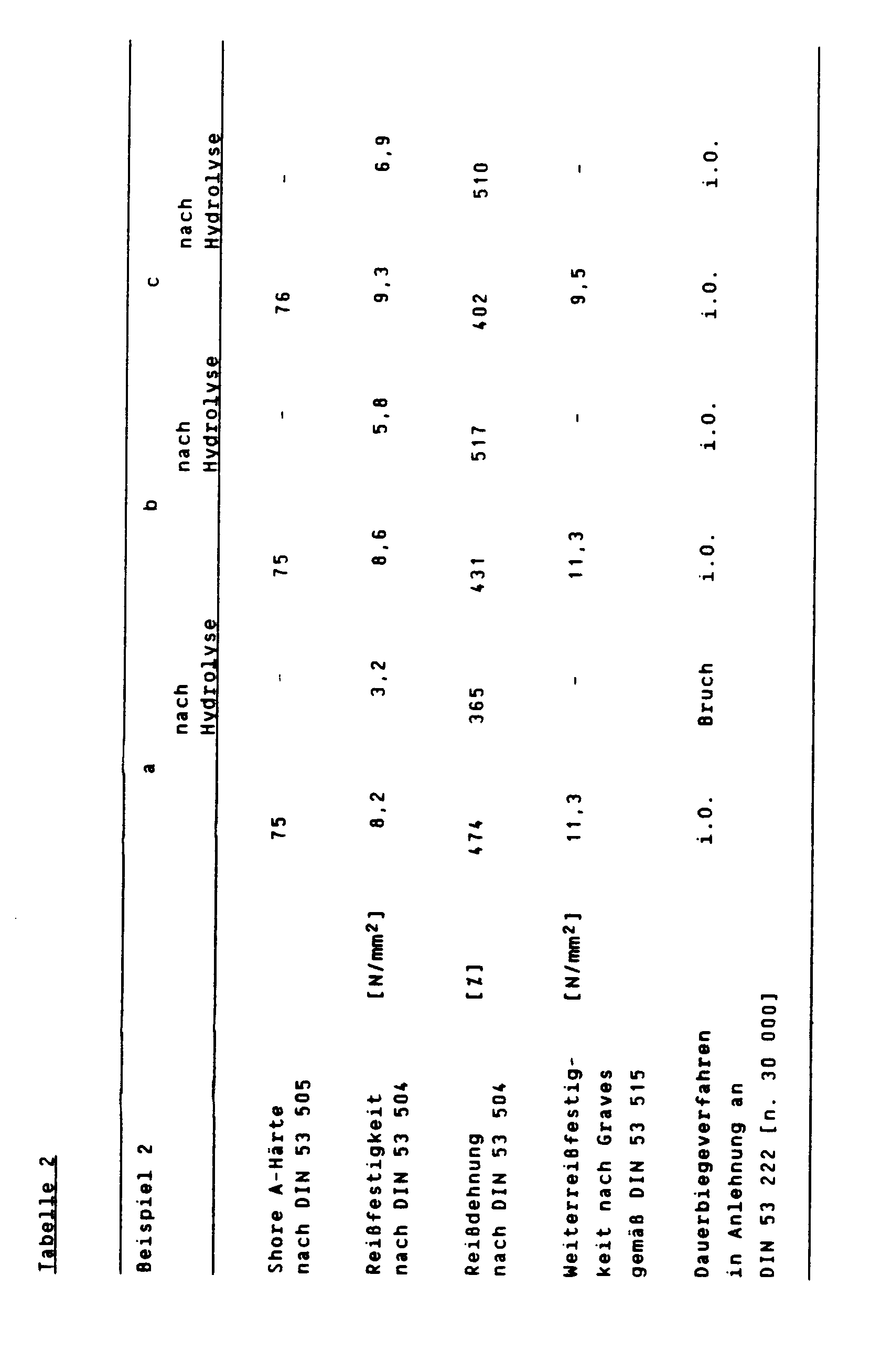

Claims (9)
- Verfahren zur Herstellung von elastischen, kompakten oder zelligen Polyurethan- oder Polyurethan-Polyharnstoff-Formkörpern durch Umsetzung vona) organischen Polyisocyanaten,b) höhermolekularen Polyesterolen,c) Kettenverlängerungsmitteln und/oder Vernetzern
in Gegenwart vond) Katalysatoren und gegebenenfallse) Treibmittelnf) Hilfsmitteln und/oder Zusatzstoffendadurch gekennzeichnet, daß man als Polyesterole (b) Polyester-diole mit einer Hydroxylzahl von 25 bis 100 und einer Säurezahl kleiner als 2 verwendet, die hergestellt werden durch Polykondensation von organischen Dicarbonsäuren und mindestens einem Polyoxytetramethylenglykol mit einem Molekulargewicht von 162 bis 600. - Verfahren nach Anspruch 1, dadurch gekennzeichnet, daß die Polyesterdiole hergestellt werden durch Polykondensation von organischen Dicarbonsäuren und einer Mischung aus mindestens einem Polyoxytetramethylen-glykol mit einem Molekulargewicht von 162 bis 600 und mindestens einem aliphatischen Diol mit 2 bis 12 C-Atomen im Alkylenrest und/oder Polyoxyalkylenglykol aus der Gruppe der Polyoxyethylen-glykole, Polyoxypropylen-glykole und/oder Polyoxypropylen-polyoxyethylen-glykole mit einem Molekulargewicht von 106 bis 1000.
- Verfahren nach Anspruch 1, dadurch gekennzeichnet, daß die Polyesterdiole hergestellt werden durch Polykondensation von10 bis 70 Gew.-Teilen mindestens einer organischen Dicarbonsäure,1 bis 90 Gew.-Teilen mindestens eines Polyoxytetramethylen-glykols mit einem Molekulargewicht von 162 bis 600 und0 bis 50 Gew.-Teilen mindestens eines aliphatischen Diols mit 2 bis 12 C-Atomen und/oder eines Polyoxyalkylen-glykols aus der Gruppe der Polyoxyethylen-glykole, Polyoxypropylen-glykole und/oder Polyoxypropylen-polyoxyethylen-glykole mit einem Molekulargewicht von 106 bis 1000.
- Verfahren nach Anspruch 1, dadurch gekennzeichnet, daß als organische Dicarbonsäure Adipinsäure, Glutarsäure und/oder Bernsteinsäure verwendet werden.
- Verfahren nach Anspruch 1, dadurch gekennzeichnet, daß zur Herstellung der Polyester-diole Polyoxytetramethylen-glykolmischungen mit durchschnittlichen Molekulargewichten von 200 bis 300 verwendet werden.
- Verfahren nach Anspruch 1, dadurch gekennzeichnet, daß die Polyester-diole hergestellt werden durch Polykondensation von Adipinsäure und mindestens einem Polyoxytetramethylen-glykol mit Molekulargewichten von 200 bis 300 oder einer Mischung aus mindestens einem Polyoxytetramethylen-glykol mit einem Molekulargewicht von 200 bis 300 und einem Alkandiol, vorzugsweise Butandiol-1,4.
- Verfahren nach Anspruch 1, dadurch gekennzeichnet, daß die Polyester-diole hergestellt werden durch Polykondensation von20 bis 50 Gew.-Teilen Adipinsäure,10 bis 90 Gew.-Teilen mindestens eines Polyoxytetramethylen-glykols mit einem Molekulargewicht von 200 bis 300 und0 bis 50 Gew.-Teilen Butandiol-1,4.
- Verfahren nach Anspruch 1, dadurch gekennzeichnet, daß man als Kettenverlängerungsmittel (c) niedermolekulare Diole und/oder aromatische Diamine, die in ortho-Stellung zu den Aminogruppen mindestens einen Alkylrest gebunden enthalten, verwendet.
- Verfahren nach Anspruch 1, dadurch gekennzeichnet, daß man als organische Polyisocyanate Quasiprepolymere mit einem NCO-Gehalt von 15 bis 30 Gew.%, bezogen auf das Gesamtgewicht, verwendet, die hergestellt werden durch Umsetzung von 4,4'-Diphenylmethan-diisocyanat mit mindestens einem Polyesterdiol mit einer Hydroxylzahl von 30 bis 300 oder einer Mischung aus einem Polyesterdiol mit einer Hydroxylzahl von 30 bis 300 und mindestens einem Alkandiol mit 2 bis 12 Kohlenstoffatomen im Alkylenrest.
Priority Applications (1)
| Application Number | Priority Date | Filing Date | Title |
|---|---|---|---|
| AT87105759T ATE80169T1 (de) | 1986-04-23 | 1987-04-18 | Verfahren zur herstellung von elastischen, kompakten oder zelligen polyurethan- oder polyurethan-polyharnstoff-form-koerpern. |
Applications Claiming Priority (2)
| Application Number | Priority Date | Filing Date | Title |
|---|---|---|---|
| DE3613650 | 1986-04-23 | ||
| DE19863613650 DE3613650A1 (de) | 1986-04-23 | 1986-04-23 | Verfahren zur herstellung von elastischen, kompakten oder zelligen polyurethan- oder polyurethan-polyharnstoff-formkoerpern |
Publications (3)
| Publication Number | Publication Date |
|---|---|
| EP0243832A2 EP0243832A2 (de) | 1987-11-04 |
| EP0243832A3 EP0243832A3 (en) | 1988-10-12 |
| EP0243832B1 true EP0243832B1 (de) | 1992-09-02 |
Family
ID=6299286
Family Applications (1)
| Application Number | Title | Priority Date | Filing Date |
|---|---|---|---|
| EP87105759A Expired - Lifetime EP0243832B1 (de) | 1986-04-23 | 1987-04-18 | Verfahren zur Herstellung von elastischen, kompakten oder zelligen Polyurethan- oder Polyurethan-Polyharnstoff-Form-Körpern |
Country Status (7)
| Country | Link |
|---|---|
| US (1) | US4798851A (de) |
| EP (1) | EP0243832B1 (de) |
| JP (1) | JPS62257923A (de) |
| AT (1) | ATE80169T1 (de) |
| CA (1) | CA1328704C (de) |
| DE (2) | DE3613650A1 (de) |
| ES (1) | ES2051703T3 (de) |
Families Citing this family (29)
| Publication number | Priority date | Publication date | Assignee | Title |
|---|---|---|---|---|
| US5034427A (en) * | 1989-11-22 | 1991-07-23 | Imperial Chemical Industries Plc | Method for preparing moulded polureapolyurethane flexible foams |
| USRE34669E (en) * | 1988-11-25 | 1994-07-19 | Imperial Chemical Industries Plc | Method for preparing moulded polyureapolyurethane flexible foams |
| US5001166A (en) * | 1989-01-25 | 1991-03-19 | Robson Mafoti | Novel polyetherester based prepolymers and elastomers made therefrom |
| AT394049B (de) * | 1989-04-04 | 1992-01-27 | Chemie Linz Gmbh | Melaminzubereitung, stabile dispersion von melamin in polyetherolen, verfahren zur herstellung und ihre verwendung |
| US4950694A (en) * | 1989-06-29 | 1990-08-21 | Union Carbide Chemicals And Plastics Company Inc. | Preparation of polyurethane foams without using inert blowing agents |
| DE3931845A1 (de) * | 1989-09-23 | 1991-04-04 | Bayer Ag | Schnellkristallisierende polyurethansysteme |
| US5114982A (en) * | 1989-11-20 | 1992-05-19 | Westinghouse Electric Corp. | Acoustic scattering and high reflection loss compositions |
| US5171758A (en) * | 1990-03-12 | 1992-12-15 | Olin Corporation | Flame retardant urethane foams made using propylene oxide-based polyols |
| CA2093994A1 (en) | 1992-04-16 | 1993-10-17 | Albert C. Chiang | Electrically conductive and semi-conductive polymers |
| US5310766A (en) * | 1992-06-15 | 1994-05-10 | The Dow Chemical Company | Foam stabilizing additive and polyurethane foam prepared in the presence thereof |
| CA2107950C (en) * | 1992-10-22 | 2001-08-14 | Bayer Corporation | Stabilization of rim systems containing acidic additives |
| US5422414A (en) * | 1993-10-04 | 1995-06-06 | Ecp Enichem Polimeri Netherlands B.V. | Modified polyurea-polyurethane systems endowed with improved processability |
| US6197242B1 (en) * | 1994-06-17 | 2001-03-06 | Bayer Corporation | Injection molding fibers embedded in polyurethane with hindered amine |
| DE19534163A1 (de) | 1995-09-15 | 1997-03-20 | Basf Ag | Verfahren zur Herstellung von kompakten oder zelligen Polyurethan-Elastomeren und hierfür geeignete Isocyanatpräpolymere |
| EP0784079B1 (de) * | 1995-11-16 | 2001-02-14 | Nok Corporation | Polyetheresterelastomer-Mischung für Dichtungs-Manschette einer homokinetischen Kupplung. |
| DE19548770A1 (de) * | 1995-12-23 | 1997-06-26 | Basf Ag | Mikrozelluläres, harnstoffgruppenhaltiges Polyurethanelastomer |
| DE19548771A1 (de) * | 1995-12-23 | 1997-06-26 | Basf Ag | Mikrozelluläres, harnstoffgruppenhaltiges Polyurethanelastomer |
| JP3930089B2 (ja) * | 1996-05-09 | 2007-06-13 | 株式会社イノアックコーポレーション | 軟質ポリウレタンフォーム及びそれを用いたスピーカエッジ |
| WO2001018086A1 (de) * | 1999-09-04 | 2001-03-15 | Basf Aktiengesellschaft | Zellige polyisocyanat-polyadditionsprodukte |
| US6451438B1 (en) | 2000-11-30 | 2002-09-17 | Mearthane Products Corporation | Copolymerization of reactive silicone and urethane precursors for use in conductive, soft urethane rollers |
| CN1241965C (zh) * | 2001-04-06 | 2006-02-15 | 巴斯福股份公司 | 多孔聚异氰酸酯聚加合物 |
| DE10247789A1 (de) * | 2002-10-14 | 2004-04-22 | Bayer Ag | Zellige Polyurethanelastomere, Verfahren zu ihrer Herstellung und ihre Verwendung |
| DE10248949B4 (de) * | 2002-10-21 | 2006-09-28 | Bayer Materialscience Ag | Polyurethanelastomere, Verfahren zu ihrer Herstellung und ihre Verwendung |
| US7168880B2 (en) * | 2004-11-17 | 2007-01-30 | Battelle Memorial Institute | Impact attenuator system |
| DE102005008263A1 (de) * | 2005-02-22 | 2006-08-24 | Basf Ag | Verfahren zur Herstellung von zylindrischen Formkörpern auf der Basis von zelligen Polyurethanelastomeren |
| DE102005008242A1 (de) | 2005-02-22 | 2006-08-24 | Basf Ag | Zylindrische Formkörper auf der Basis von zelligen Polyurethanelastomeren |
| CN102015813B (zh) * | 2008-03-17 | 2013-05-22 | 巴特勒纪念研究院 | 回弹控制材料 |
| US8222341B2 (en) | 2009-03-17 | 2012-07-17 | Mearthane Products Corporation | Semi-conductive silicone polymers |
| CN102597038A (zh) * | 2009-10-15 | 2012-07-18 | 路博润高级材料公司 | 静电消散的tpu和其组合物 |
Family Cites Families (7)
| Publication number | Priority date | Publication date | Assignee | Title |
|---|---|---|---|---|
| JPS504718B1 (de) * | 1971-04-19 | 1975-02-22 | ||
| US4376834A (en) * | 1981-10-14 | 1983-03-15 | The Upjohn Company | Polyurethane prepared by reaction of an organic polyisocyanate, a chain extender and an isocyanate-reactive material of m.w. 500-20,000 characterized by the use of only 2-25 percent by weight of the latter material |
| DE3215908A1 (de) * | 1982-04-29 | 1983-11-03 | Basf Ag, 6700 Ludwigshafen | Verfahren zur herstellung von foermkoerpern auf basis von polyurethan- oder polyurethan-polyharnstoff-elastomeren mit verbesserter licht- und witterungsbestaendigkeit |
| DE3405680A1 (de) * | 1984-02-17 | 1985-08-22 | Basf Ag, 6700 Ludwigshafen | Verfahren zur herstellung von gegebenenfalls zelligen polyurethan-polyharnstoff-formkoerpern mit verbessertem entformungsverhalten |
| JPS60206817A (ja) * | 1984-03-30 | 1985-10-18 | Sanyo Chem Ind Ltd | ポリウレタンの製造法 |
| JPS61155417A (ja) * | 1984-12-27 | 1986-07-15 | Sanyo Chem Ind Ltd | ポリウレタンの製造法 |
| JPS61181815A (ja) * | 1985-02-07 | 1986-08-14 | Dainippon Ink & Chem Inc | 気泡質ポリウレタンエラストマーの製造方法 |
-
1986
- 1986-04-23 DE DE19863613650 patent/DE3613650A1/de not_active Withdrawn
-
1987
- 1987-04-08 CA CA000534204A patent/CA1328704C/en not_active Expired - Fee Related
- 1987-04-09 US US07/036,875 patent/US4798851A/en not_active Expired - Lifetime
- 1987-04-18 ES ES87105759T patent/ES2051703T3/es not_active Expired - Lifetime
- 1987-04-18 AT AT87105759T patent/ATE80169T1/de not_active IP Right Cessation
- 1987-04-18 DE DE8787105759T patent/DE3781450D1/de not_active Expired - Lifetime
- 1987-04-18 EP EP87105759A patent/EP0243832B1/de not_active Expired - Lifetime
- 1987-04-22 JP JP62097670A patent/JPS62257923A/ja active Pending
Also Published As
| Publication number | Publication date |
|---|---|
| US4798851A (en) | 1989-01-17 |
| CA1328704C (en) | 1994-04-19 |
| EP0243832A2 (de) | 1987-11-04 |
| JPS62257923A (ja) | 1987-11-10 |
| EP0243832A3 (en) | 1988-10-12 |
| DE3781450D1 (de) | 1992-10-08 |
| DE3613650A1 (de) | 1987-10-29 |
| ATE80169T1 (de) | 1992-09-15 |
| ES2051703T3 (es) | 1994-07-01 |
Similar Documents
| Publication | Publication Date | Title |
|---|---|---|
| EP0243832A2 (de) | Verfahren zur Herstellung von elastischen, kompakten oder zelligen Polyurethan- oder Polyurethan-Polyharnstoff-Form-Körpern | |
| EP0153639B1 (de) | Verfahren zur Herstellung von zelligen oder kompakten Polyurethan-Polyharnstoff-Formkörpern mit verbesserten Entformungseigenschaften sowie innere Formtrennmittel für das Polyisocyanat-Polyadditions-verfahren | |
| EP0093335B1 (de) | Verfahren zur Herstellung von Formkörpern auf Basis von Polyurethan- oder Polyurethan-Polyharnstoff-Elastomeren mit verbesserter Licht- und Witterungsbeständigkeit | |
| EP0240715B1 (de) | Verfahren zur Herstellung von Formkörpern mit einem zelligen Kern und einer verdichteten Randzone mit verbesserten Entformungseigenschaften | |
| DE3642667A1 (de) | Bei raumtemperatur fluessige polyester-polyole auf basis von 2-methylpentandiol-1,5, 2-ethylbutandiol-1,4, 2-methylglutarsaeure und/oder 2-ethylbernsteinsaeure sowie den entsprechenden dicarbonsaeurederivaten, verfahren zu deren herstellung und deren verwendung zur herstellung von kunststoffen nach dem polyisocyanat-polyadditionsverfahren | |
| EP0026915B1 (de) | Verfahren zur Herstellung von gegebenenfalls zellhaltigen Polyurethan-Polyharnstoff-Formkörpern | |
| EP0157119B1 (de) | Verfahren zur Herstellung von gegebenenfalls zelligen Polyurethan-Polyharnstoff-Formkörpern | |
| EP0555742B1 (de) | Verfahren zur Herstellung von Fluorchlorkohlenwasserstoff freien Polyurethan-Weichschaumstoffen unter Verwendung von Urethangruppen enthaltenden Polyisocyanatmischungen auf Diphenylmethan-diisocyanatbasis sowie derartige modifizierte Polyisocyanatmischungen | |
| EP0069287B1 (de) | Verfahren zur Herstellung von gegebenenfalls zellhaltigen Polyurethan-Elastomeren | |
| EP0157120A1 (de) | Verfahren zur Herstellung von gegebenfalls zelligen Polyurethan-Polyharnstoff-Formkörpern mit verbessertem Entformungsverhalten | |
| EP0677540A2 (de) | Verfahren zur Herstellung von Polyurethan-Schaumstoffen in Gegenwart von Aminoalkyl- oder Aminophenyl-imidazolen als Katalysator sowie die Verwendung dieser Katalysatoren zur Herstellung von Polyisocyanat-polyadditionsprodukten | |
| EP0269873A2 (de) | Verfahren zur Herstellung von kompakten oder zelligen Polyurethan-Elastomeren in Gegenwart eines Titan- und/oder Zinnverbindungen enthaltenden Polyester-polyols als Katalysator sowie die Verwendung dieses Katalysators | |
| EP0284912B1 (de) | Polyamid- und Polyharnstoffgruppen gebunden enthaltende Elastomere sowie Verfahren zur Herstellung von elastischen, kompakten oder zelligen Formkörpern hieraus | |
| EP0248183A1 (de) | Bei Raumtemperatur flüssige Polyester-polyole auf Basis von 2-Methylbutandiol-1,4, Verfahren zu deren Herstellung und deren Verwendung zur Herstellung von Kunststoffen nach dem Polyisocyanat-polyadditionsverfahren | |
| DE3642666A1 (de) | Verfahren zur herstellung von im wesentlichen geschlossenzelligen, urethan- oder urethan- und isocyanuratgruppen enthaltenden hartschaumstoffen und deren verwendung | |
| EP0093334B1 (de) | Verfahren zur Herstellung von gegebenenfalls zellhaltigen Formkörpern aus Polyharnstoff-Elastomeren | |
| EP0075758B2 (de) | Verfahren zur Herstellung von elastischen Polyurethan-Weichschaumstoffen | |
| EP0093336B1 (de) | Verfahren zur Herstellung von kompakten oder zellhaltigen Formkörpern aus Polyharnstoff-Polyurethan-Elastomeren | |
| EP0124071B1 (de) | Verfahren zur Herstellung von elastischen, kompakten oder zelligen Polyurethanen | |
| EP0180758A1 (de) | Verfahren zur Herstellung von gegebenenfalls zelligen Polyurethan-Polyharnstoff-Formkörpern unter Verwendung von Urethan- und Isocyanuratgruppen enthaltenden 2,4- und/oder 2,6-Toluylen-diisocyanaten | |
| EP0209807A2 (de) | Verfahren zur Herstellung von hochtemperaturbeständigen, kompakten oder zelligen Polyurethan-Elastomeren | |
| EP0657482A1 (de) | Verfahren zur Herstellung von kompakten oder zelligen Polyurethanen, hierfür verwendbare Urethangruppen enthaltende Polyisocyanatzusammensetzungen und deren Verwendung | |
| DE10047024A1 (de) | Verfahren zur Herstellung von flammgeschützten Polyurethanweichschaumstoffen | |
| DE3904812A1 (de) | Verfahren zur herstellung von urethangruppen enthaltenden, weichelastischen formkoerpern mit einer verdichteten randzone und einem zelligen kern mit verbesserten entformungseigenschaften und hierfuer geeignete innere formtrennmittel | |
| EP0931791A1 (de) | Hydantoingruppenhaltige Diisocyanate und diese beinhaltende Polyurethane |
Legal Events
| Date | Code | Title | Description |
|---|---|---|---|
| PUAI | Public reference made under article 153(3) epc to a published international application that has entered the european phase |
Free format text: ORIGINAL CODE: 0009012 |
|
| AK | Designated contracting states |
Kind code of ref document: A2 Designated state(s): AT BE CH DE ES FR GB IT LI NL SE |
|
| PUAL | Search report despatched |
Free format text: ORIGINAL CODE: 0009013 |
|
| AK | Designated contracting states |
Kind code of ref document: A3 Designated state(s): AT BE CH DE ES FR GB IT LI NL SE |
|
| 17P | Request for examination filed |
Effective date: 19890313 |
|
| 17Q | First examination report despatched |
Effective date: 19910523 |
|
| GRAA | (expected) grant |
Free format text: ORIGINAL CODE: 0009210 |
|
| AK | Designated contracting states |
Kind code of ref document: B1 Designated state(s): AT BE CH DE ES FR GB IT LI NL SE |
|
| REF | Corresponds to: |
Ref document number: 80169 Country of ref document: AT Date of ref document: 19920915 Kind code of ref document: T |
|
| ITF | It: translation for a ep patent filed | ||
| REF | Corresponds to: |
Ref document number: 3781450 Country of ref document: DE Date of ref document: 19921008 |
|
| GBT | Gb: translation of ep patent filed (gb section 77(6)(a)/1977) | ||
| ET | Fr: translation filed | ||
| PLBE | No opposition filed within time limit |
Free format text: ORIGINAL CODE: 0009261 |
|
| STAA | Information on the status of an ep patent application or granted ep patent |
Free format text: STATUS: NO OPPOSITION FILED WITHIN TIME LIMIT |
|
| 26N | No opposition filed | ||
| REG | Reference to a national code |
Ref country code: ES Ref legal event code: FG2A Ref document number: 2051703 Country of ref document: ES Kind code of ref document: T3 |
|
| EAL | Se: european patent in force in sweden |
Ref document number: 87105759.2 |
|
| REG | Reference to a national code |
Ref country code: GB Ref legal event code: IF02 |
|
| PGFP | Annual fee paid to national office [announced via postgrant information from national office to epo] |
Ref country code: FR Payment date: 20030324 Year of fee payment: 17 |
|
| PGFP | Annual fee paid to national office [announced via postgrant information from national office to epo] |
Ref country code: NL Payment date: 20030325 Year of fee payment: 17 |
|
| PGFP | Annual fee paid to national office [announced via postgrant information from national office to epo] |
Ref country code: SE Payment date: 20030326 Year of fee payment: 17 |
|
| PGFP | Annual fee paid to national office [announced via postgrant information from national office to epo] |
Ref country code: GB Payment date: 20030331 Year of fee payment: 17 |
|
| PGFP | Annual fee paid to national office [announced via postgrant information from national office to epo] |
Ref country code: CH Payment date: 20030401 Year of fee payment: 17 Ref country code: AT Payment date: 20030401 Year of fee payment: 17 |
|
| PGFP | Annual fee paid to national office [announced via postgrant information from national office to epo] |
Ref country code: ES Payment date: 20030408 Year of fee payment: 17 |
|
| PGFP | Annual fee paid to national office [announced via postgrant information from national office to epo] |
Ref country code: BE Payment date: 20030425 Year of fee payment: 17 |
|
| PGFP | Annual fee paid to national office [announced via postgrant information from national office to epo] |
Ref country code: DE Payment date: 20030522 Year of fee payment: 17 |
|
| PG25 | Lapsed in a contracting state [announced via postgrant information from national office to epo] |
Ref country code: GB Free format text: LAPSE BECAUSE OF NON-PAYMENT OF DUE FEES Effective date: 20040418 Ref country code: AT Free format text: LAPSE BECAUSE OF NON-PAYMENT OF DUE FEES Effective date: 20040418 |
|
| PG25 | Lapsed in a contracting state [announced via postgrant information from national office to epo] |
Ref country code: SE Free format text: LAPSE BECAUSE OF NON-PAYMENT OF DUE FEES Effective date: 20040419 Ref country code: ES Free format text: LAPSE BECAUSE OF NON-PAYMENT OF DUE FEES Effective date: 20040419 |
|
| PG25 | Lapsed in a contracting state [announced via postgrant information from national office to epo] |
Ref country code: LI Free format text: LAPSE BECAUSE OF NON-PAYMENT OF DUE FEES Effective date: 20040430 Ref country code: CH Free format text: LAPSE BECAUSE OF NON-PAYMENT OF DUE FEES Effective date: 20040430 Ref country code: BE Free format text: LAPSE BECAUSE OF NON-PAYMENT OF DUE FEES Effective date: 20040430 |
|
| PG25 | Lapsed in a contracting state [announced via postgrant information from national office to epo] |
Ref country code: DE Free format text: LAPSE BECAUSE OF THE APPLICANT RENOUNCES Effective date: 20040602 |
|
| BERE | Be: lapsed |
Owner name: *BASF A.G. Effective date: 20040430 |
|
| PG25 | Lapsed in a contracting state [announced via postgrant information from national office to epo] |
Ref country code: NL Free format text: LAPSE BECAUSE OF NON-PAYMENT OF DUE FEES Effective date: 20041101 |
|
| EUG | Se: european patent has lapsed | ||
| GBPC | Gb: european patent ceased through non-payment of renewal fee |
Effective date: 20040418 |
|
| REG | Reference to a national code |
Ref country code: CH Ref legal event code: PL |
|
| PG25 | Lapsed in a contracting state [announced via postgrant information from national office to epo] |
Ref country code: FR Free format text: LAPSE BECAUSE OF NON-PAYMENT OF DUE FEES Effective date: 20041231 |
|
| NLV4 | Nl: lapsed or anulled due to non-payment of the annual fee |
Effective date: 20041101 |
|
| REG | Reference to a national code |
Ref country code: FR Ref legal event code: ST |
|
| PG25 | Lapsed in a contracting state [announced via postgrant information from national office to epo] |
Ref country code: IT Free format text: LAPSE BECAUSE OF NON-PAYMENT OF DUE FEES;WARNING: LAPSES OF ITALIAN PATENTS WITH EFFECTIVE DATE BEFORE 2007 MAY HAVE OCCURRED AT ANY TIME BEFORE 2007. THE CORRECT EFFECTIVE DATE MAY BE DIFFERENT FROM THE ONE RECORDED. Effective date: 20050418 |
|
| REG | Reference to a national code |
Ref country code: ES Ref legal event code: FD2A Effective date: 20040419 |