EP0244208A2 - Procédé pour désodoriser la triacétine fabriquée à partir de la glycérine naturelle - Google Patents
Procédé pour désodoriser la triacétine fabriquée à partir de la glycérine naturelle Download PDFInfo
- Publication number
- EP0244208A2 EP0244208A2 EP87303768A EP87303768A EP0244208A2 EP 0244208 A2 EP0244208 A2 EP 0244208A2 EP 87303768 A EP87303768 A EP 87303768A EP 87303768 A EP87303768 A EP 87303768A EP 0244208 A2 EP0244208 A2 EP 0244208A2
- Authority
- EP
- European Patent Office
- Prior art keywords
- triacetin
- glycerin
- air
- hours
- deodorized
- Prior art date
- Legal status (The legal status is an assumption and is not a legal conclusion. Google has not performed a legal analysis and makes no representation as to the accuracy of the status listed.)
- Granted
Links
Images

Classifications
-
- C—CHEMISTRY; METALLURGY
- C07—ORGANIC CHEMISTRY
- C07C—ACYCLIC OR CARBOCYCLIC COMPOUNDS
- C07C67/00—Preparation of carboxylic acid esters
- C07C67/48—Separation; Purification; Stabilisation; Use of additives
-
- C—CHEMISTRY; METALLURGY
- C07—ORGANIC CHEMISTRY
- C07C—ACYCLIC OR CARBOCYCLIC COMPOUNDS
- C07C67/00—Preparation of carboxylic acid esters
- C07C67/08—Preparation of carboxylic acid esters by reacting carboxylic acids or symmetrical anhydrides with the hydroxy or O-metal group of organic compounds
-
- C—CHEMISTRY; METALLURGY
- C11—ANIMAL OR VEGETABLE OILS, FATS, FATTY SUBSTANCES OR WAXES; FATTY ACIDS THEREFROM; DETERGENTS; CANDLES
- C11B—PRODUCING, e.g. BY PRESSING RAW MATERIALS OR BY EXTRACTION FROM WASTE MATERIALS, REFINING OR PRESERVING FATS, FATTY SUBSTANCES, e.g. LANOLIN, FATTY OILS OR WAXES; ESSENTIAL OILS; PERFUMES
- C11B3/00—Refining fats or fatty oils
- C11B3/02—Refining fats or fatty oils by chemical reaction
- C11B3/08—Refining fats or fatty oils by chemical reaction with oxidising agents
Definitions
- the present invention relates generally to a process whereby triacetin (i.e., glycerol triacetate) of acceptable odor quality can be produced from natural glycerin feedstock. More particularly, the present invention relates to the novel discovery that the combined action of elevated temperature and air sparging for a sufficient time period deodorizes to acceptable levels triacetin formed from the esterification of a natural glycerin feedstock.
- triacetin i.e., glycerol triacetate
- natural glycerin is meant to refer to glycerin having as its origin the fats and oils of animals or vegetables.
- natural glycerin is to be understood as referring to that by-product formed as a result of the direct splitting of animal or vegetable fats and oils in the production of fatty acids of the general formula CH3(CH2) n COOH or when such fats and oils are saponified in the process of manufacturing soap.
- Natural glycerin as used herein is therefore to be understood as being distinguishable from “synthetic glycerin” as the latter is intended to refer to glycerin synthesized from petroleum-based feedstocks, for example, the synthesis of glycerin from a propylene feedstock via an allyl chloride intermediate or like synthesis processes. Additionally, it should be understood that the term “glycerin” refers to purified commercial products containing greater than about 95% glycerol (i.e., 1,2,3-propanetriol) with the balance being water.
- Triacetin is widely recognized as a useful plasticizer for filamentary crimped tow, particularly cellulose acetate tow, in producing cigarette filters
- the procedure for producing such filters generally involves providing a tow (or untwisted bundle of several thousand filaments), crimping the tow, opening the tow to deregister adjacent crimps, fluffing the tow to permit subsequent uniform application of a plasticizer, pulling the tow through an appropriate plasticizer applicator, and thereafter treating the plasticized tow to reduce its cross-sectional size until it is approximately equal to the cross-sectional size of a tobacco column which, together with the filter, comprise a filtered cigarette.
- the plasticizer causes bonding of the filaments in the filter to thereby assist in forming a coherent filter rod or plug having the desired pressure drop, compressibility and like properties.
- the triacetin can either itself be used as the principal active ingredient in plasticizer liquids (i.e., in concentrations of about 99% by weight or more) or can be blended with other suitable plasticizers such as, for example, triethyl citrate, dimethylethyl phthalate, or the dimethyl ether of triethylene or tetraethylene glycol, in dependence upon the type of filamentary tow being utilized and/or the resulting properties which are desired for the cigarette filter.
- plasticizer liquids i.e., in concentrations of about 99% by weight or more
- suitable plasticizers such as, for example, triethyl citrate, dimethylethyl phthalate, or the dimethyl ether of triethylene or tetraethylene glycol
- triacetin from glycerin is very well known in this art and is practiced by the reaction of glycerin under triacetin-forming conditions with an acetic acid source (e.g. acetic anhydride).
- acetic acid source e.g. acetic anhydride
- the glycerin is thus esterified to form triacetin as a reaction product.
- Residual acetic acid and/or acetic acid source which may be present in the reaction product stream is then subsequently removed, preferably by means of distillation.
- a finished triacetin product suitable for use as a plasticizer in the production of cigarette filters from crimped filamentary tow will typically be substantially free of residual acetic acid; that is, will contain less than about 0.005%, and preferably less than about 0.002% acetic acid. Additionally, the triacetin product will be substantially colorless, and will not exhibit unpleasant odors.
- glycerin which is commercially available is suitable for producing triacetin of a quality demanded by filtered cigarette manufacturers.
- glycerin which contains detectable odoriferous compounds will not be used as a feedstock for the production of triacetin since such odoriferous compounds will carry over into the resulting triacetin product which, if applied as a plasticizer during the production of cigarette filters from crimped filamentary tow, will evidence themselves in the form of an objectionable taste when the cigarette is smoked.
- triacetin manufacturers have conventionally exclusively used synthetic glycerin (i.e., glycerin having its origin in and synthesized from petroleum-based compounds, for example, propylene) as their feedstock owing principally to its odor purity; that is to say its highly desirable deodorized quality.
- synthetic glycerin i.e., glycerin having its origin in and synthesized from petroleum-based compounds, for example, propylene
- odoriferous compounds are present in natural glycerin which are not detectably present in synthetic glycerin. That is, since the fats and oils of animals and vegetables consist of both saturated and unsaturated fatty acid esters (see, " Organic Chemistry ", Morrison et al, 3rd Ed., p. 1058 (1976)), residual unsaturated fatty acid esters may be present in natural glycerin owing, for example, to incomplete deesterification in the fat splitting stage and/or incomplete separation of the fatty acid esters from glycerin in subsequent refining stages employed in natural glycerin production.
- unsaturated fatty acids may also be present in natural glycerin owing to incomplete separation in the refining stages during natural glycerin production. Residual unsaturated fatty acid esters and/or unsaturated fatty acids in the glycerin may then be oxidized (i.e., rancidified) at mild temperatures to form unsaturated (and possibly saturated) aldehydes which contain fewer carbons than their fatty acid precursors (" Fatty Acids (Their Chemistry, Properties, Production and Use) ", Part 5, pp. 3693-3697, 3701 (1968)).
- Such aldehydes are highly odoriferous and may render the resulting triacetin produced from natural glycerin unusable as a plasticizer, even if present in a few parts per million. Moreover, the sources of animal or vegetable fats vary widely, thereby precluding with any degree of certainty whether the triacetin produced will have acceptable odor for use as a plasticizer.
- Franzen et al in U.S. Patent No. 1,977,988 disclose recovering fatty acids from a crude mixture of volatile, non-aromatic hydrocarbons produced by destructive oxidation by the method of treating the mixture with a spray of water or inert organic materials at 150° - 300°C and 10-50 mm Hg gauge.
- the crude mixture is thereby freed of hydrocarboxylic acids without the formation of; e.g., unsaturated acids.
- the fatty acids recovered only have a slight odor due to the action of the small drops of liquid.
- U.S. Patent 2,591,134 to Canariis discloses an apparatus and method for removing oxidizable taste-and-odor-producing material from liquids, such as water. Air is introduced into the liquid by means of the flow of liquid through, for example, a Venturi tube forming a part of the aeration member so that use of external sources of power; e.g., blowers, fans, compressors, etc., is avoided as well as the use of moving parts.
- external sources of power e.g., blowers, fans, compressors, etc.
- a further object of this invention is to produce triacetin of acceptable odor quality from a feedstock of natural glycerin by an effective, commercially economic process so as to enable triacetin manufacturers to utilize the more commercially plentiful supply sources of natural glycerin as opposed to synthetic glycerin, and as such, provide a commercially economical and viable alternative to the use of synthetic glycerin as a feedstock for the production of triacetin.
- the triacetin during sparging is preferably gently agitated to ensure complete and intimate contact with the air or oxygen. Additionally, the air or oxygen that is sparged into the triacetin should be substantially dry (i.e., a dew point of less than about -40°C) to avoid degradation of the triacetin, thereby ensuring that the acetic acid content after treatment by the present invention is maintained within acceptable standards (i.e., less than about 0.005%, and preferably less than about 0.002% by weight acetic acid).
- FIG. 1 A diagrammatic flowsheet, showing a preferred processing sequence to produce deodorized triacetin from natural glycerin in accordance with this invention, is shown in accompanying FIGURE 1.
- natural glycerin and a source of acetic acid e.g., acetic anhydride
- acetic anhydride e.g., acetic anhydride
- the glycerin and acetic anhydride reactants are maintained in vessel 10 under triacetin-forming conditions, that is, a temperature of greater than about 130°C under atmospheric pressure for about 160 minutes. Esterification of the natural glycerin thus occurs in reaction vessel 10 so as to produce triacetin which exits in product stream 12 together with residual acetic anhydride and acetic acid formed during the reaction.
- Product stream 12 then passes on to the acid distillation unit 14 whereby a substantial portion of the acetic anhydride and acetic acid is volatilized and removed in vapor stream 16 to be subsequently reconverted to acetic anhydride for use in further processing.
- the bottoms stream 18 from acid distillation unit 14 will thus contain substantially no acetic acid (i.e., less than about 0.005% by weight acetic acid) with the remainder being raw triacetin product. Additional purification of the raw triacetin product occurs in triacetin evaporator 20 which removes carbonaceous material and other solid particulates therefrom and passes them on to waste treatment via stream 22.
- the vapor stream 24 from triacetin evaporator 20 will thus be substantially free of carbonaceous material and other solid particulates and will be condensed by means of heat exchanger 26 and passed on to holding vessel 28.
- Raw triacetin contained in holding vessel 28 is then withdrawn as needed and passed via stream 30 to triacetin deodorizing system 32 so as to remove odoriferous compounds therefrom and thereby produce a final triacetin product acceptable for use as a plasticizer in producing cigarette filters from crimped filamentary tow.
- Deodorized triacetin from system 32 is then passed via stream 34 to the final product storage tank 36.
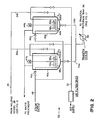
- the triacetin deodorizing system 32 preferably includes multiple closed treatment vessels 40a, 40b, each provided with a mechanical vane agitator 42a, 42b, driven by suitable motor means 44a, 44b, respectively.
- Raw triacetin is introduced into treatment vessels 40a, 40b from holding vessel 28, (see FIGURE 1) via line 30 and its manifold lines 30a, 30b.
- a corresponding steam valve 46a, 46b, respectively is opened so as to pass steam (preferably 50 psig) from steam header 48 to steam coils 48a, 48b, located within treatment tanks 40a and 40b, respectively.
- the raw triacetin in treatment tanks 40a, 40b is heated to a temperature between about 80°C to about 130°C, and preferably to a temperature within the range of about 90° to about 100°C. Condensate is collected in traps 50a, 50b and routed to the condensate return system (not shown).
- air or oxygen is then introduced via air supply line 52 connected to air distribution manifolds 52a, 52b within treatment tanks 40a, 40b, respectively, so as to sparge air into the heated and gently agitated raw triacetin being treated.
- the air or oxygen Prior to being introduced into the treatment tanks 40a, 40b, the air or oxygen is filtered so as to remove, for example, particulate matter, oil and other contaminants therefrom and is dried to a dew point of less than about -40°C and more preferably between -40°C and -100°C. Dry air is very important to the successful practice of this invention as otherwise residual water in the air or oxygen may degrade the triacetin to form acetic acid in the treatment tanks 40a, 40b.
- the triacetin is maintained at an elevated temperature as mentioned previously while air is continuously sparged thereinto via distribution manifolds 52a, 52b and is gently agitated by means of mechanical agitators 42a, 42b. Such conditions are maintained for a time period sufficient to deodorize the triacetin, and particularly for a time period between about 10 to about 36 hours (preferably between about 20 hours to about 24 hours).
- Sparging should be accomplished utilizing a sufficient quantity of air or oxygen to ensure that complete and intimate contact with the triacetin under treatment conditions is achieved so as to ensure adequate rancidification of residual fatty acids and/or fatty acid esters and also to ensure that the more volatile and odoriferous aldehyde compounds thus formed are entrained in the air or oxygen and removed as a vapor stream from the triacetin. Agitation of the triacetin during air or oxygen sparging will facilitate intimate contact between the air or oxygen and triacetin.
- At least .01 scfh of air or oxygen per pound of triacetin being treated is sufficient to adequately deodorize the triacetin.
- Lesser quantities of air or oxygen may be used, however, under conditions of more vigorous agitation, for example.
- excess quantities of air or oxygen may also be utilized and is limited by the practical considerations of unacceptably large quantities of triacetin product being lost due to entrainment with the air or oxygen.
- the now deodorized final triacetin product is emptied from treatment tanks 40a or 40b via lines 54a or 54b, respectively, and is cooled to ambient temperatures by means of triacetin cooler 56.
- the cooled and deodorized triacetin is then transferred to triacetin storage tank 36 (see Figure 1) for shipment to customers for use as a plasticizer for cigarette filters.
- the steam supply, air supply and agitation are each terminated.
- the deodorized triacetin may alternately be allowed to gradually cool by allowing it to stand within vessels 40a or 40b.
- the vessel which contains the triacetin be charged with, for example, nitrogen so as to displace substantially all air from the vessel.
- nitrogen so as to displace substantially all air from the vessel.
- Triacetin Sample Nos. 1 through 3 produced from natural glycerin and a triacetin control sample produced from synthetic glycerin (designated below as Sample No. 4) were submitted to a panel for odor evaluation. The results of the evaluation were as follows:
- the filter plugs of king-size filter cigarettes obtained commercially in the retail market were removed and replaced with either a filter plug using the triacetin of Example No. 3 as plasticizer or a filter plug using the triacetin of Example No. 4 as plasticizer thereby providing trial and control lots, respectively, of filtered tip cigarettes.
- the trial and control lots of filter tip cigarettes were then submitted to a smoking panel for evaluation in multiple, blind comparisons of the two lots of cigarettes. No consistent differences between the trial and control lots of cigarettes were detected by the smoking panel.
- Example 3 above demonstrates that treatment of natural glycerin by air sparging at elevated temperatures has no effect upon the odor quality of triacetin subsequently formed therefrom. Thus, it is only when the triacetin produced from natural glycerin is treated according to this invention that the beneficial deodorization thereof occurs to levels comparable to triacetin produced from synthetic glycerin.
Landscapes
- Chemical & Material Sciences (AREA)
- Organic Chemistry (AREA)
- Chemical Kinetics & Catalysis (AREA)
- Life Sciences & Earth Sciences (AREA)
- General Chemical & Material Sciences (AREA)
- Microbiology (AREA)
- Engineering & Computer Science (AREA)
- Oil, Petroleum & Natural Gas (AREA)
- Wood Science & Technology (AREA)
- Organic Low-Molecular-Weight Compounds And Preparation Thereof (AREA)
- Treatments For Attaching Organic Compounds To Fibrous Goods (AREA)
- Treating Waste Gases (AREA)
Priority Applications (1)
| Application Number | Priority Date | Filing Date | Title |
|---|---|---|---|
| AT87303768T ATE66457T1 (de) | 1986-04-29 | 1987-04-28 | Verfahren zur desodorierung von aus naturglycerin hergestelltem triacetin. |
Applications Claiming Priority (2)
| Application Number | Priority Date | Filing Date | Title |
|---|---|---|---|
| US85722486A | 1986-04-29 | 1986-04-29 | |
| US857224 | 1986-04-29 |
Publications (3)
| Publication Number | Publication Date |
|---|---|
| EP0244208A2 true EP0244208A2 (fr) | 1987-11-04 |
| EP0244208A3 EP0244208A3 (en) | 1988-09-07 |
| EP0244208B1 EP0244208B1 (fr) | 1991-08-21 |
Family
ID=25325499
Family Applications (1)
| Application Number | Title | Priority Date | Filing Date |
|---|---|---|---|
| EP87303768A Expired - Lifetime EP0244208B1 (fr) | 1986-04-29 | 1987-04-28 | Procédé pour désodoriser la triacétine fabriquée à partir de la glycérine naturelle |
Country Status (7)
| Country | Link |
|---|---|
| EP (1) | EP0244208B1 (fr) |
| JP (1) | JPH07116101B2 (fr) |
| AT (1) | ATE66457T1 (fr) |
| DE (1) | DE3772249D1 (fr) |
| ES (1) | ES2025159B3 (fr) |
| GR (1) | GR3002577T3 (fr) |
| MX (1) | MX167889B (fr) |
Cited By (6)
| Publication number | Priority date | Publication date | Assignee | Title |
|---|---|---|---|---|
| WO2012166238A1 (fr) * | 2011-05-27 | 2012-12-06 | R.J. Reynolds Tobacco Company | Procédé de production de triacétine à partir du tabac |
| US20150201669A1 (en) * | 2014-01-17 | 2015-07-23 | R.J. Reynolds Tobacco Company | Process for producing flavorants and related materials |
| US10499684B2 (en) | 2016-01-28 | 2019-12-10 | R.J. Reynolds Tobacco Company | Tobacco-derived flavorants |
| US10881133B2 (en) | 2015-04-16 | 2021-01-05 | R.J. Reynolds Tobacco Company | Tobacco-derived cellulosic sugar |
| CN113122386A (zh) * | 2019-12-30 | 2021-07-16 | 丰益(上海)生物技术研发中心有限公司 | 一种稻米油及其制备方法 |
| US11091446B2 (en) | 2017-03-24 | 2021-08-17 | R.J. Reynolds Tobacco Company | Methods of selectively forming substituted pyrazines |
Families Citing this family (3)
| Publication number | Priority date | Publication date | Assignee | Title |
|---|---|---|---|---|
| JP4953341B2 (ja) * | 2006-02-07 | 2012-06-13 | 独立行政法人産業技術総合研究所 | ポリアシル化合物の製造法とその装置 |
| US9458476B2 (en) | 2011-04-18 | 2016-10-04 | R.J. Reynolds Tobacco Company | Method for producing glycerin from tobacco |
| US9289011B2 (en) | 2013-03-07 | 2016-03-22 | R.J. Reynolds Tobacco Company | Method for producing lutein from tobacco |
Family Cites Families (4)
| Publication number | Priority date | Publication date | Assignee | Title |
|---|---|---|---|---|
| US2368669A (en) * | 1939-07-11 | 1945-02-06 | Lee Alan Porter | Purification and deodorization process |
| AT189314B (de) * | 1951-02-24 | 1957-03-25 | Drew & Co Inc E F | Verfahren zum Reinigen von rohen, im wesentlichen neutralen Fettsäureestern |
| US3108133A (en) * | 1960-01-22 | 1963-10-22 | Canadian Chemical Company Ltd | Purification of triacetin |
| DE2900023C2 (de) * | 1979-01-02 | 1986-12-11 | Henkel KGaA, 4000 Düsseldorf | Verfahren zur Gewinnung von säurearmem Triacetin |
-
1987
- 1987-04-27 MX MX006245A patent/MX167889B/es unknown
- 1987-04-28 AT AT87303768T patent/ATE66457T1/de not_active IP Right Cessation
- 1987-04-28 JP JP62103408A patent/JPH07116101B2/ja not_active Expired - Lifetime
- 1987-04-28 ES ES87303768T patent/ES2025159B3/es not_active Expired - Lifetime
- 1987-04-28 DE DE8787303768T patent/DE3772249D1/de not_active Expired - Fee Related
- 1987-04-28 EP EP87303768A patent/EP0244208B1/fr not_active Expired - Lifetime
-
1991
- 1991-08-22 GR GR91400485T patent/GR3002577T3/el unknown
Cited By (13)
| Publication number | Priority date | Publication date | Assignee | Title |
|---|---|---|---|---|
| WO2012166238A1 (fr) * | 2011-05-27 | 2012-12-06 | R.J. Reynolds Tobacco Company | Procédé de production de triacétine à partir du tabac |
| CN103562173A (zh) * | 2011-05-27 | 2014-02-05 | R.J.雷诺兹烟草公司 | 从烟草生产乙酸甘油酯的方法 |
| CN103562173B (zh) * | 2011-05-27 | 2015-03-18 | R.J.雷诺兹烟草公司 | 从烟草生产乙酸甘油酯的方法 |
| US9010339B2 (en) | 2011-05-27 | 2015-04-21 | R.J. Reynolds Tobacco Company | Method for producing triacetin from tobacco |
| US10188137B2 (en) | 2014-01-17 | 2019-01-29 | R.J. Reynolds Tobacco Company | Process for producing flavorants and related materials |
| US9265284B2 (en) * | 2014-01-17 | 2016-02-23 | R.J. Reynolds Tobacco Company | Process for producing flavorants and related materials |
| US20150201669A1 (en) * | 2014-01-17 | 2015-07-23 | R.J. Reynolds Tobacco Company | Process for producing flavorants and related materials |
| US10881133B2 (en) | 2015-04-16 | 2021-01-05 | R.J. Reynolds Tobacco Company | Tobacco-derived cellulosic sugar |
| US10499684B2 (en) | 2016-01-28 | 2019-12-10 | R.J. Reynolds Tobacco Company | Tobacco-derived flavorants |
| US11091446B2 (en) | 2017-03-24 | 2021-08-17 | R.J. Reynolds Tobacco Company | Methods of selectively forming substituted pyrazines |
| US11891364B2 (en) | 2017-03-24 | 2024-02-06 | R.J. Reynolds Tobacco Company | Methods of selectively forming substituted pyrazines |
| CN113122386A (zh) * | 2019-12-30 | 2021-07-16 | 丰益(上海)生物技术研发中心有限公司 | 一种稻米油及其制备方法 |
| CN113122386B (zh) * | 2019-12-30 | 2023-11-24 | 丰益(上海)生物技术研发中心有限公司 | 一种稻米油及其制备方法 |
Also Published As
| Publication number | Publication date |
|---|---|
| EP0244208A3 (en) | 1988-09-07 |
| ES2025159B3 (es) | 1992-03-16 |
| EP0244208B1 (fr) | 1991-08-21 |
| DE3772249D1 (de) | 1991-09-26 |
| GR3002577T3 (en) | 1993-01-25 |
| JPS62267247A (ja) | 1987-11-19 |
| JPH07116101B2 (ja) | 1995-12-13 |
| ATE66457T1 (de) | 1991-09-15 |
| MX167889B (es) | 1993-04-21 |
Similar Documents
| Publication | Publication Date | Title |
|---|---|---|
| US4623488A (en) | Refined fish oils and the process for production thereof | |
| EP1158039B1 (fr) | Procede de desodorisation d'huile vegetale et huile vegetale | |
| US5091116A (en) | Methods for treatment of edible oils | |
| JP6574837B2 (ja) | 有機オイルを段階的に処理する方法及び装置 | |
| RU2242505C2 (ru) | Способ удаления свободных жирных кислот из жиров и масел биологического происхождения или их паровых дистиллятов (варианты) | |
| CN102482614A (zh) | 含有低水平的结合mcpd的脱臭食用油或脂肪以及通过羧甲基纤维素和/或树脂纯化的制备方法 | |
| US4154750A (en) | Activated carbon improved vegetable oil refining process | |
| EP0244208B1 (fr) | Procédé pour désodoriser la triacétine fabriquée à partir de la glycérine naturelle | |
| JP2018515674A (ja) | 塩基性第四級アンモニウム塩処理を含む、グリセリド油精製法 | |
| WO2007075632A2 (fr) | Procedes d'amelioration de la qualite de l'huile et huile produite de la sorte | |
| JP2971962B2 (ja) | ジグリセリドに富む油脂の脱臭工程における不均化反応を抑制する方法 | |
| JP2676043B2 (ja) | シリカヒドロゲルを用いるグリセリド油の精製方法 | |
| DE69618594T2 (de) | Schonendes raffinieren von triglyceridölen | |
| DE69406255T2 (de) | Carbonatderivate | |
| JP2003516466A (ja) | 精製魚油の製造方法 | |
| CA2035158A1 (fr) | Procede de raffinage de melanges obtenus par traitements de milieux renfermant des matieres grasses a la cyclodixtrine et contenant des complexes de cyclodixtrine avec des composes lipophiles | |
| GB1575785A (en) | Manufacture of edible oil from crude soya bean oil | |
| US4966734A (en) | Deodorization of fatty ester mixtures | |
| US9677028B2 (en) | Seed oil refinement | |
| JPH07188692A (ja) | 高度不飽和脂肪酸類含有組成物の過酸化物除去方法 | |
| US3556110A (en) | Method for producing a smoking product of cellulosic material | |
| JPS61258899A (ja) | 精油 | |
| EP4410108A1 (fr) | Procédé de production d'une composition d'huile/matière grasse | |
| JP3346793B2 (ja) | 魚油の脱臭方法及び魚油含有食品 | |
| JPS60155143A (ja) | 天然ロウからの脂肪族高級アルコ−ルの分離法 |
Legal Events
| Date | Code | Title | Description |
|---|---|---|---|
| PUAI | Public reference made under article 153(3) epc to a published international application that has entered the european phase |
Free format text: ORIGINAL CODE: 0009012 |
|
| AK | Designated contracting states |
Kind code of ref document: A2 Designated state(s): AT BE CH DE ES FR GB GR IT LI LU NL SE |
|
| RIN1 | Information on inventor provided before grant (corrected) |
Inventor name: STEINER, THOMAS L. Inventor name: MC WILLIAMS, DAVID R. Inventor name: HOWELL, CARL, J. JR. |
|
| PUAL | Search report despatched |
Free format text: ORIGINAL CODE: 0009013 |
|
| AK | Designated contracting states |
Kind code of ref document: A3 Designated state(s): AT BE CH DE ES FR GB GR IT LI LU NL SE |
|
| 17P | Request for examination filed |
Effective date: 19890220 |
|
| 17Q | First examination report despatched |
Effective date: 19901114 |
|
| GRAA | (expected) grant |
Free format text: ORIGINAL CODE: 0009210 |
|
| AK | Designated contracting states |
Kind code of ref document: B1 Designated state(s): AT BE CH DE ES FR GB GR IT LI LU NL SE |
|
| REF | Corresponds to: |
Ref document number: 66457 Country of ref document: AT Date of ref document: 19910915 Kind code of ref document: T |
|
| REF | Corresponds to: |
Ref document number: 3772249 Country of ref document: DE Date of ref document: 19910926 |
|
| ITF | It: translation for a ep patent filed | ||
| ET | Fr: translation filed | ||
| REG | Reference to a national code |
Ref country code: ES Ref legal event code: FG2A Ref document number: 2025159 Country of ref document: ES Kind code of ref document: B3 |
|
| PLBE | No opposition filed within time limit |
Free format text: ORIGINAL CODE: 0009261 |
|
| STAA | Information on the status of an ep patent application or granted ep patent |
Free format text: STATUS: NO OPPOSITION FILED WITHIN TIME LIMIT |
|
| 26N | No opposition filed | ||
| REG | Reference to a national code |
Ref country code: GR Ref legal event code: FG4A Free format text: 3002577 |
|
| PGFP | Annual fee paid to national office [announced via postgrant information from national office to epo] |
Ref country code: FR Payment date: 19940317 Year of fee payment: 8 |
|
| PGFP | Annual fee paid to national office [announced via postgrant information from national office to epo] |
Ref country code: SE Payment date: 19940321 Year of fee payment: 8 |
|
| PGFP | Annual fee paid to national office [announced via postgrant information from national office to epo] |
Ref country code: CH Payment date: 19940322 Year of fee payment: 8 |
|
| PGFP | Annual fee paid to national office [announced via postgrant information from national office to epo] |
Ref country code: GB Payment date: 19940324 Year of fee payment: 8 |
|
| PGFP | Annual fee paid to national office [announced via postgrant information from national office to epo] |
Ref country code: AT Payment date: 19940405 Year of fee payment: 8 |
|
| PGFP | Annual fee paid to national office [announced via postgrant information from national office to epo] |
Ref country code: BE Payment date: 19940415 Year of fee payment: 8 |
|
| PGFP | Annual fee paid to national office [announced via postgrant information from national office to epo] |
Ref country code: ES Payment date: 19940419 Year of fee payment: 8 |
|
| PGFP | Annual fee paid to national office [announced via postgrant information from national office to epo] |
Ref country code: GR Payment date: 19940421 Year of fee payment: 8 |
|
| PGFP | Annual fee paid to national office [announced via postgrant information from national office to epo] |
Ref country code: NL Payment date: 19940430 Year of fee payment: 8 |
|
| PGFP | Annual fee paid to national office [announced via postgrant information from national office to epo] |
Ref country code: LU Payment date: 19940531 Year of fee payment: 8 |
|
| PGFP | Annual fee paid to national office [announced via postgrant information from national office to epo] |
Ref country code: DE Payment date: 19940630 Year of fee payment: 8 |
|
| EPTA | Lu: last paid annual fee | ||
| EAL | Se: european patent in force in sweden |
Ref document number: 87303768.3 |
|
| PG25 | Lapsed in a contracting state [announced via postgrant information from national office to epo] |
Ref country code: LU Free format text: LAPSE BECAUSE OF NON-PAYMENT OF DUE FEES Effective date: 19950428 Ref country code: GB Effective date: 19950428 Ref country code: AT Effective date: 19950428 |
|
| PG25 | Lapsed in a contracting state [announced via postgrant information from national office to epo] |
Ref country code: SE Effective date: 19950429 Ref country code: ES Free format text: LAPSE BECAUSE OF NON-PAYMENT OF DUE FEES Effective date: 19950429 |
|
| PG25 | Lapsed in a contracting state [announced via postgrant information from national office to epo] |
Ref country code: LI Effective date: 19950430 Ref country code: CH Effective date: 19950430 Ref country code: BE Effective date: 19950430 |
|
| BERE | Be: lapsed |
Owner name: CELANESE CORP. Effective date: 19950430 |
|
| PG25 | Lapsed in a contracting state [announced via postgrant information from national office to epo] |
Ref country code: GR Free format text: THE PATENT HAS BEEN ANNULLED BY A DECISION OF A NATIONAL AUTHORITY Effective date: 19951031 |
|
| PG25 | Lapsed in a contracting state [announced via postgrant information from national office to epo] |
Ref country code: NL Effective date: 19951101 |
|
| REG | Reference to a national code |
Ref country code: CH Ref legal event code: PL |
|
| PG25 | Lapsed in a contracting state [announced via postgrant information from national office to epo] |
Ref country code: FR Effective date: 19951229 |
|
| REG | Reference to a national code |
Ref country code: GR Ref legal event code: MM2A Free format text: 3002577 |
|
| NLV4 | Nl: lapsed or anulled due to non-payment of the annual fee |
Effective date: 19951101 |
|
| GBPC | Gb: european patent ceased through non-payment of renewal fee |
Effective date: 19950428 |
|
| PG25 | Lapsed in a contracting state [announced via postgrant information from national office to epo] |
Ref country code: DE Effective date: 19960103 |
|
| EUG | Se: european patent has lapsed |
Ref document number: 87303768.3 |
|
| REG | Reference to a national code |
Ref country code: FR Ref legal event code: ST |
|
| REG | Reference to a national code |
Ref country code: ES Ref legal event code: FD2A Effective date: 19990301 |
|
| PG25 | Lapsed in a contracting state [announced via postgrant information from national office to epo] |
Ref country code: IT Free format text: LAPSE BECAUSE OF NON-PAYMENT OF DUE FEES;WARNING: LAPSES OF ITALIAN PATENTS WITH EFFECTIVE DATE BEFORE 2007 MAY HAVE OCCURRED AT ANY TIME BEFORE 2007. THE CORRECT EFFECTIVE DATE MAY BE DIFFERENT FROM THE ONE RECORDED. Effective date: 20050428 |