EP0244367A2 - Integriertes Halbleiterbauelement des MOS-Typs mit einer nicht gleichförmigen Oxidsteuerelektrode und Verfahren zu seiner Herstellung - Google Patents
Integriertes Halbleiterbauelement des MOS-Typs mit einer nicht gleichförmigen Oxidsteuerelektrode und Verfahren zu seiner Herstellung Download PDFInfo
- Publication number
- EP0244367A2 EP0244367A2 EP87830113A EP87830113A EP0244367A2 EP 0244367 A2 EP0244367 A2 EP 0244367A2 EP 87830113 A EP87830113 A EP 87830113A EP 87830113 A EP87830113 A EP 87830113A EP 0244367 A2 EP0244367 A2 EP 0244367A2
- Authority
- EP
- European Patent Office
- Prior art keywords
- mos transistors
- layer
- oxide
- mos
- transistors
- Prior art date
- Legal status (The legal status is an assumption and is not a legal conclusion. Google has not performed a legal analysis and makes no representation as to the accuracy of the status listed.)
- Withdrawn
Links
Images


Classifications
-
- H—ELECTRICITY
- H10—SEMICONDUCTOR DEVICES; ELECTRIC SOLID-STATE DEVICES NOT OTHERWISE PROVIDED FOR
- H10D—INORGANIC ELECTRIC SEMICONDUCTOR DEVICES
- H10D84/00—Integrated devices formed in or on semiconductor substrates that comprise only semiconducting layers, e.g. on Si wafers or on GaAs-on-Si wafers
- H10D84/01—Manufacture or treatment
- H10D84/0123—Integrating together multiple components covered by H10D12/00 or H10D30/00, e.g. integrating multiple IGBTs
- H10D84/0126—Integrating together multiple components covered by H10D12/00 or H10D30/00, e.g. integrating multiple IGBTs the components including insulated gates, e.g. IGFETs
- H10D84/0144—Manufacturing their gate insulating layers
-
- H—ELECTRICITY
- H10—SEMICONDUCTOR DEVICES; ELECTRIC SOLID-STATE DEVICES NOT OTHERWISE PROVIDED FOR
- H10D—INORGANIC ELECTRIC SEMICONDUCTOR DEVICES
- H10D84/00—Integrated devices formed in or on semiconductor substrates that comprise only semiconducting layers, e.g. on Si wafers or on GaAs-on-Si wafers
- H10D84/01—Manufacture or treatment
- H10D84/02—Manufacture or treatment characterised by using material-based technologies
- H10D84/03—Manufacture or treatment characterised by using material-based technologies using Group IV technology, e.g. silicon technology or silicon-carbide [SiC] technology
- H10D84/038—Manufacture or treatment characterised by using material-based technologies using Group IV technology, e.g. silicon technology or silicon-carbide [SiC] technology using silicon technology, e.g. SiGe
-
- H—ELECTRICITY
- H10—SEMICONDUCTOR DEVICES; ELECTRIC SOLID-STATE DEVICES NOT OTHERWISE PROVIDED FOR
- H10D—INORGANIC ELECTRIC SEMICONDUCTOR DEVICES
- H10D84/00—Integrated devices formed in or on semiconductor substrates that comprise only semiconducting layers, e.g. on Si wafers or on GaAs-on-Si wafers
- H10D84/80—Integrated devices formed in or on semiconductor substrates that comprise only semiconducting layers, e.g. on Si wafers or on GaAs-on-Si wafers characterised by the integration of at least one component covered by groups H10D12/00 or H10D30/00, e.g. integration of IGFETs
- H10D84/82—Integrated devices formed in or on semiconductor substrates that comprise only semiconducting layers, e.g. on Si wafers or on GaAs-on-Si wafers characterised by the integration of at least one component covered by groups H10D12/00 or H10D30/00, e.g. integration of IGFETs of only field-effect components
- H10D84/83—Integrated devices formed in or on semiconductor substrates that comprise only semiconducting layers, e.g. on Si wafers or on GaAs-on-Si wafers characterised by the integration of at least one component covered by groups H10D12/00 or H10D30/00, e.g. integration of IGFETs of only field-effect components of only insulated-gate FETs [IGFET]
- H10D84/8314—Integrated devices formed in or on semiconductor substrates that comprise only semiconducting layers, e.g. on Si wafers or on GaAs-on-Si wafers characterised by the integration of at least one component covered by groups H10D12/00 or H10D30/00, e.g. integration of IGFETs of only field-effect components of only insulated-gate FETs [IGFET] the IGFETs characterised by having gate insulating layers with different properties
Definitions
- the present invention relates to MOS type (Metal-Oxide-Semiconductor) semiconductor devices.
- a first function is that of input data management, that is their manipulation and transformation.
- a second function is that of memory; it is in fact a function auxiliary to the first one, because data management often implies their (momentary) storage.
- Microprocessors and memories are therefore conceptually separable in two parts corresponding to the two functions mentioned. Structurally, on a single device the two distinct regions are easily recognizable. These regions may be realized with different circuital solutions dictating the choice among different fabrication processes.
- EPROM Erasable Programmable Read Only Memory
- EEPROM Electrical Erasable Programmable Read Only Memory
- Adoption of such a type of memory gives origin to a technical problem: the physical principle of operation of such types of memory requires the utilization of high voltages. Their process of fabrication, therefore, results different, in general, from the one utilized for ROM type memories and thence different from the one theorically usable for fabricating the portion of the device dedicated to data manipulation and management, normally working with a low voltage.
- the present invention is particularly advantageous for making microprocessors with EPROM or EEPROM type of memory, by proposing an innovative and particularly effective way of making compatible a typical fabrication process for low voltage MOS devices with the utilization, in selected regions of the integrated circuit, of a voltage high enough to permit the operation of the memory devices.
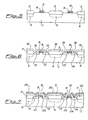
- a normal process for fabricating a MOS device contemplates the use of a semiconductor substrate 1 of a first type of conductivity (typically p doped monocrystalline silicon), onto which a thin layer of oxide 2 is formed and which is subsequently covered by a further layer 3 of a suitable inert material, usually silicon nitride.
- a semiconductor substrate 1 of a first type of conductivity typically p doped monocrystalline silicon
- a thin layer of oxide 2 is formed and which is subsequently covered by a further layer 3 of a suitable inert material, usually silicon nitride.
- the regions destined to contain the transistors are indicated with the numbers 4 and 5.
- the doping level of the substrate 1 is incremented by means of an appropriate step of introduction into the silicon of a dopant of the same type of conductivity of the one already present in the silicon substrate.
- Such a layer,having a higher doping leve1, 6 is referred to as isolation layer.
- the inert material e.g. silicon nitride
- the oxide does not grow.
- a thick layer of oxide 7 grows which, by standard terminology, is called field oxide.
- both the layer of inert material and the thin layer of oxide grown in the first step of the process are removed and, under conditions of particular freedom from chemical contamination, a new layer of oxide is grown in order to form the so-called gate oxide 8.
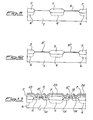
- a layer of conductive material e.g. polycrystalline silicon deposited from vapor phase and shown with the number 9 ⁇ in Fig. 4, is deposited over the whole surface.
- a new masking operation is performed by means of which, in the layer of conductive material are defined the areas which will constitute the electrodes 9 and 10, that is the gate electrodes of the transistors. Atoms of a dopant of a second type of conductivity are thence introduced in a high dosage into the portions of the original regions 4 and 5 not covered from the gate electrodes. In these regions 11, 12, 13 and 14, will be formed the source and drain electrodes of the transistors.
- the process continues with the deposition of an insulating layer 15, e.g. of silicon oxide deposited from vapor phase, through which, by means of a further masking operation, are opened the holes for the contacts 16, 17, 18 and 19 (besides those for the contact with the gate electrodes outside the section depicted in the drawing).
- an insulating layer 15 e.g. of silicon oxide deposited from vapor phase
- Deposition of a metal layer 20 and the definition of the conductive paths by means of a last masking operation complete the series of essential steps of the fabrication process.
- Fig. 7 The structure obtained by means of such a standard fabrication process for low voltage MOS devices, which may be represented by two adjacent MOS transistors in its more simplified version, but which in reality may be composed of a number as large as desired of such transistors, is depicted in Fig. 7.
- the critical points, from the point of view of electrical breakdown, are represented by the regions where the gate electrode superimposes on the source and drain regions. Such points, shown in Fig. 7 by the numbers 21, 22, 23 and 24, are easily subject to dielectric failure (voltage breakdown) if the applied voltage is too high. The weakness of these points is so much more pronunced the more the thickness of the insulating layer of oxide which is present underneath the gate oxide is decreased.
- the electric fields near the drain-substrate junction are also a critical parameter for the correct operation of the MOS device. Their intensity may in fact create an anomalous increase of the electric charge carriers, thus increasing the current flowing through the device and altering, therefore, its characteristics.
- a first known solution of the problem implies a further masking and doping operation with respect to the sequence of operations of the normal fabrication process.
- a mild oxidation is carried out in order to to grow a thin oxide layer on the regions destined to become source and drain regions, respectively, of the transistors.
- this thin layer of oxide is defined an area 25, adjacent to the gate, and only outside this area the heavy implantation of the dopant, typical of source and drain regions of the transistors, is actually performed.
- a primary objective of the present invention is to provide an integrated semiconductor device of the MOS type comprising MOS transistors for low working voltage and transistors for high working voltage which is free of the drawbacks of the devices of the prior art.
- MOS type integrated devices such as microprocessors and/or EPROM or EEPROM type memories.
- MOS type integrated semiconductor device of the present invention which may comprise, essentially, a number as high as desired of MOS transistors of the same type and wherein the insulating layer of oxide present under the gate electrode of the MOS transistors destined to operate with relatively high working voltages has a thickness which is substantially increased in comparison with the thickness of the same insulating layer of oxide present under the gate electrode of MOS transistors destined to operate with relatively low working voltages.
- the devices may in fact be fabricated by a process which, substantially, is no more complicated than the normal low voltage process. Notwithstanding the process of the invention requires an additional masking operation with respect to the basic process, such an operation does not have a critical character and therefore does not imposes sacrifices in terms of density of integration, as well as not requiring special techniques of area definition.
- All series of figures show partial microsections of a MOS type integrated device, schematically illustrating a section relative to two single MOS transistors one adjacent to the other in the device.
- an elementary section may be considered representative of the structure of the whole device which obviously may contain a number as high as desired of transistors and eventually of other circuit components.
- Such a structure is characteristic also of integrated devices known as microprocessors and/or as memories, be the latter of the PROM, EPROM or EEPROM type.
- the fabrication process of the present invention does not contemplates the formation of a relatively low doping level region along the edge of the gate electrode adjacent to the drain region of the MOS transistors.
- the fabrication process of the invention may be adequately illustrated by describing the additional operations which characterize it with respect to the sequence of steps of the standard fabrication process previously described.
- the process of the invention after having provided to implant, in the monocrystalline silicon substrate doped with impurities of a first type of conductivity, impurities of the same type for forming a dopant enriched region 6, as shown in Fig. 2; after having provided to grow the layer of field oxide 7 in the areas not covered by the nitride as shown in Fig. 3 and after having removed the layer of nitride from the areas 4 and 5 together with the thin underlying layer of oxide and having re-oxidized again the surface of the monocrystalline silicon to form the thin gate oxide layer 8, an appropriate additional masking operation is performed defining the areas which will contain transistors destined to operate with supply voltage realtively high (i.e. EPROM or EEPROM memory circuit sections).
- the already formed layer of gate oxide is removed. After having removed the masking material, the section will appear as shown in Fig. 11. At this point, under the typical conditions of particular freedom from contaminants, the step of growing the insulating layer of gate oxide is repeated, under similar environmental conditions of the same operation already performed.
- the step of forming the layer of gate oxide is repeated at least twice. After the first step of formation of said gate oxide layer, an additional masking step is carried out followed by the removal of the layer of gate oxide already formed from the areas where low voltage MOS transistors will be formed.
- the layer of gate oxide is re-formed over said areas, layer which will normally have a thickness comprised between 250 and 400 ⁇ , while the layer of gate oxide already present over the areas of the high voltage transistors will have its thickness increased by a similar amount.
- the first stage of gate oxidation may be protracted for the time necessary to form the desired thickness of the oxide and determined exclusively by the characteristics (in first place the breakdown voltage) which one desires to obtain for MOS transistors belonging to circuit sections of the device which will have to operate at a relatively high voltage.
- the second stage of gate oxidation may be advantageously conducted in function of the characteristics that one desires to obtain for MOS transistors belonging to the low voltage circuit section of the integrated device.
- the fabrication process of the device may proceed in a conventional fashion, as shown in the series of figures from 4 to 7, conserving the two different thicknesses of the insulating layer of gate oxide existing over different areas of the device being fabricated.
- the characteristic structure of the MOS type integrated semiconductor device of the present invention is schematically shown in the section of Fig. 13. As it is easily observed, between the two adjacent MOS transistors, the only structural difference is represented by the fact that while the transistor shown on the left-hand part of the section has a thickness of the insulating layer of gate oxide 8 ⁇ relatively small, the transistor represented in the right-hand portion of the same section has a thickness of the insulating layer of gate oxide 8 ⁇ markedly greater than the first transistor.
- the different types of conductivity relative to the different regions of the monocrystalline semiconductor of substrate have not been indicated in so far the transistors may be of the n-channel or of the p-channel type.
- the peculiar integrated structure of the invention with nonuniform thickness of the gate oxide may be fabricated also through processes modified in a more or less substantial way with respect to the particular process of the present invention though remaining within the scope of the present invention.
Landscapes
- Non-Volatile Memory (AREA)
- Metal-Oxide And Bipolar Metal-Oxide Semiconductor Integrated Circuits (AREA)
Applications Claiming Priority (2)
| Application Number | Priority Date | Filing Date | Title |
|---|---|---|---|
| IT8361686 | 1986-04-21 | ||
| IT83616/86A IT1191558B (it) | 1986-04-21 | 1986-04-21 | Dispositivo a semiconduttore integrato di tipo mos con spessore dell'ossido di porta non uniforme e procedimento di fabbricazione dello stesso |
Publications (2)
| Publication Number | Publication Date |
|---|---|
| EP0244367A2 true EP0244367A2 (de) | 1987-11-04 |
| EP0244367A3 EP0244367A3 (de) | 1989-06-14 |
Family
ID=11323184
Family Applications (1)
| Application Number | Title | Priority Date | Filing Date |
|---|---|---|---|
| EP87830113A Withdrawn EP0244367A3 (de) | 1986-04-21 | 1987-03-25 | Integriertes Halbleiterbauelement des MOS-Typs mit einer nicht gleichförmigen Oxidsteuerelektrode und Verfahren zu seiner Herstellung |
Country Status (3)
| Country | Link |
|---|---|
| EP (1) | EP0244367A3 (de) |
| JP (1) | JPS62252164A (de) |
| IT (1) | IT1191558B (de) |
Cited By (7)
| Publication number | Priority date | Publication date | Assignee | Title |
|---|---|---|---|---|
| EP0545074A3 (en) * | 1991-11-29 | 1993-08-18 | Sgs-Thomson Microelectronics S.R.L. | Method for producing electrically erasable and programmable read-only memory cells with a single polysilicon level |
| EP0610643A1 (de) * | 1993-02-11 | 1994-08-17 | STMicroelectronics S.r.l. | EEPROM-Zelle und peripherer MOS-Transistor |
| NL9400830A (nl) * | 1993-05-20 | 1994-12-16 | Fuji Electric Co Ltd | Halfgeleiderveldeffecttransistor met geisoleerde poortelectrode, werkend met een lage poortelectrodespanning en hoge afvoer- en aanvoerelectrodespanningen. |
| EP0713249A1 (de) * | 1994-10-28 | 1996-05-22 | Texas Instruments Incorporated | Verfahren zur Herstellung von Halbleiterbauelementen mit Oxidschichten unterschiedlicher Dicke |
| EP1049173A1 (de) * | 1999-04-28 | 2000-11-02 | Fujitsu Limited | Halbleiterbauelemente mit mehrfacher Energieversorgung und deren Herstellungsverfahren |
| US6162674A (en) * | 1997-05-08 | 2000-12-19 | Mitsubishi Denki Kabushiki Kaisha | Method of manufacturing semiconductor device |
| US6410991B1 (en) | 1998-06-15 | 2002-06-25 | Mitsubishi Denki Kabushiki Kaisha | Semiconductor device and method of manufacturing the same |
Families Citing this family (3)
| Publication number | Priority date | Publication date | Assignee | Title |
|---|---|---|---|---|
| KR910005395B1 (ko) * | 1988-08-17 | 1991-07-29 | 삼성전관 주식회사 | Ccd형 고체촬영소자의 스미어 특성 측정장치 |
| JP2596117B2 (ja) * | 1989-03-09 | 1997-04-02 | 富士電機株式会社 | 半導体集積回路の製造方法 |
| US7184315B2 (en) * | 2003-11-04 | 2007-02-27 | Micron Technology, Inc. | NROM flash memory with self-aligned structural charge separation |
Family Cites Families (1)
| Publication number | Priority date | Publication date | Assignee | Title |
|---|---|---|---|---|
| JPS5713772A (en) * | 1980-06-30 | 1982-01-23 | Hitachi Ltd | Semiconductor device and manufacture thereof |
-
1986
- 1986-04-21 IT IT83616/86A patent/IT1191558B/it active
-
1987
- 1987-03-25 EP EP87830113A patent/EP0244367A3/de not_active Withdrawn
- 1987-04-06 JP JP62084494A patent/JPS62252164A/ja active Pending
Cited By (14)
| Publication number | Priority date | Publication date | Assignee | Title |
|---|---|---|---|---|
| EP0545074A3 (en) * | 1991-11-29 | 1993-08-18 | Sgs-Thomson Microelectronics S.R.L. | Method for producing electrically erasable and programmable read-only memory cells with a single polysilicon level |
| US5367483A (en) * | 1991-11-29 | 1994-11-22 | Sgs-Thomson Microelectronics S.R.L. | Electrically erasable and programmable read-only memory cells with a single polysilicon level and method for producing the same |
| US5553017A (en) * | 1991-11-29 | 1996-09-03 | Sgs-Thomson Microelectronics S.R.L. | Electrically erasable and programmable read-only memory cells with a single polysilicon level and method for producing the same |
| EP0610643A1 (de) * | 1993-02-11 | 1994-08-17 | STMicroelectronics S.r.l. | EEPROM-Zelle und peripherer MOS-Transistor |
| US5637520A (en) * | 1993-02-11 | 1997-06-10 | Sgs-Thomson Microelectronics S.R.L. | Process for fabricating integrated devices including flash-EEPROM memories and transistors |
| NL9400830A (nl) * | 1993-05-20 | 1994-12-16 | Fuji Electric Co Ltd | Halfgeleiderveldeffecttransistor met geisoleerde poortelectrode, werkend met een lage poortelectrodespanning en hoge afvoer- en aanvoerelectrodespanningen. |
| US5595922A (en) * | 1994-10-28 | 1997-01-21 | Texas Instruments | Process for thickening selective gate oxide regions |
| EP0713249A1 (de) * | 1994-10-28 | 1996-05-22 | Texas Instruments Incorporated | Verfahren zur Herstellung von Halbleiterbauelementen mit Oxidschichten unterschiedlicher Dicke |
| KR100373665B1 (ko) * | 1994-10-28 | 2003-05-01 | 텍사스 인스트루먼츠 인코포레이티드 | 게이트옥사이드영역을선택적으로두껍게하기위한프로세스 |
| US6162674A (en) * | 1997-05-08 | 2000-12-19 | Mitsubishi Denki Kabushiki Kaisha | Method of manufacturing semiconductor device |
| DE19745582C2 (de) * | 1997-05-08 | 2001-12-06 | Mitsubishi Electric Corp | Halbleitereinrichtung mit Isolierbereich und leitender Schicht darauf und zugehöriges Herstellungsverfahren |
| US6410991B1 (en) | 1998-06-15 | 2002-06-25 | Mitsubishi Denki Kabushiki Kaisha | Semiconductor device and method of manufacturing the same |
| DE19857095B4 (de) * | 1998-06-15 | 2005-06-30 | Mitsubishi Denki K.K. | Verfahren zum Herstellen einer Halbleitervorrichtung mit unterschiedlich dicken Gateoxidschichten |
| EP1049173A1 (de) * | 1999-04-28 | 2000-11-02 | Fujitsu Limited | Halbleiterbauelemente mit mehrfacher Energieversorgung und deren Herstellungsverfahren |
Also Published As
| Publication number | Publication date |
|---|---|
| IT8683616A0 (it) | 1986-04-21 |
| EP0244367A3 (de) | 1989-06-14 |
| JPS62252164A (ja) | 1987-11-02 |
| IT1191558B (it) | 1988-03-23 |
Similar Documents
| Publication | Publication Date | Title |
|---|---|---|
| US4887142A (en) | Monolithically integrated semiconductor device containing bipolar junction transistors, CMOS and DMOS transistors and low leakage diodes and a method for its fabrication | |
| JP4859290B2 (ja) | 半導体集積回路装置の製造方法 | |
| US5716863A (en) | Method of manufacturing semiconductor device having elements different in gate oxide thickness and resistive elements | |
| US5942780A (en) | Integrated circuit having, and process providing, different oxide layer thicknesses on a substrate | |
| EP0658938B1 (de) | Integrierte Schaltung die eine EEPROM-Zelle und einen MOS-Transistor enthält | |
| KR100355840B1 (ko) | Eeprom및캐패시터를포함하는집적회로칩의제조방법 | |
| US5014098A (en) | CMOS integrated circuit with EEPROM and method of manufacture | |
| US5328861A (en) | Method for forming thin film transistor | |
| US4598460A (en) | Method of making a CMOS EPROM with independently selectable thresholds | |
| EP0610643B1 (de) | EEPROM-Zelle und peripherer MOS-Transistor | |
| US5589701A (en) | Process for realizing P-channel MOS transistors having a low threshold voltage in semiconductor integrated circuits for analog applications | |
| EP1060510B1 (de) | Verfahren zur bildung zweifacher feldoxid-strukturen | |
| JPS62252164A (ja) | 不均一な厚さのゲ−ト酸化物を有するmosタイプ集積半導体デバイス及びその製造方法 | |
| US6399442B1 (en) | Method of manufacturing an integrated semiconductor device having a nonvolatile floating gate memory, and related integrated device | |
| JPH04119666A (ja) | 集積回路の製造方法 | |
| US6319780B2 (en) | Process for the fabrication of an integrated circuit comprising MOS transistors for low voltage, EPROM cells and MOS transistors for high voltage | |
| US6180500B1 (en) | Method of creating ultra-small nibble structures during MOSFET fabrication | |
| US5960274A (en) | Oxide formation process for manufacturing programmable logic device | |
| US6221717B1 (en) | EEPROM memory cell comprising a selection transistor with threshold voltage adjusted by implantation, and related manufacturing process | |
| JP2638578B2 (ja) | Mos電界効果トランジスタ | |
| JPS6043861A (ja) | 半導体装置の製造方法 | |
| US6291851B1 (en) | Semiconductor device having oxide layers formed with different thicknesses | |
| US5716874A (en) | Method of fabricating EPROM memory by individually forming gate oxide and coupling insulator | |
| US5651859A (en) | Method for manufacturing a semiconductor memory cell with a floating gate | |
| JPS62232164A (ja) | 半導体装置およびその製造方法 |
Legal Events
| Date | Code | Title | Description |
|---|---|---|---|
| PUAI | Public reference made under article 153(3) epc to a published international application that has entered the european phase |
Free format text: ORIGINAL CODE: 0009012 |
|
| AK | Designated contracting states |
Kind code of ref document: A2 Designated state(s): DE FR GB NL |
|
| PUAL | Search report despatched |
Free format text: ORIGINAL CODE: 0009013 |
|
| AK | Designated contracting states |
Kind code of ref document: A3 Designated state(s): DE FR GB NL |
|
| STAA | Information on the status of an ep patent application or granted ep patent |
Free format text: STATUS: THE APPLICATION IS DEEMED TO BE WITHDRAWN |
|
| 18D | Application deemed to be withdrawn |
Effective date: 19890401 |
|
| RIN1 | Information on inventor provided before grant (corrected) |
Inventor name: PICCO, PAOLO Inventor name: CAVIONI, TIZIANA Inventor name: MAURELLI, ALFONSO |