EP0245595A1 - Procédé et dispositif pour déterminer, à partir de données insuffisantes, la probabilité pour un événement déterminé d'un ensemble d'être le suivant dans une suite d'événements - Google Patents
Procédé et dispositif pour déterminer, à partir de données insuffisantes, la probabilité pour un événement déterminé d'un ensemble d'être le suivant dans une suite d'événements Download PDFInfo
- Publication number
- EP0245595A1 EP0245595A1 EP87102789A EP87102789A EP0245595A1 EP 0245595 A1 EP0245595 A1 EP 0245595A1 EP 87102789 A EP87102789 A EP 87102789A EP 87102789 A EP87102789 A EP 87102789A EP 0245595 A1 EP0245595 A1 EP 0245595A1
- Authority
- EP
- European Patent Office
- Prior art keywords
- probability
- gram
- key
- discounted
- event
- Prior art date
- Legal status (The legal status is an assumption and is not a legal conclusion. Google has not performed a legal analysis and makes no representation as to the accuracy of the status listed.)
- Granted
Links
Images




Classifications
-
- G—PHYSICS
- G10—MUSICAL INSTRUMENTS; ACOUSTICS
- G10L—SPEECH ANALYSIS TECHNIQUES OR SPEECH SYNTHESIS; SPEECH RECOGNITION; SPEECH OR VOICE PROCESSING TECHNIQUES; SPEECH OR AUDIO CODING OR DECODING
- G10L15/00—Speech recognition
-
- G—PHYSICS
- G06—COMPUTING OR CALCULATING; COUNTING
- G06V—IMAGE OR VIDEO RECOGNITION OR UNDERSTANDING
- G06V30/00—Character recognition; Recognising digital ink; Document-oriented image-based pattern recognition
- G06V30/10—Character recognition
- G06V30/26—Techniques for post-processing, e.g. correcting the recognition result
- G06V30/262—Techniques for post-processing, e.g. correcting the recognition result using context analysis, e.g. lexical, syntactic or semantic context
- G06V30/268—Lexical context
-
- G—PHYSICS
- G10—MUSICAL INSTRUMENTS; ACOUSTICS
- G10L—SPEECH ANALYSIS TECHNIQUES OR SPEECH SYNTHESIS; SPEECH RECOGNITION; SPEECH OR VOICE PROCESSING TECHNIQUES; SPEECH OR AUDIO CODING OR DECODING
- G10L15/00—Speech recognition
- G10L15/08—Speech classification or search
- G10L15/14—Speech classification or search using statistical models, e.g. Hidden Markov Models [HMMs]
Definitions
- the invention relates generally to the art of estimating, from sparse sample data, the probability that a particular one of a set of events is the next event in a string of events.
- a particular embodiment of the invention involves estimating the probability that a word from a vocabulary of words is the next word in a string, given sparse word sequence sample data.
- a string of events may be known and a prediction of the next event is sought.
- a string of words may be known and it is a prediction of the next word that is sought.
- One approach to determining the next word is to store, for each word in the vocabulary, a respective probability of being next, based on frequency of occurrence. That is, a sample text is examined and the number of times each predefined sequence of words occurs in the sample text is counted. From the count for a given predefined sequence, a corresponding probability is readily computed. While this approach is useful where there is a small vocabulary of words and an extensive sample text covering the numerous predefined sequences, the approach is inadequate where data is sparse relative to the size of the vocabulary.
- sample text required to permit each tri-gram to occur just once in impractically large. Moreover, in that different events must occur at different frequencies if the statistics are to be useful, the sample text must be considerably greater than 5000 3. In addition, if the vocabulary is to be greater than 5000 -for example, 20000 -the problem of sparse data is even more pronounced.
- the present invention addresses the problem of sparse data in estimating next event probabilities, without linearly combining the counts or probabilities of multiple m-grams which include a subject event. Instead, the present invention employs a "back off" method which starts with the longest m-gram for which a count may be stored, and analyzes m-grams of successively shorter length only if no m-gram of longer length has a stored count, or a probability derived from a count, associated therewith.
- the m-grams represent ordered sequences of m words. And it is the next word in a string of words that is to be predicted from word m-grams stored for a language model. That is, the invention determines the probability that a selected vocabulary word is the jth word in a string of j words given that the previous (j-1) words are known and given that m-grams of length j,(j-1),...,2.1 that end with the selected word may or may not have occurred in the sample text.
- the discounted probabilities are summed.
- the sum of discounted probabilities is less than one, the difference therebetween representing a "freed probability mass" FM1 that is reserved for the non-occurring m-grams of length j.
- an m-gram of length j which has a small count is considered “suspect” and provides a relatively high “contribution” to the freed probability mass FM1. Contrarily, an m-gram having a relatively large count may have a small or even zero contribution.
- the selected word is concatenated onto (j-1) previous known words to form a subject m-gram of length j. If the subject m-gram of length j has occurred during the sample text and a discounted probability therefor has been stored, the discounted probability is used to represent the likelihood of the selected (subject) word being the next word.
- the freed probability mass FM1 is distributed among the m-grams of length 0-1). That is, based on the respective count for each m-gram of length 0-1) that occurs in the sample text, a respective count-based probability is stored.
- a sequence occurrence is tallied in an m-gram count, subsequence occurrences are not tallied for counts of lesser-included m-grams.
- a series of events counted in a greater-included m-gram are not counted again in any (shorter) lesser-included m-gram. For example, if occurrences of the word sequence wi, w 2 , w 3 are accounted for in a tri-gram distribution for a key wi, W2 , the count for the bi-gram w 2 , w 3 is not also increased in a bi-gram distribution for the key w 2 .
- the count-based probabilities for m-grams of length 0-1) are also discounted to again provide a freed probability mass FM2.
- FM2 is then allocated to m-grams of length (j-1) which do not occur in the sample text.
- the discounted probability is applied to the freed probability mass FM1 to provide the likelihood of the selected word being the next word.
- the freed probability mass FM2 is distributed among the m-grams of length (j-2).
- the analysis proceeds recursively, "backing off” to successively shorter m-grams until an m-gram length is reached at which an m-gram including the selected (subject) word has a discounted probability associated therewith. At that point, a probability is computed based on the freed probability masses resulting from all earlier m-gram analyses and the stored discounted probability.
- the present invention estimates the likelihood that a subject word is the next word, without the need for determining weighting factors in a linear expression.
- the language model of the specific embodiment is used in a speech recognition system in conjunction with an acoustic match component and a decoder. Based on scores, generated by the acoustic match component and the language model component, the decoder determines which word paths are sufficiently likely as to warrant further extension.
- a language model component is particularly useful in evaluating the respective likelihood of homonyms and the like.
- a speech recognition system with a language model component constructed according to the present invention has achieved high recognition accuracy rates on the order of 97% in conjunction with an acoustic match component and a stack decoder.
- m-grams which occur in a sample text are characterized as a "key” followed by an event (or events).
- An “m-gram” is a specific sequence of m events, where m is greater than or equal to one.
- a "key” is a subsequence of events in an m-gram, where the events in the subsequence have been previously decoded or are otherwise known.
- the defining of all m-grams -occurring in the sample data -as a key followed by an event (or events) is performed in step 100. In this regard, it is preferable that each m-gram include a key of (m-1) events followed by one event.
- each m-gram occurring in the sample data has a discounted probability P ⁇ computed therefor, which is stored.
- P ⁇ a method of determining the value of P ⁇ for a given m-gram is to use modified Turing's estimate on a maximum likelihood probability that is based on relative frequency of occurrence.
- a freed probability mass is defined for each key. The determination of the freed probability mass is discussed hereinbelow.
- Count-based probabilities for the plurality of occurring mth events are discounted and summed, the total being subtracted from 1.0 to provide ⁇ a "freed probability mass".
- a freed probability mass is that portion of the m-gram probability distribution which is allocated to m-grams which could have but did not occur in the sample data.
- count-based probabilities "contribute" to ⁇ based on their respective frequencies of occurrence in the sample data. Low count-based probabilities are considered “suspect" and contribute substantially more than high count-based probabilities.
- ⁇ computed for each key there is also a factor ⁇ computed for each key, at step 106. It is noted that some m-grams are lesser-included m-grams. For example, an m-gram of events w 2 , w 3 is a lesser-included m-gram of w 1 , w 2 , w 3 . Each occurrence of the m-gram w 1 , w 2 , w 3 in the sample data also results in the occurrence of the m-gram w 2 , w 3 . It is important that a count only be tallied for the longest m-gram and not the lesser-included m-grams. The factory ⁇ is thus computed to account for such multiple counting.
- the discounted probabilities P and the normalization constants ⁇ are pre-computed and stored. Real-time; processing then proceeds as follows.
- One event from a set of events is selected (step 110).
- the selected event is concatenated onto a string of (L-1) previous events which are known.
- the previous known events may be the result of previous iterations of a next event predictor system.
- the concatenated events form an m-gram of length L (see step 112).
- step 120 When the (L-1) events represent a stored key, another decision is made at step 120. Has the m-gram of length L --which includes the key and the selected event --occurred in the sample data? If not, in step 122 the value for ⁇ L-1 is set to ⁇ (key) which has been pre-computed and stored for the key in step 108. L is reduced in step 124 and step 120 is again performed.
- a pre-computed discounted probability P - (see step 102) is in storage.
- the probability estimate may also be characterized as the estimated probability of a particular m-gram, or sequence of m events, given the first (m-1) events. Moreover, by repeating steps 110 through 128 for each event in the set, the events in the set may be ordered according to their respective likelihoods as the next event. Similarly, the most likely event (or event sequence) may be determined as well.
- a logarithmic value for P may be computed by simply adding the log a values with the log P value.
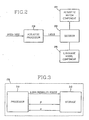
- FIG.2 A specific speech recognition environment for the invention is shown in FIG.2.
- Speech input is shown entering an acoustic processor 200 which converts acoustic waveforms into a string of labels.
- Each label is selected from an alphabet of approximately 200 labels and corresponds to a prototype vector which represents a respective sound type.
- the string of labels is directed by a decoder 202 to an acoustic match component 204.
- the acoustic match component 204 uses the string of labels to determine relative likelihoods for words in a vocabulary based on acoustic criteria. That is, the acoustic match component 204 provides a list of vocabulary words likely to correspond to the generated labels.
- Acoustic matching is discussed in a U.S. patent application S.N. 845,155 filed on March 27, 1986, entitled "Speech Recognition System".
- the acoustic match component 204 does not evaluate word context. Homonyms or similarly sounding phrases may be troublesome to the acoustic match component 204.
- the language model component 206 is preferably included to work in conjunction with the acoustic match component 204 in providing word likelihood information to the decoder 202.
- the decoder 202 selects one or more likely paths of words to which likely next words --determined from data generated by the acoustic match component 204 and the language model component 206 --are to be added. Decoders have been described in general in the literature. A particularly effective stack decoder has been described in a European patent application 86104218.2, entitled "Apparatus and Method for Determining a Likely Word Sequence from Labels Generated by an Acoustic Processor.”
- the language model component 206 is preferably formed of a processor 210 and memory storage 212 as shown in FIG.3.
- the processor 210 communicates requests to storage 212 for m-gram discounted probability values P . If the requested P is stored, storage 212 sends P to the processor 210. If the requested P is not stored, an a is communicated to the processor 210.
- FIG.4 is limited to tri-grams, bi-grams, and uni-grams, i.e, m-grams of length 3,2, and 1 respectively.
- the events are words, each word being represented by "w" with an identifier suffix or subscript.
- Each such word is included in a vocabulary list in storage (e.g. a section allocated in storage 212).
- Both the acoustic match component 204 and the language model component 206 typically limit processing to stored words in the vocabulary.
- a string of words is represented by w1, w 2 , w 3.
- w 1 , w 2 a plurality of tri-grams occurring in the text may be represented by w 1 , w 2 , w A , w 1 , w 2 , w B , w 1 , w 2 , w C , and so on.
- FIG.4 it is presumed that words w 1 , w 2 have been decoded and that the probability of a selected vocabulary word being next is sought.
- step 300 a check is made as to whether the key w 1 , w 2 corresponds to a sequence occurring in a sample text.
- a sample text size used with the invention has included approximately 25 million words.
- the same text has been examined in advance to determine how often tri-grams, bi-grams, and uni-grams have occurred in the sample text.
- step 302 a decision is made at step 302 as to whether a particular tri-gram starting with the key and ending with the selected word w A has occurred. If yes, the probability that the next word after w 1 , w 2 is w A is set equal to the stored discounted probability P (w A
- the discounted probability P ⁇ is pre-computed by (a) determining a probability based on the number of counts (i.e. the relative frequency of occurrence) of the m-gram, such probability being a count-based probability which is normally a maximum likelihood probability; (b) defining a discount factor for each m-gram occurring in the sample text; and (c) multiplying the count-based probability by the discount factor, the product being P .
- the discount factors may be computed by various methods, the use of a modified Turing's estimate being described hereinbelow.
- step 302 If, in step 302, it is found that the tri-gram wi, w 2 , w A has no stored discounted probability, a normalization constant ⁇ 2 is set equal to a pre-computed stored value ⁇ (w 1 , w 2 ) in step 306.
- step 300 it is possible that the key w 1 , w 2 did not occur in the sample text and hence there is no entry therefor in storage.
- ⁇ 2 is set equal to 1 at step 320 and a check is made at step 322 to determine if a key corre sponding to w 2 alone has been stored. If key w 2 is stored, step 308 et seq. are followed. If not, the value of ⁇ 1 is set to 1 in step 324 and step 314 is performed.
- FIG.6 shows a similar discount table for bi-grams. A particular method of pre-computing the discounts is set forth in section B hereinbelow, the discounts being determined based on modified Turing's estimates.
- a storage table which includes an entry line for each word w A , w B . and w c which can follow a key w 1 ,w 2 which occurs in the sample text.
- the total number of counts for the key w 1 ,w 2 is 12, with w A (as the next word) accounting for 8 occurrences, w B accounting for 3, and w c , accounting for 1.
- the respective count-based probabilities are thus 0.667, 0.250, and 0.083.
- the count-based probability 0.667 is multiplied by 1.00 to yield a discounted probability of 0.667.
- the above-computed value is that portion of the probability distribution for tri-grams starting with w 1 ,w 2 which is allocated to all of the tri-grams starting with w 1 ,w 2 and ending with any word other than w A ,w B , or w C .
- the 0.104 portion of the distribution is to be allocated to the 4997 words for the key w 1 ,w 2 that do not occur in the sample text.
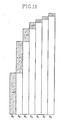
- FIG.8 and FIG.9 show the cumulative probability of the count-based probabilities and of the discounted probabilities of FIG.7, respectively.
- the last column in the graph of FIG.9 shows the 0.104 freed probability mass FM1 that remains after discounting.
- the value is specified as ⁇ 2 ( W 1 , W2 ).
- the probability of tri-grams is initially observed and a freed probability mass FM1 of 0.104 is generated.
- (0.055 ⁇ 2) of the 0.104 is allocated to those words unaccounted for by the tri-gram analysis and bi-gram analysis.
- uni-grams are employed. In that each vocabulary word is presumed, preferably, to occur at least once in the sample text, there will be a count-based probability therefor. Accordingly, at some level an m-gram ending with a selected vocabulary word will have a stored probability.
- bi-grams having the key w 2 include two types.
- the first type represents a bi-gram ending with a word w x such that the tri-gram wi,w 2 , w x occurs in the sample text and has counts which are considered in a tri-gram probability distribution.
- the second type refers to bi-grams which end with a word w y such that the tri-gram w 1 ,w 2 , wy does not occur in the sample text and does not have counts considered in the tri-gram distribution. Only counts corresponding to bi-grams of the second type are considered in the bi-gram distribution for w 2 . Only counts of the second type are used to re-distribute the freed probability mass of the tri-gram distribution having the key wi,w 2 .
- the counts for the key w 2 are adjusted to account for multiple counting in lesser-included m-grams.
- the avoidance of "multiple counting" is accounted for by a factor ⁇ which is described in greater detail in section B hereinbelow.
- the present invention contemplates starting with m-grams of length greater than three and "backing off" from there. That is, m-grams of a longest length j are analyzed first and, if necessary, analysis based on shorter m-grams is performed and, if necessary, analysis based on still shorter m-grams is performed thereafter, and so on. Although it is preferred that successive analyses decrement by a single event, this is not a requirement.
- a speech recognition embodiment of the prevent invention has been implemented in the PL1 language for use on an IBM VM/CMS system, and may be implemented on other computers in other languages as well.
- the present invention is applicable to other environments as well.
- the invention may be employed in an optical character recognition environment, in a handwriting recognition en vironment, or in a data compression environment, where the events may correspond to characters and/or words.
- image recognition would be analogous to the acoustic match component in a speech recognition system.
- the language model would assign probabilities of a specific character or word being next; from this information a code of an appropriate length is assigned according to known methods.
- the present invention addresses the problem of estimating probabilities from sparse data by reducing the apparently unreliable probability estimates of m-grams derived from observed counts and distributing the "freed probability mass" among m-grams which never occurred in the sample text.
- the reduction is achieved, in a preferred specific embodiment, by replacing maximum likelihood estimates for m-grams having low counts with re-normalized Turing's estimates.
- the re-distribution is performed with the recursive utilization of lower-level conditional distributions. The theory of this process is now described.
- N be a sample text size, i.e., the number of m-grams in the sample text, and let n r be the number of m-grams which occurred in the text exactly r times, so that
- Turing's estimate P r for a probability of an item (m-gram) which occurred in the sample r times is
- the ratio r represents a discount coefficient, or discount factor, d r .
- ⁇ r the result is Turing's discounting.
- the present method is based on the interpretation of ⁇ c in (11) as a "contribution" of an m-gram w m with a count c( i) to the probability of "unseen” m-grams. Moreover, assuming that the (m-1)-gram w m - 1 has been observed in the sample text, an entity is introduced which is a contribution analogous to ⁇ c , defined by Equation (10):
- the estimator is defined inductively as follows. It is assumed that the lower-level conditional estimator has been defined. Then, when gives the conditional probability estimate for words w m observed in the sample text after It is convenient to define a function ⁇ by
- Equation (22) is analogous to Equation (9).
- An adjustment of the d, is characterized in the form: where K is a constant. The unique solution therefor is given by
- Equality (23) is equivalent to the requirement that newly defined count "contributions” are proportional to the Turing's "contributions”
- Other ways of computing discount coefficients could be suggested, for, in general, the model is not very sensitive to the actual values of d r . This condition holds as long as an estimate for the probability of observing some previously unseen m-gram is reasonable.
- n 1/ N is well justified --there isn't too much of a difference in seeing an m-gram once or not seeing it at all. Numerical values for a's can be pre-computed which provides computational efficiency.
Landscapes
- Engineering & Computer Science (AREA)
- Physics & Mathematics (AREA)
- Multimedia (AREA)
- Computational Linguistics (AREA)
- Human Computer Interaction (AREA)
- Audiology, Speech & Language Pathology (AREA)
- Health & Medical Sciences (AREA)
- Acoustics & Sound (AREA)
- Probability & Statistics with Applications (AREA)
- Computer Vision & Pattern Recognition (AREA)
- General Physics & Mathematics (AREA)
- Theoretical Computer Science (AREA)
- Machine Translation (AREA)
Applications Claiming Priority (2)
| Application Number | Priority Date | Filing Date | Title |
|---|---|---|---|
| US06/844,904 US4831550A (en) | 1986-03-27 | 1986-03-27 | Apparatus and method for estimating, from sparse data, the probability that a particular one of a set of events is the next event in a string of events |
| US844904 | 1986-03-27 |
Publications (2)
| Publication Number | Publication Date |
|---|---|
| EP0245595A1 true EP0245595A1 (fr) | 1987-11-19 |
| EP0245595B1 EP0245595B1 (fr) | 1991-08-14 |
Family
ID=25293927
Family Applications (1)
| Application Number | Title | Priority Date | Filing Date |
|---|---|---|---|
| EP87102789A Expired EP0245595B1 (fr) | 1986-03-27 | 1987-02-27 | Procédé et dispositif pour déterminer, à partir de données insuffisantes, la probabilité pour un événement déterminé d'un ensemble d'être le suivant dans une suite d'événements |
Country Status (4)
| Country | Link |
|---|---|
| US (1) | US4831550A (fr) |
| EP (1) | EP0245595B1 (fr) |
| JP (1) | JPS62231994A (fr) |
| DE (1) | DE3772094D1 (fr) |
Cited By (3)
| Publication number | Priority date | Publication date | Assignee | Title |
|---|---|---|---|---|
| EP0385124A3 (fr) * | 1989-03-02 | 1992-06-17 | International Business Machines Corporation | Procédé optimisé pour la reconnaissance de la parole |
| EP0602296A1 (fr) * | 1992-12-17 | 1994-06-22 | International Business Machines Corporation | Méthode adaptive pour produire des modèles dépendants du domaine pour systèmes intelligents |
| WO1997017694A1 (fr) * | 1995-11-04 | 1997-05-15 | International Business Machines Corporation | Procede et appareil d'adaptation de la dimension du modele de langage dans un systeme de reconnaissance vocal |
Families Citing this family (36)
| Publication number | Priority date | Publication date | Assignee | Title |
|---|---|---|---|---|
| JPH0296800A (ja) * | 1988-10-03 | 1990-04-09 | Nec Corp | 連続音声認識装置 |
| US5307424A (en) * | 1990-12-12 | 1994-04-26 | Eberhard Kuehl | Character recognition system |
| KR950008022B1 (ko) * | 1991-06-19 | 1995-07-24 | 가부시끼가이샤 히다찌세이사꾸쇼 | 문자처리방법 및 장치와 문자입력방법 및 장치 |
| US5267345A (en) * | 1992-02-10 | 1993-11-30 | International Business Machines Corporation | Speech recognition apparatus which predicts word classes from context and words from word classes |
| US5467425A (en) * | 1993-02-26 | 1995-11-14 | International Business Machines Corporation | Building scalable N-gram language models using maximum likelihood maximum entropy N-gram models |
| CA2091658A1 (fr) * | 1993-03-15 | 1994-09-16 | Matthew Lennig | Methode et appareil utilisant la reconnaissance vocale pour automatiser l'assistance telephonique |
| EP0645757B1 (fr) * | 1993-09-23 | 2000-04-05 | Xerox Corporation | Filtre sémantique de cooccurrence pour la reconnaissance de la parole et pour utilisations dans la transcription de signaux |
| JPH07210190A (ja) * | 1993-12-30 | 1995-08-11 | Internatl Business Mach Corp <Ibm> | 音声認識方法及びシステム |
| US5524169A (en) * | 1993-12-30 | 1996-06-04 | International Business Machines Incorporated | Method and system for location-specific speech recognition |
| IT1279171B1 (it) * | 1995-03-17 | 1997-12-04 | Ist Trentino Di Cultura | Sistema di riconoscimento di parlato continuo |
| DE19516099C2 (de) * | 1995-05-05 | 2003-07-03 | Philips Intellectual Property | Verfahren zum Bestimmen von Sprachmodellwerten |
| US5677990A (en) * | 1995-05-05 | 1997-10-14 | Panasonic Technologies, Inc. | System and method using N-best strategy for real time recognition of continuously spelled names |
| US5835888A (en) * | 1996-06-10 | 1998-11-10 | International Business Machines Corporation | Statistical language model for inflected languages |
| US6151575A (en) * | 1996-10-28 | 2000-11-21 | Dragon Systems, Inc. | Rapid adaptation of speech models |
| US5950189A (en) * | 1997-01-02 | 1999-09-07 | At&T Corp | Retrieval system and method |
| US5995929A (en) * | 1997-09-12 | 1999-11-30 | Nortel Networks Corporation | Method and apparatus for generating an a priori advisor for a speech recognition dictionary |
| US6418431B1 (en) * | 1998-03-30 | 2002-07-09 | Microsoft Corporation | Information retrieval and speech recognition based on language models |
| DE19842404A1 (de) * | 1998-09-16 | 2000-03-23 | Philips Corp Intellectual Pty | Verfahren zur Schätzung von Auftrittswahrscheinlichkeiten für Sprachvokabularelemente |
| US6647395B1 (en) * | 1999-11-01 | 2003-11-11 | Kurzweil Cyberart Technologies, Inc. | Poet personalities |
| US7031908B1 (en) | 2000-06-01 | 2006-04-18 | Microsoft Corporation | Creating a language model for a language processing system |
| US6865528B1 (en) * | 2000-06-01 | 2005-03-08 | Microsoft Corporation | Use of a unified language model |
| US7711570B2 (en) * | 2001-10-21 | 2010-05-04 | Microsoft Corporation | Application abstraction with dialog purpose |
| US8229753B2 (en) * | 2001-10-21 | 2012-07-24 | Microsoft Corporation | Web server controls for web enabled recognition and/or audible prompting |
| US7028038B1 (en) | 2002-07-03 | 2006-04-11 | Mayo Foundation For Medical Education And Research | Method for generating training data for medical text abbreviation and acronym normalization |
| US7200559B2 (en) * | 2003-05-29 | 2007-04-03 | Microsoft Corporation | Semantic object synchronous understanding implemented with speech application language tags |
| US8301436B2 (en) * | 2003-05-29 | 2012-10-30 | Microsoft Corporation | Semantic object synchronous understanding for highly interactive interface |
| US8160883B2 (en) * | 2004-01-10 | 2012-04-17 | Microsoft Corporation | Focus tracking in dialogs |
| US7516050B2 (en) * | 2005-03-09 | 2009-04-07 | Poulin Christian D | Defining the semantics of data through observation |
| US8160977B2 (en) * | 2006-12-11 | 2012-04-17 | Poulin Christian D | Collaborative predictive model building |
| GB2453366B (en) * | 2007-10-04 | 2011-04-06 | Toshiba Res Europ Ltd | Automatic speech recognition method and apparatus |
| USRE47996E1 (en) | 2009-10-09 | 2020-05-19 | Ethicon Llc | Surgical generator for ultrasonic and electrosurgical devices |
| US10943583B1 (en) * | 2017-07-20 | 2021-03-09 | Amazon Technologies, Inc. | Creation of language models for speech recognition |
| CN109447937B (zh) * | 2017-08-29 | 2021-07-06 | 中国移动通信有限公司研究院 | 一种图像处理模型的确定方法及其相关装置 |
| US10600408B1 (en) * | 2018-03-23 | 2020-03-24 | Amazon Technologies, Inc. | Content output management based on speech quality |
| US11393471B1 (en) * | 2020-03-30 | 2022-07-19 | Amazon Technologies, Inc. | Multi-device output management based on speech characteristics |
| CN112395404B (zh) * | 2020-12-05 | 2023-01-24 | 中国南方电网有限责任公司 | 一种应用于电力调度的语音关键信息提取方法 |
Family Cites Families (11)
| Publication number | Priority date | Publication date | Assignee | Title |
|---|---|---|---|---|
| US3188609A (en) * | 1962-05-04 | 1965-06-08 | Bell Telephone Labor Inc | Method and apparatus for correcting errors in mutilated text |
| US3969700A (en) * | 1974-04-10 | 1976-07-13 | International Business Machines Corporation | Regional context maximum likelihood error correction for OCR, keyboard, and the like |
| US3925761A (en) * | 1974-08-02 | 1975-12-09 | Ibm | Binary reference matrix for a character recognition machine |
| US4038503A (en) * | 1975-12-29 | 1977-07-26 | Dialog Systems, Inc. | Speech recognition apparatus |
| US4156868A (en) * | 1977-05-05 | 1979-05-29 | Bell Telephone Laboratories, Incorporated | Syntactic word recognizer |
| US4277644A (en) * | 1979-07-16 | 1981-07-07 | Bell Telephone Laboratories, Incorporated | Syntactic continuous speech recognizer |
| US4400788A (en) * | 1981-03-27 | 1983-08-23 | Bell Telephone Laboratories, Incorporated | Continuous speech pattern recognizer |
| US4435617A (en) * | 1981-08-13 | 1984-03-06 | Griggs David T | Speech-controlled phonetic typewriter or display device using two-tier approach |
| US4489435A (en) * | 1981-10-05 | 1984-12-18 | Exxon Corporation | Method and apparatus for continuous word string recognition |
| JPS5921039B2 (ja) * | 1981-11-04 | 1984-05-17 | 日本電信電話株式会社 | 適応予測符号化方式 |
| JPS5885499A (ja) * | 1981-11-18 | 1983-05-21 | 株式会社デンソー | 連続音声認識装置 |
-
1986
- 1986-03-27 US US06/844,904 patent/US4831550A/en not_active Expired - Fee Related
- 1986-12-19 JP JP61301935A patent/JPS62231994A/ja active Granted
-
1987
- 1987-02-27 EP EP87102789A patent/EP0245595B1/fr not_active Expired
- 1987-02-27 DE DE8787102789T patent/DE3772094D1/de not_active Expired - Lifetime
Non-Patent Citations (1)
| Title |
|---|
| PROCEEDINGS OF THE IEEE, vol. 73, no. 11, November 1985, pages 1616-1624, IEEE, New York, US; F. JELINEK: "The development of an experimental discrete dictation recognizer" * |
Cited By (4)
| Publication number | Priority date | Publication date | Assignee | Title |
|---|---|---|---|---|
| EP0385124A3 (fr) * | 1989-03-02 | 1992-06-17 | International Business Machines Corporation | Procédé optimisé pour la reconnaissance de la parole |
| EP0602296A1 (fr) * | 1992-12-17 | 1994-06-22 | International Business Machines Corporation | Méthode adaptive pour produire des modèles dépendants du domaine pour systèmes intelligents |
| US5444617A (en) * | 1992-12-17 | 1995-08-22 | International Business Machines Corporation | Method and apparatus for adaptively generating field of application dependent language models for use in intelligent systems |
| WO1997017694A1 (fr) * | 1995-11-04 | 1997-05-15 | International Business Machines Corporation | Procede et appareil d'adaptation de la dimension du modele de langage dans un systeme de reconnaissance vocal |
Also Published As
| Publication number | Publication date |
|---|---|
| JPH0555080B2 (fr) | 1993-08-16 |
| JPS62231994A (ja) | 1987-10-12 |
| EP0245595B1 (fr) | 1991-08-14 |
| DE3772094D1 (de) | 1991-09-19 |
| US4831550A (en) | 1989-05-16 |
Similar Documents
| Publication | Publication Date | Title |
|---|---|---|
| EP0245595B1 (fr) | Procédé et dispositif pour déterminer, à partir de données insuffisantes, la probabilité pour un événement déterminé d'un ensemble d'être le suivant dans une suite d'événements | |
| US6477488B1 (en) | Method for dynamic context scope selection in hybrid n-gram+LSA language modeling | |
| US5828999A (en) | Method and system for deriving a large-span semantic language model for large-vocabulary recognition systems | |
| Riccardi et al. | Stochastic automata for language modeling | |
| US5640487A (en) | Building scalable n-gram language models using maximum likelihood maximum entropy n-gram models | |
| Gildea et al. | Topic-based language models using EM | |
| US9330660B2 (en) | Grammar fragment acquisition using syntactic and semantic clustering | |
| EP0240679B1 (fr) | Formation de modèles de Markov utilisés dans un système de reconnaissance de la parole | |
| JP2002538534A (ja) | 音声認識システムの動的意味論的制御 | |
| US20020188446A1 (en) | Method and apparatus for distribution-based language model adaptation | |
| EP0709801A1 (fr) | Procédé pour effectuer une comparaison de suites de données | |
| US20080215329A1 (en) | Methods and Apparatus for Generating Dialog State Conditioned Language Models | |
| US20040243409A1 (en) | Morphological analyzer, morphological analysis method, and morphological analysis program | |
| EP1619620A1 (fr) | Adaptation de modèles exponentiels | |
| US20040148284A1 (en) | Word recognition consistency check and error correction system and method | |
| US5787424A (en) | Process and system for recursive document retrieval | |
| US20100211378A1 (en) | Modular approach to building large language models | |
| WO2007061674A1 (fr) | Groupage de mots pour des donnees d'entree | |
| Pereira et al. | Beyond word n-grams | |
| US20050216265A1 (en) | Representation of a deleted interpolation N-gram language model in ARPA standard format | |
| EP0241183A1 (fr) | Système de reconnaissance de la parole | |
| Duh et al. | Automatic learning of language model structure | |
| US20020156628A1 (en) | Speech recognition system, training arrangement and method of calculating iteration values for free parameters of a maximum-entropy speech model | |
| Knill et al. | Fast implementation methods for Viterbi-based word-spotting | |
| US20010003174A1 (en) | Method of generating a maximum entropy speech model |
Legal Events
| Date | Code | Title | Description |
|---|---|---|---|
| PUAI | Public reference made under article 153(3) epc to a published international application that has entered the european phase |
Free format text: ORIGINAL CODE: 0009012 |
|
| AK | Designated contracting states |
Kind code of ref document: A1 Designated state(s): DE FR GB IT |
|
| 17P | Request for examination filed |
Effective date: 19880126 |
|
| 17Q | First examination report despatched |
Effective date: 19900205 |
|
| GRAA | (expected) grant |
Free format text: ORIGINAL CODE: 0009210 |
|
| AK | Designated contracting states |
Kind code of ref document: B1 Designated state(s): DE FR GB IT |
|
| REF | Corresponds to: |
Ref document number: 3772094 Country of ref document: DE Date of ref document: 19910919 |
|
| ITF | It: translation for a ep patent filed | ||
| ET | Fr: translation filed | ||
| PLBE | No opposition filed within time limit |
Free format text: ORIGINAL CODE: 0009261 |
|
| STAA | Information on the status of an ep patent application or granted ep patent |
Free format text: STATUS: NO OPPOSITION FILED WITHIN TIME LIMIT |
|
| 26N | No opposition filed | ||
| PGFP | Annual fee paid to national office [announced via postgrant information from national office to epo] |
Ref country code: FR Payment date: 19950128 Year of fee payment: 9 |
|
| PGFP | Annual fee paid to national office [announced via postgrant information from national office to epo] |
Ref country code: DE Payment date: 19950223 Year of fee payment: 9 |
|
| PG25 | Lapsed in a contracting state [announced via postgrant information from national office to epo] |
Ref country code: FR Effective date: 19961031 |
|
| PG25 | Lapsed in a contracting state [announced via postgrant information from national office to epo] |
Ref country code: DE Effective date: 19961101 |
|
| REG | Reference to a national code |
Ref country code: FR Ref legal event code: ST |
|
| PGFP | Annual fee paid to national office [announced via postgrant information from national office to epo] |
Ref country code: GB Payment date: 20000127 Year of fee payment: 14 |
|
| PG25 | Lapsed in a contracting state [announced via postgrant information from national office to epo] |
Ref country code: GB Free format text: LAPSE BECAUSE OF NON-PAYMENT OF DUE FEES Effective date: 20010227 |
|
| GBPC | Gb: european patent ceased through non-payment of renewal fee |
Effective date: 20010227 |
|
| PG25 | Lapsed in a contracting state [announced via postgrant information from national office to epo] |
Ref country code: IT Free format text: LAPSE BECAUSE OF NON-PAYMENT OF DUE FEES;WARNING: LAPSES OF ITALIAN PATENTS WITH EFFECTIVE DATE BEFORE 2007 MAY HAVE OCCURRED AT ANY TIME BEFORE 2007. THE CORRECT EFFECTIVE DATE MAY BE DIFFERENT FROM THE ONE RECORDED. Effective date: 20050227 |