EP0245643A2 - Appareil pour découper des tubes en spirales - Google Patents
Appareil pour découper des tubes en spirales Download PDFInfo
- Publication number
- EP0245643A2 EP0245643A2 EP87104994A EP87104994A EP0245643A2 EP 0245643 A2 EP0245643 A2 EP 0245643A2 EP 87104994 A EP87104994 A EP 87104994A EP 87104994 A EP87104994 A EP 87104994A EP 0245643 A2 EP0245643 A2 EP 0245643A2
- Authority
- EP
- European Patent Office
- Prior art keywords
- frame
- axis
- support plate
- web
- film
- Prior art date
- Legal status (The legal status is an assumption and is not a legal conclusion. Google has not performed a legal analysis and makes no representation as to the accuracy of the status listed.)
- Ceased
Links
Images



Classifications
-
- B—PERFORMING OPERATIONS; TRANSPORTING
- B29—WORKING OF PLASTICS; WORKING OF SUBSTANCES IN A PLASTIC STATE IN GENERAL
- B29C—SHAPING OR JOINING OF PLASTICS; SHAPING OF MATERIAL IN A PLASTIC STATE, NOT OTHERWISE PROVIDED FOR; AFTER-TREATMENT OF THE SHAPED PRODUCTS, e.g. REPAIRING
- B29C55/00—Shaping by stretching, e.g. drawing through a die; Apparatus therefor
- B29C55/28—Shaping by stretching, e.g. drawing through a die; Apparatus therefor of blown tubular films, e.g. by inflation
- B29C55/285—Shaping by stretching, e.g. drawing through a die; Apparatus therefor of blown tubular films, e.g. by inflation by using internal mechanical means
-
- B—PERFORMING OPERATIONS; TRANSPORTING
- B26—HAND CUTTING TOOLS; CUTTING; SEVERING
- B26D—CUTTING; DETAILS COMMON TO MACHINES FOR PERFORATING, PUNCHING, CUTTING-OUT, STAMPING-OUT OR SEVERING
- B26D3/00—Cutting work characterised by the nature of the cut made; Apparatus therefor
- B26D3/16—Cutting rods or tubes transversely
- B26D3/162—Cutting rods or tubes transversely cutting tubes obliquely
-
- D—TEXTILES; PAPER
- D06—TREATMENT OF TEXTILES OR THE LIKE; LAUNDERING; FLEXIBLE MATERIALS NOT OTHERWISE PROVIDED FOR
- D06H—MARKING, INSPECTING, SEAMING OR SEVERING TEXTILE MATERIALS
- D06H7/00—Apparatus or processes for cutting, or otherwise severing, specially adapted for the cutting, or otherwise severing, of textile materials
- D06H7/10—Apparatus or processes for cutting, or otherwise severing, specially adapted for the cutting, or otherwise severing, of textile materials obliquely
- D06H7/12—Apparatus or processes for cutting, or otherwise severing, specially adapted for the cutting, or otherwise severing, of textile materials obliquely cutting a tubular fabric helically
-
- Y—GENERAL TAGGING OF NEW TECHNOLOGICAL DEVELOPMENTS; GENERAL TAGGING OF CROSS-SECTIONAL TECHNOLOGIES SPANNING OVER SEVERAL SECTIONS OF THE IPC; TECHNICAL SUBJECTS COVERED BY FORMER USPC CROSS-REFERENCE ART COLLECTIONS [XRACs] AND DIGESTS
- Y10—TECHNICAL SUBJECTS COVERED BY FORMER USPC
- Y10T—TECHNICAL SUBJECTS COVERED BY FORMER US CLASSIFICATION
- Y10T29/00—Metal working
- Y10T29/11—Bias [i.e., helically] cutting of tubular stock
- Y10T29/1125—Bias [i.e., helically] cutting of tubular stock including means to inflate stock
-
- Y—GENERAL TAGGING OF NEW TECHNOLOGICAL DEVELOPMENTS; GENERAL TAGGING OF CROSS-SECTIONAL TECHNOLOGIES SPANNING OVER SEVERAL SECTIONS OF THE IPC; TECHNICAL SUBJECTS COVERED BY FORMER USPC CROSS-REFERENCE ART COLLECTIONS [XRACs] AND DIGESTS
- Y10—TECHNICAL SUBJECTS COVERED BY FORMER USPC
- Y10T—TECHNICAL SUBJECTS COVERED BY FORMER US CLASSIFICATION
- Y10T29/00—Metal working
- Y10T29/11—Bias [i.e., helically] cutting of tubular stock
- Y10T29/1131—Bias [i.e., helically] cutting of tubular stock with means to feed stock along support or mandrel
- Y10T29/115—Axially
-
- Y—GENERAL TAGGING OF NEW TECHNOLOGICAL DEVELOPMENTS; GENERAL TAGGING OF CROSS-SECTIONAL TECHNOLOGIES SPANNING OVER SEVERAL SECTIONS OF THE IPC; TECHNICAL SUBJECTS COVERED BY FORMER USPC CROSS-REFERENCE ART COLLECTIONS [XRACs] AND DIGESTS
- Y10—TECHNICAL SUBJECTS COVERED BY FORMER USPC
- Y10T—TECHNICAL SUBJECTS COVERED BY FORMER US CLASSIFICATION
- Y10T83/00—Cutting
- Y10T83/202—With product handling means
- Y10T83/2092—Means to move, guide, or permit free fall or flight of product
- Y10T83/2183—Product mover including gripper means
- Y10T83/219—Rotating or oscillating product handler
Definitions
- the invention relates to a device for helically cutting open a film tubular web made of thermoplastic, preferably for producing stretched flat film webs with an obliquely extending direction (orientation of the molecules), with a device for the cylindrical expansion of a moving section of the continuously advanced film tubular web, with devices for pulling forward the expanded one Foil tube web section, with a knife which spirally separates the expanded foil tube web section, with devices for pulling off the flat film web formed by the cutting from the expanded film tubular web section and with a winding device which winds the flat film web running off the knife into a supply roll.
- Devices of this type which are used for the helical cutting of stretched film tubular webs made of thermoplastic material for the production of, for example, cross laminates, are e.g. known from CA-PS 782 508 and DE-PS 10 07 500.
- the object of the invention is to provide a device which, starting from a stretched flat film tube sheet made of thermoplastic material, permits the production of a supply roll from a flat film sheet which is spirally separated from the film tube sheet and has a high output.
- this object is achieved in a device of the generic type in that, in a machine frame, a pair of preferred rollers for the flat-lying film tubular web is fixed to the frame, that in a base frame or the like, a frame provided with a rotary drive, a support plate or the like is rotatably mounted are carrying a support mandrel, which consists of elongated support elements, such as slide rods, arranged at a distance from one another and concentrically with the axis of rotation of the support plate or the like, that the knife separates the tubular film web in its run-up area onto the slide rods or the like the turning axis is aligned with the nip of the preferred pair of rollers and passes through this approximately in its central region that at least one co-rotating turning bar and a U deflecting or guide roller are connected to the support plate or the like, via which the flat film web runs to the winding device, and that the Winding axis of the winding device intersects the axis
- the inventive device permits the trouble-free winding a helically severed by a cylindrical expanded tubular film web F laughing film web to supply rolls with high performance.
- the inflated film tube web section which is continuously drawn in the axial direction onto the run-up area of the support mandrel in the axial direction, is cut helically into a flat web by the knife, which is expediently set in the cutting direction.
- the support mandrel carrying the knife rotates relative to the inflated film tubular web section which is inflated thereon.
- the support mandrel consists of support elements or slide rods with a low-friction surface.
- the friction can be reduced in that the supporting mandrel is provided over its circumference or the supporting elements forming it with blowing air nozzles from which blowing air emerges to reduce friction.
- the co-rotating turning bar and deflection roller ensure that the helically separated flat film web is discharged properly to the winding device.
- the supporting mandrel which supports and rotates the cylindrically widened film tubular web section, can rotate at high speed, since the winding axis of the winding device is also in its axis of rotation and therefore, despite the high rotation of the co-rotating winding device, there are essentially no imbalances from the centrifugal forces. If the axis of rotation of the support plate intersects the winding axis of the winding device, it must also rotate with the support plate or the like. Such a winding device rotating about a transverse axis can be dispensed with if the winding axis of the winding device is aligned with the axis of rotation of the support plate.
- a good operation of the device requires that the F olienschlauchbahn crease and wrinkle-free expanded and continuous, each enlarged portion is cut free from distortion helically.
- wedge-shaped support plates are arranged which converge towards the nip, and that a blow air tube is attached to the support plate or the like this projecting slide rods of the support mandrel preferably protrudes and is connected to a fan arranged on the support plate. The blowing direction of the blow air tube is directed between the support plates, so that the film tube web is inflated cylindrically as it runs off the support plates.
- the inflated film tubular web section is drawn by the devices pulling the separated flat film web onto the support mandrel consisting of the slide rods or the like.
- the support mandrel rotates relative to the film tube web section drawn on its run-up area in the axial direction.
- the axis of the blown air tube is expediently aligned with the axis of rotation of the support plate or the like.
- the slide rods are extendable and retractable on the supporting plate in the radial direction by the same amount.
- the performance of the device is additionally ensured in that the knife consists of a circular knife driven by a motor.
- the knife holder is more appropriate attached to one of the slide rods or the like, so that it participates in its radial movements during adjustment.
- the winding device can be arranged in a frame rotating with the support plate with a winding axis perpendicular to its axis of rotation.
- the support plate or the like is expediently provided with a pair of feed rollers for the flat film web, the axes of the feed rollers being parallel to the winding axis. If the pull-off of the flat film web were only formed by driving the winding shaft of the supply roll, the winding tension could become too high.
- a lower, angled deflection roller and an upper, angled turning bar are arranged, via which the flat film web runs to the pair of preferred rollers that pull it off.
- the turning bar and the deflecting roller ensure that the drawn-off flat film web is guided tautly and without fear of running to the winding device, the preferred upstream of the winding device.
- pair of rollers enables level, right-angle feeding with the desired winding tension.
- the function of the turning bar and deflection roller is known per se from DE-PS 19 48 935.
- the rotating deflecting roller leads to a deflection of the film web, the center lines of the running and running parts of the film web lying in one plane.
- Non-rotating turning bars provided with low-friction linings lead to an angular displacement of the center lines of the running and running parts of the film webs, the running-on angles with the axis of the turning bar being equal to the running angles.
- two inclined turning bars are arranged between the knife and the pair of preferred rollers.
- the slide rods or the like are connected to one another in the upper and lower regions by a toggle-like link with a central support, preferably the one Blown air tube, are connected that the upper, articulated with the slide rods link extended beyond the knee joint and with their extended inner ends are articulated on a blower or the like. Slidable and lockable sliding ring and that the knee joints of the upper and lower links are connected to each other by coupling rods.
- the turning bars and, if appropriate, deflecting rollers must also be adjusted in the radial and axial directions relative to the axis of rotation of the support plate.
- the turning bars and possibly also deflection rollers are held on a frame which is radially displaceable in the guides of the support plate.
- a turning bar can be displaceably guided on guides of the displaceable frame which are parallel to the axis of rotation of the support plate.
- the knife can also be displaceably guided parallel to the axis of rotation of the support plate or the like.
- the drive for adjusting the turning bar and possibly the knife frame can be derived from the sliding ring guided on the blown air pipe via rods, rack and pinion drives and / or rope pulleys and ropes or the like.
- the support plate or the like is supported with a horizontal axis of rotation in the region of the free end of a support frame enclosing the slide rods or the like via a rotatable ring in the frame and that the support plate is on its side opposite the slide rods is connected to a frame or carrier which receives the winding device and which is connected to a gear motor via an end-side shaft journal mounted in a stand.
- the support plate or the like with a horizontal axis of rotation is provided with a support frame enclosing the slide rods or the like, which is rotatably supported in the machine frame by two rotatable rings arranged at a distance from one another and is provided with a rotary drive , and that on the side of the support plate opposite the slide rods, the winding shaft which is aligned with the axis of rotation of the support plate and is mounted in a floating manner is mounted in a frame.
- the winding shaft can be uncoupled from its drive fixed to the frame and mounted in a transversely movable carriage.
- the winding device is expediently driven by a rotating field magnetic motor, so that the winding is always carried out with a predetermined winding tension without special speed control.
- FIG. 1 shows a system for unwinding a film tube web from a supply roll, for stretching the unwound film tube web, for heat setting the stretched film tube web, for cylindrical widening of the flat film tube web and for helically cutting and winding up the flat film web formed by the cutting.
- a supply roll 2 is mounted, from which a flat film tube sheet 3 is pulled off.
- This film tube web is stretched in a known manner between the stretching rollers 4 of a stretching device.
- the stretched film web then overflows heated rollers 5 and is thereby heat set.
- the stretched and heat-set tubular film web 3 then runs over guide rollers 6 through the nip of a pair of preferred rollers 7, the preferred rollers of which are mounted at the upper end of a frame-like frame 8 and are provided with a rotary drive.
- wedge-shaped support plates 9, 10 which converge towards the nip of the pair of preferred rollers 7 and their common center plane is aligned with the center plane of the pair of preferred rollers 7 extending through the nip.
- a frame 12 provided with a rotary drive is rotatably mounted on a pedestal 11, the vertical axis of rotation of the frame 12 lying in the central plane running through the nip of the feed rollers 7 and passing through the feed roller pair 7 in the center.
- the frame 12 carries at its upper end a central support plate 13, on which concentric to the axis of rotation and parallel to it, slide rods 14 are fastened at equal intervals, which overall form a support mandrel 15.
- a carrier for the motor 18 is fastened to a slide rod 14, on the shaft of which a circular knife 20 is fastened, which, between two slide rods 14 of the supporting mandrel 15, separates the film tubular web 3, which has been expanded to form a cylindrical tubular film section 21.
- This cutting process forms a flat film web in which the direction of stretching is inclined in accordance with the cutting angle.
- This flat film web 21 is advanced by a pair of preferred rollers 22 arranged below a passage slot of the support plate 13 via the support mandrel 15, the deflecting roller 23 and the turning bar 24 and fed in alignment to the winding core of the winding device 25 and wound up to form the supply roll 26.
- the winding device 25 is arranged in the frame 12 and therefore also rotates.
- the take-up reel is provided with a co-rotating drive, not shown.
- the winding axis of the winding device 25 extends at right angles to the axis of rotation of the support plate 13 and cuts it.
- the winding device 25 is provided with pivotable supports 28 which support the winding axis or the winding core and which are pivotably mounted on the base plate 29 of the frame 12 which forms a turntable.
- a central blowpipe 30 is fastened to the support plate, the axis of which is aligned with the axis of rotation of the frame 12 or the supporting mandrel 15.
- the blown air tube 30 has at its lower end a connection piece into which the outlet of the fan 32 driven by the motor 31 opens, which is also fastened to the support plate 13.
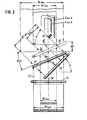
- Fig. 3 shows an enlarged plan view of the deflecting roller 23 and the turning bar 24 in the direction of arrows III in Fig. 1 in a schematic representation.
- the width Blmax means the circumference of the widest film tube to be processed, that is to say the width of the flat film web which results when it is cut open in the axial direction.
- B2min means the width of the flat film tube, which results when the smallest film tube with the diameter Dmin is cut open in the axial direction.
- the flat film web running off the cutting knife 20 first runs over the deflection roller 23, which has the cutting angle C0 is inclined to the axis of rotation 36.
- the flat film web runs from the deflection roller 23 via the turning bar 24 to the pair of preferred rollers 22.
- a straight feed of the flat film web 21 to the pair of preferred rollers 22 is achieved in that the turning bar 24 is only inclined by the angle / 2 to the axis of rotation 36.
- the turning bar 24 when the tubular film diameter changes from Dmax to Dmin, the turning bar 24 must be moved in the axial direction by the distance H2. In addition, the deflection roller 23 and the turning bar 24 must of course also be moved in the radial direction in accordance with the change in diameter of the support mandrel 15.
- the top view according to FIG. 4 shows the radial position of the deflecting roller 23 and the turning bar 24 relative to the support mandrel 15.
- the deflecting roller 23 and the turning bar 24 are mounted in a frame 37, which is relative to the support mandrel 15 in the radial direction on the support plate 33 is guided.
- the attachment of the carrier 38 of the motor 18 of the cutting knife 20 can be seen in an enlarged view from FIG. 5.
- the carrier 38 is attached to a slide rod 14 by a cranked bracket 39 through a sleeve. If necessary, the sleeve can be adjusted in height in accordance with the change in diameter of the support mandrel 15 and can be clamped on the slide rod 14.
- the slide rods 14 consist of box sections and are pressurized with compressed air in their interior and have bores 40 on their outer end faces which form blowing air nozzles which reduce friction.
- FIG. 7 shows the radially outermost position of the slide rods 14 with solid lines and the radially innermost position of the slide rods with dashed lines 14 '.
- links 44, 44 ' are connected to one another by a knee joint 45, the outer ends of which are articulated on the one hand in the upper region of the slide rods 14 on the latter and the inner ends of which are articulated on the central blow air pipe 30.
- the handlebar 44 is extended beyond the toggle joint 45 and hinged at its inner end to a sliding ring 47.
- the lower regions of the slide rods 14 are connected in a corresponding manner to the central blown air pipe 30 in an articulated manner by means of links 48, 48 ′ connected to one another in the manner of a toggle lever.
- the lower knee joint 49 is articulated by a coupling rod 50 to the upper knee joint 45.
- a displacement mechanism is created, which permits an adjustment of the slide rods 14 in the radial direction to the blown air tube 30 only by axially shifting the sliding ring 47, which is clamped in the desired position on the blown air tube 30 by a clamping screw.
- the turning bar 24 must also be adjusted in height.
- the turning bar 24 is guided in the axial direction by sliding bushings 52, 53 on vertical struts 54 of the frame 37.
- the sliding bushes are connected to a lever 55 which can be raised and lowered by a rope 56.
- the rope 56 is wound on a rope drum 58 which is rotatably mounted on a horizontal axis which is fastened to the central blown air pipe 30.
- To drive the cable drum 58 it is provided with a toothed wheel which meshes with a toothed rack 59 which is connected to a slide rod 14.
- the adjustment mechanism designed so that during an adjustment of Eq eitstäbe from the outermost to the innermost position 14 ', the turning rod 24 from the position shown in full lines to the position shown in dotted line position 24' is raised by a distance H2.
- the inwardly projecting end of the lever 56 is connected by a tension spring to the articulation area of the link 48 on the slide rod 14, which tries to pull the turning bar 24 into its lower position.
- FIG. 8 shows an embodiment with two turning bars 60, 61.
- the lower turning bar 60 When the slide rods 14 are adjusted from their outermost to their innermost position, the lower turning bar 60 must be raised in addition to its radial displacement in the axial direction by the distance H2 into the dashed position 60 ', as can be seen particularly clearly from FIG. 9, which a plan view of the turning bar arrangement of FIG. 8 shows.
- FIG. 9 also shows in a manner corresponding to FIG. 3 how the conditions change when changing from the largest to the smallest possible hose diameter.
- a tension spring is also provided in the embodiment according to FIG. 8, which strives to keep the turning bar 60 in its lower position.
- F ig. 10 shows a top view of the embodiment according to FIG . 8. Since in the embodiment according to FIG. 8 the circular knife 20 also has to be arranged displaceably in the axial direction, a guide profile 65 is additionally provided, which comprises the carrier 39 'of the support plate of the motor 18 with a sliding bush 66. To adjust the height of the motor, the cable drum 58 'is coaxial with a smaller cable drum 67 provided, wound on which a cutting device 18, 2 0 be lifted and-lowering rope 68, which runs over a guide roller 69 which is freely rotatably mounted on the central Blas Kunststoffrohr 30th
- central T is RAG plate 70 rotatably mounted about a horizontal axis so that the entire device has a horizontal arrangement.
- axially parallel supports 71 are connected, which surround the support mandrel 15 formed from the slide rods as it were in a cage shape.
- the carriers 71 are connected to a ring 72 which is supported by a ball bearing on a ring 73 which is fixedly connected to the machine frame 74.
- the support plate On its rear side, the support plate is connected to a support 76, which has a pin at the end, which is rotatably mounted in the frame 77 and is driven by a geared motor.
- the winding device with drive unit is mounted in the frame 76.
- the finished winding roll 78 made of flat film can be lifted out by the crane 79 after appropriate alignment.
- the support mandrel 15 with the end-side support plate 80 is freely cantilevered and supported in the machine frame 81 by two ring arrangements 82, 83, the respective inner rings being fastened to cage-shaped carriers 84 which are connected to the support plate 80 .
- the inner ring of the ring assembly 82 is provided with a toothing, not shown; with which a pinion driven by a motor meshes to drive the support mandrel 15 and the support plate 80.
- these rearward projecting turning bars 85, 86 are connected, via which the helical cutting of the Foil tube formed flat web 87 runs on the preferred pair of rollers 88 on the winding device 89 and is wound up to the winding roll 90.
- 14 and 15 show the helical cutting of a tubular film web with the smallest diameter. If a tubular film web with the largest diameter is cut open, the winding roll reaches the width shown by broken lines 90 '.
- the winding shaft 92 is overhung in a carriage 93, the journal of the winding shaft being connectable by a releasable coupling 94 to the driven journal of a motor or geared motor which is arranged in the stator 95. After loosening the coupling connection 94, the carriage can be moved transversely out of the device for removing the winding roll.
- the axis of the winding shaft 92 is aligned with the axis of rotation of the support mandrel 15, so that the winding shaft only has to carry out the winding movement and does not have to also rotate about a transverse axis.
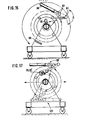
- Fig. 16 it can be seen how the running of the separating knife 20 film web via the first turn bar 85, the second rod 86 and the end of W preference roller pair 88 onto the winding core or the forming stock roll runs.
- the turntable is provided with a counterweight 98 which compensates for an imbalance caused by the turning bar arrangement.
- two separating knives 20, 20 ' one behind the other in the axial direction, are provided, by means of which two of the tubular film web are connected to one another parallel flat film webs are separated.
- the first flat film web runs over the turning bar preferred roller arrangement 99 on its winding core and the second over the turning bar preferred roller arrangement 100 on the second winding device, the winding axis of which is arranged in alignment with the winding axis of the first winding device. Both winding axes are aligned with the axis of rotation of the support mandrel 15.
Landscapes
- Engineering & Computer Science (AREA)
- Mechanical Engineering (AREA)
- Textile Engineering (AREA)
- Life Sciences & Earth Sciences (AREA)
- Forests & Forestry (AREA)
- Shaping By String And By Release Of Stress In Plastics And The Like (AREA)
- Winding Of Webs (AREA)
- Shaping Of Tube Ends By Bending Or Straightening (AREA)
- Application Of Or Painting With Fluid Materials (AREA)
- Pipe Accessories (AREA)
- Extrusion Moulding Of Plastics Or The Like (AREA)
- Automatic Cycles, And Cycles In General (AREA)
Priority Applications (1)
| Application Number | Priority Date | Filing Date | Title |
|---|---|---|---|
| EP19920104728 EP0494091B1 (fr) | 1986-04-14 | 1987-04-03 | Dispositif pour ouvrir des tubes mis à plat |
Applications Claiming Priority (4)
| Application Number | Priority Date | Filing Date | Title |
|---|---|---|---|
| DE3612497 | 1986-04-14 | ||
| DE3612497 | 1986-04-14 | ||
| DE3616666 | 1986-05-16 | ||
| DE19863616666 DE3616666A1 (de) | 1986-04-14 | 1986-05-16 | Vorrichtung zum wendelfoermigen aufschneiden einer folienschlauchbahn aus thermoplastischem kunststoff |
Related Child Applications (2)
| Application Number | Title | Priority Date | Filing Date |
|---|---|---|---|
| EP92104728.8 Division-Into | 1987-04-03 | ||
| EP19920104728 Division EP0494091B1 (fr) | 1986-04-14 | 1987-04-03 | Dispositif pour ouvrir des tubes mis à plat |
Publications (2)
| Publication Number | Publication Date |
|---|---|
| EP0245643A2 true EP0245643A2 (fr) | 1987-11-19 |
| EP0245643A3 EP0245643A3 (fr) | 1990-01-24 |
Family
ID=25842881
Family Applications (2)
| Application Number | Title | Priority Date | Filing Date |
|---|---|---|---|
| EP19870104994 Ceased EP0245643A3 (fr) | 1986-04-14 | 1987-04-03 | Appareil pour découper des tubes en spirales |
| EP19920104728 Expired - Lifetime EP0494091B1 (fr) | 1986-04-14 | 1987-04-03 | Dispositif pour ouvrir des tubes mis à plat |
Family Applications After (1)
| Application Number | Title | Priority Date | Filing Date |
|---|---|---|---|
| EP19920104728 Expired - Lifetime EP0494091B1 (fr) | 1986-04-14 | 1987-04-03 | Dispositif pour ouvrir des tubes mis à plat |
Country Status (8)
| Country | Link |
|---|---|
| US (2) | US4809413A (fr) |
| EP (2) | EP0245643A3 (fr) |
| CN (1) | CN1007716B (fr) |
| AT (1) | ATE139932T1 (fr) |
| CA (1) | CA1315532C (fr) |
| DE (2) | DE3616666A1 (fr) |
| DK (1) | DK191387A (fr) |
| RU (2) | RU1782209C (fr) |
Families Citing this family (12)
| Publication number | Priority date | Publication date | Assignee | Title |
|---|---|---|---|---|
| GB8815083D0 (en) * | 1988-06-24 | 1988-08-03 | Rasmussen O B | Method & apparatus for helical cutting of lay-flat flexible tubular sheet of polymer material |
| US5361469A (en) * | 1988-06-24 | 1994-11-08 | Rasmussen O B | Apparatus for helical cutting of a flexible tubular sheet of polymeric material |
| US5667911A (en) * | 1994-11-17 | 1997-09-16 | Hoechst Celanese Corporation | Methods of making cross-ply microporous membrane battery separator, and the battery separators made thereby |
| US6139308A (en) | 1998-10-28 | 2000-10-31 | 3M Innovative Properties Company | Uniform meltblown fibrous web and methods and apparatus for manufacturing |
| US6228195B1 (en) | 1999-02-08 | 2001-05-08 | Star Binding & Trimming Corp. | Sonic sealed bias seam |
| GB0006524D0 (en) * | 2000-03-18 | 2000-05-10 | Devro Plc | Film manufacturing method |
| GB0814308D0 (en) * | 2008-08-05 | 2008-09-10 | Rasmussen O B | Film material exhibiting textile properties, and method and apparatus for its manufacture |
| CN101875238A (zh) * | 2010-05-31 | 2010-11-03 | 徐建学 | 一种单层薄膜生产流水线上的螺旋分切、收卷组合结构 |
| US20140377397A1 (en) * | 2011-05-17 | 2014-12-25 | Ole-Bendt Rasmussen | Apparatus for manufacture of a polymer film, which is oriented under an angle to its longitudinal direction |
| CN106457594B (zh) * | 2013-12-30 | 2020-04-21 | 罗伯特·博世有限公司 | 用于电动工具的气流管理系统 |
| CN108313792A (zh) * | 2018-04-08 | 2018-07-24 | 嘉兴市布雷塑胶新材料有限公司 | 一种便于卷绕的箱包布分卷装置 |
| CN112238333A (zh) * | 2020-10-25 | 2021-01-19 | 广州增立钢管结构股份有限公司 | 一种压制钢管制作工装及方法 |
Family Cites Families (20)
| Publication number | Priority date | Publication date | Assignee | Title |
|---|---|---|---|---|
| US1504255A (en) * | 1924-08-12 | Method of manufacturing bias fabric and apparatus therefor | ||
| CA782508A (en) * | 1968-04-09 | Du Pont Of Canada Limited | Oriented thermoplastic film | |
| US1601550A (en) * | 1923-08-07 | 1926-09-28 | Morgan & Wright | Continuous bias-cutting machine |
| US1753645A (en) * | 1924-04-18 | 1930-04-08 | Walter Prior | Machine for cutting bias strips |
| US2644522A (en) * | 1950-08-15 | 1953-07-07 | Callaway Mills Co | Bias cutting machine |
| US2987796A (en) * | 1953-06-26 | 1961-06-13 | Exeter Mfg Company | Apparatus for drying and bias cutting a continuous glass cloth tubular woven strip |
| US2962792A (en) * | 1953-06-26 | 1960-12-06 | Exeter Mfg Company | Apparatus for dewrinkling bias cut glass cloth |
| US2781589A (en) * | 1953-08-31 | 1957-02-19 | American Viscose Corp | Method and apparatus for processing plastic tubing |
| DE1007500B (de) * | 1954-10-04 | 1957-05-02 | Felix Schleuter | Verfahren zur Herstellung eines duennen Bandes aus hochmolekularem thermoplastischem Kunststoff, mit in einer von der Laengenrichtung abweichenden Orientierung |
| US3161942A (en) * | 1961-01-03 | 1964-12-22 | Dow Chemical Co | Apparatus for distributing uniform gauge variations of plastic extruded film on windup rolls |
| GB1050082A (fr) * | 1962-05-08 | 1900-01-01 | ||
| US3661482A (en) * | 1968-08-28 | 1972-05-09 | Stuart L Brown Jr | Apparatus for manufacturing biaxially oriented film with dimensional stability |
| DE1948935C3 (de) * | 1969-09-27 | 1982-02-04 | General Engineering Co.(Radcliffe)Ltd., Manchester | Flachlege- und Abzugsvorrichtung für eine im Blasverfarhen hergestellte Kunststoff-Schlauchfolienbahn |
| US3635633A (en) * | 1969-11-26 | 1972-01-18 | Polymer Processing Res Inst | Apparatus for biaxially stretching a tubular film |
| DE2164282A1 (de) * | 1971-12-23 | 1973-06-28 | Windmoeller & Hoelscher | Anlage zum herstellen, flachlegen und abziehen von kunststoff-blasfolien |
| US4047272A (en) * | 1975-12-29 | 1977-09-13 | Hanes Corporation | Machine for continuous bias cutting of tubular fabric |
| US4227957A (en) * | 1977-02-24 | 1980-10-14 | Pnc Company | Process and apparatus for manufacturing a non-woven fabric and the product thereof |
| DE2752817C2 (de) * | 1977-11-26 | 1979-11-15 | Rosendahl Industrie-Handels Ag, Schoenenwerd (Schweiz) | Vorrichtung zum Auf- oder Abspulen eines strangförmigen Wickelgutes |
| IT8052984U1 (it) * | 1980-02-29 | 1981-08-29 | Officine Bianco Snc | Apparecchiatura per l'apertura ed il taglio di maglie tubolari |
| US4439260A (en) * | 1982-05-17 | 1984-03-27 | Mobil Oil Corporation | Method and apparatus for forming cross-laminated thermoplastic film |
-
1986
- 1986-05-16 DE DE19863616666 patent/DE3616666A1/de not_active Withdrawn
- 1986-05-16 DE DE19863645194 patent/DE3645194C2/de not_active Expired - Fee Related
-
1987
- 1987-04-03 AT AT92104728T patent/ATE139932T1/de not_active IP Right Cessation
- 1987-04-03 EP EP19870104994 patent/EP0245643A3/fr not_active Ceased
- 1987-04-03 EP EP19920104728 patent/EP0494091B1/fr not_active Expired - Lifetime
- 1987-04-13 RU SU874202408A patent/RU1782209C/ru active
- 1987-04-13 CA CA 534551 patent/CA1315532C/fr not_active Expired - Fee Related
- 1987-04-13 DK DK191387A patent/DK191387A/da not_active Application Discontinuation
- 1987-04-13 CN CN87103204A patent/CN1007716B/zh not_active Expired
- 1987-04-14 US US07/038,170 patent/US4809413A/en not_active Ceased
-
1991
- 1991-03-06 US US07/665,484 patent/USRE34328E/en not_active Expired - Lifetime
-
1994
- 1994-04-28 RU RU94015602A patent/RU2062233C1/ru active
Also Published As
| Publication number | Publication date |
|---|---|
| RU94015602A (ru) | 1996-07-10 |
| EP0494091A2 (fr) | 1992-07-08 |
| DE3645194C2 (de) | 1995-01-05 |
| DE3616666A1 (de) | 1987-10-15 |
| ATE139932T1 (de) | 1996-07-15 |
| RU2062233C1 (ru) | 1996-06-20 |
| CN1007716B (zh) | 1990-04-25 |
| DK191387D0 (da) | 1987-04-13 |
| DK191387A (da) | 1987-10-15 |
| CA1315532C (fr) | 1993-04-06 |
| RU1782209C (ru) | 1992-12-15 |
| EP0494091B1 (fr) | 1996-07-03 |
| EP0245643A3 (fr) | 1990-01-24 |
| USRE34328E (en) | 1993-08-03 |
| EP0494091A3 (en) | 1993-04-21 |
| US4809413A (en) | 1989-03-07 |
| CN87103204A (zh) | 1987-12-09 |
Similar Documents
| Publication | Publication Date | Title |
|---|---|---|
| DE68925424T2 (de) | Vorrichtung und verfahren zum helicoidalen schneiden von flexiblen schlauchförmigen warenbahnen aus polymermaterial | |
| DE4104635B4 (de) | Vorrichtung zum Aufrollen von bahn- oder bandförmigen Materialien | |
| EP0494091B1 (fr) | Dispositif pour ouvrir des tubes mis à plat | |
| DE4104082C2 (de) | Vorrichtung zum wahlweisen Umschlingen von Wickelhülsen in der einen oder anderen Umschlingungsdrehrichtung durch eine Warenbahn bei Mehrfach-Wickelwendemaschinen | |
| DE3907136A1 (de) | Vorrichtung zum verbinden von materialbahnen | |
| EP0873846A2 (fr) | Dispositif de tirage de films tubulaires en matière plastique | |
| EP0408996A2 (fr) | Dispositif de tirage de films tubulaires en matière plastique | |
| DE2304365C2 (de) | Vorrichtung zur Herstellung eines Fadengeleges aus sich nahezu rechtwinklig kreuzenden Längs- und Querfaäden | |
| DE102013104978A1 (de) | Maschine zum Aufwickeln von bahnförmigen Materialien | |
| EP0692370B1 (fr) | Appareil avec couteau cotatif et pivotable pour la fabrication de feuilles de carton ondulé de format variable | |
| DE10040055A1 (de) | Abzugsvorrichtung für Schlauchbahnen aus Kunststofffolie | |
| EP0676351A2 (fr) | Dispositif de transport pour bandes plates en feuille de matière plastique | |
| DD295587A5 (de) | Flachlege- und abzugsvorrichtung fuer eine im blasverfahren hergestellte kunststoffschlauchfolienbahn | |
| EP1423323B1 (fr) | Dispositif pour separer une bande de materiau continue et pour fixer le debut de la bande qui suit sur un mandrin de bobinage | |
| DE1560126C3 (de) | Vorrichtung zum Schraubenschneiden einer insbesondere aus Maschenware bestehenden Schlauchware | |
| DE4303952C2 (de) | Flachlege- und Abzugsvorrichtung für eine im Blasverfahren hergestellte Kunststoffschlauchfolienbahn | |
| DE2538819B2 (de) | Wickelmaschine zum Herstellen einer schraubenwendelformigen Reißverschlußgliederreihe aus einem Kunststoffdraht | |
| DE4041263C2 (de) | Revolverkopfaufwickelvorrichtung für band- oder folienförmiges Material | |
| DE10058437B4 (de) | Vorrichtungen zum Verbinden zweier Materialbahnen | |
| DE2232338C3 (de) | Vorrichtung an Wickelmaschinen für Werkstoffbahnen zum Trennen und erneuten Anlegen auf eine leere Wickelhülse | |
| DE1907355C3 (de) | Verfahren und vorrichtung zum kontinuierlichen Herstellen eines rohrförmigen Hohlkörpers | |
| CH664399A5 (de) | Verfahren und maschine zum abschneiden einer stoffbahn bestimmter laenge von einer stoffrolle. | |
| DE60495C (de) | Papierröhren-Maschine | |
| DE2539373C3 (de) | Aufwickelvorrichtung für kontinuirlich angeliefertesbahnförmiges Gut, insbesondere Folienbahnen | |
| DE2051082C2 (de) | Verfahren und Vorrichtung zum kontinuierlichen Herstellen eines rohrförmigen Hohlkörpers |
Legal Events
| Date | Code | Title | Description |
|---|---|---|---|
| PUAI | Public reference made under article 153(3) epc to a published international application that has entered the european phase |
Free format text: ORIGINAL CODE: 0009012 |
|
| AK | Designated contracting states |
Kind code of ref document: A2 Designated state(s): AT CH FR GB IT LI SE |
|
| PUAL | Search report despatched |
Free format text: ORIGINAL CODE: 0009013 |
|
| RHK1 | Main classification (correction) |
Ipc: B26D 3/16 |
|
| AK | Designated contracting states |
Kind code of ref document: A3 Designated state(s): AT CH FR GB IT LI SE |
|
| 17P | Request for examination filed |
Effective date: 19900221 |
|
| 17Q | First examination report despatched |
Effective date: 19910328 |
|
| STAA | Information on the status of an ep patent application or granted ep patent |
Free format text: STATUS: THE APPLICATION HAS BEEN REFUSED |
|
| 18R | Application refused |
Effective date: 19931007 |
|
| RIN1 | Information on inventor provided before grant (corrected) |
Inventor name: UPMEIER, HARTMUT, DIPL.-ING. |