EP0247412A1 - Schlagzähe Polyarylensulfidmassen - Google Patents
Schlagzähe Polyarylensulfidmassen Download PDFInfo
- Publication number
- EP0247412A1 EP0247412A1 EP87106693A EP87106693A EP0247412A1 EP 0247412 A1 EP0247412 A1 EP 0247412A1 EP 87106693 A EP87106693 A EP 87106693A EP 87106693 A EP87106693 A EP 87106693A EP 0247412 A1 EP0247412 A1 EP 0247412A1
- Authority
- EP
- European Patent Office
- Prior art keywords
- weight
- parts
- pas
- molding compositions
- resistant
- Prior art date
- Legal status (The legal status is an assumption and is not a legal conclusion. Google has not performed a legal analysis and makes no representation as to the accuracy of the status listed.)
- Granted
Links
- 239000000203 mixture Substances 0.000 title claims description 19
- -1 poly(arylene sulphide Chemical compound 0.000 title description 4
- 239000000178 monomer Substances 0.000 claims abstract description 20
- 229920000578 graft copolymer Polymers 0.000 claims abstract description 16
- 229920000412 polyarylene Polymers 0.000 claims abstract description 13
- UCKMPCXJQFINFW-UHFFFAOYSA-N Sulphide Chemical compound [S-2] UCKMPCXJQFINFW-UHFFFAOYSA-N 0.000 claims abstract description 9
- 239000000155 melt Substances 0.000 claims abstract description 7
- 239000000945 filler Substances 0.000 claims abstract description 6
- 229920001577 copolymer Polymers 0.000 claims abstract description 3
- 239000012744 reinforcing agent Substances 0.000 claims abstract description 3
- 229920005989 resin Polymers 0.000 claims abstract description 3
- 239000011347 resin Substances 0.000 claims abstract description 3
- 238000000465 moulding Methods 0.000 claims description 9
- 238000004519 manufacturing process Methods 0.000 claims description 6
- 238000001746 injection moulding Methods 0.000 claims description 5
- 238000002347 injection Methods 0.000 claims description 3
- 239000007924 injection Substances 0.000 claims description 3
- 238000000034 method Methods 0.000 claims description 3
- 230000000379 polymerizing effect Effects 0.000 claims description 3
- 238000002360 preparation method Methods 0.000 claims description 3
- 239000004413 injection moulding compound Substances 0.000 abstract description 4
- 238000006116 polymerization reaction Methods 0.000 abstract 1
- 239000004734 Polyphenylene sulfide Substances 0.000 description 6
- 229920000069 polyphenylene sulfide Polymers 0.000 description 6
- 150000003568 thioethers Chemical class 0.000 description 5
- PPBRXRYQALVLMV-UHFFFAOYSA-N Styrene Chemical compound C=CC1=CC=CC=C1 PPBRXRYQALVLMV-UHFFFAOYSA-N 0.000 description 4
- CQEYYJKEWSMYFG-UHFFFAOYSA-N butyl acrylate Chemical compound CCCCOC(=O)C=C CQEYYJKEWSMYFG-UHFFFAOYSA-N 0.000 description 4
- VZCYOOQTPOCHFL-UHFFFAOYSA-N trans-butenedioic acid Natural products OC(=O)C=CC(O)=O VZCYOOQTPOCHFL-UHFFFAOYSA-N 0.000 description 4
- JHWGFJBTMHEZME-UHFFFAOYSA-N 4-prop-2-enoyloxybutyl prop-2-enoate Chemical compound C=CC(=O)OCCCCOC(=O)C=C JHWGFJBTMHEZME-UHFFFAOYSA-N 0.000 description 3
- NLHHRLWOUZZQLW-UHFFFAOYSA-N Acrylonitrile Chemical compound C=CC#N NLHHRLWOUZZQLW-UHFFFAOYSA-N 0.000 description 3
- VVQNEPGJFQJSBK-UHFFFAOYSA-N Methyl methacrylate Chemical compound COC(=O)C(C)=C VVQNEPGJFQJSBK-UHFFFAOYSA-N 0.000 description 3
- ZPOLOEWJWXZUSP-WAYWQWQTSA-N bis(prop-2-enyl) (z)-but-2-enedioate Chemical compound C=CCOC(=O)\C=C/C(=O)OCC=C ZPOLOEWJWXZUSP-WAYWQWQTSA-N 0.000 description 3
- 150000002148 esters Chemical class 0.000 description 3
- 239000012779 reinforcing material Substances 0.000 description 3
- NIXOWILDQLNWCW-UHFFFAOYSA-M Acrylate Chemical compound [O-]C(=O)C=C NIXOWILDQLNWCW-UHFFFAOYSA-M 0.000 description 2
- KAKZBPTYRLMSJV-UHFFFAOYSA-N Butadiene Chemical compound C=CC=C KAKZBPTYRLMSJV-UHFFFAOYSA-N 0.000 description 2
- VZCYOOQTPOCHFL-OWOJBTEDSA-N Fumaric acid Chemical compound OC(=O)\C=C\C(O)=O VZCYOOQTPOCHFL-OWOJBTEDSA-N 0.000 description 2
- RRHGJUQNOFWUDK-UHFFFAOYSA-N Isoprene Chemical compound CC(=C)C=C RRHGJUQNOFWUDK-UHFFFAOYSA-N 0.000 description 2
- CERQOIWHTDAKMF-UHFFFAOYSA-M Methacrylate Chemical compound CC(=C)C([O-])=O CERQOIWHTDAKMF-UHFFFAOYSA-M 0.000 description 2
- 239000002585 base Substances 0.000 description 2
- 229910052799 carbon Inorganic materials 0.000 description 2
- 229920001971 elastomer Polymers 0.000 description 2
- 238000007720 emulsion polymerization reaction Methods 0.000 description 2
- 239000000835 fiber Substances 0.000 description 2
- 230000009477 glass transition Effects 0.000 description 2
- LVHBHZANLOWSRM-UHFFFAOYSA-N itaconic acid Chemical compound OC(=O)CC(=C)C(O)=O LVHBHZANLOWSRM-UHFFFAOYSA-N 0.000 description 2
- VZCYOOQTPOCHFL-UPHRSURJSA-N maleic acid Chemical compound OC(=O)\C=C/C(O)=O VZCYOOQTPOCHFL-UPHRSURJSA-N 0.000 description 2
- 238000002156 mixing Methods 0.000 description 2
- 239000002667 nucleating agent Substances 0.000 description 2
- FBCQUCJYYPMKRO-UHFFFAOYSA-N prop-2-enyl 2-methylprop-2-enoate Chemical compound CC(=C)C(=O)OCC=C FBCQUCJYYPMKRO-UHFFFAOYSA-N 0.000 description 2
- 239000005060 rubber Substances 0.000 description 2
- WVAFEFUPWRPQSY-UHFFFAOYSA-N 1,2,3-tris(ethenyl)benzene Chemical compound C=CC1=CC=CC(C=C)=C1C=C WVAFEFUPWRPQSY-UHFFFAOYSA-N 0.000 description 1
- RNFJDJUURJAICM-UHFFFAOYSA-N 2,2,4,4,6,6-hexaphenoxy-1,3,5-triaza-2$l^{5},4$l^{5},6$l^{5}-triphosphacyclohexa-1,3,5-triene Chemical compound N=1P(OC=2C=CC=CC=2)(OC=2C=CC=CC=2)=NP(OC=2C=CC=CC=2)(OC=2C=CC=CC=2)=NP=1(OC=1C=CC=CC=1)OC1=CC=CC=C1 RNFJDJUURJAICM-UHFFFAOYSA-N 0.000 description 1
- JAHNSTQSQJOJLO-UHFFFAOYSA-N 2-(3-fluorophenyl)-1h-imidazole Chemical compound FC1=CC=CC(C=2NC=CN=2)=C1 JAHNSTQSQJOJLO-UHFFFAOYSA-N 0.000 description 1
- FQMIAEWUVYWVNB-UHFFFAOYSA-N 3-prop-2-enoyloxybutyl prop-2-enoate Chemical compound C=CC(=O)OC(C)CCOC(=O)C=C FQMIAEWUVYWVNB-UHFFFAOYSA-N 0.000 description 1
- QISOBCMNUJQOJU-UHFFFAOYSA-N 4-bromo-1h-pyrazole-5-carboxylic acid Chemical compound OC(=O)C=1NN=CC=1Br QISOBCMNUJQOJU-UHFFFAOYSA-N 0.000 description 1
- 239000005995 Aluminium silicate Substances 0.000 description 1
- OKTJSMMVPCPJKN-UHFFFAOYSA-N Carbon Chemical compound [C] OKTJSMMVPCPJKN-UHFFFAOYSA-N 0.000 description 1
- RYGMFSIKBFXOCR-UHFFFAOYSA-N Copper Chemical compound [Cu] RYGMFSIKBFXOCR-UHFFFAOYSA-N 0.000 description 1
- VGGSQFUCUMXWEO-UHFFFAOYSA-N Ethene Chemical compound C=C VGGSQFUCUMXWEO-UHFFFAOYSA-N 0.000 description 1
- 239000005977 Ethylene Substances 0.000 description 1
- 229920000181 Ethylene propylene rubber Polymers 0.000 description 1
- CERQOIWHTDAKMF-UHFFFAOYSA-N Methacrylic acid Chemical class CC(=C)C(O)=O CERQOIWHTDAKMF-UHFFFAOYSA-N 0.000 description 1
- WHNWPMSKXPGLAX-UHFFFAOYSA-N N-Vinyl-2-pyrrolidone Chemical compound C=CN1CCCC1=O WHNWPMSKXPGLAX-UHFFFAOYSA-N 0.000 description 1
- OAICVXFJPJFONN-UHFFFAOYSA-N Phosphorus Chemical compound [P] OAICVXFJPJFONN-UHFFFAOYSA-N 0.000 description 1
- 229920002845 Poly(methacrylic acid) Polymers 0.000 description 1
- OFOBLEOULBTSOW-UHFFFAOYSA-N Propanedioic acid Natural products OC(=O)CC(O)=O OFOBLEOULBTSOW-UHFFFAOYSA-N 0.000 description 1
- 229920002125 Sokalan® Polymers 0.000 description 1
- 229910000831 Steel Inorganic materials 0.000 description 1
- OKKRPWIIYQTPQF-UHFFFAOYSA-N Trimethylolpropane trimethacrylate Chemical compound CC(=C)C(=O)OCC(CC)(COC(=O)C(C)=C)COC(=O)C(C)=C OKKRPWIIYQTPQF-UHFFFAOYSA-N 0.000 description 1
- QYKIQEUNHZKYBP-UHFFFAOYSA-N Vinyl ether Chemical compound C=COC=C QYKIQEUNHZKYBP-UHFFFAOYSA-N 0.000 description 1
- YUWBVKYVJWNVLE-UHFFFAOYSA-N [N].[P] Chemical compound [N].[P] YUWBVKYVJWNVLE-UHFFFAOYSA-N 0.000 description 1
- 239000006096 absorbing agent Substances 0.000 description 1
- 239000002253 acid Substances 0.000 description 1
- 150000007513 acids Chemical class 0.000 description 1
- NIXOWILDQLNWCW-UHFFFAOYSA-N acrylic acid group Chemical group C(C=C)(=O)O NIXOWILDQLNWCW-UHFFFAOYSA-N 0.000 description 1
- 239000000654 additive Substances 0.000 description 1
- 239000003513 alkali Substances 0.000 description 1
- 125000005250 alkyl acrylate group Chemical group 0.000 description 1
- 125000005907 alkyl ester group Chemical group 0.000 description 1
- 125000005399 allylmethacrylate group Chemical group 0.000 description 1
- 229910052782 aluminium Inorganic materials 0.000 description 1
- XAGFODPZIPBFFR-UHFFFAOYSA-N aluminium Chemical compound [Al] XAGFODPZIPBFFR-UHFFFAOYSA-N 0.000 description 1
- 235000012211 aluminium silicate Nutrition 0.000 description 1
- 229910000410 antimony oxide Inorganic materials 0.000 description 1
- 229920001400 block copolymer Polymers 0.000 description 1
- 125000004432 carbon atom Chemical group C* 0.000 description 1
- 239000006229 carbon black Substances 0.000 description 1
- 230000000052 comparative effect Effects 0.000 description 1
- 229910052802 copper Inorganic materials 0.000 description 1
- 239000010949 copper Substances 0.000 description 1
- 238000002425 crystallisation Methods 0.000 description 1
- 230000008025 crystallization Effects 0.000 description 1
- JSERQGNBTYSHLP-UHFFFAOYSA-N deca-2,8-dienedioic acid Chemical compound OC(=O)C=CCCCCC=CC(O)=O JSERQGNBTYSHLP-UHFFFAOYSA-N 0.000 description 1
- 150000001991 dicarboxylic acids Chemical class 0.000 description 1
- 239000006185 dispersion Substances 0.000 description 1
- 239000000975 dye Substances 0.000 description 1
- 239000003995 emulsifying agent Substances 0.000 description 1
- 239000000839 emulsion Substances 0.000 description 1
- QHZOMAXECYYXGP-UHFFFAOYSA-N ethene;prop-2-enoic acid Chemical compound C=C.OC(=O)C=C QHZOMAXECYYXGP-UHFFFAOYSA-N 0.000 description 1
- BLCTWBJQROOONQ-UHFFFAOYSA-N ethenyl prop-2-enoate Chemical compound C=COC(=O)C=C BLCTWBJQROOONQ-UHFFFAOYSA-N 0.000 description 1
- 229920006226 ethylene-acrylic acid Polymers 0.000 description 1
- 239000003063 flame retardant Substances 0.000 description 1
- 239000003365 glass fiber Substances 0.000 description 1
- 239000008187 granular material Substances 0.000 description 1
- 229910052736 halogen Inorganic materials 0.000 description 1
- 150000002367 halogens Chemical class 0.000 description 1
- 125000002887 hydroxy group Chemical group [H]O* 0.000 description 1
- 239000003999 initiator Substances 0.000 description 1
- 239000001023 inorganic pigment Substances 0.000 description 1
- NLYAJNPCOHFWQQ-UHFFFAOYSA-N kaolin Chemical compound O.O.O=[Al]O[Si](=O)O[Si](=O)O[Al]=O NLYAJNPCOHFWQQ-UHFFFAOYSA-N 0.000 description 1
- 150000002734 metacrylic acid derivatives Chemical class 0.000 description 1
- 229910052751 metal Inorganic materials 0.000 description 1
- 239000002184 metal Substances 0.000 description 1
- 150000002739 metals Chemical class 0.000 description 1
- 239000006082 mold release agent Substances 0.000 description 1
- 150000002763 monocarboxylic acids Chemical class 0.000 description 1
- 239000012860 organic pigment Substances 0.000 description 1
- VTRUBDSFZJNXHI-UHFFFAOYSA-N oxoantimony Chemical compound [Sb]=O VTRUBDSFZJNXHI-UHFFFAOYSA-N 0.000 description 1
- 239000002245 particle Substances 0.000 description 1
- 230000000737 periodic effect Effects 0.000 description 1
- 229910052698 phosphorus Inorganic materials 0.000 description 1
- 239000011574 phosphorus Substances 0.000 description 1
- 239000000049 pigment Substances 0.000 description 1
- 239000004033 plastic Substances 0.000 description 1
- 229920003023 plastic Polymers 0.000 description 1
- 229920000642 polymer Polymers 0.000 description 1
- 239000000843 powder Substances 0.000 description 1
- 239000010453 quartz Substances 0.000 description 1
- VYPSYNLAJGMNEJ-UHFFFAOYSA-N silicon dioxide Inorganic materials O=[Si]=O VYPSYNLAJGMNEJ-UHFFFAOYSA-N 0.000 description 1
- 229920002379 silicone rubber Polymers 0.000 description 1
- 239000000243 solution Substances 0.000 description 1
- 229910052566 spinel group Inorganic materials 0.000 description 1
- 239000003381 stabilizer Substances 0.000 description 1
- 239000007858 starting material Substances 0.000 description 1
- 239000010959 steel Substances 0.000 description 1
- 150000005846 sugar alcohols Polymers 0.000 description 1
- 239000000454 talc Substances 0.000 description 1
- 229910052623 talc Inorganic materials 0.000 description 1
- 229920001567 vinyl ester resin Polymers 0.000 description 1
- 125000000391 vinyl group Chemical group [H]C([*])=C([H])[H] 0.000 description 1
- 229920002554 vinyl polymer Polymers 0.000 description 1
Classifications
-
- C—CHEMISTRY; METALLURGY
- C08—ORGANIC MACROMOLECULAR COMPOUNDS; THEIR PREPARATION OR CHEMICAL WORKING-UP; COMPOSITIONS BASED THEREON
- C08L—COMPOSITIONS OF MACROMOLECULAR COMPOUNDS
- C08L81/00—Compositions of macromolecular compounds obtained by reactions forming in the main chain of the macromolecule a linkage containing sulfur with or without nitrogen, oxygen or carbon only; Compositions of polysulfones; Compositions of derivatives of such polymers
- C08L81/02—Polythioethers; Polythioether-ethers
-
- C—CHEMISTRY; METALLURGY
- C08—ORGANIC MACROMOLECULAR COMPOUNDS; THEIR PREPARATION OR CHEMICAL WORKING-UP; COMPOSITIONS BASED THEREON
- C08L—COMPOSITIONS OF MACROMOLECULAR COMPOUNDS
- C08L51/00—Compositions of graft polymers in which the grafted component is obtained by reactions only involving carbon-to-carbon unsaturated bonds; Compositions of derivatives of such polymers
Definitions
- the invention relates to molding compositions made of polyarylene sulfide and graft polymers with improved impact strength and better crack resistance while improving the flowability.
- Polyarylene sulfides are known injection molding compositions which can be used for highly stressed injection molded parts.
- One of the most important properties of injection molding compounds is their resistance to sudden stress and good crack resistance. Good crack resistance is particularly important for the processing of injection molding compounds into thick-walled parts.
- An increase in the impact strength of polyarylene sulfides is e.g. by adding silicone rubbers, ethylene propylene rubbers, ethylene acrylic acid rubbers, etc. possible (EP 0 142 852).
- Another object of the invention is a process for producing these polyarylene sulfide molding compositions by homogenizing components I to III in the melt.
- Another object of the invention is the use of these polyarylene sulfide molding compositions for the production of moldings, in particular injection molded articles.
- Polyarylene sulfides can be prepared in a known manner from dihaloaromatics and alkali sulfides in solution (e.g. U.S. Patent 2,513,188).
- the graft polymers II are obtained by polymerizing olefinically unsaturated monomers in the presence of the prepolymer (A), a substantial part of the monomers being grafted onto the prepolymer A).
- the production of such graft polymers is known in principle (e.g. R.J. Ceresa, Block and Graft Copolymers, Butterworth, London 1962).
- graft polymers II are preferred which have rubber-elastic properties and whose glass transition temperature is below + 10 ° C, in particular from -150 ° to -20 ° C, preferably from -80 to -30 ° C.
- the glass transition temperature can be determined according to B. Vollmert, Grundriß der Makromolekularen Chemie, pages 406-410, Springer-Verlag, Heidelberg, 1962.
- Preferred C I -C 6 alkyl acrylate (a) is n-butyl acrylate.
- Preferred monomers (b) with at least two non-conjugated double bonds per molecule are polyacrylic and polymethacrylic acid esters of polyhydric alcohols, in particular those with 2 to 8 carbon atoms and 2 to 4 hydroxyl groups, e.g. Butylene diacrylate and dimethyl acrylate, trimethylolpropane trimethacrylate; Di- and trivinylbenzene, vinyl acrylate and methacrylate; Alkyl esters of unsaturated mono- and dicarboxylic acids such as e.g.
- Particularly preferred monomers (b) are butylene diacrylate, allyl methacrylate and diallyl maleate.
- Preferred monomers (c) are ethylene, isoprene, vinyl ether, butadiene, styrene, vinyl esters, vinyl halides, vinyl-substituted heterocyclic compounds such as vinyl pyrrolidone, acrylonitrile and mixtures of these monomers.
- Preferred olefinically unsaturated monomers for the preparation of portion (B) are C 1 -C 4 alkyl acrylates and methacrylates, styrene and acrylonitrile. These monomers used to prepare fraction (B) preferably contain at least 50% by weight of C 1 -C 4 -alkyl methacrylate.
- the graft polymers II have a considerable content of polar groups. It is advisable to select products that contain more than 10% by weight are made up of (meth) -acrylic acid esters and (meth) -acrylonitrile. If the content of (meth) acrylic esters is more than 70% by weight, it is advisable not to use (meth) acrylonitrile as a building block.
- the preferred graft polymers II have an average particle diameter d 50 (measured using an ultracentrifuge according to W. Sholtan, H. Lange, Kolloid. ZuZ Polymers 250, 782-796 (1972)) from 0.2 to 0.6, preferably 0.3 to 0.5 ⁇ m.
- the prepolymers and the graft polymers II are prepared in a customary manner, preferably by emulsion polymerization with customary free-radical initiators, emulsifiers and regulators in aqueous emulsion or dispersion.
- the preparation of suitable graft polymers is described for example in DE-PS 1 260 135 and 1 238 207.
- Particularly preferred graft polymers II can be prepared by conventional emulsion polymerization processes in several stages from n-butyl acrylate, 1,3-butylene diacrylate and diallyl maleate in the first stage and methyl methacrylate in the second stage, the preferred monomer ratio (based on weight) being about 79.2 / 0. 4 / 20.0.
- the mixture of polyphenylene sulfides and graft polymers and, if appropriate, fillers and / or reinforcing materials can be prepared on commercially available mixing devices. Kneaders, single-screw and twin-screw extruders are suitable as such. For further processing, the mixture obtained can be granulated after the melt has solidified.
- the polyphenylene sulfide compositions can additionally contain fillers and / or reinforcing materials in the form of powders, fibers or mats. Examples of this are metals such as steel, copper, aluminum or carbon. Preferred fillers are quartz, talc or kaolin, preferred reinforcing materials are glass fibers.
- compositions may optionally contain organic and inorganic pigments, for example Ti0 21 ZnS, phthalocyanines, carbon black, Cd pigments, spinels or organic dyes, flow aids, mold release agents, UV absorbers and / or stabilizers.
- organic and inorganic pigments for example Ti0 21 ZnS, phthalocyanines, carbon black, Cd pigments, spinels or organic dyes, flow aids, mold release agents, UV absorbers and / or stabilizers.
- they can also contain conventional flame-retardant additives, e.g. those containing halogen, phosphorus, phosphorus-nitrogen, optionally in combination with oxides of the elements of the V subgroup (the Periodic Table of the Elements according to Mendeleev), e.g. Antimony oxide.
- conventional flame-retardant additives e.g. those containing halogen, phosphorus, phosphorus-nitrogen, optionally in combination with oxides of the elements of the V subgroup (the Periodic Table of the Elements according to Mendeleev), e.g. Antimony oxide.
- the rate of crystallization of the polyphenylene sulfide compositions can be increased by adding inorganic or organic nucleating agents such as e.g. described in plastic manual Vol. VIII. Carl Hanser Verlag, Münschen 1973, page 701. This is carried out as standard for the injection molding compounds.
- the amounts are 0.05 to 5, preferably 0.1 and 1% by weight.
- the preferred nucleating agent is microtalk.
- the polyphenylene sulfide compositions according to the invention are excellent starting materials for the production of films and fibers, preferably for the production of moldings of all kinds by injection molding.
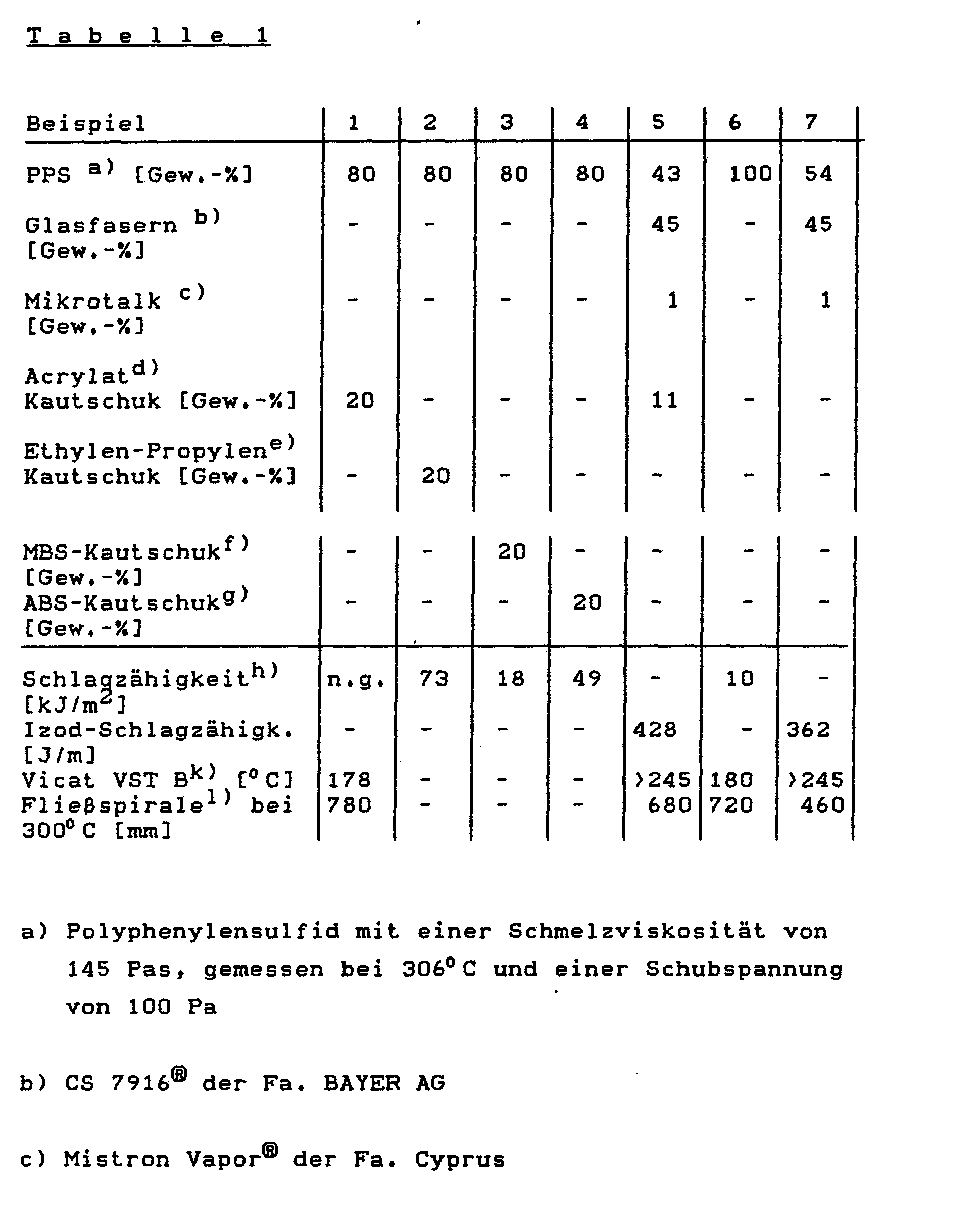
- the polyphenylene sulfide compositions according to the invention were prepared by mixing and homogenizing the base components (see Table 1) using a 30 mm Werner and Pfleiderer twin-screw extruder at a temperature in the melt of 310 ° C. The strands chopped into granules were dried overnight and processed with an Arburg Allrounder injection molding machine into test bars on which toughness tests according to DIN or ASTM were carried out.
- Examples 1 and 5 are polyphenylene sulfide samples according to the invention with acrylate rubber.
- Examples 2, 3, 4, 6 and 7 are comparative examples.
Landscapes
- Chemical & Material Sciences (AREA)
- Health & Medical Sciences (AREA)
- Chemical Kinetics & Catalysis (AREA)
- Medicinal Chemistry (AREA)
- Polymers & Plastics (AREA)
- Organic Chemistry (AREA)
- Compositions Of Macromolecular Compounds (AREA)
- Injection Moulding Of Plastics Or The Like (AREA)
Abstract
Description
- Die Erfindung betrifft Formmassen aus Polyarylensulfid und Pfropfpolymeren mit verbesserter Schlagzähigkeit und besserer Rißbeständigkeit bei gleichzeitiger Verbesserung der Fließfähigkeit.
- Polyarylensulfide sind bekannte brauchbare Spritzgußmassen für hochbeanspruchte Spritzgußteile. Eine der wichtigsten Eigenschaften von Spritzgußmassen ist ihre Festigkeit gegenüber schlagartiger Beanspruchung sowie eine gute Rißbeständigkeit. Gute Rißbeständigkeit ist besonders wichtig für die Verarbeitung von Spritzgußmassen zu dickwandigen Teilen. Eine Anhebung der Schlagzähigkeit von Polyarylensulfiden ist z.B. durch Zusatz von Silikonkautschuken, Ethylen-Propylenkautschuken, Ethylen-Acrylsäurekautschuken u.a. möglich (EP 0 142 852).
- Es wurde nun gefunden, daß die Schlagzähigkeit und/oder Rißbeständigkeit von Polyarylensulfiden durch Zusatz von bestimmten Acrylatpropfcopolymeren bei gleichzeitiger Anhebung der Fließfähigkeit und ausgezeichneter Phasenverträglichkeit wesentlich verbessert werden kann.
- Gegenstand der Erfindung sind schlagzähe, rißbeständige und leicht fließende Polyarylensulfidspritzgußmassen enthaltend
- I. 40 bis 98, vorzugsweise 50 bis 65 Gew.-Teile eines Polyarylensulfids mit einer Schmelzviskosität von mindestens 5 Pas, vorzugsweise von mindestens 50 Pas bis 3000 Pas (gemessen bei 306°C und einer Schub-2 spannung von 10 Pa).
- II. 2 bis 30, vorzugsweise 5 bis 20 Gew.-Teile eines Pfropfpolymerisats aus
- (A) 25 bis 95 Gew.-Teilen eines Copolymerisats von
- (a) 75 bis 99,8 Gew.-Teilen eines CI-C6-Alkyl- acrylats
- (b) 0,1 bis 5 Gew.-Teilen eines Monomeren mit mindestens 2 nichtkonjugierten olefinischen Dooppelbindungen und
- (c) 0 bis 40 Gew.-Teilen weiterer Monomerer
- (B) 75 bis 5 Gew.-Teilen eines durch Polymerisation mindestens eines olefinisch ungesättigten Monomeren erhaltenen Harzes, das in Gegenwart von (A) hergestellt worden ist, und
- (A) 25 bis 95 Gew.-Teilen eines Copolymerisats von
- III. 0 bis 300 Gew.-Teile Füll- und/oder Verstärkungsmittel.
- Ein weiterer Gegenstand der Erfindung ist ein Verfahren zur Herstellung dieser Polyarylensulfid-Formmassen durch Homogenisieren der Komponenten I bis III in der Schmelze.
- Ein weiterer Gegenstand der Erfindung ist die Verwendung dieser Polyarylensulfid-Formmassen zur Herstellung von Formkörpern, insbesondere von Spritzgußartikeln.
- Polyarylensulfide lassen sich auf bekannte Weise aus Dihalogenaromaten und Alkalisulfiden in Lösung herstellen (z.B. US-PS 2 513 188).
- Die Pfropfpolymerisate II werden durch Polymerisation von olefinisch ungesättigten Monomeren in Gegenwart des Prepolymere (A) erhalten, wobei ein wesentlicher Teil der Monomeren auf das Prepolymer A) aufgepfropft wird. Die Herstellung derartiger Pfropfpolymerisate ist im Prinzip bekannt (z.B. R.J. Ceresa, Block and Graft Copolymers, Butterworth, London 1962).
- Erfindungsgemäß werden Pfropfpolymerisate II bevorzugt, die kautschukelastische Eigenschaften besitzen und deren Glasübergangstemperatur unterhalb von +10°C, insbesondere von -150° bis -20°C, vorzugsweise von -80 bis -30°C, liegt. Die Ermittlung der Glasübergangstemperatur kann dabei nach B. Vollmert, Grundriß der Makromolekularen Chemie, Seiten 406-410, Springer-Verlag, Heidelberg, 1962, erfolgen.
- Bevorzugtes CI-C6-Alkylacrylat (a) ist n-Butylacrylat.
- Bevorzugte Monomere (b) mit mindestens zwei nicht konjugierten Doppelbindungen pro Molekül sind Polyacryl- und Polymethacrylsäureester von mehrwertigen Alkoholen, insbesondere solchen mit 2 bis 8 C-Atomen und 2 bis 4 Hydroxylgruppen, z.B. Butylendiacrylat und -dimethylacrylat, Trimethylolpropantrimethacrylat; Di- und Trivinylbenzol, Vinylacrylat und -methacrylat; Alkylester ungesättigter Mono- und Dicarbonsäuren wie z.B. Alkylacrylat und -methacrylat, Dialkylmaleat, -fumarat und -itaconat, Malein-, Fumar- und Itaconsäuremonoalkylester; Dialkylester von Polycarbonsäuren, die keine polymerisationsfähige Doppelbindung enthalten.
- Besonders bevorzugte Monomere (b) sind Butylendiacrylat, Allylmethacrylat und Diallylmaleat.
- Bevorzugte Monomere (c) sind Ethylen, Isopren, Vinylether, Butadien, Styrol, Vinylester, Vinylhalogenide, vinylsubstituierte heterocyclische Verbindungen wie Vinylpyrrolidon, Acrylnitril und Mischungen dieser Monomeren.
- Bevorzugte olefinisch ungesättigte Monomere zur Herstellung des Anteils (B) sind C1-C4-Alkylacrylate und -methacrylate, Styrol und Acrylnitril. Vorzugsweise enthalten diese zur Herstellung des Anteils (B) verwendete Monomeren mindestens 50 Gew.-% C1-C4-Alkylmethacrylat.
- Es ist vorteilhaft, wenn die Pfropfpolymerisate II einen beträchtlichen Gehalt an polaren Gruppen aufweisen. Zweckmäßig wählt man Produkte aus, die zu mehr als 10 Gew.-% aus (Meth)-Acrylsäureestern und (Meth)-Acrylnitril aufgebaut sind. Sofern der Gehalt an (Meth)-Acrylestern mehr als 70 Gew.-% beträgt, verzichtet man zweckmäßig auf (Meth)-Acrylnitril als Baustein.
- Bevorzugte Pfropfpolymerisate II sind solche aus
- 60-95 Gew.-% Pfropfgrundlage und
- 40-5 Gew.-% Pfropfauflage, wobei die Pfropfgrundlage aus einem Monomerengemisch enthaltend
- 95-99,8 Gew.-% Butylacrylat,
- 0,1-2,5 Gew.-% Butylendiacrylat und
- 0,1-2,6 Gew.-% Allylmethacrylat oder Diallylmaleat und die Pfropfauflage zu
- 60-100 Gew.-% aus Methylmethacrylat und
- 40-0 Gew.-% anderer Monomerer
- Die bevorzugten Pfropfpolymerisate II besitzen einen mittleren Teilchendurchmesser d50 (gemessen mittels Ultrazentrifuge nach W. Sholtan, H. Lange, Kolloid. Z.u.Z. Polymere 250, 782-796 (1972)) von 0,2 bis 0,6, vorzugsweise 0,3 bis 0,5 µm.
- Die Herstellung der Prepolymeren und die der Pfropfpolymerisate II erfolgt in üblicher Weise, vorzugsweise durch Emulsionspolymerisation mit üblichen radikalischen Initiatoren, Emulgatoren und Reglern in wäßriger Emulsion bzw. Dispersion. Die Herstellung geeigneter Pfropfpolymerisate ist beispielsweise in den DE-PS 1 260 135 und 1 238 207 beschrieben.
- Besonders bevorzugte Pfropfpolymerisate II lassen sich nach üblichen Emulsionspolymerisationsverfahren in mehreren Stufen aus n-Butylacrylat, 1,3-Butylendiacrylat und Diallylmaleat in erster Stufe und Methylmethacrylat in zweiter Stufe herstellen, wobei das bevorzugte Monomerverhältnis (bezogen auf Gewicht) etwa 79,2/0,4/20,0 beträgt.
- Die Herstellung der Mischung von Polyphenylensulfiden und Pfropfpolymerisaten und gegebenenfalls Füll- und/oder Verstärkungsstoffen kann auf handelsüblichen Mischgeräten durchgeführt werden. Als solche eignen sich Kneter, Einwellen- und Zweiwellenextruder. Für die weitere Verarbeitung kann die erhaltene Mischung nach dem Erstarren der Schmelze granuliert werden.
- Die Polyphenylensulfidzusammensetzungen können zusätzlich Füll- und/oder Verstärkungsstoffe in Form von Pulvern, Fasern oder Matten enthalten. Beispiele dafür sind Metalle wie Stahl, Kupfer, Aluminium oder Kohlenstoff. Bevorzugte Füllstoffe sind Quarz, Talk oder Kaolin, bevorzugte Verstärkungsstoffe sind Glasfasern.
- Weiterhin können die Massen gegebenenfalls organische und anorganische Pigmente, z.B. Ti021 ZnS, Phthalocyanine, Ruß, Cd-Pigmente, Spinelle oder organische Farbstoffe, Fließhilfsmittel, Entformungsmittel, UV-Absorber und/oder Stabilisatoren enthalten.
- Um die Flammfestigkeit der Produkte weiter zu erhöhen können sie zusätzlich übliche flammhindernde Additive enthalten, z.B, solche die Halogen, Phosphor, Phosphor-Stickstoff, gegebenenfalls in Kombination mit Oxiden der Elemente der V Nebengruppe (des Periodensystems der Elemente nach Mendelejew) wie z.B. Antimonoxid, enthalten.
- Die Kristallisationsgeschwindigkeit der Polyphenylensulfidmassen kann durch Zusatz von anorganischen oder organischen Keimbildungsmitteln wie z.B. in Kunststoff-Handbuch Vol. VIII. Carl Hanser Verlag, Münschen 1973, Seite 701 beschrieben weiter erhöht werden. Dies wird bei den Spritzgußmassen standardmäßig durchgeführt. Die Mengen betragen 0,05 bis 5, vorzugsweise 0,1 und 1 Gew.-%. Bevorzugtes Keimbildungsmittel ist Mikrotalk.
- Die erfindungsgemäßen Poylphenylensulfidmassen sind ausgezeichnete Ausgangsmaterialien für die Herstellung von Folien und Fasern, vorzugweise für die Herstellung von Formkörpern aller Art durch Spritzguß.
- Die erfindungsgemäßen Polyphenylensulfidmassen wurden durch Mischen und Homogenisieren der Basiskomponenten (siehe Tabelle 1) mit einem 30 mm Werner und Pfleiderer Doppelwellenextruder bei einer Temperatur in der Schmelze von 310°C hergestellt. Die zu Granulat zerhackten Stränge wurden über Nacht getrocknet und mit einer Spritzgußmaschine des Typs Arburg Allrounder zu Prüfstäben verarbeitet an denen Zähigkeitsprüfungen nach DIN oder ASTM durchgeführt wurden. Beispiele 1 und 5 sind erfindungsgemäße Polyphenylensulfidproben mit Acrylatkautschuk. Beispiele 2, 3, 4, 6 und 7 sind Vergleichsbeispiele.

erhältlich sind.
Claims (4)
Applications Claiming Priority (2)
| Application Number | Priority Date | Filing Date | Title |
|---|---|---|---|
| DE3616131 | 1986-05-14 | ||
| DE19863616131 DE3616131A1 (de) | 1986-05-14 | 1986-05-14 | Schlagzaehe polyarylensulfidmassen |
Publications (2)
| Publication Number | Publication Date |
|---|---|
| EP0247412A1 true EP0247412A1 (de) | 1987-12-02 |
| EP0247412B1 EP0247412B1 (de) | 1990-09-05 |
Family
ID=6300753
Family Applications (1)
| Application Number | Title | Priority Date | Filing Date |
|---|---|---|---|
| EP87106693A Expired - Lifetime EP0247412B1 (de) | 1986-05-14 | 1987-05-08 | Schlagzähe Polyarylensulfidmassen |
Country Status (3)
| Country | Link |
|---|---|
| EP (1) | EP0247412B1 (de) |
| JP (1) | JPS6327559A (de) |
| DE (2) | DE3616131A1 (de) |
Cited By (5)
| Publication number | Priority date | Publication date | Assignee | Title |
|---|---|---|---|---|
| EP0327300A1 (de) * | 1988-02-03 | 1989-08-09 | Polyplastics Co. Ltd. | Polyarylensulfid-Harzzusammensetzung |
| EP0389905A1 (de) * | 1989-03-30 | 1990-10-03 | Bayer Ag | Elastomermodifizierte Polyarylensulfid-Formmassen |
| EP0355615A3 (de) * | 1988-08-24 | 1991-01-09 | Bayer Ag | Elastomermodifizierte, kohlenstoffhaltige Polyarylensulfidabmischungen |
| EP0406631A3 (en) * | 1989-07-05 | 1991-07-17 | Bayer Ag | Polyarylensulfide/rubber blends, process for their preparation and their use for making mouldings |
| EP0435024A3 (en) * | 1989-12-16 | 1991-08-28 | Bayer Ag | Rubber modified polyarylene sulphide moulding compositions |
Families Citing this family (3)
| Publication number | Priority date | Publication date | Assignee | Title |
|---|---|---|---|---|
| JPH02192920A (ja) * | 1988-10-03 | 1990-07-30 | Idemitsu Petrochem Co Ltd | 食品用射出成形容器およびその製造方法 |
| US5288798A (en) * | 1990-08-22 | 1994-02-22 | Mitsubishi Rayon Co., Ltd. | Polyarylene sulfide resin compositions |
| JP2801788B2 (ja) * | 1991-04-02 | 1998-09-21 | ポリプラスチックス株式会社 | ポリアリーレンサルファイド樹脂組成物とエポキシ樹脂との複合成形品 |
Citations (1)
| Publication number | Priority date | Publication date | Assignee | Title |
|---|---|---|---|---|
| EP0142825A2 (de) * | 1983-11-17 | 1985-05-29 | Phillips Petroleum Company | Silikonkautschuk als Modifizierungsmittel für Polyarylensulfide |
-
1986
- 1986-05-14 DE DE19863616131 patent/DE3616131A1/de not_active Withdrawn
-
1987
- 1987-05-08 EP EP87106693A patent/EP0247412B1/de not_active Expired - Lifetime
- 1987-05-08 DE DE8787106693T patent/DE3764711D1/de not_active Expired - Lifetime
- 1987-05-12 JP JP62113701A patent/JPS6327559A/ja active Pending
Patent Citations (1)
| Publication number | Priority date | Publication date | Assignee | Title |
|---|---|---|---|---|
| EP0142825A2 (de) * | 1983-11-17 | 1985-05-29 | Phillips Petroleum Company | Silikonkautschuk als Modifizierungsmittel für Polyarylensulfide |
Cited By (5)
| Publication number | Priority date | Publication date | Assignee | Title |
|---|---|---|---|---|
| EP0327300A1 (de) * | 1988-02-03 | 1989-08-09 | Polyplastics Co. Ltd. | Polyarylensulfid-Harzzusammensetzung |
| EP0355615A3 (de) * | 1988-08-24 | 1991-01-09 | Bayer Ag | Elastomermodifizierte, kohlenstoffhaltige Polyarylensulfidabmischungen |
| EP0389905A1 (de) * | 1989-03-30 | 1990-10-03 | Bayer Ag | Elastomermodifizierte Polyarylensulfid-Formmassen |
| EP0406631A3 (en) * | 1989-07-05 | 1991-07-17 | Bayer Ag | Polyarylensulfide/rubber blends, process for their preparation and their use for making mouldings |
| EP0435024A3 (en) * | 1989-12-16 | 1991-08-28 | Bayer Ag | Rubber modified polyarylene sulphide moulding compositions |
Also Published As
| Publication number | Publication date |
|---|---|
| DE3616131A1 (de) | 1987-11-19 |
| EP0247412B1 (de) | 1990-09-05 |
| JPS6327559A (ja) | 1988-02-05 |
| DE3764711D1 (de) | 1990-10-11 |
Similar Documents
| Publication | Publication Date | Title |
|---|---|---|
| DE3750894T2 (de) | Pfropfcopolymerisat und dieses enthaltende Polyphenylenetherharzzusammensetzung. | |
| EP0166187B1 (de) | Tetrafluorethylenpolymerisat enthaltende Polymerisatpulverkompositionen | |
| EP0523445B1 (de) | Thermoplastische Formmassen aus semikristallinem und amorphem Polyamid, deren Verwendung und Verfahren zu ihrer Herstellung | |
| DE3852530T2 (de) | Thermoplastische Polyesterharzzusammensetzung. | |
| DE3004942A1 (de) | Modifizierte polyesterzusammensetzungen | |
| DE69129958T2 (de) | Flammhemmende Mischungen von Polycarbonat, ABS und Polyalkylmethacrylat mit erhöhter Zusammenschweissnahtfestigkeit | |
| DE2843450C2 (de) | ||
| EP0513535B1 (de) | Glasfaserverstärkte Styrol-Copolymerisate | |
| DE2418763B2 (de) | Thermoplastische schlagfeste und ermuedungsbestaendige formmasse aus einem polyphenylenoxyd, einem kautschukmodifizierten polystyrol und einem aromatischen polycarbonat | |
| DE68926128T2 (de) | Polyarylensulfid-Harzzusammensetzung | |
| EP0247412B1 (de) | Schlagzähe Polyarylensulfidmassen | |
| DE69528877T2 (de) | Polyarylensulfidharzzusammensetzung | |
| DE69331921T2 (de) | Polyphenylensulfidzusammensetzung | |
| DE68925863T2 (de) | Flammhemmende Harzzusammensetzung auf der Basis von Polyphenylenether | |
| DE69632665T2 (de) | Schlagzäh modifizierte, ein Siliconkautschukpulver enthaltende thermoplastische Formmassen | |
| DE69017394T2 (de) | Zusammensetzungen von aromatischen Polycarbonatharzen mit SAN oder SAN und ABS. | |
| EP0663426A2 (de) | Blends auf der Basis von Copolyarylenethersulfonen | |
| DE3783734T2 (de) | Formmasse mit erhoehter schweissnahtfestigkeit. | |
| EP0389905A1 (de) | Elastomermodifizierte Polyarylensulfid-Formmassen | |
| DE19842713A1 (de) | Thermoplastische Harzzusammensetzung | |
| EP0232879A2 (de) | Thermoplastische Formmassen auf der Basis von Polyamiden | |
| EP0457138A2 (de) | Thermoplastische Formmassen auf der Basis von Polyestern und Polyphenylenethern | |
| DE69128826T2 (de) | Polyarylensulfid-Harzmassen | |
| DE69722299T2 (de) | Flammhemmende thermoplastische Harzzusammensetzung | |
| DE3515867A1 (de) | Verstaerkte thermoplastische formmasse |
Legal Events
| Date | Code | Title | Description |
|---|---|---|---|
| PUAI | Public reference made under article 153(3) epc to a published international application that has entered the european phase |
Free format text: ORIGINAL CODE: 0009012 |
|
| 17P | Request for examination filed |
Effective date: 19870508 |
|
| AK | Designated contracting states |
Kind code of ref document: A1 Designated state(s): BE DE FR GB IT |
|
| 17Q | First examination report despatched |
Effective date: 19890626 |
|
| GRAA | (expected) grant |
Free format text: ORIGINAL CODE: 0009210 |
|
| AK | Designated contracting states |
Kind code of ref document: B1 Designated state(s): BE DE FR GB IT |
|
| REF | Corresponds to: |
Ref document number: 3764711 Country of ref document: DE Date of ref document: 19901011 |
|
| GBT | Gb: translation of ep patent filed (gb section 77(6)(a)/1977) | ||
| ET | Fr: translation filed | ||
| ITF | It: translation for a ep patent filed | ||
| PLBE | No opposition filed within time limit |
Free format text: ORIGINAL CODE: 0009261 |
|
| STAA | Information on the status of an ep patent application or granted ep patent |
Free format text: STATUS: NO OPPOSITION FILED WITHIN TIME LIMIT |
|
| 26N | No opposition filed | ||
| ITTA | It: last paid annual fee | ||
| PGFP | Annual fee paid to national office [announced via postgrant information from national office to epo] |
Ref country code: DE Payment date: 19950413 Year of fee payment: 9 |
|
| PGFP | Annual fee paid to national office [announced via postgrant information from national office to epo] |
Ref country code: GB Payment date: 19950427 Year of fee payment: 9 |
|
| PGFP | Annual fee paid to national office [announced via postgrant information from national office to epo] |
Ref country code: FR Payment date: 19950517 Year of fee payment: 9 Ref country code: BE Payment date: 19950517 Year of fee payment: 9 |
|
| PG25 | Lapsed in a contracting state [announced via postgrant information from national office to epo] |
Ref country code: GB Effective date: 19960508 |
|
| PG25 | Lapsed in a contracting state [announced via postgrant information from national office to epo] |
Ref country code: BE Effective date: 19960531 |
|
| BERE | Be: lapsed |
Owner name: BAYER A.G. Effective date: 19960531 |
|
| GBPC | Gb: european patent ceased through non-payment of renewal fee |
Effective date: 19960508 |
|
| PG25 | Lapsed in a contracting state [announced via postgrant information from national office to epo] |
Ref country code: FR Effective date: 19970131 |
|
| PG25 | Lapsed in a contracting state [announced via postgrant information from national office to epo] |
Ref country code: DE Effective date: 19970201 |
|
| REG | Reference to a national code |
Ref country code: FR Ref legal event code: ST |
|
| PG25 | Lapsed in a contracting state [announced via postgrant information from national office to epo] |
Ref country code: IT Free format text: LAPSE BECAUSE OF NON-PAYMENT OF DUE FEES;WARNING: LAPSES OF ITALIAN PATENTS WITH EFFECTIVE DATE BEFORE 2007 MAY HAVE OCCURRED AT ANY TIME BEFORE 2007. THE CORRECT EFFECTIVE DATE MAY BE DIFFERENT FROM THE ONE RECORDED. Effective date: 20050508 |