EP0247485A2 - Verfahren zur Herstellung von Oxetan-3-carbonsäuren - Google Patents
Verfahren zur Herstellung von Oxetan-3-carbonsäuren Download PDFInfo
- Publication number
- EP0247485A2 EP0247485A2 EP87107165A EP87107165A EP0247485A2 EP 0247485 A2 EP0247485 A2 EP 0247485A2 EP 87107165 A EP87107165 A EP 87107165A EP 87107165 A EP87107165 A EP 87107165A EP 0247485 A2 EP0247485 A2 EP 0247485A2
- Authority
- EP
- European Patent Office
- Prior art keywords
- oxetane
- hydroxymethyl
- formula
- oxygen
- optionally
- Prior art date
- Legal status (The legal status is an assumption and is not a legal conclusion. Google has not performed a legal analysis and makes no representation as to the accuracy of the status listed.)
- Granted
Links
Classifications
-
- C—CHEMISTRY; METALLURGY
- C07—ORGANIC CHEMISTRY
- C07C—ACYCLIC OR CARBOCYCLIC COMPOUNDS
- C07C53/00—Saturated compounds having only one carboxyl group bound to an acyclic carbon atom or hydrogen
- C07C53/38—Acyl halides
- C07C53/46—Acyl halides containing halogen outside the carbonyl halide group
- C07C53/50—Acyl halides containing halogen outside the carbonyl halide group of acids containing three or more carbon atoms
-
- C—CHEMISTRY; METALLURGY
- C07—ORGANIC CHEMISTRY
- C07D—HETEROCYCLIC COMPOUNDS
- C07D305/00—Heterocyclic compounds containing four-membered rings having one oxygen atom as the only ring hetero atoms
- C07D305/02—Heterocyclic compounds containing four-membered rings having one oxygen atom as the only ring hetero atoms not condensed with other rings
- C07D305/04—Heterocyclic compounds containing four-membered rings having one oxygen atom as the only ring hetero atoms not condensed with other rings having no double bonds between ring members or between ring members and non-ring members
- C07D305/08—Heterocyclic compounds containing four-membered rings having one oxygen atom as the only ring hetero atoms not condensed with other rings having no double bonds between ring members or between ring members and non-ring members with hetero atoms or with carbon atoms having three bonds to hetero atoms with at the most one bond to halogen, e.g. ester or nitrile radicals, directly attached to ring atoms
Definitions
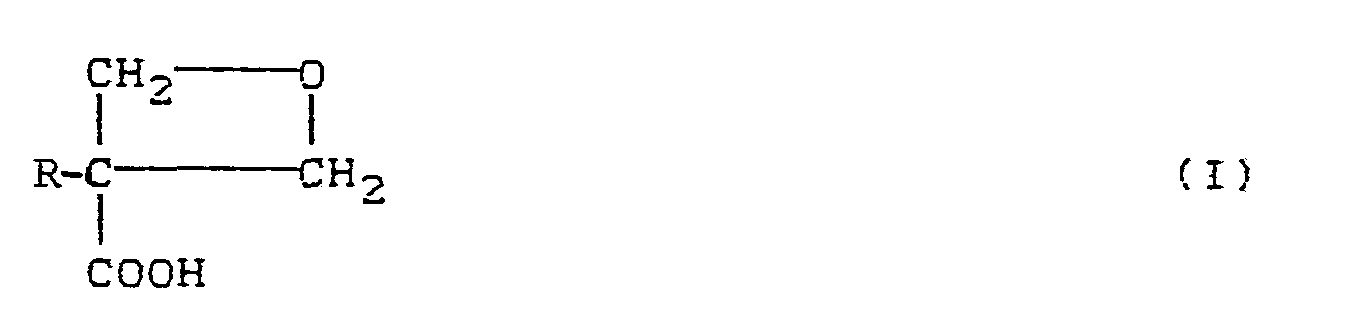
- the invention relates to a new process for the preparation of partially known oxetane-3-carboxylic acids which can be used as intermediates for the synthesis of substances with fungicidal or herbicidal activity.
- 3-alkyloxetane-3-carboxylic acids can be prepared starting from 3-alkyl-3-hydroxymethyl-oxetanes (cf. DE-PS 1 907 117).
- 3-alkyl-3-hydroxymethyl-oxetanes are dehydrated in the liquid phase in the presence of catalysts containing copper / chromium / barium at temperatures between 190 and 270 ° C.
- the resulting 3-alkyl-oxetane-3-carboxylic acid esters which contain the 3-alkyl-3-hydroxymethyl-oxetane used as the starting material as the alcohol component, are saponified in a further reaction step to give the 3-alkyl-oxetane-3-carboxylic acids .
- the disadvantage of this process is that it is a multi-stage synthesis and the desired 3-alkyloxetane-3-carboxylic acids are only available in low yield and in a mixture with other products.
- the method according to the invention is characterized by a number of advantages. This means that the required raw materials are easy and accessible in large quantities. Furthermore, the required oxidizing agents and other reaction components are inexpensive and easy to handle. It is particularly advantageous that the desired products are obtained in very high yield and excellent purity, so that a further distillative purification of the thermolabile oxetane-3-carboxylic acids, which tend to polymerize, is generally no longer necessary.
- Formula (II) provides a general definition of the 3-hydroxymethyloxetanes required as starting materials in the process according to the invention.
- R preferably represents hydrogen, alkyl having 1 to 12 carbon atoms, cycloalkyl having 3 to 8 carbon atoms or phenyl optionally substituted by halogen and / or alkyl having 1 to 6 carbon atoms.
- R is hydrogen, alkyl having 1 to 8 carbon atoms, in particular having 1 to 6 carbon atoms, cycloalkyl having 3 to 6 carbon atoms or, if appropriate, by fluorine, chlorine, bromine and / or Alkyl with 1 to 4 carbon atoms substituted phenyl.
- 3-hydroxymethyl-oxetanes of the formula (II) are known or can be prepared in a simple manner by known methods (cf. Houben-Weyl, "Methods of Organic Chemistry", 4th Edition, Vol. VI / 3, page 493 ff , Georg-Thieme-Verlag, Stuttgart 1965).
- 3-hydroxymethyl-oxetanes of the formula (II) can be obtained from the corresponding cyclic carbonates by elimination of carbon dioxide.
- catalysts When carrying out the process according to the invention, all customary palladium and platinum catalysts and mixtures thereof are suitable as catalysts.
- the catalysts can additionally be combined with activators or mixtures of different activators.
- Lead, bismuth, lead compounds and bismuth compounds and mixtures thereof are preferably used as activators.
- the platinum or palladium to be used as a catalyst or mixtures which contain these metals can be used in a customary manner.
- the substances in elemental form for example as so-called platinum or Palladium black, optionally in combination with other platinum metals, or also in the form of compounds such as the oxides.
- the platinum or the palladium can also be applied to a carrier.
- Suitable carriers are, for example, activated carbon, graphite, kieselguhr, silica gel, spinels, aluminum oxide, asbestos, calcium carbonate, barium sulfate or even organic carrier materials.
- Activated carbons for example so-called medical carbons or activated carbons made of wood, as are often used for decolorization purposes, are preferably used as the carrier material.
- the platinum and / or palladium content of the supported catalysts can be varied within a substantial range.
- supported catalysts are used in which the content of these metals is between 0.01 and 20% by weight, preferably between 0.1 and 15% by weight.
- the amounts in which the platinum and / or palladium catalysts are used can also be varied within a substantial range.
- the quantities depend, among other things, on the desired rate of oxidation.
- the amount of catalyst is chosen so that between 0.01 and 20 g, preferably between 0.05 and 10 g of platinum and / or palladium per mole of 3-hydroxymethyl-oxetane of the formula (II) are present in the reaction mixture.
- the activity and / or selectivity of the platinum catalysts is significantly increased in the process according to the invention by the presence of lead and / or bismuth and / or their compounds as activators.
- palladium catalysts already have such a surprisingly high activity and selectivity that the addition of the aforementioned activators can optionally be dispensed with.
- the amounts in which the activators are optionally used in carrying out the process according to the invention can be varied within a substantial range.
- the activator effect is already noticeable with the addition of 5 x 10 -6 moles of metal or metal compound per mole of 3-hydroxymethyloxetane.
- 0.1 mole or more activator per mole of 3-hydroxymethyl-oxetane can also be used, but these high additions generally offer no advantage.
- the activators are usually added in amounts of about 1 ⁇ 10 -5 to 1 ⁇ 10 -1 mol, preferably 2 ⁇ 10 -5 to 2 ⁇ 10 -2 mol, per mol of 3-hydroxymethyl-oxetane to be oxidized.
- the metals optionally to be used as activators in carrying out the process according to the invention can be in elemental form and / or in the form of their compounds, e.g. as oxides, hydroxides, oxide hydrates or oxygen acids or as salts of hydrogen acids, such as chlorides, bromides, iodides, sulfides, selenides, tellurides, or as salts of inorganic oxygen acids, such as nitrates, nitrites, phosphites, phosphates, arsenites, arsenates, antimonites, antimonates , Bismutates, Stannates, Plumbates, Selenites, Selenates, Tellurites, Tellurates, Borates or as salts of oxygen acids which are derived from transition metals, such as vanadates, niobates, tantalates, chromates, molybdates, tungstates, permanganates, or as salts of organic aliphatic or aromatic acids , such as formates,
- the activators can each be soluble, partially soluble or insoluble in the reaction mixture.
- the activators which may be used when carrying out the process according to the invention can be present in different and also in mixed valence levels. There can also be changes in value and the technical conditions, such as the desired reaction rate or heat dissipation. In general, temperatures between 0 ° C and the boiling point of the reaction mixture, preferably between 40 ° C and 100 ° C.
- the order in which the platinum and / or palladium catalyst and optionally activator, aqueous alkali and 3-hydroxymethyl-oxetane are combined is arbitrary.
- the platinum and / or palladium catalyst and, if appropriate, activator can be added to the mixture or solution of aqueous alkali and 3-hydroxymethyloxetane.
- Platinum and / or palladium catalyst and, if appropriate, activator can also be introduced and the mixture of aqueous alkali and 3-hydroxymethyloxetane added.
- the process according to the invention is carried out in such a way that oxygen or oxygen-containing gases, such as air, with the reaction mixture, the aqueous alkali, the platinum and / or palladium catalyst, optionally activator and 3-hydroxymethyl-oxetane are contained in intensive Brings contact.
- oxygen or oxygen-containing gases such as air
- the catalyst need not be present in the reaction mixture as a powder, but can also be in granular form Fixed bed can be arranged, which is flowed through by the other components.
- the pressure can be varied within a wide range when carrying out the method according to the invention. Generally one works under pressures between 0.5 and 10 bar.
- the oxidation is preferably carried out at atmospheric pressure.
- the course of the reaction can be followed by measuring the amount of oxygen consumed.
- the reaction is stopped when the amount of oxygen theoretically required for the preparation of the respective oxetane-3-carboxylic acid has been taken up. In general, oxygen absorption stops at this stage or slows down significantly.
- the general procedure is to separate the catalyst and any undissolved activator that may be present, for example by filtration.
- the alkali salt solutions of oxetane-3-carboxylic acids obtained can, if appropriate after prior evaporation, be used as such.
- the alkali salt solutions of oxetane-3-carboxylic acids can also be evaporated completely, ie to dryness, and the remaining salt residue reused.
- the procedure is generally such that the remaining reaction mixture, if appropriate after her concentration under reduced pressure, acidified with dilute mineral acid, then extracted with an organic solvent which is sparingly soluble in water, and the organic phase, if appropriate after prior drying, is concentrated.
- Hydrochloric acid, sulfuric acid or phosphoric acid can preferably be used as mineral acids.
- Suitable organic solvents for the extraction are preferably ethers, such as ethyl ether and diisopropyl ether, furthermore ketones, such as methyl isobutyl ketone, and also optionally halogenated aliphatic or aromatic hydrocarbons, such as methylene chloride, chloroform, carbon tetrachloride or toluene. It is also possible to release the respective oxetane-3-carboxylic acid from the aqueous alkali salt solutions initially obtained on a cation exchanger and to isolate it by gentle evaporation of the aqueous solution. If the conversion of the 3-hydroxymethyl-oxetane used is incomplete, it can be removed before acidification by extraction of the aqueous alkali salt solution with a water-insoluble organic solvent, recovered and optionally used again as the starting material.
- ethers such as ethyl ether and diisopropyl ether
- ketones such as methyl isobutyl
- oxetane-3-carboxylic acids which can be prepared by the process according to the invention are valuable intermediates for the production of other substances.
- the oxetane-3-carboxylic acids of the formula (I) can be used for the synthesis of polyaddition products (cf. DE-OS 1 907 117).
- the starting materials are the oxetane-3-carboxylic acids of the formula (I) or their salts.
- Alkali metal or alkaline earth metal salts such as sodium, potassium, magnesium or calcium salts can preferably be used as salts.
- the salts of oxetane-3-carboxylic acids of the formula (I) can be prepared by customary salt formation reactions. They are obtained in the synthesis of the oxetane-3-carboxylic acids of the formula (I) by the process according to the invention and can optionally be used for the further reaction after prior isolation.
- Suitable inorganic acid chlorides for the preparation of the compounds of the formula (III) by the above process are all customary inorganic acid chlorides.
- Thionyl chloride, phosphorus trichloride or phosphorus pentachloride can preferably be used.
- reaction temperatures can be varied within a substantial range in carrying out the above process for the preparation of the compounds of the formula (III). In general, temperatures between 20 ° C and the boiling point of the reaction mixture.
- the procedure is generally such that the oxetane-3-carboxylic acids or their salts with a stoichiometric amount or with an excess of inorganic acid chlorides and optionally in the presence a catalyst.
- the stoichiometric excess of inorganic acid chlorides can be 5 to 300%.
- the catalyst is generally used in amounts of 0.1 to 20% by weight, based on the added oxetane-3-carboxylic acids or their metal salts added.
- reaction mixture is heated in accordance with the evolution of heat and / or gas until the reaction has ended.
- inert solvent it is also possible to work in the presence of an inert solvent.
- the reaction mixture is heated to the reflux temperature and this temperature is maintained until the reaction has ended.
- the course of the reaction and the end of the reaction can be carried out using customary methods, e.g. by gas chromatography, determine in a simple manner.
- the reaction mixture is worked up in the above process for the preparation of the compounds of the formula (III) by customary methods.
- the general procedure is to subject the reaction mixture to distillation. Unreacted inorganic acid chloride is collected separately and can be used to react again. If necessary, the distillations are carried out in vacuo and / or with the interposition of a column.
- the 2,2-bis-chloromethylalkanecarboxylic acid chlorides of the formula (III) can be used as starting materials for the preparation of herbicidally active triazinone derivatives or for the synthesis of fungicidally active triazolyl derivatives.
- the 2,2-bis-chloropivaloyl chloride if necessary after prior exchange of the chlorine atoms for fluorine atoms, by conversion with trimethylsilyl cyanide into the corresponding halopivaloyl cyanides, which are converted to 1,2,4-triazin-5-one derivatives by known methods can be implemented (cf. DE-OS 3 037 300).
- the 2,2-bis-chloropivaloyl chloride for example, can be converted into the 2,2-bis-fluoropivaloyl fluoride by treatment with potassium fluoride, which reacts with monoethyl ester magnesium salt of malonate to give 2,2-bis-fluoromethylbutan-3-one.
- the latter can be reacted with bromine to give the 2,2-bis-fluoromethyl-4-bromobutan-3-one, which, after reaction with 1,2,4-triazole, produces the 2,2-bis-fluoromethyl-4- (1 , 2,4-triazol-1-yl) butan-3-one.
- a solution of 20.4 g (0.2 mol) of 3-methyl-3-hydroxymethyl-oxetane in 100 ml (0.22 mol) of 2.2 is placed in a reaction vessel which is provided with a stirrer, internal thermometer and gas supply and can be heated via a heating jacket m aqueous sodium hydroxide solution, 1 g of activated carbon with 5 wt .-% palladium content and 0.030 g of Bi (NO 3 ) 3 ⁇ 5 H 2 0 introduced.
- the stirrer is switched on and the reaction mixture is heated to 80.degree. At this temperature, oxygen is introduced into the mixture under normal pressure. After 3 hours, 0.2 mol of oxygen has been absorbed and the reaction comes to a standstill.
- the filtrate is acidified to pH 1 with 50% sulfuric acid and extracted with 2 x 50 ml of methyl isobutyl ketone.
- the methyl isobutyl ketone has been stripped off at 60 ° C. in vacuo, 24 g of 3-methyloxetane-3-carboxylic acid remain as the residue, which according to the gas chromatogram contains 3 to 4% of methyl isobutyl ketone but no other impurities.
- the yield is then 99% of theory. Mp 58-60 ° C (after recrystallization from ligroin).
- the filtered catalyst can be used again in the next batch.
- Example 2 The procedure is as in Example 1, but with the difference that 11.6 g (0.1 mol) of 3-ethyl-3-hydroxymethyl-oxetane are dissolved in 100 ml of 1.2 M aqueous sodium hydroxide solution and after addition of 1 g of activated carbon with 5 wt .-% palladium content and 30 mg Bi (NO 3 ) 3 ⁇ 5 H 2 0 with oxygen under normal pressure at 80 ° C. After 90 minutes, 0.1 mol of oxygen has been absorbed and the reaction comes to a standstill.
- Example 2 The procedure described in Example 2 is followed, but without the addition of Bi (NO 3 ) 3 ⁇ 5 H Z O. After 90 minutes, 0.1 mol of oxygen has been absorbed. This gives 12.7 g of a product which according to the gas chromatogram consists of 99.3% 3-ethyl-oxetane-3-carboxylic acid. The yield is then 97% of theory.
- suctioned-off aqueous alkaline solution is extracted with methylene chloride to remove unreacted 3-ethyl-3-hydroxymethyl-oxetane, then acidified to pH 1 with 50% sulfuric acid and again with 3-ethyl-oxetane-3-carboxylic acid Extracted methylene chloride.
- Example 2 The procedure is as in Example 1, but with the difference that 13 g (0.1 mol) of 3-isopropyl-3-hydroxymethyl-oxetane in 100 ml of 1.2 M aqueous sodium hydroxide solution in the presence of 1 g of activated carbon with 5 wt. -% Palladium content and 30 mg Bi (NO 3 ) 3 ⁇ 5 H 2 0 are oxidized. After 120 minutes, 0.1 mole of oxygen has been absorbed and the oxygen absorption has stopped.
- Example 10 The procedure is as in Example 1, but with the difference that 11.6 g (0.1 mol) of 3-ethyl-3-hydroxymethyl-oxetane are dissolved in 100 ml of 1.2N aqueous sodium hydroxide solution and after the addition of 1 g of activated carbon with 1% by weight of platinum in the absence (comparative example) or presence of 30 m g of Bi (NO 3 ) 3 ⁇ 5 H 2 0 (example 9) or 0.5 ml of 1 m Pb (NO 3 ) 2 solution (example 10) as an activator at 80 ° C with oxygen under normal pressure.
- 11.6 g (0.1 mol) of 3-ethyl-3-hydroxymethyl-oxetane are dissolved in 100 ml of 1.2N aqueous sodium hydroxide solution and after the addition of 1 g of activated carbon with 1% by weight of platinum in the absence (comparative example) or presence of 30 m g of Bi (NO 3 ) 3 ⁇ 5
Landscapes
- Chemical & Material Sciences (AREA)
- Organic Chemistry (AREA)
- Epoxy Compounds (AREA)
- Low-Molecular Organic Synthesis Reactions Using Catalysts (AREA)
- Catalysts (AREA)
Abstract

- R für Wasserstoff, Alkyl, Cycloalkyl oder gegebenenfalls substituiertes Phenyl steht, herstellen, indem man 3-Hydroxymethyl-oxetane der Formel

- R die oben angegebene Bedeutung hat, in wässrig-alkalischem Medium mit Sauerstoff oder Sauerstoff enthaltenden Gasen bei Temperaturen zwischen 0 °C und dem Siedepunkt des Reaktionsgemisches an einem Palladium- und/ oder Platinkatalysator, gegebenenfalls in Gegenwart eines Aktivators umsetzt und danach gegebenenfalls ansäuert.
Description
- Die Erfindung betrifft ein neues Verfahren zur Herstellung von teilweise bekannten Oxetan-3-carbonsäuren, die als Zwischenprodukte zur Synthese von Stoffen mit fungizider bzw. herbizider Wirksamkeit verwendbar sind.
- Es ist bereits bekannt, daß sich 3-Alkyloxetan-3-carbonsäuren ausgehend von 3-Alkyl-3-hydroxymethyl-oxetanen herstellen lassen (vgl. DE-PS 1 907 117). Bei dem bekannten Verfahren werden 3-Alkyl-3-hydroxymethyl-oxetane in flüssiger Phase in Gegenwart von Kupfer/Chrom/Barium enthaltenden Katalysatoren bei Temperaturen zwischen 190 und 270°C dehydriert. Die dabei entstehenden 3-Alkyl-oxetan-3-carbonsäureester, die das als Ausgangsmaterial eingesetzte 3-Alkyl-3-hydroxymethyl-oxetan als Alkohol-Komponente enthalten, werden in einem weiteren Reaktionsschritt zu den 3-Alkyl-oxetan-3-carbonsäuren verseift. Nachteilig an diesem Verfahren ist, daß es sich um eine mehrstufige Synthese handelt und die gewünschten 3-Alkyl- oxetan-3-carbonsäuren nur in geringer Ausbeute und im Gemisch mit anderen Produkten erhältlich sind.
- Es wurde nun gefunden, daß sich Oxetan-3-carbonsäuren der Formel

- R für Wasserstoff, Alkyl, Cycloalkyl oder gegebenenfalls substituiertes Phenyl steht,
- R die oben angegebene Bedeutung hat,
- Der Verlauf des erfindungsgemäßen Verfahrens ist als äußerst überraschend zu bezeichnen, denn bisher war außer einer thermischen Dehydrierung keine chemische Oxidation von 3-Hydroxymethyl-oxetanen beschrieben worden. Im Hinblick auf den bekannten Stand der Technik konnte also nicht davon ausgegangen werden, daß sich bei der Oxidation von 3-Hydroxymethyl-oxetanen direkt Oxetan-3-carbonsäuren der Formel (I) in einstufiger Reaktion herstellen lassen würden.
- Das erfindungsgemäße Verfahren zeichnet sich durch eine Reihe von Vorteilen aus. So sind die benötigten Ausgangsstoffe einfach und auch in größeren Mengen zugänglich. Weiterhin sind auch die erforderlichen Oxidationsmittel und übrigen Reaktionskomponenten preisgünstig und problemlos zu handhaben. Besonders vorteilhaft ist, daß die gewünschten Produkte in sehr hoher Ausbeute und hervorragender Reinheit anfallen, so daß eine weitere destillative Reinigung der thermolabilen, zur Polymerisation neigenden Oxetan-3-carbonsäuren im allgemeinen nicht mehr nötig ist.
- Verwendet man 3-Methyl-3-hydroxymethyloxetan als Ausgangsstoff, Sauerstoff als Oxidationsmittel, Palladium und Aktivkohle unter Zusatz von Bismut-nitrat als Katalysator, wäßrige Natronlauge als Reaktionsmedium und verdünnte wäßrige Schwefelsäure zum Ansäuern, so kann der Verlauf des erfindungsgemäßen Verfahrens durch das folgende Formelschema veranschaulicht werden:

- Die bei dem erfindungsgemäßen Verfahren als Ausgangsstoffe benötigten 3-Hydroxymethyl-oxetane sind durch die Formel (II) allgemein definiert. In dieser Formel steht R vorzugsweise für Wasserstoff, Alkyl mit 1 bis 12 Kohlenstoffatomen, Cycloalkyl mit 3 bis 8 Kohlenstoffatomen oder für gegebenenfalls durch Halogen und/oder Alkyl mit 1 bis 6 Kohlenstoffatomen substituiertes Phenyl.
- Besonders bevorzugt sind diejenigen Stoffe der Formel (II), in denen R für Wasserstoff, Alkyl mit 1 bis 8 Kohlenstoffatomen, insbesondere mit 1 bis 6 Kohlenstoffatomen, für Cycloalkyl mit 3 bis 6 Kohlenstoffatomen oder für gegenenfalls durch Fluor, Chlor, Brom und/oder Alkyl mit 1 bis 4 Kohlenstoffatomen substituiertes Phenyl steht.
- Als Beispiele für 3-Hydroxymethyloxetane der Formel (II) seien genannt:
- 3-Methyl-3-hydroxymethyl-oxetan, 3-Ethyl-3-hydroxymethyl- oxetan, 3-Propyl-3-hydroxymethyl-oxetan, 3-Isopropyl-3-hydroxymethyl-oxetan und 3-Butyl-3-hydroxymethyl-oxetan, 3-Hydroxymethyl-oxetan, 3-Phenyl-3-hydroxymethyl-oxetan, 3-Cyclohexyl-3-hydroxymethyl-oxetan und 3-(4-chlorphenyl)-3-hydroxymethyl-oxetan.
- Die 3-Hydroxymethyl-oxetane der Formel (II) sind bekannt oder lassen sich nach bekannten Methoden in einfacher Weise herstellen (vgl. Houben-Weyl, "Methoden der organischen Chemie", 4.Auflage, Bd. VI/3, Seite 493 ff, Georg-Thieme-Verlag, Stuttgart 1965). So können 3-Hydroxymethyl-oxetane der Formel (II) zum Beispiel durch Abspaltung von Kohlendioxid aus den entsprechenden cyclischen Carbonaten erhalten werden.
- Bei der Durchführung des erfindungsgemäßen Verfahrens kommen als Katalysatoren alle üblichen Palladium- und PlatinKatalysatoren sowie deren Gemische in Betracht. Die Katalysatoren können zusätzlich noch mit Aktivatoren oder Gemischen verschiedener Aktivatoren kombiniert werden. Als Aktivatoren kommen hierbei vorzugsweise Blei, Bismut, Bleiverbindungen und Bismutverbindungen sowie deren Gemische in Frage.
- Bei der Durchführung des erfindungsgemäßen Verfahrens können das als Katalysator zu verwendende Platin oder Palladium oder Gemische, die diese Metalle enthalten,_in üblicher Weise eingesetzt werden. So können die Stoffe in elementarer Form, z.B. als sogenanntes Platin- oder Palladium-Mohr, gegebenenfalls in Kombination mit anderen Platinmetallen, oder auch in Form von Verbindungen, wie z.B. den Oxiden, zugegeben werden.
- Das Platin oder das Palladium können auch auf einem Träger aufgebracht sein. Als Träger geeignet sind beispielsweise Aktivkohle, Graphit, Kieselgur, Kieselgel, Spinelle, Aluminiumoxid, Asbest, Calciumcarbonat, Bariumsulfat oder auch organische Trägermaterialien.
- Bevorzugt werden als Trägermaterial Aktivkohlen, beispielsweise sogenannte Medizinalkohlen oder aus Holz hergestellte Aktivkohlen, wie sie vielfach für Entfärbungszwecke verwendet werden, eingesetzt.
- Der Platin- und/oder Palladium-Gehalt der Trägerkatalysatoren kann innerhalb eines größeren Bereiches variiert werden. Im allgemeinen verwendet man Trägerkatalysatoren, in denen der Gehalt an diesen Metallen zwischen 0,01 und 20 Gew.-%, vorzugsweise zwischen 0,1 und 15 Gew.-% liegt.
- Auch die Mengen, in denen die Platin- und/oder Palladium- Katalysatoren eingesetzt werden, können in einem größeren Bereich variiert werden. Die Mengen hängen unter anderem von der gewünschten Oxidationsgeschwindigkeit ab. Im allgemeinen wählt man die Katalysatormenge so, daß zwischen 0,01 und 20 g, vorzugsweise zwischen 0,05 und 10 g Platin und/oder Palladium pro Mol 3-Hydroxymethyl-oxetan der Formel (II) im Reaktionsgemisch anwesend sind.
- Bei der Durchführung des erfindungsgemäßen Verfahrens ist es auch möglich, Platin in Kombination mit Palladium als Katalysator einzusetzen.
- Die Aktivität und/oder Selektivität der Platinkatalysatoren wird bei dem erfindungsgemäßen Verfahren durch die Gegenwart von Blei und/oder Bismut und/oder deren Verbindungen als Aktivator erheblich gesteigert.
- Palladiumkatalysatoren weisen auch ohne Zusatz der vorgenannten Aktivatoren schon eine so überraschend hohe Aktivität und Selektivität auf, daß bei ihnen gegebenenfalls auf den Zusatz der vorgenannten Aktivatoren verzichtet werden kann.
- Der Zusatz der vorgenannten Aktivatoren wirkt sich auch positiv auf die Wiederverwendbarkeit der Katalysatoren aus.
- Die Mengen, in denen die Aktivatoren bei der Durchführung des erfindungsgemäßen Verfahrens gegebenenfalls eingesetzt werden, können in einem größeren Bereich variiert werden. Die Aktivatorwirkung macht sich bereits bei Zusätzen von 5 x 10⁻⁶ Mol Metall oder Metallverbindung pro Mol 3-Hydroxymethyloxetan bemerkbar. Es können auch 0,1 Mol oder mehr Aktivator pro Mol 3-Hydroxymethyl-oxetan eingesetzt werden, jedoch bieten diese hohen Zusätze im allgemeinen keinen Vorteil. Üblicherweise werden die Aktivatoren in Mengen von etwa 1 x 10⁻⁵ bis 1 x 10⁻¹ Mol, vorzugsweise 2 x 10⁻⁵ bis 2 x 10⁻² Mol, pro Mol zu oxidierendem 3-Hydroxymethyl-oxetan zugegeben.
- Die bei der Durchführung des erfindungsgemäßen Verfahrens gegebenenfalls als Aktivatoren zu verwendenden Metalle können in elementarer Form und/oder in Form ihrer Verbindungen, z.B. als Oxide, Hydroxide, Oxidhydrate oder Sauerstoffsäuren oder als Salze von Wasserstoffsäuren, wie Chloride, Bromide, Jodide, Sulfide, Selenide, Telluride, oder als Salze von anorganischen Sauerstoffsäuren, wie Nitrate, Nitrite, Phosphite, Phosphate, Arsenite, Arsenate, Antimonite, Antimonate, Bismutate, Stannate, Plumbate, Selenite, Selenate, Tellurite, Tellurate, Borate oder als Salze von Sauerstoffsäuren, die von Ubergangsmetallen abstammen, wie Vanadate, Niobate, Tantalate, Chromate, Molybdate, Wolframate, Permanganate, oder als Salze organischer aliphatischer oder aromatischer Säuren, wie Formiate, Acetate, Propionate, Benzoate, Salicylate, Lactate, Mandelate, Glyoxylate, Oxetan-carboxylate, Citrate, Phenolate, oder als Komplexverbindungen oder als metallorganische Verbindung eingesetzt werden.
- Die Aktivatoren können im Reaktionsgemisch jeweils löslich, teilweise _löslich oder unlöslich sein.
- Es ist auch möglich, die Aktivatoren in Kombination mit anderen nicht als Aktivator beanspruchten Elementen oder Verbindungen in das erfindungsgemäße Verfahren einzusetzen.
- Die bei der Durchführung des erfindungsgemäßen Verfahrens gegebenenfalls einzusetzenden Aktivatoren können in unterschiedlichen und auch in gemischten Wertigkeitsstufen vorliegen. Es können auch Änderungen in der Wertigkeit und den technischen Gegebenheiten, wie zum Beispiel gewünschte Reaktionsgeschwindigkeit oder Wärmeabfuhr. Im allgemeinen arbeitet man bei Temperaturen zwischen 0°C und dem Siedepunkt des Reaktionsgemisches, vorzugsweise zwischen 40°C und 100°C.
- Die Reihenfolge, in der der Platin- und/oder Palladium-Katalysator sowie gegebenenfalls Aktivator, wäßriges Alkali und 3-Hydroxymethyl-oxetan zusammengegeben werden, ist beliebig. So können der Platin- und/oder Palladium-Katalysator sowie gegebenenfalls Aktivator der Mischung oder Lösung aus wäßrigem Alkali und 3-Hydroxymethyl-oxetan zugesetzt werden. Man kann auch Platin-und/oder Palladium-Katalysator sowie gegebenenfalls Aktivator vorlegen und die Mischung aus wäßrigem Alkali und 3-Hydroxymethyl- oxetan zusetzen. Schließlich ist es auch möglich, den Platin- und/oder Palladium-Katalysator, einen Teil des wäßrigen Alkalis sowie gegebenenfalls Aktivator vorzulegen und 3-Hydroxymethyl-oxetan dann zusammen mit dem restlichen Alkali hinzuzufügen. Ferner ist es möglich, den Aktivator der Mischung der übrigen Komponenten zuzusetzen.
- Im allgemeinen wird das erfindungsgemäße Verfahren so durchgeführt, daß man Sauerstoff oder Sauerstoff enthaltende Gase, wie Luft, mit dem Reaktionsgemisch, das wäßriges Alkali, den Platin- und/oder Palladium-Katalysator, gegebenenfalls Aktivator sowie 3-Hydroxymethyl-oxetan enthält, in intensiven Kontakt bringt. Der Katalysator braucht im Reaktionsgemisch nicht als Pulver suspendiert vorzuliegen, sondern kann auch in gekörnter Form als Festbett angeordnet sein, das von den übrigen Komponenten durchströmt wird.
- Der Druck kann bei der Durchführung des erfindungsgemäßen Verfahrens innerhalb eines größeren Bereiches variiert werden. Im allgemeinen arbeitet man unter Drucken zwischen 0,5 und 10 bar. Vorzugsweise führt man die Oxidation bei Atmosphärendruck durch.
- Der Verlauf der Umsetzung kann durch Messung der aufgenommenen Sauerstoffmenge verfolgt werden. Die Umsetzung wird abgebrochen, wenn die für die Herstellung der jeweiligen Oxetan-3-carbonsäure theoretisch erforderliche Sauerstoffmenge aufgenommen worden ist. Im allgemeinen hört die Sauerstoffaufnahme in diesem Stadium von selbst auf, oder sie verlangsamt sich deutlich.
- Die Aufarbeitung erfolgt bei der Durchführung des erfindungsgemäßen Verfahrens nach üblichen Methoden. Im allgemeinen geht man so vor, daß man den Katalysator sowie gegebenenfalls vorhandenen ungelösten Aktivator zum Beispiel durch Filtration abtrennt. Die erhaltenen Alkalisalzlösungen der Oxetan-3-carbonsäuren können, gegebenenfalls nach vorherigem Eindampfen, als solche weiterverwendet werden. Man kann die Alkalisalzlösungen der Oxetan-3-carbonsäuren auch vollständig, also bis zur Trockene, eindampfen und den verbleibenden Salzrückstand weiterverwenden. Wenn die freien Oxetan-3-carbonsäuren hergestellt werden sollen, geht man im allgemeinen so vor, daß man das verbleibende Reaktionsgemisch, gegebenenfalls nach vorherigem Einengen unter vermindertem Druck, mit verdünnter Mineralsäure ansäuert, dann mit einem in Wasser wenig löslichen organischen Solvens extrahiert und die organische Phase, gegebenenfalls nach vorherigem Trocknen, einengt. Als Mineralsäuren können hierbei vorzugsweise Salzsäure, Schwefelsäure oder Phosphorsäure eingesetzt werden. Als organische Solventien für die Extraktion kommen vorzugsweise Ether, wie Dethylether und Diisopropylether, weiterhin Ketone, wie Methylisobutylketon, und außerdem gegebenenfalls halogenierte aliphatische oder aromatische Kohlenwasserstoffe, wie Methylenchlorid, Chloroform, Tetrachlormethan oder Toluol, in Betracht. Es ist auch möglich, die jeweilige Oxetan-3-carbonsäure aus den zunächst anfallenden wäßrigen Alkalisalz-Lösungen an einem Kationenaustauscher freizusetzen und durch schonendes Eindampfen der wäßrigen Lösung zu isolieren. Bei unvollständigem Umsatz des verwendeten 3-Hydroxymethyl-oxetans kann man dieses vor dem Ansäuern durch Extraktion der wäßrigen Alkalisalz-Lösung mit einem in Wasser wenig löslichen organischen Solvens entfernen, wiedergewinnen und gegebenenfalls erneut als Ausgangsmaterial einsetzen.
- Die nach dem erfindungsgmäßen Verfahren herstellbaren Oxetan-3-carbonsäuren sind wertvolle Zwischenprodukte zur Herstellung anderer Stoffe. So können die Oxetan-3-carbonsäuren der Formel (I) zur Synthese von Polyadditionsprodukten eingesetzt werden (vgl. DE-OS 1 907 117).
- Außerdem lassen sich die Oxetan-3-carbonsäuren der Formel (I) bzw. deren Salze auch in 2,2-Bis-chlormethyl-alkancarbonsäure-chloride überführen. So erhält man 2,2-Bischlormethyl-alkancarbonsäurechloride der Formel

- R die oben angegebene Bedeutung hat,
- R die oben angegebene Bedeutung hat,
- Verwendet man 3-Methyl-oxetan-3-carbonsäure als Ausgangsstoff, Thionylchlorid als Säurechlorid und Dimethylformamid (= DMF) als Katalysator, so kann der Verlauf des obigen Verfahrens durch das folgende Formelschema veranschaulicht werden:

- Bei der oben erwähnten Synthese von 2,2-Bischlormethyl-alkancarbonsäurechloriden der Formel (III) kommen als Ausgangsstoffe die Oxetan-3-carbonsäuren der Formel (I) oder auch deren Salze in Frage. Als Salze können hierbei vorzugsweise Alkalimetall- oder Erdalkalimetall-Salze, wie Natrium-, Kalium-, Magnesium- oder Calcium-Salze, eingesetzt werden. Die Salze der Oxetan-3-carbonsäuren der Formel (I) lassen sich nach üblichen Salzbildungsreaktionen herstellen. Sie fallen bei der Synthese der Oxetan-3-carbonsäuren der Formel (I) nach dem erfindungsgemäßen Verfahren an und können gegebenenfalls nach vorheriger Isolierung für die Weiterreaktion verwendet werden.
- Als anorganische Säurechloride kommen bei der Herstellung der Verbindungen der Formel (III) nach dem obigen Verfahren alle üblichen anorganischen Säurechloride in Betracht. Vorzugsweise verwendbar sind Thionylchlorid, Phosphortrichlorid oder Phosphorpentachlorid.
- Als Katalysatoren können bei der Herstellung der Verbindungen der Formel (III) nach dem obigen Verfahren alle diejenigen Verbindungen verwendet werden, die bekanntermaßen auch die Umsetzung von Carbonsäuren und ihren Salzen mit anorganischen Säurechloriden zu Carbonsäurechloriden katalysieren (vgl. Houben-Weyl, "Methoden der organischen Chemie", Georg-Thieme-Verlag, Bd. VIII, Seiten 463 ff, Stuttgart 1952, und Bd. E5, Seiten 593 ff (1985)). Vorzugsweise verwendbar sind basische Stickstoffverbindungen, wie tertiäre Amine und Säureamide. Beispielhaft genannt seien Pyridin und Dimethylformamid.
- Die Reaktionstemperaturen können bei der Durchführung des obigen Verfahrens zur Herstellung der Verbindungen der Formel (III) innerhalb eines größeren Bereiches variiert werden. Im allgemeinen arbeitet man bei Temperaturen zwischen 20°C und dem Siedepunkt des Reaktionsgemisches.
- Als Verdünnungsmittel können bei der Durchführung des obigen Verfahrens zur Herstellung der Verbindungen der Formel (III) alle üblichen inerten organischen Solventien verwendet werden. Vorzugsweise in Betracht kommen aliphatische und aromatische, gegebenenfalls chlorierte Kohlenwasserstoffe sowie Phosphoroxychlorid und Schwefelkohlenstoff.
- Bei der Durchführung des obigen Verfahrens zur Herstellung von Verbindungen der Formel (III) geht man im allgemeinen so vor, daß man die Oxetan-3-carbonsäuren bzw, deren Salze mit einer stöchiometrischen Menge oder auch mit einem Überschuß an anorganischen Säurechloriden sowie gegebenenfalls in Gegenwart eines Katalysators umsetzt. Der stöchiometrische Überschuß an anorganischen Säurechloriden kann dabei 5 bis 300 % betragen. Der Katalysator wird im allgemeinen in Mengen von 0,1 bis 20 Gew.-% bezogen auf die eingesetzten Oxetan-3-carbonsäuren bzw. deren Metallsalze zugegeben.
- Das Reaktionsgemisch wird bei dem obigen Verfahren nach Maßgabe der Wärme- und/oder Gasentwicklung so lange erhitzt, bis die Umsetzung beendet ist. Zur besseren Reaktionslenkung kann auch in Gegenwart eines inerten Lösungsmittels gearbeitet werden. Im allgemeinen erhitzt man das Reaktionsgemisch bis auf Rückflußtemperatur und behält diese Temperatur bis zur Beendigung der Umsetzung bei. Reaktionsverlauf und Reaktionsende lassen sich nach üblichen Methoden, z.B. durch Gaschromatographie, in einfacher Weise ermitteln.
- Die Aufarbeitung des Reaktionsgemisches erfolgt bei dem obigen Verfahren zur Herstellung der Verbindungen der Formel (III) nach üblichen Methoden. Im allgemeinen geht man so vor, daß man das Reaktionsgemisch einer Destillation unterwirft. Nicht umgesetztes anorganisches Säurechlorid wird dabei gesondert aufgefangen und kann zur erneuten Umsetzung verwendet werden. Die Destillationen sind gegebenenfalls im Vakuum und/oder unter Zwischenschaltung einer Kolonne vorzunehmen.
- Die 2,2-Bis-chlormethyl-alkancarbonsäurechloride der Formel (III) lassen sich als Ausgangsmaterialien zur Herstellung von herbizid wirksamen Triazinon-Derivaten bzw. zur Synthese von fungizid wirksamen Triazolyl-Derivaten verwenden.
- Es kann z.B. das 2,2-Bis-chlorpivaloylchlorid, gegebenenfalls nach vorherigem Austausch der Chloratome gegen Fluoratome, durch Umsetzung mit Trimethylsilylcyanid in die entsprechenden Halogen-pivaloylcyanide überführt werden, welche sich nach bekannten Methoden zu 1,2,4-Triazin-5-on-Derivaten umsetzen lassen (vgl. DE-OS 3 037 300).
- Ferner kann z.B. das 2,2-Bis-chlorpivaloylchlorid durch Behandlung mit Kaliumfluorid in das 2,2-Bis-fluorpivaloylfluorid überführt werden, welches mit Malonsäure-monoethylester-Magnesium-Salz zum 2,2-Bis-fluormethylbutan-3- on reagiert. Letzteres läßt sich mit Brom zu dem 2,2-Bis- fluormethyl-4-brom-butan-3-on umsetzen, das nach Reaktion mit 1,2,4-Triazol das 2,2-Bis-fluormethyl-4-(1,2,4-triazol-1-yl)-butan-3-on ergibt. Dieses läßt sich durch Umsetzung mit Cyclohexylmethylbromid und Reduktion des zunächst entstehenden Produktes mit Natriumborhydrid in das 2,2-Bis-fluormethyl-5-cyclohexyl-4-(1,2,4-triazol-1-yl)-pentan-3-ol überführen (vgl. DE-OS 3 326 875, DE-OS 2 951 163 und JP-OS 61 572 (1985)). Die genannten Umsetzungen lassen sich durch das folgende Formelschema wiedergeben:


- Die Durchführung des erfindungsgemäßen Verfahrens wird durch die folgenden Beispiele veranschaulicht.
-

- Nach Verdrängen der Luft aus dem Reaktionsgefäß durch Sauerstoff wird der Rührer eingeschaltet und das Reaktionsgemisch auf 80°C erhitzt. Bei dieser Temperatur wird Sauerstoff unter Normaldruck in die Mischung eingeleitet. Nach 3 Stunden sind 0,2 Mol Sauerstoff aufgenommen und die Reaktion kommt zum Stillstand.
- Nach dem Abfiltrieren des Katalysators und Nachwaschen mit 20 ml Wasser wird das Filtrat mit 50 %iger Schwefelsäure auf pH 1 angesäuert und mit 2 x 50 ml Methylisobutylketon extrahiert. Nach Abziehen des Methylisobutylketons bei 60°C im Vakuum verbleiben als Rückstand 24 g 3-Methyl- oxetan-3-carbonsäure, die gemäß Gaschromatogramm 3 bis 4 % an Methylisobutylketon, aber sonst keine weiteren Verunreinigungen enthält. Die Ausbeute errechnet sich danach zu 99 % der Theorie. Fp. 58-60°C (nach Umkristallisation aus Ligroin).
- Der abfiltrierte Katalysator kann beim nächsten Ansatz wieder verwendet werden.
-
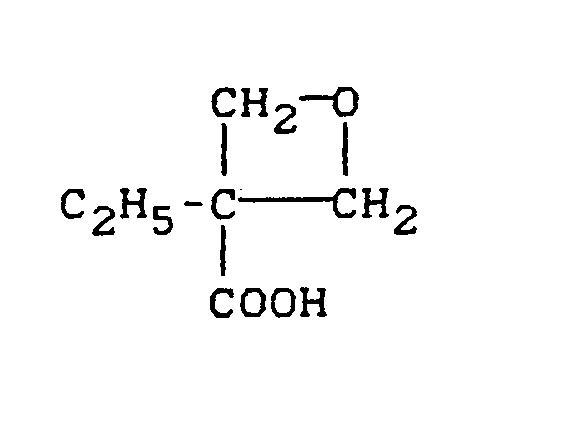
- Nach dem Abfiltrieren des Katalysators ergibt die Extraktion des mit 50 %iger Schwefelsäure auf pH 1 eingestellten Filtrates mit Diethylether 12,9 g eines Produktes, das gemäß Gaschromatogramm zu 99,7 % aus 3-Ethyloxetan-3-carbonsäure besteht. Die Ausbeute errechnet sich danach zu 98,9 % der Theorie.
- Fp. 25°C.
-
-

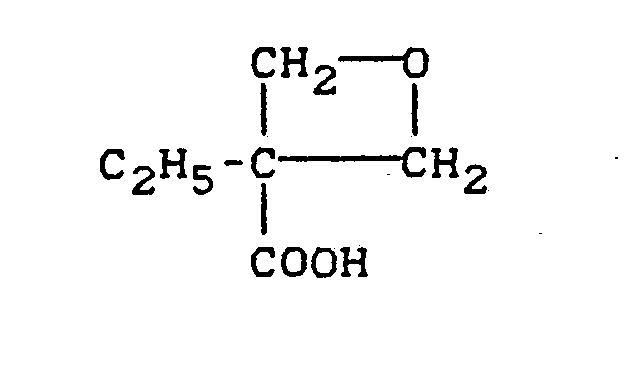
- Die abgesaugte wäßrig-alkalische Lösung wird zur Entfernung von nicht umgesetztem 3-Ethyl-3-hydroxymethyl-oxetan mit Methylenchlorid extrahiert, dann mit 50 %iger Schwefelsäure auf pH 1 angesäuert und zur Gewinnung der 3-Ethyl-oxetan-3-carbonsäure erneut mit Methylenchlorid extrahiert.
- gekommen. Man erhält 12,5 g eines Produktes, das gemäß Gaschromatogramm zu 97,8 % aus 3-Ethyl-oxetan-3-carbonsäure besteht. Die Ausbeute errechnet sich danach zu 94 % der Theorie.
-
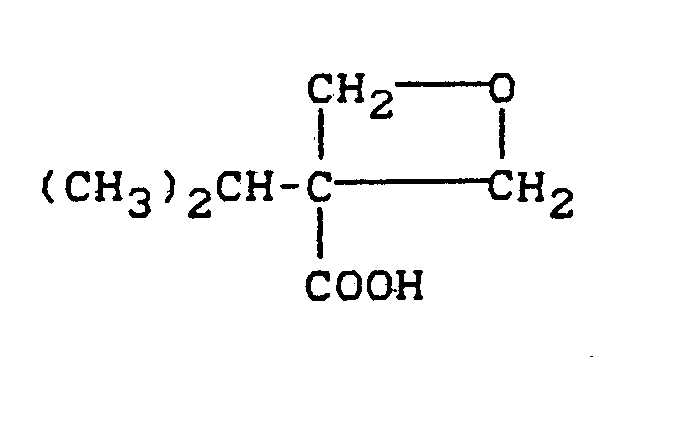
- Nach dem Abfiltrieren des Katalysators, Ansäuern des Filtrates auf pH 1 und Extraktion mit Diethylether verbleiben nach dem Einengen der organischen Phase unter vermindertem Druck 14,1 g eines Produktes, das zu 94,5 % aus 3-Isopropyl-oxetan-3-carbonsäure und zu 3,3 % aus 3-Isopropyl-3-hydroxymethyl-oxetan besteht. Die Ausbeute (Selektivität), bezogen auf umgesetztes Ausgangsmaterial errechnet sich danach zu 96 / der Theorie. Fp. 52-54°C.
-
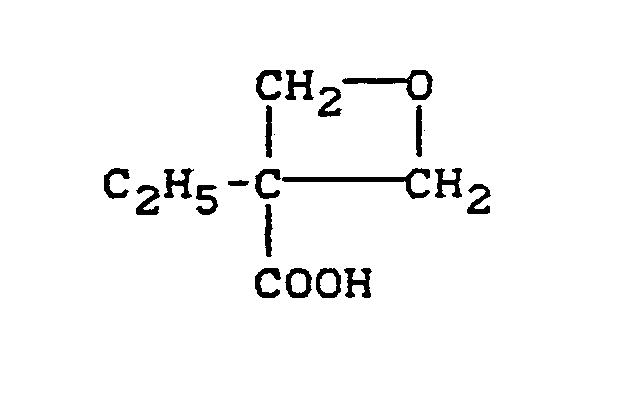
- Die Aufarbeitung erfolgt nach Absaugen des Katalysators durch Ansäuern auf pH 1 und Extraktion mit Diethylether. Es werden die in der folgenden Tabelle 1 aufgeführten Ergebnisse erzielt.

-

-

- Herstellung von 2,2-Bis-chlormethyl-alkancarbonsäurechloriden ausgehend von Oxetan-3-carbonsäuren:
-

-

Fp. 38 - 40°C
herstellen lassen, indem man 3-Hydroxymethyl-oxetane der Formel

in wäßrig-alkalischem Medium mit Sauerstoff oder Sauerstoff enthaltenden Gasen bei Temperaturen zwischen 0°C und dem Siedepunkt des Reaktionsgemisches an einem Palladium-und/oder Platinkatalysator, gegebenenfalls in Gegenwart eines Aktivators umsetzt und danach gegebenenfalls ansäuert.
Claims (9)


in wäßrig-alkalischem Medium mit Sauerstoff oder Sauerstoff enthaltenden Gasen bei Temperaturen zwischen 0°C und dem Siedepunkt des Reaktionsgemisches an einem Palladium- und/oder Platinkatalysator, gegebenenfalls in Gegenwart eines Aktivators umsetzt und danach gegebenenfalls ansäuert.
Applications Claiming Priority (2)
| Application Number | Priority Date | Filing Date | Title |
|---|---|---|---|
| DE3618135 | 1986-05-30 | ||
| DE19863618135 DE3618135A1 (de) | 1986-05-30 | 1986-05-30 | Verfahren zur herstellung von oxetan-3-carbonsaeuren |
Publications (3)
| Publication Number | Publication Date |
|---|---|
| EP0247485A2 true EP0247485A2 (de) | 1987-12-02 |
| EP0247485A3 EP0247485A3 (en) | 1989-07-26 |
| EP0247485B1 EP0247485B1 (de) | 1991-04-17 |
Family
ID=6301896
Family Applications (1)
| Application Number | Title | Priority Date | Filing Date |
|---|---|---|---|
| EP87107165A Expired - Lifetime EP0247485B1 (de) | 1986-05-30 | 1987-05-18 | Verfahren zur Herstellung von Oxetan-3-carbonsäuren |
Country Status (5)
| Country | Link |
|---|---|
| US (1) | US4824975A (de) |
| EP (1) | EP0247485B1 (de) |
| JP (1) | JPH06771B2 (de) |
| DE (2) | DE3618135A1 (de) |
| IL (1) | IL82670A0 (de) |
Families Citing this family (3)
| Publication number | Priority date | Publication date | Assignee | Title |
|---|---|---|---|---|
| KR20070113286A (ko) | 2005-04-14 | 2007-11-28 | 에프. 호프만-라 로슈 아게 | 아미노피라졸 유도체, 이의 제조 및 약학 제제로서의 용도 |
| JP2009530337A (ja) * | 2006-03-23 | 2009-08-27 | エフ.ホフマン−ラ ロシュ アーゲー | 置換インダゾール誘導体、その製造方法、及びその薬剤としての利用法 |
| CN108727309B (zh) * | 2018-06-20 | 2023-04-07 | 天津全和诚科技有限责任公司 | 一种3-氧杂环丁烷羧酸的合成方法 |
Family Cites Families (3)
| Publication number | Priority date | Publication date | Assignee | Title |
|---|---|---|---|---|
| DE2851788A1 (de) * | 1978-11-30 | 1980-06-12 | Bayer Ag | Verfahren zur herstellung von aryloxiessigsaeuren |
| JPS5759828A (en) * | 1980-09-29 | 1982-04-10 | Kao Corp | Preparation of sugar oxide |
| US4599446A (en) * | 1983-10-06 | 1986-07-08 | Mitsui Toatsu Chemicals, Incorporated | Process for the preparation of 2-keto-L-gulonic acid |
-
1986
- 1986-05-30 DE DE19863618135 patent/DE3618135A1/de not_active Withdrawn
-
1987
- 1987-05-13 US US07/049,749 patent/US4824975A/en not_active Expired - Fee Related
- 1987-05-18 DE DE8787107165T patent/DE3769366D1/de not_active Expired - Lifetime
- 1987-05-18 EP EP87107165A patent/EP0247485B1/de not_active Expired - Lifetime
- 1987-05-26 JP JP62127308A patent/JPH06771B2/ja not_active Expired - Lifetime
- 1987-05-27 IL IL82670A patent/IL82670A0/xx unknown
Also Published As
| Publication number | Publication date |
|---|---|
| US4824975A (en) | 1989-04-25 |
| DE3618135A1 (de) | 1987-12-03 |
| EP0247485A3 (en) | 1989-07-26 |
| JPH06771B2 (ja) | 1994-01-05 |
| EP0247485B1 (de) | 1991-04-17 |
| JPS62286983A (ja) | 1987-12-12 |
| IL82670A0 (en) | 1987-11-30 |
| DE3769366D1 (de) | 1991-05-23 |
Similar Documents
| Publication | Publication Date | Title |
|---|---|---|
| DE2600541C3 (de) | Verfahren zur Herstellung von Phenylbrenztraubensäure oder Arylbrenztraubensäuren | |
| EP0228701B1 (de) | 2-Iod-perfluor-2-methylalkane, Verfahren zu deren Herstellung und deren Verwendung | |
| EP0028714B1 (de) | Verfahren zur Herstellung von 3-Phenoxy-benzaldehyden | |
| EP0011793B1 (de) | Verfahren zur Herstellung von Aryloxyessigsäuren | |
| DE3030463A1 (de) | Verfahren zur herstellung von aromatischen polycarbonsaeuren | |
| EP0247485B1 (de) | Verfahren zur Herstellung von Oxetan-3-carbonsäuren | |
| EP0008699B1 (de) | Verfahren zur Herstellung von Arylglyoxylsäuren | |
| EP0124002A1 (de) | Verfahren zur Herstellung von aromatischen Verbindungen, die über ein Heteroatom gebundene perfluorierte Seitenketten enthalten | |
| DE2708751B2 (de) | Verfahren zur Erhöhung der Reaktionsfähigkeit von Perfluorhalogenalkanen | |
| EP0247481B1 (de) | Verfahren zur Herstellung von 2,2-Bis-chlormethylalkan-carbonsäurechloriden | |
| EP0005779B1 (de) | Verfahren zur Herstellung von Arylglyoxylsäuren | |
| DE2718057B2 (de) | Verfahren zur Herstellung von Epoxiden | |
| EP0713856A1 (de) | Verfahren zur Herstellung bromierter oder chlorierter aromatischer Carbonsäuren | |
| EP1481958B1 (de) | Herstellung von fluoridarmen organischen Verbindungen | |
| EP0647614B1 (de) | Verfahren zur Herstellung von 5-Fluoranthranilsäure | |
| EP0302331B1 (de) | Ester von Arylbisperfluoralkylcarbinolen, Verfahren zur Herstellung dieser Verbindungen und der zugrundeliegenden Arylbisperfluoralkylcarbinole | |
| DE3602180C2 (de) | ||
| DE3802372C2 (de) | ||
| EP0247472B1 (de) | Verfahren zur Herstellung von Carbonsäure-Derivaten | |
| DE3900479A1 (de) | Verfahren zur herstellung von 1,3-dioxan-5-on und dihydroxyaceton | |
| DE2642672A1 (de) | Selektive oxidation von chrysanthemylalkohol | |
| DE1618986C3 (de) | Verfahren zur Herstellung von chlorierten aromatischen Nitrilen | |
| DE4123322C2 (de) | 2-Chlor-3,4,5-trifluorbenzoesäure 2,2'-Dichlor-3,4,5-trifluoracetophenon, 2,2',2'-Trichlor-3,4,5-trifluoracetophenon, 5,2'-Dichlor-2,3,4-trifluoracetophenon und 5,2',2'-Trichlor-2,3,4-trifluoracetophenon und Verfahren zur Herstellung dieser Verbindungen und der isomeren 5-Chlor-2,3,4-trifluorbenzoesäure | |
| EP0530559B1 (de) | Verfahren zur Herstellung von 1-Nitroanthrachinon-2-carbonsäuren | |
| DE910290C (de) | Verfahren zur Herstellung von ª‰-Acyloxyaldehyden |
Legal Events
| Date | Code | Title | Description |
|---|---|---|---|
| PUAI | Public reference made under article 153(3) epc to a published international application that has entered the european phase |
Free format text: ORIGINAL CODE: 0009012 |
|
| 17P | Request for examination filed |
Effective date: 19870518 |
|
| AK | Designated contracting states |
Kind code of ref document: A2 Designated state(s): BE CH DE FR GB IT LI NL |
|
| PUAL | Search report despatched |
Free format text: ORIGINAL CODE: 0009013 |
|
| AK | Designated contracting states |
Kind code of ref document: A3 Designated state(s): BE CH DE FR GB IT LI NL |
|
| 17Q | First examination report despatched |
Effective date: 19900829 |
|
| GRAA | (expected) grant |
Free format text: ORIGINAL CODE: 0009210 |
|
| AK | Designated contracting states |
Kind code of ref document: B1 Designated state(s): BE CH DE FR GB IT LI NL |
|
| ET | Fr: translation filed | ||
| GBT | Gb: translation of ep patent filed (gb section 77(6)(a)/1977) | ||
| REF | Corresponds to: |
Ref document number: 3769366 Country of ref document: DE Date of ref document: 19910523 |
|
| ITF | It: translation for a ep patent filed | ||
| PLBE | No opposition filed within time limit |
Free format text: ORIGINAL CODE: 0009261 |
|
| STAA | Information on the status of an ep patent application or granted ep patent |
Free format text: STATUS: NO OPPOSITION FILED WITHIN TIME LIMIT |
|
| 26N | No opposition filed | ||
| PGFP | Annual fee paid to national office [announced via postgrant information from national office to epo] |
Ref country code: DE Payment date: 19960412 Year of fee payment: 10 |
|
| PGFP | Annual fee paid to national office [announced via postgrant information from national office to epo] |
Ref country code: CH Payment date: 19960506 Year of fee payment: 10 |
|
| PGFP | Annual fee paid to national office [announced via postgrant information from national office to epo] |
Ref country code: GB Payment date: 19960510 Year of fee payment: 10 |
|
| PGFP | Annual fee paid to national office [announced via postgrant information from national office to epo] |
Ref country code: FR Payment date: 19960515 Year of fee payment: 10 |
|
| PGFP | Annual fee paid to national office [announced via postgrant information from national office to epo] |
Ref country code: BE Payment date: 19960522 Year of fee payment: 10 |
|
| PGFP | Annual fee paid to national office [announced via postgrant information from national office to epo] |
Ref country code: NL Payment date: 19960531 Year of fee payment: 10 |
|
| PG25 | Lapsed in a contracting state [announced via postgrant information from national office to epo] |
Ref country code: GB Effective date: 19970518 |
|
| PG25 | Lapsed in a contracting state [announced via postgrant information from national office to epo] |
Ref country code: LI Free format text: LAPSE BECAUSE OF NON-PAYMENT OF DUE FEES Effective date: 19970531 Ref country code: CH Free format text: LAPSE BECAUSE OF NON-PAYMENT OF DUE FEES Effective date: 19970531 Ref country code: BE Effective date: 19970531 |
|
| BERE | Be: lapsed |
Owner name: BAYER A.G. Effective date: 19970531 |
|
| PG25 | Lapsed in a contracting state [announced via postgrant information from national office to epo] |
Ref country code: NL Effective date: 19971201 |
|
| GBPC | Gb: european patent ceased through non-payment of renewal fee |
Effective date: 19970518 |
|
| REG | Reference to a national code |
Ref country code: CH Ref legal event code: PL |
|
| PG25 | Lapsed in a contracting state [announced via postgrant information from national office to epo] |
Ref country code: FR Free format text: LAPSE BECAUSE OF NON-PAYMENT OF DUE FEES Effective date: 19980130 |
|
| NLV4 | Nl: lapsed or anulled due to non-payment of the annual fee |
Effective date: 19971201 |
|
| PG25 | Lapsed in a contracting state [announced via postgrant information from national office to epo] |
Ref country code: DE Free format text: LAPSE BECAUSE OF NON-PAYMENT OF DUE FEES Effective date: 19980203 |
|
| REG | Reference to a national code |
Ref country code: FR Ref legal event code: ST |
|
| PG25 | Lapsed in a contracting state [announced via postgrant information from national office to epo] |
Ref country code: IT Free format text: LAPSE BECAUSE OF NON-PAYMENT OF DUE FEES;WARNING: LAPSES OF ITALIAN PATENTS WITH EFFECTIVE DATE BEFORE 2007 MAY HAVE OCCURRED AT ANY TIME BEFORE 2007. THE CORRECT EFFECTIVE DATE MAY BE DIFFERENT FROM THE ONE RECORDED. Effective date: 20050518 |