EP0247555A2 - Procédé pour la préparation d'un fluide anti-parasites - Google Patents
Procédé pour la préparation d'un fluide anti-parasites Download PDFInfo
- Publication number
- EP0247555A2 EP0247555A2 EP87107555A EP87107555A EP0247555A2 EP 0247555 A2 EP0247555 A2 EP 0247555A2 EP 87107555 A EP87107555 A EP 87107555A EP 87107555 A EP87107555 A EP 87107555A EP 0247555 A2 EP0247555 A2 EP 0247555A2
- Authority
- EP
- European Patent Office
- Prior art keywords
- fluid
- disinfestation
- phosphide
- reaction
- water
- Prior art date
- Legal status (The legal status is an assumption and is not a legal conclusion. Google has not performed a legal analysis and makes no representation as to the accuracy of the status listed.)
- Ceased
Links
Images


Classifications
-
- B—PERFORMING OPERATIONS; TRANSPORTING
- B01—PHYSICAL OR CHEMICAL PROCESSES OR APPARATUS IN GENERAL
- B01J—CHEMICAL OR PHYSICAL PROCESSES, e.g. CATALYSIS OR COLLOID CHEMISTRY; THEIR RELEVANT APPARATUS
- B01J7/00—Apparatus for generating gases
- B01J7/02—Apparatus for generating gases by wet methods
-
- A—HUMAN NECESSITIES
- A01—AGRICULTURE; FORESTRY; ANIMAL HUSBANDRY; HUNTING; TRAPPING; FISHING
- A01N—PRESERVATION OF BODIES OF HUMANS OR ANIMALS OR PLANTS OR PARTS THEREOF; BIOCIDES, e.g. AS DISINFECTANTS, AS PESTICIDES OR AS HERBICIDES; PEST REPELLANTS OR ATTRACTANTS; PLANT GROWTH REGULATORS
- A01N59/00—Biocides, pest repellants or attractants, or plant growth regulators containing elements or inorganic compounds
- A01N59/26—Phosphorus; Compounds thereof
-
- A—HUMAN NECESSITIES
- A23—FOODS OR FOODSTUFFS; TREATMENT THEREOF, NOT COVERED BY OTHER CLASSES
- A23B—PRESERVATION OF FOODS, FOODSTUFFS OR NON-ALCOHOLIC BEVERAGES; CHEMICAL RIPENING OF FRUIT OR VEGETABLES
- A23B2/00—Preservation of foods or foodstuffs, in general
- A23B2/70—Preservation of foods or foodstuffs, in general by treatment with chemicals
- A23B2/704—Preservation of foods or foodstuffs, in general by treatment with chemicals in the form of gases, e.g. fumigation; Compositions or apparatus therefor
-
- A—HUMAN NECESSITIES
- A23—FOODS OR FOODSTUFFS; TREATMENT THEREOF, NOT COVERED BY OTHER CLASSES
- A23B—PRESERVATION OF FOODS, FOODSTUFFS OR NON-ALCOHOLIC BEVERAGES; CHEMICAL RIPENING OF FRUIT OR VEGETABLES
- A23B9/00—Preservation of edible seeds, e.g. cereals
- A23B9/16—Preserving with chemicals
- A23B9/18—Preserving with chemicals in the form of gases, e.g. fumigation; Compositions or apparatus therefor
-
- C—CHEMISTRY; METALLURGY
- C01—INORGANIC CHEMISTRY
- C01B—NON-METALLIC ELEMENTS; COMPOUNDS THEREOF; METALLOIDS OR COMPOUNDS THEREOF NOT COVERED BY SUBCLASS C01C
- C01B25/00—Phosphorus; Compounds thereof
- C01B25/06—Hydrogen phosphides
Definitions
- the invention relates to a method and a device or system for producing a disinfestation fluid which contains an inert fluid and hydrogen phosphide which is obtained from the hydrolysis of a water-decomposable metal phosphide.
- the hydrogen phosphide required for the fumigation of grain silos which are to be considered as an application in the following, is conventionally generated by the hydrolysis of a water-decomposable metal phosphide with water.
- preparations containing the metal phosphide are laid out in the silo in accordance with known gassing processes or introduced into the grain reserve by drilling probes. The preparations then react with the moisture from the grain or the ambient air and release the desired phosphorus.
- forced air circulation is also used to distribute the hydrogen phosphide over the entire silo content. Since the reaction between the metal phosphide and the water can be very violent depending on the type of metal phosphide and on other influencing factors such as air humidity and the ambient temperature, metal phosphide preparations are used that deliberately cause outgassing.
- This task is for a procedure of the beginning designated type solved according to the invention in that the inert fluid H2O added, the inert fluid / H2O mixture brought into contact with the metal phosphide to react and the disinfestation fluid formed is separated from the solid reaction residue.
- a very simple method of batchwise production of the disinfestation fluid consists in stacking calculated amounts of metal phosphide, solidified inert fluid and water ice in an open pressure vessel in this order, closing the pressure vessel and allowing temperature compensation to take place with the ambient temperature.
- the inert fluid above the metal phosphide which first changes to the liquid state, slowly takes up water from the molten water ice and brings it into contact with the metal phosphide to react. After the reaction has ended, a gaseous mixture of the inert fluid and of phosphorus hydrogen can be drawn off via an expansion valve.
- a continuous variant of this procedure consists in that the liquid water required for the reaction is injected into a continuous stream of the inert fluid in the liquid state and this liquid mixture is passed into a reaction or extraction column containing the metal phosphide.
- the resulting disinfestation fluid which is drawn off in gaseous form via an expansion valve, can either be used directly for gassing or, after indirect concentration by means of a suitable coolant, in pressure-resistant steel bottles by supplying further, gaseous inert fluid via a suitable pipe distributor system.
- a particularly preferred embodiment of the method according to the invention consists in saturating inert fluid in the gaseous state with water vapor.
- This moisture-laden inert gas is then fed to the reaction container containing the metal phosphide.
- Temperature control of the water tank provides an excellent control option for the amount of water supplied to the reaction space, since the absorption of water vapor by the inert gas can be regulated by influencing the saturation temperature.
- temperature control of the reaction vessel is expedient. If the reaction in the reaction container reaches an undesired temperature, this can easily be determined by a temperature sensor and the state can be counteracted either by preventing the inert gas delivery, by lowering the temperature in the water container or by directly introducing relaxation-cooled inert gas.
- the disinfestation gas produced Hydrogen phosphate and inert gas can be fed directly to a pipe distribution system for fumigation.
- the invention also relates to suitable systems for carrying out the claimed processes.
- the invention for the use of carbon dioxide as an inert fluid in connection with magnesium phosphide is explained in more detail.
- its use also has the further advantage that the carbon dioxide participates in the reaction in part and when magnesium phosphide is used as the reaction residue, magnesium carbonate results, which is a harmless salt which is in nature in the form of dolomite occurs.
- magnesium carbonate results, which is a harmless salt which is in nature in the form of dolomite occurs.
- the basic reaction residue is magnesium hydroxide.
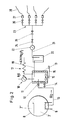
- FIG. 2 shows a process diagram of a plant for carrying out the reaction according to Example 1.
- a reservoir 8 liquid carbon dioxide 3 ⁇ is stored. Depending on the design of the container, storage takes place at a pressure between 15 and 70 bar. Above the liquid carbon dioxide 3 ⁇ there is a gas space with gaseous carbon dioxide 3 ⁇ .
- the storage container 8 is provided with a heat exchange device 9 which can be used if necessary, in order to be able to set the liquid carbon dioxide to a desired temperature for the further process.
- a line 10 for liquid carbon dioxide leads from the lower part of the storage container 8 into a reactor 11. Before entering the reactor 11, the line 10 is provided with an expansion valve 12.
- the reactor 11 also has a cooling jacket 13, to which carbon dioxide can be applied via an expansion valve 14 via a line branching off the line 10.
- the reactor 11 rests on a weighing device 15 and is provided on the inside with an agitator 16 which can be used if necessary.
- Feed devices 17 for the phosphide and 18 for water are provided on the top of the reactor 11.
- the feed device 17 for the phosphide is shown schematically as a screw conveyor to indicate that a solid has to be introduced into the reactor here.
- the feed device 18 for the water is indicated with a flow meter.
- additional feed or pumping devices for the phosphide and the water would have to be provided if necessary. If the water is supplied as ice, corresponding devices could be arranged for the phosphide input 17.
- the disinfestation gas is the Reactor 11 removed via a line 19 which leads to a water separator 20. From here, an extraction line 21 leads via a flow meter 22 to a line distribution system 23. At 24 and 25, extraction connections for a moisture measurement or an analysis device are also indicated.
- the line distribution system has a number of extraction valves 26, to which gassing hoses 28 can be connected via couplings 27. These gassing hoses 28 can be connected directly to a container gassing distribution system.
- the system shown in Fig. 2 is suitable for discontinuous operation, as described in Example 1, but can also be operated continuously if the measuring and metering devices are adapted accordingly.
- the reactor 11 can be filled under pressure or under pressure, depending on the type of charging devices and the desired process sequence.
- the phosphide can be fed into the reactor with the screw conveyor 17 without any problems.
- the expansion of the liquid carbon dioxide to be entered into the reactor 11 via the valve 12 can be carried out in such a way that carbon dioxide ice is formed by the expansion, with which, as described in Example 1, the phosphide can be coated.
- water ice can also be stacked on the carbon dioxide ice by a correspondingly modified water addition device 18.
- the filling quantity of the now closed reactor can also be heated if necessary by supplying appropriate media.
- the course of the reaction can be accelerated by the stirrer 16.
- the disinfestation fluid generated can relax with the expansion
- the reactor is removed and separated from excess water of reaction in the water separator 20.
- the disinfestation gas is then fed directly to the container to be gassed via the subsequent devices described above.
- the reactor 11 can also be charged with the phosphide under pressure via a corresponding pressure lock.
- carbon dioxide and water are expediently metered in in liquid form. This can be done continuously as well as in batches. The required conditions of the substances involved must then be set accordingly.
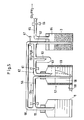
- FIG. 3 A continuous process variant for the production of a disinfestation fluid containing phosphide is illustrated in FIG. 3. It is the hydrolysis of metal phosphides in a closed system by liquid carbon dioxide, to which the required amounts of water are added by injection. Since the two gases can be separated by fractional distillation at another point in the plant and the carbon dioxide can be returned to the process, this continuous hydrolysis can also be referred to as "extraction" of hydrogen phosphide from the metal phosphides.
- FIG. 3 shows a vertical reactor 29 which is filled with magnesium phosphide 2 in its central region.
- the reactor 29 has a liquid inlet 30 to which two lines are connected, namely on the one hand a line 31 with a valve 32 for the supply of carbon dioxide and on the other hand a line 33 with a valve 34 for the supply of H2O.
- the reactor 29 is provided with an extraction line 35 for the disinfestation fluid, which is connected via a valve 36 to a Condensation container 37 is connected, which in turn is located in a cooling jacket 38 which is filled with a coolant which causes the disinfestation gas to condense, namely liquid nitrogen.
- a flow of carbon dioxide and water through the magnesium phosphide is provided from bottom to top.
- a reverse flow would also be possible.
- Certain amounts of liquid carbon dioxide and liquid water are metered into the liquid feed 30 from the lines 31 and 33 by means of the valves 32 and 34.
- the two liquids are mixed before entering the reactor.
- the disinfestation fluid formed by the reaction with the phosphide is removed from the column 29 in liquid form, but with appropriate expansion it is also removed in gaseous form and, in the exemplary embodiment, introduced into a condensation vessel in the form of a steel cylinder which serves as a shipping container for the disinfestation fluid.
- condensation vessel in the form of a steel cylinder which serves as a shipping container for the disinfestation fluid.
- the reactor 10 must be designed as a pressure vessel which is designed for working pressures between 80 and 100 bar.
- liquid carbon dioxide already provides favorable mass and heat transport in this process variant, in the supercritical state the carbon dioxide is even more mobile.
- the process can easily be kept under control by measuring the phosphorus hydrogen concentration in the disinfestation fluid produced and then controlling the water dosage.
- additional carbon dioxide can also be added for dilution in order to obtain a disinfestation fluid of the concentration ready for use in the steel cylinder.
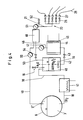
- FIG. 4 shows the diagram of a plant which can be operated by modifying the plant according to FIG. 2 for the continuous production of the disinfestation fluid according to the extraction process described above. Units corresponding to the diagram in FIG. 2 are identified by the same reference numerals.
- Liquid carbon dioxide is preferably stored in the reservoir 8 at a pressure of 70 bar.
- the CO2 reservoir is connected via a line 10 for liquid CO2 to a reactor 40.
- An indirect heat exchanger 41 is also switched on in line 10. With the help of this heat exchanger, the temperature of the liquid carbon dioxide can be adjusted to a certain value before entering the reactor 40. If work is to be carried out in the supercritical range of carbon dioxide, heating of the carbon dioxide must generally be carried out in the heat exchanger 41.
- the carbon dioxide line 10 is inserted into the upper end of the reactor.
- a first removal line 42 for the disinfestation fluid leaves the reactor 40 at the lower end, so that in this embodiment it is possible to work with media flowing downwards.
- a feed device 18 for feeding H2O into the reactor 40 is also located at the top of the reactor 40. It is for the metering of designed for liquid water.
- the possibility of loading the reactor 40 with aluminum phosphide or magnesium phosphide is not shown in this process diagram. There is the possibility of once filling the reactor 40 with phosphide in the open state, and then subsequently allowing the process to continue until the amount of phosphide has been consumed. The outgassing residues are then removed from the reactor and the reactor is refilled.
- a continuous possibility of adding the phosphide by means of a rotary lock or the like would of course also be conceivable.
- the first extraction line 42 is connected to a collecting container 44 via a valve 43.
- the collecting container 44 is provided with a heat exchange jacket 45 if necessary. Cooling may be required here if the disinfestation fluid generated is to be kept in the liquid state at reduced pressure. This is e.g. then necessary if a liquid filling of the disinfestation fluid is provided in the container.
- a removal line 46 is provided which leads via a flow meter 47 into a mixing dosing container 48.
- a line 49 is provided for gaseous CO2 from the gas space of the storage container 8, which also leads into the mixing dosing container 48 via a flow meter 50.
- the disinfestation fluid coming from the collecting container 44 can be diluted with gaseous CO2 in the mixing dosing container 48 to a required use concentration.
- a line 21 which in turn contains a flow meter 51, the disinfestation gas is fed to a line distribution system 23, which corresponds to that according to FIG. 2.
- the line 21 contains a sampling port 52, which is used for taking samples for analysis purposes Disinfestation gas can serve.
- a line 53 also leads from the upper part of the reactor 40 via a valve 54 into the mixing dosing tank 6.
- the system described permits different operating modes for the area behind the reactor 40. If disinfestation gas is to be fed directly to the line distribution system 23 for direct use without intermediate storage, the disinfestation gas generated in the reactor 40 can be drawn off via the top line 53 and the expansion valve 54 and fed to the mixing dosing container 48. The valve 43 at the lower end of the reactor remains closed. Dilution of the disinfestation gas generated can be done with gaseous CO2, which is fed to the mixing dosing tank 48 via line 49. If the disinfestation fluid is to be drawn off in liquid form, line 42 at the lower end of the reactor is used. With appropriate cooling, the disinfestation fluid can be temporarily stored in the collecting container 44.
- Line 53 can also be used to return disinfestation gas from line 46 to reactor 40 if further concentration with phosphide is desired.
- a preferred variant of the process described is the so-called continuous gas process.
- the process flow is illustrated schematically in FIG. 5.
- this variant of the method which works with gaseous carbon dioxide, the fact that the saturation amount of the carbon dioxide gas for water vapor at different temperatures is different is used to meter water into the carbon dioxide.
- the gas space of a CO2 storage container 8 is connected to a water container 57 via a line 56 provided with a relief valve 55, the line 56 protruding into the water filling 58 thereof.
- the water tank 57 is surrounded by a heating jacket 59, which is provided with a temperature controller 60.
- a further line 62 for the gaseous carbon dioxide provided with a valve 61 begins in the gas space 63 of the water container 57 above the level of the water surface 58.
- the line continues via a liquid separator 63 into a reactor 64.
- the reactor 64 contains a package of magnesium phosphide 3, in which leads the line 62 in.
- a line 65 provided with a valve 66 for the disinfestation gas generated in the reactor 64 leaves the reactor at its upper end.
- a bypass line 68 provided with a valve 67 is provided, which connects the gas space of the CO2 storage container 8 directly to the line 62, which leads into the magnesium phosphide packing of the reactor 64.
- This arrangement not only forms an elegant possibility for controlling the amount of water supplied to the reaction, it can also be operated with great certainty, since when the reaction in the reactor 64, which is expressed in a sharp increase in temperature, goes through the bypass line 68, it does not directly contain water vapor loaded Carbon dioxide gas can be fed to the reactor to slow the reaction.
- the speed of the reaction between the carbon dioxide gas loaded with water vapor and the metal phosphide charged depends on the speed of the gas flow, namely the contact time, the reactivity of the metal phosphide, the basicity of the metal ion and the temperature.
- a basic rather than a tertiary carbonate will form from aluminum phosphide, which has repercussions on the stoichiometry of the conversion of water vapor into hydrogen phosphide. Since carbon dioxide cools down as it evaporates, there is a constant transport of cold into the water tank 57, which must therefore be continuously heated to maintain a certain temperature.
- the process variant described here has the following advantages: Control of the reaction rate via water vapor saturation, - Constant exposure to the reaction mixture with inert gas in high excess and - Pressure-free generation of a gas mixture that can be used directly.
- a hydrogen phosphide concentration in the carbon dioxide gas of about 2.5 vol .-% results.
- This amount of disinfestation gas contains 7000 g of hydrogen phosphide, which corresponds to the dosage assumed above.
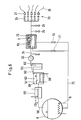
- FIG. 6 shows the diagram of a plant which operates according to the method described in connection with FIG. 5.
- the line 56 for gaseous CO2 which leads from the gas space of the storage container 8 to the water container 57
- an indirect heat exchanger 69 is also provided in the storage container 8
- the storage container 8 is also provided with a heating device 9. Since cold is continuously transported into the water tank 57 by releasing the carbon dioxide gas, ie heat is continuously removed from its filling, the heater 59 in the water tank 57 is generally not sufficient to keep the water temperature at a desired value. It is therefore expedient to preheat the carbon dioxide already in the storage container and in the additional heat exchanger 69 before it reaches the water container 57 for saturation with water vapor.
- a flow measurement 22 is located behind the water separator 63 in order to control the amount of carbon dioxide gas supplied to the reactor 64.
- a bypass line 70 for supplying additional carbon dioxide gas to the reactor 64 is connected to the liquid space of the carbon dioxide storage container 8 in this exemplary embodiment. It therefore contains an expansion valve 71 in order to supply the reactor 64 with the carbon dioxide in the gaseous state.
- the reactor 64 itself is additionally provided with a cooling jacket 72, to which liquid or expanded gaseous carbon dioxide can additionally be fed from line 70 via a branch line 73 for cooling.
Landscapes
- Chemical & Material Sciences (AREA)
- Life Sciences & Earth Sciences (AREA)
- Engineering & Computer Science (AREA)
- Organic Chemistry (AREA)
- Wood Science & Technology (AREA)
- Zoology (AREA)
- Food Science & Technology (AREA)
- Polymers & Plastics (AREA)
- Chemical Kinetics & Catalysis (AREA)
- Inorganic Chemistry (AREA)
- Plant Pathology (AREA)
- Agronomy & Crop Science (AREA)
- Pest Control & Pesticides (AREA)
- General Chemical & Material Sciences (AREA)
- Health & Medical Sciences (AREA)
- Dentistry (AREA)
- General Health & Medical Sciences (AREA)
- Environmental Sciences (AREA)
- Agricultural Chemicals And Associated Chemicals (AREA)
- Physical Or Chemical Processes And Apparatus (AREA)
- Organic Low-Molecular-Weight Compounds And Preparation Thereof (AREA)
Applications Claiming Priority (2)
| Application Number | Priority Date | Filing Date | Title |
|---|---|---|---|
| DE19863618297 DE3618297A1 (de) | 1986-05-30 | 1986-05-30 | Verfahren und vorrichtung zur herstellung eines entwesungsfluids |
| DE3618297 | 1986-05-30 |
Publications (2)
| Publication Number | Publication Date |
|---|---|
| EP0247555A2 true EP0247555A2 (fr) | 1987-12-02 |
| EP0247555A3 EP0247555A3 (fr) | 1989-02-08 |
Family
ID=6302005
Family Applications (1)
| Application Number | Title | Priority Date | Filing Date |
|---|---|---|---|
| EP87107555A Ceased EP0247555A3 (fr) | 1986-05-30 | 1987-05-23 | Procédé pour la préparation d'un fluide anti-parasites |
Country Status (7)
| Country | Link |
|---|---|
| US (1) | US4814154A (fr) |
| EP (1) | EP0247555A3 (fr) |
| JP (1) | JPS632910A (fr) |
| AU (1) | AU601187B2 (fr) |
| DE (1) | DE3618297A1 (fr) |
| YU (1) | YU44803B (fr) |
| ZA (1) | ZA873658B (fr) |
Cited By (6)
| Publication number | Priority date | Publication date | Assignee | Title |
|---|---|---|---|---|
| EP0614991A1 (fr) * | 1993-03-10 | 1994-09-14 | L'air Liquide, Societe Anonyme Pour L'etude Et L'exploitation Des Procedes Georges Claude | Une solution diluée d'un hydrure dans de l'azote liquide |
| EP0655198A1 (fr) * | 1993-11-22 | 1995-05-31 | David K. Mueller | Procédé de fumigation au phosphure d'hydrogène à concentration faible |
| WO1995019712A1 (fr) * | 1994-01-25 | 1995-07-27 | Kohlensäurewerk Deutschland Gmbh | Procede de lutte contre les parasites dans des produits en vrac |
| BE1008509A3 (nl) * | 1994-07-19 | 1996-05-07 | Desclean Desinfection & Cleani | Werkwijze voor het begassen van materiaal, in het bijzonder voedingsmiddelen. |
| EP0826307A1 (fr) * | 1989-06-27 | 1998-03-04 | Commonwealth Scientific And Industrial Research Organisation | Fumigation de plusieurs chambres de stockage de grain |
| WO2010102693A1 (fr) * | 2009-03-13 | 2010-09-16 | Linde Ag | Procédé et dispositif de fumigation |
Families Citing this family (24)
| Publication number | Priority date | Publication date | Assignee | Title |
|---|---|---|---|---|
| US5260022A (en) * | 1987-11-27 | 1993-11-09 | Detia Freyberg Gmbh | Process for generating a pesticidal gas |
| AR248331A1 (es) * | 1987-11-27 | 1995-08-18 | Detia Freyberg Gmbh | Procedimiento y aparato para generar una mezcla plaguicida gaseosa de fosfina gaseosa y aire para fumigar con fosfina un ambiente cerrado. |
| US5932172A (en) * | 1989-06-27 | 1999-08-03 | Commonwealth Scientific And Industrial Organisation | Fumigation of multiple grain storages from a single source of fumigant |
| JP2942628B2 (ja) * | 1990-06-21 | 1999-08-30 | コモンウエルス サイエンテイフイック アンド インダストリアル リサーチ オーガナイゼイション | ホスフィンの発生方法及びその発生装置 |
| GB9511495D0 (en) | 1995-06-07 | 1995-08-02 | Degesch De Chile Ltda | Composition, process and apparatus for producing phosphine - containing gas |
| AU722658B2 (en) * | 1995-06-07 | 2000-08-10 | Degesch De Chile Ltda | Phosphine generator for producing phosphine-containing gas |
| US6047497A (en) | 1997-03-18 | 2000-04-11 | The Boc Group, Inc. | Gas fumigation method and system |
| DE19983232T1 (de) * | 1998-05-14 | 2001-07-12 | Alexandr Alexandrovic Aryamkin | Verfahren, Zusammensetzung und Vorrichtung für die Erzeugung von Vergasungsmitteln, Begasungsmethoden und Kontrollmittel |
| RU2145784C1 (ru) * | 1998-05-14 | 2000-02-27 | Товарищество с ограниченной ответственностью Научно-производственная фирма "Малахит" | Способ выработки газа-фумиганта, устройство и композиция для его осуществления, способ фумигации, способ фумигации объекта в виде массива продукта (варианты) |
| DE19839385A1 (de) * | 1998-08-28 | 2000-03-23 | Horn Pedro Miguel | Verfahren und Vorrichtung zur Verdünnung von Phosphorwasserstoff mit Luft ohne Entzündungsgefahr |
| JP2001070471A (ja) * | 1999-07-07 | 2001-03-21 | Teijin Chem Ltd | リン化金属化合物製剤残渣の除害方法および除害システム |
| DE10009888C2 (de) * | 2000-03-01 | 2002-12-05 | Martin Muenzel | Verfahren zur Schädlingsbekämpfung und zur Herstellung niederkonzentrierter Phosphin-Luft-Mischungen sowie Vorrichtung zur Durchführung eines solchen Verfahrens |
| RU2202512C1 (ru) * | 2001-08-16 | 2003-04-20 | Пыщев Александр Иванович | Композиция и способ для получения фосфина |
| US20030211207A1 (en) * | 2002-05-07 | 2003-11-13 | Newman Michael D. | Apparatus and method for providing treatment to a continuous supply of food product using a vacuum process |
| US7008658B2 (en) * | 2002-05-29 | 2006-03-07 | The Boc Group, Inc. | Apparatus and method for providing treatment to a continuous supply of food product by impingement |
| US20030228401A1 (en) * | 2002-06-06 | 2003-12-11 | Newman Michael D. | System and method of using non-volatile microbiocidal application agents |
| US20040013694A1 (en) * | 2002-07-22 | 2004-01-22 | Newman Michael D. | System and method of microbiocidal gas generation |
| US7556785B2 (en) * | 2003-05-12 | 2009-07-07 | United Phosphorus, Ltd. | Apparatus and method for rapid and continuous generation of phosphine gas |
| CN100351171C (zh) * | 2004-05-03 | 2007-11-28 | 陈弘毅 | 磷化氢快速生成方法及装置 |
| KR100851626B1 (ko) | 2008-01-31 | 2008-08-13 | (주) 대하프리존 | 소독제 투약 장치 및 밀폐된 포장 내부의 소독 방법 |
| KR100851627B1 (ko) | 2008-02-13 | 2008-08-13 | (주) 대하프리존 | 소독 장치 및 밀폐된 공간의 소독 방법 |
| RU2395220C2 (ru) * | 2008-07-17 | 2010-07-27 | Людмила Александровна Тихонова | Способ выработки газа фумиганта и устройство для его осуществления (варианты) |
| CN101428836B (zh) * | 2008-12-17 | 2011-02-02 | 天津大学 | 间歇式流化床磷化铝水解法制备活性氧化铝的工艺和装置 |
| WO2013028245A2 (fr) * | 2011-08-23 | 2013-02-28 | Advanced Technology Materials, Inc. | Systèmes et procédés d'apport de phosphine pour des applications de fumigation |
Family Cites Families (9)
| Publication number | Priority date | Publication date | Assignee | Title |
|---|---|---|---|---|
| DE709748C (de) * | 1939-04-18 | 1941-08-26 | Freyberg Werner | Verfahren zur Durchfuehrung einer Phosphorwasserstoffbegasung |
| SU136327A1 (ru) * | 1960-05-09 | 1960-11-30 | Л.Л. Верейкина | Способ получени фосфидов |
| GB943281A (en) * | 1961-01-19 | 1963-12-04 | Albright & Wilson Mfg Ltd | Manufacture of phosphine |
| US3899375A (en) * | 1969-06-20 | 1975-08-12 | Erco Ind Ltd | Metallic phosphide composition for use in aquatic flares |
| US4013761A (en) * | 1976-01-23 | 1977-03-22 | Olin Corporation | Chlorine dioxide generation |
| US4421742A (en) * | 1977-02-08 | 1983-12-20 | Dr. Werner Freyberg Chemische Fabrik Delitia Nachf. | Phosphine producing pesticide and method of manufacture therefor |
| DE2950999A1 (de) * | 1979-12-18 | 1981-07-23 | Dr. Werner Fryberg Chemische Fabrik Delitia Nachf., 6941 Laudenbach | Schaedlingsbekaempfungsmittel und verfahren zu ihrer herstellung |
| AU531324B2 (en) * | 1979-12-20 | 1983-08-18 | Degesch G.M.B.H. | Low air flow fumigation method |
| PH21608A (en) * | 1982-08-05 | 1987-12-11 | Freyberg Chem Fab Werner | Auto ignition control of hydrolysabel metal phosphides |
-
1986
- 1986-05-30 DE DE19863618297 patent/DE3618297A1/de not_active Withdrawn
-
1987
- 1987-05-15 US US07/050,111 patent/US4814154A/en not_active Expired - Fee Related
- 1987-05-18 YU YU877/87A patent/YU44803B/xx unknown
- 1987-05-21 ZA ZA873658A patent/ZA873658B/xx unknown
- 1987-05-23 EP EP87107555A patent/EP0247555A3/fr not_active Ceased
- 1987-05-27 AU AU73446/87A patent/AU601187B2/en not_active Ceased
- 1987-05-29 JP JP62134813A patent/JPS632910A/ja active Granted
Cited By (7)
| Publication number | Priority date | Publication date | Assignee | Title |
|---|---|---|---|---|
| EP0826307A1 (fr) * | 1989-06-27 | 1998-03-04 | Commonwealth Scientific And Industrial Research Organisation | Fumigation de plusieurs chambres de stockage de grain |
| EP0614991A1 (fr) * | 1993-03-10 | 1994-09-14 | L'air Liquide, Societe Anonyme Pour L'etude Et L'exploitation Des Procedes Georges Claude | Une solution diluée d'un hydrure dans de l'azote liquide |
| US5543127A (en) * | 1993-03-10 | 1996-08-06 | L'air Liquide, Societe Anonyme Pour L'etude Et L'exploitation Des Procedes Georges Claude | Dilute solution of a hydride in liquid nitrogen |
| EP0655198A1 (fr) * | 1993-11-22 | 1995-05-31 | David K. Mueller | Procédé de fumigation au phosphure d'hydrogène à concentration faible |
| WO1995019712A1 (fr) * | 1994-01-25 | 1995-07-27 | Kohlensäurewerk Deutschland Gmbh | Procede de lutte contre les parasites dans des produits en vrac |
| BE1008509A3 (nl) * | 1994-07-19 | 1996-05-07 | Desclean Desinfection & Cleani | Werkwijze voor het begassen van materiaal, in het bijzonder voedingsmiddelen. |
| WO2010102693A1 (fr) * | 2009-03-13 | 2010-09-16 | Linde Ag | Procédé et dispositif de fumigation |
Also Published As
| Publication number | Publication date |
|---|---|
| JPH0536401B2 (fr) | 1993-05-31 |
| YU44803B (en) | 1991-02-28 |
| US4814154A (en) | 1989-03-21 |
| JPS632910A (ja) | 1988-01-07 |
| AU7344687A (en) | 1987-12-03 |
| DE3618297A1 (de) | 1987-12-03 |
| AU601187B2 (en) | 1990-09-06 |
| YU87787A (en) | 1988-08-31 |
| ZA873658B (en) | 1988-08-31 |
| EP0247555A3 (fr) | 1989-02-08 |
Similar Documents
| Publication | Publication Date | Title |
|---|---|---|
| DE3618297A1 (de) | Verfahren und vorrichtung zur herstellung eines entwesungsfluids | |
| DE69632834T2 (de) | Verfahren zur stabilisierung von flüssigem schlamm | |
| DE69129456T2 (de) | Verfahren und apparat zum erzeugen von phosphin sowie sicherheitssystem für phosphinerzeuger | |
| DE2326058C2 (de) | Verfahren zur Entfernung von Schwefelwasserstoff aus geschmolzenem Schwefel | |
| DE2826108C3 (de) | Verfahren zur Zerstörung von Gutbrücken, die sich innerhalb eines Behälters gebildet haben | |
| EP0852965B1 (fr) | Dispositif pour réaliser des réactions chimiques par voie humide sous pression | |
| EP0164140A2 (fr) | Procédé et appareillage pour le dégazage de soufre liquide contenant du sulfure d'hydrogène | |
| DE60021766T2 (de) | Verfahren und vorrichtung zur bereitstellung einer gasmischung | |
| DE69328361T2 (de) | Formulierungen, verfahren und gerät für die kontrollierte herstellung von phosphin | |
| DE19611093C2 (de) | Verfahren und Vorrichtung zur Anreicherung einer Flüssigkeit mit einem Gas | |
| DE3930470C2 (fr) | ||
| DE1444328B2 (de) | Verfahren und vorrichtung zum einengen radioaktiver fluessigkeiten | |
| CH691558A5 (de) | Verfahren zur Rückkühlung eines mit abgebrannten Brennelementen beladenen Behälters zum Transport und/oder zur Lagerung der Brennelemente. | |
| EP0000515B1 (fr) | Procédé pour enlever le gaz sulfureux d'un courant gazeux et installation pour la mise en oeuvre du procédé | |
| DE102012024180A1 (de) | Verfahren zur Begasung von Agrarflächen | |
| DE2557534A1 (de) | Impraegnierverfahren und vorrichtung zu seiner durchfuehrung | |
| DE3509555C1 (de) | Verfahren zum Verdampfen von Zusatzstoffen in einer Metallschmelze | |
| EP0915055B1 (fr) | Dispositif pour la séparation de gaz de liquides et utilisation d'un tel dispositif pour la séparation d'hydrogène sulfuré de soufre liquide | |
| DE1996070U (de) | Vorrichtung zum kontinuierlichen entfernen von verunreinigungen aus fluessigkeiten | |
| EP3479041A1 (fr) | Processus continu à plusieurs chambres | |
| DD142430A5 (de) | Verfahren zum haerten eines haertbaren harzes | |
| DE1535C (de) | Verfahren zur Fabrikation von assimilirbarem Dünger aus Leder, Lederrückständen etc. durch Behandlung derselben mit Schwefelsäure und schwefelsäuren Salzen bei erhöhter Temperatur | |
| EP4698493A1 (fr) | Installation de production d'ammoniaque sous forme d'eau ammoniacale | |
| EP0671373B1 (fr) | Procede d'obtention de sels mineraux et/ou d'engrais, leur transport et leur stockage | |
| AT54660B (de) | Verfahren und Vorrichtung zum mechanischen Anfeuchten des zur Herstellung von sogenanntem Sackkalk dienenden, aus dem Ofen kommenden Rohkalkes vor seiner Einlagerung. |
Legal Events
| Date | Code | Title | Description |
|---|---|---|---|
| PUAI | Public reference made under article 153(3) epc to a published international application that has entered the european phase |
Free format text: ORIGINAL CODE: 0009012 |
|
| AK | Designated contracting states |
Kind code of ref document: A2 Designated state(s): CH DE ES FR GB GR LI NL |
|
| PUAL | Search report despatched |
Free format text: ORIGINAL CODE: 0009013 |
|
| AK | Designated contracting states |
Kind code of ref document: A3 Designated state(s): CH DE ES FR GB GR LI NL |
|
| 17P | Request for examination filed |
Effective date: 19890221 |
|
| 17Q | First examination report despatched |
Effective date: 19901207 |
|
| STAA | Information on the status of an ep patent application or granted ep patent |
Free format text: STATUS: THE APPLICATION HAS BEEN REFUSED |
|
| 18R | Application refused |
Effective date: 19911115 |
|
| RIN1 | Information on inventor provided before grant (corrected) |
Inventor name: DOERNEMANN, MANFRED, DIPL.-ING. Inventor name: REIF, HELMUT, DR. PHIL. |