EP0247594A2 - Méthode pour décharger des réservoirs à produits liquides situés aux bords de ou sur l'eau, en particulier des réservoirs de navires, et pour éteindre l'incendie quand ils ont pris feu - Google Patents
Méthode pour décharger des réservoirs à produits liquides situés aux bords de ou sur l'eau, en particulier des réservoirs de navires, et pour éteindre l'incendie quand ils ont pris feu Download PDFInfo
- Publication number
- EP0247594A2 EP0247594A2 EP87107731A EP87107731A EP0247594A2 EP 0247594 A2 EP0247594 A2 EP 0247594A2 EP 87107731 A EP87107731 A EP 87107731A EP 87107731 A EP87107731 A EP 87107731A EP 0247594 A2 EP0247594 A2 EP 0247594A2
- Authority
- EP
- European Patent Office
- Prior art keywords
- water
- ship
- liquid
- tanks
- inert gas
- Prior art date
- Legal status (The legal status is an assumption and is not a legal conclusion. Google has not performed a legal analysis and makes no representation as to the accuracy of the status listed.)
- Withdrawn
Links
Images



Classifications
-
- B—PERFORMING OPERATIONS; TRANSPORTING
- B63—SHIPS OR OTHER WATERBORNE VESSELS; RELATED EQUIPMENT
- B63J—AUXILIARIES ON VESSELS
- B63J4/00—Arrangements of installations for treating ballast water, waste water, sewage, sludge, or refuse, or for preventing environmental pollution not otherwise provided for
- B63J4/004—Arrangements of installations for treating ballast water, waste water, sewage, sludge, or refuse, or for preventing environmental pollution not otherwise provided for for treating sludge, e.g. tank washing sludge
-
- A—HUMAN NECESSITIES
- A62—LIFE-SAVING; FIRE-FIGHTING
- A62C—FIRE-FIGHTING
- A62C3/00—Fire prevention, containment or extinguishing specially adapted for particular objects or places
- A62C3/07—Fire prevention, containment or extinguishing specially adapted for particular objects or places in vehicles, e.g. in road vehicles
- A62C3/10—Fire prevention, containment or extinguishing specially adapted for particular objects or places in vehicles, e.g. in road vehicles in ships
-
- B—PERFORMING OPERATIONS; TRANSPORTING
- B63—SHIPS OR OTHER WATERBORNE VESSELS; RELATED EQUIPMENT
- B63B—SHIPS OR OTHER WATERBORNE VESSELS; EQUIPMENT FOR SHIPPING
- B63B35/00—Vessels or similar floating structures specially adapted for specific purposes and not otherwise provided for
Definitions
- the invention relates to a method for disposing of storage tanks and containers for liquid goods in ports, on coasts, on or on waterways, at sea, in particular for disposing of the holds of ships, and to a method for extinguishing fire storage tanks in ports Shores or on waterways from the water side, as well as from ships that have caught fire, in particular storage tanks for liquid goods, furthermore devices for carrying out these processes.
- Tankers cause serious environmental damage if they discharge oil or water emulsified with oil into the sea. The same applies to the introduction of chemicals into water, etc.
- the invention is based on the knowledge that, with a view to keeping the groundwater clean, the dumping of waste water of all kinds must be avoided in principle and that this is only economically justified if the individual companies are largely relieved of this task.
- the invention has for its object to provide a method for disposing of the storage tanks and containers for pumpable goods in ports, on coasts, on and on waterways, at sea, in particular for disposing of the holds of ships.
- This object is achieved in that the disposal is carried out from the water side, the residual charge of pumpable product and / or the pumpable impurities and / or emulsions are pumped out of a storage tank, container or hold, the pumpable product after a possible separation the pumpable contaminants are temporarily stored, the water is separated from the pumpable contaminants and / or emulsions, the contaminants and oils are temporarily stored, the storage tank, the container or cargo space is cleaned with a liquid cleaning medium, the residues are separated from the liquid cleaning medium Residues are temporarily stored, and that the classified and temporarily stored products, impurities, oils and residues are transported by water to a facility for recycling or their disposal.
- pumpable products are generally understood to mean liquids, emulsions, oils, liquid fuels such as kerosene, diesel fuel, etc., and heavy oils which are brought to an appropriate temperature by introducing water and become fluid and thus pumpable can be pumped out as emulsions.
- Storage tanks in the sense of the invention are to be understood as stationary tanks for heating oil, petrol, etc., then stationary tanks for chemical products such as acids, spent galvanic baths, liquid waste products or waste products that generally occur during production processes, which go into solution and are therefore pumpable then tanks for sewage treatment plants, furthermore transportable tanks, for example the tanks of tank trucks for the transport of heating oil, petrol, chemical products such as terephthalic acid etc., continue to be containers for the rail and road traffic.
- the hold of ships is primarily to be understood as the hold for the transport of oil and liquid fuels.
- Disposal from the water side is carried out according to the invention with a disposal, extinguishing and disaster protection ship, which is described further below.
- the stationary storage tanks and stationary containers for the liquid goods in ports, on coasts, on and on waterways are approached according to a corresponding program and their contents adopted, with which - according to a any additional cleaning of these storage tanks and containers, if they should subsequently take up other goods - the disposal of the operators of these storage tanks is complete.
- the residual loads taken over by the disposal, extinguishing and disaster control ship according to their composition are pumped into assigned loading spaces, so that the different residual loads are separated from one another, the pumpable impurities and any emulsions which may be present are removed from the water on the disposal, extinguishing and disaster control ship separated and temporarily stored in assigned storage tanks, with the cleaned water being pumped either outboard or into assigned loading spaces and ballast spaces.
- the method according to the invention has the particular advantage that practically unlimited quantities of water are available due to disposal from the water side, which are used and which are freed of residues, pollutants etc. before being discharged into the port water, into the rivers etc. .
- the storage tanks and containers are cleaned with a liquid cleaning agent.
- a liquid cleaning agent In principle, water is used for this purpose, which is pumped over the sea boxes of the disposal, fire-fighting and disaster protection ship on board, from there is pumped into the storage tanks and containers for spraying, then pumped back on board with the impurities etc. and from the impurities, residues, etc. are freed, which are then also classified, ie separated from each other and stored if necessary.
- Intermediate storage is to be understood in the sense of the invention that the contaminants etc. are sorted and stored in assigned cargo holds of the disposal, extinguishing and disaster control ship and that after loading these cargo compartments a system for recycling or for the removal of these contaminants etc. is started up .
- the waste oils etc. can be processed in a refinery, correspondingly heavy metals can be recovered from the sludge, waste oils can also be burned, i.e. be destroyed.
- water pumped on board is used to clean the storage tanks, containers and holds.
- a cleaning solution which, after cleaning the tanks, containers and holds, is pumped back on board the disposal, fire-fighting and disaster control vessel and separated from the contaminants and residues by means of a separator and used in a closed circuit for further cleaning. This can also be done with water.
- This closed cleaning circuit according to the invention is also advantageous in the case of water or steam, in particular when tanks of toxic compounds are disposed of.
- the liquid cleaning medium is thus used for the further cleaning of storage tanks, containers and cargo spaces after the residues have been separated.
- the storage tanks, containers and holds are then dried with air from the water side. This is particularly necessary if the item to be stored is hygroscopic or is, for example, an oil.
- the storage tanks, containers and holds are then filled with inert gas from the water side. This is particularly advantageous if ignitable mixtures can form above the liquid level of the goods to be stored, as is the case with kerosene, for example.
- ignitable mixtures are formed in storage tanks, not only above the liquid level of gasoline etc., but also in storage tanks, containers and holds for free-flowing goods such as grain, flour, dust (coal, etc.). This formation of ignitable mixtures can also occur when disposing of the Storage tanks, containers and holds occur.
- the invention is therefore based on the further object. to create a method for extinguishing fire-fighting storage tanks, containers, in ports, on coasts or on waterways from the water side, in particular fire-holds for liquid goods from ships.
- storage tanks and containers are to be understood below as the tanks and containers for combustible liquids such as, for example, gasoline, kerosene, heating oils, heavy oils and chemical products such as, for example, benzene, chemical products, etc., which are either in the presence of Burn air, ignite itself or form ignitable mixtures due to their volatility.
- combustible liquids such as, for example, gasoline, kerosene, heating oils, heavy oils and chemical products such as, for example, benzene, chemical products, etc.
- a tank content to be extinguished is to be understood as meaning pourable and pourable goods, for example dust from coal, ores, also feed, grain, flour, which can also cause fires and explosions (dust explosions). The same applies to ships.
- Extinguishing cannons with water are used or a foam-forming mixture where the use of water was not possible due to the properties of the fire in the tank.
- This further object is achieved according to the invention by spraying water / or a mixture of water and an inert gas to produce a fire-extinguishing atmosphere onto the storage tank container or loading space and that the fire extinguisher or hose lines into the interior of the burning storage tank, container or into the Inert gas is pumped to produce a subcritical mixture of air and inert gas or to create an inert gas atmosphere.
- the water thus primarily has the function of cooling the flames, with substantial amounts of heat being transported away by the evaporating water, while the protective gas has the task of preventing the further influx of atmospheric oxygen or reducing it to such an extent that the source of the fire breaks down.
- inert gas is pumped into the storage tank, container or cargo space, which is based on the principle of the floating lid on the liquid surface in the storage tank, container or cargo space, prevents the formation of critical mixtures or reduces critical mixtures and the outbreak of fires on the liquid surface and prevents explosions.
- the inert gas also displaces air in the storage tank, container or cargo space to the outside via the pressure relief valves.
- the tank content is pumped out to the ship via the charge extinguisher or via hose lines.
- the inert gas is cooled down before mixing with the extinguishing water to such an extent that the water does not yet freeze. It was shown that not only does this significantly increase the solubility of the inert gas, but that the mixture of protective gas and water is so low that the protective gas flows along the outer skin of the tank to the bottom, which significantly reduces the flame temperature and is surprisingly good Shields tanks, etc. from atmospheric oxygen.
- the inert gas is nitrogen or carbon dioxide carried on board and / or extracted from the ambient air on board, which (is) mixed with water under pressure when feeding into the extinguishing cannons.
- the inert gas is carbon dioxide carried on board and / or extracted from the ambient air on board, which is mixed with water under pressure when it is fed into the extinguishing cannons.
- inert gas is both taken from storage containers and generated on board in the general case.
- the invention is also based on the object of providing a device for disposing of and extinguishing fires.
- the device is a ship and has holds or holds and containers for the classified liquid products, contaminants, residues and oils and devices for extinguishing fires.
- the ship has at least one hold for the cleaning medium freed from the residues.
- the cleaning medium is conducted in a closed cycle and cannot pollute the environment.
- the ship has a device for air liquefaction and tanks for the liquefied nitrogen and the liquefied carbon dioxide.
- the ship has a blower for generating an air stream drying the storage tanks, the containers and the holds.
- the ship has an oil suction device.
- the ship has a system for the production of drinking water that is used as a cleaning medium for extreme cleanliness requirements of the tanks to be cleaned.
- the ship can be used to supply drinking water or we can use the water obtained to extinguish it if, for example, salty sea water could damage the vegetation.
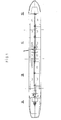
- FIG. 1 shows a top view of a combined disposal, extinguishing and disaster control ship 1, that is to say a ship which is used for the disposal of storage tanks, containers, holds of ships, etc., and also for extinguishing burning storage tanks, containers, holds, silos , other ships etc., whereby the goods from the storage tanks, holds etc. can be taken over at the same time, provided that they are pumpable.
- a combined disposal, extinguishing and disaster control ship 1 that is to say a ship which is used for the disposal of storage tanks, containers, holds of ships, etc., and also for extinguishing burning storage tanks, containers, holds, silos , other ships etc., whereby the goods from the storage tanks, holds etc. can be taken over at the same time, provided that they are pumpable.
- the wheelhouse 2 and the engine room 3 arranged below it, which has a production system for producing an oil lock, are located in a manner known per se at the stern 4 of the ship.
- the auxiliary machine room 5 which has pumps, a separator, water separator, a production plant for nitrogen and carbon dioxide, a plant for the treatment of water for drinking water, etc., adjoins the machine room.
- the hull is up to the bow thruster 6 through a bulkhead 7, cofferdams 8, 9 and bulkheads 10, 11, 12, 13 and 14 into the tank compartments 15, 16, 17, 18, 19 and 20 on the starboard side and divided into tank rooms 21, 22, 23, 24, 25 and 26 on the port side.
- the tank rooms 15, 17 and 19 and the tank rooms 22, 24, and 26 serve to hold the pure products resulting from the disposal of tanks, holds, etc., while the other tank rooms 16, 18, 20 and 21, 23 and 25 hold them of product residues, washes, filtrates, residues, emulsions, oils, dirty water, contaminated water, etc. are.
- inert gas nitrogen, carbon dioxide
- deck 27 there are on starboard and on port container 28 for the pasty waste products resulting from the disposal or for filter residues, sludge, rust, halogens etc., waste materials, which after the takeover as a special transport by truck for destruction under state supervision be transported away.
- ring line 29 designed as a suction and pressure line for washing and pressurized water which is required for cleaning and disposing of storage tanks, holds, etc.
- This ring line consists of the two main lines 30 and 31 running on the starboard and port sides in the longitudinal direction of the ship, which connects the connecting line 32 in front of the wheelhouse, between which and the line 30 a filter 34 is arranged via an interposed valve 33.
- a valve 35 is arranged between the connecting line 32 and the main line 31.
- a further valve 36 is arranged in the bypass in front of the valve 33 and is connected to a line section 37 running in the transverse direction of the ship in front of the wheelhouse.
- This line section 37 has on the port side and starboard side couplings 38 and 39 for hose lines, not shown, with which the tanks, holds, etc. are disposed of.
- a main pump 38 ′ which is arranged in front of the wheelhouse and is connected to the filter 34, is connected to this line section 37.
- a further valve 40 which is connected to the line section 37, is likewise arranged in the bypass in front of the valve 35.
- the ship valve groups 41 are further arranged between the main lines 30 and 31, so that the two main lines 30 and 31 can be divided into functional sections.
- the two main lines 30 and 31 also have couplings 42 and 43 for disposal hoses, not shown.
- line sections 44 and 45 are also provided in the transverse direction of the ship, which are connected to the main lines 30 and 31 and also have couplings 46 and 47 or 48 and 49 for disposal hoses, not shown.
- a fire extinguishing line 50 runs in front of the wheelhouse to the bow thruster, to which a pair of fire extinguisher pipes 51 and 52 or 53 and 54, or 53 ', 54' are connected in front of the wheelhouse, midships and on the bow thruster.
- the deck In the longitudinal direction of the ship, the deck also has a line 55 and 56 for nitrogen, carbon dioxide or halon on the starboard and on the port side, which is fed into the tanks to be disposed of, etc. as required.
- These lines also have couplings, which are designated 57 and 58 for hoses, not shown, which are manned in the storage tanks, holds, etc.
- Midships runs further on deck in the longitudinal direction of a line 59 with unillustrated couplings for hoses also not shown, on 'the air is introduced into the material to be dried storage tanks, cargo holds, etc..
- a fan 60 is connected to this line 59, which line 59 with air acted upon.
- a compressor can also take the place of the blower, the compressed air of which is filtered before being introduced into line 59.
- the jib crane 60 of a known oil suction device 61 is also located on the deck, approximately midships.
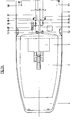
- FIG. 2 shows a longitudinal section through the exemplary embodiment shown in FIG. 1 (for the sake of clarity, the deck structures shown and explained in FIG. 1, such as the ring line, for example, are not shown).
- the cofferdams are ballast rooms that divide the hull in its transverse direction as transverse bulkheads.
- a rubber dam 62 is located between the machine room 3 and the auxiliary machine room 5.
- a ballast room 63 is located below the auxiliary machine room.
- ballast rooms and the cofferdams are connected to one another by lines in which pumps are arranged.
- ballast rooms and the cofferdams there is water as ballast, which during the disposal of storage tanks, silos, ships etc., is redistributed by the pumps into the ballast rooms and the cofferdams or by pumps, the ship is trimmed and its full maneuverability preserved.
- auxiliary machine room there is a plant for air liquefaction (nitrogen processing plant) in which air is liquefied in a manner known per se and in its components is disassembled, the liquefied nitrogen and the liquefied carbon dioxide being pumped into tanks from which the liquefied medium can be pumped into the ring line or into the fire-fighting line via pumps, valves and lines (not shown). Furthermore, tanks for halons connected to the ring line are also provided.
- auxiliary machine room there is also a separator for separating the residual loads of liquid products from contaminants, for emulsions, etc.
- the separated contaminants, residues, oils, etc. are also pumped into the assigned holds of the disposal, extinguishing and disaster control ship via pipes and pumps.
- a fire pump and a foam tank are also installed in the auxiliary machine room.
- the fire extinguisher pump draws in water on the outboard side, which may be mixed with nitrogen and / or carbon dioxide and then fed into the extinguishing line. If necessary, the fire pump feeds foam into the fire extinguishing line.
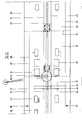
- FIG. 3 shows in the block diagram details of the machine room and the auxiliary machine room.
- the cooling circuit of the main drive 64 in the machine room 3 has a heat exchanger 65 which is flowed through on the primary side by the cooling water of the main drive and on the secondary side by water sucked in from the outside, which water is pumped into the ballast spaces after heating, from where it flows into the storage tanks to be cleaned, Holds etc. can be pumped.
- the heated water is also used to extinguish fires at temperatures below freezing and is supplied to the fire extinguishing line either directly or from the ballast rooms for this purpose.
- a system 66 for liquefying air is also coupled to the main drive, which supplies the liquefied nitrogen and the liquefied carbon dioxide to the tanks 67 and 68, respectively, or directly feeds the liquefied nitrogen or the liquefied carbon dioxide into the ring line or feeds the fire extinguishing line.
- the auxiliary machine room has an auxiliary machine 69, in the cooling circuit of which a heat exchanger 70 is arranged, through which the cooling water of the auxiliary drive flows on the primary side and water drawn in from the outside on the secondary side, which after heating is also pumped into the ballast rooms, from where it enters the pumped to clean storage tanks, holds, etc.
- the heated water is also used to extinguish fires at temperatures below freezing and for this purpose is either directly or from the ballast rooms. Load rooms supplied to the fire extinguishing line.
- the auxiliary machine is also coupled to the air liquefaction plant.
- a separator to which emulsions, etc., are pumped in via the pump 72 from the storage tanks, cargo spaces, etc. to be disposed of.
- the water from a pump 73 is supplied to an associated cargo space or outboard and the oil, etc. to an associated cargo space via a pump 74.
- the auxiliary machine room also has the fire-fighting pump, designated 75, which, via lines 76 and 77, to the tanks for liquefied nitrogen and liquefied coal di oxide or for halon can be connected via valves not shown.
- a pump 80 is also provided, which pumps nitrogen or carbon dioxide into the ring line and other lines if necessary.
- the auxiliary machine room has a treatment system 80 for water, which is used to produce drinking water, which is used at sea for cleaning tanks and can also be used for extinguishing
- the cargo holds of the disposal, extinguishing and disaster control ship are designed in a manner known per se and have main lines, bilge lines and remaining lines and a gas suspension line. If necessary, inert gas is supplied to these holds via one of these lines.
- the media, residues, impurities etc. pumped on board are separated from each other, filtered or cleaned and supplied to the assigned holds (the same procedure is used when disposing of ships).
- the resulting water is also cleaned and either pumped outboard, reused or first fed into cargo holds and ballast rooms, from which it can be removed if necessary.
- the disposal, fire-fighting and catastrophe ships approach and dispose of the storage tanks one after the other. Accordingly, the tanks, containers, large containers, etc. are started up and disposed of by companies located in ports, on coasts and on waterways, such as chemical factories, etc. Accordingly, ships are approached and disposed of at sea.
- the oil suction device In the event of oil contamination, the oil suction device is extended and the oil or oil is extracted with water. Oil and water are then separated from one another in the separator.
- Burning storage tanks in ports, on coasts and on waterways are approached by the disposal, extinguishing and disaster control ship, which builds up a curtain of water and possibly nitrogen and / or carbon dioxide in front of it.
- Water or a mixture of water and nitrogen or carbon dioxide or halon or a foam tape is placed on the burning storage tanks sprayed.
- the hose connections are made with the loading extinguishers and an inert gas atmosphere is built up in the tank.
- any remaining cargo can be taken over. We proceeded accordingly when extinguishing burning ships.
Landscapes
- Engineering & Computer Science (AREA)
- Ocean & Marine Engineering (AREA)
- Chemical & Material Sciences (AREA)
- Public Health (AREA)
- Health & Medical Sciences (AREA)
- Combustion & Propulsion (AREA)
- Mechanical Engineering (AREA)
- General Health & Medical Sciences (AREA)
- Toxicology (AREA)
- Environmental & Geological Engineering (AREA)
- Business, Economics & Management (AREA)
- Emergency Management (AREA)
- Physical Or Chemical Processes And Apparatus (AREA)
- Filling Or Discharging Of Gas Storage Vessels (AREA)
Applications Claiming Priority (2)
| Application Number | Priority Date | Filing Date | Title |
|---|---|---|---|
| DE3618008 | 1986-05-28 | ||
| DE3618008 | 1986-05-28 |
Publications (2)
| Publication Number | Publication Date |
|---|---|
| EP0247594A2 true EP0247594A2 (fr) | 1987-12-02 |
| EP0247594A3 EP0247594A3 (fr) | 1989-07-12 |
Family
ID=6301828
Family Applications (1)
| Application Number | Title | Priority Date | Filing Date |
|---|---|---|---|
| EP87107731A Withdrawn EP0247594A3 (fr) | 1986-05-28 | 1987-05-27 | Méthode pour décharger des réservoirs à produits liquides situés aux bords de ou sur l'eau, en particulier des réservoirs de navires, et pour éteindre l'incendie quand ils ont pris feu |
Country Status (1)
| Country | Link |
|---|---|
| EP (1) | EP0247594A3 (fr) |
Cited By (1)
| Publication number | Priority date | Publication date | Assignee | Title |
|---|---|---|---|---|
| WO2006021770A1 (fr) * | 2004-08-24 | 2006-03-02 | Gordon Fraser | Procede et dispositif d'amelioration de la securite des navires |
Family Cites Families (7)
| Publication number | Priority date | Publication date | Assignee | Title |
|---|---|---|---|---|
| FR1305541A (fr) * | 1961-08-22 | 1962-10-05 | Chaland automoteur destiné à la récupération de produits légers flottant en nappe, ainsi qu'au nettoiement des bateaux, des ports, des rives et autres | |
| US3270706A (en) * | 1963-10-18 | 1966-09-06 | Rellumit Inter S A R L | Self-propelling barge |
| GB1346489A (en) * | 1971-06-10 | 1974-02-13 | Hughes Co Ltd F A | Inert gas supply apparatus for an oil tanker |
| US3899099A (en) * | 1973-06-21 | 1975-08-12 | Tank Sapp Uk Ltd | Inert gas system and method for tankers |
| GB1479432A (en) * | 1974-06-11 | 1977-07-13 | Lisnave Estaleiros Navais De L | Safety device for the compensation of leaks or losses of inert gas pressure contained inside vessel tanks |
| DE2928545C2 (de) * | 1979-07-14 | 1982-12-30 | Eckhart Ing.(grad.) 2165 Harsefeld Stoyke | Verfahren und Vorrichtung zur Reinigung von Ladetanks auf Tankschiffen |
| GB2061723B (en) * | 1979-10-29 | 1984-01-04 | Sedco Inc | Suppressing fires on offshore oil platforms |
-
1987
- 1987-05-27 EP EP87107731A patent/EP0247594A3/fr not_active Withdrawn
Cited By (3)
| Publication number | Priority date | Publication date | Assignee | Title |
|---|---|---|---|---|
| WO2006021770A1 (fr) * | 2004-08-24 | 2006-03-02 | Gordon Fraser | Procede et dispositif d'amelioration de la securite des navires |
| GB2431902A (en) * | 2004-08-24 | 2007-05-09 | Gordon Fraser | Method and apparatus for increasing the safety of ships |
| GB2431902B (en) * | 2004-08-24 | 2009-01-28 | Gordon Fraser | Method and apparatus for increasing the safety of ships |
Also Published As
| Publication number | Publication date |
|---|---|
| EP0247594A3 (fr) | 1989-07-12 |
Similar Documents
| Publication | Publication Date | Title |
|---|---|---|
| DE69302550T2 (de) | Verfahren zur Reinigung eines Behälters und zur Rückgewinnung und Behandlung der Restflüssigkeit im Behälter | |
| DE2429678A1 (de) | Vorrichtung und verfahren zum beschicken der ladungstanks eines tankschiffes mit inertgas | |
| US3744257A (en) | Water-surface cleansing ship | |
| DE60125361T2 (de) | Verfahren und vorrichtung zum ausschneiden von löchern | |
| DE69205823T2 (de) | Öltransport. | |
| EP0122908B1 (fr) | Procédé pour la séparation de mélanges liquides pollués | |
| DE2046452A1 (de) | Verfahren und Vorrichtung zum Gasbzw. Luftfreimachen von Gase enthaltenden Behältern durch Verdrängen mittels Inertgas | |
| DE2251555A1 (de) | Verfahren zur herabsetzung der korrosion von schiffsladetanks | |
| DE2148326C3 (de) | Verfahren und Vorrichtung zum Füllen und Entleeren von sauerstoffarmem Schutzgas in bzw. aus Schiffsräume(n) | |
| EP0745005B1 (fr) | Procede de stockage de dechets heterogenes | |
| EP0247594A2 (fr) | Méthode pour décharger des réservoirs à produits liquides situés aux bords de ou sur l'eau, en particulier des réservoirs de navires, et pour éteindre l'incendie quand ils ont pris feu | |
| DE2428080A1 (de) | Sand- und kiesbagger | |
| DE3526879A1 (de) | Verfahren und vorrichtung zum unterbinden von braenden bzw. explosionen bzw. des ablaufs unerwuenschter reaktionen bei luftzutritt von in einem abgegrenzten volumen befindlichen guetern, insbesondere von in tanksattel- bzw. silozuegen zu transportierendem treibstoff bzw. zu transportierenden chemischen produkten | |
| DE1897323U (de) | Wasserfahrzeug mit eigenantrieb fuer die rueckgewinnung leichter in schichten auf gewaessern schwimmender substanzen sowie fuer das reinigen von schiffen, haefen, ufern u. dgl. | |
| CH675996A5 (fr) | ||
| DE2253313A1 (de) | Verfahren zum entfernen von schlamm od. dgl. aus fluessigkeitstanks von schiffen und vorrichtung zur durchfuehrung des verfahrens | |
| US3554713A (en) | Process for burning oily residues in tankers | |
| DE202022105635U1 (de) | Baggergut-Transportschiff und zugehöriges System | |
| DE69604408T2 (de) | Vorrichtung und verfahren zum reinigen eines gas- oder dampfstroms | |
| DE4007512C2 (fr) | ||
| DE2928545C2 (de) | Verfahren und Vorrichtung zur Reinigung von Ladetanks auf Tankschiffen | |
| DE102024114981A1 (de) | System zur Verringerung einer Freisetzung von Ammoniak für ein Schiff und betreffendes Verfahren | |
| DE19524800C2 (de) | Verfahren zum immissionsarmen Trennen einer flüssiggasgefüllten Rohrleitung | |
| DE102021000428A1 (de) | Schiff für die Entsorgung und Verwertung von Abfällen, die auf Schiffen anfallen | |
| DE2207567A1 (de) | Sicherheitssystem für Tanker zur Verhinderung von Explosionen |
Legal Events
| Date | Code | Title | Description |
|---|---|---|---|
| PUAI | Public reference made under article 153(3) epc to a published international application that has entered the european phase |
Free format text: ORIGINAL CODE: 0009012 |
|
| 17P | Request for examination filed |
Effective date: 19870615 |
|
| AK | Designated contracting states |
Kind code of ref document: A2 Designated state(s): AT BE CH DE FR GB LI LU NL |
|
| PUAL | Search report despatched |
Free format text: ORIGINAL CODE: 0009013 |
|
| AK | Designated contracting states |
Kind code of ref document: A3 Designated state(s): AT BE CH DE FR GB LI LU NL |
|
| 17Q | First examination report despatched |
Effective date: 19920120 |
|
| STAA | Information on the status of an ep patent application or granted ep patent |
Free format text: STATUS: THE APPLICATION IS DEEMED TO BE WITHDRAWN |
|
| 18D | Application deemed to be withdrawn |
Effective date: 19931230 |