EP0247731B1 - Para- oder Meta-Terphenyltetracarbonsäuren, ihre Dianhydride und Verfahren zu ihrer Herstellung - Google Patents
Para- oder Meta-Terphenyltetracarbonsäuren, ihre Dianhydride und Verfahren zu ihrer Herstellung Download PDFInfo
- Publication number
- EP0247731B1 EP0247731B1 EP87303730A EP87303730A EP0247731B1 EP 0247731 B1 EP0247731 B1 EP 0247731B1 EP 87303730 A EP87303730 A EP 87303730A EP 87303730 A EP87303730 A EP 87303730A EP 0247731 B1 EP0247731 B1 EP 0247731B1
- Authority
- EP
- European Patent Office
- Prior art keywords
- meta
- para
- terphenyl
- dianhydride
- acid
- Prior art date
- Legal status (The legal status is an assumption and is not a legal conclusion. Google has not performed a legal analysis and makes no representation as to the accuracy of the status listed.)
- Expired - Lifetime
Links
- KFORNJQZOMJEIK-UHFFFAOYSA-M ON1OC[IH]C(CC2)C1CC2C(CCC1)CC1C(CCC1[In](O)O2)CC1N2[U] Chemical compound ON1OC[IH]C(CC2)C1CC2C(CCC1)CC1C(CCC1[In](O)O2)CC1N2[U] KFORNJQZOMJEIK-UHFFFAOYSA-M 0.000 description 1
Images




Classifications
-
- C—CHEMISTRY; METALLURGY
- C07—ORGANIC CHEMISTRY
- C07C—ACYCLIC OR CARBOCYCLIC COMPOUNDS
- C07C63/00—Compounds having carboxyl groups bound to a carbon atoms of six-membered aromatic rings
- C07C63/33—Polycyclic acids
- C07C63/331—Polycyclic acids with all carboxyl groups bound to non-condensed rings
Definitions
- This invention relates to a novel para- or metaterphenyltetracarboxylic acid, a dianhydride thereof and a process for preparing the same.
- aromatic tetracarboxylic acid or a dianhydride thereof pyromellitic acid or a dianhydride thereof, benzophenonetetracarboxylic acid dianhydride, etc. are known predominantly as a raw material for polyimide resins.
- the tetracarboxylic acid dianhydride of the formula (I) is a compound which can be synthesized through the route illustrated by the following reaction equation (II):
- an intermediate compound is obtained through a Diels-Alder reaction between one molecule of 1,4-bis( ⁇ -furano)benzene and two molecules of maleic anhydride, and then dehydrated with a concentrated sulfuric acid or a polyphosphoric acid to yield the tetracarboxylic acid dianhydride. Because of the nature of the reaction, the acid anhydride groups come to locate at 2,3- and 2 ⁇ ,3 ⁇ -positions.
- the compound of the formula (I) is used as a cross-linking agent for epoxy resins or phenol-formaldehyde resins.
- meta-benzenedi-sulfonyl chloride is reacted with an excess phthalic anhydride under reflux of the latter with generation of sulfur dioxide gas (SO2) and hydrogen chloride gas using copper as a catalyst to yield meta-terphenyltetracarboxylic acid dianhydride.
- SO2 sulfur dioxide gas
- hydrogen chloride gas using copper as a catalyst to yield meta-terphenyltetracarboxylic acid dianhydride.
- the resulting compound had a melting point m.p. of 130 to 165 °C.
- para-terphenyltetracarboxylic acid dianhydride of the abaove formula (I) is known as a crosslinking agent for epoxy resins or phenol resins.
- said para-terphenyltetracarboxylic acid dianhydride has the acid anhydride groups at 2,3- and 2 ⁇ ,3 ⁇ -positions. Accordingly, the polyimide resin synthesized from said anhydride is difficult to have higher molecular weight, resulting in insufficient heat resistance.
- the positions of the acid anhydride groups are not definite because of the nature of the synthesis. Besides, in view of the melting point of the resulting compound ranging from as wide as 130 to 165 °C, it can be understood that it is a mixture of compounds having acid anhydride groups at different positions.
- Use of such tetracarboxylic acid dianhydride as a raw material for polyimide resin will result in a polyimide resin of low molecular weight, and its heat resistance is insufficient.
- This invention is directed to provide a novel terphenyltetracarboxylic acid or a dianhydride thereof and a process for preparing the same for the purpose of overcoming the problems in the prior art technologies.
- FIG. 1 shows a 1H-NMR spectrum of 3,4,3 ⁇ ,4 ⁇ -tetramethyl-para-terphenyl which is an intermediate in Example 1;
- FIG. 2 a 13C-NMR spectrum of 3,4,3 ⁇ ,4 ⁇ -tetramethyl-para-terphenyl;
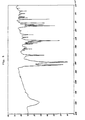
- FIG. 3 an infrared absorption spectrum of para-terphenyl-3,4,3 ⁇ ,4 ⁇ -tetracarboxylic acid;
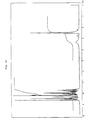
- FIG. 4 an 1H-NMR spectrum of para-terphenyl-3,4,3 ⁇ ,4 ⁇ -tetracarboxylic acid tetramethyl ester;
- FIG. 1 shows a 1H-NMR spectrum of 3,4,3 ⁇ ,4 ⁇ -tetramethyl-para-terphenyl which is an intermediate in Example 1;
- FIG. 2 a 13C-NMR spectrum of 3,4,3 ⁇ ,4 ⁇ -tetramethyl-para-terphenyl;
- FIG. 3 an infrared
- FIG. 5 an infrared absorption spectrum of para-terphenyl-3,4,3 ⁇ ,4 ⁇ -tetracarboxylic acid 3,4;3 ⁇ ,4 ⁇ -dianhydride;
- FIG. 6 a 1H-NMR spectrum of para-terphenyl-3,4,3 ⁇ ,4 ⁇ -tetracarboxylic acid 3,4;3 ⁇ ,4 ⁇ -dianhydride.
- FIG. 7 shows a 1H-NMR spectrum of 3,4,3 ⁇ ,4 ⁇ - tetramethyl-meta-terphenyl which is an intermediate in Example 2;
- FIG. 8 a 13C-NMR spectrum of 3,4,3 ⁇ ,4 ⁇ -tetramethyl-meta-terphenyl;
- FIG. 9 an infrared absorption spectrum of meta-terphenyl-3,4,3 ⁇ ,4 ⁇ -tetracarboxylic acid;
- FIG. 10 an 1H-NMR spectrum of meta-terphenyl-3,4,3 ⁇ ,4 ⁇ -tetracarboxylic acid tetramethyl ester;
- FIG. 10 an 1H-NMR spectrum of meta-terphenyl-3,4,3 ⁇ ,4 ⁇ -tetracarboxylic acid tetramethyl ester;
- FIG. 10 an 1H-NMR spectrum of meta-terphenyl-3,4,3 ⁇ ,4 ⁇ -tetracarboxylic acid te
- FIG. 11 an infrared absorption spectrum of meta-terphenyl-3,4,3 ⁇ ,4 ⁇ -tetracarboxylic acid 3,4;3 ⁇ ,4 ⁇ -dianhydride
- FIG. 12 a 1H-NMR spectrum of meta-terphenyl-3,4,3 ⁇ ,4 ⁇ tetracarboxylic acid 3,4;3 ⁇ ,4 ⁇ -dianhydride.
- One aspect of this invention relates to para- or meta-terphenyl-3,4,3 ⁇ ,4 ⁇ -tetracarboxylic acid or a dianhydride thereof.
- the para-terphenyl-3,4,3 ⁇ ,4 ⁇ -tetracarboxylic acid is a compound which can be represented by the following formula (IV):
- Para-terphenyl-3,4,3 ⁇ ,4 ⁇ -tetracarboxylic acid 3,4:3 ⁇ ,4 ⁇ -dianhydride which is a dianhydride of the above compound of the formula (IV), is a compound which can be represented by the following formula (V):
- the para-terphenyltetracarboxylic acid or dianhydride thereof has the carboxyl groups or acid anhydride groups located at both ends of the para-terphenyl at 3,4- and 3 ⁇ ,4 ⁇ -positions thereof, which is a structure different from that of the prior art para-terphenyltetracarboxylic acid dianhydride of the formula (I). Accordingly, it can give a linear structure with the molecules connected in a stretched form, when it is reacted with a diamine compound to yield polyamide acid, and then the polyamide acid obtained is further dehydrated to yield a polyimide resin, thereby giving a polyimide resin having excellent heat resistance.
- the meta-terphenyl-3,4,3 ⁇ ,4 ⁇ -tetracarboxylic acid is a compound which can be represented by the following formula (IV′):
- Meta-terphenyl-3,4,3 ⁇ ,4 ⁇ -tetracarboxylic acid 3,4:3 ⁇ ,4 ⁇ -dianhydride which is a dianhydride of the abaove compound of the formula (IV′), is a compound which can be represented by the following formula (V′):
- the meta-terphenyltetracarboxylic acid or dianhydride thereof has the carboxyl groups or acid anhydride groups located at both ends of the meta-terphenyl at 3,4-and 3 ⁇ ,4 ⁇ -positions thereof, it can give a linear structure with the molecules connected in a stretched linear form, when it is reacted with a diamine compound to yield a polyamide acid, and then the polyamid acid obtained is further dehydrated to yield a polyimide resin, thereby giving a polyimide resin having a high molecular weight and excellent heat resistance.
- the meta-terphenyltetracarboxylic acid or the dianhydride thereof according to this invention is a single compound (not a mixture) as can be seen from the Examples given below.
- Another aspect of this invention relates to a process for preparing the compound according to this invention.
- the second object of this invention is to provide a process for preparing the para- or meta-terphenyl-3,4,3 ⁇ ,4 ⁇ -tetracarboxylic acid or dianhydride thereof, comprising oxidizing 3,4,3 ⁇ ,4 ⁇ -tetramethyl-para-or meta-terphenyl, and if necessary, followed by dehydrative cyclization reaction of the resulting oxidized product.
- the above 3,4,3 ⁇ ,4 ⁇ -tetramethyl-para- or meta-terphenyl can be obtained by subjecting a Grignard reagent of a 4-halogeno-ortho-xylene and a para- or meta-dihalogeno-benzene to double cross-coupling reaction.
- the para-terphenyltetracarboxylic acid and dianhydride thereof can be prepared through the reaction illustrated by the following reaction equation (VI): wherein X1 and X2 independent of each other, represent a chlorine, a bromine or a iodine atom.
- the meta-terphenyltetracarboxylic acid and dianhydride thereof can be prepared from the reaction illustrated by the following reaction equation (VI′): wherein X1 and X2, independent of each other, represent a chlorine, a bromine or an iodine atom.
- the 4-halogeno-ortho-xylene is reacted with a metallic magnesium according to a customary method to produce a Grignard reagent, and then a para- or meta-dihalogenobenzene and a nickel metal complex catalyst are added to the Grignard reagent thus obtained to yield teteramethyl-para-terphenyl through double cross-coupling reaction.
- the resulting intermediate, 3,4,3 ⁇ ,4 ⁇ -tetramethyl-para- or meta-terphenyl is oxidized with a permanganate salt or nitric acid, or by liquid phase air oxidization to yield para- or meta-terphenyl-3,4,3 ⁇ ,4 ⁇ -tetracarboxylic acid, which is further heated or treated with acetic anhydride to yield para- or meta-terphenyl-3,4,3 ⁇ ,4 ⁇ -tetracarboxylic acid 3,4:3 ⁇ ,4 ⁇ -dianhydride.
- the above dianhydride can be obtained directly by subjecting 3,4,3 ⁇ ,4 ⁇ -tetramethyl-para-terphenyl to gas phase oxidization.
- the 4-halogeno-ortho-xylene includes 4-iodo-orthoxylene, 4-bromo-ortho-xylene, etc.
- the reaction for obtaining the Grignard reagent is conducted typically at a temperature of 0 °C or more and below the reflux temperature of a solvent used, and the reaction time is typically 1 to 10 hours.
- the solvent to be used in the above reaction includes methyl ether, tetrahydrofuran, etc.
- the para-dihalogenobenzene includes para-dibromobenzene, para-dichlorobenzene, etc.
- paradichlorobenzene By use of paradichlorobenzene, inter alia , a higher yield will be obtained from the double cross-coupling reaction.
- the meta-dihalogenobenzene includes meta-dibromobenzene, meta-dichlorobenzene, etc.
- meta-dichlorobenzene inter alia , a higher yield will be obtained from the double cross-coupling reaction.
- the para- or meta-dihalogenobenzene is used in an amount of 0.5 mole relative to 1.0 mole in terms of the 4-halogeno-ortho-xylene component in the Grignard reagent. If said amount is less than 0.5 mol, a residual unreacted Grignard reagent will be present after completion of the reaction, which will be hydrolyzed to form ortho-xylene upon subsequent water washing to reduce the yield of the desired product, although it does not interfere the reaction. On the other hand, if said amount exceeds 0.5 mole, undesired poly-para-phenylene will be formed as a by-product in larger amount.
- the nickel metal complex catalyst includes dichlorobis(triphenylphosphine)nickel, dibromobis-(triphenylphosphine)nickel, diiodobis(triphenylphosphine)nickel, dichloro[1,2-bis(diphenylphosphino)ethane]nickel, dibromo[1,2-bis(diphenylphosphino)ethane]nickel, dichloro[1,3-bis(diphenylphosphino)propane]nickel, dibromo[1,3-bis(diphenylphosphino)propane]nickel, etc.
- the nickel metal complex catalyst may preferably be used in an amount of 0.1 to 1.0 % by weight relative to the Grignard reagent in terms of the amount of the 4-halogeno-ortho-xylene component in the Grignard reagent.
- the double cross-coupling reaction may preferably be conducted at 20 to 60 °C, and the reaction time is usually 1 to 5 hours. Use of low reaction temperature simply leads to longer reaction time, causing no substantial problem. However, if the reaction temperature exceeds 60 °C, components having a high boiling point such as polyphenylene, and by-products such as tetramethylbiphenyl are liable to be formed in larger amounts.
- the magnesium salt is removed by washing with water.
- the resulting intermediate, 3,4,3 ⁇ ,4 ⁇ -tetramethyl-para-terphenyl may be purified, if necessary, by recrystallization procedure using toluene, xylene, etc. as a solvent.
- the intermediate 3,4,3 ⁇ ,4 ⁇ -tetramethyl-meta-terphenyl can be purified, if necessary, by washing with ethanol etc.
- the intermediate, 3,4,3 ⁇ ,4 ⁇ -tetramethyl-para- or meta-terphenyl may be oxidized to give para- or meta-terphenyl-3,4,3 ⁇ ,4 ⁇ -tetracarboxylic acid according to this invention.
- the solvent employed herein is a mixed solution of water and pyridine, preferably in a weight ratio of water to pyridine of 1.0 : 0.5 to 2.0.
- a mixed solution of water and pyridine preferably in a weight ratio of water to pyridine of 1.0 : 0.5 to 2.0.
- To 100 g of this solution 5 to 15 g of 3,4,3 ⁇ ,4 ⁇ -tetramethyl-para- or meta-terphenyl is added, and to the resulting mixture is added slowly 12-fold moles of potassium permanganage.
- the oxidization reaction may not be completed by use of less than 12-fold moles of the permanganate.
- the reaction is conducted at a temperature of 50 °C or more and not higher than the reflux temperature (93 °C), usually for 5 to 10 hours.
- the potassium permanganate is converted to a solvent-insoluble manganese oxide, which is then removed by filtration.
- the filtrate is subjected to acid precipitation treatment with a concentrated hydrochloric acid since it contains para- or meta-terphenyl-3,4,3 ⁇ ,4 ⁇ -tetracarboxylic acid having dissolved therein in the form of a potassium salt.
- the filtrate also contains pyridine, the pyridine is distilled off in a rotary evaporator prior to the acid precipitation.
- the concentrated hydrochloric acid is added in an amount such that the pH of the solution may be 1, to give a white crystal of para- or meta-terphenyl-terphenyl-3,4,3 ⁇ ,4 ⁇ -tetracarboxylic acid.
- the resulting para- or meta-terphenyl-3,4,3 ⁇ ,4 ⁇ -tetracarboxylic acid compound comes to be hydrated with two molecules of water of crystallization
- para- or meta-terphenyl-3,4,3 ⁇ ,4 ⁇ -tetracarboxylic acid can be converted to para-or meta-terphenyl-3,4,3 ⁇ ,4 ⁇ -tetracarboxylic acid 3,4:3 ⁇ ,4 ⁇ -dianhydride according to a method in which said para- or meta terphenyl-3,4,3 ⁇ ,4 ⁇ -tetracarboxylic acid is heated at 120 °C to 250 °C under a reduced pressure of 5 to 50 mmHg for 1 to 24 hours; to a method in which 30 to 60 g of acetic anhydride is added relative to 1 g of said para- or meta-terphenyl-3,4,3 ⁇ ,4 ⁇ -tetracarboxylic acid, and then the resulting mixture is refluxed for 0.5 to 2 hours with heating, followed by filtration using a hot funnel and subsequent recrystallization; or to other method.
- the para- or meta-terphenyl-3,4,3 ⁇ ,4 ⁇ -tetracarboxylic acid or dianhydride thereof according to this invention is useful as a raw material for polyimide resins and resins of other kinds, or as a curing agnnt for epoxy resins, phenol resins, etc.
- % means “% by weight”.
- a two liter four-necked flask equipped with an Allihn condenser, a dropping funnel, a thermometer and a stirrer was dried sufficiently under an argon gas atmosphere and then charged with 100 ml of tetrahydrofuran dried with metallic sodium, 9.72 g of metallic magnesium and 10.0 g of bromo-ortho-xylene (a mixture of 75 % of 4-bromo-ortho-xylene and 25 % of 3-bromo-orthoxylene).
- the melting point of the crystal was 168 to 169 °C.
- the proton nuclear magnetic resonance (1H-NMR) spectrum and the carbon nuclear magnetic resonance (13C-NMR) spectrum of the product are shown in FIG. 1.
- the compound obtained theoretical carbon number : 22
- the absorptions 1 to 8 appear in FIG. 2, which is consistent enough with expected values of chemical shift of a benzene ring carbon calculated by the Savitzky rule with respect to the benzene ring carbons Nos. 1 to 8 of the compound represented by the formula [VII]:
- the melting point of the crystal was 311 to 313 °C.
- the infrared absorption spectrum thereof is shown in FIG. 3.
- To the crystal were added 50 ml of methanol and 2 ml of 97 % sulfuric acid per 0.4 g of the crystal and the resulting mixture was refluxed for 8 hours to conduct methyl esterification of the above crystal.
- the result of 1H-NMR spectrum of the methyl esterified product obtained is shown in FIG. 4.
- thermogravimetry-differential thermal analysis of the above crystal was conducted at a rate of temperature elevation of 5 °C/min.
- the endothermic peaks were obtained at 160 °C, 230 °C and 310 °C.
- weight loss of 17 % in total was observed.
- the endothermic peak at 310 °C was caused by the melting, the endothermic peaks at 160 °C and 230 °C were brought about by dehydration.
- the melting point of the crystal was 311 to 313 °C.
- carbon was 71.28 % and hydrogen was 2.76 %, which were consistent enough with the theoretical values (the compound of Formula [V]), i.e. carbon : 71.36 %, hydrogen : 2.72 %. It was confirmed thereby that the crystal was para-terphenyl-3,4,3 ⁇ ,4 ⁇ -tetracarboxylic acid 3,4:3 ⁇ ,4 ⁇ -dianhydride.
- a Grignard reagent was prepared in the same manner as in (1) of Example 1.
- the melting point of the crystal was 72 to 73 °C.
- the results of the proton nuclear magnetic resonance (1H-NMR) spectrum and the carbon nuclear magnetic resonance (13C-NMR) spectrum are shown in FIG. 7 and FIG. 8, respectively.
- the compound obtained (theoretical carbon number : 22) has a symmetric structure with respect to the benzene ring in the center of terphenyl. Further, the absorptions 1 to 10 appear in FIG. 8, which corresponds approximately to the expected value of chemical shift of the benzene ring carbon calculated by the Savitzky rule with respect to the benzene ring carbons Nos. 1 to 8 of the compound represented by the formula [VIII]:
- the melting point of the crystal was 296 to 298 °C.
- the infrared absorption spectrum thereof is shown in FIG. 9. 50 ml of methanol and 2 ml of 97 % sulfuric acid per 0.4 g of the crystal were added thereto and the mixture was refluxed for 8 hours to conduct methyl esterification of the above crystal.
- the result of 1H-NMR spectrum of the resulting methyl ester is shown in FIG. 10. In FIG.
- thermogravimetry-differential thermal analysis of the above crystal was conducted at a rate of temperature increase of 5 °C/min.
- the endothermic peaks were obtained at 211 °C and 298 °C.
- weight loss of 17 % in total was observed.
- the endothermic peak at 298 °C was brought about by the melting, the endothermic peak at 211 °C was brought about by the dehydration.
- the weight loss should be 9 %. Accordingly, the crystal obtained can be thought to have crystal water and the found values of the above elemental analysis extremely correspond to theoretical values of the elemental analysis, i.e. carbon : 59.73 %, hydrogen : 4.10 %, in the case where two molecules of crystal water are hydrated in the compound of Formula [IV′].
- the melting point of the crystal was 296 to 298 °C.
- carbon was 71.17 % and hydrogen was 2.79 %, which corresponds approximately to the theoretical values (the compound of Formula [V]), i.e. carbon : 71.36 %, hydrogen : 2.72 %. It was confirmed thereby the crystal was meta-terphenyl-3,4,3 ⁇ ,4 ⁇ -tetracarboxylic acid-3,4:3 ⁇ ,4 ⁇ -dianhydride.
- the polyamide acid varnish obtained was casted on a glass plate and subjected to heat treatment in a thermo-controlled hot-air oven at 150 °C for 1 hour and subsequently at 350 °C for 1 hour to remove the reaction solvent. Also, the polyamide acid was coverted into a polyimide through a dehydration reaction to obtain a polyimide film with a thickness of 40 ⁇ m.
- the weight loss of the polyimide film after left to stand in air at 460 °C for 30 minutes was 21 %.
- the thermo-gravimetrical analysis (rate of temperature increase : 10 °C/min.) revealed that the weight loss started at 472 °C.
- the polyamide acid varnish obtained was casted on a glass plate and subjected to heat treatment in a thermo-controlled hot-air oven at 150 °C for 1 hour and at 350 °C for 1 hour to remove the reaction solvent. Also, the polyamide acid was coverted into a polyimide through a dehydration reaction to obtain a polyimide film with a thickness of 40 ⁇ m.
- the weight loss of the polyimide film after left to stand in air at 460 °C for 30 minutes was 3.2 %.
- the thermo-gravimetrical analysis (rate of temperature elevation : 10 °C/min.) revealed that the weight loss started at 464 °C.
Landscapes
- Chemical & Material Sciences (AREA)
- Organic Chemistry (AREA)
- Macromolecular Compounds Obtained By Forming Nitrogen-Containing Linkages In General (AREA)
Claims (4)
Applications Claiming Priority (4)
| Application Number | Priority Date | Filing Date | Title |
|---|---|---|---|
| JP100379/86 | 1986-04-30 | ||
| JP10037986A JPS62258339A (ja) | 1986-04-30 | 1986-04-30 | 新規なメタ−タ−フエニルテトラカルボン酸又はそのジ無水物並びにこれらの製造法 |
| JP100378/86 | 1986-04-30 | ||
| JP10037886A JPS62258338A (ja) | 1986-04-30 | 1986-04-30 | 新規なパラ−タ−フエニルテトラカルボン酸又はそのジ無水物並びにこれらの製造法 |
Publications (2)
| Publication Number | Publication Date |
|---|---|
| EP0247731A1 EP0247731A1 (de) | 1987-12-02 |
| EP0247731B1 true EP0247731B1 (de) | 1991-08-21 |
Family
ID=26441412
Family Applications (1)
| Application Number | Title | Priority Date | Filing Date |
|---|---|---|---|
| EP87303730A Expired - Lifetime EP0247731B1 (de) | 1986-04-30 | 1987-04-28 | Para- oder Meta-Terphenyltetracarbonsäuren, ihre Dianhydride und Verfahren zu ihrer Herstellung |
Country Status (3)
| Country | Link |
|---|---|
| US (1) | US4912233A (de) |
| EP (1) | EP0247731B1 (de) |
| DE (1) | DE3772260D1 (de) |
Families Citing this family (4)
| Publication number | Priority date | Publication date | Assignee | Title |
|---|---|---|---|---|
| JP2735314B2 (ja) * | 1989-10-06 | 1998-04-02 | 株式会社日立製作所 | 高純度の3,3’,4,4’―ビフェニルテトラカルボン酸又はその酸二無水物の製造方法 |
| US5198555A (en) * | 1991-11-15 | 1993-03-30 | Amoco Corporation | Dianhydrides from catalyzed reaction of monoanhydide monoacid halides with polyalkylated mononuclear aromatics |
| CN113583443B (zh) * | 2021-08-04 | 2022-11-22 | 深圳瑞华泰薄膜科技股份有限公司 | 一种应用于柔性光电领域的透明聚酰亚胺及其制备方法 |
| CN117105892A (zh) * | 2023-08-10 | 2023-11-24 | 大连新阳光材料科技有限公司 | 一种3,4,3″,4″-对三联苯四羧酸二酐的合成方法 |
Family Cites Families (6)
| Publication number | Priority date | Publication date | Assignee | Title |
|---|---|---|---|---|
| US3270067A (en) * | 1962-07-12 | 1966-08-30 | Merck & Co Inc | Chemical process and products produced thereby |
| US3576013A (en) * | 1962-12-28 | 1971-04-20 | Monsanto Chemicals | Polyanhydrides |
| US3891633A (en) * | 1970-01-07 | 1975-06-24 | Alfred Anisimovich Berlin | Method of producing dianhydrides of aromatic tetracarboxylic acids |
| GB1338932A (en) * | 1971-01-01 | 1973-11-28 | Inst Khim Fiz An Sssr | Method of producing dianhydrides of aromatic tetracarboxylic acids |
| GB2073213B (en) * | 1980-03-19 | 1983-08-24 | Coal Industry Patents Ltd | Phenanthrene based polyimide resin |
| US4600798A (en) * | 1985-03-18 | 1986-07-15 | General Electric Company | Aryl-diethers |
-
1987
- 1987-04-28 EP EP87303730A patent/EP0247731B1/de not_active Expired - Lifetime
- 1987-04-28 DE DE8787303730T patent/DE3772260D1/de not_active Expired - Lifetime
-
1988
- 1988-10-21 US US07/262,220 patent/US4912233A/en not_active Expired - Lifetime
Non-Patent Citations (1)
| Title |
|---|
| Methoden der organischen Chemie (HOUBEN-WEYL) 1981, vol. v/2b, pages 201-202 and 1952, vol VIII, pages 388-389 * |
Also Published As
| Publication number | Publication date |
|---|---|
| DE3772260D1 (de) | 1991-09-26 |
| US4912233A (en) | 1990-03-27 |
| EP0247731A1 (de) | 1987-12-02 |
Similar Documents
| Publication | Publication Date | Title |
|---|---|---|
| US4017511A (en) | Preparation of aromatic bisimides | |
| JP3053462B2 (ja) | 9,9−ビス(パーフルオロアルキル)キサンテン、9−アリール−9−パーフルオロアルキルキサンテン、それより誘導されるモノマーおよびポリマー | |
| EP0247731B1 (de) | Para- oder Meta-Terphenyltetracarbonsäuren, ihre Dianhydride und Verfahren zu ihrer Herstellung | |
| US4795827A (en) | Cyclobutarene ketoaniline monomeric and polymeric compositions | |
| CN102099349A (zh) | 邻苯二甲酸酐衍生物的制造方法 | |
| US4002645A (en) | Bis aromatic anhydrides | |
| US4173573A (en) | Process for preparing 3,4,3,4-benzophenone-tetracarboxylic dianhydride | |
| US4587312A (en) | Sulfone-ester polymers containing pendent ethynyl groups | |
| JP2704200B2 (ja) | 含フツ素ピロメリット酸無水物及びその製造方法 | |
| US5003086A (en) | Process of preparing dioxydiphthalic anhydride | |
| CN108329251B (zh) | 一种双醚双酞酰亚胺的制备方法 | |
| EP0477539B1 (de) | Tetracarbonsäuredianhydride | |
| JPH0329779B2 (de) | ||
| JPH0329778B2 (de) | ||
| US4825001A (en) | Cyclobutarene ketoaniline monomeric and polymeric compositions | |
| JPH0445527B2 (de) | ||
| CN115477629B (zh) | 一类四氟乙基双(邻苯二甲酸酐)衍生物的制备方法及其应用 | |
| JPH04103579A (ja) | テトラカルボン酸二無水物 | |
| CN119350118B (zh) | 一种含不饱和双键的本征交联苯并环丁烯单体的制备方法及其应用 | |
| US4622182A (en) | 5-(4-ethynylophenoxy)isophthalic chloride | |
| JP2933695B2 (ja) | テトラカルボン酸二無水物 | |
| CA2015164A1 (en) | Dioxydiphthalic anhydride | |
| JPH0686522B2 (ja) | 新規なポリイミドの製造法 | |
| KR940007320B1 (ko) | 신규한 폴리아릴레이트수지와 그 제조방법 | |
| US5242917A (en) | Tetracarboxylic acid dianhydride having disiloxane linkage and process for producing the same |
Legal Events
| Date | Code | Title | Description |
|---|---|---|---|
| PUAI | Public reference made under article 153(3) epc to a published international application that has entered the european phase |
Free format text: ORIGINAL CODE: 0009012 |
|
| 17P | Request for examination filed |
Effective date: 19870502 |
|
| AK | Designated contracting states |
Kind code of ref document: A1 Designated state(s): DE FR GB |
|
| 17Q | First examination report despatched |
Effective date: 19900124 |
|
| GRAA | (expected) grant |
Free format text: ORIGINAL CODE: 0009210 |
|
| AK | Designated contracting states |
Kind code of ref document: B1 Designated state(s): DE FR GB |
|
| REF | Corresponds to: |
Ref document number: 3772260 Country of ref document: DE Date of ref document: 19910926 |
|
| ET | Fr: translation filed | ||
| PLBE | No opposition filed within time limit |
Free format text: ORIGINAL CODE: 0009261 |
|
| STAA | Information on the status of an ep patent application or granted ep patent |
Free format text: STATUS: NO OPPOSITION FILED WITHIN TIME LIMIT |
|
| 26N | No opposition filed | ||
| PGFP | Annual fee paid to national office [announced via postgrant information from national office to epo] |
Ref country code: FR Payment date: 20010409 Year of fee payment: 15 |
|
| PGFP | Annual fee paid to national office [announced via postgrant information from national office to epo] |
Ref country code: DE Payment date: 20010423 Year of fee payment: 15 |
|
| PGFP | Annual fee paid to national office [announced via postgrant information from national office to epo] |
Ref country code: GB Payment date: 20010425 Year of fee payment: 15 |
|
| REG | Reference to a national code |
Ref country code: GB Ref legal event code: IF02 |
|
| PG25 | Lapsed in a contracting state [announced via postgrant information from national office to epo] |
Ref country code: GB Free format text: LAPSE BECAUSE OF NON-PAYMENT OF DUE FEES Effective date: 20020428 |
|
| PG25 | Lapsed in a contracting state [announced via postgrant information from national office to epo] |
Ref country code: DE Free format text: LAPSE BECAUSE OF NON-PAYMENT OF DUE FEES Effective date: 20021101 |
|
| GBPC | Gb: european patent ceased through non-payment of renewal fee |
Effective date: 20020428 |
|
| PG25 | Lapsed in a contracting state [announced via postgrant information from national office to epo] |
Ref country code: FR Free format text: LAPSE BECAUSE OF NON-PAYMENT OF DUE FEES Effective date: 20021231 |
|
| REG | Reference to a national code |
Ref country code: FR Ref legal event code: ST |