EP0248960A1 - Matériau produisant de l'hydrogène - Google Patents
Matériau produisant de l'hydrogène Download PDFInfo
- Publication number
- EP0248960A1 EP0248960A1 EP86306754A EP86306754A EP0248960A1 EP 0248960 A1 EP0248960 A1 EP 0248960A1 EP 86306754 A EP86306754 A EP 86306754A EP 86306754 A EP86306754 A EP 86306754A EP 0248960 A1 EP0248960 A1 EP 0248960A1
- Authority
- EP
- European Patent Office
- Prior art keywords
- hydrogen
- aluminum
- tin
- aluminum alloy
- rate
- Prior art date
- Legal status (The legal status is an assumption and is not a legal conclusion. Google has not performed a legal analysis and makes no representation as to the accuracy of the status listed.)
- Withdrawn
Links
Images



Classifications
-
- C—CHEMISTRY; METALLURGY
- C22—METALLURGY; FERROUS OR NON-FERROUS ALLOYS; TREATMENT OF ALLOYS OR NON-FERROUS METALS
- C22C—ALLOYS
- C22C21/00—Alloys based on aluminium
- C22C21/003—Alloys based on aluminium containing at least 2.6% of one or more of the elements: tin, lead, antimony, bismuth, cadmium, and titanium
-
- C—CHEMISTRY; METALLURGY
- C01—INORGANIC CHEMISTRY
- C01B—NON-METALLIC ELEMENTS; COMPOUNDS THEREOF; METALLOIDS OR COMPOUNDS THEREOF NOT COVERED BY SUBCLASS C01C
- C01B3/00—Hydrogen; Gaseous mixtures containing hydrogen; Separation of hydrogen from mixtures containing it; Purification of hydrogen; Reversible storage of hydrogen
- C01B3/02—Production of hydrogen; Production of gaseous mixtures containing hydrogen
- C01B3/06—Production of hydrogen; Production of gaseous mixtures containing hydrogen by reaction of inorganic compounds containing electro-positively bound hydrogen with inorganic reducing agents
- C01B3/08—Production of hydrogen; Production of gaseous mixtures containing hydrogen by reaction of inorganic compounds containing electro-positively bound hydrogen with inorganic reducing agents by reaction of inorganic compounds with metals
-
- Y—GENERAL TAGGING OF NEW TECHNOLOGICAL DEVELOPMENTS; GENERAL TAGGING OF CROSS-SECTIONAL TECHNOLOGIES SPANNING OVER SEVERAL SECTIONS OF THE IPC; TECHNICAL SUBJECTS COVERED BY FORMER USPC CROSS-REFERENCE ART COLLECTIONS [XRACs] AND DIGESTS
- Y02—TECHNOLOGIES OR APPLICATIONS FOR MITIGATION OR ADAPTATION AGAINST CLIMATE CHANGE
- Y02E—REDUCTION OF GREENHOUSE GAS [GHG] EMISSIONS, RELATED TO ENERGY GENERATION, TRANSMISSION OR DISTRIBUTION
- Y02E60/00—Enabling technologies; Technologies with a potential or indirect contribution to GHG emissions mitigation
- Y02E60/30—Hydrogen technology
- Y02E60/36—Hydrogen production from non-carbon containing sources, e.g. by water electrolysis
-
- Y—GENERAL TAGGING OF NEW TECHNOLOGICAL DEVELOPMENTS; GENERAL TAGGING OF CROSS-SECTIONAL TECHNOLOGIES SPANNING OVER SEVERAL SECTIONS OF THE IPC; TECHNICAL SUBJECTS COVERED BY FORMER USPC CROSS-REFERENCE ART COLLECTIONS [XRACs] AND DIGESTS
- Y10—TECHNICAL SUBJECTS COVERED BY FORMER USPC
- Y10S—TECHNICAL SUBJECTS COVERED BY FORMER USPC CROSS-REFERENCE ART COLLECTIONS [XRACs] AND DIGESTS
- Y10S428/00—Stock material or miscellaneous articles
- Y10S428/922—Static electricity metal bleed-off metallic stock
- Y10S428/9335—Product by special process
- Y10S428/937—Sprayed metal
-
- Y—GENERAL TAGGING OF NEW TECHNOLOGICAL DEVELOPMENTS; GENERAL TAGGING OF CROSS-SECTIONAL TECHNOLOGIES SPANNING OVER SEVERAL SECTIONS OF THE IPC; TECHNICAL SUBJECTS COVERED BY FORMER USPC CROSS-REFERENCE ART COLLECTIONS [XRACs] AND DIGESTS
- Y10—TECHNICAL SUBJECTS COVERED BY FORMER USPC
- Y10T—TECHNICAL SUBJECTS COVERED BY FORMER US CLASSIFICATION
- Y10T428/00—Stock material or miscellaneous articles
- Y10T428/12—All metal or with adjacent metals
- Y10T428/12493—Composite; i.e., plural, adjacent, spatially distinct metal components [e.g., layers, joint, etc.]
- Y10T428/12708—Sn-base component
-
- Y—GENERAL TAGGING OF NEW TECHNOLOGICAL DEVELOPMENTS; GENERAL TAGGING OF CROSS-SECTIONAL TECHNOLOGIES SPANNING OVER SEVERAL SECTIONS OF THE IPC; TECHNICAL SUBJECTS COVERED BY FORMER USPC CROSS-REFERENCE ART COLLECTIONS [XRACs] AND DIGESTS
- Y10—TECHNICAL SUBJECTS COVERED BY FORMER USPC
- Y10T—TECHNICAL SUBJECTS COVERED BY FORMER US CLASSIFICATION
- Y10T428/00—Stock material or miscellaneous articles
- Y10T428/12—All metal or with adjacent metals
- Y10T428/12493—Composite; i.e., plural, adjacent, spatially distinct metal components [e.g., layers, joint, etc.]
- Y10T428/12736—Al-base component
Definitions
- This invention relates to a hydrogen-producing material.
- the present invention is made from such a background. It is well known that aluminum reacts with oxygen in air at room temperature and passivation occurs owing to the formation of a highly stable oxide film on its surface. This oxide film provides resistance to corrosion by seawater and other aqueous and chemical solutions, so that aluminum and its alloys are employed in various applications.
- the inventors of this invention have now found that a binary aluminum alloy containing a certain amount of tin reacts with water even at room temperature and produces hydrogen without use of any chemicals. It has also been found that the rate of hydrogen production varies significantly with increasing tin content and with increasing temperature of water.
- Another object of the present invention is to provide a method for producing hydrogen at a low cost and at a high efficiency without use of a large quantity of electric or thermal energy.
- a hydrogen-producing material comprising an aluminum alloy consisting essentially of 5 to 50 % of tin and the balance being aluminum and inevitable impurities.
- a hydrogen-producing material comprising a deposit composed of flat fine metal particles, said metal particles comprising an aluminum alloy consisting essentially of 5 to 50 % of tin and the balance being aluminum and inevitable impurities.
- the hydrogen-producing material comprises a spray deposit formed on a base by a thermal spraying with a wire of an aluminum alloy consisting essentially of 5 to 50 % of tin and the balance being aluminum and inevitable impurities.
- the base there may be used those such as, for example, metals, plastics, glasses and ceramics.
- the metals for the base include, without being limited to, those such as mild steels, aluminum, copper and their alloys.
- the plastics for the base include, without being limited to, those such as acrylic resins, phenolic resins and polycarbonates.
- the base may take any form and may be used in the form of plates, sheets, bands and the like.
- the hydrogen producing material comprising an aluminum alloy containing 5 to 50% Sn may be produced by a continuous casting process disclosed in Japanese patent 1,049,146.
- a molten alloy of aluminum and tin is fed to a heating mold maintained at a temperature not less than the freezing point of the metal, and a casting is continuously withdrawn from the mold.
- the castings of aluminum alloys per se may be used as a hydrogen-producing material. It is, however, preferred to use it in the form of sheets, powder, spray deposits, and the like to improve the rate of hydrogen production.
- the hydrogen-producing material comprising a deposit formed on the base may be produced by a thermal spraying with a wire of an aluminum alloy consisting essentially of 5 to 50 % of tin and the balance being aluminum and inevitable impurities.
- the deposit may be formed by directly spraying a molten alloy from an furnace onto the base.
- the tin content of the hydrogen-producing material has been limited to the above range for the following reasons. It the content of tin in aluminum alloy is less than 5 % or more than 50 %, the aluminum alloy scarcely reacts with water and no hydrogen gas is produced.
- the hydrogen-producing material according to the present invention reacts with water even at room temperature and produces hydrogen gas with the purity of 99.4 % and above.
- the rate of hydrogen production varies considerably with the tin content and with the physical form of the hydrogen producing material.
- the rate of hydrogen production can be improved by the use of a hydrogen producing material comprising a spray deposit of the aluminum alloy containing 10 to 30% Sn.
- the use of such a material makes it possible to obtain the maximum rate of hydrogen production which is about 70 to 80 times as fast as that of the alloy itself.
- the hydrogen production rate may be increased by the use of hot water.
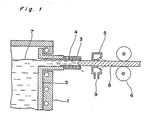
- a continuous casting device shown in Fig. 1 that comprises an electric furnace 1 with an electric heater, a graphite crucible 2 arranged in the furnace, a heating mold 3 with an electric heater 4, a cooling device 5 and pinch rollers 6.
- the melt is allowed to solidify to form a rod with a diameter of 8 mm and then cooled by the cooling device 5. Since the mold is heated to a temperature not less than the freezing point of the alloy, a boundary between the solid shell and melt is formed in a convex form as shown in Fig. 1.
- the rod of each aluminum alloy was cold rolled to form a sheet of a 0.25 mm thick and then cut to prepare test pieces of a 10 mm width, a 50 mm length and a 0.25 mm thick.
- the rate of hydrogen production was determined in the following manner.
- a graduated measuring cylinder was filled with water, inverted and put in a thermostat maintained at a temperature of 20, 30, 50 or 75 °C.
- the test piece was put into a flask and then immersed in water by placing the flask beneath the mouth of the cylinder in the thermostat.
- the gas produced by the reaction of the alloy with water was collected in the cylinder to determine the rate of hydrogen production.
- Table 2 shows variation of the rate of hydrogen production with temperature for the test piece No. 3.
- the gas produced was analyzed and found to contain not less than 99.4 % hydrogen.
- the aluminum alloy according to the present invention reacts with water and produces hydrogen even at a low temperature. Also, the rate of hydrogen production increases with temperature. This means that the rate of hydrogen production may be controlled by controlling a temperature of water.
- the aluminum alloy containing less than 5 % Sn scarcely reacts with water and no hydrogen gas is produced.
- the aluminum alloy containing not less than 5 % Sn reacts with water and produces hydrogen.
- the rate of hydrogen production is increased abruptly at the tin content of about 10 %, and reached to a peak value at the tin content of about 20 %. However, if the tin content exceeds 50 %, no reaction occurs and no hydrogen gas is produced.
- the aluminum alloy containing 20 % Sn possesses the rate of hydrogen production of 128 ml/hr.cm2 at 75°C, which is about 4 times as fast as that of an old electrolysis process operated at 2 V and a current density of 0.1 A/mm2 (30 ml/hr.cm2).
- the rate of hydrogen production at 20 °C is 24 ml/hr.cm2 which is approximately equal to that of the old electrolysis process (22 ml/hr.cm2).
- Figs. 3 and 4 show variations of the maximum rate of hydrogen production with time at 50 and 75 °C for various hydrogen-producing alloys of the present invention. From these figures, it will be seen that the rate of hydrogen production depends on the tin content and rises with increasing temperature.
- Aluminum (Al) of 99.99 % purity and tin (Sn) of 99.9 % purity were put into the electric furnace of Fig. 1 as raw materials to prepare a melt having a composition shown in Table 3.
- a rod of 8 mm diameter was cast in the same manner as in Example 1. Wire was drawn from the rod to a diameter of 3.2 mm by cold reduction through dies.
- Nozzle diameter 3.175 mm
- Air cap ethyl cellulose
- Gas flow rate Acetylene 17 l/min
- Wire feed rate 3.72 m/min
- Spray distance 200 mm
- the spray deposit was then cut to prepare test pieces with a 10 mm width and a 20 mm length.
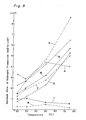
- the maximum rate of hydrogen production was determined for each specimen in the same manner as in Example 1. The results are shown in Table 4 and Figs. 5 and 6.
- Fig. 5 shows variation of a hydrogen production rate with temperature for the hydrogen-producing materials each comprising a deposit of aluminum alloy formed on the aluminum plates
- Fig. 6 shows variations of the hydrogen production rate with temperature for various hydrogen-producing material comprising the deposit of aluminum alloy formed on the acrylic resin plate.
- the hydrogen-producing materials makes it possible to obtain a considerably high rate of hydrogen production which is not less than 20 times that of the old electrolysis process even at normal temperature.
- the rate of hydrogen production rises with increasing temperature and reaches to a value which is about 300 times as fast as that of the old electrolysis process at 75 °C.
Landscapes
- Chemical & Material Sciences (AREA)
- Organic Chemistry (AREA)
- Engineering & Computer Science (AREA)
- Health & Medical Sciences (AREA)
- Metallurgy (AREA)
- Mechanical Engineering (AREA)
- Materials Engineering (AREA)
- Chemical Kinetics & Catalysis (AREA)
- General Health & Medical Sciences (AREA)
- Combustion & Propulsion (AREA)
- Inorganic Chemistry (AREA)
- Other Surface Treatments For Metallic Materials (AREA)
- Manufacture Of Metal Powder And Suspensions Thereof (AREA)
Applications Claiming Priority (4)
| Application Number | Priority Date | Filing Date | Title |
|---|---|---|---|
| JP129886/86 | 1986-06-03 | ||
| JP61129886A JPS62287032A (ja) | 1986-06-03 | 1986-06-03 | 水素生成用アルミニウム合金 |
| JP14547386A JPS632801A (ja) | 1986-06-21 | 1986-06-21 | 水素ガス生成材 |
| JP145473/86 | 1986-06-21 |
Publications (1)
| Publication Number | Publication Date |
|---|---|
| EP0248960A1 true EP0248960A1 (fr) | 1987-12-16 |
Family
ID=26465151
Family Applications (1)
| Application Number | Title | Priority Date | Filing Date |
|---|---|---|---|
| EP86306754A Withdrawn EP0248960A1 (fr) | 1986-06-03 | 1986-09-02 | Matériau produisant de l'hydrogène |
Country Status (2)
| Country | Link |
|---|---|
| US (1) | US4752463A (fr) |
| EP (1) | EP0248960A1 (fr) |
Cited By (4)
| Publication number | Priority date | Publication date | Assignee | Title |
|---|---|---|---|---|
| WO2009028143A1 (fr) | 2007-08-29 | 2009-03-05 | Japan Science And Technology Agency | Elément et procédé de production d'hydrogène gazeux |
| CN101508058B (zh) * | 2009-03-09 | 2011-04-20 | 华中科技大学 | 一种镀锌钢板搭接激光焊接方法 |
| US7951463B2 (en) * | 2004-03-10 | 2011-05-31 | Ulvac, Inc. | Water collapsible aluminum film |
| NL2017962B1 (en) * | 2016-12-09 | 2018-06-19 | Univ Northwest | Activation compounds for hydrogen generation |
Families Citing this family (12)
| Publication number | Priority date | Publication date | Assignee | Title |
|---|---|---|---|---|
| US5012719A (en) * | 1987-06-12 | 1991-05-07 | Gt-Devices | Method of and apparatus for generating hydrogen and projectile accelerating apparatus and method incorporating same |
| US6506360B1 (en) | 1999-07-28 | 2003-01-14 | Erling Reidar Andersen | Method for producing hydrogen |
| WO2002052664A2 (fr) * | 2000-06-23 | 2002-07-04 | Millenium Energy, Llc | Nouvelles compositions destinees a etre utilisees dans des accumulateurs, des condensateurs, des cellules electrochimiques et des dispositifs similaires et pour produire de l'hydrogene |
| US6800258B2 (en) | 2000-07-20 | 2004-10-05 | Erling Reidar Andersen | Apparatus for producing hydrogen |
| US6638493B2 (en) | 2000-07-20 | 2003-10-28 | Erling Reidar Andersen | Method for producing hydrogen |
| US7326263B2 (en) * | 2000-07-20 | 2008-02-05 | Erling Reidar Andersen | Method and apparatus for hydrogenating hydrocarbon fuels |
| US6440385B1 (en) * | 2000-08-14 | 2002-08-27 | The University Of British Columbia | Hydrogen generation from water split reaction |
| US7144567B2 (en) * | 2002-12-16 | 2006-12-05 | Erling Jim Andersen | Renewable energy carrier system and method |
| US20090208404A1 (en) * | 2006-07-05 | 2009-08-20 | Isao Itoh | Hydrogen generating method, hydrogen generating alloy and method for producing hydrogen generating alloy |
| US8668897B2 (en) | 2009-01-05 | 2014-03-11 | Technion Research & Development Foundation Limited | Compositions and methods for hydrogen generation |
| CN105170164A (zh) * | 2015-10-22 | 2015-12-23 | 耿烽 | 一种蒸汽制氢活性复合催化剂及制备方法 |
| IT202300026304A1 (it) | 2023-12-11 | 2024-03-11 | Damiana Naglieri | Dispositivo per la produzione di idrogeno energia elettrica e potenza termica a zero emissioni di tipo cogenerativo |
Citations (3)
| Publication number | Priority date | Publication date | Assignee | Title |
|---|---|---|---|---|
| GB191211838A (en) * | 1912-05-18 | 1913-02-06 | Sadamasa Uyeno | Improvements relating to the Generation of Hydrogen. |
| DE1148122B (de) * | 1961-05-17 | 1963-05-02 | Kurt Dies Dr Ing | Anwendung von Anoden aus zinnhaltigen Aluminiumlegierungen zum Herstellen eines Korrosionsschutzes auf aus Stahl bestehenden Gegenstaenden |
| FR2007967A1 (en) * | 1968-05-07 | 1970-01-16 | Vandervell Products Ltd | Strip hot sprayed with al tin alloy over a nickel - aluminium interlayer |
Family Cites Families (6)
| Publication number | Priority date | Publication date | Assignee | Title |
|---|---|---|---|---|
| JPS4940291A (fr) * | 1972-08-24 | 1974-04-15 | ||
| US4017414A (en) * | 1974-09-19 | 1977-04-12 | The United States Of America As Represented By The Secretary Of The Navy | Powdered metal source for production of heat and hydrogen gas |
| US4264362A (en) * | 1977-11-25 | 1981-04-28 | The United States Of America As Represented By The Secretary Of The Navy | Supercorroding galvanic cell alloys for generation of heat and gas |
| SU728363A1 (ru) * | 1978-01-31 | 1981-12-30 | Институт органического катализа и электрохимии АН КазССР | Способ получени водорода |
| JPS5567502A (en) * | 1978-11-13 | 1980-05-21 | Masahiro Suzuki | Production of hydrogen |
| US4298439A (en) * | 1980-08-11 | 1981-11-03 | Research Foundation Of The City University Of New York | Producing long life disproportionation products from a photo redox agent useful as a reducing medium for water, and the like |
-
1986
- 1986-09-02 EP EP86306754A patent/EP0248960A1/fr not_active Withdrawn
- 1986-09-05 US US06/903,770 patent/US4752463A/en not_active Expired - Fee Related
Patent Citations (3)
| Publication number | Priority date | Publication date | Assignee | Title |
|---|---|---|---|---|
| GB191211838A (en) * | 1912-05-18 | 1913-02-06 | Sadamasa Uyeno | Improvements relating to the Generation of Hydrogen. |
| DE1148122B (de) * | 1961-05-17 | 1963-05-02 | Kurt Dies Dr Ing | Anwendung von Anoden aus zinnhaltigen Aluminiumlegierungen zum Herstellen eines Korrosionsschutzes auf aus Stahl bestehenden Gegenstaenden |
| FR2007967A1 (en) * | 1968-05-07 | 1970-01-16 | Vandervell Products Ltd | Strip hot sprayed with al tin alloy over a nickel - aluminium interlayer |
Cited By (5)
| Publication number | Priority date | Publication date | Assignee | Title |
|---|---|---|---|---|
| US7951463B2 (en) * | 2004-03-10 | 2011-05-31 | Ulvac, Inc. | Water collapsible aluminum film |
| WO2009028143A1 (fr) | 2007-08-29 | 2009-03-05 | Japan Science And Technology Agency | Elément et procédé de production d'hydrogène gazeux |
| EP2213617A4 (fr) * | 2007-08-29 | 2013-05-01 | Japan Science & Tech Agency | Elément et procédé de production d'hydrogène gazeux |
| CN101508058B (zh) * | 2009-03-09 | 2011-04-20 | 华中科技大学 | 一种镀锌钢板搭接激光焊接方法 |
| NL2017962B1 (en) * | 2016-12-09 | 2018-06-19 | Univ Northwest | Activation compounds for hydrogen generation |
Also Published As
| Publication number | Publication date |
|---|---|
| US4752463A (en) | 1988-06-21 |
Similar Documents
| Publication | Publication Date | Title |
|---|---|---|
| US4752463A (en) | Method of producing hydrogen and material used therefor | |
| CA1267768A (fr) | Methode de coulee continue d'un ruban metallique | |
| DE69621348T2 (de) | Verfahren und vorrichtung zur herstellung von polykristallinem silizium und verfahren zur herstellung eines siliziumsubstrats für eine solarzelle | |
| CN107523707A (zh) | 铝型材用的熔铸铝棒熔炼工艺 | |
| GB1501132A (en) | Electroslag casting of a metal roll | |
| CN114262820B (zh) | 一种新型电弧喷涂用锌合金丝材及涂层的制备方法 | |
| JPH0438682B2 (fr) | ||
| CN109047685A (zh) | 一种制备钢锭的方法 | |
| JPH0123543B2 (fr) | ||
| GB1031317A (en) | A method for the production of ingots | |
| CN108559891A (zh) | 铝、锌、镁、钪系统的变形铝合金及其制造方法 | |
| JPS61157699A (ja) | 電気めつき用ニツケル陽極材 | |
| Duszczyk et al. | Properties of particles produced by different rapid solidification techniques | |
| CA1054334A (fr) | Moules pour coulee continue de metaux | |
| JPS57207134A (en) | Manufacture of shape memorizing alloy | |
| JP3712338B2 (ja) | 球状黒鉛鋳鉄の製造方法 | |
| JPS633706B2 (fr) | ||
| GB2275008A (en) | Particulate metal matrix composites | |
| SU1194894A1 (ru) | Способ обработки металла легирующим компонентом при непрерывном литье заготовок | |
| RU2231419C1 (ru) | Способ получения гранул и порошков редких, радиоактивных металлов и их сплавов | |
| RU2083708C1 (ru) | Способ получения карбида титана | |
| CN109402459A (zh) | 一种压铸铝合金及其精炼工艺 | |
| EP0592231A1 (fr) | Appareil pour la production d'uranium | |
| JP3849004B2 (ja) | 急冷凝固バルクアモルファス合金材料の製造方法 | |
| KR20250029885A (ko) | 단일 배치 공정에서 알루미늄 디옥스, 알루미늄 분말 및 산화아연을 제조하는 방법 |
Legal Events
| Date | Code | Title | Description |
|---|---|---|---|
| PUAI | Public reference made under article 153(3) epc to a published international application that has entered the european phase |
Free format text: ORIGINAL CODE: 0009012 |
|
| AK | Designated contracting states |
Kind code of ref document: A1 Designated state(s): DE FR GB |
|
| 17P | Request for examination filed |
Effective date: 19880217 |
|
| 17Q | First examination report despatched |
Effective date: 19890306 |
|
| STAA | Information on the status of an ep patent application or granted ep patent |
Free format text: STATUS: THE APPLICATION IS DEEMED TO BE WITHDRAWN |
|
| 18D | Application deemed to be withdrawn |
Effective date: 19900703 |
|
| RIN1 | Information on inventor provided before grant (corrected) |
Inventor name: NAGIRA, KATSUHIRO Inventor name: SHIMIZU, TORU |