EP0249963B1 - Polycarbonate - Google Patents
Polycarbonate Download PDFInfo
- Publication number
- EP0249963B1 EP0249963B1 EP87108700A EP87108700A EP0249963B1 EP 0249963 B1 EP0249963 B1 EP 0249963B1 EP 87108700 A EP87108700 A EP 87108700A EP 87108700 A EP87108700 A EP 87108700A EP 0249963 B1 EP0249963 B1 EP 0249963B1
- Authority
- EP
- European Patent Office
- Prior art keywords
- phenyl
- hydroxyphenyl
- bis
- radicals
- carbon atoms
- Prior art date
- Legal status (The legal status is an assumption and is not a legal conclusion. Google has not performed a legal analysis and makes no representation as to the accuracy of the status listed.)
- Expired
Links
- 0 CC1C(C)*C*(C)C1 Chemical compound CC1C(C)*C*(C)C1 0.000 description 12
- YTZKOQUCBOVLHL-UHFFFAOYSA-N CC(C)(C)c1ccccc1 Chemical compound CC(C)(C)c1ccccc1 YTZKOQUCBOVLHL-UHFFFAOYSA-N 0.000 description 1
- DTZMXGCBQJBCGV-UHFFFAOYSA-N CC(c(cc1)ccc1Oc1ccccc1)(c(cc1-c2ccccc2)ccc1O)c(cc1)cc(-c2ccccc2)c1O Chemical compound CC(c(cc1)ccc1Oc1ccccc1)(c(cc1-c2ccccc2)ccc1O)c(cc1)cc(-c2ccccc2)c1O DTZMXGCBQJBCGV-UHFFFAOYSA-N 0.000 description 1
- NNWUEBIEOFQMSS-UHFFFAOYSA-N CC1NCCCC1 Chemical compound CC1NCCCC1 NNWUEBIEOFQMSS-UHFFFAOYSA-N 0.000 description 1
- NCCMLVRJQAWFKV-UHFFFAOYSA-N C[C-](C)c1ccccc1 Chemical compound C[C-](C)c1ccccc1 NCCMLVRJQAWFKV-UHFFFAOYSA-N 0.000 description 1
- USIUVYZYUHIAEV-UHFFFAOYSA-N c(cc1)ccc1Oc1ccccc1 Chemical compound c(cc1)ccc1Oc1ccccc1 USIUVYZYUHIAEV-UHFFFAOYSA-N 0.000 description 1
Classifications
-
- C—CHEMISTRY; METALLURGY
- C07—ORGANIC CHEMISTRY
- C07C—ACYCLIC OR CARBOCYCLIC COMPOUNDS
- C07C317/00—Sulfones; Sulfoxides
-
- C—CHEMISTRY; METALLURGY
- C07—ORGANIC CHEMISTRY
- C07C—ACYCLIC OR CARBOCYCLIC COMPOUNDS
- C07C39/00—Compounds having at least one hydroxy or O-metal group bound to a carbon atom of a six-membered aromatic ring
- C07C39/12—Compounds having at least one hydroxy or O-metal group bound to a carbon atom of a six-membered aromatic ring polycyclic with no unsaturation outside the aromatic rings
- C07C39/15—Compounds having at least one hydroxy or O-metal group bound to a carbon atom of a six-membered aromatic ring polycyclic with no unsaturation outside the aromatic rings with all hydroxy groups on non-condensed rings, e.g. phenylphenol
- C07C39/16—Bis-(hydroxyphenyl) alkanes; Tris-(hydroxyphenyl)alkanes
-
- C—CHEMISTRY; METALLURGY
- C07—ORGANIC CHEMISTRY
- C07C—ACYCLIC OR CARBOCYCLIC COMPOUNDS
- C07C43/00—Ethers; Compounds having groups, groups or groups
- C07C43/02—Ethers
- C07C43/20—Ethers having an ether-oxygen atom bound to a carbon atom of a six-membered aromatic ring
- C07C43/23—Ethers having an ether-oxygen atom bound to a carbon atom of a six-membered aromatic ring containing hydroxy or O-metal groups
-
- C—CHEMISTRY; METALLURGY
- C07—ORGANIC CHEMISTRY
- C07C—ACYCLIC OR CARBOCYCLIC COMPOUNDS
- C07C43/00—Ethers; Compounds having groups, groups or groups
- C07C43/02—Ethers
- C07C43/257—Ethers having an ether-oxygen atom bound to carbon atoms both belonging to six-membered aromatic rings
- C07C43/295—Ethers having an ether-oxygen atom bound to carbon atoms both belonging to six-membered aromatic rings containing hydroxy or O-metal groups
-
- C—CHEMISTRY; METALLURGY
- C08—ORGANIC MACROMOLECULAR COMPOUNDS; THEIR PREPARATION OR CHEMICAL WORKING-UP; COMPOSITIONS BASED THEREON
- C08G—MACROMOLECULAR COMPOUNDS OBTAINED OTHERWISE THAN BY REACTIONS ONLY INVOLVING UNSATURATED CARBON-TO-CARBON BONDS
- C08G64/00—Macromolecular compounds obtained by reactions forming a carbonic ester link in the main chain of the macromolecule
- C08G64/04—Aromatic polycarbonates
- C08G64/06—Aromatic polycarbonates not containing aliphatic unsaturation
Definitions
- the present invention relates to novel polycarbonates, to a process for their preparation and to novel dihydric phenols which are the starting materials for the preparation of the polycarbonates.
- the present invention relates to novel polycarbonates that exhibit excellent optical properties such as high refractive index and are useful as, for example, materials for optical devices.
- polycarbonate resins resins obtained by reacting 2,2-bis-(4-hydroxyphenyl)propane (Bisphenol A) with phosgene or diphenyl carbonate are known. These resins are widely used as engineering plastics in many fields since they have excellent properties; i.e., high transparency, high thermal resistance, excellent mechanical properties, high dimensional accuracy in molding, etc.
- US-A-3 422 065 discloses linear high molecular polycarbonates which may be crosslinked at moderately elevated temperature without breakage of the molecular chain. These polycarbonates may be formed from several dihydroxy compounds, among others Bisphenyl A, and a polycarbonate precursor.
- plastic optical elements In recent years, the demand for plastic optical elements has been risen since they are more advantageous than those of glass because they are lighter in weight; they are excellent in impact strength; polishment is not essential; mass production is easier; and the mass production of nonspherical lenses is possible. While it is known that polycarbonates due to their excellent transparency and optical properties such as high refraction index are useful as materials of plastic optical elements (c.f. Japanese Patent Application Kokai No.126119/1983 and Japanese Patent Application Kokai No.179224/1983), the development of novel materials having excellent optical properties has been required with the increase of the application fields of the said optical elements.
- novel polycarbonates obtained by reacting a dihydric phenol having a particular structure with a carbonate precursor exhibit excellent optical properties such as, in particular, high refractive index, which knowledge led them to complete the present invention.
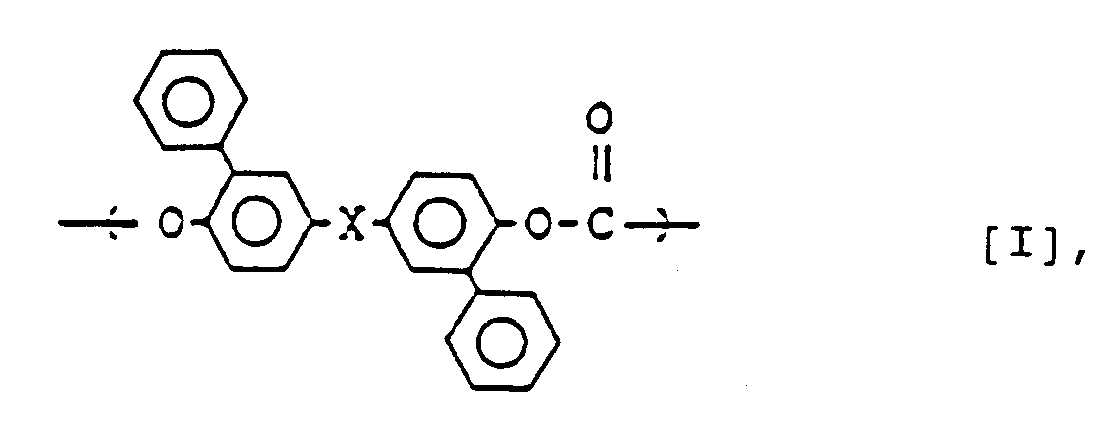
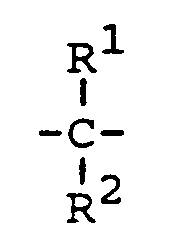
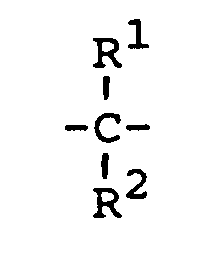
- polycarbonate polymers consisting essentially of repeating units represented by the following general formula Wherein:
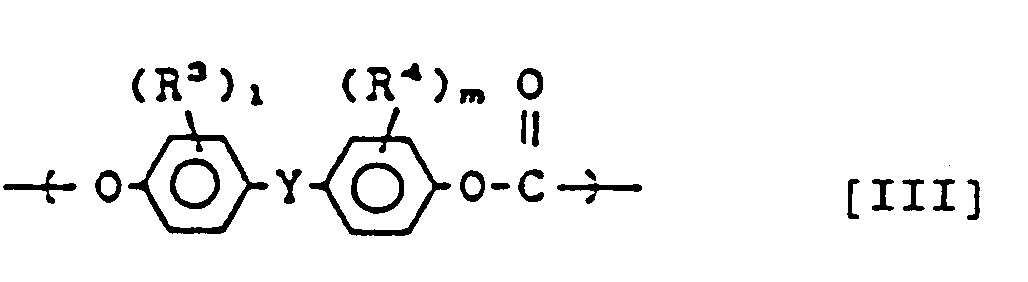
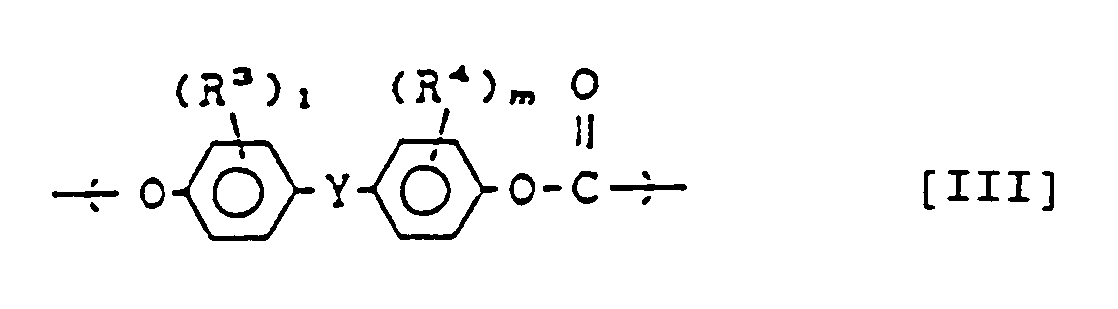
- polycarbonate copolymers consisting essentially of repeating units represented by the general formula I wherein X is as defined above, and repeating units represented by the following general formula wherein:
- R 3 and R 4 are each independenly selected from hydrogen atom, halogen radicals, or alkyl radicals of 1 to 5 carbon atoms, and 1 and m are each independently an integer having a value of from 1 to 4 and having a reduced viscosity [ ⁇ sp/c] of at least 0.2 dl/g as measured in methylene chloride at a concentration of 0.5 g/dl at 20 ° C.
- the present invention furthermore provides a process for preparing a polycarbonate polymer consisting of essentially of repeating units represented by the following general formula wherein X is as defined above, and which has a reduced viscosity [" sp/c] of at least 0.2 dl/g as measured in methylene chloride at a concentration of 0.5 g/dl at 20 ° C, which process comprises reacting a dihydric phenol having the general formula wherein X is as defined above, and a carbonate precursor.
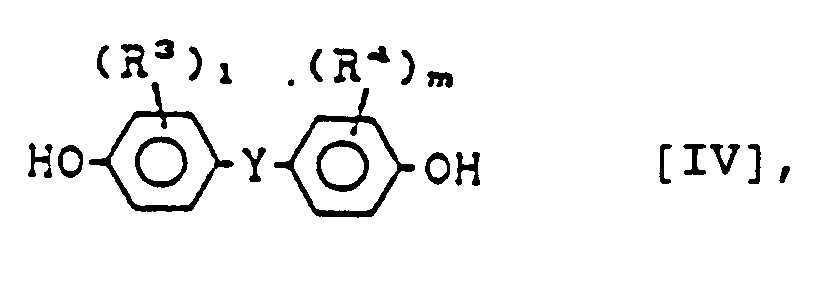
- the polycarbonate copolymers can be prepared by a process comprising reacting a dihydric phenol having the general formula and a dihydric phenol having the general formula wherein X, Y, R 3 , R 4 , I, and m are as defined above, and a carbonate precursor.
- novel dihydric phenols which are the main starting material of the polycarbonates of the present invention, having the following general formulae wherein X is
- the dihydric phenols to be used as the raw material in the preparation of the polymer of the present invention are the compounds having the structures represented by the general formula [II] hereinabove.
- Some illustrative examples of the dihydric phenols include
- the 1,1-bis(3-phenyl-4-hydroxyphenyl)methane derivatives of the present invention described in the general formula [V] hereinabove can be prepared by, for example, reacting o-phenylphenol and an aldehyde or ketone having the general formula wherein R 5 and R 6 are as defined above, in the presence of an acid catalyst, in the presence or absence of a solvent.
- the typical illustrative examples of the compounds described in formula [VI] hereinabove include benzaldehyde, acetophenone, propiophenone, benzophenone, 4' -phenoxyacetophenone, 4' - methoxyacetophenone, 4' - ethoxyacetophenone, 4-formylbiphenyl, 4-acetylbiphenyl, 4-propionylbiphenyl and 4-phenylbenzophenone.
- the reaction between these compounds and o-phenylphenol may be carried out either in the absence of a solvent or by using a solvent.
- the solvents that may be used are those being inactive in the reaction, and the preferred solvents are aromatic hydrocarbon solvents such as benzene, toluene, xylene and ethylbenzene.
- the catalysts to be used are acid catalysts such as hydrogen chloride, sulfuric acid, toluenesulfonic acid, trifluoroacetic acid, trifluoromethanesulfonic acid, oxalic acid, phosphorus pentachloride and polyphosphoric acid.
- hydrogen chloride is particularly preferable from the viewpoints of reaction accelerating property and after-treating facility.
- the amount of catalyst cannot be uniformly determined since it varies depending upon the kind of the catalyst employed. However, in case of employing hydrogen chloride, the amount will be usually selected among the range of from 0.5 to 10 % by weight to the total amount of p-phenylphenol and the aldehyde or ketone.
- a compound containing a mercapto group as a promoter in company with the above-mentioned acid catalyst.
- the compounds containing a mercapto group include alkylmercaptans such as methylmercaptan, ethylmercaptan, propylmercaptan, butylmercaptan, octylmercaptan and dodecylmercaptan;. aromatic mercaptans such as thiophenol and thiocresol; mercapto organic acids such as mercaptoacetic acid (thioglycolic acid) and mercaptopropionic acid.
- the amount of the promoter employed is usually in the range of from 0.1 to 5 % by weight to the total amount of o-phenylphenol and the aldehyde or ketone. With regard to the ratio between o-phenylphenol and the aldehyde or ketone employed, it is desirable to use o-phenylphenol in an amount larger than the stoichiometry, and 2.2 to 6 mol of o-phenylphenol is usually used per one mol of the aldehyde or ketone.
- reaction temperature cannot be uniformly determined since it varies depending upon the kind of the aldehyde or ketone and catalyst, it is generally selected among the range of from 20 to 150 ° C.
- reaction pressure is not particularly restricted and it may be any of reduced pressure, atmospheric pressure, and increased pressure, the reaction can usually be carried out advantageously under atmospheric pressure.
- reaction time varies depending upon the kind of the materials, the kind and amount of the catalyst and promoter, it is usually about 5 to 200 hours.
- the dihydric phenols of general formula [II] hereinabove may be used as the material either individually or in a mixture of two or more of them mixed in an optional ratio.
- a mixture thereof further mixed with one or more of the dihydric phenols of general formula [IV] hereinabove may be employed as the material.
- polycarbonate copolymers as used herein is meant to specify the polycarbonates obtained by copolymerizing the dihydric phenols of general formula [IV].
- dihydric phenols of general formula [IV] include 2,2-bis(4-hydroxyphenyl)propane, 2,2-bis(3-methyl-4-hydroxyphenyl)propane, bis(4-hydroxyphenyl)methane, 2,2-bis(4-hydroxyphenyl)butane, 2,2-bis(4-hydroxyphenyl)octane, 4,4-bis(4-hydroxyphenyl)heptane, 2,2-(3,5,3' 5' - tetrabromo-4,4' -dihydroxydiphenyl)propane, (3,3' - dichloro-4,4' -dihydroxydiphenyl)methane, bis-(3,5-dimethyl-4-hydroxyphenyl) ether, bis-(3,5-dimethyl-4-hydroxyphenyl) sulfone, bis-(3,5-dimethyl-4-hydroxyphenyl) sulfide and bis-(3,5-dimethyl-4-hydroxy
- Preferred dihydric phenols [IV] to be employed are those wherein R 3 and R 4 are hydrogen atom, and 2,2-bis(4-hydroxyphenyl)propane is particularly preferably used.
- the ratio between the dihydric phenols, [II] and [IV], employed is optional, and copolymers having a high refractive index can be obtained by increasing the proportion of the dihydric phenol [II].
- the refractive index can be adjusted to the values ranging from 1.58 to 1.67 by varying the proportion of the dihydric phenol [II].
- Copolymers having a refractive index of at least 1.60 can be obtained by adjusting the content of the repeating units [1 ] in the resulting copolymers to not less than 20 mol %.
- carbonate precursors include phosgene and diaryl carbonates such as diphenyl carbonate, di-p-tolyl carbonate, phenyl-p-tolyl carbonate, di-p-chlorophenyl carbonate and dinaph- thyl carbonate.
- Any known technique in the preparation of polycarbonates from Bisphenol A for example, the direct reaction of dihydric phenols with phosgene or the transesterification of dihydric phenols with diaryl carbonate, may be employed for the preparation of the polycarbonates of the present invention.
- the dihydric phenols described respectively in general formulas [II] and [IV] are reacted with phosgene, usually in the presence of an acid acceptor and a solvent.
- an acid acceptor which can be employed include pyridine and an alkaline metal hydroxides such as sodium hydroxide and potassium hydroxide.
- the solvents which can be employed include methylene chloride, chlorobenzene and, xylene.
- a catalyst for example, a tertiary amine such as triethylamine, a quaternary ammonium salt.
- a molecular weight regulator such as p-tert-butylphenol, phenylphenol is used in the reaction in order to adjust the degree of polymerization.
- a small quantity of antioxidants such as sodium sulfate, sodium hydrosulfite, can be added if necessary,
- the reaction is usually carried out at temperatures ranging from 0 to 150 "C, preferably from 5 to 40 ° C.
- the reaction time which is to be varied depending on the reaction temperature, is usually from 0.5 minute to 10 hours, preferably from 1 minute to 2 hours. It is preferred to keep the pH of the reaction system at not less than 10 during the reaction.
- the dihydric phenols having the respective general formulas [II] and [IV] hereinabove and the diaryl carbonate are mixed and reacted at high temperature under reduced pressure.
- the reaction is usually carried out at temperatures ranging from 150 to 350 "C, preferably from 200 to 300 "C, the pressure of the reaction system being decreased down to 1 mmHg or below toward the final stage of the reaction in order to distill the phenols derived from the diaryl carbonate away from the reaction system.
- the reaction time which is to be varied depending upon the reaction temperature, and the reaction pressure employed, is usually from about 1 to 4 hours. It is preferred to carry out the reaction in an atmosphere of an inert gas such as nitrogen or argon.
- Additives such as the above-mentioned molecular weight regulators, antioxidants, etc. can be added to the reaction system as the needs of the case demand.
- the polycarbonates of the present invention which can be prepared in such ways are novel polycarbonates and have a high refractive index.
- the reduced viscosity [77 sp/c] of the novel polycarbonates as measured in methylene chloride at a concentration of 0.5 g/dl at 20 ° C is not less than 0.2 dl/g.
- the polycarbonates having a reduced viscosity [77 sp/c] of less than 0.2 dl/g are so low in the degree of polymerization that they can not sufficiently satisfy the object of the present invention.
- the value of refractive index of the polycarbonate copolymers of the present invention can be controlled by varying the copolymerizing composition, and, therefore, the polycarbonate copolymers of the present invention is useful as elements for optical devices.
- the polycarbonates of the present invention may either be molded as they are or, as the needs of the case demand, be mixed with various additives such as esters of phosphorous acid for preventing the moldings from coloration and the deterioration of transparency, plasticizers for increasing the melt index, in advance of molding process.
- esters of phosphorous acid which can be employed include tributyl phosphite, tris(2-ethylhexyl)phosphite, tridecyl phosphite, tristearyl phosphite, triphenyl phosphite, tricresyl phosphite, tris(nonylphenyl)phosphite, 2-ethylhexyl diphenyl phosphite, decyl diphenyl phosphite, phenyl di-2-ethylhexyl phosphite, phenyl didecyl phosphite, tricyclohexyl phosphite, distearyl pentaerythrityl diphosphite and diphenyl pentaerythrityl diphosphite.
- plasticizers which can be employed include dialkyl phthalates such as di-2-ethylhexyl phthalate, di-n-butyl phthalate, diisodecyl phthalate, ditridecyl phthalate, diheptyl phthalate, dinonyl phthalate; alkyl esters of dibasic acids such as di-2-ethylhexyl adipate, di-2-ethylhexyl sebacate; alkyl esters of phosphoric acid such as tributyl phosphate, trioctyl phosphate, tricresyl phosphate, triphenyl phosphate; esters of epoxidized fatty acids such as epoxidized octyl oleate, epoxidized butyl oleate;, polyesters plasticizers and esters of chlorinated fatty acids.
- dialkyl phthalates such as di-2-ethylhexyl phthalate
- novel polycarbonates of the present invention exhibit excellent optical properties such as high refractive index, and therefore they are useful as materials of various optical devices for, for example, still cameras, video cameras, telescopes, eyeglasses, contact lenses, prisms, optical fibers, video disks, audio disks and optical memory disks.
- novel polycarbonates of the present invention are also useful as engineering plastics for material of various molded articles.
- the crystals were washed twice with 400 milliliters of methylene chloride, washed with 500 milliliters of a 2N aqueous sodium hydroxide solution, and then subsequently added to 2 liters of 1 N hydrochloric acid and stirred. The crystals were then filtered, washed several times with water, and dried under reduced pressure. Thus, 110 g of 1-phenyl-1,1-bis(3-phenyl-4-hydroxyphenyl)ethane having the following structure (yield: 25%) were obtained. The compound had a melting point of from 67 to 68 °C and a purity of 99.1 %.
- the molecular weight (m +) of the compound was 420.
- the compound was determined to have the following formula.
- the crystals were dispersed in 3 liters of water, and hydrochloric acid was added till the pH was lowered to not more than 1. Subsequently, the crystals were filtered out, washed with water, and then recrystallized by the use of a toluene-hexane mixture solvent to obtain 235 g of 1-(4-phenoxyphenyl)-1,1-bis(3-phenyl-4-hydroxyphenyl)ethane.
- Yield of the above-mentioned product was 44 % (based on 4' -phenoxyacetophenone), and the melting point thereof was between 125 to 129 ° C.
- the molecular weight (m+) determined by mass spectrum analysis was 534.
- Example 4 The procedure of Example 4 was repeated with the exception that 15 g (1 mol) of 4' - methoxyacetophenone was used in place of 4' -phenoxyacetophenone. Resultantly, 160 g of 1-(4-methoxyphenyl)-1,1-bis(3-phenyl-4-hydroxyphenyl)ethane was obtained. The yield was 34 % (basing on 4' - methoxyacetophenone), and the melting point was between 142 to 145 ° C.
- the molecular weight (m +) was 472.
- Example 2 Into a 1-liter flask equipped with a baffle were added 65 g of 1-phenyl-1,1-bis(3-phenyl-4- hydroxyphenyl)ethane obtained in Example 1, 1 g of p-tert-butylphenol as the molecular weight regulator, and 500 milliliters of methylene chloride. After dissolving the mixture, 300 milliliters of water and 1 milliliter of triethylamine as the catalyst was added and phosgene gas was then blown through the mixture with stirring at temperatures of from 20 to 30 ° C at a rate of from 300 to 400 ml/min.
- the resulting polymer had a reduced viscosity [ ⁇ sp/c] of 0.45 dl/g and a refractive index of 1.6750.
- the polymer was determined to have carbonate bonds and the following repeating units.
- the polymer had a glass transition temperature of 174 ° C and a birefringence of 37 nm.
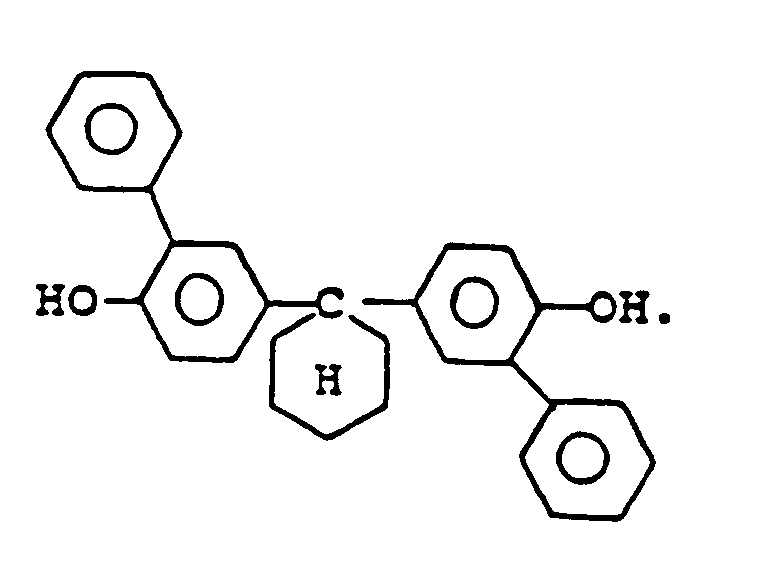
- Example 6 The procedure of Example 6 was repeated with the exception that 1,1-bis(3-phenyl-4-hydroxyphenyl)-cyclohexane obtained in Example 2 was used as the dihydric phenol to obtain a polymer having a reduced viscosity of 0.59 dl/g.
- the polymer was determined to be a polycarbonate having the following repeating units. The polymer had a glass transition temperature of 161 ° C and a birefringence measured in the form of a molding of 75 nm.
- dihydric phenol 60.3 g (0.15 mol) of bis(3-phenyl-4-hydroxyphenyl) sulfone obtained in Example 3 was dissolved in 500 milliliters of a 2N aqueous sodium hydroxide solution. To the solution were added 400 milliliters of methylene chloride, 1 milliliter of triethylamine as the catalyst, and 0.5 g of p-tert-butylphenol. Thereafter, phosgene gas was blown through the mixture with stirring vigorously at a rate of 300 ml/min. for 15 minutes, and reaction was then carried out with stirring for one hour.
- the reaction product was then diluted with 1 liter of methylene chloride and washed with successive, 0.01 N hydrochloric acid and water. The product was then poured into methanol to precipitate and recover a polymer.
- the reduced viscosity [ ⁇ sp/c] of the polymer was 0.48 dl/g.
- dihydric phenol 80 g of 1-(4-phenoxyphenyl)-1,1-bis(3-phenyl-4-hydroxyphenyl)ethane obtained in Example 4 was dissolved in 500 milliliters of a 1.5N aqueous potassium hydroxide solution. To the solution were added 400 milliliters of methylene chloride, 1.0 g of p-tert-butylphenol, and 2 milliliters of a 10 % by weight aqueous triethylamine solution, and reaction was carried out with vigorous stirring while phosgene gas was passed in for 20 minutes.
- the product was diluted with 1 liter of methylene chloride, and washed with successive, 500 milliliters of a 0.01 N aqueous sodium hydroxide solution, 500 milliliters of water, 500 milliliters of 0.01 N hydrochloric acid, and 500 ml of water.
- the methylene chloride solution was then subsequently poured into methanol to obtain a white polymer.
- the reduced viscosity [ ⁇ sp/c] of the polymer was 0.54 dl/g.
- the glass transition temperature of the polymer was 160 °C.
- the results of 1 H-NMR (CDCl 3 ) were as follows;
- the polymer was determined to be a polycarbonate comprising the following repeating units.
- the birefringence of the polymer was 70 nm.
- Example 9 The procedure of Example 9 was repeated with the exception that 1-(4-methoxyphenyl)-1,1-bis(3-phenyl-4-hydroxyphenyl)ethane obtained in Example 5 was used as the dihydric phenol.
- the resulting polymer had an reduced viscosity [ ⁇ sp/c] of 0.52 dl/g and a glass transition temperature of 164 ° C.
- the results of 1 H-NMR (CDCI a ) were as follows.
- the polymer was determined to be a polycarbonate having the following repeating units.
- the birefringence of the polymer was 42 nm.
- the resulting copolymer had a reduced viscosity [ ⁇ sp/c] of 0.38 dl/g.
- the copolymer was determined to have the following repeating units.
- the refractive index of the copolymer was 1.6558 at 20 ° C.
- the refractive index of a polycarbonate (reduced viscosity: 0.51 dl/g), that is prepared by conventional phosgene process by the use of 2,2-bis(4-hydroxyphenyl)propane as the dihydric phenol was 1.5850, at 20 °C.
- the glass transition temperature was 148 °C, and the birefringence was as large as 240 nm.
Landscapes
- Chemical & Material Sciences (AREA)
- Organic Chemistry (AREA)
- Health & Medical Sciences (AREA)
- Chemical Kinetics & Catalysis (AREA)
- Medicinal Chemistry (AREA)
- Polymers & Plastics (AREA)
- Polyesters Or Polycarbonates (AREA)
Claims (27)












Applications Claiming Priority (6)
| Application Number | Priority Date | Filing Date | Title |
|---|---|---|---|
| JP142843/86 | 1986-06-20 | ||
| JP14284286 | 1986-06-20 | ||
| JP14284386 | 1986-06-20 | ||
| JP142842/86 | 1986-06-20 | ||
| JP37595/87 | 1987-02-20 | ||
| JP62037595A JP2534694B2 (ja) | 1987-02-20 | 1987-02-20 | ポリカ−ボネ−ト系樹脂とその製法 |
Publications (3)
| Publication Number | Publication Date |
|---|---|
| EP0249963A2 EP0249963A2 (de) | 1987-12-23 |
| EP0249963A3 EP0249963A3 (en) | 1989-06-07 |
| EP0249963B1 true EP0249963B1 (de) | 1992-04-22 |
Family
ID=27289519
Family Applications (1)
| Application Number | Title | Priority Date | Filing Date |
|---|---|---|---|
| EP87108700A Expired EP0249963B1 (de) | 1986-06-20 | 1987-06-16 | Polycarbonate |
Country Status (3)
| Country | Link |
|---|---|
| US (2) | US5151531A (de) |
| EP (1) | EP0249963B1 (de) |
| DE (1) | DE3778430D1 (de) |
Cited By (1)
| Publication number | Priority date | Publication date | Assignee | Title |
|---|---|---|---|---|
| CN108430970A (zh) * | 2016-01-08 | 2018-08-21 | 本州化学工业株式会社 | 双酚化合物及芳香族聚碳酸酯 |
Families Citing this family (8)
| Publication number | Priority date | Publication date | Assignee | Title |
|---|---|---|---|---|
| EP0312860A3 (en) * | 1987-10-20 | 1990-05-16 | Idemitsu Kosan Company Limited | Resin material for optical instruments |
| EP0329991A1 (de) * | 1988-02-04 | 1989-08-30 | Idemitsu Kosan Company Limited | Film aus aromatischem Polycarbonat |
| NO170326C (no) * | 1988-08-12 | 1992-10-07 | Bayer Ag | Dihydroksydifenylcykloalkaner |
| US5227458A (en) * | 1988-08-12 | 1993-07-13 | Bayer Aktiengesellschaft | Polycarbonate from dihydroxydiphenyl cycloalkane |
| EP2222638A2 (de) * | 2007-11-21 | 2010-09-01 | Decode Genetics EHF | Biaryle als pde4-inhibitoren zur behandlung von entzündungen |
| CN103351390A (zh) | 2007-11-21 | 2013-10-16 | 解码遗传Ehf公司 | 用于治疗肺部和心血管病症的联芳基pde4 抑制剂 |
| US20250002643A1 (en) * | 2022-07-05 | 2025-01-02 | Lg Chem, Ltd. | Resin and Method for Manufacturing Same |
| EP4474404A4 (de) * | 2023-01-02 | 2025-10-01 | Lg Chemical Ltd | Harz und verfahren zur herstellung davon |
Family Cites Families (10)
| Publication number | Priority date | Publication date | Assignee | Title |
|---|---|---|---|---|
| US2506486A (en) * | 1948-04-21 | 1950-05-02 | Union Carbide & Carbon Corp | Thermosetting resin from a diphenol and a diglycidyl ether of a diphenol |
| DE1495841A1 (de) * | 1964-10-27 | 1969-04-10 | Bayer Ag | Verfahren zur Herstellung hochmolekularer Polycarbonate |
| US4514334A (en) * | 1979-05-31 | 1985-04-30 | General Electric Company | Polyphenolic compounds |
| US4426513A (en) * | 1979-05-31 | 1984-01-17 | General Electric Company | Polycarbonate resins based on polyphenolic compounds |
| US4465721A (en) * | 1980-12-22 | 1984-08-14 | Mcalister Roy E | Preparation of polycarbonates |
| JPS58179224A (ja) * | 1982-03-18 | 1983-10-20 | Konishiroku Photo Ind Co Ltd | 光学用樹脂組成物および光学用素子 |
| US4663434A (en) * | 1982-12-17 | 1987-05-05 | General Electric Company | Polycarbonates exhibiting improved heat resistance |
| EP0111849A1 (de) * | 1982-12-22 | 1984-06-27 | General Electric Company | Verzweigte Copolyester-Carbonat-Harze |
| US4469861A (en) * | 1982-12-27 | 1984-09-04 | General Electric Company | Polycarbonate composition from branched chain dihydric phenol |
| US4740330A (en) * | 1986-09-03 | 1988-04-26 | The Dow Chemical Company | Method for allylating aromatic hydroxyl-containing compounds |
-
1987
- 1987-06-16 EP EP87108700A patent/EP0249963B1/de not_active Expired
- 1987-06-16 DE DE8787108700T patent/DE3778430D1/de not_active Expired - Lifetime
-
1988
- 1988-08-25 US US07/236,142 patent/US5151531A/en not_active Expired - Lifetime
- 1988-12-21 US US07/287,036 patent/US4892924A/en not_active Expired - Fee Related
Cited By (2)
| Publication number | Priority date | Publication date | Assignee | Title |
|---|---|---|---|---|
| CN108430970A (zh) * | 2016-01-08 | 2018-08-21 | 本州化学工业株式会社 | 双酚化合物及芳香族聚碳酸酯 |
| CN108430970B (zh) * | 2016-01-08 | 2022-03-11 | 本州化学工业株式会社 | 双酚化合物及芳香族聚碳酸酯 |
Also Published As
| Publication number | Publication date |
|---|---|
| EP0249963A2 (de) | 1987-12-23 |
| US5151531A (en) | 1992-09-29 |
| DE3778430D1 (en) | 1992-05-27 |
| EP0249963A3 (en) | 1989-06-07 |
| US4892924A (en) | 1990-01-09 |
Similar Documents
| Publication | Publication Date | Title |
|---|---|---|
| US4778936A (en) | Triphenol compound | |
| US4644053A (en) | Cyclic polycarbonate oligomers and methods for their preparation and use | |
| US4474999A (en) | Phenol compounds, process and polymers | |
| US4469861A (en) | Polycarbonate composition from branched chain dihydric phenol | |
| US4415723A (en) | Randomly branched aromatic polycarbonate from triphenol | |
| US4277600A (en) | Tetraphenolic compounds and polycarbonates containing the same | |
| US4514334A (en) | Polyphenolic compounds | |
| KR20140002230A (ko) | 폴리카보네이트 삼원공중합체, 및 이를 이용하는 성형품 | |
| US4415725A (en) | Aromatic branched polycarbonate from tetraphenol | |
| US6894142B2 (en) | Highly branched (co)polycarbonates having improved flowability | |
| US5151531A (en) | Dihydric phenols | |
| CA1141078A (en) | Polyphenolic compounds | |
| EP3640278A1 (de) | Aromatisches polycarbonatharz, verfahren zu dessen herstellung und aromatische dihydroxyverbindung | |
| US4562242A (en) | Branched polycarbonate from carboxy containing diphenol | |
| JPH0753430A (ja) | 実質的に純粋なビスフェノール及びビスフェノールを含有してなる重合体 | |
| US4415724A (en) | Branched aromatic polycarbonate from tetraphenol | |
| JPS6284035A (ja) | トリフエノ−ル系化合物 | |
| US4446298A (en) | Branched copolycarbonate from triphenol | |
| KR910000423B1 (ko) | 신규의 폴리카르보네이트 | |
| US4895919A (en) | Spirobiindane copolysiloxanecarbonates and method for their preparation | |
| JP2574797B2 (ja) | 新規ポリカ−ボネ−ト系重合体とその製法 | |
| US5276213A (en) | Special dihydroxydiphenyl bicycloalkanes, their production and their use for the production of high molecular weight polycarbonates | |
| US7345133B2 (en) | Branched polycarbonates | |
| JP2556859B2 (ja) | 新規ポリカ−ボネ−ト系共重合体とその製造法 | |
| JP2011157465A (ja) | 環状オリゴマーおよびそれを用いた熱可塑性樹脂の製造方法 |
Legal Events
| Date | Code | Title | Description |
|---|---|---|---|
| PUAI | Public reference made under article 153(3) epc to a published international application that has entered the european phase |
Free format text: ORIGINAL CODE: 0009012 |
|
| AK | Designated contracting states |
Kind code of ref document: A2 Designated state(s): BE CH DE FR GB IT LI NL SE |
|
| PUAL | Search report despatched |
Free format text: ORIGINAL CODE: 0009013 |
|
| AK | Designated contracting states |
Kind code of ref document: A3 Designated state(s): BE CH DE FR GB IT LI NL SE |
|
| 17P | Request for examination filed |
Effective date: 19891120 |
|
| 17Q | First examination report despatched |
Effective date: 19900606 |
|
| GRAA | (expected) grant |
Free format text: ORIGINAL CODE: 0009210 |
|
| AK | Designated contracting states |
Kind code of ref document: B1 Designated state(s): BE CH DE FR GB IT LI NL SE |
|
| PG25 | Lapsed in a contracting state [announced via postgrant information from national office to epo] |
Ref country code: IT Free format text: LAPSE BECAUSE OF FAILURE TO SUBMIT A TRANSLATION OF THE DESCRIPTION OR TO PAY THE FEE WITHIN THE PRE;WARNING: LAPSES OF ITALIAN PATENTS WITH EFFECTIVE DATE BEFORE 2007 MAY HAVE OCCURRED AT ANY TIME BEFORE 2007. THE CORRECT EFFECTIVE DATE MAY BE DIFFERENT FROM THE ONE RECORDED.SCRIBED TIME-LIMIT Effective date: 19920422 Ref country code: SE Effective date: 19920422 Ref country code: CH Effective date: 19920422 Ref country code: LI Effective date: 19920422 Ref country code: BE Effective date: 19920422 |
|
| REF | Corresponds to: |
Ref document number: 3778430 Country of ref document: DE Date of ref document: 19920527 |
|
| ET | Fr: translation filed | ||
| REG | Reference to a national code |
Ref country code: CH Ref legal event code: PL |
|
| PLBE | No opposition filed within time limit |
Free format text: ORIGINAL CODE: 0009261 |
|
| STAA | Information on the status of an ep patent application or granted ep patent |
Free format text: STATUS: NO OPPOSITION FILED WITHIN TIME LIMIT |
|
| 26N | No opposition filed | ||
| PGFP | Annual fee paid to national office [announced via postgrant information from national office to epo] |
Ref country code: FR Payment date: 20000612 Year of fee payment: 14 |
|
| PGFP | Annual fee paid to national office [announced via postgrant information from national office to epo] |
Ref country code: DE Payment date: 20000614 Year of fee payment: 14 Ref country code: GB Payment date: 20000614 Year of fee payment: 14 |
|
| PGFP | Annual fee paid to national office [announced via postgrant information from national office to epo] |
Ref country code: NL Payment date: 20000629 Year of fee payment: 14 |
|
| PG25 | Lapsed in a contracting state [announced via postgrant information from national office to epo] |
Ref country code: GB Free format text: LAPSE BECAUSE OF NON-PAYMENT OF DUE FEES Effective date: 20010616 |
|
| PG25 | Lapsed in a contracting state [announced via postgrant information from national office to epo] |
Ref country code: NL Free format text: LAPSE BECAUSE OF NON-PAYMENT OF DUE FEES Effective date: 20020101 |
|
| GBPC | Gb: european patent ceased through non-payment of renewal fee |
Effective date: 20010616 |
|
| PG25 | Lapsed in a contracting state [announced via postgrant information from national office to epo] |
Ref country code: FR Free format text: LAPSE BECAUSE OF NON-PAYMENT OF DUE FEES Effective date: 20020228 |
|
| NLV4 | Nl: lapsed or anulled due to non-payment of the annual fee |
Effective date: 20020101 |
|
| PG25 | Lapsed in a contracting state [announced via postgrant information from national office to epo] |
Ref country code: DE Free format text: LAPSE BECAUSE OF NON-PAYMENT OF DUE FEES Effective date: 20020403 |