EP0249975B1 - Oberflächenbehandlungsmittel und -verfahren - Google Patents
Oberflächenbehandlungsmittel und -verfahren Download PDFInfo
- Publication number
- EP0249975B1 EP0249975B1 EP87108738A EP87108738A EP0249975B1 EP 0249975 B1 EP0249975 B1 EP 0249975B1 EP 87108738 A EP87108738 A EP 87108738A EP 87108738 A EP87108738 A EP 87108738A EP 0249975 B1 EP0249975 B1 EP 0249975B1
- Authority
- EP
- European Patent Office
- Prior art keywords
- group
- fluoropolyether
- surface treating
- radical
- treating agents
- Prior art date
- Legal status (The legal status is an assumption and is not a legal conclusion. Google has not performed a legal analysis and makes no representation as to the accuracy of the status listed.)
- Expired
Links
- 238000000034 method Methods 0.000 title description 2
- 239000003795 chemical substances by application Substances 0.000 claims description 33
- 150000003609 titanium compounds Chemical class 0.000 claims description 25
- 239000010702 perfluoropolyether Substances 0.000 claims description 19
- 239000010936 titanium Substances 0.000 claims description 18
- 229910052719 titanium Inorganic materials 0.000 claims description 15
- 150000001875 compounds Chemical class 0.000 claims description 13
- LFQSCWFLJHTTHZ-UHFFFAOYSA-N Ethanol Chemical compound CCO LFQSCWFLJHTTHZ-UHFFFAOYSA-N 0.000 claims description 9
- 125000003545 alkoxy group Chemical group 0.000 claims description 9
- 125000004429 atom Chemical group 0.000 claims description 8
- 125000004432 carbon atom Chemical group C* 0.000 claims description 8
- 125000003178 carboxy group Chemical group [H]OC(*)=O 0.000 claims description 7
- RTAQQCXQSZGOHL-UHFFFAOYSA-N Titanium Chemical compound [Ti] RTAQQCXQSZGOHL-UHFFFAOYSA-N 0.000 claims description 6
- 229910003088 Ti−O−Ti Inorganic materials 0.000 claims description 5
- 239000000178 monomer Substances 0.000 claims description 5
- 229910052801 chlorine Inorganic materials 0.000 claims description 4
- 229920001774 Perfluoroether Polymers 0.000 claims description 3
- 125000003342 alkenyl group Chemical group 0.000 claims description 3
- 125000000217 alkyl group Chemical group 0.000 claims description 3
- 230000007062 hydrolysis Effects 0.000 claims description 3
- 238000006460 hydrolysis reaction Methods 0.000 claims description 3
- ORTFAQDWJHRMNX-UHFFFAOYSA-N hydroxidooxidocarbon(.) Chemical compound O[C]=O ORTFAQDWJHRMNX-UHFFFAOYSA-N 0.000 claims description 3
- 229920006395 saturated elastomer Polymers 0.000 claims description 3
- REIYHFWZISXFKU-UHFFFAOYSA-N Butyl acetoacetate Chemical compound CCCCOC(=O)CC(C)=O REIYHFWZISXFKU-UHFFFAOYSA-N 0.000 claims description 2
- WRQNANDWMGAFTP-UHFFFAOYSA-N Methylacetoacetic acid Chemical compound COC(=O)CC(C)=O WRQNANDWMGAFTP-UHFFFAOYSA-N 0.000 claims description 2
- 230000001588 bifunctional effect Effects 0.000 claims description 2
- 229910052794 bromium Inorganic materials 0.000 claims description 2
- XYIBRDXRRQCHLP-UHFFFAOYSA-N ethyl acetoacetate Chemical compound CCOC(=O)CC(C)=O XYIBRDXRRQCHLP-UHFFFAOYSA-N 0.000 claims description 2
- 238000004519 manufacturing process Methods 0.000 claims description 2
- 125000002496 methyl group Chemical group [H]C([H])([H])* 0.000 claims description 2
- 125000005010 perfluoroalkyl group Chemical group 0.000 claims description 2
- DHGFMVMDBNLMKT-UHFFFAOYSA-N propyl 3-oxobutanoate Chemical compound CCCOC(=O)CC(C)=O DHGFMVMDBNLMKT-UHFFFAOYSA-N 0.000 claims description 2
- 239000003921 oil Substances 0.000 description 29
- RTZKZFJDLAIYFH-UHFFFAOYSA-N ether Substances CCOCC RTZKZFJDLAIYFH-UHFFFAOYSA-N 0.000 description 21
- YRKCREAYFQTBPV-UHFFFAOYSA-N acetylacetone Chemical compound CC(=O)CC(C)=O YRKCREAYFQTBPV-UHFFFAOYSA-N 0.000 description 13
- 238000006243 chemical reaction Methods 0.000 description 13
- VZGDMQKNWNREIO-UHFFFAOYSA-N tetrachloromethane Chemical compound ClC(Cl)(Cl)Cl VZGDMQKNWNREIO-UHFFFAOYSA-N 0.000 description 12
- -1 for instance Substances 0.000 description 10
- 239000007788 liquid Substances 0.000 description 10
- VLKZOEOYAKHREP-UHFFFAOYSA-N n-Hexane Chemical compound CCCCCC VLKZOEOYAKHREP-UHFFFAOYSA-N 0.000 description 10
- KFZMGEQAYNKOFK-UHFFFAOYSA-N Isopropanol Chemical compound CC(C)O KFZMGEQAYNKOFK-UHFFFAOYSA-N 0.000 description 9
- 239000011521 glass Substances 0.000 description 9
- 229910052751 metal Inorganic materials 0.000 description 9
- 239000002184 metal Substances 0.000 description 9
- 238000003756 stirring Methods 0.000 description 9
- 239000000243 solution Substances 0.000 description 8
- 239000000758 substrate Substances 0.000 description 8
- 238000005260 corrosion Methods 0.000 description 7
- 229920000642 polymer Polymers 0.000 description 7
- 230000000694 effects Effects 0.000 description 6
- 239000000203 mixture Substances 0.000 description 6
- XLYOFNOQVPJJNP-UHFFFAOYSA-N water Substances O XLYOFNOQVPJJNP-UHFFFAOYSA-N 0.000 description 6
- BXLICFUSUZPSHT-UHFFFAOYSA-N 1-(4-chlorophenyl)-3-fluoropropan-2-amine Chemical compound FCC(N)CC1=CC=C(Cl)C=C1 BXLICFUSUZPSHT-UHFFFAOYSA-N 0.000 description 5
- LYCAIKOWRPUZTN-UHFFFAOYSA-N Ethylene glycol Chemical compound OCCO LYCAIKOWRPUZTN-UHFFFAOYSA-N 0.000 description 5
- 239000000047 product Substances 0.000 description 5
- 239000007858 starting material Substances 0.000 description 5
- VXUYXOFXAQZZMF-UHFFFAOYSA-N titanium(IV) isopropoxide Chemical compound CC(C)O[Ti](OC(C)C)(OC(C)C)OC(C)C VXUYXOFXAQZZMF-UHFFFAOYSA-N 0.000 description 5
- 229910000831 Steel Inorganic materials 0.000 description 4
- 239000000654 additive Substances 0.000 description 4
- 230000007797 corrosion Effects 0.000 description 4
- 238000010992 reflux Methods 0.000 description 4
- 239000010959 steel Substances 0.000 description 4
- 239000000126 substance Substances 0.000 description 4
- 239000000919 ceramic Substances 0.000 description 3
- 239000000460 chlorine Substances 0.000 description 3
- 239000003960 organic solvent Substances 0.000 description 3
- ZAMOUSCENKQFHK-UHFFFAOYSA-N Chlorine atom Chemical compound [Cl] ZAMOUSCENKQFHK-UHFFFAOYSA-N 0.000 description 2
- XEEYBQQBJWHFJM-UHFFFAOYSA-N Iron Chemical compound [Fe] XEEYBQQBJWHFJM-UHFFFAOYSA-N 0.000 description 2
- 238000010521 absorption reaction Methods 0.000 description 2
- 238000000862 absorption spectrum Methods 0.000 description 2
- 150000004703 alkoxides Chemical class 0.000 description 2
- 230000015572 biosynthetic process Effects 0.000 description 2
- 125000002843 carboxylic acid group Chemical group 0.000 description 2
- 230000000052 comparative effect Effects 0.000 description 2
- 239000007822 coupling agent Substances 0.000 description 2
- 239000010687 lubricating oil Substances 0.000 description 2
- 150000002739 metals Chemical class 0.000 description 2
- 239000000843 powder Substances 0.000 description 2
- 125000001424 substituent group Chemical group 0.000 description 2
- ZLWSWTKSTUPKDY-UHFFFAOYSA-K 16-methylheptadecanoate;propan-2-olate;titanium(4+) Chemical compound [Ti+4].CC(C)[O-].CC(C)CCCCCCCCCCCCCCC([O-])=O.CC(C)CCCCCCCCCCCCCCC([O-])=O.CC(C)CCCCCCCCCCCCCCC([O-])=O ZLWSWTKSTUPKDY-UHFFFAOYSA-K 0.000 description 1
- RYGMFSIKBFXOCR-UHFFFAOYSA-N Copper Chemical compound [Cu] RYGMFSIKBFXOCR-UHFFFAOYSA-N 0.000 description 1
- 229910001111 Fine metal Inorganic materials 0.000 description 1
- PXGOKWXKJXAPGV-UHFFFAOYSA-N Fluorine Chemical compound FF PXGOKWXKJXAPGV-UHFFFAOYSA-N 0.000 description 1
- UFHFLCQGNIYNRP-UHFFFAOYSA-N Hydrogen Chemical compound [H][H] UFHFLCQGNIYNRP-UHFFFAOYSA-N 0.000 description 1
- 229910003089 Ti–OH Inorganic materials 0.000 description 1
- XSTXAVWGXDQKEL-UHFFFAOYSA-N Trichloroethylene Chemical group ClC=C(Cl)Cl XSTXAVWGXDQKEL-UHFFFAOYSA-N 0.000 description 1
- 239000007983 Tris buffer Substances 0.000 description 1
- 230000002378 acidificating effect Effects 0.000 description 1
- 230000000996 additive effect Effects 0.000 description 1
- 238000004458 analytical method Methods 0.000 description 1
- 230000003373 anti-fouling effect Effects 0.000 description 1
- 230000004888 barrier function Effects 0.000 description 1
- 238000010504 bond cleavage reaction Methods 0.000 description 1
- 239000006227 byproduct Substances 0.000 description 1
- 150000001732 carboxylic acid derivatives Chemical class 0.000 description 1
- 239000007795 chemical reaction product Substances 0.000 description 1
- 125000001309 chloro group Chemical group Cl* 0.000 description 1
- 239000011248 coating agent Substances 0.000 description 1
- 238000000576 coating method Methods 0.000 description 1
- 238000001816 cooling Methods 0.000 description 1
- 229910052802 copper Inorganic materials 0.000 description 1
- 239000010949 copper Substances 0.000 description 1
- 238000003795 desorption Methods 0.000 description 1
- 239000012153 distilled water Substances 0.000 description 1
- 238000001035 drying Methods 0.000 description 1
- 238000005516 engineering process Methods 0.000 description 1
- 238000005886 esterification reaction Methods 0.000 description 1
- 229910052731 fluorine Inorganic materials 0.000 description 1
- 239000011737 fluorine Substances 0.000 description 1
- 238000004817 gas chromatography Methods 0.000 description 1
- 229910052736 halogen Inorganic materials 0.000 description 1
- 150000002367 halogens Chemical class 0.000 description 1
- 229910052739 hydrogen Inorganic materials 0.000 description 1
- 239000001257 hydrogen Substances 0.000 description 1
- 238000002329 infrared spectrum Methods 0.000 description 1
- 229910052742 iron Inorganic materials 0.000 description 1
- JEIPFZHSYJVQDO-UHFFFAOYSA-N iron(III) oxide Inorganic materials O=[Fe]O[Fe]=O JEIPFZHSYJVQDO-UHFFFAOYSA-N 0.000 description 1
- 238000005461 lubrication Methods 0.000 description 1
- 239000011553 magnetic fluid Substances 0.000 description 1
- 239000006247 magnetic powder Substances 0.000 description 1
- 239000000463 material Substances 0.000 description 1
- 239000007769 metal material Substances 0.000 description 1
- 150000007524 organic acids Chemical class 0.000 description 1
- 235000005985 organic acids Nutrition 0.000 description 1
- SNGREZUHAYWORS-UHFFFAOYSA-N perfluorooctanoic acid Chemical compound OC(=O)C(F)(F)C(F)(F)C(F)(F)C(F)(F)C(F)(F)C(F)(F)C(F)(F)F SNGREZUHAYWORS-UHFFFAOYSA-N 0.000 description 1
- 239000005023 polychlorotrifluoroethylene (PCTFE) polymer Substances 0.000 description 1
- 238000012643 polycondensation polymerization Methods 0.000 description 1
- 238000006068 polycondensation reaction Methods 0.000 description 1
- 238000002360 preparation method Methods 0.000 description 1
- 230000000306 recurrent effect Effects 0.000 description 1
- 230000002940 repellent Effects 0.000 description 1
- 239000005871 repellent Substances 0.000 description 1
- 230000007017 scission Effects 0.000 description 1
- 238000007789 sealing Methods 0.000 description 1
- 238000007086 side reaction Methods 0.000 description 1
- 239000002904 solvent Substances 0.000 description 1
- 239000004094 surface-active agent Substances 0.000 description 1
- 150000003608 titanium Chemical class 0.000 description 1
- UBOXGVDOUJQMTN-UHFFFAOYSA-N trichloroethylene Natural products ClCC(Cl)Cl UBOXGVDOUJQMTN-UHFFFAOYSA-N 0.000 description 1
- 238000009736 wetting Methods 0.000 description 1
Images


Classifications
-
- C—CHEMISTRY; METALLURGY
- C08—ORGANIC MACROMOLECULAR COMPOUNDS; THEIR PREPARATION OR CHEMICAL WORKING-UP; COMPOSITIONS BASED THEREON
- C08G—MACROMOLECULAR COMPOUNDS OBTAINED OTHERWISE THAN BY REACTIONS ONLY INVOLVING UNSATURATED CARBON-TO-CARBON BONDS
- C08G65/00—Macromolecular compounds obtained by reactions forming an ether link in the main chain of the macromolecule
- C08G65/02—Macromolecular compounds obtained by reactions forming an ether link in the main chain of the macromolecule from cyclic ethers by opening of the heterocyclic ring
- C08G65/32—Polymers modified by chemical after-treatment
- C08G65/329—Polymers modified by chemical after-treatment with organic compounds
- C08G65/337—Polymers modified by chemical after-treatment with organic compounds containing other elements
-
- C—CHEMISTRY; METALLURGY
- C07—ORGANIC CHEMISTRY
- C07F—ACYCLIC, CARBOCYCLIC OR HETEROCYCLIC COMPOUNDS CONTAINING ELEMENTS OTHER THAN CARBON, HYDROGEN, HALOGEN, OXYGEN, NITROGEN, SULFUR, SELENIUM OR TELLURIUM
- C07F7/00—Compounds containing elements of Groups 4 or 14 of the Periodic Table
- C07F7/003—Compounds containing elements of Groups 4 or 14 of the Periodic Table without C-Metal linkages
-
- C—CHEMISTRY; METALLURGY
- C08—ORGANIC MACROMOLECULAR COMPOUNDS; THEIR PREPARATION OR CHEMICAL WORKING-UP; COMPOSITIONS BASED THEREON
- C08G—MACROMOLECULAR COMPOUNDS OBTAINED OTHERWISE THAN BY REACTIONS ONLY INVOLVING UNSATURATED CARBON-TO-CARBON BONDS
- C08G65/00—Macromolecular compounds obtained by reactions forming an ether link in the main chain of the macromolecule
- C08G65/002—Macromolecular compounds obtained by reactions forming an ether link in the main chain of the macromolecule from unsaturated compounds
- C08G65/005—Macromolecular compounds obtained by reactions forming an ether link in the main chain of the macromolecule from unsaturated compounds containing halogens
- C08G65/007—Macromolecular compounds obtained by reactions forming an ether link in the main chain of the macromolecule from unsaturated compounds containing halogens containing fluorine
-
- C—CHEMISTRY; METALLURGY
- C23—COATING METALLIC MATERIAL; COATING MATERIAL WITH METALLIC MATERIAL; CHEMICAL SURFACE TREATMENT; DIFFUSION TREATMENT OF METALLIC MATERIAL; COATING BY VACUUM EVAPORATION, BY SPUTTERING, BY ION IMPLANTATION OR BY CHEMICAL VAPOUR DEPOSITION, IN GENERAL; INHIBITING CORROSION OF METALLIC MATERIAL OR INCRUSTATION IN GENERAL
- C23F—NON-MECHANICAL REMOVAL OF METALLIC MATERIAL FROM SURFACE; INHIBITING CORROSION OF METALLIC MATERIAL OR INCRUSTATION IN GENERAL; MULTI-STEP PROCESSES FOR SURFACE TREATMENT OF METALLIC MATERIAL INVOLVING AT LEAST ONE PROCESS PROVIDED FOR IN CLASS C23 AND AT LEAST ONE PROCESS COVERED BY SUBCLASS C21D OR C22F OR CLASS C25
- C23F11/00—Inhibiting corrosion of metallic material by applying inhibitors to the surface in danger of corrosion or adding them to the corrosive agent
- C23F11/08—Inhibiting corrosion of metallic material by applying inhibitors to the surface in danger of corrosion or adding them to the corrosive agent in other liquids
- C23F11/10—Inhibiting corrosion of metallic material by applying inhibitors to the surface in danger of corrosion or adding them to the corrosive agent in other liquids using organic inhibitors
- C23F11/173—Macromolecular compounds
Definitions
- This invention relates to a fluoropolyether surface treating agent, more particularly, to new surface treating agents obtained by reaction of a fluoropolyether having carboxylic acid groups with a titanium compound having at least one group able to react with the carboxylic group and at least one residual hydrolyzable group.
- the surface treating agents of the present invention are excellent as wetting and have anticorrosion properties on the surface of metals, resistance to chemicals and to fouling for these reasons they can be used in the fields in which perfluoropolyether oils have traditionally been used, such as vacuum pump oil, lubricating oil, sealing oil, mould releasing agent and damper liquid, either alone or as additive of perfluoropolyether oils, for improving their characteristics.
- perfluoropolyethers do not show good anticorrosion properties as it is desi- dered in many applications.
- Perfluoropolyether oils do not show a sufficient value of surface activity for many purposes; see for example Shinku, vol. 28, No. 6, pp. 484-485 (1985) and "Chemistry and Industry of the Magnetic Body", p. 54, Techmart Co., (1978). Even by adding organic acids as surface active agents to perfluoropolyethers, for instance, penta-(perfluoropropylene oxide)- perfluoropropanoic acid, desorption of the surface treating agent takes place at 65 ° C, so that it is extremely difficult to improve the surface activity at higher temperatures than 65 ° C (Chemistry and Industry of the Magnetic Body, p. 39 cited above).
- perfluoropolyethers though excellent in their own chemical stability, when contain the additives mentioned above, have the disadvantage to corrode the metal surface. Particularly this must be absolutely avoided when the perfluoropolyethers are employed for magnetic media in which the magnetic substance itself is very fine metal powder.
- the present invention has the object of providing a new surface treating agent prepared by reacting a fluoropolyether having carboxylic acid groups with a titanium having at least one group able to react with the carboxylic group and at least one hydrolyzable group per titanium atom, which shows excellent surface adhesion and anti-corrosion properties for the surface of metal.
- This new compound can be used as such or as additives of perfluoropolyether oils.
- Object of the invention is a new fluoropolyether surface treating agent consisting of an organic titanium compound having per Ti atom at least one radical (A) of fluoropolyether linked by a carboxy group to the titanium and one or more hydrolyzable groups (B).
- the hydrolyzable group is an alkoxy group preferably a radical of monovalent alcohol of 1 to 8 carbon atoms having a straight or branched chain which may be substituted, a radical corresponding to mono-valency of di-valent alcohol of 2 to 3 carbon atoms, a radical of p-di-ketones such as preferably acetylacetone and a radical of p-keto-ester, and the process for preparing said surface treating agents.
- the surface treating agent of the invention is an organic titanium compound which in monomer form is expressed by the following general formula: wherein A stands for said fluoropolyether carboxy radical and B stands for said hydrolizable group and a is an integer from 1 to 3 and preferably from 1 to 2; in polymer form contains in the molecule the linkage Ti-O-Ti corresponding to the general formula being in which b is an integer from 0 to 4 and the valences of the Ti are saturated by A and B and having per Ti atom at least one radical A and one radical B as defined above; the hydrolyzable radical B being such not to generate Hhal by hydrolysis, hal is Cl, Br.
- Object of the invention is also mixtures of the compounds in monomer and in polymer form.
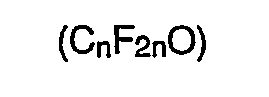
- the substitutent A is preferably a carboxy radical derived from fluoropolyethers having one or more of the following repeating units represented by the general formula (C n F 2 nO) wherein n ranges from 1 to 3 in the case of the perfluoroxyalkylene units.
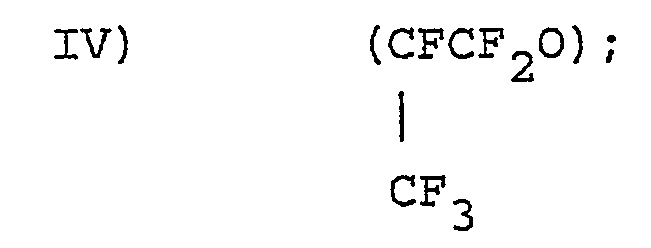
- the oxyperfluoroalkylene chain can comprise, in particular, recurrent units of the following types:
- perfluoropolyether starting materials belonging to classes II, III, VI, IX and X can be functionalized, if necessary, to both of their ends, by applying, e.g., the scission process as disclosed in Italian patent application No. 22,920 A/85, which yields acidic end groups -COF, easily convertible to carboxylic group by using the teaching of the hereunder described patents.
- fluoropolyether starting materials can be used products, which are widely known in the art and disclosed, in particular, in the following patent or patent applications: U.S. 3,242,218; U.S. 3,665,041; U.S. 3,715,378; EPO 148,482; EPO 151,877; U.S. 4,523,039; WO 87/00538, WO 87/02992.
- the fluoropolyethers used as starting material in the invention can have one carboxylic group in the case of monofunctional fluoropolyether, the other terminal group being a perfluoroalkoxy group having 1-3 C atoms.
- the perfluoroalkoxy group there is a group
- the average molecular weight of the carboxyfluoropolyether radical A is comprised in general between 400 and 8000 and preferably between 700 and 4000.
- the radical B is a hydrolyzable group in the sense that by reaction with H 2 0, the Ti-B bond forms a -Ti-OH and a BH compound.
- B is an RO- group in which R is alkyl optionally substituted for example by -OH, -NH 2 , alkenyl, or an enolate form of ⁇ -di-keto-compounds or of ⁇ -keto-esters.
- R means alkyl
- Organic titanium compounds having said substituents of the surface treating agent of the invention can be prepared by reacting a carboxylic fluoropolyether indicated above with a titanium compound B 4 Ti which has said hydrolyzable groups.
- the reaction is carried out by adding under stirring an equivalent of 1 to 3 of the carboxlic group of fluoropolyether (FPCA), preferably an equivalent of 1 to 2 per mol of Ti atom of the starting titanium compound, usually in an organic solvent for a period of 20 minutes to 4 hours at temperatures ranging from 10 ° to 80 ° C.
- FPCA carboxlic group of fluoropolyether
- this reaction according to the selection of reaction conditions such as the type of the starting material and the solvent, the monomer alone of the organic titanium compound, or a mixture of the monomer with polymer, as indicated above, is synthetically prepared.
- the esterification reaction with alcohol eliminated from FPCA and the starting titanium compound takes place as side reaction and water is formed as by-product, permitting the condensation polymerization by hydrolysis of the titanium compound which has not yet reacted, and an organic titanium compound polymer having the linkage -Ti-O-Ti- in the molecule is apt to be formed and corresponds to the general formula: wherein b ranges from 0 to 4.
- the starting titanium derivative can be easily prepared by subjecting a titanium alkoxide having 4 alkoxyl groups with at least one compound selected from divalent alcohol, acetylacetone and (3-keto-ester either in the presence or in the absence of an organic solvent.
- the organic titanium compound having a hydrolyzable group other than the alkoxy group may be obtained by reacting FPCA with titanium alkoxide, followed by reaction of at least one compound selected from the group consisting of di-valent alcohol, acetylacetone and keto-ester in an amount corresponding to the alkoxy groups to be substituted. Preferably it is substituted only one alkoxide group.
- organic titanium compound polymer having in the molecule the Ti-O-Ti linkage and FPCA radical and alkoxy group, as substitutent groups can be selectively obtained by reacting with FPCA a polytitanoxane having in the molecule the Ti-O-Ti linkage and alkoxy group as the substituent group, which is prepared by submitting titanium alkoxide to the preliminary polycondensation.
- the intended organic titanium compound polymer having a hydrolyzable group other than the alkoxy group can be selectively synthetized by reacting said polymer with at least one compound selected from the group consisting of di-valent alcohol, acetylacetone and p-keto- ester.
- the surface treating agent of the invention can be applied to the surface of the substrate by coating the said organic titanium compound alone or in an organic solvent and then drying.
- substrate it can be mentioned iron, steel, copper and like metals.
- magnetic powder, ceramic powder and ceramics moulded articles can be treated likewise.
- the surface treating agent of this invention can be admixed with perfluoropolyether oils to reduce wear and prevent the corrosion of the surface of the metal or ceramics.
- the amount of the surface treating agent of this invention to be added to perfluoropolyether oil is generally 0.1 to 2.0 parts by weight of the organic titanium compound to 100 parts by weight of oil when applied to vacuum pump oil and lubricating oil, and generally 1 to 10 parts by weight of the organic titanium compound to 100 parts by weight of oil when applied on to a magnetic fluid, said amounts being enough to achieve the object of the invention.
- the surface treating agent of this invention is characterized in that it is a new organic titanium compound having, as already mentioned, both an unhydrolyzable FPCA radical and a hydrolyzable group.
- this surface treating agent When this surface treating agent is applied onto the surface of a substrate, the adsorbed water or -OH group present on the surface of the substrate reacts with the hydrolyzable group of said organic titanium compound and hydrolyzes said organic titanium compound to form the M-O-Ti (M means the atom present on the surface of the substrate such as metal atom), causing at the same time the formation of the Ti-O-Ti linkage; all these linkages, it has been found unexpectedly, prevent the corrosion of the surface of the substrate while the FPCA radical layer is water and oil repellent. Accordingly the application of the surface treating agent of the present invention causes the formation on the surface of the substrate a coated film excellent in repellency to water and oil and resistance to corrosion.
- the organic titanium compound must have at least one hydrolyzable group and at least one FPCA radicals for each Ti atom.
- Fig. 1 is an Infra-red absorption spectrum of the surface treating agent and of the starting compounds:
- the reaction solution so obtained was charged into a rotary evaporator and removed of the volatile matter for 4 hours at a bath temperature of 45 ° C and 20 Torr. As a result, 5.2 g of isopropanol were obtained as distillate. The residue so obtained was a colorless transparent viscous liquid (T-1).
- the obtained (T-1) has no free carboxylic acid, is slightly soluble in carbon tetrachloride.
- (T-1) has the absorption due to -COOTi at 1670 cm-1 and the absorption of 1780 cm- 1 , based on -COOH found in the starting polypertluoroalkylene ether carboxylic acid, has disappeared.
- T-1 was presumed to be tris(2-propanolate)titanium-polyperfluoroalkylene ether carboxylate.
- the distillate was found to be isopropanol as a result of the analysis by gas-chromatography.
- a 400 cc four-necked flask with a stirrer, reflux condenser, thermometer and dropper was charged with 9 g of perfluorocaprylic acid (n-C 7 F 1s COOH) and then dissolved in 200 g of n-hexane under stirring. Then 3.6 g of tetraisopropoxytitanium were slowly added dropwise under stirring by means of a dropper, the reaction temperature being maintained between 20 ° and 30°C and the mixture was maintained under stirring for other three hours to obtain a colorless transparent liquid (CT-1).
- CT-1 colorless transparent liquid
- CT-1 had 5.3 per cent of non-volatile matter.
- One deck glass treated in the manner mentioned above was dipped into a solution of 1% organic titanium compound in carbon tetrachloride of T-1 and another deck glass into a solution prepared in the same way of (CT-1). Then the glasses were drawn up, rinsed immediately with fresh n-hexane, shaken off the attached n-hexane and dried for 30 minutes at 60°C.
- the surface of the glass treated with the surface treating agent of this invention exhibits repellency to oil against liquid paraffine and a comparable degree of affinity with polyperfluoroalkylene ether oil to the surface of clean untreated glass.
- the surface of glass treated with the Comparative Sample shows repellency to oil against both liquid paraffine and polyperfluoroalkylene ether oil.
- a steel plate was treated with a commercially available solution of titanium coupling agent (CT-2) composed of isopropoxytitanium triisostearate as the main component.
- CT-2 titanium coupling agent
- the steel plates and untreated plate were applied with polyperfluoroalkylene ether oil (product of Montedison S.p.A., Fomblin R Z) and hung in a dessiccator charged with 100 g of carbon tetrachloride in which 1 g of chlorine was dissolved and with 100 g of distilled water, being left undisturbed at room temperature to observe the development of rust on the steeel plates.
- polyperfluoroalkylene ether oil product of Montedison S.p.A., Fomblin R Z
- the surface treating agents of this invention show affinity with polyperfluoroalkylene ether oil, barrier characteristic to corrosive materials and repellency to oil.
- the surface treating agents of this invention can be immediately applied onto the surface of a substrate like metal as anti-corrosion and anti-fouling film. It can also be applied either alone or in addition to polyperfluoroalkylene ether oil to the systems where polyperfluoroalkylene ether oil has been hitherto used.
- the present invention provides surface treating agents useful per se as chemically stable and inert oil, or as oil additives having superior surface activity and anti-corrosive property for metal surface and it has a very great industrial meaning.
Landscapes
- Chemical & Material Sciences (AREA)
- Organic Chemistry (AREA)
- Chemical Kinetics & Catalysis (AREA)
- Health & Medical Sciences (AREA)
- Medicinal Chemistry (AREA)
- Polymers & Plastics (AREA)
- General Chemical & Material Sciences (AREA)
- Engineering & Computer Science (AREA)
- Materials Engineering (AREA)
- Mechanical Engineering (AREA)
- Metallurgy (AREA)
- Paints Or Removers (AREA)
- Lubricants (AREA)
- Preventing Corrosion Or Incrustation Of Metals (AREA)
- Materials Applied To Surfaces To Minimize Adherence Of Mist Or Water (AREA)
Claims (12)








Applications Claiming Priority (2)
| Application Number | Priority Date | Filing Date | Title |
|---|---|---|---|
| JP61140235A JPS62297478A (ja) | 1986-06-18 | 1986-06-18 | 表面処理剤およびその製造方法 |
| JP140235/86 | 1986-06-18 |
Publications (2)
| Publication Number | Publication Date |
|---|---|
| EP0249975A1 EP0249975A1 (de) | 1987-12-23 |
| EP0249975B1 true EP0249975B1 (de) | 1990-10-17 |
Family
ID=15264052
Family Applications (1)
| Application Number | Title | Priority Date | Filing Date |
|---|---|---|---|
| EP87108738A Expired EP0249975B1 (de) | 1986-06-18 | 1987-06-18 | Oberflächenbehandlungsmittel und -verfahren |
Country Status (7)
| Country | Link |
|---|---|
| US (1) | US4978389A (de) |
| EP (1) | EP0249975B1 (de) |
| JP (1) | JPS62297478A (de) |
| AU (1) | AU598819B2 (de) |
| CA (1) | CA1314902C (de) |
| DE (1) | DE3765583D1 (de) |
| ES (1) | ES2018207B3 (de) |
Cited By (3)
| Publication number | Priority date | Publication date | Assignee | Title |
|---|---|---|---|---|
| WO2011009772A1 (de) | 2009-07-23 | 2011-01-27 | Basf Se | Bauteil umfassend ein einlegeteil sowie eine kunststoffummantelung sowie verfahren zu seiner herstellung |
| WO2011061162A2 (de) | 2009-11-18 | 2011-05-26 | Basf Se | Bauteil umfassend ein einlegeteil und eine kunststoffummantelung sowie verfahren zu seiner herstellung |
| WO2011138384A1 (de) | 2010-05-05 | 2011-11-10 | Basf Se | Bauteil umfassend ein einlegeteil und eine kunststoffummantelung sowie verfahren zu seiner herstellung |
Families Citing this family (3)
| Publication number | Priority date | Publication date | Assignee | Title |
|---|---|---|---|---|
| US5376359A (en) * | 1992-07-07 | 1994-12-27 | Glaxo, Inc. | Method of stabilizing aerosol formulations |
| ES2293157T3 (es) * | 2001-08-03 | 2008-03-16 | Glaxo Group Limited | Compuestos tensioactivos y uso de los mismos. |
| EP2379301B1 (de) | 2008-12-19 | 2013-02-20 | Basf Se | Verfahren zur herstellung eines verbundbauteils durch mehrkomponentenspritzguss, solcher verbundbauteil und verwendung einer mischung zur herstellung des verbundbauteils |
Family Cites Families (10)
| Publication number | Priority date | Publication date | Assignee | Title |
|---|---|---|---|---|
| US2643262A (en) * | 1950-04-28 | 1953-06-23 | Du Pont | Organic compounds of titanium |
| US2809990A (en) * | 1955-12-29 | 1957-10-15 | Minnesota Mining & Mfg | Fluorocarbon acids and derivatives |
| US2888367A (en) * | 1958-02-14 | 1959-05-26 | Hitemp Wires Inc | Process for promoting adhesion to difficultly wettable polymer surface |
| US3242081A (en) * | 1963-04-30 | 1966-03-22 | Monsanto Res Corp | Lubricating compositions |
| US3250808A (en) * | 1963-10-31 | 1966-05-10 | Du Pont | Fluorocarbon ethers derived from hexafluoropropylene epoxide |
| US4056356A (en) * | 1975-05-14 | 1977-11-01 | Eastman Kodak Company | Polyester fiber |
| US4524201A (en) * | 1981-12-28 | 1985-06-18 | Union Carbide Corporation | Reactive organo titanate catalysts |
| IT1174206B (it) * | 1984-06-19 | 1987-07-01 | Montedison Spa | Fluouropolieteri contenenti gruppi terminali dotati di capacita' ancornanti |
| IT1213071B (it) * | 1986-05-07 | 1989-12-07 | Ausimont Spa | Perfluoropolieteri esenti da ossigeno perossidico e contenenti gruppi perfluoroepossidici disposti lungo la catena perfluoropolieterea. |
| US5226369A (en) * | 1992-06-15 | 1993-07-13 | National Castings Inc. | Sideframe for a railroad car truck |
-
1986
- 1986-06-18 JP JP61140235A patent/JPS62297478A/ja active Pending
-
1987
- 1987-06-18 EP EP87108738A patent/EP0249975B1/de not_active Expired
- 1987-06-18 DE DE8787108738T patent/DE3765583D1/de not_active Expired - Lifetime
- 1987-06-18 AU AU74473/87A patent/AU598819B2/en not_active Ceased
- 1987-06-18 CA CA000540042A patent/CA1314902C/en not_active Expired - Fee Related
- 1987-06-18 ES ES87108738T patent/ES2018207B3/es not_active Expired - Lifetime
-
1989
- 1989-02-27 US US07/317,052 patent/US4978389A/en not_active Expired - Lifetime
Cited By (3)
| Publication number | Priority date | Publication date | Assignee | Title |
|---|---|---|---|---|
| WO2011009772A1 (de) | 2009-07-23 | 2011-01-27 | Basf Se | Bauteil umfassend ein einlegeteil sowie eine kunststoffummantelung sowie verfahren zu seiner herstellung |
| WO2011061162A2 (de) | 2009-11-18 | 2011-05-26 | Basf Se | Bauteil umfassend ein einlegeteil und eine kunststoffummantelung sowie verfahren zu seiner herstellung |
| WO2011138384A1 (de) | 2010-05-05 | 2011-11-10 | Basf Se | Bauteil umfassend ein einlegeteil und eine kunststoffummantelung sowie verfahren zu seiner herstellung |
Also Published As
| Publication number | Publication date |
|---|---|
| ES2018207B3 (es) | 1991-04-01 |
| JPS62297478A (ja) | 1987-12-24 |
| US4978389A (en) | 1990-12-18 |
| CA1314902C (en) | 1993-03-23 |
| DE3765583D1 (de) | 1990-11-22 |
| AU598819B2 (en) | 1990-07-05 |
| EP0249975A1 (de) | 1987-12-23 |
| AU7447387A (en) | 1987-12-24 |
Similar Documents
| Publication | Publication Date | Title |
|---|---|---|
| EP0382224B1 (de) | Perfluorpolyether mit Antirosteigenschaften | |
| US4647413A (en) | Perfluoropolyether oligomers and polymers | |
| CN101815755B (zh) | 包含阳离子氟化醚硅烷的组合物以及相关方法 | |
| RU2034000C1 (ru) | Способ модификации перфторполиэфиров | |
| JP3056530B2 (ja) | 耐摩耗性を有するペルフルオロポリエーテル潤滑剤 | |
| US5441655A (en) | Phosphazene derivatives and use of same as stabilizers for oils and greases based on perfluoropolyethers | |
| EP4229112B1 (de) | Neuartige (per)fluorpolyetherpolymere und verwendung davon | |
| JP5431724B2 (ja) | フッ素化有機ケイ素コーティング材料 | |
| JPWO2004035656A1 (ja) | ペルフルオロポリエーテル誘導体 | |
| JPS58167597A (ja) | フルオロアミノシラン化合物 | |
| US4174461A (en) | Stabilized perfluoropolyether fluids | |
| EP0022701A1 (de) | Poly(alkylenoxid)-Zusammensetzungen, die eine dimere hydroxylsubstituierte aromatische Carbonsäure oder ein Salz davon enthalten | |
| EP0249975B1 (de) | Oberflächenbehandlungsmittel und -verfahren | |
| US20020066205A1 (en) | Method for removing water from surfaces | |
| EP0338529B1 (de) | Fluor enthaltende Polyether und sie enthaltende Gleitmittel | |
| US6887308B2 (en) | Metal coating coupling composition | |
| EP1712580B1 (de) | Zusatz für fluoriertes Öl | |
| US5190681A (en) | Antirust additives for lubricants or greases based on perfluoropolyethers | |
| EP1710267B1 (de) | Lewis Säure resistente fluorinierte Schmiermittel | |
| EP0337425B1 (de) | Antirostadditive für Schmiermittel oder Schmierfette mit Perfluoropolyäthern als Basismaterial | |
| US20040266985A1 (en) | Nitrogenated perfluoropolyether composition | |
| CA2527421A1 (en) | (per)fluoropolyether additives | |
| EP0340753A2 (de) | Oberflächen-Behandlungsmittel | |
| JP2003321785A (ja) | 金属表面処理用の液体組成物 | |
| EP1749865B1 (de) | Verwendung von fluorinierten Verbindungen zur Schutzbehandlung von Titaniumsubstraten |
Legal Events
| Date | Code | Title | Description |
|---|---|---|---|
| PUAI | Public reference made under article 153(3) epc to a published international application that has entered the european phase |
Free format text: ORIGINAL CODE: 0009012 |
|
| AK | Designated contracting states |
Kind code of ref document: A1 Designated state(s): BE DE ES FR GB IT NL SE |
|
| 17P | Request for examination filed |
Effective date: 19880516 |
|
| 17Q | First examination report despatched |
Effective date: 19891113 |
|
| ITF | It: translation for a ep patent filed | ||
| GRAA | (expected) grant |
Free format text: ORIGINAL CODE: 0009210 |
|
| AK | Designated contracting states |
Kind code of ref document: B1 Designated state(s): BE DE ES FR GB IT NL SE |
|
| ET | Fr: translation filed | ||
| REF | Corresponds to: |
Ref document number: 3765583 Country of ref document: DE Date of ref document: 19901122 |
|
| ITTA | It: last paid annual fee | ||
| PLBE | No opposition filed within time limit |
Free format text: ORIGINAL CODE: 0009261 |
|
| STAA | Information on the status of an ep patent application or granted ep patent |
Free format text: STATUS: NO OPPOSITION FILED WITHIN TIME LIMIT |
|
| 26N | No opposition filed | ||
| EAL | Se: european patent in force in sweden |
Ref document number: 87108738.3 |
|
| PGFP | Annual fee paid to national office [announced via postgrant information from national office to epo] |
Ref country code: SE Payment date: 19960528 Year of fee payment: 10 |
|
| PGFP | Annual fee paid to national office [announced via postgrant information from national office to epo] |
Ref country code: NL Payment date: 19960626 Year of fee payment: 10 |
|
| PGFP | Annual fee paid to national office [announced via postgrant information from national office to epo] |
Ref country code: ES Payment date: 19960627 Year of fee payment: 10 |
|
| PG25 | Lapsed in a contracting state [announced via postgrant information from national office to epo] |
Ref country code: SE Effective date: 19970619 Ref country code: ES Free format text: LAPSE BECAUSE OF NON-PAYMENT OF DUE FEES Effective date: 19970619 |
|
| PG25 | Lapsed in a contracting state [announced via postgrant information from national office to epo] |
Ref country code: NL Effective date: 19980101 |
|
| EUG | Se: european patent has lapsed |
Ref document number: 87108738.3 |
|
| NLV4 | Nl: lapsed or anulled due to non-payment of the annual fee |
Effective date: 19980101 |
|
| REG | Reference to a national code |
Ref country code: ES Ref legal event code: FD2A Effective date: 20000503 |
|
| REG | Reference to a national code |
Ref country code: GB Ref legal event code: IF02 |
|
| PGFP | Annual fee paid to national office [announced via postgrant information from national office to epo] |
Ref country code: FR Payment date: 20030610 Year of fee payment: 17 |
|
| PGFP | Annual fee paid to national office [announced via postgrant information from national office to epo] |
Ref country code: GB Payment date: 20030618 Year of fee payment: 17 |
|
| PGFP | Annual fee paid to national office [announced via postgrant information from national office to epo] |
Ref country code: BE Payment date: 20030902 Year of fee payment: 17 |
|
| PG25 | Lapsed in a contracting state [announced via postgrant information from national office to epo] |
Ref country code: GB Free format text: LAPSE BECAUSE OF NON-PAYMENT OF DUE FEES Effective date: 20040618 |
|
| PG25 | Lapsed in a contracting state [announced via postgrant information from national office to epo] |
Ref country code: BE Free format text: LAPSE BECAUSE OF NON-PAYMENT OF DUE FEES Effective date: 20040630 |
|
| BERE | Be: lapsed |
Owner name: *NIPPON SODA CO. LTD Effective date: 20040630 |
|
| GBPC | Gb: european patent ceased through non-payment of renewal fee |
Effective date: 20040618 |
|
| PG25 | Lapsed in a contracting state [announced via postgrant information from national office to epo] |
Ref country code: FR Free format text: LAPSE BECAUSE OF NON-PAYMENT OF DUE FEES Effective date: 20050228 |
|
| REG | Reference to a national code |
Ref country code: FR Ref legal event code: ST |
|
| PGFP | Annual fee paid to national office [announced via postgrant information from national office to epo] |
Ref country code: DE Payment date: 20060615 Year of fee payment: 20 |
|
| PGFP | Annual fee paid to national office [announced via postgrant information from national office to epo] |
Ref country code: IT Payment date: 20060630 Year of fee payment: 20 |