EP0250103A1 - Procédé de récupérationdu métal précieux - Google Patents
Procédé de récupérationdu métal précieux Download PDFInfo
- Publication number
- EP0250103A1 EP0250103A1 EP19870304552 EP87304552A EP0250103A1 EP 0250103 A1 EP0250103 A1 EP 0250103A1 EP 19870304552 EP19870304552 EP 19870304552 EP 87304552 A EP87304552 A EP 87304552A EP 0250103 A1 EP0250103 A1 EP 0250103A1
- Authority
- EP
- European Patent Office
- Prior art keywords
- compartment
- liquid medium
- tar
- solvent
- compartments
- Prior art date
- Legal status (The legal status is an assumption and is not a legal conclusion. Google has not performed a legal analysis and makes no representation as to the accuracy of the status listed.)
- Granted
Links
Images

Classifications
-
- B—PERFORMING OPERATIONS; TRANSPORTING
- B01—PHYSICAL OR CHEMICAL PROCESSES OR APPARATUS IN GENERAL
- B01J—CHEMICAL OR PHYSICAL PROCESSES, e.g. CATALYSIS OR COLLOID CHEMISTRY; THEIR RELEVANT APPARATUS
- B01J31/00—Catalysts comprising hydrides, coordination complexes or organic compounds
- B01J31/16—Catalysts comprising hydrides, coordination complexes or organic compounds containing coordination complexes
- B01J31/20—Carbonyls
-
- B—PERFORMING OPERATIONS; TRANSPORTING
- B01—PHYSICAL OR CHEMICAL PROCESSES OR APPARATUS IN GENERAL
- B01D—SEPARATION
- B01D61/00—Processes of separation using semi-permeable membranes, e.g. dialysis, osmosis or ultrafiltration; Apparatus, accessories or auxiliary operations specially adapted therefor
- B01D61/42—Electrodialysis; Electro-osmosis ; Electro-ultrafiltration; Membrane capacitive deionization
- B01D61/44—Ion-selective electrodialysis
-
- B—PERFORMING OPERATIONS; TRANSPORTING
- B01—PHYSICAL OR CHEMICAL PROCESSES OR APPARATUS IN GENERAL
- B01J—CHEMICAL OR PHYSICAL PROCESSES, e.g. CATALYSIS OR COLLOID CHEMISTRY; THEIR RELEVANT APPARATUS
- B01J31/00—Catalysts comprising hydrides, coordination complexes or organic compounds
- B01J31/02—Catalysts comprising hydrides, coordination complexes or organic compounds containing organic compounds or metal hydrides
- B01J31/0234—Nitrogen-, phosphorus-, arsenic- or antimony-containing compounds
-
- B—PERFORMING OPERATIONS; TRANSPORTING
- B01—PHYSICAL OR CHEMICAL PROCESSES OR APPARATUS IN GENERAL
- B01J—CHEMICAL OR PHYSICAL PROCESSES, e.g. CATALYSIS OR COLLOID CHEMISTRY; THEIR RELEVANT APPARATUS
- B01J31/00—Catalysts comprising hydrides, coordination complexes or organic compounds
- B01J31/02—Catalysts comprising hydrides, coordination complexes or organic compounds containing organic compounds or metal hydrides
- B01J31/0234—Nitrogen-, phosphorus-, arsenic- or antimony-containing compounds
- B01J31/0235—Nitrogen containing compounds
- B01J31/0239—Quaternary ammonium compounds
-
- B—PERFORMING OPERATIONS; TRANSPORTING
- B01—PHYSICAL OR CHEMICAL PROCESSES OR APPARATUS IN GENERAL
- B01J—CHEMICAL OR PHYSICAL PROCESSES, e.g. CATALYSIS OR COLLOID CHEMISTRY; THEIR RELEVANT APPARATUS
- B01J31/00—Catalysts comprising hydrides, coordination complexes or organic compounds
- B01J31/26—Catalysts comprising hydrides, coordination complexes or organic compounds containing in addition, inorganic metal compounds not provided for in groups B01J31/02 - B01J31/24
-
- B—PERFORMING OPERATIONS; TRANSPORTING
- B01—PHYSICAL OR CHEMICAL PROCESSES OR APPARATUS IN GENERAL
- B01J—CHEMICAL OR PHYSICAL PROCESSES, e.g. CATALYSIS OR COLLOID CHEMISTRY; THEIR RELEVANT APPARATUS
- B01J31/00—Catalysts comprising hydrides, coordination complexes or organic compounds
- B01J31/40—Regeneration or reactivation
- B01J31/4015—Regeneration or reactivation of catalysts containing metals
- B01J31/4023—Regeneration or reactivation of catalysts containing metals containing iron group metals, noble metals or copper
- B01J31/4038—Regeneration or reactivation of catalysts containing metals containing iron group metals, noble metals or copper containing noble metals
-
- B—PERFORMING OPERATIONS; TRANSPORTING
- B01—PHYSICAL OR CHEMICAL PROCESSES OR APPARATUS IN GENERAL
- B01J—CHEMICAL OR PHYSICAL PROCESSES, e.g. CATALYSIS OR COLLOID CHEMISTRY; THEIR RELEVANT APPARATUS
- B01J31/00—Catalysts comprising hydrides, coordination complexes or organic compounds
- B01J31/40—Regeneration or reactivation
- B01J31/4015—Regeneration or reactivation of catalysts containing metals
- B01J31/4023—Regeneration or reactivation of catalysts containing metals containing iron group metals, noble metals or copper
- B01J31/4038—Regeneration or reactivation of catalysts containing metals containing iron group metals, noble metals or copper containing noble metals
- B01J31/4046—Regeneration or reactivation of catalysts containing metals containing iron group metals, noble metals or copper containing noble metals containing rhodium
-
- B—PERFORMING OPERATIONS; TRANSPORTING
- B01—PHYSICAL OR CHEMICAL PROCESSES OR APPARATUS IN GENERAL
- B01J—CHEMICAL OR PHYSICAL PROCESSES, e.g. CATALYSIS OR COLLOID CHEMISTRY; THEIR RELEVANT APPARATUS
- B01J31/00—Catalysts comprising hydrides, coordination complexes or organic compounds
- B01J31/40—Regeneration or reactivation
- B01J31/4015—Regeneration or reactivation of catalysts containing metals
- B01J31/4061—Regeneration or reactivation of catalysts containing metals involving membrane separation
-
- B—PERFORMING OPERATIONS; TRANSPORTING
- B01—PHYSICAL OR CHEMICAL PROCESSES OR APPARATUS IN GENERAL
- B01J—CHEMICAL OR PHYSICAL PROCESSES, e.g. CATALYSIS OR COLLOID CHEMISTRY; THEIR RELEVANT APPARATUS
- B01J31/00—Catalysts comprising hydrides, coordination complexes or organic compounds
- B01J31/40—Regeneration or reactivation
- B01J31/4015—Regeneration or reactivation of catalysts containing metals
- B01J31/4069—Regeneration or reactivation of catalysts containing metals involving extraction with coordinating ionic liquids or supercritical fluids, e.g. CO2
-
- C—CHEMISTRY; METALLURGY
- C22—METALLURGY; FERROUS OR NON-FERROUS ALLOYS; TREATMENT OF ALLOYS OR NON-FERROUS METALS
- C22B—PRODUCTION AND REFINING OF METALS; PRETREATMENT OF RAW MATERIALS
- C22B11/00—Obtaining noble metals
- C22B11/04—Obtaining noble metals by wet processes
- C22B11/042—Recovery of noble metals from waste materials
- C22B11/048—Recovery of noble metals from waste materials from spent catalysts
-
- B—PERFORMING OPERATIONS; TRANSPORTING
- B01—PHYSICAL OR CHEMICAL PROCESSES OR APPARATUS IN GENERAL
- B01J—CHEMICAL OR PHYSICAL PROCESSES, e.g. CATALYSIS OR COLLOID CHEMISTRY; THEIR RELEVANT APPARATUS
- B01J2231/00—Catalytic reactions performed with catalysts classified in B01J31/00
- B01J2231/30—Addition reactions at carbon centres, i.e. to either C-C or C-X multiple bonds
- B01J2231/34—Other additions, e.g. Monsanto-type carbonylations, addition to 1,2-C=X or 1,2-C-X triplebonds, additions to 1,4-C=C-C=X or 1,4-C=-C-X triple bonds with X, e.g. O, S, NH/N
-
- B—PERFORMING OPERATIONS; TRANSPORTING
- B01—PHYSICAL OR CHEMICAL PROCESSES OR APPARATUS IN GENERAL
- B01J—CHEMICAL OR PHYSICAL PROCESSES, e.g. CATALYSIS OR COLLOID CHEMISTRY; THEIR RELEVANT APPARATUS
- B01J2531/00—Additional information regarding catalytic systems classified in B01J31/00
- B01J2531/80—Complexes comprising metals of Group VIII as the central metal
- B01J2531/82—Metals of the platinum group
-
- B—PERFORMING OPERATIONS; TRANSPORTING
- B01—PHYSICAL OR CHEMICAL PROCESSES OR APPARATUS IN GENERAL
- B01J—CHEMICAL OR PHYSICAL PROCESSES, e.g. CATALYSIS OR COLLOID CHEMISTRY; THEIR RELEVANT APPARATUS
- B01J2531/00—Additional information regarding catalytic systems classified in B01J31/00
- B01J2531/80—Complexes comprising metals of Group VIII as the central metal
- B01J2531/82—Metals of the platinum group
- B01J2531/822—Rhodium
-
- Y—GENERAL TAGGING OF NEW TECHNOLOGICAL DEVELOPMENTS; GENERAL TAGGING OF CROSS-SECTIONAL TECHNOLOGIES SPANNING OVER SEVERAL SECTIONS OF THE IPC; TECHNICAL SUBJECTS COVERED BY FORMER USPC CROSS-REFERENCE ART COLLECTIONS [XRACs] AND DIGESTS
- Y02—TECHNOLOGIES OR APPLICATIONS FOR MITIGATION OR ADAPTATION AGAINST CLIMATE CHANGE
- Y02P—CLIMATE CHANGE MITIGATION TECHNOLOGIES IN THE PRODUCTION OR PROCESSING OF GOODS
- Y02P10/00—Technologies related to metal processing
- Y02P10/20—Recycling
Definitions
- the present invention relates to a process for recovering metals from tar.
- the present invention relates to a process for recovering Group VIII noble metals, which have been used as catalysts in carbonylation processes, from tar produced as byproducts in such processes.
- a tar removal/catalyst recovery process of the type contemplated above has been disclosed in PCT International application 82/01829.
- This process for use with the lithium promoted, rhodium catalysed carbonylation of methyl acetate to acetic anhydride, comprises; removing by distillation, any volatile material from a process stream containing tar catalyst and promoter; mixing the tar/catalyst/promoter mixture with methyl iodide and finally contacting the tar/methyl iodide/catalyst/promoter mixture with aqueous hydrogen iodide under conditions which effect the extraction of the catalyst and promoter into the aqueous hydrogen iodide.
- methyl iodide/tar mixture and the aqueous hydrogen iodide are immiscible they can easily be separated after the extraction. Once the separation is complete the rhodium catalyst and lithium promoter can be recovered from the aqueous hydrogen iodide.
- the methyl iodide/tar mixture is fed after the separation to a distillation unit where the methyl iodide is removed overhead and recycled whilst the tar is removed at the bottom and burnt.
- the present invention provides a process for recovering a Group VIII noble metal catalyst from a liquid medium comprising the Group VIII noble metal catalyst and tar, the tar having been formed as a by-product during a carbonylation reaction,which process comprises feeding the liquid medium to a first compartment of an electrodialysis cell and feeding a solvent to a compartment adjacent the first, the electrodialysis cell being operated to effect the migration of the Group VIII metal catalyst from the first compartment to the second compartment.
- the Group VIII noble metal which can be recovered from the tar can be any one or more of the metals ruthenium, osmium, rhodium, iridium, palladium or platinum. Preferably the process is employed to recover either rhodium or iridium and most preferably to recover rhodium.
- the process can also be used to recover simultaneously any associated promoters or copromoters which may be present in the tar.
- the promoters used in such carbonylation processes are typically halogen promoters preferably bromine or iodine promoters.
- Such promoters can be recovered by the process of the invention providing that the halogen promoter is in an ionic form in the tar-containing liquid medium or is at some point converted into such a form.
- Halogen promoters are most suitably recovered as halide ion e.g. iodide or bromide or as a halide complex of the Group VIII metal e.g. Rh(CO) 2 I 2 - .
- Copromoters can also be recovered by this process providing they are also in an ionic form or can be recovered in such a form.
- copromoters such as amines, phosphines, arsines and stibines can be recovered if they are present in the tar-containing liquid medium in a cationic quaternised form.
- copromoters it is preferred to recover quaternised amines or phosphine and in particular the quaternised forms of tertiary amines or heterocyclic aromatic amines such as pyridines, imidazoles, quinolines and the like which are typically used in carbonylation processes.
- the tar can in principle arise from any Group VIII noble metal catalysed carbonylation process but it is preferably one which arises from (a) the rhodium catalysed carbonylation of methanol to produce acetic acid, or (b) the rhodium catalysed carbonylation of methyl acetate to produce acetic anhydride or (c) the rhodium catalysed carbonylation of methyl acetate in the presence of hydrogen to produce ethylidene diacetate.
- the solvent into which the Group VIII metal and any associated promoters and copromoters are extracted is suitably one which is immiscible with the tar. It is also preferably one which does not degrade the membranes which are present in the electrodialysis cell and is one in which the catalyst, promoters and copromoters are highly soluble.
- Suitable examples of solvents include water, aqueous lower carboxylic acids, e.g. formic, acetic or propionic acid, methanol and acetonitrile. The exact choice of solvent will often be determined by the carbonylation process which generates the tar.
- aqueous acetic acid is suitably one having a molar ratio of water to acetic acid in the range 100:1 to 1:20 preferably 3:1 to 1:2.
- Electrodialysis cells which are useful in this process are described in general terms in "Industrial Electrochemistry" by D. Pletcher.
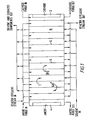
- An example of an electrodialysis cell which can be used is shown in Figure 1.
- the cell comprises one or more cathodes (2) and one or more anodes (4), which are spaced apart, the intervening space being divided by a plurality of ion-selective membranes (6) into a number of compartments (8).
- the number of such compartments used depends upon the degree of recovery that is required by the process since the greater the number of compartments the better the recovery.
- Each compartment has an inlet and outlet which allows either the liquid medium or the solvent to pass through it.
- the compartments are arranged so that the liquid medium and solvent pass through alternate compartments.
- the anode and cathode compartments It is preferable to purge the anode and cathode compartments to prevent electrolysis of the feed dialysate and to recover methyl iodide which may have diffused through the membranes.
- the ion selective membranes are arranged so that starting at the membrane nearest the anode and moving towards the cathode, the membranes alternate between being cation permeable and antion permeable until the cathode is reached.
- a very convenient purging electrolyte for the electrode compartments is a water-acetic acid mixture, since this is conducting and can then be added to the solvent stream after separation from electrolytically evolved gases. In some cases, it may be necessary to pass the electrode purge through compartments adjoining the electrode compartments to prevent further diffusion of methyl iodide or other iodine species to the anode compartment in particular.
- methyl iodide will reach the electrode compartments it is preferable to add between 0.5 to 5% by weight acetaldehyde, most preferably 2 to 3%, to prevent formation of iodine deposits.
- liquid medium it is preferable to dilute the liquid medium prior to it entering the electrodialysis cell. This ensures that the tar does not separate from the liquid medium inside the electrodialysis thereby fouling the membranes.
- Preferred solvents include methyl acetate, acetic acid and acetic anhydride.
- Figure 1 further illustrates an electrodialysis cell being used to separate a typical rhodium catalyst/promoter/copromoter mixture from a liquid medium comprising tar, carbonylation products and reactants as might be obtained by withdrawing a side stream or liquid bleed from a carbonylation reactor.
- the rhodium is present as the anion Rh(CO)2I2 and the promoter and copromoters comprise additional iodide ion, the cationic form of a metal (e.g. lithium, chromium, iron etc) and a quaternised amine cation.
- the liquid medium and solvent are each divided into a number of streams each of which pass into alternate compartments.
- anions in the liquid medium i.e. Rh(CO) 2 I2- and I-
- Rh(CO) 2 I2- and I- migrate from the tar towards the anode.
- the anions pass through the appropriate anion permeable membrane into the adjacent compartment containing the solvent. Further migration towards the anode however is prevented because the next membrane is only cation permeable.
- the anions therefore become trapped in the solvent compartment and are eventually removed in the solvent through the outlet.
- the cations present in the liquid medium undergo a similar migration except that they migrate towards the cathode through the appropriate cation permeable membrane into the adjacent compartment containing the solvent. Further progress of the cations towards the cathode is likewise prevented by an anion permeable membrane and again the cations are removed in the solvent through the outlet.
- outlet streams from the solvent containing compartments are usually combined and either recycled or further processed.
- the outlet steams from the liquid medium containing compartments, which now no longer contain any ions are likewise combined and processed further if necessary.
- the feeds to the compartments shown in Figure 1 are in parallel for the sake of simplicity. It may be preferable to arrange that liquids flow in series through the compartments to maximise the concentration gradient and to increase the turbulence at the membrane surface to overcome mass-transport effects. Alternatively the liquid medium can be treated batchwise, each batch being recirculated through the electrodialysis cell as many times as necessary.
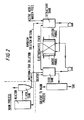
- a flow diagram for a unit used to recover rhodium is shown in Figure 2.
- the membranes Since it is the physical and chemical properties of the membranes which control the efficiency of the electrodialysis cell it is important that the membranes are selected carefully. Thus the membranes must have high mechanical strength and must be resistant to chemical attack. If possible the membrane should be resistant to clogging by the tar as this can impair the efficiency of ion transfer and should prevent excessive passage of the solvent or liquid medium between adjacent compartments.
- the membranes comprise a membrane polymer which can be made of one or more perfluoropolymers or copolymers of styrene and divinybenzene.
- a membrane polymer which can be made of one or more perfluoropolymers or copolymers of styrene and divinybenzene.
- such membrane polymers lack substantial mechanical strength and hence it is preferable to mount the membrane polymer, during the polymerisation, onto a reinforcing backbone such as polyethylene or polypropylene mesh.
- Membranes of the type described above can be chemically modified in order to improve the selectivity to either anion or cation permeability.
- the membrane polymer can be sulphonated, whilst substitution with quaternary ammonium moieties leads to improved anion permeability.
- the electrodialysis cell can be of any size, in practice the dimensions are limited by the mechanical strength of the membranes.
- the membranes used are 0.5 to 2m 2 in area and as thin as possible to reduce electrical resistance.
- the membranes are typically spaced to produce compartments 0.1 to 2mm wide to create turbulent condtions which reduce the susceptibility to mass transfer effects.
- each electrodialysis cell comprises stacks of up to 900 membrane pairs between each pair of electrodes.
- the efficiency of extraction which the electrodialysis cell achieves is determined by the number of compartments in the cell and the mobilities of the ions to be extracted.
- the ionic mobilities can be improved by operating the electrodialysis cell at an elevated temperature e.g. up to 100°C. Typical operating temperatures are on the range 10 to 80°C with 15 to 40°C being preferred.
- the electrodialysis cell described above can be operated singly or in series or parallel with other similar cells.
- Solutions containing rhodium species and a quaternery ammonium iodide salt in a mixture blended to resemble a typical carbonylation effluent stream were dialysed by recycling batches of electrolytes through a seven compartment flow cell of the type shown in Figure 3.
- the cell had a surface area of 10cm 2 of active membrane pair area and was operated at a current density of 1-10mAcm -2.
- the membranes used were functionalised, cross-linked polystyrene as supplied by BDH.
- the electrode compartments contained carbon rod electrodes. The following electrolytes were used:
- Anode Compartment 1.5 N-methylimidazole in 50/50 H 2 0/acetic acid.
- Extractant 0.05M QAS in 50/50 H 2 0/ acetic acid.
- Examples 1 and 2 used a solution consisting of: as a synthetic reactor effluent stream.
- Example 3 used a hydrolysed reactor effluent such as might be obtained from a process producing acetic acid/anhydride mixtures by carbonylation and had the following composition.
- the rhodium containing solutions were kept under carbon monoxide to prevent rhodium precipitation.
Landscapes
- Chemical & Material Sciences (AREA)
- Engineering & Computer Science (AREA)
- Chemical Kinetics & Catalysis (AREA)
- Materials Engineering (AREA)
- Organic Chemistry (AREA)
- Inorganic Chemistry (AREA)
- Water Supply & Treatment (AREA)
- Metallurgy (AREA)
- Mechanical Engineering (AREA)
- Health & Medical Sciences (AREA)
- Urology & Nephrology (AREA)
- Manufacturing & Machinery (AREA)
- Manufacture And Refinement Of Metals (AREA)
- Catalysts (AREA)
- Organic Low-Molecular-Weight Compounds And Preparation Thereof (AREA)
- Removal Of Specific Substances (AREA)
- Separation Using Semi-Permeable Membranes (AREA)
Priority Applications (1)
| Application Number | Priority Date | Filing Date | Title |
|---|---|---|---|
| AT87304552T ATE65942T1 (de) | 1986-05-30 | 1987-05-21 | Verfahren zur rueckgewinnungvon edelmetal. |
Applications Claiming Priority (2)
| Application Number | Priority Date | Filing Date | Title |
|---|---|---|---|
| GB8613221A GB8613221D0 (en) | 1986-05-30 | 1986-05-30 | Recovery process |
| GB8613221 | 1986-05-30 |
Publications (2)
| Publication Number | Publication Date |
|---|---|
| EP0250103A1 true EP0250103A1 (fr) | 1987-12-23 |
| EP0250103B1 EP0250103B1 (fr) | 1991-08-07 |
Family
ID=10598712
Family Applications (1)
| Application Number | Title | Priority Date | Filing Date |
|---|---|---|---|
| EP19870304552 Expired - Lifetime EP0250103B1 (fr) | 1986-05-30 | 1987-05-21 | Procédé de récupérationdu métal précieux |
Country Status (8)
| Country | Link |
|---|---|
| US (1) | US4871432A (fr) |
| EP (1) | EP0250103B1 (fr) |
| JP (1) | JPS6323748A (fr) |
| AT (1) | ATE65942T1 (fr) |
| AU (1) | AU600489B2 (fr) |
| DE (1) | DE3771943D1 (fr) |
| GB (1) | GB8613221D0 (fr) |
| NO (1) | NO169500C (fr) |
Cited By (1)
| Publication number | Priority date | Publication date | Assignee | Title |
|---|---|---|---|---|
| EP0363314A1 (fr) * | 1988-09-19 | 1990-04-11 | CGB CONSULTING GRUPPE BADEN Dr.-Ing. WALTHER AG | Procédé et dispositif pour récupérer des composants de catalysateurs |
Families Citing this family (3)
| Publication number | Priority date | Publication date | Assignee | Title |
|---|---|---|---|---|
| KR930003650B1 (ko) * | 1990-10-08 | 1993-05-08 | 재단법인 한국화학연구소 | 에틸리덴 디 아세테이트 제조용 유기체 담지 촉매 및 이를 이용한 에틸리덴 디 아세테이트의 제조방법 |
| FI120527B (fi) * | 2007-06-18 | 2009-11-30 | Crisolteq Oy | Talteenottomenetelmä |
| US11427887B2 (en) * | 2017-11-27 | 2022-08-30 | The Board Of Trustees Of The University Of Illinois | Extraction of selected platinum-group metals from supported catalyst |
Citations (3)
| Publication number | Priority date | Publication date | Assignee | Title |
|---|---|---|---|---|
| FR1591176A (fr) * | 1968-10-30 | 1970-04-27 | ||
| FR2021810A1 (fr) * | 1968-10-29 | 1970-07-24 | British Petroleum Co | |
| GB1266180A (fr) * | 1969-12-19 | 1972-03-08 |
Family Cites Families (5)
| Publication number | Priority date | Publication date | Assignee | Title |
|---|---|---|---|---|
| US4146455A (en) * | 1978-04-19 | 1979-03-27 | Ionics Inc. | Process for treating whey |
| US4227981A (en) * | 1979-08-31 | 1980-10-14 | Borden, Inc. | Electrodialysis of acid whey |
| WO1981001417A1 (fr) * | 1979-11-13 | 1981-05-28 | S Husain | Isolation d'activateurs plasminogenes utiles comme agents therapeutiques et diagnostiques |
| DE3040631A1 (de) * | 1980-10-29 | 1982-05-27 | Merck Patent Gmbh, 6100 Darmstadt | Verfahren zur abtrennung von metallkatalysatoren und verwendung von membrantrennvorrichtungen |
| US4680098A (en) * | 1985-03-18 | 1987-07-14 | Amoco Corporation | Aqueous recovery of cobalt or cobalt and manganese from solution also containing oxygenated aromatic compounds |
-
1986
- 1986-05-30 GB GB8613221A patent/GB8613221D0/en active Pending
-
1987
- 1987-05-21 US US07/052,052 patent/US4871432A/en not_active Expired - Fee Related
- 1987-05-21 DE DE8787304552T patent/DE3771943D1/de not_active Expired - Lifetime
- 1987-05-21 AT AT87304552T patent/ATE65942T1/de not_active IP Right Cessation
- 1987-05-21 EP EP19870304552 patent/EP0250103B1/fr not_active Expired - Lifetime
- 1987-05-26 NO NO872189A patent/NO169500C/no unknown
- 1987-05-26 AU AU73401/87A patent/AU600489B2/en not_active Ceased
- 1987-05-30 JP JP62137599A patent/JPS6323748A/ja active Pending
Patent Citations (3)
| Publication number | Priority date | Publication date | Assignee | Title |
|---|---|---|---|---|
| FR2021810A1 (fr) * | 1968-10-29 | 1970-07-24 | British Petroleum Co | |
| FR1591176A (fr) * | 1968-10-30 | 1970-04-27 | ||
| GB1266180A (fr) * | 1969-12-19 | 1972-03-08 |
Non-Patent Citations (1)
| Title |
|---|
| CHEMICAL ABSTRACTS, vol. 94, no. 6, 9th February 1981, page 236, abstact no. 34295f, Columbus, Ohio, US; & JP-A-80 23 889 (INOUE-JAPAX) 25-06-1980 * |
Cited By (1)
| Publication number | Priority date | Publication date | Assignee | Title |
|---|---|---|---|---|
| EP0363314A1 (fr) * | 1988-09-19 | 1990-04-11 | CGB CONSULTING GRUPPE BADEN Dr.-Ing. WALTHER AG | Procédé et dispositif pour récupérer des composants de catalysateurs |
Also Published As
| Publication number | Publication date |
|---|---|
| EP0250103B1 (fr) | 1991-08-07 |
| NO169500C (no) | 1992-07-01 |
| JPS6323748A (ja) | 1988-02-01 |
| NO872189L (no) | 1987-12-01 |
| NO169500B (no) | 1992-03-23 |
| AU600489B2 (en) | 1990-08-16 |
| AU7340187A (en) | 1987-12-03 |
| GB8613221D0 (en) | 1986-07-02 |
| DE3771943D1 (de) | 1991-09-12 |
| US4871432A (en) | 1989-10-03 |
| ATE65942T1 (de) | 1991-08-15 |
| NO872189D0 (no) | 1987-05-26 |
Similar Documents
| Publication | Publication Date | Title |
|---|---|---|
| JP6599367B2 (ja) | ガス拡散電極を用いて二酸化炭素を電気化学的に還元するための方法及びシステム | |
| KR100403367B1 (ko) | 아세트산제조법 | |
| US12195865B2 (en) | Method for electrochemical production of a product in a cell comprising a polyelectrolyte | |
| US4397719A (en) | Process for preparing nitrogen by ammonium nitrate decomposition | |
| WO2015184388A1 (fr) | Procédé et système pour la réduction électrochimique de dioxyde de carbone au moyen d'une électrode à diffusion gazeuse | |
| DE1468149B1 (de) | Verfahren zur herstellung von olefinoxiden | |
| US3927111A (en) | Production of carbonyl compounds | |
| CA2101963A1 (fr) | Methode de recuperation des metaux nobles du groupe viii | |
| EP0250103B1 (fr) | Procédé de récupérationdu métal précieux | |
| US6214190B1 (en) | Method for separating a catalyst by membrane electrodialysis | |
| KR20220112775A (ko) | 수소 저장 방법, 수소 가스의 제조 방법 및 수소 가스 제조 시스템 | |
| DE69500905T2 (de) | Verfahren zur Entfernung von Jod enthaltenden Verbindungen aus Essigsäure | |
| US3379626A (en) | Process and apparatus for oxidizing olefins | |
| JP3493242B2 (ja) | 硝酸塩の電気化学的回収方法及び装置 | |
| MX2015000244A (es) | Metodo para la produccion de vainillina. | |
| US5391268A (en) | Electrochemical process for the removal of residual nitric acid from aqueous hydroxylammonium nitrate | |
| CN117358060A (zh) | 一种双极膜电渗析制备季铵碱的方法 | |
| JPH08246178A (ja) | 塩類の電気化学的回収方法及び装置 | |
| Raoult et al. | Use of ion exchange membranes in preparative organic electrochemistry. IV. Electroreduction of dibromo compounds and solvent effects | |
| JP2919633B2 (ja) | プロピレンの部分酸化物の製造方法 | |
| US3227640A (en) | Manufacture of olefinically unsaturated alcohols | |
| EP4435150A1 (fr) | Electrolyse du co2 dans une cellule electrochimique a trois compartiments comprenant un milieu de fermentation | |
| JP4077253B2 (ja) | カルボニル化合物の製造方法 | |
| Juarez-Islas et al. | Metals separation by the joint process of facilitated transport and electrodialysis (electromembrane process), employing a liquid membrane compound by D2EHPA–kerosene–formamide | |
| JPH0349993B2 (fr) |
Legal Events
| Date | Code | Title | Description |
|---|---|---|---|
| PUAI | Public reference made under article 153(3) epc to a published international application that has entered the european phase |
Free format text: ORIGINAL CODE: 0009012 |
|
| AK | Designated contracting states |
Kind code of ref document: A1 Designated state(s): AT BE DE FR GB IT LU NL SE |
|
| 17P | Request for examination filed |
Effective date: 19880502 |
|
| 17Q | First examination report despatched |
Effective date: 19900626 |
|
| GRAA | (expected) grant |
Free format text: ORIGINAL CODE: 0009210 |
|
| AK | Designated contracting states |
Kind code of ref document: B1 Designated state(s): AT BE DE FR GB IT LU NL SE |
|
| REF | Corresponds to: |
Ref document number: 65942 Country of ref document: AT Date of ref document: 19910815 Kind code of ref document: T |
|
| ITF | It: translation for a ep patent filed | ||
| REF | Corresponds to: |
Ref document number: 3771943 Country of ref document: DE Date of ref document: 19910912 |
|
| ET | Fr: translation filed | ||
| PGFP | Annual fee paid to national office [announced via postgrant information from national office to epo] |
Ref country code: DE Payment date: 19920324 Year of fee payment: 6 |
|
| PGFP | Annual fee paid to national office [announced via postgrant information from national office to epo] |
Ref country code: FR Payment date: 19920325 Year of fee payment: 6 |
|
| PGFP | Annual fee paid to national office [announced via postgrant information from national office to epo] |
Ref country code: SE Payment date: 19920327 Year of fee payment: 6 |
|
| PGFP | Annual fee paid to national office [announced via postgrant information from national office to epo] |
Ref country code: BE Payment date: 19920428 Year of fee payment: 6 |
|
| PG25 | Lapsed in a contracting state [announced via postgrant information from national office to epo] |
Ref country code: GB Effective date: 19920521 Ref country code: AT Effective date: 19920521 |
|
| PG25 | Lapsed in a contracting state [announced via postgrant information from national office to epo] |
Ref country code: LU Free format text: LAPSE BECAUSE OF NON-PAYMENT OF DUE FEES Effective date: 19920531 |
|
| PLBE | No opposition filed within time limit |
Free format text: ORIGINAL CODE: 0009261 |
|
| STAA | Information on the status of an ep patent application or granted ep patent |
Free format text: STATUS: NO OPPOSITION FILED WITHIN TIME LIMIT |
|
| 26N | No opposition filed | ||
| PG25 | Lapsed in a contracting state [announced via postgrant information from national office to epo] |
Ref country code: NL Effective date: 19921201 |
|
| NLV4 | Nl: lapsed or anulled due to non-payment of the annual fee | ||
| GBPC | Gb: european patent ceased through non-payment of renewal fee |
Effective date: 19920521 |
|
| PG25 | Lapsed in a contracting state [announced via postgrant information from national office to epo] |
Ref country code: SE Effective date: 19930522 |
|
| PG25 | Lapsed in a contracting state [announced via postgrant information from national office to epo] |
Ref country code: BE Effective date: 19930531 |
|
| BERE | Be: lapsed |
Owner name: BP CHEMICALS LTD Effective date: 19930531 |
|
| PG25 | Lapsed in a contracting state [announced via postgrant information from national office to epo] |
Ref country code: FR Effective date: 19940131 |
|
| PG25 | Lapsed in a contracting state [announced via postgrant information from national office to epo] |
Ref country code: DE Effective date: 19940201 |
|
| REG | Reference to a national code |
Ref country code: FR Ref legal event code: ST |
|
| EUG | Se: european patent has lapsed |
Ref document number: 87304552.0 Effective date: 19931210 |
|
| PG25 | Lapsed in a contracting state [announced via postgrant information from national office to epo] |
Ref country code: IT Free format text: LAPSE BECAUSE OF NON-PAYMENT OF DUE FEES Effective date: 20050521 |