EP0250626B2 - Procédé de séparation des ions sulfate d'eau résiduaire - Google Patents
Procédé de séparation des ions sulfate d'eau résiduaire Download PDFInfo
- Publication number
- EP0250626B2 EP0250626B2 EP86108876A EP86108876A EP0250626B2 EP 0250626 B2 EP0250626 B2 EP 0250626B2 EP 86108876 A EP86108876 A EP 86108876A EP 86108876 A EP86108876 A EP 86108876A EP 0250626 B2 EP0250626 B2 EP 0250626B2
- Authority
- EP
- European Patent Office
- Prior art keywords
- precipitation
- calcium
- waste water
- aluminates
- sulphate
- Prior art date
- Legal status (The legal status is an assumption and is not a legal conclusion. Google has not performed a legal analysis and makes no representation as to the accuracy of the status listed.)
- Expired - Lifetime
Links
- 239000002351 wastewater Substances 0.000 title claims abstract description 64
- 238000000034 method Methods 0.000 title claims abstract description 58
- 238000000926 separation method Methods 0.000 title claims abstract description 7
- QAOWNCQODCNURD-UHFFFAOYSA-L Sulfate Chemical compound [O-]S([O-])(=O)=O QAOWNCQODCNURD-UHFFFAOYSA-L 0.000 title claims description 63
- 238000001556 precipitation Methods 0.000 claims abstract description 114
- -1 sulphate ions Chemical class 0.000 claims abstract description 35
- 239000011575 calcium Substances 0.000 claims abstract description 33
- PNEYBMLMFCGWSK-UHFFFAOYSA-N Alumina Chemical compound [O-2].[O-2].[O-2].[Al+3].[Al+3] PNEYBMLMFCGWSK-UHFFFAOYSA-N 0.000 claims abstract description 29
- 238000006243 chemical reaction Methods 0.000 claims abstract description 27
- 239000000920 calcium hydroxide Substances 0.000 claims abstract description 25
- 229910052791 calcium Inorganic materials 0.000 claims abstract description 21
- 235000011116 calcium hydroxide Nutrition 0.000 claims abstract description 21
- AXCZMVOFGPJBDE-UHFFFAOYSA-L calcium dihydroxide Chemical compound [OH-].[OH-].[Ca+2] AXCZMVOFGPJBDE-UHFFFAOYSA-L 0.000 claims abstract description 17
- 229910001861 calcium hydroxide Inorganic materials 0.000 claims abstract description 16
- XFWJKVMFIVXPKK-UHFFFAOYSA-N calcium;oxido(oxo)alumane Chemical compound [Ca+2].[O-][Al]=O.[O-][Al]=O XFWJKVMFIVXPKK-UHFFFAOYSA-N 0.000 claims abstract description 14
- 229910021653 sulphate ion Inorganic materials 0.000 claims abstract description 11
- 239000007787 solid Substances 0.000 claims abstract description 8
- 238000002156 mixing Methods 0.000 claims abstract description 7
- 150000004645 aluminates Chemical class 0.000 claims abstract description 6
- 239000010842 industrial wastewater Substances 0.000 claims abstract description 6
- 230000001376 precipitating effect Effects 0.000 claims abstract description 3
- 229910001653 ettringite Inorganic materials 0.000 claims description 25
- 238000004062 sedimentation Methods 0.000 claims description 22
- OSGAYBCDTDRGGQ-UHFFFAOYSA-L calcium sulfate Chemical compound [Ca+2].[O-]S([O-])(=O)=O OSGAYBCDTDRGGQ-UHFFFAOYSA-L 0.000 claims description 18
- 239000000203 mixture Substances 0.000 claims description 14
- 239000004568 cement Substances 0.000 claims description 12
- 230000035484 reaction time Effects 0.000 claims description 11
- XLYOFNOQVPJJNP-UHFFFAOYSA-N water Substances O XLYOFNOQVPJJNP-UHFFFAOYSA-N 0.000 claims description 8
- 239000000047 product Substances 0.000 claims description 5
- 238000002425 crystallisation Methods 0.000 claims description 4
- 239000002244 precipitate Substances 0.000 claims description 3
- 239000008399 tap water Substances 0.000 claims description 3
- 235000020679 tap water Nutrition 0.000 claims description 3
- 239000007900 aqueous suspension Substances 0.000 claims description 2
- 239000007788 liquid Substances 0.000 claims description 2
- 238000001139 pH measurement Methods 0.000 claims description 2
- 229910052593 corundum Inorganic materials 0.000 claims 5
- 229910001845 yogo sapphire Inorganic materials 0.000 claims 5
- 239000001175 calcium sulphate Substances 0.000 claims 3
- 235000011132 calcium sulphate Nutrition 0.000 claims 3
- 239000002699 waste material Substances 0.000 claims 2
- 238000003825 pressing Methods 0.000 claims 1
- 229910018072 Al 2 O 3 Inorganic materials 0.000 description 48
- 239000002994 raw material Substances 0.000 description 23
- 229910052602 gypsum Inorganic materials 0.000 description 18
- 239000010440 gypsum Substances 0.000 description 18
- QAOWNCQODCNURD-UHFFFAOYSA-N Sulfuric acid Chemical compound OS(O)(=O)=O QAOWNCQODCNURD-UHFFFAOYSA-N 0.000 description 17
- 239000004571 lime Substances 0.000 description 16
- 235000008733 Citrus aurantifolia Nutrition 0.000 description 15
- 235000011941 Tilia x europaea Nutrition 0.000 description 15
- 230000015572 biosynthetic process Effects 0.000 description 13
- 239000000243 solution Substances 0.000 description 13
- 239000000523 sample Substances 0.000 description 10
- 239000008267 milk Substances 0.000 description 9
- 210000004080 milk Anatomy 0.000 description 9
- 235000013336 milk Nutrition 0.000 description 9
- 239000010802 sludge Substances 0.000 description 8
- 238000012360 testing method Methods 0.000 description 7
- 238000002474 experimental method Methods 0.000 description 6
- 238000004519 manufacturing process Methods 0.000 description 6
- 230000002572 peristaltic effect Effects 0.000 description 5
- 239000010865 sewage Substances 0.000 description 5
- 235000019738 Limestone Nutrition 0.000 description 4
- 239000006028 limestone Substances 0.000 description 4
- 238000006386 neutralization reaction Methods 0.000 description 4
- 239000000126 substance Substances 0.000 description 4
- 229910004298 SiO 2 Inorganic materials 0.000 description 3
- HEMHJVSKTPXQMS-UHFFFAOYSA-M Sodium hydroxide Chemical compound [OH-].[Na+] HEMHJVSKTPXQMS-UHFFFAOYSA-M 0.000 description 3
- 238000002441 X-ray diffraction Methods 0.000 description 3
- 239000002253 acid Substances 0.000 description 3
- 239000011521 glass Substances 0.000 description 3
- 238000006703 hydration reaction Methods 0.000 description 3
- 238000011835 investigation Methods 0.000 description 3
- 150000002500 ions Chemical class 0.000 description 3
- 238000010979 pH adjustment Methods 0.000 description 3
- 239000000843 powder Substances 0.000 description 3
- 238000011160 research Methods 0.000 description 3
- 238000003756 stirring Methods 0.000 description 3
- 229910021532 Calcite Inorganic materials 0.000 description 2
- 230000032683 aging Effects 0.000 description 2
- 239000012496 blank sample Substances 0.000 description 2
- 238000002485 combustion reaction Methods 0.000 description 2
- 239000013078 crystal Substances 0.000 description 2
- 230000008025 crystallization Effects 0.000 description 2
- 230000007613 environmental effect Effects 0.000 description 2
- 235000013312 flour Nutrition 0.000 description 2
- 239000003546 flue gas Substances 0.000 description 2
- 239000003673 groundwater Substances 0.000 description 2
- 230000036571 hydration Effects 0.000 description 2
- TWNQGVIAIRXVLR-UHFFFAOYSA-N oxo(oxoalumanyloxy)alumane Chemical compound O=[Al]O[Al]=O TWNQGVIAIRXVLR-UHFFFAOYSA-N 0.000 description 2
- 238000005498 polishing Methods 0.000 description 2
- 229910002059 quaternary alloy Inorganic materials 0.000 description 2
- 238000000682 scanning probe acoustic microscopy Methods 0.000 description 2
- 150000003467 sulfuric acid derivatives Chemical class 0.000 description 2
- 238000004065 wastewater treatment Methods 0.000 description 2
- 239000005995 Aluminium silicate Substances 0.000 description 1
- 229910004261 CaF 2 Inorganic materials 0.000 description 1
- BHPQYMZQTOCNFJ-UHFFFAOYSA-N Calcium cation Chemical compound [Ca+2] BHPQYMZQTOCNFJ-UHFFFAOYSA-N 0.000 description 1
- UGFAIRIUMAVXCW-UHFFFAOYSA-N Carbon monoxide Chemical compound [O+]#[C-] UGFAIRIUMAVXCW-UHFFFAOYSA-N 0.000 description 1
- VEXZGXHMUGYJMC-UHFFFAOYSA-M Chloride anion Chemical compound [Cl-] VEXZGXHMUGYJMC-UHFFFAOYSA-M 0.000 description 1
- KRHYYFGTRYWZRS-UHFFFAOYSA-M Fluoride anion Chemical compound [F-] KRHYYFGTRYWZRS-UHFFFAOYSA-M 0.000 description 1
- YCKRFDGAMUMZLT-UHFFFAOYSA-N Fluorine atom Chemical compound [F] YCKRFDGAMUMZLT-UHFFFAOYSA-N 0.000 description 1
- 229910002651 NO3 Inorganic materials 0.000 description 1
- NHNBFGGVMKEFGY-UHFFFAOYSA-N Nitrate Chemical compound [O-][N+]([O-])=O NHNBFGGVMKEFGY-UHFFFAOYSA-N 0.000 description 1
- 230000001133 acceleration Effects 0.000 description 1
- 150000007513 acids Chemical class 0.000 description 1
- 239000003513 alkali Substances 0.000 description 1
- 229910052782 aluminium Inorganic materials 0.000 description 1
- 235000012211 aluminium silicate Nutrition 0.000 description 1
- DIZPMCHEQGEION-UHFFFAOYSA-H aluminium sulfate (anhydrous) Chemical compound [Al+3].[Al+3].[O-]S([O-])(=O)=O.[O-]S([O-])(=O)=O.[O-]S([O-])(=O)=O DIZPMCHEQGEION-UHFFFAOYSA-H 0.000 description 1
- 229910052925 anhydrite Inorganic materials 0.000 description 1
- 150000001450 anions Chemical class 0.000 description 1
- 239000012736 aqueous medium Substances 0.000 description 1
- 229910052785 arsenic Inorganic materials 0.000 description 1
- 244000052616 bacterial pathogen Species 0.000 description 1
- DSAJWYNOEDNPEQ-UHFFFAOYSA-N barium atom Chemical compound [Ba] DSAJWYNOEDNPEQ-UHFFFAOYSA-N 0.000 description 1
- 229910001422 barium ion Inorganic materials 0.000 description 1
- 229910001570 bauxite Inorganic materials 0.000 description 1
- 230000009286 beneficial effect Effects 0.000 description 1
- 238000009835 boiling Methods 0.000 description 1
- 229910001424 calcium ion Inorganic materials 0.000 description 1
- 159000000007 calcium salts Chemical class 0.000 description 1
- 229940125782 compound 2 Drugs 0.000 description 1
- 239000000470 constituent Substances 0.000 description 1
- 238000007796 conventional method Methods 0.000 description 1
- 230000006378 damage Effects 0.000 description 1
- 230000003247 decreasing effect Effects 0.000 description 1
- 230000001419 dependent effect Effects 0.000 description 1
- 238000006477 desulfuration reaction Methods 0.000 description 1
- 230000023556 desulfurization Effects 0.000 description 1
- HOOWDPSAHIOHCC-UHFFFAOYSA-N dialuminum tricalcium oxygen(2-) Chemical compound [O--].[O--].[O--].[O--].[O--].[O--].[Al+3].[Al+3].[Ca++].[Ca++].[Ca++] HOOWDPSAHIOHCC-UHFFFAOYSA-N 0.000 description 1
- 238000010790 dilution Methods 0.000 description 1
- 239000012895 dilution Substances 0.000 description 1
- 238000009826 distribution Methods 0.000 description 1
- 238000005516 engineering process Methods 0.000 description 1
- 230000002349 favourable effect Effects 0.000 description 1
- 239000003337 fertilizer Substances 0.000 description 1
- 239000011737 fluorine Substances 0.000 description 1
- 229910052731 fluorine Inorganic materials 0.000 description 1
- 239000007789 gas Substances 0.000 description 1
- 210000001035 gastrointestinal tract Anatomy 0.000 description 1
- 229910001385 heavy metal Inorganic materials 0.000 description 1
- 238000007654 immersion Methods 0.000 description 1
- 239000012535 impurity Substances 0.000 description 1
- 238000009616 inductively coupled plasma Methods 0.000 description 1
- 239000004615 ingredient Substances 0.000 description 1
- 229910052500 inorganic mineral Inorganic materials 0.000 description 1
- 230000002452 interceptive effect Effects 0.000 description 1
- NLYAJNPCOHFWQQ-UHFFFAOYSA-N kaolin Chemical compound O.O.O=[Al]O[Si](=O)O[Si](=O)O[Al]=O NLYAJNPCOHFWQQ-UHFFFAOYSA-N 0.000 description 1
- 238000009533 lab test Methods 0.000 description 1
- 229910052745 lead Inorganic materials 0.000 description 1
- 238000011068 loading method Methods 0.000 description 1
- 239000002075 main ingredient Substances 0.000 description 1
- 235000012054 meals Nutrition 0.000 description 1
- 235000010755 mineral Nutrition 0.000 description 1
- 239000011707 mineral Substances 0.000 description 1
- 230000007935 neutral effect Effects 0.000 description 1
- 230000003472 neutralizing effect Effects 0.000 description 1
- 150000007524 organic acids Chemical class 0.000 description 1
- 235000005985 organic acids Nutrition 0.000 description 1
- FWFGVMYFCODZRD-UHFFFAOYSA-N oxidanium;hydrogen sulfate Chemical compound O.OS(O)(=O)=O FWFGVMYFCODZRD-UHFFFAOYSA-N 0.000 description 1
- 239000002245 particle Substances 0.000 description 1
- 230000008092 positive effect Effects 0.000 description 1
- 238000012545 processing Methods 0.000 description 1
- 230000001737 promoting effect Effects 0.000 description 1
- 230000009257 reactivity Effects 0.000 description 1
- 238000009938 salting Methods 0.000 description 1
- 150000003839 salts Chemical class 0.000 description 1
- 229920006395 saturated elastomer Polymers 0.000 description 1
- 238000004904 shortening Methods 0.000 description 1
- 239000006104 solid solution Substances 0.000 description 1
- 238000002798 spectrophotometry method Methods 0.000 description 1
- 230000002269 spontaneous effect Effects 0.000 description 1
- 239000007858 starting material Substances 0.000 description 1
- 229910001427 strontium ion Inorganic materials 0.000 description 1
- 239000002352 surface water Substances 0.000 description 1
- 239000000725 suspension Substances 0.000 description 1
- 230000001988 toxicity Effects 0.000 description 1
- 231100000419 toxicity Toxicity 0.000 description 1
- 238000005406 washing Methods 0.000 description 1
- 239000003643 water by type Substances 0.000 description 1
Images



Classifications
-
- C—CHEMISTRY; METALLURGY
- C02—TREATMENT OF WATER, WASTE WATER, SEWAGE, OR SLUDGE
- C02F—TREATMENT OF WATER, WASTE WATER, SEWAGE, OR SLUDGE
- C02F1/00—Treatment of water, waste water, or sewage
- C02F1/52—Treatment of water, waste water, or sewage by flocculation or precipitation of suspended impurities
- C02F1/5236—Treatment of water, waste water, or sewage by flocculation or precipitation of suspended impurities using inorganic agents
Definitions
- Sulfuric acid is used to an extremely large extent in the chemical industry. The main amount is used for the production of artificial fertilizers. It is also used to manufacture most other mineral acids. Considerable amounts of sulfuric acid are also used as accumulator acid. In addition, sulfuric acid is used, for example, in process baths for improving the surface, for example in polishing baths in the glass industry (mixture of 55 to 85% H 2 SO 4 , 0.5 to 10% HF). The sulfuric acid production in the Federal Republic of Germany alone is currently around 5 million t / a. When processing sulfuric acids, waste water containing H 2 SO 4 is generated in most cases.
- Sulphate ions are also, although toxicologically relatively harmless, aggressive to concrete and lead to the destruction of concrete sewers; in DIN 4030 are waters with 200 to 600 mg / SO 2- 4th / l as weak, with 600 to 3000 mg SO 2- 4th / l as strong and with over 3000 mg SO 2- 4th / l defined as very strongly attacking concrete.
- the legally prescribed limit values for the sulfate content of wastewater that is discharged into public sewer networks are generally in the range of 400 to 600 mg SO 2- 4th / l.
- methods for reducing the sulfate concentration must be used, since a simple dilution of sulfuric acid solutions with tap water or other waste water is not an economically and ecologically suitable solution.
- the sulfate separation by precipitation of calcium sulfate (gypsum) with calcium hydroxide (lime milk) is used with simultaneous neutralization of the waste water (CJ Lewis, RS Boynton, NLA Bulletin 216 (1976)).
- reaction equation I Approx 2+ + 2OH - + 2H + + SO 2- 4th + nH 2nd O ⁇ CaSO 4th ⁇ 2H 2nd O + nH 2nd O Gypsum (CaSO 4 ⁇ 2H 2 O) formed, which fails due to its relatively low solubility.
- gypsum often precipitates out of the supersaturated solutions at unsuitable points, which leads to formation of deposits in piping systems and equipment.
- a further, in principle more suitable, possibility of lowering the sulfate ion concentration below the CaSO 4 solubility is to use aluminates, with a small excess of calcium ions having to be present at the same time. Under these conditions, the stable calcium aluminate sulfate ettringite (3CaO ⁇ Al 2 O 3 ⁇ 3CaSO 4 ⁇ 32H 2 O or Ca 6 Al 2 [(OH) 4 SO 4 ] 3 ⁇ 26H 2 O) can form.
- the solubility of the ettringite is very low in calcareous water. At 50 mg CaO / l only about 250 mg ettringite / l are dissolved, which corresponds to a sulfate ion concentration of 5.5 mg SO 2- 4th / l corresponds.
- Ettringite is formed in the presence of CaSO 4 , which can also originate from the above-described precipitation with Ca (OH) 2 , according to reaction equation II: 3CaO ⁇ Al 2nd O 3rd + 3CaSO 4th ⁇ 3CaO ⁇ Al 2nd O 3rd 3CaSO 4th 32H 2nd O can also be done according to the following reaction equation IIa: CaO ⁇ Al 2nd O 3rd + 3H 2nd SO 4th + 29H 2nd O + 5CaO ⁇ 3CaO ⁇ Al 2nd O 3rd 3CaSO 4th 32H 2nd O
- the amount of gypsum added to a supersaturated aluminate solution is calculated so that it is in excess of the monosulfoaluminate, the monosulfoaluminate disappears in favor of the ettringite with increasing amount of gypsum.
- the invention is accordingly based on the object, based on this prior art, to provide a process for the highly effective removal of sulfate ions from industrial wastewater, with the SO lying below the sulfate ion concentration caused by the solubility of CaSO 4 2- 4th -Concentrations in reaction times which are sufficiently short for industrial use, in particular not more than about 5 hours, and can be achieved without any additional outlay in terms of apparatus compared to the conventional procedure.
- the invention is based in particular on the surprising finding that the pH falls during the precipitation reaction with calcium aluminate and that the process result can be significantly improved by keeping the pH constant, since then low residual sulfate concentrations konzentr 5 mg SO 2- 4th / l can be achieved in extremely short reaction times of up to 5 hours.
- the stirrers were arranged eccentrically to avoid the formation of drums and suction and to ensure optimal mixing.
- the pH of the wastewater was adjusted to 11.6 ⁇ 0.1 with 20% lime milk, whereupon calcium aluminates in the form of alumina cement (TSZ) were added.
- TSZ alumina cement
- the pH was kept constant throughout the precipitation reaction by adding milk of lime.
- Table 1 Sulphate content of the artificial wastewater in mg / l after 2 h and 3 h reaction time when using different amounts of TSZ Amount of TSZ used (g) TSZ 1 TSZ 2 TSZ 3 2 h 3 h 2 h 3h 2 h 3 h 5.0 50 ⁇ 20 ⁇ 50 - 50 ⁇ 20 4.0 1350 ⁇ 50 850 ⁇ 50 1650 ⁇ 50 3.0 1500 ⁇ 50 850 ⁇ 50 1550 ⁇ 50 2.5 1150 450 ⁇ 50 - 900 ⁇ 50 2.0 1600 ⁇ 50 600 ⁇ 50 950 ⁇ 50
- Fig. 1 immediately show that extremely low residual sulfate concentrations can be achieved with alumina cement under the specified pH conditions, the temperature range from 25 to 35 ° C being optimal, since in this range very low residual sulfate concentrations with very short reaction times (3rd h) can be achieved.
- Fig. 1 shows that the precipitation of CaSO 4 ⁇ 2H 2 O improves and correspondingly lower residual sulfate concentrations are present if the precipitation in step (a) is carried out at a temperature of 30 to 45 ° C, which is the case with that from the literature known temperature dependence of the solubility of gypsum.
- Waste water 2 had a low starting sulfate concentration and contained solubility-increasing components, such as organic acids, NO - 2nd and NO - 3rd .
- the sulfate determination was carried out turbidimetrically by spectrophotometry; Al and Pb and As were determined by Auger Electron Spectrometry (AES) with Inductively Coupled Plasma (ICP); the fluoride determination was carried out potentiometrically with an ion-selective electrode.
- AES Auger Electron Spectrometry
- ICP Inductively Coupled Plasma
- the fluoride determination was carried out potentiometrically with an ion-selective electrode.
- the procedure was as in the artificial wastewater in the remaining above using a stirrer speed was adjusted to 500 min -1, the pH was 0.7 to 1.1 and at the beginning of the precipitation at 20 and 30 ° C were made .
- Precipitation (a) was carried out for 20 min, calcium aluminate precipitation in step (A) for a maximum of 5 h.
- the wastewater 1 with a high sulfate concentration was the artificial waste water found a clear dependence of the yield of the precipitation on the pH value, as can be seen from FIG. 2.
- the sulfate content dropped from 3700 mg / l at pH 6.8 to 1700 mg / l at pH 11.6.
- the cause of the continued precipitation under these conditions is apparently the high amount of sludge.
- This sludge acts as a contact mass and supports the precipitation. If the precipitate is not separated off, then during the aging process (up to 5 h) in which the small crystals dissolve at the expense of the large ones, an increase in the sulfate concentration to approximately 2000 mg / l can be observed.
- Precipitation is advantageously carried out at temperatures in the range from 40 to 45.degree.
- the tests also showed that it is not expedient to set the pH value for the TSZ precipitation of 11.6 ⁇ 0.1 during the pre-precipitation with lime milk, since after the sludge has been separated off there is too little gypsum germ in the solution are located. Therefore, the pre-precipitation was carried out at pH 10.5 to 11.0. As a result, the sulfate concentration was only reduced to about 2000 mg / l, but in the subsequent TSZ precipitation after raising the pH to 11.6 ⁇ 0.1 with KM, there were enough gypsum germs in the solution to ensure the desired precipitation reaction .
- Results were equally good when the TSZ was added as an aqueous suspension and as a solid.
- the Pb ion concentration was reduced from 4.6 to 0.1 mg / l already in the pre-precipitation in stage (a) with 20% KM.
- the Indian Federal Republic of Germany the maximum value of the Pb ion concentration for discharge into public sewage systems is 2 mg / l.
- the present lead was almost completely precipitated as PbSO 4 and Pb (OH) 2 .
- phase composition of various precipitation products obtained was determined by X-ray diffraction studies, the results of which are summarized in Table 5.
- Table 5 Sample No. Brief description of the manufacture phases found 2nd Precipitation with TSZ 1 (3 g / l) + Al 2 O 3 -RM (3 g / l) Ettringite 3rd Precipitation with TSZ 2 (2 g / l) + Al 2 O 3 -RM (3 g / l) Ettringite, calcite 4th Precipitation with TSZ 2 (1.4 g / l) Calcite 5 Precipitation with TSZ 1 (1.8 g / l) no crystalline phases 6 Precipitation with KM 20% CaSO 4 ⁇ 0.5H 2 0 7 Precipitation with TSZ 2 (3 g / l) Monosulfate * (10H 2 0) 8th Precipitation with TSZ 1 (4 g / l) Monosulfate * (10H 2 O
- Ettringite formation could not be detected in samples 4 and 5 either. In comparison to Samples 2 and 3, these samples were not air-dried at 105 ° C, but air-dried. Here there are presumably cryptocrystalline or amorphous components that cannot be detected by X-ray diffraction.
- the limit of detectability is a particle size of 1 ⁇ m.
- Table 6 shows the results of X-ray diffraction studies on samples obtained using the calcium aluminates prepared as described above.
- Table 6 Sample No. Brief description of the manufacture phases found 9 CaO + Al 2 O 3 -RM 1000 ° C, 12 h CaO, C 3 A, C 1.8 A, CA, C 4 AF 10th Limestone powder + Al 2 O 3 -RM 1000 ° C, 12 h CaO, C 3 A, C 1.8 A, C 4 AF 11 Limestone powder + Al 2 O 3 -RM 1150 ° C, 12 h CaO, C 3 A, C 1.8 A, C 12 A 7 , C 4 AF
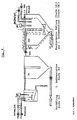
- FIG. 4 a device was used, which is shown schematically in FIG. 4.
- pre-precipitation basin I with stirrer and pH measuring device, a first sedimentation basin II downstream of the pre-precipitation basin I, a subsequent precipitation basin III with a continuously variable stirrer and pH measuring device and a second sedimentation basin IV downstream of the precipitation basin III 5 l / h) was subjected to pre-precipitation with lime milk at pH 10.5 in the pre-precipitation tank I.
- the milk of lime was dosed pH-controlled with a peristaltic pump (O - 2 l / h).
- the clear waste water from the first sedimentation basin II reached the precipitation basin III.
- the pH was adjusted to 11.6 ⁇ 0.1 with KM 20%.
- the dosage was controlled by pH.
- the TSZ was dosed proportionally.
- the device was operated in such a way that a residence time of 3 hours was guaranteed in the precipitation tank III. From the precipitation basin III the TSZ suspension reached the second sedimentation basin IV.
- the TSZ was added in 10% over-stoichiometric amounts to compensate for sedimentation losses.
- This device was operated as follows:
- the device was preloaded so that 20 l of waste water had already overflowed from the pre-precipitation basin for operation in precipitation basin III.
- the feed of raw waste water was set to 5 l / h.
- the other TSZ quantities were added proportionally.
- the precipitation basin III was filled.
- the drain to the second sedimentation basin IV was then opened.
- the sulfate content in precipitation basin III was 600 mg SO 2- 4th / l. After a further hour of stirring, it was 450 mg SO 2- 4th / l dropped.
- stage (A) the TSZ was added in solid form and suspended in proportion to the quantity.
- the precipitation basin III preloaded with 20 l of wastewater from the pre-precipitation. Continuous operation then began after 3 hours.
- the measured Pb contents were ⁇ 0.5 mg / l.
- the economy can be significantly increased by the use of Al 2 O 3 red mass, the latter also promoting the precipitation reaction and improving the sedimentation behavior of the calcium aluminate sulfates formed and their filterability.
- the Al 2 O 3 red mass no impurities are introduced into the precipitation system by the Al 2 O 3 red mass, and the Al content in the outflow is additionally reduced.
- alumina cement instead of alumina cement, it is also possible to use other calcium aluminates, which may be specially produced for use in the process according to the invention, which, if the starting materials are selected appropriately, can further reduce the overall costs of the process.
- the particular advantage of the method according to the invention lies, in addition to the simplicity of the apparatus, in the extraordinary shortening of the total process time compared to conventional methods to approximately 1/3 to 1/5.
- the duration of the pre-precipitation in stages (a) and (b) is only about 0.5 h, the precipitation in stage (a) being able to be optimized to 8.0 to 11.0 by changing the pH setting from the prior art (milk of lime precipitation at neutral pH).
- Another advantage of the process concept of the invention is that the discharge liquid from stage (B) with tap water and / or in particular with raw waste water is adjusted to a pH value corresponding to the respective legal regulations, in particular to a pH value ⁇ 9.0 can, for which in practice about 1/10 of the volume of raw wastewater is required, while the sulfate ion concentration in the outlet ⁇ 400 mg SO 2- 4th / l can be kept.
- the Pb content is simultaneously reduced to considerably below the limit value of 2 mg / l prescribed in the Federal Republic of Germany.
- the heat energy released during the pre-precipitation in stage (a) can be used via heat exchangers to heat the precipitation system in stage (A).
- the process not only can be carried out discontinuously in batch operation, especially when there is a small amount of waste water, but also continuously, especially when there is a large amount of waste water.
Landscapes
- Chemical & Material Sciences (AREA)
- Inorganic Chemistry (AREA)
- Life Sciences & Earth Sciences (AREA)
- Hydrology & Water Resources (AREA)
- Engineering & Computer Science (AREA)
- Environmental & Geological Engineering (AREA)
- Water Supply & Treatment (AREA)
- Organic Chemistry (AREA)
- Compounds Of Alkaline-Earth Elements, Aluminum Or Rare-Earth Metals (AREA)
- Removal Of Specific Substances (AREA)
Claims (24)
- Procédé pour la séparation des ions sulfates des eaux résiduaires industrielles par(A) précipitation d'aluminates-sulfates de calcium peu solubles par addition d'oxyde d'aluminium réactif et/ou d'aluminates de calcium à l'eau résiduaire
avec brassage mécanique et réglage du pH par Ca(OH)2 à une valeur dans l'intervalle de 11,2 à 11,8
et(B) séparation des aluminates-sulfates de calcium formés,caractérisé en ce que, dans l'étape (A) :(A1) on précipite de l'ettringite comme aluminate-sulfate de calcium peu soluble,(A2) l'oxyde d'aluminium réactif et/ou le ou les aluminates de calcium sont ajoutés en même temps que le réglage du pH ou après celui-ci en excès jusqu'à 20 % par rapport à la quantité stoechiométrique théoriquement nécessaire pour la formation d'ettringite pour la concentration en ions sulfates présents à chaque fois dans l'eau résiduaire ou l'effluent de la précipitation préalable, respectivement,(A3) le pH du système de précipitation obtenu, mesuré par mesure du pH dans le réacteur de précipitation (III) est maintenu constant à 11,2-11,8 pendant toute la durée de la réaction de précipitation par addition dosée séparée de Ca(OH)2 sous forme solide ou sous forme de lait de chaux
et(A4) la réaction de précipitation est effectuée à une température de 25 à 35°C. - Procédé selon la revendication 1, caractérisé en ce que- on effectue avant la précipitation des aluminates-sulfates de calcium peu solubles dans l'étape (A) les étapes opératoires suivantes d'une précipitation préalable :(a) précipitation de sulfate de calcium par addition d'hydroxyde de calcium ou d'hydrate de chaux à l'eau résiduaire avec brassage mécanique et contrôle du pH
et(b) séparation du sulfate de calcium précipité,- l'effluent obtenu dans l'étape (b) étant introduit dans l'étape (A). - Procédé selon la revendication 2, caractérisé en ce que l'étape (a) est effectuée à un pH maintenu constant dans l'intervalle de 8,0 à 11,0.
- Procédé selon la revendication 2 ou 3, caractérisé en ce que l'étape (a) est effectuée à un pH maintenu constant dans l'intervalle de 10,5 à 11,0.
- Procédé selon l'une des revendications 2 à 4, caractérisé en ce qu'une partie du sulfate de calcium obtenu dans l'étape (b) est recyclée par intervalles ou en continu dans l'étape (a) pour l'introduction de germes de cristallisation.
- Procédé selon l'une des revendications 1 à 5, caractérisé en ce que le pH du système dans l'étape (A) est réglé et maintenu constant à 11,6 ± 0,1.
- Procédé selon l'une des revendications 1 à 6, caractérisé en ce que les aluminates de calcium sont introduits dans le système dans l'étape (A) sous forme solide.
- Procédé selon l'une des revendications 1 à 6, caractérisé en ce que les aluminates de calcium sont introduits dans le système dans l'étape (A) sous forme d'une suspension aqueuse.
- Procédé selon l'une des revendications 1 à 8, caractérisé en ce que l'on utilise comme aluminates de calcium dans l'étape (A) des ciments alumineux fondus.
- Procédé selon l'une des revendications 1 à 9, caractérisé en ce que l'on utilise pour le réglage du pH dans l'étape (A) du lait de chaux à 10-40 %, de préférence 20 % en masse.
- Procédé selon l'une des revendications 1 à 10, caractérisé en ce que l'étape (A) est mise en oeuvre à une température de 30°C.
- Procédé selon l'une des revendications 1 à 11, caractérisé en ce que l'on utilise des déchets d'aluminates pour une partie des aluminates de calcium dans l'étape (A).
- Procédé selon la revendication 12, caractérisé en ce que l'on utilise dans l'étape (A) comme déchets d'aluminates une masse rouge d'Al2O3.
- Procédé selon l'une des revendications 1 à 13, caractérisé en ce que l'on utilise dans l'étape (A) des aluminates de calcium de composition CaO,Al2O3 à 3CaO,Al2O3.
- Procédé selon l'une des revendications 1 à 14, caractérisé en ce que l'on utilise dans l'étape (A) des aluminates de calcium de composition CaO,Al2O3.
- Procédé selon l'une des revendications 1 à 15, caractérisé en ce que l'étape (A) est mise en oeuvre pendant une durée de réaction de 1,5 à 5 heures.
- Procédé selon l'une des revendications 1 à 16, caractérisé en ce que pour l'introduction de germes de cristallisation dans l'étape (A), on introduit dans le système le sulfate de calcium précipité dans la précipitation préalable et/ou l'aluminate-sulfate de calcium sous forme du produit de précipitation obtenu dans l'étape (B).
- Procédé selon la revendication 17, caractérisé en ce que le précipité d'aluminates-sulfates de calcium précipité dans l'étape (B) est recyclé dans l'étape (A) en quantité de 50 à 100 % en masse, rapportée à la concentration en sulfates du système.
- Procédé selon l'une des revendications 1 à 18, caractérisé en ce que l'effluent liquide de l'étape (B) est ajusté à un pH ≦ 9 par l'eau du robinet et/ou l'eau résiduaire brute.
- Procédé selon l'une des revendications 1 à 19, caractérisé en ce que la séparation des aluminates-sulfates de calcium précipités dans l'étape (B) est effectuée par sédimentation et/ou extraction par pression.
- Procédé selon l'une des revendications 2 à 20, caractérisé en ce que l'étape (a) est effectuée à une température de 30 à 45°C.
- Procédé selon l'une des revendications 2 à 21, caractérisé en ce que l'énergie thermique libérée dans l'étape (a) est utilisée au moyen d'échangeurs de chaleur dans l'étape (A) pour l'équilibrage de température du système de précipitation.
- Procédé selon des revendications 1 à 22, caractérisé en ce que l'on utilise pour la préparation de l'aluminate-sulfate de calcium dans l'étape (A) des aluminates de calcium fabriqués en utilisant une masse rouge d'Al2O3.
- Procédé selon l'une des revendications 1 à 23, caractérisé en ce que le procédé total est mis en oeuvre en discontinu.
Priority Applications (3)
| Application Number | Priority Date | Filing Date | Title |
|---|---|---|---|
| AT86108876T ATE54122T1 (de) | 1986-06-30 | 1986-06-30 | Verfahren zur abtrennung von sulfationen aus abwaessern. |
| EP86108876A EP0250626B2 (fr) | 1986-06-30 | 1986-06-30 | Procédé de séparation des ions sulfate d'eau résiduaire |
| DE8686108876T DE3672237D1 (de) | 1986-06-30 | 1986-06-30 | Verfahren zur abtrennung von sulfationen aus abwaessern. |
Applications Claiming Priority (1)
| Application Number | Priority Date | Filing Date | Title |
|---|---|---|---|
| EP86108876A EP0250626B2 (fr) | 1986-06-30 | 1986-06-30 | Procédé de séparation des ions sulfate d'eau résiduaire |
Publications (3)
| Publication Number | Publication Date |
|---|---|
| EP0250626A1 EP0250626A1 (fr) | 1988-01-07 |
| EP0250626B1 EP0250626B1 (fr) | 1990-06-27 |
| EP0250626B2 true EP0250626B2 (fr) | 1996-09-11 |
Family
ID=8195230
Family Applications (1)
| Application Number | Title | Priority Date | Filing Date |
|---|---|---|---|
| EP86108876A Expired - Lifetime EP0250626B2 (fr) | 1986-06-30 | 1986-06-30 | Procédé de séparation des ions sulfate d'eau résiduaire |
Country Status (3)
| Country | Link |
|---|---|
| EP (1) | EP0250626B2 (fr) |
| AT (1) | ATE54122T1 (fr) |
| DE (1) | DE3672237D1 (fr) |
Cited By (3)
| Publication number | Priority date | Publication date | Assignee | Title |
|---|---|---|---|---|
| RU2233802C1 (ru) * | 2003-07-16 | 2004-08-10 | Федеральное государственное унитарное предприятие Межотраслевой научно-исследовательский институт экологии топливно-энергетического комплекса | Способ очистки сточных вод от сульфат-ионов |
| RU2236384C1 (ru) * | 2003-07-16 | 2004-09-20 | Федеральное государственное унитарное предприятие Межотраслевой научно-исследовательский институт экологии топливно-энергетического комплекса | Способ очистки сточных вод от сульфат-ионов |
| US11926542B2 (en) | 2018-06-13 | 2024-03-12 | The Water Company, Llc | Controlled removal of ions from aqueous fluid |
Families Citing this family (22)
| Publication number | Priority date | Publication date | Assignee | Title |
|---|---|---|---|---|
| DE3709950C2 (de) * | 1987-03-26 | 1996-06-05 | Walhalla Kalk Entwicklungs Und | Verfahren zur Behandlung sulfathaltigen Abwassers |
| US5269936A (en) * | 1989-10-16 | 1993-12-14 | Johannesburg Consolidated Investment Co. | Process for treating ion exchange resin |
| US5443730A (en) * | 1991-01-08 | 1995-08-22 | Lafarge Fondu International | Process for the purification of a polluted aqueous effluent |
| FR2671791A1 (fr) * | 1991-01-18 | 1992-07-24 | Lafarge Coppee | Procede de purification des eaux contenant du sulfate de calcium en solution, structures cristallines obtenues par le procede et leurs applications notamment comme charges. |
| DE4119485C2 (de) * | 1991-06-13 | 2000-07-13 | Georg Gebhard | Verfahren zur Reinigung von Schwermetallionen enthaltenden Gasen und Flüssigkeiten |
| DE4227815A1 (de) * | 1992-08-21 | 1994-02-24 | Air Beteiligungs Gmbh | Verfahren zur spontanen chemischen Fällung von in Wasser gelösten Sulfaten als Ettringit und Anwendung dieses Verfahrens zur Herstellung eines chloridarmen, aluminiumoxidhaltigen Gips-Anhydrits |
| EP0623559A1 (fr) * | 1993-05-03 | 1994-11-09 | A + F ANLAGEN-, UMWELT- UND FILTERTECHNIK GmbH & Co. | Procédé pour séparer des sulfates dissous de solutions aqueuses, en particulier d'eaux usées |
| SE508128C2 (sv) * | 1995-01-24 | 1998-08-31 | Kemira Kemi Ab | Förfarande för framställning av lösningar av aluminiumsalt |
| GB9711451D0 (en) * | 1997-06-03 | 1997-07-30 | Ramsay James I | A process for the treatment of effluent streams |
| DE19740615A1 (de) * | 1997-09-16 | 1999-03-18 | Uvr Fia Gmbh Verfahrensentwick | Verfahren zur Behandlung von sulfathaligem Wasser |
| RU2323164C1 (ru) * | 2006-10-02 | 2008-04-27 | Открытое акционерное общество "Межотраслевой научно-исследовательский и проектно-технологический институт экологии топливно-энергетического комплекса" (ОАО "МНИИЭКО ТЭК") | Способ очистки сточных вод от сульфат-ионов |
| RU2322398C1 (ru) * | 2006-10-02 | 2008-04-20 | Открытое акционерное общество "Межотраслевой научно-исследовательский и проектно-технологический институт экологии топливно-энергетического комплекса" (ОАО "МНИИЭКО ТЭК") | Способ очистки сточных вод от сульфат-ионов |
| GB0711055D0 (en) * | 2007-06-08 | 2007-07-18 | Integrated Effluent Solutions | Improved effluent treatment |
| ES2397018B1 (es) * | 2011-06-21 | 2014-02-13 | Jordi Arellano Ortiz | Método de tratamiento de residuos con carga en sulfatos y valorización de los lodos obtenidos. |
| CN102786129B (zh) * | 2012-08-16 | 2014-01-29 | 刘耀红 | 一种硫酸铝铁盐净水剂及其制备方法 |
| FI126285B (en) * | 2012-08-27 | 2016-09-15 | Outotec Finland Oy | Method for removing sulfate, calcium and / or other soluble metals from waste water |
| WO2014087026A1 (fr) * | 2012-12-03 | 2014-06-12 | Jordi Arellano Ortiz | Procédé de traitement de résidus chargés en sulfates et de valorisation des boues obtenues |
| US10071923B2 (en) | 2014-09-05 | 2018-09-11 | Ecolab Usa Inc. | Addition of aluminum reagents to oxoanion-containing water streams |
| US9389209B2 (en) | 2014-09-05 | 2016-07-12 | Ecolab Usa Inc. | Oxoanion concentration determination using aluminum reagents |
| SE545642C2 (en) * | 2020-07-16 | 2023-11-21 | Axolot Solutions Holding Ab | A method and a system for removal of sulfate from wastewater by electrocoagulation |
| CN113683249B (zh) * | 2021-09-08 | 2022-07-12 | 山东国舜建设集团有限公司 | 一种脱硫废水中氯离子的去除方法 |
| EP4488238A1 (fr) * | 2023-07-07 | 2025-01-08 | OASE GmbH | Procédé pour fixer le sulfate d'une masse d'eau, produit obtenu par le procédé, mélange recuit pour utilisation dans le procédé, et utilisation d'un tel mélange |
Family Cites Families (1)
| Publication number | Priority date | Publication date | Assignee | Title |
|---|---|---|---|---|
| DE2517665A1 (de) * | 1975-04-22 | 1976-11-11 | Heidelberg Portland Zement | Verfahren zur reinigung von ligninhaltigen abwaessern |
-
1986
- 1986-06-30 DE DE8686108876T patent/DE3672237D1/de not_active Expired - Lifetime
- 1986-06-30 AT AT86108876T patent/ATE54122T1/de not_active IP Right Cessation
- 1986-06-30 EP EP86108876A patent/EP0250626B2/fr not_active Expired - Lifetime
Cited By (3)
| Publication number | Priority date | Publication date | Assignee | Title |
|---|---|---|---|---|
| RU2233802C1 (ru) * | 2003-07-16 | 2004-08-10 | Федеральное государственное унитарное предприятие Межотраслевой научно-исследовательский институт экологии топливно-энергетического комплекса | Способ очистки сточных вод от сульфат-ионов |
| RU2236384C1 (ru) * | 2003-07-16 | 2004-09-20 | Федеральное государственное унитарное предприятие Межотраслевой научно-исследовательский институт экологии топливно-энергетического комплекса | Способ очистки сточных вод от сульфат-ионов |
| US11926542B2 (en) | 2018-06-13 | 2024-03-12 | The Water Company, Llc | Controlled removal of ions from aqueous fluid |
Also Published As
| Publication number | Publication date |
|---|---|
| ATE54122T1 (de) | 1990-07-15 |
| EP0250626A1 (fr) | 1988-01-07 |
| EP0250626B1 (fr) | 1990-06-27 |
| DE3672237D1 (de) | 1990-08-02 |
Similar Documents
| Publication | Publication Date | Title |
|---|---|---|
| EP0250626B2 (fr) | Procédé de séparation des ions sulfate d'eau résiduaire | |
| DE69807868T2 (de) | Verfahren zur behandlung von abwasserstroemen | |
| DE2029056A1 (de) | Verfahren zum Entfernen von Fluor Werten aus wäßrigen Losungen | |
| DE3709950C2 (de) | Verfahren zur Behandlung sulfathaltigen Abwassers | |
| EP0584502B1 (fr) | Procédé de précipitation spontanée des sulfates dissous dans l'eau sous forme de sulfate d'aluminium et de calcium et utilisation de ce procédé pour la préparation de gypse du type anhydrite contenant de l'oxide d'aluminium et pauvre en chlorures | |
| EP0003327B1 (fr) | Procédé pour le traitement et/ou l'épuration chimique et mécanique des eaux souterraines, des eaux de surface ou des eaux d'égout | |
| DE2535808A1 (de) | Verfahren zur herstellung von basischen aluminiumchlorosulfatloesungen und verwendung des erhaltenen produkts | |
| DE3873872T2 (de) | Verfahren zur reinigung von kalciumnitrat, in loesung oder schmelze abgeschieden aus einer durch aufloesen von phosphatgesteinen mit salpetersaeure gewonnenen mischung. | |
| EP0255629B1 (fr) | Procédé de traitement de solutions aqueuses d'acide fluosilicique | |
| DE2414182C3 (de) | Verfahren zur kontinuierlichen Herstellung von Gips aus Abfallschwefelsäure | |
| DE3908054C2 (fr) | ||
| EP0169430A2 (fr) | Procédé pour la clarification d'eau usée colorée | |
| DE2341415A1 (de) | Verfahren zur chemischen abwasseraufbereitung | |
| DE2808012A1 (de) | Verfahren zur neutralisation von saeurehaltigen fluessigkeiten | |
| EP2813475B1 (fr) | Procede d'elimination de mercure et de selenium dans des eaux usees contenant des sulfates | |
| AT406579B (de) | Verfahren zur abtrennung von phosphaten aus abwässern | |
| EP2840069A1 (fr) | Procédé de réduction du volume d'eaux usées d'une installation de désulfuration des gaz de fumée | |
| DD297919A5 (de) | Abgas-entschwefelungsverfahren | |
| DE1160376B (de) | Verfahren zur Aufbereitung von bei der Phosphorproduktion anfallenden Abwaessern | |
| DE2206523A1 (de) | Ausfällungsmittel zur Reinigung von Wasser sowie Verfahren zur Herstellung dieses Mittels | |
| DE2725958A1 (de) | Anreicherung von magnesiumenthaltenden materialien | |
| DE4025778A1 (de) | Verfahren zur eliminierung von phosphaten und organisch gebundenem phosphor aus abwaessern und zulaufwaessern | |
| EP0623559A1 (fr) | Procédé pour séparer des sulfates dissous de solutions aqueuses, en particulier d'eaux usées | |
| DE2107970C3 (de) | Verfahren zur Herstellung sulfathaltiger, basischer Aluminiumchloride | |
| EP0866768B1 (fr) | Procede de preparation de solutions de sel alcalin siliceux |
Legal Events
| Date | Code | Title | Description |
|---|---|---|---|
| PUAI | Public reference made under article 153(3) epc to a published international application that has entered the european phase |
Free format text: ORIGINAL CODE: 0009012 |
|
| AK | Designated contracting states |
Kind code of ref document: A1 Designated state(s): AT BE DE FR GB IT LU NL SE |
|
| 17P | Request for examination filed |
Effective date: 19880111 |
|
| 17Q | First examination report despatched |
Effective date: 19880415 |
|
| GRAA | (expected) grant |
Free format text: ORIGINAL CODE: 0009210 |
|
| AK | Designated contracting states |
Kind code of ref document: B1 Designated state(s): AT BE DE FR GB IT LU NL SE |
|
| REF | Corresponds to: |
Ref document number: 54122 Country of ref document: AT Date of ref document: 19900715 Kind code of ref document: T |
|
| ITF | It: translation for a ep patent filed | ||
| ET | Fr: translation filed | ||
| GBT | Gb: translation of ep patent filed (gb section 77(6)(a)/1977) | ||
| REF | Corresponds to: |
Ref document number: 3672237 Country of ref document: DE Date of ref document: 19900802 |
|
| PLBI | Opposition filed |
Free format text: ORIGINAL CODE: 0009260 |
|
| 26 | Opposition filed |
Opponent name: VEREINIGTE ALUMINIUM-WERKE AG, BERLIN UND BONN Effective date: 19910326 |
|
| PLBI | Opposition filed |
Free format text: ORIGINAL CODE: 0009260 |
|
| 26 | Opposition filed |
Opponent name: LINDE AKTIENGESELLSCHAFT, WIESBADEN Effective date: 19910326 Opponent name: KERAMCHEMIE GMBH Effective date: 19910318 Opponent name: VEREINIGTE ALUMINIUM-WERKE AG, BERLIN UND BONN Effective date: 19910326 |
|
| NLR1 | Nl: opposition has been filed with the epo |
Opponent name: VEREINIGTE ALUMINIUM-WERKE AG. |
|
| NLR1 | Nl: opposition has been filed with the epo |
Opponent name: LINDE AG Opponent name: KERAMCHEMIE GMBH |
|
| PLAB | Opposition data, opponent's data or that of the opponent's representative modified |
Free format text: ORIGINAL CODE: 0009299OPPO |
|
| R26 | Opposition filed (corrected) |
Opponent name: VEREINIGTE ALUMINIUM-WERKE AG, BERLIN UND BONN * 9 Effective date: 19910326 |
|
| ITTA | It: last paid annual fee | ||
| PGFP | Annual fee paid to national office [announced via postgrant information from national office to epo] |
Ref country code: SE Payment date: 19940504 Year of fee payment: 9 |
|
| PGFP | Annual fee paid to national office [announced via postgrant information from national office to epo] |
Ref country code: LU Payment date: 19940731 Year of fee payment: 9 |
|
| EPTA | Lu: last paid annual fee | ||
| EAL | Se: european patent in force in sweden |
Ref document number: 86108876.3 |
|
| PGFP | Annual fee paid to national office [announced via postgrant information from national office to epo] |
Ref country code: GB Payment date: 19950619 Year of fee payment: 10 |
|
| PG25 | Lapsed in a contracting state [announced via postgrant information from national office to epo] |
Ref country code: LU Free format text: LAPSE BECAUSE OF NON-PAYMENT OF DUE FEES Effective date: 19950630 |
|
| PG25 | Lapsed in a contracting state [announced via postgrant information from national office to epo] |
Ref country code: SE Effective date: 19950701 |
|
| PGFP | Annual fee paid to national office [announced via postgrant information from national office to epo] |
Ref country code: BE Payment date: 19950712 Year of fee payment: 10 |
|
| EUG | Se: european patent has lapsed |
Ref document number: 86108876.3 |
|
| PGFP | Annual fee paid to national office [announced via postgrant information from national office to epo] |
Ref country code: NL Payment date: 19960628 Year of fee payment: 11 |
|
| PG25 | Lapsed in a contracting state [announced via postgrant information from national office to epo] |
Ref country code: GB Effective date: 19960630 Ref country code: BE Effective date: 19960630 |
|
| PUAH | Patent maintained in amended form |
Free format text: ORIGINAL CODE: 0009272 |
|
| STAA | Information on the status of an ep patent application or granted ep patent |
Free format text: STATUS: PATENT MAINTAINED AS AMENDED |
|
| 27A | Patent maintained in amended form |
Effective date: 19960911 |
|
| AK | Designated contracting states |
Kind code of ref document: B2 Designated state(s): AT BE DE FR GB IT LU NL SE |
|
| GBTA | Gb: translation of amended ep patent filed (gb section 77(6)(b)/1977) |
Effective date: 19960911 |
|
| NLR2 | Nl: decision of opposition | ||
| NLR3 | Nl: receipt of modified translations in the netherlands language after an opposition procedure | ||
| APAC | Appeal dossier modified |
Free format text: ORIGINAL CODE: EPIDOS NOAPO |
|
| APAC | Appeal dossier modified |
Free format text: ORIGINAL CODE: EPIDOS NOAPO |
|
| ET3 | Fr: translation filed ** decision concerning opposition | ||
| BERE | Be: lapsed |
Owner name: WALHALLA-KALK ENTWICKLUNGS- UND VERTRIEBS G.M.B.H Effective date: 19960630 |
|
| GBPC | Gb: european patent ceased through non-payment of renewal fee |
Effective date: 19960630 |
|
| PGFP | Annual fee paid to national office [announced via postgrant information from national office to epo] |
Ref country code: AT Payment date: 19970626 Year of fee payment: 12 |
|
| PGFP | Annual fee paid to national office [announced via postgrant information from national office to epo] |
Ref country code: FR Payment date: 19970630 Year of fee payment: 12 |
|
| PG25 | Lapsed in a contracting state [announced via postgrant information from national office to epo] |
Ref country code: NL Effective date: 19980101 |
|
| NLV4 | Nl: lapsed or anulled due to non-payment of the annual fee |
Effective date: 19980101 |
|
| PG25 | Lapsed in a contracting state [announced via postgrant information from national office to epo] |
Ref country code: AT Free format text: LAPSE BECAUSE OF NON-PAYMENT OF DUE FEES Effective date: 19980630 |
|
| PG25 | Lapsed in a contracting state [announced via postgrant information from national office to epo] |
Ref country code: FR Free format text: LAPSE BECAUSE OF NON-PAYMENT OF DUE FEES Effective date: 19990226 |
|
| PGFP | Annual fee paid to national office [announced via postgrant information from national office to epo] |
Ref country code: DE Payment date: 19990331 Year of fee payment: 13 |
|
| REG | Reference to a national code |
Ref country code: FR Ref legal event code: ST |
|
| PG25 | Lapsed in a contracting state [announced via postgrant information from national office to epo] |
Ref country code: DE Free format text: LAPSE BECAUSE OF NON-PAYMENT OF DUE FEES Effective date: 20000503 |
|
| PG25 | Lapsed in a contracting state [announced via postgrant information from national office to epo] |
Ref country code: IT Free format text: LAPSE BECAUSE OF NON-PAYMENT OF DUE FEES;WARNING: LAPSES OF ITALIAN PATENTS WITH EFFECTIVE DATE BEFORE 2007 MAY HAVE OCCURRED AT ANY TIME BEFORE 2007. THE CORRECT EFFECTIVE DATE MAY BE DIFFERENT FROM THE ONE RECORDED. Effective date: 20050630 |
|
| APAH | Appeal reference modified |
Free format text: ORIGINAL CODE: EPIDOSCREFNO |