EP0250733B2 - Machine pour bourrer de produits pâteux en particulier des saucisses - Google Patents
Machine pour bourrer de produits pâteux en particulier des saucisses Download PDFInfo
- Publication number
- EP0250733B2 EP0250733B2 EP87105298A EP87105298A EP0250733B2 EP 0250733 B2 EP0250733 B2 EP 0250733B2 EP 87105298 A EP87105298 A EP 87105298A EP 87105298 A EP87105298 A EP 87105298A EP 0250733 B2 EP0250733 B2 EP 0250733B2
- Authority
- EP
- European Patent Office
- Prior art keywords
- pump
- filling
- machine according
- motor
- drive
- Prior art date
- Legal status (The legal status is an assumption and is not a legal conclusion. Google has not performed a legal analysis and makes no representation as to the accuracy of the status listed.)
- Expired - Lifetime
Links
- 235000013580 sausages Nutrition 0.000 title claims abstract description 46
- 238000012937 correction Methods 0.000 claims description 17
- 230000015654 memory Effects 0.000 claims description 17
- 230000005540 biological transmission Effects 0.000 claims description 16
- 238000011144 upstream manufacturing Methods 0.000 claims description 7
- 238000004519 manufacturing process Methods 0.000 claims description 6
- 239000000463 material Substances 0.000 claims description 5
- 235000013372 meat Nutrition 0.000 claims description 4
- 238000012544 monitoring process Methods 0.000 claims description 4
- 230000001360 synchronised effect Effects 0.000 claims description 4
- 235000011837 pasties Nutrition 0.000 claims description 2
- 239000000945 filler Substances 0.000 claims 6
- 238000010276 construction Methods 0.000 claims 1
- 230000006870 function Effects 0.000 description 5
- 238000000034 method Methods 0.000 description 5
- 238000005457 optimization Methods 0.000 description 5
- 230000008569 process Effects 0.000 description 5
- QAWIHIJWNYOLBE-OKKQSCSOSA-N acivicin Chemical compound OC(=O)[C@@H](N)[C@@H]1CC(Cl)=NO1 QAWIHIJWNYOLBE-OKKQSCSOSA-N 0.000 description 4
- 238000011161 development Methods 0.000 description 3
- 238000010586 diagram Methods 0.000 description 3
- 238000003825 pressing Methods 0.000 description 3
- 238000012545 processing Methods 0.000 description 3
- 238000003860 storage Methods 0.000 description 3
- 101100390736 Danio rerio fign gene Proteins 0.000 description 2
- 101000584583 Homo sapiens Receptor activity-modifying protein 1 Proteins 0.000 description 2
- 101000584590 Homo sapiens Receptor activity-modifying protein 2 Proteins 0.000 description 2
- 101100390738 Mus musculus Fign gene Proteins 0.000 description 2
- 102100030697 Receptor activity-modifying protein 1 Human genes 0.000 description 2
- 102100030696 Receptor activity-modifying protein 2 Human genes 0.000 description 2
- 230000008859 change Effects 0.000 description 2
- 230000008878 coupling Effects 0.000 description 2
- 238000010168 coupling process Methods 0.000 description 2
- 238000005859 coupling reaction Methods 0.000 description 2
- 238000011156 evaluation Methods 0.000 description 2
- 239000002184 metal Substances 0.000 description 2
- 238000004806 packaging method and process Methods 0.000 description 2
- 238000005303 weighing Methods 0.000 description 2
- 208000019300 CLIPPERS Diseases 0.000 description 1
- 241001237745 Salamis Species 0.000 description 1
- 230000001133 acceleration Effects 0.000 description 1
- 230000004913 activation Effects 0.000 description 1
- 230000015572 biosynthetic process Effects 0.000 description 1
- 235000013351 cheese Nutrition 0.000 description 1
- 208000021930 chronic lymphocytic inflammation with pontine perivascular enhancement responsive to steroids Diseases 0.000 description 1
- 238000004140 cleaning Methods 0.000 description 1
- 230000009849 deactivation Effects 0.000 description 1
- 230000002349 favourable effect Effects 0.000 description 1
- 235000013305 food Nutrition 0.000 description 1
- 230000003993 interaction Effects 0.000 description 1
- 238000005259 measurement Methods 0.000 description 1
- 239000005022 packaging material Substances 0.000 description 1
- 230000002093 peripheral effect Effects 0.000 description 1
- 230000009467 reduction Effects 0.000 description 1
- 230000000717 retained effect Effects 0.000 description 1
- 235000015175 salami Nutrition 0.000 description 1
- 238000005070 sampling Methods 0.000 description 1
- 230000001629 suppression Effects 0.000 description 1
- 238000004804 winding Methods 0.000 description 1
Images



Classifications
-
- A—HUMAN NECESSITIES
- A22—BUTCHERING; MEAT TREATMENT; PROCESSING POULTRY OR FISH
- A22C—PROCESSING MEAT, POULTRY, OR FISH
- A22C11/00—Sausage making ; Apparatus for handling or conveying sausage products during manufacture
- A22C11/02—Sausage filling or stuffing machines
Definitions
- the invention relates to a machine for portioned filling of pasty media, in particular sausage meat, according to the preamble of claim 1.
- Such a machine is known from CH-A-583521.
- Filling machines are particularly common in the food processing industry and they are used there for the production of sausages but also for filling portions of spreadable cheese and the like (EP 96 378 A). Two main requirements are placed on these machines, namely on the one hand high portion performance and on the other hand great portion weight accuracy. If you only fill the filled ruffled sausage casing, which can be a natural casing as well as a plastic casing, and not subdivide it, you get a sausage whose length corresponds to the stretched length of the gathered sausage casing. Such a sausage cannot be traded and therefore the stuffed sausage skein that is being filled is usually divided into individual portions directly on the filling machine.
- clips are metal clips and can be placed either individually or with a small distance in pairs, in which case each sausage has a clip on both sides.
- the drive is carried out by a hydraulic transmission via a clutch-brake combination or a stepper motor. This allows good, but not very high portion speeds to be achieved. Sometimes you also want a higher portion accuracy.
- the object of the invention is therefore to further develop a machine of the type mentioned at the outset in such a way that the number of portions per unit of time and, if possible, the portion accuracy can be increased.
- an electrically controllable motor designed as a magnetic rotor By using an electrically controllable motor designed as a magnetic rotor, on the one hand the drive can be pre-simplified and on the other hand a higher portion speed can be achieved by starting and stopping or slowing down and accelerating such motors up to 400 times per minute. The latter is necessary if the clip setting or the turning off is provided when the pump is stopped or braked. Because such a motor can be easily controlled via a microprocessor and the latter is known to work with extreme accuracy, the portioning accuracy can also be increased in this way.
- the pump is designed as a gear pump with an internally toothed, drivable outer wheel and thus meshing, externally toothed, pinion mounted eccentrically to the outer wheel.
- Pumps of this type are used as feed pumps, in particular in the sausage processing industry. They are characterized by high reliability and robustness. In addition, they are also equipped with a one- or two-part pressure piece, which separates the pressure side from the suction side. A more detailed explanation is, however, not necessary because, as I said, they are known pumps, at least as far as the working principle is concerned.
- a further embodiment of the invention is characterized in that the filled sausage strand running off can be subdivided into individual sausages by means of a controllable clip device, in particular at equal and preferably adjustable intervals, when the pump drive is switched off.
- a controllable clip device in particular at equal and preferably adjustable intervals, when the pump drive is switched off.
- Clips are, for example, U-shaped metal clips, which are pushed over the constriction point between adjacent corners and then deformed into a ring or a wire winding. If you put two such clips next to each other at a short distance. so you can cut the sausage casing between these two clips and get individual sausages in this way.
- the filling tube can be rotated by at least about one turn to form a tip by means of a twisting device.
- the gathered sausage casing and the brake ring are also rotated.
- a pinch point is created just behind the free end of the filling tube.
- the controllable motor is advantageously connected to the drive shaft of the pump outer wheel by means of at least one gear, in particular a toothed belt gear.
- a toothed belt transmission creates a large ratio with high precision with a small footprint.
- a particularly preferred embodiment of the invention provides that a pulse generator for at least the pump control can be driven by means of the pump drive shaft or an upstream transmission shaft.
- a pulse generator for at least the pump control can be driven by means of the pump drive shaft or an upstream transmission shaft.
- the use of a pulse generator is the prerequisite for the precise electronic control and also the possibility of programming this machine. If you drive the pulse generator via the pump drive shaft or in particular an upstream transmission shaft. this saves you from having to use a separate drive and at the same time achieves synchronous operation in a simple manner.
- the pump drive shaft or gear shaft must run at a predetermined speed. This does not necessarily correspond to the required speed of the pulse generator and is also not provided in the exemplary embodiment. Therefore, a development of the invention provides that the pulse generator is in drive connection with the pump drive shaft or the transmission shaft via a gear, in particular a further belt or toothed belt gear. This transmission also ensures the necessary precision. It remains to be noted, however, that another gear, in particular a reduction gear, can be connected between the toothed belt gear and the driven pinion of the pump and is preferably also provided, the drive for the pulse generator also being able to be derived from a shaft of this additional gear . becomes.
- a further embodiment of the invention is that the pump drive shaft or the upstream gear shaft is a drive element of a drive of a conveying element in a filling container placed in front of the pump inlet. If there is a comparatively thin and possibly still fat-rich mass in the latter, then it flows from the filling container into the pump inlet located thereon solely because of its own weight and its flowability. However, if relatively stiff masses have to be portioned, for example in the production of salami, it is necessary at the high output speed to convey this mass to the pump inlet. This is done by a conveyor element that is both formally adapted to the filling container and to the material to be conveyed. It is a rotating conveyor element and this can advantageously also be driven synchronously by the controllable motor mentioned. Any necessary adjustment of the speed can easily be achieved by another gear.
- a further variant of the invention is characterized in that the conveying element can be driven by means of a gear wheel or ring gear, which meshes with a pinion which can be driven by the pump shaft or the upstream gear shaft. If necessary, you can put a coupling between them. This is particularly advantageous if the container is to be removed from the pump or at least the pump fill opening for cleaning purposes.
- the electrical control has a microcomputer consisting of a microprocessor, memories and input / output components.
- a correction value reflecting the starting operation is generated for portioning the first portion of a batch in each case, which corrects the pulse number supplied by the pulse generator for the first portion in such a way that the desired weight quantity of the portion is maintained.
- a further advantageous embodiment of the electrical control provides that the correction value can be stored per batch and can be called up from the memory for the production of the first portion of a batch and can be supplied to the control.
- an input / output control a sample balance for the automatic generation of the correction value and, moreover, for the continuous automatic production monitoring of the filling quantities can be connected.
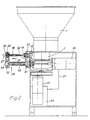
- the doughy medium to be filled in portions, in particular sausage meat, is preferably introduced into the filling container 1 by means of a suitable charging device, not shown.
- a suitable charging device not shown.
- It expediently has a conical shape and is located above a filling pump 2. More precisely, it is the case that the outlet 3 of the filling container 1 lies above the inlet 4 of the filling pump 2.
- Essential elements of the filling pump are an internally toothed, drivable outer wheel 5 with a drive shaft 7 and an eccentrically arranged, externally toothed pinion 6 with a bearing pin 7.
- the pinion teeth 8 engage in the tooth spaces 9 of the outer wheel 5, while the teeth 10 of the outer wheel 5 into the tooth spaces 11 of pinion 6 occur.
- the medium introduced into the pump completely fills the part of the pump interior which is defined by the two pressure pieces or pressure piece parts 12 and 13 and the tooth gaps currently located in the area of these pressure pieces. At the bottom, this space is delimited by a disk-shaped bottom of the outer wheel 5, on which the teeth are perpendicular to the image plane (FIG. 3), while the upper limit is reached by a cover removed in FIG. 3. If you drive the outer wheel 5 in the direction of arrow 14, it takes the pinion 6 in the same direction of rotation.
- the medium is transported to the outlet 15 of the pump via the tooth gaps 11 and 9. There the teeth then alternately enter the tooth gaps and thereby cause the tooth gaps to be emptied into the outlet 15 and an upstream pocket 16 of the housing.
- a filling pipe 17 connects to the outlet 15 of the filling pump 2.
- the front end 20 of the casing 18 in the discharge direction 20 is closed in a suitable manner, for example by a knot. If you now pump the sausage meat or the like into this sausage casing, which is closed at the front, it fills up. It is then gradually pulled off the filling pipe and unloaded.
- This running, filled sausage strand 21 is constricted at predetermined intervals in the manner explained in more detail below, in order thereby to form sausages in particular of the same length.
- the filling pump 2 is driven intermittently with the aid of an electrically controllable motor 22, in particular a magnetic rotor.
- the motor can be controlled with the aid of a microprocessor, an electrical control device 23.
- the line 24 symbolizes the electrical connection of the control device 23 to the motor 22.
- This second motor 26 can also be driven and controlled via the microprocessor or the electrical control device 23. This symbolizes line 27 in FIG. 2.
- Motor 26 is also a servo motor or a magnetic rotor. The two motors 22 and 26 are thus alternately switched on and off, and one can easily visualize their mode of operation when working quickly, i.e. with a high number of sausages per unit of time, using a sine curve and a superimposed cosine curve (see also FIG. 8).
- the controllable motor or its output shaft 28 is connected to the pump drive shaft 37 by means of at least one gear 29 - indirectly in the exemplary embodiment.
- the gear 29 is preferably a toothed belt gear with the drive wheel 30 placed on the output shaft 28 and the driven wheel 31 and the toothed belt 32.
- the driven wheel 31 is seated on a gear shaft 33 which carries a pinion 34 of the gear 35. It meshes with a gear 36 on the pump drive shaft 37.
- the gear shaft 33 is guided to the outside via the gear housing and the gear shaft extension 38 carries a drive wheel 39 of a further gear 40, which can also be designed as a belt or toothed belt gear.
- the belt 41 of this gear 40 drives a pinion or wheel 42, which is attached to a drive shaft of a pulse generator 43.
- This pulse generator is also connected to the electrical control device 23, which is shown schematically in FIG. 1 by the line 44. It provides the necessary impulses that are required to control the drives of the machine and various functions, such as portioning, of the processor.
- the transmission shaft extension 38 is preferably drive-connected to a drive shaft 46 for a conveying element 47 via a releasable coupling 45.
- This is part of a conveying device which forcibly conveys the medium in the filling container 1 to the pump inlet 4.
- the drive shaft 46 carries at its upper end in FIG. 1 a pinion 48, the teeth of which mesh with those of a ring gear 49.
- the ring gear is rotatably connected to the conveyor element 47, which passes through it in the axial direction.
- the conveyor element has the shape of a screw conveyor and it is made of a belt-shaped material. The latter was bent into a conical spiral, as FIG. 1 of the drawing clearly shows and which is adapted to the contour of the container.
- the twist-off device 25 is preferably removable. It has a countershaft 50 which, according to FIG. 2, is driven intermittently by the second motor 26.
- a first pinion 51 of the countershaft 50 drives, preferably again by means of a belt 52, a gear 53 which is connected to the filling tube 17 in a rotationally fixed manner or is produced in one piece therewith.
- the belt 52 can also be a toothed belt, just like the belt 54, which creates the rotary connection between a second pinion 55 or the like and a second gear 56 or the like. The latter is molded onto or connected to a holder for the brake ring.
- the two ratios 51, 53 and 55, 56 are the same in order to ensure a synchronous rotation of the filling tube 17 and the brake ring 19 including the gathered sausage casing 18.
- the electrical control device 23 which gives the filling machine a very high degree of flexibility with regard to the type of filling articles and a particularly high filling speed, can also be designed as a control module 63, which has an operating console 57 with a display 59 and a keypad 60, and connections 61 for a sample balance and 62 for a log printer.
- the control module 63 also has slots for receiving a processor card 66, an input / output card 67 and a power supply unit 68, as shown in FIGS. 4 and 5.
- Fig. 6 also shows an arrangement of plugs 69 for connecting the display 59, 70, for connecting the keypad 60 and 71 for connecting a printer and a balance.
- the fuses provided to protect the electrical part are shown at 72.
- the electrical control device 23 the essential element of which is a central control unit (CPU), generates the electrical control signals required for operation, setting and operation. Standard functions that are controlled here are portioning, twisting, operating breaks and a correction of the dosage for the first portion.
- the filling speed can be set via the operating voltage of the first and second servo motors 22 and 26.
- the operating voltage of the servomotors has a ramp-like curve in the range from 0 to 10 volts maximum, the value 10 volts corresponding to the maximum filling speed (100%).
- the shape or course of the ramp-shaped operating voltage, or control ramp for short can be adapted to the consistency of the filling material and the nature of the packaging material, the most favorable values being determined empirically and then stored in a read / write memory.
- the electrical control device 23 has a read / write memory 77 in which the portion parameters, such as weight, pause, turning off, turning off delay, filling speed, etc., can be stored for 100 different portions.
- the read / write memory 77 is supplied via an emergency power supply 83, an accumulator, which is located on the processor board, so that the portion data are retained even when the device is switched off or the processor card is pulled out.
- New portions can be entered or changed via the keypad 60 with a total of 16 keys. After switching on the machine, an information line appears in the 20-digit alphanumeric display, showing the portion number, name and weight of the portions. The desired portion and its data can be called up by entering the portion number.
- two interface sockets 61 and 62 for V 24 and RS 232 interfaces are embedded in the front plate 64 of the control module 63 (FIG. 4), which enable the connection of a sample balance and a printer. Deviations of the samples from the target value are processed to a correction value, which is displayed in the portioning parameter "correction" and is saved.
- the samples are logged by the printer.
- an evaluation of the statistical data of the samples is printed out (target value, number, mean value, standard deviation, minimum and maximum).
- the date and time are printed out, which are supplied by a clock 82 which is connected to the CPU 73 via the processor bus 75.
- the portion data entered it can be stored on a storage medium after connecting an external memory, preferably a cassette recorder, or in the case of a cassette recorder, on a cassette.
- an external memory preferably a cassette recorder, or in the case of a cassette recorder, on a cassette.
- the operating voltage of the servomotors with adjustable acceleration and braking ramp as well as the programmable filling speed controls both the filling and the calibration process, the latter of which is initiated by the calibration signal AD (see FIG. 7).
- the operating parameters are entered on two levels, a) filling level and b) system level, both of which are listed below:
- the entered parameters are processed accordingly by the electrical control device and lead to the generation of the corresponding output ramp, including a portioning signal P, the calibration signal AD and a speed correction signal V, which is generated whenever the speed, measured via the pulse generator 43, is too high .
- the pulse generator is dimensioned for a wide range of applications and operating conditions and in the present example is rated at one gram per pulse.
- the twisting or clipping can be set within certain limits so that the desired operating parameters are optimally achieved. This also applies to the correction of the first portion, which is necessary for the following reasons:
- the pump When the machine starts up, i.e. the very first part of the packaging envelope is filled with the doughy medium, the pump must also be filled first and only when it is completely full and the doughy medium has also reached the front end of the shirred packaging envelope is a Type of backflow a continuous pump pressure is reached.
- the pump initially works with increasing, i.e. not constant pressure. This means that if a certain number of pulses is given for the weight of the portion, a too light first portion, for example a too short first sausage, is generated.
- FIG. 7 now shows the essential components of the electrical control device 23, consisting of a central control unit (CPU) 73, for example a microprocessor of a known type, the operating processes of which are controlled in time by a clock generator 74.
- the central control unit 73 is connected via a processor bus 75, which comprises the necessary control, address and data lines, to a read / write memory 77, a read memory 78 and a programmable input / output adapter.
- the latter adapter is connected via an input / output bus 76 to an input / output control 80 and a timer 81 and the keypad 60.
- the display in turn is connected to the microcomputer via the input / output control 80.
- the clock provided for logging purposes, which specifies the time and date, is connected via the processor bus 75 already mentioned.
- the input / output controller 80 has the special task of external control signals, such as the pulses from the pulse generator 43, via the lines 44, the start signal ST or, for example, the data of the sample balance via the connection 61 to the microcomputer to supply or control signals from the computer to the other electrical components, such as the output ramp RAMP1 for the first servo motor 22 and RAMP2 for the second servo motor 26 or the data to be printed out via the connection 62 to the printer.
- external control signals such as the pulses from the pulse generator 43, via the lines 44, the start signal ST or, for example, the data of the sample balance via the connection 61 to the microcomputer to supply or control signals from the computer to the other electrical components, such as the output ramp RAMP1 for the first servo motor 22 and RAMP2 for the second servo motor 26 or the data to be printed out via the connection 62 to the printer.
- the final shape of the exit ramps is largely determined by the material used and the operating speed, i.e. the production speed of the portions is determined and largely determined empirically. These values can be stored, both the read / write memory 77 and the read memory 78, which contains the actual control program, being suitable for this purpose.
Landscapes
- Life Sciences & Earth Sciences (AREA)
- Engineering & Computer Science (AREA)
- Wood Science & Technology (AREA)
- Zoology (AREA)
- Food Science & Technology (AREA)
- Processing Of Meat And Fish (AREA)
- Formation And Processing Of Food Products (AREA)
- Meat, Egg Or Seafood Products (AREA)
- Containers And Plastic Fillers For Packaging (AREA)
- Saccharide Compounds (AREA)
Claims (14)
- Machine pour le remplissage par portions de produits pâteux, en particulier de pâte à saucisse à cuire, dans une membrane tubulaire (18), avec un dispositif de torsion (25) pour la formation des portions, ou avec un dispositif de pose de clips, ainsi qu'avec une pompe de remplissage (2) qui est entraînée par intermittence au moyen d'un moteur de pompe (22) commandé électriquement, et configuré en particulier comme coulisseau magnétique, et dont le côté refoulement est relié à écoulement à un tube de remplissage (17), la commande du moteur de pompe (22) s'effectuant au moyen d'un dispositif de commande (23) en fonction du poids des portions, le boyau à saucisses (18) étant extrait par le produit sortant, entre une bague de freinage (19) et l'extrémité libre du tube de remplissage (17) reprenant le boyau retroussé (18), le dispositif de torsion (25) ou le dispositif de pose de clips étant commandés au moyen d'un second moteur asservi (26), de préférence un second coulisseau magnétique, le second moteur (26) faisant également partie de l'entraînement du tube de remplissage (17) monté à rotation, le second moteur (26) étant commandé au moyen du dispositif de commande (23) du moteur de pompe (22), le dispositif de commande (23) étant relié à un générateur d'impulsions (43) dont les impulsions fournissent un poids de remplissage donné par impulsion, caractérisé en ce que le dispositif de commande (23) comporte un micro-ordinateur (73) créant à partir des impulsions du générateur d'impulsion (43) et du poids de consigne de la portion à remplir ainsi qu'à partir des données physiques du produit de remplissage et du matériau de remplissage ainsi que de la vitesse de remplissage prédéterminée une première pente de tension d'alimentation (RAMP 1) pour le premier moteur (22) entraînant la pompe de remplissage (2), et une seconde pente de tension d'alimentation (RAMP 2), en opposition de phase par rapport à la première, pour le second moteur (26) entraînant le dispositif de torsion (25) ou le dispositif de pose de clips.
- Machine selon la revendication 1, caractérisée en ce que la pompe (2) se présente sous la forme d'une pompe à roue dentée avec une couronne (5) entraînable et à denture intérieure et un pignon (6) s'engrenant avec cette dernière, à denture extérieure et installé à rotation sur paliers en position excentrée par rapport à la couronne.
- Machine selon la revendication 1 ou 2, caractérisée en ce que le moteur asservi (22) est relié à l'arbre d'entraînement (37) de la couronne (5) de la pompe au moyen d'au moins une transmission, et en particulier d'une transmission à courroie crantée.
- Machine selon la revendication 3, caractérisée en ce que le générateur d'impulsions (43) commandant au moins la pompe est entrainé au moyen de l'arbre d'entraînement (37) de la pompe ou d'un arbre de transmission (33) branché en amont.
- Machine selon la revendication 4, caractérisée en ce que le générateur d'impulsions (43) est relié à entraînement à l'arbre d'entraînement (37) de la pompe ou à l'arbre de transmission (33) par l'intermédiaire d'une transmission (40), et en particulier d'une autre transmission à courroie ou à courroie crantée.
- Machine selon la revendication 5, caractérisée en ce que l'arbre d'entraînement (37) de la pompe ou l'arbre de transmission (33) branché en amont est un élément d'entraînement d'un entraînement d'un organe de refoulement (47), situé dans un réservoir de remplissage (1) placé à l'entrée de l'orifice d'aspiration de la pompe (4).
- Machine selon la revendication 6, caractérisée en ce que l'organe de refoulement (47) est entraîné au moyen d'une roue dentée ou d'une couronne dentée (49) qui engrène un pignon entraîné (48) de l'arbre de la pompe (37) ou de l'arbre de transmission (33) branché en amont.
- Machine selon la revendication 7, caractérisée en ce que l'organe de refoulement (47) est réalisé sous la forme d'une vis de refoulement, la vis de refoulement présentant la forme d'une spirale à surface d'enveloppe conique, la spirale étant réalisée sous la forme d'une tôle, et en ce que le réservoir de remplissage (1) présente une forme conique, au moins au voisinage de l'organe de refoulement (47).
- Machine selon la revendication 8, caractérisée en ce que la roue dentée ou la couronne dentée (49) est traversée par l'organe de refoulement (47) et déborde de ce dernier des deux côtés.
- Machine selon la revendication 9 caractérisée en ce que le second moteur (26) entraîne un arbre (50) débordant vers l'avant dont le premier pignon (51) ou similaire est relié à entraînement synchrone avec une roue dentée (53) ou similaire du tube de remplissage (17), et dont le second pignon (55) ou similaire est relié à entraînement synchrone avec une seconde roue dentée (56) ou similaire de la bague de freinage (19).
- Machine selon l'une quelconque des revendications précédentes, caractérisée en ce que le dispositif électrique de commande (23) présente le micro-ordinateur constitué d'un microprocesseur (73), des mémoires (77, 78) et des interfaces d'entrée et de sortie (79, 80).
- Machine selon l'une quelconque des revendications précédentes, caractérisée en ce qu'en vue du fractionnement de la première portion de chaque lot, on crée une valeur de correction qui correspond à la mise en route, et qui corrige le nombre d'impulsions délivrées par le générateur d'impulsions (43) pour la première portion, de manière à maintenir pour cette portion le poids souhaité.
- Machine selon la revendication 12, caractérisée en ce que, lors de la préparation de la première portion de chaque lot, la valeur de correction de chaque lot est mise en mémoire et peut être rappelée de la mémoire (77, 78) et être envoyée vers la commande.
- Machine selon l'une ou plusieurs des revendications 11 à 13, caractérisée en ce qu'une balance de pesée d'échantillons aléatoires, pour la création automatique de la valeur de correction et, pour le reste, en vue de la surveillance automatique de la production en cours des quantités remplies peut être connectée par l'intermédiaire d'une commande d'entrée et de sortie (80).
Priority Applications (1)
| Application Number | Priority Date | Filing Date | Title |
|---|---|---|---|
| AT87105298T ATE72504T1 (de) | 1986-05-24 | 1987-04-10 | Maschine zum abfuellen teigiger medien, insbesondere von wurstbraet. |
Applications Claiming Priority (2)
| Application Number | Priority Date | Filing Date | Title |
|---|---|---|---|
| DE3617560A DE3617560C2 (de) | 1986-05-24 | 1986-05-24 | Maschine zum Abfüllen teigiger Medien, insbesondere von Wurstbrät |
| DE3617560 | 1986-05-24 |
Publications (4)
| Publication Number | Publication Date |
|---|---|
| EP0250733A2 EP0250733A2 (fr) | 1988-01-07 |
| EP0250733A3 EP0250733A3 (en) | 1989-04-12 |
| EP0250733B1 EP0250733B1 (fr) | 1992-02-12 |
| EP0250733B2 true EP0250733B2 (fr) | 1995-01-25 |
Family
ID=6301602
Family Applications (1)
| Application Number | Title | Priority Date | Filing Date |
|---|---|---|---|
| EP87105298A Expired - Lifetime EP0250733B2 (fr) | 1986-05-24 | 1987-04-10 | Machine pour bourrer de produits pâteux en particulier des saucisses |
Country Status (10)
| Country | Link |
|---|---|
| US (1) | US4823439A (fr) |
| EP (1) | EP0250733B2 (fr) |
| JP (1) | JPS6333206A (fr) |
| AT (1) | ATE72504T1 (fr) |
| CA (1) | CA1265382A (fr) |
| DE (1) | DE3617560C2 (fr) |
| DK (1) | DK260587A (fr) |
| ES (1) | ES2030009T5 (fr) |
| FI (1) | FI87129C (fr) |
| NO (1) | NO169934C (fr) |
Families Citing this family (19)
| Publication number | Priority date | Publication date | Assignee | Title |
|---|---|---|---|---|
| IT1223796B (it) * | 1988-09-02 | 1990-09-29 | Cselt Centro Studi Lab Telecom | Dispositivo sfasatore in guida d'onda coassiale |
| JP2612491B2 (ja) * | 1989-04-28 | 1997-05-21 | ハイテック株式会社 | ソーセージ等の製造装置 |
| JPH0675464B2 (ja) * | 1989-08-04 | 1994-09-28 | プリマハム株式会社 | ソーセージ充填装置 |
| IT220303Z2 (it) * | 1990-11-23 | 1993-09-16 | Righele Giovanni | Dispositivo di azionamento per tramoggia di una pompa rotativa di insacco per carne macinata. |
| US5951391A (en) * | 1996-10-21 | 1999-09-14 | Townsend Engineering Company | Method and means for linking sausage |
| ES2131474B1 (es) * | 1997-08-29 | 2000-03-01 | Castro Alejandro Ruiz | Dispositivo de control de un sistema de arrastre para maquinas de atado de embutido. |
| DE29808373U1 (de) * | 1998-05-08 | 1999-09-16 | Vemag Maschinen- Und Anlagenbau Gmbh, 27283 Verden | Füllmaschine für Wurstbrät o.dgl. mit einem abklappbaren Vorratsbehälter |
| DE19824829A1 (de) * | 1998-06-04 | 1999-12-23 | Vemag Maschinen & Anlagenbau Gmbh | Verfahren und Einrichtung zur Herstellung portionierter Würste gleicher Längen |
| JP2000332503A (ja) | 1999-05-25 | 2000-11-30 | Sharp Corp | 円偏波発生器 |
| JP3706522B2 (ja) | 2000-02-25 | 2005-10-12 | シャープ株式会社 | 衛星受信用コンバータの導波管装置 |
| EP1479297A1 (fr) * | 2003-05-19 | 2004-11-24 | Borgo & C. S.A.S. Antonio | Trémie d'alimentation pour machines de bourrage pour des pâtes souples et machine de bourrage pour des pâtes souples |
| DE102008033800A1 (de) | 2008-07-18 | 2010-01-28 | Poly-Clip System Gmbh & Co. Kg | Verpackungsvorrichtung und Verfahren zur Steuerung einer Verpackungsvorrichtung |
| DE102010031393B4 (de) | 2010-07-15 | 2012-07-05 | Albert Handtmann Maschinenfabrik Gmbh & Co. Kg | Vorrichtung und Verfahren zur Kühlung von Nahrungsmittelmaschinen |
| CN102342308A (zh) * | 2011-09-20 | 2012-02-08 | 闫树林 | 固定缸和面机刹车装置 |
| JP6232625B2 (ja) | 2013-04-26 | 2017-11-22 | ハイテック株式会社 | 充填装置 |
| NL2012455B1 (en) * | 2014-03-17 | 2016-01-08 | Marel Townsend Further Proc Bv | Method for preparing a casing material used in a co-extruding process of a food product, viscous gelling agent and a method and a system for preparing food products. |
| DE102016216851A1 (de) * | 2016-09-06 | 2018-03-08 | Albert Handtmann Maschinenfabrik Gmbh & Co. Kg | Verfahren und Füllmaschine zum Abfüllen eines Lebensmittels |
| CN114711275B (zh) * | 2022-04-11 | 2022-12-06 | 重庆市计量质量检测研究院 | 一种一体化香肠灌装设备 |
| EP4275503A1 (fr) * | 2022-05-11 | 2023-11-15 | Poly-clip System GmbH & Co. KG | Machine à clipper pour la fabrication de produits en forme de sauscisses indépendante du réseau d'alimentation éléctrique |
Family Cites Families (10)
| Publication number | Priority date | Publication date | Assignee | Title |
|---|---|---|---|---|
| DE1532010C3 (de) * | 1966-06-30 | 1980-06-26 | Karl Schnell, Maschinenfabrik, 7065 Winterbach | Fördervorrichtung für Zerkleinerungsgut mit einer Förderpumpe und einer Vacuumabsaugeanlage |
| JPS5752243B1 (fr) * | 1971-04-29 | 1982-11-06 | ||
| CH583521A5 (fr) * | 1974-01-22 | 1977-01-14 | Handtmann Albert Fa | |
| DE3018793A1 (de) * | 1980-05-16 | 1981-11-26 | Albert Handtmann Gmbh & Co, 7950 Biberach | Anordnung zum aufeinanderfolgenden portionieren einer fliessfaehigen fuellmasse, insbesondere wurstmasse |
| DE3363262D1 (en) * | 1982-06-02 | 1986-06-05 | Teepak Prod Nv | Method and apparatus for automatically making strands of sausages |
| IT1163031B (it) * | 1983-01-18 | 1987-04-08 | Effe Di Russo L & C Snc 3 | Sistema per invertire il posizionamento sequenziale dei gruppi operativi nelle macchine automatiche di impacchettamento |
| DE3311567A1 (de) * | 1983-03-30 | 1984-10-04 | Karl 7065 Winterbach Schnell | Maschine zum abfuellen teigiger medien, insbesondere wurstbraet |
| AT381209B (de) * | 1984-10-29 | 1986-09-10 | Nordischer Maschinenbau | Kontinuierlich arbeitende vorrichtung zum aufeinanderfolgenden ausbringen von portionen einer pastoesen masse |
| DE3544448A1 (de) * | 1985-12-16 | 1987-06-19 | Handtmann Albert Maschf | Verfahren und vorrichtung zum abfuellen lufthaltiger, verformbarer massen |
| US4709450A (en) * | 1987-01-13 | 1987-12-01 | Teepak, Inc. | Apparatus and methods of stuffing food casings to provide dimensionally uniform products |
-
1986
- 1986-05-24 DE DE3617560A patent/DE3617560C2/de not_active Expired - Fee Related
-
1987
- 1987-04-10 ES ES87105298T patent/ES2030009T5/es not_active Expired - Lifetime
- 1987-04-10 AT AT87105298T patent/ATE72504T1/de not_active IP Right Cessation
- 1987-04-10 EP EP87105298A patent/EP0250733B2/fr not_active Expired - Lifetime
- 1987-05-22 FI FI872284A patent/FI87129C/fi not_active IP Right Cessation
- 1987-05-22 DK DK260587A patent/DK260587A/da not_active Application Discontinuation
- 1987-05-22 NO NO872162A patent/NO169934C/no not_active IP Right Cessation
- 1987-05-22 CA CA000537715A patent/CA1265382A/fr not_active Expired - Lifetime
- 1987-05-22 US US07/054,268 patent/US4823439A/en not_active Expired - Lifetime
- 1987-05-25 JP JP62126081A patent/JPS6333206A/ja active Pending
Also Published As
| Publication number | Publication date |
|---|---|
| DK260587D0 (da) | 1987-05-22 |
| EP0250733A2 (fr) | 1988-01-07 |
| EP0250733A3 (en) | 1989-04-12 |
| US4823439A (en) | 1989-04-25 |
| NO872162D0 (no) | 1987-05-22 |
| ES2030009T3 (es) | 1992-10-16 |
| DE3617560C2 (de) | 1996-08-14 |
| EP0250733B1 (fr) | 1992-02-12 |
| FI872284A0 (fi) | 1987-05-22 |
| ES2030009T5 (es) | 1995-08-16 |
| FI87129B (fi) | 1992-08-31 |
| DE3617560A1 (de) | 1987-11-26 |
| NO169934C (no) | 1992-08-26 |
| NO169934B (no) | 1992-05-18 |
| FI87129C (fi) | 1992-12-10 |
| ATE72504T1 (de) | 1992-02-15 |
| CA1265382A (fr) | 1990-02-06 |
| DK260587A (da) | 1987-11-25 |
| NO872162L (no) | 1987-11-25 |
| JPS6333206A (ja) | 1988-02-12 |
| FI872284L (fi) | 1987-11-25 |
Similar Documents
| Publication | Publication Date | Title |
|---|---|---|
| EP0250733B1 (fr) | Machine pour bourrer de produits pâteux en particulier des saucisses | |
| EP0392083B1 (fr) | Procédé et dispositif pour diviser un chapelet de saucisses formé par une machine de bourrage en saucisses séparées | |
| DE69225728T2 (de) | Verfahren und Vorrichtung zum Aufhängen einer Kette von zusammenhängenden Produkten | |
| EP1279379B9 (fr) | Méthode et dispositif destinés à l'obtention d'une masse à plusieurs composantes, en particulier pour des applications dentaires | |
| DE2921427C2 (de) | Vorrichtung zum intermittierenden Ausstoßen einer Wurstmasse oder dergleichen | |
| DE4021305C2 (de) | Vorrichtung zum kontinuierlichen Conchieren von Schokolademasse | |
| DE2744350A1 (de) | Aufhaengevorrichtung fuer portionierte wurstketten | |
| EP0439671B1 (fr) | Procédé et dispositif pour la fabrication de saucisses en divisant un chapelet de saucisses | |
| EP1010401A1 (fr) | Méthode et dispositif destinés à l'obtention d'une masse à plusieurs composantes, en particulier pour des applications dentaires | |
| EP0013552B1 (fr) | Dispositif et procédé pour préparer des portions | |
| DE2402817A1 (de) | Verfahren und vorrichtung zum herstellen von wuersten | |
| DE29880136U1 (de) | Steuerungssystem für Fleischemulsionspumpen in eine Fleischumhüllungsmaschine | |
| DE3429400A1 (de) | Werkstueckeinstelleinrichtung fuer schleifmaschinen | |
| EP1082543B1 (fr) | Regulation de la frequence des courses du piston d'une pompe de dosage | |
| EP1199940A1 (fr) | Ensemble filiere, porte-filiere et dispositif pour extruder des matieres sous forme de pate | |
| EP0621095B1 (fr) | Procédé pour le redressage intermittent de fils | |
| DE2856308C2 (de) | Vorrichtung zum dosierten Austragen eines Materials aus einem Vorratsbehälter | |
| EP0246667B1 (fr) | Procédé et installation de préparation de produits fourrés | |
| DE2840029A1 (de) | Abgabevorrichtung fuer fliessfaehige materialien | |
| DE102020123206B3 (de) | Verfahren sowie Vorrichtung zum Abdrehen von schlauchförmigen Hüllen und betreffendes System zum Befüllen schlauchförmiger Hüllen | |
| AT381209B (de) | Kontinuierlich arbeitende vorrichtung zum aufeinanderfolgenden ausbringen von portionen einer pastoesen masse | |
| DE102008013806A1 (de) | Portioniervorrichtung (Aufwärts Schneiden) | |
| EP1312264A1 (fr) | Dispositif de mesure de longeurs avec un dispositif de serrage par clip | |
| DE3537580C1 (de) | Vorrichtung zum Abrauchen von Zigaretten | |
| DE3342290C2 (de) | Vorrichtung zur Herstellung einer schaumigen Masse |
Legal Events
| Date | Code | Title | Description |
|---|---|---|---|
| PUAI | Public reference made under article 153(3) epc to a published international application that has entered the european phase |
Free format text: ORIGINAL CODE: 0009012 |
|
| AK | Designated contracting states |
Kind code of ref document: A2 Designated state(s): AT BE CH ES FR GB IT LI NL SE |
|
| PUAL | Search report despatched |
Free format text: ORIGINAL CODE: 0009013 |
|
| AK | Designated contracting states |
Kind code of ref document: A3 Designated state(s): AT BE CH ES FR GB IT LI NL SE |
|
| 17P | Request for examination filed |
Effective date: 19890928 |
|
| 17Q | First examination report despatched |
Effective date: 19910104 |
|
| ITF | It: translation for a ep patent filed | ||
| GRAA | (expected) grant |
Free format text: ORIGINAL CODE: 0009210 |
|
| AK | Designated contracting states |
Kind code of ref document: B1 Designated state(s): AT BE CH ES FR GB IT LI NL SE |
|
| REF | Corresponds to: |
Ref document number: 72504 Country of ref document: AT Date of ref document: 19920215 Kind code of ref document: T |
|
| GBT | Gb: translation of ep patent filed (gb section 77(6)(a)/1977) | ||
| ET | Fr: translation filed | ||
| PLBI | Opposition filed |
Free format text: ORIGINAL CODE: 0009260 |
|
| PLBI | Opposition filed |
Free format text: ORIGINAL CODE: 0009260 |
|
| 26 | Opposition filed |
Opponent name: HOEGGER ALPINA AG Effective date: 19921110 |
|
| 26 | Opposition filed |
Opponent name: VEMAG MASCHINENBAU GMBH Effective date: 19921112 Opponent name: HOEGGER ALPINA AG Effective date: 19921110 |
|
| NLR1 | Nl: opposition has been filed with the epo |
Opponent name: VEMAG MASCHINEBAU GMBH. Opponent name: HOEGGER ALPINA AG |
|
| PUAH | Patent maintained in amended form |
Free format text: ORIGINAL CODE: 0009272 |
|
| STAA | Information on the status of an ep patent application or granted ep patent |
Free format text: STATUS: PATENT MAINTAINED AS AMENDED |
|
| 27A | Patent maintained in amended form |
Effective date: 19950125 |
|
| AK | Designated contracting states |
Kind code of ref document: B2 Designated state(s): AT BE CH ES FR GB IT LI NL SE |
|
| EAL | Se: european patent in force in sweden |
Ref document number: 87105298.1 |
|
| REG | Reference to a national code |
Ref country code: CH Ref legal event code: AEN |
|
| NLR2 | Nl: decision of opposition | ||
| ET3 | Fr: translation filed ** decision concerning opposition | ||
| GBTA | Gb: translation of amended ep patent filed (gb section 77(6)(b)/1977) |
Effective date: 19950322 |
|
| ITF | It: translation for a ep patent filed | ||
| NLR3 | Nl: receipt of modified translations in the netherlands language after an opposition procedure | ||
| REG | Reference to a national code |
Ref country code: ES Ref legal event code: DC2A Kind code of ref document: T5 Effective date: 19950816 |
|
| REG | Reference to a national code |
Ref country code: GB Ref legal event code: IF02 |
|
| PGFP | Annual fee paid to national office [announced via postgrant information from national office to epo] |
Ref country code: GB Payment date: 20020412 Year of fee payment: 16 |
|
| PGFP | Annual fee paid to national office [announced via postgrant information from national office to epo] |
Ref country code: CH Payment date: 20020415 Year of fee payment: 16 |
|
| PGFP | Annual fee paid to national office [announced via postgrant information from national office to epo] |
Ref country code: SE Payment date: 20020422 Year of fee payment: 16 |
|
| PGFP | Annual fee paid to national office [announced via postgrant information from national office to epo] |
Ref country code: NL Payment date: 20020430 Year of fee payment: 16 |
|
| PGFP | Annual fee paid to national office [announced via postgrant information from national office to epo] |
Ref country code: BE Payment date: 20020508 Year of fee payment: 16 |
|
| PGFP | Annual fee paid to national office [announced via postgrant information from national office to epo] |
Ref country code: ES Payment date: 20020516 Year of fee payment: 16 |
|
| PGFP | Annual fee paid to national office [announced via postgrant information from national office to epo] |
Ref country code: FR Payment date: 20030311 Year of fee payment: 17 |
|
| PGFP | Annual fee paid to national office [announced via postgrant information from national office to epo] |
Ref country code: AT Payment date: 20030313 Year of fee payment: 17 |
|
| PG25 | Lapsed in a contracting state [announced via postgrant information from national office to epo] |
Ref country code: GB Free format text: LAPSE BECAUSE OF NON-PAYMENT OF DUE FEES Effective date: 20030410 |
|
| PG25 | Lapsed in a contracting state [announced via postgrant information from national office to epo] |
Ref country code: SE Free format text: LAPSE BECAUSE OF NON-PAYMENT OF DUE FEES Effective date: 20030411 |
|
| PG25 | Lapsed in a contracting state [announced via postgrant information from national office to epo] |
Ref country code: LI Free format text: LAPSE BECAUSE OF NON-PAYMENT OF DUE FEES Effective date: 20030430 Ref country code: CH Free format text: LAPSE BECAUSE OF NON-PAYMENT OF DUE FEES Effective date: 20030430 Ref country code: BE Free format text: LAPSE BECAUSE OF NON-PAYMENT OF DUE FEES Effective date: 20030430 |
|
| BERE | Be: lapsed |
Owner name: KARL *SCHNELL MASCHINENFABRIK Effective date: 20030430 |
|
| PG25 | Lapsed in a contracting state [announced via postgrant information from national office to epo] |
Ref country code: NL Free format text: LAPSE BECAUSE OF NON-PAYMENT OF DUE FEES Effective date: 20031101 |
|
| NLV4 | Nl: lapsed or anulled due to non-payment of the annual fee |
Effective date: 20031101 |
|
| EUG | Se: european patent has lapsed | ||
| GBPC | Gb: european patent ceased through non-payment of renewal fee |
Effective date: 20030410 |
|
| REG | Reference to a national code |
Ref country code: CH Ref legal event code: PL |
|
| PG25 | Lapsed in a contracting state [announced via postgrant information from national office to epo] |
Ref country code: AT Free format text: LAPSE BECAUSE OF NON-PAYMENT OF DUE FEES Effective date: 20040410 |
|
| PG25 | Lapsed in a contracting state [announced via postgrant information from national office to epo] |
Ref country code: ES Free format text: LAPSE BECAUSE OF NON-PAYMENT OF DUE FEES Effective date: 20040412 |
|
| PG25 | Lapsed in a contracting state [announced via postgrant information from national office to epo] |
Ref country code: FR Free format text: LAPSE BECAUSE OF NON-PAYMENT OF DUE FEES Effective date: 20041231 |
|
| REG | Reference to a national code |
Ref country code: FR Ref legal event code: ST |
|
| PG25 | Lapsed in a contracting state [announced via postgrant information from national office to epo] |
Ref country code: IT Free format text: LAPSE BECAUSE OF NON-PAYMENT OF DUE FEES;WARNING: LAPSES OF ITALIAN PATENTS WITH EFFECTIVE DATE BEFORE 2007 MAY HAVE OCCURRED AT ANY TIME BEFORE 2007. THE CORRECT EFFECTIVE DATE MAY BE DIFFERENT FROM THE ONE RECORDED. Effective date: 20050410 |
|
| REG | Reference to a national code |
Ref country code: ES Ref legal event code: FD2A Effective date: 20040412 |