EP0250845A2 - Procédé de décaféination de café vert - Google Patents
Procédé de décaféination de café vert Download PDFInfo
- Publication number
- EP0250845A2 EP0250845A2 EP87107462A EP87107462A EP0250845A2 EP 0250845 A2 EP0250845 A2 EP 0250845A2 EP 87107462 A EP87107462 A EP 87107462A EP 87107462 A EP87107462 A EP 87107462A EP 0250845 A2 EP0250845 A2 EP 0250845A2
- Authority
- EP
- European Patent Office
- Prior art keywords
- caffeine
- water
- green coffee
- pressure
- gas
- Prior art date
- Legal status (The legal status is an assumption and is not a legal conclusion. Google has not performed a legal analysis and makes no representation as to the accuracy of the status listed.)
- Granted
Links
- 238000000034 method Methods 0.000 title claims abstract description 60
- RYYVLZVUVIJVGH-UHFFFAOYSA-N caffeine Chemical compound CN1C(=O)N(C)C(=O)C2=C1N=CN2C RYYVLZVUVIJVGH-UHFFFAOYSA-N 0.000 claims abstract description 140
- 229960001948 caffeine Drugs 0.000 claims abstract description 78
- XLYOFNOQVPJJNP-UHFFFAOYSA-N water Substances O XLYOFNOQVPJJNP-UHFFFAOYSA-N 0.000 claims abstract description 74
- LPHGQDQBBGAPDZ-UHFFFAOYSA-N Isocaffeine Natural products CN1C(=O)N(C)C(=O)C2=C1N(C)C=N2 LPHGQDQBBGAPDZ-UHFFFAOYSA-N 0.000 claims abstract description 70
- VJEONQKOZGKCAK-UHFFFAOYSA-N caffeine Natural products CN1C(=O)N(C)C(=O)C2=C1C=CN2C VJEONQKOZGKCAK-UHFFFAOYSA-N 0.000 claims abstract description 70
- 238000000605 extraction Methods 0.000 claims abstract description 35
- 238000007710 freezing Methods 0.000 claims abstract description 4
- 230000008014 freezing Effects 0.000 claims abstract description 4
- 241000533293 Sesbania emerus Species 0.000 claims description 41
- CURLTUGMZLYLDI-UHFFFAOYSA-N Carbon dioxide Chemical compound O=C=O CURLTUGMZLYLDI-UHFFFAOYSA-N 0.000 claims description 18
- 239000000243 solution Substances 0.000 claims description 18
- 244000046052 Phaseolus vulgaris Species 0.000 claims description 13
- 235000010627 Phaseolus vulgaris Nutrition 0.000 claims description 13
- 239000001569 carbon dioxide Substances 0.000 claims description 10
- 229910002092 carbon dioxide Inorganic materials 0.000 claims description 10
- 239000002904 solvent Substances 0.000 claims description 9
- 239000004615 ingredient Substances 0.000 claims description 7
- 238000001816 cooling Methods 0.000 claims description 5
- 238000001704 evaporation Methods 0.000 claims description 5
- 239000000203 mixture Substances 0.000 claims description 5
- 239000008237 rinsing water Substances 0.000 claims description 5
- 239000007864 aqueous solution Substances 0.000 claims description 4
- 238000005406 washing Methods 0.000 claims description 3
- 238000001035 drying Methods 0.000 claims description 2
- 239000007789 gas Substances 0.000 claims 20
- 244000013123 dwarf bean Species 0.000 claims 1
- 230000002093 peripheral effect Effects 0.000 claims 1
- 238000011084 recovery Methods 0.000 claims 1
- 238000000926 separation method Methods 0.000 claims 1
- 238000004925 denaturation Methods 0.000 abstract description 2
- 230000036425 denaturation Effects 0.000 abstract description 2
- 239000003599 detergent Substances 0.000 abstract 1
- 239000000126 substance Substances 0.000 description 5
- OKTJSMMVPCPJKN-UHFFFAOYSA-N Carbon Chemical compound [C] OKTJSMMVPCPJKN-UHFFFAOYSA-N 0.000 description 4
- 238000003756 stirring Methods 0.000 description 4
- 230000015572 biosynthetic process Effects 0.000 description 3
- 230000008020 evaporation Effects 0.000 description 3
- 238000005119 centrifugation Methods 0.000 description 2
- 238000010438 heat treatment Methods 0.000 description 2
- 238000004519 manufacturing process Methods 0.000 description 2
- 241000196324 Embryophyta Species 0.000 description 1
- XSTXAVWGXDQKEL-UHFFFAOYSA-N Trichloroethylene Chemical group ClC=C(Cl)Cl XSTXAVWGXDQKEL-UHFFFAOYSA-N 0.000 description 1
- 235000019568 aromas Nutrition 0.000 description 1
- LCHGOKZNRDAXEK-UHFFFAOYSA-N caffeine monohydrate Chemical compound O.CN1C(=O)N(C)C(=O)C2=C1N=CN2C LCHGOKZNRDAXEK-UHFFFAOYSA-N 0.000 description 1
- 230000000295 complement effect Effects 0.000 description 1
- 230000007423 decrease Effects 0.000 description 1
- 238000010586 diagram Methods 0.000 description 1
- 238000011143 downstream manufacturing Methods 0.000 description 1
- 230000000694 effects Effects 0.000 description 1
- 239000012530 fluid Substances 0.000 description 1
- 239000007788 liquid Substances 0.000 description 1
- 239000011148 porous material Substances 0.000 description 1
- 230000010349 pulsation Effects 0.000 description 1
- 230000008929 regeneration Effects 0.000 description 1
- 238000011069 regeneration method Methods 0.000 description 1
- 230000002040 relaxant effect Effects 0.000 description 1
- 229920006395 saturated elastomer Polymers 0.000 description 1
- 238000005476 soldering Methods 0.000 description 1
- 230000004580 weight loss Effects 0.000 description 1
Images

Classifications
-
- A—HUMAN NECESSITIES
- A23—FOODS OR FOODSTUFFS; TREATMENT THEREOF, NOT COVERED BY OTHER CLASSES
- A23F—COFFEE; TEA; THEIR SUBSTITUTES; MANUFACTURE, PREPARATION, OR INFUSION THEREOF
- A23F5/00—Coffee; Coffee substitutes; Preparations thereof
- A23F5/20—Reducing or removing alkaloid content; Preparations produced thereby; Extracts or infusions thereof
- A23F5/206—Reducing or removing alkaloid content; Preparations produced thereby; Extracts or infusions thereof by extraction of the beans with selective solvents other than water or aqueous bean extracts, including supercritical gases
-
- A—HUMAN NECESSITIES
- A23—FOODS OR FOODSTUFFS; TREATMENT THEREOF, NOT COVERED BY OTHER CLASSES
- A23F—COFFEE; TEA; THEIR SUBSTITUTES; MANUFACTURE, PREPARATION, OR INFUSION THEREOF
- A23F5/00—Coffee; Coffee substitutes; Preparations thereof
- A23F5/02—Treating green coffee; Preparations produced thereby
Definitions
- the invention relates to a method for decaffeinating green coffee. in which the caffeine is extracted from the green coffee using a supercritical, gaseous medium under normal conditions (1 bar, 20 ° C).
- the invention has for its object to provide a simple, reliable method for decaffeinating green coffee, which ensures a high degree of decaffeination and avoids denaturing the other components of the green coffee.
- the object on which the invention is based is surprisingly achieved in that moist green coffee is kept under a gas atmosphere of 75 to 300 bar at a temperature of 20 ° C. to 80 ° C. for a few minutes to a few hours, that this gas atmosphere suddenly or in a few minutes is relaxed to a pressure of p c ⁇ p> - 1 bar, that the relaxed coffee beans are washed with water, that the process of depressurizing, relieving and rinsing off the green coffee is repeated several times, if necessary, and that the green coffee is then used to separate noticeable residual water - Amounts of caffeine are treated in a downstream centrifuge.
- the caffeine can also advantageously be extracted selectively with the supercritical gas itself.
- the gas pressure is increased again to 75 bar to 300 bar at a temperature of 20 ° C to 80 ° C and the supercritical gas is circulated.
- the swollen beans are further loosened.
- due to the large increase in volume of the gas diffused into the green coffee bean cell it causes the caffeine-water solution to be expelled to the raw bean surface.
- the gas enclosed in the pores of the coffee beans and escaping when the pressure is released prevents the caffeine enriched on the surface of the coffee beans from diffusing back into the latter.
- the coffee beans When the coffee beans are quickly rinsed off, it is primarily the substances - especially caffeine - that are on their surface that are removed. By subsequent centrifugation, the water-caffeine solution remaining in the edge areas of the coffee beans, which was not captured by the rinsing process, is spun out. This greatly reduces the residual caffeine content and also pre-dries the beans.
- the process according to the invention can be carried out particularly advantageously in such a way that the extraction takes place at a pressure of 100 to 200 bar and a temperature of 20 ° C to 80 ° C, that the green coffee to be extracted has a water content of 35% by weight.
- % to 50 wt .-% preferably a water content of 40 wt .-%, that the coffee beans during or immediately after the pressure relief with warm (60 ° C to 65 ° C) water is rinsed and stirred during the rinsing, that the extracted and rinsed green coffee beans are centrifuged and that: from all resulting aqueous solutions (rinsing water and aqueous soldering - from the centrifuge) the caffeine is obtained, the caffeine-free water loaded with raw coffee ingredients being circulated to rinse off further green coffee beans.
- the caffeine can also be extracted in a particularly advantageous manner with the supercritical gas itself if the gas pressure is increased again to 100 bar to 200 bar at a temperature of 31 ° C to 80 ° C and the supercritical gas is circulated and if the gas phase laden with caffeine is passed through a water washing tower which is maintained under the same conditions of temperature and pressure as in the extraction autoclave, it is regenerated and fed back to the extraction autoclave.
- Carbon dioxide or a mixture of water and carbon dioxide are particularly suitable for building up the gas atmosphere.
- any gas is used to build up the stationary pressure atmosphere, which behaves in terms of its thermodynamic properties so that it diffuses in appreciable concentrations in the raw bean cells filled with the water-caffeine solution.
- a mixture of water with this gas can also be used advantageously.
- a caffeine-free, aqueous solution saturated with green coffee ingredients can also be used.
- the service life of the pressure atmosphere is a few minutes to a few hours.
- the gas atmosphere can be released suddenly or in a few minutes, whereby freezing of the moist green coffee used due to the expansion cooling can be ruled out.
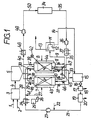
- Fig. 1 the sequence of a variant of the method for producing decaffeinated green coffee is shown schematically.
- the green coffee (8% by weight to 11% by weight of natural moisture) is moistened in a container 3 to a desired water content, preferably 40% by weight, and fed to a storage bunker 5.
- the moist green coffee optionally arrives in the pressure vessels 7 and 8, which are provided with heating jackets 43 and 44 for thermostatting and stirring devices 41 and 42.
- the pressure atmosphere in the pressure vessel is built up by means of a pump 36.
- the gas is removed from the gas supply 34 via a line 35, compressed to extraction pressure by pump 36, brought to extraction temperature in heat exchanger 37 and fed to pressure vessel 7 or 8 via valves 46 or 47.
- the caffeine-free water loaded with green coffee ingredients is pumped by means of the pump 23 via the heat exchanger 24 and valve 29 or 30 into the pressure vessel 7 or 8 until the steady state of pressure is reached.
- the pressurized pressure vessel 7 is partially expanded into the unpressurized vessel 8 via the valve 45 or vice versa.
- the heat exchanger 48 has the task of liquefying the gas pre-cooled by expansion cooling.
- the rinsing water which may be loaded with raw coffee ingredients and decaffeinated in the system 19, is conveyed by means of the pump 23 via the heat exchanger 24, the line 28 and the valves 29 and 30 into the pressure container 7 and 8.
- the water losses are replaced via line 22.
- further aroma substances can be added to the rinse water by means of the pump 26, which usually occur in green coffee, whereby the extraction of the substances which are required for the aroma formation during roasting is reduced to a minimum.
- the coffee beans are stirred using the stirring device 41, 42.
- the rinsing water is removed from the pressure tank T, a: and the collecting tank 15; fed. From this: the caffeine water solution is conveyed by means of the pump 16 via the filter 17 into the decaffeination plant 19, where caffeine is obtained in a conventional manner. The process of depressurizing, relieving and rinsing can be repeated several times if necessary. Subsequently, the moist green coffee is treated in a downstream centrifuge 12 and the water-caffeine solution obtained in the process via a line 14 to the container. 15 fed. The decaffeinated green coffee is removed from the centrifuge via line 13, brought to a minimum water content necessary for the subsequent roasting and then roasted. Because of the generally very different caffeine contents of the water-caffeine solutions obtained at two points in the process, separate caffeine extraction from these mass flows could also prove to be economically sensible.
- decaffeinated green coffee The green coffee (8 to 11% by weight of natural moisture) is moistened to a desired water content, preferably 40% by weight, and optionally introduced into the pressure vessels 51 to 53, which are provided with heating jackets for thermostatting.
- the pressure atmosphere in the pressure vessels is built up by means of a pump 82.
- the gas is removed from the gas supply 81, compressed to extraction pressure with pump 82, brought to extraction temperature in heat exchanger 83 and optionally fed to pressure vessels 51 to 53 via lines 73 to 75.
- a pressurized pressure vessel e.g. 52 in the adjacent container, e.g.
- the heat exchanger 79 has the task of liquefying the gas which has been pre-cooled by expansion cooling.
- the gas pressure is increased again by means of pump 82.
- the gas removed from the storage tank 81 is compressed to the extraction pressure by means of the pump 82 and brought to the extraction temperature in the heat exchanger 83.
- the supercritical gas is circulated by means of pump 64.
- the supercritical gas loaded with caffeine leaves the autoclaves 51 to 53 via lines 57 to 59 and is fed via line 60 to the washing column 61, where it flows against the water added from above.
- the supercritical gas largely freed of caffeine leaves the column 61 via line 62 and is fed to an activated carbon filter 63. It has been shown that complete decaffeination is achieved more quickly if the circulating fluid phase is completely regenerated by caffeine.
- Column 61 and activated carbon canister 63 are kept under the same conditions of temperature and pressure as in the autoclaves 51 to 53, so that an economical isobaric and isothermal procedure is possible. It also prevents the water content of the green coffee beans in the containers 51 to 53 from changing during the decaffeination process.
- the regenerated supercritical gas is returned to the autoclaves 51 to 53 by means of the pump 64 via the heat exchanger 65 and the lines 54 to 56.
- a number of extraction containers are provided on the extraction side, which can be switched into the extraction process in any order, in order then to be successively flowed through by the supercritical gas.
- Fig. 2 only three autoclaves are drawn. However, it is within the meaning of this invention to use further autoclaves which are connected to the autoclaves 51 to 53 via the lines 84 to 87.
- the total number of autoclaves to be used for an optimal implementation of this invention depends primarily on the number of pressure pulsations required but also on the necessary investment and operating costs.
- the cascade connection has the advantage that one extraction container can always be emptied after extraction and then filled with green coffee to be decaffeinated, while the extraction continues in the other extraction containers.
- a high caffeine saturation of the supercritical gas can be achieved by connecting the extraction containers in series. For this purpose, the most extracted container is first supplied with fresh gas. The supercritical gas, which is partially loaded with caffeine, then flows through the further extraction containers in such a way that the last extraction container contains the green coffee with the highest caffeine content. This ensures that an optimal caffeine concentration difference, which is important for the mass transfer, is always maintained between green coffee and solvent.
- the water loaded with caffeine leaves the column 61 via the line 66.
- the caffeine is removed from the aqueous caffeine solution in a known manner preferably by evaporating the water ,. obtained and removed via line 6a.
- the caffeine-free water is removed via line 69, brought to extraction pressure by means of pump 71 and fed to column 61 again. The water losses are replaced again via line 70.
- 394 g of green coffee (unroasted beans) with a caffeine content of 1.04% by weight were moistened with water to a water content of 40.9% by weight.
- the moist green coffee was placed in a pressure vessel equipped with a stirrer. At a temperature of 60 ° C, carbon dioxide was fed into the pressure vessel until a pressure of 60 bar was reached. Water was then pumped in until a pressure of 100 bar had set in.
- the moistened green coffee was kept stationary under a water-carbon dioxide atmosphere of 100 bar at a temperature of 60 ° C for four hours, with stirring briefly every 15 minutes. The pressure was then released to normal pressure in a few minutes.
- the water was removed at the bottom and the coffee beans were rinsed with 2 liters of water (65 ° C). During the rinsing process, which was repeated three times, the coffee beans were stirred. A portion of the green coffee treated in this way was centrifuged for half an hour at 5,000 rpm, 8.2% by weight of water, based on the moist green coffee used, having been removed.
- the residual caffeine content of the non-centrifuged coffee beans was 0.23% by weight, the residual caffeine content of the centrifuged beans was only 0.08% by weight.
- the degree of decaffeination was 77.9% and 92.3% respectively.
- the coffee beans were stirred.
- the process of depressurizing, relaxing and rinsing was repeated a total of three times.
- a portion of the green coffee treated in this way was centrifuged for half an hour at 5,000 rpm, 6.8% by weight, based on the moist green coffee used, having been removed.
- the caffeine content of the non-centrifuged coffee beans was 0.26% by weight and the caffeine content of the centrifuged beans was 0.25% by weight.
- the degree of decaffeination was thus 75.0% by weight and 75.96% by weight.
- the regenerated supercritical carbon dioxide was fed to the pressure vessel again from below. After an hour of extraction, the gas atmosphere in the pressure vessel was released to normal pressure within five minutes. After a standing time of ten minutes, the pressure was raised again to 250 bar within fifteen minutes, and caffeine, which became more accessible due to the pressure change, was extracted with the supercritical CO 2 . The pressure change was repeated three times in total, the extraction times being one, two, two and one hour. The last water supply was renewed after each pressure change to ensure a complete regeneration of the COr phase. After the end of the test, the green coffee beans were slowly released to normal pressure within thirty minutes and then dried to a water content of 10% by weight.
Landscapes
- Life Sciences & Earth Sciences (AREA)
- Chemical & Material Sciences (AREA)
- Engineering & Computer Science (AREA)
- Food Science & Technology (AREA)
- Polymers & Plastics (AREA)
- Tea And Coffee (AREA)
- Addition Polymer Or Copolymer, Post-Treatments, Or Chemical Modifications (AREA)
Priority Applications (2)
| Application Number | Priority Date | Filing Date | Title |
|---|---|---|---|
| AT87107462T ATE82469T1 (de) | 1986-06-20 | 1987-05-22 | Verfahren zur entcoffeinierung von rohkaffee. |
| EP91121427A EP0482675B1 (fr) | 1986-06-20 | 1987-05-22 | Procédé de décaféination de café vert |
Applications Claiming Priority (4)
| Application Number | Priority Date | Filing Date | Title |
|---|---|---|---|
| DE3620622 | 1986-06-20 | ||
| DE3620622 | 1986-06-20 | ||
| DE19873713953 DE3713953A1 (de) | 1986-06-20 | 1987-04-25 | Verfahren zur entcoffeinierung von rohkaffee |
| DE3713953 | 1987-04-25 |
Related Child Applications (1)
| Application Number | Title | Priority Date | Filing Date |
|---|---|---|---|
| EP91121427.8 Division-Into | 1991-12-13 |
Publications (3)
| Publication Number | Publication Date |
|---|---|
| EP0250845A2 true EP0250845A2 (fr) | 1988-01-07 |
| EP0250845A3 EP0250845A3 (en) | 1990-04-25 |
| EP0250845B1 EP0250845B1 (fr) | 1992-11-19 |
Family
ID=25844780
Family Applications (2)
| Application Number | Title | Priority Date | Filing Date |
|---|---|---|---|
| EP87107462A Expired - Lifetime EP0250845B1 (fr) | 1986-06-20 | 1987-05-22 | Procédé de décaféination de café vert |
| EP91121427A Expired - Lifetime EP0482675B1 (fr) | 1986-06-20 | 1987-05-22 | Procédé de décaféination de café vert |
Family Applications After (1)
| Application Number | Title | Priority Date | Filing Date |
|---|---|---|---|
| EP91121427A Expired - Lifetime EP0482675B1 (fr) | 1986-06-20 | 1987-05-22 | Procédé de décaféination de café vert |
Country Status (6)
| Country | Link |
|---|---|
| US (2) | US5089280A (fr) |
| EP (2) | EP0250845B1 (fr) |
| JP (1) | JPH0829049B2 (fr) |
| AT (1) | ATE112460T1 (fr) |
| CA (1) | CA1318812C (fr) |
| DE (1) | DE3713953A1 (fr) |
Cited By (3)
| Publication number | Priority date | Publication date | Assignee | Title |
|---|---|---|---|---|
| EP0366896A3 (fr) * | 1988-10-31 | 1991-07-24 | Societe Des Produits Nestle S.A. | Traitement de café vert |
| EP0439710A3 (en) * | 1990-01-10 | 1992-01-08 | Kohlensaeure-Werke Rud. Buse Gmbh & Co. | Process for decaffeinating green coffee |
| WO1994026125A1 (fr) * | 1993-05-12 | 1994-11-24 | Institut Für Technologie Und Umweltschutz E.V. | Procede permettant de reduire la teneur en cafeine et en acides chlorogeniques du cafe vert |
Families Citing this family (19)
| Publication number | Priority date | Publication date | Assignee | Title |
|---|---|---|---|---|
| DE4003483A1 (de) * | 1989-02-09 | 1990-08-16 | Schoeller Bleckmann Stahlwerke | Verfahren zum entkoffeinieren von rohkaffee |
| US5338575A (en) * | 1990-01-10 | 1994-08-16 | Kohiensaure-werke Rud. Buse GmbH & Co. | Process for the quasi-continuous decaffeination of raw coffee |
| DE4400096C2 (de) * | 1994-01-04 | 1997-06-12 | Barth Raiser Hopfenextraktion | Verfahren zur Entcoffeinierung von schwarzem Tee |
| DE4408784C3 (de) * | 1994-03-15 | 2000-01-27 | Linde Ag | Reinigung von Materialien mit verflüssigten oder überkritischen Gasen |
| US6203837B1 (en) * | 1998-10-06 | 2001-03-20 | Xcafe' Llc | Coffee system |
| JP2003529336A (ja) * | 1999-10-28 | 2003-10-07 | エックス・カフェ・エルエルシー | 濃縮された消耗抽出物を製造するための方法及び装置 |
| US6117431A (en) * | 1999-12-03 | 2000-09-12 | Pharmline Inc. | Method for obtaining an extract from ginkgo biloba leaves |
| US6466958B1 (en) * | 2000-09-12 | 2002-10-15 | Interstate Electronics Corporation, A Division Of L3 Communications Corporation | Parallel frequency searching in an acquisition correlator |
| JP2004299865A (ja) | 2003-03-31 | 2004-10-28 | Brother Ind Ltd | 記録媒体搬送装置とそれを利用した画像形成装置 |
| US20110135802A1 (en) * | 2008-07-09 | 2011-06-09 | Starbucks Corporation D/B/A Starbucks Coffee Company | Dairy containing beverages with enhanced flavors and method of making same |
| US8043645B2 (en) | 2008-07-09 | 2011-10-25 | Starbucks Corporation | Method of making beverages with enhanced flavors and aromas |
| US20110135803A1 (en) * | 2008-07-09 | 2011-06-09 | Starbucks Corporation D/B/A Starbucks Coffee Company | Dairy containing beverages with enhanced flavors and method of making same |
| US20120269913A1 (en) * | 2009-07-21 | 2012-10-25 | Yi-Fang Chu | Crude caffeine complex, improved food products using the crude caffeine complex, and methods of use thereof |
| US20130261136A1 (en) | 2010-10-13 | 2013-10-03 | Yi-Fang Chu | Coffee extracts as ingredients of foods, drugs, cosmetics, dietary supplements, and biologics |
| US10111554B2 (en) | 2015-03-20 | 2018-10-30 | Meltz, LLC | Systems for and methods of controlled liquid food or beverage product creation |
| US9480359B1 (en) * | 2015-07-30 | 2016-11-01 | Meltz, LLC | Semi-continuous processes for creating an extract from coffee or other extractable materials |
| KR101737585B1 (ko) * | 2017-02-13 | 2017-05-18 | 장성기 | 커피 생두의 가공 방법 |
| WO2018200922A1 (fr) | 2017-04-27 | 2018-11-01 | Meltz, LLC | Procédé d'extraction centrifuge et appareil apte à la mise en oeuvre de ce procédé |
| US11724849B2 (en) | 2019-06-07 | 2023-08-15 | Cometeer, Inc. | Packaging and method for single serve beverage product |
Family Cites Families (19)
| Publication number | Priority date | Publication date | Assignee | Title |
|---|---|---|---|---|
| US2278473A (en) * | 1941-03-20 | 1942-04-07 | Musher Corp | Coffee |
| US2309092A (en) * | 1941-05-09 | 1943-01-26 | Gen Foods Corp | Process of decaffeinating coffee |
| US4002772A (en) * | 1966-07-15 | 1977-01-11 | General Foods Corporation | Method of increasing the permeability of cellular materials |
| US3767418A (en) * | 1971-09-28 | 1973-10-23 | Gen Foods Corp | Process for upgrading green coffee |
| DE2212281C3 (de) * | 1972-03-14 | 1978-11-18 | Hag Ag | Verfahren zur entcoffeinierung von rohkaffee |
| DE2450978A1 (de) * | 1974-10-26 | 1976-04-29 | Helmut Dallinga | Verfahren und vorrichtung zum entkoffeinieren von kaffee |
| US3989850A (en) * | 1974-12-13 | 1976-11-02 | General Foods Corporation | Decaffeination process |
| US4247570A (en) * | 1976-08-04 | 1981-01-27 | Studiengesellschaft Kohle Mbh | Process for the decaffeination of coffee |
| US4348422A (en) * | 1978-02-13 | 1982-09-07 | Studiengesellschaft Kohle M.B.H. | Process for the direct decaffeination of aqueous coffee extract solutions |
| DE2837115A1 (de) * | 1978-08-25 | 1980-03-06 | Bayer Ag | Neues verfahren zur herstellung von sterilen feststoffen |
| DE2846976C3 (de) * | 1978-10-28 | 1982-05-06 | Fried. Krupp Gmbh, 4300 Essen | Verfahren zur Entcoffeinierung von Rohkaffee |
| US4531529A (en) * | 1982-10-04 | 1985-07-30 | R. J. Reynolds Tobacco Company | Process for increasing filling capacity of tobacco |
| US4486453A (en) * | 1982-12-27 | 1984-12-04 | The Procter & Gamble Company | Desolventizing process |
| US4554932A (en) * | 1983-03-03 | 1985-11-26 | R. J. Reynolds Tobacco Company | Pressure vessel and method of using same |
| DE3318317C2 (de) * | 1983-05-19 | 1987-01-29 | Technica Entwicklungsgesellschaft mbH & Co KG, 2418 Ratzeburg | Verfahren und Vorrichtung zum Aufschließen und Extrahieren von ätherische Bestandteile enthaltenden Stoffen aus Naturprodukten |
| DE3445502A1 (de) * | 1983-12-13 | 1985-06-20 | Cafe Toro Ltda., Bogota | Verfahren und einrichtung zur entcoffeinierung von gruenem kaffee |
| US4659577A (en) * | 1984-09-27 | 1987-04-21 | General Foods Corporation | Method for the decaffeination of roasted coffee extracts |
| DE3443390A1 (de) * | 1984-11-28 | 1986-05-28 | Hopfenextraktion HVG Barth, Raiser & Co, 8069 Wolnzach | Verfahren zur abtrennung von coffein aus verfluessigten oder ueberkritischen gasen |
| US4700726A (en) * | 1986-05-02 | 1987-10-20 | R. J. Reynolds Tobacco Company | Cigarette rods having segmented sections |
-
1987
- 1987-04-25 DE DE19873713953 patent/DE3713953A1/de active Granted
- 1987-05-22 EP EP87107462A patent/EP0250845B1/fr not_active Expired - Lifetime
- 1987-05-22 AT AT91121427T patent/ATE112460T1/de not_active IP Right Cessation
- 1987-05-22 EP EP91121427A patent/EP0482675B1/fr not_active Expired - Lifetime
- 1987-06-16 JP JP62148164A patent/JPH0829049B2/ja not_active Expired - Lifetime
- 1987-06-18 US US07/063,372 patent/US5089280A/en not_active Expired - Fee Related
- 1987-06-19 CA CA000540125A patent/CA1318812C/fr not_active Expired - Fee Related
-
1991
- 1991-09-11 US US07/757,571 patent/US5114728A/en not_active Expired - Fee Related
Cited By (3)
| Publication number | Priority date | Publication date | Assignee | Title |
|---|---|---|---|---|
| EP0366896A3 (fr) * | 1988-10-31 | 1991-07-24 | Societe Des Produits Nestle S.A. | Traitement de café vert |
| EP0439710A3 (en) * | 1990-01-10 | 1992-01-08 | Kohlensaeure-Werke Rud. Buse Gmbh & Co. | Process for decaffeinating green coffee |
| WO1994026125A1 (fr) * | 1993-05-12 | 1994-11-24 | Institut Für Technologie Und Umweltschutz E.V. | Procede permettant de reduire la teneur en cafeine et en acides chlorogeniques du cafe vert |
Also Published As
| Publication number | Publication date |
|---|---|
| JPS6352841A (ja) | 1988-03-07 |
| CA1318812C (fr) | 1993-06-08 |
| EP0482675B1 (fr) | 1994-10-05 |
| JPH0829049B2 (ja) | 1996-03-27 |
| EP0482675A3 (en) | 1992-08-05 |
| ATE112460T1 (de) | 1994-10-15 |
| EP0482675A2 (fr) | 1992-04-29 |
| EP0250845A3 (en) | 1990-04-25 |
| DE3713953A1 (de) | 1987-12-23 |
| EP0250845B1 (fr) | 1992-11-19 |
| DE3713953C2 (fr) | 1992-01-30 |
| US5089280A (en) | 1992-02-18 |
| US5114728A (en) | 1992-05-19 |
Similar Documents
| Publication | Publication Date | Title |
|---|---|---|
| EP0482675B1 (fr) | Procédé de décaféination de café vert | |
| DE2363418C3 (de) | Verfahren zur Extraktion und Isolierung von Fetten und Ölen pflanzlichen und tierischen Ursprungs im kritischen Druckbereich | |
| DE69107806T2 (de) | Verfahren zur Herstellung von löslichem Kaffee. | |
| DE2826466C2 (de) | Verfahren zur Behandlung eines wäßrigen Extrakts eines pflanzlichen Stoffs zwecks Verringerung des Gehalts an Kaffein und/oder Chlorogensäure | |
| DE2127642A1 (de) | Verfahren zur herstellung von coffeinfreiem schwarzem tee mit vollem aromagehalt | |
| DE2005293A1 (en) | Decaffeinating green coffee with moist - carbon dioxide in the supercritical state | |
| DE3445502C2 (fr) | ||
| EP0439710B1 (fr) | Procédé de décaféination de café vert | |
| DE2949215A1 (de) | Verfahren zum konzentrieren waessriger loesungen temperaturempfindlicher stoffe | |
| DE2127611C3 (de) | Verfahren zur Herstellung von Gewürzextrakten mit natürlicher Zusammensetzung | |
| DE3640333C3 (de) | Verfahren und Vorrichtung zur Herstellung von aromatisiertem, entcoffeiniertem Tee | |
| DE3744988C2 (en) | Decaffeination of raw coffee beans | |
| EP0067189B1 (fr) | Procede d'extraction | |
| EP0313921B1 (fr) | Procédé de décaféination ménagée de café vert | |
| EP0100325B1 (fr) | Procede et dispositif d'extraction | |
| DE3738783C2 (fr) | ||
| DE3700871A1 (de) | Verfahren zur entfernung von theobromin und coffein aus kakaobohnen | |
| DE69711059T2 (de) | Verfahren zum entfernen von mykotoxinen aus einer rohkaffeemasse | |
| CH641934A5 (en) | Process for decaffeinating green coffee | |
| DE3719991A1 (de) | Verfahren zur wiedergewinnung von als loesungsmittel fuer coffein verwendetem kohlendioxid | |
| DE3414977A1 (de) | Verfahren zur extraktion von feststoffen mit verdichtetem kohlendioxid | |
| EP0269104B1 (fr) | Procédé et installation de préparation de thé décaféiné | |
| EP0118019B1 (fr) | Procédé pour décaféiner le café torréfié | |
| DE19524481C2 (de) | Verfahren zur Entcoffeinierung von schwarzem Tee | |
| DE607979C (de) | Verfahren zum Impraegnieren von entcoffeinierten Rohkaffeebohnen fuer die Herstellung coffeinfreien bzw. coffeinarmen Kaffees |
Legal Events
| Date | Code | Title | Description |
|---|---|---|---|
| PUAI | Public reference made under article 153(3) epc to a published international application that has entered the european phase |
Free format text: ORIGINAL CODE: 0009012 |
|
| AK | Designated contracting states |
Kind code of ref document: A2 Designated state(s): AT BE CH FR GB IT LI NL |
|
| RAP1 | Party data changed (applicant data changed or rights of an application transferred) |
Owner name: KOHLENSAEURE-WERKE RUD. BUSE GMBH & CO. |
|
| 17P | Request for examination filed |
Effective date: 19891116 |
|
| PUAL | Search report despatched |
Free format text: ORIGINAL CODE: 0009013 |
|
| AK | Designated contracting states |
Kind code of ref document: A3 Designated state(s): AT BE CH FR GB IT LI NL |
|
| 17Q | First examination report despatched |
Effective date: 19910606 |
|
| GRAA | (expected) grant |
Free format text: ORIGINAL CODE: 0009210 |
|
| AK | Designated contracting states |
Kind code of ref document: B1 Designated state(s): AT BE CH FR GB IT LI NL |
|
| REF | Corresponds to: |
Ref document number: 82469 Country of ref document: AT Date of ref document: 19921215 Kind code of ref document: T |
|
| XX | Miscellaneous (additional remarks) |
Free format text: TEILANMELDUNG 91121427.8 EINGEREICHT AM 22/05/87. |
|
| ITF | It: translation for a ep patent filed | ||
| ET | Fr: translation filed | ||
| GBT | Gb: translation of ep patent filed (gb section 77(6)(a)/1977) |
Effective date: 19930222 |
|
| PG25 | Lapsed in a contracting state [announced via postgrant information from national office to epo] |
Ref country code: GB Effective date: 19930522 Ref country code: AT Effective date: 19930522 |
|
| PG25 | Lapsed in a contracting state [announced via postgrant information from national office to epo] |
Ref country code: LI Effective date: 19930531 Ref country code: CH Effective date: 19930531 Ref country code: BE Effective date: 19930531 |
|
| PLBE | No opposition filed within time limit |
Free format text: ORIGINAL CODE: 0009261 |
|
| STAA | Information on the status of an ep patent application or granted ep patent |
Free format text: STATUS: NO OPPOSITION FILED WITHIN TIME LIMIT |
|
| 26N | No opposition filed | ||
| BERE | Be: lapsed |
Owner name: KOHLENSAURE-WERKE RUD. BUSE G.M.B.H. & CO. Effective date: 19930531 |
|
| PG25 | Lapsed in a contracting state [announced via postgrant information from national office to epo] |
Ref country code: NL Effective date: 19931201 |
|
| NLV4 | Nl: lapsed or anulled due to non-payment of the annual fee | ||
| GBPC | Gb: european patent ceased through non-payment of renewal fee |
Effective date: 19930522 |
|
| PG25 | Lapsed in a contracting state [announced via postgrant information from national office to epo] |
Ref country code: FR Effective date: 19940131 |
|
| REG | Reference to a national code |
Ref country code: CH Ref legal event code: PL |
|
| REG | Reference to a national code |
Ref country code: FR Ref legal event code: ST |
|
| PG25 | Lapsed in a contracting state [announced via postgrant information from national office to epo] |
Ref country code: IT Free format text: LAPSE BECAUSE OF NON-PAYMENT OF DUE FEES;WARNING: LAPSES OF ITALIAN PATENTS WITH EFFECTIVE DATE BEFORE 2007 MAY HAVE OCCURRED AT ANY TIME BEFORE 2007. THE CORRECT EFFECTIVE DATE MAY BE DIFFERENT FROM THE ONE RECORDED. Effective date: 20050522 |