EP0251229A1 - Beta-glycerophospholipides polymérisables et leur procédé de préparation - Google Patents
Beta-glycerophospholipides polymérisables et leur procédé de préparation Download PDFInfo
- Publication number
- EP0251229A1 EP0251229A1 EP87109189A EP87109189A EP0251229A1 EP 0251229 A1 EP0251229 A1 EP 0251229A1 EP 87109189 A EP87109189 A EP 87109189A EP 87109189 A EP87109189 A EP 87109189A EP 0251229 A1 EP0251229 A1 EP 0251229A1
- Authority
- EP
- European Patent Office
- Prior art keywords
- polymerizable
- glycerophospholipid
- beta
- group
- amine
- Prior art date
- Legal status (The legal status is an assumption and is not a legal conclusion. Google has not performed a legal analysis and makes no representation as to the accuracy of the status listed.)
- Granted
Links
- 238000004519 manufacturing process Methods 0.000 title claims description 32
- 125000000524 functional group Chemical group 0.000 claims abstract description 25
- 125000002496 methyl group Chemical group [H]C([H])([H])* 0.000 claims abstract description 20
- 125000001931 aliphatic group Chemical group 0.000 claims abstract description 16
- 125000001495 ethyl group Chemical group [H]C([H])([H])C([H])([H])* 0.000 claims abstract description 12
- 125000004435 hydrogen atom Chemical group [H]* 0.000 claims abstract description 6
- 238000000034 method Methods 0.000 claims description 43
- GETQZCLCWQTVFV-UHFFFAOYSA-N trimethylamine Chemical group CN(C)C GETQZCLCWQTVFV-UHFFFAOYSA-N 0.000 claims description 22
- ZMANZCXQSJIPKH-UHFFFAOYSA-N Triethylamine Chemical compound CCN(CC)CC ZMANZCXQSJIPKH-UHFFFAOYSA-N 0.000 claims description 21
- CUXYLFPMQMFGPL-UHFFFAOYSA-N (9Z,11E,13E)-9,11,13-Octadecatrienoic acid Natural products CCCCC=CC=CC=CCCCCCCCC(O)=O CUXYLFPMQMFGPL-UHFFFAOYSA-N 0.000 claims description 19
- CUXYLFPMQMFGPL-SUTYWZMXSA-N all-trans-octadeca-9,11,13-trienoic acid Chemical compound CCCC\C=C\C=C\C=C\CCCCCCCC(O)=O CUXYLFPMQMFGPL-SUTYWZMXSA-N 0.000 claims description 19
- 150000008064 anhydrides Chemical class 0.000 claims description 19
- 235000014113 dietary fatty acids Nutrition 0.000 claims description 14
- 239000000194 fatty acid Substances 0.000 claims description 14
- 229930195729 fatty acid Natural products 0.000 claims description 14
- 150000004665 fatty acids Chemical class 0.000 claims description 14
- QGZKDVFQNNGYKY-UHFFFAOYSA-N Ammonia Chemical compound N QGZKDVFQNNGYKY-UHFFFAOYSA-N 0.000 claims description 12
- 150000001412 amines Chemical class 0.000 claims description 10
- 235000021122 unsaturated fatty acids Nutrition 0.000 claims description 10
- 150000004670 unsaturated fatty acids Chemical class 0.000 claims description 10
- CTKINSOISVBQLD-UHFFFAOYSA-N Glycidol Chemical compound OCC1CO1 CTKINSOISVBQLD-UHFFFAOYSA-N 0.000 claims description 9
- 239000002383 tung oil Substances 0.000 claims description 9
- GVNVAWHJIKLAGL-UHFFFAOYSA-N 2-(cyclohexen-1-yl)cyclohexan-1-one Chemical compound O=C1CCCCC1C1=CCCCC1 GVNVAWHJIKLAGL-UHFFFAOYSA-N 0.000 claims description 8
- 101150065749 Churc1 gene Proteins 0.000 claims description 8
- 102100038239 Protein Churchill Human genes 0.000 claims description 8
- 229940086542 triethylamine Drugs 0.000 claims description 7
- 229910021529 ammonia Inorganic materials 0.000 claims description 6
- 150000003242 quaternary ammonium salts Chemical class 0.000 claims description 6
- 150000003512 tertiary amines Chemical class 0.000 claims description 6
- 125000004432 carbon atom Chemical group C* 0.000 claims description 4
- 239000007795 chemical reaction product Substances 0.000 claims description 3
- BDAGIHXWWSANSR-UHFFFAOYSA-N formic acid Substances OC=O BDAGIHXWWSANSR-UHFFFAOYSA-N 0.000 claims 1
- 239000002502 liposome Substances 0.000 description 54
- 238000006243 chemical reaction Methods 0.000 description 39
- 150000001875 compounds Chemical class 0.000 description 17
- 238000006116 polymerization reaction Methods 0.000 description 17
- WYURNTSHIVDZCO-UHFFFAOYSA-N Tetrahydrofuran Chemical compound C1CCOC1 WYURNTSHIVDZCO-UHFFFAOYSA-N 0.000 description 16
- 150000002632 lipids Chemical class 0.000 description 15
- WTJKGGKOPKCXLL-RRHRGVEJSA-N phosphatidylcholine Chemical compound CCCCCCCCCCCCCCCC(=O)OC[C@H](COP([O-])(=O)OCC[N+](C)(C)C)OC(=O)CCCCCCCC=CCCCCCCCC WTJKGGKOPKCXLL-RRHRGVEJSA-N 0.000 description 14
- 125000002252 acyl group Chemical group 0.000 description 13
- HEDRZPFGACZZDS-UHFFFAOYSA-N Chloroform Chemical compound ClC(Cl)Cl HEDRZPFGACZZDS-UHFFFAOYSA-N 0.000 description 11
- 230000015572 biosynthetic process Effects 0.000 description 11
- 125000005456 glyceride group Chemical group 0.000 description 11
- 239000002904 solvent Substances 0.000 description 11
- 239000000126 substance Substances 0.000 description 11
- 229940079593 drug Drugs 0.000 description 9
- 239000003814 drug Substances 0.000 description 9
- VLKZOEOYAKHREP-UHFFFAOYSA-N n-Hexane Chemical compound CCCCCC VLKZOEOYAKHREP-UHFFFAOYSA-N 0.000 description 9
- IJGRMHOSHXDMSA-UHFFFAOYSA-N Atomic nitrogen Chemical compound N#N IJGRMHOSHXDMSA-UHFFFAOYSA-N 0.000 description 8
- 150000002327 glycerophospholipids Chemical class 0.000 description 8
- YLQBMQCUIZJEEH-UHFFFAOYSA-N tetrahydrofuran Natural products C=1C=COC=1 YLQBMQCUIZJEEH-UHFFFAOYSA-N 0.000 description 8
- 150000005671 trienes Chemical class 0.000 description 8
- 239000000178 monomer Substances 0.000 description 7
- XLYOFNOQVPJJNP-UHFFFAOYSA-N water Substances O XLYOFNOQVPJJNP-UHFFFAOYSA-N 0.000 description 7
- RTZKZFJDLAIYFH-UHFFFAOYSA-N Diethyl ether Chemical compound CCOCC RTZKZFJDLAIYFH-UHFFFAOYSA-N 0.000 description 6
- LFQSCWFLJHTTHZ-UHFFFAOYSA-N Ethanol Chemical compound CCO LFQSCWFLJHTTHZ-UHFFFAOYSA-N 0.000 description 6
- 102000001554 Hemoglobins Human genes 0.000 description 6
- 108010054147 Hemoglobins Proteins 0.000 description 6
- ZMXDDKWLCZADIW-UHFFFAOYSA-N N,N-Dimethylformamide Chemical compound CN(C)C=O ZMXDDKWLCZADIW-UHFFFAOYSA-N 0.000 description 6
- 102000004190 Enzymes Human genes 0.000 description 5
- 108090000790 Enzymes Proteins 0.000 description 5
- 239000012528 membrane Substances 0.000 description 5
- 238000003786 synthesis reaction Methods 0.000 description 5
- 239000002775 capsule Substances 0.000 description 4
- 150000001993 dienes Chemical class 0.000 description 4
- 229910001873 dinitrogen Inorganic materials 0.000 description 4
- 125000003989 eleostearoyl group Chemical group O=C([*])C([H])([H])C([H])([H])C([H])([H])C([H])([H])C([H])([H])C([H])([H])C([H])([H])C([H])=C([H])C([H])=C([H])C([H])=C([H])C([H])([H])C([H])([H])C([H])([H])C([H])([H])[H] 0.000 description 4
- PEDCQBHIVMGVHV-UHFFFAOYSA-N glycerol group Chemical group OCC(O)CO PEDCQBHIVMGVHV-UHFFFAOYSA-N 0.000 description 4
- 239000000047 product Substances 0.000 description 4
- 238000000425 proton nuclear magnetic resonance spectrum Methods 0.000 description 4
- 241000894007 species Species 0.000 description 4
- 239000000725 suspension Substances 0.000 description 4
- WEVYAHXRMPXWCK-UHFFFAOYSA-N Acetonitrile Chemical compound CC#N WEVYAHXRMPXWCK-UHFFFAOYSA-N 0.000 description 3
- UHOVQNZJYSORNB-UHFFFAOYSA-N Benzene Chemical compound C1=CC=CC=C1 UHOVQNZJYSORNB-UHFFFAOYSA-N 0.000 description 3
- YMWUJEATGCHHMB-UHFFFAOYSA-N Dichloromethane Chemical compound ClCCl YMWUJEATGCHHMB-UHFFFAOYSA-N 0.000 description 3
- LYCAIKOWRPUZTN-UHFFFAOYSA-N Ethylene glycol Chemical compound OCCO LYCAIKOWRPUZTN-UHFFFAOYSA-N 0.000 description 3
- JZNWSCPGTDBMEW-UHFFFAOYSA-N Glycerophosphorylethanolamin Natural products NCCOP(O)(=O)OCC(O)CO JZNWSCPGTDBMEW-UHFFFAOYSA-N 0.000 description 3
- OKKJLVBELUTLKV-UHFFFAOYSA-N Methanol Chemical compound OC OKKJLVBELUTLKV-UHFFFAOYSA-N 0.000 description 3
- 239000002253 acid Substances 0.000 description 3
- 210000004027 cell Anatomy 0.000 description 3
- 238000004821 distillation Methods 0.000 description 3
- 150000002148 esters Chemical class 0.000 description 3
- 230000002209 hydrophobic effect Effects 0.000 description 3
- 239000000463 material Substances 0.000 description 3
- 239000003094 microcapsule Substances 0.000 description 3
- 150000008104 phosphatidylethanolamines Chemical class 0.000 description 3
- YHHSONZFOIEMCP-UHFFFAOYSA-O phosphocholine Chemical group C[N+](C)(C)CCOP(O)(O)=O YHHSONZFOIEMCP-UHFFFAOYSA-O 0.000 description 3
- 229950004354 phosphorylcholine Drugs 0.000 description 3
- 229920000642 polymer Polymers 0.000 description 3
- 238000002360 preparation method Methods 0.000 description 3
- 230000001988 toxicity Effects 0.000 description 3
- 231100000419 toxicity Toxicity 0.000 description 3
- XKRFYHLGVUSROY-UHFFFAOYSA-N Argon Chemical compound [Ar] XKRFYHLGVUSROY-UHFFFAOYSA-N 0.000 description 2
- VEXZGXHMUGYJMC-UHFFFAOYSA-N Hydrochloric acid Chemical compound Cl VEXZGXHMUGYJMC-UHFFFAOYSA-N 0.000 description 2
- 238000002835 absorbance Methods 0.000 description 2
- 238000010521 absorption reaction Methods 0.000 description 2
- 239000012736 aqueous medium Substances 0.000 description 2
- 238000009835 boiling Methods 0.000 description 2
- 230000006378 damage Effects 0.000 description 2
- 238000000151 deposition Methods 0.000 description 2
- 238000010586 diagram Methods 0.000 description 2
- 238000012377 drug delivery Methods 0.000 description 2
- 210000003743 erythrocyte Anatomy 0.000 description 2
- XCPXPFNKTCFWTA-UHFFFAOYSA-N ethyl carbonobromidate Chemical compound CCOC(Br)=O XCPXPFNKTCFWTA-UHFFFAOYSA-N 0.000 description 2
- 238000002474 experimental method Methods 0.000 description 2
- 239000000706 filtrate Substances 0.000 description 2
- 238000001914 filtration Methods 0.000 description 2
- -1 for example Chemical class 0.000 description 2
- 239000011261 inert gas Substances 0.000 description 2
- 230000003993 interaction Effects 0.000 description 2
- 239000012046 mixed solvent Substances 0.000 description 2
- 229940042880 natural phospholipid Drugs 0.000 description 2
- 229910052757 nitrogen Inorganic materials 0.000 description 2
- 239000012071 phase Substances 0.000 description 2
- 150000003904 phospholipids Chemical class 0.000 description 2
- 230000008569 process Effects 0.000 description 2
- 239000011541 reaction mixture Substances 0.000 description 2
- 238000001953 recrystallisation Methods 0.000 description 2
- 229920006395 saturated elastomer Polymers 0.000 description 2
- 238000010898 silica gel chromatography Methods 0.000 description 2
- 239000007858 starting material Substances 0.000 description 2
- 125000001424 substituent group Chemical group 0.000 description 2
- 230000002194 synthesizing effect Effects 0.000 description 2
- JRMUNVKIHCOMHV-UHFFFAOYSA-M tetrabutylammonium bromide Chemical compound [Br-].CCCC[N+](CCCC)(CCCC)CCCC JRMUNVKIHCOMHV-UHFFFAOYSA-M 0.000 description 2
- 230000007704 transition Effects 0.000 description 2
- OYHQOLUKZRVURQ-NTGFUMLPSA-N (9Z,12Z)-9,10,12,13-tetratritiooctadeca-9,12-dienoic acid Chemical compound C(CCCCCCC\C(=C(/C\C(=C(/CCCCC)\[3H])\[3H])\[3H])\[3H])(=O)O OYHQOLUKZRVURQ-NTGFUMLPSA-N 0.000 description 1
- QGZKDVFQNNGYKY-UHFFFAOYSA-O Ammonium Chemical compound [NH4+] QGZKDVFQNNGYKY-UHFFFAOYSA-O 0.000 description 1
- 0 CCC(C)N(C)*C Chemical compound CCC(C)N(C)*C 0.000 description 1
- BRLQWZUYTZBJKN-UHFFFAOYSA-N Epichlorohydrin Chemical compound ClCC1CO1 BRLQWZUYTZBJKN-UHFFFAOYSA-N 0.000 description 1
- 238000012696 Interfacial polycondensation Methods 0.000 description 1
- 239000004952 Polyamide Substances 0.000 description 1
- PMZURENOXWZQFD-UHFFFAOYSA-L Sodium Sulfate Chemical compound [Na+].[Na+].[O-]S([O-])(=O)=O PMZURENOXWZQFD-UHFFFAOYSA-L 0.000 description 1
- 208000007536 Thrombosis Diseases 0.000 description 1
- 238000000862 absorption spectrum Methods 0.000 description 1
- 150000008065 acid anhydrides Chemical class 0.000 description 1
- HSFWRNGVRCDJHI-UHFFFAOYSA-N alpha-acetylene Natural products C#C HSFWRNGVRCDJHI-UHFFFAOYSA-N 0.000 description 1
- 150000003863 ammonium salts Chemical class 0.000 description 1
- 239000008346 aqueous phase Substances 0.000 description 1
- 229910052786 argon Inorganic materials 0.000 description 1
- 125000004429 atom Chemical group 0.000 description 1
- QVGXLLKOCUKJST-UHFFFAOYSA-N atomic oxygen Chemical compound [O] QVGXLLKOCUKJST-UHFFFAOYSA-N 0.000 description 1
- DQBGWLUPOYEQQT-UHFFFAOYSA-N beta-glycerylphosphocholine Chemical compound C[N+](C)(C)CCOP([O-])(=O)OC(CO)CO DQBGWLUPOYEQQT-UHFFFAOYSA-N 0.000 description 1
- 125000003178 carboxy group Chemical group [H]OC(*)=O 0.000 description 1
- 239000003054 catalyst Substances 0.000 description 1
- 239000003795 chemical substances by application Substances 0.000 description 1
- WORJEOGGNQDSOE-UHFFFAOYSA-N chloroform;methanol Chemical compound OC.ClC(Cl)Cl WORJEOGGNQDSOE-UHFFFAOYSA-N 0.000 description 1
- 238000004440 column chromatography Methods 0.000 description 1
- 238000006482 condensation reaction Methods 0.000 description 1
- 238000007796 conventional method Methods 0.000 description 1
- 230000003247 decreasing effect Effects 0.000 description 1
- 230000002950 deficient Effects 0.000 description 1
- 230000008021 deposition Effects 0.000 description 1
- 238000013461 design Methods 0.000 description 1
- 230000001627 detrimental effect Effects 0.000 description 1
- 208000037265 diseases, disorders, signs and symptoms Diseases 0.000 description 1
- 239000012153 distilled water Substances 0.000 description 1
- 230000000694 effects Effects 0.000 description 1
- 238000010894 electron beam technology Methods 0.000 description 1
- 238000004945 emulsification Methods 0.000 description 1
- 210000002472 endoplasmic reticulum Anatomy 0.000 description 1
- RIFGWPKJUGCATF-UHFFFAOYSA-N ethyl chloroformate Chemical compound CCOC(Cl)=O RIFGWPKJUGCATF-UHFFFAOYSA-N 0.000 description 1
- 230000005251 gamma ray Effects 0.000 description 1
- 125000005843 halogen group Chemical group 0.000 description 1
- 150000002430 hydrocarbons Chemical group 0.000 description 1
- 230000007062 hydrolysis Effects 0.000 description 1
- 238000006460 hydrolysis reaction Methods 0.000 description 1
- 230000001939 inductive effect Effects 0.000 description 1
- 238000002329 infrared spectrum Methods 0.000 description 1
- 238000002955 isolation Methods 0.000 description 1
- 229920002521 macromolecule Polymers 0.000 description 1
- 230000008018 melting Effects 0.000 description 1
- 238000002844 melting Methods 0.000 description 1
- QSHDDOUJBYECFT-UHFFFAOYSA-N mercury Chemical compound [Hg] QSHDDOUJBYECFT-UHFFFAOYSA-N 0.000 description 1
- 238000012986 modification Methods 0.000 description 1
- 230000004048 modification Effects 0.000 description 1
- 235000021313 oleic acid Nutrition 0.000 description 1
- 150000002889 oleic acids Chemical class 0.000 description 1
- 239000003960 organic solvent Substances 0.000 description 1
- 239000001301 oxygen Substances 0.000 description 1
- 229910052760 oxygen Inorganic materials 0.000 description 1
- 239000002245 particle Substances 0.000 description 1
- VYMDGNCVAMGZFE-UHFFFAOYSA-N phenylbutazonum Chemical compound O=C1C(CCCC)C(=O)N(C=2C=CC=CC=2)N1C1=CC=CC=C1 VYMDGNCVAMGZFE-UHFFFAOYSA-N 0.000 description 1
- 125000001095 phosphatidyl group Chemical group 0.000 description 1
- 150000008105 phosphatidylcholines Chemical class 0.000 description 1
- FAIAAWCVCHQXDN-UHFFFAOYSA-N phosphorus trichloride Chemical compound ClP(Cl)Cl FAIAAWCVCHQXDN-UHFFFAOYSA-N 0.000 description 1
- 239000002798 polar solvent Substances 0.000 description 1
- 229920001197 polyacetylene Polymers 0.000 description 1
- 229920002647 polyamide Polymers 0.000 description 1
- 230000000379 polymerizing effect Effects 0.000 description 1
- 239000002244 precipitate Substances 0.000 description 1
- BKSCPSKSRXNUHB-UHFFFAOYSA-N propyl carbonobromidate Chemical compound CCCOC(Br)=O BKSCPSKSRXNUHB-UHFFFAOYSA-N 0.000 description 1
- QQKDTTWZXHEGAQ-UHFFFAOYSA-N propyl carbonochloridate Chemical compound CCCOC(Cl)=O QQKDTTWZXHEGAQ-UHFFFAOYSA-N 0.000 description 1
- 238000006862 quantum yield reaction Methods 0.000 description 1
- 239000010453 quartz Substances 0.000 description 1
- 230000005855 radiation Effects 0.000 description 1
- 230000035484 reaction time Effects 0.000 description 1
- 230000009467 reduction Effects 0.000 description 1
- 239000011369 resultant mixture Substances 0.000 description 1
- 150000004671 saturated fatty acids Chemical class 0.000 description 1
- 235000003441 saturated fatty acids Nutrition 0.000 description 1
- 229930195734 saturated hydrocarbon Natural products 0.000 description 1
- VYPSYNLAJGMNEJ-UHFFFAOYSA-N silicon dioxide Inorganic materials O=[Si]=O VYPSYNLAJGMNEJ-UHFFFAOYSA-N 0.000 description 1
- 159000000000 sodium salts Chemical class 0.000 description 1
- 238000001228 spectrum Methods 0.000 description 1
- 230000000087 stabilizing effect Effects 0.000 description 1
- 239000008348 synthetic phosphatidyl choline Substances 0.000 description 1
- 238000012360 testing method Methods 0.000 description 1
- HWCKGOZZJDHMNC-UHFFFAOYSA-M tetraethylammonium bromide Chemical compound [Br-].CC[N+](CC)(CC)CC HWCKGOZZJDHMNC-UHFFFAOYSA-M 0.000 description 1
- 108010007387 therin Proteins 0.000 description 1
- 238000004506 ultrasonic cleaning Methods 0.000 description 1
- 229930195735 unsaturated hydrocarbon Natural products 0.000 description 1
- 238000005292 vacuum distillation Methods 0.000 description 1
- 238000005406 washing Methods 0.000 description 1
Images



Classifications
-
- C—CHEMISTRY; METALLURGY
- C07—ORGANIC CHEMISTRY
- C07F—ACYCLIC, CARBOCYCLIC OR HETEROCYCLIC COMPOUNDS CONTAINING ELEMENTS OTHER THAN CARBON, HYDROGEN, HALOGEN, OXYGEN, NITROGEN, SULFUR, SELENIUM OR TELLURIUM
- C07F9/00—Compounds containing elements of Groups 5 or 15 of the Periodic Table
- C07F9/02—Phosphorus compounds
- C07F9/06—Phosphorus compounds without P—C bonds
- C07F9/08—Esters of oxyacids of phosphorus
- C07F9/09—Esters of phosphoric acids
- C07F9/10—Phosphatides, e.g. lecithin
-
- A—HUMAN NECESSITIES
- A61—MEDICAL OR VETERINARY SCIENCE; HYGIENE
- A61K—PREPARATIONS FOR MEDICAL, DENTAL OR TOILETRY PURPOSES
- A61K9/00—Medicinal preparations characterised by special physical form
- A61K9/10—Dispersions; Emulsions
- A61K9/127—Synthetic bilayered vehicles, e.g. liposomes or liposomes with cholesterol as the only non-phosphatidyl surfactant
- A61K9/1271—Non-conventional liposomes, e.g. PEGylated liposomes or liposomes coated or grafted with polymers
- A61K9/1273—Polymersomes; Liposomes with polymerisable or polymerised bilayer-forming substances
Definitions
- This invention relates to a novel polymerizable glycerophospholipid and a method for the production thereof. More particularly, it relates to a polymerizable beta-glycerophospholipid capable of forming a macromolecular liposome of highly desirable stability and a method for the production thereof.
- Microcapsules which have hemoglobin sealed therin are handled as artificial red blood cells.
- the microcapsulation of medicinal substances, enzymes, hemoglobin, etc. is aimed mainly at enabling the medicinal substances, enzymes, hemoglobin, etc. which are inherently unstable in living systems to retain their ability for a long time and the effects thereof to last for a long time.
- the material to be used in microcapsulating the medicines and drugs intended for use in living systems is expected to fulfil the requirement that it should manifest only insignificant toxicity on living systems, permit minimization of the capsules to be produced, and enables the capsules to retain ample stability within living systems.
- the liposome i.e. the aggregate of microfine spheres formed in water by various phospholipids which are main components of biomembranes, has been known to fulfil this requirement to a fairly large extent.
- liposome as the material for microcapsules has been drawing growing attention.
- the liposome which use natural phospholipids in the unaltered form has a short life and produces an unstable interaction particularly with living cells.
- the liposome as model for the identification of cells, as a model for the classification of interactions between cells, and as a carrier for the deposition of medicines and drus, therefore, numerous studies are being made in search of a stable liposome. The most efficient means so far developed by these studies consists in high polymerization of the liposome.
- the high polymerization of the liposome is aimed at stabilizing the structure of diadic membranes and consequently that of endoplasmic reticula by the formation of convalent bonds of lipid molecules.
- this high polymerization is mainly effected by the method which comprises incorporating in lipid molecules a functional group possessing a polymerizing ability thereby preparing a liposome as the monomer subsequently causing polymerization of lipids in the liposome membrane.
- polymeric liposome-forming lipids of the class described above have been synthesized. From the viewpoint of the drug delivery, those polymeric liposome-forming lipids possessing the structure of phospholipids, particularly glycerophospholipids represented by phosphatidyl choline, which are main components of the lipids in the biomembranes are most promising.
- the species of the polymerizable phosphatidyl choline hertofore known to the art possess a conjugate diyne or a conjugate diene in two acyl chains as a polymerizable functional group.
- the acyl chain or fatty acid possessing the conjugate diyne or conjugate diene is obtainable solely by a pure organic chemical means of synthesis based on an extremely meticulous molecular design. Thus, it cannot be easily synthesized in quantities fitting commercial production. Moreover, the polymerizable phosphatidyl chloline using this fatty acid is extremely expensive.
- the production of this polymerizable phosphatidyl choline is effected, for example, by a method which aspublished in Journal of Americal Chemical Society, 106 1627 (1984) comprises first synthesizing an unsaturated fatty acid possessing a polymerizable functional group and esterifying this acid with the hydrolyzate of natural phosphatidyl choline.
- the polymerizable phosphatidyl choline thus obtained therefore, invariably acquires an alpha-phosphatidyl chlorine structure which, similarly to the structure of natural phosphatidyl choline, has acyl chains attached one each to the alpha-position and the beta-position and a phosphoryl choline group to the alpha ⁇ -position, respectively of a glycerol skeleton represented by the general formula: wherein R and R ⁇ independently stand for a saturated or unsaturated hydrocarbon group.
- An object of this invention is to provide a novel polymerizable glycerophospholipid and a method for the production thereof.
- Another object of this invention is to provide a polymerizable glycerophospholipid capable of forming a macromolecular liposome of outstanding stability and a method for the production thereof.
- Still another object of this invention is to provide a polymerizable glycerophospholipid such that the monomer liposome formed thereof can be easily polymerized under mild conditions and a method for the production of the polymerizable glycerophospholipid.
- a further object of this invention is to provide a polymerizable glycerophospholipid capable of forming a macromolecular liposome of high bioadaptability and a method for the production of the polymerizable glycerophospholipid.
- a polymerizable beta-glycerophospholipid represented by the following structural formula I: wherein R and R ⁇ independently stand for an aliphatic hydrocarbon group possessing a polymerizable functional group and A stand for N ⁇ R1 3 (wherein R1 stands for methyl group or ethyl group) or (wherein R2 and R3 independently stand for hydrogen atom, methyl group, or ethyl group).
- This invention further concerns a polymerizable beta-glycerophospholipid of the structural formula, wherein A stands for N+R13.
- This invention also concerns a polymerizable beta-glycerophospholipid of the structural formula, wherein R1 stand for methyl group.
- This invention also concerns a method for the production of a polymerizable beta-glycerophospholipid of the formula I wherein R and R ⁇ independently stand for an aliphatic hydrocarbon group containing at least 2 double bonds and having 12 to 26 carbon atoms.
- This invention also discloses a method for the production of a polymerizable beta-glycerophospholipid, wherein the 1,3-diglyceride is a species represented by the following structural formula IIa:
- the present invention further discloses a method for the production of a polymerizable beta-glycerophospholipid, wherein the amine is trimethyl amine or triethyl amine, preferably trimethyl amine.
- This invention also discloses a method for the production of a polymerizable beta-glycerophospholipid, wherein the 2-halo-2-oxo-1,3,2-dioxaphosphoran is 2-chloro-2-oxo-1,3,2-dioxaphosphoran.
- This invention further discloses a method for the production of a polymerizable beta-glycerophospholipid, wherein the 1,3-diglyceride represented by the formula II is obtained by the reaction of an unsaturated fatty anhydride with glycidol in the presence of a quaternary ammonium salt.
- the present invention also discloses a method for the production of a polymerizable beta-glycerophospholipid, wherein the unsaturated fatty anhydride is eleostearic anhydride.
- the present invention discloses a method for the production of a polymerizable beta-glycerophospholipid, wherein the eleostearic anhydride is produced from eleostearic acid contained in tung oil fatty acid by the use of a haloformic ester.
- One specific compound preferably representing the polymerizable beta-glycerophospholipid of the present invention is 1,3-dieleostearoyl glycero-2-phospho choline represented by the following structural formula Ia:
- the polymerizable phosphatidyl choline which is one specific example of the polymerizable beta-glycerophospholipid of the present invention, similarly to the natural phosphatidyl choline, is an amphipatic compound possessing a hydrophobic nonpolar moiety containing two long aliphatic acyl chains and a hydrophilic polar moiety containing a phosphoryl choline group.
- this compound When this compound is dispersed in an aqueous medium, it readily forms the so-called liposome, i.e.
- a closed endoplasmic reticulum containing a dyadic membrane of lipid having the hydrophilic polar moiety thereof disposed externally (an inner aqueous layer and an outer aqueous medium) and the hydrophobic nonpolar moiety thereof disposed internally around an aqueous layer.
- Any of the polymerizable beta-glycerophospholipids represented by the formula I similarly forms a corresponding liposome.
- the polymerizable beta-phosphatidyl choline represented by the structural formula (Ia) is one species of the polymerizable beta-glycerophospholipid of this invention excelling in symmetry and represented by the general formula I: wherein R and R ⁇ independently stnad for an aliphatic hydrocarbon group possessing a polymerizable functional group and A stands for N ⁇ R1 3 (wherein R1 stands for methyl group or ethyl group) or (wherein R2 and R3 independently stand for hydrogen atom, methyl group, or ethyl group) and has aliphatic acyl groups, specifically eleostearoyl groups originating in eleostearic acid, sttached one each to the alpha-position and the alpha ⁇ -position and a phosphoryl choline group attached to the beta-position, respectively of the glycerol skeleton.
- the polymerizable alpha-phosphatidyl choline of the structural formula (Ia) have the two acyl chains thereof disposed as not deviated in the direction perpendicular to the plane of the liposome membrane (Fig. 1.).
- the reaction between the eleostearoyl group (alpha-chain) present at the alpha-position of the glyerol skeleton and the polymerizable functional group (conjugate triene) of he eleostearoyl group (alpha ⁇ -chain) present at the alpha ⁇ -position of the glycerol skeleton comprises the polymerization reaction between the alpa-chain and the alpha ⁇ -chain in addition to the alpha-chain-alpha-chain reaction and the alpha ⁇ -chain alpha ⁇ -chain reaction, with the result that the energy required for the polymerization reaction is decreased and the stability of the produced macromolecular liposome is increased.
- the conjugate triene groups of the eleostearic acid are utilized in their unaltered form as polymerizable functional groups.
- This invention does not require the polymerizable functional groups to be synthesized by a process of organic chemistry.
- the polymerizable beta-phosphatidyl choline of the structural formula Ia possesses the cojugate trienes as polymerizable functional groups and has the acyl chains of a relatively soft structure and, therefore, is enabled by the electromagnetic wave to initiate the polymerization reaction in any state either above or below the phase transition temperature.
- the polymerizable beta-glycerophospholipid of the present invention is not limited to the polymerizable beta-phosphatidyl choline represented by the structural formula Ia. All other compounds represented by the general formula I are embraced by this invention, no matter whether they possess conjugate dienes or conjugate diynes as polymerizble functional groups or whether they possess skeletons such as of phosphatidyl ethanolamine instead of the skeleton of phosphatidyl choline.
- the polymerizable beta-glycerophospholipid represented by the general formula I and possessed of the properties described above can be prepared by the method of the present invention to be described below. It should be noted, however, that the method of this invention can be applied not merely to the preparation of the polymerizable beta-phosphatidyl choline represented by the structural formula Ia but also to the preparation of various polymerizable beta-glycerophospholipids represented by the formula I such as, for example, phosphatidyl choline possessing polymerizable functional groups in the acyl chains and having N ⁇ (CH3)3 as the substituent A in the general formula I and phosphatidyl ethanolamine having NH2 as the substituent A mentioned above.
- the polymerizable beta-glycerophospholipid represented by the general formula I is prepared by causing a 1,3-diglyceride represented by the following general formula II: wherein R and R ⁇ independently stand for an aliphatic hydrocarbon group possessing a polymerizable functional group, to undergo a condensation reaction with a 2-halo-2-oxo-1,3,2-dioxaphosphoran represented by the following formula V: wherein X stands for a halogen atom, in the presence of a tertiary amine thereby producing a compound represented by the following formula VI: and subsequently causing this produced compound to react with and amine or ammonia.
- 2-halo-2-oxo-1, 3, 2-dioxaphosphoran represented by the formula V include 2-chloro-2-oxo-1, 3, 2-dioxaphosphoran, 2-bromo-2-oxo-1, 3, 2-dioxaphosphoran, and 2-fluoro-2-oxo-1, 3, 2-dioxaphosphoran.
- 2-chloro-2-oxo-1, 3, 2-dioxaphosphoran proves to be particularly desirable. This particular compound is synthesized by following the procedure described proposed by R.S. Edmundson et al. in Chem Ind. (London), 1829 (1962), with necessary modifications and then refined by vacuum dustillation before it is put to use.
- the amount of the compound of the general formula V and that of the tertiary amine such as trimethyl amine or triethyl amine to be used as an agent for the removal of hydrochloric acid may be equal in mol to that of the 1,3-diglyceride of the general formula II.
- the reaction is carried out in a thoroughly dehydrated solvent such as chloroform or tetrahydrofuran under the atmosphere of an inert gas at a temperature in the range of 0°C to 50°C, preferably 40°C to 50°C.
- the reaction time is in the range of 1 to 10 hours.
- 1,3-dieleostearoyl glyceride of the following structural formula IIa is used as a compound for the formula II, for example, a compound of the following structural formula VIa: is obtained as an intermediate.
- the reaction of the compound of the formula VI with an amine such as, for example, trimethyl amine, or with ammonia is carried out in a dehydrated polar solvent such as dimethyl formamide or acetonitrile at a temperature in the range of room temperature to 60°C, preferably 50°C to 60°C, for a period in the range of several hours to some tens of hours, preferably 10 to 20 hours.
- the amount of the amine such as trimethyl aminel or ammonia to be used for the reaction has only to be at least equal in mol to that of the compound of the formula VI. Preferably, this amount is not less than 5 times that of the aforementiond compound.
- 1,3-dieleostearoyl glycero-2-phosphoryl choline of the structural formula Ia can be purified by the silica gel column chromatography using a chloroform/methanol mixed solvent.
- the 1,3-diglyceride of the formula II which is used in the method of production described above has heretofore been produced by the method proposed by A. P. J. Mank et al. in Chem. Phys. Lipids, 16 , 107 (1976).
- This method required epichlorohydrin to undergo two steps of reaction, first with a sodium salt of fatty acid and then with a fatty acid and further entails an operation for the conversion of 1,2-diglyceride into 1,3-diglyceride and, therefore, proves to be disadvantageous where there is used an unsaturated fatty acid of a low melting point is used.
- the 1,3-diglyceride of the formula II can be obtained in one step by the reaction of an unsaturated fatty acid anhydride with glycidol. This reaction is accelerated in the presence of a quaternary ammonium salt.
- the amount of the unsaturated fatty acid anhydride to be used is equal in mol to that of the glycidol.
- This reaction is carried out in a dehydrated solvent such as tetrahydrofuran or chloroform in the atmosphere of an inert gas such as nitrogen or argon by the addition of a quaternary ammonium salt such as tetraethyl ammonium bromide or tetra-n-butyl ammonium bromide at a temperature in the range of 40°to 60°C for a period in the range of one to five days.
- the amount of the quaternary ammonium salt to be added as the catalyst may be in the range of 1/10 to 1/100, preferably about 1/25, in molar ratio relative to the amount of the glycidol.
- the 1,3-dieleostearoyl glyceride (IIa) which is the reaction product can be easily formed by repeating recrystallization of the reaction mixture from hexane.
- the eleostearic anhydride (VII) is derived from the eleostearic acid (IVa) which ia a natural unsaturated fatty acid.
- the eleostearic acid is present as a glyceride in tung oil and accounts for 80 to 95% by weight of the mixed fatty acids of the tung oil.
- the tung oil fatty acid obtained by the hydrolysis of tung oil contains not less than 60% by weight, preferably not less than 80% by weight, of eleostearic acid and the balance of saturated fatty acids, oleic acids, linoleic acid, etc.
- This tung oil fatty acid may be used in its unaltered form as a natural unsaturated fatty acid or, when desired, may be refined as by recrystallization and/or column chromatography for isolation of eleostearic acid (IIa).
- the production of this eleostearic anhydride (VII) is effected by gradually adding to a dehydrated solution of equimolar amounts of the eleostearic acid (IIa) and a tertiary amine such as trimethyl amine or triethyl amine in tetrahydrofuran or chloroform, a haloformic ester such as ethyl bromoformate, propyl chloroformate, ethyl bromoformate, or propyl bromoformate in an amount equal in mol to the amount of the eleostearic acid at a temperature in the range of -20° to 0°C, allowing the ensuing reaction to proceed at the same temperature for one
- the eleostearic anhydride (VII) consequently obtained can be sufficiently purified by filtration and washing with water.
- the eleostearic anhydride is obtained substantially stoichiometrically without being affected by the conjugate triene groups of the eleostearic acid (IIa).
- the polymerizable beta-glycerophospholipid obtained by the mehtod for production according to this invention is enabled to form a liposome in water.
- This monomer liposome can be used as a carrier for medicinal substances, enzymes, hemoglobin, etc.
- a macromolecular liposome can be formed by exposing this monomer liposome to an ultraviolet light, a gamma ray, or an electron beam thereby inducing polymerization of the particularly when the polymerizable beta-glycerophospholipid happens to be 1,3-dieleostearoyl glycero-2-phosphoryl choline of the structural formula Ia according to the present invention, the formation of the macromolecular liposome is obtained even by the ultraviolet light of low energy because the three double bonds in the two eleostearoyl groups are readily polymerized by this radiation. Owing to the high polymerization effected in the manner described above, the stability of liposome is enhanced.
- This macromolecular liposome can also be used as a carrier for medicinal substances, enzymens, hemoglobin, etc.
- a given substance to be carried is of hydrophilic quality, it is carried as sealed in the inner aqueous phase of the monomeric or macromolecular liposome.
- a given substance is of hydrophobic quality, it is carried on the aliphatic moiety of the monomeric or macromolecular liposome.
- a solution of 50 ml of the polymerizable beta-phosphatidyl choline of the formula Ia in 5 ml of CHCl3 was placed in an eggplant-shaped flask and treated with a rotary evaporator for thorough removal of the solvent, with the result that a film of lipid was formed on the bottom surface of the eggplant-shaped flask.
- the film of lipid and 10 ml of nitrogen-aerated distilled water added thereto were sonically treated wit an ultrasonic cleaning device under the atmosphere of nitrogen gas as kept cooled with ice for 5 miutes.
- the solution resulting from the treatment was negative stained with phsophotungstic acid and was observed under a transimssion type electron microscope at 100,000 magnifications. Consequently, formation of a liposome film about 50 ⁇ in thickness was confirmed.
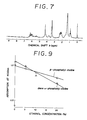
- the macromolecular liposome obtained consequently was placed in an aqueous ethanol solution to determine the relation between the enthanol concentration and the turbidity of the liposome suspension (absorbance at 400 nm) (Fig. 9).
- the present invention is directed to the polymerizable beta-glycerophospholipid represented by the general formula I and possessed of a symmetrical structure having polymerizable functional group-containing acyl chains at the 1- and 3-positions of the glycerol skeleton.
- this lipid is in the state forming a liposome, therefore, the polymerizable functional groups are not deviated.
- the monomer liposome formed from this lipid is easily polymerized.
- the acyl chains possess polymerizable functional groups originating in eleostearic acid (conjugate trienes), they are easily polymerized by irradiation with the ultraviolet light.
- the macromolecular liposome resulting from the polymerization enjoys enhanced stability as compared with the liposome formed solely of natural phospholipid or the macromolecular liposome formed of the conventional asymmetrical polymerizable phosphatidyl choline.
- medicinal substances, enzymes, hemoglobin, etc. on the macromolecular liposome formed from the polymerizable beta-glycerophospholipid of this invention, therefore, there can be obtained highly desirable medicines and drugs and artificial red blood cells.
- the present invention is also directed to a method for the production of the polymerizable beta-glycerophospolipid represented by the general formula I, characterized by the steps of causing a 1,3-diglyceride representd by the general formula II to react with a 2-halo-2-oxo-1,3,2-dioxaphosphoran in the presence of a tertiary amine and subsequently causing the resultant reaction product to react with an amine or ammonia.
- the method of this invention therefore, permits easy production of a polymerizable beta-glycerophospholipid I possessing a symmetrical structure like the aformentioned polymeric beta-phosphatidyl choline Ia.
- the 1,3-diglyceride to be used in the method for production according to the present invention can be obtained by the reaction of an unsaturated fatty acid anhydride with glycidol in the presence of a quaternary ammonium salt.
- the production of the polymerizable beta-phosphatidyl choline of the structural formula Ia from the eleostearic acid IIIa derived as the starting material from natural fatty acid is accomplished by preparing an eleostearic anhydride VII by acid anhydridization using a haloformic ester, causing the acid anhydride to react with glycidol thereby forming 1,3-dieleostearoyl glyceride IIa, and causing the glyceride IIa to react with a 2-halo-2-oxo-1,3,2-dioxaphosphoran.
- the polymerizable functional groups of a naturally produced fatty acid can be utilized in their unaltered form.
- the method of this invention therefore, has no use for the step of synthesizing a fatty acid possessing polymerizable functional groups by means of organic chemistry.
- it permits a generous reduction in the process and allows provision of polymerizable beta-glycerophospholipids enjoying outstanding properties mentioned above.
- the method for production according to this invention can be applied similarly effectively to the production using other fatty acids as the starting material.
- the present invention warrants efficient production of a polymerizable beta-glycerophospholipid posessing a symmetrical structure and giving rise to a liposome capable of efficient stable polymerization.
Landscapes
- Chemical & Material Sciences (AREA)
- Health & Medical Sciences (AREA)
- Life Sciences & Earth Sciences (AREA)
- Organic Chemistry (AREA)
- General Health & Medical Sciences (AREA)
- Medicinal Chemistry (AREA)
- Epidemiology (AREA)
- Animal Behavior & Ethology (AREA)
- Pharmacology & Pharmacy (AREA)
- Public Health (AREA)
- Veterinary Medicine (AREA)
- Biochemistry (AREA)
- Molecular Biology (AREA)
- Dispersion Chemistry (AREA)
- Medicinal Preparation (AREA)
Applications Claiming Priority (2)
| Application Number | Priority Date | Filing Date | Title |
|---|---|---|---|
| JP61150941A JPS638391A (ja) | 1986-06-27 | 1986-06-27 | 重合性β−グリセロリン脂質およびその製造方法 |
| JP150941/86 | 1986-06-27 |
Publications (2)
| Publication Number | Publication Date |
|---|---|
| EP0251229A1 true EP0251229A1 (fr) | 1988-01-07 |
| EP0251229B1 EP0251229B1 (fr) | 1990-04-04 |
Family
ID=15507761
Family Applications (1)
| Application Number | Title | Priority Date | Filing Date |
|---|---|---|---|
| EP87109189A Expired - Lifetime EP0251229B1 (fr) | 1986-06-27 | 1987-06-26 | Beta-glycerophospholipides polymérisables et leur procédé de préparation |
Country Status (3)
| Country | Link |
|---|---|
| EP (1) | EP0251229B1 (fr) |
| JP (1) | JPS638391A (fr) |
| DE (1) | DE3762128D1 (fr) |
Cited By (4)
| Publication number | Priority date | Publication date | Assignee | Title |
|---|---|---|---|---|
| EP0395382A3 (fr) * | 1989-04-27 | 1991-10-30 | Nippon Oil And Fats Company, Limited | Réticulum endoplasmique macromoléculaire |
| US5717047A (en) * | 1993-01-28 | 1998-02-10 | Biocompatibles Limited | Materials |
| WO2017109784A1 (fr) * | 2015-12-22 | 2017-06-29 | Yeda Research And Development Co. Ltd. | Analogues lipidiques et liposomes les comprenant |
| WO2018150429A1 (fr) * | 2017-02-16 | 2018-08-23 | Yeda Research And Development Co. Ltd. | Véhicules liposomaux pour l'administration de médicaments |
Families Citing this family (3)
| Publication number | Priority date | Publication date | Assignee | Title |
|---|---|---|---|---|
| JP4897300B2 (ja) * | 2006-01-31 | 2012-03-14 | 三和シヤッター工業株式会社 | 建築用シャッター装置における支持ブラケット |
| MX2011008050A (es) * | 2009-02-03 | 2011-09-09 | Aquaz As | Membrana nanofabricada con proteoliposomas polimerizados. |
| JP7275455B2 (ja) * | 2018-03-02 | 2023-05-18 | 三井化学株式会社 | 電池用非水電解液及びリチウム二次電池 |
Citations (3)
| Publication number | Priority date | Publication date | Assignee | Title |
|---|---|---|---|---|
| DE2647395A1 (de) * | 1976-10-20 | 1978-04-27 | Nattermann A & Cie | Verfahren zur herstellung von estern des glycerophosphocholins |
| EP0032622A1 (fr) * | 1979-12-20 | 1981-07-29 | Dennis Chapman | Phospholipides polymérisables et leurs polymères, procédés pour leur préparation, procédés pour leur utilisation dans le revêtement de substrats et la formation de liposomes et substrats revêtus et compositions de liposomes ainsi obtenus |
| EP0036155A2 (fr) * | 1980-03-17 | 1981-09-23 | Max-Planck-Gesellschaft zur Förderung der Wissenschaften e.V. | Phospholipides polymérisables, leur procédé de préparation, phospholipides polymères, procédé pour leur préparation ainsi que l'utilisation des phospholipides polymères |
Family Cites Families (3)
| Publication number | Priority date | Publication date | Assignee | Title |
|---|---|---|---|---|
| DE3367219D1 (en) * | 1982-10-25 | 1986-12-04 | Nattermann A & Cie | Substituted aminoalcanol phospholipids and process for their preparation |
| JPS6191A (ja) * | 1984-06-11 | 1986-01-06 | Hidetoshi Tsuchida | 重合性リン脂質化合物 |
| JPS61129190A (ja) * | 1984-11-27 | 1986-06-17 | Nippon Oil & Fats Co Ltd | 重合性グリセロリン脂質 |
-
1986
- 1986-06-27 JP JP61150941A patent/JPS638391A/ja active Pending
-
1987
- 1987-06-26 DE DE8787109189T patent/DE3762128D1/de not_active Expired - Fee Related
- 1987-06-26 EP EP87109189A patent/EP0251229B1/fr not_active Expired - Lifetime
Patent Citations (3)
| Publication number | Priority date | Publication date | Assignee | Title |
|---|---|---|---|---|
| DE2647395A1 (de) * | 1976-10-20 | 1978-04-27 | Nattermann A & Cie | Verfahren zur herstellung von estern des glycerophosphocholins |
| EP0032622A1 (fr) * | 1979-12-20 | 1981-07-29 | Dennis Chapman | Phospholipides polymérisables et leurs polymères, procédés pour leur préparation, procédés pour leur utilisation dans le revêtement de substrats et la formation de liposomes et substrats revêtus et compositions de liposomes ainsi obtenus |
| EP0036155A2 (fr) * | 1980-03-17 | 1981-09-23 | Max-Planck-Gesellschaft zur Förderung der Wissenschaften e.V. | Phospholipides polymérisables, leur procédé de préparation, phospholipides polymères, procédé pour leur préparation ainsi que l'utilisation des phospholipides polymères |
Non-Patent Citations (3)
| Title |
|---|
| CHEMICAL ABSTRACTS FORMULA INDEX, C16-Z, vol. 89, July-December 1978, page 2278F, Column 1, line 100; column 2, line 28, Columbus, Ohio, US; * |
| J. LIEBIG "Annalen der Chemie", vol. 709, 1967, pages 226-230, formula, line 10, page 230, Publication Chemistry GmbH, Weinheim * |
| PATENT ABSTRACTS OF JAPAN, vol. 9, no. 200 (C-298)[1923], 16th August 1985; & JP - A - 60 67489 (TOYO SODA KOGYO K.K.) 17-04-1985 * |
Cited By (14)
| Publication number | Priority date | Publication date | Assignee | Title |
|---|---|---|---|---|
| EP0395382A3 (fr) * | 1989-04-27 | 1991-10-30 | Nippon Oil And Fats Company, Limited | Réticulum endoplasmique macromoléculaire |
| CN1037492C (zh) * | 1989-04-27 | 1998-02-25 | 日本油脂株式会社 | 大分子内质网的制备方法 |
| US5717047A (en) * | 1993-01-28 | 1998-02-10 | Biocompatibles Limited | Materials |
| US10730976B2 (en) | 2015-12-22 | 2020-08-04 | Yeda Research And Development Co. Ltd. | Lipid analogs and liposomes comprising same |
| CN108884117A (zh) * | 2015-12-22 | 2018-11-23 | 耶达研究及发展有限公司 | 脂质类似物和包含脂质类似物的脂质体 |
| WO2017109784A1 (fr) * | 2015-12-22 | 2017-06-29 | Yeda Research And Development Co. Ltd. | Analogues lipidiques et liposomes les comprenant |
| CN108884117B (zh) * | 2015-12-22 | 2022-03-08 | 耶达研究及发展有限公司 | 脂质类似物和包含脂质类似物的脂质体 |
| CN114621374A (zh) * | 2015-12-22 | 2022-06-14 | 耶达研究及发展有限公司 | 脂质化合物和包含脂质化合物的脂质体 |
| US11396563B2 (en) | 2015-12-22 | 2022-07-26 | Yeda Research And Development Co. Ltd. | Lipid analogs and liposomes comprising same |
| EP4230632A3 (fr) * | 2015-12-22 | 2023-10-25 | Yeda Research and Development Co. Ltd | Analogues de lipides et liposomes comprenant celui-ci |
| CN114621374B (zh) * | 2015-12-22 | 2024-06-11 | 耶达研究及发展有限公司 | 脂质化合物和包含脂质化合物的脂质体 |
| US12116428B2 (en) | 2015-12-22 | 2024-10-15 | Yeda Research And Development Co. Ltd. | Lipid analogs and liposomes comprising same |
| WO2018150429A1 (fr) * | 2017-02-16 | 2018-08-23 | Yeda Research And Development Co. Ltd. | Véhicules liposomaux pour l'administration de médicaments |
| US11684578B2 (en) | 2017-02-16 | 2023-06-27 | Yeda Research And Development Co. Ltd. | Liposomic drug-delivery vehicles |
Also Published As
| Publication number | Publication date |
|---|---|
| DE3762128D1 (de) | 1990-05-10 |
| EP0251229B1 (fr) | 1990-04-04 |
| JPS638391A (ja) | 1988-01-14 |
Similar Documents
| Publication | Publication Date | Title |
|---|---|---|
| US4485045A (en) | Synthetic phosphatidyl cholines useful in forming liposomes | |
| CA1240692A (fr) | Phospholipides synthetiques, leur preparation et leur emploi | |
| EP0032622B1 (fr) | Phospholipides polymérisables et leurs polymères, procédés pour leur préparation, procédés pour leur utilisation dans le revêtement de substrats et la formation de liposomes et substrats revêtus et compositions de liposomes ainsi obtenus | |
| US4594193A (en) | Thiol based lipids and membranes made therefrom | |
| US4861521A (en) | Polymerizable liposome-forming lipid, and method for production thereof | |
| CA1167838A (fr) | Phospholipides polymerisables et methode de preparation; phospholipides polymeres et methode de preparation; applications pour les phospholipides polymeres | |
| US20020090383A1 (en) | Phosphatidyl oligoglycerols | |
| EP0251229A1 (fr) | Beta-glycerophospholipides polymérisables et leur procédé de préparation | |
| JPH0597878A (ja) | エルシル−、ブラシジル−およびネルボニル誘導体、その製造方法、それを含有する腫瘍および原虫によるおよび菌類による疾患に対抗するための医薬および自己免疫疾患および骨髄障害の治療のための医薬およびその医薬の製造方法 | |
| JP4991049B2 (ja) | 不飽和アルキル鎖及びアシル鎖を有するリン脂質 | |
| EP0470251B1 (fr) | Composition liquide de prostaglandine | |
| US4587055A (en) | Polymerized vesicles and compounds for their preparation | |
| US4808480A (en) | Polymerizable heterocyclic disulfide-based compounds and membranes made therefrom | |
| JP2009298817A (ja) | ホスファチジルオリゴグリセリン | |
| EP0245799B1 (fr) | Matériaux sensibles aux ondes électromagnétiques et agent de traitement de surface biocompatible | |
| JPH0455433B2 (fr) | ||
| Ohkatsu et al. | Synthesis and polymerization of a macromonomer derived from phosphatidylcholine | |
| KR940011186B1 (ko) | 인산 에스테르 및 그의 제조방법 | |
| JPH0572915B2 (fr) | ||
| JPH0710874B2 (ja) | 重合性リン脂質 | |
| JPH0588718B2 (fr) | ||
| JPH0148776B2 (fr) | ||
| JPS63139186A (ja) | 三本鎖型リン脂質化合物およびその製造方法 | |
| JPS61155336A (ja) | 医用担体 | |
| JPS61155392A (ja) | 重合性のリポソ−ム形成脂質およびその製造方法 |
Legal Events
| Date | Code | Title | Description |
|---|---|---|---|
| PUAI | Public reference made under article 153(3) epc to a published international application that has entered the european phase |
Free format text: ORIGINAL CODE: 0009012 |
|
| 17P | Request for examination filed |
Effective date: 19870713 |
|
| AK | Designated contracting states |
Kind code of ref document: A1 Designated state(s): BE CH DE FR GB IT LI NL SE |
|
| 17Q | First examination report despatched |
Effective date: 19881209 |
|
| GRAA | (expected) grant |
Free format text: ORIGINAL CODE: 0009210 |
|
| ITF | It: translation for a ep patent filed | ||
| AK | Designated contracting states |
Kind code of ref document: B1 Designated state(s): BE CH DE FR GB IT LI NL SE |
|
| ET | Fr: translation filed | ||
| REF | Corresponds to: |
Ref document number: 3762128 Country of ref document: DE Date of ref document: 19900510 |
|
| PLBE | No opposition filed within time limit |
Free format text: ORIGINAL CODE: 0009261 |
|
| STAA | Information on the status of an ep patent application or granted ep patent |
Free format text: STATUS: NO OPPOSITION FILED WITHIN TIME LIMIT |
|
| 26N | No opposition filed | ||
| ITTA | It: last paid annual fee | ||
| EAL | Se: european patent in force in sweden |
Ref document number: 87109189.8 |
|
| PGFP | Annual fee paid to national office [announced via postgrant information from national office to epo] |
Ref country code: FR Payment date: 19950609 Year of fee payment: 9 |
|
| PGFP | Annual fee paid to national office [announced via postgrant information from national office to epo] |
Ref country code: SE Payment date: 19950615 Year of fee payment: 9 Ref country code: GB Payment date: 19950615 Year of fee payment: 9 |
|
| PGFP | Annual fee paid to national office [announced via postgrant information from national office to epo] |
Ref country code: DE Payment date: 19950617 Year of fee payment: 9 |
|
| PGFP | Annual fee paid to national office [announced via postgrant information from national office to epo] |
Ref country code: CH Payment date: 19950623 Year of fee payment: 9 |
|
| PGFP | Annual fee paid to national office [announced via postgrant information from national office to epo] |
Ref country code: NL Payment date: 19950628 Year of fee payment: 9 |
|
| PGFP | Annual fee paid to national office [announced via postgrant information from national office to epo] |
Ref country code: BE Payment date: 19950809 Year of fee payment: 9 |
|
| PG25 | Lapsed in a contracting state [announced via postgrant information from national office to epo] |
Ref country code: GB Effective date: 19960626 |
|
| PG25 | Lapsed in a contracting state [announced via postgrant information from national office to epo] |
Ref country code: SE Effective date: 19960627 |
|
| PG25 | Lapsed in a contracting state [announced via postgrant information from national office to epo] |
Ref country code: LI Effective date: 19960630 Ref country code: CH Effective date: 19960630 Ref country code: BE Effective date: 19960630 |
|
| BERE | Be: lapsed |
Owner name: TERUMO K.K. Effective date: 19960630 |
|
| PG25 | Lapsed in a contracting state [announced via postgrant information from national office to epo] |
Ref country code: NL Effective date: 19970101 |
|
| GBPC | Gb: european patent ceased through non-payment of renewal fee |
Effective date: 19960626 |
|
| REG | Reference to a national code |
Ref country code: CH Ref legal event code: PL |
|
| PG25 | Lapsed in a contracting state [announced via postgrant information from national office to epo] |
Ref country code: FR Effective date: 19970228 |
|
| PG25 | Lapsed in a contracting state [announced via postgrant information from national office to epo] |
Ref country code: DE Effective date: 19970301 |
|
| EUG | Se: european patent has lapsed |
Ref document number: 87109189.8 |
|
| NLV4 | Nl: lapsed or anulled due to non-payment of the annual fee |
Effective date: 19970101 |
|
| REG | Reference to a national code |
Ref country code: FR Ref legal event code: ST |
|
| PG25 | Lapsed in a contracting state [announced via postgrant information from national office to epo] |
Ref country code: IT Free format text: LAPSE BECAUSE OF NON-PAYMENT OF DUE FEES;WARNING: LAPSES OF ITALIAN PATENTS WITH EFFECTIVE DATE BEFORE 2007 MAY HAVE OCCURRED AT ANY TIME BEFORE 2007. THE CORRECT EFFECTIVE DATE MAY BE DIFFERENT FROM THE ONE RECORDED. Effective date: 20050626 |