EP0255595A2 - Verfahren zur Herstellung von spannungsarmen Formteilen - Google Patents
Verfahren zur Herstellung von spannungsarmen Formteilen Download PDFInfo
- Publication number
- EP0255595A2 EP0255595A2 EP87108934A EP87108934A EP0255595A2 EP 0255595 A2 EP0255595 A2 EP 0255595A2 EP 87108934 A EP87108934 A EP 87108934A EP 87108934 A EP87108934 A EP 87108934A EP 0255595 A2 EP0255595 A2 EP 0255595A2
- Authority
- EP
- European Patent Office
- Prior art keywords
- mold
- radiation
- mass
- curing
- mold part
- Prior art date
- Legal status (The legal status is an assumption and is not a legal conclusion. Google has not performed a legal analysis and makes no representation as to the accuracy of the status listed.)
- Granted
Links
Images

Classifications
-
- B—PERFORMING OPERATIONS; TRANSPORTING
- B29—WORKING OF PLASTICS; WORKING OF SUBSTANCES IN A PLASTIC STATE IN GENERAL
- B29C—SHAPING OR JOINING OF PLASTICS; SHAPING OF MATERIAL IN A PLASTIC STATE, NOT OTHERWISE PROVIDED FOR; AFTER-TREATMENT OF THE SHAPED PRODUCTS, e.g. REPAIRING
- B29C39/00—Shaping by casting, i.e. introducing the moulding material into a mould or between confining surfaces without significant moulding pressure; Apparatus therefor
- B29C39/22—Component parts, details or accessories; Auxiliary operations
- B29C39/40—Compensating volume change, e.g. retraction
-
- B—PERFORMING OPERATIONS; TRANSPORTING
- B29—WORKING OF PLASTICS; WORKING OF SUBSTANCES IN A PLASTIC STATE IN GENERAL
- B29C—SHAPING OR JOINING OF PLASTICS; SHAPING OF MATERIAL IN A PLASTIC STATE, NOT OTHERWISE PROVIDED FOR; AFTER-TREATMENT OF THE SHAPED PRODUCTS, e.g. REPAIRING
- B29C37/00—Component parts, details, accessories or auxiliary operations, not covered by group B29C33/00 or B29C35/00
- B29C37/005—Compensating volume or shape change during moulding, in general
-
- Y—GENERAL TAGGING OF NEW TECHNOLOGICAL DEVELOPMENTS; GENERAL TAGGING OF CROSS-SECTIONAL TECHNOLOGIES SPANNING OVER SEVERAL SECTIONS OF THE IPC; TECHNICAL SUBJECTS COVERED BY FORMER USPC CROSS-REFERENCE ART COLLECTIONS [XRACs] AND DIGESTS
- Y10—TECHNICAL SUBJECTS COVERED BY FORMER USPC
- Y10S—TECHNICAL SUBJECTS COVERED BY FORMER USPC CROSS-REFERENCE ART COLLECTIONS [XRACs] AND DIGESTS
- Y10S425/00—Plastic article or earthenware shaping or treating: apparatus
- Y10S425/808—Lens mold
Definitions
- the invention relates to a process for the production of low-tension molded parts, in which reactive curable and / or crosslinkable compositions having a low viscosity are introduced into a mold by polymerization into a solid state.
- the object of the invention is to find a method for producing an irreversible or reversible hardened, low-stress molded part, which despite high reaction speeds and temperatures during curing should avoid relative movement of the molded part and the molded surface in order to achieve a precise reproduction of the given dimensions of the mold, and which one Molded part with excellent homogeneous optical properties.
- the object is achieved in that the mass is brought into a homogeneous, calm state, in order to then be hardened in predetermined directions, with at least one of the inner surfaces of the closed part bearing against the molded part corresponding to the change in dimension during the hardening in the respective Direction is tracked.
- the method is particularly suitable for thin, flat, transparent moldings such as panes, lenses, etc. Surprisingly, it has been shown that if the hardening is carried out in the direction of the thickness of the molded part, there are no significant shrinkages, particularly in the direction transverse to it occur. Elevations or depressions attached to the inner surface of the mold are thus reproduced true to form. In addition, the pane is almost stress-free due to the layer-by-layer hardening.
- the disc is therefore particularly suitable for the reproduction of contour-related information NEN, which can later be picked up by laser beam
- compositions with a viscosity of less than 10,000 mPas, in particular less than 1000 mPas are used. These can consist of various components with any additives. Degassing is possible beforehand. The filling should take place in the rising process, the flow speed being regulated depending on the degree of filling of the mold in such a way that a laminar source flow is present at all times. However, it is also conceivable to homogenize the speed field after filling and before closing the mold by means of vibration, as a result of which, in particular, large distortions can be reduced. Finally, the movement of the dipoles can be strongly damped by electromagnetic fields that can possibly be reversed.
- the irradiated mold wall should largely let the waves of the working area pass, which is the case for example with quartz, silicates and some amorphous plastics at certain wavelengths.
- the depth of the heating can be adjusted by changing the wavelength or by using filters.
- Hardening is also possible by adding peroxide from the inside to the outside or vice versa depending on the heat applied.
- the low pressure which is less expensive than normal pressing processes, ensures the proper functioning of the mold, although it should be adapted to the course of the reaction of the mass.
- the tracking of the mold wall depends on the shrinkage behavior of the material used. It should be set in such a way that there is no space at any time in order to prevent the flow of mass or depressions.
- reactive compounds or reactive components of mixtures e.g. can be used:
- Unsaturated polyester resins dissolved in copolymerizable monomers, preferably styrene, vinyl toluene, tert-butyl styrene, bis- and trifunctional acrylates, preferably methacrylates of linear and branched alkanols (C1 to C10), cyclohexanol, alkylcyclohexanols and phenols, cresols, bisphenols, preferably bisphenol A and F, and their reaction products with one to three, preferably one mole of ethylene oxide and / or propylene oxide per OH, furthermore glycerol and / or glycidyl ether of the phenols and bisphenols mentioned.
- copolymerizable monomers preferably styrene, vinyl toluene, tert-butyl styrene, bis- and trifunctional acrylates, preferably methacrylates of linear and branched alkanols (C1 to C
- Possible hardeners for EP systems are: aliphatic, cycloaliphatic and aromatic amines as well as acid anhydrides, e.g. Tetrahydrophthalic anhydride.
- Polymerization initiators in the sense of this invention are:
- UV rays eg benzophenone, 1-hydroxycyclohexylphenyl ketone, 2-methyl-1-4- (methylthio) phenyl-2-morpholinopropanone-1, benzoin ether, preferably benzoin isopropyl and iso butyl ether, benzil diketals, preferably benzil dimethyl ketal, and optionally mixtures of the compounds mentioned and / or their preparations, for. B. in plasticizers and / or the used and / or other reactants;
- diacyl peroxides for radical curing with organic peroxides or radiation / peroxide mixed curing: diacyl peroxides, peroxydicarbonates, peresters, perketals, dialkyl peroxides, ketone peroxides, hydroperoxides, e.g.: bis (2,4-dichlorobenzoyl) peroxide, dilauroyl peroxide, dibenzoyl peroxide, di-2-peroxide -ethylhexyl peroxydicarbonate, diisopropyl peroxydicarbonate, dicyclohexyl peroxydicarbonate, bis (4-t-butylcyclohexyl) peroxydicarbonate, t-butyl perpivalate, t-butyl per-2-ethylhexanoate, t-butyl per-3,5,5 -trimethylhexanoate, t-butyl perbenzoate, t-but
- Accelerators for the purposes of this invention are inorganic, preferably organic, salts which are soluble in the reaction masses and also complex compounds of metals, preferably of cobalt and vanadium, for example cobalt octoate, -Naphthenate, -acetylacetonate, vanadylacetylacetonate, vanadyl octonate, vanadyl acetate, vanadyl p-toluenesulfonate.
- metals preferably of cobalt and vanadium, for example cobalt octoate, -Naphthenate, -acetylacetonate, vanadylacetylacetonate, vanadyl octonate, vanadyl acetate, vanadyl p-toluenesulfonate.
- amines preferably tertiary alkylarylamines, for example N, N-d
- accelerators for curing with accelerators based on cobalt compounds are the amines mentioned above, preferably N, N-dimethylaniline, N, N-diethylaniline, N, N-dimethyl-p-toluidine, N, N bis- ⁇ -hydroxyethyl and / or -propyl-p-toluidine and / or their esters, for example with adipic acid, phthalic acids, monocarboxylic acids (C2-C10).
- Additional accelerators for vanadium compounds are: thiols and thiocarboxylic acid esters, preferably thioglycolic acid esters, as described, for example, in German Patent Specification 2,025,410.
- Inhibitors for the purposes of this invention are: benzoquinone, toluchinone, naphthoquinones, trimethylquinone, mono- and di-tertiary-butylquinone and / or hydroquinones, preferably hydroquinone, toluhydroquinone, 1,4-naphthohydroquinone, pyrocatechols - preferably tert-butyl-catechol - and also catechol whose esters with monocarboxylic acids and / or their mono-alkyl ethers, furthermore chloranil and soluble copper salts and / or complexes, for example Copper naphthenate, octoate, acetylacetonate, copper (I) chloride-trischloroethyl phosphite complex.
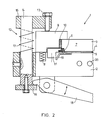
- FIG. 1 and 2 show a mold 1 which consists of a lower mold part 2 and an upper mold part 3, between which the molded part 4 is produced.
- a die 5 with information depressions is arranged, which is held in a circle at the edge by an elastic seal 6.
- the upper mold part 3 consists of a glass plate 7, which is held by a ring 9 adjustable in height by springs 8 with lateral rubber coating 10, the mobility of which is predetermined by individual adapters 11 and upwards by clamping device 12 via adjusting screw 13.
- the clamping device 12 consists of a column 14 guided on the lower mold part 2 with an upper arm 15 and head piece 16. The height is adjusted by cylinder spring 17 and down by a (hydraulically) movable lever 18.
- Vacuum channels 19 or heating medium channels 20 are also arranged in the lower mold part 2.
Landscapes
- Casting Or Compression Moulding Of Plastics Or The Like (AREA)
- Solid State Image Pick-Up Elements (AREA)
- Compositions Of Macromolecular Compounds (AREA)
- Polysaccharides And Polysaccharide Derivatives (AREA)
- Electrical Discharge Machining, Electrochemical Machining, And Combined Machining (AREA)
- Paper (AREA)
- Devices For Conveying Motion By Means Of Endless Flexible Members (AREA)
- Inorganic Insulating Materials (AREA)
- Processing And Handling Of Plastics And Other Materials For Molding In General (AREA)
- Processes Of Treating Macromolecular Substances (AREA)
- Moulds For Moulding Plastics Or The Like (AREA)
- Magnetic Record Carriers (AREA)
Abstract
Description
- Die Erfindung betrifft ein Verfahren zur Herstellung von spannungsarmen Formteilen, in dem reaktiv härtbare und/oder vernetzbare Massen mit geringer Viskosität nach dem Einfüllen in eine Form durch Polymerisation in einen festen Zustand überführt werden.
- Während der Polymerisation und/oder Polyaddition von Reaktionsharzen zu Duroplasten findet im allgemeinen eine Volumenminderung statt, die sich nachteilig auf die Formteilqualität auswirkt. Im Formteil treten Eigenspannungen auf, die im allgemeinen zu einer Minderung der mechanischen Festigkeit führen. Die Oberfläche weist sichtbar Einfallserscheinungen auf. Bei transparenten Werkstoffen ergeben sich infolge von Schlieren Verzerrungen der optischen Abbildungen. in besonders krassen Fällen werden Risse im Formteil beobachtet. Insbesondere sind als Folge des Volumenschrumpfens Relativbewegungen zwischen Formoberfläche und Formteiloberfläche (Ablösungen und/oder Querbewegungen) zu beobachten, die eine präzise Abbildung der Forminnenfläche auf das Formteil nicht zulassen. Es ist bekannt, härtbare Monomere und/oder Reaktionsharze in eine Form einzubringen, die Härtungsreaktion einzuleiten und den Volumenschrumpf während der Härtung durch Zudosieren (Nachdrücken) von weiteren härtbaren Monomeren und/oder Oligomeren auszugleichen. Dieses Verfahren hat den Nachteil, daß während der Härtung Monomere und/oder Oligomere vom Anguß aus über längere Wege bis zum Ort des Volumenschrumpfes nachgedrückt werden müssen, und dabei Eigenspannungen und Inhomogenitäten im Formteil erzeugt werden. Das führt insbesondere bei transparenten Werkstoffen zu den genannten Nachteilen. In einer späten Härtungsphase ist wegen des Viskositätsanstieges ein Nachdrücken nicht mehr möglich, so daß Einfallstellen im Formteil auftreten.
- Weiterhin ist bekannt (EP 0 142 367 A), eine planparallele Polymerschicht auf ein Substrat aufzubringen, wobei das Substrat zunächst in einer Form fixiert, in diese Form ein flüssiges Monomeres eindosiert und während oder vor der Härtung das Substrat von der Form gelöst wird, so daß das Substrat sich innerhalb der Form bewegen kann und so den Schrumpf während der Polymerisation ausgleichen kann. Z. B. ist diese Form mit einem demontierbaren Deckel ausgerüstet, der entfernt wird, bevor oder während das Teil schrumpft. Damit wird die Form belüftet und der Umgebungsdruck in dem Bereich der Form wirksam, der der beschichteten Substratseite abgewandt ist, bevor signifikanter Schrumpf auftritt. Damit kann sich das Substrat bewegen und den Schrumpf ausgleichen.
- Nachteil des Verfahrens ist, daß Formteile nicht in einem Arbeitsgang hergestellt werden, sondern zur Herstellung von kompletten Formteilen mehrere Arbeitsgänge erforderlich sind. Das Verfahren setzt auch eine innige Verbindung von Substrat und Beschichtung voraus.
- Schließlich ist ein Verfahren bekannt, bei dem spannungsfreie oder spannungsarme Formteile mit möglichst kleiner Reaktionsgeschwindigkeit bei möglichst niedriger Temperatur und möglichst kleiner Temperaturdifferenz ausgehärtet werden. Zur Herstellung ebener oder planparalleler, ebener Flächen wird dabei mit einer Nachdosierung des reaktiven Produktes unter Anwendung von Druck oder Nachdruck im Bereich 10 bis 50 bar gearbeitet.
- Aufgabe der Erfindung ist es, ein Verfahren zur Herstellung eines irreversiblen bzw. reversiblen ausgehärteten, spannungsarmen Formteils zu finden, welches trotz hoher Reaktionsgeschwindigkeiten und Temperaturen beim Aushärten Relativbewegung von Formteil und Formoberfläche zur Erzielung einer präzisen Wiedergabe der vorgegebenen Maße der Form vermeiden soll und welches ein Formteil mit hervorragenden homogenen optischen Eigenschaften, erzeugt.
- Die Aufgabe wird erfindungsgemäß dadurch gelöst, daß die Masse in einen homogenen, beruhigten Zustand gebracht wird, um dann in vorgegebenen Richtungen gehärtet zu werden, wobei mindestens eine der am Formteil anliegenden Innenflächen der geschlossenen Form entsprechend der Änderung der Abmessung während der Härtung in der jeweiligen Richtung nachgeführt wird.
- Überraschenderweise wurde gefunden, daß auch bei wirtschaftlich günstiger Fahrweise - nämlich hohe Reaktionsgeschwindigkeiten und Temperaturen - abbildungsgetreue Formteile mit geringen Eigenspannungen und Schlierenfreiheit zu erzielen sind, wenn während der Härtung Änderungen (Schrumpfungen) der Masse durch entsprechendes Nachführen der Form sofort kompensiert werden. Hierdurch werden Relativbewegungen zwischen Form und Formteil vermieden. Es können also keine Scherkräfte auftreten, die beispielsweise zu Abrissen vorstehender Teile führen würden. Gleichzeitig können keine Einfallstellen entstehen, da zu jedem Zeitpunkt die Form vollständig gefüllt ist. Da die Härtung gerichtet ist, kann sie genau gesteuert werden. Die Härtungsfront durchläuft in Härtungsflächen, die eben sind oder nacheinander bestimmte Raumformen annehmen können, das Formteil, wodurch Eigenspannungen vermieden werden.
- Andere Ausführungsformen sind in den Unteransprüchen angegeben.
- Das Verfahren eignet sich besonders gut für dünne, flächige, transparente Formteile wie Scheiben, Linsen etc. Überraschenderweise hat sich nämlich gezeigt, daß, wenn die Härtung in Richtung der Dicke des Formteils vorgenommen wird, keine nennenswerten Schrumpfungen, insbesondere in der quer dazu liegende Richtung auftreten. An der Innenfläche der Form angebrachte Erhebungen oder Vertiefungen werden also formgetreu abgebildet. Hinzu kommt, daß die Scheibe wegen der schichtweisen Härtung nahezu spannungslos ist. Die Scheibe eignet sich deshalb besonders zur Widergabe von konturbedingten Informatio nen, die später beispielsweise durch Laserstrahl abgegriffen werden.
- Bei dem Verfahren werden Massen mit einer Viskosität kleiner 10.000 mPas, insbesondere kleiner 1000 mPas eingesetzt. Diese können aus verschiedenen Komponenten mit evtl. Zusätzen bestehen. Vorher ist eine Entgasung möglich. Die Füllung sollte im Steigeverfahren erfolgen, wobei die Fließgeschwindigkeit in Abhängigkeit vom Füllgrad der Form so geregelt wird, daß zu jeder Zeit eine laminare Quellströmung vorhanden ist. Denkbar ist aber auch eine Homogenisierung des Geschwindigkeitsfeldes nach dem Füllen und vor dem Schließen der Form durch Vibration, wodurch insbesondere große Verzerrungen abgebaut werden können. Schließlich kann durch elektromagnetische, evtl. umpolbare, Felder die Bewegung der Dipole stark gedämpft werden.
- Durch Strahlenbündel, insbesondere mit gerichteten Strahlen (UVA 340-420 nm), ist es möglich, gezielt in Richtung und Intensität die Härtung von außen schrittweise vorzunehmen, wobei der erste Schritt auch beispielsweise zur Beruhigung der Strömung innerhalb der Form eingesetzt werden kann.
- Die durchstrahlte Formwand sollte die Wellen des Arbeitsbereiches weitgehend durchlassen, was beispielsweise bei Quarz, Silikaten und einigen amorphen Kunststoffen bei bestimmten Wellenlängen der Fall ist. Die Tiefe der Erwärmung kann durch Änderung der Wellenlänge bzw. Vorlage von Filtern eingestellt werden.
- Es ist aber auch möglich, bei zwei gegenüberliegenden Formwänden ein Temperaturgefälle in einer Richtung aufzubauen, indem diese mit Kanälen ausgerüstet sind, die das Heiz- bzw. Kühlmedium aufnehmen.
- Weiter ist eine Härtung durch Zugabe von Peroxid von innen nach außen bzw. umgekehrt je nach Wärmebeaufschlagung möglich.
- Der gegenüber normalen Preßverfahren preiswertere geringe Druck stellt das einwandfreie Funktionieren der Form sicher, wobei er dem Reaktionsverlauf der Masse angepaßt werden sollte.
- Die Nachführung der Formwand ist abhängig von dem Schwindungsverhalten des eingesetzten Werkstoffes. Sie sollte so eingestellt werden, daß zu keiner Zeit ein Zwischenraum vorhanden ist, um das Abfließen von Masse bzw. Einsenkungen zu vermeiden.
- Das erfindungsgemäße Verfahren kann mit der beanspruchten Vorrichtung durchgeführt werden, welche folgenden charakteristischen Merkmale besitzt:
- 1) daß ein Teil des Formoberteils aus transparentem Material besteht, welches Strahlen - zumindest im Arbeitsbereich - ohne wesentliche Absorption durchläßt,
- 2) die Ausnehmung entlang des kreisförmigen Randes eine elastische Dichtung besitzt,
- 3) die Klemmvorrichtung in der Höhe zur Nachführung des Formoberteils nach Vorgabe einstellbar ist.
- Als reaktive Verbindungen bzw. reaktive Komponenten von Gemischen können z.B. eingesetzt werden:
- Ungesättigte Polyesterharze, gelöst in copolymerisierbaren Monomeren, vorzugsweise Styrol, Vinyltoluol, tert.-Butylstyrol, bis- und trïfunktionellen Acrylaten, bevorzugt Methacrylaten von linearen und verzweigten Alkanolen (C₁ bis C₁₀), Cyclohexanol, Alkylcyclohexanolen und Phenolen, Cresolen, Bisphenolen, vorzugsweise Bisphenol A und F, sowie deren Reaktionsprodukte mit einem bis drei, vorzugsweise einem Mol Ethylenoxid und/oder Propylenoxyd je OH, ferner Glycerin und/oder Glycidylether der genannten Phenole und Bisphenole.
- Aliphatische und/oder cycloaliphatische und/oder aromatische Epoxydharze (EP) und Isocyante.
- Als Härter für EP-Systeme kommen in Betracht: aliphatische, cycloaliphatische und aromatische Amine sowie Säureanhydride, z.B. Tetrahydrophthalsäureanhydrid. Als Härter für Isocyanate: Aliphatische und/oder cycloaliphatische und/oder aromatische Polyole und/oder Amine und/oder Aminole.
- Polymerisationsinitiatoren im Sinne dieser Erfindung sind:
- für die Strahlenhärtung, vorzugsweise mit UV-Strahlen: z.B. Benzophenon, 1-Hydroxycyclohexylphenylketon, 2-Methyl-1-4-(methylthio)-phenyl-2-morpholinopropanon-1, Benzoin-Ether, vorzugsweise Benzoin-isopropyl- und -iso butyl-ether, Benzildiketale, vorzugsweise Benzildimethylketal, und gegebenenfalls Gemische der genannten Verbindungen und/oder deren Zubereitungen, z. B. in Weichmachern und/oder den verwendeten und/oder anderen Reaktionspartnern;
- für die radikalische Härtung mit organischen Peroxiden oder Strahlungs-/Peroxid-Mischhärtungen: Diacylperoxide, Peroxydicarbonate, Perester, Perketale, Dialkylperoxide, Ketonperoxide, Hydroperoxide, z.B.: Bis-(2,4-dichlorbenzoyl)-peroxid, Dilauroylperoxid, Dibenzoylperoxid, Di-2-ethylhexylperoxydicarbonat, Diisopropylperoxy-dicarbonat, Dicyclohexyl-peroxydicarbonat, Bis-(4-t-Butylcyclohexyl)-peroxydicarbonat, t-Butyl-perpivalat, t-Butyl-per-2-ethylhexanoat, t-Butyl-per-3,5,5-trimethylhexanoat, t-Butyl-perbenzoat, t-Butylpermaleinat, 1,1-Bis(t-butylperoxy)3,3,5-trimethylcyclohexan, 1,1-Bis(t-butylperoxy)cyclohexan, 2,2-Bis-(t-butylperoxy)butan, n-Butyl-4,4-bis(t-butylperoxy)valerat, Ethyl-3,3-bis(t-butylperoxy)butyrat, Dicumylperoxid, t-Butylcumylperoxid, Bis(t-butylperoxy-isopropyl)benzol, 2,5-dimethylhexan-2,5-di-t-butylperoxid, Di-t-butylperoxid, Methylisobutylketonperoxid, Methylethylketonperoxid, t-Butylhydroperoxid und gegebenenfalls Gemische der genannten Verbindungen und/oder deren Zubereitungen z.B. 40 - 60 Gew.-% in Weichmacher auf Basis Phthalate, Adiphate, Phosphate.
- Beschleuniger im Sinne dieser Erfindung sind in den Reaktionsmassen lösliche anorganische, vorzugsweise organische Salze sowie Komplexverbindungen von Metallen, vorzugsweise von Cobalt und Vanadin, z.B. Cobalt-Octoat, -Naphthenat, -Acetylacetonat, Vanadylacetylacetonat, Vanadyloctonat, Vanadylacetat, Vanadyl-p-Toluolsulfonat. Ferner Amine, vorzugsweise tertiäre Alkylarylamine, z.B. N,N-Dimethylanilin.
- N,N-Dimethylanilin, 10 %ig in Styrol, N,N-Diethylanilin, 10 %ig in Styrol, N,N-Dimethyl-p-toluidin, 10 %ig in Styrol, N,N-bis-(β-hydroxyethyl)-p-toluidin, N,N-bis-(β-hydroxypropyl)p-toluidin, N,N-bis-(β-hydroxypropyl)-p-toluidin-adipat.
- Zusatzbeschleuniger (Promotoren) im Sinne dieser Erfindung sind für Härtungen mit Beschleunigern auf Basis von Cobalt-Verbindungen die oben genannten Amine, vorzugsweise N,N-dimethylanilin, N,N-Diethylanilin, N,N-Dimethyl-p-Toluidin, N,N-bis-β-hydroxyethyl und/oder -propyl-p-Toluidin und/oder deren Ester, z.B. mit Adipinsäure, Phthalsäuren, Monocarbonsäuren (C₂-C₁₀).
- Zusatzbeschleuniger für Vanadinverbindungen sind: Thiole und Thiocarbonsäureester, vorzugsweise Thioglykolsäureester, wie z.B. in der deutschen Auslegeschrift 2 025 410 beschrieben.
- Inhibitoren im Sinne dieser Erfindung sind: Benzochinon, Toluchinon, Naphthochinone, Trimethylchinon, Mono- und di-tertiär-Butylchinon und/oder Hydrochinone, vorzugsweise Hydrochinon, Toluhydrochinon, 1,4-Naphthohydrochinon, Brenzcatechine - vorzugsweise tert.-Butyl-Brenzcatechin - sowie deren Ester mit Monocarbonsäuren und/oder deren Mono-alkylether, ferner Chloranil und lösliche Kupfersalze und/oder -Komplexe, z.B. Kupfer-Naphthenat, -Octoat, -Acetylacetonat, Kupfer(I)chlorid-Trischlorethylphosphit-Komplex.
- Ein Beispiel der Erfindungen ist in den Zeichnungen dargestellt und wird im Folgenden erläutert. Es zeigen
Fig. 1 Draufsicht auf Form
Fig. 2 Schnitt durch Form - In Fig. 1 und Fig. 2 ist eine Form 1 dargestellt, die aus einem Formunterteil 2 und einem Formoberteil 3 besteht, zwischen denen das Formteil 4 hergestellt wird. Auf der Oberseite des plangeschliffenen Formunterteils 2 ist eine Matrize 5 mit Informationsvertiefungen angeordnet, die kreisförmig am Rand von einer elastischen Dichtung 6 gehalten wird. Das Formoberteil 3 besteht aus einer Glasscheibe 7, die über einen durch Federn 8 in der Höhe verstellbaren Ring 9 mit seitlicher Gummierung 10 gehalten wird, deren Beweglichkeit nach unten durch einzelne Paßstücke 11 und nach oben durch Klemmvorrichtung 12 über Justierschraube 13 vorgegeben wird. Die Klemmvorrichtung 12 besteht aus einer, am Formunterteil 2 geführten Säule 14 mit oberem Ausleger 15 und Kopf stück 16. Die Höhenverstellung erfolgt nach oben durch Zylinder-Feder 17 und nach unten über einen (hydraulisch) bewegbaren Hebel 18.
- Im Formunterteil 2 sind noch Vakuum-Kanäle 19 bzw. Heizmedium-Kanäle 20 angeordnet.
Claims (10)
- zumindest im Arbeitsbereich - ohne wesentliche Absorption durchläßt,
Priority Applications (1)
| Application Number | Priority Date | Filing Date | Title |
|---|---|---|---|
| AT87108934T ATE70767T1 (de) | 1986-07-04 | 1987-06-23 | Verfahren zur herstellung von spannungsarmen formteilen. |
Applications Claiming Priority (2)
| Application Number | Priority Date | Filing Date | Title |
|---|---|---|---|
| DE3622540 | 1986-07-04 | ||
| DE19863622540 DE3622540A1 (de) | 1986-07-04 | 1986-07-04 | Verfahren zur herstellung von spannungsarmen formteilen |
Publications (3)
| Publication Number | Publication Date |
|---|---|
| EP0255595A2 true EP0255595A2 (de) | 1988-02-10 |
| EP0255595A3 EP0255595A3 (en) | 1989-07-26 |
| EP0255595B1 EP0255595B1 (de) | 1991-12-27 |
Family
ID=6304420
Family Applications (1)
| Application Number | Title | Priority Date | Filing Date |
|---|---|---|---|
| EP87108934A Expired - Lifetime EP0255595B1 (de) | 1986-07-04 | 1987-06-23 | Verfahren zur Herstellung von spannungsarmen Formteilen |
Country Status (6)
| Country | Link |
|---|---|
| US (1) | US4908216A (de) |
| EP (1) | EP0255595B1 (de) |
| JP (1) | JPS6325010A (de) |
| AT (1) | ATE70767T1 (de) |
| AU (1) | AU596196B2 (de) |
| DE (2) | DE3622540A1 (de) |
Cited By (1)
| Publication number | Priority date | Publication date | Assignee | Title |
|---|---|---|---|---|
| CN115356794A (zh) * | 2022-09-15 | 2022-11-18 | 苏州晶方光电科技有限公司 | 晶圆级微透镜阵列的压印固化设备、制造方法及应用 |
Families Citing this family (11)
| Publication number | Priority date | Publication date | Assignee | Title |
|---|---|---|---|---|
| DE3937474C1 (en) * | 1989-11-10 | 1991-02-14 | Bayer Ag, 5090 Leverkusen, De | Appts. for prodn. of duroplastics mouldings - has tensionable band around elastic seal at mould half edges, to prevent moulding from sticking |
| US5407627A (en) * | 1992-08-03 | 1995-04-18 | Polycryl Enterprises Inc. | Process and apparatus for forming stress-free thermosetting resin products |
| US5451151A (en) * | 1994-02-28 | 1995-09-19 | Hoover Universal, Inc. | Apparatus for molding foam articles |
| KR100827741B1 (ko) * | 2000-07-17 | 2008-05-07 | 보드 오브 리전츠, 더 유니버시티 오브 텍사스 시스템 | 임프린트 리소그래피 공정을 위한 자동 유체 분배 방법 및시스템 |
| US20060005657A1 (en) * | 2004-06-01 | 2006-01-12 | Molecular Imprints, Inc. | Method and system to control movement of a body for nano-scale manufacturing |
| DE10201796A1 (de) * | 2002-01-17 | 2003-07-31 | Zf Lemfoerder Metallwaren Ag | Verfahren und Vorrichtung zur Steuerung des Schrumpfungsverhaltens während des Urformens von Kunststoffen |
| US7442336B2 (en) * | 2003-08-21 | 2008-10-28 | Molecular Imprints, Inc. | Capillary imprinting technique |
| DE10313788A1 (de) * | 2003-03-20 | 2004-10-07 | Schock Gmbh | Verfahren zur Herstellung von Formteilen aus einer aushärtbaren Reaktionsmasse, nach dem Verfahren hergestelltes Formteil und zugehörige Gießform |
| US20110133366A1 (en) * | 2005-02-07 | 2011-06-09 | Henkel Corporation | Injection molding process, apparatus and material for forming cured-in-place gaskets |
| DE102008041136A1 (de) * | 2008-08-11 | 2010-02-18 | Evonik Röhm Gmbh | Vorrichtung und Verfahren zur Herstellung von Kunststoff-Körpern durch Polymerisation von ethylenisch ungesättigten Monomeren und/oder (Pre)polymer |
| JP5267174B2 (ja) * | 2009-02-03 | 2013-08-21 | ソニー株式会社 | 光造形装置及び造形ベース |
Family Cites Families (13)
| Publication number | Priority date | Publication date | Assignee | Title |
|---|---|---|---|---|
| US2745138A (en) * | 1953-05-26 | 1956-05-15 | Optical Plastics Corp | Apparatus for the manufacture of plastic lenses from monomeric materials |
| US3056166A (en) * | 1959-07-20 | 1962-10-02 | Bausch & Lomb | Lens mold and apparatus |
| DE1232727B (de) * | 1964-08-01 | 1967-01-19 | Carl Lindstroem Ges M B H | Vorrichtung zum flaechigen Festhalten von kreisfoermigen Matrizen auf kreisfoermigenFormspiegeln von Schallplattenpressformen |
| US3752620A (en) * | 1971-10-18 | 1973-08-14 | R Renoux | Apparatus for pressing objects out of thermoplastic material, and particularly phonographic disks |
| US4166088A (en) * | 1977-05-25 | 1979-08-28 | Neefe Charles W | Method of making high quality plastic lenses |
| US4257988A (en) * | 1978-09-12 | 1981-03-24 | Optical Warehouse Showroom And Manufacturing, Inc. | Method and assembly for molding optical lenses |
| NL7904113A (nl) * | 1979-05-25 | 1980-11-27 | Philips Nv | Optisch uitleesbare informatieschijf, werkwijze voor de vervaardiging ervan alsmede een inrichting voor het uitvoeren van deze werkwijze. |
| US4227673A (en) * | 1979-08-10 | 1980-10-14 | American Optical Corporation | Gasket for casting lenses |
| JPS599024A (ja) * | 1982-07-07 | 1984-01-18 | Toshiba Corp | 情報デイスクの複製製造方法 |
| US4473673A (en) * | 1983-05-09 | 1984-09-25 | Wildon Industries, Inc. | Cast polyester resin process and product |
| US4637904A (en) * | 1983-11-14 | 1987-01-20 | Rohm And Haas Company | Process for molding a polymeric layer onto a substrate |
| JPS62103116A (ja) * | 1985-10-30 | 1987-05-13 | Kyowa Gas Chem Ind Co Ltd | 光デイスク基板用プレス金型 |
| GB8601967D0 (en) * | 1986-01-28 | 1986-03-05 | Coopervision Optics | Manufacturing contact lenses |
-
1986
- 1986-07-04 DE DE19863622540 patent/DE3622540A1/de not_active Withdrawn
-
1987
- 1987-06-23 EP EP87108934A patent/EP0255595B1/de not_active Expired - Lifetime
- 1987-06-23 AT AT87108934T patent/ATE70767T1/de not_active IP Right Cessation
- 1987-06-23 DE DE8787108934T patent/DE3775490D1/de not_active Expired - Lifetime
- 1987-07-02 JP JP62166230A patent/JPS6325010A/ja active Pending
- 1987-07-03 AU AU75227/87A patent/AU596196B2/en not_active Ceased
-
1989
- 1989-01-23 US US07/300,427 patent/US4908216A/en not_active Expired - Fee Related
Cited By (1)
| Publication number | Priority date | Publication date | Assignee | Title |
|---|---|---|---|---|
| CN115356794A (zh) * | 2022-09-15 | 2022-11-18 | 苏州晶方光电科技有限公司 | 晶圆级微透镜阵列的压印固化设备、制造方法及应用 |
Also Published As
| Publication number | Publication date |
|---|---|
| DE3622540A1 (de) | 1988-01-07 |
| AU7522787A (en) | 1988-01-07 |
| JPS6325010A (ja) | 1988-02-02 |
| ATE70767T1 (de) | 1992-01-15 |
| DE3775490D1 (de) | 1992-02-06 |
| US4908216A (en) | 1990-03-13 |
| EP0255595B1 (de) | 1991-12-27 |
| AU596196B2 (en) | 1990-04-26 |
| EP0255595A3 (en) | 1989-07-26 |
Similar Documents
| Publication | Publication Date | Title |
|---|---|---|
| EP0255595B1 (de) | Verfahren zur Herstellung von spannungsarmen Formteilen | |
| DE69110092T2 (de) | Solides Darstellungssystem unter Verwendung eines elastischen Films mit veränderbarer Spannung. | |
| DE69322869T2 (de) | Vorrichtung und verfahren zur vernetzung einer linse mit einer schicht | |
| DE3882957T2 (de) | Verfahren und Vorrichtung zum Herstellen eines optischen Elementes. | |
| EP2054216B1 (de) | Selbstaushärtendes material und verfahren zum schichtweisen aufbau von modellen | |
| DE69524861T2 (de) | Nichtdoppelbrechendes optisches harzmaterial, verfahren zur herstellung und gegenstand mit optischem harzmaterial enthaltendem flüssigkristallelement | |
| DE69626942T2 (de) | Formwerkzeug, bestehend aus einem lichtausgehärteten Harz mit verstärkendem Füllmaterial | |
| US20230043266A1 (en) | A direct ink writing three-dimensional printing method based on near-infrared photopolymerization | |
| DE3880642T2 (de) | Zusammensetzung , mit aktiven Strahlen härtbar, und Medium für die optische Registrierung mit dieser gehärteten Zusammensetzung. | |
| KR102254001B1 (ko) | 3d 프린팅용 경화용 수지 조성물 및 이로부터 제조된 성형물 | |
| DE2512642C3 (de) | Durch aktinische Strahlung härtbare Masse | |
| KR101838520B1 (ko) | 양이온경화 및 자외선경화 메커니즘을 동시에 가지는 지환족 에폭시 아크릴계 화합물을 포함하는 현상성과 수축률이 우수한 3d프린팅용 수지 조성물 | |
| EP0342567A2 (de) | Verfahren zur Herstellung kratzfest beschichteter Kunststoffbahnen | |
| DE69738250T3 (de) | Durch Photostereographie hergestelltes, dreidimensionales Objekt und die Harzzusammensetzung zu seiner Herstellung | |
| DE69934330T2 (de) | Endabmessungsnahe gegenstände und polymerisationsverfahren und materialen dafür | |
| GB2085901A (en) | Plastic components having improved hardness and scratch reesistance | |
| DE3736280A1 (de) | Verfahren zur herstellung kratzfest beschichteter extrudierter kunststoffbahnen | |
| DE2915209A1 (de) | Optisch auslesbare datenscheibe | |
| DE102009001498A1 (de) | Verwendung von Vinylester-Copolymeren als Low-Profile-Additive (LPA) | |
| DE102007041489A1 (de) | Flexibler medizintechnischer Formkörper sowie Verfahren zu dessen Herstellung | |
| EP0271051A2 (de) | Verfahren zur Herstellung kratzfest beschichteter Kunststofformkörper | |
| DE102005025636A1 (de) | Gussartikel aus Methacryl-Harz mit feiner Oberflächenstruktur und Herstellungsverfahren dafür | |
| DE3779476T2 (de) | Loeschbare optische platte mit optisch transparentem substrat. | |
| DE69307106T2 (de) | Gegenstände aus Polyoxymethylen mit einer bedruckbaren Oberfläche, Verfahren zum Erteilen von Bedruckbarkeit dazu und Verfahren zum Drucken auf Gegenständen aus Polyoxymethylen | |
| DE3516661A1 (de) | Strahlungshaertbare kleber |
Legal Events
| Date | Code | Title | Description |
|---|---|---|---|
| PUAI | Public reference made under article 153(3) epc to a published international application that has entered the european phase |
Free format text: ORIGINAL CODE: 0009012 |
|
| 17P | Request for examination filed |
Effective date: 19870623 |
|
| AK | Designated contracting states |
Kind code of ref document: A2 Designated state(s): AT DE ES FR GB IT NL |
|
| PUAL | Search report despatched |
Free format text: ORIGINAL CODE: 0009013 |
|
| AK | Designated contracting states |
Kind code of ref document: A3 Designated state(s): AT DE ES FR GB IT NL |
|
| 17Q | First examination report despatched |
Effective date: 19900706 |
|
| GRAA | (expected) grant |
Free format text: ORIGINAL CODE: 0009210 |
|
| AK | Designated contracting states |
Kind code of ref document: B1 Designated state(s): AT DE ES FR GB IT NL |
|
| PG25 | Lapsed in a contracting state [announced via postgrant information from national office to epo] |
Ref country code: NL Effective date: 19911227 Ref country code: IT Free format text: LAPSE BECAUSE OF FAILURE TO SUBMIT A TRANSLATION OF THE DESCRIPTION OR TO PAY THE FEE WITHIN THE PRE;WARNING: LAPSES OF ITALIAN PATENTS WITH EFFECTIVE DATE BEFORE 2007 MAY HAVE OCCURRED AT ANY TIME BEFORE 2007. THE CORRECT EFFECTIVE DATE MAY BE DIFFERENT FROM THE ONE RECORDED.SCRIBED TIME-LIMIT Effective date: 19911227 Ref country code: FR Effective date: 19911227 Ref country code: GB Effective date: 19911227 |
|
| REF | Corresponds to: |
Ref document number: 70767 Country of ref document: AT Date of ref document: 19920115 Kind code of ref document: T |
|
| REF | Corresponds to: |
Ref document number: 3775490 Country of ref document: DE Date of ref document: 19920206 |
|
| PG25 | Lapsed in a contracting state [announced via postgrant information from national office to epo] |
Ref country code: ES Free format text: LAPSE BECAUSE OF FAILURE TO SUBMIT A TRANSLATION OF THE DESCRIPTION OR TO PAY THE FEE WITHIN THE PRESCRIBED TIME-LIMIT Effective date: 19920407 |
|
| EN | Fr: translation not filed | ||
| PGFP | Annual fee paid to national office [announced via postgrant information from national office to epo] |
Ref country code: DE Payment date: 19920526 Year of fee payment: 6 |
|
| NLV1 | Nl: lapsed or annulled due to failure to fulfill the requirements of art. 29p and 29m of the patents act | ||
| PG25 | Lapsed in a contracting state [announced via postgrant information from national office to epo] |
Ref country code: AT Effective date: 19920623 |
|
| GBV | Gb: ep patent (uk) treated as always having been void in accordance with gb section 77(7)/1977 [no translation filed] | ||
| PLBE | No opposition filed within time limit |
Free format text: ORIGINAL CODE: 0009261 |
|
| STAA | Information on the status of an ep patent application or granted ep patent |
Free format text: STATUS: NO OPPOSITION FILED WITHIN TIME LIMIT |
|
| 26N | No opposition filed | ||
| PG25 | Lapsed in a contracting state [announced via postgrant information from national office to epo] |
Ref country code: DE Effective date: 19940301 |