EP0255601A2 - Dialkylmaleinimide, Verfahren zu ihrer Herstellung und ihre Verwendung als Herbizide - Google Patents
Dialkylmaleinimide, Verfahren zu ihrer Herstellung und ihre Verwendung als Herbizide Download PDFInfo
- Publication number
- EP0255601A2 EP0255601A2 EP87109174A EP87109174A EP0255601A2 EP 0255601 A2 EP0255601 A2 EP 0255601A2 EP 87109174 A EP87109174 A EP 87109174A EP 87109174 A EP87109174 A EP 87109174A EP 0255601 A2 EP0255601 A2 EP 0255601A2
- Authority
- EP
- European Patent Office
- Prior art keywords
- group
- hydrogen atom
- alkyl
- carbon atoms
- formula
- Prior art date
- Legal status (The legal status is an assumption and is not a legal conclusion. Google has not performed a legal analysis and makes no representation as to the accuracy of the status listed.)
- Granted
Links
- 0 CC[C@@](C1)[C@]1[C@@](C1)[C@@]1[C@]1[C@@](CC2)C[C@]2CC*1 Chemical compound CC[C@@](C1)[C@]1[C@@](C1)[C@@]1[C@]1[C@@](CC2)C[C@]2CC*1 0.000 description 6
Classifications
-
- C—CHEMISTRY; METALLURGY
- C07—ORGANIC CHEMISTRY
- C07D—HETEROCYCLIC COMPOUNDS
- C07D413/00—Heterocyclic compounds containing two or more hetero rings, at least one ring having nitrogen and oxygen atoms as the only ring hetero atoms
- C07D413/02—Heterocyclic compounds containing two or more hetero rings, at least one ring having nitrogen and oxygen atoms as the only ring hetero atoms containing two hetero rings
- C07D413/04—Heterocyclic compounds containing two or more hetero rings, at least one ring having nitrogen and oxygen atoms as the only ring hetero atoms containing two hetero rings directly linked by a ring-member-to-ring-member bond
Definitions
- the present invention relates to new dialkylmaleimides, processes for their preparation and their use as herbicides.
- the new dialkylmaleimides show potent herbicidal properties.
- dialkylmaleimides according to the invention not only have a substantially stronger herbicidal action than those known from the prior art mentioned above, but also a favorable compatibility with useful plants, without phytotoxicity.
- the compound of the formula (11) denotes as starting material a compound based on the above definitions for R I , R 2 , R 3 and X, preferably one which is based on the preferred definitions of these symbols.
- the compounds of the formula (11) include, for example, the known compounds described in JP-OSs 30586/1986 and 76486/1986.
- the compounds of the formula (11) can be obtained in a simple manner by reducing the corresponding 4-substituted 6-nitro-1,4-benzoxazinone by the process described in JP-OS 30586/1986 cited above.
- the 4-substituted 6-nitro-1,4-benzoxazinone can also be prepared in a simple manner by the process of JP-OS 30586/1986.
- the 4-substituted 6-nitro-1,4-benzoxazinone can be prepared in a simple manner from 2-amino-4-nitrophenol as a starting material according to the procedures described in JP-OS 125529/1974 and in "Synthesis" 1984, page 851 .
- the compounds of the formal (III) include, for example, the known compounds described in JP-OS 23965/1978.
- a specific example is 2,3-dimethyl maleic anhydride.
- the starting compound of the formula (I-a) is one of the compounds of the formula (I) which are prepared by process a).
- Examples of the reducing agent used in process b) are metal hydrides such as sodium borohydride and lithium aluminum hydride.
- the compound of the formula (I-b) used as starting material in process c) is one of the compounds of the formula (I) of the present invention which are prepared by process b).
- the compounds of formulas (IV) and (V) are well known, and specific examples include acetyl chloride and acetic anhydride.
- diluents examples include water, halogenated and aromatic hydrocarbons (such as ethylene chloride, chlorobenzene, dichlorobenzene and biphenyl), ethers (such as dioxane and diphenyl ether), alcohols (such as ethanol, isopropanol, butanol and ethylene glycol) and organic acids (such as acetic acid and propionic acid) ).
- halogenated and aromatic hydrocarbons such as ethylene chloride, chlorobenzene, dichlorobenzene and biphenyl
- ethers such as dioxane and diphenyl ether
- alcohols such as ethanol, isopropanol, butanol and ethylene glycol
- organic acids such as acetic acid and propionic acid
- the process a) can be carried out within a temperature range of considerable width, for example between approximately 70 ° C. and approximately 280 ° C., but preferably between approximately 80 ° C. and approximately 100 ° C.
- the reaction is expediently carried out under atmospheric pressure, but it is also possible to work under increased or reduced pressure.
- the desired compounds of the formula (I) can be obtained in a simple manner by reducing the compounds of the formula (Ia) with a reducing agent as exemplified above, in particular with sodium borohydride, as in one below specified working example is shown.
- Aromatic hydrocarbons such as toluene, ethers such as diethyl ether and tetrahydrofuran, halogenated hydrocarbons such as dichloromethane and chloroform and water may be mentioned as suitable diluents for the practical implementation of process c).
- Process c) can be carried out in the presence of an acid-binding agent.
- the acid-binding agents are hydrides, hydroxides, carbonates and hydrogen carbonates of alkali metals and tertiary amines such as triethylamine, diethylaniline and pyridine.
- Process c) can be carried out within a temperature range of considerable width, for example between approximately -10 ° C. and approximately 100 ° C., preferably between approximately 10 ° C. and approximately 100 ° C.
- the reaction is expediently carried out under atmospheric pressure, but it is also possible to work under increased or reduced pressure.
- the desired compounds of the formula (I) can be combined, for example, by reacting 1 mol of the compounds of the formula (Ib) with about 1 to 1.2 mol of the compounds of the formula (IV) or (V) inert solvents, optionally in the presence of acid-binding agents.
- the active compounds according to the invention can be used as defoliants, burn-off agents, agents for destroying broad-leaved plants and in particular as weed killers. "Weeds" in the broadest sense are all plants that grow in places where they are not wanted. Whether the substances according to the invention act as total or selective herbicides depends essentially on the amount used.
- Echinochloa Setaria, Panicum, Digitaria, Phleum, Poa, Festuca, Eleusine, Brachiaria, Lolium, Bromus, Avena, Cyperus, Sorghum, Agropyron, Cynodon, Monochoria, Fimbristylis, Sagittaria, Eleocharis, Scirpus, Paspalum, Spochhenium, Ischatenumum, Ischaeaeaum Agrostis, Alopecurus and Apera.
- Oryza Zea, Triticum, Hordeum, Avena, Secale, Sorghum, Panicum, Saccharum, Pineapple, Asparagus and Allium.
- the compounds can be used for total weed control, for example on industrial sites and railroad bodies, and on paths and squares with or without trees.
- the compounds can also be used for weed control in perennial crops, for example afforestation, ornamental tree plantings, orchards, vineyards and gardens, citrus groves, walnut plantations, banana plantations, coffee plantations, tea plantations, rubber plantations, oil palm plantations, cocoa plantations, soft fruit plantations and hop crops, and for crop cultivation in selective fields will.
- the active ingredients can be used in conventional preparations such as solutions, emulsions, suspensions, powders, dusts, foams, pastes, soluble powders, granules, aerosols, natural and synthetic materials impregnated with the active ingredient, very fine capsules in polymeric substances, coating agents for application to the seeds and formulations that are used in connection with combustion devices such as smoking cartridges, smoking cans and smoking snakes, as well as ULV cold nebulization and warm nebulization preparations.
- preparations can be prepared in a known manner, for example by mixing the active ingredients with extenders, i.e. liquid or liquefied gaseous or solid diluents or carriers, optionally using surfactants, i.e. Emulsifiers and / or dispersants and / or foam-forming agents.
- extenders i.e. liquid or liquefied gaseous or solid diluents or carriers
- surfactants i.e. Emulsifiers and / or dispersants and / or foam-forming agents.
- organic solvents can, for example, also be used as auxiliary solvents.
- Suitable liquid diluents or carriers are mainly aromatic hydrocarbons such as xylene, toluene or alkylnaphthalenes, chlorinated aromatic or chlorinated aliphatic hydrocarbons such as chlorobenzenes, chloroethylenes or methylene chloride, aliphatic or alicyclic hydrocarbons such as cyclohexane or paraffins, for example mineral oil fractions, alcohols such as butanol or glycol and their ethers and esters, ketones such as acetone, methyl ethyl ketone, methyl isobutyl ketone or cyclohexanone, or strongly polar solvents such as dimethylformamide or dimethyl sulfoxide, and also water.
- aromatic hydrocarbons such as xylene, toluene or alkylnaphthalenes
- chlorinated aromatic or chlorinated aliphatic hydrocarbons such as chlorobenzenes, chloroethylenes or methylene
- Liquefied gaseous diluents or carriers are to be understood as liquids which would be gaseous at normal temperature and under normal pressure, for example aerosol propellants such as halogenated hydrocarbons as well as butane, propane, nitrogen and carbon dioxide.
- Ground natural minerals such as kaolins, clays, talc, chalk, quartz, attapulgite, montmorillonite or diatomaceous earth, and ground synthetic minerals such as highly disperse silica, aluminum oxide and silicates can be used as solid carriers.
- Crushed and fractionated natural rock material such as calcite, marble, pumice, sepiolite and dolomite as well as synthetic granulate from inorganic and organic flours and granulate from organic material such as sawdust, coconut shells, corn cobs and tobacco stalks can be used as solid carriers for granules.
- Non-ionic or anionic emulsifiers such as polyoxyethylene fatty acid esters, polyoxyethylene fatty alcohol ethers, for example alkylaryl polyglycol ethers, alkyl sulfonates, alkyl sulfates, aryl sulfonates and hydrolysis products of albumins can be used as emulsifiers and / or foaming agents.
- the dispersants include, for example, lignin sulfite leaching and methyl cellulose.
- Adhesives such as carboxymethyl cellulose and natural and synthetic polymers in the form of powder, granules or latices, e.g. Gum arabic, polyvinyl alcohol and polyvinyl acetate can be used in the formulations.
- colorants such as inorganic pigments, for example iron oxide, titanium oxide ur - id Prussian blue, and organic dyes such as alizarin dyes, azo dyes or metal phthalocyanirri dyes, and trace nutrients such as salts of iron, manganese, boron, copper, cobalt, Molybdenum and zinc.
- inorganic pigments for example iron oxide, titanium oxide ur - id Prussian blue
- organic dyes such as alizarin dyes, azo dyes or metal phthalocyanirri dyes
- trace nutrients such as salts of iron, manganese, boron, copper, cobalt, Molybdenum and zinc.
- the preparations generally contain from 0.1 to 95% by weight, preferably from 0.5 to 90% by weight, of the active ingredient.
- the active compounds according to the present invention can be used as such or in the form of their weed control preparations as mixtures with other herbicides, finished preparations or tank mixes being possible.
- the active compounds can be used as such, in the form of preparations or in use forms which are prepared therefrom by further dilution, for example in the form of ready-to-use solutions, suspensions, emulsions, powders, pastes and as granules. They are used in the usual way, for example by watering, spraying, atomizing or scattering.
- the active compounds according to the invention can be used before or after emergence of the plants.
- They can also be worked into the soil before sowing. In particular, they are used after the plants have emerged.
- the area-related amounts of active compound can be varied within a considerable range. They largely depend on the type of effect sought. In general, the amounts of active ingredient used, based on the area of the soil, are between about 0.001 and about 5 kg / ha, preferably between about 0.01 and about 2.5 kg / ha.
- the compounds of formula (I) according to the present invention can be prepared by the same procedures as in Examples 1 to 3 and are listed in Table 1 together with the compounds obtained in Examples 1 to 3.
- Carrier 5 parts by weight of acetone; Emulsifier: 1 part by weight of benzyloxypolyglycol ether.
- An active ingredient preparation in the form of an emulsifiable concentrate was obtained by mixing 1 part by weight of the active compound with the above-mentioned amounts of the carrier and the emu-1, pouring agent. A predetermined amount of the preparation was diluted with water.
- Rice culture soil was filled in pots (5 dm 2 ; 25 cm x 20 cm x 9 cm), and rice seedlings (variety: "Nihonbare") in the 2.5-leaf stage (15 cm high) were each at two locations per Transplanted pot as a stick of three seedlings.
- the compound of the present invention in the form of an emulsifiable concentrate prepared as above, was pipetted onto the surface of the water in a predetermined amount. Thereafter, the condition of about 3 cm deep flooding was maintained, and four weeks after the chemical treatment, the herbicidal activity and the phytotoxicity to rice were examined and rated from 0 to 5 on the following scale:
- test chemical in a predetermined concentration prepared as in Example 4 was sprayed evenly over the surface layer of the soil in each of the test pots.
- test chemical in a predetermined concentration prepared as in Example 4, was sprayed evenly over test plants in each of the test pots.
Landscapes
- Chemical & Material Sciences (AREA)
- Organic Chemistry (AREA)
- Agricultural Chemicals And Associated Chemicals (AREA)
- Plural Heterocyclic Compounds (AREA)
Abstract
Description
- Die vorliegende Erfindung betrifft neue Dialkylmaleinimide, Verfahren zu ihrer Herstellung und ihre Verwendung als Herbizide.
- Es wurde bereits offenbart, daß bestimmte Tetrahydrophthalimide herbizide Aktivitäten besitzen (siehe die JP-OS 30586/1986).
- Nunmehr wurden neue Dialkylmaleinimide der Formel (I)


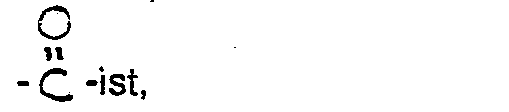
- R1 ein Wasserstoff-Atom, eine Alkyl-Gruppe, eine Alkenyl-Gruppe, eine Alkinyl-Gruppe, eine Aralkyl-Gruppe, eine Alkoxyalkyl-Gruppe, eine Cyanoalkyl-Gruppe, eine Trialkylsilylalkyl-Gruppe, eine Alkylthioalkyl-Gruppe oder die Gruppe

- R3 ein Wasserstoff-Atom oder eine Alkyl-Gruppe,
- R4 eine Alkyl-Gruppe und
- X ein Wasserstoff-Atom, ein Halogen-Atom oder eine Alkyl-Gruppe.
- Die Verbindungen der Formel (I) werden mittels eines Verfahrens erhalten, bei dem
- a) in dem Fall, in dem A


- b) in dem Fall, in dem A


- c) in dem Fall, in dem A


- Die neuen Dialkylmaleinimide zeigen potente herbizide Eigenschaften.
- Überraschenderweise zeigen die erfindungsgemäßen Dialkylmaleinimide nicht nur eine wesentlich stärkere herbizide Wirkung als die aus dem oben genannten Stand der Technik bekannten, sondern auch eine günstige Verträglichkeit mit Nutzpflanzen, ohne Phytotoxizität.
- Vorzugsweise bezeichnen in der die Verbindungen der vorliegenden Erfindung repräsentierenden Formel (I)

- R1 ein Wasserstoff-Atom, eine Alkyl-Gruppe mit 1 bis 4 Kohlenstoff-Atomen, eine Alkenyl-Gruppe mit 2 bis 4 Kohlenstoff-Atomen, eine Alkinyl-Gruppe mit 2 bis 4 Kohlenstoff-Atomen, eine Benzyl-Gruppe, eine Alkoxyalkyl-Gruppe mit insgesamt 2 bis 6 Kohlenstoff-Atomen, eine Cyanomethyl-Gruppe, eine Trimethylsiiylmethyl-Gruppe, eine Alkylthioalkyl-Gruppe mit insgesamt 2 bis 6 Kohlenstoff-Atomen oder die Gruppe

- R2 ein Wasserstoff-Atom oder eine Alkyl-Gruppe mit 1 bis 6 Kohlenstoff-Atomen, eine Phenyl-Gruppe oder eine Benzyl-Gruppe,
- R3 ein Wasserstoff-Atom oder eine Alkyl-Gruppe mit 1 bis 4 Kohlenstoff-Atomen,
- R4 eine Alkyl-Gruppe mit 1 bis 4 Kohlenstoff-Atomen und
- X ein Wasserstoff-Atom, ein Fluor-Atom, ein Chlor-Atom, ein Brom-Atom, eine Methyl-Gruppe oder eine Ethyl-Gruppe.
- Besonders bevorzugt bezeichnen in der Formel (I)

- R1 ein Wasserstoff-Atom, eine Methyl-, Ethyl-, Propyl-, Allyl-, Propargyl-, Benzyl-, Methoxymethyl-, Cyanomethyl-, Trimethylsilylmethyl-, Methylthiomethyl-oder 2-Ethylthioethyl-Gruppe oder die Gruppe

- R2 ein Wasserstoff-Atom oder eine Methyl-, Ethyl-, n-Propyl-, n-Butyl-, n-Hexyl-, Phenyl-oder Benzyl-Gruppe
- R3 ein Wasserstoff-Atom oder eine Methyl-Gruppe,
- R4 eine Methyl-Gruppe und
- X ein Wasserstoff-oder ein Fluor-Atom.
- Zu speziellen Beispielen für die durch die vorliegende Erfindung verfügbar gemachten Verbindungen der Formel (I) zählen
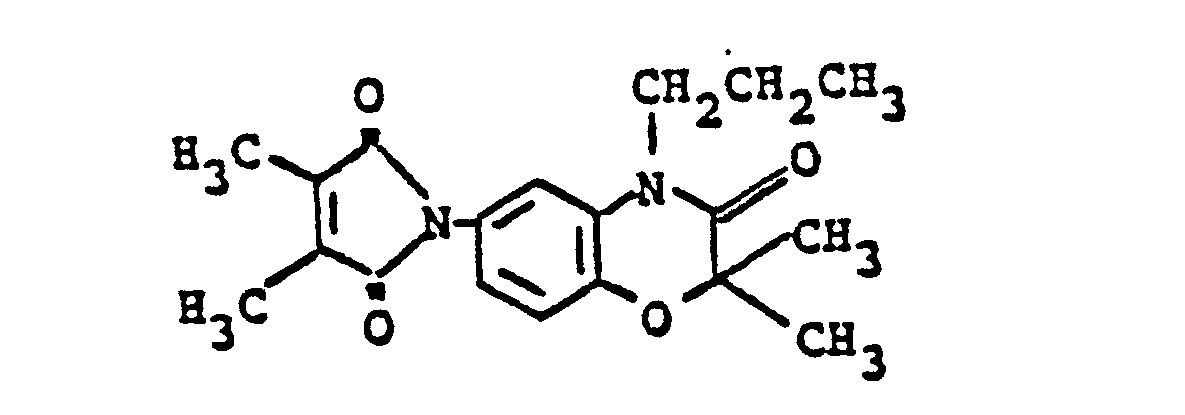
- 1-[4-Propyl-2H-1,4-benzoxazin-3(4H)-on-6-yl]-3,4-dimethyl-2,5-dioxo-2,5-dihydropyrrol, 1-[4-Allyl-2H-1,4-benzoxazin-3(4H)-on-6-yl]-3,4-dimethyl-2,5-dioxo-2,5-dihydropyrroli 1-[4-Propargyl-2H-1,4-benzoxazin-3(4H)-on-6-yl]-3,4-dimethyl-2,5-dioxo-2,5-dihydropyrrol, 1-[4-Propyl-2-methyl-1,4-benzoxazin-3(4H)-on-6-yl]-3,4-dimethyl-2,5-dioxo-2,5-dihydropyrrol und 1-[4-Propyl-2,2-dimethyl-1,4-benzoxazin-3(4H)-on-6-yl]-3,4-dimethyl-2,5-dioxo-2,5-dihydropyrrol.
- Wenn in dem Verfahren a) beispielsweise 6-Amino-4-propy)-2H-1,4-benzoxazin-3(4H)-on' und 2,3-Dimethylmaleinsäureanhydrid als Ausgangsstoffe eingesetzt werden, wird die Reaktion durch das folgende Schema dargestellt.

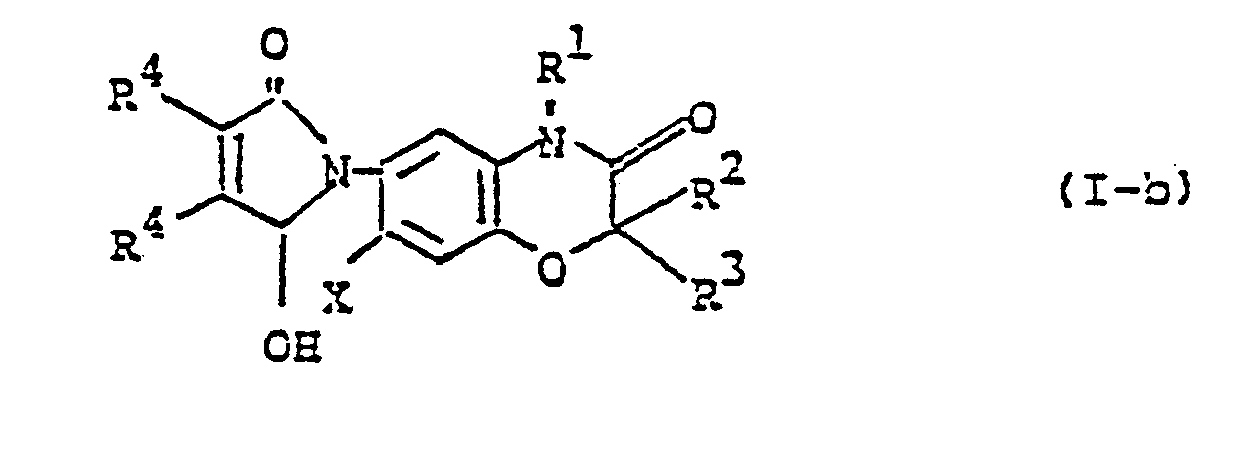
- Wenn in dem Verfahren b) beispielsweise 1-[4-Propyl-2H-1,4-benzoxazin-3(4H)-on-6-yl]-3,4-dimethyl-2,5-dioxo-2,5-dihydropyrrol und Natriumborhydrid als Ausgangsstoffe eingesetzt werden, wird die Reaktion durch das folgende Schema dargestellt.

- Wenn in dem Verfahren c) beispielsweise 1-[4-Propyl-2H-1,4-benzoxazin-3(4H)-on-6-ylJ-3,4-dimethyl-2-hydroxy-5-oxo-2,5-dihydropyrrol und Acetylchlorid als Ausgangsstoffe eingesetzt werden, wird die Reaktion durch das folgende Schema dargestellt.

- In dem Verfahren a) bezeichnet die Verbindung der Formel (11) als Ausgangsstoff eine auf den obigen Definitionen für RI, R2, R3 und X basierende Verbindung, vorzugsweise eine, die auf den bevorzugten Definitionen dieser Symbole beruht.
- Zu den Verbindungen der Formel (11) zählen beispielsweise die bekannten, in den JP-OSen 30586/1986 und 76486/1986 beschriebenen Verbindungen.
- Im allgemeinen lassen sich die Verbindungen der Formel (11) in einfacher Weise durch Reduktion des entsprechenden 4-substituierten 6-Nitro-1,4-benzoxazinons nach dem in der oben zitierten JP-OS 30586/1986 beschriebenen Verfahren gewinnen.
- Das 4-substituierte 6-Nitro-1,4-benzoxazinon kann ebenfalls in einfacher Weise nach dem Verfahren der JP-OS 30586/1986 hergestellt werden.
- Das 4-substituierte 6-Nitro-1,4-benzoxazinon kann in einfacher Weise aus 2-Amino-4-nitrophenol als Ausgangsstoff nach den in der JP-OS 125529/1974 und in "Synthesis" 1984, Seite 851 beschriebenen Arbeitsweisen hergestellt werden.
- 6-Amino-4-propyl-2H-1,4-benzoxazin-3(4H)-on sei als spezielles Beispiel für die Verbindungen der Formel (11) angeführt.
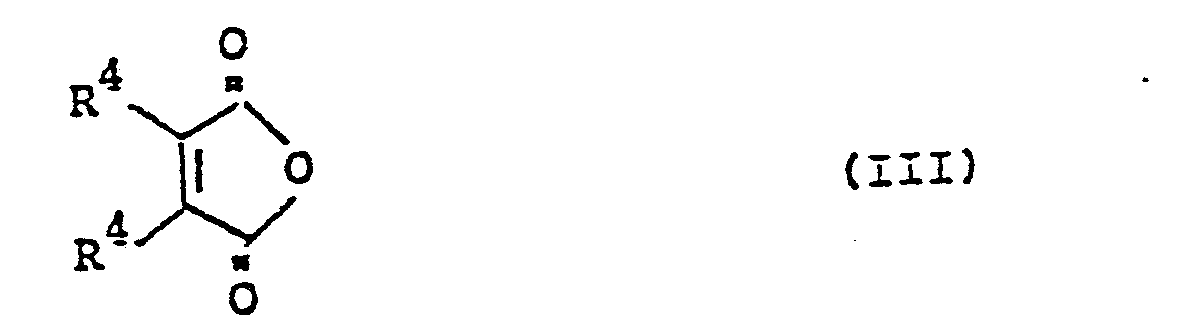
- Die Verbindungen der Formel (lll), die in gleicher Weise Ausgangsstoffe sind, bezeichnen auf der obigen Definition für R4 basierende Verbindungen, vorzugsweise solche, die auf den bevorzugten Definitionen für R4 beruhen.
- Zu den Verbindungen der Formal (lll) zählen beispielsweise die bekannten, in der JP-OS 23965/1978 beschriebenen Verbindungen. Ein spezielles Beispiel ist 2,3-Dimethylmaleinsäureanhydrid.
- In dem Verfahren b) zählt die Ausgangsverbindung der Formel (I-a) zu den Verbindungen der Formel (I), die mittels des Verfahrens a) hergestellt werden.
- Beispiele für das in dem Verfahren b) eingesetzte Reduktionsmittel sind Metallhydride wie Natriumborhydrid und Lithiumaluminiumhydrid.
- Die als Ausgangsstoff in dem Verfahren c) eingesetzte Verbindung der Formel (I-b) zählt zu den Verbindungen der Formel (I) der vorliegenden Erfindung, die mittels des Verfahrens b) hergestellt werden.
- Die Verbindungen der Formeln (IV) oder (V), die in gleicher Weise Ausgangsstoffe sind, bezeichnen auf den obigen Definitionen für R5 und Hal basierende Verbindungen, vorzugsweise solche, die auf den bevorzugten Definitionen für R5 und einem Chlor-Atom für Hal beruhen.
- Die Verbindungen der Formeln (IV) und (V) sind wohlbekannt, und zu speziellen Beispielen zählen Acetylchlorid und Acetanhydrid.
- Für die praktische Durchführung des Verfahrens a) seien sämtliche inerten organischen Lösungsmittel als geeignete Verdünnungsmittel angeführt.
- Zu Beispielen für solche Verdünnungsmittel zählen Wasser, halogenierte und aromatische Kohlenwasserstoffe (wie Ethylenchlorid, Chlorobenzol, Dichlorobenzol und Biphenyl), Ether (wie Dioxan und Diphenylether), Alkohole (wie Ethanol, Isopropanol, Butanol und Ethylenglycol) und organische Säuren (wie Essigsäure und Propionsäure).
- Das Verfahren a) kann innerhalb eines Temperaturbereichs von beträchtlicher Breite, beispielsweise zwischen etwa 70 °C und etwa 280 °C, vorzugsweise aber zwischen etwa 80 °C und etwa 100 °C, durchgeführt werden.
- Zweckmäßigerweise wird die Reaktion unter Atmosphärendruck durchgeführt, jedoch ist es auch möglich, unter erhöhtem oder vermindertem Druck zu arbeiten.
- Bei der Durchführung des Verfahrens a) kann beispielsweise 1 mol der Verbindungen der Formel (11) mit etwa 1 bis 1,2 mol der Verbindungen der Formel (111) in einem inerten organischen Lösungsmittel zur Reaktion gebracht werden, um die gewünschten Verbindungen der Formel (I) zu erhalten.
- Für die praktische Durchführung des Verfahrens b) seien Wasser, Alkohole (vorzugsweise Methanol) und Ether (vorzugsweise Dioxan und Tetrahydrofuran) als geeignete Verdünnungsmittel angeführt.
- Bei der Durchführung des Verfahrens b) können die gewünschten Verbindungen der Formel (I) in einfacher Weise durch Reduktion der Verbindungen der Formel (I-a) mit einem Reduktionsmittel, wie sie oben beispielhaft genannt sind, insbesondere mit Natriumborhydrid, erhalten werden, wie in einem nachstehend angegebenen Arbeitsbeispiel gezeigt wird.
- Für die praktische Durchführung des Verfahrens c) seien aromatische Kohlenwasserstoffe wie Toluol, Ether wie Diethylether und Tetrahydrofuran, halogenierte Kohlenwasserstoffe wie Dichloromethan und Chloroform sowie Wasser als geeignete Verdünnungsmittel angeführt.
- Das Verfahren c) kann in Gegenwart eines säurebindenden Mittels durchgeführt werden. Beispiele für die säurebindenden Mittel sind Hydride, Hydroxide, Carbonate und Hydrogencarbonate von Alkalimetallen und tertiäre Amine wie Triethylamin, Diethylanilin und Pyridin.
- Das Verfahren c) kann innerhalb eines Temperaturbereichs von beträchtlicher Breite, beispielsweise _ zwischen etwa -10 °C und etwa 100 °C, vorzugsweise zwischen etwa 10 °C und etwa 100 °C, durchgeführt werden.
- Zweckmäßigerweise wird die Reaktion unter Atmosphärendruck durchgeführt, jedoch ist es auch möglich, unter erhöhtem oder vermindertem Druck zu arbeiten.
- Bei der Durchführung des Verfahrens c) können die gewünschten Verbindungen der Formel (I) beispielsweise durch Umsetzung von 1 mol der Verbindungen der Formel (I-b) mit etwa 1 bis 1,2 mol der Verbindungen der Formel (IV) oder (V) in einem inerten Lösungsmittel, gegebenenfalls in Gegenwart säurebindender Mittel, umgesetzt werden.
- Die erfindungsgemäßen aktiven Verbindungen können als Entlaubungsmittel, Abbrandmittel, Mittel zur Zerstörung breitblättriger Pflanzen und insbesondere als Unkrautvernichtungsmilei eingesetzt werden. Unter "Unkräutern" im weitesten Sinne sind alle Pflanzen zu verstehen, die an Stellen wachsen, wo sie nicht erwünscht sind. Ob die erfindungsgemäßen Substanzen als totale oder selektive Herbizide wirken, hängt im wesentlichen von der verwendeten Menge ab.
- Die aktiven Verbindungen gemäß der Erfindung können beispielsweise in Verbindung mit den folgenden Pflanzen verwendet werden:
- Sinapis, Lepidium, Galium, Stellaria, Matricaria, Anthemis, Galinsoga, Chenopodium, Urtica, Senecio, Amaranthus, Portulaca, Xanthium, Convolvulus, Ipomoea, Polygonum, Sesbania, Ambrosia, Cirsium, Carduus, Sonchus, Solanum, Rorippa, Rotala, Lindernia, Lamium, Veronica, Abutilon, Emex, Datura, Viola, Galeopsis, Papaver und Centaurea.
- Gossypium, Glycine, Beta, Daucus, Phaseolus, Pisum, Solanum, Linum, Ipomoea, Vicia, Nicotiana. Lycopersicon, Arachis, Brassica, Lactuca, Cucumis und Cucurbita.
- Echinochloa, Setaria, Panicum, Digitaria, Phleum, Poa, Festuca, Eleusine, Brachiaria, Lolium, Bromus, Avena, Cyperus, Sorghum, Agropyron, Cynodon, Monochoria, Fimbristylis, Sagittaria, Eleocharis, Scirpus, Paspalum, Ischaemum, Sphenoclea, Dactyloctenium, Agrostis, Alopecurus und Apera.
- Oryza, Zea, Triticum, Hordeum, Avena, Secale, Sorghum, Panicum, Saccharum, Ananas, Asparagus und Allium.
- Die Anwendung der erfindungsgemäßen aktiven Verbindungen ist jedoch keineswegs auf diese Gattungen begrenzt, sondern umfaßt auch andere Pflanzen in gleicher Weise.
- In Abhängigkeit von den Konzentrationen können die Verbindungen zur totalen Bekämpfung von Unkräutern, beispielsweise auf Industriegelände und Bahnkörpern sowie auf Wegen und Plätzen mit oder ohne Baumbestand, verwendet werden. Ebenso können die Verbindungen auch zur Unkrautbekämpfung in perennierenden Kulturen, beispielsweise Aufforstungen, Zierbaumpflanzungen, Obstgärten, Weinbergen und -gärten, Zitrushainen, Nußbaumpflanzungen, Bananenplantagen, Kaffeeplantagen, Teeplantagen, Gummiplantagen, Ölpalmenplantagen, Kakaoplantagen, Weichfruchtplantagen und Hopfenfeldern, sowie zur selektiven Unkrautbekämpfung in Jahreskulturen verwendet werden.
- Die Wirkstoffe können in übliche Präparate wie Lösungen, Emulsionen, Suspensionen, Pulver, Stäubemittel, Schäume, Pasten, lösliche Pulver, Granulat, Aerosole, mit dem Wirkstoff imprägnierte natürliche und synthetische Materialien, sehr feine Kapseln in polymeren Substanzen, Beschichtungsmittel zum Aufbringen auf das Saatgut und Formulierungen, die in Verbindung mit Verbrennungseinrichtungen wie Räucherpatronen, Räucherdosen und Räucherschlangen eingesetzt werden, sowie ULV-Kaltvernebelungs-und Warmvernebelungspräparate umgewandelt werden.
- Diese Präparate können in bekannter Weise hergestellt werden, beispielsweise durch Vermischen der Wirkstoffe mit Streckmitteln, d.h. flüssigen oder verflüssigten gasförmigen oder festen Verdünnungsmitteln oder Trägern, gegebenenfalls unter Verwendung von grenzflächenaktiven Mitteln, d.h. Emulgatoren und/oder Dispergiermitteln und/oder schaumbildenden Mitteln. Bei Verwendung von Wasser als Streckmittel können beispielsweise auch organische Lösungsmittel als Hilfslösungsmittel verwendet werden.
- Als flüssige Verdünnungsmittel oder Träger eignen sich hauptsächlich aromatische Kohlenwasserstoffe wie Xylol, Toluol oder Alkylnaphthaline, chlorierte aromatische oder chlorierte aliphatische Kohlenwasserstoffe wie Chlorobenzole, Chloroethylene oder Methylenchlorid, aliphatische oder alicyclische Kohlenwasserstoffe wie Cyclohexan oder Paraffine, beispielsweise Mineralöl-Fraktionen, Alkohole wie Butanol oder Glycol sowie deren Ether und Ester, Ketone wie Aceton, Methylethylketon, Methylisobutylketon oder Cyclohexanon, oder stark polare Lösungsmittel wie Dimethylformamid oder Dimethylsulfoxid, sowie auch Wasser.
- Unter verflüssigten gasförmigen Verdünnungsmitteln oder Trägern sind Flüssigkeiten zu verstehen, die bei normaler Temperatur und unter normalem Druck gasförmig sein würden, beispielsweise AerosolTreibmittel wie halogenierte Kohlenwasserstoffe sowie Butan, Propan, Stickstoff und Kohienstoffdioxid.
- Als feste Träger können gemahlene natürliche Minerale wie Kaoline, Tone, Talkum, Kreide, Quarz, Attapulgit, Montmorillonit oder Diatomeenerde, und gemahlene synthetische Minerale wie hochdisperse Kieselsäure, Aluminiumoxid und Silikate verwendet werden. Als feste Träger für Granulat können zerkleinertes und fraktioniertes natürliches Gesteinsmaterial wie Calcit, Marmor, Bimsstein, Sepiolith und Dolomit sowie synthetisches Granulat aus anorganischen und organischen Mehlen und Granulat aus organischem Material wie Sägemehl, Kokosnußschalen, Maiskolben und Tabakstengeln verwendet werden.
- Als Emulgatoren und/oder Schaumbildner können nichtionische oder anionische Emulgatoren wie Polyoxyethylen-Fettsäureester, Polyoxyethylen-Fettalkoholether, beispielsweise Alkylarylpolyglycolether, Alkylsulfonate, Alkylsulfate, Arylsulfonate sowie Hydrolyseprodukte des Albumins verwendet werden. Zu den Dispergiermitteln zählen beispielsweise Ligninsulfit-Ablaugen und Methylcellulose.
- Haftmittel wie Carboxymethylcellulose und natürliche und synthetische Polymerisate in Form von Pulver, Granulat oder Latices, z.B. Gummi arabicum, Polyvinylalkohol und Polyvinylacetat, können in den Formulierungen verwendet werden.
- Es ist möglich, farbgebende Stoffe wie anorganische Pigmente, beispielsweise Eisenoxid, Titanoxid ur-id Preußischblau, und organische Farbstoffe wie Alizarin-Farbstoffe, Azo-Farbstoffe oder Metallphthalocyanirri-Farbstoffe, und Spurennährstoffe wie Salze von Eisen, Mangan, Bor, Kupfer, Cobalt, Molybdän und Zink, zu verwenden.
- Die Präparate enthalten im allgemeinen von 0,1 bis 95 Gewichts-%, vorzugsweise von 0,5 bis 90 Gewichts-% des Wirkstoffs.
- Die Wirkstoffe gemäß der vorliegenden Erfindung können als solche oder in Form ihrer Präparate zur Unkrautbekämpfung als Mischungen mit anderen Herbiziden eingesetzt werden, wobei Fertigpräparate oder Tankmischungen möglich sind.
- Mischungen mit anderen aktiven Verbindungen wie Herbiziden, Fungiziden, Insektiziden, Akariziden, Nematiziden, vogelabweisenden Mitteln, Pflanzennährstoffen sowie Mitteln zur Verbesserung der Bodenstruktur sind ebenfalls möglich.
- Die Wirkstoffe können als solche, in Form von Präparaten oder in Gebrauchsformen, die daraus durch weitere Verdünnung hergestellt werden, eingesetzt werden, beispielsweise in Form gebrauchsfertiger Lösungen, Suspensionen, Emulsionen, Pulver, Pasten und als Granulat. Sie werden in üblicher Weise angewandt, beispielsweise durch Bewässern, Sprühen, Zerstäuben oder Streuen.
- Die erfindungsgemäßen Wirkstoffe können vor oder nach dem Auflaufen der Pflanzen zur Anwendung gelangen.
- Sie können auch vor der Einsaat in den Boden eingearbeitet werden. Insbesondere werden sie nach dem Auflaufen der Pflanzen angewandt.
- Die flächenbezogenen Aufwandsmengen der Aktiven Verbindung können innerhalb eines Bereichs von erheblicher Breite variiert werden. Sie hängen wesentlich von der Art der angestrebten Wirkung ab. Im allgemeinen liegen die aufgewandten Mengen des Wirkstoffs, bezogen auf die Fläche des Bodens, zwischen etwa 0,001 und etwa 5 kg/ha, vorzugsweise zwischen etwa 0,01 und etwa 2,5 kg/ha.
- Die Herstellung und Verwendung der erfindungsgemäßen Verbindungen sind den folgenden Beispielen zu entnehmen.
-

-

-

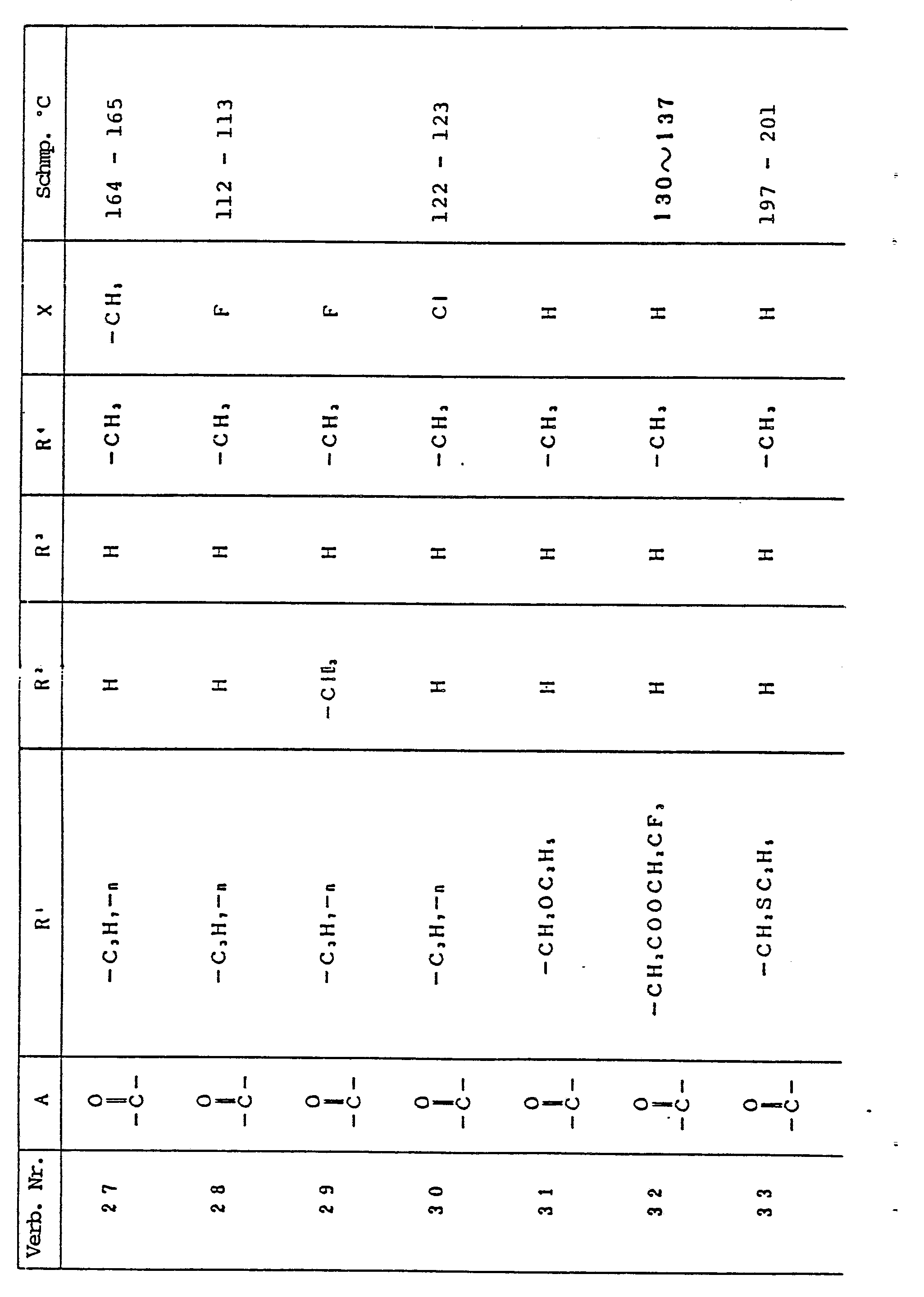
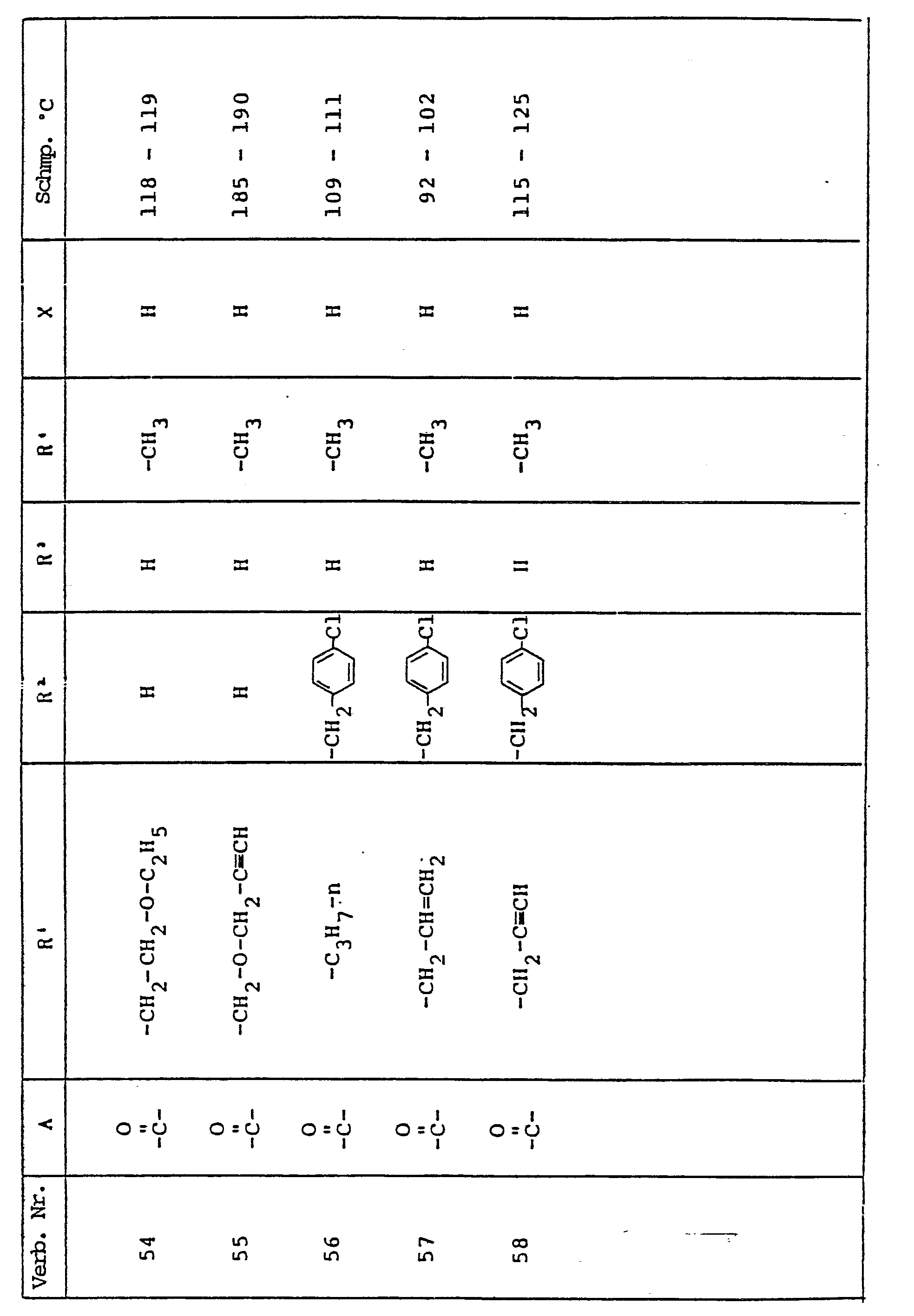
- Die Verbindungen der Formel (I) gemäß der vorliegenden Erfindung können mittels der gleichen Arbeitsweisen wie in den Beispielen 1 bis 3 hergestellt werden und sind zusammen mit den in den Beispielen 1 bis 3 erhaltenen Verbindungen in Tabelle 1 aufgeführt.




- (Vergleichs-Verbindung E-l)

- Test gegen Unkräuter in einem überfluteten Reisfeld durch Wasseroberflächen-Anwendung
- Träger: 5 Gewichtsteile Aceton; Emulgator: 1 Gewichtsteil Benzyloxypolyglycolether.
- Ein Wirkstoff-Präparat in Form eines emulgierbaren Konzentrats wurde erhalten durch Vermischen von 1 Gewichtsteil der aktiven Verbindung mit den oben angegebenen Mengen des Trägers und des emu-1,gie renden Mittels. Eine vorher festgelegte Menge des Präparats wurde mit Wasser verdünnt.
- Reis-Kulturboden wurde in Töpfe (5 dm2; 25 cm x 20 cm x 9 cm) gefüllt, und Reis-Setzlinge (Varietät: "Nihonbare") im 2,5-Blattstadium (15 cm hoch) wurden jeweils an zwei Stellen pro Topf als Stock von drei Setzlingen umgepflanzt. Samen von Hühnerhirse (Echinochloa oryzicola Vasing.), Schirmkraut (Cyperus difformis L.), Monochoria (Monochoria vaginalis) sowie einjährigen breitblättrigen Unkräutern [Falsche Pimpernelle (Lindernia pyxidaria L.), Rotala indica, Amerikanischer Wasserwurz (Elatine triandra), Rotstengel (Ammannia multiflora Roxburgh) und Dopatrium junceum Hamilton] wurden eingesät und die Töpfe wurden feucht gehalten. Zwei Tage später wurden die Töpfe bis zu einer Tiefe von etwa 2 bis 3 cm überflutet. Fünf Tage nach dem Umpflanzen der Setzlinge wurde die Verbindung der vorliegenden Erfindung, in Form eines wie im Vorstehenden hergestellten emulgierbaren Konzentrats mittels einer Pipette in einer vorher festgelegten Menge auf die Oberfläche des Wassers aufgebracht. Danach wurde der Zustand der etwa 3 cm tiefen Überflutung aufrechterhalten, und vier Wochen nach der chemischen Behandlung wurden die herbizide Wirkung und die Phytotoxizität gegenüber Reis untersucht und mit Hilfe der folgenden Skala von 0 bis 5 bewertet:
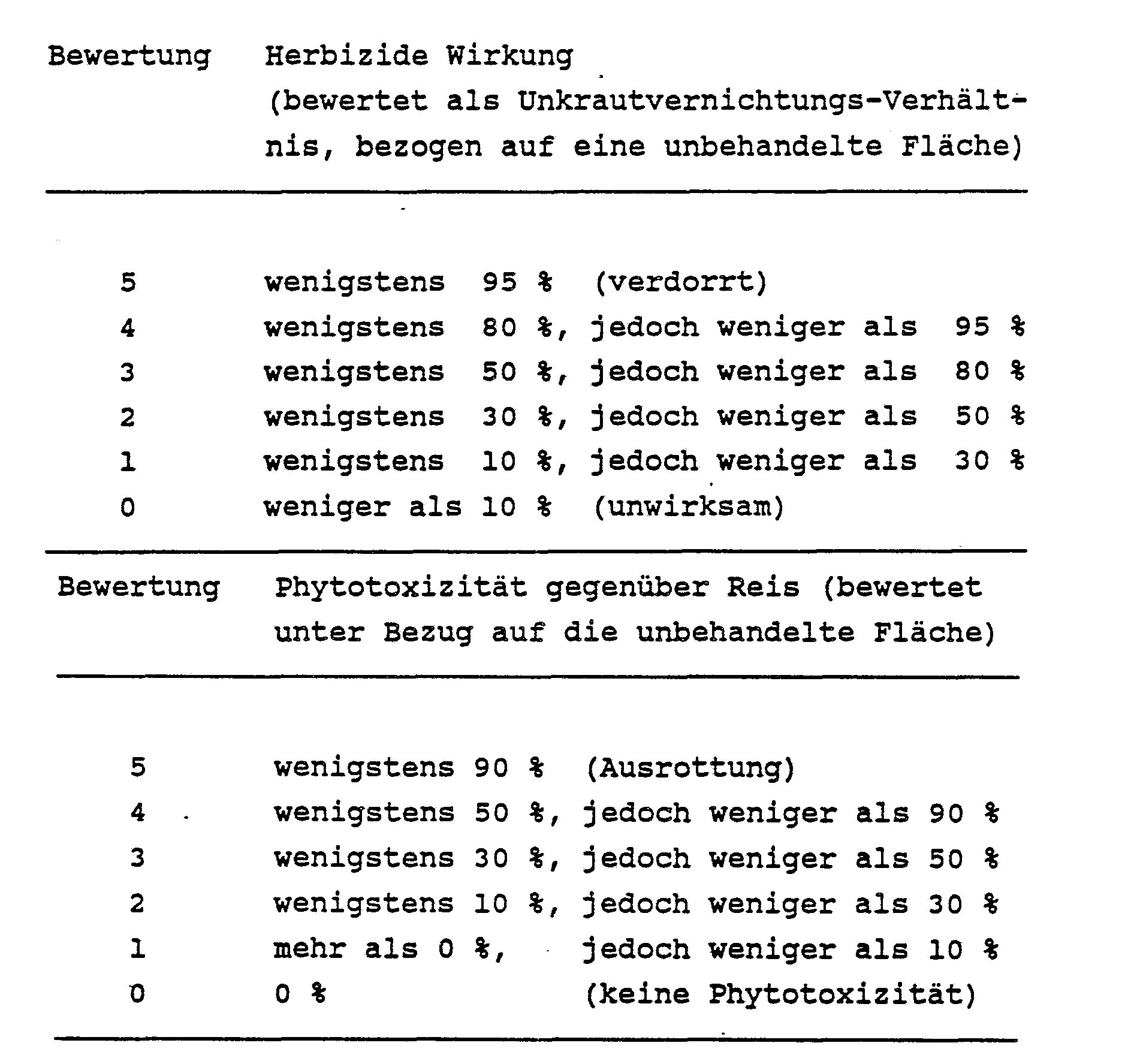
- Die Test-Ergebnisse sind anhand typischer Beispiele in Tabelle 2 aufgeführt.

- Test gegen Unkräuter auf höher gelegenem Ackerboden durch Behandlung vor dem Auflaufen:
- In einem Gewächshaus wurden Sojabohnen-Samen in Töpfe von 500 cm2 Fläche, die mit Ackererde gefüllt waren, eingesät, und Erde, die Samen von Hühnerhirse (Echinocloa crus-galli), grauem Amaranth (Amaranthus lividus L.) und Gänsefuß (Chenopodium album L.) enthielt, wurde über die Erde in den Töpfen in einer Tiefe von 1 cm gestreut.
- Einen Tag nach der Einsaat wurde eine Test-Chemikalie in einer vorher festgelegten Konzentration, hergestellt wie in Beispiel 4, gleichmäßig über die Oberflächenschicht des Bodens in jedem der Test-Töpfe gesprüht.
- Vier Wochen nach dem Sprühen wurden die herbizide Wirkung und die Phytotoxizität gegenüber den Nutzpflanzen anhand der gleichen Bewertungsskalen wie in Beispiel 4 geprüft. Die Ergebnisse sind anhand typischer Beispiele in Tabelle 3 aufgeführt.

- Test gegen Unkräuter auf höher gelegenem Ackerboden durch Laub-Behandlung:
- In einem Gewächshaus wurden Sojabohnen-Samen in Töpfe von 500 cm2 Fläche, die mit Ackererde gefüllt waren, eingesät, und Erde, die Samen von Hühnerhirse (Echinocloa crus-galli), grauem Amaranth (Amaranthus lividus L.) und Gänsefuß (Chenopodium album L.) enthielt, wurde über die Erde in den Töpfen in einer Tiefe von 1 cm gestreut.
- Nach der Einsaat wurden die Pflanzen 14 Tage angezogen, und eine Test-Chemikalie in einer vorher festgelegten Konzentration, hergestellt wie in Beispiel 4, wurde gleichmäßig über Test-Pflanzen in jedem der Test-Töpfe gesprüht.
- Vier Wochen nach dem Sprühen wurden die herbizide Wirkung und die Phytotoxizität gegenüber den Nutzpflanzen anhand der gleichen Bewertungsskalen wie in Beispiel 4 geprüft. Die Ergebnisse sind anhand typischer Beispiele in Tabelle 4 aufgeführt.

Claims (9)











Applications Claiming Priority (2)
| Application Number | Priority Date | Filing Date | Title |
|---|---|---|---|
| JP61157890A JPS6314782A (ja) | 1986-07-07 | 1986-07-07 | 新規ジアルキルマレインイミド類及び除草剤 |
| JP157890/86 | 1986-07-07 |
Publications (3)
| Publication Number | Publication Date |
|---|---|
| EP0255601A2 true EP0255601A2 (de) | 1988-02-10 |
| EP0255601A3 EP0255601A3 (en) | 1989-03-08 |
| EP0255601B1 EP0255601B1 (de) | 1991-09-11 |
Family
ID=15659652
Family Applications (1)
| Application Number | Title | Priority Date | Filing Date |
|---|---|---|---|
| EP87109174A Expired - Lifetime EP0255601B1 (de) | 1986-07-07 | 1987-06-26 | Dialkylmaleinimide, Verfahren zu ihrer Herstellung und ihre Verwendung als Herbizide |
Country Status (8)
| Country | Link |
|---|---|
| US (1) | US4729784A (de) |
| EP (1) | EP0255601B1 (de) |
| JP (1) | JPS6314782A (de) |
| KR (1) | KR880001644A (de) |
| BR (1) | BR8703423A (de) |
| DE (1) | DE3772897D1 (de) |
| IL (1) | IL83080A0 (de) |
| PH (1) | PH23573A (de) |
Cited By (6)
| Publication number | Priority date | Publication date | Assignee | Title |
|---|---|---|---|---|
| EP0360072A1 (de) * | 1988-09-20 | 1990-03-28 | Nihon Tokushu Noyaku Seizo K.K. | Herbizidaktive Dimethylmaleinimide |
| EP0369262A3 (de) * | 1988-11-17 | 1990-10-03 | Nihon Bayer Agrochem K.K. | Pyrrol-Derivate |
| EP0477677A1 (de) * | 1990-09-25 | 1992-04-01 | Nihon Bayer Agrochem K.K. | Benzoxazine mit herbizider Wirkung |
| EP0338533A3 (de) * | 1988-04-20 | 1992-04-08 | Sumitomo Chemical Company, Limited | N-Phenylimide, ihre Herstellung und Verwendung |
| EP0488220A3 (en) * | 1990-11-27 | 1992-08-12 | Sumitomo Chemical Company Limited | Pyridone derivatives, and their production and use |
| EP0311135B1 (de) * | 1987-10-09 | 1993-06-02 | Schering Aktiengesellschaft | Heterocyclisch substituierte Azole und Azine, Verfahren zu ihrer Herstellung und ihre Verwendung als Mittel mit herbizider Wirkung |
Families Citing this family (6)
| Publication number | Priority date | Publication date | Assignee | Title |
|---|---|---|---|---|
| US4803270A (en) * | 1986-03-10 | 1989-02-07 | Sumitomo Chemical Company, Limited | Process of producing fluoroaniline derivatives |
| US4804394A (en) * | 1986-09-09 | 1989-02-14 | Nihon Tokushu Noyaku Seizo K.K. | Benzoxazines and use as herbicides |
| JPS63230689A (ja) * | 1987-03-18 | 1988-09-27 | Tanabe Seiyaku Co Ltd | ベンゾオキサジン誘導体 |
| EP0290863A3 (en) * | 1987-05-09 | 1989-03-15 | Nihon Tokushu Noyaku Seizo K.K. | Benzoxazine derivative, process and intermediates for its preparation and its use as herbicide |
| DE3936826A1 (de) * | 1989-11-04 | 1991-05-08 | Bayer Ag | N-aryl-stickstoffheterocyclen |
| DE4207220A1 (de) * | 1992-03-07 | 1993-09-09 | Philips Patentverwaltung | Festkoerperelement fuer eine thermionische kathode |
Family Cites Families (3)
| Publication number | Priority date | Publication date | Assignee | Title |
|---|---|---|---|---|
| EP0170842B1 (de) * | 1984-07-02 | 1989-09-13 | Nihon Tokushu Noyaku Seizo K.K. | N-Benzylcyclopropancarboxamid-Derivate, Verfahren zu ihrer Herstellung und Fungizide für Landwirtschaft und Gartenbau |
| JPS6130586A (ja) * | 1984-07-23 | 1986-02-12 | Sumitomo Chem Co Ltd | テトラヒドロフタルイミド誘導体およびそれを有効成分とする除草剤 |
| US4640707A (en) * | 1984-07-23 | 1987-02-03 | Sumitomo Chemical Company, Ltd. | Tetrahydrophthalimides and their herbicidal use |
-
1986
- 1986-07-07 JP JP61157890A patent/JPS6314782A/ja active Pending
-
1987
- 1987-06-19 PH PH35430A patent/PH23573A/en unknown
- 1987-06-23 US US07/065,443 patent/US4729784A/en not_active Expired - Fee Related
- 1987-06-26 DE DE8787109174T patent/DE3772897D1/de not_active Expired - Lifetime
- 1987-06-26 EP EP87109174A patent/EP0255601B1/de not_active Expired - Lifetime
- 1987-07-03 IL IL83080A patent/IL83080A0/xx unknown
- 1987-07-06 BR BR8703423A patent/BR8703423A/pt unknown
- 1987-07-07 KR KR1019870007227A patent/KR880001644A/ko not_active Withdrawn
Cited By (10)
| Publication number | Priority date | Publication date | Assignee | Title |
|---|---|---|---|---|
| EP0311135B1 (de) * | 1987-10-09 | 1993-06-02 | Schering Aktiengesellschaft | Heterocyclisch substituierte Azole und Azine, Verfahren zu ihrer Herstellung und ihre Verwendung als Mittel mit herbizider Wirkung |
| EP0338533A3 (de) * | 1988-04-20 | 1992-04-08 | Sumitomo Chemical Company, Limited | N-Phenylimide, ihre Herstellung und Verwendung |
| EP0360072A1 (de) * | 1988-09-20 | 1990-03-28 | Nihon Tokushu Noyaku Seizo K.K. | Herbizidaktive Dimethylmaleinimide |
| EP0369262A3 (de) * | 1988-11-17 | 1990-10-03 | Nihon Bayer Agrochem K.K. | Pyrrol-Derivate |
| US5007952A (en) * | 1988-11-17 | 1991-04-16 | Nihon Tokushu Noyaku Seizo K.K. | Herbicidal novel benzothiazolonyl pyrroles |
| US5096482A (en) * | 1988-11-17 | 1992-03-17 | Nihon Tokushu Noyaku Seizo Kk | Herbicidal benzoxazines |
| EP0477677A1 (de) * | 1990-09-25 | 1992-04-01 | Nihon Bayer Agrochem K.K. | Benzoxazine mit herbizider Wirkung |
| US5207818A (en) * | 1990-09-25 | 1993-05-04 | Nihon Bayer Agrochem K.K. | Herbicidally active benzoxazines |
| EP0488220A3 (en) * | 1990-11-27 | 1992-08-12 | Sumitomo Chemical Company Limited | Pyridone derivatives, and their production and use |
| US5238906A (en) * | 1990-11-27 | 1993-08-24 | Sumitomo Chemical Company, Limited | Pyridone derivatives and use |
Also Published As
| Publication number | Publication date |
|---|---|
| EP0255601A3 (en) | 1989-03-08 |
| IL83080A0 (en) | 1987-12-31 |
| BR8703423A (pt) | 1988-03-22 |
| EP0255601B1 (de) | 1991-09-11 |
| PH23573A (en) | 1989-09-11 |
| JPS6314782A (ja) | 1988-01-21 |
| DE3772897D1 (de) | 1991-10-17 |
| US4729784A (en) | 1988-03-08 |
| KR880001644A (ko) | 1988-04-25 |
Similar Documents
| Publication | Publication Date | Title |
|---|---|---|
| EP0296416B1 (de) | Benzo-anellierte cyclische Verbindungen | |
| EP0263299B1 (de) | Neue Benzoxazine | |
| DE3623302A1 (de) | Nicotinsaeurederivate | |
| EP0255601B1 (de) | Dialkylmaleinimide, Verfahren zu ihrer Herstellung und ihre Verwendung als Herbizide | |
| EP0029183B1 (de) | Tetrazolyloxycarbonsäureamide, Verfahren zu ihrer Herstellung und ihre Verwendung als Herbizide | |
| DE3024901A1 (de) | Herbizide mittel auf basis von piperidin-derivaten | |
| EP0286816A1 (de) | 2,5-Dihydropyrrole | |
| EP0074595A1 (de) | Substituierte Phenylsulfonylharnstoff- Derivate, Verfahren und neue Zwischenprodukte zu ihrer Herstellung und ihre Verwendung als Herbizide | |
| EP0297378A2 (de) | 2,5-Dihydropyrrole | |
| DE2822155A1 (de) | Substituierte carbonsaeureamide, verfahren zu ihrer herstellung und ihre verwendung als herbizide | |
| EP0339390A1 (de) | Herbizid aktive 2,5-Dihydropyrrole | |
| EP0290863A2 (de) | Benzoxazin-Derivat, Verfahren und Zwischenprodukte zu seiner Herstellung und seine Verwendung als Herbizid | |
| EP0073999B1 (de) | Hetero-substituierte 4-Pyridon-Derivate, Verfahren zu ihrer Herstellung sowie ihre Verwendung als Herbizide | |
| EP0010163B1 (de) | N-Diazolylalkyl-chloracetanilide, Verfahren zu ihrer Herstellung sowie ihre Verwendung als Herbizide | |
| EP0349832A2 (de) | Triazolo[1,2-a]pyridazinderivate, Verfahren und Zwischenprodukte zu ihrer Herstellung und diese enthaltende Herbizidmittel | |
| EP0015452B1 (de) | 6-Substituierte 3-Dimethylamino-4-methyl-1,2,4-triazin-5-(4H)-one, Verfahren zu ihrer Herstellung und ihre Verwendung als Herbizide | |
| EP0065712A2 (de) | N-(1-Alkenyl)-chloressigsäureanilide, Verfahren zu ihrer Herstellung sowie ihre Verwendung als Herbizide und Pflanzenwachstumsregulatoren | |
| DE69118634T2 (de) | Benzoxazine mit herbizider Wirkung | |
| EP0084774A1 (de) | 3-Alken(in)yl-mercapto(amino)-4-amino-6-tert.-butyl-1,2,4-triazin-5-one, Verfahren zu ihrer Herstellung sowie ihrer Verwendung als Herbizide | |
| DE3922107A1 (de) | N-aryl-stickstoffheterocyclen | |
| EP0024017A2 (de) | N-Pyrimidinylmethyl-halogenacetanilide, Verfahren zu ihrer Herstellung sowie ihre Verwendung als Herbizide; Zwischenprodukte und ihre Herstellung | |
| DE3520390A1 (de) | Imidazo-pyrrolo-pyridin-derivate | |
| EP0337151A2 (de) | N-Substituierte phenyl-heterocyclische Verbindungen | |
| EP0253256A1 (de) | Neue N-Benzothiazolyl-2,5-dihydropyrrole | |
| EP0410238A2 (de) | 2H-Pyridazinon-Derivate |
Legal Events
| Date | Code | Title | Description |
|---|---|---|---|
| PUAI | Public reference made under article 153(3) epc to a published international application that has entered the european phase |
Free format text: ORIGINAL CODE: 0009012 |
|
| 17P | Request for examination filed |
Effective date: 19870626 |
|
| AK | Designated contracting states |
Kind code of ref document: A2 Designated state(s): BE CH DE FR GB IT LI NL |
|
| PUAL | Search report despatched |
Free format text: ORIGINAL CODE: 0009013 |
|
| AK | Designated contracting states |
Kind code of ref document: A3 Designated state(s): BE CH DE FR GB IT LI NL |
|
| 17Q | First examination report despatched |
Effective date: 19900928 |
|
| RAP1 | Party data changed (applicant data changed or rights of an application transferred) |
Owner name: NIHON BAYER AGROCHEM K.K. |
|
| GRAA | (expected) grant |
Free format text: ORIGINAL CODE: 0009210 |
|
| AK | Designated contracting states |
Kind code of ref document: B1 Designated state(s): BE CH DE FR GB IT LI NL |
|
| REF | Corresponds to: |
Ref document number: 3772897 Country of ref document: DE Date of ref document: 19911017 |
|
| GBT | Gb: translation of ep patent filed (gb section 77(6)(a)/1977) | ||
| ITF | It: translation for a ep patent filed | ||
| ET | Fr: translation filed | ||
| PG25 | Lapsed in a contracting state [announced via postgrant information from national office to epo] |
Ref country code: GB Effective date: 19920626 |
|
| PG25 | Lapsed in a contracting state [announced via postgrant information from national office to epo] |
Ref country code: LI Effective date: 19920630 Ref country code: CH Effective date: 19920630 Ref country code: BE Effective date: 19920630 |
|
| PLBE | No opposition filed within time limit |
Free format text: ORIGINAL CODE: 0009261 |
|
| STAA | Information on the status of an ep patent application or granted ep patent |
Free format text: STATUS: NO OPPOSITION FILED WITHIN TIME LIMIT |
|
| 26N | No opposition filed | ||
| BERE | Be: lapsed |
Owner name: NIHON BAYER AGROCHEM K.K. Effective date: 19920630 |
|
| PG25 | Lapsed in a contracting state [announced via postgrant information from national office to epo] |
Ref country code: NL Effective date: 19930101 |
|
| NLV4 | Nl: lapsed or anulled due to non-payment of the annual fee | ||
| GBPC | Gb: european patent ceased through non-payment of renewal fee |
Effective date: 19920626 |
|
| PG25 | Lapsed in a contracting state [announced via postgrant information from national office to epo] |
Ref country code: FR Effective date: 19930226 |
|
| REG | Reference to a national code |
Ref country code: CH Ref legal event code: PL |
|
| PG25 | Lapsed in a contracting state [announced via postgrant information from national office to epo] |
Ref country code: DE Effective date: 19930302 |
|
| REG | Reference to a national code |
Ref country code: FR Ref legal event code: ST |
|
| PG25 | Lapsed in a contracting state [announced via postgrant information from national office to epo] |
Ref country code: IT Free format text: LAPSE BECAUSE OF NON-PAYMENT OF DUE FEES;WARNING: LAPSES OF ITALIAN PATENTS WITH EFFECTIVE DATE BEFORE 2007 MAY HAVE OCCURRED AT ANY TIME BEFORE 2007. THE CORRECT EFFECTIVE DATE MAY BE DIFFERENT FROM THE ONE RECORDED. Effective date: 20050626 |