EP0255774A1 - Landwirtschaftliche Produkte und Methoden - Google Patents
Landwirtschaftliche Produkte und Methoden Download PDFInfo
- Publication number
- EP0255774A1 EP0255774A1 EP87306596A EP87306596A EP0255774A1 EP 0255774 A1 EP0255774 A1 EP 0255774A1 EP 87306596 A EP87306596 A EP 87306596A EP 87306596 A EP87306596 A EP 87306596A EP 0255774 A1 EP0255774 A1 EP 0255774A1
- Authority
- EP
- European Patent Office
- Prior art keywords
- cepacia
- plant
- root
- strain
- strains
- Prior art date
- Legal status (The legal status is an assumption and is not a legal conclusion. Google has not performed a legal analysis and makes no representation as to the accuracy of the status listed.)
- Granted
Links
- 238000000034 method Methods 0.000 title claims abstract description 43
- 241000589513 Burkholderia cepacia Species 0.000 claims abstract description 194
- 241000233866 Fungi Species 0.000 claims abstract description 29
- 201000010099 disease Diseases 0.000 claims abstract description 18
- 208000037265 diseases, disorders, signs and symptoms Diseases 0.000 claims abstract description 18
- 241000196324 Embryophyta Species 0.000 claims description 120
- 240000008042 Zea mays Species 0.000 claims description 82
- 235000002017 Zea mays subsp mays Nutrition 0.000 claims description 82
- 235000005824 Zea mays ssp. parviglumis Nutrition 0.000 claims description 81
- 235000005822 corn Nutrition 0.000 claims description 81
- 230000001580 bacterial effect Effects 0.000 claims description 56
- 239000002689 soil Substances 0.000 claims description 53
- 241000894006 Bacteria Species 0.000 claims description 48
- 241000223218 Fusarium Species 0.000 claims description 48
- UHPMCKVQTMMPCG-UHFFFAOYSA-N 5,8-dihydroxy-2-methoxy-6-methyl-7-(2-oxopropyl)naphthalene-1,4-dione Chemical compound CC1=C(CC(C)=O)C(O)=C2C(=O)C(OC)=CC(=O)C2=C1O UHPMCKVQTMMPCG-UHFFFAOYSA-N 0.000 claims description 39
- 239000002054 inoculum Substances 0.000 claims description 38
- 238000011081 inoculation Methods 0.000 claims description 33
- 230000002538 fungal effect Effects 0.000 claims description 32
- 239000005557 antagonist Substances 0.000 claims description 22
- 239000000203 mixture Substances 0.000 claims description 19
- 239000002609 medium Substances 0.000 claims description 17
- 238000007747 plating Methods 0.000 claims description 14
- 229920000742 Cotton Polymers 0.000 claims description 11
- 238000010790 dilution Methods 0.000 claims description 10
- 239000012895 dilution Substances 0.000 claims description 10
- 244000061176 Nicotiana tabacum Species 0.000 claims description 8
- 235000002637 Nicotiana tabacum Nutrition 0.000 claims description 8
- 230000012010 growth Effects 0.000 claims description 8
- 238000012216 screening Methods 0.000 claims description 8
- 238000005406 washing Methods 0.000 claims description 8
- 244000020551 Helianthus annuus Species 0.000 claims description 7
- 235000003222 Helianthus annuus Nutrition 0.000 claims description 7
- 235000007688 Lycopersicon esculentum Nutrition 0.000 claims description 7
- 240000003768 Solanum lycopersicum Species 0.000 claims description 7
- 235000011684 Sorghum saccharatum Nutrition 0.000 claims description 6
- 239000001963 growth medium Substances 0.000 claims description 6
- 244000068988 Glycine max Species 0.000 claims description 5
- 235000010469 Glycine max Nutrition 0.000 claims description 5
- 240000004658 Medicago sativa Species 0.000 claims description 5
- 235000017587 Medicago sativa ssp. sativa Nutrition 0.000 claims description 5
- 240000004713 Pisum sativum Species 0.000 claims description 5
- 235000010582 Pisum sativum Nutrition 0.000 claims description 5
- 238000006243 chemical reaction Methods 0.000 claims description 5
- 238000005507 spraying Methods 0.000 claims description 5
- 230000003042 antagnostic effect Effects 0.000 claims description 3
- 230000003385 bacteriostatic effect Effects 0.000 claims description 3
- 238000003306 harvesting Methods 0.000 claims description 3
- 230000001900 immune effect Effects 0.000 claims description 3
- 231100001184 nonphytotoxic Toxicity 0.000 claims description 2
- 244000299507 Gossypium hirsutum Species 0.000 claims 3
- 240000006394 Sorghum bicolor Species 0.000 claims 3
- 238000007865 diluting Methods 0.000 claims 1
- 230000035784 germination Effects 0.000 claims 1
- 230000002879 macerating effect Effects 0.000 claims 1
- 230000009286 beneficial effect Effects 0.000 abstract description 5
- 239000013598 vector Substances 0.000 abstract description 5
- 241000234282 Allium Species 0.000 description 32
- 235000002732 Allium cepa var. cepa Nutrition 0.000 description 32
- 241000233732 Fusarium verticillioides Species 0.000 description 26
- 208000015181 infectious disease Diseases 0.000 description 19
- 230000005764 inhibitory process Effects 0.000 description 18
- 238000003556 assay Methods 0.000 description 15
- 230000000694 effects Effects 0.000 description 15
- 230000009545 invasion Effects 0.000 description 15
- XLYOFNOQVPJJNP-UHFFFAOYSA-N water Substances O XLYOFNOQVPJJNP-UHFFFAOYSA-N 0.000 description 15
- 208000031888 Mycoses Diseases 0.000 description 14
- 239000006916 nutrient agar Substances 0.000 description 13
- 238000011282 treatment Methods 0.000 description 13
- 235000013339 cereals Nutrition 0.000 description 12
- 238000012360 testing method Methods 0.000 description 12
- 210000001519 tissue Anatomy 0.000 description 12
- 206010017533 Fungal infection Diseases 0.000 description 11
- 230000000843 anti-fungal effect Effects 0.000 description 11
- 229920001817 Agar Polymers 0.000 description 10
- 239000008272 agar Substances 0.000 description 10
- 239000003415 peat Substances 0.000 description 10
- 238000002955 isolation Methods 0.000 description 9
- 244000052769 pathogen Species 0.000 description 9
- 230000001717 pathogenic effect Effects 0.000 description 9
- 230000009467 reduction Effects 0.000 description 9
- 239000007787 solid Substances 0.000 description 9
- LDVVMCZRFWMZSG-OLQVQODUSA-N (3ar,7as)-2-(trichloromethylsulfanyl)-3a,4,7,7a-tetrahydroisoindole-1,3-dione Chemical compound C1C=CC[C@H]2C(=O)N(SC(Cl)(Cl)Cl)C(=O)[C@H]21 LDVVMCZRFWMZSG-OLQVQODUSA-N 0.000 description 8
- 239000005745 Captan Substances 0.000 description 8
- 241001057636 Dracaena deremensis Species 0.000 description 8
- 241000219146 Gossypium Species 0.000 description 8
- 230000008485 antagonism Effects 0.000 description 8
- 229940117949 captan Drugs 0.000 description 8
- 238000002474 experimental method Methods 0.000 description 8
- 235000015097 nutrients Nutrition 0.000 description 8
- 230000007918 pathogenicity Effects 0.000 description 8
- JQXXHWHPUNPDRT-WLSIYKJHSA-N rifampicin Chemical compound O([C@](C1=O)(C)O/C=C/[C@@H]([C@H]([C@@H](OC(C)=O)[C@H](C)[C@H](O)[C@H](C)[C@@H](O)[C@@H](C)\C=C\C=C(C)/C(=O)NC=2C(O)=C3C([O-])=C4C)C)OC)C4=C1C3=C(O)C=2\C=N\N1CC[NH+](C)CC1 JQXXHWHPUNPDRT-WLSIYKJHSA-N 0.000 description 8
- 229960001225 rifampicin Drugs 0.000 description 8
- 238000009631 Broth culture Methods 0.000 description 7
- 238000010253 intravenous injection Methods 0.000 description 7
- 241000894007 species Species 0.000 description 7
- WQYVRQLZKVEZGA-UHFFFAOYSA-N hypochlorite Chemical compound Cl[O-] WQYVRQLZKVEZGA-UHFFFAOYSA-N 0.000 description 6
- 230000008659 phytopathology Effects 0.000 description 6
- 239000006152 selective media Substances 0.000 description 6
- 239000008223 sterile water Substances 0.000 description 6
- 238000010254 subcutaneous injection Methods 0.000 description 6
- 239000007929 subcutaneous injection Substances 0.000 description 6
- 208000004770 Fusariosis Diseases 0.000 description 5
- 206010051919 Fusarium infection Diseases 0.000 description 5
- 241000221779 Fusarium sambucinum Species 0.000 description 5
- 241000589540 Pseudomonas fluorescens Species 0.000 description 5
- 241000918585 Pythium aphanidermatum Species 0.000 description 5
- 230000003115 biocidal effect Effects 0.000 description 5
- 239000007788 liquid Substances 0.000 description 5
- 239000000047 product Substances 0.000 description 5
- 108090000623 proteins and genes Proteins 0.000 description 5
- 238000011084 recovery Methods 0.000 description 5
- 210000002966 serum Anatomy 0.000 description 5
- VTYYLEPIZMXCLO-UHFFFAOYSA-L Calcium carbonate Chemical compound [Ca+2].[O-]C([O-])=O VTYYLEPIZMXCLO-UHFFFAOYSA-L 0.000 description 4
- MHAJPDPJQMAIIY-UHFFFAOYSA-N Hydrogen peroxide Chemical compound OO MHAJPDPJQMAIIY-UHFFFAOYSA-N 0.000 description 4
- 241000589516 Pseudomonas Species 0.000 description 4
- 241000233639 Pythium Species 0.000 description 4
- 241001361634 Rhizoctonia Species 0.000 description 4
- 241000221662 Sclerotinia Species 0.000 description 4
- 230000004520 agglutination Effects 0.000 description 4
- 230000001276 controlling effect Effects 0.000 description 4
- 238000002845 discoloration Methods 0.000 description 4
- 238000000338 in vitro Methods 0.000 description 4
- 230000002401 inhibitory effect Effects 0.000 description 4
- 244000005700 microbiome Species 0.000 description 4
- 238000002360 preparation method Methods 0.000 description 4
- 230000002269 spontaneous effect Effects 0.000 description 4
- UCSJYZPVAKXKNQ-HZYVHMACSA-N streptomycin Chemical compound CN[C@H]1[C@H](O)[C@@H](O)[C@H](CO)O[C@H]1O[C@@H]1[C@](C=O)(O)[C@H](C)O[C@H]1O[C@@H]1[C@@H](NC(N)=N)[C@H](O)[C@@H](NC(N)=N)[C@H](O)[C@H]1O UCSJYZPVAKXKNQ-HZYVHMACSA-N 0.000 description 4
- 241000186361 Actinobacteria <class> Species 0.000 description 3
- 244000075850 Avena orientalis Species 0.000 description 3
- 235000007319 Avena orientalis Nutrition 0.000 description 3
- 241000193830 Bacillus <bacterium> Species 0.000 description 3
- OKTJSMMVPCPJKN-UHFFFAOYSA-N Carbon Chemical compound [C] OKTJSMMVPCPJKN-UHFFFAOYSA-N 0.000 description 3
- 241000222199 Colletotrichum Species 0.000 description 3
- 240000008067 Cucumis sativus Species 0.000 description 3
- WQZGKKKJIJFFOK-GASJEMHNSA-N Glucose Natural products OC[C@H]1OC(O)[C@H](O)[C@@H](O)[C@@H]1O WQZGKKKJIJFFOK-GASJEMHNSA-N 0.000 description 3
- PEDCQBHIVMGVHV-UHFFFAOYSA-N Glycerine Chemical compound OCC(O)CO PEDCQBHIVMGVHV-UHFFFAOYSA-N 0.000 description 3
- 208000032843 Hemorrhage Diseases 0.000 description 3
- 241000283973 Oryctolagus cuniculus Species 0.000 description 3
- 241000233614 Phytophthora Species 0.000 description 3
- 241000209504 Poaceae Species 0.000 description 3
- 241001558929 Sclerotium <basidiomycota> Species 0.000 description 3
- VYPSYNLAJGMNEJ-UHFFFAOYSA-N Silicium dioxide Chemical compound O=[Si]=O VYPSYNLAJGMNEJ-UHFFFAOYSA-N 0.000 description 3
- 239000005708 Sodium hypochlorite Substances 0.000 description 3
- 240000003829 Sorghum propinquum Species 0.000 description 3
- 241001112810 Streptocarpus Species 0.000 description 3
- 239000003242 anti bacterial agent Substances 0.000 description 3
- 229940088710 antibiotic agent Drugs 0.000 description 3
- 239000000427 antigen Substances 0.000 description 3
- 108091007433 antigens Proteins 0.000 description 3
- 102000036639 antigens Human genes 0.000 description 3
- 230000000740 bleeding effect Effects 0.000 description 3
- 230000000747 cardiac effect Effects 0.000 description 3
- 238000012512 characterization method Methods 0.000 description 3
- 239000008121 dextrose Substances 0.000 description 3
- 238000011534 incubation Methods 0.000 description 3
- 230000006799 invasive growth in response to glucose limitation Effects 0.000 description 3
- 238000002156 mixing Methods 0.000 description 3
- 239000008188 pellet Substances 0.000 description 3
- 239000002953 phosphate buffered saline Substances 0.000 description 3
- 244000000003 plant pathogen Species 0.000 description 3
- 238000011160 research Methods 0.000 description 3
- 239000004576 sand Substances 0.000 description 3
- SUKJFIGYRHOWBL-UHFFFAOYSA-N sodium hypochlorite Chemical compound [Na+].Cl[O-] SUKJFIGYRHOWBL-UHFFFAOYSA-N 0.000 description 3
- 239000000243 solution Substances 0.000 description 3
- 230000001954 sterilising effect Effects 0.000 description 3
- 238000004659 sterilization and disinfection Methods 0.000 description 3
- 239000000126 substance Substances 0.000 description 3
- 244000215068 Acacia senegal Species 0.000 description 2
- 241001530056 Athelia rolfsii Species 0.000 description 2
- IJGRMHOSHXDMSA-UHFFFAOYSA-N Atomic nitrogen Chemical compound N#N IJGRMHOSHXDMSA-UHFFFAOYSA-N 0.000 description 2
- 241000194110 Bacillus sp. (in: Bacteria) Species 0.000 description 2
- 241000221198 Basidiomycota Species 0.000 description 2
- 241001120669 Colletotrichum lindemuthianum Species 0.000 description 2
- 235000010799 Cucumis sativus var sativus Nutrition 0.000 description 2
- 241001131785 Escherichia coli HB101 Species 0.000 description 2
- 241000223221 Fusarium oxysporum Species 0.000 description 2
- 241000879141 Fusarium tricinctum Species 0.000 description 2
- SXRSQZLOMIGNAQ-UHFFFAOYSA-N Glutaraldehyde Chemical compound O=CCCCC=O SXRSQZLOMIGNAQ-UHFFFAOYSA-N 0.000 description 2
- 240000002024 Gossypium herbaceum Species 0.000 description 2
- 235000004341 Gossypium herbaceum Nutrition 0.000 description 2
- 229920000084 Gum arabic Polymers 0.000 description 2
- 241000223642 Helicobasidium purpureum Species 0.000 description 2
- 241000238631 Hexapoda Species 0.000 description 2
- 244000147568 Laurus nobilis Species 0.000 description 2
- 231100000678 Mycotoxin Toxicity 0.000 description 2
- 239000000020 Nitrocellulose Substances 0.000 description 2
- 241000588912 Pantoea agglomerans Species 0.000 description 2
- 239000001888 Peptone Substances 0.000 description 2
- 108010080698 Peptones Proteins 0.000 description 2
- 241000233618 Phytophthora cinnamomi Species 0.000 description 2
- 241000276498 Pollachius virens Species 0.000 description 2
- 241001646398 Pseudomonas chlororaphis Species 0.000 description 2
- 241000589615 Pseudomonas syringae Species 0.000 description 2
- 241000918584 Pythium ultimum Species 0.000 description 2
- 241000813090 Rhizoctonia solani Species 0.000 description 2
- 241000221696 Sclerotinia sclerotiorum Species 0.000 description 2
- 244000061456 Solanum tuberosum Species 0.000 description 2
- 235000002595 Solanum tuberosum Nutrition 0.000 description 2
- GWEVSGVZZGPLCZ-UHFFFAOYSA-N Titan oxide Chemical compound O=[Ti]=O GWEVSGVZZGPLCZ-UHFFFAOYSA-N 0.000 description 2
- 235000021307 Triticum Nutrition 0.000 description 2
- 244000098338 Triticum aestivum Species 0.000 description 2
- 239000000205 acacia gum Substances 0.000 description 2
- 235000010489 acacia gum Nutrition 0.000 description 2
- 239000000853 adhesive Substances 0.000 description 2
- 230000001070 adhesive effect Effects 0.000 description 2
- 239000002671 adjuvant Substances 0.000 description 2
- RWAXAHFFXZKMPA-UHFFFAOYSA-N aminopyrrolnitrin Chemical compound NC1=C(Cl)C=CC=C1C1=CNC=C1Cl RWAXAHFFXZKMPA-UHFFFAOYSA-N 0.000 description 2
- 230000000656 anti-yeast Effects 0.000 description 2
- 238000004178 biological nitrogen fixation Methods 0.000 description 2
- 244000309464 bull Species 0.000 description 2
- 239000000969 carrier Substances 0.000 description 2
- 239000006285 cell suspension Substances 0.000 description 2
- 239000003795 chemical substances by application Substances 0.000 description 2
- 230000001332 colony forming effect Effects 0.000 description 2
- 244000038559 crop plants Species 0.000 description 2
- 238000001514 detection method Methods 0.000 description 2
- 238000007598 dipping method Methods 0.000 description 2
- 231100000676 disease causative agent Toxicity 0.000 description 2
- 239000003292 glue Substances 0.000 description 2
- 239000008187 granular material Substances 0.000 description 2
- 238000010255 intramuscular injection Methods 0.000 description 2
- 239000007927 intramuscular injection Substances 0.000 description 2
- 238000009630 liquid culture Methods 0.000 description 2
- 230000014759 maintenance of location Effects 0.000 description 2
- 238000004519 manufacturing process Methods 0.000 description 2
- 239000000463 material Substances 0.000 description 2
- 230000000813 microbial effect Effects 0.000 description 2
- 239000002636 mycotoxin Substances 0.000 description 2
- 229920001220 nitrocellulos Polymers 0.000 description 2
- 235000019319 peptone Nutrition 0.000 description 2
- 239000002304 perfume Substances 0.000 description 2
- XNGIFLGASWRNHJ-UHFFFAOYSA-N phthalic acid Chemical compound OC(=O)C1=CC=CC=C1C(O)=O XNGIFLGASWRNHJ-UHFFFAOYSA-N 0.000 description 2
- 239000001965 potato dextrose agar Substances 0.000 description 2
- QJBZDBLBQWFTPZ-UHFFFAOYSA-N pyrrolnitrin Chemical compound [O-][N+](=O)C1=C(Cl)C=CC=C1C1=CNC=C1Cl QJBZDBLBQWFTPZ-UHFFFAOYSA-N 0.000 description 2
- 238000005070 sampling Methods 0.000 description 2
- 244000000000 soil microbiome Species 0.000 description 2
- 238000009331 sowing Methods 0.000 description 2
- 229960005322 streptomycin Drugs 0.000 description 2
- 239000000725 suspension Substances 0.000 description 2
- 235000013311 vegetables Nutrition 0.000 description 2
- FHVDTGUDJYJELY-UHFFFAOYSA-N 6-{[2-carboxy-4,5-dihydroxy-6-(phosphanyloxy)oxan-3-yl]oxy}-4,5-dihydroxy-3-phosphanyloxane-2-carboxylic acid Chemical compound O1C(C(O)=O)C(P)C(O)C(O)C1OC1C(C(O)=O)OC(OP)C(O)C1O FHVDTGUDJYJELY-UHFFFAOYSA-N 0.000 description 1
- 241000589291 Acinetobacter Species 0.000 description 1
- 244000151012 Allium neapolitanum Species 0.000 description 1
- 244000153158 Ammi visnaga Species 0.000 description 1
- 235000010585 Ammi visnaga Nutrition 0.000 description 1
- 235000017060 Arachis glabrata Nutrition 0.000 description 1
- 244000105624 Arachis hypogaea Species 0.000 description 1
- 235000010777 Arachis hypogaea Nutrition 0.000 description 1
- 235000018262 Arachis monticola Nutrition 0.000 description 1
- 241000235349 Ascomycota Species 0.000 description 1
- 244000063299 Bacillus subtilis Species 0.000 description 1
- 235000014469 Bacillus subtilis Nutrition 0.000 description 1
- 241000722913 Callistephus chinensis Species 0.000 description 1
- 229920002134 Carboxymethyl cellulose Polymers 0.000 description 1
- 241001515917 Chaetomium globosum Species 0.000 description 1
- 241001123534 Colletotrichum coccodes Species 0.000 description 1
- 241001429695 Colletotrichum graminicola Species 0.000 description 1
- 241000222235 Colletotrichum orbiculare Species 0.000 description 1
- 241000870659 Crassula perfoliata var. minor Species 0.000 description 1
- 241000219112 Cucumis Species 0.000 description 1
- 235000015510 Cucumis melo subsp melo Nutrition 0.000 description 1
- 235000009849 Cucumis sativus Nutrition 0.000 description 1
- 240000006497 Dianthus caryophyllus Species 0.000 description 1
- 235000009355 Dianthus caryophyllus Nutrition 0.000 description 1
- 206010014009 Ear haemorrhage Diseases 0.000 description 1
- 241000588914 Enterobacter Species 0.000 description 1
- 241000588697 Enterobacter cloacae Species 0.000 description 1
- LFQSCWFLJHTTHZ-UHFFFAOYSA-N Ethanol Chemical compound CCO LFQSCWFLJHTTHZ-UHFFFAOYSA-N 0.000 description 1
- 241000589565 Flavobacterium Species 0.000 description 1
- 241000223195 Fusarium graminearum Species 0.000 description 1
- 241000912943 Fusarium oxysporum f. sp. callistephi Species 0.000 description 1
- 241000912945 Fusarium oxysporum f. sp. cepae Species 0.000 description 1
- 108010010803 Gelatin Proteins 0.000 description 1
- 238000003794 Gram staining Methods 0.000 description 1
- 241000186984 Kitasatospora aureofaciens Species 0.000 description 1
- 241001495424 Macrophomina Species 0.000 description 1
- 241001495426 Macrophomina phaseolina Species 0.000 description 1
- 240000007594 Oryza sativa Species 0.000 description 1
- 235000007164 Oryza sativa Nutrition 0.000 description 1
- 229910019142 PO4 Inorganic materials 0.000 description 1
- 108091005804 Peptidases Proteins 0.000 description 1
- 244000046052 Phaseolus vulgaris Species 0.000 description 1
- 241000233616 Phytophthora capsici Species 0.000 description 1
- 241000233620 Phytophthora cryptogea Species 0.000 description 1
- 241000233622 Phytophthora infestans Species 0.000 description 1
- 241000626604 Phytophthora porri Species 0.000 description 1
- 239000004365 Protease Substances 0.000 description 1
- 240000005519 Prunus mexicana Species 0.000 description 1
- 241000947836 Pseudomonadaceae Species 0.000 description 1
- 241000960597 Pseudomonas fluorescens group Species 0.000 description 1
- 241000589776 Pseudomonas putida Species 0.000 description 1
- 239000006004 Quartz sand Substances 0.000 description 1
- 102100037486 Reverse transcriptase/ribonuclease H Human genes 0.000 description 1
- 240000000296 Sabal minor Species 0.000 description 1
- 235000003534 Saccharomyces carlsbergensis Nutrition 0.000 description 1
- 240000004808 Saccharomyces cerevisiae Species 0.000 description 1
- 241001123227 Saccharomyces pastorianus Species 0.000 description 1
- 241000015479 Schizothorax intermedius Species 0.000 description 1
- 244000273618 Sphenoclea zeylanica Species 0.000 description 1
- 229930006000 Sucrose Natural products 0.000 description 1
- CZMRCDWAGMRECN-UGDNZRGBSA-N Sucrose Chemical compound O[C@H]1[C@H](O)[C@@H](CO)O[C@@]1(CO)O[C@@H]1[C@H](O)[C@@H](O)[C@H](O)[C@@H](CO)O1 CZMRCDWAGMRECN-UGDNZRGBSA-N 0.000 description 1
- 244000172533 Viola sororia Species 0.000 description 1
- 241000607479 Yersinia pestis Species 0.000 description 1
- 235000016383 Zea mays subsp huehuetenangensis Nutrition 0.000 description 1
- 239000000654 additive Substances 0.000 description 1
- 229940072056 alginate Drugs 0.000 description 1
- 235000010443 alginic acid Nutrition 0.000 description 1
- 229920000615 alginic acid Polymers 0.000 description 1
- 238000004458 analytical method Methods 0.000 description 1
- 238000009634 analytical profile index Methods 0.000 description 1
- 239000011324 bead Substances 0.000 description 1
- 230000008901 benefit Effects 0.000 description 1
- 239000000440 bentonite Substances 0.000 description 1
- 229910000278 bentonite Inorganic materials 0.000 description 1
- SVPXDRXYRYOSEX-UHFFFAOYSA-N bentoquatam Chemical compound O.O=[Si]=O.O=[Al]O[Al]=O SVPXDRXYRYOSEX-UHFFFAOYSA-N 0.000 description 1
- 238000010256 biochemical assay Methods 0.000 description 1
- 238000010876 biochemical test Methods 0.000 description 1
- 239000003124 biologic agent Substances 0.000 description 1
- 238000010170 biological method Methods 0.000 description 1
- 229910000019 calcium carbonate Inorganic materials 0.000 description 1
- ZOMBKNNSYQHRCA-UHFFFAOYSA-J calcium sulfate hemihydrate Chemical compound O.[Ca+2].[Ca+2].[O-]S([O-])(=O)=O.[O-]S([O-])(=O)=O ZOMBKNNSYQHRCA-UHFFFAOYSA-J 0.000 description 1
- 229940041514 candida albicans extract Drugs 0.000 description 1
- 229910052799 carbon Inorganic materials 0.000 description 1
- 239000001768 carboxy methyl cellulose Substances 0.000 description 1
- 235000010948 carboxy methyl cellulose Nutrition 0.000 description 1
- 239000008112 carboxymethyl-cellulose Substances 0.000 description 1
- 230000030833 cell death Effects 0.000 description 1
- CYDMQBQPVICBEU-UHFFFAOYSA-N chlorotetracycline Natural products C1=CC(Cl)=C2C(O)(C)C3CC4C(N(C)C)C(O)=C(C(N)=O)C(=O)C4(O)C(O)=C3C(=O)C2=C1O CYDMQBQPVICBEU-UHFFFAOYSA-N 0.000 description 1
- 229960004475 chlortetracycline Drugs 0.000 description 1
- CYDMQBQPVICBEU-XRNKAMNCSA-N chlortetracycline Chemical compound C1=CC(Cl)=C2[C@](O)(C)[C@H]3C[C@H]4[C@H](N(C)C)C(O)=C(C(N)=O)C(=O)[C@@]4(O)C(O)=C3C(=O)C2=C1O CYDMQBQPVICBEU-XRNKAMNCSA-N 0.000 description 1
- 235000019365 chlortetracycline Nutrition 0.000 description 1
- 239000002734 clay mineral Substances 0.000 description 1
- 239000011248 coating agent Substances 0.000 description 1
- 238000000576 coating method Methods 0.000 description 1
- 230000000052 comparative effect Effects 0.000 description 1
- 230000002860 competitive effect Effects 0.000 description 1
- 150000001875 compounds Chemical class 0.000 description 1
- 230000002596 correlated effect Effects 0.000 description 1
- 239000012228 culture supernatant Substances 0.000 description 1
- 230000007423 decrease Effects 0.000 description 1
- 230000000994 depressogenic effect Effects 0.000 description 1
- 238000011161 development Methods 0.000 description 1
- 238000000502 dialysis Methods 0.000 description 1
- ZPWVASYFFYYZEW-UHFFFAOYSA-L dipotassium hydrogen phosphate Chemical compound [K+].[K+].OP([O-])([O-])=O ZPWVASYFFYYZEW-UHFFFAOYSA-L 0.000 description 1
- 229910000396 dipotassium phosphate Inorganic materials 0.000 description 1
- 235000019797 dipotassium phosphate Nutrition 0.000 description 1
- LOKCTEFSRHRXRJ-UHFFFAOYSA-I dipotassium trisodium dihydrogen phosphate hydrogen phosphate dichloride Chemical compound P(=O)(O)(O)[O-].[K+].P(=O)(O)([O-])[O-].[Na+].[Na+].[Cl-].[K+].[Cl-].[Na+] LOKCTEFSRHRXRJ-UHFFFAOYSA-I 0.000 description 1
- 239000010459 dolomite Substances 0.000 description 1
- 229910000514 dolomite Inorganic materials 0.000 description 1
- 210000005069 ears Anatomy 0.000 description 1
- 230000001804 emulsifying effect Effects 0.000 description 1
- 238000005516 engineering process Methods 0.000 description 1
- 230000007613 environmental effect Effects 0.000 description 1
- 229910052564 epsomite Inorganic materials 0.000 description 1
- 239000000706 filtrate Substances 0.000 description 1
- 238000004362 fungal culture Methods 0.000 description 1
- 208000024386 fungal infectious disease Diseases 0.000 description 1
- 244000000004 fungal plant pathogen Species 0.000 description 1
- 239000008273 gelatin Substances 0.000 description 1
- 229920000159 gelatin Polymers 0.000 description 1
- 235000019322 gelatine Nutrition 0.000 description 1
- 235000011852 gelatine desserts Nutrition 0.000 description 1
- 230000004077 genetic alteration Effects 0.000 description 1
- 231100000118 genetic alteration Toxicity 0.000 description 1
- 238000009650 gentamicin protection assay Methods 0.000 description 1
- 239000011521 glass Substances 0.000 description 1
- 230000009036 growth inhibition Effects 0.000 description 1
- 210000004349 growth plate Anatomy 0.000 description 1
- 239000010440 gypsum Substances 0.000 description 1
- 229910052602 gypsum Inorganic materials 0.000 description 1
- 235000012907 honey Nutrition 0.000 description 1
- 239000003864 humus Substances 0.000 description 1
- 238000005286 illumination Methods 0.000 description 1
- 238000003018 immunoassay Methods 0.000 description 1
- 238000002347 injection Methods 0.000 description 1
- 239000007924 injection Substances 0.000 description 1
- 235000021374 legumes Nutrition 0.000 description 1
- 230000000670 limiting effect Effects 0.000 description 1
- 235000009973 maize Nutrition 0.000 description 1
- 239000003550 marker Substances 0.000 description 1
- 230000007246 mechanism Effects 0.000 description 1
- 229920000609 methyl cellulose Polymers 0.000 description 1
- 239000001923 methylcellulose Substances 0.000 description 1
- 235000010981 methylcellulose Nutrition 0.000 description 1
- 238000012986 modification Methods 0.000 description 1
- 230000004048 modification Effects 0.000 description 1
- 230000035772 mutation Effects 0.000 description 1
- 230000017066 negative regulation of growth Effects 0.000 description 1
- 230000007935 neutral effect Effects 0.000 description 1
- 229910052757 nitrogen Inorganic materials 0.000 description 1
- 231100000252 nontoxic Toxicity 0.000 description 1
- 230000003000 nontoxic effect Effects 0.000 description 1
- 235000016709 nutrition Nutrition 0.000 description 1
- 230000003287 optical effect Effects 0.000 description 1
- 235000020232 peanut Nutrition 0.000 description 1
- 230000002688 persistence Effects 0.000 description 1
- 235000021317 phosphate Nutrition 0.000 description 1
- 150000003013 phosphoric acid derivatives Chemical class 0.000 description 1
- -1 phosphorous compounds Chemical class 0.000 description 1
- 230000003032 phytopathogenic effect Effects 0.000 description 1
- 231100000208 phytotoxic Toxicity 0.000 description 1
- 230000000885 phytotoxic effect Effects 0.000 description 1
- 229930000184 phytotoxin Natural products 0.000 description 1
- 239000000049 pigment Substances 0.000 description 1
- 239000003123 plant toxin Substances 0.000 description 1
- 239000004033 plastic Substances 0.000 description 1
- 235000012015 potatoes Nutrition 0.000 description 1
- 235000008476 powdered milk Nutrition 0.000 description 1
- 208000037920 primary disease Diseases 0.000 description 1
- 230000002035 prolonged effect Effects 0.000 description 1
- 239000011814 protection agent Substances 0.000 description 1
- 102000004169 proteins and genes Human genes 0.000 description 1
- 229960002132 pyrrolnitrin Drugs 0.000 description 1
- 230000002829 reductive effect Effects 0.000 description 1
- 238000005057 refrigeration Methods 0.000 description 1
- 230000001850 reproductive effect Effects 0.000 description 1
- 230000004044 response Effects 0.000 description 1
- 235000009566 rice Nutrition 0.000 description 1
- 239000011435 rock Substances 0.000 description 1
- 238000010187 selection method Methods 0.000 description 1
- 239000002002 slurry Substances 0.000 description 1
- 238000001228 spectrum Methods 0.000 description 1
- 239000007921 spray Substances 0.000 description 1
- QTENRWWVYAAPBI-YCRXJPFRSA-N streptomycin sulfate Chemical compound OS(O)(=O)=O.OS(O)(=O)=O.OS(O)(=O)=O.CN[C@H]1[C@H](O)[C@@H](O)[C@H](CO)O[C@H]1O[C@@H]1[C@](C=O)(O)[C@H](C)O[C@H]1O[C@@H]1[C@@H](N=C(N)N)[C@H](O)[C@@H](N=C(N)N)[C@H](O)[C@H]1O.CN[C@H]1[C@H](O)[C@@H](O)[C@H](CO)O[C@H]1O[C@@H]1[C@](C=O)(O)[C@H](C)O[C@H]1O[C@@H]1[C@@H](N=C(N)N)[C@H](O)[C@@H](N=C(N)N)[C@H](O)[C@H]1O QTENRWWVYAAPBI-YCRXJPFRSA-N 0.000 description 1
- 239000005720 sucrose Substances 0.000 description 1
- 235000000346 sugar Nutrition 0.000 description 1
- 150000008163 sugars Chemical class 0.000 description 1
- 239000006228 supernatant Substances 0.000 description 1
- 230000001629 suppression Effects 0.000 description 1
- 230000004083 survival effect Effects 0.000 description 1
- 208000024891 symptom Diseases 0.000 description 1
- 230000009897 systematic effect Effects 0.000 description 1
- 239000000454 talc Substances 0.000 description 1
- 229910052623 talc Inorganic materials 0.000 description 1
- 239000008399 tap water Substances 0.000 description 1
- 235000020679 tap water Nutrition 0.000 description 1
- 239000004408 titanium dioxide Substances 0.000 description 1
- 231100000331 toxic Toxicity 0.000 description 1
- 230000002588 toxic effect Effects 0.000 description 1
- 210000003462 vein Anatomy 0.000 description 1
- 230000035899 viability Effects 0.000 description 1
- 238000009736 wetting Methods 0.000 description 1
- 239000012138 yeast extract Substances 0.000 description 1
Images




Classifications
-
- A—HUMAN NECESSITIES
- A01—AGRICULTURE; FORESTRY; ANIMAL HUSBANDRY; HUNTING; TRAPPING; FISHING
- A01N—PRESERVATION OF BODIES OF HUMANS OR ANIMALS OR PLANTS OR PARTS THEREOF; BIOCIDES, e.g. AS DISINFECTANTS, AS PESTICIDES OR AS HERBICIDES; PEST REPELLANTS OR ATTRACTANTS; PLANT GROWTH REGULATORS
- A01N63/00—Biocides, pest repellants or attractants, or plant growth regulators containing microorganisms, viruses, microbial fungi, animals or substances produced by, or obtained from, microorganisms, viruses, microbial fungi or animals, e.g. enzymes or fermentates
- A01N63/20—Bacteria; Substances produced thereby or obtained therefrom
- A01N63/27—Pseudomonas
Definitions
- the present invention is directed to biological methods and products useful in agriculture. More specifically, the present invention is directed to a method of controlling plant fungal disease particularly those diseases caused by fungus of the genus Fusarium , certain biological control agents useful in such a method, and biological agents generally useful in agriculture.
- Fungi of the genus Fusarium are responsible for numerous crop plant diseases around the world. These fungi are particularly harmful to cereal crops, such as corn, sorghum and wheat. For example, one or more species of Fusarium can be isolated in every season from nearly every vegetative or reproductive part of corn in every corn-growing region of the United States. A particular species of Fusarium can occur singly or as a part of a complex of Fusarium species or fungi of other genera. Depending upon weather, soil and the particular cereal variety, damage to the crop can range from negligible to extensive. A common occurrence, for example, is for a Fusarium infected cereal crop to be damaged if it comes under stress.
- the diseases caused by Fusarium fungi include seedling blight, root rot, stalk rot, and ear rot.
- Fusarium moniliforme is the most widely prevalent and economically important Fusarium species found on corn in the United States, and is the most frequently isolated Fusarium species in shelled corn. Seed lots with 100% infection are not uncommon. It is also the most frequent cause of ear rot, and has been implicated in seedling blight and root rot.
- stalk rot One of the primary diseases affecting the corn crop in the United States is stalk rot, and F . moniliforme is considered to be the predominant stalk rot fungus in at least 10 states: Florida, Idaho, Iowa, Minnesota, Iowa, New Jersey, North Carolina, Pennsylvania, South Carolina, and Virginia.
- F . roseum is also known to produce a phytotoxin.
- Fusarium roseum is found less often in corn kernels than F . moniliforme primarily occurring in the humid sections of the corn belt east of the Mississippi River and along the Atlantic seaboard.
- F . roseum is a cause of ear rot and seedling blight, and one of the important causes of stalk rot in the New England, Mid-Atlantic and Northern corn belt states.
- F . roseum also produces mycotoxins in kernels and stalks.
- F . tricinctum Additional species of Fusarium fungi which are of lesser importance than F . moniliforme and F . roseum in corn disease include F . tricinctum , F . exysporum , and F . soloni . While these species are mainly of importance as parts of disease complexes, F . tricinctum has been reported to produce mycotoxins in kernels and stalks.
- Fusarium fungi are not believed to be strong pathogens. Generally, they produce major symptoms and damage crops only when the crops are under stress. The advance of the fungi in the plant is determined largely by what stress is occurring and the rate of cell death in plant tissues. Fusarium fungi has a wide host range of cereals and grasses and very effective methods of survival in soil or plant residues. Wherever grasses or cereals are grown in the United States, a Fusarium infection of seedlings, roots, stalks, or ears is always possible. Thus, a method of controlling Fusarium infection in cereal crops is highly desirable. See generally, Fusarium: Diseases, Biology and Taxonomy (P.E. Nelson, T.A. Toussoun, and R.J.
- Phythium spp. Phytophthora spp.
- Sclerotinia spp. Sclerotium spp.
- Rhizoctonia spp. Colletotrichum spp.
- Pythium spp. are the causive agents of a wide range of diseases on many crop plants, including damping off, hollow stem, stem rots, root rots and wilts.
- Important strains include, among others, P . ultimum , P . debarynum and P . aphanidermatum . Phytophthora spp.
- Plant pathogenic strains include, among others, Phytophthora porri , P . capsici , P . cryptogea , P . mexicana , P . cinnamomi (root decay) and P . infestans (late blight in tomatoes).
- Sclerotinia spp. causative agents of white rot, are widely dispersed and have a wide host range.
- Important plant pathogens include Sclerotinia sclerotiorum , S . minor and S . intermedia . Sclerotium spp. and S .
- Rhizoctonia spp. (literally root killers) are associated with root rots. Rhizoctonia are the mycelia stage of Basidiomycetes . The basidial stage is often designated by another name. Rhizoctonia solani (basidial stage: Thanatephoris cucumeris ) is the most important member of this group which in particular affects cereals (wheat and oats), sunflower and cotton. Rhizoctonia violacea (basidial stage: Helicobasidium purpureum ) is the causative agent of violet root rot.
- Colletotrichum spp. are associated with anthracnose disease in a number of plants. Colletotrichum graminicola affects cereals and grasses; C . coccodes affects vegetables including tomatoes and potatoes; C . lagenarium affects cucumbers and melons, in particular, and C . lindemuthianum affects Phaseolus bean.
- cepacia protects young seedlings was open to speculation. The authors concluded that the experiments reported at least supported the feasibility of biological control measures to improve onion seedling stand, but that "at present we would not recommend infesting onion seed with P . cepacia for commercial plantings... ", presumably because some strains of P . cepacia have been reputed to be pathogenic to onions.
- R.D. Lumsden reported in an abstract in Phytopathology 72 :709 (1982) that a strain of P . cepacia is antagonistic to Pythium aphanidermatum and protects cucumber seedlings from infection by this fungus in soil.
- US Patent Application Serial No. 500,043, filed June 1, 1983, by R.D. Lumsden and Myron Sasser* they describe the protection of cucumber and peas from Pythium disease by use of a new biotype of P . cepacia designated SDL-POP-S-1. Protection is afforded through bacterial inoculation of seeds.
- Another object of the present invention is to provide methods of inoculating plants as well as bacterial strains useful in such methods, which protect plants from fungal infection and thereby enhance plant yields.
- Still another object of the present invention is to provide bacterial strains which readily colonize the roots or rhizosphere of plants.
- Yet another object of the present invention is to provide bacterial strains that colonize plant leaves.
- a further object of the present invention is to provide a strain of a bacterium which readily colonizes a plant and can serve as a vector for the introduction to the plant of beneficial gene products produced by the bacterium.
- the present invention provides methods and bacterial strains which protect corn plants from fungal infection and enhance corn yield.
- the present invention provides substantially purified novel bacterial strains of Pseudomonas cepacia type Wisconsin.
- This type of P . cepacia is distinguished by the following characteristics:
- the present invention provides a method of protecting a plant from a disease caused by a fungus comprising inoculating the plant with a strain of Pseudomonas cepacia type Wisconsin.
- the present invention provides bacterial-containing agricultural inoculum suitable for inoculating a plant to introduce a bacterial strain into the plant rhizosphere, the plant roots or onto the plant surface comprising:
- the present invention provides a composition of matter comprising a plant seed and a strain of P . cepacia type Wisconsin.
- the present invention describes the isolation and identification of diverse corn root colonizing bacteria from samples of corn root tissue and rhizosphere soil.
- root-colonizing strains a number of non-fluorescent Pseudomonas strains, typed as belonging to the species Pseudomonas cepacia , were identified as good colonizers of the roots and rhizosphere of corn. It was discovered that a surprisingly large percentage of all the root-colonizing bacteria isolated were antagonists of the plant pathogenic fungus Fusarium moniliforme .
- a variety of bacterial strains including members of the genera Pseudomonas , Bacillus and Enterobacter were found to be antagonists of Fusarium .
- the fungal antagonist root-colonizing Pseudomonads P . fluorescens and non-fluorescent P . cepacia were the most numerous.
- Another surprising discovery of the present invention is the identification of a group of P . cepacia corn root-isolates which are good colonizers of both the root and/or rhizosphere of plants as well as colonizers of plant leaves.
- These strains where isolated from corn root samples but unexpectedly have an affinity for root colonization of diverse plants including sorghum, soybean, rape, cotton, tobacco and sunflower. More surprising is the ability of these bacteria to colonize leaves of diverse plants including tobacco, streptocarpus and cotton.
- these strains have been found to be broad spectrum fungal antagonists, with activity against species of Phycomycetes ( Pythium spp. and Phytophthora spp.), Ascomycetes ( Sclerotinia spp. and Sclerotium spp.), Basidiomycetes ( Rhizoctonia spp.) and Fungi Imperfecti ( Fusarium spp. and Colletotrichum spp.).
- P . cepacia 526 Cell-free supernatant of a representative strain of this group, P . cepacia 526, have been shown to have activity against Fusarium moniliforme , Saccharomyces carlsbergensis and against the bacterium Streptomyces aureofaciens . Analysis of culture supernatant of P . cepacia 526 indicates the presence of at least three or four antibiotic substances. Two of these compounds have been identified as pyrrolnitrin and aminopyrrolnitrin which are known to have anti-fungal and anti-yeast activity and have previously been found to be produced by P . multivorans (now called P . cepacia ) strains (Elander et al . (1968) Applied Microbiol. 16 :753-758). A third and possibly a fourth antibiotic component which have both anti-fungal and anti-yeast activity have not as yet been identified.
- strains of this type of P . cepacia have been found to protect plants which they colonize from fungal invasion and infection.
- these P . cepacia strains provide superior protection of corn from the pathogen Fusarium moniliforme when applied as a corn seed inoculant.
- Pseudomonas cepacia type Wisconsin the organisms of the present invention are designated Pseudomonas cepacia type Wisconsin.
- This type of P . cepacia is distinguished from other P . cepacia by the combined characteristics of good colonization of plant roots and/or rhizosphere and colonization of plant leaves, non-pathogenicity toward onion, broad spectrum fungal antagonism, and having the capability of protecting plants from infection and invasion by these fungi, particularly by fungus of the genus Fusarium .
- the present invention provides substantially purified cultures of P . cepacia type Wisconsin.
- substantially purified is meant a culture containing primarily only bacteria of the subject bacterial strain and free of contaminating microorganisms, particularly other strains of soil bacteria.
- Strains of P . cepacia type Wisconsin have the distinguishing characteristics noted above including the useful feature that they are effective colonizers of plant roots and leaves. These bacterial strains can then serve as vectors bringing to the plant any beneficial gene products of the strain. Such beneficial products could be those normally produced by the wild-type bacterium or the result of genetic alteration of the vector strain, for example, by simple mutation or the introduction of foreign genes.
- the Fusarium antagonist P The Fusarium antagonist P .
- cepacia type Wisconsin wild-type strains are useful for providing Fusarium disease protection to the plants they colonize.
- Concurrently filed U.S. patent application (Stock et al ., Serial No. 891,305) describes the introduction of foreign genes encoding insect toxic protein into P . cepacia type Wisconsin strains and the successful use of these genetically altered strains to protect plants from insect larvae.
- Specific embodiments of the present invention include the Pseudomonas cepacia type Wisconsin strains, listed in Table 1.
- the listed strains are independent isolates from different samples of corn root from several different fields having a history of use for corn cultivation at the Jacques seeds research farm near Prescott, Wisconsin (East half of the Northeast one fourth of Section 2, Township 26 North, Range 20 West, Pierce County, Wisconsin, USA). All of these strains have the distinguishing characteristics of P . cepacia type Wisconsin.
- Strains of P . cepacia type Wisconsin are represented by two colony morphologies types: mucoid and smooth including strains 406, 531 and 462 and mucoid becoming wrinkled with depressed center including strains 526 and 504.
- Example 2 All bacteria isolated as described in Example 1, were screened initially, as in Example 2, for antagonism against the fungus Fusarium moniliforme .
- strains identified as P . fluorescens , P . cepacia , Bacillus sp., Actinomycetes and Enterobacter agglomerans displayed anti-fungal activity against this Fusarium .
- Fusarium antagonist P . cepacia strains were obtained from many samples assayed (Table 3).
- P . cepacia root-isolates were assayed using in vitro plate assays for inhibition of a wider group of fungi, as shown in Table 4. In each case, P .
- cepacia root-isolates had antifungal activity against at least one other fungus tested.
- P . cepacia type Wisconsin strains 526 and 406 were particularly effective as broad spectrum fungal antagonists. In addition to Fusarium moniloforme , P . cepacia 526 and 406 were active against the plant pathogens F . graminearum , F . oxysporum , Sclerotinia sclerotiorum , Macrophomina phaseoli , Colletotrichum lindemuthianum and Rhizoctonia solani (Table 4). In further assays, P .
- cepacia 526 and 406 were also found to be antagonists of Phytophthora cinnamomi , Pythium ultimum , Sclerotium rolfsii and Verticullium dahliae . Included in Table 4 are six ATCC strains of P . cepacia for comparison to root isolates; only one half of these strains displayed any anti-fungal activity. In the ATCC strains tested, fungal antagonism was not found to be correlated with the environmental origin of the strain.
- Plant pathogenicity was herein assessed as pathogenicity to onion bulb tissue because of the known association of many P . cepacia strains with onion.
- P . cepacia strains were assessed for onion pathogenicity by inoculation of onion tissue as described in Example 8. Isolates with scores of 2 or more are considered to be pathogenic strains.
- some of the P . cepacia (not type Wisconsin) root-isolates were onion pathogens, particularly strain 64.
- the P . cepacia type Wisconsin stains 526 and 406 were not found to be significantly pathogenic to onion tissue.
- a microorganism that is isolated from a particular environment is considered to colonize that environment.
- bacteria isolated from plant roots are root-colonizing bacteria.
- the ability of a bacterium to colonize a particular environment can also be assessed as the ability of the bacterium to proliferate or persist in that particular environment after introduction.
- a bacterium that becomes established and persists on leaf tissue after inoculation is considered to colonize leaf tissue.
- the relative ability of bacterial strains to colonize a particular environment can be measured in experiments like those described in Examples 3, 4 and 7.
- P . cepacia 526 is found to colonize the tip, mid and base sections of the root after seed inoculation ( Figure 1). High levels of P . cepacia 526 are recovered from unsterile root macerate, root wash and rhizosphere soil, suggesting general colonization of the whole rhizosphere. At two weeks, after seed inoculation, P . cepacia 526 is not only recovered in high numbers from roots of inoculated plants but it is shown to be the dominant (about 99%) aerobic heterotroph isolatable from macerated root.
- a comparison of root colonizing ability of the good root colonizer P . cepacia 526 to that of six ATCC P . cepacia strains indicates that all of the ATCC strains tested were good to average colonizers of corn root and/or rhizosphere. To applicants' knowledge none of the tested ATCC strains is reported to be a root-isolate. ATCC strains 29424 and 17616 are at least equivalent to P . cepacia 526 in colonization ability. P . cepacia type Wisconsin strains 526 and 406 were found to colonize roots of a variety of plants (Table 5).
- strains are good colonizers of corn, sorghum, sunflower, alfalfa, cotton, pea and tomato and average colonizers of rape and soybean.
- the persistence of these strains on roots is relatively good except for alfalfa and tomato, in which 526 and 406 population decreases significantly with time.
- P . cepacia strains 526, 406 and 64 were found to protect corn plants from invasion and infection by Fusarium moniliforme . Seed inoculation by both P . cepacia 526 or 406 was found to protect both roots and stems of plants from fungal invasion.
- the P . cepacia type Wisconsin strains ( Figure 6, Table 7) are found to be superior plant fungal protection agents, when applied for example as seed inocula. Superior protection is herein assessed as greater that 50 % protection from Fusarium invasion as determined by the methods of Example 5.
- colonization ability is requisite for a strain to be capable of protecting a plant on which it is inoculated from fungal invasion and infection.
- Fungal antagonism at least as determined by in vitro plate inhibition assays, is not absolutely requisite for a strain to provide a plant with fungal protection.
- the ability of a bacterial strain to protect a plant from fungal invasion is thus an independent property useful for strain characterization.
- P . cepacia type Wisconsin strain 526 is shown to be distinct from those P . cepacia strains tested. It is distinguished from the 64-22 strains as non-pathogenic to onions.
- P . cepacia strain SDL-POP-S-1 (which was reported by Lumsford and Sasser (U.S. Patent Application 500,043, filed June 1, 1983) to be a Pythium antagonist) has bee found to be distinct from P . cepacia type Wisconsin strain 526 and 406. Strain SDL-POP-S-1 produces a diffusible pigment which fluoresces (yellow-green) under UV light and does not inhibit F . moniloforme in in vitro plate assays.
- Root-colonizing fungal antagonist bacterial strains are reproducibly isolated by applying the screening methods of Example 1 and 2.
- An important but not limiting factor in the initial isolation of large numbers of fungal antagonists is believed to be the choice of corn root and corn field soil samples from fields that had been under cultivation for corn for many years. For example, the cornfield at Jacques experimental station had been under continuous cultivation by corn for forty years.
- P . cepacia root-colonizing fungal antagonists including strains distinguished as P . cepacia type Wisconsin can also be readily and reproducibly isolated from root and/or rhizosphere soil samples by initial dilution plating of samples on a P . cepacia selective medium.
- P . cepacia selective medium One such medium has been described by Burbage et al . (1982) Phytopathology 72 :706.
- Root-colonizing P . cepacia selected in this initial plating are then screened, as in Example 2, for anti-fusarium activity. In principle, any fungus could be employed in this screen.
- the resultant selections are P. cepacia root-colonizing fungal antagonists. It is preferred that colonization ability and fungal protection of the resultant isolates be confirmed.
- a primary use of the bacteria in the present invention is the inoculation of a plant to impart some benefit to the plant, such as the inhibition of fungal diseases caused by Fusarium fungi.
- the bacteria of the present invention are colonizers of the rhizosphere and/or root tissue of plants, it is only necessary that they be applied in the vicinity of the seed or young plant, sufficiently close to establish colonization. It is preferred that the bacterial strains of the present invention be applied in the vicinity of the seed at the time of planting in order to establish root colonization. This can be accomplished by either direct or indirect inoculation of seeds at the time of planting.
- direct inoculation is meant that the bacterial inoculant is applied directly to the seed prior to sowing it in the field. In its simplest form, this can be spraying the seed with or dipping the seed into a liquid culture containing a strain of the present invention. This results in a plant seed coated with a composition containing the bacterium.
- a preferred method of direct inoculation is to pellet the seed with a carrier containing the desired P . cepacia strain. Generally, the bacterium is applied to a carrier and then a pellet is formed with the carrier surrounding the seed.
- a typical inoculant of the present invention is prepared by mixing gum arabic (30% w/v) with the bacterial strain in a finely ground (to pass 300 mesh) peat carrier. This mixture is then mixed with seed, for example, at the rate of 400 g per 20 kg of seed, or enough seed to plant 1 hectare.
- An alternative to direct seed inoculation is indirect seed inoculation; i.e., an agricultural inoculum containing a bacterium of the present invention in a suitable carrier is introduced into the vicinity of the seed at the time of sowing.
- the carrier can either be solid or liquid, many being known to those of skill in the art. The basic requirement is that the carrier neither be phytotoxic, bacteriostatic, nor bacteriocidal.
- An example of a liquid agricultural inoculum is simply a P . cepacia type Wisconsin strain of the present invention in a liquid growth medium, which is sprayed into the row as the seed is planted.
- Solid carriers can comprise many of the materials indicated as being suited for pelleting seed.
- a popular method is to employ peat suspended in water as a carrier of the bacterium, and spray this mixture into the row in the furrow beside and over the seed as it is planted.
- a solid agricultural inoculum is granules comprised of calcium sulfate hemihydrate and carboxymethylcellulose sprayed with a bacterial broth.
- a solid inoculant is granulated peat inoculated with a bacterium which is run into the seed furrow at planting in the vicinity of the seed.
- Other examples of solid inoculant are quartz sand and marble chips coated with a peat culture of the bacterium. It is also known to include nutrients, such as powdered milk or sucrose, in the solid inoculant granules.
- the P . cepacia type Wisconsin strains of the present invention also colonize plant leaves and thus are useful also as vectors to target beneficial products to plant leaves.
- inoculate leaves with an appropriate agricultural composition containing the desired strain.
- Such foliar inoculants can be applied, in principle, at any time during growth of the plant.
- a particularly useful method of inoculating plant leaves is by spraying, either liquid or particulate inoculating compositions onto plant leaves.
- Inoculating compositions suitable for spraying generally include a sprayable agricultural carrier such as water which contains viable cells of the desired bacterial strain. Often, it is desirable to include wetting, emulsifying and sticking agents to improve application.
- bacterial nutrients or other additives which enhance retention of inoculum viability.
- all components of such a composition must be non-toxic to plants and the bacterial inoculant, and further must not inhibit bacterial growth (bacteriostasis) nor injure plant foliage.
- the present invention contemplates that those of ordinary skill in the art are familiar with the basic techniques of agricultural inoculation. See , e.g. , Brockwell in Methods for Evaluating Biological Nitrogen Fixation , pp. 417-488 (F.J. Bergersen ed. 1980); Burton in Biological Nitrogen Fixation Technology for Tropical Agriculture , pp. 105-114 (P.H. Graham and S. Harris eds. 1982); Roughley in Ibid ., pp. 115-127; Brockwell in Nitrogen Fixation in Legumes , pp. 211-227 (J.M. Vincent ed. 1982); Kremer et al ., (1982) Soil Sci. Soc. Am. J.
- Example 1 Isolation of rhizosphere bacteria
- This example demonstrates the isolation of bacteria from the rhizosphere soil and roots of corn plants.
- Corn roots and corn field soil were harvested from several geographical locations (Table 3), different sites within these locations and different corn plant cultivars. Within these locations both old and young root samples were taken. Samples of corn roots and the accompanying loosely attached rhizosphere soil were individually bagged and transported to the Genetics Department, Research School of Biological Sciences, Australian National University, Canberra, Australia, where subsampling and isolation procedures were performed.
- Simple root wash - soil is removed by thorough washing under running tap water.
- Extensive root wash - after the rhizosphere soil is shaken off roots (2-5 g) were transferred to 100 ml of sterile Fahraeus nutrient solution with 20 gms of 2 mm glass beads, and shaken for 15-20 minutes at 250 rpm in an orbital shaker.
- Sterilized root macerate - time required for surface sterilization differed for old roots and for roots from 2 week old seedlings:
- Root washings and root macerates were serially diluted in 4.5 ml Fahraeus medium (Vincent (1970), A Manual for the Practical Study of Root Nodule Bacteria , Blackwell) and 0.1 ml was plated onto nutrient agar (NA, Difco) (1.5% agar, pH 6.8-7.0), King's B medium (1.5% agar, pH 7.2) (King et al . (1954) J. Lab. Clin. Med. 44 :301-307), and complex carbon medium (Rennie (1981) Can. J. Microbiol. 27 :8-14) at dilutions 104 to 108. The plates were incubated at 30°C-33°C for 48 to 72 hours and colonies counted.
- NA Bacterial counts
- This example demonstrates the screening of the rhizosphere isolates of Example 1 for inhibition of growth of Fusarium fungi.
- Purified rhizosphere isolates were spotted onto King's B and Potato Dextrose agar (Difco) plates with a toothpick and incubated at 30°C-33°C to allow establishment of the bacterial isolates. After 24 hours, the plates were sprayed with a spore suspension of F . moniliforme using a perfume sprayer. The spore suspension was prepared by shaking carnation leaf pieces infested with F . moniliforme in 10 ml of sterile water. Spore inoculated plates were then incubated at 28°C for 48-72 hours and bacterial isolates showing a fungus-free zone around them were scored as positive for Fusarium inhibition. Inhibition ranged from weak, where the fungal mycelium did not grow over the bacterial spot, to strong where there was 3-6 mm zone of inhibition surrounding the bacterial spot.
- the percentage of bacterial isolates showing inhibition of F . moniliforme varied depending upon the soil from which they were isolated. Thirty-seven percent of Darling Downs isolates, 20% of Wisconsin isolates, 29% of Kempsey isolates and 11% of Kairi isolates showed plate inhibition of F . moniliforme .
- Table 2 gives a representative list of Fusarium inhibitory bacteria isolated from the corn roots from different soils. Inhibition on plates varied depending upon the medium used. A few strains, Pseudomonas fluorescens (916, 611 and 508), Pseudomonas cepacia (526, 406, 64), Bacillus sp. (1023) and Actinomycetes (1032), showed inhibition on both Potato Dextrose and King's B agar. The spectrum of inhibitory bacteria varied according to soil type. Table 6 lists these types and their levels in some of the different soils studied. Corn root isolates from Wisconsin soils demonstrated high levels of several species of Pseudonomas . Inhibition is presumably due to the production of some inhibitory substance by the microorganism.
- This example demonstrates a screen for root or rhizosphere colonization ability applied to Fusarium antagonists identified in Example 2.
- corn seeds were surface sterilized with 4% sodium hypochlorite for 20 to 30 minutes and washed 3-4 times with sterile water.
- the seeds were pre-germinated on semi-solid Fahraeus Medium (0.5%) agar (Vincent, 1970) for 24 hours at 33°C. Seeds were either broth or peat inoculated.
- the pre-germinated seeds were soaked in a late log phase nutrient broth culture (ca. 1 ⁇ 109/ml) for 10-15 minutes and sown in 25 cm pots filled with soil watered to field capacity.
- seeds were coated with a slurry made by mixing 1g of a peat culture of the antagonistic bacteria and 1.5g of a sticker solution (1.1g methyl cellulose in 60ml water). Seeds were then sown in pots as above.
- Rhizosphere soil, root washings, and root macerates from 2 week and 2 month old corn plants from inoculated seeds were plated on selective medium (nutrient agar plus rifampicin at 100 ⁇ g/ml) and counts taken after 48-72 hours of incubation.
- the bacterial isolates were classified as good or poor colonizers depending upon their recovery from corn rhizosphere soil and roots. Isolates recovered at levels less than about 105/gm root or soil are considered poor colonizers, about 105-106 as average colonizers, and about 107-108/gm root or soil as good colonizers. Most bacterial isolates showed fairly good colonization after the first 2 weeks of growth but their numbers declined after 2 months.
- Pseudomonas cepacia 406 and 526, and Enterobacter agglomerans 621 showed good colonization while Enterobacter cloacae 900, Flavobacterium 403 and 1002, Pseudomonas fluorescens A12, 508, 608 and 976, Pseudomonas putida 920 and 963, and Acinetobacter 902 were medium to poor colonizers. Pseudomonas fluorescens 916, Bacillus and Actinomycetes were poor colonizers. The strains P . cepacia 406 and 526 were selected for further study and characterization.
- Example 3 demonstrates the efficiency of colonization in a competitive situation for one of the strains identified as a good colonizer in Example 3, P . cepacia 526.
- the tests of Example 3 showed P . cepacia to be a good colonizer of corn when inoculated at relatively high levels.
- the following experiments examine the variation of colonizing ability of P . cepacia 526 as a function of inoculum size. These experiments assay how well P . cepacia 526 will compete for root colonization with natural soil isolates.
- Corn seeds were dipped for 5-10 minutes in broth cultures of the rif-resistant mutant of P . cepacia 526 which were adjusted to 107, 105, 103 and 101cells/ml. The seeds were then sown into 700g of raw, non-sterile soil in plastic tubes. After 10 days or 2 weeks of growth, inoculated plants were harvested, and the bacterial population of the rhizosphere soil, root wash and unsterile root macerate were examined by plating on rif-containing medium (100 ⁇ g rif/ml).
- Figure 1 shows bacterial counts (rif-resistant colonies) from portions of the primary root after 10 days of seedling growth.
- P . cepacia 526 was recovered from root tip even when the initial broth inoculum concentration in which the seeds were dipped was as low as 10 bacteria/ml.
- Basal region of the primary root showed higher counts than the mid or root tip region.
- Figure 2 shows recovery of P . cepacia 526 (as rif-resistant colonies) from rhizosphere soil, root washings and unsterilized root macerates from 2-week old seedlings after corn seed inoculation. An inoculum level of 1 ⁇ 107 bacteria per ml showed slightly higher counts than other treatments between which there was no significant difference. Recovery of P . cepacia 526 from root washings and unsterile root macerates was higher than from the rhizosphere soil.
- This example demonstrates the ability of bacterial isolates, showing plate antagonism against Fusarium and good colonization ability to suppress Fusarium fungi infections in plants.
- Corn seeds were inoculated using broth culture or peat based inoculum as described in Example 3. The seeds were sown into a 60:40 soil:sand mixture in an aglar's tube (25mm ⁇ 200mm) closed with a rubber stopper at one end. The soil-sand mixture was infected with 10,000 cfu (colony forming units) of F . moniliforme per gm of soil by thoroughly mixing in a fungal inoculum prepared as follows: 100 gm of oats in a conical flask were soaked in water overnight. The water was drained off and the flask autoclaved at 121°C for 15 minutes on 3 successive days.
- the flask was inoculated with a few pieces of agar culture of F . moniliforme and incubated at 28°C for 2 weeks, shaking daily to keep the grains loose.
- the grain was later dried and ground in a mill to pass through a 1mm sieve.
- the ability of bacterial isolates to protect corn stems against F . moniliforme infection was assessed by determining the extent of invasion of the fungus into the mesocotyl and plumule regions of plants grown from inoculated seed. After 10 days the seed and old roots of the plant were excised and the mesocotyl and plumule regions then were surface sterilized with 4% hypochlorite for 2 minutes. This was followed by 3-4 washings in sterile water. Using a sterile scalpel the plumule region was cut from the mesocotyl region and plated on Wayd antibiotic medium ( vide infra ) to enumerate Fusarium .
- Plates were incubated at 25°C day and 20°C night temperature with a 12 hour photo period using both fluorescent and "black-light” illumination. After 3-5 days of incubation, the plates were scored for the presence of chain forming fusaria growing out of the mesocotyl and plumule and the percentage reductions of Fusarium infection determined by comparison to uninoculated controls.
- Wayd (water agar with yeast and dextrose) medium contained: Dextrose 10g Yeast extract 1g Agar 20g Water (deionized) 1000ml pH 7.0 filter sterilized antibiotics: streptomycin sulphate 1g aureomycin 0.01g
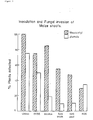
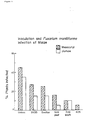
- Results from fungal stem and root invasion assays showed a significant reduction in Fusarium moniliforme infection of mesocotyl, plumule and root following inoculation of seed with P . cepacia 526 and 406.
- Bacillus and Pseudomonas SV35 inoculation also showed a reduction in infection, but to a lesser extent.
- There was also a reduction in total fungal counts in the mesocotyl and plumule in treatments with strains 526 and 406 (Fig. 4), as well as a significant reduction in total fungal counts on roots in treatments with these strains Fig. 5).
- This example demonstrates the response of field grown corn to inoculation with a Fusarium antagonist identified in Example 5, P . cepacia 526.
- cepacia strain 526 had colonized the root system of the 5 inbred corn seedlings to the extent of 1.7 ⁇ 107 organisms/g fresh weight of root (mean across all cultivars, see Table 7). This represented 79% of the total population of bacteria on the root capable of growing on nutrient agar. There was little apparent difference between cultivars in their root microbial populations.
- cepacia increased dry matter production of plant tops by 81%.from 18.6 ⁇ 3.1 SD to 33.6 ⁇ 8.7 SD g/plant.
- cultivar A641 top weight was also increased by inoculation from 86 g fresh weight/plant to 116 g/plant, an increase of 35%. Both of these cultivars are susceptible to lodging. There was little effect of inoculation on the other 3 cultivars in this trial.
- Example 7 Leaf Colonization by P. cepacia 526
- Colonization ability of P . cepacia 526 was assayed on leaves of tobacco plants in greenhouse experiments.
- Test inocula were overnight nutrient broth grown cultures of the test organisms.
- a rifampicin resistant spontaneous mutant of P . cepacia was used in this assay.
- a streptomycin resistant spontaneous mutant of E . coli HB101 was also included as a control.
- Inocula were painted on both sides of leaves using a small paint brush and inoculated leaves were allowed to dry. After 48 hrs, leaf samples were harvested, weighed and 1 g of leaf material was placed in 10 ml of phosphate buffered saline containing 0.1% peptone.
- Leaf colonization was also assessed on cotton plants in the field. Four mature cotton plants were sprayed on both surfaces with rif-resistant P . cepacia 526 broth culture containing approximately 10 cfu/ml, using a small fine-spread perfume sprayer.
- Leaves were harvested after 8 days, macerated and dilutions (Fahraeus medium) of root macerate were plated on nutrient agar (100 ⁇ g/ml rif) and nutrient agar with no antibiotic. Counts of P . cepacia 526 recovered on cotton leaves range from about 103 to 104 bacteria/g dry weight leaves. Total bacterial nutrient agar counts ranged from about 107 to 108. P . cepacia 526 represents a low percentage of the total population on cotton leaves at 8 days, but did persist on the surface and was recoverable. Field temperatures ranged from 18°C (night) to 30°C (day).
- Leaf colonization can also be assayed by similar sampling and selective plating experiments using other methods of inoculation including spraying leaves with inoculating compositions of test organisms or inoculating seeds and sampling leaves of plants from these seeds for colonization.
- P . cepacia 526 has been found to colonize leaves of corn, cotton and streptocarpus plants in addition to tobacco.
- P . cepacia Several Fusarium antagonists characterized biochemically as P . cepacia have been isolated from unsterilized root macerate samples. These isolates include several related strains represented by strains 526 and 406 from Wisconsin corn samples (Table 8) and strains 64 and 65 isolated from Australian corn samples. A comparison among these isolates and five ATCC cultures designated P . cepacia was made. The following P . cepacia ATCC strains were included in the comparison: ATCC 25416, species type strain, onion isolate; ATCC 29424, from phthalic acid enrichment; ATCC 17460, from Maraval River, Trinidad; ATCC 10856; and ATCC 17616, from soil enriched with anthraniliate. Two strains identified as P .
- cepacia (Kawamoto and Lorbeer (1976) Plant Disease Reporter 60 :189-191) which are onion isolates and known onion pathogens were also included, strains 64-22NS and 64-22NK. These strains were reported to protect onions from Fusarium infection.
- Table 8 summarizes the results of a number of biochemical comparisons among P . cepacia strains. No significant distinction can be made among the strains based on the biochemical assays included in Table 8. This supports the identification of these root isolates included as members of the species P . cepacia . Several other assays were included in the comparison: fungal inhibition, onion pathogenicity, corn root colonization and plant protection assays.
- Onion pathogenicity (Cother and Dowling (1985) Austral. Plant Pathol. 14 :10-12) was assayed by inoculating white onion tissue with P . cepacia cultures. Outer dry scales of onions were peeled and the onions were dippped into 80% alcohol and flamed twice to sterilize the surface. Transverse sections 5 mm thick were then cut from the center of the onion bulb (3-5 pieces/bulb) and placed in a petri dish under sterile conditions with a wet filter paper included to maintain humidity. Plates were then sealed with film and incubated at 30°C for 72 hrs. Onions were examined at 24, 48 and 72 hrs.
- P . cepacia corn root isolates 526 and 406 appear to be non-pathogenic to onions (0 or 1 score, Table 8). In contrast, isolates 64 and 65 are moderate onion pathogens. Again the pathogenicity of ATCC strains toward onions is variable, with ATCC strains 17460, 10856 and 17616 essentially non-pathogenic, while ATCC 25416 and 29429 are moderate and severe pathogens, respectively.
- Colonization potential showed some difference between P . cepacia strains; 526, ATCC 29424, ATCC 17616 and the 64-22 NK and NS onion pathogens appear to be better colonizers (root) compared to ATCC strains 17460, 25416 and 10856.
- Corn root isolates 526 and 406 are superior at supressing hypocotyl infection by Fusarium moniliforme .
- Corn root isolate 64 is significantly less effective, while strain 65 displays no protection ofcorn seedlings in this experiment.
- ATCC strains only one strain ATCC 17616 shows any significant protection of corn seedlings against fungal infection. It is interesting to note that ATCC 17616 displayed no antifungal activity in plate assays.
- Corn root samples are washed, macerated and prepared as in Example 1. Appropriate dilutions of unsterile root macerate are plated on a Pseudomonas cepacia selective medium (PC), for example that described by Burbage and Sasser (1982) Phytopathology 72 :706. Selections from these platings are purified by streaking on NA. Purified P . cepacia corn root isolates are then screened for inhibition of Fusarium as described in Example 2. Root and leaf colonization by the resultant Fusarium antagonist P . cepacia selections is confirmed as described in Examples 4 and 7. It is preferred that the biochemical strain characteristics of the resultant presumptive P. cepacia type Wisconsin strains be confirmed.
- PC Pseudomonas cepacia selective medium
- presumptive P . cepacia type Wisconsin strains can be confirmed by agglutination experiments using antisera raised to known P . cepacia type Wisconsin strains, the preparation of such antisera is described in Example 10.
- a sample of presumptive P . cepacia type Wisconsin liquid culture (about 10 ⁇ l) is added to about 5 ⁇ l of a 1:10 dilution of antiserum on a microscope slide. The mixture is allowed to incubate at room temperature for several minutes, after which the mixture is examined under the microscope for agglutination of cells. Samples in which cell agglutination is observed are P . cepacia type Wisconsin.
- the P . cepacia type Wisconsin antisera can also be used in conventional immunological colony screening (see, for example, Methods Enzymol . (1979) Vol. 68, Wu (ed.), Chapter 30-32, pp. 428-453) to isolate P . cepacia type Wisconsin strains.
- corn root isolates are purified and inoculated onto an appropriate growth medium (i.e., NA).
- Isolates can be rapidly screened simultaneously by spot inoculating many isolates onto the same growth plate. Plates are incubated to allow bacterial spots to grow up and the spotted isolates are replica plated onto nitrocellulose filters placed over solid growth medium (i.e. NA).
- isolates can be directly spot inoculated onto nitrocellulose filters. Inoculated filters are incubated to allow development of bacterial spots. Inoculated filters are then treated with antiserum, followed by treatment with 125I-Protein A and autoradiographic detection of P . cepacia type Wisconsin strains. Alternate methods of detection of antiserum binding are well known in the art.
- P . cepacia type Wisconsin strains can be rapidly isolated from corn root samples by combining an initial plating of the corn root samples on P . cepacia selective medium followed by immunological screening of the resultant presumptive P . cepacia root isolates.
- the isolation procedures described above can also be applied to samples of cornfield soil.
- Soil sample can be directly plated onto P . cepacia selective media or an intermediate enrichment step can be employed.
- Enrichment for root colonizing soil isolates can be done by planting surface sterilized corn seeds in the sample of cornfield soil. Corn plants (10-14 days old) resulting from these seeds are then harvested and unsterile root macerates of these plants are subjected to screening and selection methods described above in order to isolate P . cepacia type Wisconsin strains. Root colonizing bacteria are enriched in the plant root and rhizosphere.
- P . cepacia 526 was grown overnight in nutrient broth, after which cells were fixed by addition of glutaraldehyde (2% v/v). Cells were killed but not lysed by this procedure. After 2-5 hrs treatment with glutaraldehyde, the cell suspension was dialyzed (72 hrs, 4°C) against PBS. After dialysis, the cell suspension was adjusted to an optical density (650 nm) of 0.3 to 0.4 by addition of PBS. Cell samples were stored frozen in aliquots. These samples were used as antigen for preparation of P . cepacia 526 antiserum.
- the last four steps can be repeated as long as desired, alternating boosters with and without Freund's incomplete adjuvant.
- Rabbits were bled through the marginal ear vein for titer estimation, which was performed by a slide agglutination method. It was found that P . cepacia 526 antiserum showed some reaction with Pseudomonas syringae . Although P . cepacia is readily distinguished from P . syringae by conventional criteria, P . cepacia 526 antiserum can be subjected to clearing with P . cepacia antigen prior to use if required. About 10 ⁇ l of AG was added to 5 ⁇ l of a 1:10 dilution of serum on a microscope slide.
- the serum was deemed usable if cells clumped to the serum. Comparison was always made to reaction of cells with pre-immune serum. Collected serum of immune rabbits was filtered, sterilized through a 0.45 micron filter, and then frozen at -80°C.
Landscapes
- Life Sciences & Earth Sciences (AREA)
- General Health & Medical Sciences (AREA)
- Engineering & Computer Science (AREA)
- Zoology (AREA)
- Health & Medical Sciences (AREA)
- Plant Pathology (AREA)
- Microbiology (AREA)
- Pest Control & Pesticides (AREA)
- Biotechnology (AREA)
- Virology (AREA)
- Agronomy & Crop Science (AREA)
- Dentistry (AREA)
- Wood Science & Technology (AREA)
- Environmental Sciences (AREA)
- Agricultural Chemicals And Associated Chemicals (AREA)
- Micro-Organisms Or Cultivation Processes Thereof (AREA)
- Preparation Of Compounds By Using Micro-Organisms (AREA)
- Cephalosporin Compounds (AREA)
Priority Applications (1)
| Application Number | Priority Date | Filing Date | Title |
|---|---|---|---|
| AT87306596T ATE93682T1 (de) | 1986-07-28 | 1987-07-27 | Landwirtschaftliche produkte und methoden. |
Applications Claiming Priority (2)
| Application Number | Priority Date | Filing Date | Title |
|---|---|---|---|
| US89121286A | 1986-07-28 | 1986-07-28 | |
| US891212 | 1986-07-28 |
Publications (2)
| Publication Number | Publication Date |
|---|---|
| EP0255774A1 true EP0255774A1 (de) | 1988-02-10 |
| EP0255774B1 EP0255774B1 (de) | 1993-09-01 |
Family
ID=25397797
Family Applications (1)
| Application Number | Title | Priority Date | Filing Date |
|---|---|---|---|
| EP87306596A Expired - Lifetime EP0255774B1 (de) | 1986-07-28 | 1987-07-27 | Landwirtschaftliche Produkte und Methoden |
Country Status (6)
| Country | Link |
|---|---|
| EP (1) | EP0255774B1 (de) |
| AT (1) | ATE93682T1 (de) |
| AU (1) | AU610511B2 (de) |
| CA (1) | CA1293701C (de) |
| DE (1) | DE3787236T2 (de) |
| ES (1) | ES2044936T3 (de) |
Cited By (6)
| Publication number | Priority date | Publication date | Assignee | Title |
|---|---|---|---|---|
| EP0257756A3 (en) * | 1986-07-11 | 1990-05-30 | Daikin Industries, Limited | Prevention of fusarium diseases and microorganisms therefor |
| EP0350244A3 (de) * | 1988-07-01 | 1991-07-17 | Stine Seed Farm, Inc. | Verfahren zum Schutz von Pflanzen gegen Nematoden |
| EP0444664A3 (en) * | 1990-02-28 | 1991-10-23 | Suntory Limited | Fusaric acid resistant genes |
| EP0353689A3 (de) * | 1988-08-02 | 1992-03-04 | RAMOT UNIVERSITY, AUTHORITY FOR APPLIED RESEARCH & INDUSTRIAL DEVELOPMENT LTD. | Verfahren zur Bekämpfung von durch Pilz-Krankheiterreger verursachten Blattkrankheiten mit fungiziden Bakterien und neuen Reinkulturen von fungiziden Bakterien |
| WO1994003065A1 (en) * | 1992-07-31 | 1994-02-17 | The University Of Sydney | Biocontrol of fungal infection using pseudomonas strains |
| WO2000000032A1 (en) * | 1998-06-26 | 2000-01-06 | Bioagri Ab | Novel biocontrol agents |
Families Citing this family (1)
| Publication number | Priority date | Publication date | Assignee | Title |
|---|---|---|---|---|
| US4956177A (en) * | 1985-11-04 | 1990-09-11 | Microlife Technics, Inc. | Method for inhibiting fungi |
Citations (1)
| Publication number | Priority date | Publication date | Assignee | Title |
|---|---|---|---|---|
| US4588584A (en) * | 1983-06-01 | 1986-05-13 | The United States Of America As Represented By The Secretary Of Agriculture | Medium for the isolation of Pseudomonas cepacia biotype from soil and the isolated biotype |
Family Cites Families (1)
| Publication number | Priority date | Publication date | Assignee | Title |
|---|---|---|---|---|
| DE3765449D1 (de) * | 1986-03-11 | 1990-11-15 | Plant Genetic Systems Nv | Durch gentechnologie erhaltene und gegen glutaminsynthetase-inhibitoren resistente pflanzenzellen. |
-
1987
- 1987-07-23 CA CA000542853A patent/CA1293701C/en not_active Expired - Lifetime
- 1987-07-27 EP EP87306596A patent/EP0255774B1/de not_active Expired - Lifetime
- 1987-07-27 DE DE87306596T patent/DE3787236T2/de not_active Expired - Fee Related
- 1987-07-27 AT AT87306596T patent/ATE93682T1/de not_active IP Right Cessation
- 1987-07-27 ES ES87306596T patent/ES2044936T3/es not_active Expired - Lifetime
- 1987-07-27 AU AU76128/87A patent/AU610511B2/en not_active Ceased
Patent Citations (1)
| Publication number | Priority date | Publication date | Assignee | Title |
|---|---|---|---|---|
| US4588584A (en) * | 1983-06-01 | 1986-05-13 | The United States Of America As Represented By The Secretary Of Agriculture | Medium for the isolation of Pseudomonas cepacia biotype from soil and the isolated biotype |
Non-Patent Citations (2)
| Title |
|---|
| COMMONWEALTH AGRICULTURAL BUREAU, 1976, abstract no. 76085318, Slough, GB; S.O. KAWAMOTO et al.: "Protection of onion seedlings from Fusarium oxysporum f. sp. cepae by seed and soil infestation with Pseudomonas cepacia", & PLANT DISEASE REPORTER, vol. 60, no. 3, 1976, pages 189-191 * |
| COMMONWEALTH AGRICULTURAL BUREAU, 1982, abstract no. 82624966, Slough, GB; M.G. FANTINO et al.: "Antagonistic effect of Pseudomonas cepucia on Fusarium oxysporum f. sp. cepae", & INFORMATORE FITOPATOLOGICO, vol. 32, no. 4, 1982, pages 55-58 * |
Cited By (7)
| Publication number | Priority date | Publication date | Assignee | Title |
|---|---|---|---|---|
| EP0257756A3 (en) * | 1986-07-11 | 1990-05-30 | Daikin Industries, Limited | Prevention of fusarium diseases and microorganisms therefor |
| EP0350244A3 (de) * | 1988-07-01 | 1991-07-17 | Stine Seed Farm, Inc. | Verfahren zum Schutz von Pflanzen gegen Nematoden |
| EP0353689A3 (de) * | 1988-08-02 | 1992-03-04 | RAMOT UNIVERSITY, AUTHORITY FOR APPLIED RESEARCH & INDUSTRIAL DEVELOPMENT LTD. | Verfahren zur Bekämpfung von durch Pilz-Krankheiterreger verursachten Blattkrankheiten mit fungiziden Bakterien und neuen Reinkulturen von fungiziden Bakterien |
| EP0444664A3 (en) * | 1990-02-28 | 1991-10-23 | Suntory Limited | Fusaric acid resistant genes |
| US5292643A (en) * | 1990-02-28 | 1994-03-08 | Suntory Limited | Fusaric acid resistant genes |
| WO1994003065A1 (en) * | 1992-07-31 | 1994-02-17 | The University Of Sydney | Biocontrol of fungal infection using pseudomonas strains |
| WO2000000032A1 (en) * | 1998-06-26 | 2000-01-06 | Bioagri Ab | Novel biocontrol agents |
Also Published As
| Publication number | Publication date |
|---|---|
| DE3787236D1 (de) | 1993-10-07 |
| DE3787236T2 (de) | 1994-04-28 |
| ATE93682T1 (de) | 1993-09-15 |
| ES2044936T3 (es) | 1994-01-16 |
| CA1293701C (en) | 1991-12-31 |
| EP0255774B1 (de) | 1993-09-01 |
| AU7612887A (en) | 1988-02-11 |
| AU610511B2 (en) | 1991-05-23 |
Similar Documents
| Publication | Publication Date | Title |
|---|---|---|
| US4798723A (en) | Agricultural products from Pseudomonas cepacia strains and methods of preparation | |
| Xu et al. | Selection of fluorescent pseudomonads antagonistic to Erwinia carotovora and suppressive of potato seed piece decay. | |
| Mao et al. | Seed treatment with a fungal or a bacterial antagonist for reducing corn damping-off caused by species of Pythium and Fusarium | |
| US5994117A (en) | Use of Bacillus Subtilis as an endophyte for the control of diseases caused by fungi | |
| US6406690B1 (en) | Bacillus firmus CNCM I-1582 or Bacillus cereus CNCM I-1562 for controlling nematodes | |
| AU2002227228B2 (en) | Bacterial inoculants for enhancing plant growth | |
| Åström et al. | Differential reactions of wheat and pea genotypes to root inoculation with growth-affecting rhizosphere bacteria | |
| US4996157A (en) | Biological control of phytophthora by trichoderma | |
| CA1337392C (en) | Method for protecting plants from nematodes | |
| US5403583A (en) | Bacillus megetarium ATCC 55000 and method of use thereof to control R. solani | |
| US4663162A (en) | Method of using Bacillus polymyxa 9A to protect plants against verticillium wilt | |
| US5165928A (en) | Biological control of phytophthora by gliocladium | |
| US20020000540A1 (en) | Materials and methods for biological control of soilborne pathogens | |
| Savithiry et al. | Bacterization of peanut with Pseudomonas fluorescens for biological control of Rhizoctonia solani and for enhanced yield | |
| CA2218299C (en) | Bacteria having nematicidal activity and their agricultural use | |
| EP0255774B1 (de) | Landwirtschaftliche Produkte und Methoden | |
| US5968504A (en) | Fungus Gliocladium catenulatum for biological control of plant diseases | |
| Hwang et al. | Decrease in incidence of Pythium damping-off of field pea by seed treatment with Bacillus spp. and metalaxyl/Reduzierung des Auftretens der Pythium-Umfallkrankheit an Felderbsen durch Saatgutbehandlung mit Bacillus spp. und Metalaxyl | |
| KR20050034000A (ko) | 병원성 진균에 길항력을 가지는 신규의 식물 내생 세균인버크홀더리아 비에나멘시스 엠씨1404 및 이를 함유하는항진균성 미생물 살균제 | |
| US5332673A (en) | Application of native soil bacteria as selective biological control agents of the weeds downy brome, Japanese brome, and jointed goatgrass in wheat | |
| Harris et al. | Soil bacteria as selective biological control agents of winter annual grass weeds in winter wheat | |
| CA2141413A1 (en) | A microorganism of the genus colletotrichum and its uses | |
| JPH06133763A (ja) | 新規微生物および植物病害防除剤 | |
| JP2006151898A (ja) | ダイズ黒根腐病を生物的に防除するための組成物及び方法 | |
| US6110726A (en) | Actinomycete strains of ATCC 55984 and uses thereof for growth enhancement and control of pathogen infection in plants |
Legal Events
| Date | Code | Title | Description |
|---|---|---|---|
| PUAI | Public reference made under article 153(3) epc to a published international application that has entered the european phase |
Free format text: ORIGINAL CODE: 0009012 |
|
| AK | Designated contracting states |
Kind code of ref document: A1 Designated state(s): AT BE CH DE ES FR GB GR IT LI LU NL SE |
|
| 17P | Request for examination filed |
Effective date: 19880715 |
|
| RAP1 | Party data changed (applicant data changed or rights of an application transferred) |
Owner name: STINE SEED FARM, INC. |
|
| 17Q | First examination report despatched |
Effective date: 19910610 |
|
| GRAA | (expected) grant |
Free format text: ORIGINAL CODE: 0009210 |
|
| AK | Designated contracting states |
Kind code of ref document: B1 Designated state(s): AT BE CH DE ES FR GB GR IT LI LU NL SE |
|
| REF | Corresponds to: |
Ref document number: 93682 Country of ref document: AT Date of ref document: 19930915 Kind code of ref document: T |
|
| REF | Corresponds to: |
Ref document number: 3787236 Country of ref document: DE Date of ref document: 19931007 |
|
| ITF | It: translation for a ep patent filed | ||
| ET | Fr: translation filed | ||
| REG | Reference to a national code |
Ref country code: ES Ref legal event code: FG2A Ref document number: 2044936 Country of ref document: ES Kind code of ref document: T3 |
|
| REG | Reference to a national code |
Ref country code: GR Ref legal event code: FG4A Free format text: 3009973 |
|
| PLBE | No opposition filed within time limit |
Free format text: ORIGINAL CODE: 0009261 |
|
| STAA | Information on the status of an ep patent application or granted ep patent |
Free format text: STATUS: NO OPPOSITION FILED WITHIN TIME LIMIT |
|
| EPTA | Lu: last paid annual fee | ||
| 26N | No opposition filed | ||
| EAL | Se: european patent in force in sweden |
Ref document number: 87306596.5 |
|
| PGFP | Annual fee paid to national office [announced via postgrant information from national office to epo] |
Ref country code: SE Payment date: 19980622 Year of fee payment: 12 |
|
| PGFP | Annual fee paid to national office [announced via postgrant information from national office to epo] |
Ref country code: AT Payment date: 19980623 Year of fee payment: 12 |
|
| PGFP | Annual fee paid to national office [announced via postgrant information from national office to epo] |
Ref country code: DE Payment date: 19980625 Year of fee payment: 12 |
|
| PGFP | Annual fee paid to national office [announced via postgrant information from national office to epo] |
Ref country code: CH Payment date: 19980706 Year of fee payment: 12 |
|
| PGFP | Annual fee paid to national office [announced via postgrant information from national office to epo] |
Ref country code: ES Payment date: 19980715 Year of fee payment: 12 |
|
| PGFP | Annual fee paid to national office [announced via postgrant information from national office to epo] |
Ref country code: LU Payment date: 19980727 Year of fee payment: 12 |
|
| PGFP | Annual fee paid to national office [announced via postgrant information from national office to epo] |
Ref country code: GR Payment date: 19980731 Year of fee payment: 12 |
|
| PGFP | Annual fee paid to national office [announced via postgrant information from national office to epo] |
Ref country code: FR Payment date: 19990630 Year of fee payment: 13 |
|
| PGFP | Annual fee paid to national office [announced via postgrant information from national office to epo] |
Ref country code: GB Payment date: 19990702 Year of fee payment: 13 |
|
| PGFP | Annual fee paid to national office [announced via postgrant information from national office to epo] |
Ref country code: NL Payment date: 19990712 Year of fee payment: 13 |
|
| PG25 | Lapsed in a contracting state [announced via postgrant information from national office to epo] |
Ref country code: LU Free format text: LAPSE BECAUSE OF NON-PAYMENT OF DUE FEES Effective date: 19990727 Ref country code: AT Free format text: LAPSE BECAUSE OF NON-PAYMENT OF DUE FEES Effective date: 19990727 |
|
| PG25 | Lapsed in a contracting state [announced via postgrant information from national office to epo] |
Ref country code: ES Free format text: LAPSE BECAUSE OF NON-PAYMENT OF DUE FEES Effective date: 19990728 |
|
| PGFP | Annual fee paid to national office [announced via postgrant information from national office to epo] |
Ref country code: BE Payment date: 19990729 Year of fee payment: 13 |
|
| PG25 | Lapsed in a contracting state [announced via postgrant information from national office to epo] |
Ref country code: SE Free format text: THE PATENT HAS BEEN ANNULLED BY A DECISION OF A NATIONAL AUTHORITY Effective date: 19990730 |
|
| PG25 | Lapsed in a contracting state [announced via postgrant information from national office to epo] |
Ref country code: LI Free format text: LAPSE BECAUSE OF NON-PAYMENT OF DUE FEES Effective date: 19990731 Ref country code: GR Free format text: LAPSE BECAUSE OF NON-PAYMENT OF DUE FEES Effective date: 19990731 Ref country code: CH Free format text: LAPSE BECAUSE OF NON-PAYMENT OF DUE FEES Effective date: 19990731 |
|
| REG | Reference to a national code |
Ref country code: CH Ref legal event code: PL |
|
| EUG | Se: european patent has lapsed |
Ref document number: 87306596.5 |
|
| PG25 | Lapsed in a contracting state [announced via postgrant information from national office to epo] |
Ref country code: DE Free format text: LAPSE BECAUSE OF NON-PAYMENT OF DUE FEES Effective date: 20000503 |
|
| PG25 | Lapsed in a contracting state [announced via postgrant information from national office to epo] |
Ref country code: GB Free format text: LAPSE BECAUSE OF NON-PAYMENT OF DUE FEES Effective date: 20000727 |
|
| PG25 | Lapsed in a contracting state [announced via postgrant information from national office to epo] |
Ref country code: BE Free format text: LAPSE BECAUSE OF NON-PAYMENT OF DUE FEES Effective date: 20000731 |
|
| BERE | Be: lapsed |
Owner name: STINE SEED FARM INC. Effective date: 20000731 |
|
| PG25 | Lapsed in a contracting state [announced via postgrant information from national office to epo] |
Ref country code: NL Free format text: LAPSE BECAUSE OF NON-PAYMENT OF DUE FEES Effective date: 20010201 |
|
| GBPC | Gb: european patent ceased through non-payment of renewal fee |
Effective date: 20000727 |
|
| PG25 | Lapsed in a contracting state [announced via postgrant information from national office to epo] |
Ref country code: FR Free format text: LAPSE BECAUSE OF NON-PAYMENT OF DUE FEES Effective date: 20010330 |
|
| NLV4 | Nl: lapsed or anulled due to non-payment of the annual fee |
Effective date: 20010201 |
|
| REG | Reference to a national code |
Ref country code: FR Ref legal event code: ST |
|
| REG | Reference to a national code |
Ref country code: ES Ref legal event code: FD2A Effective date: 20000810 |
|
| PG25 | Lapsed in a contracting state [announced via postgrant information from national office to epo] |
Ref country code: IT Free format text: LAPSE BECAUSE OF NON-PAYMENT OF DUE FEES;WARNING: LAPSES OF ITALIAN PATENTS WITH EFFECTIVE DATE BEFORE 2007 MAY HAVE OCCURRED AT ANY TIME BEFORE 2007. THE CORRECT EFFECTIVE DATE MAY BE DIFFERENT FROM THE ONE RECORDED. Effective date: 20050727 |