EP0255802B1 - Copolymere aus N-Hydroxyphenylmaleinimid(derivaten) und Allylverbindungen - Google Patents
Copolymere aus N-Hydroxyphenylmaleinimid(derivaten) und Allylverbindungen Download PDFInfo
- Publication number
- EP0255802B1 EP0255802B1 EP87810437A EP87810437A EP0255802B1 EP 0255802 B1 EP0255802 B1 EP 0255802B1 EP 87810437 A EP87810437 A EP 87810437A EP 87810437 A EP87810437 A EP 87810437A EP 0255802 B1 EP0255802 B1 EP 0255802B1
- Authority
- EP
- European Patent Office
- Prior art keywords
- mol
- formula
- radicals
- radical
- hydrogen
- Prior art date
- Legal status (The legal status is an assumption and is not a legal conclusion. Google has not performed a legal analysis and makes no representation as to the accuracy of the status listed.)
- Expired - Lifetime
Links
- 0 C*1**=NCNC1 Chemical compound C*1**=NCNC1 0.000 description 2
Classifications
-
- G—PHYSICS
- G03—PHOTOGRAPHY; CINEMATOGRAPHY; ANALOGOUS TECHNIQUES USING WAVES OTHER THAN OPTICAL WAVES; ELECTROGRAPHY; HOLOGRAPHY
- G03F—PHOTOMECHANICAL PRODUCTION OF TEXTURED OR PATTERNED SURFACES, e.g. FOR PRINTING, FOR PROCESSING OF SEMICONDUCTOR DEVICES; MATERIALS THEREFOR; ORIGINALS THEREFOR; APPARATUS SPECIALLY ADAPTED THEREFOR
- G03F7/00—Photomechanical, e.g. photolithographic, production of textured or patterned surfaces, e.g. printing surfaces; Materials therefor, e.g. comprising photoresists; Apparatus specially adapted therefor
- G03F7/004—Photosensitive materials
- G03F7/038—Macromolecular compounds which are rendered insoluble or differentially wettable
- G03F7/0388—Macromolecular compounds which are rendered insoluble or differentially wettable with ethylenic or acetylenic bands in the side chains of the photopolymer
-
- C—CHEMISTRY; METALLURGY
- C08—ORGANIC MACROMOLECULAR COMPOUNDS; THEIR PREPARATION OR CHEMICAL WORKING-UP; COMPOSITIONS BASED THEREON
- C08F—MACROMOLECULAR COMPOUNDS OBTAINED BY REACTIONS ONLY INVOLVING CARBON-TO-CARBON UNSATURATED BONDS
- C08F222/00—Copolymers of compounds having one or more unsaturated aliphatic radicals, each having only one carbon-to-carbon double bond, and at least one being terminated by a carboxyl radical and containing at least one other carboxyl radical in the molecule; Salts, anhydrides, esters, amides, imides, or nitriles thereof
- C08F222/36—Amides or imides
- C08F222/40—Imides, e.g. cyclic imides
- C08F222/404—Imides, e.g. cyclic imides substituted imides comprising oxygen other than the carboxy oxygen
-
- C—CHEMISTRY; METALLURGY
- C08—ORGANIC MACROMOLECULAR COMPOUNDS; THEIR PREPARATION OR CHEMICAL WORKING-UP; COMPOSITIONS BASED THEREON
- C08G—MACROMOLECULAR COMPOUNDS OBTAINED OTHERWISE THAN BY REACTIONS ONLY INVOLVING UNSATURATED CARBON-TO-CARBON BONDS
- C08G59/00—Polycondensates containing more than one epoxy group per molecule; Macromolecules obtained by polymerising compounds containing more than one epoxy group per molecule using curing agents or catalysts which react with the epoxy groups
- C08G59/18—Macromolecules obtained by polymerising compounds containing more than one epoxy group per molecule using curing agents or catalysts which react with the epoxy groups ; e.g. general methods of curing
- C08G59/40—Macromolecules obtained by polymerising compounds containing more than one epoxy group per molecule using curing agents or catalysts which react with the epoxy groups ; e.g. general methods of curing characterised by the curing agents used
- C08G59/62—Alcohols or phenols
-
- C—CHEMISTRY; METALLURGY
- C08—ORGANIC MACROMOLECULAR COMPOUNDS; THEIR PREPARATION OR CHEMICAL WORKING-UP; COMPOSITIONS BASED THEREON
- C08L—COMPOSITIONS OF MACROMOLECULAR COMPOUNDS
- C08L63/00—Compositions of epoxy resins; Compositions of derivatives of epoxy resins
-
- G—PHYSICS
- G03—PHOTOGRAPHY; CINEMATOGRAPHY; ANALOGOUS TECHNIQUES USING WAVES OTHER THAN OPTICAL WAVES; ELECTROGRAPHY; HOLOGRAPHY
- G03F—PHOTOMECHANICAL PRODUCTION OF TEXTURED OR PATTERNED SURFACES, e.g. FOR PRINTING, FOR PROCESSING OF SEMICONDUCTOR DEVICES; MATERIALS THEREFOR; ORIGINALS THEREFOR; APPARATUS SPECIALLY ADAPTED THEREFOR
- G03F7/00—Photomechanical, e.g. photolithographic, production of textured or patterned surfaces, e.g. printing surfaces; Materials therefor, e.g. comprising photoresists; Apparatus specially adapted therefor
- G03F7/004—Photosensitive materials
- G03F7/022—Quinonediazides
- G03F7/023—Macromolecular quinonediazides; Macromolecular additives, e.g. binders
- G03F7/0233—Macromolecular quinonediazides; Macromolecular additives, e.g. binders characterised by the polymeric binders or the macromolecular additives other than the macromolecular quinonediazides
Definitions
- the present invention relates to new copolymers of N-hydroxyphenylmaleimide (derivatives) and allyl compounds, a process for the preparation of these polymers, the use of these compounds as binders for photoresists or epoxy hardeners and the uses of the representatives of these compounds containing epoxy groups as self-crosslinking resins.
- Homopolymers of 4-substituted phenylmaleimides are known, for example from Kobunshi Kagaku 26 , 393-400 (1969) (Chem. Abstr. 71 , 61815 g).
- Homopolymers of N- (4-hydroxyphenyl) maleimides are known from BE-PS 613,801. Copolymers of N-hydroxyphenylmaleimide and (meth) acrylic acid derivatives or other vinyl monomers have also been reported, for example in Kobunshi Kagaku 29 , 643-7 (1972) and 26 , 593-601 (1969) (Chem. Abstr. 78 , 16624c and 72 , 21964u or by SR Turner et al. In Photopolymer Conference, Ellenville USA, October 22-30, 1985.
- the binders that are usually used in positive resists cannot generally be used in negative resists.
- polyphenols for example novolaks based on phenol and formaldehyde, have so far been used in positive resists but not in negative resists.
- the N-hydroxyphenylmaleimide copolymers according to the invention can be used both in positive and in negative resists. In this way it is possible to produce aqueous systems that can be developed in an alkaline-alkaline state with high temperature and shape stability.
- N-hydroxyphenylmaleimide polymers can be improved by incorporating allyl monomers into the polymer backbone.
- allyl monomers which simultaneously contain a phenolic hydroxyl group and a glycidyl radical in one molecule and which can be used as self-crosslinking epoxy resins.
- the present invention relates to copolymers containing 30-100 mol%, based on the total polymer, of structural units of the formulas I and II, the proportion of the structural units of the formula I, based on the total proportion of I and II, being 5 to 95 mol%
- R1 is C1-C4alkyl, C1-C4alkoxy or halogen
- R2 is hydrogen or -COR3 and R3 is C1-C20alkyl
- m represents 1, 2 or 3
- n is 0, 1, 2, 3 or 4 and the sum of m and n is at most 5
- A is selected from the group consisting of halogen, cyano or structural units of the formulas III to VIII wherein R4 and R6 are independently hydroxy, or glycidyl groups of the formula IXa or IXb
- R5 and R7 are independently C1-C4alkyl, C1-C4alkoxy or halogen
- o and q are independently 0, 1, 2 or 3
- R1, R5 or R7 are C1-C4alkyl, they are straight-chain or branched, preferably straight-chain, alkyl radicals. Examples of such groups are methyl, ethyl, n-propyl, isopropyl, n-butyl or sec-butyl. Methyl is preferred.
- alkyl part of R1, R5 or R7 has the meanings mentioned above as examples. Methoxy is preferred.
- R1, R5 or R7 are fluorine, chlorine, bromine or iodine. Chlorine or bromine, in particular bromine, is preferred.
- radicals C1-C20alkyl it is preferably straight-chain groups. But it can also be branched alkyl groups.
- C1-C20alkyl radicals are methyl, ethyl, n-propyl, isopropyl, n-butyl, sec-butyl, tert-butyl, n-pentyl, isoamyl, n-hexyl, n-heptyl, n-octyl, 2-ethylhexyl, n-nonyl, n-decyl, n-undecyl, n-dodecyl, n-tetradecyl, n-hexadecyl, n-octadecyl or n-eicosyl.
- C1-C8alkyl radicals of this type are preferred, especially the straight-chain and very particularly methyl or ethyl.
- a as halogen is fluorine, chlorine, bromine or iodine. Chlorine or bromine, in particular chlorine, is preferred.
- R9, R11 and R12 as cycloalkyl with 5-7 ring C atoms are generally cyclopentyl, cyclohexyl or cycloheptyl, but especially cyclohexyl. These radicals are optionally alkyl-substituted.
- R11 or R12 are for example phenyl or naphthyl.
- suitable substituents are alkyl groups, in particular methyl, alkoxy groups, in particular methoxy, halogen atoms, in particular chlorine or bromine, or cyano groups.
- substituted aryl radicals are o-, m- or p-tolyl, xylyl or chlorophenyl. Phenyl is preferred.
- R11 or R12 are, for example, benzyl, ⁇ -methylbenzyl or ⁇ , ⁇ -dimethylbenzyl.
- the radicals mentioned above for aryl as examples are also suitable here as substituents.
- substituted aralkyl radicals are 4-methylbenzyl or 4-methoxybenzyl. Benzyl is preferred.
- R11 and R12 form a five- or six-membered non-aromatic heterocyclic ring together with the common nitrogen atom, these are, for example, piperidyl, pyrrolidinyl or morpholinyl.
- Copolymers as defined above are preferred, in which the proportion of structural units I and II is 50-100 mol%, based on the total polymer.
- Copolymers consisting essentially of structural elements of the formulas I and II are very particularly preferred.
- the term "essentially” is to be understood as meaning a content of structural elements of the formulas I and II which, compared to a polymer, consists exclusively of the corresponding structural units I and II leads to no noticeable difference in the thermal, electrical and mechanical properties of the polymer.
- Copolymers consisting particularly of structural elements of the formulas I and II are particularly preferred.
- copolymers as defined above in which the proportion of the radicals of the formula I, based on the proportion of I and II, is 10-80 mol%, particularly preferably 30-75 mol%.
- copolymers containing structural units of the formulas I and II, in which R2 is hydrogen are also preferred. These are copolymers with N-hydroxyphenylmaleimide residues as the monomer unit.
- copolymers containing the structural units of the formulas I and II are preferred, in which R2 is hydrogen and A is selected from the group of the radicals of the formulas III, IV, V, VII and VIII, R4 and R6 are glycidyl groups of the formulas IXa or IXb, R8 , R10 and at least one of R11 or R12 is a glycidyl group of formula IXa and o and q are independently 1, 2 or 3.
- the index m is preferably 1 or 2, in particular 1.
- the index n preferably denotes 0, 1 or 2, but in particular 0 or 1, very particularly 0.
- the indices o and q are preferably 0 or 1, particularly preferably 0. In the case of comonomers with glycidyl radicals, they are preferably 1.
- the indices q and r are preferably 0 or 1, in particular 0.
- copolymers with the structural units of the formulas I and II, in which R2 is hydrogen, m is 1, n is 0, 1 or 2, A is selected from the group consisting of the radicals of the formulas III, IV or V and R8 C1 -C4Alkyl or a radical of formula VI, wherein R9 is C1-C4alkyl.
- copolymers according to the invention can surprisingly be produced under mild conditions in high yield and with relatively high molecular weights (M n : 500-100000).
- a further preference of process variant b) relates to the use of glycidyl group-containing allyl compounds IIa, particularly preferably the use of allyl compounds in which A is a radical of the formula V and R8 is a group of the formula IXa, or in which A is a radical of the formula III or IV, R4 and R6 are glycidyl groups of the formula IXb, o and q are 1 or 2 and p and r are 0.
- the compounds of the formulas Ia and Ib are known per se or can be prepared by standard reactions. These compounds and their preparation are described, for example, in US Pat. No. 4,289,699.
- allyl compounds of the formulas IIa are also known and some are commercially available.
- these monomers can also be olefins, for example ethylene or propylene.
- the copolymers are prepared by radical polymerization of the corresponding monomer mixture using heat or actinic radiation.
- the allyl monomer of the formula IIa is preferably used in excess, since the N-hydroxyphenylmaleimide (derivative) of the formula Ia or Ib has the tendency to polymerize preferably with itself.
- the comonomer ratio can be controlled as desired by choosing an excess of allyl compound. As a rule, excess allyl monomer must be separated from the copolymer after the reaction. This is done in a manner known per se, e.g. by precipitating the copolymer in a non-solvent.
- the polymerization is generally initiated by one of the usual free-radical polymerization initiators.
- thermal initiators such as azo compounds, for example azoisobutyronitrile (AIBN), or peroxides, for example - benzoyl peroxide, or redox initiator systems, such as a mixture of iron (III) acetyl acetonate, benzoin and benzoyl peroxide, or photochemical radical formers, such as benzoin or benzilmethyl ketal.
- azo compounds for example azoisobutyronitrile (AIBN)
- peroxides for example - benzoyl peroxide
- redox initiator systems such as a mixture of iron (III) acetyl acetonate, benzoin and benzoyl peroxide
- photochemical radical formers such as benzoin or benzilmethyl ketal.
- the copolymerization can be carried out in solution.
- the reaction temperature is generally in the range from 10 to 200 ° C., preferably between 40 and 150 ° C., particularly preferably between 40 and 100 ° C.
- Aromatic hydrocarbons, chlorinated hydrocarbons and ketones can be used as solvents. Examples include benzene, toluene, xylene, ethylbenzene, isopropylbenzene, ethylene chloride, propylene chloride, methylene chloride, chloroform, methyl ethyl ketone, acetone or cyclohexanone.
- reaction conditions in particular the choice of initiator and solvent, are generally known and are described in detail in the literature (for example in Houben-Weyl, Methods of Organic Chemistry, Vol. 14/1, pp. 24-110; G. Thieme Verlag 1961) .
- the usual processes are used as the polymerization process, for example bulk or solvent polymerization, emulsion, suspension or precipitation polymerization.
- M n measured by gel permeation chromatography
- copolymers according to the invention are solid products which are soluble in numerous organic solvents, for example in ketones or esters. With a sufficiently large proportion of structural units of the formula I with phenolic hydroxyl groups, the copolymers can even be dissolved in water, preferably in aqueous alkaline media.
- a reagent capable of introducing the R3-CO- residue, with which the product of the polymerization of the monomers Ia and IIa may be further reacted is generally understood to mean an acylating agent.
- acylating agent are in particular carboxylic acids or their activated derivatives, for example the corresponding acid chlorides, in particular acetyl chloride.
- a polymerization step is optionally followed by the polymerization of the monomers Ib and IIa.
- the acyl group of the N-phenylmaleimidyl radical is split off.
- the cleavage is carried out according to conventional methods, for example by hydrolysis in acid or basic medium. Such a sequence of reactions is described by SR Turner et al. in 'Photopolymer Conference, Ellenville USA (October 28-30, 1985), pp. 35-47'.
- copolymers according to the invention are used, for example, as binders for positive and negative photoresist systems.
- the derivatives with N- (hydroxyphenyl) maleimide units are preferably used for this purpose.
- These compounds can be developed in aqueous alkaline solutions because of their phenolic hydroxyl group content, and their use as binders for photoresists is also the subject of this invention.
- the copolymers allow the production of thermally stable resist images with good resolution, since they generally have relatively high glass transition temperatures (T g ) combined with good mechanical properties.
- copolymers according to the invention are particularly suitable as binders for negative resist systems based on epoxy resins and cationic photoinitiators.
- N- (hydroxyphenyl) maleimide copolymers of the invention relates to their use as hardeners for epoxy resins.
- the invention also relates to the use of N- (hydroxyphenyl) maleimide copolymers with glycidyl-substituted allyl units of the formula II as self-crosslinking epoxy resins.
- the compounds have both an epoxy group and a hardening function (phenol) in the same molecule.
- They can therefore be crosslinked by heating alone or in combination with conventional hardeners.
- they can be thermally hardened without further hardeners, preferably in the presence of conventional accelerators.
- the glycidyl group-containing copolymers of the present invention can, however, also be cured in a mixture with further, conventional thermal hardeners and, if appropriate, accelerators.
- Suitable additional epoxy resins which can be used in a mixture with the epoxy compounds according to the invention are the resins which are customarily used in the art of epoxy compounds.
- polyglycidyl and poly ( ⁇ -methylglycidyl) esters include, for example, polyglycidyl and poly ( ⁇ -methylglycidyl) esters, polyglycidyl and poly ( ⁇ -methylglycidyl) ethers, poly (N-glycidyl) compounds, poly (S-glycidyl) compounds or cycloaliphatic Epoxy resins.
- polyglycidyl ethers of bisphenols such as, for example, of 2,2-bis (4-hydroxyphenyl) propane or bis- (4-hydroxyphenyl) methane, of novolaks or of aliphatic diols, are used together with the epoxy resins according to the invention.
- Acidic, basic or catalytic hardeners are suitable as epoxy curing agents. These include, for example, amines or amides, such as aliphatic, cycloaliphatic or aromatic, primary, secondary or tertiary amines, for example hexamethylene diamine, N, N-diethylpropylene diamine, bis (4-aminocyclohexyl) methane, 3,5,5-trimethyl-3- (aminomethyl) cyclohexylamine ('isophoronediamine'), 2,4,6-tris (dimethylaminomethyl) phenol, p-phenylenediamine or bis- (4-aminophenyl) methane; or polyamides, for example those made from aliphatic polyamines and di- or trimerized unsaturated fatty acids; or polyhydric phenols such as resorcinol, 2,2-bis (4-hydroxyphenyl) propane or phenol-formaldehyde resins (Phenol no
- curable mixtures can also contain suitable plasticizers, such as dibutyl phthalate, dioctyl phthalate or tricresyl phosphate, or else reactive diluents, such as phenyl or cresyl glycidyl ether, butanediol diglycidyl ether or hexahydrophthalic acid diglycidyl ether.
- suitable plasticizers such as dibutyl phthalate, dioctyl phthalate or tricresyl phosphate
- reactive diluents such as phenyl or cresyl glycidyl ether, butanediol diglycidyl ether or hexahydrophthalic acid diglycidyl ether.
- the hardenable mixtures can be hardened in any phase with extenders, fillers and reinforcing agents, such as coal tar, bitumen, textile fibers, glass fibers, asbestos fibers, boron fibers, carbon fibers, mineral silicates, mica, quartz powder, aluminum oxide hydrate, bentonites, kaolin , Silica airgel or metal powders, e.g. Aluminum powder or iron powder, also with pigments and dyes such as carbon black, oxide paints, titanium dioxide.
- Other customary additives can also be added to the curable mixtures. e.g. Flame retardants, such as antimony trioxide, thixotropy agents, flow control agents, such as silicones, waxes or stearates (which are also used in part as mold release agents).
- the curable mixtures according to the invention can be prepared in the customary manner with the aid of known mixing units (stirrers, kneaders, rollers).
- the curable epoxy resin mixtures according to the invention are used above all in the fields of surface protection, electrical engineering, lamination processes and in construction. They can be used in formulations adapted to the specific application, in the unfilled or filled state, as paints, lacquers such as sintered powder lacquers, as molding compounds, immersion resins, casting resins, injection molding formulations, impregnating resins and adhesives, as Tool resins, laminating resins, sealants and fillers, flooring compounds and binders for mineral aggregates can be used.
- the cured products produced with the copolymers containing glycidyl groups according to the invention are notable for very good thermal, electrical and mechanical properties.
- hardening accelerators for hardening; such accelerators are e.g. tertiary amines, their salts or quaternary ammonium compounds, e.g. Benzyldimethylamine, 2,4,6-tris (dimethylaminomethyl) phenol, 1-methylimidazole, 2-ethyl-4-methylimidazole, 4-aminopyridine, tripentylammonium phenolate or tetramethylammonium chloride; or alkali metal alcoholates, e.g. Na alcoholates of 2,4-dihydroxy-3-hydroxymethylpentane.
- the curing of the copolymers according to the invention containing glycidyl groups is expediently carried out in the temperature range from 50 ° C. to 300 ° C., preferably from 80-250 ° C.
- the curing can also be carried out in a known manner in two or more stages, the first curing stage being carried out at a low temperature and the post-curing at a higher temperature.
- the curing can also be carried out in two stages such that the curing reaction is prematurely terminated or the first stage is carried out at a slightly elevated temperature, with a still meltable and / or soluble, curable precondensate (so-called "B stage") from the Epoxy component (a) and the optionally present hardener or accelerator (b) is obtained.
- a precondensate can e.g. serve to produce "prepregs", molding compounds or sinter powders.
- hardening means the conversion of the soluble, either liquid or meltable, polyepoxides into solid, insoluble and infusible, three-dimensionally crosslinked products or materials, usually under simultaneous shaping to shaped bodies such as castings, pressed bodies and laminates, to impregnation, coatings, paint films and bonds.
- the suspension After inerting with nitrogen, the suspension is heated with an oil bath while stirring. At an internal temperature of approx. 70 ° C, the polymerization sets in with considerable heat.
- the oil bath is removed and cooled with an ice bath for approx. 10 minutes.
- the oil bath is then used to heat for 7 hours at a temperature of approx. 70 ° C.
- the yellowish suspension is introduced into 4000 ml of toluene with thorough stirring, the precipitate is filtered off and dried in vacuo at 60 ° C. for 14 hours.
- the solid product is dissolved in acetone and again precipitated from toluene. After drying in vacuo, 427.9 g of colorless, solid copolymer remain.
- the mixture is inertized with nitrogen and polymerized at about 70 ° C. for 7 hours, as described in Example 1.
- the yellowish, clear solution is added dropwise to toluene with thorough stirring, the precipitate is filtered off and dried in vacuo at 60.degree. After reprecipitation of the acetone solution in toluene, 19.86 g of solid copolymer remain as a powder after drying.
- reaction mixture is stirred in a weak stream of nitrogen at about 65 ° C. for 24 hours.
- the yellowish suspension is then slowly introduced into 300 ml of ether with stirring, the precipitate is filtered off and washed with about 200 ml of ether. After drying, 12.3 g of colorless powder remain.
- reaction mixture is stirred in a weak stream of nitrogen at about 65 ° C. for 24 hours.
- the yellowish suspension is then slowly introduced into 1 l of ether with stirring, the precipitate is filtered off and washed with about 200 ml of ether. After drying, 17.0 g of colorless powder remain.
- This example shows the use as a binder for the formulation of aqueous-alkaline developable negative photoresists based on epoxy resin.
Landscapes
- Chemical & Material Sciences (AREA)
- Physics & Mathematics (AREA)
- Health & Medical Sciences (AREA)
- Chemical Kinetics & Catalysis (AREA)
- Medicinal Chemistry (AREA)
- Polymers & Plastics (AREA)
- Organic Chemistry (AREA)
- Spectroscopy & Molecular Physics (AREA)
- General Physics & Mathematics (AREA)
- Addition Polymer Or Copolymer, Post-Treatments, Or Chemical Modifications (AREA)
Description
- Die vorliegende Erfindung betrifft neue Copolymere aus N-Hydroxyphenylmaleinimid(derivaten) und Allylverbindungen, ein Verfahren zur Herstellung dieser Polymeren, die Verwendung dieser Verbindungen als Bindemittel für Photoresists oder Epoxidhärter sowie die Verwendungen der epoxidgruppenhaltigen Vertreter dieser Verbindungen als selbstvernetzende Harze.
- Homopolymere von 4-substituierten Phenylmaleinimiden sind bekannt, beispielsweise aus Kobunshi Kagaku 26, 393-400 (1969) (Chem. Abstr. 71, 61815 g). Homopolymere von N-(4-Hydroxyphenyl)maleinimiden sind aus der BE-PS 613,801 bekannt. Auch über Copolymere aus N-Hydroxyphenylmaleinimid und (Meth)acrylsäurederivaten oder anderen Vinylmonomeren wurde bereits berichtet, beispielsweise in Kobunshi Kagaku 29, 643-7 (1972) bzw. 26, 593-601 (1969) (Chem. Abstr. 78, 16624c bzw. 72, 21964u oder von S.R. Turner et al. in Photopolymer Conference, Ellenville USA, 22.-30. Oktober 1985.
- Es ist bekannt, dass sich durch den Einbau von N-Hydroxyphenylmaleinimiden die Glasübergangstemperatur von Vinylcopolymeren steigern lässt. Solche Harze lassen sich potentiell als Bindemittel in positiven Photolacken einsetzen (vergl. Turner et al.).
- Allerdings lassen sich die Bindemittel, die üblicherweise in Positiv-Resists verwendet werden, in der Regel nicht in Negativ-Resists einsetzen. Insbesondere Polyphenole, beispielsweise Novolake auf Phenol- und Formaldehydbasis, wurden bislang zwar in Positiv-Resists nicht aber in Negativ-Resists eingesetzt. Ueberraschenderweise lassen sich die erfindungsgemässen N-Hydroxyphenylmaleinimid-Copolymeren sowohl in Positiv- als auch in Negativ-Resists verwenden. Auf diese Weise lassen sich wässrig-alkalisch entwickelbare Negativsysteme mit hoher Temperatur- und Formstabilität herstellen.
- Es wurde jetzt gefunden, dass man die Flexibilität von N-Hydroxyphenylmaleinimid-Polymeren verbessern kann, indem man Allylmonomere in das Polymergerüst einbaut. Ausserdem wurde eine Untergruppe solcher Polymerer gefunden, die gleichzeitig eine phenolische Hydroxylgruppe und einem Glycidylrest in einem Molekül enthalten und die als selbstvernetzende Epoxidharze eingesetzt werden können.
- Ferner ist bekannt, das Allylverbindungen nur relativ schlecht polymerisiert werden können (vergl. Yocum/Nyquist, 'Functional Monomers', Vol. 1, 384 ff, Marcel Dekker Inc., New York, 1975). Es war daher überraschend zu finden, dass die Polymerisation von N-Hydroxyphenylmaleinimiden mit Allylverbindungen rasch und unter milden Bedingungen abläuft und dass sich relativ hohe Molekulargewichte erreichen lassen.
- Die vorliegende Erfindung betrifft Copolymere enthaltend 30-100 Mol%, bezogen auf das Gesamtpolymere, an Struktureinheiten der Formeln I und II, wobei der Anteil der Struktureinheiten der Formel I, bezogen auf den gesamten Anteil von I und II, 5 bis 95 Mol% ausmacht

worin R¹ C₁-C₄Alkyl, C₁-C₄Alkoxy oder Halogen ist,
R² Wasserstoff oder -COR³ bedeutet und R³ C₁-C₂₀Alkyl ist,
m 1, 2 oder 3 darstellt, n 0, 1, 2, 3 oder 4 ist und die Summe von m und n höchstens 5 bedeutet, A ausgewählt wird aus der Gruppe der Reste bestehend aus Halogen, Cyano oder Struktureinheiten der Formeln III bis VIII
worin R⁴ und R⁶ unabhängig voneinander Hydroxy,
oder Glycidylgruppen der Formel IXa oder IXb darstellen
R⁵ und R⁷ unabhängig voneinander C₁-C₄Alkyl, C₁-C₄Alkoxy oder Halogen sind,
o und q unabhängig voneinander 0, 1, 2 oder 3 sind,
p und r unabhängig voneinander 0, 1, 2, 3, 4 oder 5 bedeuten,
wobei die Summen o+p und q+r höchstens 5 betragen dürfen,
R⁸ Wasserstoff, C₁-C₂₀Alkyl, ein Glycidylrest der Formel IXa oder ein Rest der Formel VI ist,
R⁹ Wasserstoff, C₁-C₂₀Alkyl, Cycloalkyl mit 5-7 Ring C-Atomen, Phenyl, Naphthyl oder Benzyl darstellt,
R¹⁰ Wasserstoff, C₁-C₂₀Alkyl oder ein Glycidylrest der Formel IXa ist und die Gruppen R¹¹ und R¹² unabhängig voneinander Wasserstoff, C₁-C₂₀Alkyl, Cycloalkyl mit 5-7 Ring C-Atomen, gegebenenfalls substituiertes Aryl oder ein Glycidylrest der Formel IXa sind oder zusammen mit dem gemeinsamen Stickstoffatom einen fünf- oder sechsgliedrigen nichtaromatischen heterocyclischen Ring bilden und
R¹³ und R¹⁴ unabhängig voneinander Wasserstoff oder Methyl sind,
wobei die Reste R¹ bis R¹⁴ und A eines Polymermoleküls innerhalb der gegebenen Definitionen unterschiedlich sein können;
und 70-0 mol%, bezogen auf das Gesamtpolymere, au Struktureinheiten, die sich von radikalisch polymerisierbaren Vinylverbindungen ableiten. - Bedeuten R¹, R⁵ oder R⁷ C₁-C₄Alkyl, so handelt es sich dabei um geradkettige oder verzweigte, bevorzugt um geradkettige, Alkylreste. Beispiele für solche Gruppen sind Methyl, Ethyl, n-Propyl, Isopropyl, n-Butyl oder sek.Butyl. Bevorzugt wird Methyl.
- Als C₁-C₄Alkoxy besitzt der Alkylteil von R¹, R⁵ oder R⁷ die oben beispielhaft erwähnten Bedeutungen. Bevorzugt wird Methoxy.
- Als Halogen sind R¹, R⁵ oder R⁷ Fluor, Chlor, Brom oder Iod. Bevorzugt wird Chlor oder Brom, insbesondere Brom.
- Sind irgendwelche Reste C₁-C₂₀Alkyl, so handelt es sich dabei bevorzugt um geradkettige Gruppen. Es können aber auch verzweigte Alkylgruppen sein.
- Beispiele für C₁-C₂₀Alkylreste sind Methyl, Ethyl, n-Propyl, Isopropyl, n-Butyl, sek.Butyl, tert.Butyl, n-Pentyl, Isoamyl, n-Hexyl, n-Heptyl, n-Octyl, 2-Ethylhexyl, n-Nonyl, n-Decyl, n-Undecyl, n-Dodecyl, n-Tetradecyl, n-Hexadecyl, n-Octadecyl oder n-Eicosyl. Bevorzugt werden C₁-C₈Alkylreste dieses Typs, insbesondere die geradkettigen und ganz besonders Methyl oder Ethyl.
- A als Halogen ist Fluor, Chlor, Brom oder Iod. Bevorzugt wird Chlor oder Brom, insbesondere Chlor.
- Bei R⁹, R¹¹ und R¹² als Cycloalkyl mit 5-7 Ring C-Atomen handelt es sich in der Regel um Cyclopentyl, Cyclohexyl oder Cycloheptyl, insbesondere jedoch um Cyclohexyl. Diese Reste sind gegebenenfalls alkylsubstituiert.
- Als gegebenenfalls substituiertes Aryl sind R¹¹ oder R¹² beispielsweise Phenyl oder Naphthyl. Als Substituenten kommen beispielsweise Alkylgruppen, insbesondere Methyl, Alkoxygruppen, insbesondere Methoxy, Halogenatome, insbesondere Chlor oder Brom, oder Cyanogruppen in Frage.
- Spezifische Beispiele für substituierte Arylreste sind o-, m- oder p-Tolyl, Xylyl oder Chlorphenyl. Bevorzugt wird Phenyl.
- Als gegebenenfalls substituiertes Aralkyl sind R¹¹ oder R¹² beispielsweise Benzyl, α-Methylbenzyl oder α,α-Dimethylbenzyl. Auch hier kommen als Substituenten die oben für Aryl beispielhaft erwähnten Reste in Frage.
- Spezifische Beispiele für subsituierte Aralkylreste sind 4-Methylbenzyl oder 4-Methoxybenzyl. Bevorzugt wird Benzyl.
- Bilden R¹¹ und R¹² zusammen mit dem gemeinsamen Stickstoffatom einen fünf- oder sechsgliedrigen nichtaromatischen heterocyclischen Ring, so handelt es sich dabei beispielsweise um Piperidyl, Pyrrolidinyl oder Morpholinyl.
- Bevorzugt werden Copolymere, wie oben definiert, worin der Anteil der Struktureinheiten I und II 50-100 Mol%, bezogen auf das Gesamtpolymere, ausmacht.
- Ganz besonders bevorzugt werden Copolymere bestehend im wesentlichen aus Strukturelementen der Formeln I und II. Unter dem Begriff 'im wesentlichen' ist ein solcher Gehalt an Strukturelementen der Formeln I und II zu verstehen, der verglichen mit einem Polymeren bestehend aus ausschliesslich den entsprechenden Struktureinheiten I und II zu keinem merklichen Unterschied in den thermischen, elektrischen und mechanischen Eigenschaften des Polymeren führt.
- Insbesondere bevorzugt werden Copolymere bestehend ausschliesslich aus Strukturelementen der Formeln I und II.
- Ebenfalls bevorzugt werden Copolymere, wie oben definiert, worin der Anteil der Reste der Formel I, bezogen auf den Anteil von I und II, 10-80 Mol%, besonders bevorzugt 30-75 Mol%, ausmacht.
- Weiterhin bevorzugt werden Copolymere enthaltend Struktureinheiten der Formeln I und II, worin R² Wasserstoff bedeutet. Hierbei handelt es sich um Copolymere mit N-Hydroxyphenylmaleinimidresten als Monomereinheit.
- Auch werden Copolymere enthaltend die Struktureinheiten der Formeln I und II bevorzugt, worin R² Wasserstoff bedeutet und A ausgewählt wird aus der Gruppe der Reste der Formeln III, IV, V, VII und VIII, R⁴ und R⁶ Glycidylgruppen der Formeln IXa oder IXb darstellen, R⁸, R¹⁰ und mindestens einer der Reste R¹¹ oder R¹² eine Glycidylgruppe der Formel IXa ist und o und q unabhängig voneinander 1, 2 oder 3 sind.
- Ganz besonders bevorzugt werden Copolymere enthaltend die Struktureinheiten der Formeln I und II, vorzugsweise solche mit m = 1 und n = 0, worin R² Wasserstoff bedeutet, A ein Rest der Formel V ist und R⁸ eine Gruppe der Formel IXa bedeutet. Ebenfalls besonders bevorzugt werden Copolymere enthaltend Struktureinheiten der Formeln I und II, vorzugsweise solche mit m = 1 und n = 0, worin R² Wasserstoff bedeutet, A eine Gruppe der Formeln III oder IV ist, R⁴ und R⁶ Glycidylgruppen der Formel IXb sind, o und q 1 oder 2, insbesondere 1, bedeuten und p und r 0 sind.
- Der Index m ist vorzugsweise 1 oder 2, insbesondere 1.
Der Index n bedeutet bevorzugt 0, 1 oder 2, insbesondere jedoch 0 oder 1, ganz besonders 0.
Die Indizes o und q sind vorzugsweise 0 oder 1, besonders bevorzugt 0. Bei Comonomeren mit Glycidylresten sind sie vorzugsweise 1. Die Indizes q und r sind bevorzugt 0 oder 1, insbesondere 0. - Bevorzugt werden weiterhin Copolymere mit den Struktureinheiten der Formeln I und II, worin R² Wasserstoff bedeutet, m 1 ist, n 0, 1 oder 2 bedeutet, A ausgewählt wird aus der Gruppe bestehend aus den Resten der Formeln III, IV oder V und R⁸ C₁-C₄Alkyl oder ein Rest der Formel VI ist, worin R⁹ C₁-C₄Alkyl bedeutet.
- Die erfindungsgemässen Copolymeren lassen sich überraschenderweise unter milden Bedingungen in hoher Ausbeute und mit relativ hohen Molekulargewichten (Mn: 500-100000) herstellen.
- Gegenstand der Erfindung ist daher auch ein Verfahren zur Herstellung dieser Copolymeren dadurch gekennzeichnet, dass man
- a) 30-100 mol% Verbindungen der Formel Ia und IIa

- b) 30-100 mol% Verbindungen der Formel Ib und IIa

- Eine weitere Bevorzugung der Verfahrensvariante b) betrifft den Einsatz glycidylgruppenhaltiger Allylverbindungen IIa, besonders bevorzugt den Einsatz von Allylverbindungen, worin A ein Rest der Formel V ist und R⁸ eine Gruppe der Formel IXa bedeutet, oder worin A ein Rest der Formel III oder IV ist, R⁴ und R⁶ Glycidylgruppen der Formel IXb sind, o und q 1 oder 2 bedeuten und p und r 0 sind. Die Verbindungen der Formeln Ia und Ib sind an sich bekannt oder können nach Standardreaktionen hergestellt werden. Diese Verbindungen und ihre Herstellung sind beispielsweise in der US-PS 4,289,699 beschrieben.
- Die Allylverbindungen der Formeln IIa sind ebenfalls bekannt und teilweise im Handel erhältlich.
- Neben den Monomeren der Formeln Ia und IIa bzw. Ib und IIa können gegebenenfalls noch bis zu 70 mol% weitere radikalisch polymerisierbare Vinylverbindungen anwesend sein.
- Beispiele für Monomere dieses Typs sind
- a) Styroltypen, wie beispielsweise Styrol, α-Methylstyrol, p-Methylstyrol oder p-Hydroxyphenylstyrol;
- b) α,β-ungesättigte Säuren, deren Ester oder Amide, wie beispielsweise Acrylsäure, Acrylsäuremethylester, Acrylsäureamid, die entsprechenden Methacrylverbindungen, Maleinsäure oder Maleinsäuremethylester;
- c) Nitrile von α,β-ungesättigten Säuren, wie beispielsweise Acrylnitril oder Methacrylnitril;
- d) halogenhaltige Vinylverbindungen, wie beispielsweise Vinylchlorid, Vinylfluorid, Vinylidenchlorid oder Vinylidenfluorid;
- e) Vinylester, wie beispielsweise Vinylacetat oder
- f) Vinylether, wie beispielsweise Methylvinylether oder Butylvinylether.
- Es kann sich bei diesen Monomeren aber auch um Olefine handeln, beispielsweise um Ethylen oder Propylen.
- Man kann auch Mischungen dieser Monomeren einsetzen.
- Die Herstellung der Copolymeren geschiet durch radikalische Polymerisation der entsprechenden Monomermischung mittels Hitze oder aktinischer Strahlung. Das Allylmonomere der Formel IIa wird dabei bevorzugt im Ueberschuss eingesetzt, da das N-Hydroxyphenylmaleinimid(derivat) der Formel Ia oder Ib die Tendenz besitzt, vorzugsweise mit sich selbst zu polymerisieren. Durch die Wahl eines Ueberschusses an Allylverbindung lässt sich das Comonomerenverhältnis beliebig steuern. In der Regel muss nach der Reaktion überschüssiges Allylmonomeres vom Copolymer abgetrennt werden. Dies erfolgt in an sich bekannter Weise, z.B. durch Fällen des Copolymers in einem Nichtlösungsmittel. Die Polymerisation wird in der Regel durch einen der üblichen Initiatoren der radikalischen Polymerisation eingeleitet.
- Dazu zählen thermische Initiatoren, wie Azoverbindungen, beispielsweise Azoisobutyronitril (AIBN), oder Peroxide, beispielsweise - Benzoylperoxid, oder Redoxinitiatorsysteme, wie eine Mischung von Eisen(III)acetyl-acetonat, Benzoin und Benzoylperoxid, oder photochemische Radikalbildner, wie Benzoin oder Benzilmethylketal.
- Die Copolymerisation kann in Lösung ausgeführt werden. Die Reaktionstemperatur bewegt sich im allgemeinen im Bereich von 10 bis 200°C, vorzugsweise zwischen 40 und 150°C, besonders bevorzugt zwischen 40 und 100°C.
- Gegebenenfalls anwesende Lösungsmittel müssen unter Reaktionsbedingungen inert sein. Als Lösungsmittel kommen u.a. aromatische Kohlenwasserstoffe, chlorierte Kohlenwasserstoffe und Ketone in Betracht. Beispiele dafür sind Benzol, Toluol, Xylol, Ethylbenzol, Isopropylbenzol, Ethylenchlorid, Propylenchlorid, Methylenchlorid, Chloroform, Methylethylketon, Aceton oder Cyclohexanon.
- Die Reaktionbedingungen insbesondere die Wahl des Initiators und des Lösungsmittels, sind allgemein bekannt und in der Literatur ausführlich beschrieben (beispielweise in Houben-Weyl, Methoden der organischen Chemie, Bd. 14/1, S. 24-110; G. Thieme Verlag 1961).
- Als Polymerisationsverfahren finden die üblichen Verfahren Anwendung, wie beispielsweise Polymerisation in der Masse oder in Lösungsmitteln, Emulsions-, Suspensions- oder Fällungspolymerisation.
- Unter den gewählten Reaktionsbedingungen entstehen sogenannte statistische Copolymere, d.h. Polymere, in denen die Reihenfolge der einzelnen Monomereinheiten zufällig ist. Das Molekulargewicht der Produkte (
M n; gemessen durch Gel-Permeationschromatographie) variiert in der Regel zwischen etwa 500 und 100000, insbesondere zwischen 1000 und 50000. - Die erfindungsgemässen Copolymeren sind feste Produkte, die in zahlreichen organischen Lösungsmitteln löslich sind, beispielsweise in Ketonen oder Estern. Bei einem genügend grossen Anteil an Struktureinheiten der Formel I mit phenolischen Hydroxylgruppen lassen sich die Copolymeren sogar in Wasser, bevorzugt in wässrig alkalischen Medien, lösen.
- Unter einem zur Einführung des Restes R³-CO- befähigten Reagenz, mit dem das Produkt der Polymerisation der Monomeren Ia und IIa gegebenenfalls weiter umgesetzt wird, versteht man ganz allgemein ein Acylierungsmittel. Dabei handelt es sich insbesondere um Carbonsäuren oder deren aktivierte Derivate, beispielsweise die entsprechenden Säurechloride, insbesondere Acetylchlorid.
- An die Polymerisation der Monomeren Ib und IIa schliesst sich gegebenenfalls eine Hydrolysestufe an. Dabei wird die Acylgruppe des N-Phenylmaleinimidylrestes abgespalten. Die Spaltung erfolgt nach an sich üblichen Methoden, beispielsweise durch Hydrolyse im sauren oder basischen Medium. Eine solche Reaktionsfolge wird von S.R. Turner et al. in 'Photopolymer Conference, Ellenville USA (28.-30. October 1985), S. 35-47' beschrieben.
- Die erfindungsgemässen Copolymeren finden beispielsweise Verwendung als Bindemittel für Positiv- und Negativ-Photoresistsysteme. Bevorzugt setzt man für diesen Zweck die Derivate mit N-(Hydroxyphenyl)-maleinimideinheiten ein. Diese Verbindungen lassen sich aufgrund ihres Gehaltes an phenolischen Hydroxylgruppen in wässrig-alkalischen Lösungen entwickeln, und ihre Verwendung als Bindemittel für Photoresists ist ebenfalls Gegenstand dieser Erfindung.
- Die Copolymeren gestatten die Herstellung thermisch beständiger Resistbilder mit guter Auflösung, da sie im allgemeinen relativ hohe Glasübergangstemperaturen (Tg) kombiniert mit guten mechanischen Eigenschaften aufweisen.
- Die Anwendung der entsprechenden N-(Hydroxyphenyl)maleimid-/Vinylcopolymeren als Bindemittel in Positiv-Resists wird im oben zitierten Artikel von S.R. Turner et al. beschrieben.
- Besonders eignen sich die erfindungsgemässen Copolymeren als Bindemittel für Negativ-Resistsysteme auf Basis von Epoxidharzen und kationischen Photoinitiatoren.
- Ein weiteres Anwendungsgebiet der N-(Hydroxyphenyl)maleimid-Copolymeren der Erfindung betrifft ihren Einsatz als Härter für Epoxidharze.
- Die Erfindung betrifft auch die Verwendung von N-(Hydroxyphenyl)maleinimid-Copolymeren mit glycidylsubstituierten Allyleinheiten der Formel II als selbstvernetzende Epoxidharze. Die Verbindungen weisen in ein und demselben Molekül sowohl eine Epoxidgruppe als auch eine Härterfunktion (Phenol) auf.
- Sie lassen sich daher allein oder auch in Kombination mit üblichen Härtern unter Erwärmen vernetzen. Insbesondere lassen sie sich ohne weitere Härter, vorzugsweise in Anwesenheit üblicher Beschleuniger thermisch härten. Die glycidylgruppenhaltigen Copolymeren der vorliegenden Erfindung lassen sich allerdings auch im Gemisch mit weiteren, üblichen thermischen Härtern und gegebenenfalls Beschleunigern härten.
- Als zusätzliche Epoxidharze, die sich in Mischung mit den erfindungsgemässen Epoxidverbindungen einsetzen lassen, eignen sich die üblicherweise in der Technik der Epoxidverbindungen eingesetzten Harze.
- Dazu zählen beispielsweise Polyglycidyl- und Poly-(β-methylglycidyl)-ester, Polyglycidyl- und Poly-(β-methylglycidyl)-ether, Poly-(N-glycidyl)-verbindungen, Poly-(S-glycidyl)-verbindungen oder cycloaliphatische Epoxidharze.
- Beispiele für die einzelnen Verbindungen dieses Typs sind in der EP-A 160,621 gegeben.
- Insbesondere setzt man zusammen mit den erfindungsgemässen Epoxidharzen Polyglycidylether von Bisphenolen, wie beispielsweise von 2,2-Bis-(4-hydroxyphenyl)-propan oder Bis-(4-hydroxyphenyl)-methan, von Novolaken oder von aliphatischen Diolen ein.
- Als Epoxidhärtungsmittel kommen saure, basische oder katalytische Härter in Frage. Dazu zählen beispielsweise Amine oder Amide, wie aliphatische, cycloaliphatische oder aromatische, primäre, sekundäre oder tertiäre Amine, beispielsweise Hexamethylendiamin, N,N-Diethylpropylendiamin, Bis-(4-aminocyclohexyl)-methan, 3,5,5-Trimethyl-3-(aminomethyl)-cyclohexylamin ('Isophorondiamin'), 2,4,6-Tris-(dimethylaminomethyl)-phenol, p-Phenylendiamin oder Bis-(4-aminophenyl)-methan; oder Polyamide, beispielsweise solche aus aliphatischen Polyaminen und di- oder trimerisierten ungesättigten Fettsäuren; oder mehrwertige Phenole, wie beispielsweise Resorcin, 2,2-Bis-(4-hydroxyphenyl)-propan oder Phenol-Formaldehydharze (Phenol-Novolake); oder Bortrifluorid und seine Komplexe mit organischen Verbindungen, wie beispielsweise BF₃-Ether-Komplexe oder BF₃-Amin-Komplexe; oder mehrbasische Carbonsäuren und deren Anhydride, wie beispielsweise Phthalsäureanhydrid, Tetrahydrophthalsäureanhydrid oder Hexahydrophthalsäureanhydrid oder die entsprechenden Säuren.
- Derartige härtbare Gemische können ferner geeignete Weichmacher, wie Dibutylphthalat, Dioctylphthalat oder Trikresylphosphat, oder auch reaktive Verdünner, wie Phenyl- oder Kresylglycidylether, Butandioldiglycidylether oder Hexahydrophthalsäurediglycidylether enthalten.
- Schliesslich können die härtbaren Gemische vor der Härtung in irgendeiner Phase mit Streck-, Füll- und Verstärkungsmitteln, wie beispielsweise Steinkohlenteer, Bitumen, Textilfasern, Glasfasern, Asbestfasern, Borfasern, Kohlenstoff-Fasern, mineralischen Silikaten, Glimmer, Quarzmehl, Aluminiumoxidhydrat, Bentoniten, Kaolin, Kieselsäureaerogel oder Metallpulvern, z.B. Aluminiumpulver oder Eisenpulver, ferner mit Pigmenten und Farbstoffen, wie Russ, Oxidfarben, Titandioxid versetzt werden. Man kann den härtbaren Gemischen ferner auch andere übliche Zusätze. z.B. Flammschutzmittel, wie Antimontrioxid, Thixotropiemittel, Verlaufmittel ("flow control agents"), wie Silicone, Wachse oder Stearate (welche zum Teil auch als Formtrennmittel Anwendung finden), zusetzen.
- Die Herstellung der erfindungsgemässen härtbaren Mischungen kann in üblicher Weise mit Hilfe bekannter Mischaggregate (Rührer, Kneter, Walzen) erfolgen.
- Die erfindungsgemässen härtbaren Epoxidharzmischungen finden ihren Einsatz vor allem auf den Gebieten des Oberflächenschutzes, der Elektrotechnik, der Laminierverfahren und im Bauwesen. Sie können in jeweils dem speziellen Anwendungszweck angepasster Formulierung, im ungefüllten oder gefüllten Zustand, als Anstrichmittel, Lacke, wie Sinterpulverlacke, als Pressmassen, Tauchharze, Giessharze, Spritzgussformulierungen, Imprägnierharze und Klebmittel, als Werkzeugharze, Laminierharze, Dichtungs- und Spachtelmassen, Bodenbelagsmassen und Bindemittel für mineralische Aggregate verwendet werden.
- Die mit den erfindungsgemässen glycidylgruppenhaltigen Copolymeren hergestellten ausgehärteten Produkte zeichnen sich durch sehr gute thermische, elektrische und mechanische Eigenschaften aus.
- Man kann bei der Härtung ausserdem Härtungsbeschleuniger einsetzen; solche Beschleuniger sind z.B. tertiäre Amine, deren Salze oder quaternäre Ammoniumverbindungen, z.B. Benzyldimethylamin, 2,4,6-Tris(dimethylaminomethyl)phenol, 1-Methylimidazol, 2-Ethyl-4-methylimidazol, 4-Aminopyridin, Tripentylammoniumphenolat oder Tetramethylammoniumchlorid; oder Alkalimetallalkoholate, wie z.B. Na-Alkoholate von 2,4-Dihydroxy-3-hydroxymethylpentan. Die Härtung der erfindungsgemässen glycidylgruppenhaltigen Copolymeren wird zweckmässig im Temperaturintervall von 50°C bis 300°C, bevorzugt von 80-250°C, durchgeführt.
- Man kann die Härtung in bekannter Weise auch zwei- oder mehrstufig durchführen, wobei die erste Härtungsstufe bei niedriger Temperatur und die Nachhärtung bei höherer Temperatur durchgeführt wird.
- Die Härtung kann gewünschtenfalls auch derart in 2 Stufen erfolgen, dass die Härtungsreaktion zunächst vorzeitig abgebrochen bzw. die erste Stufe bei wenig erhöhter Temperatur durchgeführt wird, wobei ein noch schmelzbares und/oder lösliches, härtbares Vorkondensat (sogenannte "B-Stufe") aus der Epoxi-Komponente (a) und dem gegebenenfalls anwesenden Härter oder Beschleuniger (b) erhalten wird. Ein derartiges Vorkondensat kann z.B. zur Herstellung von "Prepregs", Pressmassen oder Sinterpulvern dienen.
- Der Ausdruck "Härten", wie er hier gebraucht wird, bedeutet die Umwandlung der löslichen, entweder flüssigen oder schmelzbaren Polyepoxide in feste, unlösliche und unschmelzbare, dreidimensional vernetzte Produkte bzw. Werkstoffe, und zwar in der Regel unter gleichzeitiger Formgebung zu Formkörpern, wie Giesskörpern, Presskörpern und Schichtstoffen, zu Imprägnierungen, Beschichtungen, Lackfilmen und Verklebungen.
- Die folgenden Beispiele erläutern die Erfindung näher.
-

- Einen 2,5 1 Sulfierkolben, versehen mit Rührer, Thermometer, Rückflusskühler sowie Stickstoffeinleitung und -ausleitung, beschickt man mit:
- 233,4 g ( 1,234 Mol)
- p-Maleinimidylphenol
- 1264,8 g (11,08 Mol)
- Allylglycidylether
- 4,95 g ( 0,030 Mol)
- α,αʹ-Azobisisobutyronitril (AIBN).
- Nach dem Inertisieren mit Stickstoff wird die Suspension unter Rühren mit einem Oelbad aufgeheizt. Bei ca. 70°C Innentemperatur setzt die Polymerisation unter erheblicher Wärmetönung ein. Das Oelbad wird entfernt und mit einem Eisbad für ca. 10 Min. gekühlt. Mit dem Oelbad heizt man dann während 7 Stunden bei einer Temperatur von ca. 70°C. Die gelbliche Suspension wird unter gutem Rühren in 4000 ml Toluol eingetragen, die Ausfällung abfiltriert und im Vakuum während 14 Stunden bei 60°C getrocknet. Man löst das Festprodukt in Aceton und fällt nochmals aus Toluol. Nach dem Trocknen im Vakuum verbleiben 427,9 g farbloses, festes Copolymer.
- gefunden %: C 63,52 H 5,88 N 3,94
Zusammensetzung berechnet nach N-Gehalt: 2,83 Mol/kg Maleinimidylphenol
-

-

- Einen 350 ml Sulfierkolben, ausgestattet wie in Beispiel 1, beschickt man mit:
- 18,92 g ( 0,100 Mol)
- p-Maleinimidylphenol
- 11,42 g ( 0,100 Mol)
- Allylglycidylether
- 144,50 g
- Methylethylketon
- 0,380 g ( 0,0023 Mol)
- α,αʹ-Azobisisobutyronitril (AIBN)
- Man inertisiert mit Stickstoff und polymerisiert während 7 Stunden bei ca. 70°C, wie im Beispiel 1 beschrieben. Die gelbliche, klare Lösung wird unter gutem Rühren in Toluol eingetropft, der Niederschlag abfiltriert und im Vakuum bei 60°C getrocknet. Nach nochmaligem Umfällen der Acetonlösung in Toluol verbleiben nach dem Trocknen 19,86 g festes Copolymer als Pulver.
- gefunden %: C 60,33 H 4,90 N 6,07
Zusammensetzung berechnet nach N-Gehalt: 4,31 Mol/kg Maleinimidylphenol
-

- Analog dem Verfahren von Beispiel 1 polymerisiert man:
- 9,45 g (0,050 Mol)
- m-Maleinimidylphenol
- 51,15 g (0,488 Mol)
- Allylglycidylether
- 0,20 g (0,0012 Mol)
- α,αʹ-Azobisisobutyronitril (AIBN)
- Nach dem Umfällen mit Toluol verbleiben 14,88 g farbloses, festes Copolymer.
- gefunden %: C 62,63 H 5,83 N 4,27
Zusammensetzung (berechnet nach N-Gehalt): 3,07 Mol/kg Maleinimidylphenol
-

-
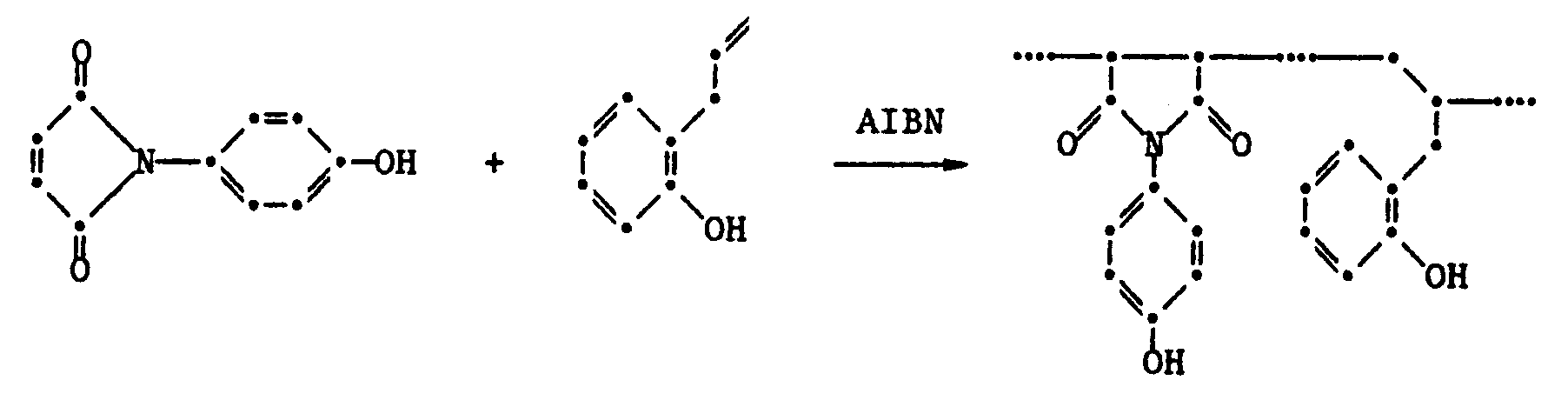
- Eine Apparatur bestehend aus 100 ml Dreihalsrundkolben, Magnetrührer, Oelbad, Thermometer, Kühler sowie Gaseinleitungsrohr und Blasenzähler beschickt man mit:
- 9,45 g ( 50 mMol)
- p-Maleinimidylphenol
- 40,25 g (300 mMol)
- 2-Allylphenol
- 0,28 g ( 1,7 mMol)
- α,αʹ-Azobisisobutyronitril (AIBN)
- In einem schwachen Stickstoffstrom rührt man das Reaktionsgemisch während 24 Stunden bei ca. 65°C. Danach wird die gelbliche Suspension unter Rühren langsam in 300 ml Ether eingetragen, der Niederschlag abfiltriert und mit ca. 200 ml Ether gewaschen. Nach dem Trocknen verbleiben 12,3 g farbloses Pulver.
- gefunden %: C 68,12 H 5,86 N 4,40
Zusammensetzung berechnet nach N-Gehalt: 3,15 Mol/kg Maleinimidylphenol
Gehalt an phenolischem OH: 5,56 Mol/kg
-

- Eine Apparatur bestehend aus: 1 l Dreihalsrundkolben, Magnetrührer, Oelbad, Thermometer, Kühler sowie Gaseinleitungsrohr und Blasenzähler beschickt man mit:
- 18,92 g (100 mMol)
- p-Maleinimidylphenol
- 65,49 g (300 mMol)
- 2,6-Dimethyl-4-allyl-phenylglycidylether
- 0,38 g ( 2,3 mMol)
- α,αʹ-Azobisisobutyronitril (AIBN)
- 420 ml
- Tetrahydrofuran
- In einem schwachen Stickstoffstrom rührt man das Reaktionsgemisch während 24 Stunden bei ca. 65°C. Danach wird die gelbliche Suspension unter Rühren langsam in 1 l Ether eingetragen, der Niederschlag abfiltriert und mit ca. 200 ml Ether gewaschen. Nach dem Trocknen verbleiben 17,0 g farbloses Pulver.
- gefunden %: C 66,83 H 5,78 N 4,65
Zusammensetzung berechnet nach N-Gehalt: 4,14 Mol/kg Maleinimidylphenol
-

- Analog dem Verfahren von Beispiel 4 polymerisiert man:
- 18,92 g (100 mMol)
- p-Maleinimidylphenol
- 90,00 g (762 mMol)
- Allylbenzol
- 0,39 g ( 2,4 mMol)
- α,αʹ-Azobisisobutyronitril (AIBN)
- Nach dem Eintragen in Ether, Filtrieren, Waschen mit Ether und Trocknen verbleiben 20,8 g farbloses Pulver.
- gefunden %: C 71,15 H 5,72 N 5,12
Zusammensetzung berechnet nach N-Gehalt: 3,65 Mol/kg Maleinimidylphenol
-

- Analog dem Verfahren von Beispiel 5 polymerisiert man:
- 18,92 g (100 mMol)
- p-Maleinimidylphenol
- 95,12 (500 mMol)
- 2-Allyl-phenylglycidylether
- 0,38 g ( 2,3 mMol)
- α,αʹ-Azobisisobutyronitril (AIBN)
- 400 ml
- Tetrahydrofuran
- Nach dem Eintragen in Ether, Filtrieren, Waschen mit Ether und Trocknen verbleiben 17,2 g farbloses Pulver.
- gefunden %: C 67,16 H 5,49 N 4,66
Zusammensetzung berechnet nach N-Gehalt: 3,33 Mol/kg Maleinimidylphenol
-

- Analog dem Verfahren von Beispiel 5 polymerisiert man:
- 19,40 g (102,6 mMol)
- p-Maleinimidylphenol
- 100,00 g (616 mMol)
- 4-Allyl-2,6-dimethylphenol
- 0,39 g ( 2,4 mMol)
- α,αʹ-Azobisisobutyronitril (AIBN)
- 400 ml
- Tetrahydrofuran
- Nach dem Eintragen in Ether, Filtrieren, Waschen mit Ether und Trocknen verbleiben 27.3 g farbloses Pulver.
- gefunden (%): C 68,08 H 5,77 N 4,92
Zusammensetzung berechnet nach N-Gehalt: 3,53 Mol/kg Maleinimidylphenol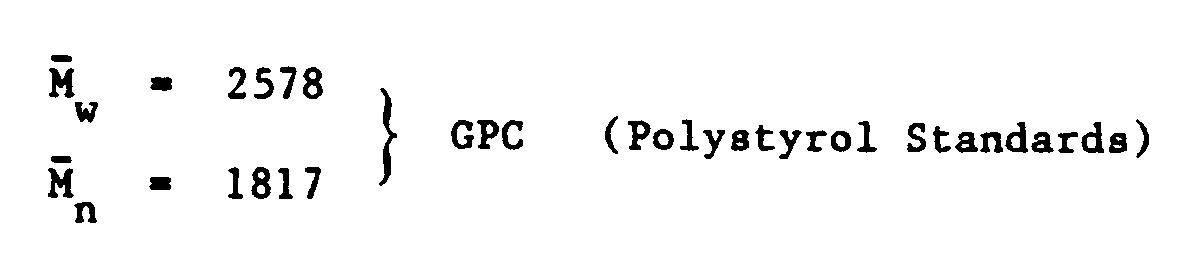
-

- Analog dem Verfahren von Beispiel 1 polymerisiert man
- 189,17 g (1,0 Mol)
- p-Maleinimidylphenol
- 232,32 g (4,0 Mol)
- Allylalkohol
- 600 g
- 1-Methoxypropanol (Dowanol®PM)
- 3,83 g
- α,αʹ-Azobisisobutyronitril (AIBN)
- gefunden (%): C 61,20 H 5,87 N 5,44
Zusammensetzung (aus N-Gehalt): - 3,88 Mol/kg
- Maleinimidylphenol
- 4,57 Mol/kg
- Allylalkohol

-

- Analog dem Verfahren von Beispiel 1 polymerisiert man
- 9,45 g (0,05 Mol)
- p-Maleinimidylphenol
- 22,84 g (0,20 Mol)
- Allylbutylether
- 30,0 g
- 1-Methoxypropanol (Dowanol®PM)
- 0,235 g
- α,αʹ-Azobisisobutyronitril (AIBN)
- gefunden (%): C 63,91 H 6,18 N 5,38
Zusammensetzung (aus N-Gehalt): - 3,84 Mol/kg
- Maleinimidylphenol
- 2,39 Mol/kg
- Allylbutylether
-

- Analog dem Verfahren von Beispiel 1 polymerisiert man
- 9,45 g (0,05 Mol)
- p-Maleinimidylphenol
- 20,02 g (0,20 Mol)
- Essigsäure-allylester
- 30,0 g
- 1-Methoxypropanol (Dowanol®PM)
- 0,22 g
- α,αʹ-Azobisisobutyronitril (AIBN)
- gefunden (%): C 61,11 H 5,47 N 5,43
Zusammensetzung berechnet aus N-Gehalt: - 3,88 Mol/kg
- Maleinimidylphenol
- 2,66 Mol/kg
- Essigsäure-allylester
- Dieses Beispiel zeigt die Anwendung als Bindemittel für die Formulierung von wässrig-alkalisch entwickelbaren Negativ-Photoresists auf Epoxidharz-Basis.
- Polymer aus Beispiel 1 1,80 g
3,4-Epoxicyclohexylmethyl-3,4-epoxicyclohexancarboxylat 1,20 g
Photoinitiator (Stilben-cyclopentadienyl-eisen-(II)-hexafluorphosphat als 10 %ige Lösung in Cyclohexanon) 1,50 g
Orasolrot B Farbstoff 0,006 g
Methylethylketon/Methylcellosolve 5,50 g
Unter Gelblicht beschichtet man die Lösung mittels eines Ziehrakels in ca. 100 µm Nassfilmdicke auf eine gereinigte, kupferkaschierte Leiterplatte. Man trocknet während 30 Min bei 80°C und erhält eine Trockenschichtdicke von ca. 25 g/m². Diese Photoresist-beschichtete Leiterplatte wird durch eine Photomaske (Stouffer Sensitivity Guide) mittels einer 5000 W Halogenlampe (Silvania M 061) im Abstand von 65 cm wie üblich belichtet und dann thermisch nachbehandelt. Als Entwickler dient folgende Lösung: - 75,00 g
- Natrium-metasilicat pentahydrat
- 0,40 g
- Suprionic® B 50 (ABM Chemicals Ltd, Stockport Cheshire GB); Netzmittel
- 1925,00 g
- Deionisiertes Wasser.
-
- Belichtungszeit:
- 15 sec
- Thermische Behandlung:
- 10 Min/120°C
- Entwicklungszeit:
- 30 sec/20°C (Manuell mit Baumwolltuch)
- Keilkopie:
- Letzte abgebildete Stufe = Nr.9


Claims (12)
- Copolymere enthaltend 30-100 Mol%, bezogen auf das Gesamtpolymere, an Struktureinheiten der Formeln I und II, wobei der Anteil der Reste der Formel I, bezogen auf den gesamten Anteil von I und II, 5 bis 95 Mol% ausmacht

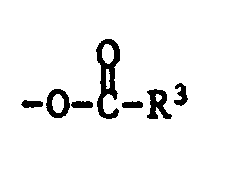
R² Wasserstoff oder -COR³ bedeutet und R³ C₁-C₂₀Alkyl ist,
m 1, 2 oder 3 darstellt, n 0, 1, 2, 3 oder 4 ist und die Summe von m und n höchstens 5 bedeutet, A ausgewählt wird aus der Gruppe der Reste bestehend aus Halogen, Cyano oder Struktureinheiten der Formeln III bis VIII

o und q unabhängig voneinander 0, 1, 2 oder 3 sind,
p und r unabhängig voneinander 0, 1, 2, 3, 4 oder 5 bedeuten,
wobei die Summen o+p und q+r höchstens 5 betragen dürfen,
R⁸ Wasserstoff, C₁-C₂₀Alkyl, ein Glycidylrest der Formel IXa oder ein Rest der Formel VI ist,
R⁹ Wasserstoff, C₁-C₂₀Alkyl, Cycloalkyl mit 5-7 Ring C-Atomen, Phenyl, Naphthyl oder Benzyl darstellt,
R¹⁰ Wasserstoff, C₁-C₂₀Alkyl oder ein Glycidylrest der Formel IXa ist und die Gruppen R¹¹ und R¹² unabhängig voneinander Wasserstoff, C₁-C₂₀Alkyl, Cycloalkyl mit 5-7 Ring C-Atomen, gegebenenfalls substituiertes Aryl oder Aralkyl oder ein Glycidylrest der Formel IXa sind oder zusammen mit dem gemeinsamen Stickstoffatom einen fünf- oder sechsgliedrigen nichtaromatischen heterocyclischen Ring bilden und R¹³ und R¹⁴ unabhängig voneinander Wasserstoff oder Methyl sind, wobei die Reste R¹ bis R¹⁴ und A eines Polymermoleküls innerhalb der gegebenen Definitionen unterschiedlich sein können;
und 70-0 mol%, bezogen auf das Gesamtpolymere, an Struktureinheiten, die sich von radikalisch polymerisierbaren Vinylverbindungen ableiten. - Copolymere gemäss Anspruch 1, worin der Anteil der Struktureinheiten I und 11 50-100 Mol%, bezogen auf das Gesamtpolymere, ausmacht.
- Copolymere gemäss Anspruch I bestehend ausschliesslich aus Strukturelementen der Formeln I und II.
- Copolymere gemäss Anspruch 1, worin der Anteil der Reste der Formel I, bezogen auf den Anteil von I und II, 10-80 Mol% ausmacht.
- Copolymere gemäss Anspruch 1, worin R² Wasserstoff bedeutet.
- Copolymere gemäss Anspruch 5, worin A ausgewählt wird aus der Gruppe der Reste der Formeln III, IV, V, VII und VIII, R⁴ und R⁶ Glycidylgruppen der Formeln IXa oder IXb darstellen, R⁸, R¹⁰ und mindestens einer der Reste R¹¹ oder R¹² eine Glycidylgruppe der Formel IXa ist und o und q unabhängig voneinander 1, 2 oder 3 sind.
- Copolymere gemäss Anspruch 5, worin A ein Rest der Formel V ist und R⁸ eine Gruppe der Formel IXa bedeutet.
- Copolymere gemäss Anspruch 5, worin A ein Gruppe der Formeln III oder IV ist, R⁴ und R⁶ Glycidylgruppen der Formel IXb sind, o und q 1 oder 2 bedeuten und p und r 0 sind.
- Copolymere gemäss Anspruch 5, worin m 1 ist, n 0, 1 oder 2 bedeutet, A ausgewählt wird aus der Gruppe bestehend aus den Resten der Formel III, IV oder V und R⁸ C₁-C₄Alkyl oder ein Rest der Formel VI ist, worin R⁹ C₁-C₄Alkyl bedeutet.
- Verfahren zur Herstellung von Copolymeren gemäss Anspruch 1 dadurch gekennzeichnet, dass mana) 30-100 mol% Verbindungen der Formel Ia und IIa
 b) 30-100 mol% Verbindungen der Formel Ib und IIa
- Verwendung der Copolymeren gemäss Anspruch 5 als Bindemittel für Photoresists oder als Epoxidhärter.
- Verwendung der Copolymeren gemäss Anspruch 6 als selbstvernetzende Epoxidharze.
Applications Claiming Priority (2)
| Application Number | Priority Date | Filing Date | Title |
|---|---|---|---|
| CH315686 | 1986-08-06 | ||
| CH3156/86 | 1986-08-06 |
Publications (3)
| Publication Number | Publication Date |
|---|---|
| EP0255802A2 EP0255802A2 (de) | 1988-02-10 |
| EP0255802A3 EP0255802A3 (en) | 1989-03-22 |
| EP0255802B1 true EP0255802B1 (de) | 1992-04-08 |
Family
ID=4249824
Family Applications (1)
| Application Number | Title | Priority Date | Filing Date |
|---|---|---|---|
| EP87810437A Expired - Lifetime EP0255802B1 (de) | 1986-08-06 | 1987-07-31 | Copolymere aus N-Hydroxyphenylmaleinimid(derivaten) und Allylverbindungen |
Country Status (5)
| Country | Link |
|---|---|
| US (1) | US4888402A (de) |
| EP (1) | EP0255802B1 (de) |
| JP (1) | JPS6366214A (de) |
| CA (1) | CA1293581C (de) |
| DE (1) | DE3778087D1 (de) |
Families Citing this family (7)
| Publication number | Priority date | Publication date | Assignee | Title |
|---|---|---|---|---|
| CA1338543C (en) * | 1988-12-27 | 1996-08-20 | Mohinder S. Chattha | Thermosettable powder compositions of polymaleimide and allyl-functional prepolymer |
| JPH0548904U (ja) * | 1991-12-09 | 1993-06-29 | 株式会社マルトー | 姿勢保持の警報装置 |
| US5302680A (en) * | 1992-12-30 | 1994-04-12 | Eastman Kodak Company | Copolymers of epoxybutadiene and maleimides |
| WO1994015975A1 (en) * | 1992-12-30 | 1994-07-21 | Eastman Chemical Company | Copolymers of epoxybutadiene and imidized derivatives of maleic anhydride |
| US20070036743A1 (en) * | 2005-08-10 | 2007-02-15 | Isp Investments Inc. | Antimicrobial polymers |
| US20110160341A1 (en) | 2009-12-30 | 2011-06-30 | E. I. Du Pont De Nemours And Company | Composition for fixing wound items |
| DE112014000568B4 (de) | 2013-01-25 | 2023-09-07 | Axalta Coating Systems Gmbh | Zusammensetzung zum Fixieren von bewickelten Gegenständen, Verfahren zu deren Herstellung, Verfahren zum Fixieren von bewickelten Gegenständen und bewickelter Gegenstand |
Family Cites Families (13)
| Publication number | Priority date | Publication date | Assignee | Title |
|---|---|---|---|---|
| US3265708A (en) * | 1961-03-01 | 1966-08-09 | Us Rubber Co | Nu-parahydroxyphenylmaleimide |
| NL275223A (de) * | 1961-03-01 | |||
| JPS4928673B1 (de) * | 1970-06-09 | 1974-07-29 | ||
| JPS4928697A (de) * | 1972-07-13 | 1974-03-14 | ||
| US4205151A (en) * | 1975-04-04 | 1980-05-27 | Dynapol | Polymeric N-substituted maleimide antioxidants |
| AU511667B2 (en) * | 1976-09-02 | 1980-08-28 | Goodyear Tire And Rubber Company, The | Chemically bound antioxidants |
| JPS53134087A (en) * | 1977-04-28 | 1978-11-22 | Toshiba Corp | Heat-resistant resin composition |
| US4231934A (en) * | 1977-11-02 | 1980-11-04 | Mitsui Toatsu Chemicals, Incorporated | Process for the production of N-(hydroxyphenyl) maleimides |
| JPS5622311A (en) * | 1979-07-31 | 1981-03-02 | Mitsui Toatsu Chem Inc | Thermosetting resin composition |
| US4388451A (en) * | 1981-09-28 | 1983-06-14 | Ashland Oil, Inc. | Polymers derived from allylphenol or substituted allylphenol and maleic anhydride |
| CH647249A5 (de) * | 1981-12-23 | 1985-01-15 | Ciba Geigy Ag | Lagerstabile, waermehaertbare, einen polymerisationskatalysator enthaltende mischungen auf polyimidbasis. |
| US4609705A (en) * | 1983-07-18 | 1986-09-02 | General Electric Company | Polyimide molding compositions |
| JPS61162509A (ja) * | 1985-01-10 | 1986-07-23 | Nippon Shokubai Kagaku Kogyo Co Ltd | 熱可塑性樹脂およびそれを用いて成る熱可塑性樹脂組成物 |
-
1987
- 1987-07-29 US US07/079,056 patent/US4888402A/en not_active Expired - Fee Related
- 1987-07-31 EP EP87810437A patent/EP0255802B1/de not_active Expired - Lifetime
- 1987-07-31 DE DE8787810437T patent/DE3778087D1/de not_active Expired - Lifetime
- 1987-08-06 JP JP62197265A patent/JPS6366214A/ja active Pending
- 1987-08-06 CA CA000543844A patent/CA1293581C/en not_active Expired - Lifetime
Also Published As
| Publication number | Publication date |
|---|---|
| EP0255802A3 (en) | 1989-03-22 |
| DE3778087D1 (de) | 1992-05-14 |
| JPS6366214A (ja) | 1988-03-24 |
| EP0255802A2 (de) | 1988-02-10 |
| US4888402A (en) | 1989-12-19 |
| CA1293581C (en) | 1991-12-24 |
Similar Documents
| Publication | Publication Date | Title |
|---|---|---|
| EP0058638B1 (de) | Härtbare Zusammensetzung auf Basis eines säurehärtbaren Harzes und Verfahren zu dessen Härtung | |
| EP0200674B1 (de) | (Acylthiopropyl)-Polyphenole | |
| DE3114341A1 (de) | Acylphosphinverbindungen, ihre herstellung und verwendung | |
| DE69619575T2 (de) | Epoxyacrylatharze und ihre Verwendungen | |
| EP0072780B1 (de) | Imidylverbindungen, Polymere daraus und Verwendung der Polymeren | |
| EP0038300B1 (de) | Polymerisierbare Zusammensetzung und (Meth)acrylsäureester | |
| DE2626767A1 (de) | Imidyl-benzoldi- und -tricarbonsaeure-derivate | |
| EP0255802B1 (de) | Copolymere aus N-Hydroxyphenylmaleinimid(derivaten) und Allylverbindungen | |
| DE1100962B (de) | Verfahren zur Herstellung von Polymerisaten | |
| DE69315200T2 (de) | Neue härter und beschleuniger für epoxidharze und härtbare zusammensetzungen und verfahren | |
| CA1183639A (en) | Water-dispersible energy curable heterocyclic group- containing polyesters | |
| DE19537887A1 (de) | (Meth)acrylat mit einer Alkenyl-Gruppe, Epoxy(meth)acrylat, (Meth)acrylharz mit Alkenyl-Gruppen, (Metz)acrylharz mit Epoxy-Gruppen, hitzehärtbare Harzzusammensetzung, Beschichtungszusammensetzung, Pulver-Beschichtungszusammensetzung und Verfahren zu deren Herstellung | |
| DE3784356T2 (de) | Thiol/ene zusammensetzung. | |
| EP0231149B1 (de) | Mercaptan enthaltende Polyphenole | |
| EP0056971A1 (de) | Verfahren zur Herstellung von Copolymerisaten und Verwendung der erhaltenen Produkte | |
| EP0731815A1 (de) | Zur lackierung von automobilkarosserien geeignete pulverlacke | |
| DE2147899A1 (de) | Neue Polyglycidylverbindungen, Verfahren zu ihrer Herstellung und Anwendung | |
| DE2755359C2 (de) | ||
| DE69211874T2 (de) | Pulverlackzusammensetzung | |
| DE2334827A1 (de) | Neue epoxy-acrylsaeureester, verfahren zu ihrer herstellung und ihre anwendung | |
| DE68925953T2 (de) | Härtbare Zusammensetzung | |
| DE2461355C2 (de) | Ungesättigter Polyester | |
| DE3720851A1 (de) | Epoxidharze | |
| DE2411064A1 (de) | Mit butadienpolymeren modifizierte epoxyharze | |
| EP0340705B1 (de) | Neues Polyphenol und daraus hergestellte Duromere |
Legal Events
| Date | Code | Title | Description |
|---|---|---|---|
| PUAI | Public reference made under article 153(3) epc to a published international application that has entered the european phase |
Free format text: ORIGINAL CODE: 0009012 |
|
| 17P | Request for examination filed |
Effective date: 19870803 |
|
| AK | Designated contracting states |
Kind code of ref document: A2 Designated state(s): CH DE FR GB IT LI NL SE |
|
| PUAL | Search report despatched |
Free format text: ORIGINAL CODE: 0009013 |
|
| AK | Designated contracting states |
Kind code of ref document: A3 Designated state(s): CH DE FR GB IT LI NL SE |
|
| 17Q | First examination report despatched |
Effective date: 19901115 |
|
| GRAA | (expected) grant |
Free format text: ORIGINAL CODE: 0009210 |
|
| AK | Designated contracting states |
Kind code of ref document: B1 Designated state(s): CH DE FR GB IT LI NL SE |
|
| REF | Corresponds to: |
Ref document number: 3778087 Country of ref document: DE Date of ref document: 19920514 |
|
| ITF | It: translation for a ep patent filed | ||
| GBT | Gb: translation of ep patent filed (gb section 77(6)(a)/1977) | ||
| ET | Fr: translation filed | ||
| PLBE | No opposition filed within time limit |
Free format text: ORIGINAL CODE: 0009261 |
|
| STAA | Information on the status of an ep patent application or granted ep patent |
Free format text: STATUS: NO OPPOSITION FILED WITHIN TIME LIMIT |
|
| 26N | No opposition filed | ||
| PGFP | Annual fee paid to national office [announced via postgrant information from national office to epo] |
Ref country code: CH Payment date: 19941028 Year of fee payment: 8 |
|
| EAL | Se: european patent in force in sweden |
Ref document number: 87810437.1 |
|
| PGFP | Annual fee paid to national office [announced via postgrant information from national office to epo] |
Ref country code: FR Payment date: 19950606 Year of fee payment: 9 |
|
| PGFP | Annual fee paid to national office [announced via postgrant information from national office to epo] |
Ref country code: GB Payment date: 19950615 Year of fee payment: 9 |
|
| PGFP | Annual fee paid to national office [announced via postgrant information from national office to epo] |
Ref country code: DE Payment date: 19950619 Year of fee payment: 9 |
|
| PGFP | Annual fee paid to national office [announced via postgrant information from national office to epo] |
Ref country code: NL Payment date: 19950628 Year of fee payment: 9 |
|
| PGFP | Annual fee paid to national office [announced via postgrant information from national office to epo] |
Ref country code: SE Payment date: 19950630 Year of fee payment: 9 |
|
| PG25 | Lapsed in a contracting state [announced via postgrant information from national office to epo] |
Ref country code: LI Effective date: 19950731 Ref country code: CH Effective date: 19950731 |
|
| REG | Reference to a national code |
Ref country code: CH Ref legal event code: PL |
|
| PG25 | Lapsed in a contracting state [announced via postgrant information from national office to epo] |
Ref country code: GB Effective date: 19960731 |
|
| PG25 | Lapsed in a contracting state [announced via postgrant information from national office to epo] |
Ref country code: SE Effective date: 19960801 |
|
| PG25 | Lapsed in a contracting state [announced via postgrant information from national office to epo] |
Ref country code: NL Effective date: 19970201 |
|
| GBPC | Gb: european patent ceased through non-payment of renewal fee |
Effective date: 19960731 |
|
| PG25 | Lapsed in a contracting state [announced via postgrant information from national office to epo] |
Ref country code: FR Effective date: 19970328 |
|
| NLV4 | Nl: lapsed or anulled due to non-payment of the annual fee |
Effective date: 19970201 |
|
| PG25 | Lapsed in a contracting state [announced via postgrant information from national office to epo] |
Ref country code: DE Effective date: 19970402 |
|
| EUG | Se: european patent has lapsed |
Ref document number: 87810437.1 |
|
| REG | Reference to a national code |
Ref country code: FR Ref legal event code: ST |
|
| PG25 | Lapsed in a contracting state [announced via postgrant information from national office to epo] |
Ref country code: IT Free format text: LAPSE BECAUSE OF NON-PAYMENT OF DUE FEES;WARNING: LAPSES OF ITALIAN PATENTS WITH EFFECTIVE DATE BEFORE 2007 MAY HAVE OCCURRED AT ANY TIME BEFORE 2007. THE CORRECT EFFECTIVE DATE MAY BE DIFFERENT FROM THE ONE RECORDED. Effective date: 20050731 |