EP0255802B1 - Copolymères à partir de dérivés de N-hydroxyphényle maléimide et de composés allyliques - Google Patents
Copolymères à partir de dérivés de N-hydroxyphényle maléimide et de composés allyliques Download PDFInfo
- Publication number
- EP0255802B1 EP0255802B1 EP87810437A EP87810437A EP0255802B1 EP 0255802 B1 EP0255802 B1 EP 0255802B1 EP 87810437 A EP87810437 A EP 87810437A EP 87810437 A EP87810437 A EP 87810437A EP 0255802 B1 EP0255802 B1 EP 0255802B1
- Authority
- EP
- European Patent Office
- Prior art keywords
- mol
- formula
- radicals
- radical
- hydrogen
- Prior art date
- Legal status (The legal status is an assumption and is not a legal conclusion. Google has not performed a legal analysis and makes no representation as to the accuracy of the status listed.)
- Expired - Lifetime
Links
- 0 C*1**=NCNC1 Chemical compound C*1**=NCNC1 0.000 description 2
Classifications
-
- G—PHYSICS
- G03—PHOTOGRAPHY; CINEMATOGRAPHY; ANALOGOUS TECHNIQUES USING WAVES OTHER THAN OPTICAL WAVES; ELECTROGRAPHY; HOLOGRAPHY
- G03F—PHOTOMECHANICAL PRODUCTION OF TEXTURED OR PATTERNED SURFACES, e.g. FOR PRINTING, FOR PROCESSING OF SEMICONDUCTOR DEVICES; MATERIALS THEREFOR; ORIGINALS THEREFOR; APPARATUS SPECIALLY ADAPTED THEREFOR
- G03F7/00—Photomechanical, e.g. photolithographic, production of textured or patterned surfaces, e.g. printing surfaces; Materials therefor, e.g. comprising photoresists; Apparatus specially adapted therefor
- G03F7/004—Photosensitive materials
- G03F7/038—Macromolecular compounds which are rendered insoluble or differentially wettable
- G03F7/0388—Macromolecular compounds which are rendered insoluble or differentially wettable with ethylenic or acetylenic bands in the side chains of the photopolymer
-
- C—CHEMISTRY; METALLURGY
- C08—ORGANIC MACROMOLECULAR COMPOUNDS; THEIR PREPARATION OR CHEMICAL WORKING-UP; COMPOSITIONS BASED THEREON
- C08F—MACROMOLECULAR COMPOUNDS OBTAINED BY REACTIONS ONLY INVOLVING CARBON-TO-CARBON UNSATURATED BONDS
- C08F222/00—Copolymers of compounds having one or more unsaturated aliphatic radicals, each having only one carbon-to-carbon double bond, and at least one being terminated by a carboxyl radical and containing at least one other carboxyl radical in the molecule; Salts, anhydrides, esters, amides, imides, or nitriles thereof
- C08F222/36—Amides or imides
- C08F222/40—Imides, e.g. cyclic imides
- C08F222/404—Imides, e.g. cyclic imides substituted imides comprising oxygen other than the carboxy oxygen
-
- C—CHEMISTRY; METALLURGY
- C08—ORGANIC MACROMOLECULAR COMPOUNDS; THEIR PREPARATION OR CHEMICAL WORKING-UP; COMPOSITIONS BASED THEREON
- C08G—MACROMOLECULAR COMPOUNDS OBTAINED OTHERWISE THAN BY REACTIONS ONLY INVOLVING UNSATURATED CARBON-TO-CARBON BONDS
- C08G59/00—Polycondensates containing more than one epoxy group per molecule; Macromolecules obtained by polymerising compounds containing more than one epoxy group per molecule using curing agents or catalysts which react with the epoxy groups
- C08G59/18—Macromolecules obtained by polymerising compounds containing more than one epoxy group per molecule using curing agents or catalysts which react with the epoxy groups ; e.g. general methods of curing
- C08G59/40—Macromolecules obtained by polymerising compounds containing more than one epoxy group per molecule using curing agents or catalysts which react with the epoxy groups ; e.g. general methods of curing characterised by the curing agents used
- C08G59/62—Alcohols or phenols
-
- C—CHEMISTRY; METALLURGY
- C08—ORGANIC MACROMOLECULAR COMPOUNDS; THEIR PREPARATION OR CHEMICAL WORKING-UP; COMPOSITIONS BASED THEREON
- C08L—COMPOSITIONS OF MACROMOLECULAR COMPOUNDS
- C08L63/00—Compositions of epoxy resins; Compositions of derivatives of epoxy resins
-
- G—PHYSICS
- G03—PHOTOGRAPHY; CINEMATOGRAPHY; ANALOGOUS TECHNIQUES USING WAVES OTHER THAN OPTICAL WAVES; ELECTROGRAPHY; HOLOGRAPHY
- G03F—PHOTOMECHANICAL PRODUCTION OF TEXTURED OR PATTERNED SURFACES, e.g. FOR PRINTING, FOR PROCESSING OF SEMICONDUCTOR DEVICES; MATERIALS THEREFOR; ORIGINALS THEREFOR; APPARATUS SPECIALLY ADAPTED THEREFOR
- G03F7/00—Photomechanical, e.g. photolithographic, production of textured or patterned surfaces, e.g. printing surfaces; Materials therefor, e.g. comprising photoresists; Apparatus specially adapted therefor
- G03F7/004—Photosensitive materials
- G03F7/022—Quinonediazides
- G03F7/023—Macromolecular quinonediazides; Macromolecular additives, e.g. binders
- G03F7/0233—Macromolecular quinonediazides; Macromolecular additives, e.g. binders characterised by the polymeric binders or the macromolecular additives other than the macromolecular quinonediazides
Definitions
- the present invention relates to new copolymers of N-hydroxyphenylmaleimide (derivatives) and allyl compounds, a process for the preparation of these polymers, the use of these compounds as binders for photoresists or epoxy hardeners and the uses of the representatives of these compounds containing epoxy groups as self-crosslinking resins.
- Homopolymers of 4-substituted phenylmaleimides are known, for example from Kobunshi Kagaku 26 , 393-400 (1969) (Chem. Abstr. 71 , 61815 g).
- Homopolymers of N- (4-hydroxyphenyl) maleimides are known from BE-PS 613,801. Copolymers of N-hydroxyphenylmaleimide and (meth) acrylic acid derivatives or other vinyl monomers have also been reported, for example in Kobunshi Kagaku 29 , 643-7 (1972) and 26 , 593-601 (1969) (Chem. Abstr. 78 , 16624c and 72 , 21964u or by SR Turner et al. In Photopolymer Conference, Ellenville USA, October 22-30, 1985.
- the binders that are usually used in positive resists cannot generally be used in negative resists.
- polyphenols for example novolaks based on phenol and formaldehyde, have so far been used in positive resists but not in negative resists.
- the N-hydroxyphenylmaleimide copolymers according to the invention can be used both in positive and in negative resists. In this way it is possible to produce aqueous systems that can be developed in an alkaline-alkaline state with high temperature and shape stability.
- N-hydroxyphenylmaleimide polymers can be improved by incorporating allyl monomers into the polymer backbone.
- allyl monomers which simultaneously contain a phenolic hydroxyl group and a glycidyl radical in one molecule and which can be used as self-crosslinking epoxy resins.
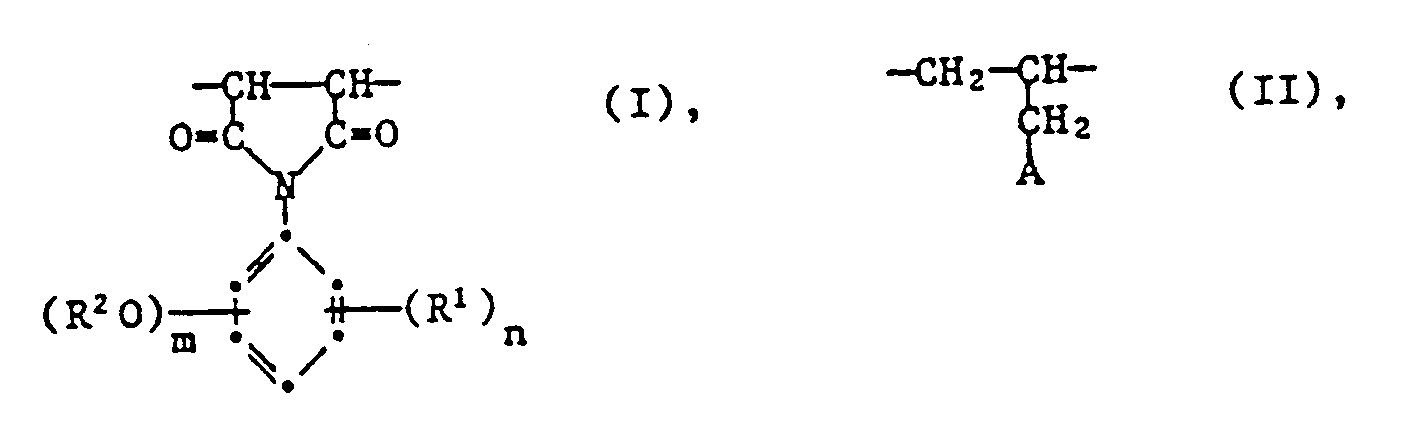
- the present invention relates to copolymers containing 30-100 mol%, based on the total polymer, of structural units of the formulas I and II, the proportion of the structural units of the formula I, based on the total proportion of I and II, being 5 to 95 mol%
- R1 is C1-C4alkyl, C1-C4alkoxy or halogen
- R2 is hydrogen or -COR3 and R3 is C1-C20alkyl
- m represents 1, 2 or 3
- n is 0, 1, 2, 3 or 4 and the sum of m and n is at most 5
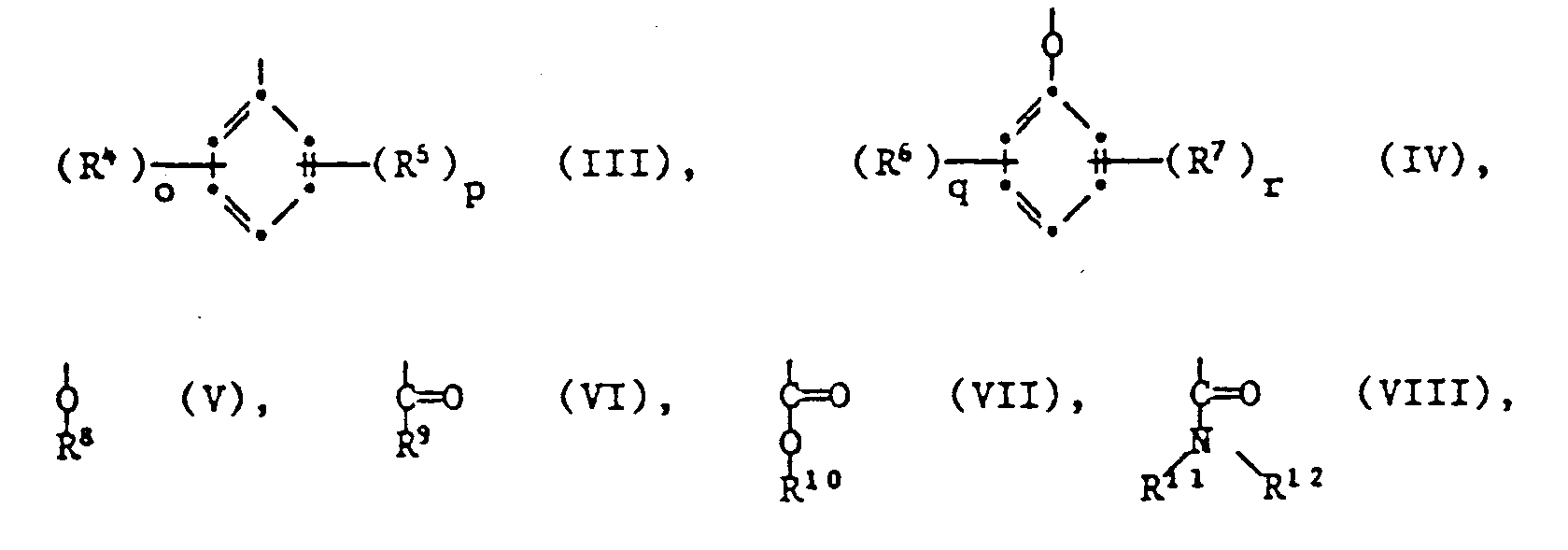
- A is selected from the group consisting of halogen, cyano or structural units of the formulas III to VIII wherein R4 and R6 are independently hydroxy, or glycidyl groups of the formula IXa or IXb
- R5 and R7 are independently C1-C4alkyl, C1-C4alkoxy or halogen
- o and q are independently 0, 1, 2 or 3
- R1, R5 or R7 are C1-C4alkyl, they are straight-chain or branched, preferably straight-chain, alkyl radicals. Examples of such groups are methyl, ethyl, n-propyl, isopropyl, n-butyl or sec-butyl. Methyl is preferred.
- alkyl part of R1, R5 or R7 has the meanings mentioned above as examples. Methoxy is preferred.
- R1, R5 or R7 are fluorine, chlorine, bromine or iodine. Chlorine or bromine, in particular bromine, is preferred.
- radicals C1-C20alkyl it is preferably straight-chain groups. But it can also be branched alkyl groups.
- C1-C20alkyl radicals are methyl, ethyl, n-propyl, isopropyl, n-butyl, sec-butyl, tert-butyl, n-pentyl, isoamyl, n-hexyl, n-heptyl, n-octyl, 2-ethylhexyl, n-nonyl, n-decyl, n-undecyl, n-dodecyl, n-tetradecyl, n-hexadecyl, n-octadecyl or n-eicosyl.
- C1-C8alkyl radicals of this type are preferred, especially the straight-chain and very particularly methyl or ethyl.
- a as halogen is fluorine, chlorine, bromine or iodine. Chlorine or bromine, in particular chlorine, is preferred.
- R9, R11 and R12 as cycloalkyl with 5-7 ring C atoms are generally cyclopentyl, cyclohexyl or cycloheptyl, but especially cyclohexyl. These radicals are optionally alkyl-substituted.
- R11 or R12 are for example phenyl or naphthyl.
- suitable substituents are alkyl groups, in particular methyl, alkoxy groups, in particular methoxy, halogen atoms, in particular chlorine or bromine, or cyano groups.
- substituted aryl radicals are o-, m- or p-tolyl, xylyl or chlorophenyl. Phenyl is preferred.
- R11 or R12 are, for example, benzyl, ⁇ -methylbenzyl or ⁇ , ⁇ -dimethylbenzyl.
- the radicals mentioned above for aryl as examples are also suitable here as substituents.
- substituted aralkyl radicals are 4-methylbenzyl or 4-methoxybenzyl. Benzyl is preferred.
- R11 and R12 form a five- or six-membered non-aromatic heterocyclic ring together with the common nitrogen atom, these are, for example, piperidyl, pyrrolidinyl or morpholinyl.
- Copolymers as defined above are preferred, in which the proportion of structural units I and II is 50-100 mol%, based on the total polymer.
- Copolymers consisting essentially of structural elements of the formulas I and II are very particularly preferred.
- the term "essentially” is to be understood as meaning a content of structural elements of the formulas I and II which, compared to a polymer, consists exclusively of the corresponding structural units I and II leads to no noticeable difference in the thermal, electrical and mechanical properties of the polymer.
- Copolymers consisting particularly of structural elements of the formulas I and II are particularly preferred.
- copolymers as defined above in which the proportion of the radicals of the formula I, based on the proportion of I and II, is 10-80 mol%, particularly preferably 30-75 mol%.
- copolymers containing structural units of the formulas I and II, in which R2 is hydrogen are also preferred. These are copolymers with N-hydroxyphenylmaleimide residues as the monomer unit.
- copolymers containing the structural units of the formulas I and II are preferred, in which R2 is hydrogen and A is selected from the group of the radicals of the formulas III, IV, V, VII and VIII, R4 and R6 are glycidyl groups of the formulas IXa or IXb, R8 , R10 and at least one of R11 or R12 is a glycidyl group of formula IXa and o and q are independently 1, 2 or 3.
- the index m is preferably 1 or 2, in particular 1.
- the index n preferably denotes 0, 1 or 2, but in particular 0 or 1, very particularly 0.
- the indices o and q are preferably 0 or 1, particularly preferably 0. In the case of comonomers with glycidyl radicals, they are preferably 1.
- the indices q and r are preferably 0 or 1, in particular 0.
- copolymers with the structural units of the formulas I and II, in which R2 is hydrogen, m is 1, n is 0, 1 or 2, A is selected from the group consisting of the radicals of the formulas III, IV or V and R8 C1 -C4Alkyl or a radical of formula VI, wherein R9 is C1-C4alkyl.
- copolymers according to the invention can surprisingly be produced under mild conditions in high yield and with relatively high molecular weights (M n : 500-100000).
- a further preference of process variant b) relates to the use of glycidyl group-containing allyl compounds IIa, particularly preferably the use of allyl compounds in which A is a radical of the formula V and R8 is a group of the formula IXa, or in which A is a radical of the formula III or IV, R4 and R6 are glycidyl groups of the formula IXb, o and q are 1 or 2 and p and r are 0.
- the compounds of the formulas Ia and Ib are known per se or can be prepared by standard reactions. These compounds and their preparation are described, for example, in US Pat. No. 4,289,699.
- allyl compounds of the formulas IIa are also known and some are commercially available.
- these monomers can also be olefins, for example ethylene or propylene.
- the copolymers are prepared by radical polymerization of the corresponding monomer mixture using heat or actinic radiation.
- the allyl monomer of the formula IIa is preferably used in excess, since the N-hydroxyphenylmaleimide (derivative) of the formula Ia or Ib has the tendency to polymerize preferably with itself.
- the comonomer ratio can be controlled as desired by choosing an excess of allyl compound. As a rule, excess allyl monomer must be separated from the copolymer after the reaction. This is done in a manner known per se, e.g. by precipitating the copolymer in a non-solvent.
- the polymerization is generally initiated by one of the usual free-radical polymerization initiators.
- thermal initiators such as azo compounds, for example azoisobutyronitrile (AIBN), or peroxides, for example - benzoyl peroxide, or redox initiator systems, such as a mixture of iron (III) acetyl acetonate, benzoin and benzoyl peroxide, or photochemical radical formers, such as benzoin or benzilmethyl ketal.
- azo compounds for example azoisobutyronitrile (AIBN)
- peroxides for example - benzoyl peroxide
- redox initiator systems such as a mixture of iron (III) acetyl acetonate, benzoin and benzoyl peroxide
- photochemical radical formers such as benzoin or benzilmethyl ketal.
- the copolymerization can be carried out in solution.
- the reaction temperature is generally in the range from 10 to 200 ° C., preferably between 40 and 150 ° C., particularly preferably between 40 and 100 ° C.
- Aromatic hydrocarbons, chlorinated hydrocarbons and ketones can be used as solvents. Examples include benzene, toluene, xylene, ethylbenzene, isopropylbenzene, ethylene chloride, propylene chloride, methylene chloride, chloroform, methyl ethyl ketone, acetone or cyclohexanone.
- reaction conditions in particular the choice of initiator and solvent, are generally known and are described in detail in the literature (for example in Houben-Weyl, Methods of Organic Chemistry, Vol. 14/1, pp. 24-110; G. Thieme Verlag 1961) .
- the usual processes are used as the polymerization process, for example bulk or solvent polymerization, emulsion, suspension or precipitation polymerization.
- M n measured by gel permeation chromatography
- copolymers according to the invention are solid products which are soluble in numerous organic solvents, for example in ketones or esters. With a sufficiently large proportion of structural units of the formula I with phenolic hydroxyl groups, the copolymers can even be dissolved in water, preferably in aqueous alkaline media.
- a reagent capable of introducing the R3-CO- residue, with which the product of the polymerization of the monomers Ia and IIa may be further reacted is generally understood to mean an acylating agent.
- acylating agent are in particular carboxylic acids or their activated derivatives, for example the corresponding acid chlorides, in particular acetyl chloride.
- a polymerization step is optionally followed by the polymerization of the monomers Ib and IIa.
- the acyl group of the N-phenylmaleimidyl radical is split off.
- the cleavage is carried out according to conventional methods, for example by hydrolysis in acid or basic medium. Such a sequence of reactions is described by SR Turner et al. in 'Photopolymer Conference, Ellenville USA (October 28-30, 1985), pp. 35-47'.
- copolymers according to the invention are used, for example, as binders for positive and negative photoresist systems.
- the derivatives with N- (hydroxyphenyl) maleimide units are preferably used for this purpose.
- These compounds can be developed in aqueous alkaline solutions because of their phenolic hydroxyl group content, and their use as binders for photoresists is also the subject of this invention.
- the copolymers allow the production of thermally stable resist images with good resolution, since they generally have relatively high glass transition temperatures (T g ) combined with good mechanical properties.
- copolymers according to the invention are particularly suitable as binders for negative resist systems based on epoxy resins and cationic photoinitiators.
- N- (hydroxyphenyl) maleimide copolymers of the invention relates to their use as hardeners for epoxy resins.
- the invention also relates to the use of N- (hydroxyphenyl) maleimide copolymers with glycidyl-substituted allyl units of the formula II as self-crosslinking epoxy resins.
- the compounds have both an epoxy group and a hardening function (phenol) in the same molecule.
- They can therefore be crosslinked by heating alone or in combination with conventional hardeners.
- they can be thermally hardened without further hardeners, preferably in the presence of conventional accelerators.
- the glycidyl group-containing copolymers of the present invention can, however, also be cured in a mixture with further, conventional thermal hardeners and, if appropriate, accelerators.
- Suitable additional epoxy resins which can be used in a mixture with the epoxy compounds according to the invention are the resins which are customarily used in the art of epoxy compounds.
- polyglycidyl and poly ( ⁇ -methylglycidyl) esters include, for example, polyglycidyl and poly ( ⁇ -methylglycidyl) esters, polyglycidyl and poly ( ⁇ -methylglycidyl) ethers, poly (N-glycidyl) compounds, poly (S-glycidyl) compounds or cycloaliphatic Epoxy resins.
- polyglycidyl ethers of bisphenols such as, for example, of 2,2-bis (4-hydroxyphenyl) propane or bis- (4-hydroxyphenyl) methane, of novolaks or of aliphatic diols, are used together with the epoxy resins according to the invention.
- Acidic, basic or catalytic hardeners are suitable as epoxy curing agents. These include, for example, amines or amides, such as aliphatic, cycloaliphatic or aromatic, primary, secondary or tertiary amines, for example hexamethylene diamine, N, N-diethylpropylene diamine, bis (4-aminocyclohexyl) methane, 3,5,5-trimethyl-3- (aminomethyl) cyclohexylamine ('isophoronediamine'), 2,4,6-tris (dimethylaminomethyl) phenol, p-phenylenediamine or bis- (4-aminophenyl) methane; or polyamides, for example those made from aliphatic polyamines and di- or trimerized unsaturated fatty acids; or polyhydric phenols such as resorcinol, 2,2-bis (4-hydroxyphenyl) propane or phenol-formaldehyde resins (Phenol no
- curable mixtures can also contain suitable plasticizers, such as dibutyl phthalate, dioctyl phthalate or tricresyl phosphate, or else reactive diluents, such as phenyl or cresyl glycidyl ether, butanediol diglycidyl ether or hexahydrophthalic acid diglycidyl ether.
- suitable plasticizers such as dibutyl phthalate, dioctyl phthalate or tricresyl phosphate
- reactive diluents such as phenyl or cresyl glycidyl ether, butanediol diglycidyl ether or hexahydrophthalic acid diglycidyl ether.
- the hardenable mixtures can be hardened in any phase with extenders, fillers and reinforcing agents, such as coal tar, bitumen, textile fibers, glass fibers, asbestos fibers, boron fibers, carbon fibers, mineral silicates, mica, quartz powder, aluminum oxide hydrate, bentonites, kaolin , Silica airgel or metal powders, e.g. Aluminum powder or iron powder, also with pigments and dyes such as carbon black, oxide paints, titanium dioxide.
- Other customary additives can also be added to the curable mixtures. e.g. Flame retardants, such as antimony trioxide, thixotropy agents, flow control agents, such as silicones, waxes or stearates (which are also used in part as mold release agents).
- the curable mixtures according to the invention can be prepared in the customary manner with the aid of known mixing units (stirrers, kneaders, rollers).
- the curable epoxy resin mixtures according to the invention are used above all in the fields of surface protection, electrical engineering, lamination processes and in construction. They can be used in formulations adapted to the specific application, in the unfilled or filled state, as paints, lacquers such as sintered powder lacquers, as molding compounds, immersion resins, casting resins, injection molding formulations, impregnating resins and adhesives, as Tool resins, laminating resins, sealants and fillers, flooring compounds and binders for mineral aggregates can be used.
- the cured products produced with the copolymers containing glycidyl groups according to the invention are notable for very good thermal, electrical and mechanical properties.
- hardening accelerators for hardening; such accelerators are e.g. tertiary amines, their salts or quaternary ammonium compounds, e.g. Benzyldimethylamine, 2,4,6-tris (dimethylaminomethyl) phenol, 1-methylimidazole, 2-ethyl-4-methylimidazole, 4-aminopyridine, tripentylammonium phenolate or tetramethylammonium chloride; or alkali metal alcoholates, e.g. Na alcoholates of 2,4-dihydroxy-3-hydroxymethylpentane.
- the curing of the copolymers according to the invention containing glycidyl groups is expediently carried out in the temperature range from 50 ° C. to 300 ° C., preferably from 80-250 ° C.
- the curing can also be carried out in a known manner in two or more stages, the first curing stage being carried out at a low temperature and the post-curing at a higher temperature.
- the curing can also be carried out in two stages such that the curing reaction is prematurely terminated or the first stage is carried out at a slightly elevated temperature, with a still meltable and / or soluble, curable precondensate (so-called "B stage") from the Epoxy component (a) and the optionally present hardener or accelerator (b) is obtained.
- a precondensate can e.g. serve to produce "prepregs", molding compounds or sinter powders.
- hardening means the conversion of the soluble, either liquid or meltable, polyepoxides into solid, insoluble and infusible, three-dimensionally crosslinked products or materials, usually under simultaneous shaping to shaped bodies such as castings, pressed bodies and laminates, to impregnation, coatings, paint films and bonds.
- the suspension After inerting with nitrogen, the suspension is heated with an oil bath while stirring. At an internal temperature of approx. 70 ° C, the polymerization sets in with considerable heat.
- the oil bath is removed and cooled with an ice bath for approx. 10 minutes.
- the oil bath is then used to heat for 7 hours at a temperature of approx. 70 ° C.
- the yellowish suspension is introduced into 4000 ml of toluene with thorough stirring, the precipitate is filtered off and dried in vacuo at 60 ° C. for 14 hours.
- the solid product is dissolved in acetone and again precipitated from toluene. After drying in vacuo, 427.9 g of colorless, solid copolymer remain.
- the mixture is inertized with nitrogen and polymerized at about 70 ° C. for 7 hours, as described in Example 1.
- the yellowish, clear solution is added dropwise to toluene with thorough stirring, the precipitate is filtered off and dried in vacuo at 60.degree. After reprecipitation of the acetone solution in toluene, 19.86 g of solid copolymer remain as a powder after drying.
- reaction mixture is stirred in a weak stream of nitrogen at about 65 ° C. for 24 hours.
- the yellowish suspension is then slowly introduced into 300 ml of ether with stirring, the precipitate is filtered off and washed with about 200 ml of ether. After drying, 12.3 g of colorless powder remain.
- reaction mixture is stirred in a weak stream of nitrogen at about 65 ° C. for 24 hours.
- the yellowish suspension is then slowly introduced into 1 l of ether with stirring, the precipitate is filtered off and washed with about 200 ml of ether. After drying, 17.0 g of colorless powder remain.
- This example shows the use as a binder for the formulation of aqueous-alkaline developable negative photoresists based on epoxy resin.
Landscapes
- Chemical & Material Sciences (AREA)
- Physics & Mathematics (AREA)
- Health & Medical Sciences (AREA)
- Chemical Kinetics & Catalysis (AREA)
- Medicinal Chemistry (AREA)
- Polymers & Plastics (AREA)
- Organic Chemistry (AREA)
- Spectroscopy & Molecular Physics (AREA)
- General Physics & Mathematics (AREA)
- Addition Polymer Or Copolymer, Post-Treatments, Or Chemical Modifications (AREA)
Claims (12)
- Copolymères renfermant de 30 à 100 % en moles, par rapport au polymère total, d'unités structurales de formules I et II, la proportion des unités structurales de formule I par rapport à l'ensemble des unités I et II représentant de 5 à 95 % en moles,
 R¹ représente un alkyle en C₁-C₄, un alcoxy en C₁-C₄ ou un halogène,R² représente l'hydrogène ou un radical -COR³ dont le symbole R³ représente un alkyle en C₁-C₂₀,m est égal à 1, à 2 ou à 3,n est égal à 0, à 1, à 2, à 3 ou à 4, la somme (m+n) étant au plus égale à 5, etA représente un radical pris dans l'ensemble constitué par les halogènes, le cyano et les unités structurales répondant aux formules III à VIII :
 R⁴ et R⁶ représentent chacun, indépendamment l'un de l'autre, un hydroxy, un radical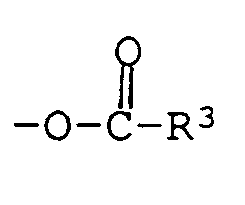
 R⁵ et R⁷ représentent chacun, indépendamment l'un de l'autre, un alkyle en C₁-C₄, un alcoxy en C₁-C₄ ou un halogène,o et q représentent chacun, indépendamment l'un de l'autre, un nombre égal à 0, à 1, à 2 ou à 3,p et r représentent chacun, indépendamment l'un de l'autre, un nombre égal à 0, à 1, à 2, à 3, à 4 ou à 5, la somme (o+p) et la somme (q+r) étant chacune au plus égale à 5,R⁸ représente l'hydrogène, un alkyle en C₁-C₂₀, un glycidyle de formule IXa ou un radical de formule VI,R⁹ représente l'hydrogène, un alkyle en C₁-C₂₀, un cycloalkyle contenant de 5 à 7 atomes de carbone dans son cycle, un phényle, un naphtyle ou un benzyle,R¹⁰ représente l'hydrogène, un alkyle en C₁-C₂₀ ou un glycidyle de formule IXa,R¹¹ et R¹² représentent chacun, indépendamment l'un de l'autre, l'hydrogène, un alkyle en C₁-C₂₀, un cycloalkyle contenant de 5 à 7 atomes de carbone dans son cycle, un radical aryle ou aralkyle éventuellement substitué ou un glycidyle de formule IXa, ou forment ensemble, avec l'atome d'azote commun, un hétérocycle non aromatique à 5 ou 6 maillons, etR¹³ et R¹⁴ représentent chacun, indépendamment l'un de l'autre, l'hydrogène ou un méthyle, les radicaux R¹ à R¹⁴ et A dans une même molécule de polymère pouvant avoir des significations différentes à l'intérieur des définitions données,et de 70 à 0 % en moles, par rapport au polymère total, d'unités structurales dérivant de composés vinyliques polymérisables par voie radicalaire.
 - Copolymères selon la revendication 1 dans lesquels la proportion des unités structurales I et II est de 50 à 100 % en moles par rapport au polymère total.
- Copolymères selon la revendication 1 qui sont constitués exclusivement d'unités structurales de formules I et II.
- Copolymères selon la revendication 1 dans lesquels la proportion des radicaux de formule I, par rapport à l'ensemble des radicaux I et IL, est comprise entre 10 et 80 % en moles.
- Copolymères selon la revendication 1 dans lesquels R² représente l'hydrogène.
- Copolymères selon la revendication 5 dans lesquels A est choisi dans l'ensemble constitué par les radicaux de formules III, IV, V, VII et VIII, R⁴ et R⁶ représentent chacun un radical glycidyle de formule IXa ou IXb, R⁸, R¹⁰ et au moins un des symboles R¹¹ et R¹² représentent un radical glycidyle de formule IXa, et o et q représentent chacun, indépendamment l'un de l'autre, un nombre égal à 1, à 2 ou à 3.
- Copolymères selon la revendication 5 dans lesquels A représente un radical de formule V et R⁸ un radical de formule IXa.
- Copolymères selon la revendication 5 dans lesquels A représente un radical de formule III ou IV, R⁴ et R⁶ représentent chacun un radical glycidyle de formule IXb, o et q sont égaux chacun à 1 ou à 2, et p et r sont égaux chacun à 0.
- Copolymères selon la revendication 5 dans lesquels m est égal à 1, n est égal à 0, à 1 ou à 2, A est choisi dans l'ensemble constitué par les radicaux de formules III, IV et V, et R⁸ représente un alkyle en C₁-C₄ ou un radical de formule VI dans lequel R⁹ représente un alkyle en C₁-C₄.
- Procédé pour préparer des copolymères selon la revendication 1, procédé caractérisé en ce que :a) on polymérise par voie radicalaire de 30 à 100 % en moles de composés répondant aux formules Ia et IIa :

ou en ce que :b) on polymérise par voie radicalaire de 30 à 100 % en moles de composés répondant aux formules Ib et IIa :
- Application des copolymères selon la revendication 5 comme liants pour des photorésists ou comme durcisseurs d'époxydes.
- Application des copolymères selon la revendication 6 comme résines époxydiques auto-réticulantes.
Applications Claiming Priority (2)
| Application Number | Priority Date | Filing Date | Title |
|---|---|---|---|
| CH315686 | 1986-08-06 | ||
| CH3156/86 | 1986-08-06 |
Publications (3)
| Publication Number | Publication Date |
|---|---|
| EP0255802A2 EP0255802A2 (fr) | 1988-02-10 |
| EP0255802A3 EP0255802A3 (en) | 1989-03-22 |
| EP0255802B1 true EP0255802B1 (fr) | 1992-04-08 |
Family
ID=4249824
Family Applications (1)
| Application Number | Title | Priority Date | Filing Date |
|---|---|---|---|
| EP87810437A Expired - Lifetime EP0255802B1 (fr) | 1986-08-06 | 1987-07-31 | Copolymères à partir de dérivés de N-hydroxyphényle maléimide et de composés allyliques |
Country Status (5)
| Country | Link |
|---|---|
| US (1) | US4888402A (fr) |
| EP (1) | EP0255802B1 (fr) |
| JP (1) | JPS6366214A (fr) |
| CA (1) | CA1293581C (fr) |
| DE (1) | DE3778087D1 (fr) |
Families Citing this family (7)
| Publication number | Priority date | Publication date | Assignee | Title |
|---|---|---|---|---|
| CA1338543C (fr) * | 1988-12-27 | 1996-08-20 | Mohinder S. Chattha | Compositions pulverulentes thermodurcissables a base de polymaleimide et d'un prepolymere allyle |
| JPH0548904U (ja) * | 1991-12-09 | 1993-06-29 | 株式会社マルトー | 姿勢保持の警報装置 |
| US5302680A (en) * | 1992-12-30 | 1994-04-12 | Eastman Kodak Company | Copolymers of epoxybutadiene and maleimides |
| WO1994015975A1 (fr) * | 1992-12-30 | 1994-07-21 | Eastman Chemical Company | Copolymeres d'epoxybutadiene et derives imidizes d'anhydride maleique |
| US20070036743A1 (en) * | 2005-08-10 | 2007-02-15 | Isp Investments Inc. | Antimicrobial polymers |
| US20110160341A1 (en) | 2009-12-30 | 2011-06-30 | E. I. Du Pont De Nemours And Company | Composition for fixing wound items |
| DE112014000568B4 (de) | 2013-01-25 | 2023-09-07 | Axalta Coating Systems Gmbh | Zusammensetzung zum Fixieren von bewickelten Gegenständen, Verfahren zu deren Herstellung, Verfahren zum Fixieren von bewickelten Gegenständen und bewickelter Gegenstand |
Family Cites Families (13)
| Publication number | Priority date | Publication date | Assignee | Title |
|---|---|---|---|---|
| US3265708A (en) * | 1961-03-01 | 1966-08-09 | Us Rubber Co | Nu-parahydroxyphenylmaleimide |
| NL275223A (fr) * | 1961-03-01 | |||
| JPS4928673B1 (fr) * | 1970-06-09 | 1974-07-29 | ||
| JPS4928697A (fr) * | 1972-07-13 | 1974-03-14 | ||
| US4205151A (en) * | 1975-04-04 | 1980-05-27 | Dynapol | Polymeric N-substituted maleimide antioxidants |
| AU511667B2 (en) * | 1976-09-02 | 1980-08-28 | Goodyear Tire And Rubber Company, The | Chemically bound antioxidants |
| JPS53134087A (en) * | 1977-04-28 | 1978-11-22 | Toshiba Corp | Heat-resistant resin composition |
| US4231934A (en) * | 1977-11-02 | 1980-11-04 | Mitsui Toatsu Chemicals, Incorporated | Process for the production of N-(hydroxyphenyl) maleimides |
| JPS5622311A (en) * | 1979-07-31 | 1981-03-02 | Mitsui Toatsu Chem Inc | Thermosetting resin composition |
| US4388451A (en) * | 1981-09-28 | 1983-06-14 | Ashland Oil, Inc. | Polymers derived from allylphenol or substituted allylphenol and maleic anhydride |
| CH647249A5 (de) * | 1981-12-23 | 1985-01-15 | Ciba Geigy Ag | Lagerstabile, waermehaertbare, einen polymerisationskatalysator enthaltende mischungen auf polyimidbasis. |
| US4609705A (en) * | 1983-07-18 | 1986-09-02 | General Electric Company | Polyimide molding compositions |
| JPS61162509A (ja) * | 1985-01-10 | 1986-07-23 | Nippon Shokubai Kagaku Kogyo Co Ltd | 熱可塑性樹脂およびそれを用いて成る熱可塑性樹脂組成物 |
-
1987
- 1987-07-29 US US07/079,056 patent/US4888402A/en not_active Expired - Fee Related
- 1987-07-31 EP EP87810437A patent/EP0255802B1/fr not_active Expired - Lifetime
- 1987-07-31 DE DE8787810437T patent/DE3778087D1/de not_active Expired - Lifetime
- 1987-08-06 JP JP62197265A patent/JPS6366214A/ja active Pending
- 1987-08-06 CA CA000543844A patent/CA1293581C/fr not_active Expired - Lifetime
Also Published As
| Publication number | Publication date |
|---|---|
| EP0255802A3 (en) | 1989-03-22 |
| DE3778087D1 (de) | 1992-05-14 |
| JPS6366214A (ja) | 1988-03-24 |
| EP0255802A2 (fr) | 1988-02-10 |
| US4888402A (en) | 1989-12-19 |
| CA1293581C (fr) | 1991-12-24 |
Similar Documents
| Publication | Publication Date | Title |
|---|---|---|
| EP0058638B1 (fr) | Compositions durcissables à base d'une résine durcissable par un acide et procédé pour leur durcissement | |
| EP0200674B1 (fr) | (Acylthiopropyl)-polyphénols | |
| DE3114341A1 (de) | Acylphosphinverbindungen, ihre herstellung und verwendung | |
| DE69619575T2 (de) | Epoxyacrylatharze und ihre Verwendungen | |
| EP0072780B1 (fr) | Composés imidyliques, polymères préparés à partir de ces composés et utilisation de ces polymères | |
| EP0038300B1 (fr) | Composition polymérisable et ester (méth)acrylique | |
| DE2626767A1 (de) | Imidyl-benzoldi- und -tricarbonsaeure-derivate | |
| EP0255802B1 (fr) | Copolymères à partir de dérivés de N-hydroxyphényle maléimide et de composés allyliques | |
| DE1100962B (de) | Verfahren zur Herstellung von Polymerisaten | |
| DE69315200T2 (de) | Neue härter und beschleuniger für epoxidharze und härtbare zusammensetzungen und verfahren | |
| CA1183639A (fr) | Polyesters renfermant un groupe heterocyclique, reticulables par apport d'energie, et dispersables dans l'eau | |
| DE19537887A1 (de) | (Meth)acrylat mit einer Alkenyl-Gruppe, Epoxy(meth)acrylat, (Meth)acrylharz mit Alkenyl-Gruppen, (Metz)acrylharz mit Epoxy-Gruppen, hitzehärtbare Harzzusammensetzung, Beschichtungszusammensetzung, Pulver-Beschichtungszusammensetzung und Verfahren zu deren Herstellung | |
| DE3784356T2 (de) | Thiol/ene zusammensetzung. | |
| EP0231149B1 (fr) | Polyphénols contenant des groupes mercapto | |
| EP0056971A1 (fr) | Procédé de préparation de copolymères et utilisation des produits obtenus | |
| EP0731815A1 (fr) | Peintures pulverulentes pour carrosseries d'automobiles | |
| DE2147899A1 (de) | Neue Polyglycidylverbindungen, Verfahren zu ihrer Herstellung und Anwendung | |
| DE2755359C2 (fr) | ||
| DE69211874T2 (de) | Pulverlackzusammensetzung | |
| DE2334827A1 (de) | Neue epoxy-acrylsaeureester, verfahren zu ihrer herstellung und ihre anwendung | |
| DE68925953T2 (de) | Härtbare Zusammensetzung | |
| DE2461355C2 (de) | Ungesättigter Polyester | |
| DE3720851A1 (de) | Epoxidharze | |
| DE2411064A1 (de) | Mit butadienpolymeren modifizierte epoxyharze | |
| EP0340705B1 (fr) | Polyphénols et duromères obtenus à partir de ces polyphénols |
Legal Events
| Date | Code | Title | Description |
|---|---|---|---|
| PUAI | Public reference made under article 153(3) epc to a published international application that has entered the european phase |
Free format text: ORIGINAL CODE: 0009012 |
|
| 17P | Request for examination filed |
Effective date: 19870803 |
|
| AK | Designated contracting states |
Kind code of ref document: A2 Designated state(s): CH DE FR GB IT LI NL SE |
|
| PUAL | Search report despatched |
Free format text: ORIGINAL CODE: 0009013 |
|
| AK | Designated contracting states |
Kind code of ref document: A3 Designated state(s): CH DE FR GB IT LI NL SE |
|
| 17Q | First examination report despatched |
Effective date: 19901115 |
|
| GRAA | (expected) grant |
Free format text: ORIGINAL CODE: 0009210 |
|
| AK | Designated contracting states |
Kind code of ref document: B1 Designated state(s): CH DE FR GB IT LI NL SE |
|
| REF | Corresponds to: |
Ref document number: 3778087 Country of ref document: DE Date of ref document: 19920514 |
|
| ITF | It: translation for a ep patent filed | ||
| GBT | Gb: translation of ep patent filed (gb section 77(6)(a)/1977) | ||
| ET | Fr: translation filed | ||
| PLBE | No opposition filed within time limit |
Free format text: ORIGINAL CODE: 0009261 |
|
| STAA | Information on the status of an ep patent application or granted ep patent |
Free format text: STATUS: NO OPPOSITION FILED WITHIN TIME LIMIT |
|
| 26N | No opposition filed | ||
| PGFP | Annual fee paid to national office [announced via postgrant information from national office to epo] |
Ref country code: CH Payment date: 19941028 Year of fee payment: 8 |
|
| EAL | Se: european patent in force in sweden |
Ref document number: 87810437.1 |
|
| PGFP | Annual fee paid to national office [announced via postgrant information from national office to epo] |
Ref country code: FR Payment date: 19950606 Year of fee payment: 9 |
|
| PGFP | Annual fee paid to national office [announced via postgrant information from national office to epo] |
Ref country code: GB Payment date: 19950615 Year of fee payment: 9 |
|
| PGFP | Annual fee paid to national office [announced via postgrant information from national office to epo] |
Ref country code: DE Payment date: 19950619 Year of fee payment: 9 |
|
| PGFP | Annual fee paid to national office [announced via postgrant information from national office to epo] |
Ref country code: NL Payment date: 19950628 Year of fee payment: 9 |
|
| PGFP | Annual fee paid to national office [announced via postgrant information from national office to epo] |
Ref country code: SE Payment date: 19950630 Year of fee payment: 9 |
|
| PG25 | Lapsed in a contracting state [announced via postgrant information from national office to epo] |
Ref country code: LI Effective date: 19950731 Ref country code: CH Effective date: 19950731 |
|
| REG | Reference to a national code |
Ref country code: CH Ref legal event code: PL |
|
| PG25 | Lapsed in a contracting state [announced via postgrant information from national office to epo] |
Ref country code: GB Effective date: 19960731 |
|
| PG25 | Lapsed in a contracting state [announced via postgrant information from national office to epo] |
Ref country code: SE Effective date: 19960801 |
|
| PG25 | Lapsed in a contracting state [announced via postgrant information from national office to epo] |
Ref country code: NL Effective date: 19970201 |
|
| GBPC | Gb: european patent ceased through non-payment of renewal fee |
Effective date: 19960731 |
|
| PG25 | Lapsed in a contracting state [announced via postgrant information from national office to epo] |
Ref country code: FR Effective date: 19970328 |
|
| NLV4 | Nl: lapsed or anulled due to non-payment of the annual fee |
Effective date: 19970201 |
|
| PG25 | Lapsed in a contracting state [announced via postgrant information from national office to epo] |
Ref country code: DE Effective date: 19970402 |
|
| EUG | Se: european patent has lapsed |
Ref document number: 87810437.1 |
|
| REG | Reference to a national code |
Ref country code: FR Ref legal event code: ST |
|
| PG25 | Lapsed in a contracting state [announced via postgrant information from national office to epo] |
Ref country code: IT Free format text: LAPSE BECAUSE OF NON-PAYMENT OF DUE FEES;WARNING: LAPSES OF ITALIAN PATENTS WITH EFFECTIVE DATE BEFORE 2007 MAY HAVE OCCURRED AT ANY TIME BEFORE 2007. THE CORRECT EFFECTIVE DATE MAY BE DIFFERENT FROM THE ONE RECORDED. Effective date: 20050731 |