EP0255997A2 - Dispositif de fixation monté sur un équipement de transport - Google Patents
Dispositif de fixation monté sur un équipement de transport Download PDFInfo
- Publication number
- EP0255997A2 EP0255997A2 EP87890185A EP87890185A EP0255997A2 EP 0255997 A2 EP0255997 A2 EP 0255997A2 EP 87890185 A EP87890185 A EP 87890185A EP 87890185 A EP87890185 A EP 87890185A EP 0255997 A2 EP0255997 A2 EP 0255997A2
- Authority
- EP
- European Patent Office
- Prior art keywords
- jaws
- transported
- lever
- vehicle
- support
- Prior art date
- Legal status (The legal status is an assumption and is not a legal conclusion. Google has not performed a legal analysis and makes no representation as to the accuracy of the status listed.)
- Ceased
Links
Images



Classifications
-
- F—MECHANICAL ENGINEERING; LIGHTING; HEATING; WEAPONS; BLASTING
- F41—WEAPONS
- F41A—FUNCTIONAL FEATURES OR DETAILS COMMON TO BOTH SMALLARMS AND ORDNANCE, e.g. CANNONS; MOUNTINGS FOR SMALLARMS OR ORDNANCE
- F41A23/00—Gun mountings, e.g. on vehicles; Disposition of guns on vehicles
- F41A23/26—Mountings for transport only; Loading or unloading arrangements for guns for use with carrier vehicles
-
- F—MECHANICAL ENGINEERING; LIGHTING; HEATING; WEAPONS; BLASTING
- F41—WEAPONS
- F41A—FUNCTIONAL FEATURES OR DETAILS COMMON TO BOTH SMALLARMS AND ORDNANCE, e.g. CANNONS; MOUNTINGS FOR SMALLARMS OR ORDNANCE
- F41A23/00—Gun mountings, e.g. on vehicles; Disposition of guns on vehicles
- F41A23/50—Travelling locks; Brakes for holding the gun platform in a fixed position during transport
Definitions
- the invention relates to a transport device with a holding device or a holding device on a transport device, in particular for holding projectile gun barrels on vehicles, with a frame, preferably a vehicle frame, which has at least one, in particular pivotably mounted, support, optionally a roller or the like, for the Transport object, for example the projectile barrel.
- the master patent relates to a vehicle, in particular a trailer vehicle, carrier or the like.
- a projectile weapon in particular a grenade launcher with a base plate that can be separated or separated from the latter, with a transport device on the rear side, in particular, facing away from the tiller, that has connecting elements that releasably cooperate with connecting elements of the projectile weapon, in particular the base plate of a grenade launcher.
- a support preferably designed as a roller, is provided for the weapon barrel with a releasable fixing member.
- the tube can slide on this tube support when the base plate is pulled up or set down. In an end position reached when loading, a fixation with a clamp or the like can then be carried out separately. respectively.
- the object of the invention is to continue this embodiment form, and to create a transport device or holding device which allows a safe and quickly releasable fixation of the goods to be transported, preferably by means of one-hand operation.
- the holding device has at least two mutually movable, the object of transport, preferably the projectile barrel, at least partially including basin, which is pivotally mounted on a carrier connected to the frame and as a two-armed lever are formed, wherein in each case one lever arm is provided for at least partially encompassing or holding the object to be transported and in each case the other lever arm, in particular with an adjusting rod or the like, on a rotary or mounted on the carrier, preferably provided with a handle.
- Lever body is articulated at a distance from its axis of rotation or lever, which is thus located between the articulation points of the two lever arms, which are preferably diametrically opposite one another with respect to the axis of the axis of rotation or lever body.
- This training allows a secure and quickly detachable fixation of the cargo. If this is a projectile barrel, rapid deployment is thus ensured, one operator being sufficient for loosening and fixing, and preferably one-handed operation.
- the special arrangement of the articulation points on the rotary or lever body ensures that the jaws for gripping or holding the transported goods against one another or move towards each other and swing out together when opening.
- the holding of the goods to be transported is made easier if the support for the object to be transported is also mounted on the carrier on which the jaws are pivotally mounted.
- the goods to be transported are possibly a projectile barrel, the like can be formed when the support is formed as a roller.
- the pivot pin of the jaws or the like substantially perpendicular to the axis of the roller. run.
- the carrier carrying the jaws can be connected to the tilting frame and thus be arranged pivotably with respect to the frame of the transport device.
- the adjusting rods are articulated on the jaws and / or on the rotary or lever body with pivot bearings, preferably self-aligning bearings.
- the adjusting rods are designed to be variable in length, preferably consist of two parts that can be adjusted in the axial direction by means of a thread.
- the turning or Lever body is rotatably mounted on a bush mounted on the carrier or on its carrier part, the axis of the bush preferably or the like being substantially perpendicular to the axis of the roller. runs.
- An expedient embodiment in practice consists in the fact that the rotary or lever body is formed from two disks arranged at a distance from one another in the axial direction, which are separated by at least two diametrically opposed disks at a distance from the axis of rotation of the rotary or.
- Bolt arranged lever body are penetrated, on which the adjusting rods are articulated, optionally by means of the pivot bearing.
- three or four jaws could also be three or four bolts as links for a corresponding number of adjusting rods.
- one of the disks has an extension on which the handle is arranged.
- the handle has a recess in which a pressure pin is slidably mounted in the axial direction, which can be brought into operative connection, preferably with a rocker arm, with a locking pin, which in at least one locking recess on the carrier or the carrier part can be brought into engagement.
- the jaws are formed in two or more parts, whereby too at least one, possibly made of metal, for example aluminum, or plastic insert or the like. in a, in particular U-shaped and made of aluminum or the like. existing part of the jaw used and with this, if necessary, firmly connected. However, this is not absolutely necessary.
- the inner surface of the jaws or the insert parts can optionally also have a shape that deviates from the curvature of the goods to be transported.
- the inner surface or recess of the jaws or the insert parts can also be non-circular.
- a particularly good holding is achieved if the jaws and / or their insert parts have systems which are adapted to the circumference or the curvature of the goods to be conveyed, the pincer-shaped receiving opening for the tubular goods to be transported delimited by the support and the two jaws preferably having the same diameter is adjusted.
- the jaws and / or their insert parts with recesses e.g. are provided to accommodate the legs of the bipod.
- jaws and / or their insert parts are curved in the shape of a handle or hook at the freely projecting outer ends of the lever arm which is used to partially encompass the goods to be transported.
- At least one of the screws for connecting the insert parts or the like. is slidably guided with the baking in an elongated hole.
- the locking pin is held in its latching recess with at least one compression spring.
- the jaws and / or their insert parts on their inner surface facing the goods to be transported are covered with a friction-increasing or heat-resistant material, e.g. a brake pad are provided, the support being at least partially adapted to the circumference or the curvature of the goods to be transported.
- a friction-increasing or heat-resistant material e.g. a brake pad
- the support can have at least one, in particular flat, section which runs differently from the curvature of the goods to be transported.
- a trailer vehicle with the holding device according to the invention is shown in side view.
- the trailer vehicle is a coffer 100 with two wheels 3, which have conventional pneumatic tires and are suspended on axle swing arms 2 and with a loading device 200.
- the trailer vehicle further comprises a vehicle frame or a vehicle frame 1 and a retractable or foldable coffer support 22 and a drawbar 27.
- Die Drawbar 27 has an eyelet 26 for coupling to a towing vehicle and a parallel drive 23, for example Fixing recesses 28 cooperating with plug pins and link not shown, on, whereby it can be adjusted in parallel and height-fixed.
- the drawbar 27 further comprises a hook 30 and safety chains 301 and a hand brake with lever 24.
- a carriage 10 which is designed as a guide element for an approximately Y-type compensating lever body 11 which is articulated to it with a leg, is movably guided.
- the compensating lever body 11 can be pivoted about the longitudinal axis A1 of the articulated leg of the Y-frame.
- a cable winch 21 arranged near the drawbar with a hand crank 20
- Reelable steel cable 37 which is hooked into the suspension bolt 181 of a compensating lever body 11 with a hook member 371 approximately in the region of the fork of the Y frame at 370 articulated pulling leg 18, change the horizontal position of the compensating lever body 11 in the longitudinal direction R1, R2 of the vehicle 100.
- a total of three flexible tension elements 13a, 13b, 14 extend from the compensating lever body 11 in the longitudinal direction R2 to the rear of the vehicle from the end 140 of the leg of the Y-frame articulated on the carriage 10 and from its two other free ends 130a, 130b.
- tension elements 13a, 13b, 14 are releasably connected to the compensating lever body 11 via connecting elements 36, 35.
- the tension elements 13a, 13b, 14 are deflected in the downward direction by means of deflection rollers 7 arranged on a tilting frame which is connected to the vehicle frame 1 in an articulated manner. They carry at their free ends connecting elements, for example hooking eyelets 12, which are detachably connected to three of six hooks 48 arranged above the surface of the base plate 40 of a grenade launcher 400 with a grenade launcher tube 41 and arranged essentially in a regular hexagon in plan view.
- the hooks 48 have brackets 480 connected to the base plate 40, which are each connected again to the base plate 40 via a connecting piece 482, forming a closed, handle-like, stable manipulation handle 485.
- the flexible tension elements 13a, 13b, 14 are provided with recesses 81 by means of which, for example, tube-like position retaining eyes 8, which can cooperate with the interacting suspension elements 48, 12 of the base plate 40 and tension elements, by means of which position-stabilizing cooperation with the suspension hooks 48 of the base plate 40 takes place when this first in dash-dotted lines shown position A is pulled up against the tipping frame 6 and finally tipped with it into the transport position T of FIG. 1, also indicated by dash-dotted lines.
- the base plate 40 of the grenade launcher 400 has a bearing body 401 with a spherical recess 402, which cooperates with the correspondingly designed base piece 411 of the grenade launcher tube 41, and a height-swiveling limiting element 49 with a manipulation element 498, which can be rotated and positioned in 360 ° within the bearing body 401 .
- the grenade launcher tube 41 itself is placed on a roller-like tube support 9 during and for loading and can be fixed in the locked state T with the holding device according to the invention, which is described in more detail below with reference to FIGS. 2-4.
- the tilting frame 6 has suspension travel limiting elements 32, which are also tilted down with it when it is tilted down and form an upper limit stop for the movement of the sprung steering knuckle 2.
- the tilting frame 6 is folded up with the base plate 40 connected to it by means of the holding eyes 8 so that it cannot move, the grenade launcher tube 41 lies essentially horizontally on the tube support roller 9 tilted with the tilting frame 6 and the traction force application cable 37 is wound up with the winch 21 and has only a small free length.
- the compensating lever body 11 With the carriage 10, the compensating lever body 11 is shifted into a position close to the drawbar in the longitudinal direction R1 of the vehicle, this compensating lever body 11 with its drawbar 18 or its suspension bolt 181 on a suspension hook 171 of a support bracket 17, which with is attached to the vehicle frame 1 via a joint 172 and detachably connected to a safety wheel 39, so that the cable 37 and its cable winch 21 are relieved.
- the tipping frame 6 is tilted up or down with the trolley 100 to move the grenade launcher 400 approximately backwards in the direction of the shot. If, for example, the wheel axis of the carriage 100 has reached a position above the front outer edge of the base plate 40, the latter can be switched off and secured with the hand brake 24.
- the grenade launcher tube 41 with a bipod is lifted by the operating team in an approximately vertical position and held in this position with the tube swiveling device 43 of the base plate 40.
- the Y-frame of the compensating lever body 11 hangs on the tensile force application cable 37 and after loosening the crank fixation, the cable winch 21 is released.
- the compensating lever body 11 migrates together with the carriage 10 in the direction R2 to the rear of the vehicle, and thus the tilting frame 6 is lowered, its spring travel limiting members 32 taking effect, which prevent undesired deflection.
- the two further outer ropes 13a, 13b are successively or simultaneously in another two, the hooking eyelets 12 of the ropes 13a, 13b, the nearest hooking handles 48 of the base plate 40 are hooked in, so that the hooking handles 48, which are now connected to the three cables 13a, 13b, 14, take up 120 ° with one another.
- the compensating lever body 11 can also be pivoted about the leg of the Y-shaped frame connected to the carriage 10 in the horizontal direction by a relatively large angle of approximately 40 °, even if the base plate 40 is strongly inclined, the hanging of the two further behind and outside pull cables 13a, 13b can be done without any problems.
- This makes it possible to fasten a grenade launcher 400 to the trailer vehicle 100 very quickly, even on uneven and difficult terrain and when the base plate 40 is embedded very obliquely.
- the cable winch 21 is actuated by means of the hand crank 20 to wind up the traction cable, as a result of which the traction cables 13a, 13b, 14 are tensioned with the same tractive force via the compensating body 11.
- the grenade launcher tube 41 is placed in the tube support roller 9 with a bipod.
- the tube pivot limiting members 49 of the base plate 40 By rotating the tube pivot limiting members 49 of the base plate 40 into the position shown in FIG. 1, the grenade launcher tube 41 is secured against tipping backwards in the longitudinal direction R2 (approximately the original direction of the shot).
- the tilting frame 6 itself, with its struts which are at an angle to one another to the front, also prevents the grenade launcher tube 41 from tipping sideways and ensures its guidance to the support roller 9.
- the drawbar 27 is held down with a lever ratio of about 1: 6 and with winding the cable winch 21 is pulled as a result of the compensating lever body 11 approximately equal tensile forces of the traction cables 13a, 13b, 14, the base plate 40 from their bedding and subsequently the hooking eyes 12 finally snap Pull ropes 13a, 13b, 14 together with the hooking handles 48 of the base plate 40 into the retaining eyes 8 of the tilting frame 6, with which position A in FIG. 1 is reached.
- the tilting frame 6 with the loaded grenade launcher 400 then swivels into the transport position T and the bolt 181 of the pull leg 18 of the compensating frame 11 is then suspended in the hook 171 of the holding bracket 17.
- the fixation 39 of the bracket 17 is tightened, the end position of the loaded grenade launcher 400 is reached, the pull cable 37 is completely relieved and the crank 20 can, for example, be lashed down or removed from the drive shaft of the cable winch.
- the grenade launcher tube 41 is secured with the holding device 34.
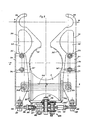
- the holding device 34 shown in FIGS. 2 to 4 for holding the projectile barrel 41 of the grenade launcher 400 comprises two jaws 201, 202 which can be moved relative to one another and partially encompasses the projectile barrel 41.
- the jaws 201, 202 are designed as two-armed levers and pivotally mounted about pivot pins 203, 204 and connected via the legs 206, 207 to the carrier 205 and the tilting frame 6 and thus to the vehicle frame 1.
- This carrier 205 also serves to hold the support roller 9 for the projectile barrel 41;
- the carrier 205 has two legs 206, 207 which are arranged at a distance from one another and which carry an axis 208 on which the support roller 9 is rotatably mounted.
- the pivot pins 203, 204 for the jaws 201, 202 which are at least partially U-shaped in cross section run perpendicular to the axis 208 and penetrate them in the region of their axial ends.
- the pivot pins 203, 204 are in here Sliding bushes 209, 210 of the jaws 201, 202 mounted and secured by means of locking rings 211, 212 against displacement in the axial direction.
- the jaws 201, 202 comprise on their one lever arm insert parts 213, 214 made of metal, for example aluminum or plastic, which are fastened to the jaws 201, 202 with screws 215, 216 and by means of which the jaws 213, 214 encompass the projectile barrel 41 .
- the inside of the insert parts 213, 214 is adapted to the circumferential surface of the projectile barrel 41, and can optionally have a pad 213 ⁇ , 214 ⁇ made of friction-increasing or heat-resistant material, for example a metal-asbestos composite, a brake pad or the like. exhibit.
- the inner surface of this insert 213 ⁇ , 214 ⁇ can be partially curved in accordance with the diameter of the projectile barrel 41, and - as shown in FIG.
- the insert parts 213, 214 are provided with recesses 217, 218, which can at the same time be designed as handles for manual actuation of the jaws 201, 202.
- the outer ends, ie the ends of the components of the jaws 201, 202 facing insert parts 213, 214 facing away from the pivot pin 203, 204 are bent in the shape of handles or hooks, which means that each additional handle 219, 220 for handling the jaws or for holding them a bipod for the launcher tube.
- insert parts 213, 214 can be provided with elongated holes 221 in the area of the screws 215, 216, as is indicated in FIG. 2 by dash-dotted lines.
- the screws 215, 216 then enforce these elongated holes.
- the insert parts 213, 214 can also be fastened between the U-shaped section of the jaws 201, 202 with the interposition of an elastic insert 222 made of rubber or elastic plastic, as a result of which a certain elasticity is achieved.
- This insert 222 is also indicated in FIG. 2 with dash-dotted lines.
- a spring element can also be provided in its place.
- the two-armed jaws 201, 202 are connected to a rotating or lever body 225 mounted on the support part 205 ⁇ with a bush 223 and a screw 224 passing through this bush 223.
- the rotating or lever body 225 consists of two axially spaced disks 226, 227 which are penetrated by two diametrically opposed bolts 228, 229 with nuts and intermediate rings (washers), each of which has a self-aligning bearing 230, 231 wearing.
- These self-aligning bearings 230, 231 are thus arranged at a radial distance from the axis of the bush 223 or screw 224 and at an axial distance between the disks 226, 227.
- An adjusting rod 232, 233 is pivotally mounted around each of the self-aligning bearings 230, 231 and is pivotably connected to one of the jaws 201, 202 in each case.
- the pivoting mounting of the actuating rods 232, 233 on the jaws 201, 202 is likewise carried out by means of self-aligning bearings 234, 235 and screws 237, 238.
- Each of the two actuating rods 232, 233 consists of two parts which can be adjusted in the axial direction by means of thread 236, so that a turnbuckle-like Training is achieved, the adjustment of the distance between the pivot point of the position rods 232, 233, which are arranged at a distance from the pivot pins 203, 204 of the jaws 201, 202, and allow the rotating body 225.
- the disc 226 of the rotating body 225 which is initially located on the carrier part 205 als, is designed as a so-called tensioning lug and, for this purpose, is provided with a radially outward extension 239 to which a handle 240 is attached.
- the handle 240 has a recess 241 running obliquely to the axis of the bush 223 or screw 224, in which a pressure bolt 242 is mounted, which has a spherical end face 243 at its outer end and a detent recess 244 in the region of its inner end, into which one end of a two-armed rocker arm 245 can be latched.
- the rocker arm is pivotable about a pin 246.
- the end of the rocker arm 245 opposite the locking recess 244 engages in a locking recess 247 of a locking pin 248, which is mounted displaceably in a recess 149 of the handle 240 against the pressure of a compression spring 250, and can be brought into engagement in a locking recess 251 on the circumference of the carrier part 205 ⁇ is.
- the spring-loaded locking pin 248 By snapping the spring-loaded locking pin 248 into the recess 251, the jaws 201, 202 are secured in the lashing position.
- both jaws By connecting the jaws 201, 202 via the swivel mechanism, it is also possible, by actuating one of the jaws, for example by means of the recess 217 or 218 designed as a handle, both jaws into the lashing position for fixing the launcher tube 41 and at the same time a bipod bring, the handle 240 is automatically pivoted and the locking pin 248 with the position of the jaws 201, 202 in the Lashing position snaps into the recess 251.
- the handle 240 with the rotating body 225 is pivoted about the sleeve 223 of the carrier part 205 ⁇ in such a way that the jaws 201, 202 are pivoted about their pivot axes 203, 204 by means of the adjusting rods 232, 233 and with their insert parts 213, 214 clamp the projectile barrel.
- the hook-shaped ends 219, 220 of the insert parts 213, 214 simultaneously fix the bipod of the grenade launcher.
- the pressure bolt 242 is displaced in the axial direction by exerting pressure on its spherical end face 243, as a result of which the rocker arm 245 is pivoted about its pin 246 and pulls the locking pin 248 out of the latching recess 251.
- the carrier 205 with carrier part 205 ⁇ does not have to be connected to the tilting frame 6, but could also be connected directly or indirectly via other components to the frame 1 of the transport device.
- an additional, possibly analogous holding device could be provided for the muzzle end of the projectile barrel.
- the transport device does not necessarily have to be a trailer vehicle, but could also be one that can be used in particular in the mountains, e.g. be carried by draft animals - transport device. It can also be driven by a powered vehicle, e.g. an armored personnel carrier.
- the rotary or lever body does not necessarily have to be disc-shaped, but could also be an elongated lever body, e.g. be a two-armed lever body; Instead of a horizontal axis of rotation, the rotary or lever body could also be articulated by a vertical axis of rotation.
- the articulation points of the adjusting rod do not necessarily have to be diametrically opposed to one another with respect to the axis of the rotating or hollow body; they can also be arranged eccentrically to the axis of the rotary or lever body in other ways.
- the diametrically opposite position is primarily chosen only when an automatic locking is desired, which can be released by turning the rotary or lever body with the handle.
- the swivel or self-aligning bearings do not necessarily have to be present; They primarily serve to avoid friction or jamming with short lever lengths. reason in addition, the adjusting rods could also be pivotably mounted about the bolts arranged essentially parallel to the axis of the rotary or lever body.
- At least one spring can also be provided for returning the jaws to their - open - rest position.
- the torsion or lever body can be connected to a torsion spring or each jaw can be connected to a tension spring.
Landscapes
- Engineering & Computer Science (AREA)
- General Engineering & Computer Science (AREA)
- Toys (AREA)
- Chain Conveyers (AREA)
- Automobile Manufacture Line, Endless Track Vehicle, Trailer (AREA)
- Handcart (AREA)
Applications Claiming Priority (2)
| Application Number | Priority Date | Filing Date | Title |
|---|---|---|---|
| AT2137/86 | 1986-08-07 | ||
| AT213786A AT396988B (de) | 1986-08-07 | 1986-08-07 | Transporteinrichtung mit einer haltevorrichtung bzw. haltevorrichtung an einer transporteinrichtung |
Publications (2)
| Publication Number | Publication Date |
|---|---|
| EP0255997A2 true EP0255997A2 (fr) | 1988-02-17 |
| EP0255997A3 EP0255997A3 (fr) | 1989-11-15 |
Family
ID=3528560
Family Applications (1)
| Application Number | Title | Priority Date | Filing Date |
|---|---|---|---|
| EP87890185A Ceased EP0255997A3 (fr) | 1986-08-07 | 1987-08-06 | Dispositif de fixation monté sur un équipement de transport |
Country Status (2)
| Country | Link |
|---|---|
| EP (1) | EP0255997A3 (fr) |
| AT (1) | AT396988B (fr) |
Cited By (2)
| Publication number | Priority date | Publication date | Assignee | Title |
|---|---|---|---|---|
| FR2757620A1 (fr) * | 1996-12-20 | 1998-06-26 | Giat Ind Sa | Dispositif de fixation d'un tube de canon sur un vehicule porteur |
| WO2006043981A3 (fr) * | 2004-04-29 | 2007-02-08 | United Defense Lp | Systeme de deploiement et de rangement de mortier |
Family Cites Families (5)
| Publication number | Priority date | Publication date | Assignee | Title |
|---|---|---|---|---|
| FR382148A (fr) * | 1907-09-23 | 1908-01-30 | Axel Bremberg | Équipements de bats de pièces pour artillerie de montagne |
| DE611540C (de) * | 1931-03-21 | 1935-03-30 | Emil Hene Dr Ing | Verfahren zur Herstellung von Cyannatrium |
| DE2052033A1 (de) * | 1970-10-23 | 1972-04-27 | Dr.Ing.H.C. F. Porsche Kg, 7000 Stuttgart | Vorrichtung zum Abstützen freitragend aufgehängter Aufbautenteile von Fahrzeugen, insbesondere zum Abstützen des Geschützrohres von Kampfpanzern |
| DE3217170A1 (de) * | 1982-05-07 | 1983-11-10 | Dr.Ing.H.C. F. Porsche Ag, 7000 Stuttgart | Haltevorrichtung |
| AT401310B (de) * | 1984-08-29 | 1996-08-26 | Boehler Pneumatik Int Gmbh | Fahrzeug, insbesondere anhängerfahrzeug, karrette od. dgl. |
-
1986
- 1986-08-07 AT AT213786A patent/AT396988B/de not_active IP Right Cessation
-
1987
- 1987-08-06 EP EP87890185A patent/EP0255997A3/fr not_active Ceased
Cited By (3)
| Publication number | Priority date | Publication date | Assignee | Title |
|---|---|---|---|---|
| FR2757620A1 (fr) * | 1996-12-20 | 1998-06-26 | Giat Ind Sa | Dispositif de fixation d'un tube de canon sur un vehicule porteur |
| WO2006043981A3 (fr) * | 2004-04-29 | 2007-02-08 | United Defense Lp | Systeme de deploiement et de rangement de mortier |
| JP2007535653A (ja) * | 2004-04-29 | 2007-12-06 | ビーエーイー システムズ ランド アンド アーマメンツ リミテッド パートナーシップ | 迫撃砲用展開及び格納システム |
Also Published As
| Publication number | Publication date |
|---|---|
| AT396988B (de) | 1994-01-25 |
| EP0255997A3 (fr) | 1989-11-15 |
| ATA213786A (de) | 1993-05-15 |
Similar Documents
| Publication | Publication Date | Title |
|---|---|---|
| EP3103712B1 (fr) | Scooter pliable | |
| DE3142489C2 (de) | Gleitschutzvorrichtung für Räder | |
| DE3033308A1 (de) | Entlade- und verladebruecke mit schwenksicherung | |
| EP0342198A1 (fr) | Vehicule de remorquage pour man uvrer des avions | |
| DE2730803A1 (de) | Beladungs- und entladungssystem fuer lastanhaenger | |
| DE3007578A1 (de) | Lasttraeger | |
| DE1680107C3 (de) | Vorrichtung für Fahrzeuge zum Auf- und Abladen von Lasten | |
| EP3483004B1 (fr) | Dispositif de sauvetage pour un véhicule militaire | |
| DE2646646C2 (de) | Vorrichtung zum Ausheben und Einsetzen von Kanaldeckeln oder dergleichen | |
| DE69816929T2 (de) | Hubwagen zum Abschleppen oder Handhaben für das Bergen von Fahrzeugen mit Rädern | |
| AT396988B (de) | Transporteinrichtung mit einer haltevorrichtung bzw. haltevorrichtung an einer transporteinrichtung | |
| AT401310B (de) | Fahrzeug, insbesondere anhängerfahrzeug, karrette od. dgl. | |
| DE4224638A1 (de) | Transport- und Bugsiergerät | |
| DE202015103507U1 (de) | Lastenträger mit Stützstruktur | |
| DE4000915A1 (de) | Anschlaggeraet und hebevorrichtung insbesondere fuer kraftfahrzeuge | |
| DE102021005064A1 (de) | Fahrradträger zur Montage an einer Anhängerkupplung eines Kraftfahrzeugs | |
| CH667721A5 (de) | Anordnung fuer den transport eines geschuetzes. | |
| DE2539972C2 (de) | Straßenfahrzeug mit Schwenkladegerät und Kippvorrichtung | |
| DE3130328A1 (de) | Kettbaumwagen | |
| DE102011112727A1 (de) | Vorrichtung zum Verhindern des Überschlagen oder Kippen eines Kraftfahrzeuges | |
| DE476567C (de) | Auf dem Hinterende eines Kraftfahrzeugs abnehmbar angeordnete einachsige Motorspritze | |
| DE202017107521U1 (de) | Fahrradanhänger | |
| DE8707554U1 (de) | Vorrichtung zum Transportieren von an Haken aufgehängten, geschlachteten Tierkörpern oder Tierkörperteilen | |
| DE19721396C2 (de) | Vorrichtung zum stufenlosen Verstellen und Einstellen der Höhe einer Zuggabel an einem Anhänger | |
| CH639323A5 (en) | Anti-skid device for motor vehicles |
Legal Events
| Date | Code | Title | Description |
|---|---|---|---|
| PUAI | Public reference made under article 153(3) epc to a published international application that has entered the european phase |
Free format text: ORIGINAL CODE: 0009012 |
|
| 17P | Request for examination filed |
Effective date: 19870826 |
|
| AK | Designated contracting states |
Kind code of ref document: A2 Designated state(s): AT BE CH DE ES FR GB GR IT LI LU NL SE |
|
| RAP1 | Party data changed (applicant data changed or rights of an application transferred) |
Owner name: BOEHLER PNEUMATIK INTERNATIONAL GESELLSCHAFT M.B.H |
|
| PUAL | Search report despatched |
Free format text: ORIGINAL CODE: 0009013 |
|
| AK | Designated contracting states |
Kind code of ref document: A3 Designated state(s): AT BE CH DE ES FR GB GR IT LI LU NL SE |
|
| 17Q | First examination report despatched |
Effective date: 19901122 |
|
| STAA | Information on the status of an ep patent application or granted ep patent |
Free format text: STATUS: THE APPLICATION HAS BEEN REFUSED |
|
| 18R | Application refused |
Effective date: 19920124 |
|
| RIN1 | Information on inventor provided before grant (corrected) |
Inventor name: MELCHER, GUENTHER |