EP0256076B1 - Convertisseur analogique numerique et procede d'utilisation - Google Patents
Convertisseur analogique numerique et procede d'utilisation Download PDFInfo
- Publication number
- EP0256076B1 EP0256076B1 EP87901078A EP87901078A EP0256076B1 EP 0256076 B1 EP0256076 B1 EP 0256076B1 EP 87901078 A EP87901078 A EP 87901078A EP 87901078 A EP87901078 A EP 87901078A EP 0256076 B1 EP0256076 B1 EP 0256076B1
- Authority
- EP
- European Patent Office
- Prior art keywords
- samples
- sample
- phase
- carrier frequency
- analogue
- Prior art date
- Legal status (The legal status is an assumption and is not a legal conclusion. Google has not performed a legal analysis and makes no representation as to the accuracy of the status listed.)
- Expired
Links
Images


Classifications
-
- H—ELECTRICITY
- H03—ELECTRONIC CIRCUITRY
- H03D—DEMODULATION OR TRANSFERENCE OF MODULATION FROM ONE CARRIER TO ANOTHER
- H03D1/00—Demodulation of amplitude-modulated oscillations
- H03D1/22—Homodyne or synchrodyne circuits
- H03D1/2245—Homodyne or synchrodyne circuits using two quadrature channels
-
- H—ELECTRICITY
- H03—ELECTRONIC CIRCUITRY
- H03D—DEMODULATION OR TRANSFERENCE OF MODULATION FROM ONE CARRIER TO ANOTHER
- H03D1/00—Demodulation of amplitude-modulated oscillations
- H03D1/22—Homodyne or synchrodyne circuits
-
- H—ELECTRICITY
- H03—ELECTRONIC CIRCUITRY
- H03D—DEMODULATION OR TRANSFERENCE OF MODULATION FROM ONE CARRIER TO ANOTHER
- H03D3/00—Demodulation of angle-, frequency- or phase- modulated oscillations
-
- H—ELECTRICITY
- H03—ELECTRONIC CIRCUITRY
- H03M—CODING; DECODING; CODE CONVERSION IN GENERAL
- H03M1/00—Analogue/digital conversion; Digital/analogue conversion
- H03M1/12—Analogue/digital converters
- H03M1/20—Increasing resolution using an n bit system to obtain n + m bits
-
- H—ELECTRICITY
- H03—ELECTRONIC CIRCUITRY
- H03M—CODING; DECODING; CODE CONVERSION IN GENERAL
- H03M1/00—Analogue/digital conversion; Digital/analogue conversion
- H03M1/12—Analogue/digital converters
- H03M1/1205—Multiplexed conversion systems
- H03M1/121—Interleaved, i.e. using multiple converters or converter parts for one channel
- H03M1/1215—Interleaved, i.e. using multiple converters or converter parts for one channel using time-division multiplexing
Definitions
- the present invention concerns improvements in or relating to a method and apparatus for analogue-to-digital conversion most especially converters (ADC's) for digital radio applications.
- ADC's converters
- the requirement for an ADC for use in a radio is particularly stringent.
- the dynamic range, if the ADC is used to convert the incoming signal without prefiltering, must exceed 100 db and preferably be over 130 db. This calls for accuracy of greater than 17 bits and ideally more than 22 bits.
- the baseband signal is sampled at an arbitrarily high rf frequency, and, after digital conversion, a large number of digitised samples accumulated to afford improved resolution or unwanted signal rejection.
- Such techniques have been described in the patent literature, for example : - United Kingdom Patent Applications G.B. 1, 532, 538 ; G. B. 1, 580, 178; G.B. 2, 123, 233; and, G.B. 2, 144, 285; United States Patent Serial No. U.S. 3, 820, 111 ; and, International Patent Application W. O. 86/02217.
- the present invention provides a method and an apparatus for analogue to digital conversion, adapted to offer enhanced resolution, and, suitable thus for digital radio application.
- apparatus for analogue to digital conversion comprising :
- n + m bit accuracy is thus attainable using only n bit conversion quantisation at front end.
- sampling means aforesaid may be incorporated as a part of the conversion means (e. g. as in a « flash » ADC) or may be included as a dedicated sampling or sample-and-hold device.
- the apparatus aforesaid may be followed by a digital filter and a digital detector.
- the filter may process signals either serially or in parallel if speed is requisite.
- This apparatus may be applied to single sideband and amplitude modulation (AM), demodulation being performed by the action of the ADC sampling.
- the converter system may, with modification, also be used to process frequency modulated (FM) and frequency shift keyed (FSK) signals.
- FM frequency modulated
- FSK frequency shift keyed
- the sample clock may run at a rate equal to an harmonic multiple of the selected carrier frequency, to sample thus at several samples per cycle.
- the data then would be fed to separate locations for respective sample phases and separate averaging performed serially or sequentially.
- the ADC apparatus to be described below makes use of the essential differences between a true analogue to digital converter and the type of ADC apparatus which is acceptable in a radio application.
- the first of these differences is that, provided the departures from the ideal transfer characteristic are not great the main consideration is the signal-to-noise ratio rather than the existence of all states.
- Existing high accuracy ADCs in the baseband radio systems mentioned above and in digital telephone systems exploit this feature.
- the second, and possibly more important factor is that one key piece of information about the incoming wanted signal is known i. e. the frequency. It is possible to assume in modern receiver systems that a clock signal 'can be generated at the incoming frequency or a multiple of it with arbitrary accuracy.
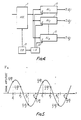
- FIG. 1 shows an essentially conventional ADC 1, of the « flash type (which needs no sample hold), sampling at the input carrier frequency under control of a clock 3, followed by a memory and averaging circuit 5, a digital filter 7, a digital detector 9 and an output circuit 11, which could take the form of a d-a converter and audio output stage, or could be in the form of further processing circuitry for digital signals.
- the analogue-to-digital converter 1 directly follows the « rf » or « if stage 13 of a radio receiver, from which it receives' modulated analogue signal.
- FIG. 2 A more detailed schematic of the ADC/memory organisation is shown in figure 2.
- the memory and averaging circuit 5 shown comprises a store 14 having 2 m memory locations 15 each of which is of n-bit word length and is loaded sequentially by demultiplexing 17 the output from the ADC 1. Once loaded, each memory location 15 is read by microprocessor or other averaging circuitry 19 and an n + m bit word length signal generated at the circuitry output.
- the ADC 1 could be essentially a conventional parallel « flash type, of eight or more bits « n Vet It would preferably have a wide analogue input bandwith to accommodate signals up to or above the top of the HF band (30 MHz). With some compromise in performance, fewer than eight bits could be used ; this may be more attractive at V.H.F.
- the clock 3 in this simplest system is synchronous with the nominal input carrier frequency. Hence, successive samples S 1 ; S 2 ; ..., occur at equal time intervals on the carrier waveform (see fig. 3). If therefore a number of successive samples S 1 ; S 2 ; ..., are stored and subsequently averaged, then the average value S will represent further bits of resolution in the equivalent ADC. For example, if « 2 m samples S 1 ; S 2 ; ... ; S 2 m, are averaged, then « m » further bits of resolution will be obtained.
- the averaging would most advantageously be a « rolling » arrangement, with the oldest samples S 1 , etc., being discarded in favour of new values S 2 m + 1, etc.
- a level weighting would be imposed, but for increased output bandwith it would be possible to weight the average S to the newest samples
- the total of « n + m » bits are then passed to a digital filter, which can be of many different forms : generic classes are « finite impulse response (FIR) and infinite impulse response" -(IIR).
- FIR finite impulse response
- IIR infinite impulse response
- the composite ADC apparatus figure 1 can be used to receive all classes of modulation by providing a suitable digital detector.
- Single sideband and amplitude modulation will be demodulated by the action of the ADC sampling.
- a phase control (not shown) may be included to prevent sampling at zero-crossing points.
- Frequency modulation, or FSK can be demodulated using a phase and quadrature receiver of appropriate characteristics, for example the receiver described in our United Kingdom patent application GB-A 2186139, brief details of which will follow below (fig. 7). This leads to a modification of the scheme which may be generally advantageous.
- a phase shift at the carrier frequency is needed for the FM demodulator cited and for certain others. This is achieved in the ADC apparatus described here Fig.
- the phase and gradrature receiver circuit shown in figure 7 comprises four digital multipliers 21, 23, 25 and 27, a difference amplifier 31 and a running amplifier 33.
- the multipliers are arranged in pairs 21 and 23, 25 and 27 and are connected to receive the averaged sample outputs So and S l of the conversion apparatus, respectively.
- One multiplier 21, 27 in each pair receives an in-phase multiplicand, sin ⁇ 0 t, whilst the other multiplier 23, 25 in each pair receives a quadrature multiplicand, cos ⁇ 0 t.
- the output of each multiplier 21, 25 and 23, 27 is referred to the difference amplifier 31 and to the summing amplifier 33, respectively to generate in-phase I and quadrature Q detected digital signals.
- Filtering is again speed dependent. Fast systems (in relation to available processing speed) will use parallel digital filters, while slower systems may use the same filter 7 on a time-multiplexed basis. Data is then stored in a further memory (not shown) for sequential reconstruction. Essentially, the memories are polled at a rate which is either a submultiple of the original sample rate or is a multiple (at least twice) of the maximum output frequency. The output, after d/a conversion, is the recovered modulation. Again SSB, AM, FM or FSK modes are possible. The two sample per cycle method for FM detection described above is clearly one case of the more general p-sample system just described.
- the filter 7 at the output frequency consists of several identical sections. These can be strictly separate filters for each successive sample interval. To great advantage, however, a single filter section instead could be used on a time multiplexed basis.
- the several section version of the filter has an analogue in the class of filters known as « N-path Erasmus
- the sequential version could be regarded as a special case of « N-path " filtering.
- sample rate would then need to be synchronous with the input and at a frequency at least twice that of the highest possible received frequency.
- the input would still need anti-alias low-pass input filtering, so each case should be considered on its merits.
- Prefiltering is commonly used in analogue systems and the requirement is only for a reduction in the harmonics of the received frequency; adjacent channel filtering is carried out by the digital system.
- the apparatus described above may be assembled from standard components.
Landscapes
- Engineering & Computer Science (AREA)
- Power Engineering (AREA)
- Theoretical Computer Science (AREA)
- Digital Transmission Methods That Use Modulated Carrier Waves (AREA)
- Analogue/Digital Conversion (AREA)
Abstract
Claims (14)
Priority Applications (1)
| Application Number | Priority Date | Filing Date | Title |
|---|---|---|---|
| AT87901078T ATE51480T1 (de) | 1986-01-30 | 1987-01-30 | Analog-digitalwandlungsverfahren und geraet dafuer. |
Applications Claiming Priority (4)
| Application Number | Priority Date | Filing Date | Title |
|---|---|---|---|
| GB08602227A GB2186139A (en) | 1986-01-30 | 1986-01-30 | Phase and quadrature receiver |
| GB868602230A GB8602230D0 (en) | 1986-01-30 | 1986-01-30 | Analogue to digital converter |
| GB8602227 | 1986-01-30 | ||
| GB8602230 | 1986-01-30 |
Publications (2)
| Publication Number | Publication Date |
|---|---|
| EP0256076A1 EP0256076A1 (fr) | 1988-02-24 |
| EP0256076B1 true EP0256076B1 (fr) | 1990-03-28 |
Family
ID=26290292
Family Applications (1)
| Application Number | Title | Priority Date | Filing Date |
|---|---|---|---|
| EP87901078A Expired EP0256076B1 (fr) | 1986-01-30 | 1987-01-30 | Convertisseur analogique numerique et procede d'utilisation |
Country Status (3)
| Country | Link |
|---|---|
| US (1) | US4982193A (fr) |
| EP (1) | EP0256076B1 (fr) |
| WO (1) | WO1987004880A1 (fr) |
Families Citing this family (27)
| Publication number | Priority date | Publication date | Assignee | Title |
|---|---|---|---|---|
| US5265039A (en) * | 1988-10-21 | 1993-11-23 | Bio-Rad Laboratories | Technique for improving the resolution of an A/D converter |
| US5125008A (en) * | 1990-03-09 | 1992-06-23 | Scientific-Atlanta, Inc. | Method and apparatus for autoranging, quadrature signal generation, digital phase reference, and calibration in a high speed rf measurement receiver |
| US5119321A (en) * | 1990-05-14 | 1992-06-02 | Harris Corporation | Adaptive threshold suppression of impulse noise |
| JP2777291B2 (ja) * | 1991-04-30 | 1998-07-16 | 株式会社東芝 | アナログ・ディジタル混在集積回路 |
| DE4114971A1 (de) * | 1991-05-03 | 1992-11-05 | Siemens Ag | Schaltungsanordnung zum wandeln mehrerer an eingangsanschluessen liegender, analoger elektrischer messsignale in entsprechende digitale signale |
| JP2791519B2 (ja) * | 1991-11-20 | 1998-08-27 | 三菱電機株式会社 | 2進データ発生回路およびa/d変換器 |
| FR2695770B1 (fr) * | 1992-09-15 | 1994-10-21 | Thomson Csf | Procédé et dispositif de démodulation en quadrature. |
| US5652585A (en) * | 1995-04-05 | 1997-07-29 | Crystal Semiconductor Corp. | Multiple function analog-to-digital converter with multiple serial outputs |
| FR2747861B1 (fr) * | 1996-04-18 | 1998-05-22 | Valeo Equip Electr Moteur | Procede et dispositif de regulation de la tension de sortie d'un alternateur par traitement numerique dans lequel la tension de sortie de l'alternateur est mesuree par echantillonnage |
| GB9717324D0 (en) * | 1997-08-16 | 1997-10-22 | Eastman Kodak Co | Electronic sampling circuit |
| JP2001237902A (ja) * | 2000-02-24 | 2001-08-31 | Mitsubishi Electric Corp | 受信機 |
| US6317071B1 (en) * | 2000-08-22 | 2001-11-13 | Lucent Technologies Inc. | Method and apparatus for analog-to-digital conversion by combining digital sample values |
| CA2407242C (fr) | 2001-10-10 | 2011-05-31 | David I. Havelock | Conformateur de faisceau utilisant des signaux composites pour reseau recepteur directionnel |
| US7317774B2 (en) * | 2003-02-13 | 2008-01-08 | Honeywell International, Inc. | Systems and methods for reducing harmonic interference effects in analog to digital conversion |
| US20060227898A1 (en) * | 2003-07-10 | 2006-10-12 | Gibson Timothy P | Radio receiver |
| FR2861931B1 (fr) * | 2003-10-30 | 2006-03-03 | St Microelectronics Sa | Demodulateur numerique a faible frequence d'echantillonnage |
| EP1777811B1 (fr) * | 2005-10-19 | 2018-10-03 | Heptagon Micro Optics Pte. Ltd. | Procédé et Dispositif pour démoduler un signal optique modulé |
| US20070252747A1 (en) * | 2006-04-28 | 2007-11-01 | Colin Lyden | No-missing-code analog to digital converter system and method |
| US7541950B2 (en) * | 2006-07-20 | 2009-06-02 | Samplify Systems, Inc. | Enhanced time-interleaved A/D conversion using compression |
| US20080084861A1 (en) * | 2006-10-10 | 2008-04-10 | Honeywell International Inc. | Avionics communication system and method utilizing multi-channel radio technology and a shared data bus |
| US8081933B2 (en) * | 2007-07-13 | 2011-12-20 | Honeywell International Inc. | Reconfigurable aircraft radio communications system |
| US8019338B2 (en) * | 2008-05-29 | 2011-09-13 | Honeywell International Inc. | Reconfigurable aircraft communications system with integrated avionics communication router and audio management functions |
| US8711993B2 (en) | 2010-12-10 | 2014-04-29 | Honeywell International Inc. | Wideband multi-channel receiver with fixed-frequency notch filter for interference rejection |
| US8896474B2 (en) * | 2012-02-16 | 2014-11-25 | Stichting Voor De Technische Wetenschappen | Two-stage phase digitizer |
| US9197236B1 (en) * | 2014-11-14 | 2015-11-24 | Tektronix, Inc. | Digitizer auto aperture with trigger spacing |
| US9983304B2 (en) | 2015-02-20 | 2018-05-29 | Northrop Grumman Systems Corporation | Delta-sigma digital radiometric system |
| US10158370B2 (en) * | 2017-03-15 | 2018-12-18 | Assocciated Universities, Inc. | Polar analog-to-digital converter and down converter for bandpass signals |
Family Cites Families (9)
| Publication number | Priority date | Publication date | Assignee | Title |
|---|---|---|---|---|
| US3820111A (en) * | 1972-11-13 | 1974-06-25 | Bell Telephone Labor Inc | Analog-to-digital converter |
| GB1580178A (en) * | 1975-12-11 | 1980-11-26 | Post Office | Digital measurement |
| GB1532538A (en) * | 1976-07-31 | 1978-11-15 | Marconi Co Ltd | Analogue to digital conversion systems |
| NL180895C (nl) * | 1978-11-30 | 1987-05-04 | Philips Nv | Analoog-digitaal-omzetter. |
| US4564831A (en) * | 1982-07-02 | 1986-01-14 | Transamerica Delaval Inc. | Analog to digital converters for converting a plurality of different input signals |
| EP0125268B1 (fr) * | 1982-10-29 | 1987-04-22 | Devon County Council | Appareil de codage/decodage de signaux |
| GB2144285B (en) * | 1983-07-29 | 1986-09-24 | Raymond Allan Belcher | Analague-to-digital and digital-to-analogue conversion |
| US4716385A (en) * | 1985-07-24 | 1987-12-29 | Nec Corporation | Multilevel modulator comprising a compact error correcting code producing unit |
| US4815136A (en) * | 1986-11-06 | 1989-03-21 | American Telephone And Telegraph Company | Voiceband signal classification |
-
1987
- 1987-01-30 EP EP87901078A patent/EP0256076B1/fr not_active Expired
- 1987-01-30 US US07/110,763 patent/US4982193A/en not_active Expired - Lifetime
- 1987-01-30 WO PCT/GB1987/000068 patent/WO1987004880A1/fr not_active Ceased
Also Published As
| Publication number | Publication date |
|---|---|
| EP0256076A1 (fr) | 1988-02-24 |
| WO1987004880A1 (fr) | 1987-08-13 |
| US4982193A (en) | 1991-01-01 |
Similar Documents
| Publication | Publication Date | Title |
|---|---|---|
| EP0256076B1 (fr) | Convertisseur analogique numerique et procede d'utilisation | |
| JP4213348B2 (ja) | 無線周波数のサンプリングを伴うデジタル受信 | |
| CN1086066C (zh) | 数字补偿的直接转换接收器和方法 | |
| US5172070A (en) | Apparatus for digitally demodulating a narrow band modulated signal | |
| FI120124B (fi) | Menetelmä ja piiri signaalin näytteistämiseksi suurella näytteistystaajuudella | |
| JPH10117220A (ja) | ディジタル復調器 | |
| US5216696A (en) | Programmable noise bandwidth reduction by means of digital averaging | |
| EP0962057A1 (fr) | Procede et dispositif pour l'echantillonnage de signaux analogiques | |
| US5052027A (en) | Programmable noise bandwidth reduction by means of digital averaging | |
| GB2211703A (en) | A psk signal demodulation system | |
| US6301294B1 (en) | Spread spectrum communication device | |
| JPS63500766A (ja) | ディジタル無線周波受信機 | |
| KR100406224B1 (ko) | 주파수변조신호복조회로및이를채용한통신단말장비 | |
| US4947408A (en) | Digital carrier demodulator employing components working beyond normal limits | |
| US5825756A (en) | Receiver for FM data multiplex broadcasting | |
| JP3628463B2 (ja) | デルタシグマ型a/d変換器 | |
| US20020172170A1 (en) | Spread spectrum demodulation using a subsampling communication receiver architecture | |
| US20090135970A1 (en) | Direct conversion receiver | |
| JPH0427723B2 (fr) | ||
| US5373533A (en) | FSK signal receiving device | |
| Poberezhskiy et al. | Sampling technique allowing exclusion of antialiasing filter | |
| JP2918857B2 (ja) | デジタルセンターラインフィルタ | |
| JP2003527795A (ja) | 角度変調信号の受信デバイス | |
| KR100432987B1 (ko) | 통신 단말기용 수신 회로 및 수신 회로에서의 신호 처리방법 | |
| JPH0787148A (ja) | 同期加算装置 |
Legal Events
| Date | Code | Title | Description |
|---|---|---|---|
| PUAI | Public reference made under article 153(3) epc to a published international application that has entered the european phase |
Free format text: ORIGINAL CODE: 0009012 |
|
| 17P | Request for examination filed |
Effective date: 19870918 |
|
| AK | Designated contracting states |
Kind code of ref document: A1 Designated state(s): AT BE CH DE FR GB IT LI LU NL SE |
|
| 17Q | First examination report despatched |
Effective date: 19890804 |
|
| GRAA | (expected) grant |
Free format text: ORIGINAL CODE: 0009210 |
|
| AK | Designated contracting states |
Kind code of ref document: B1 Designated state(s): AT BE CH DE FR GB IT LI LU NL SE |
|
| REF | Corresponds to: |
Ref document number: 51480 Country of ref document: AT Date of ref document: 19900415 Kind code of ref document: T |
|
| ITF | It: translation for a ep patent filed | ||
| ET | Fr: translation filed | ||
| REF | Corresponds to: |
Ref document number: 3762078 Country of ref document: DE Date of ref document: 19900503 |
|
| PLBE | No opposition filed within time limit |
Free format text: ORIGINAL CODE: 0009261 |
|
| STAA | Information on the status of an ep patent application or granted ep patent |
Free format text: STATUS: NO OPPOSITION FILED WITHIN TIME LIMIT |
|
| ITTA | It: last paid annual fee | ||
| 26N | No opposition filed | ||
| ITPR | It: changes in ownership of a european patent |
Owner name: CESSIONE;PLESSEY SEMICONDUCTORS LIMITED |
|
| REG | Reference to a national code |
Ref country code: CH Ref legal event code: PUE Owner name: PLESSEY SEMICONDUCTORS LIMITED |
|
| REG | Reference to a national code |
Ref country code: FR Ref legal event code: TP |
|
| EPTA | Lu: last paid annual fee | ||
| EAL | Se: european patent in force in sweden |
Ref document number: 87901078.3 |
|
| PGFP | Annual fee paid to national office [announced via postgrant information from national office to epo] |
Ref country code: LU Payment date: 19970101 Year of fee payment: 11 |
|
| PGFP | Annual fee paid to national office [announced via postgrant information from national office to epo] |
Ref country code: AT Payment date: 19970114 Year of fee payment: 11 |
|
| PGFP | Annual fee paid to national office [announced via postgrant information from national office to epo] |
Ref country code: SE Payment date: 19970115 Year of fee payment: 11 |
|
| PGFP | Annual fee paid to national office [announced via postgrant information from national office to epo] |
Ref country code: CH Payment date: 19970206 Year of fee payment: 11 |
|
| PGFP | Annual fee paid to national office [announced via postgrant information from national office to epo] |
Ref country code: BE Payment date: 19970318 Year of fee payment: 11 |
|
| PG25 | Lapsed in a contracting state [announced via postgrant information from national office to epo] |
Ref country code: AT Free format text: LAPSE BECAUSE OF NON-PAYMENT OF DUE FEES Effective date: 19980130 Ref country code: LU Free format text: LAPSE BECAUSE OF NON-PAYMENT OF DUE FEES Effective date: 19980130 |
|
| PG25 | Lapsed in a contracting state [announced via postgrant information from national office to epo] |
Ref country code: BE Free format text: LAPSE BECAUSE OF NON-PAYMENT OF DUE FEES Effective date: 19980131 Ref country code: CH Free format text: LAPSE BECAUSE OF NON-PAYMENT OF DUE FEES Effective date: 19980131 Ref country code: LI Free format text: LAPSE BECAUSE OF NON-PAYMENT OF DUE FEES Effective date: 19980131 Ref country code: SE Free format text: LAPSE BECAUSE OF NON-PAYMENT OF DUE FEES Effective date: 19980131 |
|
| BERE | Be: lapsed |
Owner name: PLESSEY SEMICONDUCTORS LTD Effective date: 19980131 |
|
| REG | Reference to a national code |
Ref country code: CH Ref legal event code: PL |
|
| EUG | Se: european patent has lapsed |
Ref document number: 87901078.3 |
|
| REG | Reference to a national code |
Ref country code: GB Ref legal event code: IF02 |
|
| PGFP | Annual fee paid to national office [announced via postgrant information from national office to epo] |
Ref country code: FR Payment date: 20030110 Year of fee payment: 17 |
|
| PGFP | Annual fee paid to national office [announced via postgrant information from national office to epo] |
Ref country code: NL Payment date: 20030130 Year of fee payment: 17 |
|
| PGFP | Annual fee paid to national office [announced via postgrant information from national office to epo] |
Ref country code: DE Payment date: 20030206 Year of fee payment: 17 |
|
| PG25 | Lapsed in a contracting state [announced via postgrant information from national office to epo] |
Ref country code: NL Free format text: LAPSE BECAUSE OF NON-PAYMENT OF DUE FEES Effective date: 20040801 |
|
| PG25 | Lapsed in a contracting state [announced via postgrant information from national office to epo] |
Ref country code: DE Free format text: LAPSE BECAUSE OF NON-PAYMENT OF DUE FEES Effective date: 20040803 |
|
| PG25 | Lapsed in a contracting state [announced via postgrant information from national office to epo] |
Ref country code: FR Free format text: LAPSE BECAUSE OF NON-PAYMENT OF DUE FEES Effective date: 20040930 |
|
| NLV4 | Nl: lapsed or anulled due to non-payment of the annual fee |
Effective date: 20040801 |
|
| REG | Reference to a national code |
Ref country code: FR Ref legal event code: ST |
|
| PG25 | Lapsed in a contracting state [announced via postgrant information from national office to epo] |
Ref country code: IT Free format text: LAPSE BECAUSE OF NON-PAYMENT OF DUE FEES;WARNING: LAPSES OF ITALIAN PATENTS WITH EFFECTIVE DATE BEFORE 2007 MAY HAVE OCCURRED AT ANY TIME BEFORE 2007. THE CORRECT EFFECTIVE DATE MAY BE DIFFERENT FROM THE ONE RECORDED. Effective date: 20050130 |
|
| REG | Reference to a national code |
Ref country code: GB Ref legal event code: 732E |
|
| PGFP | Annual fee paid to national office [announced via postgrant information from national office to epo] |
Ref country code: GB Payment date: 20060125 Year of fee payment: 20 |
|
| PG25 | Lapsed in a contracting state [announced via postgrant information from national office to epo] |
Ref country code: GB Free format text: LAPSE BECAUSE OF EXPIRATION OF PROTECTION Effective date: 20070129 |
|
| REG | Reference to a national code |
Ref country code: GB Ref legal event code: PE20 |