EP0256474A2 - Méthode et appareil pour détecter une substance particulaire déterminée - Google Patents
Méthode et appareil pour détecter une substance particulaire déterminée Download PDFInfo
- Publication number
- EP0256474A2 EP0256474A2 EP87111545A EP87111545A EP0256474A2 EP 0256474 A2 EP0256474 A2 EP 0256474A2 EP 87111545 A EP87111545 A EP 87111545A EP 87111545 A EP87111545 A EP 87111545A EP 0256474 A2 EP0256474 A2 EP 0256474A2
- Authority
- EP
- European Patent Office
- Prior art keywords
- particulate substance
- wavelength
- detecting
- antibody
- light beam
- Prior art date
- Legal status (The legal status is an assumption and is not a legal conclusion. Google has not performed a legal analysis and makes no representation as to the accuracy of the status listed.)
- Granted
Links
Images


Classifications
-
- G—PHYSICS
- G01—MEASURING; TESTING
- G01N—INVESTIGATING OR ANALYSING MATERIALS BY DETERMINING THEIR CHEMICAL OR PHYSICAL PROPERTIES
- G01N21/00—Investigating or analysing materials by the use of optical means, i.e. using sub-millimetre waves, infrared, visible or ultraviolet light
- G01N21/17—Systems in which incident light is modified in accordance with the properties of the material investigated
- G01N21/1702—Systems in which incident light is modified in accordance with the properties of the material investigated with opto-acoustic detection, e.g. for gases or analysing solids
-
- G—PHYSICS
- G01—MEASURING; TESTING
- G01N—INVESTIGATING OR ANALYSING MATERIALS BY DETERMINING THEIR CHEMICAL OR PHYSICAL PROPERTIES
- G01N15/00—Investigating characteristics of particles; Investigating permeability, pore-volume or surface-area of porous materials
- G01N15/06—Investigating concentration of particle suspensions
-
- G—PHYSICS
- G01—MEASURING; TESTING
- G01N—INVESTIGATING OR ANALYSING MATERIALS BY DETERMINING THEIR CHEMICAL OR PHYSICAL PROPERTIES
- G01N21/00—Investigating or analysing materials by the use of optical means, i.e. using sub-millimetre waves, infrared, visible or ultraviolet light
- G01N21/75—Systems in which material is subjected to a chemical reaction, the progress or the result of the reaction being investigated
-
- G—PHYSICS
- G01—MEASURING; TESTING
- G01N—INVESTIGATING OR ANALYSING MATERIALS BY DETERMINING THEIR CHEMICAL OR PHYSICAL PROPERTIES
- G01N33/00—Investigating or analysing materials by specific methods not covered by groups G01N1/00 - G01N31/00
- G01N33/48—Biological material, e.g. blood, urine; Haemocytometers
- G01N33/50—Chemical analysis of biological material, e.g. blood, urine; Testing involving biospecific ligand binding methods; Immunological testing
- G01N33/53—Immunoassay; Biospecific binding assay; Materials therefor
Definitions
- This invention relates to a method and apparatus for detecting a particulate substance in a liquid and more particularly to a detection method and apparatus of an immunoreaction product which may be suitable for detecting a trace amount of an immunoreaction product.
- the prior art technique described above does not take into consideration the particle size dependency of sensitivity of the photoacoustic spectrometry and cannot selectively detect and determine very small particles having specific sizes such a rheumatuid factors, cancer specific antigens, and the like.
- the object described above can be accomplished in the following way.
- the sensitivity of an photoacoustic spectrometry to particulate substances as the object of analysis is increased by use of excitation beam having a wavelength which is in agreement with, or close to, the sizes of the particulate substances as the object of analysis by utilizing the size dependence of the sensitivity of photoacoustic spectroscopy which is found out by the present inventors, and the particulate substance are then detected and determined selectively.
- the object described above can be accomplished, too, by controlling the sizes of the resulting particulate substances so that they coincide with the wavelength of excitation beam of the photoacoustic spectroscope.
- the present invention can selectively detect particulate substance having a specific size in the liquid and can determine it highly sensitively, the invention provides the following effects.
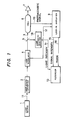
- Fig. l shows an example of the fundamental construction of a detector for an immunoreaction product in accordance with the present invention.
- the light beam ll from a light source l such as laser is converted to excitation light 3 having a wavelength which is equal to, or near, the size of a particulate substance as the object of analysis by a wavelength converter 2 consisting of a dye laser, a non-linear type optical element, spectrometer, and the like.
- the light beam is then incident to a cell 6.
- the particulate substance contained in a liquid sample inside the cell 6 absorbs the excitation light and generates an photoacoustic signal.
- the resulting photoacoustic signal is detected by a detector such as a piezoelectric device that is fitted to the cell.
- the detected photoacoustic signal l3 is amplified by a lock-in amplifier 9 referring to a signal from an light modulator 4 such as an optical chopper being a reference signal l2.
- the magnitude of the photoacoustic signal measured by such an photoacoustic spectrometry is proportional to the quantity (concentration) of the particulate substance contained in the sample. Therefore, a calibration curve of the particulate substance in accordance with the magnitude of the photoacoustic signal can be obtained.
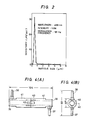
- Fig. 2 shows particle size dependence of the photoacoustic spectroscope, that is, the slope of the calibration curve.
- the diagram shows the result of measurement of polystyrene particles. Measurement was performed with an intensity of excitation light of 0.8 W, a wavelength of 488 nm and modulation frequency of l8l Hz. As shown in Fig. 2, it was found for the first time that when the particle size coincides with the wavelength 488 nm (approx. 0.5 ⁇ m) of excitation light, the sensitivity of the photoacoustic spectrometry increases resonantly. This experimental result reveals that when the wavelength of excitation light 3 of the photoacoustic spectrometry shown in Fig.
- the reaction product can be measured selectively and highly sensitively even when unreacted antibodies or particles supporting the unreacted antibodies coexist, if the wavelength of excitation light is selected in such a manner that it is in agreement with the size of the reaction product but is out of agreement with the size of the antibody or that of the particle supporting the antibody.
- Particle size dependence of sensitivity presumably results from the fact that dielectric loss due to particles increases resonantly at the wavelength which is in agreement with the particle size and near that wavelength in the same way as scattering of resonant light and heat resulting from the dielectric loss increases resonantly, too, so that the magnitude of the photoacoustic signal generated from the heat released to the medium increases resonantly.
- Fig. 3 shows the construction of a detector for an immunoreaction product in accordance with the present invention.
- An excitation beam source is an argon laser l7 having a l0 W output and laser beam 25 from the argon laser has emission lines of 488 nm, 5l4.5 nm and a line in the ultraviolet wavelength range.
- a pigment inside a dye laser l8 is excited (pumped) in accordance with the size of the reaction product as the object of analysis.
- the wavelength of the excitation beam 25 from the argon laser l7 is set to 5l4.5 nm while Rhodamine is used as the pigment of the dye laser l8.
- Part of the laser beam 27 whose wavelength is converted in accordance with the size of the object of analysis is branched by a half mirror 5, and is incident to a wavelength monitor 28 and its wavelength is confirmed by a wavelength monitor 28.
- the remaining laser light is subjected to light modulation to a periodical rectangular wave by an intensity modulator l9 consisting of a rotating blade type optical chopper and changes to excitation beam 26.
- This beam 26 is incident to a cell 23 and lets the sample inside the cell generate an photoacoustic signal.
- the photoacoustic signal generated in the cell 23 is detected by a piezoelectric element and is amplified by a lock-in amplifier 3l referring a signal 35 from a driver 29 of the light modulator l9.
- Part of the excitation beam 26 is branched by the half mirror 5 and its intensity is monitored by an optical intensity monitor 30.
- the lock-in amplifier 3l inputs information relating to the magnitude and phase of the photoacoustic signal while the wavelength monitor 28, the driver 29 of the light modulator and the optical intensity monitor 30 input information relating to the wavelength of the excitation beam, the modulation frequency and intensity, to a data processor 32.
- the data processor 32 displays the information of parameters relating to the measurement condition such as the excitation beam wavelength and the modulation frequency on a display 33 or processes the data of the measurement result and displays the calibration curve of the reaction product and the result of determination of an unknown sample on the display 33.
- the sample such as serum is placed in a reaction tube inside the reactor 2l and the antibody or particles supporting antibody is added by a reagent charger 22.
- the reaction product formed under the predetermined reaction condition is moved from the reactor 2l to the cell 23 through a sample path 37.
- the sample path 37 is washed by ultra-pure water from a ultra-pure water device 20 together with the cell 23 and the next measurement is prepared.
- the apparatus of the present invention measures automatically a plurality of samples and processes the data by repeating these processes.
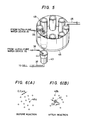
- Fig. 4 is a detailed view of the cell 23 of the present apparatus.
- the inside of the cell is cylindrical.
- the excitation beam 26 is allowed to be incident along the center axis of the cylinder.
- the photoacoustic signal generated inside the cell is detected by the piezoelectric element 40 and sent as a piezoelectric signal from an electrode terminal 42 to the lock-in amplifier 3l.
- the piezoelectric element is disposed at the center of the cell 23 and its inner diameter is the same as that of the glass cylinder 4l of the cell, and the inside of the cell describes a smooth cylindrical shape.
- the sample flows into the cell through an inlet tube 37 and after measurement, is discharged to a drain through an outlet tube 38.
- Fig. 5 shows in detail the reactor 2l of the present apparatus and a sample introduction portion 43.
- the reactor 2l consists of a reaction tube 49 and a rotary holer 45.
- a sample such as serum is placed into the reaction tube 49 and the reagent such as the antibody is charged, too, through the reagent charger 22.
- a stirring device such as a stirrer may be disposed inside the reaction tube 49, whenever necessary.
- the sample is caused to flow into the sample introduction portion 43 from an extraction port at the lower part of the reaction tube 49 and sent into the cell.
- the reaction tube 49, the sample introduction portion 43, the sample flow path 37 and the cell 23 are washed by ultrapure water emitted from a spray 44.
- Fig. 6 is a schematic view of a material supporting the antibody to be used in the present invention and the reaction product after immunoreaction.
- the material supporting the antibody is preferably one that has a specific gravity near l, can be dispersed uniformly into the serum and exhibits a large exothermic quantity due to dielectric loss.
- polystyrene particles are particulate substance which is suitable for the apparatus of the present invention.
- the particle diameter of the polystyrene particles 46 supporting the antibody before reaction is set to be 0.2 m. Since this embodiment is directed to detect a rheumatuid factor, the corresponding antibody is supported on the polystyrene particles 46.
- the polystyrene particles 46 agglutinate through the antigen and turn to the reaction product 47.
- the size of the reaction product is about 0.5 m and it coexists with the unreacted polystyrene particles 48.
- the wavelength of the laser beam 25 from the argon laser l7 is set to be 5l4.4 nm so that the wavelength of the excitation beam becomes 0.6 m, and hodamine is selected as the pigment of the dye laser l8.
- the modulation frequency is set to l8l Hz.
- Fig. 7 shows an example of the calibration curve of the rheumatuid factor obtained by the present apparatus. It can be understood from the result of measurement that the immunoreaction product can be determined in the concentration range of l0 ⁇ 3 U/ml (U: international unit). This result shows that the immunoreaction product can be measured in a concentration range which is incomparably lower than the lower determination limit obtained by ordinary turbiditmetry. In the conventional photoacoustic spectroscopes for liquid which cannot select the wavelength, the unreacted product and the reaction product cannot be distinguished and the total amount of the particulate substances in the sample are measured. Therefore, a calibration curve cannot be obtained.
- the wavelength can be scanned in the visible range so that the size of the reaction product in the sample can be known from the wavelength providing the peak of signal intensity by monitoring the signal intensity while scanning the wavelength.
- the excitation light intensity at each wavelength is monitored by the light intensity monitor and the signal magnitude is standardized.
- the wavelength that provides the peak is displayed on the display 33 after wavelength of scanning is completed. Therefore, the wavelength thus displayed can be used for the determination of the reaction product.
- the present invention can measure the phase of the photoacoustic signal by the lock-in amplifier 3l.
- the photoacoustic signal generated from the particulate substance in the liquid has a phase corresponding to the size of the particle. This phase depends on the heat radiation time from the particle to the medium and according to the studies made by the present inventors, is a function of the square of the size. Therefore, if the polstyrene particles are 0.2 ⁇ m in diameter before the reaction and the reaction proceeds, the reaction product of 0.6 um in size increases.
- the present apparatus can monitor the progress of the reaction and the quantity of the reaction product or can detect and determine the reaction product by measuring the change of the phase. In this case, the modulation frequency of the excitation light intensity is set to about l0 KHz in order to increase the variation of the phase.
- the apparatus When measurement is made using the wavelength 0.6 ⁇ m, the apparatus has sensitivity of about l/l00 of the 0.6 ⁇ m paricles to the unreacted 0.2 ⁇ m particles. Therefore, when the amount of the unreacted particles becomes about l00 times that of the reaction product, the signal component from the unreacted particles, that is, the background, becomes substantially equal to the signal component from the reaction product and determination of the reaction product becomes difficult.
- 0.2 ⁇ m particles are determined by the 0.6 ⁇ m excitation light exhibiting high sensitivity to the 0.2 ⁇ m particles and the data thereby obtained is reduced from the data obtained by using the 0.6 ⁇ m excitation light. In this manner, the background of the 0.2 ⁇ m particles can be reduced and the reaction product can be determined.
Landscapes
- Physics & Mathematics (AREA)
- Health & Medical Sciences (AREA)
- Life Sciences & Earth Sciences (AREA)
- Chemical & Material Sciences (AREA)
- Analytical Chemistry (AREA)
- Biochemistry (AREA)
- General Health & Medical Sciences (AREA)
- General Physics & Mathematics (AREA)
- Immunology (AREA)
- Pathology (AREA)
- Investigating Or Analysing Materials By Optical Means (AREA)
- Investigating Or Analyzing Materials By The Use Of Ultrasonic Waves (AREA)
Applications Claiming Priority (2)
| Application Number | Priority Date | Filing Date | Title |
|---|---|---|---|
| JP61186808A JPH0731112B2 (ja) | 1986-08-11 | 1986-08-11 | 粒子状物質の検出方法およびその装置 |
| JP186808/86 | 1986-08-11 |
Publications (3)
| Publication Number | Publication Date |
|---|---|
| EP0256474A2 true EP0256474A2 (fr) | 1988-02-24 |
| EP0256474A3 EP0256474A3 (en) | 1989-11-23 |
| EP0256474B1 EP0256474B1 (fr) | 1992-01-22 |
Family
ID=16194949
Family Applications (1)
| Application Number | Title | Priority Date | Filing Date |
|---|---|---|---|
| EP87111545A Expired EP0256474B1 (fr) | 1986-08-11 | 1987-08-10 | Méthode et appareil pour détecter une substance particulaire déterminée |
Country Status (4)
| Country | Link |
|---|---|
| US (1) | US4890925A (fr) |
| EP (1) | EP0256474B1 (fr) |
| JP (1) | JPH0731112B2 (fr) |
| DE (1) | DE3776222D1 (fr) |
Cited By (3)
| Publication number | Priority date | Publication date | Assignee | Title |
|---|---|---|---|---|
| EP0369176A3 (fr) * | 1988-10-19 | 1991-04-24 | Hitachi, Ltd. | Essai immunologique utilisant de spectroscopie photo-acoustique |
| EP0366151A3 (fr) * | 1988-10-28 | 1991-05-22 | Hitachi, Ltd. | Procédé et dispositif pour l'essai immunologique photo-acoustique |
| WO2008008402A2 (fr) | 2006-07-11 | 2008-01-17 | The Curators Of The University Of Missouri | Dispositif et procédé de détection photo-acoustique |
Families Citing this family (14)
| Publication number | Priority date | Publication date | Assignee | Title |
|---|---|---|---|---|
| JP2685482B2 (ja) * | 1988-04-08 | 1997-12-03 | 株式会社日立製作所 | 粒子状物質の分析方法及び装置 |
| JP2556910B2 (ja) * | 1989-11-30 | 1996-11-27 | 浜松ホトニクス株式会社 | 光強度変化検出装置 |
| JP3102935B2 (ja) * | 1991-11-20 | 2000-10-23 | シスメックス株式会社 | イメージングフローサイトメータ |
| US5515163A (en) * | 1994-09-01 | 1996-05-07 | Sunshine Medical Instruments, Inc. | Method and apparatus for detection, analysis and identification of particles |
| US5825018A (en) * | 1996-01-11 | 1998-10-20 | Northeastern University | Optical lock-in detection technique for coherent detection applications |
| JP2935665B2 (ja) * | 1996-05-31 | 1999-08-16 | 日本原子力研究所 | レーザー誘起光熱変位分光法による溶液の光吸収スペクトル測定法 |
| US6335943B1 (en) | 1999-07-27 | 2002-01-01 | Lockheed Martin Corporation | System and method for ultrasonic laser testing using a laser source to generate ultrasound having a tunable wavelength |
| US7122384B2 (en) * | 2002-11-06 | 2006-10-17 | E. I. Du Pont De Nemours And Company | Resonant light scattering microparticle methods |
| US20050042072A1 (en) * | 2002-12-13 | 2005-02-24 | Samuel Amdahl | Transportation system for sheet delivery between sheet or sheet stack processing equipment |
| US20080252901A1 (en) * | 2003-09-26 | 2008-10-16 | School Jiridical Person Kitasato Gakuen | Wavelength-Tunable Light Source And Optical Coherence Tomography |
| US7791739B2 (en) * | 2004-04-20 | 2010-09-07 | Lockheed Martin Corporation | System and method to enable eye-safe laser ultrasound detection |
| US7818350B2 (en) | 2005-02-28 | 2010-10-19 | Yahoo! Inc. | System and method for creating a collaborative playlist |
| JP5336438B2 (ja) * | 2010-07-22 | 2013-11-06 | 日本電信電話株式会社 | 成分濃度測定方法および装置 |
| EP3693725B1 (fr) * | 2019-02-11 | 2021-04-07 | Infineon Technologies AG | Capteur photo-acoustique |
Family Cites Families (7)
| Publication number | Priority date | Publication date | Assignee | Title |
|---|---|---|---|---|
| JPS5811575B2 (ja) * | 1976-08-16 | 1983-03-03 | 帝国臓器製薬株式会社 | 抗原−抗体反応の測定法 |
| JPS5945088B2 (ja) * | 1976-09-13 | 1984-11-02 | 株式会社東芝 | 赤外吸収検出装置 |
| JPS59126933A (ja) * | 1983-01-10 | 1984-07-21 | Hitachi Ltd | 光音響分析装置 |
| DE3438798C2 (de) * | 1984-10-23 | 1987-01-02 | Löffler, Friedrich, Prof. Dr.-Ing., 7500 Karlsruhe | Verfahren und Vorrichtung zum Messen der Feststoffkonzentration und der Korngrößenverteilung in einer Suspension mittels Ultraschall |
| JPS61102541A (ja) * | 1984-10-25 | 1986-05-21 | Hitachi Ltd | 液体中の不純物分析方法および装置 |
| JPS61225656A (ja) * | 1985-03-29 | 1986-10-07 | Toshiba Corp | 検体検査装置 |
| JP3173999B2 (ja) * | 1996-06-17 | 2001-06-04 | 株式会社クボタ | 廃棄物処理炉の排ガス処理設備 |
-
1986
- 1986-08-11 JP JP61186808A patent/JPH0731112B2/ja not_active Expired - Lifetime
-
1987
- 1987-08-10 EP EP87111545A patent/EP0256474B1/fr not_active Expired
- 1987-08-10 US US07/083,197 patent/US4890925A/en not_active Expired - Fee Related
- 1987-08-10 DE DE8787111545T patent/DE3776222D1/de not_active Expired - Lifetime
Cited By (4)
| Publication number | Priority date | Publication date | Assignee | Title |
|---|---|---|---|---|
| EP0369176A3 (fr) * | 1988-10-19 | 1991-04-24 | Hitachi, Ltd. | Essai immunologique utilisant de spectroscopie photo-acoustique |
| EP0366151A3 (fr) * | 1988-10-28 | 1991-05-22 | Hitachi, Ltd. | Procédé et dispositif pour l'essai immunologique photo-acoustique |
| WO2008008402A2 (fr) | 2006-07-11 | 2008-01-17 | The Curators Of The University Of Missouri | Dispositif et procédé de détection photo-acoustique |
| EP2047250A4 (fr) * | 2006-07-11 | 2014-04-02 | Univ Missouri | Dispositif et procédé de détection photo-acoustique |
Also Published As
| Publication number | Publication date |
|---|---|
| EP0256474A3 (en) | 1989-11-23 |
| DE3776222D1 (de) | 1992-03-05 |
| JPH0731112B2 (ja) | 1995-04-10 |
| JPS6344149A (ja) | 1988-02-25 |
| US4890925A (en) | 1990-01-02 |
| EP0256474B1 (fr) | 1992-01-22 |
Similar Documents
| Publication | Publication Date | Title |
|---|---|---|
| EP0256474B1 (fr) | Méthode et appareil pour détecter une substance particulaire déterminée | |
| US4762413A (en) | Method and apparatus for measuring immunological reaction with the aid of fluctuation in intensity of scattered light | |
| US4446239A (en) | Light scattering immunoassay involving particles with selective frequency band apparatus | |
| US3850525A (en) | Simultaneous multiple measurements in laser photometers | |
| JP4229529B2 (ja) | 反射率および透過率による分光分析装置および方法並びに分光計用のプローブ | |
| US4725140A (en) | Method of measuring specific binding reaction with the aid of polarized light beam and magnetic field | |
| JPH0523617B2 (fr) | ||
| EP0180140B1 (fr) | Méthode pour l'analyse d'impuretés dans un liquide et appareil à cette fin | |
| US20050062972A1 (en) | System and method for cavity ring-down spectroscopy using continuously varying continuous wave excitation | |
| US4799796A (en) | Method and apparatus for measuring immunological reaction with the aid of phase-modulation of light | |
| JP2012202742A (ja) | 検出方法および検出装置 | |
| EP0366151A2 (fr) | Procédé et dispositif pour l'essai immunologique photo-acoustique | |
| EP0369176A2 (fr) | Essai immunologique utilisant de spectroscopie photo-acoustique | |
| EP0606374A1 (fr) | Titrage rapide de l'or et instrument connexe | |
| CN112378857A (zh) | 一种微纳光纤光栅光热试纸条传感器及其检测方法 | |
| JP3311406B2 (ja) | 分光測定装置 | |
| JPH0650314B2 (ja) | 免疫反応測定装置 | |
| JPH0552848A (ja) | 免疫測定法および装置 | |
| JPH0290041A (ja) | 分光分析方法及び装置 | |
| GB1600069A (en) | Method for the measurement of antigens and antibodies | |
| Wolfbeis et al. | Annual Chemical Congress: new spectroscopic sensors and techniques | |
| JPS6166151A (ja) | 免疫反応の自動測定装置 | |
| JPH0514219B2 (fr) | ||
| US5982485A (en) | Determination of interface adsorption | |
| JPS61137048A (ja) | 光散乱計測装置 |
Legal Events
| Date | Code | Title | Description |
|---|---|---|---|
| PUAI | Public reference made under article 153(3) epc to a published international application that has entered the european phase |
Free format text: ORIGINAL CODE: 0009012 |
|
| AK | Designated contracting states |
Kind code of ref document: A2 Designated state(s): DE FR GB |
|
| PUAL | Search report despatched |
Free format text: ORIGINAL CODE: 0009013 |
|
| AK | Designated contracting states |
Kind code of ref document: A3 Designated state(s): DE FR GB |
|
| RHK1 | Main classification (correction) |
Ipc: G01N 15/02 |
|
| 17P | Request for examination filed |
Effective date: 19891109 |
|
| 17Q | First examination report despatched |
Effective date: 19910313 |
|
| GRAA | (expected) grant |
Free format text: ORIGINAL CODE: 0009210 |
|
| AK | Designated contracting states |
Kind code of ref document: B1 Designated state(s): DE FR GB |
|
| REF | Corresponds to: |
Ref document number: 3776222 Country of ref document: DE Date of ref document: 19920305 |
|
| ET | Fr: translation filed | ||
| PLBE | No opposition filed within time limit |
Free format text: ORIGINAL CODE: 0009261 |
|
| STAA | Information on the status of an ep patent application or granted ep patent |
Free format text: STATUS: NO OPPOSITION FILED WITHIN TIME LIMIT |
|
| 26N | No opposition filed | ||
| PGFP | Annual fee paid to national office [announced via postgrant information from national office to epo] |
Ref country code: GB Payment date: 19950731 Year of fee payment: 9 |
|
| PGFP | Annual fee paid to national office [announced via postgrant information from national office to epo] |
Ref country code: FR Payment date: 19950817 Year of fee payment: 9 |
|
| PGFP | Annual fee paid to national office [announced via postgrant information from national office to epo] |
Ref country code: DE Payment date: 19951031 Year of fee payment: 9 |
|
| PG25 | Lapsed in a contracting state [announced via postgrant information from national office to epo] |
Ref country code: GB Effective date: 19960810 |
|
| GBPC | Gb: european patent ceased through non-payment of renewal fee |
Effective date: 19960810 |
|
| PG25 | Lapsed in a contracting state [announced via postgrant information from national office to epo] |
Ref country code: FR Effective date: 19970430 |
|
| PG25 | Lapsed in a contracting state [announced via postgrant information from national office to epo] |
Ref country code: DE Effective date: 19970501 |
|
| REG | Reference to a national code |
Ref country code: FR Ref legal event code: ST |