EP0257893A1 - Procédé de destruction de materiaux organiques de rebut - Google Patents
Procédé de destruction de materiaux organiques de rebut Download PDFInfo
- Publication number
- EP0257893A1 EP0257893A1 EP19870307034 EP87307034A EP0257893A1 EP 0257893 A1 EP0257893 A1 EP 0257893A1 EP 19870307034 EP19870307034 EP 19870307034 EP 87307034 A EP87307034 A EP 87307034A EP 0257893 A1 EP0257893 A1 EP 0257893A1
- Authority
- EP
- European Patent Office
- Prior art keywords
- waste material
- reduction
- vessel
- oxidation
- halogenated
- Prior art date
- Legal status (The legal status is an assumption and is not a legal conclusion. Google has not performed a legal analysis and makes no representation as to the accuracy of the status listed.)
- Granted
Links
- 239000000463 material Substances 0.000 title claims abstract description 27
- 239000010815 organic waste Substances 0.000 title claims abstract description 22
- 230000006378 damage Effects 0.000 title claims abstract description 14
- 238000000034 method Methods 0.000 title claims description 36
- 230000003647 oxidation Effects 0.000 claims abstract description 38
- 238000007254 oxidation reaction Methods 0.000 claims abstract description 38
- 239000002699 waste material Substances 0.000 claims abstract description 29
- 239000007789 gas Substances 0.000 claims abstract description 28
- 239000011541 reaction mixture Substances 0.000 claims abstract description 22
- 239000001257 hydrogen Substances 0.000 claims abstract description 21
- 229910052739 hydrogen Inorganic materials 0.000 claims abstract description 21
- 239000003638 chemical reducing agent Substances 0.000 claims abstract description 16
- UFHFLCQGNIYNRP-UHFFFAOYSA-N Hydrogen Chemical compound [H][H] UFHFLCQGNIYNRP-UHFFFAOYSA-N 0.000 claims abstract description 12
- 238000002156 mixing Methods 0.000 claims abstract description 12
- 150000002431 hydrogen Chemical class 0.000 claims abstract description 9
- 239000007800 oxidant agent Substances 0.000 claims abstract description 6
- 150000002894 organic compounds Chemical class 0.000 claims abstract description 4
- 238000002485 combustion reaction Methods 0.000 claims description 26
- XEEYBQQBJWHFJM-UHFFFAOYSA-N Iron Chemical compound [Fe] XEEYBQQBJWHFJM-UHFFFAOYSA-N 0.000 claims description 12
- PXHVJJICTQNCMI-UHFFFAOYSA-N Nickel Chemical compound [Ni] PXHVJJICTQNCMI-UHFFFAOYSA-N 0.000 claims description 12
- 239000007788 liquid Substances 0.000 claims description 10
- VNWKTOKETHGBQD-UHFFFAOYSA-N methane Chemical compound C VNWKTOKETHGBQD-UHFFFAOYSA-N 0.000 claims description 10
- XLYOFNOQVPJJNP-UHFFFAOYSA-N water Substances O XLYOFNOQVPJJNP-UHFFFAOYSA-N 0.000 claims description 10
- 238000010926 purge Methods 0.000 claims description 9
- ATUOYWHBWRKTHZ-UHFFFAOYSA-N Propane Chemical compound CCC ATUOYWHBWRKTHZ-UHFFFAOYSA-N 0.000 claims description 8
- QGZKDVFQNNGYKY-UHFFFAOYSA-N Ammonia Chemical compound N QGZKDVFQNNGYKY-UHFFFAOYSA-N 0.000 claims description 6
- HCHKCACWOHOZIP-UHFFFAOYSA-N Zinc Chemical compound [Zn] HCHKCACWOHOZIP-UHFFFAOYSA-N 0.000 claims description 6
- QVGXLLKOCUKJST-UHFFFAOYSA-N atomic oxygen Chemical compound [O] QVGXLLKOCUKJST-UHFFFAOYSA-N 0.000 claims description 6
- 239000012530 fluid Substances 0.000 claims description 6
- 229910052742 iron Inorganic materials 0.000 claims description 6
- 239000002184 metal Substances 0.000 claims description 6
- 229910052751 metal Inorganic materials 0.000 claims description 6
- 229910052759 nickel Inorganic materials 0.000 claims description 6
- 239000001301 oxygen Substances 0.000 claims description 6
- 229910052760 oxygen Inorganic materials 0.000 claims description 6
- 229910052725 zinc Inorganic materials 0.000 claims description 6
- 239000011701 zinc Substances 0.000 claims description 6
- ATJFFYVFTNAWJD-UHFFFAOYSA-N Tin Chemical compound [Sn] ATJFFYVFTNAWJD-UHFFFAOYSA-N 0.000 claims description 5
- 235000010290 biphenyl Nutrition 0.000 claims description 5
- 150000002013 dioxins Chemical class 0.000 claims description 5
- 239000011135 tin Substances 0.000 claims description 5
- 229910052718 tin Inorganic materials 0.000 claims description 5
- 150000001335 aliphatic alkanes Chemical class 0.000 claims description 4
- 150000001555 benzenes Chemical class 0.000 claims description 4
- 150000004074 biphenyls Chemical class 0.000 claims description 4
- 239000003054 catalyst Substances 0.000 claims description 4
- 150000001924 cycloalkanes Chemical class 0.000 claims description 4
- 150000004826 dibenzofurans Chemical class 0.000 claims description 4
- 150000002989 phenols Chemical class 0.000 claims description 4
- 239000001294 propane Substances 0.000 claims description 4
- 229910021529 ammonia Inorganic materials 0.000 claims description 3
- 230000003116 impacting effect Effects 0.000 claims description 2
- -1 iron filings Chemical compound 0.000 claims description 2
- 239000003345 natural gas Substances 0.000 claims description 2
- 239000006227 byproduct Substances 0.000 abstract description 7
- 230000015556 catabolic process Effects 0.000 abstract description 4
- 150000001875 compounds Chemical class 0.000 abstract description 2
- 150000002896 organic halogen compounds Chemical class 0.000 abstract description 2
- 230000001473 noxious effect Effects 0.000 abstract 1
- 239000005416 organic matter Substances 0.000 abstract 1
- 238000006722 reduction reaction Methods 0.000 description 43
- 238000006243 chemical reaction Methods 0.000 description 20
- 239000007787 solid Substances 0.000 description 7
- 239000000203 mixture Substances 0.000 description 6
- 239000000047 product Substances 0.000 description 6
- VEXZGXHMUGYJMC-UHFFFAOYSA-N Hydrochloric acid Chemical compound Cl VEXZGXHMUGYJMC-UHFFFAOYSA-N 0.000 description 5
- 238000010438 heat treatment Methods 0.000 description 5
- IXCSERBJSXMMFS-UHFFFAOYSA-N hydrogen chloride Substances Cl.Cl IXCSERBJSXMMFS-UHFFFAOYSA-N 0.000 description 5
- 229910000041 hydrogen chloride Inorganic materials 0.000 description 5
- 150000003071 polychlorinated biphenyls Chemical class 0.000 description 5
- 239000000126 substance Substances 0.000 description 5
- IJGRMHOSHXDMSA-UHFFFAOYSA-N Atomic nitrogen Chemical compound N#N IJGRMHOSHXDMSA-UHFFFAOYSA-N 0.000 description 4
- HEDRZPFGACZZDS-UHFFFAOYSA-N Chloroform Chemical compound ClC(Cl)Cl HEDRZPFGACZZDS-UHFFFAOYSA-N 0.000 description 4
- 230000002378 acidificating effect Effects 0.000 description 4
- 230000015572 biosynthetic process Effects 0.000 description 4
- 239000000919 ceramic Substances 0.000 description 4
- 239000013049 sediment Substances 0.000 description 4
- PBKONEOXTCPAFI-UHFFFAOYSA-N 1,2,4-trichlorobenzene Chemical compound ClC1=CC=C(Cl)C(Cl)=C1 PBKONEOXTCPAFI-UHFFFAOYSA-N 0.000 description 3
- UHOVQNZJYSORNB-UHFFFAOYSA-N Benzene Chemical compound C1=CC=CC=C1 UHOVQNZJYSORNB-UHFFFAOYSA-N 0.000 description 3
- HEMHJVSKTPXQMS-UHFFFAOYSA-M Sodium hydroxide Chemical compound [OH-].[Na+] HEMHJVSKTPXQMS-UHFFFAOYSA-M 0.000 description 3
- 239000003795 chemical substances by application Substances 0.000 description 3
- 239000000446 fuel Substances 0.000 description 3
- 229930195733 hydrocarbon Natural products 0.000 description 3
- 150000002430 hydrocarbons Chemical class 0.000 description 3
- 238000004519 manufacturing process Methods 0.000 description 3
- 239000000376 reactant Substances 0.000 description 3
- 239000010802 sludge Substances 0.000 description 3
- UGFAIRIUMAVXCW-UHFFFAOYSA-N Carbon monoxide Chemical compound [O+]#[C-] UGFAIRIUMAVXCW-UHFFFAOYSA-N 0.000 description 2
- 206010016754 Flashback Diseases 0.000 description 2
- CDBYLPFSWZWCQE-UHFFFAOYSA-L Sodium Carbonate Chemical compound [Na+].[Na+].[O-]C([O-])=O CDBYLPFSWZWCQE-UHFFFAOYSA-L 0.000 description 2
- 125000003118 aryl group Chemical group 0.000 description 2
- 238000000889 atomisation Methods 0.000 description 2
- 239000003990 capacitor Substances 0.000 description 2
- 150000008422 chlorobenzenes Chemical class 0.000 description 2
- 238000010924 continuous production Methods 0.000 description 2
- 238000006731 degradation reaction Methods 0.000 description 2
- 238000005695 dehalogenation reaction Methods 0.000 description 2
- ZUOUZKKEUPVFJK-UHFFFAOYSA-N diphenyl Chemical compound C1=CC=CC=C1C1=CC=CC=C1 ZUOUZKKEUPVFJK-UHFFFAOYSA-N 0.000 description 2
- 230000000694 effects Effects 0.000 description 2
- 239000002360 explosive Substances 0.000 description 2
- 239000003546 flue gas Substances 0.000 description 2
- 238000002347 injection Methods 0.000 description 2
- 239000007924 injection Substances 0.000 description 2
- 229910052757 nitrogen Inorganic materials 0.000 description 2
- 230000035484 reaction time Effects 0.000 description 2
- 238000011946 reduction process Methods 0.000 description 2
- 229910010271 silicon carbide Inorganic materials 0.000 description 2
- 239000002002 slurry Substances 0.000 description 2
- 231100000331 toxic Toxicity 0.000 description 2
- 230000002588 toxic effect Effects 0.000 description 2
- OKTJSMMVPCPJKN-UHFFFAOYSA-N Carbon Chemical compound [C] OKTJSMMVPCPJKN-UHFFFAOYSA-N 0.000 description 1
- DGAQECJNVWCQMB-PUAWFVPOSA-M Ilexoside XXIX Chemical compound C[C@@H]1CC[C@@]2(CC[C@@]3(C(=CC[C@H]4[C@]3(CC[C@@H]5[C@@]4(CC[C@@H](C5(C)C)OS(=O)(=O)[O-])C)C)[C@@H]2[C@]1(C)O)C)C(=O)O[C@H]6[C@@H]([C@H]([C@@H]([C@H](O6)CO)O)O)O.[Na+] DGAQECJNVWCQMB-PUAWFVPOSA-M 0.000 description 1
- KEAYESYHFKHZAL-UHFFFAOYSA-N Sodium Chemical compound [Na] KEAYESYHFKHZAL-UHFFFAOYSA-N 0.000 description 1
- 238000009825 accumulation Methods 0.000 description 1
- 239000003513 alkali Substances 0.000 description 1
- 230000009286 beneficial effect Effects 0.000 description 1
- 230000033228 biological regulation Effects 0.000 description 1
- 239000004305 biphenyl Substances 0.000 description 1
- 230000000711 cancerogenic effect Effects 0.000 description 1
- 229910052799 carbon Inorganic materials 0.000 description 1
- 231100000315 carcinogenic Toxicity 0.000 description 1
- 239000003153 chemical reaction reagent Substances 0.000 description 1
- MVPPADPHJFYWMZ-UHFFFAOYSA-N chlorobenzene Chemical compound ClC1=CC=CC=C1 MVPPADPHJFYWMZ-UHFFFAOYSA-N 0.000 description 1
- 238000004140 cleaning Methods 0.000 description 1
- 239000002131 composite material Substances 0.000 description 1
- 239000000470 constituent Substances 0.000 description 1
- 238000001816 cooling Methods 0.000 description 1
- 239000000498 cooling water Substances 0.000 description 1
- 230000007613 environmental effect Effects 0.000 description 1
- 238000001704 evaporation Methods 0.000 description 1
- 230000008020 evaporation Effects 0.000 description 1
- 238000004880 explosion Methods 0.000 description 1
- 231100001261 hazardous Toxicity 0.000 description 1
- 239000002920 hazardous waste Substances 0.000 description 1
- 229910000039 hydrogen halide Inorganic materials 0.000 description 1
- 239000012433 hydrogen halide Substances 0.000 description 1
- 239000011261 inert gas Substances 0.000 description 1
- 238000009434 installation Methods 0.000 description 1
- 238000009413 insulation Methods 0.000 description 1
- 239000010808 liquid waste Substances 0.000 description 1
- 230000007774 longterm Effects 0.000 description 1
- 239000000314 lubricant Substances 0.000 description 1
- 230000014759 maintenance of location Effects 0.000 description 1
- 150000002739 metals Chemical class 0.000 description 1
- 239000003595 mist Substances 0.000 description 1
- 230000003472 neutralizing effect Effects 0.000 description 1
- 239000003921 oil Substances 0.000 description 1
- 230000001590 oxidative effect Effects 0.000 description 1
- 239000002245 particle Substances 0.000 description 1
- 230000001717 pathogenic effect Effects 0.000 description 1
- 239000004014 plasticizer Substances 0.000 description 1
- 229920005547 polycyclic aromatic hydrocarbon Polymers 0.000 description 1
- 238000004886 process control Methods 0.000 description 1
- 230000001681 protective effect Effects 0.000 description 1
- 230000005180 public health Effects 0.000 description 1
- 238000000197 pyrolysis Methods 0.000 description 1
- 230000006798 recombination Effects 0.000 description 1
- 238000005215 recombination Methods 0.000 description 1
- 150000003839 salts Chemical class 0.000 description 1
- 150000004760 silicates Chemical class 0.000 description 1
- HBMJWWWQQXIZIP-UHFFFAOYSA-N silicon carbide Chemical compound [Si+]#[C-] HBMJWWWQQXIZIP-UHFFFAOYSA-N 0.000 description 1
- 229910052708 sodium Inorganic materials 0.000 description 1
- 239000011734 sodium Substances 0.000 description 1
- 229910000029 sodium carbonate Inorganic materials 0.000 description 1
- 239000002689 soil Substances 0.000 description 1
- 239000011343 solid material Substances 0.000 description 1
- 239000011269 tar Substances 0.000 description 1
- 239000012974 tin catalyst Substances 0.000 description 1
- 239000002916 wood waste Substances 0.000 description 1
Images

Classifications
-
- A—HUMAN NECESSITIES
- A62—LIFE-SAVING; FIRE-FIGHTING
- A62D—CHEMICAL MEANS FOR EXTINGUISHING FIRES OR FOR COMBATING OR PROTECTING AGAINST HARMFUL CHEMICAL AGENTS; CHEMICAL MATERIALS FOR USE IN BREATHING APPARATUS
- A62D3/00—Processes for making harmful chemical substances harmless or less harmful, by effecting a chemical change in the substances
- A62D3/30—Processes for making harmful chemical substances harmless or less harmful, by effecting a chemical change in the substances by reacting with chemical agents
- A62D3/38—Processes for making harmful chemical substances harmless or less harmful, by effecting a chemical change in the substances by reacting with chemical agents by oxidation; by combustion
-
- A—HUMAN NECESSITIES
- A62—LIFE-SAVING; FIRE-FIGHTING
- A62D—CHEMICAL MEANS FOR EXTINGUISHING FIRES OR FOR COMBATING OR PROTECTING AGAINST HARMFUL CHEMICAL AGENTS; CHEMICAL MATERIALS FOR USE IN BREATHING APPARATUS
- A62D3/00—Processes for making harmful chemical substances harmless or less harmful, by effecting a chemical change in the substances
- A62D3/30—Processes for making harmful chemical substances harmless or less harmful, by effecting a chemical change in the substances by reacting with chemical agents
- A62D3/37—Processes for making harmful chemical substances harmless or less harmful, by effecting a chemical change in the substances by reacting with chemical agents by reduction, e.g. hydrogenation
-
- F—MECHANICAL ENGINEERING; LIGHTING; HEATING; WEAPONS; BLASTING
- F23—COMBUSTION APPARATUS; COMBUSTION PROCESSES
- F23G—CREMATION FURNACES; CONSUMING WASTE PRODUCTS BY COMBUSTION
- F23G7/00—Incinerators or other apparatus for consuming industrial waste, e.g. chemicals
-
- F—MECHANICAL ENGINEERING; LIGHTING; HEATING; WEAPONS; BLASTING
- F23—COMBUSTION APPARATUS; COMBUSTION PROCESSES
- F23G—CREMATION FURNACES; CONSUMING WASTE PRODUCTS BY COMBUSTION
- F23G7/00—Incinerators or other apparatus for consuming industrial waste, e.g. chemicals
- F23G7/008—Incinerators or other apparatus for consuming industrial waste, e.g. chemicals for liquid waste
-
- A—HUMAN NECESSITIES
- A62—LIFE-SAVING; FIRE-FIGHTING
- A62D—CHEMICAL MEANS FOR EXTINGUISHING FIRES OR FOR COMBATING OR PROTECTING AGAINST HARMFUL CHEMICAL AGENTS; CHEMICAL MATERIALS FOR USE IN BREATHING APPARATUS
- A62D2101/00—Harmful chemical substances made harmless, or less harmful, by effecting chemical change
- A62D2101/20—Organic substances
- A62D2101/22—Organic substances containing halogen
-
- A—HUMAN NECESSITIES
- A62—LIFE-SAVING; FIRE-FIGHTING
- A62D—CHEMICAL MEANS FOR EXTINGUISHING FIRES OR FOR COMBATING OR PROTECTING AGAINST HARMFUL CHEMICAL AGENTS; CHEMICAL MATERIALS FOR USE IN BREATHING APPARATUS
- A62D2101/00—Harmful chemical substances made harmless, or less harmful, by effecting chemical change
- A62D2101/20—Organic substances
- A62D2101/28—Organic substances containing oxygen, sulfur, selenium or tellurium, i.e. chalcogen
-
- A—HUMAN NECESSITIES
- A62—LIFE-SAVING; FIRE-FIGHTING
- A62D—CHEMICAL MEANS FOR EXTINGUISHING FIRES OR FOR COMBATING OR PROTECTING AGAINST HARMFUL CHEMICAL AGENTS; CHEMICAL MATERIALS FOR USE IN BREATHING APPARATUS
- A62D2203/00—Aspects of processes for making harmful chemical substances harmless, or less harmful, by effecting chemical change in the substances
- A62D2203/02—Combined processes involving two or more distinct steps covered by groups A62D3/10 - A62D3/40
-
- Y—GENERAL TAGGING OF NEW TECHNOLOGICAL DEVELOPMENTS; GENERAL TAGGING OF CROSS-SECTIONAL TECHNOLOGIES SPANNING OVER SEVERAL SECTIONS OF THE IPC; TECHNICAL SUBJECTS COVERED BY FORMER USPC CROSS-REFERENCE ART COLLECTIONS [XRACs] AND DIGESTS
- Y02—TECHNOLOGIES OR APPLICATIONS FOR MITIGATION OR ADAPTATION AGAINST CLIMATE CHANGE
- Y02E—REDUCTION OF GREENHOUSE GAS [GHG] EMISSIONS, RELATED TO ENERGY GENERATION, TRANSMISSION OR DISTRIBUTION
- Y02E20/00—Combustion technologies with mitigation potential
- Y02E20/12—Heat utilisation in combustion or incineration of waste
-
- Y—GENERAL TAGGING OF NEW TECHNOLOGICAL DEVELOPMENTS; GENERAL TAGGING OF CROSS-SECTIONAL TECHNOLOGIES SPANNING OVER SEVERAL SECTIONS OF THE IPC; TECHNICAL SUBJECTS COVERED BY FORMER USPC CROSS-REFERENCE ART COLLECTIONS [XRACs] AND DIGESTS
- Y02—TECHNOLOGIES OR APPLICATIONS FOR MITIGATION OR ADAPTATION AGAINST CLIMATE CHANGE
- Y02E—REDUCTION OF GREENHOUSE GAS [GHG] EMISSIONS, RELATED TO ENERGY GENERATION, TRANSMISSION OR DISTRIBUTION
- Y02E50/00—Technologies for the production of fuel of non-fossil origin
- Y02E50/30—Fuel from waste, e.g. synthetic alcohol or diesel
Definitions
- This invention relates to a system for the destruction of organic waste material and more particularly it relates to a process for the destruction of organic waste material which may or may not contain polyhalogenated waste material, and to apparatus for carrying out the process.
- This invention includes the addition of gaseous reducing agents, particularly hydrogen, in concentrations sufficient to saturate or reduce the molecules produced such that aromatic and polyaromatic structures are eliminated as by-products of the intended reaction.
- a process for the destruction of organic waste material which comprises subjecting the waste material to reduction with a gaseous reducing agent at a temperature of from about 700°C to about 900°C, the reduction being effected over a residence time of from about 5 seconds to about 40 seconds and thereafter subjecting the hot reaction mixture thus obtained to oxidation with a gaseous oxidizing agent at a temperature of from about 1000°C to about 1400°C, the oxidation being effected over a residence time of from about 1 second to about 4 seconds.
- the process of this invention may, for example, be conveniently carried out by the direct injection of organic waste material, for example, halogenated organic waste material in the form of a liquid, a pumpable sludge, a fine particulate slurry such as contaminated sediment/water mixtures, or a pulverized solid, upwardly into a pressurized reaction vessel, in the absence of oxygen.
- organic waste material for example, halogenated organic waste material in the form of a liquid, a pumpable sludge, a fine particulate slurry such as contaminated sediment/water mixtures, or a pulverized solid
- the reaction vessel is heated and maintained at temperatures above about 600°C, preferably at a temperature of from about 700°C to about 900°C.
- the waste may be co-injected with a gaseous reducing agent such as hydrogen, gaseous ammonia, natural gas, methane, propane or water vapour, or a mixture of such reducing agents.
- a gaseous reducing agent such as hydrogen, gaseous ammonia, natural gas, methane, propane or water vapour, or a mixture of such reducing agents.
- the reduction may be carried out with or without the addition of a metal catalyst such as iron, zinc, tin or nickel in the form of iron filings or powdered zinc, tin or nickel which may be co-injected into the vessel to promote the reduction reaction.
- the preferred system embodiment comprises the steps of co-injecting (on a continuous basis) the waste, with hydrogen, into a preheated reduction vessel, maintaining the vessel at an internal pressure above atmospheric, up to one atmosphere above ambient, without the addition of catalyst materials.
- the reaction vessel can be arranged and the rate of injection may be adjusted, such that the residence time of gaseous material in the reduction vessel is greater than about 5 seconds and preferably from about 15 seconds to about 45 seconds.
- a particularly effective residence time in which to effectively complete the reduction is about 30 seconds.
- the reduction may be carried out at a temperature of from about 600°C to about 1100°C, preferably within the range of from about 700°C to about 900°C and particularly at a temperature of from about 800°C to about 900°C.
- the reduction may also be carried out in the presence of a metal, such as an iron, nickel, zinc or tin catalyst.
- a metal such as an iron, nickel, zinc or tin catalyst.
- the catalyst may be in the form of iron filings, powdered nickel, powdered zinc or powdered tin.
- the organic waste material may or may not contain organic compounds such as halogenated biphenyls, halogenated benzenes, halogenated phenols, halogenated cycloalkanes, halogenated alkanes, halogenated dioxins and halogenated dibenzofurans.
- the organic waste material may contain commonly used chlorinated organic compounds such as chlorinated biphenyls, also known as polychlorinated biphenyls (PCB's), chlorinated benzenes, chlorinated phenols, chlorinated cycloalkanes, chlorinated alkanes, chlorinated dioxins and chlorinated dibenzofurans.
- PCB's polychlorinated biphenyls
- the organic waste material may be in the form of a liquid, a pumpable sludge, a fine particulate slurry such as contaminated sediment/water mixtures, or a pulverized or shredded solid such as contaminated wood waste or soils.
- waste material may include, for example, oils containing polychlorinated biphenyls (PCB's) as waste products from capacitor and transformer manufacturing processes, or from obsolete electrical or non-electrical equipment, and products used in various industries as plasticizers, hydraulics fluids and lubricants.
- PCB's polychlorinated biphenyls
- the organic waste material may also be such that it contains non-halogenated organic compounds. It may, for example, be in the form of shredded or particulate organic solid material, such as shredded pathogenic waste material.
- the reaction vessel for the reduction stage of the process is lined with suitable chemical and thermal resistant materials to withstand gaseous by-products generated, such as hydrogen halides, for example, hydrogen chloride. It also is fitted with a clean-out auger to remove solid debris or by-products, such as metals, metal salts, silicates or other solid matter, which accumulates in the vessel.
- gaseous reducing agents such as gaseous ammonia are less costly and also potentially less explosive than hydrogen, methane or propane, certain advantages are obtained with these latter reducing agents.
- gaseous hydrogen is preferred for a number of reasons, it is contemplated that propane may be used if the BTU content of the waste is potentially too low for proper oxidation to take place.
- the use of a reducing vessel and selection of gaseous hydrogen as the reducing agent has many beneficial and optimizing effects.
- the utilization of hydrogen minimizes the necessary size of the reducing vessel for carrying out a continuous process and the potential for production of carbon.
- Reduction of PCBs or hazardous waste to gaseous fuel further reduces the necessity of additional fuel and the additional required combustion air for the fuel, therefore greatly reducing the size of the secondary incinerator and overall destruction apparatus.
- the safety requirements for the reduction vessel involve the use of a multiple purge by inert gas, such as nitrogen, to ensure the absence of oxygen (by way of air) within the vessel, so as to preclude the likelihood of explosion.
- inert gas such as nitrogen
- both of the vessels are initially thus purged.
- the reduction zone is maintained at a pressure sufficiently higher than that within the combustor as to warrant no flow-back of oxidizing agents, including air, from the combustor, into the reduction vessel.
- the arrangement of the reduction zone has the mixing nozzles, wherein the pressurized reducing gas mixes intimately with and atomizes the incoming waste by high velocity impact therewith, located at a low level within the zone, and a gaseous residence zone containing reduced gaseous products located thereabove, so as to isolate the reduction zone from the outlet to the oxidation zone.
- This interface zone between reduction and oxidation may include a ceramic firestop to prevent flash backs.
- the hot reduced gas is introduced into the oxidation zone through a combustion mantle, combustion nozzles or suitable apparatus to allow adequate mixing with the combustion air introduced into the oxidation zone and to allow optimal positioning of the flame front within the oxidation chamber.
- a further advantage of utilizing hydrogen, generally in gaseous form, is the capability of utilizing a jet or jets of hydrogen in impacting relation with the substances being reduced, so as to achieve a highly active mixing zone wherein the as-supplied state of the hydrogen is utilized in order to optimize the mixing efficiency, and the reduction process.
- a jet of the waste can be impacted by a transversely directed jet of hydrogen, to effect atomization with intimate mixing, to promote the chemical effectiveness of the reduction process.
- One embodiment incorporates the use of a radially inward gas cross-flow nozzle of the CALDYN (TM) type.
- the subject system is capable of handling fluid waste incorporating particles up to one-quarter inch mesh size therein, and droplets sized down to as small as forty microns (40) can be economically obtained.
- the reduction may also be carried out in the presence of water vapour which does not inhibit the reduction reaction.
- water vapour which does not inhibit the reduction reaction.
- the hot reaction mixture from this reduction procedure will generally be dehalogenated, hydrogenated or reduced hydrocarbons or substantially dehalogenated hydrocarbons together with hydrogen halide, such as hydrogen chloride, water and excess hydrogen.
- hydrogen halide such as hydrogen chloride, water and excess hydrogen.
- the reaction vessel to be used for the reduction in a preferred embodiment is vertically interfaced with a second vessel to be used for the second, oxidation phase.
- the hot reaction mixture from the reduction stage at a temperature of from about 600°C to about 1000°C, and more particularly from about 800°C to about 900°C, may be forced through a short insulated ceramic or refractory lined tube by convection and the pressure created as a result of evaporation and volatilization of the injected liquid or partially liquid waste together with continuous expansion of the gases as the reduction breakdown occurs.
- Excess air or oxygen can be introduced into the second vessel in such a way as to create a turbulent flow of hot gases of the hot reaction mixture together with oxygen which will promote the complete combustion of those gases at a temperature of above about 1000°C.
- Particularly useful temperatures are those within the range of about 1000°C to about 1500°C and especially a temperature of from about 1200°C to about 1400°C.
- the size of the second vessel for the oxidation procedure may be such that the retention or residence time of the hot reaction mixture in the combustion chamber will be from about 1 second to about 4 seconds, preferably for a residence time of about 2 seconds, or more.
- the combustion chamber of the second vessel may also be lined with suitable material to withstand the hot acidic gases, such as hydrogen chloride, which will pass through it.
- the hot emission from this second vessel is then rapidly cooled and scrubbed with water and aqueous alkali such as sodium hydroxide mist or sodium carbonate in order to remove and neutralize the acidic gases.
- a 5% excess of preheated air was then mixed with the gaseous reaction mixture in the second reaction chamber and oxidation was completed at a temperature of 1000°C to 1200°C during a residence time of 2 seconds. This oxidation of the gaseous reaction mixture was effective in completing oxidation of the remaining reactants in the mixture.
- the preheating of the subject vessel is preferred by way of passive heating means, such as electrical heating elements, as opposed to active heating methods, such as gas combustion.
- passive heating means such as electrical heating elements
- active heating methods such as gas combustion.
- the present invention thus provides a system for the reduction and subsequent oxidation of organic waste materials, the system having a reducing vessel for the chemical reduction of the waste materials therein, first gas entry means for admitting a purge gas within the vessel in air purging relation thereto, to provide an oxygen-free environment within the vessel; preheating means for raising the temperature within the vessel above a predetermined minimum reduction temperature for a predetermined group of the organic waste material; feed means for feeding the organic waste material in a feedable form into the vessel within a localized mixing zone therein; fluid admission nozzle means for admitting a reducing fluid in directed intimate mixing relation with the waste material in the mixing zone, whereby the waste material is effectively reduced to a form including combustible gaseous components therewith.
- the system further provides a combustion chamber to receive the combustible gaseous products for combustion therein.
- the combustion chamber is superposed over the reduction vessel, to receive the gases therefrom in upward flowing relation, through a central passage, equipped with a ceramic fire stop to prevent flash back.
- the hot reduced gas is introduced into the oxidation zone through a combustion mantle, combustion nozzles or other suitable apparatus to promote mixing with the combustion air being admitted to the oxidation zone, and provide optimal positioning of the flame front within the oxidation chamber.
- the system further provides flue gas treatment means to handle the highly acidic flue gas by way of an alkaline scrub down, prior to release to the atmosphere.
- a control system not forming a part of the present invention, provides an automated control, in order to monitor and maintain appropriate feed rates of the process constituents, and safe and suitable environmental conditions for the respective stages of the process.
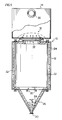
- the reduction vessel 10 for carrying out the subject process has a metal shell 12 and is substantially free-standing, having a combustion chamber 14 mounted thereon.
- the reduction vessel 10 has one or more inlet nozzles 20 (see Fig. 2) for injecting waste, including pulverized solids, for atomization of the liquid portion thereof by jets of hydrogen gas through an annulus of nozzles 27.
- the vessel 10 has a bank of radiant electrical heaters 22 of known commercial type such as Carborundum silicon carbide glow bar heaters lining the walls thereof.
- Chemically resistant FIBERFRAX TM ceramic thermal insulation 24 protects the shell 12, while also ensuring a safe working thermal environment in the locality of the vessel 10.
- a bottom portion 26 of shell 12 includes an auger 28, and a sealed outlet 30 whereby cleaning out of solid inorganic residues can be effected.
- a passage 32 connects vessel 10 with vessel 14 for upward passage therethrough of the reduced gaseous products.
- the passage 32 is positioned and sized to allow the pressure within vessel 10 to be controlled, in order to ensure a safe, positive pressure differential between reduction chamber 10 and combustion chamber 14.
- a blow-out panel (not shown) safeguards the vessel 10 against explosive over pressure.
- An air supply nozzle and combustion grid combination 31 ensures safe and stable combustion within chamber 14.
- the nozzles 20, positioned as shown in Figure 1 each have a liquid inlet 21 and a gaseous inlet 23.
- the gaseous inlet 23 connects, by way of control valves 201, 203 with respective pressurized nitrogen and pressurized hydrogen supplies (not shown), for use in initially purging the combined vessel 10/14, and for subsequently operating the chemical reduction process, respectively.
- the exhaust opening 36 of chamber 14 connects with an acidic gas scrubber and centrifugal fan or particulate removal apparatus 61, particularly in view of the hydrogen chloride content of the exhaust gases.
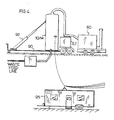
- the system 40 is shown schematically, with reduction chamber 10 supporting combustion chamber 14. Feed of waste-with-liquid or liquids such as PCB or PCB-containing sludge is fed by way of a controllable feed valve 50 to the inlets 21 of the nozzles 20 in chamber 10. The reduced gases pass by way of passage 32 to combustion chamber 14. Variable air inlet controls 54 permit regulation of combustion chamber 14, operating substantially at atmospheric pressure.
- Exhaust gases leave by way of passage 56, passing through a scrubber system 60 centrifugal fan particulate removal apparatus 61, and cooling showers, shown schematically at 62, to leave by stack 65, to atmosphere.
- the subject system includes neutralizing water tank 67, cooling water tank 69, and associated pumps and controls.
- the overall system does not preclude other types of scrubbers.
- Figure 4 is an artist's impression of the system as set up as a low-bed trailer 90, having a hydraulic actuator 92 for positioning the composite reduction/combustion vessel 10/14.
- steam from a steam generator may be utilized, both as the purging agent for the combined vessel 10/14, and as the pre-heating agent for the reduction and combustor chambers 10/14.
- Process control instrumentation located in ancilliary trailer 95 provides automated control and back-up by way of instrumentation and controls (not shown).
Landscapes
- Engineering & Computer Science (AREA)
- Environmental & Geological Engineering (AREA)
- Chemical & Material Sciences (AREA)
- Health & Medical Sciences (AREA)
- Chemical Kinetics & Catalysis (AREA)
- General Chemical & Material Sciences (AREA)
- Business, Economics & Management (AREA)
- Emergency Management (AREA)
- Toxicology (AREA)
- General Health & Medical Sciences (AREA)
- Mechanical Engineering (AREA)
- General Engineering & Computer Science (AREA)
- Processing Of Solid Wastes (AREA)
- Fire-Extinguishing Compositions (AREA)
- Gasification And Melting Of Waste (AREA)
Applications Claiming Priority (2)
| Application Number | Priority Date | Filing Date | Title |
|---|---|---|---|
| CA515603 | 1986-08-08 | ||
| CA000515603A CA1294111C (fr) | 1986-08-08 | 1986-08-08 | Procede de destruction de rebuts organiques |
Publications (2)
| Publication Number | Publication Date |
|---|---|
| EP0257893A1 true EP0257893A1 (fr) | 1988-03-02 |
| EP0257893B1 EP0257893B1 (fr) | 1997-04-23 |
Family
ID=4133697
Family Applications (1)
| Application Number | Title | Priority Date | Filing Date |
|---|---|---|---|
| EP87307034A Expired - Lifetime EP0257893B1 (fr) | 1986-08-08 | 1987-08-07 | Procédé de destruction de materiaux organiques de rebut |
Country Status (7)
| Country | Link |
|---|---|
| US (1) | US4819571A (fr) |
| EP (1) | EP0257893B1 (fr) |
| JP (1) | JP2755946B2 (fr) |
| CA (1) | CA1294111C (fr) |
| DE (1) | DE3752053T2 (fr) |
| DK (1) | DK411987A (fr) |
| HK (1) | HK1007523A1 (fr) |
Cited By (7)
| Publication number | Priority date | Publication date | Assignee | Title |
|---|---|---|---|---|
| EP0295454A3 (en) * | 1987-06-13 | 1989-03-15 | Felten & Guilleaume Energietechnik Ag | Process and apparatus for the purposeful destruction (cracking) of organo-chemical matter in the production and for the low-pollution processing of the cracked matter |
| EP0387417A1 (fr) * | 1989-03-17 | 1990-09-19 | BASF Aktiengesellschaft | Méthode pour éliminer ou diminuer des aromates halogénés des gaz d'échappement de l'incinération de déchets |
| EP0392727A1 (fr) * | 1989-04-10 | 1990-10-17 | 655901 Ontario Inc. | Procédé de destruction de matériaux organiques de rebut |
| WO1991007209A1 (fr) * | 1989-11-15 | 1991-05-30 | Klaus Rennebeck | Procede et bruleur a gaz pour le nettoyage, le degazage, la desinfection et/ou la decontamination et procede pour fabriquer ce bruleur a gaz |
| EP0553511A1 (fr) * | 1992-01-24 | 1993-08-04 | METALLGESELLSCHAFT Aktiengesellschaft | Méthode d'élimination des résidus contenant du fluor et du cyanure |
| WO1994014503A1 (fr) * | 1992-12-18 | 1994-07-07 | Technological Resources Pty. Limited | Elimination de matieres toxiques |
| EP0668089A1 (fr) * | 1994-02-17 | 1995-08-23 | Buck Werke GmbH & Co | Procédé et appreil pour la conversion des déchets et des matières résiduelles |
Families Citing this family (21)
| Publication number | Priority date | Publication date | Assignee | Title |
|---|---|---|---|---|
| US4934286A (en) * | 1989-08-24 | 1990-06-19 | Fowler Benjamin P | Apparatus and method for the disposal of waste |
| US5319176A (en) * | 1991-01-24 | 1994-06-07 | Ritchie G. Studer | Plasma arc decomposition of hazardous wastes into vitrified solids and non-hazardous gasses |
| US5163829A (en) * | 1991-07-24 | 1992-11-17 | Thermo Electron Wisconsin, Inc. | Compact regenerative incinerator |
| TW255004B (en) * | 1995-03-06 | 1995-08-21 | Eli Eco Logic Inc | Method and apparatus for treatment of organic waste material |
| JP3696992B2 (ja) * | 1996-09-27 | 2005-09-21 | 三菱重工業株式会社 | 廃棄物の熱処理方法 |
| JP3288995B2 (ja) * | 1999-09-22 | 2002-06-04 | 淳一 岩村 | 難揮発性有機物質の分別分離方法 |
| US20030049182A1 (en) * | 2000-05-01 | 2003-03-13 | Christopher Hertzler | System and method for abatement of dangerous substances from a waste gas stream |
| DE10058640A1 (de) * | 2000-11-25 | 2002-06-06 | Ald Vacuum Techn Ag | Verfahren zur thermischen Dekontamination von mit PCB, PCDF, PCDD, Furanen und/oder einer Mischung dieser Verbindungen kontaminierten Teilen |
| US6663681B2 (en) | 2001-03-06 | 2003-12-16 | Alchemix Corporation | Method for the production of hydrogen and applications thereof |
| US6685754B2 (en) * | 2001-03-06 | 2004-02-03 | Alchemix Corporation | Method for the production of hydrogen-containing gaseous mixtures |
| KR100479627B1 (ko) * | 2002-05-25 | 2005-04-06 | 유니셈 주식회사 | 폐가스 처리용 습식 전처리 장치 및 그 전처리 방법 |
| USH2198H1 (en) | 2002-07-30 | 2007-08-07 | Ch2M Hill Inc. | Multi-stage pyrolysis systems for treating chlorine contaminated wastes |
| CA2540293A1 (fr) * | 2003-02-26 | 2004-09-10 | Ch2M Hill, Inc. | Procede de stabilisation de dechets par ceramique en phosphate deshydratee a liage chimique |
| US8742195B2 (en) * | 2004-02-26 | 2014-06-03 | Ch2M Hill, Inc. | Aluminum phosphate ceramics for waste storage |
| JP4518382B2 (ja) * | 2004-05-24 | 2010-08-04 | 株式会社神鋼環境ソリューション | 有機ハロゲン化合物の除去方法および除去装置 |
| US7694523B2 (en) | 2004-07-19 | 2010-04-13 | Earthrenew, Inc. | Control system for gas turbine in material treatment unit |
| US7685737B2 (en) | 2004-07-19 | 2010-03-30 | Earthrenew, Inc. | Process and system for drying and heat treating materials |
| US7024800B2 (en) | 2004-07-19 | 2006-04-11 | Earthrenew, Inc. | Process and system for drying and heat treating materials |
| US7610692B2 (en) | 2006-01-18 | 2009-11-03 | Earthrenew, Inc. | Systems for prevention of HAP emissions and for efficient drying/dehydration processes |
| US11391458B2 (en) * | 2016-06-27 | 2022-07-19 | Combustion Systems Company, Inc. | Thermal oxidization systems and methods |
| US12405003B2 (en) | 2016-06-27 | 2025-09-02 | Emission Rx, Llc | Thermal oxidization systems and methods with greenhouse gas capture |
Citations (3)
| Publication number | Priority date | Publication date | Assignee | Title |
|---|---|---|---|---|
| DE1551838A1 (de) * | 1951-01-28 | 1970-06-18 | Fellner & Ziegler Gmbh | Verfahren und Vorrichtung zum Verbrennen von Industrieabfaellen |
| WO1982002001A1 (fr) * | 1980-12-08 | 1982-06-24 | Vasak Vladimir | Elimination de dechets |
| GB2159137A (en) * | 1984-05-21 | 1985-11-27 | Univ Southern California | Conversion of halogenated toxic substances |
Family Cites Families (14)
| Publication number | Priority date | Publication date | Assignee | Title |
|---|---|---|---|---|
| JPS5126482Y2 (fr) * | 1971-04-01 | 1976-07-06 | ||
| JPS51133833A (en) * | 1975-05-15 | 1976-11-19 | Mitsubishi Heavy Ind Ltd | Utilization method of combustioned gas |
| DE2855650C2 (de) * | 1978-12-22 | 1984-10-25 | Nukem Gmbh, 6450 Hanau | Verfahren zur pyrohydrolytischen Zersetzung von Phosphor enthaltenden, mit hochangereichertem Uran kontaminierten Flüssigkeiten |
| US4230053A (en) * | 1979-02-05 | 1980-10-28 | Deardorff Paul A | Method of disposing of toxic substances |
| JPS55105111A (en) * | 1979-02-08 | 1980-08-12 | Nittetsu Kakoki Kk | Process for combustion of fluid |
| US4474121A (en) * | 1981-12-21 | 1984-10-02 | Sterling Drug Inc. | Furnace control method |
| US4463691A (en) * | 1982-03-08 | 1984-08-07 | American Toxic Disposal Partners | Method and apparatus for treating polychlorinated biphenyl contaminated sludge |
| JPS5925335A (ja) * | 1982-07-30 | 1984-02-09 | Kitamura Gokin Seisakusho:Kk | Pcbの無害化処理装置 |
| JPS59232947A (ja) * | 1982-10-19 | 1984-12-27 | 荒井 由和 | 固化剤およびその固化処理法 |
| JPS5921916A (ja) * | 1983-05-10 | 1984-02-04 | Marugo Gomme Kogyo Kk | ゴムスクラツプの焼却方法 |
| DE3341748A1 (de) * | 1983-11-18 | 1985-05-30 | Kraftwerk Union AG, 4330 Mülheim | Verfahren und ofen zur beseitigung radioaktiver abfaelle |
| JPS60125600A (ja) * | 1983-12-09 | 1985-07-04 | 株式会社日立製作所 | 使用済イオン交換樹脂の処理方法および装置 |
| NL8402641A (nl) * | 1984-08-30 | 1986-03-17 | Univ Leiden | Werkwijze voor het vernietigen van organische afvalstoffen door thermische omzetting. |
| CA1236488A (fr) * | 1985-06-25 | 1988-05-10 | Hydro-Quebec | Procede pour la destruction de produits organiques toxiques |
-
1986
- 1986-08-08 CA CA000515603A patent/CA1294111C/fr not_active Expired - Lifetime
-
1987
- 1987-08-05 US US07/082,452 patent/US4819571A/en not_active Expired - Fee Related
- 1987-08-07 DK DK411987A patent/DK411987A/da not_active Application Discontinuation
- 1987-08-07 DE DE3752053T patent/DE3752053T2/de not_active Expired - Fee Related
- 1987-08-07 EP EP87307034A patent/EP0257893B1/fr not_active Expired - Lifetime
- 1987-08-08 JP JP62198982A patent/JP2755946B2/ja not_active Expired - Lifetime
-
1998
- 1998-06-25 HK HK98106794A patent/HK1007523A1/en not_active IP Right Cessation
Patent Citations (3)
| Publication number | Priority date | Publication date | Assignee | Title |
|---|---|---|---|---|
| DE1551838A1 (de) * | 1951-01-28 | 1970-06-18 | Fellner & Ziegler Gmbh | Verfahren und Vorrichtung zum Verbrennen von Industrieabfaellen |
| WO1982002001A1 (fr) * | 1980-12-08 | 1982-06-24 | Vasak Vladimir | Elimination de dechets |
| GB2159137A (en) * | 1984-05-21 | 1985-11-27 | Univ Southern California | Conversion of halogenated toxic substances |
Non-Patent Citations (2)
| Title |
|---|
| CHEMISTRY AND INDUSTRY, vol. 102, no. 19, 3rd October 1983, pages 759-760, Letchworth, Herts, GB; R. LOUW et al.: "Thermal hydro-dechlorination of (poly)chlorinated organic compounds" * |
| ENVIRONMENT CANADA, ECONOMIC AND TECHNICAL REVIEW, REPORT EPS 3-EC-83-1, February 1983, pages 32-35, Ottawa, Ontario, Canada, US; "Destruction technologies for polychlorinated biphenyls (PCBs)" * |
Cited By (8)
| Publication number | Priority date | Publication date | Assignee | Title |
|---|---|---|---|---|
| EP0295454A3 (en) * | 1987-06-13 | 1989-03-15 | Felten & Guilleaume Energietechnik Ag | Process and apparatus for the purposeful destruction (cracking) of organo-chemical matter in the production and for the low-pollution processing of the cracked matter |
| EP0387417A1 (fr) * | 1989-03-17 | 1990-09-19 | BASF Aktiengesellschaft | Méthode pour éliminer ou diminuer des aromates halogénés des gaz d'échappement de l'incinération de déchets |
| EP0392727A1 (fr) * | 1989-04-10 | 1990-10-17 | 655901 Ontario Inc. | Procédé de destruction de matériaux organiques de rebut |
| WO1991007209A1 (fr) * | 1989-11-15 | 1991-05-30 | Klaus Rennebeck | Procede et bruleur a gaz pour le nettoyage, le degazage, la desinfection et/ou la decontamination et procede pour fabriquer ce bruleur a gaz |
| EP0553511A1 (fr) * | 1992-01-24 | 1993-08-04 | METALLGESELLSCHAFT Aktiengesellschaft | Méthode d'élimination des résidus contenant du fluor et du cyanure |
| WO1994014503A1 (fr) * | 1992-12-18 | 1994-07-07 | Technological Resources Pty. Limited | Elimination de matieres toxiques |
| US5648591A (en) * | 1992-12-18 | 1997-07-15 | University Of Western Australia | Toxic material disposal |
| EP0668089A1 (fr) * | 1994-02-17 | 1995-08-23 | Buck Werke GmbH & Co | Procédé et appreil pour la conversion des déchets et des matières résiduelles |
Also Published As
| Publication number | Publication date |
|---|---|
| CA1294111C (fr) | 1992-01-14 |
| DK411987D0 (da) | 1987-08-07 |
| EP0257893B1 (fr) | 1997-04-23 |
| HK1007523A1 (en) | 1999-04-16 |
| DK411987A (da) | 1988-02-09 |
| DE3752053T2 (de) | 1997-09-25 |
| JP2755946B2 (ja) | 1998-05-25 |
| US4819571A (en) | 1989-04-11 |
| JPS6399413A (ja) | 1988-04-30 |
| DE3752053D1 (de) | 1997-05-28 |
Similar Documents
| Publication | Publication Date | Title |
|---|---|---|
| US4819571A (en) | Process for the destruction of organic waste material | |
| HK1007523B (en) | Process for the destruction of organic waste material | |
| EP2396089B1 (fr) | Procédé pour la conversion d'un matériau organique en gaz combustible riche en méthane | |
| US5050511A (en) | Process for the destruction of organic waste material | |
| Vadillo et al. | Problems in supercritical water oxidation process and proposed solutions | |
| GB2152949A (en) | A method and apparatus for the pyrolytic destruction of waste materials | |
| US4198384A (en) | Multistage incineration of halogenated hydrocarbon containing waste streams | |
| JP7652720B2 (ja) | 有機材料を還元してメタンおよび/または水素を生成するためのプロセス | |
| CA1260959A (fr) | Conversion de substances toxiques halogenees | |
| EP0392727A1 (fr) | Procédé de destruction de matériaux organiques de rebut | |
| JP3219689B2 (ja) | 難分解物質の分解処理方法及びその装置 | |
| CA1324394C (fr) | Procede de destruction de dechets organiques | |
| CN219976435U (zh) | 一种等离子熔融耦合焚烧炉的医废处理系统 | |
| US20050079127A1 (en) | Method and apparatus for destruction of liquid toxic wastes and generation of a reducing gas | |
| JP3669881B2 (ja) | 難分解物質の分解処理方法及びその装置 | |
| JP3730794B2 (ja) | 難分解物質の分解処理方法及びその装置 | |
| DE69031288T2 (fr) | ||
| Kokoszka et al. | Methods of PCB disposal | |
| HK40077305B (zh) | 用於还原有机材料以产生甲烷和/或氢气的方法 | |
| Grasso | Thermal Processes | |
| HK1165743A (en) | Process for the conversion of organic material to methane rich fuel gas | |
| Li et al. | 6 Supercritical Water Oxidation of Hazardous Waste |
Legal Events
| Date | Code | Title | Description |
|---|---|---|---|
| PUAI | Public reference made under article 153(3) epc to a published international application that has entered the european phase |
Free format text: ORIGINAL CODE: 0009012 |
|
| AK | Designated contracting states |
Kind code of ref document: A1 Designated state(s): BE DE FR GB IT NL |
|
| 17P | Request for examination filed |
Effective date: 19880811 |
|
| 17Q | First examination report despatched |
Effective date: 19890707 |
|
| RAP3 | Party data changed (applicant data changed or rights of an application transferred) |
Owner name: 655901 ONTARIO INC. |
|
| GRAG | Despatch of communication of intention to grant |
Free format text: ORIGINAL CODE: EPIDOS AGRA |
|
| GRAH | Despatch of communication of intention to grant a patent |
Free format text: ORIGINAL CODE: EPIDOS IGRA |
|
| GRAH | Despatch of communication of intention to grant a patent |
Free format text: ORIGINAL CODE: EPIDOS IGRA |
|
| GRAA | (expected) grant |
Free format text: ORIGINAL CODE: 0009210 |
|
| AK | Designated contracting states |
Kind code of ref document: B1 Designated state(s): BE DE FR GB IT NL |
|
| REF | Corresponds to: |
Ref document number: 3752053 Country of ref document: DE Date of ref document: 19970528 |
|
| ET | Fr: translation filed | ||
| RAP2 | Party data changed (patent owner data changed or rights of a patent transferred) |
Owner name: ELI ECO LOGIC INC. |
|
| NLT2 | Nl: modifications (of names), taken from the european patent patent bulletin |
Owner name: ELI ECO LOGIC INC. |
|
| PLBE | No opposition filed within time limit |
Free format text: ORIGINAL CODE: 0009261 |
|
| STAA | Information on the status of an ep patent application or granted ep patent |
Free format text: STATUS: NO OPPOSITION FILED WITHIN TIME LIMIT |
|
| NLT1 | Nl: modifications of names registered in virtue of documents presented to the patent office pursuant to art. 16 a, paragraph 1 |
Owner name: ELI ECO LOGIC INC. |
|
| 26N | No opposition filed | ||
| REG | Reference to a national code |
Ref country code: GB Ref legal event code: IF02 |
|
| PGFP | Annual fee paid to national office [announced via postgrant information from national office to epo] |
Ref country code: NL Payment date: 20040803 Year of fee payment: 18 |
|
| PGFP | Annual fee paid to national office [announced via postgrant information from national office to epo] |
Ref country code: GB Payment date: 20040804 Year of fee payment: 18 |
|
| PGFP | Annual fee paid to national office [announced via postgrant information from national office to epo] |
Ref country code: FR Payment date: 20040810 Year of fee payment: 18 |
|
| PGFP | Annual fee paid to national office [announced via postgrant information from national office to epo] |
Ref country code: DE Payment date: 20040819 Year of fee payment: 18 |
|
| PGFP | Annual fee paid to national office [announced via postgrant information from national office to epo] |
Ref country code: BE Payment date: 20041020 Year of fee payment: 18 |
|
| PG25 | Lapsed in a contracting state [announced via postgrant information from national office to epo] |
Ref country code: IT Free format text: LAPSE BECAUSE OF NON-PAYMENT OF DUE FEES Effective date: 20050807 Ref country code: GB Free format text: LAPSE BECAUSE OF NON-PAYMENT OF DUE FEES Effective date: 20050807 |
|
| PG25 | Lapsed in a contracting state [announced via postgrant information from national office to epo] |
Ref country code: BE Free format text: LAPSE BECAUSE OF NON-PAYMENT OF DUE FEES Effective date: 20050831 |
|
| PG25 | Lapsed in a contracting state [announced via postgrant information from national office to epo] |
Ref country code: NL Free format text: LAPSE BECAUSE OF NON-PAYMENT OF DUE FEES Effective date: 20060301 Ref country code: DE Free format text: LAPSE BECAUSE OF NON-PAYMENT OF DUE FEES Effective date: 20060301 |
|
| GBPC | Gb: european patent ceased through non-payment of renewal fee |
Effective date: 20050807 |
|
| PG25 | Lapsed in a contracting state [announced via postgrant information from national office to epo] |
Ref country code: FR Free format text: LAPSE BECAUSE OF NON-PAYMENT OF DUE FEES Effective date: 20060428 |
|
| NLV4 | Nl: lapsed or anulled due to non-payment of the annual fee |
Effective date: 20060301 |
|
| REG | Reference to a national code |
Ref country code: FR Ref legal event code: ST Effective date: 20060428 |
|
| BERE | Be: lapsed |
Owner name: *ELI ECO LOGIC INC. Effective date: 20050831 |