EP0258346B1 - Flüssigkristallanzeigeelement - Google Patents
Flüssigkristallanzeigeelement Download PDFInfo
- Publication number
- EP0258346B1 EP0258346B1 EP87901438A EP87901438A EP0258346B1 EP 0258346 B1 EP0258346 B1 EP 0258346B1 EP 87901438 A EP87901438 A EP 87901438A EP 87901438 A EP87901438 A EP 87901438A EP 0258346 B1 EP0258346 B1 EP 0258346B1
- Authority
- EP
- European Patent Office
- Prior art keywords
- atoms
- groups
- liquid crystal
- dielectric
- dio
- Prior art date
- Legal status (The legal status is an assumption and is not a legal conclusion. Google has not performed a legal analysis and makes no representation as to the accuracy of the status listed.)
- Expired - Lifetime
Links
Classifications
-
- C—CHEMISTRY; METALLURGY
- C09—DYES; PAINTS; POLISHES; NATURAL RESINS; ADHESIVES; COMPOSITIONS NOT OTHERWISE PROVIDED FOR; APPLICATIONS OF MATERIALS NOT OTHERWISE PROVIDED FOR
- C09K—MATERIALS FOR MISCELLANEOUS APPLICATIONS, NOT PROVIDED FOR ELSEWHERE
- C09K11/00—Luminescent materials, e.g. electroluminescent or chemiluminescent
-
- C—CHEMISTRY; METALLURGY
- C09—DYES; PAINTS; POLISHES; NATURAL RESINS; ADHESIVES; COMPOSITIONS NOT OTHERWISE PROVIDED FOR; APPLICATIONS OF MATERIALS NOT OTHERWISE PROVIDED FOR
- C09K—MATERIALS FOR MISCELLANEOUS APPLICATIONS, NOT PROVIDED FOR ELSEWHERE
- C09K19/00—Liquid crystal materials
- C09K19/02—Liquid crystal materials characterised by optical, electrical or physical properties of the components, in general
-
- C—CHEMISTRY; METALLURGY
- C09—DYES; PAINTS; POLISHES; NATURAL RESINS; ADHESIVES; COMPOSITIONS NOT OTHERWISE PROVIDED FOR; APPLICATIONS OF MATERIALS NOT OTHERWISE PROVIDED FOR
- C09K—MATERIALS FOR MISCELLANEOUS APPLICATIONS, NOT PROVIDED FOR ELSEWHERE
- C09K19/00—Liquid crystal materials
- C09K19/04—Liquid crystal materials characterised by the chemical structure of the liquid crystal components, e.g. by a specific unit
- C09K19/42—Mixtures of liquid crystal compounds covered by two or more of the preceding groups C09K19/06 - C09K19/40
Definitions
- the invention relates to a liquid crystal display element (LC display element) with a low multiplex ratio and a low operating voltage.
- nematic or nematic-cholesteric liquid-crystalline materials are used for LC display elements to change their optical properties such as light absorption, light scattering, birefringence, reflectivity or color under the influence of electrical fields.
- the function of such display elements is based, for example, on the phenomena of dynamic scattering, the deformation of aligned phases, the guest-host effect, the Schadt-Helfrich effect in the twisted cells or the cholesteric-nematic phase transition.
- LC phases are required, which have to meet a variety of requirements.
- the chemical resistance to moisture, air and physical influences such as heat, radiation in the infrared, visible and ultraviolet range and electrical DC and AC fields are particularly important here.
- technically usable LC phases require a liquid-crystalline mesophase in a suitable temperature range, low viscosity, low optical anisotropy, high steepness of the electro-optical characteristic and sufficient solvency for pleochroic dyes.
- LC display elements that are produced today are controlled in multiplex mode with multiplex ratios of approximately 1: 2 to 1: 4 and with operating voltages of approximately 3 volts.
- the working temperature range of such display elements is generally between -10 and + 50 °.
- the invention has for its object to provide LC display elements that have a wide working temperature range and do not have the disadvantages indicated above or only to a lesser extent.
- EP-A-0 168 012 describes liquid-crystalline compositions with CN transitions of 0 ° C. or below and NI transitions between 59.5 and 66.1 ° C. and corresponding working temperature ranges.
- WO-A-8 603 769 specifies liquid-crystalline phases which contain both compounds of the formula 1 and compounds of the formula II.
- WO-A-8 605 799 describes liquid crystal phases which contain compounds of a specific formula which overlaps with the present formula I; however, there is no indication of the 3-X 2 -4-X 1 phenyl group which is mandatory in the compounds of the formula I. The latter two publications were only published after this priority date.
- Preferred compounds of the formula I correspond to the following sub-formulas (in which FCP denotes the 3-fluoro-4-cyanophenyl radical):
- the radical R 1 is preferably straight-chain alkyl having 1-9 C atoms, such as methyl, ethyl, propyl, butyl, pentyl, hexyl, heptyl, octyl or nonyl, furthermore straight-chain alkoxy having 1-9 C atoms using methoxy, ethoxy, Propoxy, butoxy, pentoxy, hexoxy, heptoxy, octoxy, or nonoxy, furthermore alkoxyalkyl with 2-9 C atoms such as methoxymethyl, ethoxymethyl.
- Phe preferably denotes an unsubstituted 1,4-phenyl group, further preferably a 2-fluoro-1,4-phenylene group.
- the individual compounds of the formula I which can be used in the LC display elements according to the invention are either known, or they can be prepared analogously to known compounds.
- Preferred dielectrics which can be used according to the invention contain, for example, about 7-20% I. They contain a total of preferably 10-20, in particular, 12-18 components.
- the working temperature range of these dielectrics is between -30 and + 80 °, preferably between -40 and + 85 °.
- Their viscosity at 20 ° is less than 40, preferably less than 30 m Pa-s, their threshold voltage is preferably at most 1.7, in particular at most 1.5 volts.
- the dielectrics which can be used according to the invention are produced in a manner which is conventional per se.
- the desired amount of the components used in smaller amounts is dissolved in the components which make up the main constituent, advantageously at elevated temperature.
- solutions of the components in an organic solvent e.g. in acetone, chloroform or methanol, and to remove the solvent after mixing, for example by distillation.
- the dielectrics can also contain further additives known to the person skilled in the art and described in the literature.
- 0-15% pleochroic dyes can be added, furthermore conductive salts, preferably ethyl dimethyldodecylammonium 4-hexoxybenzoate, tetrabutylammonium tetraphenylboranate or complex salts of crown ethers (see, for example, Haller et al., Mol. Cryst. Liq. Cryst. Volume 24, pages 249 -258, (1973)) to improve the conductivity or substances to change the dielectric anisotropy, the viscosity and / or the orientation of the nematic phases.
- Such substances are e.g. in DE-OS 22 09 127, 22 40 864, 23 21 632, 23 38 281, 24 50 088, 26 37 430 and 28 53 728.
Landscapes
- Chemical & Material Sciences (AREA)
- Engineering & Computer Science (AREA)
- Materials Engineering (AREA)
- Organic Chemistry (AREA)
- Crystallography & Structural Chemistry (AREA)
- Liquid Crystal Substances (AREA)
- Organic Low-Molecular-Weight Compounds And Preparation Thereof (AREA)
Description
- Die Erfindung betrifft ein Flüssigkristallanzeigeelement (FK-Anzeigeelement) mit niedrigem Multiplexverhältnis und niedriger Betriebsspannung.
- Für FK-Anzeigeelemente werden die Eigenschaften nematischer oder nematisch-cholesterischer flussigkristalliner Materialien ausgenutzt, ihre optischen Eigenschaften wie Lichtabsorption, Lichtstreuung, Doppelbrechung, Reflexionsvermögen oder Farbe unter dem Einfluß elektrischer Felder zu verändern. Die Funktion derartiger Anzeigeelemente beruht dabei beispielsweise auf den Phänomenen der dynamischen Streuung, der Deformation aufgerichteter Phasen, dem Guest-Host-Effekt, dem Schadt-Helfrich-Effekt in der verdrillten Zellen oder dem cholesterisch-nematischen Phasenübergang.
- Für die technische Anwendung dieser Effekte in elektronischen Bauelementen werden FK-Phasen benötigt, die einer Vielzahl von Anforderungen genügen müssen. Besonders wichtig sind hier die chemische Beständigkeit gegenüber Feuchtigkeit, Luft und physikalischen Einflüssen wie Wärme, Strahlung im infraroten, sichtbaren und ultravioletten Bereich und elektrische Gleich- und Wechselfelder. Ferner wird von technisch verwendbaren FK-Phasen eine flüssigkristalline Mesophase in einem geeigneten Temperaturbereich, niedrige Viskosität, niedrige optische Anisotropie, hohe Steilheit der elektrooptischen Kennlinie und ausreichendes Lösungsvermögen für pleochroitische Farbstoffe gefordert.
- In keiner der bisher bekannten Reihen von Verbindungen mitflüssigkristalliner Mesophase gibt es eine Einzelverbindung, die allen diesen Erfordernissen entspricht. Es werden daher in der Regel Mischungen von zwei bis 25, vorzugsweise drei bis 18, Verbindungen hergestellt, um als FK-Phasen verwendbare Substanzen zu erhalten. Optimale Phasen lassen sich jedoch auf diese Weise nicht leicht herstellen, da Komponenten mit hohen Schmelz- und Klärpunkten den Gemischen häufig auch eine hohe Viskosität verleihen. Dadurch werden die Schaltzeiten der damit hergestellten elektrooptischen Anzeigeelemente in unerwünschter Weise verändert.
- Es besteht somit immer noch ein großer Bedarf, nach FK-Phasen mit größerem Arbeitstemperaturbereich, niedriger Viskosität (und damit kurzen Schaltzeiten) und niedriger Schwellenspannung.
- Die meisten FK-Anzeigeelemente, die heute produziert werden, werden im Multiplexbetrieb mit Multiplexverhältnissen von etwa 1:2 bis 1:4 und mit Betriebsspannungen von ca. 3 Volt angesteuert. Der Arbeitstemperaturbereich solcher Anzeigeelemente liegt im allgemeinen etwa zwischen -10 und +50°.
- Insbesondere für Anwendungen im Freien, z.B. auch in Automobilen, ist jedoch ein breiterer Arbeitstemperaturbereich wünschenswert.
- Der Erfindung liegt die Aufgabe zugrunde, FK-Anzeigeelemente bereitzustellen, die einen breiten Arbeitsttemperaturbereich besitzen und die oben angegebenen Nachteile nicht oder nur in geringerem Maße aufweisen.
- Es wurde gefunden, daß diese Aufgabe gelöst werden kann, wenn man in diesen Anzeigeelementen bestimmte flüssigkristalline Dielektrika verwendet, die Arbeitstemperaturbereiche zwischen -30 und +80°C und Viskositäten von weniger als 40 m Pa·s bei 20° besitzen.
- Gegenstand der Erfindung ist ein FK-Anzeigeelement mit statischer oder Multiplex-Ansteuerung mit niedrigem Multiplexverhältnis und einer Betriebsspannung unterhalb 3,3 Volt, enthaltend ein flüssigkristallines Dielektrikum, dadurch gekennzeichnet, daß sich der Arbeitstemperaturbereich von -30°C bis +80°C erstreckt, die Viskosität des Dielektrikums bei 20°C weniger als 40 m Pa·s beträgt und daß das Dielektrikum mindestens eine Komponente der Formel I enthält:

- A° und A' jeweils unabhängig voneinander Cy, Dio oder Phe,
- Z -CO-0-, -O-CO-, ―CH2―O―, -O-CH2- oder eine Einfachbindung
- X' F, CI oder CN
- X2 F oder CI
- m 0 oder 1,
- Cy trans-1,4-Cyclohexylen,
- Dio trans-1,3-Dioxan-2,5-diyl und
- Phe unsubstituiertes oder durch Fluor substituiertes 1,4-Phenylen bedeutet, mit der Maßgabe, daß das Dielektrikum keine Komponente der Formel II enthält

- R3 Alkyl mit 1 bis 12 C-Atomen, worin auch eine oder zwei nicht benachbarte CH2-Gruppen durch O-Atome, ―CO―, ―O―CO―, ―CO―O― und/oder-CH=CH-Gruppen ersetzt sein können, F, Cl oder CN,
- A2 und A3 jeweils 1,4-Phenylen oder Cy,
- n 0, 1 oder 2 bedeutet und
- Z, Dio und Cy die angegebenen Bedeutungen haben.
- In der EP-A-0 168 012 sind flüssig-kristalline Kompositionen mit C-N-übergängen von 0°C oder darunter und N-I-Übergangen zwischen 59,5 und 66,1°C und entsprechenden Arbeitstemperaturbereichen beschrieben. In der WO-A-8 603 769 sind flüssig-kristalline Phasen angegeben, die sowohl Verbindungen der Formel 1 als auch Verbindungen der Formel II enthalten. In der WO-A-8 605 799 sind Flüssigkkristallphasen beschrieben, die Verbindungen einer bestimmten Formel enthalten, welche sich mit der vorliegenden Formel I überlappt; jedoch findet sich dort kein Hinweis auf die 3-X2-4-X1-phenylgruppe, die in den Verbindungen der Formel I zwingend enthalten ist. Die beiden letztgenannten Druckschriften wurden erst nach dem vorliegenden Prioritätstag veröffentlicht.
- Bevorzugte Verbindungen der Formel I entsprechenden den folgenden Teilformeln (worin FCP den 3-Fluor-4-cyanphenylrest bedeutet):
-





- Der Rest R1 bedeutet vorzugsweise geradkettiges Alkyl mit 1-9 C-Atomen, wie Methyl, Ethyl, Propyl, Butyl, Pentyl, Hexyl, Heptyl, Octyl oder Nonyl, ferner geradkettiges Alkoxy mit 1-9 C-Atomen mitt Methoxy, Ethoxy, Propoxy, Butoxy, Pentoxy, Hexoxy, Heptoxy, Octoxy, oder Nonoxy, ferner Alkoxyalkyl mit 2-9 C-Atomen wie Methoxymethyl, Ethoxymethyl.
- Phe bedeutet vorzugsweise eine unsubstituierte 1,4-Phenylgruppe, ferner bevorzugt eine 2-Fluor-1,4-phenylengruppe.
- Die einzelnen Verbindungen der Formel I, die in den erfindungsgemäßen FK-Anzeigeelementen verwendet werden können, sind entweder bekannt, oder sie können analog zu bekannten Verbindungen hergestellt werden.
- Bevorzugte erfindungsgemäß verwendbare Dielektrika enthalten z.B. etwa 7-20% I. Sie enthalten insgesamt vorzugsweise 10-20, insbesondere, 12-18 Komponenten.
- Der Arbeitstemperaturbereich dieser Dielektrika liegt zwischen -30 und +80°, vorzugsweise zwischen -40 und +85°. Ihre Viskosität beträgt bei 20° weniger als 40, vorzugsweise weniger als 30 m Pa-s, ihre Schwellenspannung beträgt vorzugsweise höchstens 1,7, insbesondere höchstens 1,5 Volt.
- Die Herstellung der erfindungsgemäß verwendbaren Dielektrika erfolgt in an sich üblicher Weise. In der Regel wird die gewünschte Menge der in geringerer Menge verwendeten Komponenten in der den Hauptbestandteil ausmachenden Komponenten gelöst, zweckmäßig bei erhöhter Temperatur. Es ist auch möglich, Lösungen der Komponenten in einem organischen Lösungsmittel, z.B. in Aceton, Chloroform oder Methanol, zu mischen und das Lösungsmittel nach Durchmischung wieder zu entfernen, beispielswiese durch Destillation.
- Die Dielektrika können auch weitere, dem Fachmann bekannte und in der Literatur beschriebene Zusätze enthalten. Beispielsweise können 0-15% pleochroitische Farbstoffe zugesetzt werden, ferner Leitsalze, vorzugsweise Ethyl-dimethyldodecylammonium-4-hexoxybenzoat, Tetrabutylammoniumtetraphenylboranat oder Komplexsalze von Kronenethern (vgl. z.B. Haller et al., Mol. Cryst. Liq. Cryst. Band 24, Seiten 249-258, (1973)) zur Verbesserung der Leitfähigkeit oder Substantzen zur Veränderung der dielektrischen Anisotropie, der Viskosität und/oder der Orientierung der nematischen Phasen. Derartige Substanzen sind z.B. in den DE-OS 22 09 127, 22 40 864, 23 21 632, 23 38 281, 24 50 088, 26 37 430 und 28 53 728 beschrieben.
- Die folgenden Beispiele sollen die Erfindung erläutern, ohne sie zu begrenzen.
- Es bedeutet:

- Vor und nachstehend sind alle Temperaturen in °C angegeben. Die Prozentzahlen sind Gewichtsprozente.
- Ein Gemisch aus

- Ein Gemisch aus
-
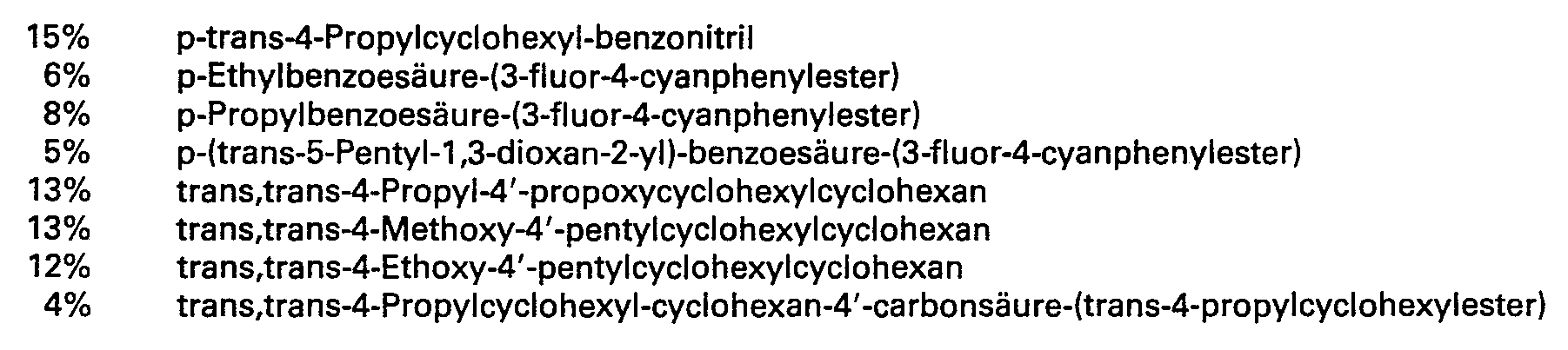

- Ein Gemisch aus
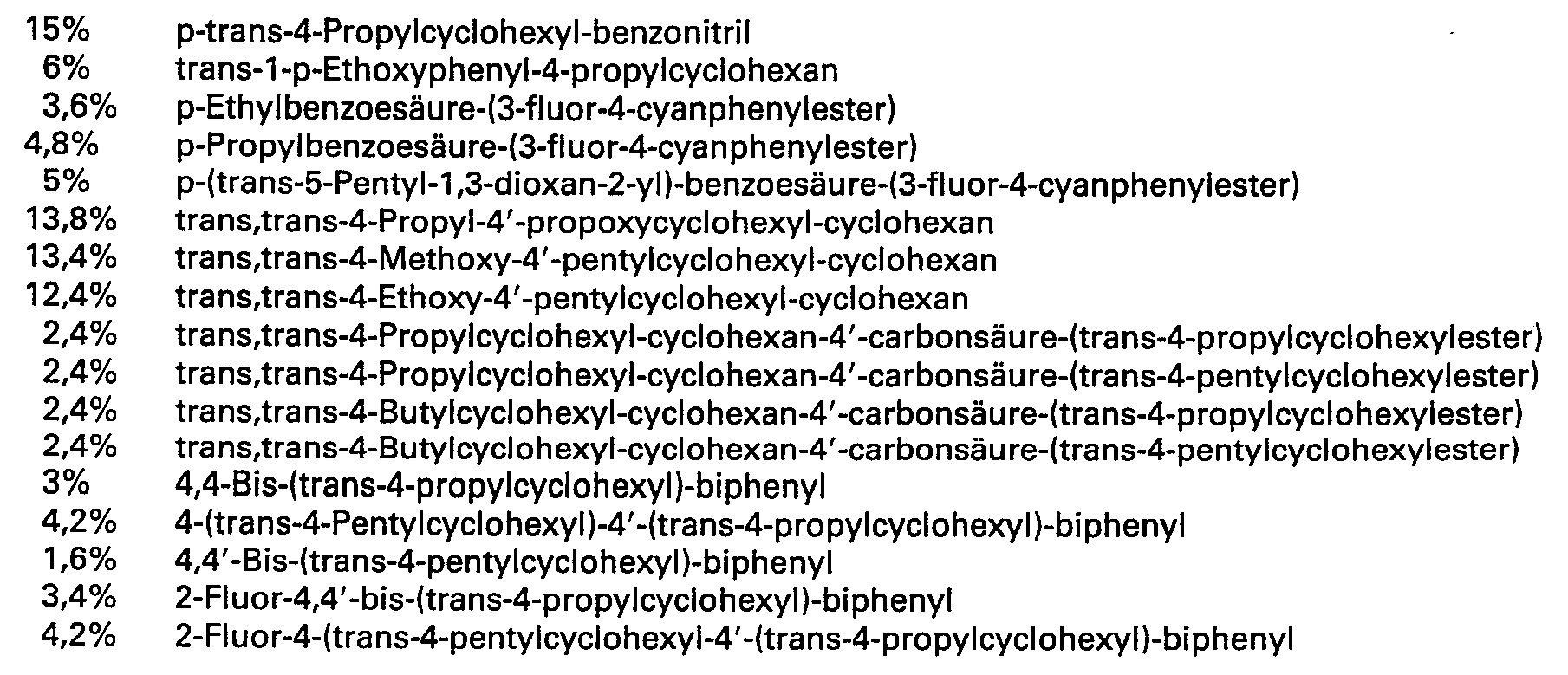
- Ein Gemisch aus

- Ein Gemisch aus


- Ein Gemisch aus

- Ein Gemisch aus

- Ein Gemisch aus

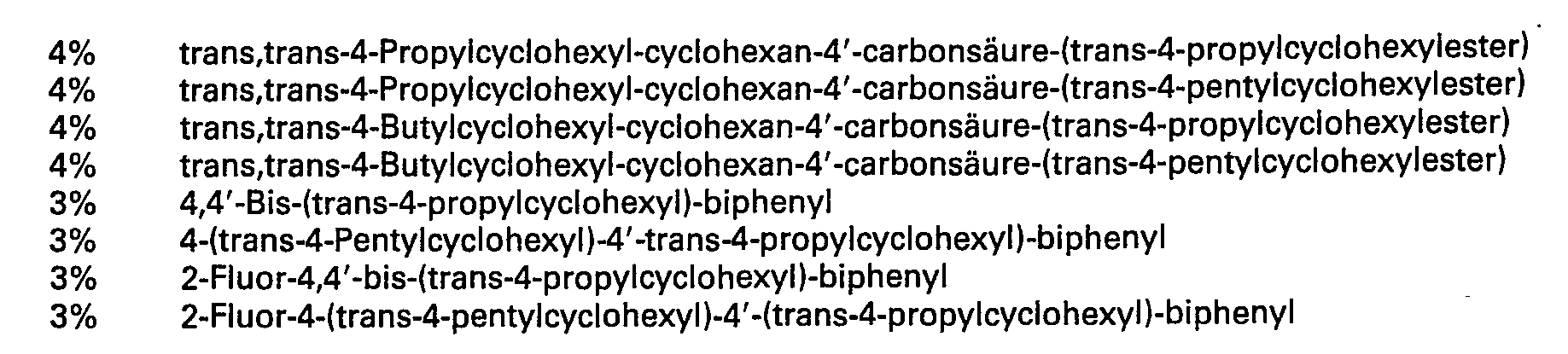
- Ein Gemisch aus

- Ein Gemisch aus

- Ein Gemisch aus
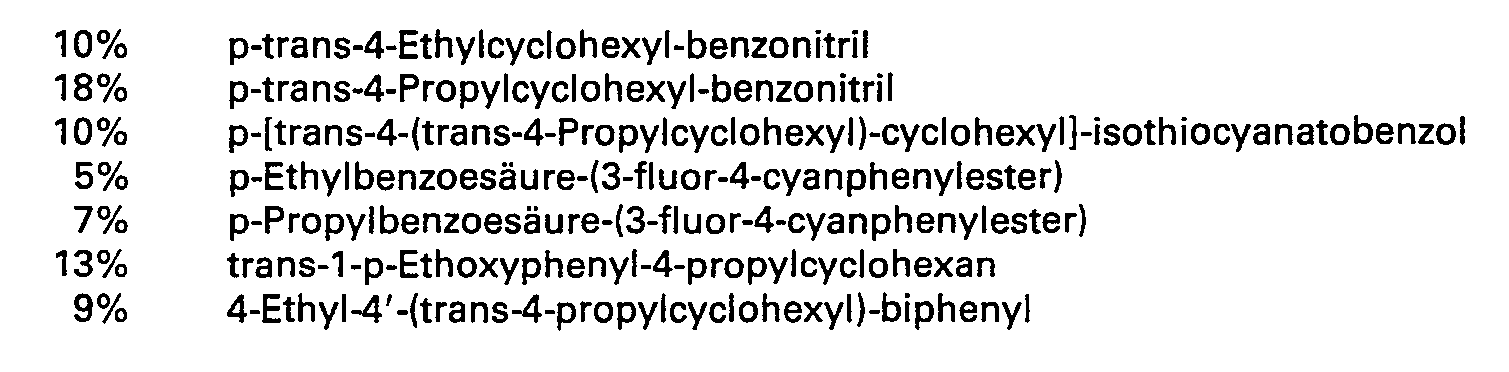

- Es Gemisch aus

- Ein Gemisch aus

- Ein Gemisch aus


- Ein Gemisch aus

- Ein Gemisch aus

Claims (2)
- Flussigkristallanzeigeelement mit statischer oder Multiplex-Ansteuerung mit niedrigem Multiplexverhältnis und einer Betriebsspannung unterhalb 3,3 Volt, enthaltend ein flüssigkristallines Dielektrikum, dadurch gekennzeichnet, daß sich der Arbeitstemperaturbereich von -30°C bis +80°C erstreckt, die Viskosität des Dielektrikums bei 20°C weniger als 40 mPa·s beträgt und daß das Dielektrikum mindestens eine Komponente der Formel I enthält:
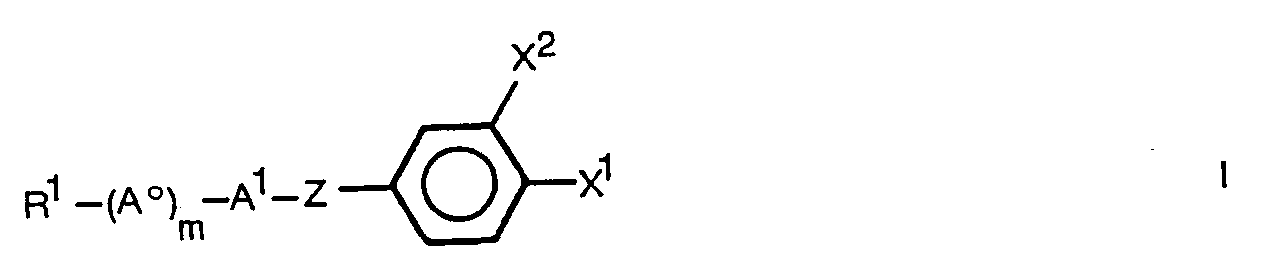 A° und A1 jeweils unabhängig voneinander Cy, Dio oder Phe,Z ―CO―O―, -0-CO-, ―CH2―O―, ―O―CH2― oder eine Einfachbindung,X1 F, CI oder -CN,X2 F oder CI,m 0 oder 1,Cy trans-1,4-Cyclohexylen,Dio trans-1,3-Dioxan-2,5-diyl undPhe unsubstituiertes oder durch Fluor substituiertes 1,4-Phenylen bedeutet, mit der Maßgabe, daß das Dielektrikum keine Komponente der Formel II enthält
 R3 Alkyl mit 1 bis 12 C-Atomen, worin auch eine oder zwei nicht benachbarte CH2-Gruppen durch O-Atome,―CO―,―O―CO―,―CO―O― und/oder-CH=CH-Gruppen ersetzt sein können, F, Cl oder CN,A2 und A3 jeweils 1,4-Phenylen oder Cy,n 0, 1 oder 2 bedeutet und
 - Z, Dio und Cy die angegebenen Bedeutungen haben.
Applications Claiming Priority (2)
| Application Number | Priority Date | Filing Date | Title |
|---|---|---|---|
| DE3606153 | 1986-02-06 | ||
| DE19863606153 DE3606153A1 (de) | 1986-02-26 | 1986-02-26 | Fluessigkristallanzeigeelement |
Publications (2)
| Publication Number | Publication Date |
|---|---|
| EP0258346A1 EP0258346A1 (de) | 1988-03-09 |
| EP0258346B1 true EP0258346B1 (de) | 1990-12-27 |
Family
ID=6294957
Family Applications (1)
| Application Number | Title | Priority Date | Filing Date |
|---|---|---|---|
| EP87901438A Expired - Lifetime EP0258346B1 (de) | 1986-02-26 | 1987-02-14 | Flüssigkristallanzeigeelement |
Country Status (8)
| Country | Link |
|---|---|
| US (1) | US4877547A (de) |
| EP (1) | EP0258346B1 (de) |
| JP (1) | JPS63502596A (de) |
| KR (1) | KR950006077B1 (de) |
| DE (2) | DE3606153A1 (de) |
| HK (1) | HK40691A (de) |
| MY (1) | MY102692A (de) |
| WO (1) | WO1987005317A1 (de) |
Families Citing this family (23)
| Publication number | Priority date | Publication date | Assignee | Title |
|---|---|---|---|---|
| CH660003A5 (de) * | 1984-04-16 | 1987-03-13 | Merck Patent Gmbh | Anisotrope verbindungen und fk-mischungen mit diesen. |
| DE3530126A1 (de) * | 1985-08-23 | 1987-02-26 | Merck Patent Gmbh | Bicyclooctanderivate |
| JPH07100790B2 (ja) * | 1986-09-01 | 1995-11-01 | チッソ株式会社 | ネマチツク液晶組成物 |
| JPH01500837A (ja) * | 1986-09-08 | 1989-03-23 | メルク・パテント・ゲゼルシヤフト・ミツト・ベシユレンクテル・ハフツング | 液晶相 |
| GB8712464D0 (en) * | 1987-05-27 | 1987-07-01 | Merck Patent Gmbh | Liquid crystal phase |
| US5286410A (en) * | 1988-03-10 | 1994-02-15 | Merck Patent Gesellschaft Mit Beschrankter Haftung | Supertwist liquid-crystal display |
| DE3807958B4 (de) * | 1988-03-10 | 2004-03-18 | Merck Patent Gmbh | Supertwist-Flüssigkristallanzeigeelement |
| US6004479A (en) * | 1988-07-13 | 1999-12-21 | Merck Kgaa | Matrix liquid crystal display |
| US5266235A (en) * | 1988-07-20 | 1993-11-30 | Dainippon Ink And Chemicals, Inc. | Phenylbicyclohexanol ester derivative |
| US5152920A (en) * | 1988-07-20 | 1992-10-06 | Dainippon Ink & Chemicals, Inc. | Phenylbicyclohexanol ester derivative |
| DE68917233T2 (de) * | 1988-09-08 | 1995-02-09 | Dainippon Ink & Chemicals | Flüssigkristallvorrichtung. |
| ES2058433T3 (es) * | 1988-10-20 | 1994-11-01 | Merck Patent Gmbh | Indicador matriz de cristal liquido. |
| US5178794A (en) * | 1989-03-01 | 1993-01-12 | Dainippon Ink And Chemicals, Inc. | Alkylene glycol derivative and liquid crystal mixture containing the same |
| JP2917286B2 (ja) * | 1989-03-28 | 1999-07-12 | セイコーエプソン株式会社 | 液晶装置 |
| EP0452460B2 (de) * | 1989-10-02 | 1999-08-11 | MERCK PATENT GmbH | Elektrooptisches flüssigkristallsystem |
| KR0171590B1 (ko) * | 1990-04-13 | 1999-03-20 | 위르겐 호이만, 라인하르트 슈틀러 | 액정 매질 |
| US5292452A (en) * | 1990-09-14 | 1994-03-08 | Hoffmann-La Roche Inc. | Alkenylcyclohexane liquid crystalline compounds |
| DE69120245T2 (de) * | 1990-10-02 | 1996-11-28 | Merck Patent Gmbh | Flüssigkristallmedium |
| US6030545A (en) * | 1995-06-16 | 2000-02-29 | Chisso Corporation | Tercyclohexane, liquid-crystalline compound and liquid crystal composition comprising same |
| DE19549123A1 (de) * | 1995-12-29 | 1997-07-10 | Merck Patent Gmbh | 1,3-Dioxane und flüssigkristallines Medium |
| US6693223B1 (en) | 1997-11-28 | 2004-02-17 | Dainippon Ink And Chemicals, Inc. | Fluorine-substituted-4-alkenylbenzoic acid and derivatives thereof, and nematic liquid crystal composition containing cyanophenyl benzoate derivatives and liquid crystal display system using the same |
| TW579388B (en) | 1997-11-28 | 2004-03-11 | Dainippon Ink & Chemicals | Fluorine-substituted-4-alkenylbenzoic acid and derivatives thereof, and nematic liquid crystal composition containing cyanophenyl benzoate derivatives and liquid crystal display system using the same |
| KR20010016326A (ko) * | 2000-12-02 | 2001-03-05 | 김용배 | 네마틱액정화합물 및 이를 포함하는 네마틱액정조성물 과이것을 이용한 액정표시장치 |
Family Cites Families (26)
| Publication number | Priority date | Publication date | Assignee | Title |
|---|---|---|---|---|
| DE3266741D1 (en) * | 1981-03-13 | 1985-11-14 | Secr Defence Brit | Liquid crystal compositions |
| JPS588778A (ja) * | 1981-07-08 | 1983-01-18 | Hitachi Ltd | 液晶組成物 |
| JPS588780A (ja) * | 1981-07-08 | 1983-01-18 | Hitachi Ltd | 液晶組成物 |
| JPS58191782A (ja) * | 1982-04-30 | 1983-11-09 | Sharp Corp | 液晶組成物 |
| US4490276A (en) * | 1982-09-20 | 1984-12-25 | Merck Patent Gmbh | Liquid crystal admixtures including chloro-cyanophenyl substituted benzoates |
| GB2132192B (en) * | 1982-10-30 | 1986-01-22 | Dainippon Ink & Chemicals | Nematic liquid crystalline 3-fluro-4-cyanophenol derivatives |
| US4536321A (en) * | 1983-02-18 | 1985-08-20 | Chisso Corporation | Fluorobenzene derivatives and liquid crystal compositions containing the same |
| EP0126883B1 (de) * | 1983-03-30 | 1987-03-11 | Wojskowa Akademia Techniczna im. Jaroslawa Dabrowskiego | Flüssigkristall-Cyclohexylbenzolabkömmlinge, deren Herstellung und diese enthaltende Flüssigkristallzusammensetzungen |
| JPS59221376A (ja) * | 1983-05-31 | 1984-12-12 | Sharp Corp | 液晶組成物 |
| DE3566901D1 (en) * | 1984-04-07 | 1989-01-26 | Merck Patent Gmbh | Liquid crystal phase |
| US4676924A (en) * | 1984-07-02 | 1987-06-30 | Wojskowa Akademia Techniczna | Liquid crystalline isothiocyanates with dioxane ring and liquid crystalline admixtures containing same |
| JPH0629426B2 (ja) * | 1984-07-09 | 1994-04-20 | カシオ計算機株式会社 | 液晶組成物 |
| DE3575158D1 (de) * | 1984-07-12 | 1990-02-08 | Hoffmann La Roche | Fluessigkristalline gemische enthaltend komponenten mit einer 4-alkenyl- oder 2z-alkenyl-seitenkette. |
| JPS6176449A (ja) * | 1984-08-16 | 1986-04-18 | Chisso Corp | アルコキシエトキシ置換エステル誘導体 |
| DE3437935A1 (de) * | 1984-10-17 | 1986-04-24 | Merck Patent Gmbh, 6100 Darmstadt | Heterocyclische verbindungen |
| EP0178937B1 (de) * | 1984-10-19 | 1991-04-17 | Dainippon Ink And Chemicals, Inc. | Nematische Flüssigkristallzusammensetzung |
| DE3447359A1 (de) * | 1984-12-24 | 1986-07-03 | Merck Patent Gmbh, 6100 Darmstadt | Fluessigkristalline phase |
| DE3500897A1 (de) * | 1985-01-12 | 1986-07-17 | Merck Patent Gmbh, 6100 Darmstadt | Fluessigkristalline phase |
| DE3506446A1 (de) * | 1985-02-23 | 1986-08-28 | Merck Patent Gmbh, 6100 Darmstadt | Pyrimidinderivate |
| DE3510733A1 (de) * | 1985-03-25 | 1986-09-25 | Merck Patent Gmbh, 6100 Darmstadt | Fluessigkristallphase |
| EP0195974B1 (de) * | 1985-03-26 | 1989-11-29 | F. Hoffmann-La Roche Ag | Alkenylsubstituierte Phenylisothiocyanate und Benzonitrile |
| JPS61282328A (ja) * | 1985-06-10 | 1986-12-12 | Chisso Corp | シクロヘキサン誘導体 |
| JPS62143990A (ja) * | 1985-12-18 | 1987-06-27 | Hitachi Ltd | 液晶表示素子 |
| JPH07100790B2 (ja) * | 1986-09-01 | 1995-11-01 | チッソ株式会社 | ネマチツク液晶組成物 |
| JPS6436A (en) * | 1987-02-06 | 1989-01-05 | Chisso Corp | Cyclohexane derivative |
| JPH0813764B2 (ja) * | 1987-05-19 | 1996-02-14 | 大日本インキ化学工業株式会社 | 新規フッ素系ネマチック液晶化合物 |
-
1986
- 1986-02-26 DE DE19863606153 patent/DE3606153A1/de not_active Withdrawn
-
1987
- 1987-02-14 EP EP87901438A patent/EP0258346B1/de not_active Expired - Lifetime
- 1987-02-14 DE DE8787901438T patent/DE3767085D1/de not_active Expired - Lifetime
- 1987-02-14 WO PCT/EP1987/000078 patent/WO1987005317A1/de not_active Ceased
- 1987-02-14 KR KR1019870700970A patent/KR950006077B1/ko not_active Expired - Lifetime
- 1987-02-14 JP JP62501256A patent/JPS63502596A/ja active Pending
- 1987-02-14 US US07/124,791 patent/US4877547A/en not_active Expired - Lifetime
- 1987-09-10 MY MYPI87001631A patent/MY102692A/en unknown
-
1991
- 1991-05-23 HK HK406/91A patent/HK40691A/xx not_active IP Right Cessation
Also Published As
| Publication number | Publication date |
|---|---|
| KR880700847A (ko) | 1988-04-12 |
| WO1987005317A1 (fr) | 1987-09-11 |
| US4877547A (en) | 1989-10-31 |
| HK40691A (en) | 1991-05-31 |
| EP0258346A1 (de) | 1988-03-09 |
| JPS63502596A (ja) | 1988-09-29 |
| DE3767085D1 (de) | 1991-02-07 |
| MY102692A (en) | 1992-09-30 |
| DE3606153A1 (de) | 1987-08-27 |
| KR950006077B1 (ko) | 1995-06-08 |
Similar Documents
| Publication | Publication Date | Title |
|---|---|---|
| EP0205503B1 (de) | Flüssigkristalline phase | |
| DE3606153A1 (de) | Fluessigkristallanzeigeelement | |
| EP0056501B1 (de) | Flüssigkristallmischung | |
| DE10064995B4 (de) | Flüssigkristallines Medium und seine Verwendung in einer elektrooptischen Anzeige | |
| EP0474062A2 (de) | Matrix-Flüssigkristallanzeige | |
| DE3500897A1 (de) | Fluessigkristalline phase | |
| DE2450088A1 (de) | Biphenylester | |
| CH645664A5 (de) | Fluessigkristallmischung. | |
| EP1146104A2 (de) | Flüssigkristallines Medium | |
| EP0258349B1 (de) | Elektrooptisches anzeigeelement | |
| EP0151446B1 (de) | Flüssigkristalline Phase | |
| DE3023989A1 (de) | Fluessigkristallines dielektrikum | |
| DE69506773T2 (de) | Flüssigkristallzusammensetzung | |
| EP0149209A1 (de) | Flüssigkristall-Phase | |
| DE10354404A1 (de) | Flüssigkristallines Medium | |
| DE102007009944A1 (de) | Flüssigkristallines Medium | |
| DE69008544T2 (de) | Flüssigkristallverbindungen mit hoher optischer Anisotropie. | |
| EP0158252B1 (de) | Flüssigkristalline Phase | |
| EP0226592B1 (de) | Flüssigkristall-phase | |
| EP0302916B1 (de) | Elektrooptisches anzeigeelement | |
| EP0450368A2 (de) | Flüssigkristallanzeige und Flüssigkristallmischung | |
| EP0304738B1 (de) | Optisch aktive Flüssigkristallkomponenten | |
| DE4223059A1 (de) | Flüssigkristallanzeige | |
| DE3434335A1 (de) | Fluessigkristalline phase | |
| EP0690047B1 (de) | Substituierte Phenyl 4-[(E)-alk-2-enoyloxy] benzoate |
Legal Events
| Date | Code | Title | Description |
|---|---|---|---|
| PUAI | Public reference made under article 153(3) epc to a published international application that has entered the european phase |
Free format text: ORIGINAL CODE: 0009012 |
|
| AK | Designated contracting states |
Kind code of ref document: A1 Designated state(s): CH DE FR GB LI |
|
| 17P | Request for examination filed |
Effective date: 19880112 |
|
| 17Q | First examination report despatched |
Effective date: 19890413 |
|
| GRAA | (expected) grant |
Free format text: ORIGINAL CODE: 0009210 |
|
| AK | Designated contracting states |
Kind code of ref document: B1 Designated state(s): CH DE FR GB LI |
|
| GBT | Gb: translation of ep patent filed (gb section 77(6)(a)/1977) | ||
| REF | Corresponds to: |
Ref document number: 3767085 Country of ref document: DE Date of ref document: 19910207 |
|
| PGFP | Annual fee paid to national office [announced via postgrant information from national office to epo] |
Ref country code: FR Payment date: 19910212 Year of fee payment: 5 |
|
| PGFP | Annual fee paid to national office [announced via postgrant information from national office to epo] |
Ref country code: CH Payment date: 19910227 Year of fee payment: 5 |
|
| ET | Fr: translation filed | ||
| PLBE | No opposition filed within time limit |
Free format text: ORIGINAL CODE: 0009261 |
|
| STAA | Information on the status of an ep patent application or granted ep patent |
Free format text: STATUS: NO OPPOSITION FILED WITHIN TIME LIMIT |
|
| 26N | No opposition filed | ||
| PG25 | Lapsed in a contracting state [announced via postgrant information from national office to epo] |
Ref country code: CH Effective date: 19920229 Ref country code: LI Effective date: 19920229 |
|
| PG25 | Lapsed in a contracting state [announced via postgrant information from national office to epo] |
Ref country code: FR Effective date: 19921030 |
|
| REG | Reference to a national code |
Ref country code: CH Ref legal event code: PL |
|
| REG | Reference to a national code |
Ref country code: FR Ref legal event code: ST |
|
| REG | Reference to a national code |
Ref country code: GB Ref legal event code: IF02 |
|
| PGFP | Annual fee paid to national office [announced via postgrant information from national office to epo] |
Ref country code: GB Payment date: 20060208 Year of fee payment: 20 |
|
| PGFP | Annual fee paid to national office [announced via postgrant information from national office to epo] |
Ref country code: DE Payment date: 20060209 Year of fee payment: 20 |
|
| PG25 | Lapsed in a contracting state [announced via postgrant information from national office to epo] |
Ref country code: GB Free format text: LAPSE BECAUSE OF EXPIRATION OF PROTECTION Effective date: 20070213 |
|
| REG | Reference to a national code |
Ref country code: GB Ref legal event code: PE20 |