EP0259827A2 - Anzeigegerät - Google Patents
Anzeigegerät Download PDFInfo
- Publication number
- EP0259827A2 EP0259827A2 EP87113102A EP87113102A EP0259827A2 EP 0259827 A2 EP0259827 A2 EP 0259827A2 EP 87113102 A EP87113102 A EP 87113102A EP 87113102 A EP87113102 A EP 87113102A EP 0259827 A2 EP0259827 A2 EP 0259827A2
- Authority
- EP
- European Patent Office
- Prior art keywords
- character
- display
- mode
- screen
- character data
- Prior art date
- Legal status (The legal status is an assumption and is not a legal conclusion. Google has not performed a legal analysis and makes no representation as to the accuracy of the status listed.)
- Withdrawn
Links
Images




Classifications
-
- G—PHYSICS
- G09—EDUCATION; CRYPTOGRAPHY; DISPLAY; ADVERTISING; SEALS
- G09G—ARRANGEMENTS OR CIRCUITS FOR CONTROL OF INDICATING DEVICES USING STATIC MEANS TO PRESENT VARIABLE INFORMATION
- G09G1/00—Control arrangements or circuits, of interest only in connection with cathode-ray tube indicators; General aspects or details, e.g. selection emphasis on particular characters, dashed line or dotted line generation; Preprocessing of data
- G09G1/007—Circuits for displaying split screens
-
- G—PHYSICS
- G09—EDUCATION; CRYPTOGRAPHY; DISPLAY; ADVERTISING; SEALS
- G09G—ARRANGEMENTS OR CIRCUITS FOR CONTROL OF INDICATING DEVICES USING STATIC MEANS TO PRESENT VARIABLE INFORMATION
- G09G5/00—Control arrangements or circuits for visual indicators common to cathode-ray tube indicators and other visual indicators
- G09G5/22—Control arrangements or circuits for visual indicators common to cathode-ray tube indicators and other visual indicators characterised by the display of characters or indicia using display control signals derived from coded signals representing the characters or indicia, e.g. with a character-code memory
- G09G5/222—Control of the character-code memory
- G09G5/227—Resolution modifying circuits, e.g. variable screen formats, resolution change between memory contents and display screen
Definitions
- the present invention relates to a display apparatus mounted on office automation machinery such as the word processor, personal computer, electronic typewriter and the like, and particularly a display apparatus for use on compact office automation machinery.
- Office automation machinery such as the word processor, personal computer, electronic typewriter and the like have made rapid progress in recent years as the central instrument for streamlining office work.
- CMOS complementary metal-oxide-semiconductor
- CMOS complementary metal-oxide-semiconductor
- plasma display utilizing discharge of plasma gas.
- the latest office automation machinery of a relatively sophisticated class offer a diversified range of mode choice. Some of them are equipped with functions including a split screen mode wherein the screen is divided into two or more sections to allow editing work to be carried out on each screen section independently, and a help menu mode wherein handling methods are called to the screen when the operator forgets how to operate the machine. For these display modes it is desirable to have a large number of characters displayed on the screen.
- the above panel type display includes means for varying the number of characters per screen according to purpose.
- a primary object of the present invention is to provide a display apparatus incorporating a rational improvement for coping with various display modes.
- Another object of the invention is to provide a display apparatus capable of display in various modes presenting characters in different sizes and numbers of lines without rewriting character code data stored in the video RAM.
- a further object of the invention is to provide a display apparatus capable of various mode changes without changing a relative position of a reference point on the screen.
- a still further object of the invention is to provide a display apparatus capable of coping with various display modes without changing a relative cursor position.
- a display apparatus comprises a display device having a two-dimensional screen for displaying the character information; character data generating means for generating character data corresponding to the character information to be displayed; display mode judging means for judging a display mode for displaying the character information on the screen; operating means for operating a display start address for each display mode on the basis of a reference position on the screen; control means for controlling the character data generating means to generate a character font of a size necessary to each display mode; and display device drive means for causing the character information to be displayed in a selected mode on the screen in response to the character data generated by the character data generating means and the display start address operated by the operating menas.
- the reference position on the screen is a cursor position.
- the character data generating means stores different size character fonts and gnerates a character font designated by a font select command from the control means.
- the character data generating means may have an external memory, the control means being operable to cause a high speed transfer of font bit data from the external memory to an internal memory, whereby the character data stored in the internal memory are rewritten for a selected character size.
- a display apparatus comprising a display device having a two-dimensional expanse for displaying the character information; a video memory for generating character code data; character data generating means for generating selected character data in response to the character code data; parallel to serial conversion means for converting the character data into serial data for input to the display device; a display sequencer for providing controls to determine a character to be displayed on the display device and to determine a position on the display device at which the character is displayed; a CPU for calculating a display start address for each display mode on the basis of a cursor position, rewriting a display start address in the display sequencer, and transmitting a character font size designating signal to the character data generating means; and a display device drive means for causing the character information to be displayed in response to a synchronizing signal received from the display sequencer and a serial signal received from the parallel to serial conversion means.
- the CPU when the operator selects a certain display mode by pressing keys, the CPU recognizes the selection, instructs the character data generating means to select a suitable character font size. In parallel with this, the CPU calculates a display start address on the basis of a cursor position, and input the address to the display sequencer. Consequently, character data designated by the display start address appear on the display screen in the selected character size. In this case, the data are presented over a range available on the display screen, using the cursor position for the basis in order to involve no change in the cursor position. Since this display is effected without rewriting contents of the video memory, the apparatus according to the present invention reduces the load on software and provides an advantage of low cost.
- Fig. 1 is a block diagram of a display apparatus according to one embodiment of the invention.
- This display apparatus comprises a CPU 1, a display sequencer 2, a video RAM 3, a latch 4, a character generator memory 4, a shift registor 6, and a display 7.
- the CPU 1 is connected through a data bus A to the display sequencer 2, video RAM 3, latch 4 and character generator memory 5.
- the CPU transmits a rewrite command regarding the number of lines to be displayed to the display sequencer 2, a character font select command to the character generator memory 5, and a character code data rewrite command to the video RAM 3.
- This character code data rewriting does not include rewriting of characters having different sizes.
- the CPU 1 transmits the character font select command to the character generator memory 5 and the number of lines rewrite command to the display sequencer 2.
- the display sequencer 2 transmits a character address signal to the video RAM 3 through a bus line B, a raster address signal to the character generator memory 5 through a bus line E, and a synchronizing signal to the display 7 through a signal line G.
- the character address signal corresponds to a character position on the screen of display 7.
- the video RAM 3 Upon receipt of this signal, the video RAM 3 outputs a character code data corresponding to a character address in the video RAM 3.
- the display sequencer 2 comprises an HD68451 manufactured by Hitachi, for example.
- the video RAM 3 is accessible to the CPU 1 and the display sequencer 2.
- One display cycle period is divided into two parts, one of which is allocated for the access by the CPU 1 and the other for the access by the display sequencer 2.
- the character code data output from the video RAM 3 are retained at the latch 4 during one display cycle, and are successively input to an address input terminal of the character generator memory 5 through a bus line C.
- the character generator memory 5 receives, along with the character code data, the raster address signal from the display sequencer 2, and outputs character bit data corresponding to the two signals.
- the character generator memory 5 stores a multiplicity of character fonts including those of different size characters in particular. However, the character code data and raster address signals do not serve to the extent of selecting a character font size.
- the font size selection is effected by a font size select command output from the CPU 1.
- the bit data output from the character generator memory 5 are applied to the shift register 6 through a data line D, where the bit data are subjected to parallel to serial conversion for input to the display 7 as a video signal.
- the display 7 shows characters determined by the video signal on the screen and in response to the video signal and to the synchronizing signal output from the display sequencer 2.
- the display mode is fixable to a selected mode and a change of characters for display is effected by a character code data rewrite command given from the CPU 1 to the video RAM 3.
- characters are displayed on the screen with a character size and the number of lines corresponding to the selected mode without rewriting the character code data and without changing the relative position of the cursor.
- the split screen mode is intended for carrying out editing work on each divided section of the screen independently.
- the help menu mode is for providing the operator with an operational guidance. In either mode, the greater the number of displayed line is, the more convenience is given to the operator. In the case of input mode and edit mode, on the other hand, the larger the character size is, the easier it is for the operator to work, advantageously with a small number of lines displayed on the screen.
- the standard mode S here means a screen mode presenting a minimum number of lines on the screen of display 7 whereas the reduction mode R means a screen mode presenting a maximum number of lines.
- the difference in arrangement between the standard mode S and reduction mode R lies in the number of dots (the number of rasters for one character) in the vertical direction of the character font and the number of lines shown on the screen of display 7.
- a plurality of character fonts of different character sizes are stored in the character generator memory 5, and a desired character size is selected upon input of a font select signal from the CPU 1.
- the CPU 1 transmits the number of lines rewrite command to the display sequencer 2.
- the rewriting of the number of lines is effected by rewriting a one character raster register, a number of lines register and a display start address register in the display sequencer 2.
- the number of scan lines necessary for forming one character is determined by rewriting the one character raster register
- the number of lines arranged vertically is determined by rewriting the number of lines register
- a display start position is determined by rewriting the display start address register.
- Fig. 2 illustrates an example of mode change where the reduction mode R has a character size half the charac ter size of the standard mode S.
- the number of rasters for one character is halved and the number of lines doubled, thereby to form a blank space BL for displaying new characters input through an external input device.
- the area for one character may be set to 8 by 12 dots, the entire screen area to 48 letters by 24 lines, and the character display area excluding the blank area to 32 letters by 16 lines. Then, the one character raster register is set to 12 and the number of lines register is set to 16.
- the one character raster register is set to 6 and the number of lines register to 32, whereby the character display area on the screen becomes 32 characters by 32 lines.
- the display start address is calculated on the basis of the cursor position. The method of this calculation will be described with reference to Fig. 3 which illustrates a relationship between the display screen and the addresses in the video RAM at a time of mode change from the standard mode S to the reduction mode R. As shown in Fig. 1, the video RAM retains certain character code data corresponding to the reduction mode R.
- a display in the standard mode S is effected without changing the cursor position on the screen and contents of the video RAM, by removing the display start address register from A1 to A2.
- A1 represents the display start address for the reduction mode R is provided there is no blank lines on the display screen
- A3 represents the cursor address
- N represents the number of lines
- L represents a line buffer size of the video RAM (an area on the memory in the video RAM corresponding to one line on the display screen)
- a leading address A4 of the line on which the cursor is present is obtained by subtracting the remainder of (A3-A1)/L from A3.
- the leading address A4 corresponds to a line point for the line to which the cursor belongs. Therefore, by obtaining the address of this line pointer, the display start address A2 for the standard mode S may be obtained in the above manner.
- the display start address may be obtained by substituting (N/M) for (M/N) in the above equation (1).
- the display start address thus obtained is set to the display start address register in the display sequencer.
- the display sequencer transmits a display start address signal and a signal of the number of lines register to the video RAM 3 through the bus line B, which are then input to the character generator memory 5 through the latch 4, to generate a selected bit pattern with the one character raster address.
- This bit pattern is subjected to the parallel to serial conversion at the shift register 6 and thereafter is presented on the display 7.
- the size of the character displayed corresponds to a selected mode, the numbr of lines equals a number set to the number of lines register, and the display start point is at a position designated by the display start address.
- the display apparatus having the described constructed permits the standard mode S to be selected when a large character size is described such as for the input mode and the edit mode, and the reduction mode R to be selected to display a large number of lines for the split screen mode and the help menu mode. Moreover, this apparatus requires only a small load for software and is economical since the switching between the reduction mode and the standard mode is effected by operating the character generator memory 5 and without rewriting the character codes stored in the video RAM 3.
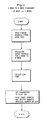
- Fig. 4 shows a flowchart illustrating the operation of the above display apparatus for changing the mode from the reduction mode to the standard mode.
- Fig. 5 shows a change on the screen occurring with a mode change between the standard mode and the split screen mode.
- the screen pattern is rearranged between the two modes without changing the relative position of the cursor.
- a cursor position on the screen for the standard made corresponds to a cursor position in a window (i.e. each divided section formed on the screen) produced in the split screen mode, whereby the operator is free from an extra operation for moving the cursor.
- Fig. C shows a change on the screen occurring with a mode change from the standard mode to the help menu mode.
- the help menu mode produces a menu window on a section of the screen (the shaded portion in Fig. 6), and therefore the cursor may be fixed to a position on the screen during the mode change.
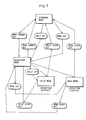
- Fig. 7 is a mode change diagram illustrating the display modes and various input steps for establishing these display modes. Though keys such as a mode change key, a split key and so on are not shown in the drawings so far referred to, these keys are provided on a keyboard belonging to the display apparatus.
- Fig. 8 shows another embodiment of the present invention.
- the character generator memory 5 comprises a RAM to which an external memory 8 such as an external ROM or an external disk storing character fonts is concerned.
- the external memory 8 Upon receipt of a command from the CPU 1, the external memory 8 transfers bit data of a selected character font to the character generator memory 5 by high speed transfer such as direct memory access. Thereafter the character data in the character generator memory 5 are rewritten for a selected character size, and the CPU 1 transmits a command to the display sequencer 2 for rewriting the number of lines. The rewriting of the number of lines is carried out in the same sequence as in the embodiment of Fig. 1 and its description will not be repeated.
- this character font when selecting a desired character font, such as a character font for the reduction mode R, this character font may just be transformed from the external memory 8 to the character generator memory. This permits the character generator memory 5 to have a small capacity. This embodiment is particularly effective for operating the apparatus with many character font sizes.
Landscapes
- Engineering & Computer Science (AREA)
- Physics & Mathematics (AREA)
- Computer Hardware Design (AREA)
- General Physics & Mathematics (AREA)
- Theoretical Computer Science (AREA)
- Radar, Positioning & Navigation (AREA)
- Remote Sensing (AREA)
- Controls And Circuits For Display Device (AREA)
Applications Claiming Priority (2)
| Application Number | Priority Date | Filing Date | Title |
|---|---|---|---|
| JP211197/86 | 1986-09-08 | ||
| JP61211197A JPS6365486A (ja) | 1986-09-08 | 1986-09-08 | デイスプレイ表示装置 |
Publications (2)
| Publication Number | Publication Date |
|---|---|
| EP0259827A2 true EP0259827A2 (de) | 1988-03-16 |
| EP0259827A3 EP0259827A3 (de) | 1990-10-03 |
Family
ID=16601978
Family Applications (1)
| Application Number | Title | Priority Date | Filing Date |
|---|---|---|---|
| EP19870113102 Withdrawn EP0259827A3 (de) | 1986-09-08 | 1987-09-08 | Anzeigegerät |
Country Status (3)
| Country | Link |
|---|---|
| US (1) | US4896148A (de) |
| EP (1) | EP0259827A3 (de) |
| JP (1) | JPS6365486A (de) |
Cited By (5)
| Publication number | Priority date | Publication date | Assignee | Title |
|---|---|---|---|---|
| DE4102752A1 (de) * | 1990-01-30 | 1991-08-08 | Mitsubishi Electric Corp | Textanzeigegeraet und verfahren zum anzeigen von text |
| GB2241415A (en) * | 1990-01-30 | 1991-08-28 | Mitsubishi Electric Corp | Cursor maintains position relative to text as character size changes |
| EP0422577A3 (en) * | 1989-10-13 | 1992-02-26 | Microslate, Inc. | Method and apparatus for displaying simulated keyboards on touch-sensitive displays |
| FR2669448A1 (fr) * | 1990-11-19 | 1992-05-22 | Bull Sa | Architecture de terminal et circuit de gestion. |
| US5828369A (en) * | 1995-12-15 | 1998-10-27 | Comprehend Technology Inc. | Method and system for displaying an animation sequence for in a frameless animation window on a computer display |
Families Citing this family (28)
| Publication number | Priority date | Publication date | Assignee | Title |
|---|---|---|---|---|
| JPH02196296A (ja) * | 1989-01-26 | 1990-08-02 | Hitachi Ltd | 文字発生器 |
| JPH02249581A (ja) * | 1989-03-22 | 1990-10-05 | Mitsuboshi Belting Ltd | 表皮体の製造方法 |
| US5283562A (en) * | 1990-04-17 | 1994-02-01 | Pioneer Electronic Corporation | Map display apparatus |
| DE69123407T2 (de) * | 1990-09-06 | 1997-04-30 | Canon Kk | Elektronisches Gerät |
| US5227771A (en) * | 1991-07-10 | 1993-07-13 | International Business Machines Corporation | Method and system for incrementally changing window size on a display |
| US5555002A (en) * | 1994-04-29 | 1996-09-10 | Proxima Corporation | Method and display control system for panning |
| GB2300551A (en) * | 1995-05-03 | 1996-11-06 | Ibm | Computer workstation |
| US6807676B1 (en) * | 1995-07-14 | 2004-10-19 | General Instrument Corporation | Methods of formatting data to maximize the readability and the amount of song identification information displayed on a limited number of lines |
| US6583797B1 (en) | 1997-01-21 | 2003-06-24 | International Business Machines Corporation | Menu management mechanism that displays menu items based on multiple heuristic factors |
| US7191247B1 (en) * | 1998-09-11 | 2007-03-13 | Lv Partners, Lp | Method for connecting a wireless device to a remote location on a network |
| US6970914B1 (en) * | 1998-09-11 | 2005-11-29 | L. V. Partners, L.P. | Method and apparatus for embedding routing information to a remote web site in an audio/video track |
| US6823388B1 (en) | 1998-09-11 | 2004-11-23 | L.V. Parners, L.P. | Method and apparatus for accessing a remote location with an optical reader having a programmable memory system |
| US7159037B1 (en) * | 1998-09-11 | 2007-01-02 | Lv Partners, Lp | Method and apparatus for utilizing an existing product code to issue a match to a predetermined location on a global network |
| US6868433B1 (en) * | 1998-09-11 | 2005-03-15 | L.V. Partners, L.P. | Input device having positional and scanning capabilities |
| US7386600B1 (en) * | 1998-09-11 | 2008-06-10 | Lv Partners, L.P. | Launching a web site using a personal device |
| US7284066B1 (en) * | 1998-09-11 | 2007-10-16 | Lv Partners, Lp | Method and apparatus for matching a user's use profile in commerce with a broadcast |
| US7440993B1 (en) * | 1998-09-11 | 2008-10-21 | Lv Partners, L.P. | Method and apparatus for launching a web browser in response to scanning of product information |
| US6636896B1 (en) * | 1998-09-11 | 2003-10-21 | Lv Partners, L.P. | Method and apparatus for utilizing an audibly coded signal to conduct commerce over the internet |
| US7392945B1 (en) * | 1998-09-11 | 2008-07-01 | Lv Partners, L.P. | Portable scanner for enabling automatic commerce transactions |
| US7370114B1 (en) | 1998-09-11 | 2008-05-06 | Lv Partners, L.P. | Software downloading using a television broadcast channel |
| US6745234B1 (en) * | 1998-09-11 | 2004-06-01 | Digital:Convergence Corporation | Method and apparatus for accessing a remote location by scanning an optical code |
| US6829646B1 (en) | 1999-10-13 | 2004-12-07 | L. V. Partners, L.P. | Presentation of web page content based upon computer video resolutions |
| US6392650B1 (en) | 1999-05-14 | 2002-05-21 | National Semiconductor Corporation | Character line address counter clock signal generator for on screen displays |
| US20080227440A1 (en) | 2007-03-16 | 2008-09-18 | Vinay Kumar Chowdary Settepalli | Methods and apparatus for discovering and updating a mobile device via user behavior |
| US7930640B2 (en) * | 2007-07-31 | 2011-04-19 | International Business Machines Corporation | Methods for splitting and merging calendar entries |
| US20100204979A1 (en) * | 2009-02-06 | 2010-08-12 | Inventec Corporation | System and method for magnifiedly displaying real-time translated word |
| US8260550B2 (en) * | 2009-06-19 | 2012-09-04 | GM Global Technology Operations LLC | Presentation of navigation instructions using variable levels of detail |
| US8407075B2 (en) * | 2010-06-25 | 2013-03-26 | International Business Machines Corporation | Merging calendar entries |
Family Cites Families (8)
| Publication number | Priority date | Publication date | Assignee | Title |
|---|---|---|---|---|
| US31200A (en) * | 1861-01-22 | I H S White | Newspaper-file | |
| US3911420A (en) * | 1973-11-23 | 1975-10-07 | Xerox Corp | Display system including a high resolution character generator |
| USRE31200F1 (en) | 1976-01-19 | 1990-05-29 | Raster scan display apparatus for dynamically viewing image elements stored in a random access memory array | |
| US4300206A (en) * | 1977-06-30 | 1981-11-10 | International Business Machines Corporation | Flexible text and image generator for a raster printer |
| US4314244A (en) * | 1980-06-16 | 1982-02-02 | International Business Machines Corporation | Multiple height proportioned character generation |
| DE3209530C2 (de) * | 1981-03-17 | 1985-05-02 | Sharp K.K., Osaka | Textdarstellungseinrichtung für ein Textverarbeitungssystem |
| JPS59114631A (ja) * | 1982-12-22 | 1984-07-02 | Hitachi Ltd | 端末制御装置 |
| US4754270A (en) * | 1984-02-16 | 1988-06-28 | Nintendo Co., Ltd. | Apparatus for varying the size and shape of an image in a raster scanning type display |
-
1986
- 1986-09-08 JP JP61211197A patent/JPS6365486A/ja active Pending
-
1987
- 1987-09-08 EP EP19870113102 patent/EP0259827A3/de not_active Withdrawn
- 1987-09-08 US US07/094,143 patent/US4896148A/en not_active Expired - Fee Related
Cited By (11)
| Publication number | Priority date | Publication date | Assignee | Title |
|---|---|---|---|---|
| EP0422577A3 (en) * | 1989-10-13 | 1992-02-26 | Microslate, Inc. | Method and apparatus for displaying simulated keyboards on touch-sensitive displays |
| DE4102752A1 (de) * | 1990-01-30 | 1991-08-08 | Mitsubishi Electric Corp | Textanzeigegeraet und verfahren zum anzeigen von text |
| GB2241415A (en) * | 1990-01-30 | 1991-08-28 | Mitsubishi Electric Corp | Cursor maintains position relative to text as character size changes |
| GB2241416A (en) * | 1990-01-30 | 1991-08-28 | Mitsubishi Electric Corp | Automatic change of character size to suit display resolution |
| US5233334A (en) * | 1990-01-30 | 1993-08-03 | Mitsubishi Denki Kabushiki Kaisha | Text display apparatus and a method of displaying text |
| GB2241415B (en) * | 1990-01-30 | 1994-04-20 | Mitsubishi Electric Corp | Text display apparatus and a method of displaying text |
| GB2241416B (en) * | 1990-01-30 | 1994-05-25 | Mitsubishi Electric Corp | Text display apparatus and a method of displaying text |
| FR2669448A1 (fr) * | 1990-11-19 | 1992-05-22 | Bull Sa | Architecture de terminal et circuit de gestion. |
| EP0487400A1 (de) * | 1990-11-19 | 1992-05-27 | Bull S.A. | Bauweise eines Terminals und Verwaltungsschaltung |
| US5799202A (en) * | 1990-11-19 | 1998-08-25 | Rongione; Eric | Video terminal architecture without dedicated memory |
| US5828369A (en) * | 1995-12-15 | 1998-10-27 | Comprehend Technology Inc. | Method and system for displaying an animation sequence for in a frameless animation window on a computer display |
Also Published As
| Publication number | Publication date |
|---|---|
| EP0259827A3 (de) | 1990-10-03 |
| US4896148A (en) | 1990-01-23 |
| JPS6365486A (ja) | 1988-03-24 |
Similar Documents
| Publication | Publication Date | Title |
|---|---|---|
| US4896148A (en) | Display apparatus | |
| EP0004554B1 (de) | Anzeigevorrichtung nach Art eines Fernsehgeräts mit mehreren Layouts | |
| US5481661A (en) | Method and apparatus for converting attribute of display data into code | |
| US4881064A (en) | Information processor having cursor display system and control | |
| US4228430A (en) | CRT Display apparatus with changeable cursor indicia | |
| USRE34835E (en) | Method and apparatus for editing document in colors | |
| EP0295692B1 (de) | Kathodenstrahlröhre-/Plasmaanzeigesteuergerät | |
| GB1579641A (en) | Visual display apparatus | |
| US4529978A (en) | Method and apparatus for generating graphic and textual images on a raster scan display | |
| US4198685A (en) | Text editing system having flexible repetitive operation capability with keyboard interactive feature | |
| US6266070B1 (en) | Character pattern generator, character generating method, and storage medium therefor | |
| GB1579643A (en) | Digital data processor | |
| JPS62269989A (ja) | 表示制御装置 | |
| US5790093A (en) | Document processing apparatus | |
| JPH0113117B2 (de) | ||
| GB2233800A (en) | Text processing with framing | |
| EP0337752B1 (de) | Graphisches Anzeigesystem zum Ausschneiden eines Teilbildes | |
| JPH0318999Y2 (de) | ||
| JP3102979B2 (ja) | 罫線変換機能を持つ文書情報処理装置 | |
| JPS6355097B2 (de) | ||
| JP2680805B2 (ja) | グラフィック座標制御装置 | |
| JPS6322334B2 (de) | ||
| JPH04188192A (ja) | 多階調文字発生方法及びその装置 | |
| JPH0469919B2 (de) | ||
| JPH0734233B2 (ja) | グラフ作成方法 |
Legal Events
| Date | Code | Title | Description |
|---|---|---|---|
| PUAI | Public reference made under article 153(3) epc to a published international application that has entered the european phase |
Free format text: ORIGINAL CODE: 0009012 |
|
| AK | Designated contracting states |
Kind code of ref document: A2 Designated state(s): DE FR GB |
|
| PUAL | Search report despatched |
Free format text: ORIGINAL CODE: 0009013 |
|
| AK | Designated contracting states |
Kind code of ref document: A3 Designated state(s): DE FR GB |
|
| 17P | Request for examination filed |
Effective date: 19910313 |
|
| STAA | Information on the status of an ep patent application or granted ep patent |
Free format text: STATUS: THE APPLICATION HAS BEEN WITHDRAWN |
|
| 17Q | First examination report despatched |
Effective date: 19930216 |
|
| 18W | Application withdrawn |
Withdrawal date: 19930226 |